BIRD GUIDE (continued 2)
Reading edition
Range.—Western United States from the Great Plains to the Pacific coast; north along the coast to British Columbia; south in winter to Mexico.
[119]
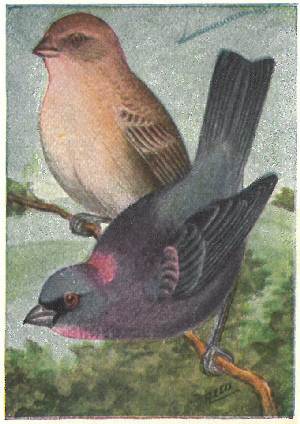
VARIED BUNTING
600. Passerina versicolor. 5½ inches
This beautiful species is less common than any others of the genus and has a very restricted range in the United States. The plumage of the male birds varies a great deal; that shown in the accompanying illustration is from a brightly colored specimen. They will average duller than this. These birds frequent thickets or brush-studded pasture land. Their song is described as weaker than that of the Indigo Bunting, but having much of the same character.
Nest.—Built of grasses, bark and fine rootlets; a cup-shaped structure placed in forks of bushes, usually in tangled thickets. The three or four eggs cannot be distinguished from those of the last species.
Range.—The Lower Rio Grande Valley in southern Texas. A sub-species (pulchra) is also found in Lower California and southern Arizona.
[120]
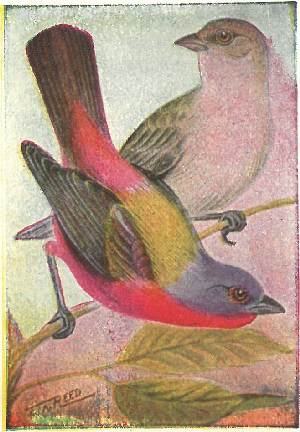
PAINTED BUNTING
601. Passerina ciris. 5½ inches
Male, vari-colored; female, greenish gray.
Without any exception, these are the most gaudily plumaged North American birds, but their colors have a harshness of contrast that renders them far less pleasing to the eye than many others of our birds. They are often caged, but in confinement soon lose the natural brilliancy of their plumage. Like the Indigo Bunting, they are found in thickets and hedges; their habits seem to be precisely like those of the last species.
Song.—Similar to that of the Indigo but lacking the brilliancy of that of the latter bird.
Nest.—Of grasses, leaves, strips of bark and rootlets, compactly compressed and woven together, situated at low elevations in thickets and low bushes; eggs whitish, specked and blotched with reddish brown (.78 × .58).
Range.—Southeastern U. S., breeding from the Gulf north to Virginia, Ohio and Kansas; winters in Central America.
[121]
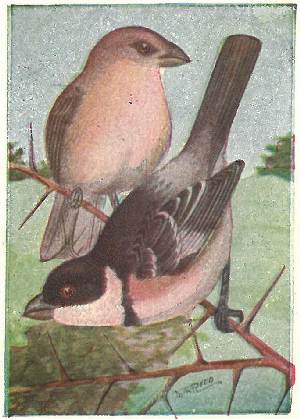
MORELLET SEED-EATER
602. Sporophila morelleti sharpei. 4½ inches
The male of this interesting little species requires at least three years in which to obtain the perfect plumage as shown in our illustration. The majority of birds seen will be in intermediate stages of plumage between that of the adult female and this one. These little fellows are usually found in thickets or patches of briars and are quite tame.
Note.—During the breeding season the male has a sprightly song similar to that of the Indigo Bunting.
Nest.—The nests are made of fine grass and placed in bushes or young trees. The eggs are bluish green spotted rather evenly with brown (.65 × .48).
Range.—Southeastern Texas and southward into Mexico.
[122]
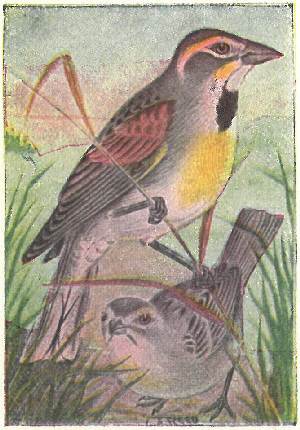
DICKCISSEL
604. Spiza americana. 6¼ inches
Male beautifully blended with yellow, white and gray, and with a black throat patch and brown shoulders; female duller.
In the middle portions of the U. S. these birds, or Black-throated Buntings, as they are commonly called, are very numerous, frequenting dry, bushy fields or prairies. They are very persistent songsters, although their song is weak and has little melody. In July and August, when many birds are silent, they continue their plaintive chant even on the most sultry days.
Song.—A simple chanting “chip, chip, che-che-che.”
Nest.—Either on the ground, in bushes or thistles, or in trees; of weeds, grasses, rootlets, corn husks, etc.; eggs four or five in number, plain bluish white and hardly distinguishable from those of the Bluebird; size .80 × .60.
Range.—N. A. east of the Rockies, breeding from the Gulf States north to northern U. S.; rare in the Atlantic States north to Connecticut.
[123]
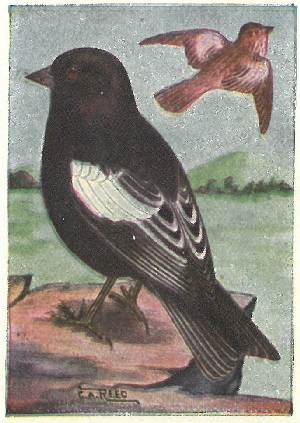
LARK BUNTING
605. Calamospiza melanocorys. 7 inches
Male, black and white; female, brown and gray.
This species is often known as the White-winged Blackbird, not because it bears any resemblance to any of the Blackbirds, nor because any of the habits are the same, but simply because of its plumage. They are very gregarious and usually fly in flocks even in nesting time.
They seem to be very methodical and well trained; if one of a flock takes wing, the entire flock rises simultaneously and in a very compact body they fly until some leader chooses the next stopping place, when they as suddenly alight. They have the habit of Skylarks in mounting into the air while singing and then descending on set wings.
Song.—A very lively, sweetly modulated warble.
Nest.—On the ground, usually under a tuft of grass or small bush; four or five eggs of a bluish color (.85 × .65), brighter than those of the Dickcissel.
Range.—Western U. S., most abundant from Kansas to Colorado and north to Assiniboia.
[124]
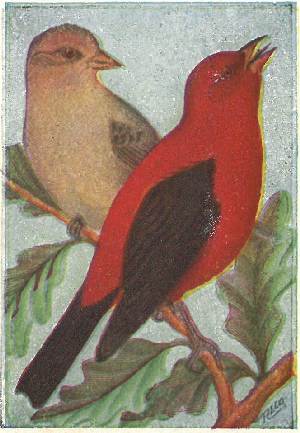
SCARLET TANAGER
608. Piranga erythromelas. 7½ inches
Male, scarlet and black; female, greenish yellow and blackish.
These beautiful birds are found in open woods, but they often come out in fields, parks, orchards and sometimes in yards when feeding; one of the prettiest sights that I ever saw was of about a dozen of these birds tripping along the furrows of a ploughed field, where they were feeding on insects. Besides berries and seeds, they live upon quantities of insects, frequently catching them on the wing in true Flycatcher style.
Song.—Resembling that of the Robin, but harsher, less varied and higher pitched. Call, a sharp chip or “chip-churr.”
Nest.—Loosely made of twigs and rootlets, on lower branches of trees; eggs four, pale bluish green, spotted with brown (.95 × .65).
Range.—Breeds in the northern parts of the U. S. from the Atlantic to the Plains; winters in the tropics, whence it arrives about May 15.
[125]
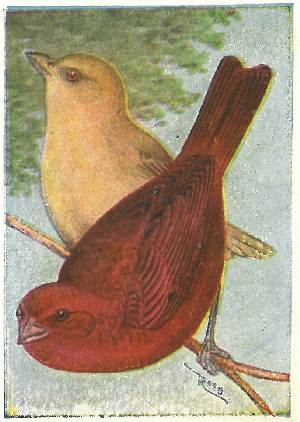
SUMMER TANAGER
610. Piranga rubra. 7½ inches
Male, rosy red; female, greenish yellow.
These Tanagers have a more southerly distribution than the Scarlet variety, but are found in the same kind of territory. In its localities it is rather more abundant and less retiring than is the latter bird in the north, and more often dwells in public parks. This bird is often called the Redbird and in localities where both the Scarlet Tanager and this species are found, they are frequently known by the same name, as their habits and notes are similar.
Song.—Similar to that of the Scarlet Tanager but said to be sweeter and clearer, and to more nearly resemble that of the Robin.
Nest.—On the outer horizontal limbs of trees in open woods or groves; nest of twigs and rootlets; eggs bluish green, spotted with brown (.95 × .65).
Range.—U. S. east of the Rockies, breeding from the Gulf to New Jersey and Kansas; winters in Central America. A subspecies is found west of the Rockies.
[126]
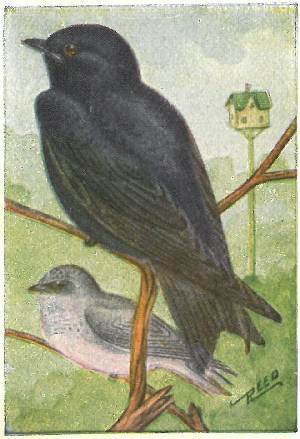
PURPLE MARTIN
611. Progne subis. 7¾ inches
Male, blue black; female, dull black and grayish.
These large, jolly Swallows are commonly seen about cities and towns within their range. Originally they dwelt in hollow trees, and some do yet, but the majority have recognized the superiority of man’s dwelling and now live in houses built especially for them or in cornices of houses or barns. It is no uncommon sight to see a handsome gabled structure of many rooms, perched upon a twelve-foot pole, on the lawns of many wealthy residents; others less bountifully supplied with this world’s goods use plain soap boxes for the same purpose, and the Martins seem to like the one as well as the other.
Song.—A strong, varied grating warble or twitter, more forcible than melodious.
Nest.—Of straw, paper, rags, etc., in bird houses, gables or hollow trees; eggs dull white (.98 × .72).
Range.—N. A., breeding from the Gulf to New Brunswick and Saskatchewan; winters in northern South America.
[127]
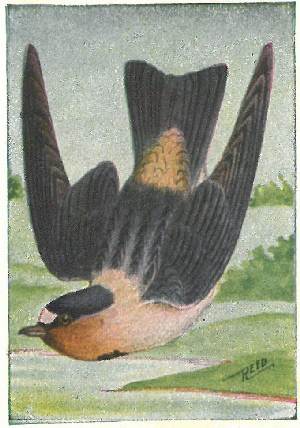
CLIFF SWALLOW
612. Petrochelidon lunifrons. 5½ inches
Adults similar in plumage but the female slightly paler. Easily distinguished from the Barn Swallow by the square tail and light buffy forehead and rump.
This is what is commonly called the Eave Swallow in the East, because of its habit of plastering its nests on the outside of barns or other buildings, up under the eaves. In the West they usually resort to cliffs where, sometimes, large sections of the face will be completely covered with the little mud flasks; often colonies of several thousand will build their nests together.
Song.—A continuous twitter, uttered while on the wing or at rest.
Nest.—A flask or gourd-shaped structure of mud, lined with straw and feathers, attached under the eaves to the outside of buildings or on the faces of cliffs; five to seven eggs are laid; white dotted and spotted with reddish brown (.80 × .55).
Range.—N. A., breeding from the Gulf to Greenland and Alaska; winters in the Tropics.
[128]
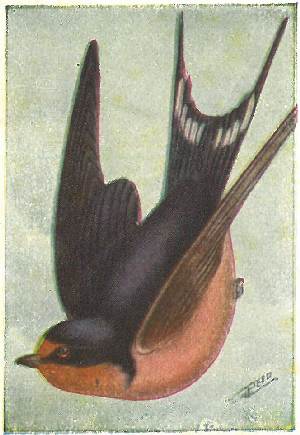
BARN SWALLOW
613. Hirundo erythrogastra. 7½ inches
Female duller plumaged and with a less deeply forked tail than the male. Forehead and throat chestnut and entire under parts buffy; tail deeply forked and with a white spot on the inner web of each feather except the central pair.
This is the most graceful and beautiful of all our swallows, and is the most common about farmhouses, the inside beams and rafters of which they appropriate for their own use. They delight in skimming over the rolling meadows or the surface of ponds, now rising with the wind, now swooping downward with the speed of an arrow.
Song.—A continuous, rapid twitter.
Nest.—A bowl-shaped structure made up of pellets of mud cemented together with the birds’ saliva, and lined with feathers; attached to rafters in barns, the opening being at the top and not at the side as in the last; eggs exactly like those of the last.
Range.—N. A., breeding north to the limit of trees; winters in northern South America.
[129]
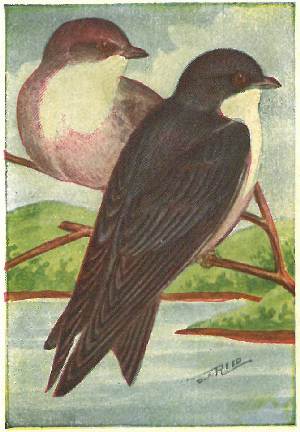
TREE SWALLOW
614. Iridoprocne bicolor. 6 inches
Male, steely blue or greenish above; female, duller and often plain gray above, but both sexes always entirely white below.
These Swallows are also abundant about farmyards; except when they are skimming over ponds, they are almost always scouring the air above buildings or fields, at higher elevations than the Barn Swallows. When weary they roost on dead twigs or telephone wires, hundreds often being seen in rows on the latter. Like the Martins, these birds frequently nest in bird boxes, but usually not more than one or two pairs in a single house.
Notes.—A twittering like that of the other Swallows.
Nest.—Of grass, lined with feathers, in hollow trees on the border of water or in orchards, or in bird boxes erected for their use; eggs white (.75 × .52).
Range.—Breeds in the northern half of the U. S. and northward to Labrador and Alaska; winters in southern U. S. and southward.
[130]
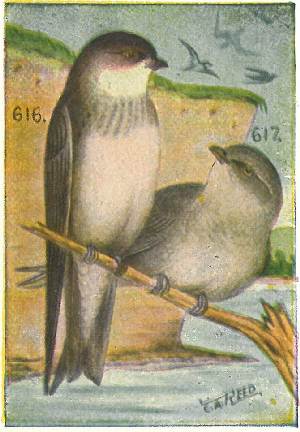
BANK SWALLOW
616. Riparia riparia. 5¼ inches
These are the smallest of our Swallows; this species can be distinguished, even at a distance, by the conspicuous band across the breast, showing in bold relief against the lighter throat. They are found throughout North America, breeding from the middle of the U. S. north to the Arctic regions.
They nest in colonies in holes in banks, laying the four to seven white eggs on a grass nest in an enlarged chamber at the end of the tunnel.
ROUGH-WINGED SWALLOW
617. Stelgidopteryx serripennis. 5½ inches
In this species the throat is gray as well as the breast. The outer vane of the outer primary is stiff and bristly, thus giving the species its name. These birds breed from the Gulf north to Massachusetts and Washington, in banks or in crevices of stone bridges. The eggs cannot with certainty be distinguished from those of the Bank Swallow. They measure .75 × .52.
[131]
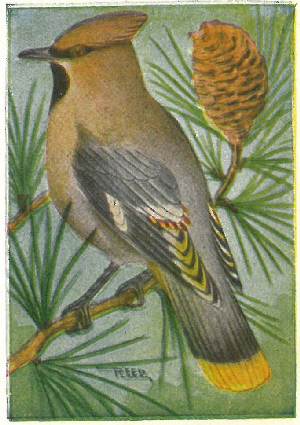
BOHEMIAN WAXWING
618. Bombycilla garrula. 8 inches
Larger and grayer than our common Cedar Waxwing and with yellow and white on the wing; it is a northern species and is only casually found in eastern U. S. They nest within the Arctic Circle and only a few of their nests have ever been found. In winter they are found in flocks, roving restlessly about the country, often appearing where least expected and utterly deserting other places where they are usually found.
Nest.—Of small twigs and moss, lined with feathers, usually placed at low elevations in spruce or coniferous trees; eggs dull bluish white specked sparingly with black (1.00 × .70), similar to those of the Cedar Waxwing but larger.
Range.—Northern parts of the Northern Hemisphere, breeding within the Arctic Circle and wintering casually south to Massachusetts, Pennsylvania, Kansas and California.
[132]
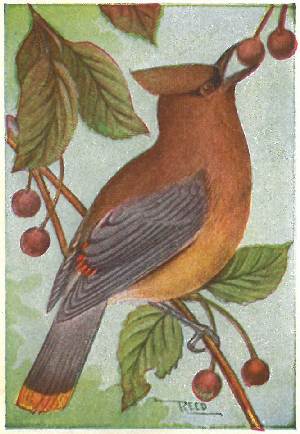
CEDAR WAXWING
619. Bombycilla cedrorum. 7 inches
Plumage very soft colored with a general brownish tone, shading to gray on the rump. The Waxwings are named from the curious wax-like appendages attached to the tips of the secondaries, and rarely to the tail feathers. They are very sociable and usually feed in flocks. They live chiefly upon fruit and are especially fond of cherries, for which reason they are very often known as Cherry-birds. They are very tame and allow any one to almost touch them while they are feeding or sitting upon their nests.
Note.—An insignificant lisping hiss.
Nest.—A substantial structure of twigs, mosses, twine, etc., lined with fine grasses; placed in cedar trees or, when near habitations, usually in orchard trees; the four or five eggs are dull bluish white specked with black (.85 × .60).
Range.—N. A., breeding from Virginia, Missouri and northern California north to Labrador and southern Alaska; winters throughout the United States.
[133]
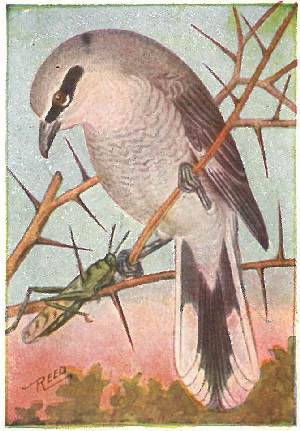
NORTHERN SHRIKE
621. Lanius borealis. 10 inches
This shrike is larger than any of the species found in summer in the United States and has the breast quite distinctly barred.
Shrikes are cruel, rapacious and carnivorous birds, feeding upon insects, grasshoppers, lizards and small birds. As they have passerine feet, the same as all our small birds, they are unable to hold their prey between the feet while tearing it to pieces, so they impale it upon thorns or the barbs of a wire fence so they may tear it to shreds with their hooked bill.
Song.—Loud snatches consisting of various whistles and imitations suggesting that of a Catbird.
Nest.—They breed chiefly north of the U. S., placing their rude, bulky structures of twigs and weeds in thorny trees or hedges; their four to six eggs are grayish white with spots of light brown and darker gray (1.08 × .80).
Range.—N. A., breeding chiefly in the northern parts of Canada; winters south to Pennsylvania, Kansas and California.
[134]
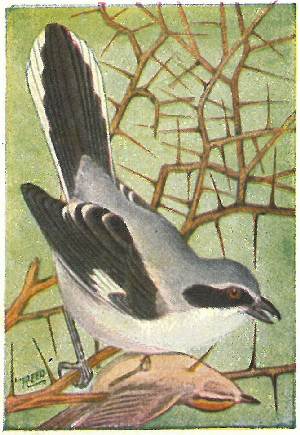
LOGGERHEAD SHRIKE
622. Lanius ludovicianus. 9 inches
Pure white below and with the markings above, intense black instead of the brownish or grayish black of the last species. Although smaller, these Shrikes have the same destructive habits of the northern species. All the Shrikes do considerable good to mankind, for they eat quantities of grasshoppers and mice, and probably resort to their diet of small birds when other food is unusually scarce. It cannot be denied that they are cruel, for they often kill more than they can eat and leave it impaled on thorns to decay.
Song.—Of harsh, discordant whistles.
Nest.—In scrubby hedges and thickets; of twigs, weeds, leaves, etc.; eggs four to seven in number, grayish white, spotted with shades of brown and gray.
Range.—Eastern U. S., breeding from the Gulf to southern New England and Manitoba; winters in southern states.
Sub-Species.—622a. White-rumped Shrike (excubitorides), paler and with a white rump; found from the Plains to the Pacific in the U. S.
[135]
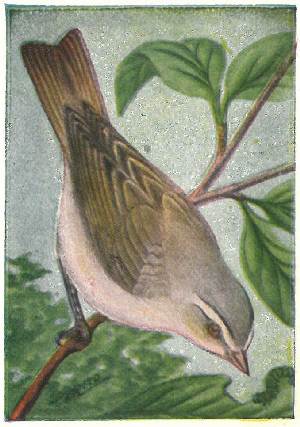
RED-EYED VIREO
624. Vireosylva olivacea. 6 inches
Crown slaty gray with a black border; white stripe above eye; eye reddish brown.
Throughout the United States this is one of the most abundant of the family. All through the spring and summer months their warble is heard from woodland and roadside, often becoming so monotonous as to be irritating. Oftentimes during the spring migrations of Warblers, Vireos are so numerous and singing so lustily that it is impossible to hear or distinguish the songs of any of the smaller birds.
Song.—Delivered in parts with intermission of a few seconds between, from morning until night; a short varied warble; call, a petulant mew.
Nest.—A basket woven of strips of bark and fibres, and often with pieces of newspaper worked in, lined with fine grass; eggs white with a few blackish-brown specks on the large end (.85 × .55).
Range.—U. S. east of the Rockies, breeding from the Gulf to Labrador and Manitoba; winters in Central America.
[136]
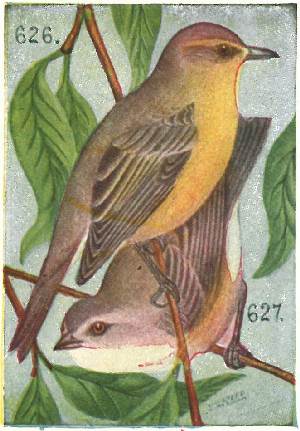
PHILADELPHIA VIREO
626. Vireosylva philadelphica. 5 inches
This is one of the least common of the eastern Vireos, although it is more common than most people know; its song is not distinctive and it keeps high up in trees, so it is not usually noticed. Their nests are swung from branches at high altitudes and are seldom found.
WARBLING VIREO
627. Vireosylva gilva. 5 inches
Above olive-green; crown grayer but with no black border. These are among the most common of the Vireos and may be found even in the hearts of large cities, swinging their pretty little nests high up in shade trees. Their song is after the style of that of the Purple Finch, very different from that of the Red-eye. The eggs are white with a few brown specks on the large end. These birds breed throughout the U. S. and southern Canada.
[137]
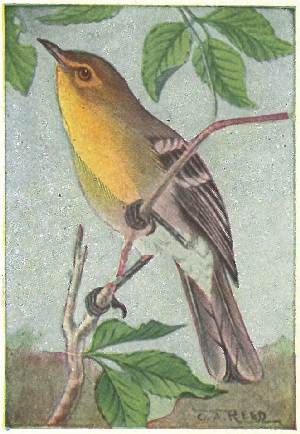
YELLOW-THROATED VIREO
628. Lanivireo flavifrons. 5¾ inches
Upper parts greenish; throat, breast and line over eye yellow; two prominent whitish wing bars.
A handsome Vireo found in localities such as are frequented by the Red-eyed species. Nowhere do they appear to be as abundant as that species, however; they are more abundant than many suppose, but the difficulty of clearly seeing the yellow breast when they are feeding in the tree tops, combined with the similarity of their songs, usually caused them to be passed by without inspection.
Song.—Similar to that of the Red-eye, but louder and more nasal, less varied and not uttered as often.
Nest.—A pensile structure of strips of bark, grasses, etc., with the outside often ornamented with lichens; three to five eggs with a creamy or rosy-white tint, specked, more profusely than those of the Red-eye, with reddish brown (.82 × .60).
Range.—Eastern U. S., breeding from the Gulf to southern Canada; winters in Central America.
[138]
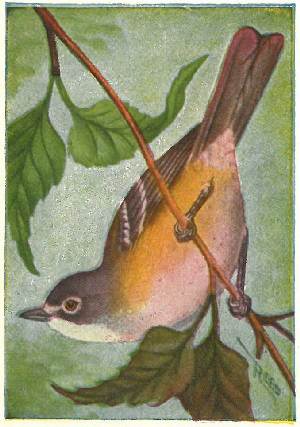
BLUE-HEADED VIREO
629. Lanivere solitarius. 5¾ inches
Crown and sides of head bluish slate; lores, eye-ring and underparts white; back and flanks greenish yellow; two whitish wing bars.
This species, to my eye, is the prettiest of the Vireos, all the colors being in just the right proportion and blending and harmonizing perfectly. They are solitary, in that they are usually found in deep woods, glens or ravines, and seldom is more than one pair found in a single woods.
Song.—Similar to that of the Yellow-throated Vireo but longer and more varied.
Nest.—A handsome, finely woven basket, with the outside covered with spider webs and often with lichens; eggs pale creamy white with chestnut specks.
Range.—Eastern N. A., breeding from the Gulf to New Brunswick and Manitoba; winters south of the United States.
Sub-Species.—629c. Mountain Solitary Vireo (alticola), head darker and back less greenish; Alleghanies from North Carolina to Georgia.
[139]
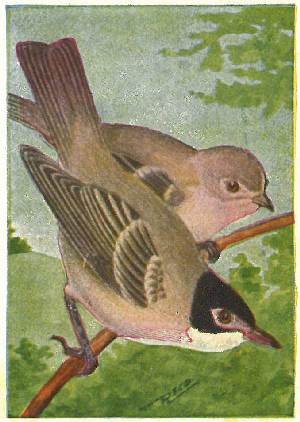
BLACK-CAPPED VIREO
630. Vireo atricapillus. 4½ inches
Male, with crown and sides of head glossy black, lores and eye-ring white; female, duller colored.
This strange and comparatively rare Vireo frequents brushwood on the prairies of Kansas, Indian Territory and central and western Texas. Their habits in all respects resemble those of the more common Vireos or Greenlets as they are otherwise called.
Notes.—Similar to those of the White-eyed Vireo.
Nest.—Suspended as usual from forked branches at low elevations; made of fibres and bark strips closely woven together with spider webs. The four eggs are pure white, unmarked (.70 × .52).
Range.—Breeds from central and western Texas north to southern Kansas; winters in Mexico.
[140]
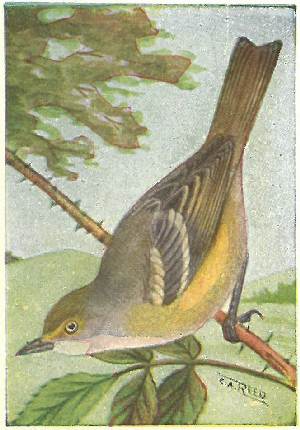
WHITE-EYED VIREO
631. Vireo griseus. 5 inches
This species shows a partiality for low, swampy places, covered with briars or tangled thickets of blackberry vines. Their habits are entirely different from any of the preceding Vireos. They do not seem to sing as they eat, but feed in silence, then, the task ended, mount to the tops of the brush and indulge in an endless variety of calls and whistles.
Song.—A great variety of clear whistles and squeaky notes.
Nest.—A bulky structure of strips of bark, leaves, paper, etc., either placed in the branches or partially suspended in a fork; eggs white with minute brown specks (.75 × .55).
Range.—Eastern United States, breeding from the Gulf to Massachusetts and Manitoba; winters in Mexico.
Sub-Species.—631a. Key West Vireo (maynardi), southern Florida. 631b. Bermuda White-eyed Vireo (bermudianus), resident in the Bermudas. 631c. Small White-eyed Vireo (micrus); southeastern Texas.
[141]
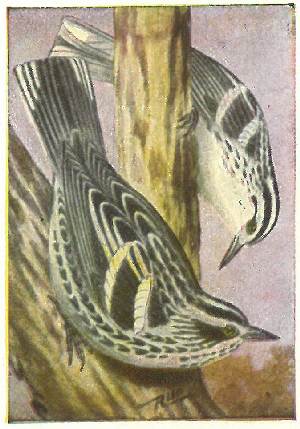
BLACK AND WHITE WARBLER
636. Mniotilta varia. 5¼ inches
Male, heavily streaked with black below; female, with only a few streaks on the sides.
These Warblers are usually known as Black and White Creepers because of their habit of creeping along the limbs and branches of trees. They are abundant in northern United States, being found in open woods, swamps and often in parks, gleaning insects and grubs from crevices in the bark.
Song.—A weak, thin, wiry “tsee, tsee, tsee.”
Nest.—Of grasses and strips of bark on the ground at the foot of a stump or tree trunk or beside a rock; they lay four or five eggs, white with a wreath of reddish brown around the large end (.65 × .55).
Range.—Eastern N. A., breeding from Virginia and Louisiana north to Labrador and Hudson Bay; winters in northern South America.
[142]
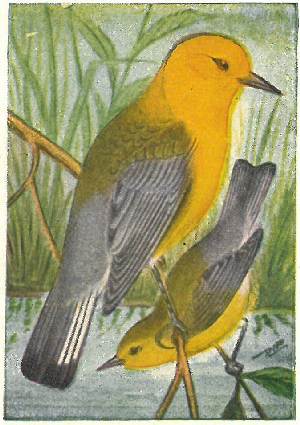
PROTHONOTARY WARBLER
637. Protonotaria citrea. 5¼ inches
Whole head and underparts intense yellow, almost orange on the head of the male; tail with white spots near the tip; female, duller.
A common species in the interior, found in bushy swamps and the willows around the borders of pools and lakes; they are found in the latter localities with Tree Swallows and often Chickadees all nesting in holes in hollow stubs along the bank, they being one of the few members of this family to make use of such locations for their nests.
Song.—A loud, ringing “tweet, tweet, tweet.”
Nest.—In hollow stubs near or over water, the cavity of the stump being partially filled with moss, leaves and grasses hollowed on the top to receive the four to six creamy-white eggs which are heavily spotted over the entire surface with reddish brown (.72 × .55).
Range.—Eastern U. S., breeding from the Gulf north to Virginia, Illinois and Minnesota; winters in Central America.
[143]
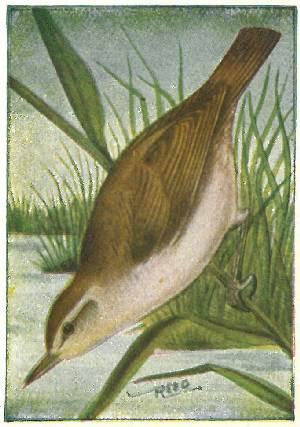
SWAINSON WARBLER
638. Helinaia swainsonii. 5 inches
Upper parts brownish; underparts whitish; a white superciliary stripe and a brown stripe through the eye.
Some of the habits of this species are similar to those of the last but they are even more aquatic; they like swamps or stagnant pools thickly grown with rushes and tangled underbrush; unless cognizant of their habits, one would never look for a Warbler in the places frequented by these birds in company with Least Bitterns and Marsh Wrens. Until within a few years these were regarded as rare birds but are now found to be not uncommon in certain of the South Atlantic states, notably Georgia.
Song.—A series of descending, loud, clear whistles with a ventriloquial effect.
Nest.—Quite large structures consisting mostly of leaves with strips of bark, roots and pine needles. The four or five eggs are plain white, being the only eggs of American Warblers that are unmarked.
Range.—Southeastern U. S. from Georgia to Louisiana and north to North Carolina and Missouri.
[144]
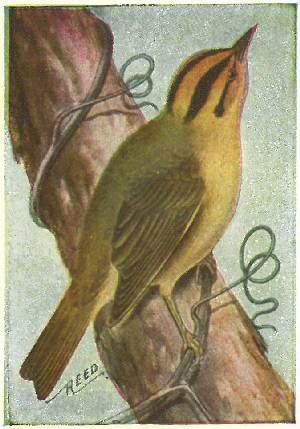
WORM-EATING WARBLER
639. Helmitheros vermivorus. 5½ inches
Crown buffy with two black stripes; back, wings and tail olive green with no white markings; below buffy white.
These birds are very unsuspicious and easy to approach; they spend the greater portion of their time on or near the ground; they are very fond of spiders and find quantities by overturning bits of bark and leaves. They also glean part of their living from the underside of the foliage much as do the Vireos. They are met with in open woods and brush-grown pastures.
Song.—A weak, rapid chipping.
Nest.—On the ground in depressions under logs, stones or bushes; of leaves and grass, lined with fine grass or hair; eggs four or five in number, white, spotted principally around the large end with brownish (.70 × .55).
Range.—Eastern U. S., breeding from the Gulf north to Connecticut, Ohio and Iowa; winters in Central America.
[145]
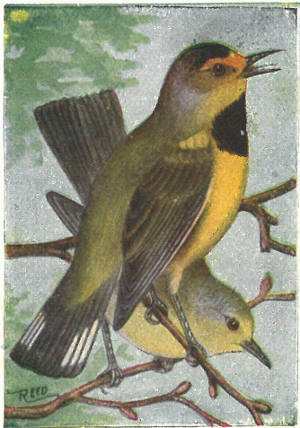
BACHMAN WARBLER
640. Vermivora bachmani. 4¼ inches
Male, with a yellow forehead, shoulders and underparts; black cap and breast patch; female, duller and with less black.
This species was first discovered by Dr. John Bachman near Charleston, S. C.
Song.—An insignificant warble or twitter, similar to the song of the Parula.
Nest.—In low bushes or briers, one to three feet above ground. Made of fine grasses and leaf skeletons, lined with black fibres. Found breeding by Widmann in Missouri, by Embody in Kentucky and by Wayne in South Carolina. Eggs four in number; pure white (.63 × .48).
Range.—Southeastern U. S., north to North Carolina and west to Missouri. Rare and local in distribution.
[146]
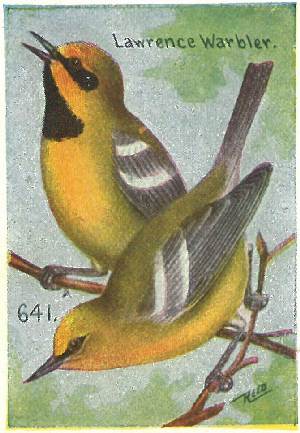
BLUE-WINGED WARBLER
641. Vermivora pinus. 4¾ inches
Crown and underparts yellow; a narrow black line through the eyes; two broad whitish wing bars.
A common bird of the southeastern states and north to Connecticut, frequenting open woods, thickets and gardens. They are ground birds, spending most of their time on the ground or in low bushes which they clean of the insects which are destructive.
Song.—A loud, rapid chirrup, similar to that of the Grasshopper Sparrow but loud and distinct.
Nest.—Of leaves and strips of bark, lined with fine grasses; on the ground in clumps of weeds or blackberry vines; eggs white, sparingly spotted around the large end with rufous (65. × .50).
Range.—Eastern U. S., breeding north to southern Connecticut and Wisconsin; winters in the tropics.
Hybrids.—Lawrence Warbler, which is a hybrid between this species and the next; it has the general plumage of this species with the black ear patches and throat of the Golden-winged Warbler. It is found chiefly in southwestern Connecticut and New York.
[147]
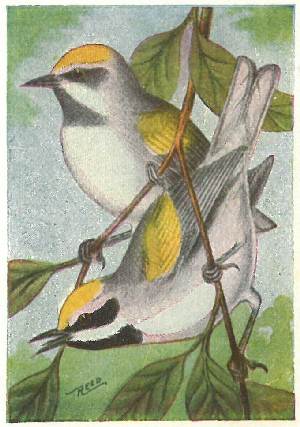
GOLDEN-WINGED WARBLER
642. Vermivora chrysoptera. 5 inches
Crown and two large wing bars yellow; throat and ear patches black; rest of plumage gray and white; female with less black.
The distribution of this beautiful Warbler is about the same as that of the last, with which it seems to have many habits in common. It seems to prefer low ridges and side hills covered with small bushes.
Song.—A buzzing “zwee-ze-ze.”
Nest.—Of leaves, rootlets, strips of bark and grass; located on the ground among clumps of weeds, usually in moist places; eggs white with brown specks (.62 × .48).
Range.—Eastern U. S., breeding north to Connecticut and Michigan; winters in Central America.
Hybrid.—Brewster Warbler is a hybrid between this species and the last. It resembles the Golden-winged Warbler without the black, but with a yellow patch on the breast and the black line of the Blue-wing through the eye.
[148]
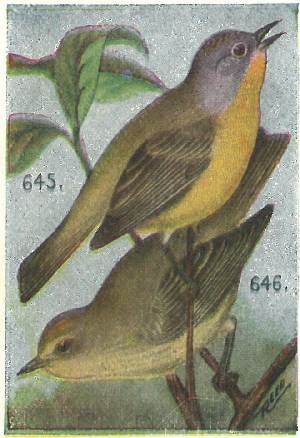
NASHVILLE WARBLER
645. Vermivora rubricapilla. 4¾ inches
Male with a brown crown patch; female duller colored and with no crown patch. Dry side hills covered with young trees are favorite resorts for the Warblers. They conceal their nests on the ground under tufts of dead grass or overhanging stones. They are often rather shy and hard to sight, but you can usually hear their song, a lazy sounding “ker-chip-chip-chip-cherr-wee-e-e,” ending in a short trill. These birds breed in the northern half of the U. S. and southern Canada, wintering in Central America. A sub-species is found on the Pacific Coast.
ORANGE-CROWNED WARBLER
646. Vermivora celata. 5 inches
This species is fairly common in the Mississippi Valley but is rare in New England. Its habits are much like those of the last species and it is often mistaken for that bird. These birds breed only north of the U. S. and winter in Mexico. A sub-species, the Lutescent Warblers, nests from California to Alaska.
[149]
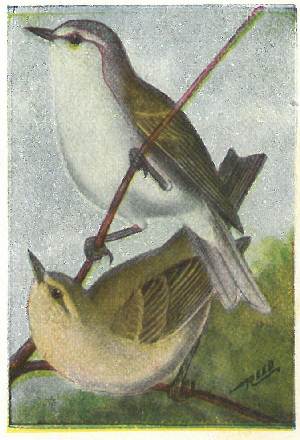
TENNESSEE WARBLER
647. Vermivora peregrina. 5 inches
Male, with a gray head and greenish back; female, with the top of the head the same color as the back.
A dull-colored bird that, with the exception of the bill, bears a strong resemblance to some of the Vireos. Like many others of our birds, this one has received an inappropriate name, because the first specimen was shot on the banks of the Cumberland River, while the bird is no more abundant in Tennessee than in other states during migration.
Song.—A simple ditty similar to that of the Chipping Sparrow.
Nest.—Either on the ground or at low elevations in bushes; of grasses and fibres lined with hair; eggs white, sparsely specked with reddish brown (.62 × .45).
Range.—Eastern N. A., breeding from the northern parts of the northern tier of states northward to the limit of trees; winters in Central and South America.
[150]
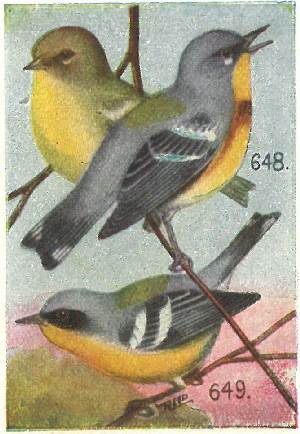
PARULA WARBLER
648. Compsothlypis americana. 4½ inches
In the summer Parulas are found in wet swamps where the ground is covered with a carpeting of moss which only partially keeps your feet from the water below; the dead trees are covered with a growth of long, drooping moss; the ends of this moss are turned up and formed into a neat cradle within which the eggs are laid.
Song.—A little lisping trill.
Range.—Breeds in the southern half of the U. S. The Northern Parula (usnea), No. 648a, breeds in the northern half of the U. S. and southern Canada; it is brighter colored than the southern form. Both varieties winter from the Gulf States southward.
SENNETT WARBLER
649. Compsothlypis pitiayumi nigrilora. 4½ inches
A smaller similar bird from southern Texas. Note the black ear patches and lack of black on breast.
[151]
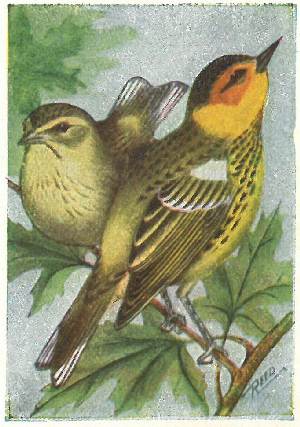
CAPE MAY WARBLER
650. Dendroica tigrina. 5 inches
Male, with a chestnut wash on the ears and throat; female, duller and with little or no chestnut.
In the greater part of eastern North America, Cape May Warblers are regarded as rare birds; they appear to migrate in compact bodies, not spreading out over the country as do most of the others; consequently they may be very common in restricted areas while lacking entirely in others. I have never met with but two specimens in Massachusetts. While passing through the United States you may meet with them in open woods, parks or in shade trees along the streets of cities.
Song.—A thin, high-pitched whistle repeated several times.
Nest.—Of small cedar twigs lined with horse hair, placed within a few feet of the ground in small cedar trees; eggs white spotted with brown (.68 × .50).
Range.—Eastern N. A., breeding in eastern Canada and, rarely, northern New England; winters south of the U. S.
[152]
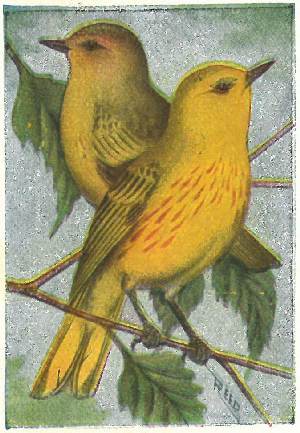
YELLOW WARBLER
652. Dendroica æstiva. 5 inches
Male, with chestnut streaks on the sides; female, duller and without the streaks.
An abundant bird everywhere in woodland, park, orchard or garden and one of the most vivacious of the family. Arrives in the north soon after May first and is seen flitting about like a gleam of sunshine snatching insects from the foliage or darting after them in the air. Often known as the Summer Yellow-bird. It frequently nests in garden or orchard trees, where it is a most welcome tenant.
Song.—A sharp, vigorous “che-wee, che-wee, che-wee.”
Nest.—A beautiful and compact structure of vegetable or plant fibres firmly quilted together, and fastened to upright forks of bushes or trees at low elevations. Willows along creeks, ponds or rivers are favorite resorts.
Range.—N. A., breeding from the Gulf to Labrador and Alaska; winters in Central America.
[153]
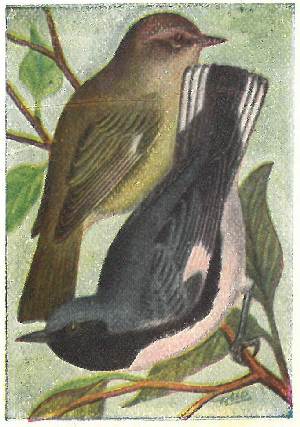
BLACK-THROATED BLUE WARBLER
654. Dendroica cærulescens. 5¼ inches
Male, grayish blue above and with a black face, throat, breast and sides; female, grayish olive above, whitish below. Both sexes always have a white patch or speck at the base of the primaries.
You will find these birds in damp woods or swamps, or less often in parks or open woods. They are usually seen at low elevations in scrubby underbrush. Their notes are very peculiar and will draw attention to them anywhere.
Song.—A deep grating whistle with a sharply rising inflection, “zee-zee-zwee.”
Nest.—In deep, swampy woods, especially common in laurel; of grapevine bark and rootlets lined with fine black roots and hair; the four eggs are white or buffy white with reddish brown spots and blotches.
Range.—Eastern N. A., breeding from Connecticut (sparingly) and Michigan north to Labrador and Hudson Bay; winters in Central America. 654a. Cairns Warbler (cairnsi) is said to be darker on the back; found in the southern Alleghanies.
[154]
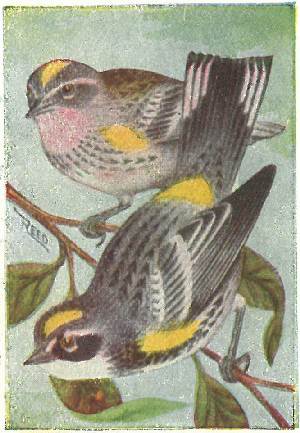
MYRTLE WARBLER
655. Dendroica coronata. 5½ inches
Yellow patches on crown, sides and rump; outer tail feathers with large white spots; female duller and browner.
During migrations these pretty birds are very abundant in the United States. They usually travel in large flocks so that a small piece of woodland is literally flooded with them when they pause in the flight to feed upon insects or small berries. They are often known as Yellow-rumped Warblers.
Song.—A clear, broken trill or warble.
Nest.—Usually in coniferous trees, though sometimes in others, and at low elevations; of plant fibres and grasses; the four or five eggs are white, spotted and blotched with reddish brown (.70 × .54).
Range.—Eastern N. A., breeding from northern New England and Minnesota northward; winters south of the U. S.
[155]
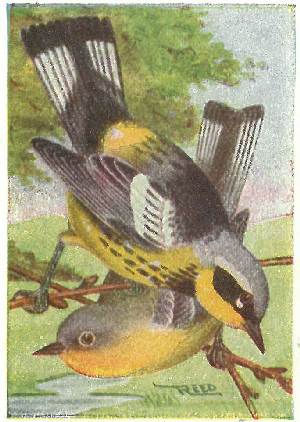
MAGNOLIA WARBLER
657. Dendroica magnolia. 5 inches.
Male, with black ear patch, back, and necklace; female, with the black replaced with grayish; both sexes have a yellow rump and white spots midway of the tail feathers.
One of the prettiest of the Warblers and one of the least timid. I have often had one or more of these birds follow me the whole length of a piece of woods apparently out of curiosity, coming down to the nearest twigs within arms’ reach of me. Birch woods are their favorites during migrations, although a few of them will be found almost anywhere.
Song.—A short, rapidly uttered warble.
Nest.—Usually in coniferous trees, far out on the longer branches, where they are often difficult to get at, of rootlets lined with fine black rootlets and hair; four or five white eggs with small spots of chestnut around the large end (.60 × .48).
Range.—Eastern N. A., breeding from Massachusetts and Michigan northward; winters south of the U. S.
[156]
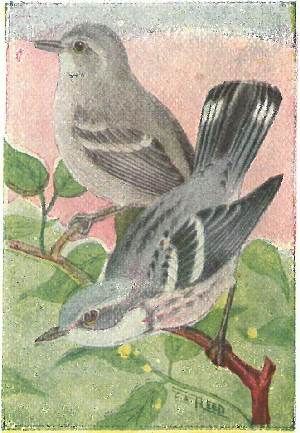
CERULEAN WARBLER
658. Dendroica cærulea. 5 inches
Above grayish blue with black streaks, below white with a bluish breast band and streaks on the sides; female washed with greenish above and yellowish below; both have white patches near the ends of the tail feathers.
These dainty little Warblers are not abundant anywhere, but seem to be most so in the central states. They are birds of the tree tops, rarely coming down so that they can be distinctly seen. They may be more common than supposed, for so small a body at such heights can readily be overlooked.
Song.—A little warbling trill, “zee-zee-ze-ee-eep.”
Nest.—In the higher outer branches of large trees usually in deep woods; compactly made of dry grasses and cobwebs, adorned with a few lichens; eggs white specked at the large end with brownish (.65 × .50).
Range.—Interior portions of the U. S., breeding north to Michigan and Minnesota; east to western New York and, rarely, southern New England; winters in northern South America.
[157]
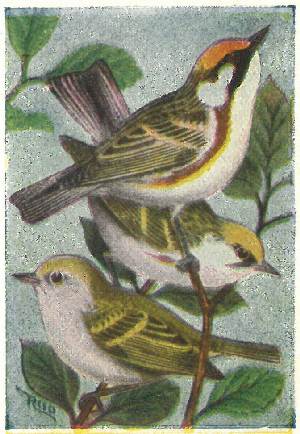
CHESTNUT-SIDED WARBLER
659. Dendroica pennsylvanica. 5 inches
Yellow crown, black line through eye and on side of throat and broad chestnut stripe on sides; female, paler and with less chestnut; young greenish yellow above and with no chestnut.
Nearly every swamp or bush-covered pasture within their range shelters one or more pairs of these Warblers. While they sometimes feed in the tree tops, they are birds of the lower foliage and are usually seen in low bushes.
Song.—Similar to that of the Yellow Warbler but more choppy.
Nest.—In low bushes or weeds, and often in sweet fern or briars; similar to that of the Yellow Warbler but coarser, being made more with grasses than with fibres, situated in upright forks or attached to several weed stalks; eggs white, specked around the large end with reddish brown (.68 × .50).
Range.—Eastern N. A., breeding from New Jersey and Ohio north to Manitoba and New Brunswick; winters south of U. S.
[158]
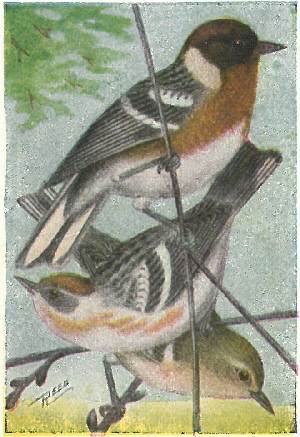
BAY-BREASTED WARBLER
660. Dendroica castanea. 5½ inches
Male, with crown, throat and sides rich chestnut; female, paler; young and adults in winter, greenish above, streaked with black and with a trace of chestnut on the flanks.
These Warblers are only locally abundant during migrations, while in eastern New England they are rare. They are active insect hunters, darting rapidly about the tree tops or, less often, in brush; their habits most nearly resemble those of the Chestnut-sided Warbler.
Song.—A low, liquid warble.
Nest.—At low elevations in trees in swampy woods; compact, cup-shaped structures made of fine shreds of bark, rootlets and grass; eggs bluish white, finely specked around the large end with reddish brown (.70 × .50).
Range.—Eastern N. A., breeding from the northern edge of the U. S. northward; winters south of the U. S.
[159]
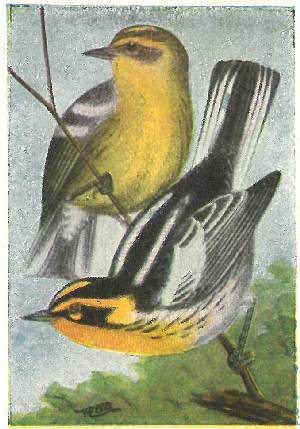
BLACKBURNIAN WARBLER
662. Dendroica fusca. 5¼ inches
Male, black above with large white patch on wing, and bases of outer tail feathers white; throat and breast intense orange; female duller and with the orange replaced by dull yellow.
Without exception, this is the most exquisite of the whole family; it is the most eagerly sought bird by bird lovers, in the spring. Some years they are very abundant, while others few are seen, their routes of migration evidently varying. They arrive about the time that apple trees are in bloom, and are frequently seen among the blossoms, dashing after insects.
Song.—A high-pitched lisping “zwe-zwe-zwe-see-ee-ee,” ending in a thin, wiry tone, almost a hiss; it is very distinct from the song of any other bird.
Nest.—In coniferous trees at any height from the ground; of shreds of bark, fine cedar twigs, rootlets, etc.; eggs greenish white blotched with brown.
Range.—Eastern N. A., breeding from Massachusetts (rarely) and Minnesota northward; winters in Central America.
[160]
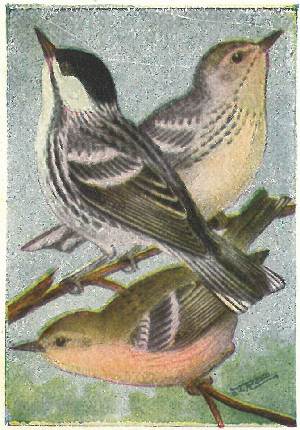
BLACK-POLL WARBLER
661. Dendroica striata. 5½ inches
Whole crown black; female, without black cap, greenish gray above streaked with black; young paler than the female.
These birds are one of the latest of the migrants to arrive, reaching northern United States about the last of May, but coming in such numbers that they are found everywhere. While their plumage somewhat resembles that of the Black and White Warbler, their habits are entirely different.
Song.—A high-pitched, hissing whistle similar to that of the Black and White Warbler but uttered more deliberately and with an instant’s pause between each note.
Nest.—At low elevations in thick coniferous trees; made of slender twigs, rootlets and lichens, lined with hair or feathers; eggs whitish, thickly spotted with brown (.75 × .52).
Range.—Eastern N. A., breeding from northern New England, Minnesota and Wyoming north to the Arctic regions; winters south of the United States.
[161]
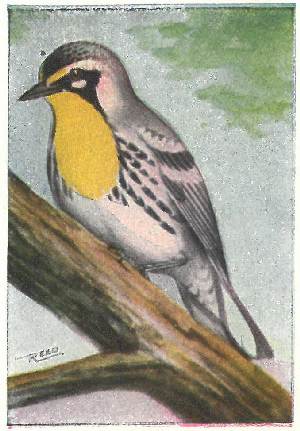
YELLOW-THROATED WARBLER
663. Dendroica dominica. 5¼ inches
Throat, breast and line from eye to bill yellow.
This species has habits very similar to those of the Black and White Creeper, being often seen creeping around the trunks or over the branches of trees with almost as much facility as the Nuthatches. They are southern birds and are only rarely or accidentally found in the northern half of the U. S., and they are one of the few members of the family that winter in the southern parts of our country.
Song.—Loud and similar to that of the Indigo Bunting, but shorter.
Nest.—Usually high up in pines and often concealed in tufts of moss; made of fine twigs and strips of bark, held together with cobwebs and Spanish moss; eggs greenish white, spotted with various shades of brown.
Range.—Southeastern U. S., breeding north to Virginia; winters in the West Indies. 663a. Sycamore Warbler (albilora) is like the Yellow-throated, but is white before the eye; found in the Mississippi Valley north to Illinois and Iowa; winters in Mexico.
[162]
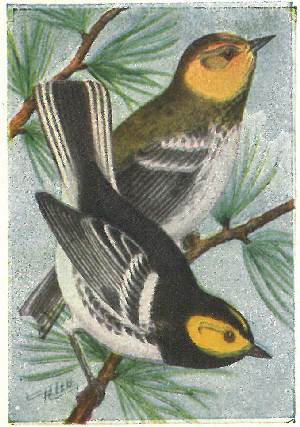
GOLDEN-CHEEKED WARBLER
666. Dendroica chrysoparia. 4¾ inches
In some plumages these birds may be confused with the Black-throated Green. Notice that the adult male has a short median line of yellow on the crown, otherwise the top of head and entire back are intense black. Young birds, which bear the closest resemblance to the next species, can be distinguished because their underparts are white, those of the Black-throated green being tinged with yellow.
These rare Warblers have a very restricted distribution, but are said to be not uncommon within their range.
Notes.—Song with the usual Warbler quality, but entirely distinctive: “sweah-sweah-swee-e-e.”
Nest.—Of strips of bark, usually located in juniper trees six to twenty feet above ground. Eggs white, splashed about the large end with reddish brown (.65 × .50).
Range.—Central Texas southward into Mexico.
[163]
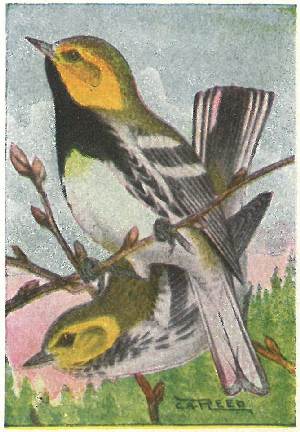
BLACK-THROATED GREEN WARBLER
667. Dendroica virens. 5 inches
Throat black; two wing bars and outer tail feathers white; female with little black on the throat.
A common bird in pine groves in northern United States, or during migrations in birch woods. I have found them most abundant on side hills covered with low-growth pines. They seem to be very nervous and are greatly excited if you appear near their nests. They often have the habit of building several nests, whether with the deliberate intent to deceive or whether because the first was not satisfactory as to location is not known.
Song.—Entirely different from that of any other bird; a rather harsh “zee” repeated six times, with the fourth and fifth syllables lower.
Nest.—Of rootlets and fine grasses, lined with hair; placed high up in pine trees; eggs white with fine brown specks around the large end (.60 × .50).
Range.—Eastern North America, breeding from southern New England and Illinois north to Nova Scotia and Hudson Bay; winters in Central America.
[164]
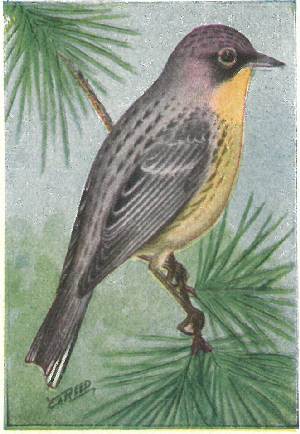
KIRTLAND WARBLER
670. Dendroica kirtlandi. 5½ inches
Above bluish gray streaked with black; underparts pale yellow streaked on the side with black.
This is one of the rarest of American Warblers, and until 1903 but little was known of their habits or range; in that year they were discovered nesting in Oscoda County, Michigan. They were found near the banks of a river in Jack pines, building on the ground and remaining in the underbrush near it.
Song.—Loud and clear and said to resemble that of the Maryland Yellow-throat.
Nest.—In depressions in the ground at the foot of pine trees and probably also under bushes; made of strips of bark and vegetable fibres; eggs white, wreathed about the large end with brown (.72 × .56).
Range.—Breeds in Michigan and migrates southeast through Ohio, Missouri, Tennessee, Virginia, the Carolinas and Florida to the Bahamas.
[165]
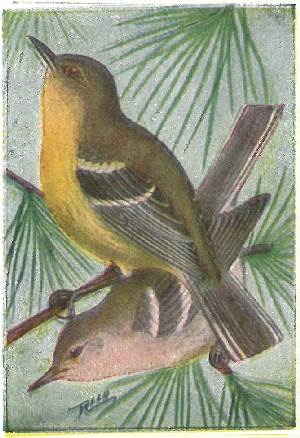
PINE WARBLER
671. Dendroica vigorsi. 5½ inches
Greenish yellow above, brighter below; two white wing bars and white spots on outer tail feathers; female, duller and grayer.
Found only in tracts of coniferous trees, except during migrations, when they are often in company with other kinds of Warblers. They like dry hillsides covered with scrub pines and are often quite abundant in such localities. They are rather quiet in their manners, creeping about among the tree tops like Black and White Warblers and occasionally giving their clear little trill.
Song.—Nearest like that of the Chipping Sparrow, but easily distinguishable; a long, clear trill.
Nest.—A small, compact structure of black rootlets lined with hair; placed in the extreme tops of scrub pines, where it is very difficult to see them; eggs white specked with reddish brown (.62 × .50).
Range.—Eastern N. A., breeding from the Gulf north to southern Canada; winters in southern U. S.
[166]
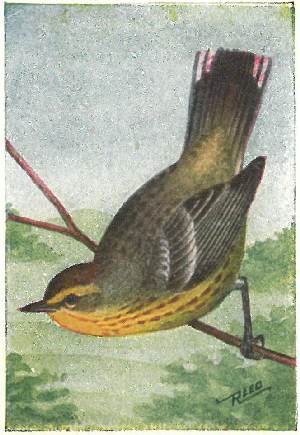
PALM WARBLER
672. Dendroica palmarum. 5¼ inches
No wing bars, but white spots on the outer tail feathers; crown, cheeks and streaks on the sides chestnut.
During migrations you will find these Warblers along roadsides, in open woods and scrubby pastures. They are of a very nervous temperament and, when at rest or when walking, are continually flirting their tail, a habit which none of the Warblers, except the Water-thrush, seem to have. They are one of the earliest of the family to appear in the spring, reaching northern United States in April.
Song.—A short trill; an ordinary Warbler chirp.
Nest.—On the ground under shrubs, or sunken in moss; made of fine grasses, bark and moss; the four eggs are creamy white with reddish-brown spots.
Range.—Interior of N. A., breeding in the interior of British America; winters in southern U. S. 672a. Yellow Palm Warbler (hypochrysea) is brighter yellow below; it is found in eastern N. A., breeding north of Nova Scotia; winters along the Gulf.
[167]
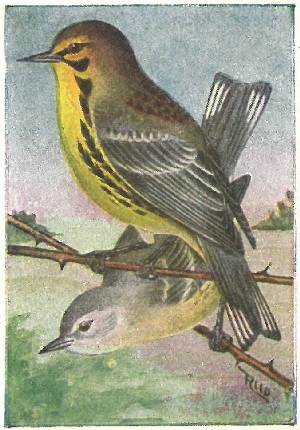
PRAIRIE WARBLER
673. Dendroica discolor. 4¾ inches
Above greenish with chestnut spots on the back; below yellow with black markings; female paler.
These are very locally distributed birds and will often be found breeding abundantly in a small patch of brush-covered pasture, while many others apparently just as well suited for their purposes will be shunned by them. They are very active, flitting rapidly from one bush to another, the male occasionally mounting to a bush top to hurriedly deliver his song, then diving out of sight below the foliage.
Song.—An energetic, rather harsh “zee-zee-zee-ee” on an ascending scale.
Nest.—A neat cup of grasses and vegetable fibres, lined with black rootlets or horsehair; located in low shrubs or bushes from one to two feet above ground; eggs whitish with blackish-brown specks about the large end (.65 × .48).
Range.—Eastern U. S., breeding from the Gulf to Massachusetts and southern Michigan; winters in the West Indies.
[168]
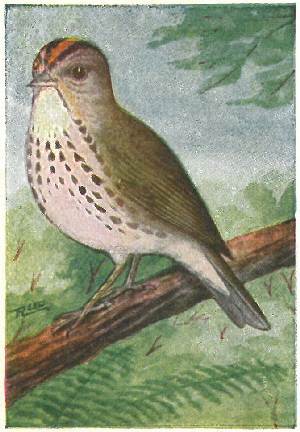
OVEN-BIRD
674. Seiurus aurocapillus. 6 inches
Crown orange brown bordered by black; no white in wings or tail.
This bird is found in open woods, where it builds its arched nest on the ground among the leaves or pine needles. It is the peculiar oven-like construction of their nests that gives them their name. They are essentially ground birds, only mounting to the lower branches of trees to sing or when scolding an intruder.
Song.—A peculiar ascending song resembling the word teacher, repeated five or six times and gathering strength and volume with each syllable; call, a sharp chip.
Nest.—Of leaves, strips of bark and grass arched over the top so as to leave a very small opening; placed on the ground in woods; four to six white eggs spotted with reddish brown (.78 × .58).
Range.—Eastern N. A., breeding in the northern half of the U. S. and north to Labrador; winters chiefly south of U. S.
[169]
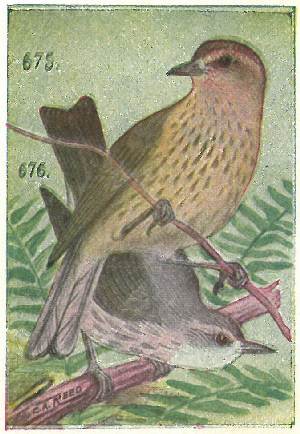
WATER-THRUSH
675. Seiurus noveboracensis. 6 inches
This species always has a yellowish tinge to the underparts and the stripes beneath are narrow, but prominent. These Warblers are found in tangled underbrush near water. They have a habit of continually flirting their tails, thus giving them the local name of Water-Wagtail. Their call is a sharp metallic “chink”; their song a loud, liquid “quit-quit-quit-que-quewe-u.” Breeds from the northern edge of the U. S. northward; winters south of U. S.
LOUISIANA WATER-THRUSH
676. Seiurus motacilla. 6¼ inches
Larger, grayer above and whiter below than the preceding; stripes fewer and broader. This is a more southern species and breeds from the Gulf to Connecticut and southern Minnesota. Its notes are wild and ringing, like those of the last. They build their nests under the roots of trees or under the edges of overhanging banks. The eggs are creamy white, boldly blotched with brown.
[170]
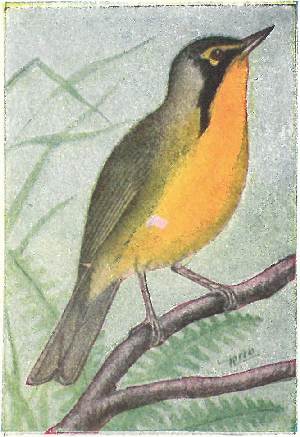
KENTUCKY WARBLER
677. Oporornis formosa. 5½ inches
Crown and ear coverts black, underparts and line over eye yellow; no white in the plumage.
These birds are found in about such localities as are frequented by Oven-birds, but with a preference for woods which are low and damp. They are locally common in some of the southern and central states. They are active gleaners of the underbrush, keeping well within the depths of tangled thickets. Like the Maryland Yellow-throat, which has similar habits to those of this bird, they are quite inquisitive and frequently come close to you to investigate or to scold.
Song.—A loud, musical, Wren-like warble.
Nest.—A bulky structure of leaves, bark and grasses, lined with black rootlets or horsehair; placed on the ground in bunches of weeds or at the foot of a small bush; the four or five eggs are quite heavily speckled, chiefly at the large end, with reddish brown.
Range.—Eastern U. S., breeding from the Gulf north to New York and southern Michigan; winters in northern South America.
[171]
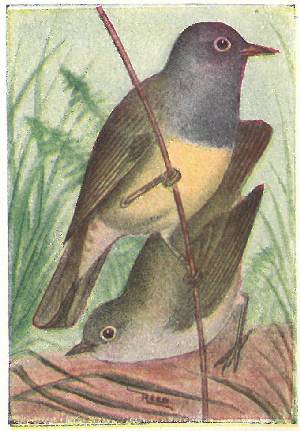
CONNECTICUT WARBLER
678. Oporornis agilis. 5½ inches
Male with a bluish slate-colored head; eye ring white and completely encircling the eye; female with a saffron-colored head.
In the United States we find this Warbler only in spring and fall migrations. They appear to be much more rare in the spring than in the fall; while I have seen perhaps a hundred in the fall I have never seen but one in spring. They frequent wild tangled thickets, such as you often find Maryland Yellow-throats in. As they do most of their feeding upon the ground and remain in the depths of the thickets, they are rarely seen unless attention is drawn to them.
Song.—Somewhat like that of the Maryland Yellow-throat; call, a sharp, metallic “peenk.”
Nest.—In thickets or clumps of briars, either on the ground or just above it; made of strips of bark and skeletons of leaves lined with hair; eggs whitish sparingly specked at the large end with brown (.75 × .56).
Range.—Eastern N. A., breeding north of the U. S.; winters in northern South America.
[172]
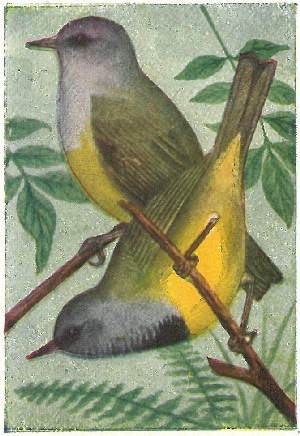
MOURNING WARBLER
679. Oporornis Philadelphia. 5½ inches
Similar to the last, but with no eye ring and with a black patch on the breast.
These birds are found in swamps and thickets, as well as among the bushes and weeds along walls, fences and the edges of woods. Their habits are like those of the Maryland Yellow-throats, they being found on or near the ground, scratching about among the leaves or gleaning insects from the foliage of the low shrubbery. They appear to be the most abundant in the middle states and northward.
Song.—Similar to the liquid song of the Water-Thrush; call, a sharp “peenk,” like that of the last.
Nest.—On or near the ground in thickets or tangled vines; made of fine bark strips and fibres, lined with hair; eggs white specked with reddish brown (.71 × .54).
Range.—Eastern U. S., breeding from northern New England, Ohio and Michigan north to southern Canada; winters south of the U. S.
[173]
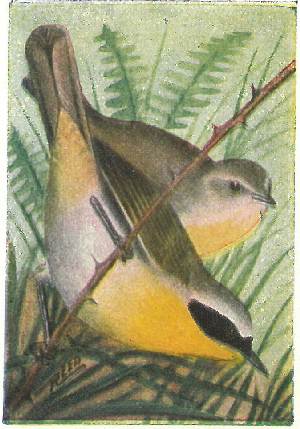
MARYLAND YELLOW-THROAT
681. Geothlypis trichas. 5¼ inches
One of our most common birds in swamps and also in shrubbery along roadsides or walls. They are very inquisitive, and their bright eyes will peek at you from behind some leaf or shrub as long as you are in sight.
Song.—A lively “witchity-witchity-witch”; call, a deep chip; also a rattling note of alarm.
Nest.—Of grapevine and grasses, located in clumps of weeds on or nearly touching the ground; eggs white with brown specks (.70 × .50).
Range.—Eastern N. A., breeding from the Gulf to New Jersey.
Sub-Species.—681a. Western Yellow-throat (occidentalis), said to be brighter; found chiefly west of the Rockies, but east to the Plains. 681b. Florida Yellow-throat (ignota), South Atlantic and Gulf coasts. 68ld. Northern Yellow-throat (brachidactyla), slightly larger and deeper colored; found in northeastern U. S. and southeastern Canada, west to Dakota and south through the Mississippi Valley to the Gulf.
[174]
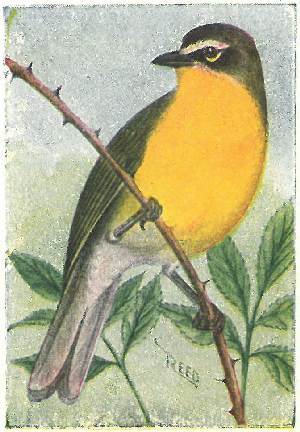
YELLOW-BREASTED CHAT
683. Icteria virens. 7½ inches
Breast yellow, lores black, line over the eye and underparts white; no white on wings or tail.
Dry side hills and ravines covered with thick underbrush are the places to look for Chats. Usually if they are present they will make themselves heard long before you see them. They are one of the most odd birds both in action and song. They are mimics of the highest order and can make any kind of whistle or squawk, but all their vocal efforts seem to require a great deal of flirting of the tail and twisting of the head. They even jerk their tail up and down while flying, this making them appear extremely ludicrous.
Song.—A varied medley of whistles and calls.
Nest.—Near the ground in tangled thickets; of grass, weeds, etc.; eggs whitish plentifully specked with reddish brown (.90 × .70).
Range.—Eastern U. S., breeding north to Massachusetts and southern Minnesota; winters in Central America. 683a. Long-tailed Chat (longicauda) is found in the U. S. from the Plains to the Pacific.
[175]
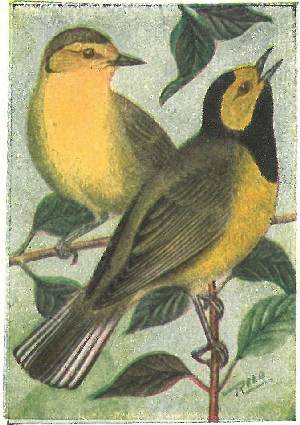
HOODED WARBLER
684. Wilsonia citrina. 5½ inches
Male with yellow forehead and cheeks, the rest of the head and throat being black; female much duller with little or no black; both sexes have white spots on the outer tail feathers, but no bars on the wings.
This is one of the liveliest of the family, being very active in catching insects on the wing like a true Flycatcher; because of this habit all the members of this genus are often called Fly-catching Warblers. They also have a habit of often spreading and folding the tail as they flit through the underbrush that they frequent.
Song.—A clear, liquid series of whistles; call, a sharp “chip.”
Nest.—Within a few inches of the ground in low underbrush or vines; made of leaves, bark, etc., held firmly together with cobwebs; the four or five eggs are white, profusely spotted with reddish brown.
Range.—Eastern U. S., breeding from the Gulf to southern Connecticut and Michigan; winters south of the U. S.
[176]
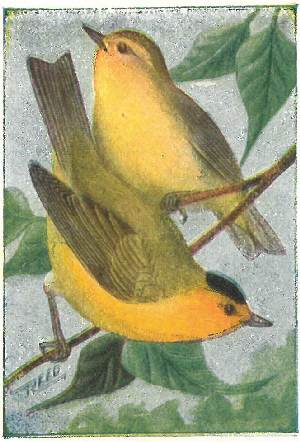
WILSON WARBLER
685. Wilsonia pusilla. 5 inches
Male, with black crown patch; female, with the crown greenish like the back.
These little fly-catching Warblers are abundant in the United States during migrations, being found in woods or swamps, and very often in apple trees when they are in bloom. They fly about among the outer branches snatching insects from the foliage or blossoms, and often dashing out to catch one that is flying by. Their natural quickness is intensified by their very attractive plumage which harmonizes perfectly with green leaves.
Song.—A simple and rather weak trill.
Nest.—Of leaves and bark, imbedded in the ground under bushes on the edges of swamps or woods; eggs white, specked with reddish brown (.60 × 48).
Range.—Eastern N. A., breeding from the northern edge of the U. S. northward; winters in Central America. Two subspecies are found west of the Rockies.
[177]
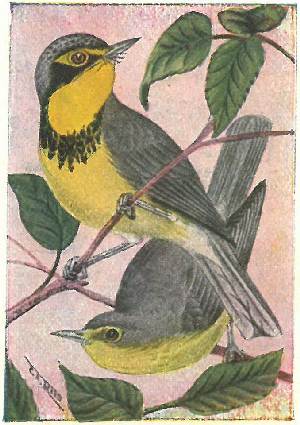
CANADIAN WARBLER
686. Wilsonia canadensis. 5½ inches
Male, with a necklace of black spots, white eye ring and lores; female, and young, with only a slight indication of the necklace.
These Warblers travel northward in company with many other kinds, always keeping in the underbrush near the ground, except when they come out into orchards and parks. Like the two last, they are very lively, rarely remaining still for more than a few seconds, before they must dash after some tempting morsel that is flying by.
Song.—A loud liquid warble, most nearly resembling that of the Water-Thrush; call, a sharp, querulous chip.
Nest.—Of rootlets and strips of bark, under roots of trees or shrubs or at the foot of stumps in the moss; the four eggs are white with a wreath of chestnut spots around the large end (.68 × .50).
Range.—Eastern N. A., breeding from Massachusetts and Michigan northward; winters in northern South America.
[178]
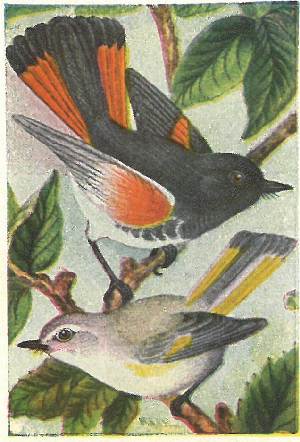
AMERICAN REDSTART
687. Setophaga ruticilla. 5½ inches
Male, black, orange and white; female, grayish, yellow and white; it requires two or three years to attain the black plumage of the male, in the intermediate stages they are sometimes strangely mottled.
In the northeastern half of the United States, these are one of the commonest and most active of the species. Both the males and females seem to be proud of their handsome plumage and are continually spreading and closing their tails. They are equally happy whether in the tree tops or near the ground, and are as often found in the one place as the other.
Song.—“Che-wee, che-wee, che-wee,” very similar to that of the Yellow Warbler and also the Chestnut-sided Warbler.
Nest.—Of plant fibres and grasses in forks of bushes or trees, usually at greater heights than those of the Yellow Warbler; eggs whitish specked with brown.
Range.—N. A., rare west of the Rockies, breeding from North Carolina and Missouri northward; winters south of the U. S.
[179]
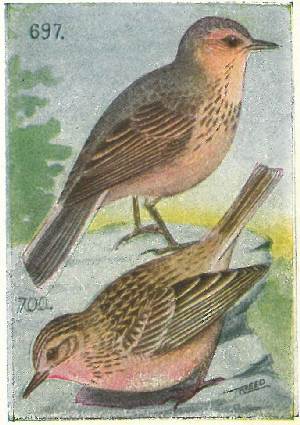
AMERICAN PIPIT; TITLARK
697. Anthus rubescens. 6½ inches
These are Arctic birds that spend the winter months in the United States. We find them in flocks along roadsides or in fields, feeding upon weed seeds. They are shy and take wing readily, uttering sharp whistles as they wheel about in the air. They are always restless and stay in a place but a short time. They nest on the ground in northern Canada. Eggs grayish, profusely specked with brown.
SPRAGUE PIPIT
700. Anthus spraguei. 6¼ inches
Upper parts streaked with buff and blackish; below pale buffy with black markings. These birds are found on the Plains from the Dakotas to Hudson Bay in summer, migrating to Mexico in winter. They resemble the European Skylark in their habit of soaring to a great height while singing. Their song is very melodious, resembling that of the Bobolink. Their nests are depressions in the ground, lined with grasses. Eggs grayish, finely specked with purplish gray (.87 × .67).
[180]
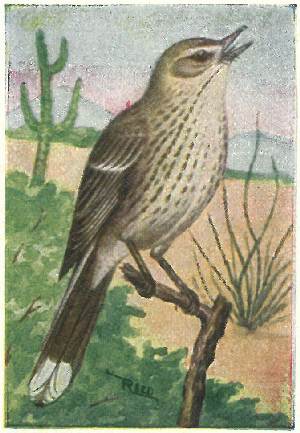
SAGE THRASHER
702. Oreoscoptes montanus. 8¾ inches
This species is often known as the Mountain Mockingbird because of the brilliance of its song, a very varied performance, long continued and mocking that of many other species. They inhabit sage-brush regions and are partial to the lower portions of the country, although frequently met in open mountains. They are not shy and can readily be located by their voices.
Nest.—In bushes, especially the sage and cactus; a loose structure made of bark strips, small twigs and coarse grasses, lined with fine rootlets. The three or four eggs have a rich greenish-blue ground, spotted with bright reddish brown (.95 × .70).
Range.—Sage-brush regions of western United States from the Plains to the Pacific; winters in Mexico and Lower California.
[181]
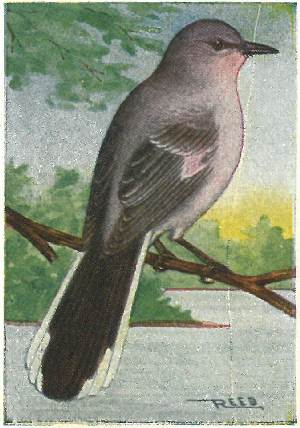
MOCKINGBIRD
703. Mimus polyglottos. 10½ inches
General colors, gray and white; bases of primaries and outer tail feathers with white.
This is the great vocalist of the south, and by many is considered to be the most versatile singer in America. It is found in gardens, pastures and open woods. All its habits are similar to our Catbird, and like that species, it is given to imitating the notes of other birds.
Song.—An indescribable medley, sometimes very sweet and pleasing, at others, harsh and unmusical.
Nest.—Usually built in impenetrable thickets or hedges, or again in more open situation in the garden; made of twigs and rootlets, lined with black rootlets; the four or five eggs are bluish green with blotches of reddish brown (95 × .70).
Range.—Southern U. S., breeding north to New Jersey (and casually farther) and Ohio; winters in the South Atlantic and Gulf states. 703a. Western Mockingbird (leucopterus) is found in southwestern U. S., north to Indian Territory and California.
[182]
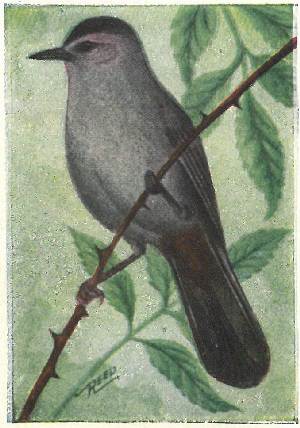
CATBIRD
704. Dumetella carolinensis. 9 inches
General color dark gray with a black cap and chestnut under tail coverts.
This is one of the most common birds throughout the United States, being found equally abundantly in gardens, swamps and scrubby pastures. They are very persistent songsters and have a large repertoire of notes, as well as being able to imitate those of many other birds. They delight in spending an hour or more at a time, perched in a bush or tree top, singing, and apparently making their song up as they go along, for it is an indescribable medley interspersed with various mews and cat calls.
Song.—A medley like that of the Mockingbird; sometimes pleasing, sometimes not.
Nest.—In hedges or thickets; made of twigs, rootlets and grass, lined with fine black roots; the four eggs are plain greenish blue (.95 × .70).
Range.—N. A., breeding from the Gulf to New Brunswick and Hudson Bay; rare west of the Rockies; winters from the Gulf States southward.
[183]
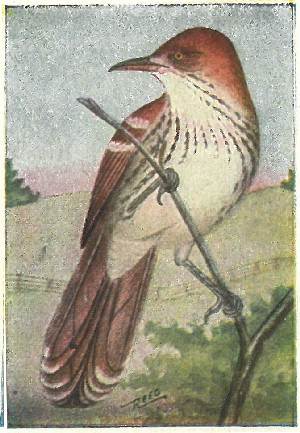
BROWN THRASHER
705. Toxostoma rufum. 11½ inches
Above bright reddish brown; below white with black spots.
Taken as a whole I think that the song of this Thrasher is the most musical and pleasing of any that I have ever heard. It has a similarity to that of the Catbird, but is rounder, fuller and has none of the grating qualities of the song of that species. They apparently have a song of their own and do not deign to copy that of others. They are one of the most useful and desirable birds that we have.
Song.—A bright and cheerful carol, often long continued, but always clear and sweet; call, a clear whistled “wheuu.”
Nest.—Of twigs and rootlets, in hedges, thickets or thorn bushes; the four or five eggs are bluish white with numerous fine dots or reddish brown over the entire surface (1.08 × .80).
Range.—Eastern N. A., breeding from the Gulf to southern Canada; winters in the southern half of the U. S.
[184]
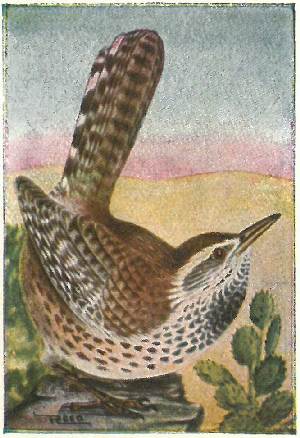
CACTUS WREN
713. Heleodytes brunneicapillus. 8½ inches
Cactus groves are the favorite resorts of these large Wrens. Often a bed of cactus not more than thirty feet square will contain the homes of half a dozen pairs of them. Like all the members of the family, they are very sprightly and have violent tempers, scolding any one or anything that incurs their displeasure.
Nest.—Their nests are placed in cactus or other thorny shrubs; they are very large, purse-shaped affairs with an entrance on the side; they are made of little thorny twigs and grasses woven together, and the interior is warmly lined with feathers. The four or five eggs are creamy white, finely sprinkled with reddish brown (.95 × .65). Two or three broods are often raised in a season.
Range.—Southwestern border of the United States, ranging from southern Texas to California.
[185]
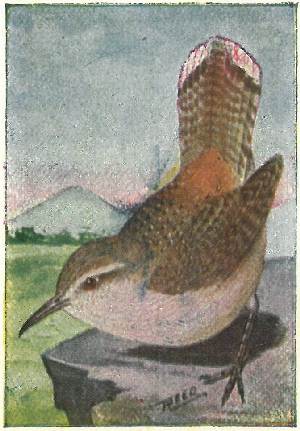
ROCK WREN
715. Salpinctes obsoletus. 5¾ inches
Upper parts stone color, specked with black; rump brownish; underparts whitish with indistinct streaks on the throat.
A common bird on the dry, rocky foothills of the Rockies and westward. They are well named, for their favorite places are among the rocks, where they are always busily engaged in hunting insects or spiders in the crevices. Owing to their colors and their habits of slinking away behind the rocks they are quite difficult to see, but their sweet song is always heard if any of the birds are in the vicinity.
Song.—Very sweet and varied, almost canary-like, but impossible to describe; call, a harsh grating note.
Nest.—Of sticks, weeds, grasses, etc., concealed in crevices among the rocks; the five or six eggs are white, sparingly specked with reddish brown (.72 × .54).
Range.—Western U. S. from the western border of the Plains to the Pacific, north to Dakota and British Columbia; winters from southwestern U. S. southward.
[186]
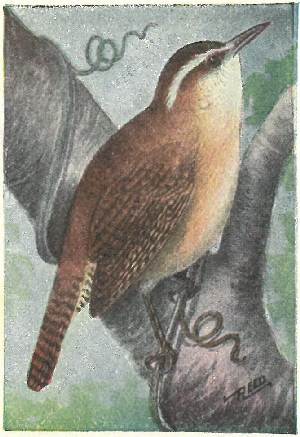
CAROLINA WREN
718. Thryothorus ludovicianus. 5½ inches
Above rusty brown and below washed with the same, the throat and line over the eye being white.
Like all the Wrens, this one commonly sits or flits about in the brush, with the tail erect over the body; only when singing it is held downward. Their flight is usually only for a short distance, accomplished by rapid wing beats and with a jerking motion of the tail.
Song.—Loud and tinkling, and utterly impossible to describe.
Nest.—In brush heaps, holes in trees, bird boxes or bushes; made of weeds, grass and any trash that they may pick up; eggs, five to seven in number, white, specked with reddish brown (.74 × .60).
Range.—Eastern U. S., breeding from the Gulf north to Connecticut and Illinois; resident. 718a. Florida Wren (miamensis) is found in southern Florida. 718b. Lomita Wren (lomitensis), found in southern Texas.
[187]
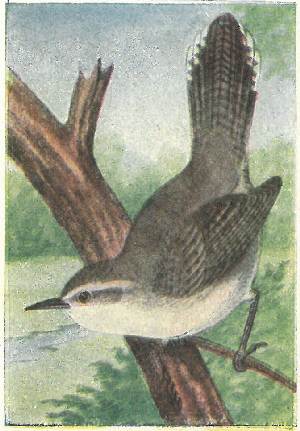
BEWICK WREN
719. Thryomanes bewickii. 5 inches
Above dark brown; below and line over eye whitish; tail blackish with the outer feathers barred with white.
Like all the Wrens, these seem to be very restless and are continually creeping about in brush heaps or along stone walls, fences or over fallen trees or stumps. They are locally abundant in interior United States, in some sections entirely replacing the House Wren.
Song.—A sweet chant of liquid melodious notes.
Nest.—In any location that happens to take the bird’s fancy, such as holes in trees, bird boxes, in barns, sheds, etc.; made of straw, grass and trash; eggs white profusely specked with reddish brown.
Range.—Mississippi Valley and the Plains north to South Dakota; east to the Alleghanies and casually to the South Atlantic States. 719c. Texas Bewick Wren (crythus) is found from Texas north to Indian Territory.
[188]
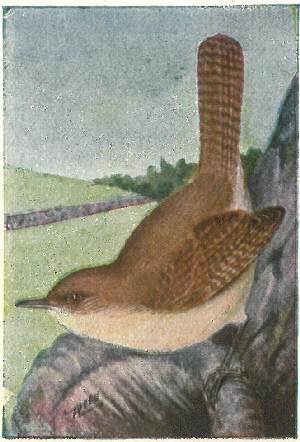
HOUSE WREN
721. Troglodytes ædon. 4¾ inches
Above brownish with tail and wings barred; below dull grayish, barred on the flanks with brown.
These are bold, sociable and confiding birds, seeming to prefer men’s society, building their nests in bird boxes that are erected for them, or in the most unexpected situations about buildings. They are one of the most beneficial birds that can be attracted to one’s yard, feeding wholly upon insects.
Song.—Loud, clear and bubbling over with enthusiasm.
Nest.—Of grass or weeds, stuffed into any crevice that takes their fancy, frequently in bird boxes and holes in orchard trees; eggs white, so minutely and thickly dotted with pinkish brown as to nearly conceal the ground color (.64 × .52).
Range.—Eastern N. A., breeding north to Maine and Manitoba; winters along the Gulf coast. 721b. Western House Wren (aztecus) is found from the Plains to the Pacific Coast ranges.
[189]
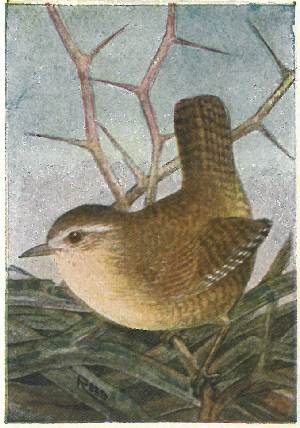
WINTER WREN
722. Nannus hiemalis. 4 inches
Above bright cinnamon, below paler; sides, wings and tail heavily barred with black.
This is the shortest and most stoutly built Wren that we have. They look very pert with their little stubby tail erect over their back. In most of the United States we only see them in the winter, and they are associated, in my mind, with brush heaps in woods and gardens. They will hide in a small pile of brush, running from side to side, so that it is almost impossible to make them leave it.
Song.—A rippling flow of melody, not as loud, but more musical than that of the House Wren.
Nest.—In brush heaps, tin cans, hollow stumps or crevices in unoccupied buildings; made of piles of grass, weeds, etc., lined with feathers; eggs white, sparingly specked with reddish brown (.65 × .50).
Range.—Eastern N. A., breeding from the northern edge of the U. S. northward; winters from its breeding range to the Gulf.
[190]
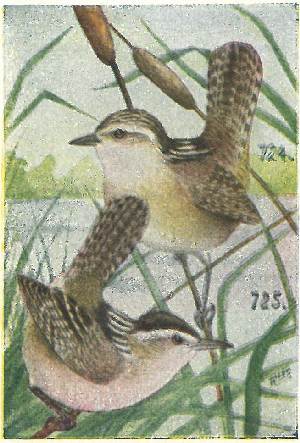
SHORT-BILLED MARSH WREN
724. Cistothorus stellaris. 5¼ inches
This species can readily be distinguished from the next, as the whole crown is streaked with black and white, whereas that of the Long-bill is uniformly colored. Both species are marsh birds, at home among the reeds, to which they attach their globular woven nests, with the little entrance in the side. The eggs of this species are pure white. It is found in eastern N. A. from the Gulf to southern Canada.
LONG-BILLED MARSH WREN
725. Telmatodytes palustris. 5¼ inches
The bill of this species is .5 inch or more in length; that of the last is .4 inch or less. This species is by far the most abundant. Its eggs are so profusely dotted with dark brown as to appear a chocolate color. Breeds from the Gulf to Massachusetts and Manitoba.
[191]
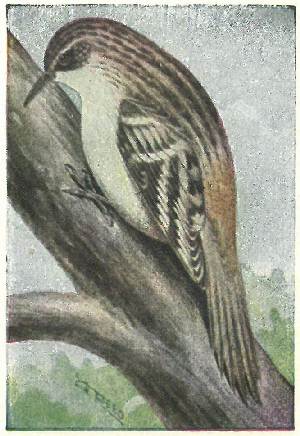
BROWN CREEPER
726. Certhia familiaris americana. 5½ inches
Tail feathers stiffened and pointed; rump rusty.
These odd birds are fairly common throughout the United States in winter. They will be found in woods always climbing up tree trunks, carefully investigating every crevice in the bark for larvæ or grubs. When they reach the top of one tree, they drop to the foot of the next and continue the operation. They are very tame, not seeming to comprehend that danger can befall them, for they will allow any one to approach very closely, so that they have been caught under a hat.
Song.—A very faint trill; call, a weak “tseep,” hardly noticeable unless very near them.
Nest.—Of twigs, moss and bark, behind loose bark on dead trees or stumps, usually not high above the ground; eggs white, specked with reddish brown.
Range.—Eastern N. A., breeding from northern New England and Minnesota northward; winters throughout the U. S.
[192]
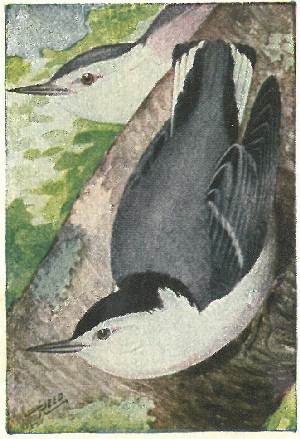
WHITE-BREASTED NUTHATCH
727. Sitta carolinensis. 6 inches
Male with the crown bluish black; female with the crown gray; both sexes with chestnut under tail coverts.
These birds seem to be the very opposite of the Brown Creepers. Their tails are short and square, and nearly always pointed toward the zenith, for Nuthatches usually clamber among the branches and down the tree trunks, head first.
Note.—A nasal “yank-yank,” and a repeated “ya-ya,” all on the same tone.
Nest.—In cavities of hollow limbs and trunks of trees at any elevation from the ground; the cavity is filled with leaves and usually lined with feathers; eggs white, spotted with reddish brown (.75 × .55).
Range.—Eastern United States, breeding from the Gulf to southern Canada; resident in most of its range. 727b. Florida White-breasted Nuthatch (atkinsi) is slightly smaller; other races are found west of the Rockies.
[193]
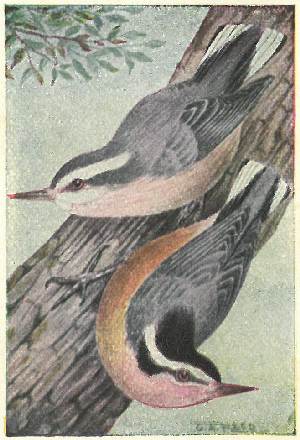
RED-BREASTED NUTHATCH
728. Sitta canadensis. 4½ inches
These birds have the same habits as the larger Nuthatch, but are often found in flocks, while the White-breasted are usually in pairs and in the fall accompanied by their young. In the winter we usually find them in coniferous trees, where we can locate them by their nasal calls or by the shower of bark that they pry from the tree in their quest for grubs.
Song.—A nasal “yank-yank,” like that of the last, but not so loud, and usually repeated more times.
Nest.—In hollow stumps and limbs, the area about the opening nearly always being coated with fir balsam, for what purpose is not known; the cavity is lined with grasses and feathers; they lay from four to seven white eggs, which are very thickly spotted with reddish brown (.60 × .50).
Range.—N. A., breeding from the northern parts of the northern tier of states, northward; winters south nearly to the Gulf and southern California.
[194]
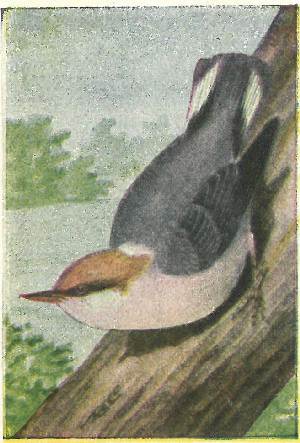
BROWN-HEADED NUTHATCH
729. Sitta pusilla. 4¼ inches
Crown brownish with a white patch on the nape.
These diminutive Nuthatches are found in the southern states. Their general habits do not appear to differ from those of other members of the family. They nest very early, commencing to excavate their holes in January and having complete sets of eggs as early as the middle of February.
They usually are found in small flocks and at night they will often be seen flying to the top of a pine where they sleep, all huddled together.
Note.—A continued twittering “nya-nya.”
Nest.—In cavities of dead limbs or stumps, sometimes only a few inches from the ground, and again as high as fifty feet; they lay five or six eggs, white with numerous spots of reddish brown (.62 × .49).
Range.—South Atlantic and Gulf states, breeding north to Virginia.
[195]
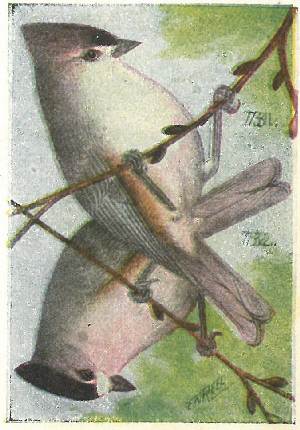
TUFTED TITMOUSE
731. Bæolophus bicolor. 6 inches
Head crested, forehead black, flanks brownish. The habits of this large Titmouse are almost identical with those of Chickadees. They swing from the ends of twigs in all manner of positions and creep about trunks, peering in crevices of the bark for insects. They are common in the southern states, breeding from the Gulf to New York and Illinois; they are resident in the southern portion of their range. Their eggs are laid in soft nests of down and feathers in hollow stumps. Their notes are loud, clear whistles.
BLACK-CRESTED TITMOUSE
732. Bæolophus atricristatus. 6 inches
Crest black, forehead white, flanks rusty. The habits of this species are just like those of the very similar preceding one. The birds are very tame, especially so during the nesting season, when they will allow themselves to be lifted from the nest by hand. They are found in southern and western Texas.
[196]
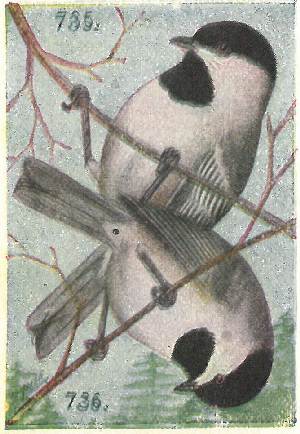
BLACK-CAPPED CHICKADEE
735. Penthestes atricapillus. 5¼ inches
The Chickadees are one of the most popular birds that we have, owing to their uniform good nature even in the coldest weather, and their confiding disposition. They are common about farms, and even on the outskirts of large cities they will come to feasts prepared for them on the window sill.
Notes.—A clear “phe-be”; a “chick-a-dee-dee-dee” or “dee-dee-dee,” and several scolding or chuckling notes.
Nest.—In hollow stumps at any elevation from the ground but usually near the ground, and most often in birch stubs; eggs white, sparingly specked with reddish brown.
Range.—Eastern N. A., breeding in the northern half of the U. S. and northward; resident.
736. Carolina Chickadee (Parus carolinensis) is similar to the last but smaller and with no white edges to the wing feathers; length 4½ inches; found in southeastern U. S., breeding north to Virginia and Ohio.
[197]
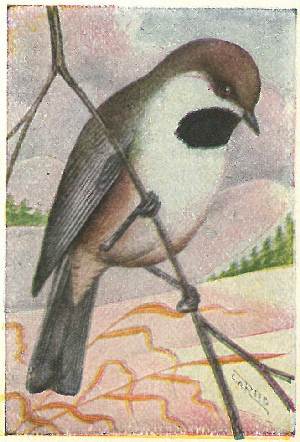
HUDSONIAN CHICKADEE
740. Penthestes hudsonicus. 5 inches
Crown and back brownish.
The habits of this little northerner are like those of the bird that we know so well; if anything they are even more tame than our bird, especially in the vicinity of lumbermen’s camps. They are only met with along our northern border or casually farther south; I have seen one individual in company with other Chickadees in Massachusetts.
Song.—Not distinguishable from that of our Chickadee, but uttered more incessantly.
Nest.—In cavities of stumps, trees, posts or telephone poles, the cavity being lined with grass, feathers and fur; the six or seven eggs are white sprinkled with brown (.60 × .46).
Range.—Resident in Canada and the northern border of the U. S.
[198]
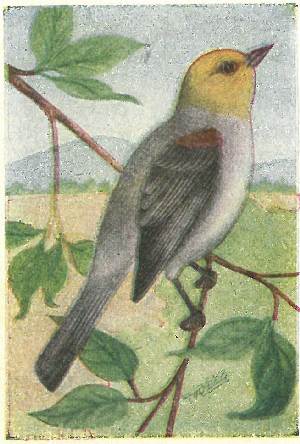
VERDIN; YELLOW-HEADED TIT
746. Auriparus flaviceps. 4¼ inches
Adult male with the head and throat yellow, usually with some concealed orange brown on the forehead; lesser wing-coverts reddish brown. The female is colored very similarly, but is much duller. These are among the smallest of N. A. birds; they are even smaller than their length would indicate, for their bodies are slender. The birds are usually found in high dry portions of the country where cacti and thorny bushes predominate.
Nest.—Their nests are remarkable structures for so diminutive birds; flask-shaped, the outside being a mass of thorny twigs and stems interwoven; this is lined with feathers and the entrance is a small circular hole near the top. The eggs are bluish white specked around the large end with reddish brown.
Range.—Mexican border of the United States from southern Texas to Arizona and Lower California.
[199]
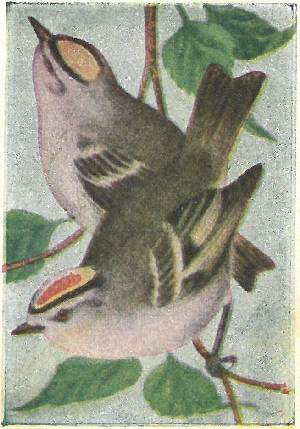
GOLDEN-CROWNED KINGLET
748. Regulus satrapa. 4 inches
Male with crown orange and yellow, bordered with black; female with yellow crown.
Although very small, these birds are very rugged and endure the severe storm and low temperatures of our northern states apparently with little concern, for they always seem to be happy. They are always busily engaged among the underbrush of side hills and along the banks of brooks, hunting for the scanty fare that awaits them.
Song.—A few weak chips, chirps and trills.
Nest.—A large ball of soft green mosses and feathers, suspended from the small twigs in the tops of coniferous trees; it is neatly hollowed out for the reception of the six to nine eggs that are laid; eggs creamy white, minutely but profusely specked with brown (.56 × .44).
Range.—N. A., breeding from Northern U. S. northward and farther south in mountain ranges; winters throughout the U. S.
[200]
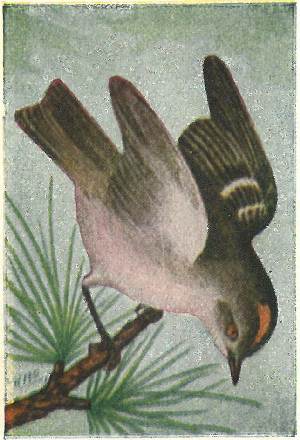
RUBY-CROWNED KINGLET
749. Regulus calendula. 4¼ inches
Male with a concealed patch of red on the crown; female with no red.
Like the last, these are chiefly winter visitants in the United States and they do not remain with us in the coldest weather, but pass on to the southern half of our country. They are nearly always met with in pine or other coniferous trees, being very abundant in spring in open pine woods and parks.
Song.—A clear warble, surprisingly loud and varied for so small a bird; call, a grating chatter.
Nest.—A ball of moss, grass and feathers, deeply cupped, like that of the last; partially suspended among the small twigs in the tops of coniferous trees; eggs white more sparingly marked than those of the last (.55 × .43).
Range.—N. A., breeding northward from the northern boundary of the U. S. and farther south in mountains; winters in the southern half of the U. S.
[201]
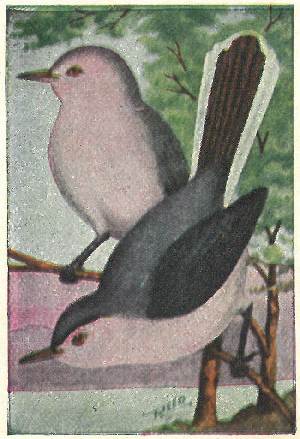
BLUE-GRAY GNATCATCHER
751. Polioptila cærulea. 4½ inches
Forehead black; tail black with white edges and tips to the outer ones.
Their food is chiefly insects, which they are very expert in catching, taking them on the wing with great celerity. Their movements are all very rapid, flitting from one part of a tree to another, but usually among the upper branches. Their nests are among the most beautiful of bird architecture, even surpassing that of the Hummingbird.
Song.—Sweet, but very faint.
Nest.—Situated on horizontal limbs of trees at medium heights; made of plant fibres, woolly substances and cobwebs, adorned with handsome lichens; the walls are very high and thick, the bird sitting so low inside that only her tail is visible; the four or five eggs are bluish white specked with reddish brown (.56 × .44).
Range.—Eastern U. S., breeding north to New Jersey and Illinois.
[202]
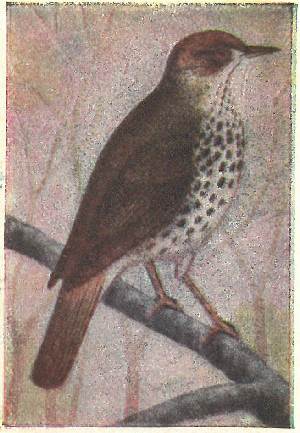
WOOD THRUSH
755. Hylocichla mustelina. 8 inches
Reddish brown above, brightest on the head; below white heavily spotted with black.
These large Thrushes are locally abundant in swamps and moist woodland. They are one of our best songsters, their tones being very rich and flute-like, and, like most of the Thrushes, their songs are most often heard along toward night.
Song.—Very clear and flute-like, containing many notes of the scale; often two or more birds answer back and forth from different parts of the woods; calls, a sharp “quit, quit,” and a liquid “quirt.”
Nest.—Either in forks or on horizontal boughs of bushes or trees, usually not more than ten feet from the ground; made of grass, weeds, leaves and some mud; the three or four eggs are bluish green (1.02 × .75)
Range.—Eastern U. S., breeding from Virginia and Missouri north to Maine, Ontario and Minnesota; winters south of the U. S.
[203]
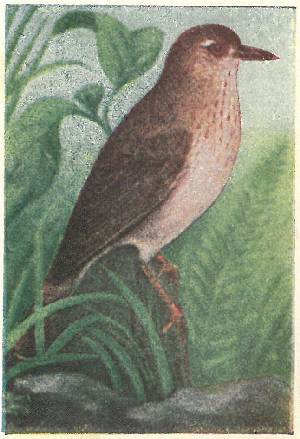
WILSON THRUSH OR VEERY
756. Hylocichla fuscescens. 7½ inches
Entire upper parts a uniform reddish brown; below soiled white with a few faint marks on the breast.
This species is more abundant than the last. It is found in swamps and also in dry open woods, they being especially numerous where ferns grow luxuriantly.
Song.—Very peculiar and not nearly as melodious as that of the Wood Thrush, but still attractive; a slightly descending “too-whe-u-whe-u-whe-u”; call, a clear “whee-you.”
Nest.—On the ground among the leaves, on hummocks, or in tangled masses of briars; made of strips of bark and leaves; eggs greenish blue, darker and smaller than those of the Wood Thrush (.88 × .65).
Range.—Eastern N. A., breeding in the northern half of the United States and southern Canada; winters in Central America. 756a. Willow Thrush (salicicola) is more olive above; it is found in the Rockies and eastward to the Mississippi River.
[204]
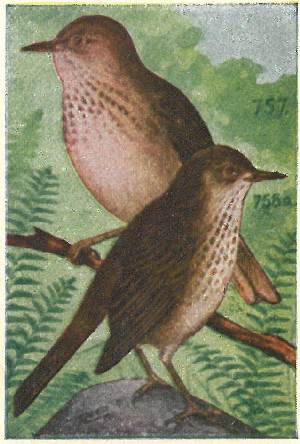
GRAY-CHEEKED THRUSH
757. Hylocichla aliciæ. 7½ inches
Quite similar to the following but with the eye ring white and the sides of head and breast much paler.
Breeds in northern Canada and migrates through the eastern states to Central America. 757a. Bicknell Thrush (bicknelli) is similar to the Gray-cheeked but smaller. It breeds in Nova Scotia.
OLIVE-BACKED THRUSH
758a. Hylocichla ustulata swainsonii. 7¼ inches
Upper parts woolly olive gray, with no brownish tinge; eye ring, sides of head and breast distinctly buff; breast spotted with blackish.
Song.—Quite similar to that of the Veery.
Nest.—Composed of leaves, grass and strips of bark, located in bushes or small trees near the ground; the four eggs are greenish blue spotted with reddish brown (.90 × .65).
Range.—Eastern N. A., breeding from northern U. S. to New Brunswick and Manitoba.
[205]
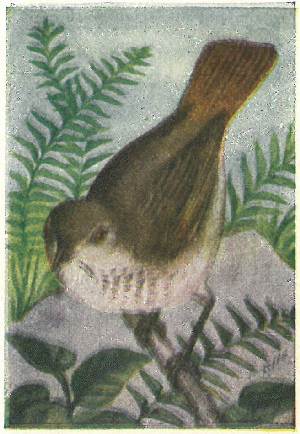
HERMIT THRUSH
759b. Hylocichla guttata pallasii. 6¾ inches
Tail reddish brown, much brighter than the back and head; breast quite heavily spotted with black.
During its migrations it rarely sings, but in its summer home it is regarded as a remarkable musician. Its song has the sweetness and purity of tone of that of the Wood Thrush, and is, perhaps, more varied, but it is not nearly as powerful, and has a ventriloquial effect. I watched one that was perched on a dead stump, about twenty feet from me, for several minutes with a pair of glasses before I could make sure that he was the author of the song I heard, for it sounded as though coming from across the next field.
Nest.—Similar to that of the Wilson Thrush and like that, placed on the ground or very near it; the eggs are plain greenish blue (.85 × .65).
Range.—Breeds from northern U. S. northward, and farther south in mountains; winters in the Gulf States.
[206]
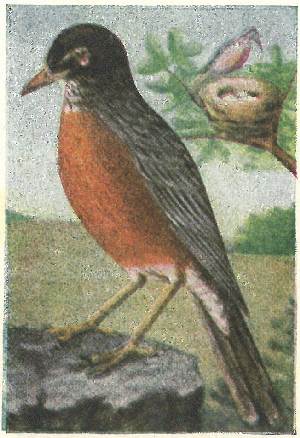
AMERICAN ROBIN
761. Planesticus migratorius. 10 inches
Male with a black head and bright reddish-brown breast; female with a gray head and much paler breast; young intermediate between the two and with a reddish-brown breast spotted with black.
These well-known birds are very abundant in the northern half of the United States, being found most commonly about farms and dwellings in the country, and also in cities if they are not persecuted too severely by English Sparrows.
Song.—A loud cheery carol, “cheerily-cheerup, cheerily-cheerup,” often long continued.
Nest.—A coarse but substantial structure of mud and grass, placed on horizontal boughs or in forks at any height, or in any odd place about dwellings; the four or five eggs are bluish green (1.15 × .80).
Range.—Eastern N. A., breeding from the middle of the U. S. northward; winters throughout the U. S. 761b. Southern Robin (achrustera) is a paler form found in the Carolinas and Georgia.
[207]
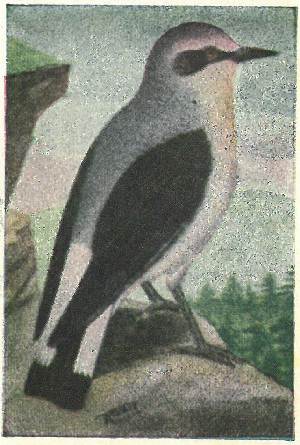
GREENLAND WHEATEAR
765a. Saxicola œnanthe leucorrhoa. 6 inches
The Wheatear is a European bird, but this sub-species is found in Greenland and occasionally in Labrador.
Their habits are about the same as those of the Bluebird. They feed upon insects, larvæ, fruits, berries and some seeds. They are essentially ground birds and are usually found in rocky country.
Nest.—Their nests are made of grasses, hair or any rubbish obtainable, and are hidden in the innermost recesses of crevices among rocks, in deserted Bank Swallow nests or even in rabbit burrows.
The four to six eggs are pale greenish blue, a little brighter in shade than those of the Bluebird. They measure .94 × .60
[208]
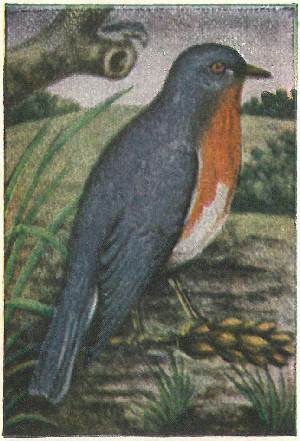
BLUEBIRD
766. Sialia sialis. 7 inches
These beautiful, gentle and well-known birds spend the winter in the southern parts of the United States and north to the snow line; some more hardy than the rest are found throughout the winter in southern New England.
Call.—A short sweet warble; song, a continued warbling.
Nest.—In holes in trees, particularly in orchards, in bird boxes or crannies about the buildings. The bottom of the cavity is lined with grasses for the reception of the four or five pale bluish eggs, which measure .84 × .62.
Range.—Eastern United States, breeding from the Gulf to New Brunswick and Manitoba; winters chiefly in the southern parts of the United States. 766a. Azure Bluebird (azurea) is found in the mountains of eastern Mexico and north casually to southern Arizona. It is paler both above and below than our eastern bird.
[209]