PART OF AN EDUCATION.
Reading edition
Prairie born;
Once his feet touch the slope of Western mountain
The level road they ever more shall spurn.
If once he drink from snow-pure crystal fountain
His thirst shall, ever more consuming, burn
With deepened draughts from common stream.
Once his eye catch glimpse of more substantial glory
Than prairie horizon high piled with clouded foam
His quickened yearning shall inspire old story
Of unbounded, deathless realms beyond the sunset—Home!
There were two of us, a prairie born tenderfoot in the person of a sixteen-year-old college sophomore and the writer. After months of anticipation and planning we hurried away at the close of the college term, leaving the prairies of Iowa to spend a short vacation in the mountains; and we arrived in Denver on a perfect, cloudless morning in June.
Since early daylight we had kept an eager watch to westward across the even plains to catch a first glimpse of the great Front Range of the Rocky Mountains with its covering of summer snow, and after making some purchases of camp supplies we climbed to Capitol Hill in Denver to see the foothills soften to purple and the snow fields melt to liquid gold as the crystal day turned to crimson glory with the setting of the sun.
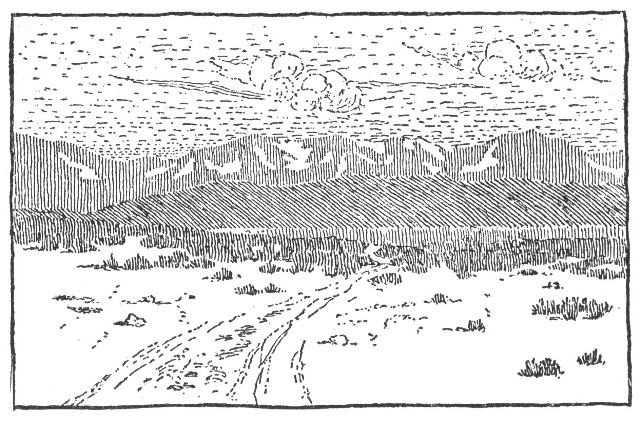
This is the land that the sunset washes,
Those are the Banks of the Yellow Sea
Where it arose, and whither it rushes
This is the western mystery."
Late in the evening we took the train for Loveland from which place we were to start on a walking trip to Laramie, up in Wyoming.
In Loveland we purchased a pony and a pack-saddle. The pony had never been broken to the saddle, and inasmuch as the art of packing has always to be learned anew when one has not practiced it for several years, both of us were, in some respects, as green as the pony, and naturally somewhat nervous when we started from Loveland. The pony served us well however and at the worst only gave us a name for the Bucking Horse Pass when we crossed the range of the Medicine Bow Mountains from the waters of the Grand River to those of the North Platte.
From Loveland we reached Sprague's Ranch in Estes Park, thirty-five miles away, in two days of easy travel over a good stage road, encountering a snow squall in the high foothills which left us cold and wet at sundown of the first day. In Estes Park we stayed three days, fishing, running up to timber line as preliminary exercise, and writing letters. The writer had spent two previous summers in Estes Park near Sprague's Ranch in company with friends from the University of Kansas.
Camp Acclimatization;
June 21st.
My dear little Friend:—
D. and I reached this place day before yesterday. I saw Fred Sprague yesterday. He had already learned of our presence in the Park, having seen our characteristic hob-nail tracks, and, as his mother tells me, he remarked upon seeing them that "God's people had come," meaning the Kansas boys with whom he became acquainted in '86 and '89.
We have passed thousands of flowers since leaving Loveland, white poppies, cactus, blue bells, columbine and others more than I can tell. The blue bells are of the same kind that you and I found near Bloomington several weeks ago. It would be very nice if you and I could make some of our Saturday excursions in this country.
I wish I could tell you more of our trip. Of course it is scarcely begun as yet, but I know pretty well what it will be; hard, for one thing, and lonesome, but strangely fascinating. We are beginning already to have that attitude towards nature which I imagine Indians have, namely, the desire to get something to eat out of everything we see. [M. had written her brother D. at Moraine post office of the pies and cakes they were making at home.] This is by no means greediness, for a measured appetite is essentially incompatible with the conditions of Indian life. In fact the only wild animals which are not gourmands on occasion are those which eat grass. Of course, we are at best only Agency Indians, but we shall soon be off our reservation.
Few people realize the utter desolation of many parts of the Rocky Mountains; and often on my mountain trips, hungry and foot-sore, my fancy has turned to what my friend 'Gric [8] has told me of the utterly desolate Funeral Mountains that border Death Valley in southern California, and of the infinite sunshine there. What would you think, my little friend, even now amid the comforts and joys of home, if you could hear a trustworthy account of an actual trip over those dreadful Mountains and into that awful Valley?
I hope that the map with the accompanying description will help you to a knowledge of the geography and geology of this country. I send kind regards to your father and mother.
Your friend, F.
Starting from Estes Park for the Grand River country we stopped over night at Camp Desolation in Windy Gulch, an enormous amphitheater rising above timber line on the north, east, and west, and opening to the south into Big Thompson Canyon. The mouth of the Gulch is dammed by the lateral moraine of an ancient Thompson glacier and behind this dam is a level, marshy stretch with a few green spruce and thickets of aspen, black alder and mountain willow. Near timber line also is a scattered fringe of green with dots of white. All the rest is a desolate stretch of burned timber.
Trailing to the head of Windy Gulch in the morning we gained the summit of Thompson Ridge which we followed in a northwesterly direction for about twelve miles; then we circled around the head of Big Thompson river and went down to Camp at the head of the Cache la Poudre river, precisely on the Continental Divide in Milner Pass about two hundred feet below timber line with Specimen Mountain immediately to the north of us.
Specimen Mountain Camp
June 24th.
My Dear B:—
D. and I are going to run down to Grand Lake settlement to-morrow for bacon and flour so I write this today. I have been in camp all morning cooking and mending while D. has been looking for sheep up in the crater of Specimen Mountain. He saw two and shot without effect. Specimen Mountain is an extinct volcano and sheep come to the crater to lick. I have seen as many as a hundred and fifty sheep there at different times during the four trips that I have made to this region, but I have hunted them only one day (the first) of the twenty-five that I have spent in this camp—without success, of course.
Flowers in profusion are found at these altitudes already where the shrinking snow drifts have exposed the ground to the warm June sun, but under the drifts it is yet the dead of winter. As the season advances the snow recedes, and each newly uncovered strip of ground passes with exuberant haste through a cycle of spring.
We came over from Estes Park yesterday and the day before. At one point I carried the horse's pack about a quarter of a mile on account of steepness of trail and depth of snow, leaving the pony under D.'s guidance to wallow through as best she could. We shall, no doubt, have some hard work getting out of the Grand River valley to the north over the Medicine Bow but we intend to keep at it. We are, of course, likely to get cold and wet, tired and hungry. In fact, I am neither very dry nor very warm now as I write, for it is half snowing and half raining; nor hungry (?) for I have just eaten three slices of bacon, half a corn cake eight inches in diameter and an inch thick, with bacon gravy made with flour and water, and nearly a quart of strong coffee of syrupy sweetness. I do wish D. had killed that sheep this morning! We hope to get some trout to-morrow out of Grand River, but to see the sheets of water which are being shed off the range from rain and melting snow makes one feel uncertain of the trout fishing. I will close for this time and put this into my knapsack. To-morrow D. and I will get our "walkins" on bright and early, and pack it to Grand Lake. This is a tough country beyond imagination.
Your sincerely, F.
When trailing above timber line on our way to Specimen Mountain and subsequently we were on snow much of the time; below timber line at high altitudes we contended about equally with snow and fallen timber; and at middle altitudes where the timber is heavy and where fires have been frequent and disastrous the fallen timber alone is quite enough to make travel troublesome. Mud and water, fallen and falling, we encountered everywhere, but without much concern. The greatest vexation to the amateur traveler in the Rockies is to slip off a log in trying to cross a stream, and thus get wet all over, when if one had been reasonable, one might have been wet only to the middle. An awkward comrade of '89 did this so many times that it became a standing joke; but 'Gric, as we called him, that is to say Agricola, after his father "Farmer" Funston of Kansas, developed grit enough to take him through Death Valley in southern California, to take him, all alone, 1,600 miles down the Yukon River in an open boat and across 200 miles of unexplored country during the winter night to the shores of the Arctic Ocean, to take him into the Cuban army, where he received three serious wounds, and finally to take him through the Philippines with our Volunteer Army where he captured Aguinaldo.
From Specimen Mountain Camp in Milner Pass we made our way to Grand River over an extremely difficult trail, nearly breaking our pony's leg in the fallen timber, and, finding it impossible to reach Grand Lake by the river trail without wetting our pack, we went into (Mosquito) camp and did our week's washing. The next day we left our pony, and made a flying round trip of thirty miles to the settlement. The next morning, hoping to escape the mosquitoes, we moved campseveral miles up stream and in the afternoon we climbed to the summit of one of the high spurs of a nameless [9] peak in the range of the Medicine Bow. We got back to camp late in the evening in a sharp rain, which continued all night.
The next morning promised fair weather, and after some hesitation, we packed up for the trip over to North Park. Starting at eight o'clock we reached the deserted mining camp, Lulu, at eleven, having forded Grand River seven times, the water of it ice cold and swift as an arrow. We then began to climb the range, the summit of which we reached at three o'clock at the pass of the Bucking Horse far above timber line. At four o'clock we began the descent into the valley of the Michigan fork of the North Platte. The rain, until now fitful, became steady and we, determined to reach a good camping place, kept our pony at a half-trot until eight o'clock, when we found a deserted cabin. We were too impatiently hungry to make biscuit, which we ordinarily baked in the frying pan before cooking our bacon, so we made our supper of graham mush, bacon, bacon gravy and coffee. Next morning we found to our dismay that our baking powder had been left at the Bucking Horse—and no wonder, for our pack had been strewn for a quarter of a mile along the trail—so we were reduced to mush again for breakfast.
Gould's Ranch
July 7th.
My Dear B:—
We have just returned from a week's hunt in the Medicine Bow Mountains east of here. We saw elk, killed a deer, and spent the Fourth of July on a prominent but nameless peak from which we got a splendid view.
** ** *
After breakfast at Camp Mush, Mr. E. B. Gould, a neighboring cattle rancher who has no cattle, was attracted by the smoke of our campfire, and coming up to see us, he invited us to his shanty to eat venison. We went. We have now been with him a week and we are starting on our second carcass.
Gould lives by hunting and trapping, and by odd work in the Park during the haying season. He came to this country years ago with a hunting party and has been hunting ever since. Several years ago he took up a claim in the extreme southeastern corner of North Park conveniently near to hunting grounds in the Medicine Bow. He gave up his claim, for good, a year ago, and made an overland trip to New Mexico. That did not satisfy him either, so now he is back in his old shanty again. He thinks we are the toughest "tender-foots" he ever saw. He approves of us, there is no doubt about that, and he has pulled up his stakes to travel with us just for the pleasure of our company! He takes great interest in D.'s knowledge of bugs, and D. and he are both real hunters each according to his experience. Before we fell in with Gould I could persuade D. to wanton exertion in the way of mountain climbing but now I am in the minority, but the hunters propose, with a flourish, the scaling of every peak that comes in sight.
I had a spell of mountain fever just before the Fourth and Gould dosed me with sage brush tea, the vilest concoction I ever had to take.
Gould is not accustomed to walk except when actually hunting, so he has a riding horse, and a trusty old pack animal whose minimum name is "G—— d—— you Jack," and whose maximum name (and load) is indeterminate. Gould is going with us to spend a week in the Range of the Rabbit's Ear, far to the west across North Park. He has an old wagon which, if it holds together, will save D. and me some tedious steps across the desert, for indeed this "park" is a desert. We shall pass through Walden, the metropolis and supply station of the Park.
Yours, F.
From D.'s Mother
My precious boy:
I trust you will excuse me for using this paper but I am up stairs, and no one [is] here to bring me any other. They tell me I need not wonder that we do not hear from you and I shall try not to be disappointed if we do not hear for a while. Nevertheless my dear boy, the uncertainty I feel in regard to your safety will make a letter very welcome indeed. Perhaps I would have more courage if I were strong. For five days I have been very uncomfortable. I am sitting up some today for the first [time] and hope soon to be well as usual.
We were exceedingly glad to hear from you from Grand Lake. I cannot, however, say that the account of your experience by stone slide [10] and river have lessened my anxiety. I am writing now, Thursday, in bed. I have been quite poorly again. We shall not look now for a letter from you but hope to see you face to face before many days. May God bless and keep you! Give our love to Mr. F. All join me in tenderest love to you.
Your devoted mother.
At Walden we laid in a fresh supply of flour and bacon, and canned goods, especially canned fruit, to last us while we stayed with the wagon. We then pushed on to the west, striking camp on the West Fork of the North Platte, where we stayed two nights. Here we tried hard a third time for trout without success, but we turned off the water from an irrigating ditch and captured a large number of "squaw fish" (suckers).
From Camp Chew we made our way well up into the foothills of the Range of the Rabbit's Ear, and then packed our animals, minimum Jack and our pony, and pushed up the range over the worst trail we had yet encountered, through an absolute wilderness of fallen timber. Rain with fog set in as we approached timber line, and we were forced to go into camp early to wait for morning. Morning came with fog and rain, and we spent the entire day hunting trail, only to go into camp again towards evening. The next day, however, came clear and we made our way over the range, through Frying Pan Meadow, and reached camp down on Elk river towards evening without difficulty. We found good fishing here at last and great numbers of deer but no elk. After three rainy days in Elk River Camp, one of which was spent jerking venison of D.'s killing, we packed up and made the return trip over the range in one day of hard travel, going into camp by the shore of a shallow pond well out on the barren level of North Park. The next morning we parted company with Gould, and in two days we made sixty stage road miles across North Park and over the northern portion of the Medicine Bow Mountains to Woods post office at the edge of the Laramie plains, twenty-five miles from Laramie.
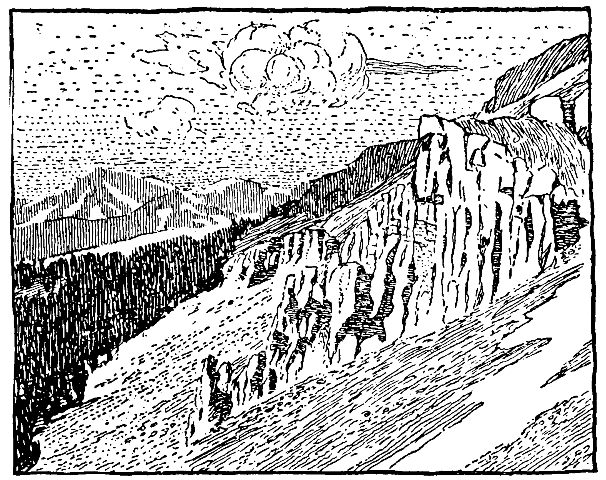
Looking North Across Specimen Mountain Stone Slide.
We had intended walking through to Laramie, but ninety miles and two mountain ranges in three days, not to mention the writer's terribly blistered feet, had temporarily taken some of the ambition out of us, and after some fine diplomacy D. and the writer each found that the other was willing to descend to stage coach riding. We accordingly sold our fine little pony for five dollars, packed our outfit in a compact bundle which we wrapped in our small tent (which had been used as a smoke-house for curing venison at Elk River Camp), and took the stage for Laramie.
At Laramie we took the train for home, and with eyes eagerly awake we watched for hundreds of miles an increasing luxuriance of vegetation which reached its climax in the marvelously rich, endless, undulating fields of eastern Nebraska and Iowa:
This is the land that the sunset washes
These are the Waves of the Yellow Sea;
Where it arose and whiter it rushes,
This is the western mystery.
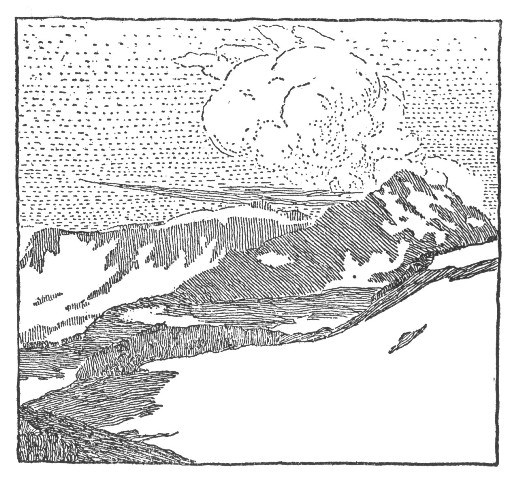
In the Range of the Rabbit's Ear.
We had been away from home for thirty-three days, and in the mountains for thirty-one nights—Indians reckon by nights; and we had tramped more than three hundred and fifty miles from Loveland to the edge of the Laramie plains. A large portion of the time was spent at high altitudes where the weather is not lamb-like in June, and no small portion of the three hundred and fifty miles was mud and water, snow and fallen timber, through a country as rough, perhaps, as is to be found anywhere, and as interesting. The only way to study Geography is with the feet! No footless imagination can realize the sublimity< of western Mountain and Plain. Nothing but a degree of hardship can measure their widespread chaos and lonely desolation, and only the freshened eagerness of many mornings can perceive their matchless glory.
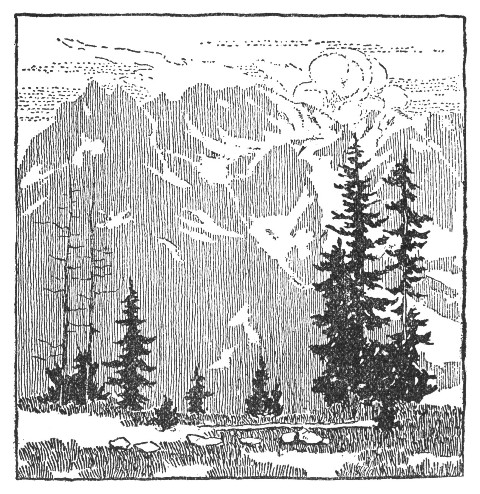
Near Frying Pan Meadow.
We reached home weather-beaten almost beyond recognition, but in robust health, especially D., who had actually gained in weight during the trip. From the railroad station we carried our outfit, and venison, two miles to the college grounds, reaching D.'s home about midnight.
Here our madly exuberant spirits were suddenly checked by finding that the illness of D.'s mother had become extremely serious. However she was determined to see us both—to give a last approval.
"We never know how high we are
Till we are called to rise;
And then, if we are true to plan,
Our statures touch the skies.
"The heroism we recite
Would be a daily thing,
Did not ourselves the cubits warp
For fear to be a king."
After four days D.'s mother died. It fell to B. and F. to make a sculptor's plaster mask, and photographs; and to F. to watch overnight—and hasten to the woods in the morning.
"The bustle in a house
The morning after death
Is solemnest of industries
Enacted upon earth.
"The sweeping up the heart
And putting love away
We shall not want to use again
Until Eternity."
A beautiful Campanile now stands on the college campus erected in memory of D.'s mother by the state of Iowa; and from this memory-tower a chime of bells
Greets
Those who pass in joy
And those who pass in sorrow;
As we have passed,
"Superiority to fate
Is difficult to learn.
'Tis not conferred by any,
But possible to earn
A pittance at a time,
Until, to her surprise,
The soul with strict economy
Subsists till Paradise."