Chapter II · SOUTH AFRICA FIFTY YEARS AGO
Reading edition
By W. Cotton Oswell
WILLIAM COTTON OSWELL: A BIOGRAPHICAL SKETCH
By Sir Samuel W. Baker
One man alone was left who could describe from personal experience the vast tracts of Southern Africa and the countless multitudes of wild animals which existed fifty years ago in undisturbed seclusion; the ground untrodden by the European foot; the native unsuspicious of the guile of a white intruder. This man, thus solitary in this generation, was the late William Cotton Oswell. He had scarcely finished the pages upon the fauna of South Africa when death seized him (May 1, 1893) and robbed all those who knew him of their greatest friend. His name will be remembered with tears of sorrow and profound respect.
Although Oswell was one of the earliest in the field of South African discovery, his name was not world-wide, owing to his extreme modesty, which induced him to shun the notoriety that is generally coupled with the achievements of an explorer. Long before the great David Livingstone became famous, when he was the simple unknown missionary, doing his duty under the direction of his principal, the late Rev. Robert Moffat, whose daughter he married, Oswell made his acquaintance while in Africa, and became his early friend.
At that time Oswell with his companion Murray allied themselves with Livingstone to discover a reported lake of the unknown interior, together with Mrs. Livingstone and their infantine family. This expedition was at the private cost of Oswell and Murray; but, in grateful remembrance of the assistance rendered by Livingstone in communicating with the natives and in originating the exploration, Oswell sent him a present of a new waggon and a span of splendid oxen (sixteen animals), in addition to a thorough outfit for his personal requirements.
Livingstone, in the ‘Zambesi and its Tributaries,’ dwelt forcibly upon the obligation imposed upon him by Oswell’s generosity; but, having submitted the manuscript to his friend for revision, Oswell insisted upon disclaiming the title of a benefactor. After the discovery of the Lake ’Ngami by Livingstone and his party, Oswell received the medal of the French Geographical Society; he was therefore allied with Livingstone, who was the first explorer of modern times to direct attention to the lake system of Africa, which has been developed within the last forty years by successive travellers.
Oswell was not merely a shooter, but he had been attracted towards Africa by his natural love of exploration, and the investigation of untrodden ground. He was absolutely the first white man who had appeared upon the scene in many portions of South Africa which are now well known. His character, which combined extreme gentleness with utter recklessness of danger in the moment of emergency, added to complete unselfishness, ensured him friends in every society; but it attracted the native mind to a degree of adoration. As the first-comer among lands and savage people until then unknown, he conveyed an impression so favourable to the white man that he paved the way for a welcome to his successors. That is the first duty of an explorer; and in this Oswell well earned the proud title of a ‘Pioneer of Civilisation.’
As these few lines are not a biography, but merely a faint testimony to one whose only fault was the shadowing of his own light, I can sincerely express a deep regret that his pen throughout his life was unemployed. No one could describe a scene more graphically, or with greater vigour; he could tell his stories with so vivid a descriptive power that the effect was mentally pictorial; and his listeners could feel thoroughly assured that not one word of his description contained a particle of exaggeration.
I have always regarded Oswell as the perfection of a Nimrod. Six feet in height, sinewy and muscular, but nevertheless light in weight, he was not only powerful, but enduring. A handsome face, with an eagle glance, but full of kindliness and fearlessness, bespoke the natural manliness of character which attracted him to the wild adventures of his early life.
He was a first-rate horseman, and all his shooting was from the saddle, or by dismounting for the shot after he had run his game to bay.
In 1861, when I was about to start on an expedition towards the Nile sources, Oswell, who had then retired from the field to the repose of his much-loved home, lent me his favourite gun, with which he had killed almost every animal during his five years’ hunting in South Africa. This gun was a silent witness to what its owner had accomplished. In exterior it looked like an ordinary double-barrelled rifle, weighing exactly ten pounds; in reality it was a smooth-bore of great solidity, constructed specially by Messrs. Purdey & Co. for Mr. Oswell. This useful gun was sighted like a rifle, and carried a spherical ball of the calibre No. 10; the charge was six drachms of fine-grained powder. There were no breech-loaders in those days, and the object of a smooth-bore was easy loading, which was especially necessary when shooting from the saddle. The spherical ball was generally wrapped in either waxed kid or linen patch; this was rolled rapidly between the hands with the utmost pressure; the folds were then cut off close to the metal with scissors, and the bullet was again rolled as before. The effect was complete; the covering adhered tightly to the metal, which was now ready for ramming direct upon the powder-charge, without wads or other substance intervening. In this manner a smooth-bore could be loaded with great rapidity, provided that the powder-charge was made up separately in the form of a paper cartridge, the end of which could be bitten off, and the contents thrust into the barrel, together with the paper covering. The ball would be placed above, and the whole could be rammed down by a single movement with a powerful loading rod if great expedition should be necessary. Although the actual loading could thus be accomplished easily, the great trouble was the adjustment of the cap upon the nipple, which with an unsteady horse was a work of difficulty.
This grand old gun exhibited in an unmistakable degree the style of hunting which distinguished its determined owner. The hard walnut stock was completely eaten away for an inch of surface; the loss of wood suggested that rats had gnawed it, as there were minute traces of apparent teeth. This appearance might perhaps have been produced by an exceedingly coarse rasp. The fore-portion of the stock into which the ramrod was inserted was so completely worn through by the same destructive action, that the brass end of the rod was exposed to view. The whole of this wear and tear was the result of friction with the ‘wait-a-bit’ thorns!
Oswell invariably carried his gun across the pommel of his saddle when following an animal at speed. In this manner at a gallop he was obliged to face the low scrubby ‘wait-a-bits,’ and dash through these unsparing thorns, regardless of punishment and consequences, if he were to keep the game in view, which was absolutely essential if the animal were to be ridden down by superior pace and endurance. The walnut stock thus brought into hasty contact with sharp thorns became a gauge, through the continual friction, which afforded a most interesting proof of the untiring perseverance of the owner, and of the immense distances that he must have traversed at the highest speed during the five years’ unremitting pursuit of game upon the virgin hunting-grounds of Southern Africa. I took the greatest care of this gun, and entrusted it to a very dependable follower throughout my expedition of more than four years. Although I returned the gun in good condition, the ramrod was lost during a great emergency. My man (a native) was attacked, and being mobbed during the act of loading, he was obliged to fire at the most prominent assailant before he had time to withdraw his ramrod. This passed through the attacker’s body, and was gone beyond hope of recovery.
There could not have been a better form of muzzle-loader than this No. 10 double-barrel smooth-bore. It was very accurate at fifty yards, and the recoil was trifling with the considerable charge of six drams of powder. This could be increased if necessary, but Oswell always remained satisfied, and condemned himself, but not his gun, whenever a shot was unsatisfactory. He frequently assured me that, although he seldom fired at a female elephant, one bullet was sufficient to kill, and generally two bullets for a large bull of the same species.
Unlike Gordon Cumming, who was accustomed to fire at seventy and eighty yards, Oswell invariably strove to obtain the closest quarters with elephants, and all other game. To this system he owed his great success, as he could make certain of a mortal point. At the same time the personal risk was much increased, as the margin for escape was extremely limited when attacking dangerous game at so short a distance as ten or fifteen paces. When Oswell hunted in South Africa, the sound of a rifle had never disturbed the solitudes in districts which are now occupied by settlers. The wild animals have now yielded up their territory to domestic sheep and cattle; such are the rapid transitions within half a century! In those days the multitudes of living creatures at certain seasons and localities surpassed the bounds of imagination; they stretched in countless masses from point to point of the horizon, and devoured the pasturage like a devastating flight of locusts. Whether they have been destroyed, or whether they have migrated to far distant sanctuaries, it is impossible to determine; but it is certain that they have disappeared, and that the report of the rifle which announces the advance of civilisation has dispersed all those mighty hosts of animals which were the ornaments of nature, and the glory of the European hunter. The eyes of modern hunters can never see the wonders of the past. There may be good sport remaining in distant localities, but the scenes witnessed by Oswell in his youth can never be viewed again. Mr. W. F. Webb, of Newstead Abbey, is one of the few remaining who can remember Oswell when in Africa, as he was himself shooting during the close of his expedition. Mr. Webb can corroborate the accounts of the vast herds of antelopes which at that time occupied the plains, and the extraordinary numbers of rhinoceros which intruded themselves upon the explorer’s path, and challenged his right of way. In a comparatively short period the white rhinoceros has almost ceased to exist.
Where such extraordinary changes have taken place, it is deeply interesting to obtain such trustworthy testimony as that afforded by Mr. Oswell, who has described from personal experience all that, to us, resembles history. He was accepted at that time as the Nimrod of South Africa, ‘par excellence,’ and although his retiring nature tended to self-effacement, all those who knew him, either by name or personal acquaintance, regarded him as without a rival; and certainly without an enemy: the greatest hunter ever known in modern times, the truest friend, and the most thorough example of an English gentleman. We sorrowfully exclaim, ‘We shall never see his like again.’
INTRODUCTION
By W. Cotton Oswell
I have often been asked to write the stories of the illustrations given in the chapters on South Africa, but have hitherto declined, on the plea that the British public had had quite enough of Africa, and that all I could tell would be very old. As I now stand midway between seventy and eighty I trusted I might, in the ordinary course of nature, escape such an undertaking; but in the end of ’91 the best shot, sportsman and writer that ever made Africa his field—I refer to my good friend Sir Samuel Baker—urged me to put my experiences on paper; and Mr. Norton Longman at the same time promising that, if suitable, he would find them a place in the Badminton volume on ‘Big Game,’ I was over-persuaded, made the attempt, and here is the result.
The illustrations are taken from a set of drawings in my possession by the best artist of wild animal life I have ever known—Joseph Wolf. After describing the scene, I stood by him as he drew, occasionally offering a suggestion or venturing on two or three scrawling lines of my own, and the wonderful talent of the man produced pictures so like the reality in all essential points, that I marvel still at his power, and feel that I owe him most grateful thanks for a daily pleasure. Many of the scenes it would have been impossible to depict at the moment of their occurrence, so that even if the chief human actor had been a draughtsman he must have trusted to his memory. Happily I was able to give my impressions into the hands of a genius who let them run out at the end of his fingers. They are rather startling, I know, when looked through in the space of five minutes; but it must be remembered that they have to be spread over five years, and that these are the few accidents amongst numberless uneventful days. I was once asked to bring these sketches to a house where I was dining. During dinner the servants placed them round the drawing-room, and on coming upstairs I found two young men examining them intently. ‘What’s all this?’ one asked. ‘I don’t know,’ the other replied. ‘Oh, I see now,’ the first continued, ‘a second Baron Munchausen; don’t you think so?’ he inquired, appealing to me. We were strangers to each other, so I corroborated his bright and certainly pardonable solution; but they are true nevertheless. I have kept them down to the truth: indeed, two of them fall short of it. I am very well aware that there are two ways of telling a story, one with a clearly defined boundary, the other with a hazy one, over which if your reader or hearer pass but a foot’s length he is in the realms of myth. I think I had my full share of mishaps; but I was in the saddle from ten to twelve hours a day for close upon five seasons, and general immunity, perhaps, induced carelessness. I may say now, I suppose, that I was a good rider, and got quickly on terms with my game. I was, however, never a crack shot, and not very well armed according to present notions, though I still have the highest opinion of a Purdey of 10-bore, which burnt five or six drachms of fine powder, and at short distances drove its ball home. This gun did nearly all my work. I had besides a 12-bore Westley-Richards, a light rifle, and a heavy single-barrelled one carrying two-oz. belted balls. This last was a beast of a tool, and once—I never gave it a second chance—nearly cost me my life, by stinging, without seriously wounding, a bull elephant. The infuriated brute charged nine or ten times wickedly, and the number might have been doubled had I not at last got hold of the Purdey, when he fell to the first shot. We had no breech-loaders in those days, save the disconnecting one, and that would have been useless, for we had to load as we galloped through the thick bush, and the stock and barrel would soon have been wrenched asunder or so strained as to prevent their coming accurately into contact again.
The Purdey gun has a second history which gives it more value in my eyes than the good work it did for me. I lent it to Baker when he went up the Nile, and it had the honour, I believe, of being left with Lady Baker to be used, if required, during her husband’s enforced absences. Baker returned it to me with a note apologising for the homeliness of the ramrod—a thornstick which still rests in the ferrules—adding that having to defend themselves from a sudden attack, his man Richarn, being hard pressed whilst loading, had fired the original ramrod into a chief’s stomach, from which they had no opportunity of extracting it.
I am sorry now for all the fine old beasts I have killed; but I was young then, there was excitement in the work, I had large numbers of men to feed, and if these are not considered sound excuses for slaughter, the regret is lightened by the knowledge that every animal, save three elephants, was eaten by man, and so put to a good use. I have no notes, and though many scenes and adventures stand out sharply enough, the sequence of events and surroundings is not always very clear. If my short narrative seems to take too much the form of a rather bald account of personal adventure, I must apologise; and I may add that the nature and habits generally of the animals I met with are now so well known, and have over and over again been so well described by competent writers, that my relations with a few individuals of their families must be the burden of my song.
I spent five years in Africa. I was never ill for a single day—laid up occasionally after an accident, but that was all. I had the best of companions—Murray, Vardon, Livingstone—and capital servants, who stuck to me throughout. I never had occasion to raise a hand against a native, and my foot only once, when I found a long lazy fellow poking his paw into my sugar tin. If I remember right, I never lost anything by theft, and I have had tusks of elephants, shot eighty miles from the waggons, duly delivered. One chief, and one only, wanted to hector a little, but he soon gave it up. And with the rest of the potentates, and people generally, I was certainly a persona grata, for I filled their stomachs, and thus, as they assured me, in some mysterious way made their hearts white.
There is a fascination to me in the remembrance of the past in all its connections: the free life, the self-dependence, the boring into what was then a new country; the feeling as you lay under your caross that you were looking at the stars from a point on the earth whence no other European had ever seen them; the hope that every patch of bush, every little rise, was the only thing between you and some strange sight or scene—these are with me still; and were I not a married man with children and grandchildren, I believe I should head back into Africa again, and end my days in the open air. It is useless to tell me of the advantages of civilisation; civilised man runs wild much easier and sooner than the savage becomes tame. I think it desirable, however, that he should be sufficiently educated, before he doffs his clothes, to enjoy the change by comparison. Take the word of one who has tried both states: there are charms in the wild; the ever-increasing, never-satisfied needs of the tame my soul cannot away with.
But I am writing of close upon fifty years ago. Africa is nearly used up; she belongs no more to the Africans and the beasts; Boers, gold-seekers, diamond-miners and experimental farmers—all of them (from my point of view) mistakes—have changed the face of her. A man must be a first-rate sportsman now to keep himself and his family; houses stand where we once shot elephants, and the railway train will soon be whistling and screaming through all hunting-fields south of the Zambesi.
FIRST EXPEDITION TO AFRICA
Reduced from 12 st. 2 lb. to 7 st. 12 lb. by many attacks of Indian fever caught during a shooting excursion in the valley of the Bhavany River, I was sent to the Cape as a last chance by the Madras doctors; indeed, whilst lying in a semi-comatose state, I heard one of them declare that I ought to have been dead a year ago; so all thanks to South Africa, say I! I gained strength by the voyage, and, shortly after reaching Cape Town, hearing that a Mr. Murray, of Lintrose, near Cupar Angus, had come from Scotland for the purpose of making a shooting expedition to the interior, I determined to join him. The resolve was carried out early in the spring of 1844 (the beginning of the Cape winter); we started out from Graham’s Town to Colesberg, buying on the way horses, oxen, dogs, waggons, and stores, crossed the Orange River, and set our faces northwards. We were all bitten in those days by Captain—afterwards Sir Cornwallis-Harris, whose book, published about 1837, was the first to give any notion of the capabilities of South Africa for big game shooting, and, Harris excepted, ‘we were the first that ever burst into that “sunny” sea’-as sportsmen. Murray was an excellent kind-hearted gentleman, rather too old perhaps for an expedition of this kind, as he felt the alternations of the climate very much; and no wonder, for I have known the thermometer to register 92° in the shade at 2 p.m., and 30° at 8 p.m. I was younger, and though still weak from the effects of fever, the dry air of the uplands daily gave me vigour, and the absolute freedom of the life was delightful to me. Just at first I had to become accustomed to the many little annoyances of missing oxen, strayed horses, &c.; but when our waggons became our home, and our migratory state our life, all anxious care vanished. Things would be put right somehow; there was no use worrying ourselves; what had been yesterday would be to-morrow. What though the flats between the Orange and Molopo Rivers were full of sameness, they were also full of antelope, gnu, and quagga. These, with the bird and insect life, were all fresh, and made the world very bright around us. These upland flats have been so often described, that I will not bore the reader unnecessarily with an account of them, and besides, I am not writing of the country or its appearance, but have merely undertaken to try and give some idea of the game that once held possession of it; and, indeed, I doubt very much if I could convey any notion at the present time of what it was some fifty years ago, for all the glamour of the wildness and abundant life has long passed away.
On these plains the springbucks were met with in vast herds; for an hour’s march with the waggons—say two and a quarter miles—I once saw them to the left of the track, along a slightly rising ground, thicker than I ever saw sheep. I suppose they must have been trek bokken; that is, a collection of the herds over an extended area on the move for pasturage. The Hottentot waggon-drivers shot many of them, frequently killing two at a time, they were so closely packed. They were to be counted only by tens of thousands. Formerly, they used often to invade the northern outlying farms of the Boers, and destroy their crops; and though shot in waggon-loads, they would still hang about as long as there was a green blade of anything. They were nearly as bad as the locusts, a flight of which we saw, by the way, a few days after leaving Kuruman, near the ‘Chooi,’ or large natural salt-pan. We were at breakfast, when far down on the south-east horizon I noticed a wreath as of dark smoke rising rapidly, broadening as it advanced. In a very short time it enveloped us in the form of a locust storm; the whole earth and air were full of them; tens of myriads settled, and myriads of myriads rode on clanking in mimicry of armed cavalry, and crackling like a flame devouring the stubble. Look which way you would—nothing but locusts; they did not hide the sun, but they so obscured his rays that you could look straight at him. No simile seems so apt to me as that of a heavy snow-storm with large flakes, and this uninterruptedly for two or three hours. Though the land before them was not exactly as the Garden of Eden, verily behind them it was a desolate wilderness. As the cold of night came on, they collected on the bushes in enormous masses, eight or ten feet through, for warmth, weighing them completely to the ground, and they took flight again the next morning after the sun was well up. For two days my oxen never put their heads down; there was nothing found for them to eat. The swarms pass through waste and cultivated land alike, bringing dearth and destruction, and men’s hearts fail; but the adversary has arrayed his forces against them, and through the dense flights sweep the wedge-shaped squadrons of the springkhän vogel, or locust birds: dark and long of wing like swifts, with white patches beneath the pinion. As squadron after squadron wheels and passes over you, the husks of the locusts fall like hail. The birds are in very large numbers and do their work deftly; before long the air above you is clear, and though the evidence of the curse is upon the earth, and remains, the locusts themselves are soon got rid of, for everything on two legs and four eats them. The Bushmen follow the flights, feed on them, dry them, and keep them in store. One night, Livingstone and I lost our way, and seeing the light of a fire, made for it. Around it sat a family of Bushmen; so, heralding our approach from a safe distance, for fear of a flight of arrows, we introduced ourselves. They welcomed us, and offered us guides and a snack of dried locusts. I ate two or three, and they were not so nasty; something like what old shrimp-shells without the insides might be. These insects are bad enough in their winged, but worse in their early wingless, form, when, as the dreaded ‘foot-gangers’ of the Dutch farmer, they roll in living waves over his land, defy all attempts at extermination from their multitude, climb walls, quench lines of small fires placed in the hopes of turning them, cross rivers, millions jumping in, and millions getting over on the living raft. In both the winged and wingless state they are wonderfully described in chapter ii. of Joel.
On these choois, of which there are many, some of them twenty miles long and half as broad, the effect of mirage is more wonderful than I have ever seen it elsewhere. What seems an antelope grows into an elephant, and with the waving of the gauze returns to its actual form—a bush. By nearly all these salt-pans there is a spring which may perhaps have once played its part in their formation, or be the relic of the cause.
At one period of its history, Africa must have been a better watered country than it is now. In the driest tracts, in the waterless woods, you light unexpectedly on deep eroded channels, coming no whither and going nowhere. It gave me the impression that there had been a gradual uplifting of the surface, and a consequent sinking away of the old torrents and streams. The Bushmen and the elephants dig in these courses for water, which is now never seen on the surface, though the sides are sometimes worn away by its former action, twenty feet down. Over a large area the rainfall is exceedingly small, and in it the trees and grass have adapted themselves to their surrounding conditions. The former all send down long tap-roots through the upper soil to the close substratum, utilising them as the Bushman does the reed in his sucking-holes mentioned elsewhere; the latter grows with fleshy roots, and from the joints are thrown out delicate fibres ending in small tubers which, through the excessive drought and heat, act as reservoirs of moisture, thus sustaining vitality and enabling a bright green carpet to be spread two days after the fall of the rain. The animals, instinct led, follow the waterfall of the storm, and migrate to and fro in narrow zones. The birds do likewise; one beautiful hawk—happily called from his graceful movement Molela shoquan, ‘he flows as he turns’—is a most assiduous attendant in the green-room of nature. But the thunderstorms are very partial. For two days I have passed through country so drought-stricken that the bushes were leafless, the twigs dry, the grass dust, the ground iron, and all animal, bird, and even insect life completely absent. In those two days we felt and knew the abomination of desolation, and so did our poor beasts.
Nothing particular happened during our journey between the two rivers. We shot and trekked—one day much like another—and stopped a short time at Kuruman, the station of that grand old patriarch of missionaries, Mr. Moffat, where we received all the kindly hospitality, attention and advice possible from him and Mrs. Moffat—verily the two best friends travellers ever came across. I shall never forget their affectionate courtesy, their beautifully ordered household, and their earnest desire to help us on in every way. He advised us to go to Livingstone, who was then stationed at Mabotsé, 220 miles or so to the northward, and obtain from him guides and counsel for our further wanderings.
We were once nearly in trouble, however, after leaving Kuruman. We had crossed a little stream called, I think, the Meritsani, and one of our men, while cooking some tit-bit of an antelope Murray had shot far away from the camp, carelessly set the grass on fire. Luckily we saw it two miles off, and by clearing the ground, and burning the stubble round the waggons, we escaped. It was a wonderful sight to watch the wall of smoke and flame as it licked up the grass and bush and coiled itself in folds about the tree stems; birds, insects, and beasts fleeing before it. As it approached our clearing, the heat was intense, and we had some difficulty in restraining the frightened horses and oxen; but the roaring rolling flame came within thirty yards of us, and then as it touched the edge of our charmed circle died away into nothingness, its disappointment seeming to goad it onward to right and left.
The flat open country held till we reached the Molopo River. The sketch very correctly represents this little stream when we first saw it, and gives a good general idea of the 500 or 600 miles we had come. Seven different kinds of animals were within view, some, especially the quaggas and the buffaloes, in large herds—springbucks, hartebeests, gnus, &c., filling in the picture; together there could not have been fewer than 3,000. I shot a couple of buffaloes for the camp, and then inspanning passed ahead towards the ridge of low hills, fifteen miles beyond, and running east and west; they told of a coming change of scenery, and the next day we stood on the top of them—to the south 600 miles of rolling plain, very similar to that immediately below, lay between us and the southern sea; but to the north the scene was changed, the well-wooded and watered valley of the Ba-Katla, a broken country full of game, was stretched out before us—in those days a hunter’s paradise. For the first time tracks of rhinoceros, giraffe, and other unknown creatures were abundant, and we longed to cultivate the closest relations with them.
Without any just cause I thought myself a better sportsman than my companion, and determined to seek my game alone, in the hope that I might be the first to bag a rhinoceros. All day long I followed, with an attendant Hottentot, a trail of one of these animals, neglecting inferior game, but my experience in African woodcraft was small then, and I believe now that the spoor may have been a week old. At last, tired and disgusted with my want of success in not coming up with the object of my search, I shot an antelope, and returned rather earlier than usual to the waggons, which had been ordered to outspan under the range of hills. It was still daylight when I reached them, and there sat my friend Murray, quiet, cool and calm, very calm indeed. He greeted me with a nod and a smile, and asked me what I had killed? ‘A buck,’ I answered. He said nothing, but kept on smiling serenely. Presently I noticed a group of Kafirs sitting round their fire, and eating as only Kafirs can eat. ‘What are those brutes gorging themselves with?’ I asked my quiet friend. ‘Oh, only some of the rhinoceroses I shot this afternoon.’ I noted the plural, the iron entered into my soul, but I merely said: ‘Ah! indeed!’ in an easy nonchalant way I flattered myself, as if the shooting a rhinoceros was a matter of supreme indifference to me in those days, and walked to my own waggon.
Next morning at breakfast my friend offered to show me where the rhinoceroses lived. I was quite meek now, and ready to be introduced to this entirely imaginary locality. At that time we had not to go far to find, and had hardly left the camp a quarter of an hour, when the leading Kafir pointed out a great ugly beast rubbing itself against a tree eighty yards from us. I was off my pony in a second, determined to get to close quarters as soon as, and if possible sooner than, my companion. We both stalked to within twenty yards without being seen, and knelt down, I with the stump of a small tree before me; we fired together, and while the smoke still hung, I was aware of an angry and exceedingly plain-looking beast making straight at me through it. Luckily he had to come rather uphill to my stump, and his head was a little thrown back, when, within five feet of the muzzle of my gun, he fell, with a shot up his nostril, the powder blackening his already dingy face. This was a borili (or sour-tempered one); as a rule, the only really troublesome fellow of his family. I remember thinking my first introduction promised a stormy acquaintance, and hoping there might be gentler specimens, who rather liked being shot, or at all events did not resent it so violently. I got two or three times into serious trouble with these lumbering creatures; but the stories shall be told as they crop up. I may mention here, however, that success in rhinoceros shooting depends very greatly upon the sportsman’s kneeling or squatting. I lost many at first by firing from a standing position. The consequence was, that the ball only penetrated one lung, and with the other untouched the beast runs on for miles, unless, of course, the heart happen to be pierced; whereas, fired from a lower level, the ball passes through both lungs, and brings him up in 100 or 200 yards. A rhinoceros very seldom drops to the shot. Of all I killed, but two fell dead in their tracks. Exclusive of the Quebaaba (R. Oswellii), which was probably a variety of the mahoho, (R. Simus), and of which we killed three and saw five, there were three kinds—the Mahoho, the R. Africanus, and the R. Keitloa.[1] I say ‘were,’ for whilst I write I hear that the dear old mahoho is extinct. I am very sorry. He was never, I believe, found north of the Zambesi, but between that river and the Molopo, of which we have just spoken, he was formerly in great force. Poor old stupid fellow, too quiet as a rule, though, when thoroughly upset (like a good-natured man in a passion) reckless, he was just the very thing for young gunners to try their ’prentice hand on, and directly the Kafirs got muskets he was bound to go; though, considering the numbers there used to be, I hoped he would have lasted longer. He had no enemies to fear, save man and the hyæna, and the first without firearms would have made but little impression on him; for, although sometimes taken in the pitfalls, he was never, so far as I know, killed by spears. The hyæna, when hard pressed for food, would occasionally attack the male, who is formed like the boar, and eat into his bowels from behind; but it was a long business, and not by any means always successful. The ‘Cape wolf’ must have been very hard set before he attempted it.
I have seen these long-horned, square-nosed creatures in herds of six and eight, and when in need of a large supply of meat for a tribe, have shot six within a quarter of a mile, with single balls. They had a curious habit which helped the sportsman, and has no doubt led to their too rapid extinction. If you found four or five together, and wounded one mortally, he would run off with the others until he fell, and then the survivors would make a circular procession round him until the gun was again fired, and another wounded. Off they would go again, halting and repeating the performance when the second fell, and so on to the end. The female was an affectionate mother, never deserting her calf, but making it trot before her, until she was mortally wounded, when she seemed to lose her head and shot on in advance, and we then always knew she would not go fifty yards further. Though they were a very meditative inoffensive lot, there was a point at which they drew the line. I once saw Vardon pull a mahoho’s tail; this, however, was taking too great a liberty, and if I had not been near he might have suffered, but, as the heavy brute swung round to give chase, a ball at very close quarters stopped him. We have often been obliged to drive them from the bush before camping for the night. They apparently mistook the waggons for some huge new beasts, and were very troublesome; but this hallucination was not confined to the mahoho. A borili in a great passion away to the east of the Limpopo, charged Livingstone’s waggon, smashing his iron baking-pot. The borili is fidgety, apparently always in bad health, and constantly on the look out for a tree to scratch his mangy hide against. He has, too, an evil habit of hunting you like a bloodhound. He is the smallest of the three, with a short, snubby head, and a well-defined prehensile lip.
The keitloa, or more equal horned variety, is a mixture in form and temper between the mahoho and the borili; much larger than the latter, with differently shaped body, head, and horns, and less development of lip. The mahoho and quebaaba live on grass, the end of the latter’s horn from its downward curve being abraded by contact with the ground as he feeds. The borili eats bush alone, and the keitloa a mixed diet of grass and bush.
I could never understand the great power and strength of a rhinoceros’ horn. It is sessile on the bone of the snout, but not part of, or attached to it; apparently it is only kept in its place by the thickness of the skin, and yet, as I mention hereafter, a white rhinoceros threw me and my horse clear up into the air. Of course, the enormous muscles of the neck bore the brunt of the lift, but the horn did not suffer in any way. It is quite intelligible that the fact of it not being cemented to the bone would render it less liable to fracture at the base, and in itself it is tough enough, though consisting only of agglutinated hair; but I am only wondering that, attached as it is, it should possess the necessary rigidity for the work it does. It is occasionally used in the most determined way by rhinoceroses who have mutual differences to adjust. The Kafirs pare it down into hafts for their battle-axes. Of strips of the hide we made horse-whips, as the Egyptians do man-whips of that of the hippopotamus.
For his bulk the rhinoceros, especially the borili, is a quick mover in a hard trot and sometimes a gallop. The whole tribe are heavies, taking their pleasure, if any, very sadly. The hippopotamus, an even more ungainly beast, has the decency to remain most of his time in the water, but the ‘chukuru’ thinks it behoves him to bask in the sunlight and parade his ugliness. Standing motionless is the routine of his life, a scrub now and then against a tree his délassement—a very solid, stolid brute!
These creatures appear to me to be out of time, to have belonged to a former state of things, and to have been forgotten when the change was made. Often have I sat upon a ridge and looked at them as they moved solemnly and clumsily on the plain below, wondering how they still came to be in this world, and it has occurred to me how delightful it would have been to watch the pre-Adamite beasts in the same way, and learn their manners—which, I fear, were bad—as they came and went, no other man to interfere with your preserves, the world all to yourself and your beastly companions! How they would fight, and wallow, and roar, and how very cunning you would have to be to escape being eaten! I am afraid in my dreams two or three large-bored, hard-hitting guns have figured as desiderata; indeed, under such circumstances, I should not see the fun of doing king with a celt for a sceptre and half a dozen flint-headed arrows as a standing armament.
The rhinoceros would be even easier of approach than he is were it not for his attendant bird, a black slim-built fellow very like the king crow of India, who, in return I take it for his food, the parasitic insects on the chukuru, watches over his fat friend and warns him of the coming danger by springing up in the air and alighting smartly again with a peck on his back or head. This puts him on the alert, and he does his best, by sniffing and listening, to find out the point from which he is threatened, for his ears are quick and his scent excellent; but, as you are below wind of him, sound and smell travel badly, and his vision is by no means first rate. The natives by a figure transfer the connection between the bird and the beast to themselves, and when they wish to emphasise the great affection they bear you, or the great care they intend to take of you, address you as ‘my rhinoceros,’ an elliptical expression by which they mean to convey that they are your guardian birds. They are not always quite unfailing. Going out from Kolobeng after elephants I had heard of in the neighbourhood, I passed an old rain-doctor, whom I knew well, making rain with his pot on the fire, and his herbs and charms on the bubble. ‘Chukuru ami, where are you going?’ he asked. ‘To shoot elephants,’ I replied. ‘I was just making rain, but as you are my chukuru, I put it off till to-morrow.’ Is it necessary to say I was wet through in half an hour? A fine heavy thunderstorm was brewing whilst he was boiling. This rain-making is the Kafir’s pet superstition—the power is hereditary—believed in by the maker and his fellow-countrymen. Conditions difficult to keep are imposed, such as that the women are not to speak one word when at work in the fields: if the rain fails, why of course the women spoke!
We travelled very slowly towards Mabotsé, Livingstone’s station, and on our arrival there received every kindness and attention from him and Mrs. Livingstone, guides to the country to the north, with advice as to route, &c. Livingstone had not long got over his lion mishap—get over it altogether, indeed, he never did—the overlapping end of the broken humerus was visible enough when the body was brought home. The story of the accident was fresh with him and the Kafirs when we reached Mabotsé. A lion had killed an ox near the village, and the Ba-Katla turned out, as they always did when the lion deserted his game, and attacked their herds. Each man, as is usual in a hunt of this kind, carried two or three assegais and a plume of ostrich feathers on a pointed six-foot stick. The lion was tracked to his sleeping place, and the men made a ring round it, gradually closing the space between man and man as they advanced. Presently the quarry was roused and sat up, and then a spearman, taking a few steps in advance, threw his assegai. The thrower is generally charged, but the animal’s attention is immediately taken off by a second spearman and second assegai, and so on until, poor beast, it is killed. Accidents seldom occur in fairly open ground, as the men support one another very coolly and effectively. In rocky places the sport is dangerous; sometimes, however, even in favourable spots, the man is pressed closely by the beast, and he then as he runs plants the stick with the plume firmly in the ground and dodges away from it; the lion, half-blinded by rage, sees something before him, and springs at the ostrich feathers, giving the man a chance of escape. In Livingstone’s case they had lost the lion after wounding it, and were looking for it; the dear old Doctor caught sight of its tail switching backwards and forwards. Up and off went a gun that would hardly have killed a strong tomtit. Livingstone was spun over eight or ten feet, and the lion was standing over him. The brute took his arm in its mouth and put a heavy paw on the nape of his neck, from which he pushed it off, for, as he said, ‘It was so heavy, man, and I don’t like to be stamped on’—neither did he! The lion was then driven off and killed. Livingstone was so quiet and imperturbable that he would have made a capital sportsman, but he could neither shoot nor ride (except on oxback)—this was not his business. I am afraid he despised the rôle of a sportsman, and no doubt believed, as he has stated, that the Kafirs looked upon us as weaklings to be used for providing them food. Perhaps he was right; but I think he overlooked that we, with no knowledge of the language, would have found it very difficult to make our way, if we had only come to see the country, without shooting. He could talk to the Kafirs’ ears and hearts, we only to their stomachs; and I would fain believe that his grand work was occasionally made a little smoother by the guns.
An incident highly creditable to Kafir womanhood occurred just as we reached Mabotsé. The women, as is their custom, were working in the fields—for they hoe, and the men sew—and a young man, standing by the edge of the bush, was chatting with them. A lioness sprang on him and was carrying him off, when one of the women ran after her, and, catching her by the tail, was dragged for some little distance. Hampered with the man in her mouth and the woman behind her, she slackened her pace, whereupon her assailant straddled over her back and hit her across the nose and head with a heavy short-handled hoe till she dropped her prey and slunk into cover. This man was her husband! Would Mrs. Smith do as much for Mr. Smith? Could she do more?
We pushed on from Livingstone’s station and hunted through the country of the Ba-Katla, the people amongst whom he was living. It was then full of game, and put me in mind of the children’s pictures of Adam naming the beasts in the Garden of Eden—more animals than bushes. The first giraffes fell here, Murray again scoring, and killing No. 1. We seldom shot these beautiful-eyed, gentle-looking creatures—only a cow as a dainty now and then, for the flesh of the female is the most excellent eating, a kind of venisony beef. They were to be seen nearly every day in herds of from five to thirty. Shooting them on foot was a difficult matter, their great height giving them an extended view. I never stalked but two—a delicate head peering over a mimosa-tree nearly always detecting the coming danger before I could get within reasonable distance with my smooth-bore. There is no difficulty in riding them down (as we had, of course, sometimes to do for the men when other game was scarce) provided you are a light weight and a fair rider, for a horse requires more driving up to this animal than to any other. The towering height and the ungainly sawing motion appear to terrify him; and to these must, I think, be added the scent. Horses have very sensitive noses, and try to avoid giraffes, as in India they do camels. A good-couraged beast soon conquers his fears, but I have had regular fights with faint-hearted ones. Get as good a start as possible, press your game as much as you can for 300 or 400 yards—for press them you must, or you may ride after their tails all day—and you are alongside; a shot in the gallop with the gun across the pommel brings the poor thing to the ground, and you are ashamed of yourself if it has been done wantonly. Eland hunting, from horseback, may be classed with giraffe, as very tame after the novelty is over.
I would utter two words of warning with regard to hunting the giraffe. Do not ride close behind him, for in his panic he sometimes lashes out most vigorously—I have had his heels whiz very ominously within a few inches of my head; and my friend Vardon, in pistolling one that was standing wounded, only just missed what might have been serious injury from a vicious stamp of the forefoot—and be careful after you have fired to slacken speed at once, or pull your horse to the right, lest your victim fall on you.
I have measured bulls quite 18 feet—6 feet of leg, 6 feet of body, 6 feet of neck. For their peculiarity of shape, shared by other African animals, there must be a reason. Now we can understand that ‘a deer with a neck that was longer by half than the rest of his family—try not to laugh—by stretching and stretching became a giraffe,’ to the detriment of his hind-quarters. But what about the sasaybye, hartebeest, and elephant—why are they so low behind? The lion, too, is weak-quartered in comparison with his forehand, and even the hyæna has thought it necessary to follow the fashion. The animals of South Africa, indeed, are a queer lot—all countries have their specialities, but Africa is all speciality—distinct are the giraffes, the gnus, the hippos; adapted plus æquo are the elephants, rhinoceroses and antelopes.
Buffaloes were abundant, the bravest and most determined of all animals when wounded and at bay; courage is the instinct of the buffalo family. Look at the wild cousin in India, who will charge home upon a line of elephants, and even at his tame relations in the same country. In Collegal, an outlying talook of the district of Coimbatoor, in the Madras Presidency, I have seen the village buffaloes drive a full-grown tiger helter-skelter up the hills, pursuing him far beyond their feeding grounds. Again, I have known a misguided tiger spring into the midst of a herd penned up for the night; he was stamped and gored to death, and when taken out from amongst the half-maddened beasts in the morning he was a pulp. The Bubalus caffer is a stirring fellow when his blood is up; you may shoot a dozen on a flat or in open ground, taking your own distance for dismounting and shooting, and think them oxen; but wound one in thickish bush and follow him, and if alive he’ll let you know it! The Kafirs will hunt a blood spoor of elephant, lion, rhinoceros, or any other animal right ahead of you like hounds; but put them upon wounded buffalo tracks, they will follow you at a respectful distance; they know the ways of him and his character. Wounded in bush he runs straight on for some little distance, then turns back and takes a line close to and parallel with his up-tracks, lying down or concealing himself behind a patch of cover. With his eyes on the ground the sportsman is picking out the trail, when a hard grunting bellow to right or left makes him look up, and he had better beware and hold straight now if ever, for down comes the wounded bull, and nothing but death or a disabling shot will stop him. I have seen one with entirely paralysed hind-quarters attempt to carry out his rush to the bitter end by dragging himself along with his forefeet. His pluck is splendid; no single lion will face him, though, attacked by stealth or numbers, he occasionally falls a prey. Once I went out in one direction and Murray in another to shoot elands for fat to make candles—we carried wicks and tin moulds amongst our stores. I turned homewards early to throw off my load, and within a mile or two of the waggons put up six lions on a flat surrounded by bush; in riding after them for a shot I drove up a couple more, so I had a ‘flock’ of eight before me. Pressing them, the hindmost, a fine black-maned fellow, who seemed willing to sacrifice himself for his friends and relations, turned on me, thus giving the others time to continue their retreat. Twice I dismounted to shoot him, but before I could get the chance I wanted, I was obliged to remount, for the whole of his companions, seeing their rearguard cut off and in difficulties, bore down upon me. One was all very well, but I felt I was not the man for the eight; they were not very far from bush when I first saw them, and before I could get upon anything I thought equal terms they reached cover without a shot.
I found Murray already in camp. He had come upon an ostrich’s nest, and making his after-rider take off his trousers and tie up the bottoms, he had carefully packed the eggs in them, put them across a horse, and, with heart set on omelet, had returned to the cookery pots. Unfortunately, he had not broken an egg, but taken them in faith, and they all contained young birds, which the Kafirs were joyfully stirring round in our big baking-pot preparatory to a feast when I appeared on the scene. My readers may naturally say, ‘What has eland fat and ostrich eggs to do with the courage of buffaloes?’ Well, these are just the incidents of daily camp life, which have brought up another recollection illustrative of my point.
Death of Superior
That night, half a mile from the waggons, from dark to dawn a fight was going on. The air rang again and again with the short snapping bark of attacking lions and the grunting snorts of buffaloes on the defensive; and, as soon as it was day, we went to the field of battle. None of the combatants were to be seen, but the whole story was clearly told by the trampled ground. A herd of 40 or 50 buffaloes had evidently been attacked by a number of lions—the Kafirs said nine, from the spoor—but the ground was so torn and trampled I could not pretend to count. They had taken up a position in front of a very dense patch of thorns, on a curve, and shifted backwards and forwards as their flanks were threatened; the bulls and cows had come to the front, the calves had been placed in the rear, and they had held their own throughout the night without the loss of a single calf! The lions I had seen in the afternoon were probably the baffled marauders.
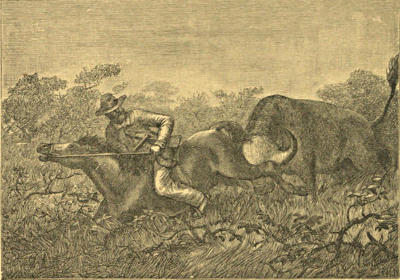
We had been unsuccessful up to this time in killing buffaloes handsomely. More than half those hit got away—chiefly, I think, from our not having as yet adopted the squatting position; but this may be a fad of mine, and our bad shooting have been the cause. Two days after leaving the camping ground I have just spoken of, whilst the waggons were moving slowly through the low bush, three bulls crossed the line of march. I was on my horse, Superior, and, with a shout to Murray that I intended to make sure of a bag this time, galloped after them, and singling out one, got alongside of him within five feet and fired. He pitched upon his head and lay perfectly still. Making sure he was dead, I would not give him the second barrel, and turned the horse to ride after the two others which were still in view; but, before I could get my animal into his stride, the wounded beast sprang up and struck him heavily. I felt the thud, but the horse did not fall, and cantered on for twenty yards, when the whisk of his tail dabbled my trousers with blood, and, on getting off, I found a hole thirty inches deep, and nearly wide enough to get into, in his flank, for the horn had been driven up to the base. The bull was too weak to follow up the attack, and died where he stood; the horse crawled on for a few yards, and then, seeing it was a hopeless case, I put a ball through his head.
This lesson early in shooting experiences made me cautious in buffalo-hunting throughout the whole of my time, though I have had a narrow escape or two. Coming homewards one afternoon, we stumbled into the middle of a herd asleep in the long grass. Our sudden appearance startled them from their dreams, a panic seized them, and away they galloped in the wildest confusion. One old patriarch had been taking his siesta apart from the rest, in a dense patch of bush to the right: the sound of the gun and the rush of his companions roused him, and with one barrel loaded, as I ran after his relations, I found myself face to face with him, within ten yards. He was evidently bent on mischief. We stared at one another for a second. I fired at his broad chest; it was the best I could do, for his nose was up, and the points of his shoulders were not exposed. He plunged at me instantly. I fortunately caught a projecting bough of the mimosa-tree under which I was standing, and, drawing my knees up to my chin, he passed below me. I have heard of people avoiding a charge by quickly stepping on one side, but the ground must have been in their favour, and they must have been very cool, and only resorted to this instinctively, I think, as a last resource. A buffalo, it is true, drops his head very low, but only just before he closes, and he can strike desperately right and left from the straight line, so you ought to secure four or five feet side room. I have never been obliged to try this lateral movement, and fear I should have made a mess of it, though I know it is possible; for I once travelled down the west coast of South America with a bull-fighting man and woman, and they explained to me how, when the ‘toro’ charged, they stepped aside and stuck the banderillos into his neck; but they had no bush or smoke to contend with. I have often, however, had to dodge animals round a tree, and once escaped from a borili by catching a bough, as in this instance.
On our first journey to Lake ’Ngami, when within a hundred miles, the oxen wearied, so we selected twelve of the freshest and started with my waggon only, and some of the men, leaving the rest to encamp themselves and await our return. During our absence the drivers had to supply the party with meat. One of them wounded a buffalo, which immediately charged. The man, dropping his musket, climbed a tree just in time. For four hours the buffalo watched that tree, walking round and lying down under it. How Piet got to terra firma again I do not remember. Probably the animal grew tired of waiting, though they are generally very patient, and willing to bide their time for retaliation. The following short story illustrates the vengeful nature of the beast; it is told, I think, in Moffat’s ‘Missionary Travels,’ but I have not the book by me, and cannot vouch for the exact words: A native, sitting by the water at night, wounded a buffalo, but not mortally. It made for the shooter, who ran and lay down under a projecting rock. Unable to get its horns to bear, but not to be baulked, with its long, rough tongue it licked off the flesh of the exposed part of the man’s thigh down to the bone, and then left its victim, who died early in the morning.
The smell of blood seems to madden these beasts; they will turn on a wounded and bleeding companion and gore him most savagely. As I write recollections come back of scenes that had left no vivid pictures in my mind, because nothing untoward happened; but why not, and how not, now one thinks of it, is wonderful. Stalking an antelope, or I know not what, I found myself in an immense herd of buffaloes. The bush was full of them, I was surrounded, and had nothing to do but stand still. They dashed about me like rooks after the wireworms in a newly ploughed field. I had the sensation of drawing myself in very tightly about the waistband. Till they thinned out into a tail I could not begin to shoot, but there were such numbers that even then I knocked over six at exceedingly close quarters. The danger was, being run over or butted down in the headlong stampede. The same thing has happened to me, and, I dare say, to many all-round shots, with elephants. How they avoided or missed you—for they didn’t seem to try to avoid—you can’t tell. You come out of it without a scratch, and therefore, as a rule, think no more of it.
If I were to write our daily life and shooting, it would be weary reading. In a few chapters of this kind, all I can do is to take my readers into some of my scrapes, and let them fill in the blanks; but perhaps, once for all, I may put the abundance of the game in those days in some way intelligibly before them, if I say that in most parts, with horses, one gun could easily have kept 800 men—600 we tried—fattened, and supplied with a store sufficient to last for months. Fortunately, in consequence of the excessive dryness of the climate, meat, cut into long thin strips and hung over the bushes to dry in the sun, will keep quite good for a long time. It needs soaking before cooking, and loses much of its flavour, but it holds body and soul together.
Leaving the valley and rocky hills of the Ba-Katla, we moved slowly onwards towards the Ba-Wangketsi; before reaching them, an event occurred which coloured my whole African life, and will colour my life as long as I live. It is no story of big game, and perhaps ought not to find a place in these pages; but it is so bound up with all my shooting, all my pleasure in Africa, that I would ask to be forgiven for telling it. I should feel a traitor to the memory of a dead friend if I did not.
We were trekking through some low sand-hills covered with scrub, when three lions crossed about fifty yards ahead of the oxen. Snatching up a gun, I jumped from the waggon, calling upon someone to follow me with a heavy rifle which was always kept loaded as a reserve battery. I pressed so closely on the leisurely retreating trio that the largest stopped short. I squatted, intending to take his shoulder as he turned, looked round for my second gun, and heard the bearer, who was close to me, whisper in Dutch, ‘You can get nearer by the ant-hill.’ The move lost me the lion, as he broke away after his companions; and then for the first time I took notice of the cool, tall, handsome lad who had offered me advice, and recognised in him at once the stuff to make a henchman of. From that day forth he was my right-hand man in the field, and never failed me.
John Thomas was an Africander, born at the Cape, of parents probably slaves; but as a grand specimen of manhood, good nature, faithfulness, and cheerful endurance, I never met his equal, white or black. Plucky to a fault, he was the least quarrelsome of men, the life and light of our camp fires, and the pet of the Kafirs, who seemed at once to understand his quiet unpretending nature, and always made their requests to me through ‘bono Johnny.’ To tell his good deeds through a five years’ wandering would very often be to show up my own faults; let it be enough to say that he was a perfect servant to a very imperfect master, who, now that his friend is dead, feels that he did not value him half enough, though he never loved man better. His worth, to those who know the troubles and difficulties of African travelling, may be outlined by the following little story.
When Livingstone and I made our journey in search of Lake ’Ngami, we held out to our followers that if we were successful we would not attempt to press on further. They were, as a rule, a timid folk, dreading the unknown, too ready to listen to any tale of danger and difficulty that might be in the world beyond, and always eager to turn colony-wards. After some hard work we reached the lake, and success bred in us the wish to do more; but we were bound to stand to our agreement. At last the desire of penetrating deeper into the land became so strong that I suggested calling a meeting of the servants and trying what our eloquence might effect. After putting before them that we fully recognised our promise of not constraining them to go with us any further, I told them that the Doctor and I had made up our minds to give them one of the waggons with sufficient stores, supplies and ammunition for their homeward journey, while we ourselves had decided to push on ahead. I further explained to them that they would have no difficulty in reaching the colony, as they knew the waters, and had the wheel-tracks. I paused for a minute, and then added, that though we could not ask them to accompany us, yet that if any one of them was willing to do so, we should be very glad. I rather enlarged upon our ignorance of the country in advance, for we did not wish to influence them unduly to join us. For a few moments there was silence, and blankness of face; then out stepped John, and speaking in Dutch, as he always did when his feelings were touched, though he at other times spoke English perfectly, said: ‘What you eat I can eat, where you sleep I can sleep, where you go I will go; I will come with you.’ The effect was instantaneous. ‘We will all go!’ was the cry. Do you think after that it was much matter to us whether our brother was black or white?
Time wore on. I was obliged to return to England. John accompanied me to the Cape. I told him, in part, how I valued his services, and asked him if I could in any way repay my debt of gratitude. I had taught him to read, in the bush, but that was the only good I had ever done him. His answer came, after some hesitation. He had heard so much of England that he should like, of all things, to go with me there. Two days later we were on board ship together. He, as usual, was everything to everybody—helping the steward, attending the sick ladies, nursing the babies; the idol of the sailors, to whom he told stories of bush life, the adored of the nurses. John, with all his virtues, was a flirt—the admirer and admired of all womankind. On arriving in England, I left him in London and went down to my brother’s. He hesitated about my henchman, thinking a real live black man would hardly suit the household of a country clergyman. But his coachman fell sick. Could John drive? I should think so. He was the best eight-in-hander in Cape Town. Down he came, and in half an hour he was perfectly established in the family. My brother declared he never had such a coachman, and was very kind to him, timidly at first. The cook taught him writing; the lady’s-maid went on with his reading. I shall not forget meeting him with the two women, one on either arm, chatting with them in the most accomplished style. His stay in England was limited to six months, as we had agreed, and he went back to the Cape with a friend of mine, who wrote most highly of him.
Two years passed away; I was a wanderer again; and at the beginning of the Crimean War found myself carrying secret-service money to Colonel, now Field Marshal, Sir Lintorn Simmons, political agent at Shumla. On my return to the coast I fell in with a cavalry regiment and the 60th Rifles encamped near Devna, a few miles from Varna. A sergeant of the latter regiment saluted as I passed, and asked for news from the front. Silistria was then besieged. I turned myself half round to the right on my saddle to talk with him, and presently felt a hand placed very gently, lovingly, on my left foot. John stood by my stirrup, his face a picture of affectionate triumph at having caught me again. He had taken service with an officer of the 60th. We threw ourselves down under a bush and renewed old memories. The Major, near whose tent we were, called John, and, finding from him who I was, most courteously entreated me, telling me how beloved John was by the regiment, and how well, through him, they knew my name. I had letters to deliver at Constantinople, and went on. John, I believe, sickened, and was invalided to England; but for two or three years I heard no more of him, for I was away in South America and elsewhere. Shortly after my return home a letter came to me, asking if I could recommend a black man named ‘John Thomas’ as a butler! He had referred the writer to me. I was obliged to say I knew nothing of his capabilities in this line, but added that, as a staunch ally in a fight with an elephant and an absolutely trustworthy man in all the relations of life (save that of a butler, in which I had not tried him), I could most highly recommend him. My friend engaged him, and had an excellent servant, for such was John’s power of adapting himself to circumstances that nothing ever came amiss to him. But the dark day was coming on; and, in the midst of his affectionate service, beloved from the head of the house to the youngest child, trusted and never found wanting, always ready and always willing, this fine, noble fellow died. I heard of his sickness too late to see him alive on earth, but I trust that master and man may hereafter meet as brothers in Heaven.
We had been shooting in this Ba-Wangketsi country for a fortnight, and the work had been very hard. One morning after breakfast, my companion, who was busy cleaning the head of a koodoo, said he would have a day of rest, and finish what he was about. His laziness was catching. I ordered my horses to be unsaddled, and was idling about the camp when our head man told me there was no food for the twelve or fourteen dogs, our night watchmen; so I took up my gun, which was only loaded in one barrel, and strolled out on the chance of a shot; but as, kill or miss, I intended to return immediately, I did not carry any spare ammunition. A reedy pond lay close in advance of the waggons in a little opening; beyond this, as on every other side, stretched a sea of bush and mimosa-trees. Two hundred yards from the outspan I came upon a clump of quagga and wounded one, which though mortally hit struggled on before falling. I followed, and marking the place where it fell, set my face as I thought towards the waggons, meaning to send out men for the flesh. No doubt of the direction crossed my mind—the pool was certainly not more that 400 yards in a straight line, and I thought I could walk down upon it without any trouble; so taking no notice of my out tracks, which had bent slightly in following the quagga, I started. It was now about 10 a.m.; little did I think that 5 p.m. would still find me seeking three vans nearly as large as Pickford’s, and half an acre of water.
In my first cast I cannot say whether I got wide or stopped short of the mark I was making for, and it was not until I had wandered about carelessly hither and thither for half an hour, feeling sure that it was only the one particular bush in front of me which hid the waggons, that I very unwillingly owned to myself that I was drifting without bearings in this bushy sea. The sun was nearly overhead, and gave but slight help as to direction, and the constant turning to avoid thick patches of thorns rendered it nearly impossible, in the absence of any guiding point, to hold a fixed course through this maze of sameness.
I tried walking in circles in the hopes of cutting the wheel tracks, but though on a previous occasion this plan had succeeded, it now failed. As with empty gun I plodded on, occasional small herds of rooyebuck and blue wildebeest, evidently very much at home, swept and capered by me, and, stopping and looking at me with wondering eyes, increased my feeling of loneliness. I had no doubts of regaining my party next day at latest, and cared but little for passing a night in the jungle; but, bewildered and baffled, I envied the instinct of the so-called brutes, which, careless of their steps, were nevertheless quite sure of their ways. Twilight near the tropics is very short. Just before the sun set, therefore, I followed a game track which I knew would lead to water, as it was still early in the season, and the rain supply had not yet dried up in the hollows. At dusk I reached a pool similar to the one I had quitted in the morning. After a good draught I began collecting firewood, but for once it was very scarce, and the night closed in so rapidly, that a bare hour’s supply was all my store. Partly to save fuel, and partly in the hope that as the night crept on signals would be made from the waggons, I climbed a tree which stood by the side of the water, and had not been long perched before I heard, though so far off that I could hardly catch the sound, the smothered boom of guns. Alarmed at my absence my companions suspected the cause, and were inviting my return: but it required a very pressing invitation indeed to induce a man to walk through two miles of an African wood in those days on a dark night.
This particular spot, too, was more infested with lions than any other, save one, I was ever in; and, though harmless and cowardly enough as a rule in the day, they were not likely to prove very acceptable followers at night. But I had been walking all day under a tropical sun, my clothing was wet with perspiration, and it now froze hard—for freeze it can in Southern Africa—and I was bitterly cold. I determined to come down and light my fire. I knew it would last but a short time, but thought I would make the best of it, and thaw myself before attempting to return. I got to the lowest bough of my tree, and had placed my hand beside my feet before jumping off, when from the bush immediately under me a deep note, and the sound of a heavy body slipping through the thorny scrub, told me that a lion was passing. Whether the creaking of the tree had roused his attention and caused him to speak so opportunely I don’t know, but without the warning, in another half-second I should have alighted on his back. I very quickly put two or three yards more between the soles of my feet and the ground. Presently, from the upper end of the pool came the moaning pant of a questing lion; it was immediately answered from the lower end—their majesties were on the look-out for supper, and had divided the approaches to the water between them. It was much too dark to see anything, but from the sounds they seemed to walk in beats, occasionally telling one another of their whereabouts by a low pant; of my presence I think they were not aware.
This went on for an hour or more, and I got colder and colder; my beard and moustache were stiff with frost. I could not much longer endure the cramped position in my scraggy tree, and I felt I must get down and light a fire, when, suddenly up came the blessed moon, and right under her the sound of three or four muskets fired together. With the help of her light and partial direction in case my companions got tired of firing, I was not going to stay up a tree to be frozen. Waiting, therefore, until she was about ‘one tree high,’ and until the lions were far asunder, on their separate beats, as well as I could make out from the sound, I came down, and capping—it was all I could do; for, as I said, I had started without powder and ball—my empty gun, which was standing against the tree, I passed at the double round the end of the water and dived into the bush on the opposite side. I have no doubt my desire was to get on as quickly as possible, but reasons for a cautious advance soon made themselves heard on all sides. An African forest was then alive at night. I only thought of the lions, and especially of the two I had left, or perhaps not left, at the water; but every little nocturnal animal that stirred kept me on the stretch—the less noise the more danger. The movement of a mouse might well be mistaken for the stealthy tread of the king of the cats. Among the trees the moon gave but scanty light, and nearly every minute I had to stop and listen as some unseen animals passed near me. Sometimes I could recognise them by their cry, but mostly it was ‘a running that could not be seen of skipping beasts’ that troubled me. The only animal I really saw that night was a rhinoceros that, with head and tail up and in a terrible fuss, crossed a few yards before me. A sound in front, and I strained my eyes into the shadowy darkness in advance; the rustling of a leaf told of life to the right or left; and the snapping of a twig of possible death in the rear. But I struggled on for an hour, I should think, when, stooping to clear a low bough, four or five muskets fired together within fifty yards told me I was at home again. I hope I was thankful then; I know I am now. Two of my Hottentot servants and a batch of Kafirs had come some distance into the bush in the hope of meeting me, and escorted me to the fire in triumph. As I held my still only half-thawed hands over it, the baulked roar of a disappointed lion rang through the camp. He had not been heard before that night. ‘He has missed you, Tlaga,[2] by a little this time,’ said my black friends. ‘Let him go back to his game.’ They were right, for in the morning we found his spoor on mine for a long way back. Whether he had come with me from the water or I had picked up a follower in the bush I never knew. My constantly stopping and listening probably saved me, for a lion seldom makes up his mind very suddenly to attack a man unless hard pressed by hunger. He likes to know all about it first, and my turning, and slow, jerky progress had probably roused his suspicions.
Two nights before this we had met with a sad misfortune. The oxen were ‘kraaled’—surrounded, that is, by a hedge of thorn-trees, and bushes strong enough to keep them in and lions out, we hoped—a mode of defence we always adopted if there was wood enough close to the outspan, or we intended staying any length of time in the same place; though occasionally, when we only halted for the night and were distant from water, and therefore likely to be free from lions, the oxen were instead made fast to the leathern rope, or ‘trek tow,’ by which they draw the waggon, each pair—there were five to each waggon—to their own yoke in the order they worked in the team, so that they were ready and in right position for inspanning in the morning. We were lying on this occasion by a large Wangketsi village, and the cattle had been kraaled rather to prevent them getting mixed with those of the Wangketsi, as they were taken out to graze at sunrise, than from any apprehension of an attack. The three waggons were drawn up as usual on one side of the enclosure, and the Kafirs were by their fires on the other. I was asleep, but was roused by shouts, the discharge of a musket, and the sudden rush of our pack of dogs. I found a lion had sprung over a weak place in the thorn fence on to the back of an ox, and, scared by the shouting, had jumped back again the same way. According to tradition I know the ox ought to have been in his mouth, but it wasn’t. A lion will drag an ox by the nape of its neck anywhere, but he can’t carry it, much less jump a 6-foot hedge with it in his jaws. It was quite dark, but by the gleam of the fires the men, aroused by the panic of the oxen, caught sight of him, and one of the Hottentot drivers had taken a flying shot. The dogs pressed hard upon him; directly he gained the cover he stood to bay. I suppose the poor things got hampered in the bush, for presently two crawled up to us mangled and dying. The hubbub went on for some minutes, and then the lion, frightened probably by the firing and yelling—we could give no other aid to our allies—broke bay, and ten dogs returned exclusive of the two that had come in to die; two were still missing—one of them a brindled bull terrier, which we all knew must one day come to grief, for he was a most reckless, determined brute, game to go in to anything. A few days before, feeling offended at a puff adder—the worst of the Cape snakes—hissing at him, he had seized it, and notwithstanding the snake striking him on the head with its fangs, had stuck to and killed it. His head swelled to an immense size, but he pulled through and recovered. With day we went to the place where the scrimmage of the night before had occurred, and there lay ‘Tod,’ as the Hottentots had named him, with the other absentee, both dead. ‘Tod’ had apparently run straight into the lion’s mouth, for the marks of the teeth were visible enough over his back and loins. He was a rash fellow, but he died an honourable death. The loss of dogs was a very serious one, for it was through their fidelity and watchfulness we were able to sleep in comparative ease and safety. At the first sound or smell of danger they went to the fore, and walked barking round and round with the lions, just keeping clear of their spring or sudden rush, showing them they were detected and that the camp was not all asleep. In the times I am writing of I don’t think it would have been possible, save with a large number of armed watchers and fires, to have kept your oxen in anything like safety without dogs. You went to sleep in peace as soon as the dog-watch was set and the fires made up for the night. Firewood was abundant after passing the Molopo. A store of huge logs was collected directly the waggons halted, and the blaze was kept up throughout the night, the fires being shaken together and replenished by anyone who chanced to wake; and as their own safety depended on it, the men were zealous in this part of their duty.
By this time we had shot most of the kinds of game to be found away from the rivers, in large numbers—Harris’s black buck potoquan (Aigoceros niger), and the beautiful hill zebra (Equus montanus) excepted. The former I only saw once during my five years in Africa, and never got a chance at, and the latter I would not have shot if I could—he is such a pretty, tiny, thoroughbred-looking thing, the size of a small Shetland pony, and the most playful little fellow imaginable, springing about the rocky hill-tops with the surefootedness of an ibex. We had not yet fallen in with elephants or even seen their tracks. Three years after the time of which I am writing I killed them frequently to the south, but now they were away to pastures new for the time, and we decided on going on north to the Ba-Mungwato country in the hope of finding them.
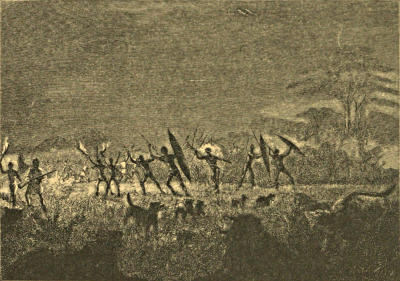
A night attack—Lupapi
On our way we halted at a small spring at the bottom of a slight depression. It looked as if the water had once been much larger, and might have occupied the best part of the area. There was a trickling overflow, which, after running a few yards, tumbled into a hole and disappeared; hence its name ‘Lupapi,’ or the ‘Mouse.’ This was the very worst place for lions I ever knew; not so much from their number as their insolent audacity. I stopped here on three separate occasions, and each time was molested more than sufficiently. On this, the first, we had made, luckily, a very strong kraal. The fires would not burn brightly, as there was a misty rain falling. At 10 p.m. or half-past we had only just turned in when we were attacked in force by two lions and a lioness. Our vedettes, the dogs, were driven in, and the enemy charged down upon the cattle enclosure. The noise, of course, woke us all, and dogs, Kafirs, Hottentots, Murray and myself had our work fully cut out; our assailants kept just outside the firelight, making savage rushes at the dogs, but never giving us the chance of a shot. I stood for a long time in very scant attire (someone brought me a jacket and trousers later on), my first entrance to the scene being anything but noble, for on running from the waggon to the front my foot caught in a creeper, and I fell heavily. The Kafirs behaved admirably, never yielding an inch, though the lions were very determined. After half an hour or so we nursed the fires into brighter glow, and increased the circle of light around us, and things grew rather calmer. We could hear every breath and angry purr, though as we were looking into the dark we could see nothing. For some time I made a Kafir stand beside me and throw brands into the darkness, hoping by a gleam to get sufficient indication of the whereabouts of our foes for a shot—but in vain. I fired frequently as near as I could guess on the spot where the purring seemed to come from, and could hear the angry beast make a dash at the pinging ball. But I struck nothing save the ground. However, we had checked the onset, and now had only to keep on the alert. Just before the day broke the siege was raised, and I was on horseback to look out a better camping-ground for the next night. As I cleared the low jungle which lay around us, a lioness broke away from the edge of it and took across an opening beyond. She was eighty yards from me, rather too long a shot for the old Purdey; but there was cover ahead from which I could not cut her off, and I was savage enough at her unwished-for attentions during the night, for she was, no doubt, one of the three, and oh! how glad I was when I heard the ball thud, and saw her stride short. I mounted and rode her to a standstill in a couple of hundred yards, when she squatted in front of a bush. I got within twenty or twenty-five yards of her, intending to dismount, but found I had fired all my loose balls away during the night, and that the one in the barrel was all I had to rely on. I have a weakness for a second bullet, and backing my pony a little further off I told my after-rider to go to the waggon and bring me a fresh supply. He was only absent a few minutes, I keeping watch on the lioness meanwhile. On his return I loaded the empty barrel, and, getting off for a steady shot, found to my dismay that, although I could see her well enough whilst sitting on my horse, the long grass hid her entirely when on my feet. I could not remount, for the after-rider had removed the horse, and it is not probable the lioness would have allowed me to do so without interference. For a moment I was in a fix, but about ten yards to my left I saw a dead mimosa-tree with a fork in it five feet from the ground. It appeared my only chance, though a risky one; and I wonder to this day that the beast did not charge when she saw the scrub moving as I passed through it. She did not, however, and I gained my fork and could now see her quite plainly, and she me likewise, for she never took her eyes off for one second. Her head was full front. I aimed between her eyes, but a twig must have turned the ball, for I was firing from a rest, and it only bored a clean hole through her ear. She struck it angrily with her paw, and then faced me again. The second shot was more successful, and she dropped dead. I had hit her the first time very far aft, but I think she must have been more crippled than I had supposed, or she would never have allowed me to move about so clumsily without attempting a diversion.
The second attack, a year afterwards, was not so prolonged, but the lions pressed the men so hard that they had to take refuge between the fires and the hedge of the kraal, and the beasts twice crossed the line of firelight in pursuit. The third imbroglio at this water was more serious, but the initiative this time was with me. John, my after-rider, woke me very early one morning to tell me a lioness and her cub were drinking at the spring, from which we were lying only 200 yards distant. Ordering him to saddle two horses—they had not yet been loosed from the waggon-wheels to which we always made them fast in pairs—I slipped on my clothes and, jumping on the back of one of them, galloped towards the spring, followed by John, half a dozen Kafirs, and the dogs, hoping to cut off mother and child from the thick bush behind them. But they beat me; and the dogs, taking the scent, followed them. The Kafirs had come with me, partly to see the fun and partly, in case of my shooting the lioness, to catch the cub, which, when it is quite young, they manage to do by chasing and dodging it, and throwing their short skin carosses over it. They then roll it up like a baby in swaddling clothes, with only its head out at one end and its tail at the other; round the bundle they wind a leathern riem or strap, and pass the snarling though now harmless little beast from one to another, saying pretty things of its father and mother, aunts and uncles, &c.
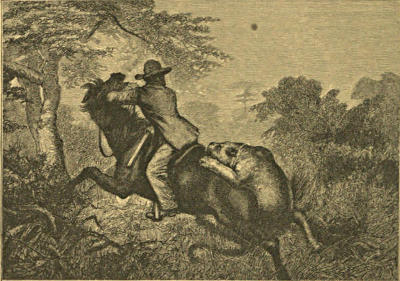
‘Post equitem sedet “fulva” cura’—The lioness does the scansion
The dogs very soon brought the lioness to bay, and I got within thirty yards, but from the thickness of the bush could neither see them nor her. I shifted my position once or twice in the hope of making out what was going on, standing up in my stirrups looking for an opening, that I might dismount and get a shot. Suddenly the barking of the dogs and snapping snarl of the lioness ceased, and I thought she had broken bay and gone on, but in a second I heard a roar on the horse’s right quarter, in a different direction from that into which I had been peering, and, looking round, saw her with her mouth open, clearing a rather high patch of bush twenty yards from me. There was no time to get off the horse, and no possibility of a shot from his back, for the charge was on his right flank, and you cannot shoot to the right. I did the only thing that I could—jammed the spurs in and tried to make a gallop of it; but my follower was too close, and before I could get up full speed I heard her strike the ground heavily twice in her bound, and with the third she sat up behind me. She jumped short, however, and failed to get hold with her mouth, but drove her front claws well into the horse’s quarters, and a hind foot underneath him, and so clung, but only for a moment; for the poor beast, maddened by fright and pain, and unable to stand up under the extra weight, became unmanageable, threw his head up, and swerved under the projecting bough of a tree which, striking me on the chest, swept me from the saddle against the lioness, and we rolled to the ground together. A sharp rap on the head, from my having fallen on a stump, stunned me for a minute or two, and I woke to life to find John kneeling alongside of me, asking me if I was dead, which was a needless question, seeing I was at the time sitting up rubbing my eyes. ‘What’s the matter?’I said, but at the same instant I heard the dogs again baying fifty yards off, and recollection came back. Rising to my feet, I staggered like a drunken man, rather than walked towards the sound, and propped myself up against a tree, for I was still weak and dazed; indistinctly I could occasionally see both dogs and lioness. Presently, something broke through the thinner part of the bush, and I fired and wounded one of the dogs. And the lioness, tired by the protracted worrying, and startled perhaps by the sound of the gun, bounded off and escaped without a shot. I have been often asked by those who have seen the sketch, ‘Oh, but why did you not turn round and shoot her from the saddle?’ And all the answer I could or can give is, ‘It’s easy to say but difficult to do,’ and that in a second we were on the ground together. The men told Livingstone that the dogs came out so close upon the lioness that she, rather flustered at being swept from the horse’s back, turned to fight with them, and took no notice of me. We caught the horse four miles off, and I sewed up and cured his wounds, but he was never fit for anything again, bolting dangerously at a stump or other dark object. A hard spin after a straight-horned gemsbok killed him.