"Big Game" (continued 5)
Reading edition
A blessed intuition told Margot that her waiting was at an end, and that this was the message for which she had longed ever since her return to consciousness. With a swift movement she slipped the envelope into her pocket, to be opened later on in the privacy of her room, and returned to the table, bearing the other communications in her hand.
“I should have thought that after six weeks’ absence from home you might have been willing to talk to me, instead of wanting to read letters at your very first meal!” said Agnes severely; and Margot laughed in good-natured assent.
“I won’t open them! It was only curiosity to see what they were. I’ll talk as much as you like, Aggie dear.”
It was, all of a sudden, so easy to be amiable and unselfish! The nervous irritation which had made it difficult to be patient, even with dear, tactful Edie during the last weeks, had taken wing and departed with the first sight of that square white envelope. The light came back to Margot’s eyes; she held her head erect, the very hollows in her cheeks seemed miraculously to disappear, and to be replaced by the old dimpling smile. Mr Vane and Ron exchanged glances of delight at the marvellous manner in which their invalid had stood the journey home.
The letters and parcel lay unnoticed on the table until the conclusion of the meal, but as Margot picked them up preparatory to carrying them upstairs to her own room, she gave a sudden start of astonishment.
“Ron, it’s the Loadstar! Some one has sent me a copy of the Loadstar. From the office, I think, for the name is printed on the cover. Who could it be?”
“The Editor, of course—as a mark of attention on your return home. Lazy beggar! It was easier than writing a letter,” laughed Ron easily, stretching out his hand as he spoke to take forcible possession, for the magazine was of more interest to himself than to Margot, and he felt that a new copy was just what was needed to occupy the hours before bedtime.
Margot made no demur, but stood watching quietly while Ron tore off the wrapper, and flattened the curled paper. She was not in a reading mood, but the suggestion that George Elgood might have sent the magazine made it precious in her sight, and she waited anxiously for its return.
“It’s mine, Ron. It was sent to me! I want to take it upstairs.”
“Let me look at the index first, to see who is writing this month! You don’t generally care for such stiff reading; I say, there’s a fine collection of names! It’s stronger than ever this month. I don’t believe there is another paper in the world which has such splendid fellows for contribu—”
Ron stopped short, his voice failing suddenly in the middle of the word. His jaw dropped, and a wave of colour surged in his cheeks.
“It—it can’t be!” he gasped incredulously. “It can’t! There must be another man of the same name. It can’t possibly be meant for me!...”
“What? What? Let me see? What are you talking about?” cried Margot, peering eagerly over his shoulder, while Ron pointed with a trembling finger to the end of the table of contents. Somehow the words seemed to be printed in a larger type than the rest. They grew larger and larger until they seemed to fill the whole page—“Solitude. A Fragment. By Ronald Vane!”
“Oh, Ron, it is!” shrieked Margot, in happy excitement. “It is you, and no one else! I told you it was beautiful when you read it to me that day in the Glen! Oh, when did you send it to him?”
“Never! I never so much as mentioned my verses in his hearing. That was part of the bargain—that we should not worry him on his holiday. Margot, it was you! You are only pretending that you know nothing about it. It must be your doing.”
“Indeed it isn’t! I never even spoke of you to him.” Margot had the grace to blush at the confession; but by this time Ron had turned over the pages until he had come to the one on which his own words faced him in the beautiful distinct typing of the magazine, and the rapture of the moment precluded every other sentiment. He did not hear what Margot said, so absorbed was he in re-reading the lines in their delightful new setting.
“It is good; but it is only a fragment. It isn’t finished. Why was this chosen, instead of one of the others?”
“I told you you would ruin it if you made it longer. It is perfect as it is, and anything more would be padding. It is a little gem, worthy even of a place in the Loadstar. Father, do you hear? Do you understand? Look at your son’s name among all those great men! Aren’t you glad? Aren’t you proud! Aren’t you going to congratulate us both?”
Mr Vane growled a little, for the sake of appearances; but though his eyebrows frowned, the corners of his lips relaxed in a manner distinctly complacent. Even recognising as he did the herald of defeat, it was impossible to resist a thrill of pride as his eye glanced down the imposing list of names held open for his inspection. A great scientist; a great statesman; a leading author; an astronomer known throughout the world; a soldier veteran, and near the end that other name, so dearly familiar—the name of his own son! The voice in which he spoke was gruff with emotion. “Humph! You are in good company, at least. Let me see the verses themselves. There must be something in them, I suppose, but I am no judge of these things.”
Chapter Twenty Five.
“In Corn.”
Meantime Margot had returned to the far end of the room, and adroitly slipped the third letter out of her pocket, feeling that it would be selfish to delay reading the contents, as they must certainly cast some light upon the present situation. Her heart sank a little as she recognised that the attention was less personal than she had imagined, but even so, it was to herself that the magazine had been directed, and that was an evidence of the fact that in publishing the poem her pleasure had been considered even more than Ronald’s advancement.
She tore open the stiff white envelope and read as follows:—
“Dear Miss Vane,—
“I hear that you are to arrive home this afternoon, and intend to take the liberty of calling upon you after dinner, in the hope that you may be able to give me a few minutes of uninterrupted conversation on a subject of great importance. If you are too much fatigued after your journey, pray have no scruples in refusing me admission, in which case I shall take an early opportunity of calling again; but after the strain of the past few weeks I do not find myself able to wait longer than is absolutely necessary for an interview.
“Yours faithfully,—
“George Elgood.”
“Is that from Elgood? What does he say? What does he say? Let us see what he says!” petitioned Ron eagerly; but Margot returned the letter to her pocket, resolutely ignoring his outstretched hand.
“He gives no explanation, but he is coming to-night. Coming to call after dinner, and he asks me to see him alone, so I’ll find out all about it, and tell you afterwards.”
“Alone!” Ron’s face was eloquent with surprise, disappointment, and a dawning suspicion. “Why alone? It’s more my affair than yours. I must thank him before he goes.”
“I’ll send for you, then. I suppose he wants to explain to me first. I’ll be sure to send for you!” reiterated Margot hurriedly, as she disappeared through the doorway. Her first impulse was, girl-like, to make for her own room, to give those final touches to hair and dress, which are so all-important in effect, and that done, to sit alone, listening for the expected knock at the door, the sound of footsteps ascending to the drawing-room. To meet George Elgood here! To see his tall dark figure outlined against the familiar background of home,—Margot gasped at the thought, and felt her heart leap painfully at every fresh sound.
The postman, the parcels delivery, a van from the Stores, had all claimed the tribute of a blush, a gasp, and a fresh rush to the glass, before at last slow footsteps were heard mounting the stairs, and Mary’s voice at the door announced, “A gentleman to see you, Miss Margot!” and in another minute, as it seemed, she was facing George Elgood across the length of the drawing-room.
The rôles of invalid and anxious inquirer seemed for the moment to be reversed, for while she was pink and smiling, he was grave and of a ghastly pallor. Nervous also; for the first words of greeting were an unintelligible murmur, and they seated themselves in an embarrassed silence.
“You—er—you received my letter?”
“Yes!” Margot gazed at the tips of her dainty slippers, and smiled softly to herself. In the interval which had passed since they last met, the Editor had evidently suffered a relapse into his old shyness and reserve. She had guessed as much from the somewhat stilted phraseology of his letter, and was prepared to reassure him by her own outspoken gratitude.
“Yes; I was so pleased!”
He gave a little start of astonishment, and stared at her with bright, incredulous eyes.
“Pleased? You mean it? You did not think it a liberty—”
“Indeed I did not. I guessed what you had to tell me, and it made me so happy.”
He leaned forward impetuously, the blood flushing his cheeks.
“You had guessed before? You knew it was coming?”
“Not exactly, but I hoped—”
“Hoped!—Margot, is it possible that you have cared, too? It seems too wonderful to be true.—I never dreamt of such amazing happiness. At the best it seemed possible that you would be willing to give me a hearing. I did not dare to write, but this time of waiting has seemed as if it would never end...”
As he began to speak Margot faced him with candid eyes, but at the sound of his voice, and at sight of the answering flash of his eyes, her lids quivered and fell, and she shrank back against the cushions of her chair. Astonishment overwhelmed her; but the relief, the thankfulness, the rapture of the moment obliterated everything else. She gave a strangled sob of emotion and said faintly—
“It—it has seemed long to me, too!”
At that he was on his knees before her, clasping her hands and gazing at her with an expression of rapturous relief. “Oh, Margot, my darling, was it because I was not there? Have you missed me? Not as I have missed you—that is not possible, but enough to remember me sometimes, and to be glad to meet again. Have you thought of me at all, Margot?”
“I—I have thought of nothing else!” sighed Margot. She was generous with her assurance, knowing the nature of the man with whom she had to deal, and her reward was the sight of the illumined face turned upon her.
There, in a corner of a modern drawing-room, with a glimpse of a London street between the curtain folds, Margot and George Elgood found the Eden which is discovered afresh by all true lovers. Such moments are too sacred for intrusion; they live enshrined in memory until the end of life.
It was not until a considerable time had flown by that Margot recalled the events of the earlier evening, and with them still another claim held by her lover upon her gratitude and devotion. Drawing back, so as to lift her charming face to his—a rosy, sparkling face, unrecognisable as the same white and weary visage of a few hours back, she laid her hand on his, and said sweetly—
“We went off at a tangent, didn’t we? I don’t know how we went off, and forgot the real business of the evening; but I never finished thanking you! You must think me terribly ungrateful!”
George Elgood regarded her with puzzled, adoring eyes.
“I haven’t the least idea what you are talking about, but what does it matter? What does anything matter, except that we love each other, and are the happiest creatures on earth? Business, indeed! Why need we trouble ourselves to talk about business? Margot, do you know that you have a dimple in the middle of your cheek? The most beautiful dimple in the world!”
Margot shook her head at him with a pretence of disapproval, smiling the while, so as to show off the dimple to the best advantage.
“You mustn’t make me conceited. I am vain enough already to know that you love me, and have taken so much trouble to please me. It was kind of you!”
“What was kind, sweetheart? There is no kindness in loving you. I had no choice in the matter, for I simply could not help myself!”
“Ah, but you know what I mean! You have given me my two greatest desires! I can’t tell you how happy I was when I saw it.”
He stared at her for a moment, then smiled complacently.
“You mean—my note?”
“No, I didn’t mean your note. Not this time. I meant the magazine!”
“Magazine!”
The accent of bewilderment was unmistakably genuine, and Margot hastened to explain still further.
“The new number of the Loadstar with Ron’s poem in it!”
“Ron’s poem!” The note of bewilderment was accentuated to one of positive incredulity. “A poem by your brother in the Loadstar! I did not know that he wrote at all.”
Now it was Margot’s turn to stare and frown.
“You didn’t know! But you must have known. How else could it get in? You must have given permission.”
“My sweetheart, what have I to do with the Loadstar, or any other magazine? What has my permission to do with it?”
“Everything in the world! Oh, I know exactly what has happened. Your brother has told you about Ron, and showed you his verses, and you put them in for his sake—and mine! Because you knew I should be pleased, and because they are good too, and you were glad to help him. He is longing to come in to thank you himself. We shall both thank you all our lives!”
George Elgood’s face of stupefaction was a sight to behold. His forehead was corrugated with lines of bewilderment; he stared at her in blankest dismay.
“What are you talking about, sweetheart? What does it all mean? Your brother has no need to thank me for any success which he has gained. I should have been only too delighted to help him in any way that was in my power, but I have no influence with the Loadstar Magazine.”
“No influence! How can that be when you are the Editor?”
“I am the What?”
“Editor! You have every influence. You are the magazine!”
George Elgood rose to his feet with a gesture of strongest astonishment.
“I the Editor of a magazine! My dearest little girl, what are you dreaming about? There never was a man less suited to the position. I know nothing whatever of magazines—of any sort of literature. I am in corn!”
A corn merchant! Margot’s brain reeled. She lay back in her chair, staring at him with wide, stunned eyes, too utterly prostrated by surprise to be capable of speech!
Chapter Twenty Six.
An Interview with the Editor.
Could it be believed that it was the Chieftain who was the Editor, after all! That short, fat, undignified, commonplace little man! “Not in the least the type,”—so Ron had pronounced, in his youthful arrogance, “No one would ever suspect you of being literary!” so saucy Margot had declared to his face. She blushed at the remembrance of the words, blushed afresh, as, one after another, a dozen memories rushed through her brain. That afternoon by the tarn, for example, when she had summoned courage to confess her scheme, and he had lain prone on the grass, helpless and shaken with laughter!
No wonder that he had laughed! but oh, the wickedness, the duplicity of the wretch, to breathe no word of her mistake, but promptly set to work to weave a fresh plot on his own account! This was the reason why he had extracted a promise that George was not to be told of Ron’s ambition during his holiday, feigning an anxiety for his brother’s peace of mind, which he was in reality doing his best to destroy! This was the explanation of everything that had seemed mysterious and contradictory. He had been laughing in his sleeve all the time he had pretended to help!
George Elgood listened with a mingling of amaze, amusement, and tenderness to the hidden history of the weeks at Glenaire. Being in the frame of mind when everything that Margot did seemed perfect in his eyes, he felt nothing but admiration for her efforts on her brother’s behalf.
It was an ingenious, unselfish little scheme, and the manner in which she had laid it bare to the person most concerned was delightfully unsophisticated. He laughed at her tenderly, stroking her soft, pretty hair with his big man’s hand, the while he explained that he was a business man pure and simple, and had made no excursions whatever into literature; that the “writing” with which he had been occupied was connected with proposed changes in his firm, and a report of a technical character.
Margot flamed with indignation, but before the angry words had time to form themselves on her lips, the thought occurred that after all the help vouchsafed to her had been no pretence, but a very substantial reality. Ron’s foot had been placed on the first rung of the ladder, while as for herself, what greater good could she have found to desire than that which, through the Chieftain’s machinations, had already come to pass? She lifted her face to meet the anxious, adoring gaze bent upon her, and cried hurriedly—
“He—he meant it all the time! He meant it to happen!”
“Meant what, darling?”
“This!”
Margot waved her hand with a gesture sufficiently expressive, whereat her lover laughed happily.
“Bless him! of course he did. He has been badgering me for years past to look out for a wife; and when we met you he was clever enough to realise that you were the one woman to fill the post. If he had said as much to me at that stage of affairs, I should have packed up and made off within the hour; if he had said it to you, you would have felt it incumbent upon you to do the same. Instead, he let you go on in your illusion, while he designed the means of throwing us into each other’s society. Good old Geoff! I’m not at all angry with him. Are you?”
Margot considered the point, her head tilted to a thoughtful angle.
“I’m—not—sure! I think I am, just a little bit, for I hate to be taken in. He was laughing at me all the time.”
“But after all, he has done what you wished! I envy him for being able to give you such pleasure; but perhaps I may be able to do as much in another way. Geoff tells me that Mr Martin has had financial troubles, and there is nothing I would not do to help any one who belongs to you. I’m out of my depths in poetry, but in business matters I can count, and in this case I shall not be satisfied until I do.”
Margot drew a long breath of contentment. “Oh, if Jack is happy, and Ron is successful, and I have—You!—there will be nothing left to wish for in all the world. Poor Ron! he is waiting eagerly to come in to thank you for publishing his verse, and wondering why in the world you wanted to see me alone. Don’t you think you ought just to read it, to be able to say it is nice?”
“No, I don’t! You are all the poetry I can attend to to-night, and for goodness’ sake keep him away; I shall have to interview your father later on, but after waiting all these weeks I must have you to myself a little longer.”
“Oh, I won’t send for him. I don’t want him a bit,” cried Margot naïvely, “but he will come!”
And he did!
Waiting downstairs in the study, an hour seemed an absurd length of time, and when no summons came Ron determined to take the law in his own hands and join the conference. The tableau which was revealed to him on opening the drawing-room door struck him dumb with amazement, and the explanations which ensued appeared still more extraordinary.
George Elgood speedily beat a retreat to the study, where Mr Vane listened to his request with quiet resignation. Elderly, grey-haired fathers have a way of seeing more than their children suspect, and Margot’s father had recognised certain well-known signs in the manner in which he had been questioned concerning his daughter’s progress during those anxious days at Glenaire. His heart sank as he listened to the lover’s protestations, but he told himself that he ought to be thankful to know that his little Margot had chosen a man of unblemished character, who was of an age to appreciate his responsibility, possessed an income sufficient to keep her in comfort, and, last but not least, a home within easy distance of his own.
Late that evening, when her lover had taken his departure, Margot stole down to the study and sat silently for a time on her old perch on the arm of her father’s chair, with her head resting lovingly against his own. He was thankful to feel her dear presence, and to know that she wished to be near him on this night of all others, but his heart was too full to speak, and it was she who at last spoke the first words.
“I never knew,” she said softly, “I never knew that it was possible to be as happy as this. It’s so wonderful! One can’t realise it all. Father dear, I’ve been thinking of you! ... I never realised before what it meant to you when mother died—all that you lost! You have been good, and brave, and unselfish, dear, and we must have tried you sorely many times. We didn’t understand, but I understand a little bit now, daddy, and it makes me love you more. You’ll remember, won’t you, that this is going to draw us closer together, not separate us one little bit? You’ll be sure to remember?”
“Bless you, dear!” he said, and stroked her hand with tender fingers. “It is sweet to hear you say so, at least. I’m glad you are going to be happy, and if I am to give you away at all, I am glad it is to a strong, sensible man whom I can trust and respect; but it will be a sad day for me when you leave the old home, Margot.”
Margot purred over him with tenderest affection.
“How I wish Agnes would marry!”
“What has that to do with it, pray?”
“Then you could live with me, of course! I should love it,” said Margot warmly; and though her father had no intention of accepting such an invitation, it remained through life a solace to him to remember that it had been in the girl’s heart to wish it.
Next morning at twelve o’clock a daintily attired damsel ascended a dusty staircase in Fleet Street and desired to see the Editor in his den. The dragon who guarded the fastness inquired of her if she had an appointment, and, unsoftened by the charm of her appearance, volunteered the information that Mr Elgood would see no stray callers.
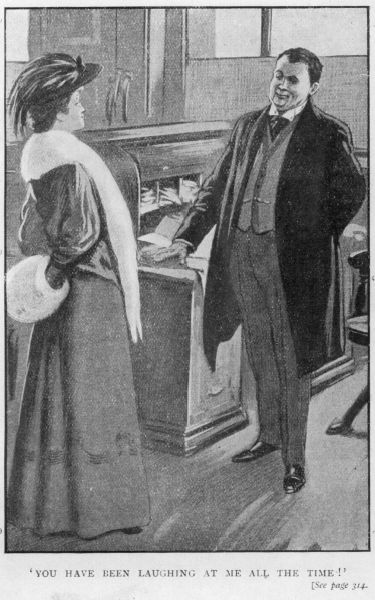
“He will see me!” returned Margot arrogantly; and she was right, for, to the surprise of the messenger, the sight of the little printed card was followed by an order to “Show the lady in at once.”
A moment later Margot made her first entrance into an Editor’s den, and round the corner of a big desk caught a glimpse of a decorous, black-coated figure whom at first sight it was difficult to associate with the light-hearted Chieftain of Glenaire. As they confronted each other, however, the round face twinkled into a smile, which served as fuel to the girl’s indignation. She stopped short, ostentatiously disregarding the outstretched hand, drew her brows together, and proclaimed haughtily—
“I have come to let you know that you are found out. I know all about it now. You have been laughing at me all the time?”
“Well,—very nearly!” he assented smilingly. “You are such a nice little girl to laugh at, you see, and it was an uncommonly good joke! Do you remember the day when you confided to me solemnly that you had journeyed to Scotland on purpose to stalk me, and run me to earth? You’d have been a bit embarrassed if I’d told you the truth then and there, wouldn’t you now? And besides—I see quite enough of literary aspirants all the year round. It was a bit hard to be hunted down on one’s holidays. I felt bound to prevaricate, for the sake of my own peace. Then again there was George! Where would George have come in? If I had confessed my identity, should I have been kept awake, as I was last night, listening to his rhapsodies by the hour together? By the way, we are going to be near relatives. Don’t you want to shake hands?”
“I’m very angry indeed!” maintained Margot stubbornly—nevertheless her hand was in his, and her fingers involuntarily returned his pressure. “Are you—glad! Do you think I shall—do? Does he seem really happy?”
“Ah, my dear!” he sighed, and over the plump features there passed once more the expression of infinite longing which Margot had seen once before, when, in a moment of confidence, he had spoken of his dead love. “Ah, my dear, how happy he is! There is no word to express such happiness! George has not frittered away his affections on a number of silly flirtations—his heart is whole, and it is wholly yours. Do you owe me no thanks for bringing you together? You wanted to help your brother; I wanted to help mine; so we are equally guilty or praiseworthy, as the case may be. For myself I am very well satisfied with the result?”
Margot blushed, and cast down her eyes.
“I’m satisfied, too!” she said shyly. “Much more than satisfied—and Ron is enraptured. Have you seen him? He said he was coming to see you first thing this morning!”
“Have I seen him, indeed? I should think I had! I thought I should never get rid of the boy. I told him straight that the magazine comes first to me, and that not even a prospective sister-in-law—with dimples!—could induce me to accept a line for publication otherwise than on its own merits. But the boy has power. I can’t tell yet how far it may go, but it’s worth encouraging. When he gave me his manuscript book to read I was struck by one fragment, and wrote it out in shorthand, to publish as a surprise to you both. I like the lad, and will be glad to help him so far as it is in my power. I can give him a small post in this office, where at least he will be in the atmosphere; but after that his future rests with himself. What he writes that is worth publishing, I will publish, but it will be judged on its merits alone, and without any remembrance of his private associations. He will have his chance!”
He put out his hands and held her gently by the elbows, smiling at her the while with the kindliest of smiles.
“Now are you satisfied, little girl? From the moment that you looked at me with her eyes, and asked my help, I have had no better wish than to give it. I did not set about it quite in your own way, perhaps, but the end is the same. Don’t trouble any more about the lad, but let me smooth the way with your father, while you devote yourself to George. His happiness is in your hands. Be good to him! He looks upon you as an angel from heaven! Be an angel for his sake! He sees in you everything that is good, and pure, and womanly. Be what he believes! Humanly speaking, his life is yours, and these little hands will draw him more strongly than any power in the world. It’s a big responsibility, little girl, but I am not afraid! I know a good woman when I see one, and can trust George to your care. You will be very happy. I wonder if in the midst of your happiness you will sometimes remember—a lonely man?”
Margot twisted herself quickly from his grasp, and her arms stretched out and encircled his neck. She did not speak, but her lips, pressed against his cheek, gave an assurance more eloquent than words.
The End.
| Chapter 1 | | Chapter 2 | | Chapter 3 | | Chapter 4 | | Chapter 5 | | Chapter 6 | | Chapter 7 | | Chapter 8 | | Chapter 9 | | Chapter 10 | | Chapter 11 | | Chapter 12 | | Chapter 13 | | Chapter 14 | | Chapter 15 | | Chapter 16 | | Chapter 17 | | Chapter 18 | | Chapter 19 | | Chapter 20 | | Chapter 21 | | Chapter 22 | | Chapter 23 | | Chapter 24 | | Chapter 25 | | Chapter 26 |