BIBLE CHARACTERS DISCUSSED AND ANALYZED BY THE SCHOLARLY DIVINE, Joseph Parker, D. D.
Reading edition
ABIJAH.
We forget Abijah’s character in his eloquence. He carries a spell with him. Judging from his speech, one would suppose him faultless—entirely noble in every aspiration and impulse and sublimely religious and unselfish.
The whole Abijah is not here. This is but the ideal Abijah. Who ever shows himself wholly upon any one occasion? Who does not sometimes go forth in his best clothing?
We must read the account of Abijah which is given in the Book of Kings before we can correctly estimate the Abijah who talks in the Book of Chronicles.
It is, perhaps, encouraging that while men are upon the Earth they should not be so dazzlingly good as to blind their fellow men. Yet it is pitiful to observe how men can be religious for the occasion. Nearly all men are religious at a funeral; but few men are religious at a wedding.
Abijah has a great cause to serve, and he addresses himself to it not only with the skill of a rhetorician but with the piety of a mind that never tenanted a worldly thought. God knows the whole character—how bright we are in points, how dark in many places; how lofty, how low. Knowing all, He judges correctly, and His mercy is His delight. Neither God nor man is to be judged by one aspect, or one attribute, or one quality. We must comprehend, so far as we may be able, the whole circuit of character and purpose before we can come to a large and true conclusion.
But as we have to do with the ideal Abijah, let us hear what he has to say in his ideal capacity. We will forget his faults while we listen to the music of his religious eloquence.
Abijah comes before us like a man who has a good cause to plead. He fixes his feet upon a mountain as upon a natural throne, and from its summit he addresses a king and a nation, and he addresses his auditors in the sacred name of “the Lord God of Israel.” He will not begin the argument at a superficial point, or take it as starting from yesterday’s new raw history—history hardly settled into form. He will go back, and with great sweep of historical reference he will establish his claim to be heard. In II. Chronicles, thirteenth chapter and fifth verse, Abijah asks:
“Ought ye not to know that the Lord God of Israel gave the kingdom over Israel to David for ever, even to him and to his sons by a covenant of salt?”
The binding covenant—the covenant that even pagans would not break. If you have eaten salt with a man you can never speak evil of him with an honest heart. You must forget your criticism in the remembrance of the salt. You are at liberty to decline intercourse and fellowship and confidence; you are perfectly at liberty to say: “I will have nothing to do with thee in any association whatsoever.” But you can not be both friend and enemy. You can not eat salt with a man and smite him in the face, or wound him in the heel, or hurt him in any way, at any time, in any line or point.
That was pagan morality.
We are fallen a long way behind it in many cases, for what Christian is there who could not eat all the salt a man has, and then go out and speak about him with bitterness, plunder him, frustrate his plans, anticipate him in some business venture, and laugh at him over his misplaced confidence?
Abijah recognized the perpetuity of the covenant. The kingdom was given to David for ever—if not in words, yet in spirit; if chapter and verse can not be quoted, yet the whole spirit of the divine communion with David meant eternity of election and honor. It is right to hold up the ideal covenant; it is right that even men who themselves have broken covenants should insist that covenants are right. We must never forget the ideal. Our prayers must express our better selves. A dying thief may pray. Again and again we have to fall back upon the holy doctrine that a man is not to be judged in his character by the prayers which he offers, inasmuch as his prayers represent what he would be if he could.
Abijah, having to deal with a perpetual covenant, charges Jeroboam with breaking it:
“Yet Jeroboam, the son of Nebat, the servant of Solomon, the son of David, is risen up, and hath rebelled against his Lord.”
All rebellion is wrong, unless it arises from a sense of injustice, untruthfulness or dishonesty. No man has a right to dissent from the national Church unless his dissent be founded upon conscience, a right conception of the nature of the Kingdom of Christ upon the Earth, which leads him to say to certain men: “Stand off.”
No part of the empire has a right to arise against the central authority, of which itself constitutes a part, merely for the sake of expressing political prejudice or selfish design. Every rebellion must be put down that can not justify itself by the very spirit and genius of justice. Separation becomes schism when it but expresses a whim, an aversion, of a superficial or technical kind; and every rebellion is wickedness, is born of the spirit of the pit, that can not justify itself by appeals to justice, nobleness, liberty and God.
Yet our rebellions have made our history.
We should have been in slavery but for rebellion. The rebels are the heretics that have created orthodoxy. We owe nothing to the indifferent, the languid, the selfish, the calculating, the let-alone people who simply want to eat and drink and sleep and die. That they were ever born is either an affront to nature or is the supreme mystery of human life.
Abijah, therefore, is perfectly right when he insists upon mere rebellion being put down; but when rebellion expresses the spirit of justice and the spirit of progress—the new revelation, the new day—all the Abijahs that ever addressed the world can only keep back the issue for a measurable period.
The accusation of Abijah was that Jeroboam had “gathered unto him vain men, the children of Belial.” For “vain men” read “sons of worthlessness”—empty fellows, who will join any mob that pays best; men who will cheer any speaker for a half-crown an hour, and put out anybody on any plea on any side for extra remuneration.
Where do these men come from? Whose language do they speak? Whose image and superscription do they bear?
They are in every country; they worship in the sanctuary of mischief and bow down at the altar of selfishness. They know not what they do. They will make a cross for a day’s wages. Evil company follows evil men. Worthless fellows are soon dissatisfied with the company of righteousness; the intercourse becomes monotonous and suffocating. A bad man could not live in Heaven. It is not in the power of mercy to save men from hell, for they carry hell with them; they are perdition.
Who can wonder if desecration followed in the steps of worthlessness? Abijah asks:
“Have ye not cast out the priests of the Lord, the sons of Aaron and the Levites, and have made you priests after the manner of the nations of other lands, so that whosoever cometh to consecrate himself with a young bullock and seven rams, the same may be a priest of them that are no gods?”
Let them bring the offering, and then they may become priests and do what they please at altars that have no foundations, the incense of which is a cloud that Heaven will not absorb. William Rufus declared that church bread was sweet bread. How many men have eaten church bread who ought to have died of hunger! What responsibility attaches to some people in this matter! Church bread ought never to be given away—ought never to be dishonored with the name of a “living.” No man should be in the Church who could not make five times the money out of it that he ever made in it. It should be felt that if he put forth all his power—both his hands, his whole mind and strength—he could be the greatest man in the commonwealth.
Jeroboam would admit any one to the altar; he would make room if there was none; he would cast out a priest of the Lord to make room for a priest of Belial. This is the accusation which Abijah brings against Jeroboam and his company of rebels.
Now Abijah turns to state his own case. He tells us what he and his people are:
“But as for us, the Lord is our God, and we have not forsaken Him; and the priests, which minister unto the Lord, are the sons of Aaron, and the Levites wait upon their business. And they burn unto the Lord every morning and every evening burnt sacrifices and sweet incense; the shew-bread also set they in order upon the pure table; and the candlestick of gold with the lamps thereof, to burn every evening; for we keep the charge of the Lord our God; but ye have forsaken Him.”
What a character Abijah gives himself!
Let us remember that we are dealing with an ideal man, and not with the real personality.
Take this, however, as an ideal representation, and how perfect it is in every line! “The Lord is our God.” We have a sound and vital theology; we have a clear upward look, and no cloud conceals the face divine; no idols have we—no images of wood, no pillars, no groves, no high places where idolatry may be performed as an entertainment.
The man reasons well. He insists upon having corner stones in any edifice or argument he puts up. When he accuses, he goes back to the covenant of salt; when he claims a right position, he claims that it is a theological one. He holds the right God. Losing the right theology, we lose all the detail with it. When the conception of God is wrong, no other conception can be right. It is only bold because it is true to say that if a man has not the right desire after the right God he can not keep correct weights and scales. The custom house, the inland revenue, the excise—call it what you please—may to some extent keep him up to the right mark, but in his soul he takes in every customer that comes near him; if he does not, he loses sleep. This applies to the so-called heathen as well as to the Christian. It is not necessary that a man should have a clear and perfect revelation of God, but that in his heart he feels that he is a creature, not a creator; a subject, not a sovereign; that he is under responsibility, and not above it. In that proportion only can he deal righteously and nobly with his fellow men.
“And the priests, which minister unto the Lord, are the sons of Aaron, and the Levites wait upon their business.”
Here is apostolic succession before the time of the invention of the term. Here is an excellent pedigree, a most complete genealogy. Our priests are in the Aaronic line, and the Levites know their business and keep to it; every thing is in order in our Church.
That is beautiful, and that is right. We need not shrink from adding, that is necessary. We must have nothing to do with men who are not in the Aaronic and apostolic succession; they must not occupy our pulpits, nor be allowed to make pulpits of their own; no man must sell them wood or stone with which to construct a pulpit; they must be forbidden by the genius of law from ever preaching or attempting to preach.
When we let go the doctrine of apostolic succession we let go a vital treasure and blessing.
We may differ as to our definition of “apostolic succession,” but surely there can be no difference among frank and enlightened hearts and minds as to what apostolic succession is. No man is in the apostolic succession who is not in the apostolic spirit, and no man is out of the apostolic succession who is animated by the spirit of the apostles. That is not a spirit which is conferred by the tips of any fingers; that is the gift of God.
Do you see your calling, brethren? God has chosen you. What a Church is God’s! Not a Church of wax-works, all made at one factory, and all charged for in one invoice; but living men, characterized by innumerable individualities—some broad as the firmament, others beautiful and tender as little flowers that can only grow in the fullest sun-warmth; some military in argument and in discipline, others persuasive in pathos, sympathy and tenderness.
There is no monotony in God. One star differeth from another in glory; no two blades of grass are microscopically identical. There is a common likeness in the worlds and in the sub-economies of Nature, but the more penetrating our vision is made by mechanical and scientific aids the more wondrous in difference are discovered to be the very things which are supposed to be identical.
We must never allow the apostolic succession to be handed about without its being accompanied by the apostolic spirit. Every man is in the apostolic succession who believes in the apostles, who follows them as they followed Christ, and who would know nothing among men but Jesus Christ and Him crucified.
“And they burn unto the Lord every morning and every evening burnt sacrifices and sweet incense; the shew-bread also set they in order upon the pure table; and the candlestick of gold with the lamps thereof, to burn every evening.”
At that time piety was mechanical. It could not be otherwise. God never forces history. The days come, each with its own burden and its own blessing, its own dawn and its own apocalypse. We can not have today what is due tomorrow. God’s seasons move in measured revolution, and come to us in orderly and timely procession; and no man can hasten them by lighting his camp fire, or striking his matches, or kindling his little inflammable powder.
We can not imitate the Sun.
Some have tried to mimic the stars; but where is the image of the Sun that the Sun has not obliterated by one mid-day look?
The time came when all these ordinances were set aside. There was to be no more burning; there was to be no morning sacrifice and evening sacrifice and sweet incense, or shew-bread and candlestick of gold and lamps thereof for evening burning.
“Ye are not come unto the mount that might be touched, and that burned with fire, nor unto blackness, and darkness, and tempest, and the sound of a trumpet, and the voice of words; which voice they that heard intreated that the word should not be spoken to them any more; but ye are come unto Mount Sion, and unto the city of the living God, the heavenly Jerusalem, and to an innumerable company of angels, to the general assembly and church of the first-born, which are written in Heaven, and to God the Judge of all, and to the spirits of just men made perfect, and to Jesus the Mediator of the new covenant, and to the blood of sprinkling, that speaketh better things than that of Abel.”
So we may misuse history by going back and making that necessary which has already been abrogated. We may thus ill-treat the day of rest, by measuring it and weighing it in Jewish scales. We may cast a cloud over the day of jubilee that comes every week, by measuring its beginning and its ending by Jewish arithmetic; we may make the whole week sabbatic by Christian consecration. There will always be ordinances, because while man is in the body he needs external helps, collateral assistances and auxiliaries. He is not always equally awake; he is not always equally spiritual. He needs the communion of saints, the coming together in holy fellowship, all the associations of a sacred time and a sacred place, and through the active yet subtle ministry of these he comes to feel that he is in touch with God. “Here in the body pent” we need such aids as can penetrate our prison and minister to the liberty of the soul.
Now Abijah says, as a kind of climax:
“And, behold, God himself is with us for our captain, and His priests with sounding trumpets to cry alarm against you. O children of Israel, fight ye not against the Lord God of your fathers; for ye shall not prosper.”
How steadfastly Abijah abides by the altar! He can not be tempted one step from the throne of God. His appeal is sublime because it is religious. It is historically religious. “The Lord God of your fathers.” It would seem to be a solemn thing to cut off oneself from all the currents of history—to bury our fathers over again in a deeper grave; yea, to bury them at night-time, so that when the morning came we could not tell where they were interred.
Abijah will have a historic line. He maintains the doctrine of philosophic and personal heredity and organic unity. He will insist upon it that the men of his day represented the men of dead generations, and were to do what they would have done had they then lived. Not only was it historically religious, but it was religion accentuated by motives, such as act most powerfully upon human conduct—“for ye shall not prosper.” That appeal they could understand.
The double appeal constitutes God’s address to men. He is bound to point out consequences, though He would not have life built upon them. There is no other way of getting at certain people than by telling them that if they believe not they shall be damned. They are so curiously and fearfully made that only hell can excite their attention. The preacher does not declare this doctrine of fire, or mere penalty, for the sake of revealing God and acting upon human thought and conduct. He knows it is an appeal more or less tinctured with possible selfishness. He can not but despise the man who asks for Heaven simply because he has smelt the fire of hell.
But the Christian preacher will begin where he can. He has to do with all classes and conditions of men. All men do not occupy the highest point of thought—do not approach the Kingdom of Heaven from the noblest considerations—and he is the wise pastor, he has the great shepherd heart, who receives men by night, by day, through the gate of fear, through the portals of love; who keeps the door ajar for men, not knowing when they may come home.
He is but a poor preacher, and he knows it, who bids people come to God that they may get to Heaven; but he is aware that some people can only understand through the medium of such terms, if ever; and he really hopes for them that by experience they may eventually rise to a nobler level, and desire God for God’s own sake. He only is in the Spirit of Christ who would pray as much, give as much, suffer as much, if he knew he had to die this night, and be blotted out for ever, as he would do and give if he knew he were this night going into everlasting glory.
To be good in order to buy Heaven is not to be good. To be religious in order to escape hell is not to be religious.
Yet we must always so judge human nature as to provide for people who can only act through fear, and through love and hope of reward. Their education will be continued and completed, and some day they will look back upon their infantile beginning and pity themselves.
The great thing, however, is to begin. If we are afraid of hell, let us ask great questions. If we are in hope of Heaven, let us begin to do great services. Hell and Heaven have nothing to do with it in reality, but they have to do a great deal with it initially, instrumentally and educationally.
What was the upshot of the war? Who needs to inquire? When Omnipotence goes forth to war, what can be the issue of the battle? God takes out His glittering sword, and His hand lays heavy in judgment; can grasshoppers stand before Him? Oppose a wooden fence to a boundless conflagration, and you may act almost rationally—most rationally—as compared with those who set a grasshopper to oppose the march of God.
The writer in the Book of Kings takes a much worse view of Abijah’s character than we find in the Book of Chronicles. From the first Book of Kings we learn that Abijah endeavored to recover the kingdom of the Ten Tribes, and made war on Jeroboam. No details are given, but we are also informed that he walked in all the sins of Rehoboam—idolatry and its attendant immoralities—and that his heart “was not perfect before God, as the heart of David, his father.”
In the second Book of Chronicles Abijah’s war upon Jeroboam is more minutely described, and he makes a speech to the men of Israel, reproaching them for breaking their allegiance to the house of David, for worshiping the golden calves, and substituting unauthorized priests for the sons of Aaron and the Levites. He was successful in the battle against Jeroboam, and took the cities of Bethel, Jeshanah and Ephraim, with their dependent villages. Nothing is said by the writer in Chronicles of the sins of Abijah, but we are told that after his victory he “waxed mighty, and married fourteen wives”—whence we may well infer that he was elated with prosperity, and like Solomon, his grandfather, fell during the last two years of his life into wickedness, as described in Kings. Both records inform us that he reigned only for the period of three years.
AHAB.
God is the time-keeper. He says: “Now.” We wonder we can not go just when it is convenient to ourselves. We think we see the exact juncture when it would be right to go, but if we went just then a serpent would bite us on the road.
We want to go to Heaven, but God says: “Not yet.”
We want to begin the battle, but God says: “Wait.”
In the eighteenth chapter of the first Book of Kings we read:
“And it came to pass, after many days, that the word of the Lord came to Elijah in the third year, saying: ‘Go, show thyself unto Ahab; and I will send rain upon the Earth.’ And Elijah went to show himself unto Ahab. And there was a sore famine in Samaria.”
Think of waiting “many days” and doing nothing! But what if waiting be the best working? What if we can best do every thing by simply doing nothing? There is a time to stand still and see the salvation of God.
Mark another thing in these verses. The Lord said “Go,” and Elijah went. Not Elijah “objected,” Elijah “reasoned,” or Elijah “pointed out the difficulties,” but simply Elijah “went.”
That is the true ideal of life.
Always be ready.
Contrast with this the case of Jonah. Elijah had no fear of Ahab. He who fears God can not fear man. If you go up to your duties in your own strength, you will find them difficult; if you come down upon them from high communion with God, you will find them easy.
The governor of the house of Ahab was called Obadiah. The word Obadiah means “servant of Jehovah,” and it would seem to have been a true description of the man, for we read that “Obadiah feared [or reverenced] the Lord greatly.”
It is possible for a man to be very bad in one direction and very tolerant in another. It was so in the case of Ahab. He was the worst of the kings of Israel, yet he kept a governor over his house who feared the Lord greatly.
The Lord causes the most wicked men to pay His religion the homage which is due to its excellence. A bad king employs a good governor. He who himself disobeys Jehovah yet engages a servant who fears the Lord greatly. The thief likes an honest man for steward. The blasphemer likes a godly teacher for his child. The great speculator prefers an unspeculative man for book-keeper. It is thus that virtue has many unconscious votaries.
He who is the slave of idolatry becomes an easy prey to the power of cruel tempters. We do not know that Ahab was a cruel man, but we do know that Jezebel was a cruel woman, and Ahab was greatly influenced by his passionate and sanguinary wife. Ahab’s provocation of the Lord may have been in the direction of idolatry alone; but to be wrong in your conception of worship is to expose yourself to every possible attack of the enemy. To pray in the wrong direction is to be weak in every other.
Ahab was a speculative idolater; Jezebel was a practical persecutor. Ahab showed that speculative error is consistent with social toleration. You must distinguish between Ahab and Elijah in this matter. It was Jezebel who slew the prophets of the Lord, and Ahab knew that his servant, Obadiah, had hidden fifty of these prophets in a cave; and yet Ahab kept Obadiah in his service. But redeeming points do not restore the whole character. “One swallow does not make a Summer.”
In the same character may be met great faith and great doubt. Obadiah risked his life to save fifty of the prophets of the Lord, yet dare not risk it, without first receiving an oath, for the greatest prophet of all! This mixture we find in every human character. “How abject, how august, is man!”
In Ahab, Obadiah, Elijah and Jezebel we see a fourfold type of human society. There is the speculator, the godly servant, the far-seeing prophet and the cruel persecutor.
Society has got no farther than this today. The Ahabs of the age are leading us away into speculation that ends in idolatry and in infinite provocation of the Lord; the Obadiahs of the age are still praying, and serving God, and saving even the worst households from the wrath of Heaven; the Elijahs of the age are still hurling their divine thunders through the corrupt and stagnant air, and piercing with lightning shafts the gloomy and threatening future; and the Jezebels of the age are still narrow, bitter, indignant, vengeful and sanguinary.
O wondrous combination! So checked, so controlled, by invisible but benignant power! Speculative error has its counterpart in actual cruelty, and patient worship has its counterpart in daring service.
We sometimes hear that Ahab was a covetous man. Are we quite sure that the charge is just and that it can be substantiated?
This charge is based on the affair of Naboth’s vineyard. How could Ahab be covetous? He proposed terms, saying:
“Give me thy vineyard, that I may have it for a garden of herbs, because it is near unto my house, and I will give thee a better vineyard than it; or, if it seems good to thee, I will give thee the worth of it in money.”
The terms do not, upon the face of them, appear to be unreasonable or inapplicable. Surely this is not mere covetousness, if covetousness at all. The vineyard was close to the palace, and that fact was assigned as a reason for wishing to open negotiations concerning its transfer. But do we not sometimes too narrowly interpret the word covetousness? It is generally, at least, limited to money. When a man is fond of money, wishes to add to it, and is not scrupulous as to the means by which he seeks to enhance his fortune, we describe him as covetous. The term is perfectly applicable in such a case.
But the term “covetous” may apply to a much larger set of circumstances, and describe quite another set of impulses and desires.
We may even be covetous of personal appearance; we may be covetous of popular fame, such as is enjoyed by other men; we may be covetous in every direction which implies the gratification of our own wishes; and yet, with regard to the mere matter of money, we may be almost liberal.
This is an astounding state of affairs.
A man may be liberal with money, and yet covetous in many other directions. Sometimes, when covetousness takes this other turn, we describe it by the narrower word, “envy.” We say we envy the personal appearance of some; we envy the greatness and the public standing of others.
But under all this envy is covetousness.
Envy is in a sense but a symptom; covetousness is the vital and devouring disease. Under this interpretation of the term, therefore, it is not unfit or unjust to describe Ahab as a covetous man.
Look at his dissatisfaction with circumstances. He wishes to have “a garden of herbs.” That is all. He is king of Israel in Samaria; but there is one little thing of which he has not yet possessed himself, and until he gets that in his hand he can not rest well. There is a dream that troubles him; there is a nightmare which makes him afraid to lie down to sleep.
Look at what he has. Who can measure it? Who can run through the enumeration of his possessions? Who can take an exhaustive inventory of all the riches of the king of Israel?
But there is one little corner that is not his, and he wants it, and until he can get it all the rest goes for nothing.
The great Alexander could not rest in his palace at Babylon because he could not get ivy to grow in his garden. What was Babylon, or all Assyria, in view of the fact that this childish king could not cause ivy to grow in the palace gardens?
Ahab lived in circumstances; he lived in the very narrowest kind of circumstances. As a little man, he lived in little things, and because those things were not all to his mind it was impossible for him to be restful or noble or really good.
Once let the mind become dissatisfied with some trifling circumstance, and that fly spoils the whole pot of ointment. Once get the notion that the house is too small, and then morning, noon and night you never see a picture that is in it, or acknowledge the comfort of one corner in all the little habitation. The one thing that is present in the mind throughout all the weary hours is that the house is too small.
Once get the idea that the business is undignified, and you go to it late in the morning and leave it early in the afternoon, neglecting it between times; you are also ashamed to speak of it, and will not throw your whole heart and soul during business hours into its execution.
Once get the notion that the neighborhood is unfashionable, and it goes for nothing that the rooms are large and airy, that the garden is one of the best you ever had, that there is ample scope for a rich library, that all the neighbors are men of peculiar intelligence and goodness. All go for nothing, because the tempter has said: “This neighborhood is not a fashionable quarter of the town, and when people come to know that you are living here they will lose confidence in you and respect for you.”
If we live in circumstances, we shall be the sport of events; we shall be without dignity, without calmness, without reality and solidity of character. Let us, therefore, betake ourselves into inner thoughts, into spirituality of life, into the soul’s true character, into the very sanctuary of God. There we shall have truth and light and peace; there the stormy wind can not disturb us, and the great darkness is but an outside circumstance, for within there is the shining of the light of God.
Then notice in Ahab a childish servility to circumstances.
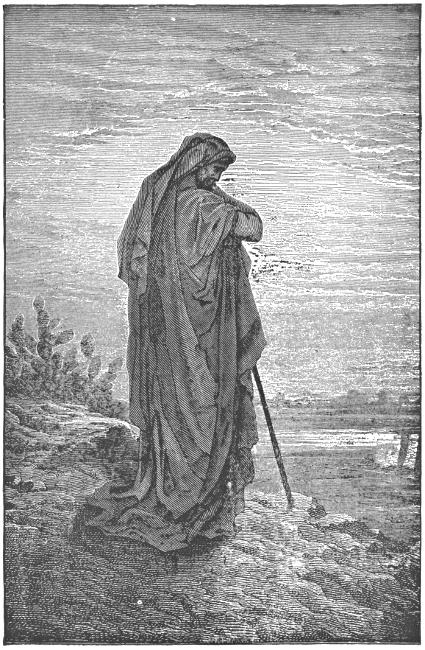
The Prophet Amos.
From the Painting by Gustave Dore.
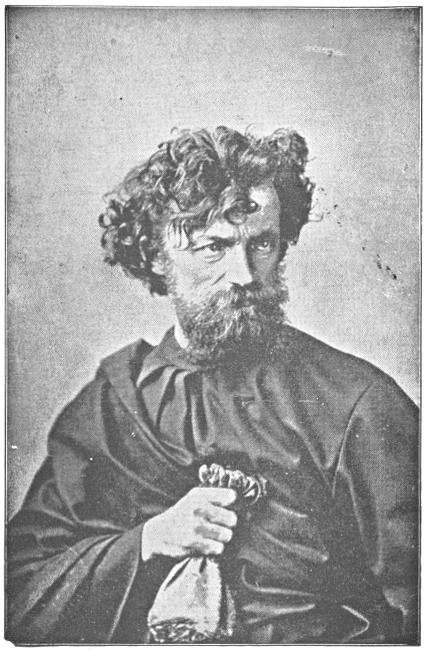
The Despair of Judas.
From a Photograph of the Character in the Passion Play.
“Ahab came into his house heavy and displeased … and he laid him down upon his bed, and turned away his face, and would eat no bread.”
Yet he was the king of Israel in Samaria! He actually had subjects under him. He was in reality a man who could give law, whose very look was a commandment, and the uplifting of his hand could move an army. Now we see him surely at his least. So we do, but not at his worst.
All this must have an explanation. We can not imagine that the man is so simply childish and foolish as this incident alone would describe him. Behind all this childishness there is an explanation. What is it?
We find it in the twenty-fifth verse:
“But there was none like unto Ahab, which did sell himself to work wickedness in the sight of the Lord, whom Jezebel, his wife, stirred up.”
That explains the whole mystery. The man had sold himself to the devil. And men are doing that self-same thing every day.
If it were a transaction in the market place—if the auctioneer were visibly interested in this affair, if he could call out in audible tones “So much is the price, and the man is about to take it,” people would shrink from the villainous transaction.
But this is an affair which does not take place in the open market or in the open daylight. It is not conducted in words. If the men involved in such transactions could speak the words, the very speech of the words might break the spell and destroy the horrible infatuation. But the compact is made in darkness, in silence, in out-of-the-way places. It is an understanding unwritten, rather than an agreement in detail signed in the presence of witnesses. It is a mystery which the heart alone can understand, which even the preacher can not explain in terms, but he can only throw himself upon his own consciousness, and throw others upon their consciousness, and call for a united testimony to the fact that it is possible to sell one’s very soul to evil.
Now we understand King Ahab better. We thought him but little, frivolous of mind, childish and petty, without a man’s worthy ambition; but now we see that all this was only symptomatic, an outward sign, pointing, when rightly followed, to an inward and mortal corruption.
Now, let us look at the case of Naboth and the position which he occupied in this matter.
Naboth possessed the vineyard which Ahab is said to have coveted. Naboth said: “The Lord forbid.” He made a religious question of it. Why did he invoke the Eternal Name and stand back, as if an offense had been offered to his faith? The terms were commercial; the terms were not unreasonable; the approach was courteous, and the ground given for the approach was not an unnatural ground. Why did Naboth stand back as if his religion had been shocked?
The answer is in the Book of Numbers, thirty-sixth chapter and seventh verse:
“So shall not the inheritance of the children of Israel remove from tribe to tribe; for every one of the children of Israel shall keep himself to the inheritance of the tribe of his fathers.”
So Naboth stood upon the law.
In Ezekiel we read:
“Moreover, the prince shall not take of the people’s inheritance by oppression, to thrust them out of their possession; but he shall give his sons inheritance out of his own possession, that My people be not scattered every man from his possession.”
So Naboth was not answering haughtily or resentfully. He was answering both solemnly and religiously. When money was offered for his fathers’ inheritance, he spurned the offer. There are some things, blessed be God, we can not pay for.
When Ahab said “I will give thee for it a better vineyard than it” he knew not of what he was speaking. There can be no better vineyard than the vineyard of the fathers; there can be no vineyard equal to the vineyard that is sown with history, planted with associations, solemnized and endeared by a thousand precious memories. There ought to be some things which we can not barter. Surely there ought to be some things which we should never try to sell.
Verily, when we hear propositions made to us that money shall be given in exchange for certain things, our whole soul should rise in horror and indignation, and repel the approach of a barter which itself expresses an infinite, because a most spiritual, injustice. So Naboth’s position was strong, and he had the courage to answer the king in these terms.
Kings must submit to law. Kings ought to be the subjects of their own people. Ahab was taught that there was a man in Samaria who valued the inheritance which had been handed down to him. Have we no inheritance handed down to us—no book of revelation, no day of rest, no flag of liberty, no password of common trust? Do we inherit nothing? Did we make the age as it is, and is civilization a creature of our own fashioning? And are we not bound to hand on to others what was handed to us intact and unpolluted?
Let us live in a sacred past, and regard ourselves as trustees of many possessions, and only trustees, and as bound to vindicate our trust and have an ample acquittal at the last.
So Ahab lay down upon his bed, turned away his face, and would eat no bread. But there is a way of accomplishing mean desires. There is a way of obtaining what we want. Take heart! There is a way of possessing oneself of almost whatever one desires. There is always some Merlin who will bring every Uther-Pendragon what he longs to have; there is always some Lady Macbeth who will show the thane how to become king. There is always a way to be bad. The gate of hell stands wide open; or, if apparently half closed, a touch will make it fly back, and the road is broad that leads to destruction.
Jezebel said she would find the garden or vineyard for her husband. She taunted him. “Dost thou now govern the kingdom of Israel? Arise and eat bread, and let thine heart be merry. I will give thee the vineyard of Naboth, the Jezreelite.” Jezebel threw into the word “govern” a subtle and significant emphasis.
How will she proceed? She will be ceremoniously religious; she will proclaim a fast. O thou sweet, white, pure religion, thou hast been forced into strange uses! “Proclaim a fast;” lengthen your faces; mimic solemnity; promise your hunger an early satisfaction, but look as if you were fasting.
It is a sure sign of mischief when certain men become serious. The moment they appear to be religious the devil is just adding the last touch to the building which he has been putting up within their souls. When they talk long words—when they speak about responsibility, obligation, duty, conscience, compulsion of conviction—they are walking over tesselated pavement into the very jaws of hell.
They do not mean their words; they do but use them. “The heart is deceitful above all things, and desperately wicked.”
First of all, then, be ceremoniously religious, Jezebel; then trample down truth. “Set two men, sons of Belial, before him, to bear witness against him, saying: ‘Thou didst blaspheme God and the king.’” Falsehood is always ready. A great black lie is always willing to be loosed and to be set going in the minds of men to pervert them and mislead them. It is always open to the bad heart to speak the untrue word. Nor is the untrue word always frankly and broadly spoken. If so, it could be answered in some cases.
The false word is hardly spoken at all; it is uttered in a whisper. Falsehood is made to use signs and gestures; even silence is made to bear witness to falsehood. Truly, again we may say: “The heart is deceitful above all things, and desperately wicked.” Tell a lie big enough about any man, and it will be difficult, if not impossible, to do away with the consequences of the false accusation. People will always be found to say: “There must be something in it; it may not be just as rumor has it, but surely a statement of that kind never could have been invented. Allowing a good deal for exaggeration, there must be something in it.”
Nor is it always possible to get even righteous men to purge their minds of that damnable sophism. Men who ought to stand up and say “There is nothing in it” hang down their heads, and with a coward’s gesture let the lie pass on.
This is how men insult the Son of God, and crucify the Man of truth. They will not be thorough, bold and fearless, and make the enemy ashamed of himself for either having invented or repeated a falsehood. Nor may the man escape because he says he heard the lie. Tell him he may have heard it, but he is yet responsible for repeating it. He may have no control over the hearing, but the moment he repeats it he adopts it, and renders himself amenable to the Eternal Righteousness.
Make the very law an instrument of injustice! First charge this man with blasphemy and treason, and then take him out and stone him, that he may die! Do not give him time to speak; do not ask for his defense; do not give him an opportunity of interrogating the witnesses. But who would cross-examine two “sons of Belial?” Better almost to die than to taint the hands and eyes with the touch and look of such children of blackness!
“Then they carried him [Naboth] forth out of the city, and stoned him with stones, that he died.” It is all over! Jezebel did this. Jezebel—a woman, a king’s wife—did this. High position goes for nothing when the heart is wrong. Great influence means great mischief when the soul is not in harmony with the spirit of righteousness.
Is Naboth quite dead? Yes, he is dead. Take the vineyard—take possession of it instantly. Now grow herbs, and grow them plentifully. The vineyard is now at liberty—take it. “Ahab rose up to go down to the vineyard of Naboth, the Jezreelite, to take possession of it.” But who is that looms in the distance? Is it Naboth? No.
How comes this man to be here just now—aye, just now? How the end is marked off into points, and how does providence reveal itself at unexpected times and in ways unforeseen! Who is this? He looks stern. He has an eye of fire. His lips are shut as if they could never be opened. He does but look.
Who is he? “Elijah, the Tishbite.” He has a message:
“Thus saith the Lord: ‘Hast thou killed, and also taken possession?’ … Thus saith the Lord: ‘In the place where dogs licked the blood of Naboth shall dogs lick thy blood, even thine.’”
A sad walk!
Ahab went down to take possession of a vineyard, and a death warrant was read to him! After all, it is safe to live in this universe; there is law in it, there is a genius of righteousness, there is a Force that moves on toward noble issues.
“And Ahab said to Elijah: ‘Hast thou found me, O mine enemy?’ And he answered: ‘I have found thee; because thou hast sold thyself to work evil in the sight of the Lord.’” Ahab went out to take possession of a garden of herbs, and there he stands face to face with righteousness—face to face with honor—face to face with judgment.
Now take the vineyard. He can not! An hour since the Sun shone upon it, and now it is black as if it were part of the midnight which has gathered in judgment.
There is a success which is failure. We can not take some prizes. Elijah will not allow us. When we see him we would that a way might open under our feet that we might flee and escape the judgment of his silent look.
In the Septuagint version the twentieth chapter of the first Book of Kings immediately precedes the twenty-second. The three years without war is a period which is reckoned from the peace which was so rashly made by Ahab with Ben-hadad.
It is clear that Ben-hadad has recovered his independence, and is probably in a position of superiority. It is certain that he has not restored Ramoth-gilead, as he had promised to do, and his reconstructed army now seems to him to be sufficient to encounter successfully the united hosts of Israel and Judah. In the forty-second verse of the same chapter we have seen how Ahab was rebuked for allowing the enemy to escape.
It has been supposed that this conduct on the part of Ahab may have been due partly to compassion and partly to weakness. The judgment of the Lord was, however, expressed in the severest terms:
“Because thou hast let go out of thy hand a man whom I appointed to utter destruction, therefore thy life shall go for his life, and thy people for his people.”
In the third verse we see these words signally fulfilled. The king of Israel seems to have a good cause when he said to his servants: “Know ye that Ramoth, in Gilead, is ours, and we be still, and take it not out of the hand of the king of Syria?” On this occasion Ahab entered into an alliance with Jehoshaphat, king of Judah, for the purpose of taking back the city which belonged to Israel. Jehoshaphat made a deferential as well as a friendly reply, but insisted upon the fulfillment of a religious condition. Jehoshaphat would make inquiry at the word of the Lord.
Thereupon four hundred prophets were gathered together, and with one consent they advised that the attack should be made upon Ramoth-gilead. Surely this was enough to satisfy the judgment and the conscience of the most religious man, yet Jehoshaphat was not content with the unanimous reply which four hundred prophets had returned.
“There is a spirit in man, and the inspiration of the Almighty giveth them understanding.”
All external unanimity goes for nothing when the conscience itself dissents from the judgment which has been pronounced. There is a verifying faculty which operates upon its own responsibility, and which can not be overpowered by the clamor of multitudes who eagerly rush down paths that are forbidden. Even when imagination assents to the voice of the majority, and when ambition is delighted with the verdict of the prophets, there yet remains the terrible but gracious authority of conscience. Through all the clamor that authority makes its way, and calmly distinguishes between right and wrong, and solemnly insists that right shall be done at all hazards and in view of all consequences.
A vital lesson rises here to all who are anxious to know the right way under difficult circumstances. It is not enough to have great numbers of authorities on our side; so long as the conscience remains unsatisfied all other authorities are “trifles light as air.”
Jehoshaphat was uneasy, therefore, notwithstanding the prophets had said: “Go up; for the Lord shall deliver it into the hand of the king.” He inquired: “Is there not here a prophet of the Lord besides, that we might inquire of him?” The word which Jehoshaphat used was the great word, Jehovah. It was not enough for him to use a religious or sacred term. He must have the prophecy identified with the awful name, Jehovah; then it would come with final authority.
The king of Israel knew that there was another man whose very name signified “Who is like Jehovah?” Ahab frankly admitted that he hated Micaiah because he never prophesied good concerning him, but always evil.
Observe the madness of Ahab’s policy, and note how often it is the policy which we ourselves are tempted to pursue. We suppose that if we do not consult the Bible we may take license to do what seems good in our own eyes, and we imagine that by ignoring the Bible we have divested it of authority. We flatter ourselves that if we do not listen to an exposition of the divine word we shall be judged according to the light we have, forgetting the solemn law that it is not according to the light we have that we are to be judged, but according to the light we might have if we put ourselves in right relations to the opportunities created for us by divine providence.
We know that if we go to hear a certain preacher he will insist upon “righteousness, temperance and judgment to come;” and, supposing that we already know every thing that he will say, we turn away from him and listen to men who do not profoundly treat vital subjects, or press home upon the conscience the terrible judgments of God.
What is this but closing our eyes to light, and supposing that darkness is safety? What is this ostrich policy but one that ought to be condemned by our sense as well as shrunk from by our piety?
Our duty under all critical circumstances is to go to the truth-teller, and to get at the reality of things at all costs. Where the truth-teller disturbs our peace and disappoints our ambition, we ought surely to learn that it is precisely at that point that we have to become self-rectifying. The truth-teller is only powerful in proportion as he tells the truth. Officially, he is nothing; his power is simply the measure of his righteousness.
But do not men love to be flattered, even in courses of evil? Is it not pleasant to go to forbidden war amid the huzzas of thoughtless and irresponsible multitudes?
Jehoshaphat, however, was a just man, and as such he protested against the sin of the king of Israel, saying: “Let not the king say so.” Jehoshaphat being so bent upon a complete judgment of the case, Micaiah was sent for. The king of Israel wished to overawe the despised prophet by the pomp and circumstance under which he was introduced to the royal presence. “The king of Israel and Jehoshaphat, the king of Judah, sat each on his throne, having put on their robes, in a void place in the entrance of the gate of Samaria,” and, to increase the impressiveness of the occasion, all the prophets prophesied before the kings.
A singular addition was made to the surroundings of the occasion which was intended to impress the imagination and stagger the courage of the despised Micaiah. A man bearing the name of Zedekiah (“righteousness of Jehovah”) made him horns of iron. The use of symbolical acts is quite common in biblical history. We have already seen Abijah engaged in acts of this kind. He “caught the new garment that was on him and rent it in twelve pieces, and said to Jeroboam: ‘Take thee ten pieces.’”
The enthusiasm of Zedekiah inflamed all the other prophets to the highest point of excitement, and they shouted as with one voice:
“Go up to Ramoth-gilead, and prosper; for the Lord shall deliver it into the king’s hand.”
In this instance the prophets, overborne by the enthusiasm of Zedekiah, actually ventured to use the name of Jehovah, which had not been used in the first instance. The excitement had passed the point of worship and had become more nearly resembling the frantic cry that was heard on Mount Carmel: “O Baal, hear us.”
Is it possible that there can be found any solitary man who dare oppose such unanimous testimony and complete enthusiasm?
The messenger who was sent to call Micaiah was evidently a man of considerate feeling and who wished the prophet well. Seeing that the words of the prophets had all declared good unto the king with one mouth, the messenger wished that Micaiah should for once agree with the other prophets, and please the king by leaving undisturbed their emphatic and unanimous counsel.
Thus the voice of persuasion was brought to bear on Micaiah, and that voice is always the most difficult to resist. The temptation thus addressed to Micaiah was thus double in force. On the one hand, there were the pomp and the terror of the king who had sold himself to do evil, and who would shrink from the infliction of no cruelty that would express his unreasoning and unlimited anger; on the other hand, there was the good will of the messenger, who wished Micaiah to escape all danger and penalty, and for once to take the popular side. Micaiah’s reply is simply sublime: “As the Lord liveth, what the Lord saith unto me, that will I speak.”
The humility of this answer is as conspicuous as its firmness. Its profound religiousness saves it from the charge of being defiant. Micaiah recognizes himself merely in the position of a servant or medium, who has nothing of his own to say; who is not called upon to invent an answer or to play the clever man in the presence of the kings. He was simply as a trumpet through which God could blow His own blast, or a pillar on which God would inscribe his own message, or a voice which God would use for the declaration of His own will. It is unjust to attribute obstinacy or any form of self-will or self-worship to Micaiah. If he had consulted his natural inclination alone, he would have sought favor with the king, and the logical effect of his subsequent position would have been that Ahab would have endeavored for ever to silence him by constituting him the prince and leader of the four hundred prophets. Micaiah said, in effect, what was said centuries afterward: “We have this treasure in earthen vessels.”
Micaiah lived in God, for God, and had nothing of his own to calculate or consider. Until preachers realize this same spiritual independence, they will be attempting to accommodate themselves to the spirit of the times, and even the strongest of them may be betrayed into connivances and compromises fatal to personal integrity and to the claims of truth.
Now came the critical moment. Now it was to be seen whether Micaiah was to be promoted to honor, or thrust away in contempt and wrath. It is easy to read of the recurrence of such moments, but difficult to realize them in their agony. Yet these are the moments which make history in its sublimest lines.
It is not too much to say that there have been points of time at which if certain men had given way the whole economy of the world have been wrecked.
The king addressed himself to the prophet, saying: “Shall we go against Ramoth-gilead to battle, or shall we forbear?” The answer of Micaiah must have been a surprise to all who heard it, for he said: “Go, and prosper; for the Lord shall deliver it into the hand of the king.”
This is an answer which can not be understood in print. It was evident, however, that Ahab was in no doubt as to its meaning, for the tone of the prophet was a tone of almost contemptuous irony. If King Ahab had taken Micaiah’s literal answer, he would have gone forth to the battle comforting himself with the thought that he was carrying out the will of Heaven; but he knew in his own soul that Micaiah was not uttering that which expressed the reality of the case. With anger the king said unto him: “How many times shall I adjure thee that thou tell me nothing but that which is true in the name of the Lord?”
Then Micaiah replied in symbolic language, the full meaning of which was vividly clear to the mind of Ahab; for, turning to Jehoshaphat, he said: “Did I not tell thee that he would prophesy no good concerning me, but evil?”
Thereupon Micaiah charged the whole band of prophets with being under the inspiration of a lying spirit, and thus he put a stigma upon their judgment and extracted from it every particle of dignity and authority.
But this was not to be borne, for Zedekiah went near and smote Micaiah on the cheek and taunted him as being the only prophet in Israel. Micaiah had to bear the sarcasm conveyed in the inquiry: “Which way went the Spirit of the Lord from me to speak unto thee?”
Micaiah, like a true prophet, leaves his judgment to the decision of time. He will not stoop to argue, or to exchange words either of anger or of controversy; he simply says that Zedekiah will one day see the meaning of the whole prophecy, and until that day controversy would be useless.
Micaiah had to pay for his intrepidity. He was carried unto Amon, the governor of the city, and to Joash, the king’s son, and was to be put in prison and fed with the bread of affliction and with the water of affliction until Ahab returned in peace.
Micaiah thus disappears from history. Of his fate we know nothing; but there can be no difficulty in forecasting it a cruel death. Micaiah knew well the meaning of the king’s message. It may be difficult for the commentator to explain the expression, “bread of affliction and water of affliction,” but Micaiah knew the full meaning of the terms, and yet, while their cruel sound was in his ears, he looked at the king and said: “If thou return at all in peace, the Lord hath not spoken by me.”
Micaiah also made his appeal to the people, and thus committed himself to the verdict of history, saying: “Hearken, O people, every one of you.”
See whether it is not a moment to be proud of when Micaiah turns away in the custody of his persecutors, having delivered his soul with a fearlessness that did not cower or blanche, even at the sight of death in its most ghastly form. Surely, it is due to history to recognize the fact that there have been men who have not counted their lives dear unto themselves when they were called upon to testify for truth and goodness.
The martyrs must never be forgotten.
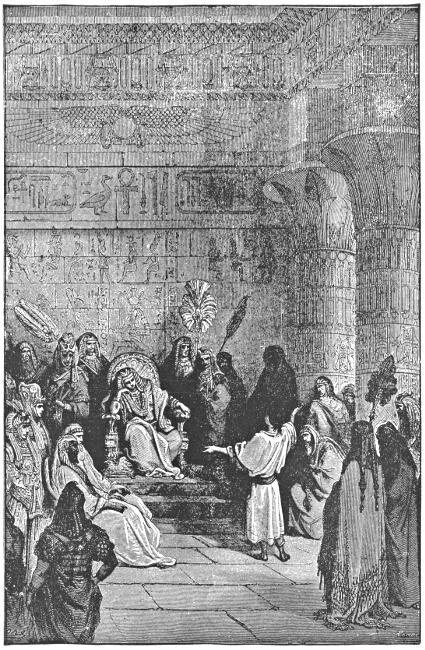
Joseph Interpreting Pharaoh’s Dream. Genesis, xli.
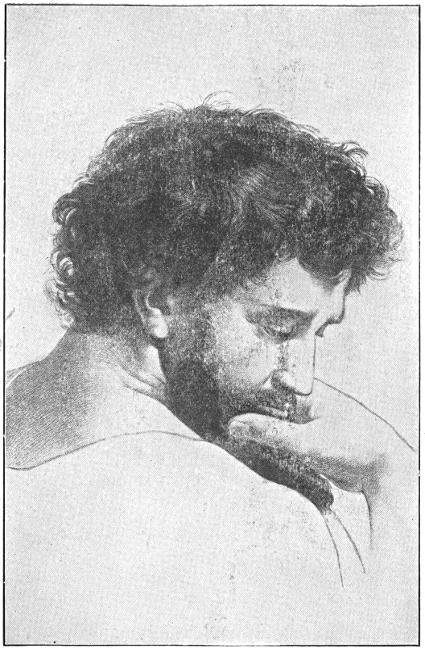
St. Paul.
From the Painting by Raphael.
Dark will be the day in the history of any nation when the men who shed their blood that truth might be told and honor might be vindicated are no longer held in remembrance. In vain do we bring forth from our hidden treasure the coins of ancient times, the robes worn in high antiquity by kings and priests, the rusty armor of warriors, if there is no longer in our heart the most tender recollection of the men who wandered about clad in sheep-skins and goat-skins—being destitute, afflicted and tormented—that they might save the torch of truth from extinction and the standard of honor from overthrow.
Away the kings have gone, and instead of relying upon the word of the Lord, or taking refuge in the sanctuary of great principles, they invent little tricks for the surprise and dismay of the enemy.
The king of Israel disguised himself, and Jehoshaphat made himself as the king of Israel; but all their inventions came to nothing. A certain man drew a bow at a venture, and smote the king of Israel between the joints of the harness. The poor king was fatally struck. He “was stayed up his chariot against the Syrians, and died at even; and the blood ran out of the wound into the midst of the chariot.… And one washed the chariot in the pool of Samaria; and the dogs licked up his blood; and they washed his armor; according unto the word of the Lord which He spake.”
So will perish all the enemies of the Lord.
Differences of merely accidental detail there will ever be, but no honor can mark the death of those who have gone contrary to the will of Heaven, and taken counsel of their own imagination. How long shall the lessons of history be wasted upon us? How long will men delude themselves with the mad infatuation that they can fight against God and prosper? Horsemen and chariots are nothing; gold and silver are valueless; all the resources of civilization are but an elaborate display of cobwebs. Nothing can stand in the final conflict but truth, right and purity. These are the eternal bulwarks, and unto these are assured complete and unchangeable victory. If God be for us, who can be against us? And if God be against us, it will matter not what kings are for us; they shall be blown away by the wind as if contemptuously, and cast out as refuse which is of no value.
My soul, be thou faithful to the voice of history, nor tell lies to thyself, nor operate merely through imagination, ambition or selfish calculation; for the end of this course is death—not heroic death, not death over which coming men and women will weep, but death that shall be associated with dishonor, a thing to be forgotten, an event never to be named without bitterness and shame.
The first and second Book of Kings constitute a section of Jewish history, and originally formed only one book in the sacred writings. It was customary with the Jews to name the sacred books from the word or words with which they commenced; and, while this practice may have given rise to the designation, “Kings,” it is right to observe that the title is well fitted to indicate the character of these historic compositions.
The annals given in these sacred registers are necessarily brief; but they extend from the close of David’s reign till the commonwealth was dissolved, a period of 427 years. Succinct as is the history contained in these books, there are some peculiarities in them which should not be overlooked, and from which not a little may be learned. There is not here a simple biography of the various kings that occupied the thrones of Judah and Israel, nor is there a mere detail of national movements and events, nor even a tabular register of ecclesiastical affairs. The throne, the state and the church are all exhibited in their mutual relations and bearings upon each other. Kings and people are held up to view as existing and acting under the immediate government of God; and hence the character of the ruler is always tested by the mode in which he adheres to the laws of the Most High and develops the moral excellences of the people. The notice of his accession to royal office is generally accompanied with an estimate of his conduct, and the standard to which he is likened or with which he is contrasted is either the character of David, of his own father or of Jeroboam, the son of Nebat, “who made Israel to sin.”
All the political events which are recorded have been brought forward chiefly to exhibit the influence of religion on national prosperity, and in this way to show how the divine King of Israel observed the conduct of his subjects, and rewarded their fidelity or avenged their wickedness with expressions of righteous indignation. And the affairs of the Church are all portrayed with the evident design of giving prominence to the same important truth.
Idolatry in Israel was treason against their King; religious defection was open revolt, and every act of overt wickedness was an act of rebellion. Hence there is a constant comparing or contrasting of religious state and feeling with those of former times, and especially are the oracles of truth continually elevated as the perfect standard to which the thoughts and actions of all should be conformed.
The Mosaic promises and warnings are strikingly verified in the Books of Kings. For this object they were written, and to the manifestation of this the author has made his whole narrative conduce.
Much variety of opinion exists with reference to the author of these records and the period of their composition. Jewish tradition ascribes the authorship of the treatise to Jeremiah, the prophet—a supposition which is greatly strengthened by the similarity of style and idiom which is traceable between the language of the Books of Kings and that of Jeremiah.
AHAZIAH.
Ahaziah was the son of Ahab and Jezebel. He was badly born. Some allowance must be made for this fact in estimating his character.
Again and again we have had occasion, and shall indeed often have, to remark upon the disadvantages of children born of wicked parents. It is not for us to lay down any final doctrine of responsibility; we must leave that in the hands of a just and gracious God.
A terrible spectacle, however, it is to see a man whose father sold himself to work wickedness in the sight of the Lord, who bound himself as for a price to show rebellion on the very floor of Heaven.
Ahaziah was a prince of evil—a man who said he would defile the sanctuary and commit his supreme sin within the shadow of the altar, and whose mother laid the plans for the murder of Naboth, and who all but personally superintended their execution. What can we expect from such a child of darkness? Who can gather grapes of thorns, or figs of thistles? Was he responsible for his own actions? Society is often hard on such men—not unreasonably or unnaturally. Yet society is often very gracious to such men, saying with an instinctive piety and sense of justice: “After all, such men are not to be personally blamed for their antecedents; they may indeed be open to some measure of suspicion, but even they must have their opportunity in life.”
Let us consider the case of Ahaziah and see how matters stand for our own instruction.
To understand the matter thoroughly, we must go to the twenty-second chapter of the first Book of Kings: “Then said Ahaziah, the son of Ahab, unto Jehoshaphat: ‘Let my servants go with thy servants in the ships.’ But Jehoshaphat would not.”
Jehoshaphat was right when he acted upon his instinct. By-and-by he came to act upon a basis of calculation, and then a compact was entered into. But who dare set aside the voice of instinct—the very first voice that rises in the soul to make judgment and to give direction?
Jehoshaphat, on hearing the proposal of the son of Ahab, said: “No. I have known thy father too well. I am too familiarly acquainted with thy family history. Thou shalt not send thy servants with mine.”
It would be well for us if we could sometimes act more promptly upon our instincts. It would have been well for Jehoshaphat if he had acted upon his instinct.
Ahaziah fell through the lattice, and in his helplessness he became religious. Man must have some God. Even Atheism is a kind of religion. When a man recoils openly from what may be termed the public faith of his country, he seeks to apologize for his recoil, and to make up for his church absence by creating high obligations of another class. He plays the patriot; he plays the disciplinarian; he will be a Spartan in personal training and drill—in some way he will try to make up for or defend the recoil of his soul from the old altar of his country.
It is in their helplessness that we really know what men are. Do not listen to the frivolous and irresponsible chatter of men who, being in robust health, really know nothing about the aching, the sorrow, the pain, the need and the agony of this awful human life.
What does our helplessness suggest? Instantly we go out of ourselves to seek friendship, assistance and sympathy. “Oh, would some gentle hand but touch my weariness!” Thus cries the helpless one. All that, being fairly and duly interpreted, has a religious signification. The cry for friendship is but a subdued cry for God.
Sometimes men will invent Gods of their own. This is what was done, practically, by Ahaziah. Men will go out after novel deities. This is what is being done every day—not under that name, but the mere name makes no difference in the purpose of the spirit. Say new enjoyments, new entertainments, new programs, new customs—these, being interpreted as to the heart of them, mean new altars, new helpers, new gods.
It is said of Shakespeare that he first exhausted worlds, and then invented new. That was right. It was but of the liberty of a poet to do so. But it is no part of the liberty of the soul. Necessity forbids it, because the true God cannot be exhausted. He is like His own nature, so far as we know it in the great creation; He is all things in one, gleaming and dazzling as noon-tide, soft and gentle as the balmy wind, strong as the great mountains and rocks, beauteous as the tiny fragrant flowers, musical as the birds that make the air melodious, awful as the gathered thunder which hovers above the Earth as if in threatening.
Who can exhaust nature?
Who can exhaust nature’s God?
Still, the imagination of man is evil continually. He will invent new ways of enjoying himself. He will degrade religion into a mere form of interrogation. This is what Ahaziah did in this instance: “Go, inquire of Baal-zebub, the god of Ekron, whether I shall recover of this disease.” All that we sometimes want of God is that He should be the great fortune teller.
How true it is that Ahaziah represents us all in making his religion into a mere form of question asking—in other words, into a form of selfishness!
The messengers have now come. They have taken their speech from their king, and they are on the road to consult Baal-zebub, the god of Ekron. But who is this who meets them, and who asks:
“Is it not because there is not a God in Israel that ye go to inquire of Baal-zebub, the god of Ekron?”
The men had said nothing about their errand. Who is it that reads the heart night and day, to whom the darkness and the light are both alike, and from the fire of whose eye nothing is hid? How do we get the impression that when we have perfected our lie it is in some sense public property? We are sure the man whom we meet knows it. He looks as if he did.
Elijah is an abrupt speaker. The “hairy man” and “girt with a girdle of leather” did not study the scanning of his sentences. He struck with a battering ram; his interrogations were spears that quivered in the heart; his looks were judgments. What an effect he produced upon these men! Why did they not go past him and say: “Keep thy speeches to thyself, thou hairy man, nor interfere with the king’s messengers”?
We can not do that. We know that some men are not to be turned away so. We may attempt to deceive, evade or disappoint them, but they have a magnetic and most marvelous influence upon us. Though they do not speak in the imperative mood, they speak with imperative force.
The men turned back like whipped children to tell the king what they had heard, and Ahaziah was surprised at their early return. He can not sleep. He asks that the book of the chronicles may be brought, that he may look up events and see where the loop slipped, where the wrong entry was made, or where the minutes were not carried out in detail.
All this means that Elijah lives in some form or other and will meet us and confront us and have it out with us.
Look at the conflict between Ahaziah and Elijah, the Tishbite. Ahaziah is the king and Elijah is only the prophet, and the king ought to have every thing his own way ex-officio. Now we shall see what metal Elijah is made of. He handled kings as if they were little children. He took them up and set them down behind him and said: “Wait there until I return, and stir at your peril.”
The prophet should always be the uppermost man. Kings are nothing compared to teachers and seers—men who hold the judgments of God on commission. The great men of the nation are the prophets, the teachers, the educators of thought, the inspirers of noble sacrificial enthusiasm. See how Elijah tramps among the kings. He has no favor to ask. If he were driven to ask for one morsel of bread, he would be Elijah no more.
Ahaziah sends to Elijah and says: “Come down.” These words sound very commanding and imperative. Elijah answered: “If I be a man of God, then let fire come down from Heaven and consume thee and thy fifty. And there came down fire from Heaven and consumed him and his fifty.”
Look at the conflict and its parties. On the one hand, petulance; on the other, dignity. On the one side, anger—fretful, fuming, petty; on the other, judgment—calm, sublime, comprehensive, final.
Ekron was one of the royal cities of the Philistines. Its situation is pointed out with considerable minuteness in Scripture. It is described as lying on the northern border of Philistia and of the territory allotted to Judah. It stood on the plain between Bethshemesh and Jabneel. Jerome locates it on the east of the road leading from Azotus (Ashdod) to Jamnia (Jabneel). From these notices we have no difficulty in identifying it with the modern village of Akir. Akir stands on the southern slope of a low and bleak ridge or swell which separates the Plain of Philistia from Sharon. It contains about fifty mud houses, and has not a vestige of antiquity except two large and deep wells and some stone water troughs. Ekron means “wasteness.” The houses are built on the accumulated rubbish of past ages, and, like their predecessors, if left desolate for a few years they would crumble to dust. The most interesting event in its history was the sending of the ark to Bethshemesh. A new cart was made and two milch kine yoked to it, and then left to choose their own path; “and they took the straight way to the way of Bethshemesh,” the position of which can be seen in a gorge of the distant mountains eastward. The deity worshiped at Ekron was called Baal-zebub, and we may conclude from the story of Ahaziah that this oracle had a great reputation, even among the degenerate Israelites. Ekron was a large village in the days of Jerome, and also in the age of the crusades.
ASA.
Asa was a good king of Judah. He “did that which was good and right in the eyes of the Lord, his God.” Not only “good and right,” because these might be variable terms. There are persons who set themselves to the presumptuous and impious task of settling for themselves what is “right” and what is “good.”
In the case of Asa, he did not invent a righteousness, nor did he invent a goodness which he could adapt to his own tempers, ambitions and conveniences. He was right and good and “did that which was good and right in the eyes of the Lord, his God.”
While the land had peace, Asa set to work and built walls, towers and fences, and did all that he could for the good of his country.
Zerah, an Ethiopian warrior, did not understand silence. He mistook quietness for languor. He made the vulgar mistake of supposing that quietness was indifference. He did not know that repose is the very highest expression of power.
Zerah brought against Asa, king of Judah, no fewer than a million soldiers—to us a large number, but to the Orientals quite a common array. Zerah’s host was the largest collected army of which we read in Scripture, but it does not exceed the known numbers of other Oriental armies in ancient times. Darius Codomannus brought into the field at Arbela a force of 1,040,000. Xerxes crossed into Greece with certainly above a million combatants. Artaxerxes Mnemon collected 1,260,000 men to meet the attack of the younger Cyrus.
What was to be done? Asa did not shrink from war, though he never courted it. He must meet the foe in battle. Before doing so he must pray.
“Lord, it is nothing with Thee to help, whether with many or with them that have no power. Help us, O Lord, our God, for we rest on Thee; and in Thy name we go against this multitude. O Lord, thou art our God; let not man prevail against Thee.”
Having risen from their knees, they launched themselves against the Ethiopians, and were mighty as men who answer straw with steel. They fought in God’s name and for God’s cause, and the thousand thousand of the Ethiopians were as nothing before the precise and terrific stroke of men who had studied war in the school of God.
The defeat of Zerah is one of the most remarkable events in the history of the Jews. On no other occasion did they meet in the field and overcome the forces of either of the two great monarchies between which they were placed. It was seldom that they ventured to resist, unless behind walls. Shishak, Sennacherib, Esarhaddon, Nebuchadnezzar, Alexander and Ptolemy I. were either unopposed or only opposed in this way. On the other occasion on which they took the field—which was under Josiah against Necho—their boldness issued in a most disastrous defeat.
Asa, then, began upon a good foundation; he established himself upon a great principle. That is what all, young people especially, should take to heart right seriously. Do not make an accident of your lives—a thing without center, purpose, certitude or holiness. Be right in your great foundation lines, and you will build up a superstructure strong, after the nature and quality of the foundation upon which you build. Do not snatch at life. Do not take out an odd motto here and there and say: “This will do for the occasion.” Life should be deeply laid in its bases, strongly cemented together in its principles, noble in its convictions; then it can be charitable in its concessions and recognitions.
“And Asa took courage, and put away the abominable idols out of all the land of Judah and Benjamin, and out of the cities which he had taken from Mount Ephraim, and renewed the altar of the Lord.”
Let us not trifle with the occasion by suggesting that we have no idolatries to uproot, no heathen groves to examine, to purify or to destroy. That would indeed be making light of history and ignoring the broadest and saddest facts of our present circumstances. The world is full of little gods, man-made idols, groves planted by human hands, oppositions and antagonisms to the tried Theism of the universe.
We are apt to think that the idols are a long way off—far beyond seas; or that they existed long centuries ago and spoke languages now obsolete or forgotten.
Nothing of the kind. They live here; they build today. Our gods are a million strong. We do not call them gods, but we worship them none the less. Luck, Accident, Fortune, Fashion, Popularity, Self-Indulgence—these are the base progeny of idols that did once represent some ideal thought and even some transcendental religion. Idolatry has retrograded; polytheism has gone quickly backward.
Asa said, in effect: “We must be right about our gods before we can be right with one another.” That is true teaching. With a wrong theology we never can have a thoroughly sound and healthy economic system.
This was the corner-stone upon which Asa built his great and gracious policy. What was the effect of it upon other people? We find that the effect then was what it must always be:
“They fell to him out of Israel in abundance when they saw that the Lord, his God, was with him.”
Such is the influence of a great leadership. If Asa had been halting, the people would have halted, too. Asa was positive; and positiveness, sustained by such beneficence, begets courage in other people. “They fell to him out of Israel in abundance”—that is, they came over to him and were on his side. They ranked themselves with Asa; they looked for his banner and called it theirs, “when they saw that the Lord, his God, was with him.”
Nations perish for want of great leaders. Social reforms are dependent to a large extent upon the spirit of the leadership which has adopted them. The Church is always looking around for some bolder man, some more heroic and dauntless spirit, who will utter the new truth, if any truth can be new—say, rather, the next truth; for truth has always a next self, a larger and immediately impending self, and the hero, who is also martyr, must reveal that next phase of truth and die on Golgotha for his pains.
Can we not, in some small sense, be leaders in our little circles—in our business relations, in our family life, in our institutional existence? Many people can follow a tune who can not begin one. That is the philosophy we would unfold and enforce.
Regard all leaders with prayerful hopefulness in so far as they want to do good and to be good. Sympathize with them; say to Asa, even the king: “What thou hast done thou hast well done; in God’s name we bless thee for the purification of the land and for the encouragement of all noble things.”
Asa showed the limits of human forbearance and human philosophy. He broke down in the very act of doing that which was right because he went too far. He made a covenant, and the people made it along with him.
Solemn renewals of the original covenant which God made with their fathers in the wilderness occur from time to time in the history of the Jews, following upon intervals of apostacy. This renewal in the reign of Asa is the first on record. The next falls three hundred years later, in the reign of Josiah. There is a third in the time of Nehemiah. On such occasions the people bound themselves by a solemn oath to observe all the directions of the Law, and called down God’s curse upon them if they forsook it.
“And they entered into a covenant to seek the Lord God of their fathers with all their heart and all their soul; that whosoever would not seek the Lord God of Israel should be put to death, whether small or great, whether man or woman.”
That is the danger. You can not make men religious by killing them, by threatening them, by inflicting upon them any degree of penalty. Do not force a child to church. Lead it; lure it; make the church so bright and homelike and beautiful that the child will eagerly long for the time to come when the door will be opened.
Asa was impartial. There was a touch of real grandeur about the man. He would not even allow his mother to keep an idol. The queen had an idol of her own “in a grove.”
“And also concerning Maachah, the mother of Asa, the king, he removed her from being queen, because she had made an idol in a grove; and Asa cut down her idol, and stamped it and burnt it at the brook Kidron.”
Thus ruthlessly Asa disestablished that little royal church. See how burningly in earnest the man was, and what a man will do when his earnestness is fervent! He knows nothing about fathers, mothers, partialities or concessions. He says: “Light is the foe of darkness, and you can not have any little dark corner of your own. This light must find you out, chase away every shadow and purify every secret place in human life and thought.”
Some have supposed that Maachah, the mother of Abijah, and Maachah, the “mother” of Asa, were different persons, the former being the daughter of Absalom, the latter the daughter of Uriel of Gibeah. There are really no grounds for this. Maachah, the mother of Abijah, enjoyed the rank of queen mother not only during his short reign of three years, but also during that of her grandson, Asa, until deposed by him on account of her idolatry.
The original word for “idol” appears to signify a “horrible abomination” of some monstrous kind; and instead of “in a grove” we should read “for an asherah,” the wooden emblem of the Canaanitish deity.
There seems little doubt that some obscene emblem is meant, of the kind so often connected with worship of the productive powers of nature in ancient religions—substituted, as a still greater abomination, for the ordinary asherah. Clearly, the act of Maachah was one of so flagrant a kind that Asa took the unusual step, on which the historian here lays great stress, of degrading her in her old age from her high dignity, besides hewing down her idol and burning it publicly under the walls of Jerusalem.
“Now,” said Asa, in effect, “what is good for the public is good for the individual; what is good for the subject is good for the queen.”
ATHALIAH.
Athaliah was a king’s daughter and a king’s wife. She had a son whose name was Ahaziah, but, as he was an invalid, he did not occupy the throne longer than about twelve months.
As soon as his mother saw that he was dead a fierce and most murderous passion seized her heart. She then resolved to be queen herself.
In order to carry out this nefarious purpose, she slew all the seed royal, so that, there being no successor to the throne, she ascended it and reigned as queen.
It is very wonderful that some of the most cruel and startling things in the world have been done by women. One called Laodice poisoned her six sons one by one, that she might be empress of Constantinople. Another, ironically named Irene, took the eyes out of her own boy, that he might be incapable of empire, and that she might reign alone.
These things were done in the ancient time. Is any of the cruelty of heart left still? The accident may be changed—what about the passion and purpose of the heart? Let every one answer the question individually.
Athaliah made her heap of corpses and laughed in her mad heart, saying that now she was queen. But always some Fleance escapes the murderer’s clutch. In that heap of corpses there was an infant boy, hardly twelve months old; he was spared. The sword had not taken his little life, but the queen knew not that the child Joash had escaped. He was taken and with his nurse was hidden in the Temple, and there he was trained by the good priest, Jehoiada, for some six years. All the while the queen was reigning and doing evil.
The little boy was saved by his aunt, Jehosheba, and when six years had passed and the boy was seven years of age, being twelve months old when he was snatched from impending ruin, Jehoiada called the rulers together and all the chief and mighty men of Israel. He then revealed the secret to them.
Having disposed these dignitaries in military order and with military precision around the person of the young king, Jehoiada brought the crown and put it upon his head, and he gave him the testimony or Book of Leviticus; and, having gone through all this ceremonial process, the young king stood upright by the pillar of inauguration in the Temple, and all that great throng then clapped their hands and shouted: “God save the king!” Louder the shout rang till the queen heard it in her own house, which was not far off.
“The nearer the church, the farther from God,” has been wittily said.
Athaliah hastened to the sacred place to know the reason of this hilarious tumult, and when the case was made clear to her she shrieked and cried:
“Treason! Treason!”
But her voice found no echo in the hearts of men. Not a soul fluttered—not a heart started up in the royal defense. The woman—the evil daughter of an evil mother—was taken out by the way along which the horses came into the king’s house, and the sword which she had thrust into the throats of others drank her own blood.
In an event of this kind there must be some great lessons for all time. These are not merely momentary ebullitions of wrath or malice. They have history in them; they are red with the common blood of the whole race.
Very few men stand out in ancient history with so fair and honorable a fame as good Jehoshaphat. It is like a tonic, intellectual and spiritual, to read his vivid history. He was a grand king—long-headed, good-hearted, honest and healthy in purpose of doing wondrous things for his kingdom and for the chosen of God.
But is there not a weak point in every man? Does not the strongest man stoop? Does not great Homer sometimes nod?
Jehoshaphat had this weakness, that he hankered after some kind of connection with the wicked house of Ahab. He had a son, whose name was Jehoram (or Joram), and he wanted his son married. He must look around for royal blood. Explain it as we may—no man has explained it fully yet—Jehoshaphat wanted to be connected with the evil house of Ahab. To that house he looked for a wife for his son, Jehoram. His son married Athaliah, and she brought into the kingdom all the idolatry of Ahab and the fierce blood-thirstiness of Jezebel. That was the root of the mischief. Some roots lie a long time before they begin to germinate. There may be roots in our lives which will take ten years or forty years to develop, but the root will bring forth according to its kind. Let us take care what roots we plant in our lives—what connections we form.
Jehoram, the son of good Jehoshaphat, walked in the evil ways of the kings of Israel, and he wrought that which was evil in the sight of the Lord. Mark the reason given by the inspired historian: “He had the daughter of Ahab to wife.”
What secrets were indicated by that one reason! What a whole volume of tragedy is wrapped up in that brief sentence!
The responsibility seems to a large extent transferred from Jehoram and placed upon his wife, who was a more subtle thinker, a more desperate character, with a larger brain and a firmer will, with more accent and force of personality. Jehoram played the evil trick, repeated the foul habit, went in the wrong direction, bowed down to forbidden altars, for—“he had the daughter of Ahab to wife.” She lured him; the seduction was hers; she won the conquest. When he would have bowed the knee to the God of Heaven, she laughed at him and mocked him into Baal worship. He fell as a victim into her industrious and cruel hands.
“Be not unequally yoked together.” Do not look upon marriage lightly; do not suppose that it is a game for the passing day, a flash and gone, a hilarious excitement, a wine-bibbing, a passing around of kind salutations, then dying away like a trembling echo. Beware what connections you form, and do not suppose that the laws of God can be set aside with impunity. Get out of your heads the infinite mistake that you can do as you like and escape the operation of divine law. Deliver yourselves from the cruel delusion that you can sow tares and reap wheat. Be not deceived. God is not mocked, for whatever a man sows that shall he also reap.
Our family life explains our public attitude and influence. What we are at home we are really abroad.
Wives, do not destroy your husbands. When they would do good, help them. When they propose to give to the cause of charity, suggest that the donation be doubled, not divided. When they would help in any good and noble work, give them sympathy, prayer and blessing. We never knew a man yet of any enduring public power that was not made by his wife, and we never knew a public man yet that fully appreciated the value of that ministry. It is secret; it is at home; it does not show. It is chalked on a black-board, and not gilded on a high ceiling; it is silent, but vital.
We have seen a man go down in his church life, and we have wondered why. It was his wife—the daughter of Ahab—who was degrading him, narrowing him and dwarfing him in his thinking and sympathy.
We have seen a man go up in his public influence, and we have found that it was his wife who was encouraging him, helping him, telling him that he was on the right way, and wishing him good luck in the name of the Lord.
See to it that your home is right. Have a beautiful home—morally and religiously; a sacred house, a sanctuary where joy is the singing angel. And then, when you come abroad into the market-place, into the pulpit, into parliament, into trade and commerce or into any of the social relations of life, you will bring with you all the inspiration which comes from a home that blooms like a garden or glows like a Summer sun.
Do not suppose that the divine purpose can be set aside by Athaliahs, Irenes, Laodices or any false, furious or desperate characters of any kind.
The Lord promised David that he should always have a candle in Jerusalem. The light was very low sometimes—it was reduced to a spark in young Joash; but it was God’s candle, and Athaliah’s wild breath could not blow out that light. The word of the Lord abideth for ever.
Observe a very strong peculiarity in human nature, as shown in the conduct of Athaliah. She went into the Temple and saw the young Joash with a crown upon his head, and she shrieked out: “Treason! Treason!”
Poor innocent Athaliah! Who would not pity so gentle a dove, with a breast of feathers and a cruel dart rankling in it? Sweet woman—gentle and loving creature—injured queen! Her hands were perfectly clean; she was the victim of a cruel stratagem. She was outwitted by heads longer than hers. She, poor unsuspecting soul, had been brought into this condition, and all she could do was to cry in injured helplessness: