Chapter XVII
Reading edition
"I think, Major Kendrill, that it will be best to communicate with Washington, and announce that we have power," said Commander Coache. He winked a very broad wink. Major Kendrill looked puzzled.
"But," he objected, "that will simply mean that the full forces of the Council of Five will be directed against us, instead of having a divided force to fight."
"Certainly, Jack, certainly. That's exactly what I want, you nut." Commander Coache became suddenly Gil Coache, arguing with his old and good friend Jack Kendrill. "We've got power to fight 'em, and they have just nine ships, Atkill said. He will be here to help us. He can't divide his force. Washington has no power, and no defense. We can't battle them here if there is another half of their force hanging over Washington, and announcing that they are going to wipe out that city if we so much as harm one of their machines here. Atkill solemnly assures me they could—and without a second thought they would."
"Right!" agreed the Major.
A few minutes later the most powerful broadcasting station in New York City was sending out its message on twice its usual power.
"Power has been supplied to this city at the last minute! Dr. James Atkill, famous physicist, appeared here shortly before nine, and offered to Commander Coache a new generator of power.
"It was brought in a small autogyro, and is scarcely larger than a good-sized packing box. Yet it is now supplying the entire city with unlimited power. With this sudden, and welcome power, the best defense of the city, the powerful Harrell tubes become operative."
Victory for the Country Is Certain
"Dr. Atkill has left now, to join his men, who have a ship similar to those of the so-called Council of Five, but more powerful, for the scientist has introduced more weapons. It is confidently felt that between the ground forces and the powerful force in the sky, the few ships the Council can bring against us will be destroyed. Dr. Atkill reported also that there were but nine ships in the hands of the enemy, so if the forces are divided between Washington and New York, victory is certain."
Commander Coache chuckled as he heard it over the radio, and eight million other people, in and near New York, sighed with relief as their radios brought them the glad tidings. With the coming of power they were once more in touch with the world, and the world was well!
Thaddeus Nestor scowled blackly at the radio. The ship under his feet heaved slightly as a powerful up-draft rocked even its massive structure. "Well," he queried impatiently, "what shall we do?"
"We can't afford to lose our ships—we can't afford it. If we don't have them, the whole venture is lost. I am sure that ungrateful renegade, Atkill, will have told them who we are," wailed Ringman.
Nestor scowled even more deeply. Fordham looked thoughtful. "I wonder if they'd dare attack our ships over New York," he suggested, "if the ships over Washington threatened to destroy that city."
Nestor's scowl vanished. Ringman sat up with a look of dawning joy.
"Oh, of course not," he said happily. "We could kill every man and child in the city. They wouldn't dare."
"If they destroy one ship, we'll rip up Pennsylvania Avenue with the heat ray. I think that would stop them. And we can send four ships to New York, and five here, as planned," went on Fordham. "Give the orders, Nestor."
Nestor gave the orders unwillingly. Fordham was taking control, and Nestor didn't like it. However, that was the right idea. There would be no battle in New York, Washington would be the scene of any trouble.
In three minutes the orders had been given, and in another one the ultimatum had been given to New York City and its defenders.
The Ensign of the Attackers—of the Five
High above the city of New York four slim ships floated. On the side of each metal hull was a patch of bright blue paint, with five silvery stars on it.
Deep under New York City Commander Coache was sitting at his desk, his head in his hands.
"I was afraid of that—but there was nothing else to try. I hoped they wouldn't think of it—but it's too obvious."
Something wailed through the sky like a dart of red and white. High—very high in the air. It seemed pointed with a long nose of light, and the sword of radiance swept suddenly, and struck a shining dirigible of metal squarely amidships. The dirigible of metal exploded with a terrific thunder, yet without a flash of light. The two halves were flung abruptly across the heavens in opposite directions, falling rapidly toward New York City and its crowded populace. Something stopped them, gripped the two halves, and drew them together again, then hurled them with a force inconceivable out toward the open sea. They glowed white-hot, shining brilliantly in the young morning light. Far out at sea they fell with a terrific hiss.
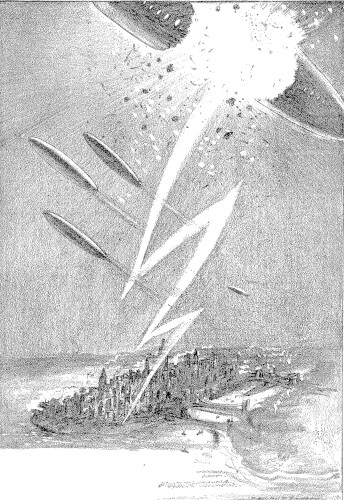
Something wailed through the sky like a dart of red and white. High—very high in the air. It seemed pointed with a long nose of light and the sword of radiance swept suddenly and struck a shining dirigible of metal squarely amidships. The dirigible of metal exploded with a terrific thunder.
Long before they fell, a second ship had been caught in the grip of that same hurling force, and went flying end over end, out to sea, and down. It struck off Sandy Hook, and was crushed beyond all recognition, driven through thirty fathoms of water, and twenty feet into sand and mud and shattered rock.
But then the other two ships began their work. And the land defense stations, which had been ordered to remain inactive, became very active, as the orders were countermanded.
Reaching fingers, that glowed green in the daylight, reached out toward the fighting, streaking ships—the red-and-white dart of Atkill's ship, covered with an enormous American flag, and the silvery darts of the ships of the Council of Five.
The Strapped and Bound Crew of Atkill's Ship
Burt Hillen was commanding one of those ships, and he fought as best he knew how, but what did any of them know of this new fighting at terrific speed, and under terrific acceleration. Atkill's men were strapped and bound at their posts, their hands scarcely capable of movement. They were splinted and bound in position that they might withstand a slightly greater acceleration, and have that extra ten feet of speed per time-unit, that would put them beyond the reaching finger of a ray.
A dozen rays from ground stations reached up at the two silvery ships. But all those rays seemed to flood harmlessly against a shining, shimmering coat of radiance. The ships were protected against those radio waves. So simple—too simple to overlook. They were protected against the heat rays that Atkill lashed at them.
Then one of them was touched, barely touched by the sword of radiance that had struck the first ship. As the beam struck it, the molecules of its metals were suddenly freed of every bond, and the ship became a thing of gas, tremendously compressed gas. It expanded. But it had been touched only, and but one small portion expanded.
Unfortunately, for the officers and crew, this small portion included the control that kept the release-flame within bounds. The men in the control room died instantly as the inconceivable blast of steel molecules struck them. That steel had been under a "pressure" of about one hundred thousand pounds per square inch due to its own molecules. With the release of the terrific pressure it expanded. The expansion destroyed everything in its path.
A man dragged himself along the corridor a moment later. His nose, his ears, his eyes even were bleeding. His face was contorted with pain, till Burt Hillen could scarcely be recognized. He stopped as he entered the power room. There was a fierce, unaccustomed heat beating out of its doorway. The man raised his eyes and looked. The white flame had become an angry violet color, and it pulsed slowly, but faster and faster, as he watched it. With each pulse the ship seemed to rise, then fall, rise and fall—the flame grew steadily, the pulsations came more swiftly, and the difference grew greater. The man turned and fled before the heat, but it seemed to pursue him.
The Destruction of the Ships
Suddenly the ship lurched, then pressed downward. The man was struck by the overhead deck as it descended on him, and he became a rust colored stain on the deck, a stain that was likely a queerly contorted man. In a moment he was gone though, for the ship had become a white-hot mass.
Atkill had known that ship was finished. He had turned to the other, pursuing him now, striking at him with rays that leaked through his screens, for their power was as great as his. He turned his beam on it, and a great strip disappeared from the side of the ship. Simultaneously the ship seemed to bulge, cracks appeared in its walls, and its course became erratic.
Then he became aware of the force that was pulling his ship, tugging it to one side, and upward.
"Atty!" called Joe Keller. He pointed up, and to one side. A great ball of white fire was rocketting down, down toward the city. As he watched a violet flame seemed to lick its way through the wall of white flame, and grow swiftly in size.
"Atty—if dat hits the city, dere won't be nothin' lef' but a lotta puddles o' boilin' water!"
Atkill's face grew white. He could feel now, the pull of that white fire. It was growing, as the violet flame grew larger, and masked the great steel hull, white-hot now.
Atkill's hands worked rapidly at the controls, a plane of force formed under that thing that no matter could penetrate. The white-hot thing stopped, and suddenly, from behind him came a shriek from the power room, the shriek of the over-loaded white flame. Atkill's face went whiter as he saw what the thing on the dial before him was saying.
"Joe—I can't stop that!" There was violet flame crawling on the force-plane now, and with all the energy of his white release-flame, Atkill strove to damp that force that ate through his shield. He maneuvered directly beneath it; the shields he had used he withdrew, so that more power might go to that plane of force and he began to push toward the open sea.
That ball of death above him was attracting the earth, dust was rising, water seemed flowing into the harbor, a tide that rose quickly, and crawled out over the streets, flooding them with a rapid, silvering tide.
Atkill's hands were steady, his face white under its tan. Keller fell silent. This man, Atkill, almost a god to him, could not handle that thing—he had best keep quiet.
The violet force was eating holes in that plane of force, and here and there a glob of white-hot steel fell through, to hurtle down, and fall into the harbor.
"Where ya goin'?" asked Keller at last.
"Out—to sea—where it can't—do any damage," muttered Atkill.
The Defensive Plane of Force Is Succumbing
The holes were widening now, growing larger. The ship and its terrible burden were moving swiftly now, the water whirling behind them, the restless sea was under them soon, but Atkill wanted the deep water beyond the Continental Shelf. He knew that this thing would burn itself out in a month, but in that month the sea about it, and the rock below would be a boiling inferno.
Out—out—out——
"God! The power's droppin'!" Atkill's voice was shrill with excitement, horror perhaps.
The shrill whine from the outraged white flame back there was growing in pitch now. But as it grew higher and shriller, the flame itself dwindled, slowly, but then more and more rapidly—the holes in the shield grew——
Watchers on ships reported it. A terrific flash, a roar of thunder—and the great white ball of steel with the violet flame burning over it steadily seemed to swell, then drop at great speed down—down—and the sea rose up in a mighty flash of spouting steam.
There were few ships that lived to report it, and as Atkill had foreseen, it still boiled for a month. And the sea was redolent of dead fish for a thousand miles about.
But the crippled air ship Atkill had left behind as he carried off that deadly thing lay a smouldering, blistered wreck on Long Island. The Harrell tubes had at last gotten in their energy for the screen had been ruined by Atkill's ray.
It was over in three minutes. Even that last ship had fallen to Long Island inside of that third minute.
But in Washington the action had begun.