Front matter
Reading edition
Have you ever seen monsters stalking the streets? Only if you're drunk, you say?—Don't laugh—your best friend could be one of them!...
[Transcriber's Note: This etext was produced from Imagination Stories of Science and Fantasy November 1951 Extensive research did not uncover any evidence that the U.S. copyright on this publication was renewed.]
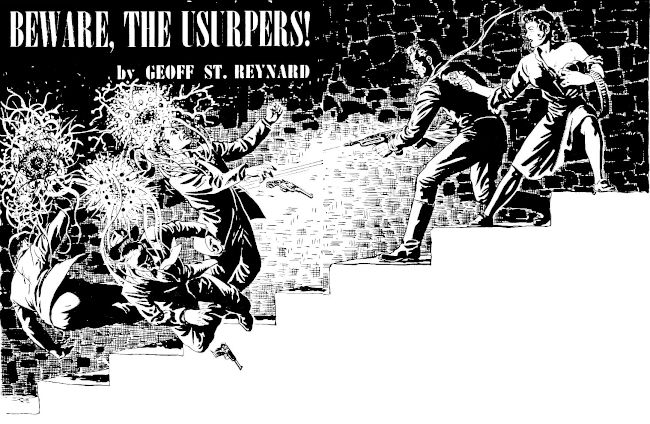
I stopped the black Jaguar beside the crumbling stone balustrade and swung my legs out. The drive was deep in rotted leaves and long-uncleared trash. Above me the ancient castle looked out across the groves of oak and elm and chestnut to the silent moors, like the veritable ghost of Old England itself: aloof, brooding, noble, withdrawn from this hectic modern age into its memories. Blind blank holes of windows stared over my head as I walked up the drive where in a more regal century the carriages of dukes and knights and princes of the blood must have rolled, the big horses of neighboring squires must have pawed impatiently before many a hunt, and lovers in satin and velvet and cascading lace must have strolled and dallied a thousand thousand times.
As I was hauling open the heavy iron-banded door, my foot trod upon something that squashed unpleasantly. I bent down, and in the sick yellow moonlight saw a newly-dead rook, its eyes already pecked out. I shivered, uncontrollably. Then I went in and pulled the door shut.
My electric torch stabbing the darkness before me, I crossed the empty hall and mounted the broad curving stairs. At the top I turned and glanced downward; the great hall was patterned with moonlight, and although there was no furniture of any sort, the whole vast place seemed to crawl and pulse with shapes of menace, of dead-yet-living evil. I shook myself angrily. My nerves were rotten, my mind was bursting with fear. That was the whole trouble—fear, fear and nerves. The only thing to do was act quickly.
I strode down the dank passageway, opened the third door on the left, went into the room and shut the door behind me.
Here the old stone walls were ashine with lights, the air was less musty and far less creepy. Six people were here, standing about or sitting on straight-backed chairs. They all turned to look at me. Nobody spoke. I nodded to each in turn.
There was an old army officer, leathered and permanently tanned by decades of the dreadful Indian sun; he wore a short grizzled mustache and a stern, rather stuffy expression. There was a man of about fifty who could not have been anything but a physician, so scrubbed and competent he seemed. There was a youngish fellow with only one arm, and another whose dark glasses sheltered sightless scar-pitted hollows. There was an antique of a man, poker-thin and poker-straight and poker-hard, with a pale face and keen, faded blue eyes. And there was a girl, who had sometimes been described as a summer sky, as a star, and as other things just as lovely and unbelievable.
"What ho," I said, with empty cheerfulness. "Sorry to be late. Let's get at it."
"Will," said the doctor abruptly, "I forbid it. It's madness, it's criminal lunacy."
"Sorry you feel that way, John. We've gone too far to stop here—and we've been all through this a hundred times." I went to the table and sat down briskly in the vacant chair beside it. Truth to tell, every muscle in my body was rebelling, was shrieking to me that John Baringer was right; only my mind still insisted that he was wrong, and I knew that if I dallied for an instant my body would conquer my brain....
I fitted my head snugly against the curious apparatus we had attached to the back of the chair. It was constructed along the lines of an old-fashioned photographer's head clamp. To the table were nailed a number of steel braces, which held a Tower musket, an obsolete firearm primed with black powder and aimed rigidly so that the load would pass within a hair's breadth of my eyes as I sat with my head pressed against the clamp. The musket was already cocked. "Let 'er go," I said, and felt glad that my voice had not cracked into falsetto.
"No!" said John Baringer. "No!"
None of them moved.
"Have I got to do it myself?" I asked, rather angrily.
The retired officer pushed the doctor aside, took two steps forward and laid his hand on the musket. "Ready?" he asked.
"I am."
"Hold hard," he said, and pulled the trigger.
The world seemed to lift up into the air all at once, its foundations tearing apart with a noise like all hell bursting in half; then it slowly toppled down again, and everything was blackness and hot, searing death.
The last thing I remember was the scream of the beautiful girl, she who was as lovely as a summer sky.
CHAPTER II
I lay in the warm bed and for a long time I tried to think of something that I knew I should recall, and at last, after hours of waking and dozing and waking again, I had it; it was the fact that I was not dead. When I knew this for certain I was extremely surprised, in the weak fashion of the very ill. I slept once more, and when I woke again I was stronger and more in command of my mind. I was still a little astonished that I was alive. Then I began to wonder whether I was blind. The knowledge that I would not know about this for some days was intolerable. I yelled angrily, and a cool hand was laid across my lips.
"Gently, Will, gently," said the loveliest voice in England.
Then I knew that I could bear the uncertainty till doomsday, if I must.
"Hello, Marion," I said, brushing the hand with my dry lips. "What time is it?"
"Middle of the afternoon, Will. You've been asleep a long while. It's Tuesday."
"Tuesday. Good Lord, nearly forty-eight hours!"
"Do your eyes hurt?"
"Not much."
"Thank John for that."
"Where is he?"
"Here," said the physician's voice. "We're all here but the Colonel."
"He's in London," said Marion Black, "buying supplies."
"Is Johnson here?"
"Yes, sir," said the respectful voice of the pale-faced old man. "Very much at sea, if you'll allow me, Mister Chester."
"They haven't told you, Johnson?" I asked incredulously. "You must think us all mad!"
"No, sir," said he promptly, "I give you my word I don't, sir. Had it been one or two of you, why then I might fancy you'd gone off your respective rockers, as you might say, sir; but six of you—that's different."
"What do you think, then, Johnson?"
"I think there's something big going on, sir," said the old man. "Something fearfully big. With poor young Mister Exeter blind, and you a-lying here like this—what is it, sir? They told me you were the proper one to explain."
"Johnson," I said, grinning, "that's the first time I ever heard your voice express anything but well-bred deference."
Johnson coughed and, I imagine, looked at the floor with embarrassment. "Very strange circumstances, sir," he said.
"I shan't keep you in suspense, Johnson, although these callous people have. Are you prepared to hear a nightmare of a yarn?"
"Are you prepared to tell it?" growled John Baringer.
"Oh, yes. I seem to have had a good bit of rest lately." I drank from a glass that Marion put to my mouth, and said, "You remember Jerry Wolfe?"
"Of course, sir."
"You were there the day he came back to the Gloucester Club and was murdered, weren't you?" I knew he had been, but I was feeling my way into the story.
"Yes, sir. I brought him and Mister Talbot here a bottle of Scotch. I saw him killed."
"He told Alec—" Alec Talbot was the chap with one arm; he'd left the other in Europe somewhere, during the latter days of the war—"he told Alec a tale that day, Johnson. It's a wild, incredible, super-fantastic tale. No sane man would believe a word of it."
"No, sir."
"But we six believe it, Johnson."
"Yes, sir. I gather it has something to do with this—"
"This madness of ours. It does. You see, Jerry Wolfe was nearly blinded in India when a Tower musket was discharged athwart his eyes. The bandages were removed as he was coming home, and he found he could see ... could see rather more than most of us can."
"Yes, sir," said the dignified voice. "May I ask what he could see, sir?"
"He could see into Hell," said Alec Talbot quietly.
"He could see that certain people are not—people," I went on. "Let me try to explain that. He discovered that there are among us many aliens of another race, perhaps from another dimension, or from another planet, or—who knows? He thought they were out of a different dimension, because he could see silvery lines behind them which he believed to be that dimension's scenery, as it were. Each of these aliens, these usurpers, as he called them, had stolen a human body, and was using it as a focal point of entrance into our world. Do you follow me?"
"With some difficulty, sir."
"Drop the 'sir', Johnson. We're all plain human beings together in this."
"Yes, sir."
"Well, he could see these alien creatures, but within them, or behind them, he could also see the human bodies they were occupying; the bodies which to everyone else appeared to be quite normal men and women. The bodies apparently didn't contain a human soul or mind or whatever you want to call it, but were only puppets for the interlopers. He sat in Charing Cross Station and made notes on them, at one stage of his adventures, and he decided that they were entering this world by usurping the bodies of newly-born children, children of unions between two of them or between one of them and a regular human. See?"
"Vaguely, sir."
"He figured out that after a few of them got into our dimension, through some fluke or other, they found that they could spawn puppet-humans who would become vehicles for others of their breed. They come 'in' by route of birth. Perhaps, Jerry thought, a freak accident generations ago let just one of them into our world, and he put his foot in the door. Now there are multitudes of them here. What was the ratio Jerry calculated, Alec?"
"About seven to six in our favor," said Alec Talbot. "Of course, that was figured within an hour or so at Charing Cross Station. He didn't have a chance to make a real survey. They got him first."
"Yes, they got him. He was so shocked by his discovery that he didn't cover up fast enough, and they found out he could see them. They harried him all over half of England, and finally they tracked him down at the club and shot his guts out."
"He died in my arms," said Alec without expression.
"But Mister Wolfe was shot by men from Scotland Yard and bobbies, sir," protested Johnson.
"That's what they seemed to be, Johnson, to you. Jerry could see them truly. He knew they were the usurpers, using the husks of human beings as points of contact between our dimension and theirs."
Johnson coughed politely. "And this is the story he told Mister Talbot?"
"It is."
"And you all believe it?"
"We do. Partly because it tallies up with a lot of queer things, partly because it explains a lot of others. But mainly because we all knew Jerry Wolfe, and he was as sane and decent a fellow as ever breathed tobacco smoke."
"Yes, sir."
"He couldn't see all of their dimension, you understand. It was only where one of them had taken over a human body that the veil was thin enough to be pierced by his blast-warped sight. There was a sort of field of force or something around them, and he could see the beasts and their nearby background of silver lines that ran at an angle of about forty-five degrees. That was all. He killed the human parts of three or four of them, and although he couldn't touch the other-dimensional folk with his bullets, when their human puppets died they were relegated to their own world again. They faded out and vanished, he said. Their point of contact was obliterated."
"I see, sir. I begin to get the picture. These foreigners—" I could not help smiling at the word—"have been infiltrating our island by some means, using our bodies, you might say, as disguises. A dirty bit of business, sir, if I may say so."
"Very dirty, Johnson. Because if nothing is done to stop them, eventually they'll have our whole world to themselves."
Johnson evidently thought this over for a moment. I could hear everyone breathing heavily in the silence. Then, "What do they want with it, sir?" he asked.
"Lord knows. Jerry never asked 'em."
"Ah. It gives one pause, sir."
"It damned well does. It's given us so much pause—the six of us—that we've decided to devote our lives to fighting the usurpers. That's why we're doing this huggermugger business, Johnson. We're duplicating Jerry Wolfe's experience, trying to get our eyesight warped or marred or shifted, or whatever the phrase ought to be, as his was. So we can see 'em, and combat 'em, and send 'em home to their silver-lined wastelands."
"And that's what happened—"
"To Geoff Exeter. Yes. We did the same thing with him that you saw two nights ago with me in the chair. Unfortunately—there's a feeble word!—we bungled somehow. And Geoff is blind."
"You get used to it," said Geoff Exeter cheerfully. "It's in a good cause. Better cause than we fought the Nazis for if Jerry Wolfe was right."
"We're banking that he was. We're betting our eyes or our lives, Johnson, that he was right."
"If you'll forgive me, sir, it seems a terribly long chance to take. He might have been addled in the head, or drunk; or if he was right, you may all lose your eyes and never acquire his strange vision."
"We're relying on old Jerry," said Alec Talbot. "You see, at least three of us were at loose ends, with nothing to make of our lives, and our hearts full of bitterness and frustration. It's given us an aim in life. It's given us life itself, by heaven! We drew lots, Geoff and Will and I; Geoff got first try, Will the second, and I lost. I'm to be the third one. Before he was murdered, Jerry told me who was all right and who wasn't. He'd seen a few chaps he knew—Will and Geoff and the doctor here, Marion and Colonel Bedford. He bequeathed me their names. I rounded them up and beat them with Jerry's yarn until they began to feel a horrid truth in it. Then just a few days ago I remembered that you'd been our waiter at the Club that night, and he'd sat easy and safe in your presence; so we knew you were human too."
"I'm sure I'm very gratified, sir. But what can I do?"
"We don't know. We don't know what any of us can do. But we were only six. Johnson—six against half a world. We grasped at you like a drowning man at a—"
"Straw," said Marion. "Really, Alec, your similes stun me!"
"I was going to say 'bottle of whisky'," growled Alec.
"Do you get the whole picture now, Johnson?" I asked.
"I think so, sir. Just one thing...."
"What's that?"
"Well, sir, what do these aliens look like? I mean, if you can see them?"
"Like obscene nightmares," I said. "Like demons down under the sea. Like anything and everything you can conjure up that's evil and strange and full of hellishness."
"Oh. Quite so, sir," said Johnson woodenly.
"Jerry talked of toads, of sharks and dragons, weird tree-shapes and amoebae, but he made it clear that those were only far-fetched similes." Alec's voice was low; he was remembering his friend, haggard and gray in the face, a ghastly ghost of the man he had once been. I broke in.
"Yes, Johnson, they're a fearful horde. If Jerry was right, they're overrunning us in a manner far more subtle and deadly than any invader ever did before. Which is why we must take these desperate measures. Are you with us?"
"Of course, sir," said the old waiter.
"Why?" asked the skeptical Doctor Baringer. "Why so quick to leap at this fantastic story, Johnson? I've got into the affair over my head, but I'm still not sure I believe in it."
"Well, sir, you might say I'm in just about the same position as Mister Exeter and Mister Talbot and Mister Chester. I'm an old soldier, much too old to be of any use in a regular war any longer; and I still fret for the days of bivouac and battle. If you'll pardon the liberty, sir, I must agree with you that it's a rum go, a very rum go. But if it's true, then I may be of some slight use in the world after all."
"You were a soldier, Johnson?" I asked.
"Sergeant, Boer War, sir. I fought at the siege of Ladysmith and a dozen other engagements."
"I thought the Boer War was a million years ago," said Marion Black.
"Very nearly, miss," said Johnson with a dry chuckle.
"Welcome to the ranks, Sergeant Johnson," said Alec Talbot.
I started to say something, but suddenly was very weary, so instead I went to sleep.
CHAPTER III
Ten days later they took off the bandages. The doctor had changed them and examined my eyes a number of times, but always in what was to me total darkness; I believe he used some sort of queer light, infra-red or black or what-have-you. I'm not up on these medical and scientific gadgets.
The last layer of gauze came off. Nothing happened. The world to me was all a pinkish-red blurring.
"I can't see," I said. "John! I can't see!"
"Neither can I when my eyes are closed," said Marion, with a nervous choked laugh.
So I opened my eyes.
I saw a tall straight old man, a one-armed chap, a young fellow in dark glasses, a rather stuffy-looking retired colonel, a middle-aged physician with a worried face, and a girl as radiant as a spring morning.
"Greetings," I said unsteadily. "Greetings, little army. Don't look so scared."
Alec Talbot grinned and Marion gulped with relief, Colonel Bedford clapped me hard on the shoulder, muttering something that was probably "Stout fella!" Geoff Exeter said, "You can see, Will? Your eyes are all right?"
"I think so. Yes, there isn't anything but a little fuzziness around the edges."
"That may be the result of the long spell of darkness," said John Baringer, fussing about professionally.
"Well, let's get out and test the old orbs," said I, throwing off the covers. John pushed me back into the pillow.
"Not for a day or two. You've got to regain your strength. Been in bed a long time."
I raged, but it did no good. It was three mornings later when at last I was allowed to leave the old castle—it belonged to Geoff Exeter's family, by the way, Geoff's father being old Lord Joseph Exeter—and go into town, with Colonel Bedford at the wheel of my Jaguar.
We averaged a wild and impetuous thirty-two miles per hour all the way there. The Colonel was a driver of the old, the very old, school, and obviously wished that the sleek little sports car were a two-wheeled tonga. As for me, I fidgeted and mumbled and longed to get behind the wheel myself; I had once clocked the two-seater at a hundred and fourteen m.p.h., and when she was forced to creep along like this, both she and I were unhappy. However, my job was to observe, and so I contained my impatience perforce.
We circled the village and came in from the opposite end. No one knew we were staying at the long-deserted Exeter Castle, and we meant to keep it that way. It was a priceless hideaway, an excellent G.H.Q. for our planned insurgence.
The village of Exeter Parva contained some three hundred souls, if one included eighteen large placid-faced farm horses and ninety-seven dogs more or less. It was market day. The countryside had boiled into town for a hectic time. You might have scraped more citizens out of the pubs of one short London lane, and heard more noise in Westminster Abbey; but for Exeter Parva it was a gala morning.
We drove down the main street—I believe it was the only street, but this may be prejudice on my part—and stopped to let a couple of deeply suspicious cows pass by on either side. "Well?" asked the Colonel.
I had nearly forgotten the purpose of the jaunt. I narrowed my eyes and stared keenly about me. I saw farmers in dull blue and faded gray, women in carefully mended finery, children in everything from Sunday bests to Saturday rags. I saw what one might see in any small village on market day. I saw no monsters whatever. I sighed and gave a weak grin. "Just people," I told him. "Just Englishmen."
He attempted to gnaw his short mustache. "Which means either that they don't foregather in small towns, or that they existed only in Captain Wolfe's brain," said he meditatively. "Which, mind you, young fella, I don't believe for a minute. If there was ever a sane 'un, Wolfe was he. Besides, he'd served in my old stations in India." He pronounced it "Injuh." He edged the Jaguar forward through what Exeter Parva doubtless considered its heavy traffic. "Or else the experiment didn't work. When you think about it, that's the logical explanation. Whatever happened to the Captain's eyes must have been almighty complicated. Don't understand a tenth of it myself, these dimensions and whatnot, but there it is. Frightfully complex changes must ha' been wrought."
I was too dispirited to answer that. "Let's have a drink," I said. "There's a tavern. At least we can have a mug of ale before we go back."
"Right." He parked the Jaguar expertly if rather slowly. We went into the tavern, which was called The Leathern Funnel.
"Well, gents, what'll it be?" inquired the barmaid affably.
"Two ales, miss, if you please," said the Colonel. It was lucky for me that he ordered. I could not have produced anything but a squeak or a howl. The mugs bumped down before us and I picked mine up with both hands and drank it off like a thirst-mad sot after a month of bread-and-water. Then I aimed myself carefully at the door and put on the greatest piece of acting of my career; I walked casually and without a single stumble all the way to the street. The Colonel came after me.
"What the deuce, Chester! You don't allow a chap much time to enjoy his bit of ale," he grumbled.
I got in at the off side of the Jaguar without speaking and put my hands on the wheel. "Ready?" I managed to ask.
"Here, I'm to drive."
"You are like hell. Get in." He did. "Hang on." I nudged the old girl out of the village and when we were hidden by the first hill I trod on her pedals with all my weight and terror behind my feet. We crashed off into a beautiful eighty m.p.h., which I held or surpassed all the way home. Three or four times he tried to bellow something at me. I ignored him.
When we had flown up the long winding drive I put her into the stables, part of which we had fitted up as a garage. Then I sat there in the gloom and shook with what felt like fever.
"Here, what is it, laddie?" he barked. "What's wrong?"
"Describe the barmaid," I said.
"What?"
"Describe the barmaid."
"Fortyish, plain, thickset, red hands, red face, couple of warts. Pleasant expression. Right?"
"Not exactly. You left out a few things."
"What on earth?"
"The green horns, six of 'em, growing out of her face in the middle where the nose should have been. The shifting outlines that looked now like a tree stump and now like an octopus. The pulsing heart of scarlet fire in the belly. The dusky-pink tentacles that pushed the mugs across the bar. The pure hatred that throbbed visibly and seemed to feel cold when it got near you. The eyes like bursting orchids full of slimy white worms."
He put his hand on my arm and tightened his grip until his knuckles grew pale. "Merciful God!" he said quietly. "Merciful God!"
CHAPTER IV
We went into the deserted hall of Exeter Castle. "Look, Colonel," I said, "will you tell them about this? They'll be upstairs. Tell 'em that it works, that I can see as Jerry Wolfe saw, and everything he told Alec was true. I'll be all right after a while, but now I want to be alone. I don't want to be hedged in by close walls, or have to talk. I'll just roam around down here for a bit. You tell 'em it's okay, that I'll speak to them later."
"Absolutely." The Colonel was the best stuff there is. "Come up when you feel like it, son." He was gone.
I strolled over to one of the great mullioned windows and touched its dusty glass lightly. That glass was older, probably, than all our little band put together. I thought: when it was placed here, were the usurping devils abroad in England? How long have they been filtering through into our world—a hundred years, a thousand? If you start with one and he lets in others, then figuring by the birth rate and the multiplying branches of his horrid clan, how long would it take to let in a million of them? How many figures of our glorious history were just that—figures, puppets, marionettes pulled by fourth-dimensional strings, flesh-and-bone shadows fronting for demons....
We are no other than a moving row of magic shadow-shapes that come and go....
Jerry had asserted that when the human body died, the alien was relegated to his own world again. Then it had to come back, I presumed, via another birth. It must be centuries, then, at the very least a couple of centuries, since the first one came through. It takes time to corrupt the blood of six-thirteenths of all England.
But was it six-thirteenths? Jerry had taken his census in Charing Cross Station. At Exeter Parva I had seen exactly one usurper. Were they then centered in London? Were there perhaps no more than fifteen or twenty thousand of them altogether? That brought down the odds!
I laughed loudly, and the age-old echoes waked in the oak rafters and laughed after me. Oh, the odds were in my favor, all right.
Opposing me, say (conservatively) twenty thousand foemen: great livid beasts like nothing a sane mind could conceive, that had a system of communication outside my dimension which could gather a score or a thousand of them to down me if I showed fight.
On my side, a regular Colonel Blimp of a retired officer, a Boer War veteran, a skeptical middle-aged physician, a blind man, another chap with no left arm, and a girl.
And I: Will Chester, thirty-three years old, five feet ten, moderately strong, normally intelligent; having all my teeth save two, a thick crop of black hair, brown eyes, a complexion more ruddy than otherwise, and a face that, if it would not halt a charging bull in his tracks, still would not win a beauty competition either.... Seven years of Army behind me, an income of eight hundred pounds a year from a legacy, and nothing much in view as a future, until this morning—when I had suddenly been elected the savior of mankind.
I walked across to the tremendous blackened fireplace, empty now of everything but a lonely-looking single bronze firedog. Above the keystone of the arch were the arms and motto of the Exeters, done in ancient stonework. I could not read the motto, having forgotten what Latin I once knew. The arms were a jumble of crossed lances, fleurs-de-lis, and hounds couchant. I wished I had a hound to fondle and pat, to be a companion in these moments when I felt I could not bear a human being near me.
For half an hour or so I stood there gazing blindly into the depths of the hearth and pitying myself shamelessly. Then a touch on my arm made me leap like a deer. It was Marion; Marion, carrying with her her own special radiance even in the shadowed hall.
"What cheer, old stager?" she said.
"Not much cheer, lady."
"Obviously. What is it, got the wind up? Scared sky-blue-pink?"
"Yes. I've just realized that this whole affair is fact, is true; that it's not a crazy adventure in fancy, but a dreadfully real matter of saving the sane world from destruction—and I'm scared!"
"We all are." She said it quietly, and with her simple words I knew for the first time that I was not alone in my terror of the unknown. We were all afraid. I put my arm around her shoulders. Her long light hair tingled on the back of my hand. I loved her very much, and so I tormented myself.
"I've been thinking of Jerry Wolfe, and of how alone he must have felt. He didn't have six pals behind him when the first alien fouled his view."
"Poor old Jerry," she said.
"You were engaged to him, weren't you?"
"Yes, back in prehistoric times, before Jennifer Tregennis caught him. Jennifer was one of them, you know."
"Yes, I know. D'you still love Jerry?"
"How do you mean? Of course I do."
I didn't say anything. She went on after a moment. "But I'm not in love with him, if that's what you're driving at. Good heavens, Will, do you see me as a moony widow-in-name-only? I've got more sense than that."
My heart lifted. I patted her on the back. "Come along young Marion. Let's go plan strategy with the troops."
We went up the stairs to our sitting room, and I stood before the six of them and took the reins into my hands. I had a job to do.
CHAPTER V
"It comes to this, then," said Alec. "You mean to go and mingle with the enemy, and try to discover weak spots in 'em, eh?"
"I don't see any other way to begin. We've been scratching for a plan ever since we first heard of the usurpers; and nobody's come up with one, for the good reason that we have nothing to go on. Oh, granted we know we can kill their worldly bodies and send them home. But I hardly think we're going to do nothing but roam the countryside killing off puppets for the next thirty years."
"Remember what Jerry told me—that once one of them was sent back to his own dimension, he could evidently still communicate with those who were left here? That the aliens who're attached to human bodies exist in both dimensions equally?"
"Yes, Alec, I was thinking of that a few minutes ago. It means that under no circumstances can I let any one of them discover I can see them; for even if I killed him here, he could go around his silver-lined dimension telling all his pals about me. It means working in the dark, from behind, anonymously. It means I've got to be circumspect as Satan. We all have to be circumspect."
"Beg pardon, sir," put in Johnson, "but when do the rest of us have a try at warping our eyeballs?"
"You don't, Sergeant," I said flatly.
"What d'you mean, we don't?" cried Alec. "Of course we do."
"No, son, not for a while, anyhow. It's a hundred to one, or a million, more likely, to one, that we couldn't duplicate the exact injuries again. We can't blind anyone else now. One of us seeing them may be enough—or if he isn't, then half a dozen might not be any better."
"I think Will's right," said Marion suddenly. She lit a cigarette while we waited. "I think we mustn't press our luck too far. At least we should wait until we have a plan. I think—I really think one will be enough."
"Why?"
"Those million to one odds. Why did the experiment succeed the second time? I think God's with us. I think God's on our side, and means us to win."
We were all very quiet for a while.
I went over to a wall mirror and examined my face. I took out my little tin of pancake makeup, Marion's clever idea, and spread some thinly on the scars of the blast: the little pink almost-healed scars that ran across the bridge of my nose and scattered out fanwise toward my ears. We were dealing with cleverness beyond thought, and every tiny giveaway must be taken care of.
"Jerry Wolfe died," I said, still peering in the mirror, "because he was taken unawares, because he hadn't prepared himself to stay incognito among them. I have. I've had my first sight of them, and been terribly shocked, yes; but now I think I'll be all right. I'm ready to go."
"Up to London?"
"Yes."
"We'll all go."
"In a bunch? I don't think."
"No, in pairs and trios. But there's no sense in any of us frettin' here without news from you." The Colonel was firm. "The motors are below. Ready, you chaps?"
"Packed and primed," said Geoff.
"Let's be off."
And almost before I knew it we were in the old stables, putting our gear in the back of Alec's great red Rolls.
"Who'll ride with me?" I asked.
"Not I," barked the Colonel promptly. "I've had some of your idea of driving."
"I'll go with you, Will," said Geoff Exeter. "Just put my fist on the car, will you?" I did so, and he climbed in. "I like speed," he said.
I had been hoping for Marion's company, but Geoff—well, he rated a front-row stall in the game. He'd lost his eyes for us. I said, "Geoff will stick with me for the first days. The rest of you put up at the Albany, where Colonel Bedford has a suite, and at that inn in Baker Street, The Gray Gander. Geoff and I will be at the Gloucester Club."
"I shall be there too, sir," said Johnson. "I've been on 'sick leave' quite long enough."
"Roger. Geoff, the Sergeant and I at the Gloucester. The Colonel and John at the Albany. Marion and Alec at The Gray Gander. Don't get in touch with me, unless you give birth to some really ripping idea. I'll find you when there's news."
I touched Marion's hand in farewell, and slid into the Jaguar. We backed out and shot away into the blue.
CHAPTER VI
We stood at the bar of a dingy little pub on the outskirts of the dingy little district of Seven Dials. Geoff, who was learning to orient himself by sounds, heard the clunk of his mug on the bar, and unerringly put his fingers around it. "Pretty good, eh?" he asked me, sipping the half-and-half.
"You'll be a wizard at it in a few months."
"I meant the ruddy ale, idiot. I'm not bragging about my accomplishments yet. Seen any of our chums lately?" he asked.
"Oh, dozens. Run into 'em everywhere." It was a kind of simple code; I was telling him that the pub was full of the aliens.
"Fine. Any of 'em give you any news? Anything startling been happening?"
"Not much. Same old stuff."
Same old stuff!
Same old fiends from Abaddon! Same old hosts of Hell! Same old ogres and ghouls, harpies and bugaboos, hobgoblins and hellhags!
The barman, when I squinted, was a big jovial red-nosed Cockney. The barman, when I opened my eyes normally, was a writhing monster, a shapeless blob of intangible protoplasm in whose depths moved turgid lights of orange and mauve; from whose devilish form the waves of malevolence came and went like the roiled swell made by the sluggish moving of some hideous primeval entity beneath the surface of a grisly tarn....
I grinned at him. "Cool weather for June, mate," said I affably.
"Ar, yus," he agreed.
I was pleased with myself. Like a spy plunked down in a strange land, I had been feeling my way to confidence these last days, growing used to the shapes about me, learning to show an expression of bland normality when confronted with unnameable horrors. I believed I was perfectly ready now to begin our war.
The only trouble was that I hadn't the faintest idea of how to begin it!
One could move among these usurpers for a lifetime, I thought, and learn nothing about them except that they were more hideous than leprous two-headed baboons, more incomprehensible than might be the dwellers of Mars. I watched them talking among themselves where they sat at the little oak tables. While their earthly husks chatted of prosaic things, the forms around the husks spoke—inaudibly to me—with twisting tentacles, gesturing pseudopods, flowers of rotten-looking "flesh" that grew upon their bodies and swelled and burst and subsided to nothingness again. I knew they were speaking of terrible things....
"Let's go," I said to Geoff. "Time we were thinking of bed."
"Righto."
I gave the barman good-night in a pleasant voice, and we emerged from that ninth circle of Hell into the cool and lovely air. Seven Dials lay about us, all a-murmur with the homely human sounds of earth's evening. I could not stand it.
"Geoff," I whispered, "I'm going to start the ball rollin'. I'm going to find out something."
"How, old son?"
"I'm going to do a murder."
"Think it's wise?" he asked.
"I want to ascertain something. Just come along a bit."
We went up a dingy street and turned down a lane or two, until at last we were alone on a length of grubby pavement, shadowed by the rickety houses on either side. "Stand here," I said to Geoff Exeter. "It's black in this corner and you won't be noticed. I'll come for you in half a tick."
He saluted carelessly. What nerve he had! To stand alone, blind and helpless, ignorant of what I meant to do—I think Geoff was the bravest of all our little band.
I slunk up the street to a place some forty yards off, and hid myself in a time-battered doorway. The street lay empty and deserted in the early moonlight. I drew the great keen knife that lived on the side of my belt these days, and I waited.
A man came down the road, staggering drunkenly. He was a man. I let him pass.
Another came toward me. I heard his footsteps in the dark, echoing valley of brick, and shortly thereafter saw him pass beneath a fading street lamp.
Do you remember the passage in Doyle's Lost World, where the hero is pursued along a jungle trail by a prehistoric carnivore?
"This beast had a broad, squat, toad-like face ... the moonlight shone upon his huge projecting eyes, the row of enormous teeth in his open mouth, and the gleaming fringe of claws upon his short, powerful forearms. With a scream of terror I turned and rushed wildly down the path."
Well, I did not turn and rush wildly down the street, but if I had not been hardened by much contact with the aliens, I think I must have done so. This was the worst I had seen: toad-like, yes, but squat and loathsome as no toad ever hoped to be; and indeed some of the projections of its form did look like claws and fangs. Yet no prehistoric reptile could ever have exuded the repulsive effluvium of evil which radiated from this hideous usurper.
As it passed me I felt my stomach draw in as if from a sharp blow, and it is a wonder to me to this day that I did not scream or become violently ill. The gods were with me, however, and I kept strict silence.
When it had gone on a dozen paces, I slipped out and followed it noiselessly. Moving as I had moved on many a commando raid in the old days, I eased up behind it. It did not turn—neither of its bodies turned. Narrowing my eyes, I lifted the great knife and struck, with all the hatred in my soul concentrated in the blow. The blade sank into the pseudo-human neck, severing the spinal cord instantly, and before my horrified eyes the great toad-creature swelled, turned vivid crimson, and went out like the flame of a trodden candle.
It had left our dimension in the very instant that its human husk had died.
Sheathing the knife under my coat, I flew down to where Geoff stood patiently waiting. I took his arm.
"Come on, boy, let's make tracks."
"Home?"
"No, to another pub." We hurried down an alley, turned up a street and down another, until I had put a maze of lanes behind us. Then we slowed abruptly and ambled into a smoky little room full of liquor fumes.
"Two beers, old toff," I said to the fright behind the bar.
We guzzled them slowly, while I watched the aliens around the tables and at the bar. Shortly there was a flurry of excitement among them, the tentacles writhing quickly and the ghastly brutes enlarging and deflating as though pumped by a bellows. All the time the human portions drank and chatted and played darts. But the usurpers were excited over something. Shortly half a dozen of them moved toward the door, the people in no evident hurry, but their marionette-masters wriggling like mad, as though eaten with impatience.
I knew they were going to discuss something important. I had what I had come for.
"Bedtime," I said to Geoff Exeter. We went out of the pub and caught a tram for the vicinity of the Gloucester Club.
CHAPTER VII
Safe in our rooms, with Johnson sitting, very unlike a waiter, behind a bottle of brandy and a tray of sandwiches, and Geoff lying on the Chesterfield smoking a pipe he could not taste, I told them what I had done.
"It's taught me a couple of things I didn't know, and affirmed some others I wasn't sure of. First, I'm certain the faculties of these brutes are the same in this dimension as their 'human parts'. That toad didn't hear me coming, I know. He didn't have time to turn and get a look at me before he went pop and left us. He was bound to the body till I released him, I think, and if he'd left it he couldn't have got back into it, or rather around it. His ears weren't keener than a man's, or he'd have turned to see me when I crept up behind him.
"But their communication system is terrific. That's where they have it all over us. When he was shut out of our world, the toad must have gone around their region telling his pals about it; and before long the ones who were in that pub heard of it, too. Now they weren't told by a newcomer, for I watched the door; so they were told on their side of the veil, by an alien who wasn't occupying a human frame. Got it thus far?"
"I admit to a little uncertainty here and there, sir."
"Well, put it like this. There's a long tall screen set up across a stage. On one side of the screen—our side—are a lot of human beings. This side is our world as we know it. On the other side, the fourth dimension or whatever it may be, are a lot of these horrid-lookin' beasts of usurpers.
"Now here and there in the screen are holes, and through them some of the aliens are holding fake human beings, just as in our well-worn simile of the puppet show. I can see those who are leaning through the holes, but you can't.
"When they're leaning through, they haven't any powers except those of normal people. They can't hear any better than a man. They can't walk through bricks or see through stones. They can't look behind them without turning the human puppet around. I've been watching them and I feel pretty certain of that. In some curious way they're limited by their puppets' limitations here. That makes it easier to assassinate 'em, by the way—I just have to make sure that the human form doesn't get a chance to turn its head and spot me before it dies."
I drank a little brandy and went on intently. "The only way they really have me beat six ways from the jack is in their system of tidings, of spreading 'em, I mean. That's a marvel. For as soon as I shoot or stab or throttle a puppet, the beast that's been twiddlin' his strings leaves him and goes along behind that hypothetical screen between the worlds, telling all his playmates about it; and if he's had a chance to see me, and can describe me, then about a thousand of the others will be watching through their holes in the screen for a blighter of my specifications, and my name is Lord Jonathan Mud."
"I see," nodded Johnson.
"So my problem is to remain utterly anonymous. And I needn't tell you that if I try to embark on a career of murder-by-night, I won't last very long."
"No, you won't." Geoff was grave. "What else is there to do, though?"
"I don't know. And I think I could watch them for a lifetime and not learn another thing about 'em. I'm a tremendously handicapped spy because I can't disguise myself as one of them, and I can't understand what they say to each other. It's like a man going into a colony of bears and trying to pass himself off as a bear, except that I can't even begin to look like a usurper, while I could put on a grizzly skin."
"What are we to do, sir?" asked Johnson. His pale face was deadly serious. "We must do something, sir—but only you can decide what it's to be."
Two weeks before, I might have groaned aloud at such a responsibility. Now I took it in stride. Anyone who had been observing the demons of Hell at their work for fourteen days and nights had either to take things as they came along or to go stark staring loony.
"I'll tell you what we'll do first. I'll take Geoff over to the Albany. Then I'll strike out alone for a bit. Maybe for a week, maybe a month. Travel light, fast, and inquisitive. Give myself a chance to cook up plots. And if nothing's come of it by then, why, I suppose we'll just have to set up an assassination bureau and hope I live a hundred years...."
CHAPTER VIII
And so for a time I dwelt alone among the beast-folk.
Packing a few shirts and such in a Gladstone bag, I left London in the black Jaguar, ostensibly on a casual motoring jaunt. I headed up through the East Anglian Heights, stopping the first night in the lovely town of Bury St. Edmunds. Strolling through the streets next morning, I was astonished and heartened beyond measure to find not a single usurper abroad. I went into a pub—I had begun to think that the aliens were concentrated in pubs, so many horrendous bartenders had I seen—and bought a pint from a perfectly normal girl. Lingering about the town, I passed the time of day with gardeners and workmen and loafers, and was tempted to throw up the game and stay here in this oasis of normality forever; but after lunch forced myself to get into the Jaguar and roar off into the Lincoln Heights, where I spent a jolly evening in Old Bolingbroke talking politics with a spidery yellow creature who amused himself by flicking my face now and again with his hairy-looking, tenuous, unfelt members. When at last I went to bed I felt that I had served my apprenticeship and was a full-fledged spy who could thenceforth bear anything the enemy could show or do....
I worked westward and put up for a week at Manchester, in which great inland port I found an awful concentration of them. I left the two-seater at a garage and walked the streets from dawn till midnight, observing, thinking furiously, trying to construct impossible plans of attack.
The third night, making sure that my knife was safely sheathed under my coat, I went into the slums to do murder.
Deliberately I chose my victim: a strapping brute of a navvy whose mortal form was surrounded by a cloudy gray beast of indescribable grossness. I shadowed him from tavern to tavern, finally catching him alone in a narrow gut of an alley where the light fell dismally on scummed pools of stagnant water and heaps of filth. I crept up behind him and circling his neck with my left arm I held him motionless for dragging seconds, my knee in the small of his back. He struggled madly, but could not turn his head; and although the gray fiend puffed up and hurled out its streamers of ugly mist-like stuff, I knew it was helpless to see me without twisting the human neck around. That was what I had wanted to know for certain, what I had staked the continuance of my crusade on. I tipped up the navvy's chin and sliced across his throat with the clean steel. He died, gurgling, and the monster dwindled away into gray ribbons and vanished.
Now I felt I had verified my earlier theory of the limitation of their senses on this plane. Not only did the outsider have to rely for hearing on the ears of his manikin, for tactile sensations on the nerves of the were-human, for strength on its muscles and (for all I knew) for taste and scent on the poor dumb thing's tongue and nose—but most important of all, I believed that the beast must see into this world through the puppet's eyes, and through them alone! The recent gray devil had been able to twist and turn itself to some degree independently of its fleshly body; what I took to be its eyes, a cluster of violet-tinted globules high in its upper torso, had flashed all round as it moved, even seeming to flit over me once or twice; yet it obviously could not detect me with them, or surely it would have concentrated their baleful focus on my face.
No, I was certain that I could only be seen by the eyes in the heads of the puppets. I may as well say now that I never had cause to change this conception of mine, and still strongly believe it to be true.
This may be as good a place as any to make it plain that my descriptions of the beast-folk are of necessity limited and analogical; but that the beings themselves had no analogy in anything existing on this prosaic three-dimensional globe. This is true in part because of their utterly undefinable proportions and lineations, which had to be seen to be fathomed, and in part because the creatures did, after all, exist in at least one more dimension than our acknowledged three, so that, despite my own mutant vision, I saw them in a state of flux, continuously moving, warping, and seeming to bend at impossible angles and to flow off just beyond the range of my sight into a sphere which was to me forever invisible.
It must be understood, too, that when I identify portions of them as beaks, mouths, orifices, eyes on stalks, and other natural parts of animal life, I am only grasping at the nearest comparison. For all I know, their senses may reside in quite different organs than eyes, mouths, noses and so on. For all I know, indeed, they may have no actual five senses in our meaning of the term. They seemed to communicate, it's true, by a kind of writhing and wriggling motion, which may have been accompanied by sounds which I could not hear; but this may have been akin to a nervous reaction, while their actual talk might well have been telepathic.
During the next two nights I gave rein to my intense abhorrence of these invaders from another world, and stalked through the city slaying indiscriminately in a passion of hatred. This makes me sound as bloodthirsty as a weasel. Well, I was. A tiny human David opposing a hideous throng of Goliaths, I gave no quarter even as they had given none to my friend Jerry Wolfe.
Of course the police, the newspapers, the citizens of Manchester were shaken by the wave of inexplicable violence. Headlines shrieked that a new Ripper was abroad. And at that I began to wonder: what if an accident had happened to somebody's eyes back in the 1880s, and he, seeing the aliens all about him, had begun on a wild career of assassination like my own? What if he had prowled the slums as I was doing, killing and mutilating in a frenzy of detestation? Was that the true explanation of the never-identified Jack The Ripper? Was he, perhaps, a much-maligned champion of mankind? It was at least a fascinating possibility!
For those few score of hours I felt no remorse, no distaste for my butcher's job, no sorrow except a fleeting one for the human relatives and friends of these poor brainless husks I was destroying. And their grief, I was persuaded, was as nothing in the balance against the good I was actually doing them by ridding our plane of the invading beast-folk.
Then reaction set in, and I lay in my hotel room and shook as though I had blackwater.
I couldn't keep this up, week after week, month after month, for years—even if I were not discovered, either by our police or by them, I knew I could not go on. Give me what resounding titles you wish: savior of mankind, champion of humanity, valiant worker for the survival of the race—I was still only a kind of butcher. I knew I was glutted with killing. The papers put my total score at nineteen corpses. They were husks, puppets, yes: but even though what I killed had no life save that imparted by the guiding usurper, it still had the flesh and the blood of my own breed. When the alien was dispatched to his own place, what remained had the look and feel and smell of someone who might have been my brother. I had once quite callously shot a number of tigers in India: but when a tiger dies, he does not turn into the slashed corpse of a man. He remains a tiger. If only the usurpers had continued in their own true shapes after the slayings, I think I might have gone on killing them forever.
So again I moved harmlessly among my foemen, and watched them colloque together in their silent, loathsome fashion, and did nothing.
And a great melancholy took me; and I felt as helpless as a child surrounded by the dismal wraiths of all ghost-haunted England, as hopeless as a man alone in a jungle full of teeming ghouls.
I would have given a year of my life for one hour with Marion Black, but I would not write or telephone her to come to me. I didn't want them to be able to connect me with any of my band, in case they ever discovered my identity.
Then, on the last night I spent in Manchester, I got a little drunk (out of frustration and despondency, and my inarticulate, stupidly silent love for Marion) and I decided to put just one more of the enemy out of the fight, before I went on my way.
CHAPTER IX
It was a mean street, one of the meanest in the whole city. The moon was vivid, and straight overhead, so that my shadow lay in a black little pool around my feet. I sought a dark doorway and waited, knife in hand, my brain full of liquor and loathing.
A man, and a man, and then a beast....
I slid along in his tracks, glancing quickly behind me to make sure we were unobserved, and swiftly performed the now-familiar operation of driving the impalpable demon back to its own dimension by hacking the throat of the man-shape. Standing above the dead thing, I knew for a second or two the feeling that must have held Jack The Ripper as he stood over his victims: I wanted to stab and slash and mutilate, I wanted to let out some of the terrible hatred that boiled in my heart.
Civilization won, however, and I sheathed the knife after wiping it clean on the man's leather jacket.
At that moment one of them came round the corner and stood staring at me, not twenty feet off!
It was a gorgon of a brute, with several repulsive "heads" on lean stalks of necks; the biggest one looked rather like a hippopotamus whose mother had been frightened by a Ubangi, and I was so used to the weird beings by now that, had I seen this one on a daylit street, I think I would have chuckled. In that deserted lane, though, with the shell of its brother's puppet at my feet, I didn't chuckle. I turned and ran like hell.
A whistle split the air; I turned my head as I pelted away, and squinted my eyes. By all the gods! The hippo gorgon was a bobbie! A ruddy P.C.!
The garage where my Jaguar champed at her inactive gears was only a couple of blocks from the lane. I made for it, taking an extra turning or two in order to lose my pursuer. Coming to the big double doors, I slowed to a business-like stride, went in and demanded my car with a brisk tone, and bestowed a couple of notes on the attendant who brought her to me.
"Be coming back again?" he asked me cheerily.
"Oh, very likely," I lied, and because he was a blessedly human little man, I tipped him an extra pound, which made him goggle and stutter as he thanked me.
I shot the black car out into the street, turned left and lost myself in the maze of Manchester. The distant whistling of the searchers died out behind me.
Now, I thought, I was in the bloody soup. My description would be circulated in the other world, first of all. Well, I look like the common man, and that wouldn't help them much. Second, however, they'd be sure to discover that a fellow came into a garage in the vicinity and took his two-seater at the very time the bobbies were hunting the Manchester Slasher (as the papers called me) thereabouts. That's elementary police work. So up to there all I really had to fret over was the ordinary human bloodhound business.
I'd given the garage a false name, naturally, when I took the old girl in to leave her. A purely automatic precaution. Lucky I have a turn for the criminal life, said I to myself smugly. Nothing to identify her with me, Will Chester of London.
Then there was my gear in the hotel.
Whoa! I slapped the wheel with one palm. I'd given the hotel the same fake name—Robert Hood—but in my Gladstone were half a dozen items with my own label on them. I'd intended a quick baggageless dash out of the city, before they traced me to the garage and sent out a call for a black Jaguar; but to leave without that damning luggage would be to present my true identity to the police in a matter of a few days, or even less. I headed for the hotel. Minutes counted, but so did that accursed Gladstone bag.
Then I bethought myself of the garage again. Of course they knew where I had been staying! That meant that within two minutes of the police—they—arriving at the garage and discovering that I had come in and hared out, the hotel would be receiving a call about me.
I groaned aloud. The Jaguar, sensitive to my thought waves or perhaps to the unconscious pressure of my foot, pounced forward at a law-shattering speed. Minutes counted? Seconds!
The hotel was no fly-by-night, tuppenny-ha'penny wee place, for I had seen no reason on earth why I should not be comfortable while on my crusade; I put the Jaguar alongside the curb within a dozen paces of the entrance, walked nonchalantly in and demanded my key. The desk clerk was listening to the telephone. "One moment," he said, and then to me, holding his hand over the mouthpiece, "I think this is for you, sir."
My mind speeded up and raced like a mad thing. No one would be calling me, so it must be about me; therefore the police had already found the garage; and the clerk must only have heard them say my name (my false name) within the instant. I imagined that they had said, "Have you a Mister Robert Hood staying there?" or something of the sort. Now I had two choices: I could bolt at once, leave my luggage to be inspected, and subsequently have my face plastered on every newspaper in England as the Manchester Slasher; or I could brazen it out. Instinctively I chose the right course, the only course. I bluffed to the top of my bent.
"Give me my key first," I said. He did so. "Now just tell 'em I'm not in, and hang up. It's a bloke I don't care to talk to."
"Ah," said he, smirking, "I see." To the instrument he murmured, "I'm sorry, Mister Hood is out at present," and—my eternal gratitude to that sleek-haired, smug-faced desk clerk!—rang off without asking if there was any message. He had given me a good half minute of free time. I went to the lift and said, "Four please." If it had not been there I should have had to take the steps. Surely my luck was running that night!
I judged that, just about the time I struck the fourth floor, that phone at the desk would be sounding impatiently again. I opened my door, bolted it behind me, and began to throw things into my Gladstone.
My phone started to ring.
I emptied the drawers of the high-boy, the devilish jangle in my ears; leaped into the bathroom and brushed my shaving kit and toilet articles into a little leather bag I used for them. I would be certain I was leaving nothing behind on which there might be a monogram, an engraved name....
Fingerprints! Great merciful God!
I was packed. Everything I had brought with me was in the Gladstone.
The phone stopped ringing.
They would be on their way. A hotel detective or a couple of policemen, called in after that urgent message from the garage. Perhaps the usurpers—
I whipped out my handkerchief, wrapped it round my right hand, and started in to dust that room as no chambermaid had ever dusted it in all its memory. Each piece of wood which I might have touched in the past week received a quick vigorous swipe. Each glass and porcelain surface in the bathroom. Everything. The door knob. The glasses. Is that all? The window, which I'd raised a few times. Is that all? It that all?
I believed it was. I snatched up the Gladstone and with the cloth still around my hand I opened the door and slipped into the corridor.
Close the door, son. That'll halt them for a precious two seconds.
Down the corridor, around the first turn....
Safe, for the moment, safe!
And now what? Here was a flight of stairs. And in the distance I heard a lift door open.
Down the stairs I rushed, and was on the third floor.
Running for another flight, a different one, with a vague thought of confusing my trail, I stumbled and almost fell. Recovering, I fled down these, on down, down, down.
I was on the ground floor at last. The men's bar lay before me. The lobby was far away in the front of the building.
I straightened my tie, tried to appear like an eccentric who always carried a large brown bag with him, and paced into the bar.
As I put my hand—still swathed in the linen—to the outer door, the barman cried out, "'Ere, sir!" but I was gone. They would think I was an absconding guest. They would pursue me. But I shouldn't run, didn't dare run, along this street where humans and aliens strolled singly and in couples. I walked as fast as I thought I could without attracting attention. The hue and cry arose behind me. I came to the corner, rounded it without halting, and saw my dear old Jaguar twenty yards off.
I ran then, for there was no help, indeed there was deadly peril, in walking any longer. I went with great bounds, brushing aside people and them indiscriminately. Hurling the bag onto the seat, I hurdled it with a last burst of energy, crashed in behind the wheel, and in a flash my motor and I had leaped forward and were on our merry way.
We had gone a dozen blocks before I took my right hand off the wheel and unwrapped the handkerchief from it, stowing it away in the side pocket that also contained my hotel key. Mentally I checked over every clue to my true identity; so far as I could think, I had wiped them all out. Now all that remained was to get out of Manchester safely.
Choosing the darkest streets almost without volition, I had put a couple of miles between me and that by-now-surely-tumultuous deathtrap of a hostelry. I thought of road blocks. One is always reading in American mystery stories of road blocks set up to catch thieves and murderers, but I had no notion as to whether they were used in England. Relying on the thought that at any rate I had never heard of one here, I tore for the outskirts of the city.
They would be on my trail. I kept seeing mental pictures of the alien beasts, sniffing me out like so many obscene bloodhounds. My hands grew slippery on the wheel with the sweat of fear. Then I put my panic behind me; they, after all would be working in the usual human channels, for surely they had at worst no more than a hazy suspicion that I could see them. True, I had relegated quite a few of them. But it must seem more likely to them that I was a maniac with luck on his side, rather than a seer. I doubted strongly that they would make such a concentrated effort at finding me as they had done last year with poor Jerry Wolfe. So I had only the laws and power of Old England to worry about.
Going over the past hour again and again, while driving, now at breakneck speed through deserted streets and now at a snail's pace in traffic, I decided that once I had left the city I had a very good chance of escaping entirely. Therefore I set myself to leave it as soon as possible. Beneath me the Jaguar purred contentedly as my foot caressed her accelerator.
And so the notorious Manchester Slasher went into the fastnesses of the Peak District, and laid his course south for Birmingham.
CHAPTER X
I did not take the Jaguar into Birmingham proper; I put her into a half-smashed, bombed-out old building I found quite by chance some few miles out of the city, and prayed that she would wait there for me till my business was done. It was then about four-thirty in the morning.
At a little tea-and-biscuit place in the suburbs I had a hearty breakfast, and read in an early edition the terrifying tale of the Manchester Horrors. It seemed that the infamous Slasher had been tentatively identified when he was tracked by the police to his lair in a well-known hotel; he was thought to be either a certain Irish communist agitator, or else a celebrated American gangster who I happened to know had been killed in 1937....
I walked on down to Birmingham and took a room in an obscure house in a slum district, run by a blowzy slattern who answered to "Old Mag." The parlor was equipped with a weary wireless set and an assortment of highly-flavored gentlemen in the last stages of disrepair. One of them looked like a racetrack tout fallen on evil days, another I could have sworn was a professional mugger. A fitting den for the Manchester Slasher!
I was careful not to touch anything at all until I had gone out and bought a pair of thin silk gloves, which I wore at all times thereafter. The proprietor of the pawnshop gave me a knowing wink as he handed them to me. I'm sure he thought I was a cat-burglar or a safe-cracker. No one in my new home deigned to notice them. I must mention that, quite by accident and not through any searching on my part, I had happened to strike a place where none of the other-world brutes lived; I had been prepared to see a number of them here, but only found the lowly humans I have spoken of.
I spent my first evening in going over my clothing and other possessions, ripping out name tags, obliterating initials, and cleaning off fingerprints. I would not be trapped again as I had nearly been in Manchester.
The second day and the early evening thereof I walked through the streets, thinking furiously. And the only conclusions I could come to anent my problems were bitter and lonely and hopeless.
Going "home" about eight o'clock, I wandered into the parlor and was accosted diffidently by a very low-looking form of life, which begged the pleasure of my company in a nearby hooch hut. I agreed. I would have stood drinks to a wolverine if the creature would have listened to me. I was starved for speech.
When I had bought him a few rounds, his taste running to that noble old British concoction, a four-o'-gin-hot, we began to talk freely: of anything, the weather, the latest race results, the difficulty of getting "real prime raw gin"....
He was a curious fellow. The name he gave me was Arold Smiff, which I imagine had once been Harold Smith; he was small and stringy and of a tobacco-brown hue, with eyes in which liquor-broken veins had long since stained the irises and the white to an all-over muddy-crimson. He stank like a shebeen, his breath would have shriveled a brass monkey, but I soon noticed something really odd about him—he did not seem to be at all intoxicated. I made bold to comment on this.
"Why, General," he said, grinning wryly, "fak is, I been lushed for so long, I can't get lushed any more hardly at all. You ever had the snykes?"
I shook my head. He nodded wisely. "Ar, I thought not. You're clarss. Me, I got a permanent case of 'em, bloody snykes and 'orrors all the tyme. You wouldn't know what it's lyke, General, seeing such 'orrors all the bloody damn tyme."
Would I not, I said to myself, oh, would I not!
"No, you're clarss, any bloody fool could see that." He leaned over confidentially, and I could fairly feel my eyebrows curl under that breath. "Between pals, now, wot's your lay?"
"Lay?" I repeated idiotically.
"Gyme, General, gyme! I knew you was hot stuff the mo' I seen yer at Old Mag's. Wot's your specialty—jools?"
Good Lord! The man took me for a jewel-thief!
"Not exactly," I said.
We were sitting in a booth. He craned his neck around to see that no one could overhear us. "Aye, but it's something fust-rate. You're no bloomin' snaveler nor knuckler."
"Ah, no," I agreed, presuming that, whatever they were, I couldn't be one of them.
"You're clarss," he repeated obstinately. "Me, I may not look so likely now, but once I was Manny Jarman's right'and lad."
I tried to look impressed, and wondered who Manny Jarman had been. A great deal of ale had flowed down my gullet at a good clip, and I was feeling reckless and friendly. "I'll tell you one thing," I said, "the police want me rather badly. I wouldn't tell you that if I didn't trust you."
"Ar! You trust Arold Smiff, General. 'E won't letcher down. I knowed you was on the lam when you come into Old Mag's. You're okay there. And you're okay so long as I'm your chum, too, see? I got connections." He brooded darkly over his connections. "Mugs, but they respecks old Arold Smiff, knowing wot 'e was once. Before the gin got 'im," he added significantly, peering into the depths of his glass. I snapped my fingers for another four-o'-gin-hot.
He chattered on, in his strange drunk-sober style, for a few minutes: and then, someone pushing by me, I moved my elbow to make more room in the aisle. In doing so I glanced up. It was one of them. A truly fearsome beast, this one purplish, slimy and grotesque.
Arold bent closer, again singeing my eyebrows. "I'll give yer an example," he hissed. "Example o' wot I go through nowadyes. You seen that bloke leave?"
"Yes?"
"'E were a bloke to you, huh? Regular normal bloke?"
"Mmmm," I said noncommittally.
"Welp, me, I didn't see no bloke at all, d'yer get me? I seen a great big glob o' goop! A great big purple wet-looking barstid of a garstly freak! You think a joker's bad off when 'e's got snykes, huh? Wot about me, wot sees Frank and Stein's monsters all about?" He sat back triumphantly.
I suppose I gaped. I suppose my jaw dropped, my hands shook, my face grew pale. I don't know. For the moment the gin palace was a blur and my faculties were frozen, as Arold Smiff's words rang in my head.
Frankenstein monsters! Purple freak!
Fate had given me an ally worth more than all six of my band combined. A souse of an ally, a lowbred criminal of an ally, a gin-soaked worthless-appearing ally: but one who could see the aliens, evidently as plainly as I could myself!
Our gallant pioneer, Jerry Wolfe, had speculated that perhaps some people could see them when having a fit of what we call the d.t.s—when they were saturated with alcohol, their vision was warped into the uncanny dimension-piercing angles which the musket blast had given me. Here was living proof of the theory. And here likewise was a fellow so permanently full of liquor (I swear the stuff ran in his veins) that he could see them all the time!
CHAPTER XI
"Where can we talk?" I asked him quietly, when I had got control of myself.
"Why, 'ere, General."
"No, no. A good safe place where we can talk privately and without interruption."
"Ow! Old Mag's, o' course. None better. Your room or mine."
"Mine," I said. "Let's go, old horse."
We went, taking along a bottle of gin for medicinal purposes. I sat him down in the dilapidated rocking chair, in my bedroom and, staring into his brown face intently, said, "I've got a proposition for you, Arold. It's a whopper, too."
"Big job?" he said. "You want me on a big job?"
"Yes, you. You'll be my partner in it."
"Me?" he repeated incredulously.
"You're the one chap who can help me."
The muddy eyes actually filled with tears; it was not a maudlin drunk's easy weeping, though, but the honest emotion of a humble workman who finds himself asked to assist a master. "You want me, Arold Smiff, to link up wiff you, a gent, a real gent, clarss, wot I mean a toff as ever was? Cor! I knowed I wasn't through yet," said he. "Just you lead on, General."
"I was only a Captain," said I.
"Then you didn't 'ave your deserts, I'll say. Wot's the gyme?"
"The biggest."
"Bank o' England?" he asked without much astonishment.
"No, not theft. We don't have to steal anything in this game."
He frowned. "'Old on, now, you mean I gotta knock somebody orf? Scrag 'em?"
"Not you personally, Arold. You'll be too high in the game for that."
"Ow, not that I objecks, mindjer," he hastened to assure me. "It just took me off guard, as you might say, you not lookin' lyke a basher." He grinned. "'Twouldn't be the first mug I've did in, General."
"I'll wager on that," said I under my breath, and aloud, "I told you: you'll be too important in this affair to do any murdering yourself, Arold." I prodded him in the chest with a finger. "You'll give the orders," said I.
He was deeply impressed by that. "Cripes!" he said. "Me?"
"Yes. Now listen closely, and I'll explain the whole business. Think back. Remember that purple monster you saw leaving the pub?"
"Not 'arf. Holy hell, not 'arf!"
"It was something like a lizard in shape," I said slowly. "It had a long trailing tail, and two big hind legs it walked on; it had two sets of little forearms, only they weren't like arms, but more like big snakes: no fingers, no hands, just oozy rounded arms. It looked as if it had just crawled out of the sea, and around it there were a lot of thin silvery-blue lines, running at a tangent like this—" I chopped my hands through the air at a forty-five degree angle—"that seemed like a background to the creature. There were glowing eyes in its chest, and for a head it had what looked like a dead fish. Right?"
"Right." He gave me a long blank stare. Then he batted his lids up and down. "'Ow did you know? I never told you all that!"
"I saw it too."
"Garn!" he said scornfully. "Wotcher givin' us?"
"If I didn't see it, then how did I know just what it looked like?"
He thought that over, sucking his yellow teeth. Then he gasped. "My Gawd! You got 'em too?"
"Do I look drunk?"
"No, but—"
"And if I were, would I have seen exactly what you saw, unless it were really there?"
Arold Smiff sank back in the rocker and let out a wheeze that began in the tips of his toes. "My old mother! I'm off it for good. The snykes are catchin'. Ow! 'O are you, mister?"
I threw my whole hand into the center of the table, staking everything on it.
"I'm the Manchester Slasher," I said.
He recoiled. His brown face, incapable of turning pale, nonetheless gave the effect of blanching in some mysterious manner of its own. The common little thief and garden-variety mugger quailed before the celebrated Mad Ghoul of Manchester. He drew out a large clasp knife and snapped open the blade, his hand shaking. "'Ere, now, you keep back from me, you 'ear? I'm not to be trifled wiff, see? You touch me and you're a deader, that's wot."
"Oh, put it away," I said fiercely. When he refused, I grabbed his wrist with my left hand and struck it a stinging judo blow with my right: the knife fell.
"Ow-er!" he yelled. "You keep back!" Cowering, he gazed at me with those muddy-crimson eyes wide, his mouth stretched in a nervous, sickly grimace of fear. "Twenty you done in, all in a couple of dyes," he whispered. "And I been and gone and drunk wiff you lyke you was my brother. You're mad-dorg crazy, you are."
"I'm as sane as you are," I said, "or saner. For heaven's sake, man, get hold of yourself. Do you think I stood you a bucket of gin and wasted two hours on you just to murder you in my own room?"
"Welp, no," he said grudgingly.
"Up north I killed four in the time I've taken to talk to you," I said, to impress him further. "Now listen closely, because I don't want to go over this more than a couple of times. In the first place, those people I killed weren't people."
"Garn!"
"They were beasts like the purple lizard. Some of 'em were worse. I killed one that was like a giant hoptoad with fangs."
"I've seen 'em like that.... 'Ere, wotcher giving us? I know them 'orrors is all in my mind. I ain't no common lushington. I knows it's the gin. I know they're folks like everyone."
"Oh, you know, do you? Open up that walnut you call your mind, chum. Why do we both see the identical brutes, if they're in your mind?"
"I dunno," he growled sullenly.
"Then just sit quiet—there's the gin beside you—and I'll explain it all in words of one syllable."
And this I did. I went over the whole frightful business, with a side dissertation on the theory of a fourth dimension. Then I went over it again. Somewhere in the distance a clock struck two. I summarized it again. I could see it beginning to penetrate to his submerged intellect. I went through it all a fourth time, and his murky gaze began to glow. The far-away clock struck three.
"'Ere," he said at last. "You ain't loony at all, are yer? Tell me agayn about them as is in it wiff yer."
"There's an old Colonel, a real big gun in his day, with pots of money. There's two veterans, gentlemen both, and one the son of a lord. There's a doctor with plenty of brains, and an old chap with more dignity than you ever saw in your misspent life. There's even a girl, a real lady. And there's me. Do you think we'd all be chucking our lives into this mess if we didn't know it was desperately real?"
He scratched his nose with a black nail. "No," he said, "no, you wouldn't. I can see as you're real clarss, ripper or no. What d'yer want of me, though? I'm plain dirt compared wiff you."
"Why, you were Manny Jarman's right-hand man," I said. "You haven't forgotten what it's like to be top dog?"
He was immensely flattered at that. "Thank you kindly, General. You sees deeper into a bloke than most. Go on."
"I've only a hazy idea of what I want you to do, Arold, when the time comes. But here's an important part of it. Could you find me a whole raft of fellows who'd be willing to commit murder for money, no questions asked?"
"Hell," he grinned, "could a cat find garbage cans?"
"They'd have to be given definite instructions, and be the kind of men who would carry them out to the letter. And no copper's narks, see? Nobody who'd take our cash and then squeal."
"I could do it," he said, thinking. "I could get bullies 'ere in Brummagem who'd cut their mothers' necks for three quid. And they could get others. Ow, trust Arold Smiff to find the right 'uns!"
"We might need a hundred."
"There's that many and more."
I was giving slow birth to a real plan now. "It might be that they'd have to go all over England, and do these murders in a hundred different places. And they'd have to do them in a certain manner you'd tell 'em about, see? No slipshod hatchet work, but well-planned assassinations."
"Might be harder to find them as would work precise to orders, but I could do it. I know every rogue in these parts, don'tcher doubt it, General."
"That's why you're so valuable, Arold: that's why you'll be my right-hand man. And only you and I must know that the men we'll be killing aren't truly men, but—"
"But oosluppers," agreed Arold, proud of the new word. "Oosluppers from the fourth demented, yus. Why, General, it's lyke a crusade, a bloody noble crusade, ain't it?"
"That's what we think, pal. But that part's a deep secret."
"Hot knives won't drag it outen me," he bragged. "Gawd, to think I been seein' these 'ere Frank and Stein's monsters for eight years more or less, and thought all the time it was the gin!" He made his apologies to the liquor by taking an enormous gulp of it.
"Now I've got to go away for a while, Arold," I told him. "I've got to travel all over this island, and collect some names. When I've done that I'll let you know. Meanwhile you can be lining up your lieutenants. With care, old horse, with the greatest care." Then it occurred to me that he had never asked what his reward would be. "You'll find yourself a rich man when this is over, Arold."
"Garn, what'd I do wiff a lot o' money? I don't need much but gin and a few comforts now and agayn, and maybe a bit o' cash to swank it wiff around town."
"You'll be able to build a swimming pool and fill it with Gordon's if you do your job right."
"Trust old Arold, General."
"I do," I said. "I do."
"That's damn near thanks enough," said he in a choked voice. There was a stratum of pretty fine stuff in Arold Smiff, besides the streak of sentimentality you'll usually find in your lower-class Briton.
"Now," I went on, "here's the plan. I'll go over it until we both know it word for word."
I sketched it out as it had come to me in this strange night of lengthy explanation. Then I repeated it, and re-repeated it, until I thought it would bubble out of our ears.
And when the clock rang five, we were nearly ready to begin. But first we laid ourselves down to sleep for a few hours, till the pubs had opened again; when we arose, and put on our coats, and sallied out together to commit a murder ... a most unpleasant but most necessary murder.
CHAPTER XII
I walked out of Birmingham alone, just before noon, heading for the bombed-out old building in which I had left the Jaguar, with my Gladstone bag locked in her dickey, or rumble seat. I had not carried any baggage with me into the city except my razor, toothbrush, knife and automatic, and my pipe.
It occurs to me that, since she played nearly as useful a part in my adventures as did my human colleagues, I should perhaps devote a moment to describing my black Jaguar. I had bought her late in 1937 for a matter of some four hundred pounds, and except for the war years, which she waited out in a barn near my home in Coventry, we had been inseparable ever since. She was one of the mighty Standard Swallow 100s, with a wonderfully reliable three-and-a-half-liter engine, and as I've said, I once clocked her at a hundred and fourteen m.p.h. and believed she could do more. She would go from a standstill to eighty m.p.h. in a matter of twenty-seconds, for her acceleration was ferocious. Yet she was the smoothest-riding jade I ever owned. Her brown leather upholstery had faded through the years to a rich old tan, but her heart was as young as ever. I had lavished on her the affection that might more properly have gone to a wife or a kennel of hounds; in my lonely careering about the countryside in these last days she had amply repaid me. She had been companion and steed and confidante to a very homesick man.
It was a clear day, with a promise of sultry heat to come that prickled my body with sweat under the old tweed suit. I tramped briskly along, thinking of Marion—I thought of her whenever I could, for her sweet face shut out the menacing usurpers from my mind—until I came in sight of the wrecked building. As I swung down the hill toward it, I heard voices raised in argument.
Cautiously I slowed a little, looking nonchalant and disinterested. I walked past the ruin and from the corner of my eye saw a number of men (and monsters) clustered around the Jaguar looking at her curiously. "Aye," said one of them, "that's his, right enough. Black Jaggiar, it says here on the prints." Two of them were constables. I ambled over.
Now this was a particularly idiotic thing to do, but I must plead extenuating circumstances. In the first place, I had just been a partner in the commission of a messy homicide, and was strung up as high as a barrage balloon. Secondly, I had been hardheaded and coldly practical for many hours—indeed, since the night of my last murder in Manchester I had not done an impetuous act, nor played the swaggering gambler with death for any stakes except the highest. It suddenly came to me that I must do a doughty deed, act the bold Quixote for once, to liven up my interest and tone up my reflexes. I was never born to be an ice-brained plotter, although I had been forced by fate into that uncongenial role. Rather for me the swirling cape and impetuous rapier, the big-plumed hat and gallant gesture, the fiery and slightly ridiculous beau geste. So I ambled into the wrecked building.
The men (and monsters) turned to stare at me. I could see the great brutes of aliens turning orange and green with interest. I had learned that they often swelled and changed color when intrigued or alarmed. "Cheero," I said vacuously. "What's up?"
One of the group, a portly constable with a red face, eyed me dourly and said, "Stranger 'ereabouts, sir?"
"I'm on a walking tour," said I. "Just spent a night in Birming'm. Saw you chaps in a rum sweat over something, thought I'd have a dekko. Dashed sleek-lookin' car, what?"
"Ar," said the constable, observing my boots. They were stout and old, the very thing for a walking tour. "You know anything about motors, sir?"
"Me? Lord, no," said I. I then giggled, which pained him visibly. "I wouldn't touch one. Cousin owned one, name of Algy; cousin, you know, not the car. Turned over in a treacherous manner and simply squashed him like a bloomin' bug. What's up with this one?"
The monsters were scrutinizing me intently. I told myself that I needn't be afraid of their inspection: in addition to my quite ordinary features, which could scarcely have been described in much detail by their compatriot who had seen me, I was at the moment wearing the shell-rimmed spectacles which I ordinarily used only for reading, being far-sighted as an eagle. I had put them on a few moments before, just in case.
An alien said, leaning his human form toward me, "We think it may be the Manchester Slasher's."
If he thought to startle me into betraying myself, he was disappointed. I fluttered my hands and bleated. "Gad! Not that murderer chappie? The one who killed about ninety people up north?"
"Twenty, sir." The alien appeared to relax. "Yes, it fits the description, all right." He turned to another. "Tom, you'd best go and telegraph Manchester. Sam, you go with him and bring back another couple o' boys. We'll just lay us a trap."
I walked all about the Jaguar, prodding her bonnet and peering at the dashboard gingerly. "Deuced mysterious affairs, motors," I said. "Don't see how anyone can tell what gadget to push next."
"We're a-going to lay an ambush for this 'ere Slasher, sir, if you don't mind," said one of them.
"Hear, hear," I said. "Chop the blighter, what? Pip him in the early counties, right?"
"There's liable to be trouble, sir," insinuated another.
"Rather," I yammered. "Oh, rather."
"We'd like to get ready now, if you please, sir."
"Oh, absolutely. Carry on. Lay a snare for the wretched person, lads," said I heartily.
"You'd better leave now, sir," said the constable firmly. "Before there's trouble, you know. Wouldn't want to get hurt."
"Heavens, no," said I. "I say, officer, could I just sit in that seat a mo'? Give one something to boast of, what?"
"No, sir. There may be fingerprints in the thing."
"I won't touch a bally thing," I assured him, and as there was no one within six feet of me, I hopped in behind the wheel. At once they all shouted angrily; but there was no suspicion of me yet. It is the firm belief of the lower-middle classes that anyone who bleats and says "bally" and "dashed" is a regular Bertie Wooster character and as harmless as a sheep, although somewhat less attractive. "Come out o' that, sir!" yelled the constable.
"Just want to get the feel of it, you know," said I reassuringly. "Want to tell old Algy I sat in what's-his-name's seat."
"I thought you said Algy was killed in a wreck."
"That was Algy Witherspoon, my cousin," I told him reproachfully, secretly extracting the ignition key from my pocket. "This is young Algy Pope, my other cousin. Regular ripping chappy on murders and all that, Algy is. Tell you all about Crippen, and whoozis that did in his maiden aunt over at that little place in Sussex, and all such bloody—pardon the expression—goin's-on. Likes birds, too. Sits about in swamps watchin' them. Deuced rum feller."
Suspicion must have dawned just about then. They moved toward me, while the humans still hesitated. I slid the key in under cover of my bent body, chortling something inane about the mythical Algy, and stepped on the clutch. A hand was laid heavily on my shoulder. The Jaguar leaped backwards at the same instant, hit someone who reeled away with a scream, rocked crazily over the rubble and struck the road. I twisted her madly around, waved my hand in an appropriately cavalier-like manner, and sped off south-eastward on the great road that leads to London. Shouts of rage followed me. I patted the Jaguar's wheel. "Everything's all right, baby," I said. "Old Will is back. It'll all be all right now."
I devoutly hoped that it would be.
CHAPTER XIII
It is a hundred and fifteen or twenty miles from Birmingham to London. Having gambled the fate of the world on a silly trick, and won back my two-seater from the very hands of the law and of the usurpers, I was wonderfully bouyed up; and decided to go down to my gang's headquarters and tell them all the new developments. I was aching to talk to someone ... preferably Marion.
In half an hour I had left Birmingham and then Coventry far behind me, and was feeling pretty safe, as there had been no signs of pursuit. Then, just as I roared into some cursed little hamlet along the route—I don't even know its name—a great black motor dashed out of a lane ahead of me and blocked the way. I saw it was crammed to the roof with them; knew that this was no accidental barrier, but a contingent of the enemy, either lawful or of the misbegotten underground of the beasts; and without pausing ran the Jaguar up over the curb, squeezed through between their car and the wall of a shop, rocketed on two wheels back into the road and trod the accelerator down to the floor. The black job was after me in a flash. We howled through that hamlet like a pair of greased lightning bolts.