The Call of Abraham.
Reading edition



AFTER the people were scattered from Babel, they became more wicked than before. Nearly all turned from the true God, and worshiped idols. Abraham remained true to God; but even his father's household were beginning to worship false gods. The world then was about as wicked as before the flood.
Then God chose Abraham to represent Him in the earth. He would call him the father of the faithful, which means those who have faith, or who believe God. He would give His truth a new start, as He did when He chose Noah before the flood.
God would not destroy the sinners, as He did at the flood, but would call Abraham out from among them. Then through Abraham He would give to the world the knowledge of the only true God.
But the Lord must separate Abraham from his own kindred and friends, and teach him, and fit him to be the father of a nation that should serve Him. Hence Abraham must leave his home, and go where the wicked lives of his friends and relatives would not lead him away from God.
And God said, "Get thee out of thy country, and from thy kindred, and from thy father's house, unto a land that I will show thee." Genesis 12:1.
Abraham obeyed at once. "And he went out, not knowing whither he went." He loved his home, but he loved to obey God more than he loved his home or friends. He did not even know where he was going. He simply trusted God.
The Lord led him to the land of Canaan, or Palestine. Lot, who was his nephew, was the only one of his relatives who went with him.
Abraham was very rich. He had vast flocks and herds and a large number of servants to care for them. Lot had also large flocks and many servants.
When Abraham finally pitched his tents in Canaan, he was distressed to find the country filled with idolatry. Idols were worshiped in the temples and groves, and human beings were sacrificed upon the hills.
But the Lord appeared to him in the night and said, "Unto thy seed will I give this land," and, "I will multiply thy seed as the stars of heaven."
This gave him hope and courage, "And there builded he an altar unto the Lord who appeared unto him." Genesis 12:7. He did the same as Abel and Noah. He offered a lamb. This shows that he believed in Jesus who was to die for the sins of the world.
The Lord prospered Abraham in Canaan, and his wealth, his flocks and herds, increased wonderfully. By the example of his life the Canaanites learned of the true God.
Wherever he pitched his tent he built an altar to the true God, and morning and evening called his large family together to sacrifice and prayer.
Thus the Canaanites learned of the God of Abraham. They saw that the Lord was with him. But idol worship had so strong a hold upon them that few turned to the true God.
By and by there came a great drought in Canaan. The rain ceased to fall, the streams were dried, and the grass withered. It seemed that his whole encampment must perish.
Then Abraham journeyed to Egypt where he remained until the rains again filled the streams and caused the grass to grow in Canaan.
By this visit to Egypt the people there learned of the true God. Thus, in His own way the knowledge of a promised Saviour was taken by Abraham to the great countries of Canaan and Egypt.
It was God's plan that through Abraham and his descendants the whole world should learn of the "good news" of salvation from sin and death, through Christ who was to suffer for men, and thus buy them back to God and happiness.
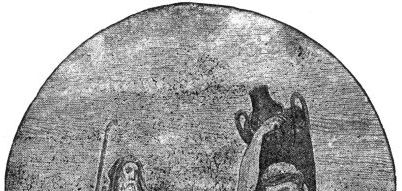
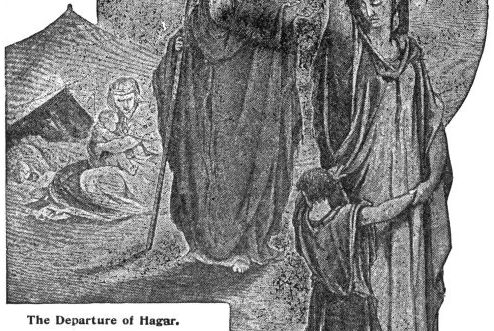
But Abraham had no children, and Sarah, his wife, did not believe that God would give her a son. So she got Abraham to marry her Egyptian maid, Hagar. But the Lord said that His promise was not to be fulfilled through Ishmael, the son of this woman, but through a son whom He would give Sarah. So after Isaac was born, Hagar and Ishmael were sent away; for the Lord had said, "In Isaac shall thy seed be called."
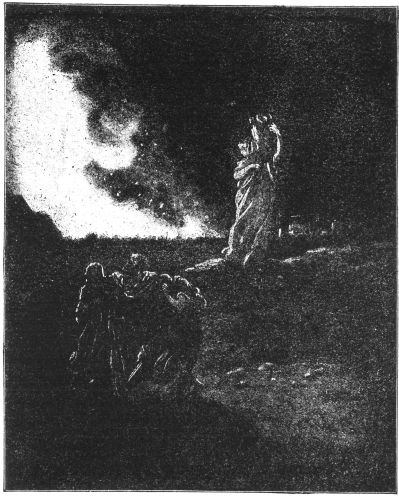
The Flight from Sodom.




ABRAHAM returned from Egypt "very rich in cattle, in silver, and in gold." Lot was still with him, and their flocks and herds became so great that they could not find pasture for them all together.
So Abraham said to Lot, "Is not the whole land before thee? Separate thyself, I pray thee, from me. If thou wilt take the left hand, then I will go to the right; or if thou depart to the right hand, then I will go to the left."
Abraham was the elder, and the choice should have been his. But he was not selfish, and so gave the choice to the younger man, his nephew.
Lot selfishly chose the plain of Jordan. This was the most beautiful and productive portion of all the land of Canaan. And he "pitched his tent toward Sodom."
But Lot did not stop to consider that Sodom and the other cities of the plain were very wicked. He thought only of his own interests, and was soon living in the city of Sodom itself. His daughters married wicked men of Sodom, and so forgot God. Lot could now see the evil of choosing his home among wicked people.
At last Sodom and some of the other cities near it became so wicked that God would not suffer them to remain. He must destroy them from off the earth. But first the Lord would tell Abraham what He was about to do.
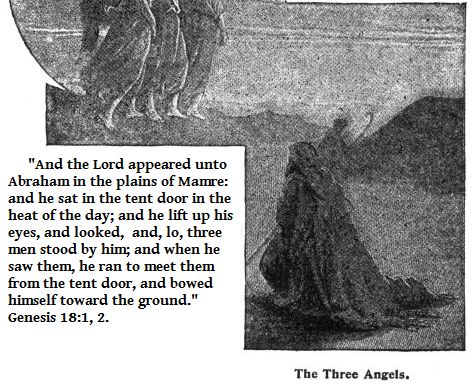
One day when it was very warm, Abraham sat in the door of his tent. Soon he saw three strangers coming toward him. He ran to them and asked them to come and sit under a tree and rest while he prepared some food for them to eat.
After they had eaten, two of the men went toward Sodom, but the third, who was the Lord, or Christ, remained to tell Abraham that He was about to destroy Sodom.
Then Abraham began to plead for Sodom. He made many requests of the Lord, and finally gained the promise that if ten righteous people could be found in Sodom the city would be saved.
In his child-like faith Abraham felt safe when this promise was made. In the household of Lot alone he thought there must be at least ten who were true to God. But the evil surroundings of Sodom had corrupted even the family of Lot.

The two angels who left Abraham came to Lot and told him to take his sons and daughters, and flee from the city. But these young persons, who were married to the people of Sodom, would not heed the warning.
Early the next morning the angels told Lot to take his wife and the two daughters who were with him, and hasten out of the city.
But Lot lingered, for he was sorry to know that some of his children, his friends, the beautiful city, and all his wealth must be destroyed. So the angels took hold of them and hastened them out of Sodom.
Then the angel said to them, "Escape for thy life; look not behind thee, neither stay thou in all the plain; escape to the mountain, lest thou be consumed." And then the angel adds, "For I can not do anything till thou be come thither."
The angel had said, "Look not behind thee." But the treasure of Lot's wife was in Sodom. She did not heed the warning of the angel. She loved her beautiful home and the riches of Sodom more than she loved God. She proved unworthy of the deliverance that the angels of God had brought to them, and she turned and looked back to see if God really meant what he said. That very moment she became a pillar of salt, dead and white like a marble statue.
When Lot and his daughters were far away, the Lord rained a horrible tempest of fire and brimstone upon the cities of the plain, and they were utterly destroyed. The very ground where they stood is now covered by the Dead Sea.
Thus God showed His hatred of their awful wickedness. They loved sin, and were not thankful that God had paid the great price of the life of His only Son in order to save them from doing wrong, if they would only ask Him for help to do right. Holding on to sin they perished with it, as many will perish in the last great "lake of fire" "prepared for the devil and his angels." That fire is not being prepared for man; heaven is being fitted up for him. Oh that all would accept it!
Jesus said, "In my Father's house are many mansions; I go to prepare a place for you." Which place are we preparing ourselves for? We are to make the choice.



GOD had promised Abraham that he should be the father of a great nation, and that the land of Canaan should be their home. This was not to come through Ishmael, but through another son.
God had also promised that "in thy seed shall all nations of the earth be blessed." Genesis 22:18. Paul says, in Galatians 3:16, that the "seed" here mentioned is Christ; so Genesis 22:18 is a promise that Christ shall come through the family of Abraham. In Christ all nations of the earth are blessed, although not all of them accept the blessing.
Abraham was called "The friend of God," because he loved and served the Lord so faithfully.
He had a son named Isaac, whom he loved very much. God had told Abraham that Isaac should be his heir, or have all that was Abraham's when he died. All the blessings promised to Abraham were to come to his son Isaac.
But a great trial was to come to Abraham to test his faith in God. The Lord said to him, "Take now thy son, thine only son Isaac, whom thou lovest, and get thee into the land of Moriah; and offer him there for a burnt offering upon one of the mountains which I will tell thee of." Genesis 22:2.
What a terrible test this was! How could God's promise be fulfilled if Isaac should die? But Abraham did not distrust God nor question His command. He believed that if Isaac should die God would "raise him up, even from the dead." Hebrews 11:19.
Early the next morning Abraham took Isaac and two of his servants and prepared for the long journey. They cut the wood and bound it to the back of his beast, and started for the place of sacrifice.
None but Abraham knew of the awful command of God. His heart was very sad as they journeyed three days in silence.
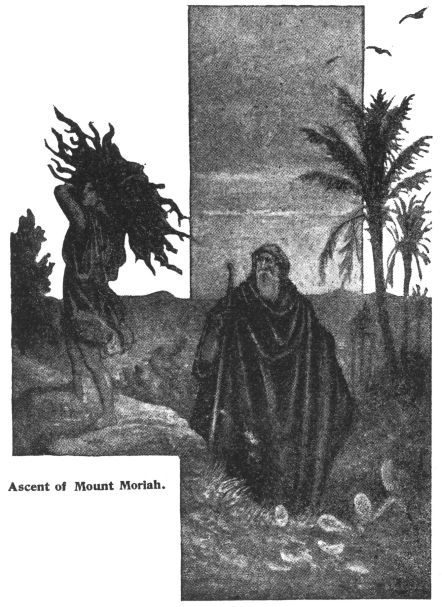
On the third day they came in sight of the mountain God had appointed as the place of sacrifice.
"And Abraham said unto his young men, Abide ye here with the ass; and I and the lad will go yonder and worship.
"And Abraham took the wood of the burnt offering, and laid it upon Isaac his son; and he took the fire in his hand, and a knife; and they went both of them together." Genesis 22:5, 6.
As the two walked on in silence, Isaac finally asked, "My father," "behold the fire and the wood; but where is the lamb for a burnt offering?"
This was the first time this question had been asked on the journey. What pain it must have brought to the heart of the loving father! He could not tell him yet, so he said, "God will prepare himself a lamb for a burnt offering."
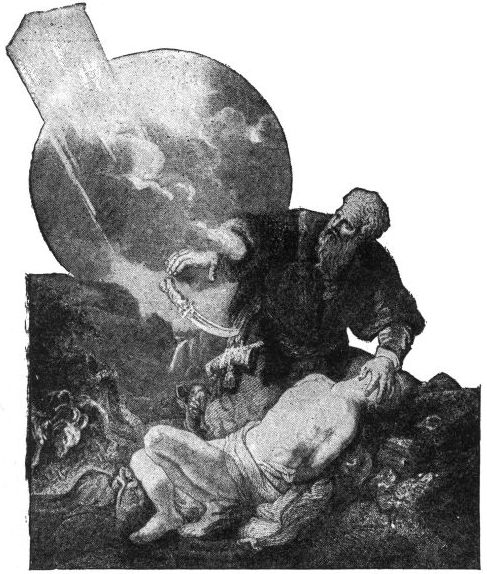
"Lay not thine hands upon the lad."
At last they came to the appointed place. They built an altar and placed upon it the wood. Abraham must now tell his son the command that God had given. He could keep it no longer.
Isaac heard the message of his fate in sorrow, but he did not resist. Abraham was a hundred and twenty years old, and weak from grief. Isaac was twenty years old, and strong and vigorous. He could have escaped if he had desired to do so, but he, too, had faith in God, and was obedient to his parents.
Isaac let his aged father bind him down to the wood upon the altar, just as Jesus was to let Himself be nailed to a cross of wood. The last good-bye had been said, and the last tender words spoken. Then Abraham raised the knife to slay his son.
But before the stroke could fall, an angel calls to him from Heaven, "Abraham, Abraham!" And the patriarch answers, "Here am I."
Then the angel said, "Lay not thine hand upon the lad, neither do thou anything unto him; for now I know that thou fearest God, seeing thou hast not withheld thy son, thine only son from me." Genesis 22:12.
What a joyful command! How easy it was to obey it! Then Abraham saw a ram caught in the bushes. This he took and offered upon the altar in the place of his son. Then they journeyed back to their home with joyful hearts. The Lord blessed Abraham still more because he had obeyed Him.
Abraham was willing that Isaac should die, believing it to be best, just as God was willing that Jesus should die for us, knowing it to be best.
Isaac was willing to lay down his own life, just as Jesus was willing to lay down His life for us.
Abraham was spared the awful sorrow of seeing his son die. Another victim was found. But no one could take the place of Jesus. His Father and all the angels in Heaven had to see His dreadful death; and it was all for us.
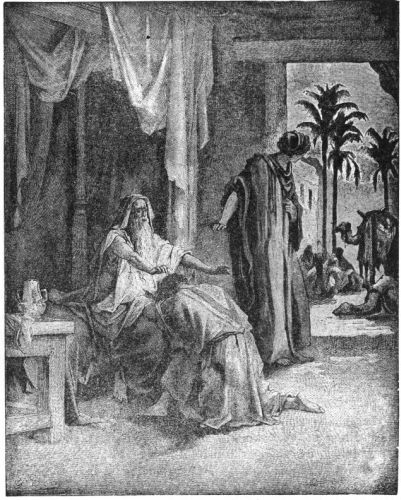
Jacob Deceiving His Father.



ISAAC had two sons, named Jacob and Esau. Esau was a little older than Jacob, and was a hunter of wild animals. Jacob was a shepherd, and cared for his father's sheep.
Esau, the daring hunter, was very dear to his father; but Rebekah loved Jacob most because he was so kind and careful.
God had said to Rebekah that "the elder shall serve the younger." So she knew that the Lord would especially bless Jacob, and finally give him the birthright, which meant that he was to have a double portion of his father's wealth, and also become the head of the family when his father died.
The birthright usually went to the eldest son, but the birthright in the family of Isaac must go to the son who would obey God. He was to be the father of God's people,—the children of Israel.
Jacob loved God, and was willing to obey Him. He greatly desired the blessing which the birthright would bring to him. But Esau did not love God nor care to serve Him. He would rather live the wild, free life of a hunter, and do as he chose, than have the birthright.
Jacob did not trust God as he should, for he feared that Esau would have the birthright because he was the eldest son of Isaac. So he studied all the time to find some plan to get it away from Esau.
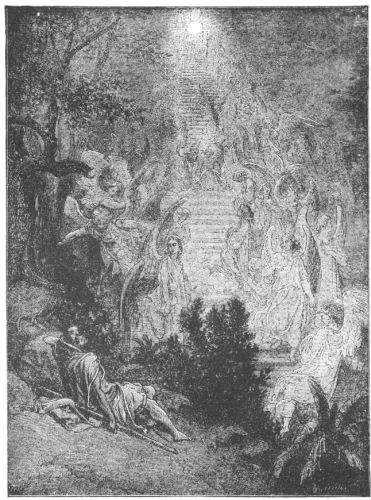
Jacob's Dream.
One day Esau had been in the fields hunting, but had found nothing. On the way home he became very hungry. Coming to the tent of his brother he found him preparing his dinner of pottage. "And Esau said to Jacob, Feed me I pray thee, with that same red pottage; for I am faint."
Jacob forgot that he ought to be kind to his brother. He only thought that this was the chance he had been looking for. "And Jacob said, Sell me this day thy birthright."
"And Esau said, Behold, I am at the point to die; and what profit shall this birthright do to me?" So he sold his birthright to his brother for a good dinner.
You see Jacob took a mean advantage of his brother when he was faint and hungry. This made it easier for him afterward to do another great wrong, and deceive his father. One wrong act always makes it easier to do another.
When Isaac was very old he became blind. He was still determined to give the birthright to Esau. So one day he told him to go into the field and kill a deer and make some savory meat, and then he would bless him.
But Rebekah heard it, and she was afraid the Lord would let Esau have the birthright. She thought she must do something to help the Lord keep His promise that Jacob should be head of the family.
So she told Jacob to kill two young goats, and she made savory meat, such as Esau made from venison. Then she dressed Jacob in Esau's clothes, and sent him in to deceive his blind father.
This was very wicked, for Jacob told lies to his father to make him think that he was Esau. So through falsehood Jacob got the blessing which made him head of the family.
When Esau returned and learned what Jacob had done, he was very angry. Fearing that his brother would kill him, Jacob fled from his father's house, and went to Mesopotamia, where his mother's family lived.
He felt very sorrowful on his journey. He was afraid that his sin was too great to be forgiven. But one night he confessed it all to God, and then laid his head on a stone for a pillow, and went to sleep.
In the night the Lord gave him a beautiful dream. In it he saw a ladder which reached from earth to heaven. On this ladder there were angels ascending and descending.
At the top of the ladder Jacob saw his Saviour, who told him that He was the God of Abraham and Isaac, and that He would be his God, and make him the father of a great nation. This was because Jacob was sorry for his sins. The Lord promised to go with him on his journey, and finally bring him back again, and that his children should have the land of Canaan for their home.
From this place Jacob journeyed until he came to the home of Laban, his mother's brother. Here he worked hard twenty years.
One night the Lord came to him in a dream, and said, "Arise, get thee out of this land, and return unto the land of thy kindred." Then Jacob prepared immediately to return to Canaan.
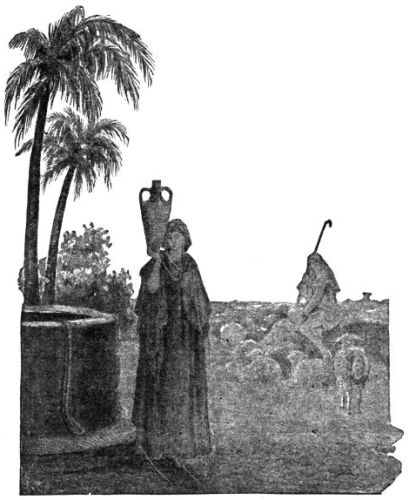
Jacob and Rachel.



JACOB had become very rich in sheep and cattle, and had many servants to care for them. His journey back to Canaan was slow. He was very sad because of his sin in deceiving his father.
As he neared his old home he learned that Esau was coming against him with four hundred armed soldiers. Jacob had no soldiers, and was much afraid.
Then Jacob divided his band into two companies, thinking that at least one might escape. He then sent servants with splendid presents to Esau, hoping thus to touch the heart of his brother.
Jacob had now done all that he could do. Then he went by himself to spend the night in prayer. He knew that God could touch the heart of his brother, and this was his only hope.
While praying he suddenly felt a hand laid upon him. He thought it was an enemy seeking his life. He put forth all his strength to escape, but could not. Jacob struggled and wrestled until near morning.
Then the stranger touched him on the hollow of his thigh, and his thigh was put out of joint. Then Jacob knew that he had been struggling with an angel, and not with a man. It was the Lord, his Saviour.
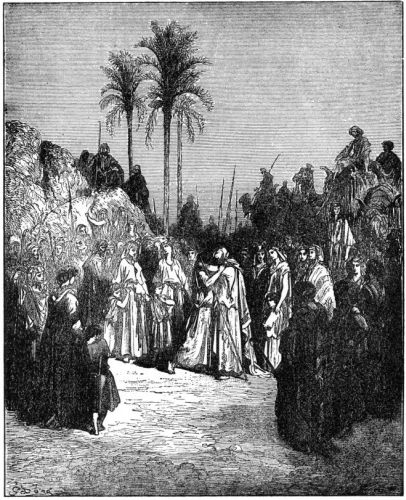
The Meeting of Jacob and Esau.
Jacob ceased to struggle, and clung to the Angel. He knew he must have divine help or perish. Unless God should work for him, his brother Esau would overcome and destroy him.
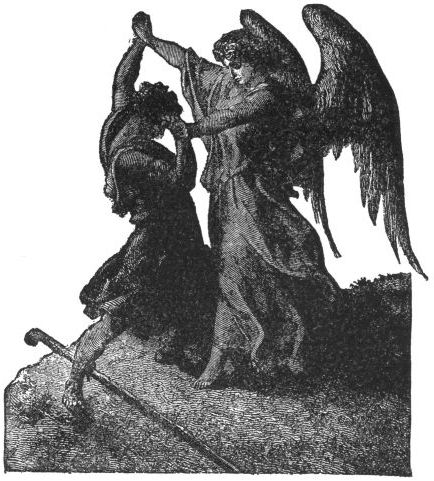
Jacob and the Angel.
But Jacob's faith must be fully tested. The Angel said, "Let me go, for the day breaketh." With the realizing sense of his sins and of his deep need, he clung to his Lord the closer, and cried, "I will not let Thee go, except Thou bless me."
And "he had power over the Angel, and prevailed; he wept and made supplication unto Him; he found Him in Bethel." And the Angel said unto him, "What is thy name? And he said, Jacob. And He said, Thy name shall be called no more Jacob, but Israel [A prince of God]; for as a prince hast thou power with God and with men, and hast prevailed."
If we come to God as Jacob did, with confession, with tears, and a perseverance that will not be denied, we can prevail with Him also.
The Lord sent an angel to soften the heart of Esau. At sight of Jacob "Esau ran to meet him, and fell on his neck, and kissed him; and they wept."
Jacob journeyed to the Jordan, which he crossed, and "came in peace to the city of Shechem, which is in the land of Canaan." Here he erected an altar which he named "El-elohe-Israel," which means, "God, the God of Israel."
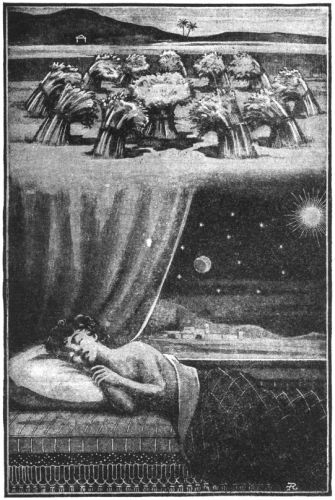
The Two Dreams of Joseph.





JACOB had twelve sons. The ten elder sons were shepherds. They often went far from home to find grass and water for their father's flocks. Joseph and Benjamin, the two younger sons, remained at home with their father.
The elder sons were quarrelsome, and gave their father much trouble. But Joseph was gentle, kind, and truthful. And Jacob "loved Joseph more than all his children." To show his love, Jacob made him a beautiful coat of many colors. These things made his brothers jealous, and they hated him.
But the Lord was pleased with Joseph because he loved to do right and obey his father. God had a great work for Joseph to do. So He gave him two dreams which came true many years afterward.
In his first dream Joseph saw himself and his eleven brothers in the field binding grain into bundles, or sheaves. And his bundle arose and stood upright, and his brothers' bundles bowed down to his bundle.
Probably Joseph did not know what his dream meant. Had he known, he would not have told it to his brothers. When he did tell it to them they hated him more than ever, and said, "Shalt thou indeed rule over us?"
Some time after this Joseph dreamed another dream. In this dream he saw the sun, moon, and eleven stars. And they all bowed down to him. He told this dream to his father and to his brethren. And his father said to him, "Shall I and thy mother and thy brethren indeed come to bow down ourselves to thee to the earth?" But years after, when the famine came, the father, brothers, and their families had to depend on Joseph for even the food which they ate.


One day Jacob sent Joseph to find his brethren, for he wanted to know if they were well. They were many miles away caring for the sheep.
When they saw Joseph coming, these wicked brothers said one to another, "Behold, this dreamer cometh. Let us slay him, and cast him into some pit, and we will say, Some evil beast hath devoured him; and we shall see what will become of his dreams."
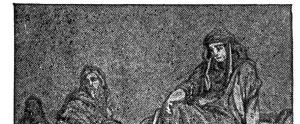
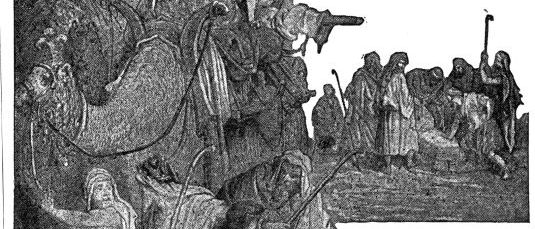
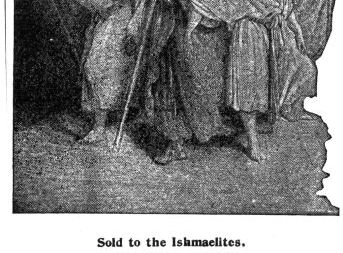
But Reuben would not consent to have Joseph killed, so they took off his beautiful coat, and cast him alive into a pit. Soon a company of Ishmaelites came along on their way to Egypt. Then the brothers drew him out of the pit and sold him to be a slave.
After Joseph was gone, the brothers began to think of their father, and what they should tell him. Then to hide their sin they did another wicked thing. They killed a young goat and put its blood all over Joseph's coat, so it would look as though some wild beast had slain him.
Some of the brothers then took the coat to their father, and told him they had found it. They said they had brought it to him to see if it was Joseph's coat.
And Jacob said, "It is Joseph's coat; some evil beast hath devoured him." And Jacob rent his clothes and mourned for his son many days. The wicked brothers deceived their father then, but many years afterward the truth came out, and they had to confess their sin.
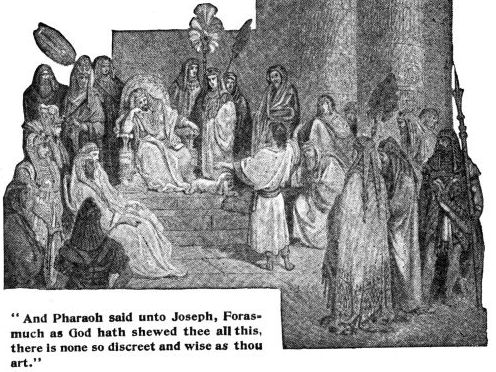
Joseph was sold to a rich man in Egypt, by the name of Potiphar. The Lord blessed Joseph, and Potiphar saw that whatever he did prospered. So he made him steward of all that he had.
But God had a higher place for Joseph, and he must reach it through affliction. In all his troubles it was the Lord who was giving Joseph just the training he needed to fit him for the great work before him.
Through a wicked and false charge of Potiphar's wife, Joseph was cast into prison. But by his honesty he gained the confidence of the keeper of the prison, and was given charge of the prisoners.
One morning he met the chief butler and the chief baker of the king. They had been cast into prison for some offense, and were looking very sad. He kindly asked the cause, and each said that he had dreamed a strange dream, and could not tell what it meant.
Joseph then said, "Do not interpretations belong to God? tell me them, I pray thee." Then they told their dreams, and the Lord told Joseph their meaning. In three days the butler was to go back to his place with the king, but the baker would be put to death.
Then Joseph told the story of his wrong treatment to the butler, and asked him to tell the king, and try to get him out of prison. But the butler was like many other people who soon forget those who were their friends in trouble. When he got out of prison he forgot all about Joseph and his request.
But God was working all the time in His own way. The king had two dreams in one night, which seemed to mean the same thing. He wanted to understand them, so he called in the wise men of his kingdom, but they could not tell what the dreams meant.
Now get your Bible and read the forty-first and forty-second chapters of the book of Genesis, and see what these dreams were, and how the Lord got Joseph out of prison and made him ruler of Egypt.
When the dreadful famine came, he had corn saved up to keep the Egyptians from starving. Thus the Lord often uses good people to provide for the needs of those who are evil.
But God had another reason for delivering Joseph from prison. What do you think it was?





WHEN food began to be scarce with Jacob's family, he sent his ten sons to Egypt to buy corn. Joseph knew his brethren when he saw them, but they did not know him. He did not look like the boy whom they had sold.
As they bowed before him, the ruler of Egypt, he remembered his dreams of many years before. He saw them fulfilled completely. As the sheaves had bowed to his sheaf, so his brethren were now bowing to him.
His heart went out in love for them, but before he should tell them who he was, he wanted to know if they were still wicked, or if their hearts had been changed since he had been separated from them.
Joseph accused them of being spies. But they denied the charge, and said that they were true men, and a family of twelve brethren. Ten were in Egypt, the youngest was with their father, and one was dead. They had never heard of Joseph since they had sold him, and supposed he was dead.
But Joseph still accused them of being spies, and shut them all up in prison for three days. These days in prison were days of sorrow. They felt that they were being punished for their cruel treatment of Joseph.
Finally Joseph called them from prison. He told them that all but one could return to their father. He would keep Simeon in prison until they should come back to Egypt, but they must bring their youngest brother when they came, or Joseph would not even see them.
Joseph chose Simeon to remain because he had been the chief actor in their cruelty to him in the past. They returned to their home with heavy hearts.
When the food brought from Egypt was nearly gone, Jacob said to his sons, "Go again, buy us a little food." But they dared not go unless Benjamin should go with them. To this the father at last consented, and they again went to Egypt, taking with them presents for the great governor.
As they started, the sorrowful father raised his hands to heaven and prayed, "God Almighty give you mercy before the man, that he may send away your elder brother, and Benjamin. If I am bereaved of my children, I am bereaved."
When they reached Egypt, their brother Simeon was released, and all were brought to dine at the house of the governor. According to the customs of Egypt, Joseph must eat at a table by himself, and the eleven brothers at a table by themselves. They had been jealous of Joseph in his home, and he wanted to know if they had become better men. So he sent five times as much food to Benjamin. They showed no jealousy now.
But Joseph desired to test them once more. So when the sacks were filled with corn he had his silver drinking cup put secretly into Benjamin's sack.
The eleven brothers departed joyfully, and felt that they had escaped all the perils which they feared. But they had hardly left the city when they were overtaken by the governor's steward.
He said to them, "Wherefore have ye rewarded evil for good?" He then accused them of stealing the cup. They all denied taking it, and felt so sure that they said if it was found with one of them he should die, and all the rest would become servants of the governor.
But the steward would not agree to this. He said, "He with whom it is found shall be my servant; and ye shall be blameless." So all the sacks were opened, and the cup was found in Benjamin's sack.
What will the brothers do now? If still selfish, they will leave their brother to his fate, and go back home. But no, they were changed men. They would now face any peril to save their brother. They rent their clothes to show their grief, and all went back with him to the city, and met the governor.
Then Judah offered to become a slave in the place of Benjamin. This test was enough. Joseph now knew that his brothers were changed.
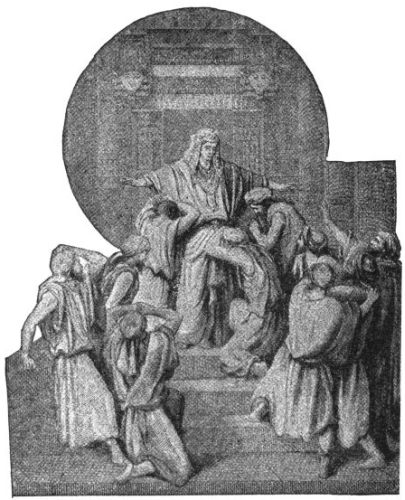
"I am Joseph, your brother."
Did he make slaves of them because they had sold him into bondage when he was a boy?
Find the forty-fifth chapter of Genesis and read what he did, and how the king felt about it when he heard the news, and what became of Joseph's brothers and their father's family.
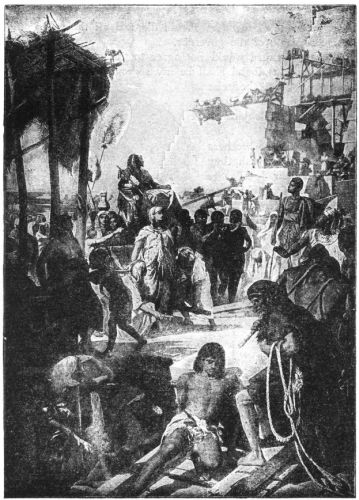
Building the Pyramids



AFTER the death of Joseph "there arose up a new king over Egypt, which knew not Joseph." This king did not wish to remember the good that Joseph had done.
The children of Israel had increased in numbers; "and the land was filled with them." The Egyptians feared that if there was a war the Israelites would join their enemies and fight against them.
So the king made them slaves, and set taskmasters over them to make them work. "And they made their lives bitter with hard bondage, in mortar, and in brick, and in all manner of service in the field."
They thought that by their cruelty and the hard work in the fields, they would stop the Israelites from increasing in the land. "But the more they afflicted them, the more they multiplied and grew."
Then the cruel king commanded that all the boys should be killed at their birth. But even this plan did not succeed. The Israelites still increased in the land.
It was at this time that Moses was born. For three months he was carefully hidden at home and cared for by his mother. But she dared not keep him there any longer. So she made an ark of bulrushes, and laying the babe in it, hid it among the flags by the river.
His sister Miriam anxiously watched the little ark while the mother prayed earnestly that her child might not be destroyed. God heard the mother's prayer, for the babe in the little ark was to be used by the Lord to deliver Israel from bondage.
One day the daughter of the king came to the river to bathe. She saw the ark, and sent one of her maids to bring it. When she opened it and saw the beautiful child, she knew why it was there, and said, "This is one of the Hebrews' children." And the child wept, and Pharaoh's daughter pitied it.
Then Miriam came near and said to Pharaoh's daughter, "Shall I go and call to thee a nurse of the Hebrew women, that she may nurse the child for thee? And Pharaoh's daughter said to her, Go. And the maid went and called the child's mother.
"And Pharaoh's daughter said unto her, Take this child away, and nurse it for me, and I will give thee thy wages."
How glad the mother was to again have the care of her own child. He was now safe, for he was the adopted son of Pharaoh's daughter. And better still, he was in the home of his own parents.
The mother had the care of her boy until he was about twelve years old. During these years she taught him carefully about the true God. These lessons he never forgot. They kept him pure and free from the wickedness and idolatry which surrounded him in after years.
From his humble home he was taken to the royal palace, and became the son of Pharaoh's daughter. "And she called his name Moses," which means, drawn out. For, she said, "I drew him out of the water." In his royal home he was trained in all the learning of the Egyptians.
This training fitted him for the highest position in all Egypt. He was the leader in Pharaoh's army, and became a great general. Pharaoh determined that when he died, his daughter's adopted son should be king. But all the plans of man were "overruled by God for the training and education of the future leader of His people." Moses was not to shine as king of Egypt.
One day, when Moses was forty years old, he saw an Egyptian smiting an Israelite. He thought the time had come for him to help his people, so he slew the Egyptian and buried him.
Here Moses made a mistake. He took into his own hands the work which God had promised to do. He supposed his people were to be delivered by warfare, and that he, a skillful general, was to be the leader of the Hebrew armies.
But God had a different plan. By His own hand He would bring His people out of bondage. In the delivering of Israel, He would teach the Egyptians the knowledge of the true God by such wonders and plagues as they could never forget.
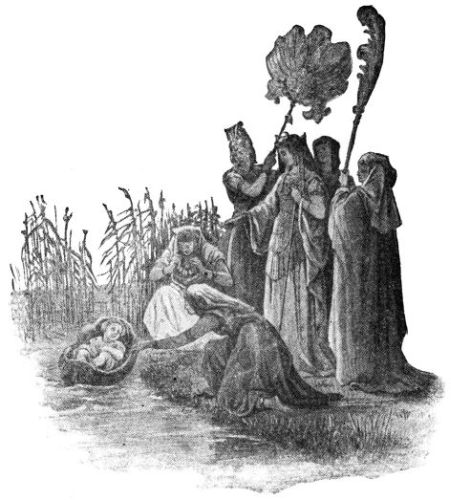
Pharaoh's Daughter finds Moses in the Ark of Bulrushes.
When King Pharaoh learned that Moses had killed the Egyptian, he commanded that he should be slain. But Moses fled toward Arabia, and the Lord led him to Jethro the prince of Midian, whose flocks he cared for during the forty years in which God was preparing him to lead the Israelites out of bondage.
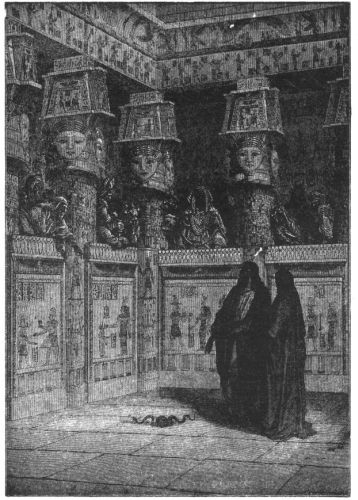
Moses and Aaron Before Pharaoh


ONE day as Moses was leading Jethro's flocks near Mount Horeb, he saw a strange sight. A bush was on fire, but it did not burn up. So he went to see what it should mean.
As he came near, a voice from the bush said to him, "Put off thy shoes from off thy feet, for the place whereon thou standest is holy ground." Then Moses knew that it was the Lord who was talking to him from the bush.
The Lord told Moses that the time had come for the Israelites to go free from their bondage in Egypt. He told Moses to start for Egypt, and that his brother Aaron would meet him on the way and go with him.
They were then to go to Pharaoh and tell him that the God of Israel had sent them to him, and that he must let His people go. And he gave Moses wonderful signs to show to Pharaoh, so that he would know that God had sent them.
When Moses and Aaron came before Pharaoh and told him what the Lord had said, he answered, "Who is the Lord that I should let Israel go?" The Hebrew slaves were very valuable to the Egyptians, and they wanted to keep them, and make them do their hard work.
Pharaoh asked them to show a miracle to prove that their God had sent them. Then they performed one of the wonders that the Lord had given to Moses. Aaron cast down his rod, and it became a serpent. Then Pharaoh called in his sorcerers, who were wicked men claiming to have power to do wonderful things. He showed them what Aaron had done with his rod, and asked them if they could turn their rods into serpents.
Then the sorcerers cast down their rods, and they appeared to become serpents also. But while they were looking at them, Aaron's serpent swallowed the serpents of the sorcerers.
But the work of the sorcerers was only a deception of their master, the devil. God only could really give life to the staff of Aaron. Neither the devil nor his servants can give life to anything. But the sorcerers had deceived the people and made their work look like God's work.
By thus deceiving Pharaoh they destroyed the effect of God's miracle, and so the king's heart was hardened against letting Israel go. Satan is ever counterfeiting, or imitating, the work of God. He often makes his lies appear like God's truth. In this way he leads many away from God.
Then God sent ten terrible plagues upon the land of Egypt. Each one was more awful than the one before it. They were sent to teach the Egyptians that the God of Israel was the only true God, and to punish them for refusing to obey Him.
The First Plague.—The River Nile, which they worshiped, was turned to blood.
Second Plague.—An army of frogs, which the Egyptians considered sacred, came up from the river. They went into all the houses, and even into the ovens and the troughs where they made their bread.
Third Plague.—The very dust of Egypt became lice on both man and beast.
Fourth Plague.—Swarms of flies came up until "the land was corrupted" because of them.
Fifth Plague.—A "grievous murrain" came upon the cattle, so that a great many of them died.
Sixth Plague.—Moses sprinkled dust into the air, and it became boils on man and beast.
Seventh Plague.—An awful hail, mingled with fire, smote the land, and killed all men and beasts that were not under shelter.
Eighth Plague.—Clouds of locusts came up and ate every green thing.
Ninth Plague.—"Darkness which might be felt" covered the land for three days. It was so dark that the people did not dare to go out of their houses.
Through nine plagues Pharaoh's heart had remained hard and rebellious against God. Egypt was a ruined country because of this. Now the Lord told Moses that He would send one more plague, more terrible than all the others, and then they would be glad to let His people go.
But before it came, the Hebrews were to "borrow" from the Egyptians "jewels of silver and jewels of gold." For many years they had toiled without wages. What they received at this time was only a partial payment for their long years of service. This silver and gold would be needed when they should build the tabernacle in the wilderness.
Tenth Plague.—At midnight the angel of the Lord was to pass through Egypt and slay the first-born in every house, and the first-born of beasts.
None of the other plagues had come near to the land of Goshen where the children of Israel dwelt. But now they had a part to act or they would suffer with the Egyptians when the destroying angel should pass through the land.
In order to escape, the Israelites must separate from the Egyptians, and come into their own houses. They were to kill a lamb, and, with a bunch of hyssop, strike some of its blood upon the door-posts of their houses. Wherever this was done the destroying angel would "pass over" the house, and all within it were safe.
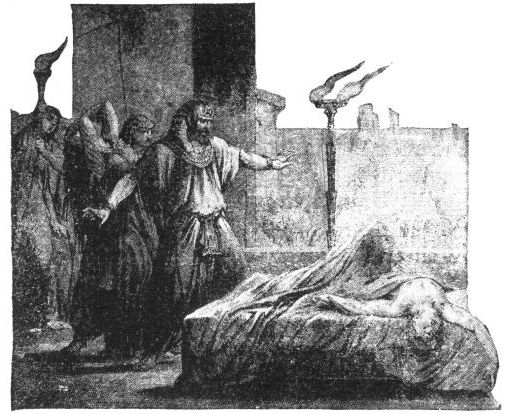
Death of the First-born.
They were also to roast the lamb whole, and eat it at midnight, while the destroying angel was doing his awful work among the Egyptians. They were to eat it standing, their shoes on their feet, their staff in hand, ready for flight.
This most solemn ceremony was called the "passover," because the destroying angel passed over the houses of those who had faith in God's commands and had put the blood upon the door-posts of their houses. The children of Israel were commanded to keep the passover each year as a memorial of their preservation in Egypt.
The passover was also a type of Christ, the Lamb of God. As the blood of the passover lamb upon the door-posts saved those in the house from death, so all will be saved now who confess their sins, believing that the blood of Jesus was shed to save sinners just as surely as the blood of the passover lamb saved those who trusted in it.




"AND it came to pass, that at midnight the Lord smote all the first-born in the land of Egypt; . . . and there was a great cry in Egypt; for there was not a house where there was not one dead."
And Pharaoh "called for Moses and Aaron by night, and said, Rise up, and get you forth from among my people." And he hurried them out of the land of Egypt with their flocks and herds and all they possessed.
When Jacob went into Egypt his whole company numbered only seventy. When Israel left Egypt there were six hundred thousand men, beside women and children. The whole number must have been nearly three millions.
The Lord went before them in a pillar of cloud by day and a pillar of fire by night. And the children of Israel went forward and camped by the Red Sea.
After Israel had left Egypt, Pharaoh became angry because he had let them go. So he took a very large army and pursued after them, and overtook them as they were camped by the Red Sea.
There seemed to be no way of escape for the Israelites. They were hedged in between the mountain and the Red Sea, and behind was the army of Pharaoh. But the Lord had brought them there to test their faith, and show once more how He would deliver them from their enemies.
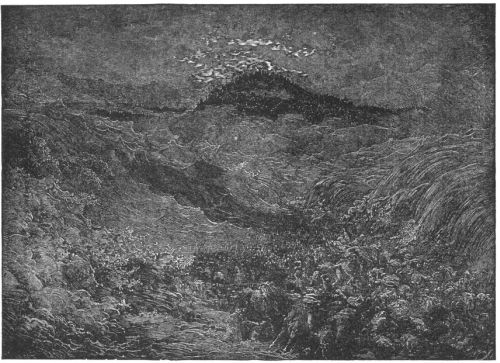
The Egyptians Overthrown In the Red Sea.
Moses was commanded to stretch forth his rod, and as he did so the sea parted and left a dry road through which the Israelites passed over and were safe. And so blind and foolish was Pharaoh that he and his army followed after. When Israel was safe on the other side, Moses again stretched forth his rod, and the sea came back and drowned Pharaoh and all his army.
The Lord cared for his people wonderfully on their journey. At Marah the water was bitter, and they could not drink it. The Lord showed Moses a tree, and told him to cast it into the water; and when he did so it was made sweet and good.
By and by the food which they had brought from Egypt began to fail. The Lord wanted them to learn to trust Him, and so He was willing they should have difficulties to test them. But they did not trust the Lord. They began to complain and find fault with Moses. God had promised to care for them, and if they had only believed Him they would have learned precious lessons and received great blessings.
Then the Lord said to Moses, "I will rain bread from Heaven for you." In the morning they found it on the ground, and called it Manna. Each one gathered just enough to last through the day. This manna would keep fresh and sweet only one day. So they all had to depend on the Lord every day for the food they ate.
In Egypt the people had forgotten the Sabbath. Now the Lord would have them remember it. So on the seventh day no manna was given. But on the sixth day the people gathered enough for two days.
And the Lord kept it sweet for them over the Sabbath. This was a Sabbath lesson for them every week. The Sabbath was made for man, and given to him at creation as a memorial of God's great work of making the world in six days. But Israel had forgotten. God wants His Sabbath kept holy now as well as in the time of Israel in the wilderness.
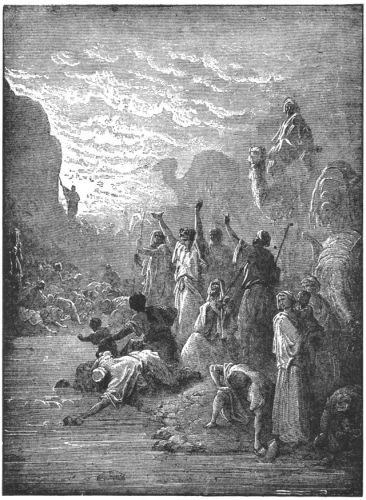
Water from the Rock.
When they came to Rephidim there was no water, and the people complained again to Moses. And the Lord told Moses to go to Mount Horeb and smite the rock with his staff. When he did so, water burst from the rock, enough for the whole camp. It was Moses who smote the rock, but the Lord made the waters to flow.
Whenever the camp was pitched after this they found good water flowing from the rock for them. This rock was to make them and us think of Christ, and the water flowing from it represents the living water of the Word of God which He gives to all who want it.
Soon a new danger arose. The Amalekites came out to attack them. Joshua led the armies of Israel against them. While the battle was going on, Moses stood on a hill and raised his hands to God and prayed for the success of Israel. When he became weary and lowered his hands, the Amalekites were successful. Then Aaron and Hur held up the hands of Moses until the sun went down, and Israel gained the victory.
This was to teach Israel that the victory came from God, and that he would hear and answer prayer. It also taught them that they should help their leader, Moses, in the great work he had to do.
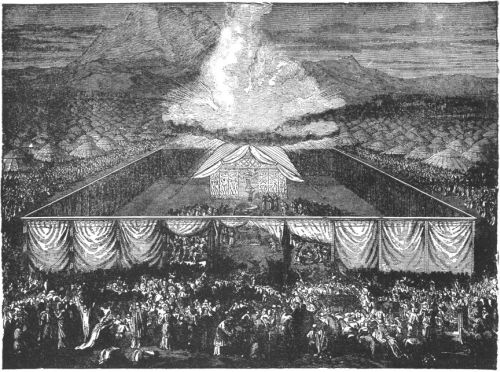
The Camp and Tabernacle in the Wilderness.




FROM Rephidim Israel journeyed to Mount Sinai. Here God would give His law to the people, and here they were to build the tabernacle for His holy service.
Before this time these people had no books to read. God's Word and His law had been told from father to son, and so remembered. But during the slavery in Egypt this instruction had been forgotten by many, until they had become like the heathen around them.
During their journey God had spoken to Israel only through Moses. But at this time all the people were called together, and God spoke His law to them with His own voice.
The scene which the people saw was terribly grand. There was a thick cloud on the mount, and amidst it were thunderings and lightnings. The whole mountain was shaken with an earthquake.
There was a loud blast of a trumpet from the mount, "so that all the people that was in the camp trembled." Then God spake His law to the people,—the ten commandments recorded in Exodus 20:3-17.
The children of Israel were always to remember this scene. It was to impress upon their minds the greatness and power of God, the importance of His law, and the necessity of obeying it.
Moses was called up into the very presence of God, on the top of the mountain. Here God gave him two tables of stone on which He had written with His finger the same ten commandments that He had spoken in the hearing of all Israel.
God's law is as enduring as the stone on which it was written. These two tables are called "the tables of the covenant." Deuteronomy 9:11. The ten commandments are called God's covenant with His people. "And He wrote upon the tables the words of the covenant, the ten commandments." Exodus 34:28.
David said that His covenant, or law, was "commanded to a thousand generations." Psalms 105:8. It will continue forever. Christ Himself said, "Till heaven and earth pass, one jot or one tittle shall in no wise pass from the law." Matthew 5:17, 18.
Again He said, "Whosoever therefore shall break one of these least commandments, and shall teach men so, he shall be called the least (or, of no account) in the kingdom of heaven." Matthew 5:19.
The Apostle James said, "For whosoever shall keep the whole law, and yet offend in one point, he is guilty of all." James 2:10. Keeping nine of the commandments will not save us. If we break one commandment, the law will condemn us as surely as if we broke all the ten.
Man can not change one single commandment of God's law. If he tries to do so, it is then only a commandment of men. The worship of those who make or keep such commandments is useless, for God will not accept it. Christ said of those who do so, "But in vain do they worship Me, teaching for doctrines the commandments of men." Matthew 15:9.
The only safe course is to take God's law just as He gave it on Sinai, and obey it as He gave it. Of those who will be alive when Christ comes it is written, "Here are they that keep the commandments of God." Revelation 14:12.
Heaven will be filled with commandment-keeping people; for it is written, "Blessed are they that do His commandments, that they may have right to the tree of life, and may enter in through the gates into the city." Revelation 22:14.
We can not keep these commandments ourselves any more than the children of Israel could in the wilderness. It is for this that Christ died on Calvary. Through Him we can have forgiveness for our sins, and receive help to overcome sin and obey the law of God.
While Moses was in the mount God gave him instructions for building the sanctuary. It was to be like the one in heaven. In it the Lord would meet His people and give them such instruction as they needed. Provision was also made in it for sacrifices and offerings, all of which were to show their faith in the Saviour to come.
Moses was in the mountain one-ninth of a year. The faith of the people was not strong enough to endure the long separation from their leader. They did not think he would return to them. They said, "As for this Moses, . . . we wot not what has become of him."
They came to Aaron and said to him, "Up, make us gods, which shall go before us." They would make to themselves a calf as their leader to take the place of Moses, and then go on to the promised land without him. The old habits of idol worship in Egypt had come back to them.
So Israel brought their ornaments of gold to Aaron, and he made of them a golden calf. The calf represented Apis, the god held most sacred by the Egyptians.
When it was done the people gathered around it and cried, "These be thy gods, O Israel, which brought thee up out of the land of Egypt." Exodus 32:4.
How could they so soon forget the wonders and plagues brought by the Lord upon Egypt! How could they forget the terrible day when God spake to them His law from the top of Mount Sinai!
And the Lord said to Moses, "Get thee down, for thy people have corrupted themselves." As Moses came in sight of the camp of Israel, and saw their heathen worship, he was filled with horror and anger.
In his hands he bore the tables of the sacred law which they were transgressing. He threw them down, and they were broken in pieces at the foot of the mount. This was to remind the Israelites that they had broken God's law which they had promised to obey. In consequence of this they could not claim the promise He had made them.
Through the pleading of Moses, God spared Israel at this time, but the rebellion and evil must be put away from among them.
Moses called for a separation in the camp. Some had not joined in the idolatry, but through it all had remained true to God. These were asked to take their place at the right hand of Moses. Many others saw how wicked they had been, and repented. These took their stand at the left.
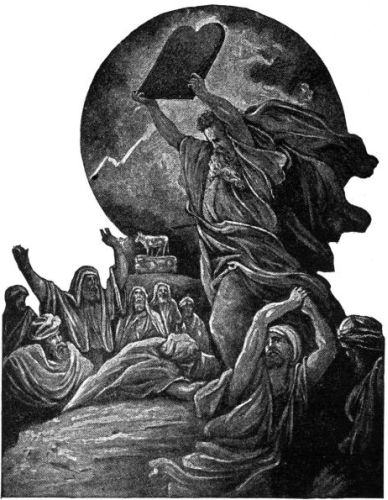
Moses Breaking the Tables of the Law.
Others were stubborn and would not repent, and would not come by the side of Moses at all. About three thousand of the leaders in wickedness perished at the command of the Lord, and the camp was cleansed.
Aaron confessed his sin in making the golden calf, and was forgiven. The calf was ground to powder and scattered in the waters of the brook from which they drank.
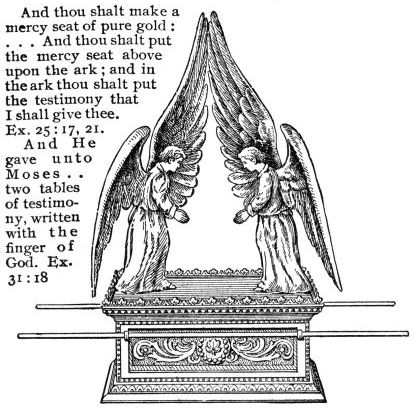
At the command of God, Moses hewed out two more tables of stone, and took them up to Sinai. On these God again wrote His law. When the sanctuary was completed, these tables were placed in a beautiful ark, overlaid with gold. For this reason it was called "The Ark of the Covenant."
This ark was the most sacred thing in all the earthly sanctuary. It was sacred because it contained the tables on which God had written His law. It was deposited in the most holy place, into which none but the high priest ever entered.
On the top of the ark was the mercy seat, and here was where the glory of God rested, and from this place He spake to His people.
When the children of Israel were taken captive by the Babylonians, the ark disappeared, and the Bible makes no mention of it since that time.
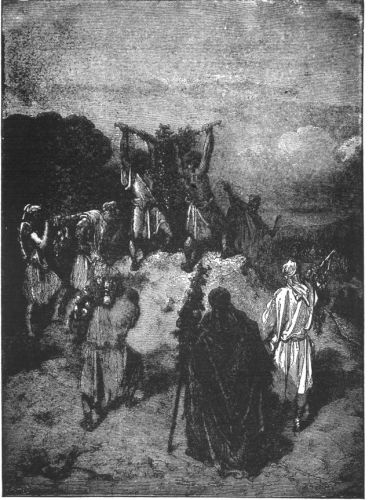
The Return of the Spies.





AFTER all the work on the tabernacle was done, the Israelites again took up their march toward the promised land. In eleven days they reached Kadesh, near the borders of Canaan.
Here twelve spies—one from each tribe—were sent to view the land. They were gone forty days, and on their return brought samples of the fruit of Canaan. They brought one cluster of grapes, so large that it was carried on a pole between two of the men.
In their report to Moses they said, "We came unto the land whither thou sentest us, and surely it floweth with milk and honey; and this is the fruit of it." Numbers 13:17.
Oh, if they had only been willing to stop there in their report! But they went on to tell that the land was filled with strong nations. There were walled cities that could not be broken down, and there were giants, the sons of Anak.
Then Israel lost all hope and courage, "And all the congregation . . . cried; and the people wept that night." And they murmured against Moses and Aaron, and said, "Would God we had died in Egypt! or . . . in the wilderness. . . . Let us return to Egypt." Numbers 14:2, 4.
Where now was their faith and trust in God? They had forgotten the wonders and plagues and the deliverance from Egypt. They had forgotten the many times God had done wonderful things for them on their journey. Surely a God who could do such things could give them the victory over their enemies in Canaan.
Only two of the twelve spies kept their faith in God. Caleb and Joshua told the people that God was able to give them the land. "And Caleb said, Let us go up at once, and possess it; for we are well able to overcome it." Numbers 13:30. But the people would not listen to them.
Then God spake to Moses, and told him that Israel had been so rebellious that those who came out of Egypt should never enter the land of promise. They should wander in the wilderness forty years until they died, and when their children were grown He would bring them into the land.
But Caleb and Joshua had been faithful to God. These two were excepted, and of all the men that left Egypt, only these two should finally enter Canaan. The other ten spies, who had caused Israel to sin, were smitten by the plague, and died in the sight of all Israel.
All the next night Israel spent in mourning. They now realized what they had lost. But in the morning a new hope came to them. They would make up for their lack of courage. They would now go up and take the land.
The armies of Israel gathered, but Moses said to them, "Go not up, for the Lord is not among you." They had lost their opportunity, and if they went up God would not fight for them.
But the army of Israel was a vast multitude of over half a million solders. They now felt able to attack their enemies. So against the command of God they went up to battle with the armies of the Canaanites that had come out to meet them.
But the ark of God remained in camp, and so did Moses and Aaron, Caleb and Joshua. Without a leader, and forsaken of God, the army of Israel was defeated with great slaughter.
Then the Israelites turned back to the wilderness.




THE Israelites wandered in the wilderness nearly forty years. Then, at the command of the Lord, they again turned their faces toward Canaan.
On this journey they were permitted to meet many difficulties, that their faith and trust in God might be tested. They were sometimes short of food to eat and water to drink, and as they neared the promised land great armies came out to destroy them. But the Lord helped them in every trouble, and gave them the victory over their enemies.
Part of their way lay through a hot, sandy desert, where they suffered from heat and thirst. But, instead of being patient, they rebelled against God, and found fault with Moses.
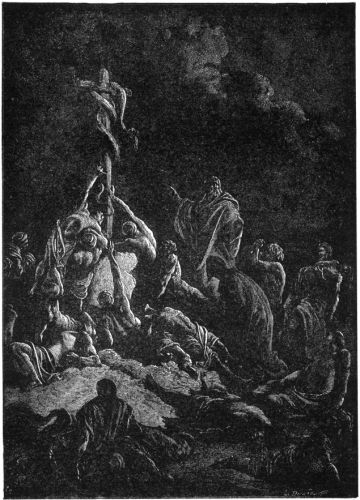
The Brazen Serpent.
Then the Lord let serpents come into the camp, whose bite was like fire, and brought sure death. Some in almost every tent were bitten.
This punishment showed them their sin, and they came to Moses and said, "We have sinned, for we have spoken against the Lord, and against thee. Pray unto the Lord that He take away the serpents from us." Numbers 21:7-9.
In answer to the prayer of Moses the Lord told him to make a serpent of brass, and raise it up on a pole, so that all in the camp could see it. Those who were bitten were told to look at this Serpent and they would be healed. The serpent could not heal them, but to look required faith, and faith brought the healing power.
The Lord could have healed them with a word, but the lesson must be complete. The lifting up of the serpent was to them a type of the lifting up of Christ on the cross, for through Him only could they receive pardon and relief from the consequences of sin. The brazen serpent was an object lesson to lead the children of Israel to look to Christ.
The Hebrews had the same Gospel, or good news of pardon and salvation through Christ, that we have. Speaking of them in the wilderness, the Apostle Paul says, "For unto us was the Gospel preached as well as unto them." Hebrews 4:2.
Every sacrifice they made for sin, every lamb slain, was to show their faith in "the Lamb of God, which taketh away the sin of the world." John 1:29. The blood of the offering was a type of the blood of Christ.
Jesus Christ is the great central figure of the Gospel. It was Christ who was with Israel in all their journey from Egypt to the promised land.
Christ was the "Spiritual Rock" which followed them. He was in the pillar of cloud by day, and in the pillar of fire by night. He was the "Angel" that went before Israel; for Jehovah said, "My name is in Him." (See Exodus 23:21, 22.) No being bears the name of God but His Son.
So, in the history of the world, it has not been as some have supposed, God the Father in the Old Testament, and Christ the Son in the New Testament. It has been Christ with His people all the way.
In the Old Testament Christ was their "Spiritual Rock." In the New Testament, "God was in Christ, reconciling the world unto Himself." 2 Corinthians 5:19.
Both the Father and the Son have ever worked for the salvation of man; but Christ has been the active agent in this work. It was God who "so loved the world that He gave His only begotten Son" for our redemption. It was Christ who made the terrible sacrifice for our salvation.
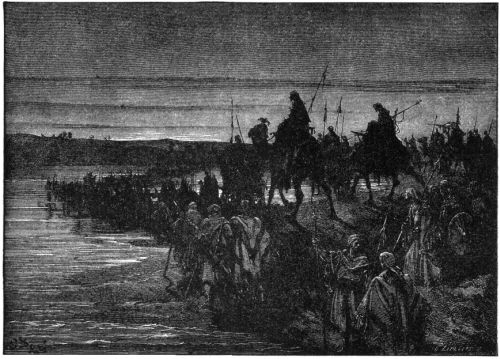
The Israelites Crossing the Jordan.





AS Israel neared the promised land, both Moses and Aaron died. Joshua was then made commander in the place of Moses.
Soon they came to the River Jordan, which they must cross. Here again the Lord made a way for them. He told Israel to go forward, and as the feet of the leaders touched the water, the river stopped flowing from above, and the bed of the stream was left dry. Then the people passed over on dry ground, as their fathers had crossed the Red Sea forty years before.
The book of Joshua tells of the battles that Israel fought with the inhabitants of the land of Canaan. These were very wicked nations, who were as bad as the people who lived before the flood. So the Lord used the armies of Israel to destroy those wicked people.
The first city overthrown was Jericho. This city had very strong and high walls, and the Hebrews were not able to break them down. But the Lord could do what man could not.
One day Joshua saw a man near the camp, with a sword drawn in his hand. "And Joshua went unto him and said, Art thou for us or for our adversaries?
"And he said, Nay; but as Captain of the host of the Lord am I come." Joshua 5:13-15. Then Joshua knew that it was Jesus Christ, for He is the Captain of the Lord's host.
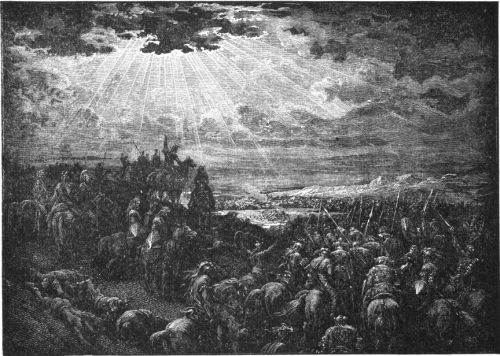
Joshua Commanding the Sun to Stand Still.
The Lord told Joshua what to do. Each day, for six days, all the army of Israel was to march around the city. The soldiers were to go ahead, the priests with the ark of God were to come next, and all the rest of the people were to follow.
On the seventh day they marched around the city seven times. "And it came to pass at the seventh time, when the priests blew with the trumpets, Joshua said unto the people, Shout; for the Lord hath given you the city." Joshua 6:16.
And when the people shouted, the walls of Jericho "fell down flat," and the soldiers went into the city and utterly destroyed it as the Lord had told them to do. This was to show to all nations that God was fighting for Israel.
The tenth chapter of Joshua also tells of a very wonderful battle between Israel and five of the kings of Canaan. All day the battle lasted, and God fought for Israel, sending down great hailstones upon their enemies. More were killed by these hailstones than were slain by the Israelites.
As the conflict raged, Joshua saw that the day would be too short to finish the battle. Then, led by the Spirit of God, he commanded the sun and moon to stand still until the work should be fully done.
"So the sun stood still in the midst of heaven, and hasted not to go down about a whole day. And there was no day like that before it or after it." Joshua 10:13, 14.
In this battle the armies of the wicked Canaanites were utterly destroyed, and their kings slain.
When the nations of Canaan were fully conquered, the land was divided up and given to the different tribes of Israel, as their home.
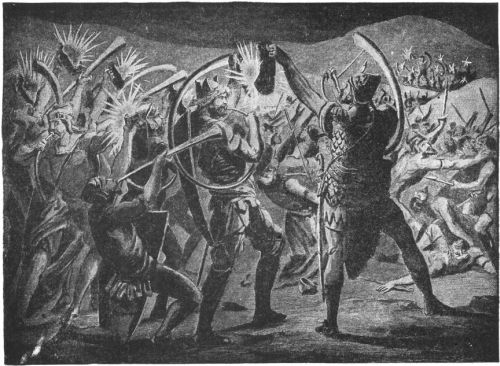
Gideon's Three Hundred.



AFTER the death of Joshua, Israel was governed by judges for many hundred years. Sometimes these judges were wicked men, and led the people into the worship of idols.
Then the Lord, although He still loved them, allowed their enemies to afflict them, that they might remember that He alone could save them from their foes and from sin.
Then when they returned to Him, confessed their sins, and put away their idols, He would choose good and wise men to be their judges. He would then go with their armies to battle, defeat their enemies, and deliver them.
At one time the armies of Midian afflicted Israel for seven years. At harvest time they would come "as grasshoppers for multitude," and take from Israel "all the increase of the earth." During these attacks the people fled to the dens, and caves, and strongholds of the mountains.
Then Israel cried to the Lord for help, and He raised up Gideon to deliver them. One day an angel appeared to him, as he was threshing grain in secret for fear of the invaders. And the angel told him that he was chosen to "save Israel from the hand of the Midianites."
Gideon then prepared food and brought it to the angel. He also asked for a sign that he might know that the words spoken by the angel came from the Lord. So instead of eating the food, the angel said to Gideon, "Take the flesh and the unleavened cakes, and lay them upon this rock, and pour out the broth."
When Gideon had done as he was told, the angel touched the food with the rod in his hand, and fire came out of the rock and burned it. Then the angel disappeared, and Gideon knew that it was the Lord who had spoken to him.
And the Spirit of the Lord came upon Gideon, and he made a call for soldiers. But before he dared take command of the army that gathered, he asked for other signs that he might be sure that God had really chosen him and would go with him.
So one night he spread a fleece of wool on the floor, and asked the Lord that if He had chosen him to lead Israel, to let dew fall on the fleece, and the rest of the floor be dry. And in the morning he found it so.
The next night he asked that the dew might fall on the floor and dampen it, and the fleece remain dry. This also was done. Then Gideon knew that the Lord had called him to lead the armies of Israel.
Gideon's army numbered only thirty-two thousand men, but their enemies were "like grasshoppers for multitude." Yet the Lord told Gideon that his army was too large. The Lord would show all Israel that He would deliver them if they would trust him.
So Gideon was told to let all who were fearful go back to their homes. As a result, twenty-two thousand men returned, leaving only ten thousand.
Yet these were too many. The army must be so small that every one would know that it was God alone who gave the victory. So at the command of the Lord they were led to a brook to drink.
Those who kneeled down and drank were sent home. But there were three hundred men whose thoughts were only on the work before them. They dipped up the water in their hands, and drank as they went on, with their faces toward the enemy.
These three hundred men were then armed for their work, and in a strange manner. Each man was given a trumpet, a pitcher, and a blazing torch hidden in the pitcher. This little army was then divided into three companies, and, in the darkness of night, approached the hosts of Midian from three sides.
At a signal from Gideon, all three companies gave a blast of their trumpets to awaken the sleeping enemy. Then they broke the pitchers and let their torches flame up, and gave the battle cry,—"The sword of the Lord, and of Gideon." To the Midianites it appeared that they were surrounded by a great army.
In their fear they fled for life. They mistook their own companions for enemies, and killed one another. The news of the victory spread, and thousands of Israel joined in pursuit of their retreating foes, and the great army of Midianites was utterly destroyed.
The strongest and most wonderful Judge of Israel was Samson. According to instruction given his mother from the Lord, he was a "Nazarite" from his birth. This meant that he was to drink no wine, and the hair of his head was never to be cut.
As he grew up, the Lord gave him wonderful strength. One day as he was passing through a vineyard of the Philistines, a young lion met him. He had no weapons with him, but with his bare hands he tore the lion and killed him.
Soon after this a great army of Philistines came out against Israel. "And the Spirit of the Lord came mightily upon Samson." His only weapon was the jaw bone of an ass; but with this he defeated the whole army of the Philistines, and slew a thousand of them.
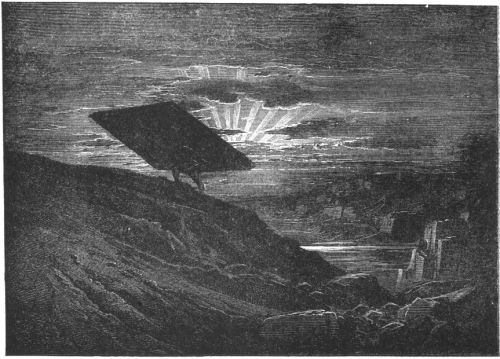
Samson Carrying the Gates of Gaza.
Here was another lesson of what the Lord could do for His people. Gideon had three hundred men when he fought the hosts of Midian; but at this time one man alone won the battle against an army of the Philistines.
At another time Samson stayed part of a night in a city of the Philistines, called Gaza. And the dwellers in Gaza shut the gates, and set men to watch them, so that when he should come out they might kill him.
But before morning Samson arose, tore down the great gate of the city, carried it on his shoulders to a hill, and left it there.
All the wonderful things that Samson did, and how he finally died, a prisoner to the Philistines, are recorded in Judges 13-16.
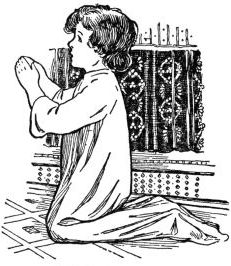
The Child Samuel.
About fifty years after Samson's death, Samuel was born, who was to be both a judge and a prophet. His mother was a good woman. The Bible says, she "lent him to the Lord as long as he liveth." 1 Samuel 11:28.
Eli was priest at this time in the temple of the Lord, and "the child Samuel ministered unto the Lord before Eli."
While Samuel was a small boy, it came to pass one night, ere the lamp of God went out in the temple of the Lord, where the ark of God was, and Samuel was laid down to sleep, that the Lord called Samuel, and he answered, "Here am I," thinking Eli had called him.
Three times this occurred. Then Samuel said, "Speak, Lord; for Thy servant heareth."
Let us answer the Lord as did Samuel. He speaks to each of us in His word, the Bible.
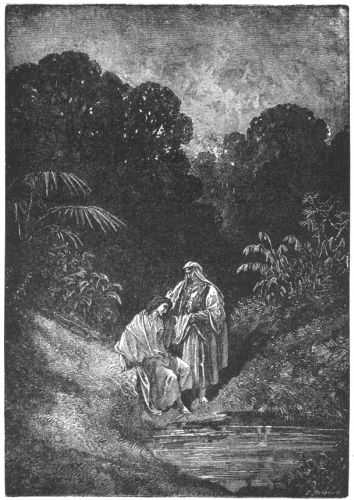
The Parting of David and Jonathan.


UNTIL the days of Samuel, Israel was not governed by kings. Jehovah had promised to be their Ruler and King. Had they been true to Him they would have been prospered and given every needed blessing.
But the people wanted to be like the nations around them. So the elders came to Samuel and said, "Make us a king to judge us like all the nations."
Samuel was a prophet of the Lord, and had been the judge of Israel for many years. Their demand for a king displeased him, for he felt that the people had rejected him.
But the Lord told Samuel to do as they asked, "for they have not rejected thee, but they have rejected Me." And the Lord chose Saul, of the tribe of Benjamin, to be king.
At the command of the Lord, Samuel anointed Saul as king. A little later he called the people together and presented their new-made king to them. And they shouted, "God save the king!"
But Saul soon became proud, and many times refused to obey the Lord. Then the Lord rejected Saul and chose David, a young shepherd boy, to be king when Saul should die. And Samuel anointed David to be king in the place of Saul.
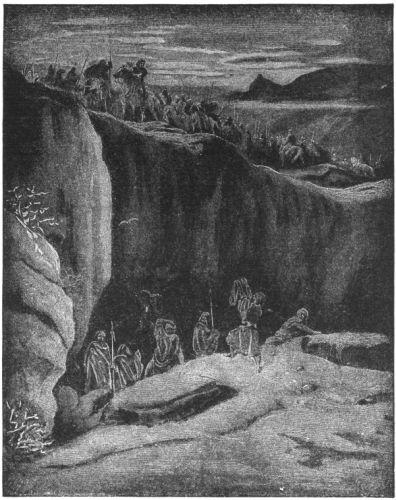
David and Saul at the Cave.
When Saul heard of this he was very angry, and tried many times to kill David. Saul wanted his son Jonathan to be king when he died. How foolish it was for Saul to try to kill David, when God had said he should be king over Israel!
So David fled from Saul, and for many years lived among strangers, and in the dens and caves of the mountains. But Saul hunted him so many times that David had to change his hiding place very often.
One time Saul lay down to sleep in the very cave where David was hidden, not knowing he was there. Some of the men who were with David wanted him to kill Saul, but he would not do it. He only crept up to the king and cut off a piece of the robe which he wore.
When the king had gone, David called to him and showed him the piece he had cut from his garment. Saul saw at once that David could have killed him as easily as he cut a piece from his garment.
Then Saul promised David that he would not again try to destroy him. But David did not trust his promises; and it was well he did not, for Saul was soon hunting him as wickedly as before.
Notwithstanding David was hated by Saul, his son Jonathan loved David. They were as brothers to each other. Jonathan was a true servant of God. He was always true to David, and whenever he could aid him in escaping from his father, he did so, notwithstanding he knew that David was to be made king instead of himself. This shows that he was one of the most generous and lovable characters recorded in the Bible.
Finally there was a great battle between Saul's army and the Philistines. In this battle Jonathan was slain, and Saul fell on his own sword and killed himself.
Soon after this David was made king. In most things he was a good king, and obeyed the Lord and ruled Israel well. He was a great warrior, and subdued the enemies of his people.
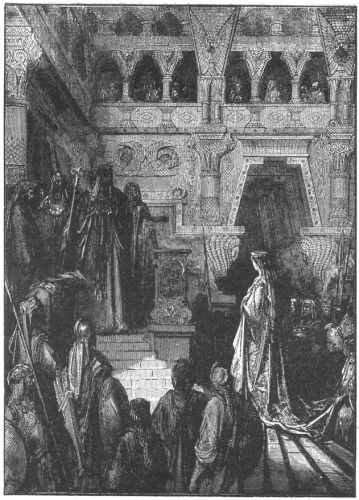
Solomon and the Queen of Sheba
At the death of David, his son Solomon was made king. He was a very wise man and a good king. It was he who built at Jerusalem the wonderful temple for the service of the Lord.
The wisdom and riches of Solomon were so wonderful that his fame was spread abroad in all the earth. And the queen of Sheba, in Arabia, came to see if all the reports she had heard were true.
And the queen asked Solomon hard questions; but he was able to answer every one of them. She was then shown the riches and wonderful works of Solomon.
When ready to return to her own land she told Solomon that she had heard wonderful reports about him and his kingdom, but she had not believed them. Now, she said, "Mine eyes have seen it; and, behold, the one-half of the greatness of thy wisdom was not told me." 2 Chronicles 9.
After the days of Solomon, Israel was ruled by many kings. Some of them were good, and their rule brought the blessing of God to their people. But many were wicked men who led Israel into sin and idolatry. Then the Lord could not protect them, and their enemies would afflict them.
The history of Israel is a sorrowful story. God wanted to bless them and make them the light of the world. He wanted to show the whole world what wonderful things He would do for those who were faithful to Him. But they preferred their own way, and in consequence perished as a nation.
The apostle Paul says that "all these things happened unto them for ensamples; and they are written for our admonition, upon whom the ends of the world are come." 1 Corinthians 10:11.
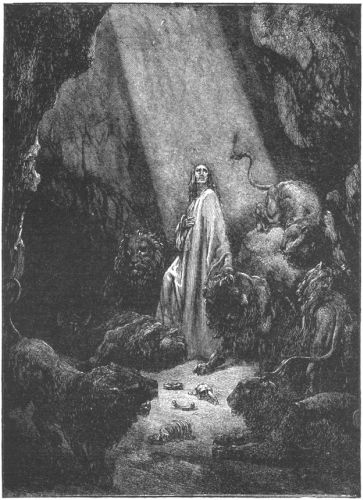
Daniel in the Den of Lions





AFTER Samuel, the sixteen prophets whose writings bear their names in the Bible, may be classified as follows:—
(1) Those before Israel's Babylonian captivity, namely: Jonah, Joel, Amos, Hosea, Isaiah, Micah.
(2) Those near to, and during the captivity: Nahum, Zephaniah, Habakkuk, Jeremiah, Daniel, Obadiah, Ezekiel.
(3) Those after the return from the captivity in Babylon: Haggai, Zachariah, Malachi.
The books which bear these names in our Bible are not arranged in the order in which they were written; but in the order of their supposed importance. But man can not tell which part of God's word is most valuable. "All scripture is given by inspiration of God."
Peter says that "the prophecy came not in old time by the will of man; but holy men of God spake as they were moved by the Holy Ghost." 2 Peter 1:21.
We will refer to a few prophecies which have been fulfilled:
Isaiah mentions by name the Persian prince, Cyrus, 200 years before he was born, and tells what he should do. Compare Isaiah 44:28 with Ezra 1:1, and notice the dates in the margin of your Bible.
Isaiah also foretold and described the sufferings of Jesus. Compare the fifty-third chapter of Isaiah with Luke 22:37; John 1:10, 11; Matthew 8:17; 1 Peter 2:24, 25; Acts 8:32-38; Luke 22:37; Matthew 27:57-60.
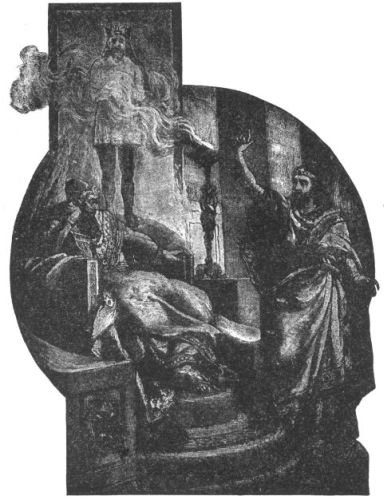
Daniel Interpreting the King's Dream.
Forty-seven of the sixty-six chapters in Isaiah are referred to in the New Testament, and Jesus twice mentioned Isaiah by name. Matthew 13:14; Matthew 15:37.
Jeremiah prophesied that Jerusalem should be destroyed, and that during the siege the famine should be so great that the Jews should "eat the flesh of their sons and the flesh of their daughters." Jeremiah 19:9.
This prophecy was given six hundred and five years before Christ, and it was fulfilled when the Roman army surrounded Jerusalem, A. D. 70, thirty-six years after the crucifixion of Jesus.
Some of the most wonderful of the prophecies are in the book of Daniel. The history of the world since his time is given plainly in chapters two, seven and eight.
In the second chapter the Lord foretold, by a dream, what should come to pass from that time to the end of the world.
Daniel, a prophet of the Lord, was given wisdom to tell the king his dream, which he had forgotten, and also its meaning, after the false prophets had confessed that they could not do so.
Daniel said: "There is a God in heaven that revealeth secrets, and maketh known to the king Nebuchadnezzar what shall be in the latter days." Daniel 2:28.
So the interpretation is for us, because "the secret things belong unto the Lord our God; but those things which are revealed belong unto us and to our children." Deuteronomy 29:29.
Prophecy is history told in advance. The Lord is the only one who can do this without making a mistake.
Turn to Daniel 2:31-36, and read the dream. Verses 37 to 45 interpret it plainly, showing that the four parts of the image mean four great kingdoms.
History tells us that the Babylonian kingdom, symbolized by the head of gold, was conquered B. C. 538 (five hundred and thirty-eight years before the time of Christ), by the Medo-Persians, represented by the breast and arms of silver. Cyrus was their general.
The Medo-Persians were overcome by the Grecians, under Alexander, 331 B. C. The brass thighs of the image represent their kingdom.
The Romans, "strong as iron," signified by the legs of iron, subdued the Grecians in the year 168 B. C.
The feet and toes of the image represent the ten parts into which the Roman empire was divided between the years 351 and 476 after the birth of Christ.
These parts of Rome exist in Europe to-day, under the names, England, Germany, France, Spain, Italy, etc., and will continue separate (see verse 43) until the kingdom of Christ is set up, represented by the stone "cut out of the mountain without hands," which "shall break in pieces and consume all these kingdoms, and shall stand for ever." Jesus said, "Blessed are the meek, for they shall inherit the earth."
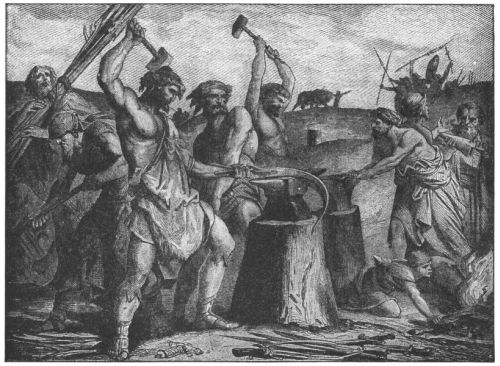
Swords and Plowshares, Spears and Pruning Hooks.



THE great Teacher said, "Love your enemies, bless them that curse you, do good to them that hate you, and pray for them which despitefully use you." Matthew 5:9, 39-44.
When everybody does this, there will be no war. All will be righteous; for "love is the fulfilling of the law," God's standard of right-doing.
But no person can love everybody without a change of heart. "Ye must be born again," said Jesus. This change, or new life, comes by believing that God will change us. It is only when we stop believing right that we stop doing right.
If the world would believe, the world would be converted, or changed; but the parable of the tares and the wheat (Matthew 13:36-43), and what Jesus said about the "many" in the broad way and the "few" in the narrow way (Matt. 7:13, 14), show that "many are called, but few chosen."
Yet thousands of people are prophesying "peace and safety" (1 Thessalonians 5:1-5), forgetting that "evil men and seducers shall wax worse and worse, deceiving and being deceived" (2 Timothy 3:13), and that the "tares," or sinners, are finally to be destroyed instead of being changed over into wheat. "Ye will not come unto Me," said Jesus.
One of the prophecies of Isaiah (2:2-5) says that "many people" "in the last days" shall talk about peace as if it were coming soon by the conversion of the world. The marginal reading of Isaiah 2:16, calls such talk "pictures of desire," and says they shall "be brought low" (verse 12).
Verses three to five tell what the "people" are saying. Verses six to twenty-two are the prophet's declarations because of what the people have said. He foretells destruction for those who do not repent, the same as does the prophet Joel. It will be a time of general war. Here are the people's sayings and the Lord's sayings, side by side. They are direct opposites; yet both refer to "the last days," when "the day of the Lord is near:"
"It shall come to pass in THE LAST DAYS that . . . MANY PEOPLE shall say, Come ye, and let us go up to the mountain of the Lord, to the house of the God of Jacob; and he will teach us of his ways, and we will walk in his paths: . . .
"And he shall judge among the nations, and shall rebuke many people: and they shall beat their swords into plowshares, and their spears into pruninghooks: nation shall not lift up sword against nation, neither shall they learn war any more.
"O house of Jacob, come ye and let us walk in the light of the Lord." Isaiah 2:2-5.
Proclaim ye this among the Gentiles. Prepare war, wake up the mighty men, let all the men of war draw near; let them come up:
"Beat your plowshares into swords, and your pruninghooks into spears: let the weak say I am strong. . . . Put ye in the sickle, for the harvest is ripe: come, . . . for their WICKEDNESS is great.
"Multitudes, multitudes in the valley of decision: for the day of the Lord is near in the valley of decision." Joel 3:9-16.
The DAY OF THE LORD "shall come as A DESTRUCTION from the Almighty." Isaiah 13:6-11.
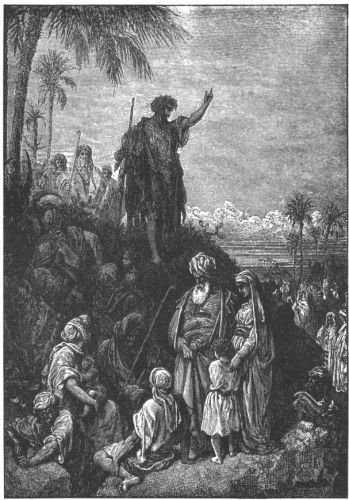
John the Baptist by the Jordan.



"THERE was a man sent from God, whose name was John.
"The same came for a witness, to bear witness of the Light, that all men through Him might believe.
"He was not that Light, but was sent to bear witness of that Light." John 1:6-8.
"As it is written in the prophets, Behold, I send My Messenger before Thy face, which shall prepare Thy way before Thee.
"The voice of one crying in the wilderness, Prepare ye the way of the Lord, make His paths straight.
"John did baptize in the wilderness, and preach the baptism of repentance for the remission of sins.
"And there went out unto him all the land of Judea, and they of Jerusalem, and were all baptized of him in the river of Jordan, confessing their sins.
"And John was clothed with camel's hair, and with a girdle of a skin about his loins; and he did eat locusts and wild honey;
"And preached, saying, There cometh One mightier than I after me, the latchet of whose shoes I am not worthy to stoop down and unloose.
"I indeed have baptized you with water; but He shall baptize you with the Holy Ghost." Mark 1:2-8.
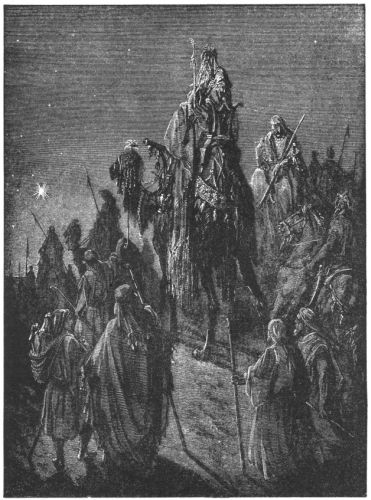
The Wise Men Following the Star.
In ancient times, when a king made a visit to another country, he sent messengers before him. These messengers would see that there was a good path for him to travel, and that the people where he was going were ready to receive him.
John the Baptist was God's messenger, sent to arouse the people of this world, and prepare them to receive Jesus when He should come to visit them.
Before Jesus came to this earth He was a great King in heaven. Paul says He was "equal with God." Philippians 2:6.
We can never understand how the Son of God, the great King of heaven, could come to this earth as a babe. This is one of God's great mysteries.
But he did come in just this way. He was born in a manger in Bethlehem. Coming in this humble manner, the priests and rulers of Israel were not ready to receive this Babe as their Saviour. They were looking for Him to come as a great King, in pomp and splendor.
But there were on the plains of Bethlehem some humble shepherds who were looking and waiting for the promised Messiah. To them angels were sent to tell of the birth of Jesus.
And the angel said, "Ye shall find the babe wrapped in swaddling clothes, lying in a manger." And they went to Bethlehem in haste, and found the infant Jesus as the angel had told them.
God meant that others, as well as the Jews, should know that the Saviour had come to begin His work on earth. Away off in the Eastern country there were wise men who had read the prophecies about the Messiah, and believed that He would soon appear.
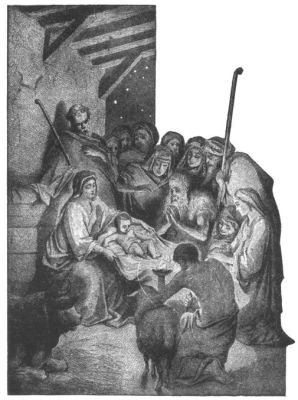
The Shepherds Worship Jesus.
One night these men saw a wonderfully bright star in the sky, moving toward the land of Judea. They believed this to be a sign that the Messiah had come. So they followed the star, and it brought them to the manger in Bethlehem.
"And when they were come into the house, they saw the young child with Mary His mother, and fell down and worshiped Him; and when they had opened their treasures, they presented unto Him gifts; gold, and frankincense, and myrrh.
"And being warned of God in a dream that they should not return to Herod, they departed into their own country another way.
"And when they were departed, behold, the angel of the Lord appeareth to Joseph in a dream, saying, Arise, and take the young child and His mother, and flee into Egypt, and be thou there until I bring thee word: for Herod will seek the young child to destroy Him."
Find the second chapter of Matthew, and read about the flight into Egypt, and why they finally went to Nazareth, in Galilee, instead of to a city of Judea. Verses 15 and 23 tell the reason.


THE early life of Jesus was spent in Nazareth, a small city in the northern part of Palestine. His parents were very poor, and He had only what poor children have.
His father was a carpenter, and Christ learned the carpenter's trade and worked with him. From His earliest days He was a pattern of obedience and industry. He was used to a life of hardship and toil, and can comfort all those who must work for a living.
Of the childhood of Jesus it is written, "The child grew, and waxed strong in spirit, filled with wisdom; and the grace of God was upon Him." Luke 2:40.
The mother of Jesus was His first earthly teacher. From her lips, and by reading the prophecies, He was taught of heavenly things and of His mission to this world.
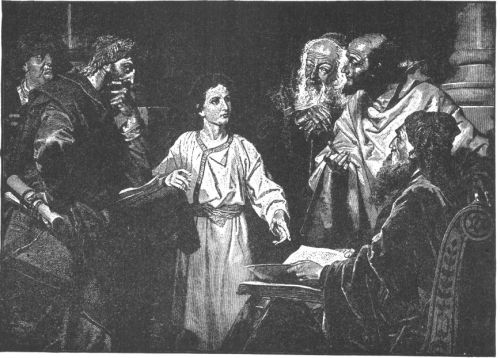
\Jesus among the Teachers of the Law.
The wonderful truths which He Himself had spoken to Moses and the prophets, He was now taught by His mother. The Holy Spirit gave her wisdom to teach Him aright. All parents should teach their children as Jesus was taught, that every child may obtain knowledge as Jesus did.
Jesus left all His glory and power when He came to earth as a babe. He took His place by the side of the fallen men of earth. He came "in the likeness of sinful flesh." He was subject to all the temptations and weakness of our fallen race.
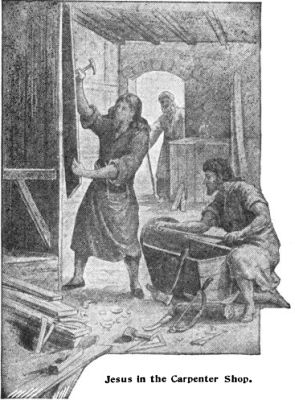
Jesus in the Carpenter Shop.
Yet by the power of God He was kept from yielding to the temptations which surrounded Him. This power He gained by earnest prayer to His Father in Heaven. This power every child and man can obtain in the same way.
In His humble life, as the child of poor parents, He faithfully did His part of the work. Ever obedient and cheerful, He was as a pleasant sunbeam in the home circle.