Chapter XXIII · MY LADY’S MANSIONS
Reading edition
It is universally conceded by our nation that the French have a sense of the theatre which we shall never possess. The only set-off we can produce is a pre-eminent “sense of the house.” In France this has to a great extent died out. In French and in most continental cities the greater number of people live like pigeons in large cotes. It is the tendency of all towns, though in England the notion takes hold slowly. In the country the sense of the house is as strong as ever, with this change—that it is the day of the little house. Of the great house in its perfect sense as a home there are but few happy instances. It is the day of little things—little books, little songs, little pictures, little buildings, little frequent journeys, little incomes, and little sports. Above all, the little incomes! Little incomes laugh defiance at great houses. For great houses, as aforesaid, are great thieves. Bess and her Lord knew it, in the end, to their sorrow. Slowly English men and women have come to realise this, and not to aspire enviously to great houses. That notion was long a-dying, that obsession of the great house. Its long decline meant assuredly much that was tragic, wounding, self-torturing. Oh! those mistaken, ostentatious shams and pomposities of the early Victorian days 350when many a kindly, highly cultured, hypersensitive group of persons dwelt the lives of immured cabbages! And all this because of false pride, because of a penury they deliberately huddled round them, like a coward, who flings his cloak over his head so that he may not see even the opportunity for the courage which must go to the changed order of things.
And so the little incomes of to-day—the day of the triumph of the exploitation of limited resources—laugh at the great houses because the first have been forced to learn that trick of defiance side by side with the bitter lesson of monetary limitations which they share with the last. Yet behind their defiance is a great admiration of the big mansions. And behind the admiration, if they but guessed it, a great sense of indebtedness. For it is the little incomes, and not the little houses, which laugh at great mansions. Is it not by virtue of the past life and compassion of the great houses that the little ones achieve their beauty in miniature, and, lastly, their sweet appropriateness to the usages of modern life? The great house begat these little ones of to-day—no hovels, but decent homes—which spring up all over England and Scotland and Ireland—in the hollows or heights of downs, in richly watered places, on ridges, by the fringes of woods, upon the sea flank—creeping up almost impudently to the very skirts of the great “places” which have passed into the traditions of history. Some of these remain to us as dazzling show places, some few are also emphatically homes. Whether applied in the present to this most beautiful and intimate purpose or not, all the great mansions of Elizabeth Lady Shrewsbury were most truly intended for sweet daily uses. Two principal houses had she of her 351own—Hardwick and Chatsworth. Eight more George Talbot brought her—Wingfield, Sheffield, Rufford, Welbeck, Worksop, Tutbury, Bolsover. One smaller place he cherished for his old age, a little country house at Handsworth in the same county, and one more, as already explained, she in her old age founded—Owlcotes or Oldcotes—besides beginning the rebuilding of Bolsover Castle. Great houses indeed! Four of them, in especial, were widely sung and praised. How runs the curious old rhyme?
“Hardwicke for hugeness, Worsope for height,
Welbecke for use, and Bolser for sighte.
Worsope for walks, Hardwicke for hall,
Welbecke for brewhouse, Bolser for all.
Welbecke a parish, Hardwicke a Court,
Worsope a pallas, Bolser a fort.
Bolser to feast in, Welbecke to ride in,
Hardwicke to thrive in, and Worsope to bide in.
Hardwicke good house, Welbecke good keepinge,
Worsope good walkes, Bolser good sleepinge.
Bolser new built, Welbecke well mended,
Hardwicke concealed, and Worsope extended.
Bolser is morn, and Welbecke day bright,
Hardwicke high noone, Worsope good night;
Hardwicke is now, and Welbecke will last,
Bolser will be and Worsope is past.
Welbecke a wife, Bolser a maide,
Hardwicke a matron, Worsope decaide.
Worsope is wise, Welbecke is wittie,
Hardwicke is hard, Bolser is prettie.
Hardwicke is riche, Welbecke is fine,
Worsope is stately, Bolser divine.
Hardwicke a chest, Welbecke a saddle,
Worsope a throne, Bolser a cradle.
Hardwicke resembles Hampton Court much,
352And Worsope, Welbecke, Bolser none such.[88]
Worsope a duke, Hardwicke an earl,
Welbecke a viscount, Bolser a pearl.
The rest are jewels of the sheere
Bolser pendant of the eare.
Yet an old abbey hard by the way—
Rufford—gives more alms than all they.”
It is curious that Chatsworth, so famous in history, has no part in the rhyme. Save for an old engraving of it in the new, the present Chatsworth, no trace of the fabric of the second mansion, the house planned by William Cavendish the first, exists; and in the grounds no relic is to be found belonging to the date of Queen Mary’s imprisonment except a scrap of ivied ruin known as her “bower.”
What is the fate of the rest of the long list? Wingfield is an exquisite ruined fragment. The relic of that which was once Sheffield Castle is only to be found thickly embedded among the workshops and factories of a great smoke-belching town; and the whole property has passed to the dukedom of Norfolk.
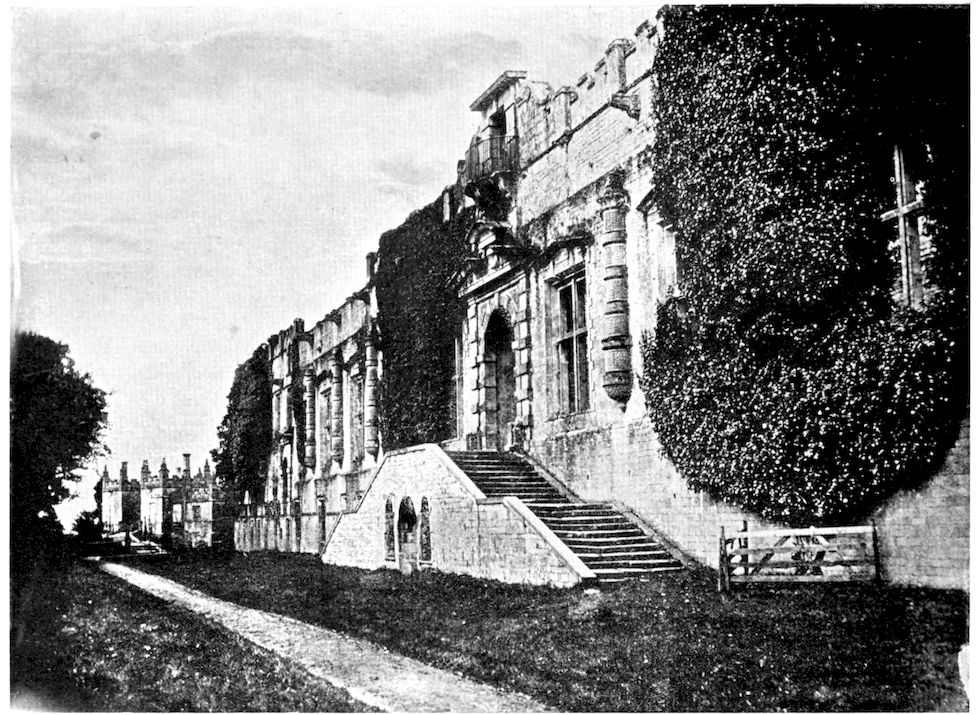
Photo by Richard Keene, Ltd., Derby BOLSOVER CASTLE Page 352
353Oldcotes, as we know, Bess Hardwick never finished, nor Bolsover, for that last duty fell upon her son, Sir Charles Cavendish, who “cleared away the loose cement and tottering stones and began to lay the foundation of the newe house at Bolsover,” only finished by his son, Marquis of Newcastle. Strangely enough, it is not this—the beautiful Elizabethan mansion, which witnessed now glorious pageants and now civil war—that remains for habitation, but a portion of the original stronghold. Says one descriptive writer: “The figure of Hercules, supporting the balcony over the principal doorway, is an appropriate symbol of the Castle’s strength. The fortress is habitable, and makes a very unconventional and picturesque residence, with its pillar parlour ornamented with old-fashioned devices; its noble Star Chamber lined with sombre portraits of the twelve Cæsars and ceilinged with blue and gold to represent the firmament at night; and its quaint bed-chambers, two of which are covered with pictures indicative of Heaven and Hades ... pictures ... of angels reclining on clouds, or wandering in delightful glades; and of angels of darkness, hideous ... and writhing in torment.” The which, says this chronicler, so affected the conscience of one inhabitant that he effaced them—“took a lime brush and ruthlessly wiped out both sinners and saints.” The ruin near this building must have stood finely “on the grand terrace to the south” in its heyday when the elasticity of good Bolsover steel spears and buckles was a household word in England.
Tutbury Castle lies a ruin by the Dove, unregretted, well detested by all who were ever immured there.
Welbeck—how true to the rhyme!—lasts and “will last”—“day bright,” a “saddle,” a place to “ride in,” a great “parish,” a home for use, for “good keepinge,”—in a word, an institution for posterity to wonder at. Such also is Rufford, one of the few great buildings which have escaped fire. Among the list of the disestablished monasteries it passed into the hands of the Talbots, who made good use of its Elizabethan gallery and its state chambers. On the other hand, the original manor house of Worksop—“the wise,” the “pallas,” the “throne,” was burnt down in 1761, was “decaide” very soon. Bolser the “maid” as aforesaid is now grown very 354grey, but is still lovely, the more wonderful in its isolation because of the ugly little new town below it. Welbeck “the wife” flourishes, has grown, is much increased.
Hardwick the “matron” endures. In her “hugeness,” in her character of spacious court and hall, in her seclusion and peace, her well-being, her riches and comfort, well warmed with the sun of prosperity, as at “high noone”—in her rôle as “chest,” as storehouse of unassailable fortunes, as a place “to thrive in,” Hardwick is the chiefest of all these houses, because, saving the church of All Saints at Derby, with the monument Bess Shrewsbury erected in it to herself, and the almshouses in the same town, it is the only thing of all her “workes” upon which her sole impress remains. Into this grey stone house, which bears her maiden name, has passed her extraordinary and very fine “sense of the home,” and the doggerel just quoted adds to that almost a portrait of herself. Time was when she wore stiff outstanding dresses, encrusted with network of jewels or bordered and lined with fur, like others who visited Court or the weddings and pageants of her circle. In the principal portrait of her, the one which hangs in the centre of the Cavendish group in the glorious Hardwick gallery—a stretch of 170 feet, of which the walls carry nearly two hundred portraits—she is, however, presented just in the character of matron and widow. Her child-bearing days were over, her schemes were many. One cannot read the rhymes quoted without feeling that when Hardwick is named in the jingle she herself passes in and out of the string of words, which in itself is like a ladies’ chain in a country dance. She is in black velvet with a rich quadruple necklace of pearls. Her chest, with gold and documents and household “stuff,” goes with her; we hear the jingle of her household keys, her ringing, authoritative voice, meet the glance of those clear, keen eyes, and follow the line of the thin, sensitive mouth, which could help that far-seeing brain of hers so much. That mouth could flatter, but it could also speak with terrible sharpness; it could repeat a good joke, a spicy scandal, or quiver with grief; it could say tender things—“my juwell and love, my dearest harte”—and it could bargain finely. “Hardwick is hard,” says the rhyme, and her lips seem to tighten to that phrase. She could certainly be both terribly hard and tender.
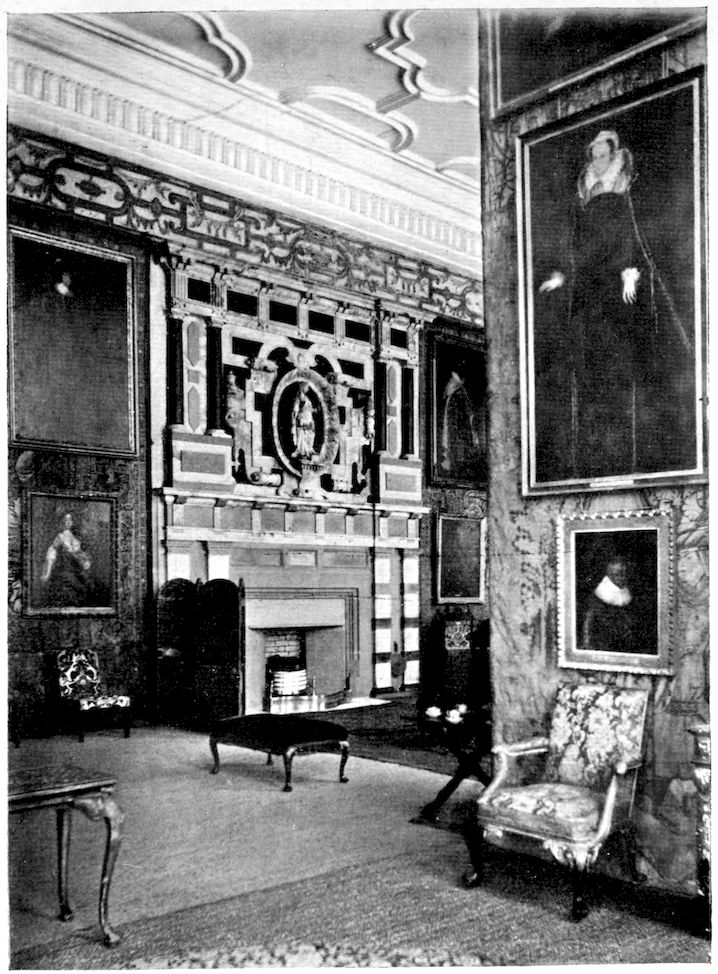
Photo by Richard Keene, Ltd., Derby PICTURE GALLERY, HARDWICK HALL (Showing the fireplace and a portrait of Mary Queen of Scots) Page 354
355There is another smaller portrait of her, in her Countess’s coronet and an ermine tippet, which is rather more gracious in expression than the stiff, beruffed, matronly picture above mentioned. Close about her are her husbands—all save Barlow. Most comfortable of these is Sir William Cavendish, sturdy, bearded, and well-liking, in his furred robe and flat cap. Close by, and matching the figure of Arabella Stuart in sheer pathos, is that of the quiet, childless Grace Talbot, whom Fate so soon made the widow of the much-travelled Henry Cavendish. It is that of a dumpy little woman in black, holding in one hand a single pale eglantine—the flower of the Cavendishes. Her reddish-brown hair, her pale lips, a spinet of which the under portion of the open lid is faintly decorated with red-winged cherubs, and a dark green table-cloth, are the only scraps of colour in the sombre scheme. Her psalter, with diamond notation, lies open at the words “Sois moy seigneur ma garde et mon appuy, Car en toy gist toute mon esperance.”
356In the same group one finds Burghley, rosy, astute, richly clad, a prince of dignitaries, than whom no statesman ever had richer experience of men and things, of power and place, of sovereigns and the royal caprice, who on the eve of death could still write to his first-born, over the trembling signature of “Your anguished father,” the words “Serve God by serving of the Queen, for all other service is indeed bondage to the devil.”
Very warm and full of life is the portrait of William Cavendish the younger, the Countess’s favourite son. To him in his right as first Earl and ancestor of the Dukes of Devonshire belongs, after his mother, the whole of this glorious gallery, typical of this magnificent house.
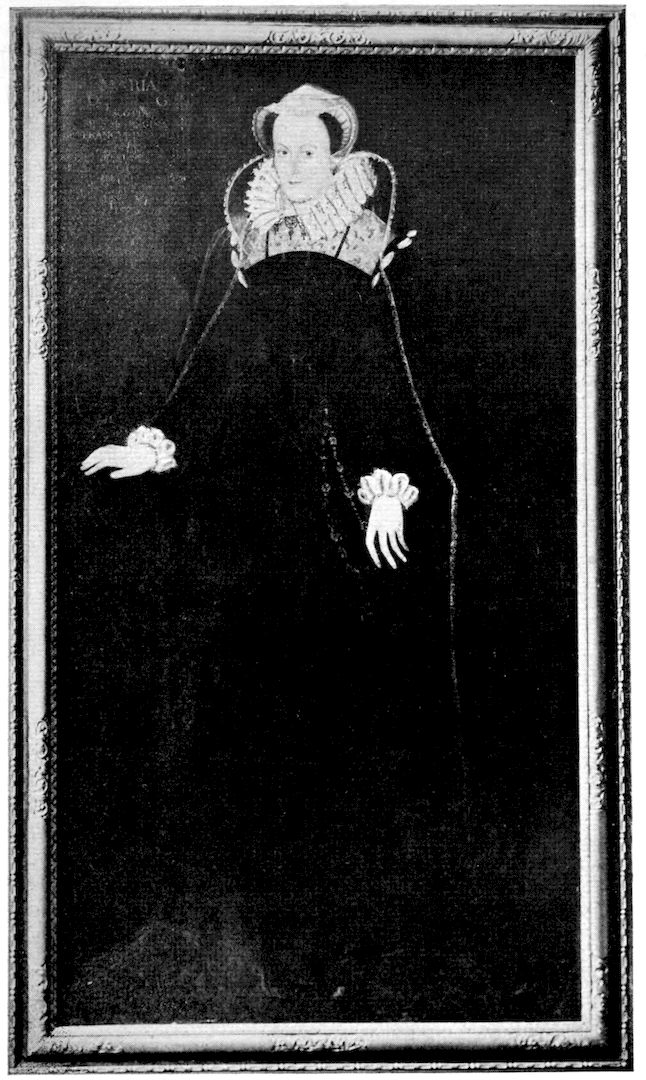
From a photo by Richard Keene, Ltd., Derby, after the picture by P. Oudry at Hardwick Hall, by permission of his Grace the Duke of Devonshire MARY QUEEN OF SCOTS Page 356
357The end wall is given up to the portraits of the three English Queens. In the centre is Elizabeth, magnificent and monstrous, the clothes hiding the woman, the whole art of portraiture merged in the painter’s dogged intent to reproduce every detail of her jewels, her lace, and the birds, beasts, and reptiles with which her enormous, billowing dress is embroidered. On her right stands Queen Anne, very dull, complacent, and richly attired; on her left Queen Mary, solemn, handsomely robed, dignified. An opposite wall bears the other often-painted Mary, the Arch-Enigma, she whose personality, to my thinking, is so much more subtle and dominant than that of her magnificent English sisters. This is the famous Mary of Oudry’s brush, graceful, simple, subtle, the face diaphanous and elusive. There is an odd likeness between the motto she chose for her dais and that which the baby Arabella bears on the jewel pendent from her necklace: “Pour parvenir j’endure” is the legend. And both women bear witness to that determination in their faces, in their tragic fates. That and the old “En ma fin est mon commencement” ring in your ears as you turn from the gallery and from the beautiful presence-chamber with its wonderful coloured plaster frieze to the little bedroom dedicated to the relics of the Scots Mary. The curtains she embroidered, the coverings for the chairs, the tapestry, the very bed in which she slept and tossed and wept, are all proudly cherished. Mary never stayed at Hardwick, pace Horace Walpole, nor possibly ever saw it. Nor was she ever housed at the old Hardwick, which stands now like a ghostly, ruined parent of the newer building, at right angles to it. The old house served “Building Bess” not only as model for her new hall, but furnished her, it is said, with actual material. It was, for those days, a good model that she took, and its high and countless windows made it hygienically a great improvement upon the gloom of Tutbury and Sheffield. No trace of superstition or pettiness has gone to the building, begun soon after she acquired the house—either by purchase or by legacy from her brother James Hardwick—some years before the death of her fourth husband, and completed seven years or so after it—that is in 1597. At first, says tradition, she seems to have intended to make her home at the older house and reserve the new one for ceremonial and entertainment, “as if she had a mind to preserve her Cradle and set it by her Bed of State.” The stones of that “Cradle” she eventually took for the “Bed,” and into that bed she literally wove all that was best of herself. Of mere personal feminine vanity she expresses little, of personal importance much. She was fond of 358her crest, and the modelled stags of her own family are devised to flatter her duly in an inscription (in the great drawing-room) to the intent that noble as is the stag, in all its animal perfection, its nobility is enhanced by bearing the arms of the Countess. She doted also on her initials. They are worked into the stone scrolling which adorns her four towers, into the main gateway, and into the low wall which flanks the square garden where you enter. They are repeated in the flower-beds. She must have loved signing her name also, for scarcely a scrap, it seems, of the household accounts concerning her buildings exists but bears evidence of her minute scrutiny. Here is her signature as it appears often repeated under such items as “thre ponde hyght pence,” or at the close of a letter thus:—
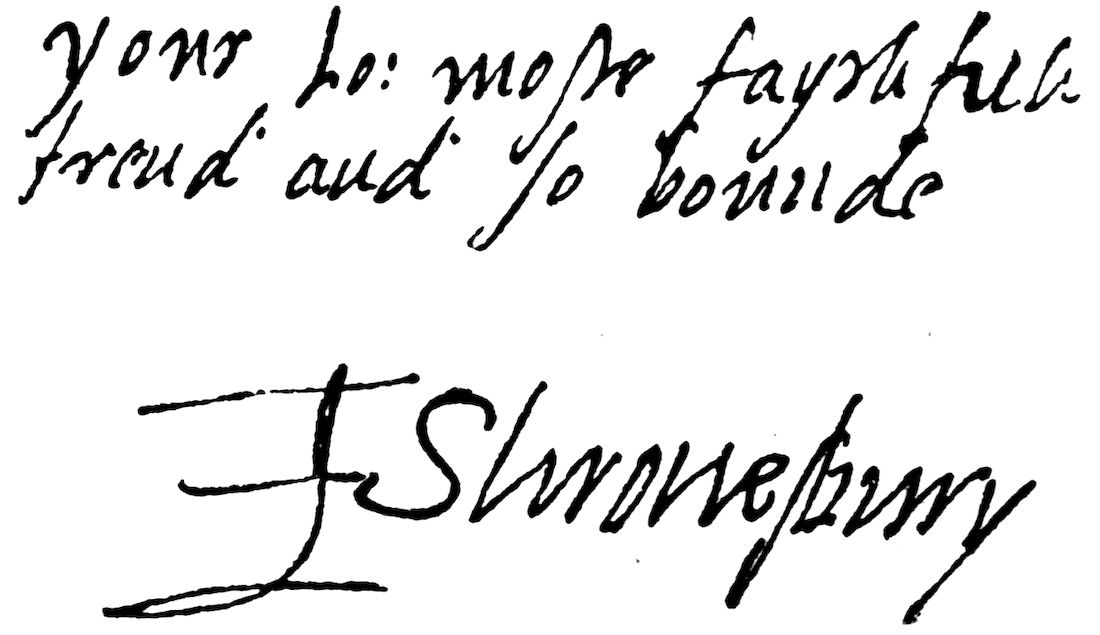
The Hardwick wages-book between New Year, 1576, and the close of December, 1580, with the list of her men—stone-breakers, gardeners, moss-gatherers, thatchers, wall-builders, ditchers—was made up by her once a fortnight and signed. Inside the house too are her initials, with the arms of her father, the stags and the roses of the Hardwicks, and into a famous inlaid table (brought, it is said, by her son Henry from the East) is woven the cryptic poetical motto of her father’s family:—
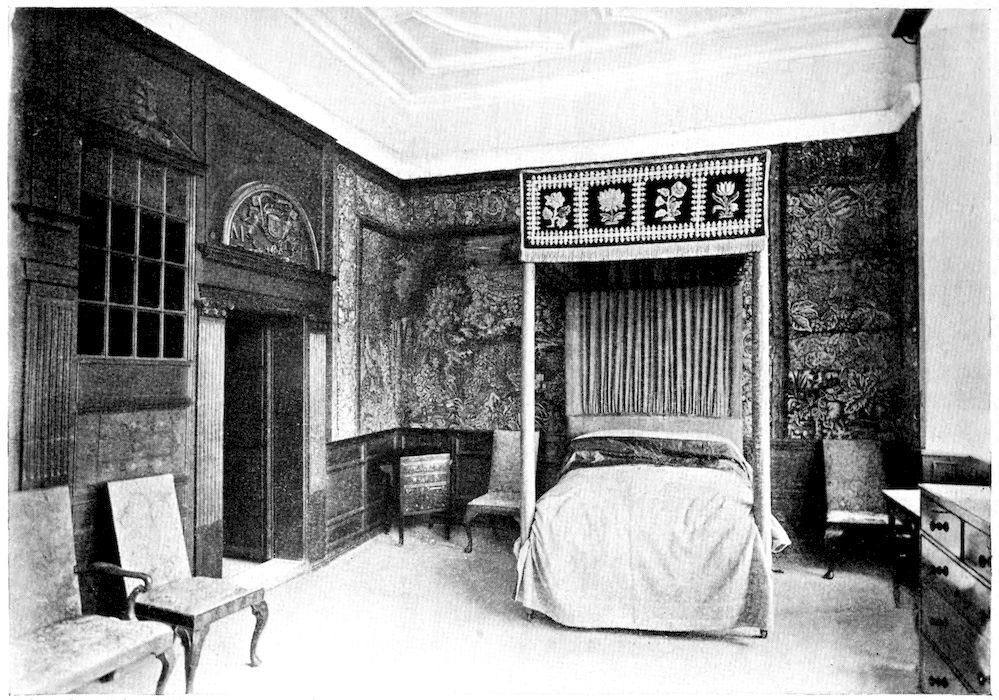
Photo by Richard Keene, Ltd., Derby MARY QUEEN OF SCOTS BED, NOW AT HARDWICK HALL Page 358
359“The redolent smell of aeglantyne
We stagges exault to the deveyne.”
This legend is to be faintly traced in the interior of the ruined old hall. With the exception of the Shrewsbury coronet and the initials, you find very little suggestion of the Talbots. Everywhere the arms of Hardwick predominate in panel, fireplace, and lock. They strike the eye the instant you enter the house by the great entrance-hall. Large and magnificent, they are set forth on the right wall: in heraldic language, “a saltire engrailed azure; on a chief of the second three cinquefoils of the field,” set in a lozenge-shaped shield and bearing the aforesaid coronet. The supporters are two “stags proper, each gorged with a chaplet of roses, argent, between two bars azure.” To these supporters the lady had no right because her family had none. But she assumed them, turning to account the stag of her family crest. Her son William adopted a variation of this, and in the Devonshire arms of to-day we again find the wreathed stags proper, while the shield bears three harts’ heads. In the Mary Queen of Scots bedroom you will find in plaster work again the Hardwick arms, but also those of Cavendish and of the Countess’s mother, Elizabeth Leake. Needless to say, the house is built in the grand manner. The great entrance-hall runs to the height of two stories, and besides its panelling and old furniture has screens of tapestry. Just off the stairway on the left is the curious little chapel shut off from the landing by an open-work oak 360screen. Close by is a state bedroom, and adjoining it is a fine dining-room, whence a minstrels’ gallery leads to the wainscoted and tapestried drawing-room. The splendid presence-chamber, sixty-five feet long, thirty-three wide, and twenty-six high, is another remarkable feature, and besides its pictures and tapestry has the famous ancient frieze, already mentioned, in coloured plaster relief representing the Court of Diana. The choice of theme was, no doubt, out of compliment to the Queen, for her initials and arms are in this room substituted for those of the Countess, who, in spite of her dreams, never had the delight of receiving Elizabeth here.
In regard to the sheer details of furniture and tapestries the guide-books have sufficiently noted such items, and this is not the place for an inventory. But in the household lists, carefully catalogued and cherished, are noted “silver cloath of tissue and cloath of gold, velvet of sundry colours, needlework twelve feet deep, one piece of the picture of Faith and her contrary Mahomet, another piece with Temperance and her contrary Sardynapales.” And there are others “wrought with Flowers and slipps of Needlework,” while a “white Spanish rugg,” great chairs and little chairs, French stools, “a little desk of mother o’ pearl, a purple sarcanet quilt,” are duly noted, in addition to carpets and hangings galore storied with myth and legend. Good rich things over which to fight when it was a case of family quarrels! Many of these and the other famous tapestries with which the lovely house is crammed are being wisely guarded, and, where possible, delicately repaired, while taste and gracious sympathy with every object are turning the Hall into a place which is a perfect museum with the added grace of a house. The very ring—attached to the foot of the Countess’s writing-table—through which she slipped the leash of her dog, is still preserved.
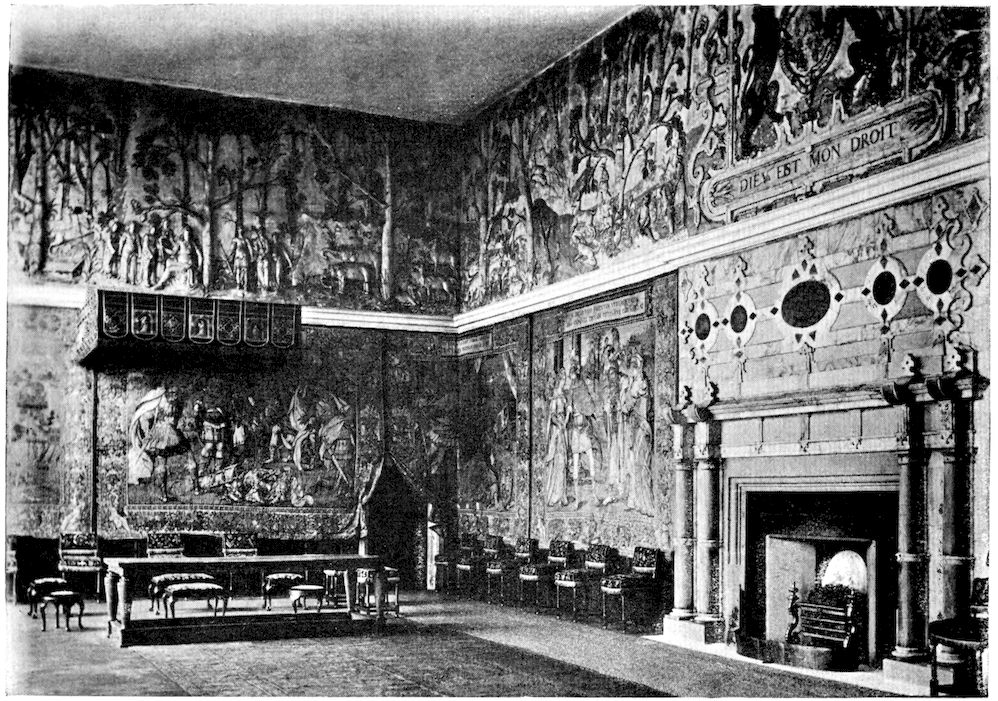
Photo by Richard Keene, Ltd., Derby THE PRESENCE-CHAMBER, HARDWICK HALL Page 360
361Set high upon a fine hill in the centre of a park, encircled with rolling country, and facing east and west, the great, old windows of Hardwick look out above colonnades upon a new world. At no great distance are mines like those which have spoiled Bolsover and Worksop. The masons still labour at the stonework of Hardwick, for storms have worn the elaborate scrolling of those four proud towers, and the flagged pathway from gate to house-door is pitted and hollowed by frost and rain and the feet of generations. And still it stands, a monument and a living record of one who knew in her strange, active life much grief and much joy, who loved flattery and self-assertion and the struggle for individual development, and yet could write in letters of stone over the door of her presence-chamber: “The conclusion of all thinges is to feare God and keepe His commaundements.”
She had the great secret of living almost to the last in the “high noone” of her desires. When the western sun bathes her façade she lives again, walks again upon her terrace and under her colonnades. And with her goes that great procession, pathetic and vital, of her “workes”—her children, her friends, her buildings, her household gods, her intrigues, her dazzling dreams, her bargains—and all of them seem to have a part in the music of that duet of notions ever running in her head—“of bricks and mortar to yield grandeur, of human beings to yield wealth.”
She has been turned into ridicule by Horace Walpole, 362whose flippant vulgarity nevertheless acknowledged her magnificence. She was called shrew by a pompous bishop, but she had too much brain for a shrew. She could certainly scold—“like one from the banke”—but so could her royal mistress. In these two Elizabeths there is, after one allows for the difference in their actual circumstances, a strange likeness. Both were violent natures; both, in spite of their extraordinary sense of dignity, had a strong dash of the hoyden. Both had immense vitality, relished life intensely, loved to play with schemes. Both were obstinate, affectionate, vindictive, pugnacious, essentially women of their era, a type to which Elizabeth herself set the measure and called the tune. While the sum of all sorrow is the same, their sorrows differed in detail. Elizabeth of England, called to the immense sacrifice of her womanhood for England, fell back in private on petty vanities, and had her reward in the love of the larger public of her day and in the enlightened homage of posterity to her sacrifice and her statesmanship. Elizabeth Shrewsbury justly refused to sacrifice herself to the official burdens put upon her earl, unjustly refused to go shares with him in their common responsibilities, and so in her the “combat for the individual” ran to exaggeration, with its harvest of sheer bitterness and errors. In body and soul she represented that spirit of individualism set in an epoch of intrigue, sensation, change, uncertainty, wide and violent contrast, in days of large treasons and international piracy, of high feeding and large ideas, of scented gloves, masks, doublets, and ill-managed kitchen heaps, of plot and counter-plot, of Court splendour and national drama.
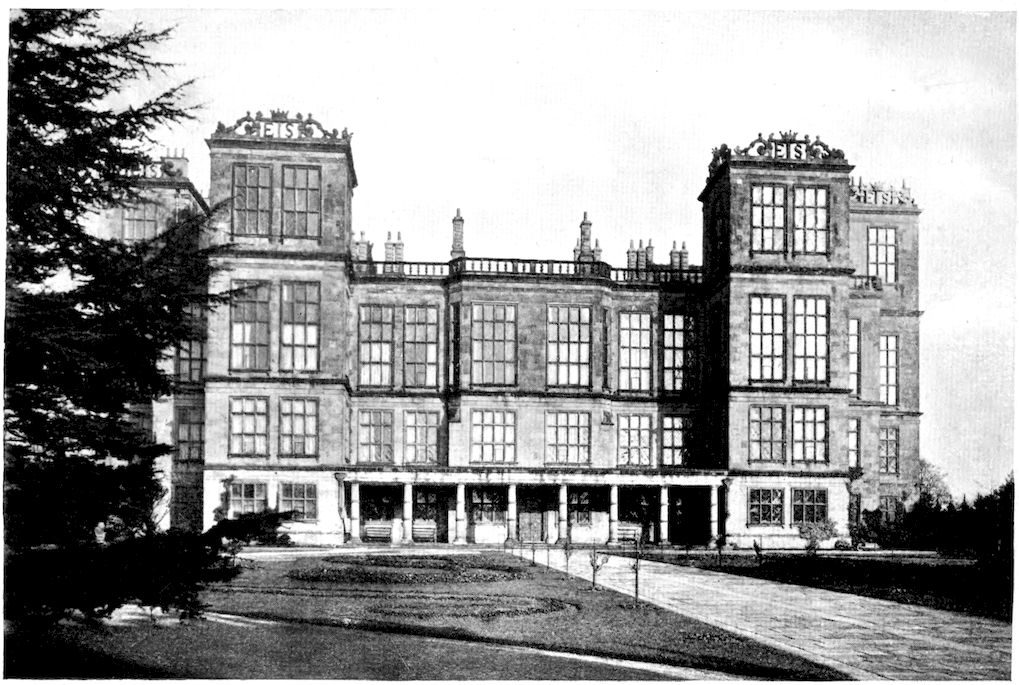
Photo by Richard Keene, Ltd., Derby HARDWICK HALL FROM THE WEST GARDEN Page 362
363Tobie Matthew, Archbishop of York, preached a fine funeral sermon upon this “costly Countess,” in which she was likened to the ideal virtuous woman of Solomon, while Hunter, on the other hand, ironically suggests that Massinger based his character of Sir Giles Overreach upon her. Lodge has termed her violent, treacherous, tyrannical. Such in many ways was the nature of England’s Elizabeth. Yet both women were makers and builders, often blind, always resourceful, achieving immense results in their several capacities. And since the royal symbol of the one is the stately Tudor rose, so also shall the lovely “redolent aeglantyne” of the motto of the other entwine and weave through the ages the memory of all that was finest in the amazing Lady of Hardwick. With that sweet savour—regarding it as the final evaporation of her complex, rampant, thorny, vital nature—let all harsher thoughts of her now be chased away.
365