“WORDS, WORDS, WORDS” Hamlet, Act II, Sc. 2
Reading edition
The English language is quite frugal with the letters of the alphabet as compared to the prodigality of foreign tongues. How the Germans do squander the alphabet!
What is the longest word in the English language? Who knows? Here are, however, a few that have posed for the time being as the longest words in the language.
The word most frequently cited is honorificabilitudinity, which is to be found in Shakespeare’s “Love’s Labor Lost,” act 5, scene 1, line 44. To the Puritan divine Byfeld we owe incircumscriptibleness. Doctor Benson is credited with antidisestablishmentarions. To William E. Gladstone we owe disestablishmentarianism.
An examination of any treatise on chemistry will reveal several like these: paraoxymentamethoxyallylbenzene, and tetrahydroparamethyloxyquinoline.
Among modern German words of cumbersome formation is Schützengrabenvernichtungsautomobile, which contains thirty-six letters to express what the English indicate by the word “tank” in its military sense.
There is also the “Turkish Association of Constantinopolitan Bagpipe Makers,” which is designed in German by Constantinopolitanischedudelsackspfeifenmachergesellschaft.
Bismarck always spoke of a druggist as Gesundheitswiederherstellungsmittelzusammenmischungsverhältnisskundiger. When he was angry he vented his spleen with this expletive—Himmelherrgottkreuzmillionendonnerwetter! Damenmantelschneiderinnungskrankenkassenhauptvorstandsmitgliederversammlung is a nice German way of saying “Assembly of the all-highest direction of the sick fund of the union of female cloak tailors.” And there is a club of Vienna called Donaudampfschifffahrtselectricitaetenhauptbetriebswerkbauunterbeamtengesellschaft, which contains 81 letters.
You can give your tongue a rest by pronouncing this little Czech phrase—Strc prst skrz krk. That twister is literally translated into “thrust finger through neck.”
This one should be easy for you—Chrzaszcz szumi w trzcinie. It is the Polish way of saying that “the bug buzzes in the reeds.”
* * *
Here is the longest 12-word telegram. It won a prize in London in 1904:
Administrator-General’s counter-revolutionary intercommunications uncircumstantiated Stop Quartermaster-General’s disproportionableness characteristically contradistinguished unconstitutionalist’s incomprehensibilities Stop.
* * *
A Revenue Agent in Germany is called by this name Obertranksteuerdonativcautionszinsgelderhauptcassir which may be literally translated “First Main Cashier of Duty on Drinks and Bail Rent Moneys.”
* * *
Madame Schwartz, of Berlin, could understand a speech with the words pronounced backwards.
* * *
There is a river “Aa” in Pas de Calais, France. There is a lake called “Oo,” and a town called “Oo” in the Dept. of Haute Garonne.
* * *
HINTERLADUNGVETTERLIGEWEHRPATRONENHÜLSENFABRIKARBEITERVEREIN
“Society of workers in the factory of bullet cartridges for back loading Vetterli rifles.”
* * *
“PARAMINOBENZOYLDIAETHYLAMINOAETHANOLUMPHYDROCHLORICUM”
—ought to be in every medicine chest. Advertisement in a French newspaper.
* * *
Mons. Wzs is a native of the village of Ws, in France.
* * *
THE 1792 FAMILY
1792 is not a number but a name. The 1792 family is living in Coulommiers, France. There are four sons—and each is named after the months. January 1792, February 1792, March 1792, and April 1792.
March 1792 died in September 1904.
* * *
EPIGRAM UPON NOTHING
U O A O but I O thee, O O no O but O O me; Let not my O a mere O go, But O my O I O thee so. You sigh for a cipher but I sigh for thee O sigh for no cipher but O sigh for me; Let not my sigh for a mere cipher go, But sigh for my sigh, for I sigh for thee so.
Composed by Rev. R. Egerton, Warburton.
* * *
CAN YOU PUNCTUATE THIS SENTENCE?
That that is is that that is not is not but that that is not is not that that is nor is that that is that that is not.
That, that is, is; that, that is not, is not; but that, that is not, is not that that is; nor is that, that is, that that is not.
* * *
“THAT” WORD USED 7 TIMES IN SUCCESSION
It is true for all that, that that that that that that signifies, is not the one to which I refer.
* * *
Enough of that.
* * *
Can you put a comma between—“The king and and and and and Queen”?
* * *
IT’S THE KATZ
The oldest surname in the world is KATZ (the initials of the two words—Kohen Tsedek). Every Katz is a priest, descending in an unbroken line from Aaron the brother of Moses, 1300 B.C.
* * *
Short sentences containing all the letters of the alphabet:
A quick brown fox jumps over the lazy dog.
Pack my box with five dozen liquor jugs.
* * *
Machoumearobilengmonoolemongametsoarobilengmonoolemong means “99” in the language of the Bassoutos tribe of Africa.
* * *

HERE IS THE WORLD’S LONGEST CUSS WORD! Next time you get mad, say:— HIMMELHERRGOTTKREUZMILLIONENDONNERWETTER!
* * *
The longest name yet wished on a helpless infant was bestowed some years ago upon the little daughter of Arthur Pepper, a Liverpool laundryman. The child’s initials exhausted the alphabet, and her christening occupied half a day. They called her Anna Bertha Cecilia Diana Emily Fanny Gertrude Hypatia Inez Jane Kate Louise Maud Nora Ophelia Prudence Quince Rebecca Sarah Teresa Ulysis Venus Winifred Xenophon Yetty Zeno Pepper. She was usually called Alphabet Pepper for short.
* * *
Ed Ek, of Brockton, Mass., owns the shortest name in the United States.
* * *
There is a city called “A” in Sweden, and a city in Wales called Llanfairpwllgwyngyllgerychwyrndrobwllgerdysiliogogogoch. I have been in a bay called “Y” in the Zuyder Zee, and on a Lake called Chargoggagoggmanchaugagoggchaubunagungamaug in Connecticut—which means in the Indian language, “You fish on your side, I fish on my side; nobody shall fish in the middle.”
* * *
THE LONGEST WORD IN THE WORLD CONTAINS 184 LETTERS
This word is found in Aristophanes, Ecclesiazousae 1169. It means “hash.”
Lepado-temacho-selacho-galeo-kranio-leipsano-drim-hypotrimmato-silphio-karabo-melito-katakechymeno-kichl-epikossypho-phatto-perister-alektryon-opto-kephallio-kingklo-pepeio-lagoio-siraio-baphe-tragano-pterygon.
* * *
THERE ARE 58,366,440 DIFFERENT WAYS OF SPELLING THE WORD “SCISSORS”—(PHONETICALLY)
The vocal (phonetical) value of the word scissors is S-I-Z-E-R-S.
There are 17 ways to spell the sound S in English.
„ „ 36 „ „ „ „ I „
„ „ 17 „ „ „ „ Z „
„ „ 33 „ „ „ „ E „
„ „ 10 „ „ „ „ R „
„ „ 17 „ „ „ „ S „
On this basis it is merely a question of mathematics to arrive at the stupendous number of 58,366,440 possible ways of spelling the word.
You will find “all the justifiable forms” of reproducing the 6 sounds S-I-Z-E-R-S in the “Plea for reformed spelling” pages 35-39 by Alexander John Ellis.
* * *
THE AUTHOR WHO NEVER READ A BOOK
Pierre Loti, on the occasion of his initiation ceremony as a member of the French academy in 1892, addressed his fellow members as follows: “Je n’ai jamais rien lu. Par paresse d’esprit, par une frayeur inexpliquée des choses avant d’avoir commencé je n’ai jamais rien lu.” (I have never read anything. Through laziness of the spirit, an unexplained fright of things before I start, I have never read anything.)
When interviewed by a representative of the “Revue des deux Mondes” in 1900 he reiterated this statement and called it “the only truthful one of all legends connected with my person.”
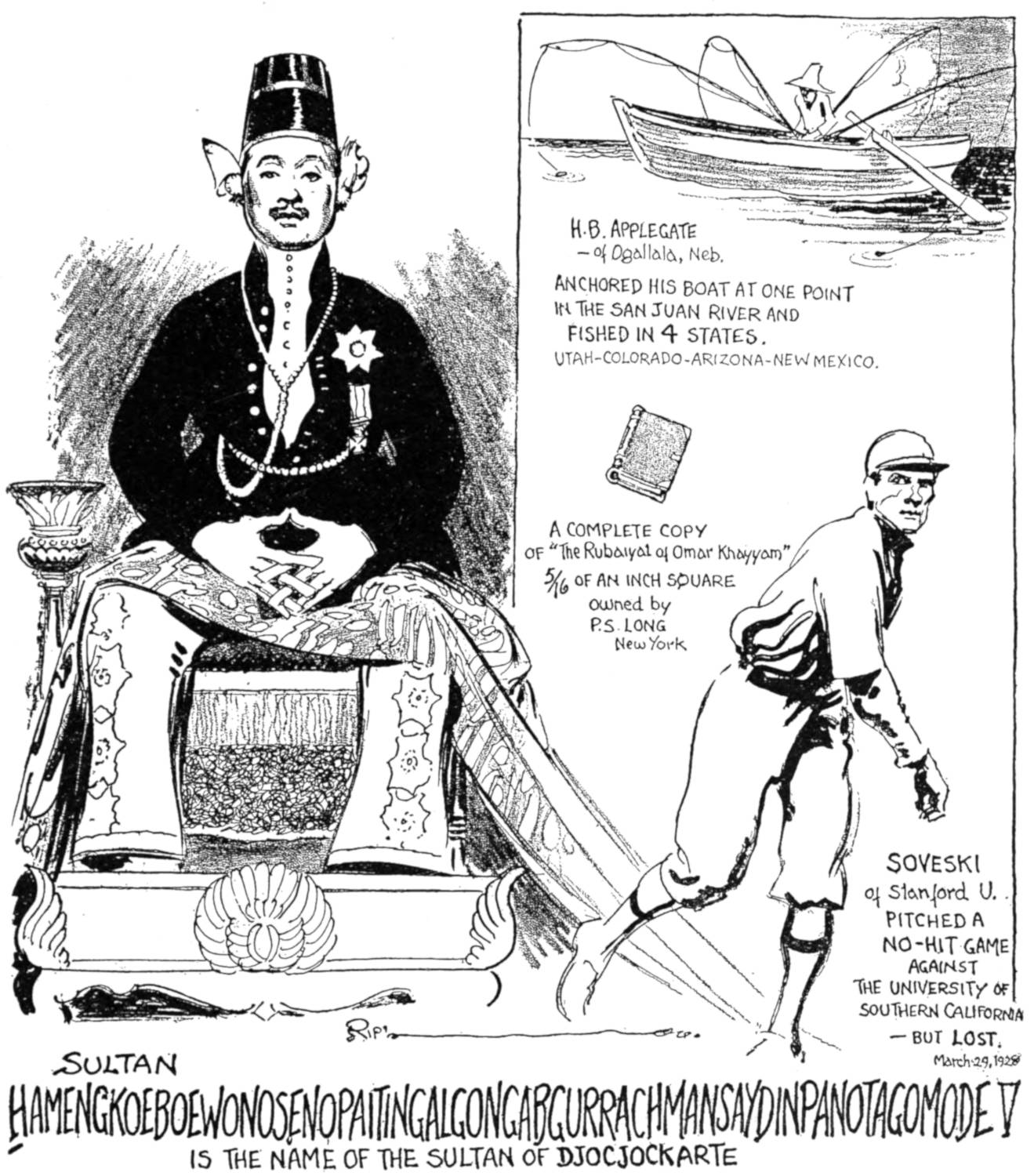
H.B. APPLEGATE —of Ogallala, Neb. ANCHORED HIS BOAT AT ONE POINT IN THE SAN JUAN RIVER AND FISHED IN 4 STATES, UTAH—COLORADO—ARIZONA—NEW MEXICO.
A COMPLETE COPY OF “The Rubaiyat of Omar Khayyam” ⁵⁄₁₆ OF AN INCH SQUARE owned by P.S. LONG New York
SOVESKI of Stanford U. PITCHED A NO-HIT GAME AGAINST THE UNIVERSITY OF SOUTHERN CALIFORNIA —BUT LOST. March 29, 1928
SULTAN HAMENGKOEBOEWONOSENOPAITINGALGONGABGURRACHMANSAYDINPANOTAGOMODE! IS THE NAME OF THE SULTAN OF DJOCJOCKARTE
* * *
AN AMERICAN PALINDROME
N O M A D
O C A N A
M A D A M
A N A C O
D A M O N
Doc. Applegate.
* * *
ANTIPERICATAMETAPARHENGEDAMPHICRIBRATIONES
Is the title of a book by Rabelais.
“Aldiborontephoscophornio, where left you Chrononhotonthologos?” is a burlesque pomposo in Henry Carey’s farce.
When traveling in Argentina, I met a man in Buenos Aires whose name was Señor Don Juan Iturriberrigorrigoicoerotaberricooechea.
Pe Maung, in his “The Glass Palace Chronicle of the Kings of Burma,” mentions the name of King Siritaribhavanadityapauaraanditasudhammarajamahadhipatinarapatisithu. His subjects were compelled to pronounce the entire 69 letters whenever they were permitted to address him.
The thirteenth holder of the title of “Living Budha,” or Dalai Lama, of Lhassa, Tibet, was called “Ahwangloputsangtoputanchiatachichiawangchuchuehlelangschieh.” This name was comparatively easy for his worshipers as it only contains 58 letters.
Mark Twain speaks of a Holy Man in Benares, India, who had 109 names—the last of which contained 58 letters. He writes it this way Sri 108 Matparamahansaparivrajakacharyaswamibhaskaranandasaraswati.
* * *
A little Honolulu lady bears this appellation: Miss Kalani Kaumehamehakahikikalanynakawahinekuhao.
The late Western Empress Dowager, of China, that ancient Dame who hated the “Foreign Devils” with such celestial severity, was named: Tzu-hsi-tuan-yu-kang-hsi-chao-yu-chuang-cheng-shou-kung-chin-hsien-chung-hsi-huang-tai-hou. A careful count reveals 72 letters—all important.
If the old Chinese Empress possessed the longest appellation, then just as surely does one of her many millions of subjects possess the shortest of all names. Meet Mr. “I,” of Hangchow, China. Philologists all declare this name the shortest as it is only one letter long and that letter displaces less space than any other in the alphabet. Mr. I is a graduate of the Johns Hopkins Medical School in Baltimore.
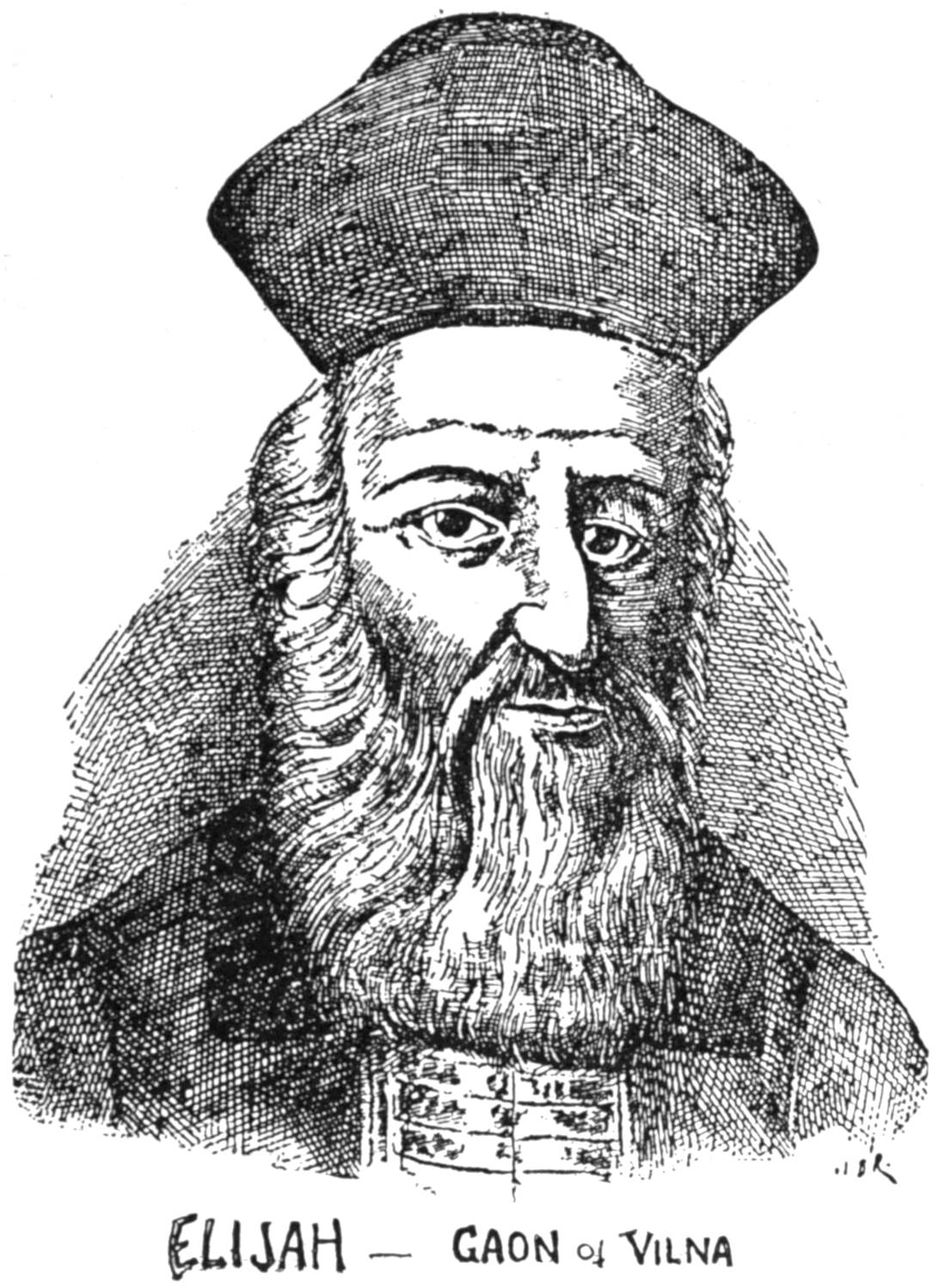
ELIJAH—GAON of VILNA
THE MENTAL MARVEL
Elijah, the Gaon, Chief Rabbi of Lithuania, possessed such a prodigal memory that he never forgot a book once he read it. Prof. Graetz, noted contemporary historian, states that the Gaon committed to memory 2,500 volumes. He knew by heart the Bible, Midrash, Mekilta, Sifre Tosefta, Seder Olam, the Talmuds (Babylonian and Jerusalmi), the Zohar, the Code, Rashi, Rambam, etc. and could quote any passage at will.
This venerable scholar resided in Vilna, the ancient capital of Lithuania, which at the time was the largest Jewish settlement in the world. His memory is revered to the present day by the Jews of Eastern Europe, and the above ancient print of the Gaon is prominently displayed on the Eastern wall of almost every orthodox dwelling.
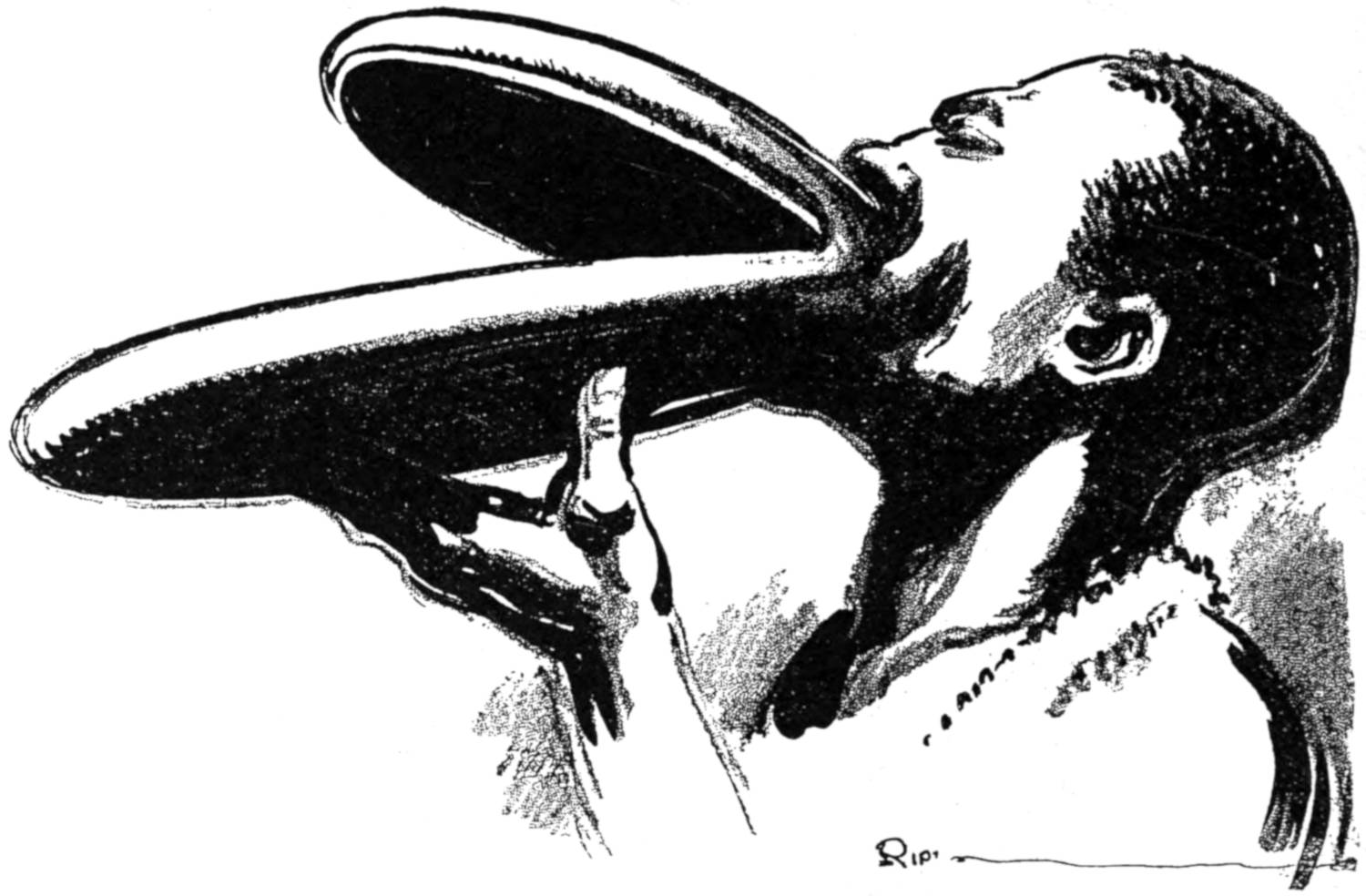
HOT LIPS
Beauty, of course, is a matter of personal opinion, but surely nowhere in the world do people have stranger opinions than among the Saras-Djinges in Africa. The distorted lips of these Central-Africa belles are one of the most astonishing customs in the world. Their lips are pierced with wooden discs of increasing size until the lower lip is distended to such an extent that 14-inch soup plates can be worn. The enormous overgrowth of lip makes chewing of food impossible, so these women must live almost entirely upon a liquid diet. Speech is almost impossible and so difficult that they do not make anything but the most necessary splutters.
When a girl is about four years old her future husband makes a hole in the centers of her upper and lower lips with a rough knife and small pegs of wood are placed within. Gradually the size of the wooden pegs are increased until by the time she has reached womanhood her lips are things of beauty and a joy forever.
At night the Djinges wife sleeps with her huge lower lip on her husband’s shoulder. This enables him to feel sure that his wife is with him, that she has not been stolen, or run away from him in the darkness.
* * *
PILLAR SAINTS
A man may be too foolish for his own good—but not for mine. Their folly is my fortune. I’ll get rich off the ridiculous yet. As long as they have ‘Bunion Derbies,’ Marathon Dances, Non-Stop Coffee Drinkers, and Pole-Sitters, the “Believe It or Not” business will prosper.
For instance, if someone had told you some time ago that a man in his right mind would climb a pole and sit on top of it for more than two weeks without once descending you most likely would not believe it.
Of course you know better now. You have grown accustomed to that particular and peculiar swarm of Koo-Koo birds who have been infesting the flag poles of our nation for some time past.
“Shipwreck” Kelly began it with a well-sat record of 12 days and 12 hours. “Spider” Haines clambered up a pole in Denver and stayed there four days longer than “Shipwreck Kel.” Soon all the available flag-poles in the country were inhabited. The city of Los Angeles was topped by a girl—even the air is elevating out there. Miss Bobby Mack, age 21, perched herself aloft for nearly three weeks.
I am not quite sure which one of these nuts is the nuttiest—but I think “Hold ’Em” Joe Powers, of Chicago, who stayed on top of the Morrison Hotel flag pole, 637 feet above Randolph Street, for 16 days, 2 hours and 35 minutes, is deserving of the crown of razzberries—or whatever they give the winners of sitting contests.
Let me add a comment from a Chicago paper just to give you an idea of fun at top-mast.
(Chicago Tribune Press Service)
Chicago, July 16.—“Hold ’Em” Joe Powers, a dusty, dirty, frazzly, frowzy creature, came down from his flagpole.
Six teeth were gone; his legs were swollen; little needles of nerves burned into the soles of his feet when he tried to walk; his hair was snarled and matted; his beard was long; his face was black; his neck was sunburned.
But life had its compensations.
Joe had the memory of a record sixteen days, two hours and thirty-odd minutes on top of the flagpole which is on top of the roof which is on top of the tower which is on top of the Morrison Hotel.
But no matter what you do, whether it is sitting on top of a flag pole or on a tack there seems to be someone who has done you one better at some time or other. Now Sitting Joe and “Shipwreck” Kelly to all intents and purposes did some tall sitting; but I have seen better!
I saw a man who had been sitting on a bed of sharp spikes for 18 years. (I have already told you about him on page 9.)
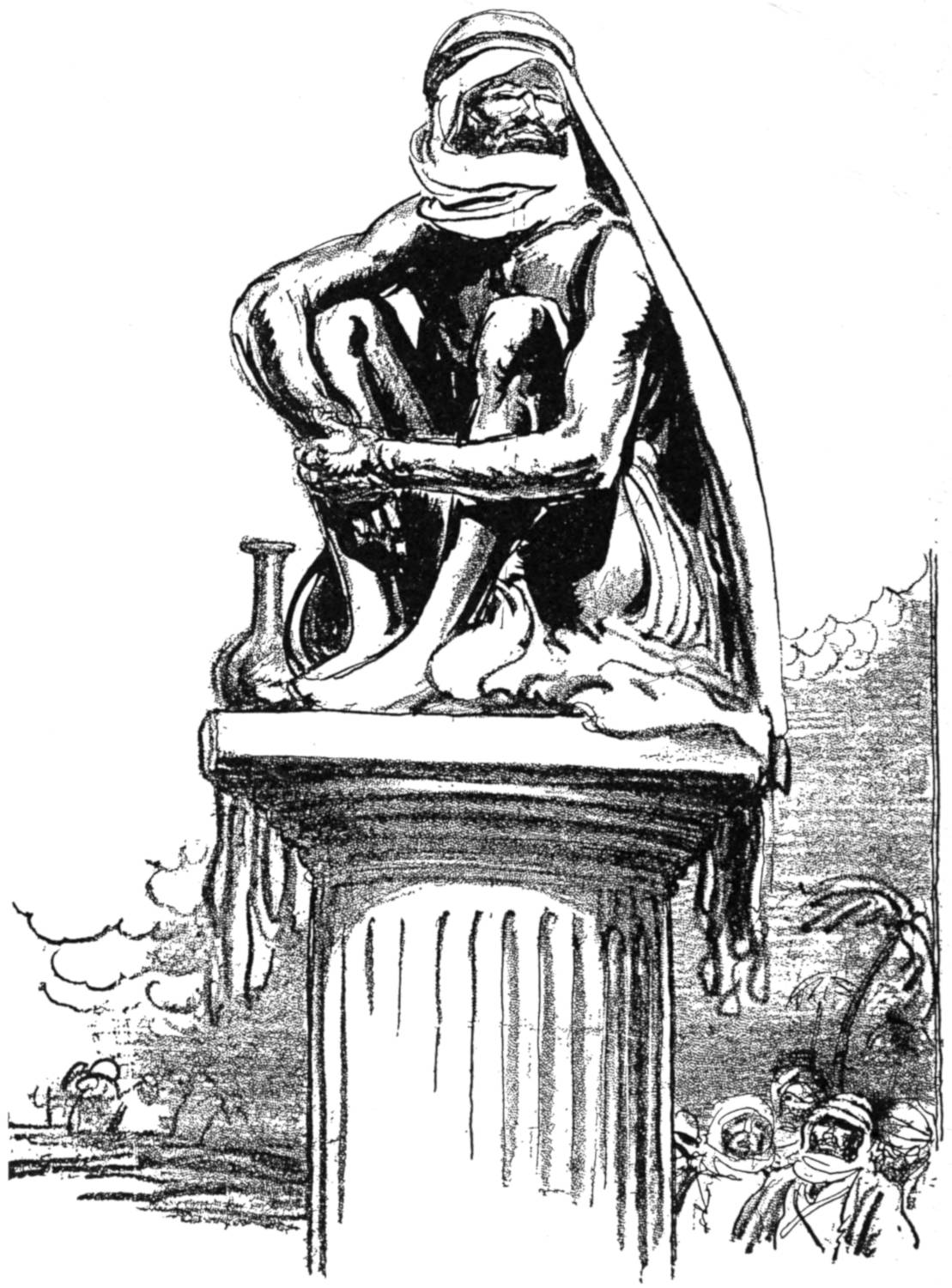
SIMON OF THE PILLAR
And there was that man Savan. Savan’s sitting amounted to something. He is the only sitter that I have ever heard of that had a practical idea behind him—or I should say under him. Savan was a soldier in Napoleon’s army in Egypt. He went AWOL or something. You know the women out there all wear veils and maybe Savan got curious. The veil is the great beauty secret of the Orient. The heavier the veil the greater the beauty. I haven’t the same faith in Oriental beauty since I have been out there. And particularly since I discovered that Cleopatra was fat and black and 46 years old and married to her brother when she met Mark Antony, who was 60 himself and wore a full set of whiskers. But as I was saying, Savan was ordered to do K.P. work but demurred. Nap called him in and asked him “Qu’est-ce que ça?”
“I am not able to work,” said Savan. “I am too weak to do anything more than just sitting around.” So they took him at his word and gave him just such a job. They fixed up a nest of hen’s eggs and placed Savan on it—and kept him sitting there, mad as a wet hen, until he hatched 3 broods of chickens!
But a word about Simon. Here was a man who really could sit. They called him Simon of the Pillar. Maybe he was a forefather of the illustrious Simple Simon of nautical fame. But Simon could sit. He was a Syrian ascetic who sat on top of a marble column in Alexandria for 69 years—without descending one time. Simon clambered up the column when a young boy and remained seated on this narrow space of less than 3 feet in diameter until his death years later.
This man belonged to a school of “Pillar-Saints”—a class of ascetics who sat atop various columns or rocks in the Near East, in the expectation of catching the first glint of the second coming of Christ, in the 5th and 6th centuries.
St. Simon the Elder, who is the subject of Tennyson’s “St. Simon Stylites” (he spent 37 years sitting on top of a column) and St. Simon the Younger who remained aloft for 69 years, are the two best known.
During my several trips to Egypt and Syria I saw many standing columns, especially around Antioch, and they all bore some kind of a legend about some such “Saint” or other, who sat atop them for various lengths of time.
Food and drink were passed up to them, and the climate, as you know, is very mild in the Near East.
I refer you to the following books: “Die Säulen Heiligen im Arabischen,” by Dr. Ignatz Weinzieher; “St. Simon Stylites,” by René Aldoni; “Stylites or Pillar Saints,” by Herbert Thurston.
* * *
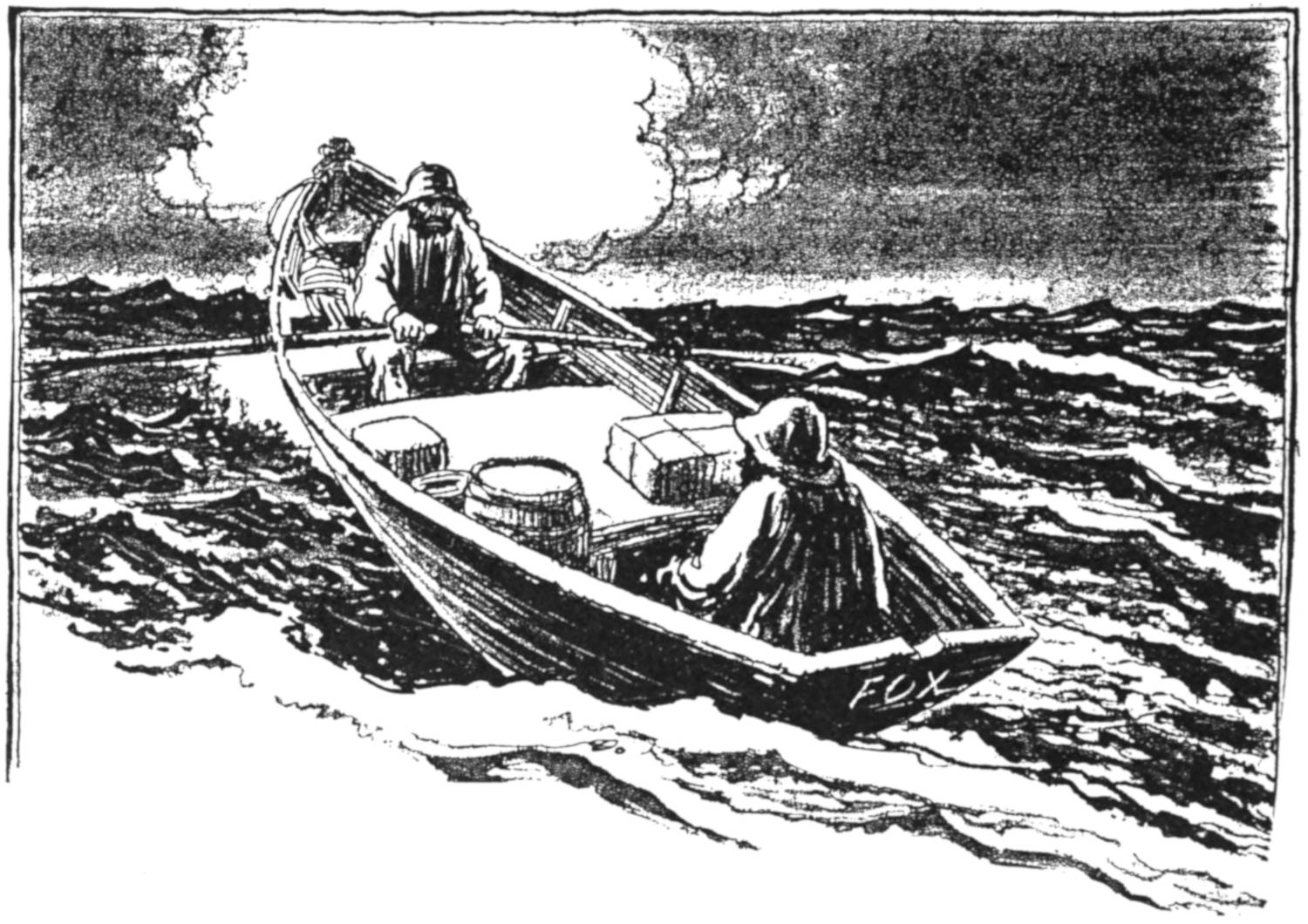
TWO SCANDINAVIANS ROWED ACROSS THE ATLANTIC OCEAN
Just thirty years ago two Norwegians rowed—actually rowed—across the Atlantic from New York. They made no great fuss about it. They were in New York. The weather was fine. They reckoned that they would row home and see how the old folks were getting on. Of course one ought to have a good, reliable rowing-boat, not a second-hand craft, so, like most wise cockleshell cruisers, they built her themselves, of well and truly seasoned cedar-wood. Eighteen ft. long was she, clinker built, with a 5-ft. beam and a depth inside of 35 in. Fox was her name. She dropped down the river from New York, on the outgoing tide, at five o’clock on the afternoon of June 6, 1896.
For more than a month the life of the rowers was relatively uneventful. The sun shone. The hills of swell went rolling majestically by. The oars were steadily plied, shift after shift. One ate. One sang. One slept.
Then things began to happen and their trip the rest of the way was a nightmare. God was good to them, however, and eventually they made the port of Havre where they landed sixty-two days after leaving New York. By examining their log-book and talking with them, Dr. Chancellor, the at first openly sceptical American consul at that port, ascertained that this astounding feat had indeed been accomplished.
* * *
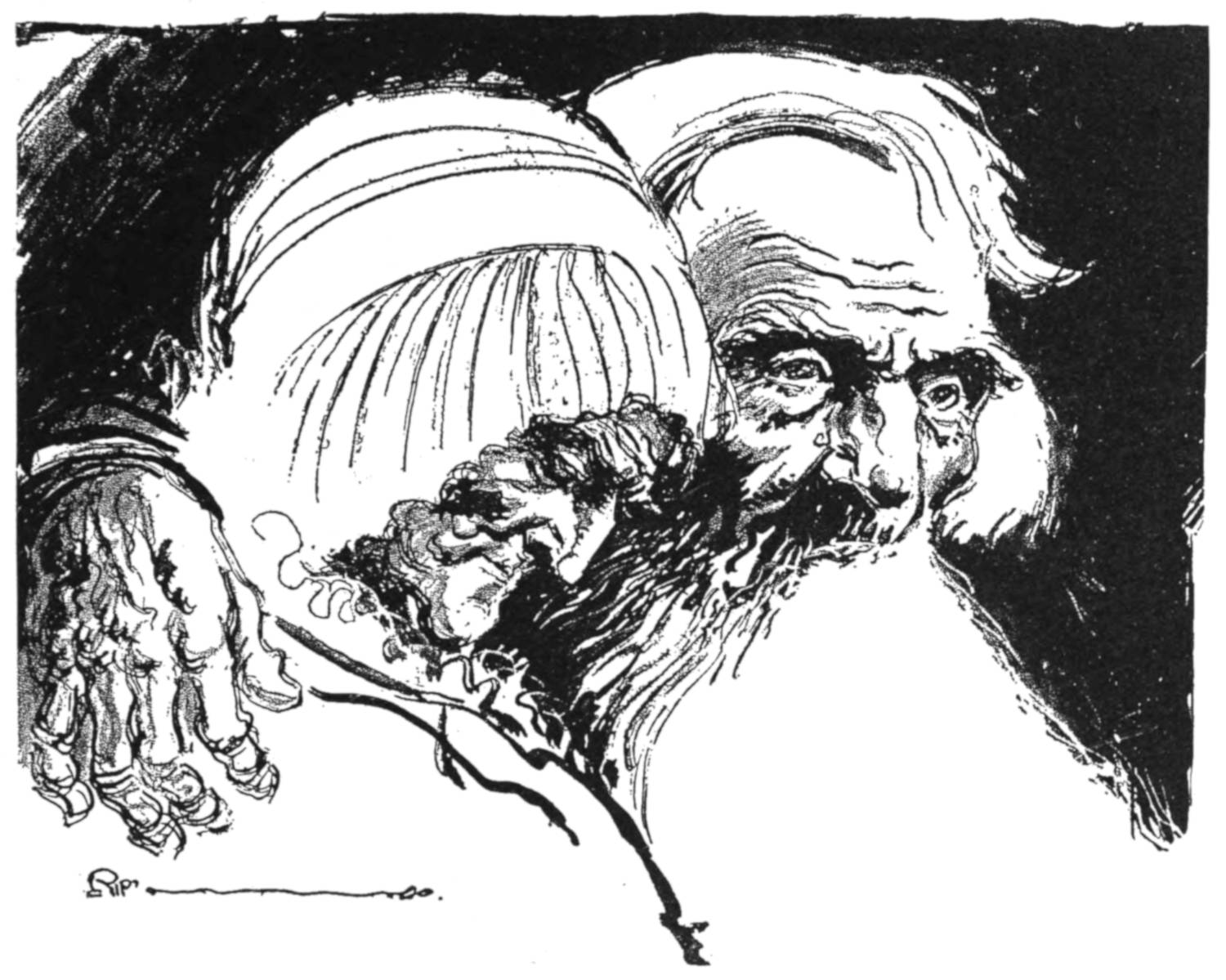
WEDDED FOR 147 YEARS
All records for a long and happy wedded life belong to Janos Roven and his good wife Sara. They lived together as man and wife for 147 years—and almost saw their third golden jubilee.
Janos and Sara were born in the little village of Stradova, Comitat (County) Casanseber, Banat (Province) of Temesvar, Hungary; and they both died there—Janos being 172 years old and Sara, 164.
The aged couple attracted considerable attention during the later years of the wedlock, and the Dutch envoy in Vienna visited them and had their pictures painted. This painting is now in the possession of William Bosville, the trustee of the Earl of Northumberland, who also has the original documents of their marriage.
Janos and Sara died almost on the same day in 1825. Their son, aged 116 years, and his two great-great-grandsons, were at the bedside.
* * *
THE LAND OF THE HUMMING BIRDS
Early one morning—Oh! earlier than one wants to get up in indolent weather—we approached La Boca del Dragon—the Mouth of the Dragon, and squeezed in among the teeth-like islands onto the peaceful bosom of placid Paria and slid silently and quietly down along the ever-green shore of Trinidad.
“Rocklets of ocean, so bright in your green, Bosomed on Paria’s stormless breast, How many mem’ries of times that have been Linger around ye, sweet Isles of the West.”
Trinidad!—“The Trinity.” So named by Columbus when he first sighted it—not only on account of its formation, but in fulfillment of a vow he had made when in dire distress on the unknown sea with his wine, water, and food all gone.
Since we have all the wine and food we want (and we can get water) I prefer the appellation “Iere” as the Caribs called it—the “Land of the Humming Birds”—a well-merited name from the myriads of winged gems that fly like glowing sparks in the deep green forests that pile up so picturesquely on the starboard. Glittering Paradise!
Nature is nowhere more charming than on this warm, sweet isle. My arborist friend tells me that among the effulgent efflorescence of Iere there grows the Tecoma Serratifolia—the Borassus Flabelliformis, the Corypha Umbracilifera—the Pithecolobium Saman, and the Couroupita Guianensis. But they are rare and beautiful just the same.
Columbus and Raleigh wrote home to their girl friend, Isabella, about “the oysters that grew on trees; crabs that climb their branches; trumpet fish that tooted their own fish horns; and about the Cascadura fish that wore a coat of mail.”
Isa only laughed and said “Creelo ó no.”
And I suppose you will say so too when I tell you about the Burning Birds of Huevos. Huevos is that little egg-shaped island off toward Venezuela where there is a cave full of whirring birds that suck goats and grow so fat that the natives of Paria stick wicks through them and use them for candles.
We were only 10 degrees from the equator—that magic line where nature is the strongest and man is the weakest. Here the earth grows vigorous and man grows lazy. The land turns green and the people turn black.
Kipling said something about East is East and West is West and never the twain shall meet, but Rud forgot about the Port of Spain. East Indians and West Indians meet and mix. The island is one-third Hindoo and the mixture is well seasoned with Chinese, Japs, Syrians wearing their turbans and saroongs, shirts and pants. The singular Singhalees and the Trinadadians act like brothers under their black skins.
I returned at night from the Pitch Lake—the “wonder” of the island—a lake of pitch of more than 100 acres furrowed by deep fissures of cool water. These fissures are crossed by planks. In many spots the pitch is absolutely firm, but in some places one’s feet sink quickly, and here and there the pitch is seen boiling. The lake is said to have sunk ten inches in fifty years. The lake is at present leased to the Trinidad Lake Asphalt Company, whose average exportation is about 200,000 tons of pitch annually. A chain of buckets carries the pitch along the jetty, at which lie the steamers awaiting their cargo.
The streets are lined with sleeping Hindoos who only fold up, bow their heads and close their eyes when the day is done. I accidentally stepped on a black toe peeping out from under a huddled figure in a darkened doorway and a low rumble issued forth. You see, every man’s home is his castle.
Now I am sitting on the veranda of the Ice House with the two sisters from Ottawa. On the wall inside is a framed tag line from the old English song.
“Ours is a nice house, ours is.”
So they call it the “Ice House”—“where the cool green swizzles grow.” A “swizzle” is the best tropical drink in this hemisphere. It is made of rum, white of an egg, a lemon, sugar, nutmeg—and swizzled. Inasmuch as Ontario voted dry recently it is only fitting and proper that Ottawa girls and I should be having a swig of a swizzle on the veranda of an Ice House as the sun goes down.
How the sun goes down! Night falls in the tropics. There is no twilight. The blood-red disk down the end of Marine Square has just tumbled precipitously into the sea.
Now it is dark.
* * *
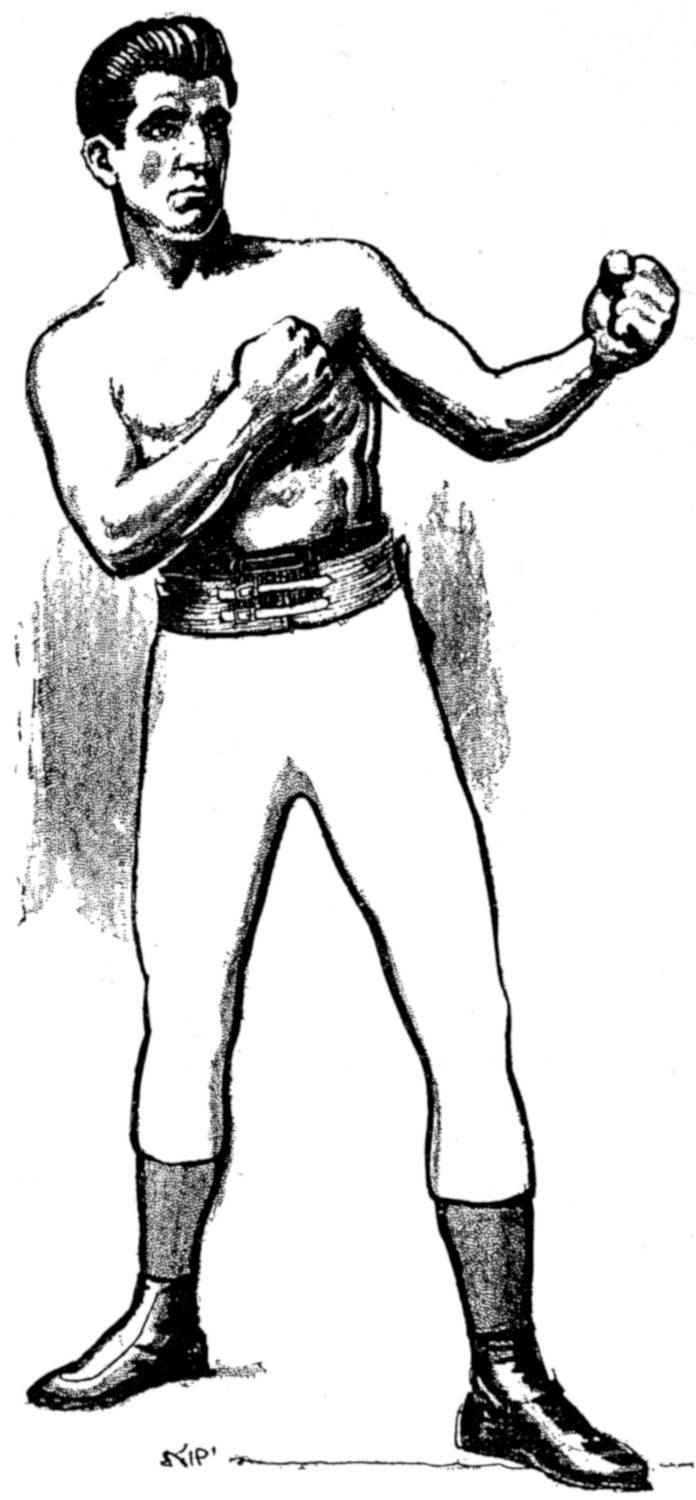
JIM CORBETT FOUGHT IN THE PRIZE RING FOR 18 YEARS ... and never had a black eye or a bloody nose.
This fact is flattering testimony to the remarkable skill of Corbett. “Gentleman” Jim was the first great exponent of cleverness inside the ropes. When he defeated the great slugger John L. he revolutionized the game at the same time.
* * *
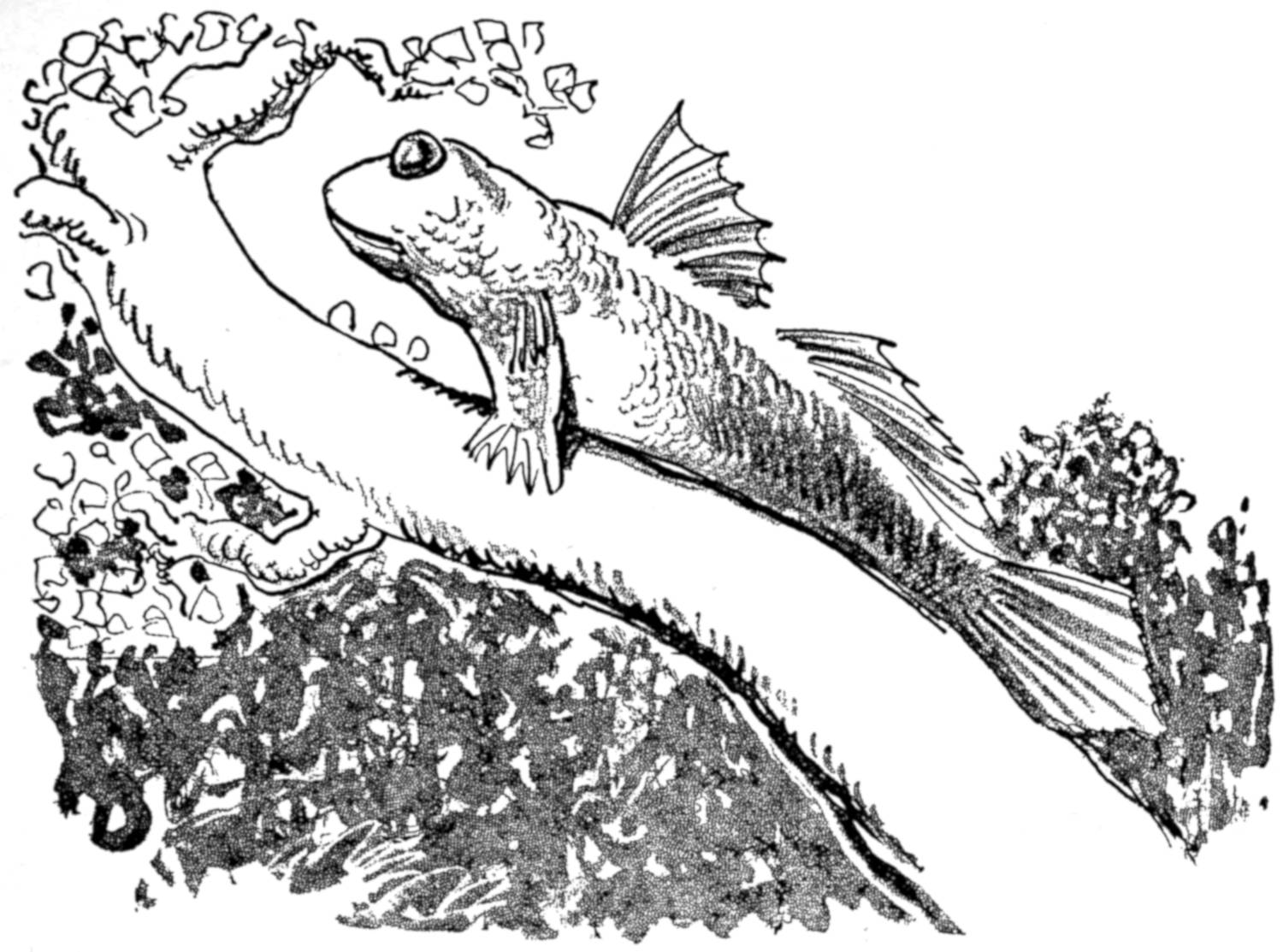
THE FISH THAT CLIMBS TREES
This finny acrobat that is wont to leave its aquaeous habitat to climb trees is a native of Malaysia. It is more formally known as the Periophthalmus Schlosseri. When the tide is out these frisky fish squirm playfully about in the mud and frequently wriggle up the nearby trees in quest of toothsome insects. They propel themselves with unusual agility by means of two strong leg-like fins, and are able to ascend good-sized trees where they sometimes look down on travelers with their big soulful eyes.
* * *
“Dear Rip:
Your “Believe It or Not” cartoons astound me daily, but I think that recently I witnessed a happening worthy of your mention.
I was fishing about a mile or so above Kalma on the Columbia River when suddenly I saw a Black Bass—weighing about 4 pounds—leap from the river and swallow a bird.
Believe me, A. B. Stafford.”
* * *
RED RAIN
Every now and then some section of the world goes into a panic over the queer behavior of the skies. Not long ago in Clermont, France, the provincials thought the end of the world had come. It was raining blood! At least they thought so; and there could be no doubt but that the rain was red.
Surely it was the end of the world. But in a short time the showers stopped and the old world went rolling on just the same.
There are no proven explanations for such showers. The rain was red, no doubt, and the best reason advanced for the phenomenon disclosed the fact that the air was full of red dust which was believed to have been blown over from the Desert of Sahara.
Wild stories of bloody rain have been related for ages, and it is only of recent date that the non-miraculous nature of them was determined. Homer, Virgil, and Plutarch mention blood showers. Plutarch speaks of showers of blood following great battles, and asserts that bloody vapors, distilled from the bodies of the slain, impregnated the clouds, from which they were subsequently shed upon the earth.
The most recent account of red rain was sent to me from a friend of mine in China, who clipped it from the Central China Post. There is no doubt of its authenticity.
* * *
RAIN OF BLOOD
Mongolia Folk in Terror Over Phenomenon
Harbin, June 29, 1928.
A “rain of blood” in Mongolia has spread terror among the people and temporarily deranged trading conditions there, according to reports received here.
The “blood rain” coincided with an epidemic of dysentery and the Mongols took this as a sign of heavenly displeasure, fleeing terror-stricken in every direction and abandoning their yiurts and cattle herds.
The Phenomenon started with a rapid approach of heavy dull-brown clouds and a red rain then continued to fall for three hours, leaving the whole landscape, yiurts and cattle painted a deep red hue.
European traders who were present easily discovered that the coloring was due to red clay, which must have been raised skyward by a cyclone, but they were unable to persuade the Mongols of this.
For three days the terror lasted, the men wearing amulets of horsehair around their necks and the women each night placing infants outside the yiurts as an offering to God with the hope of diverting heavenly wrath from the rest of the occupants. As the nights were cold the wails of the infants ceased only with daylight.
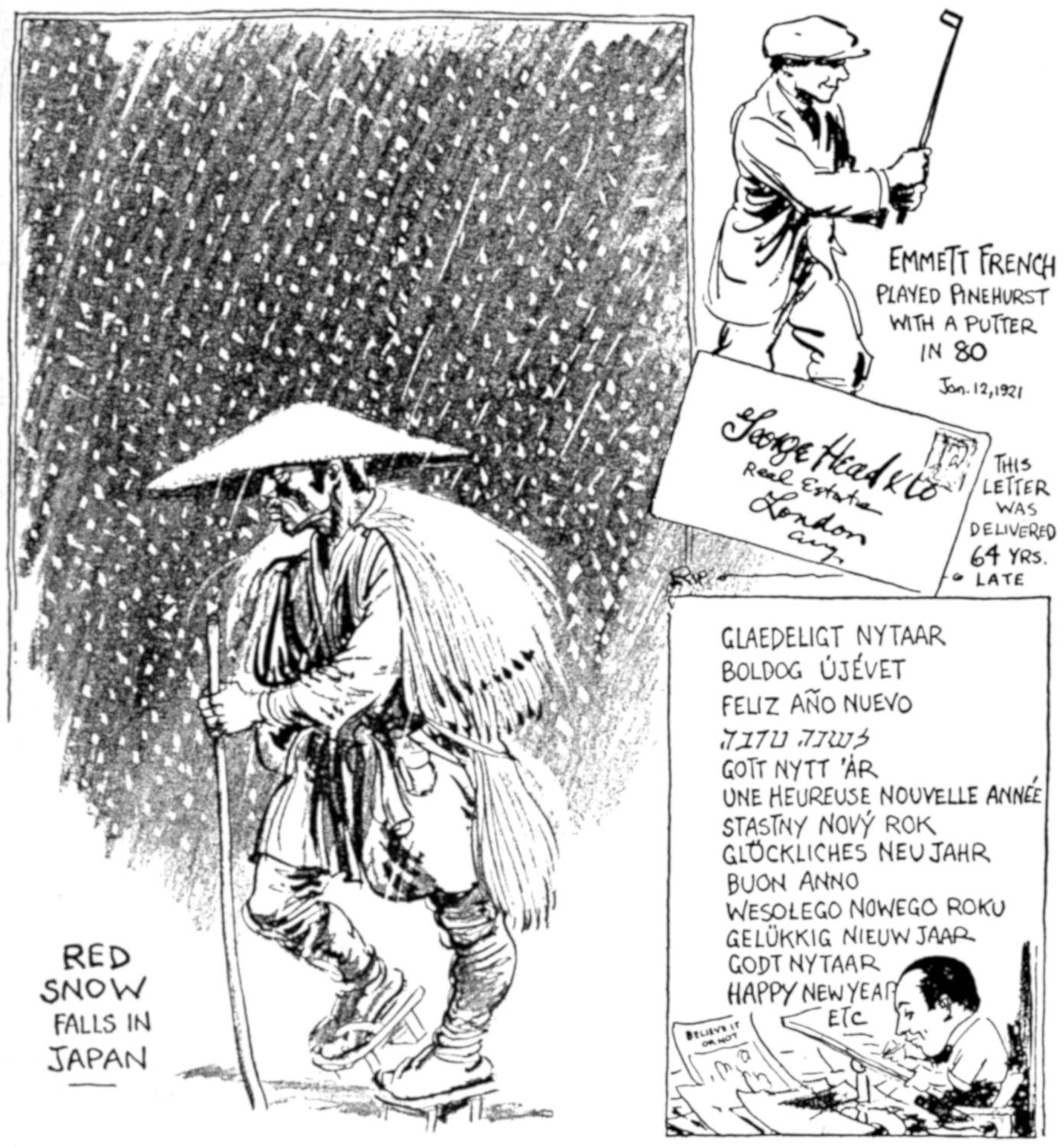
RED SNOW FALLS IN JAPAN EMMETT FRENCH PLAYED PINEHURST WITH A PUTTER IN 80 Jan. 12, 1921
George Head & Co Real Estate London [...] THIS LETTER WAS DELIVERED 64 YRS. LATE
GLAEDELIGT NYTAAR BOLDOG ÚJÉVET FELIZ AÑO NUEVO טובה שנהל GOTT NYTT ’ÅR UNE HEUREUSE NOUVELLE ANNÉE STASTNY NOVÝ ROK GLÜCKLICHES NEUJAHR BUON ANNO WESOŁEGO NOWEGO ROKU GELÜKKIG NIEW JAAR GODT NYTAAR HAPPY NEW YEAR ETC
* * *
THE BARKING BIRD
The bird that barks is a red-breasted little fellow indigenous to central Chile, and is called by the natives “Guid-guid.” It sounds altogether like a small dog yelping in the forest. A person will sometimes hear the bark close by, but in vain may endeavor by watching, and with still less chance by beating the bushes, to see the bird; yet at other times the guid-guid fearlessly comes near.
Ref.: Charles Darwin.
* * *
THE SHARK DESTROYER
Who would ever imagine that a little soft fish—less than a foot in length—could kill the great and savage shark?
The little Urchin-fish, or Sea Hedgehog (Diodon Maculatus), of South America frequently destroys savage monsters 25 feet long, in a most peculiar manner. This fish, with its flabby skin, arrayed with spiny points, possesses the singular power of distending itself into a globular form, and thus causing the spines to project in every direction like the quills of an irritated porcupine.
When swallowed by a shark it calmly eats and bores its way out, not only through the coats of the stomach, but completely through the sides of the monster—thus killing it.
* * *
MAN-EATING CLAMS
I mean that this species of clams eats men—not that men eat the clams. The mammoth clams of Malaysia—measuring 4 feet across and weighing 500 pounds are sure death to anybody careless enough to step within their open jaws. I heard many stories, when I was out there, of natives who had lost their lives in this manner.
There is a giant clam whose shells are now used as holy-water basins in the Cathedral of St. Sulpice, Paris, which must have weighed nearly 700 pounds. The shells alone weigh 550 pounds and are nearly 5 feet across.
* * *
PRANKS OF NATURE
When we consider how fearfully and wondrously made we all are, it is not surprising that Mother Nature sometimes makes a mistake. Human errors are not always pleasant to look at or think about, so I will not go into any length of detail discussing the mistakes or monstrosities of life.
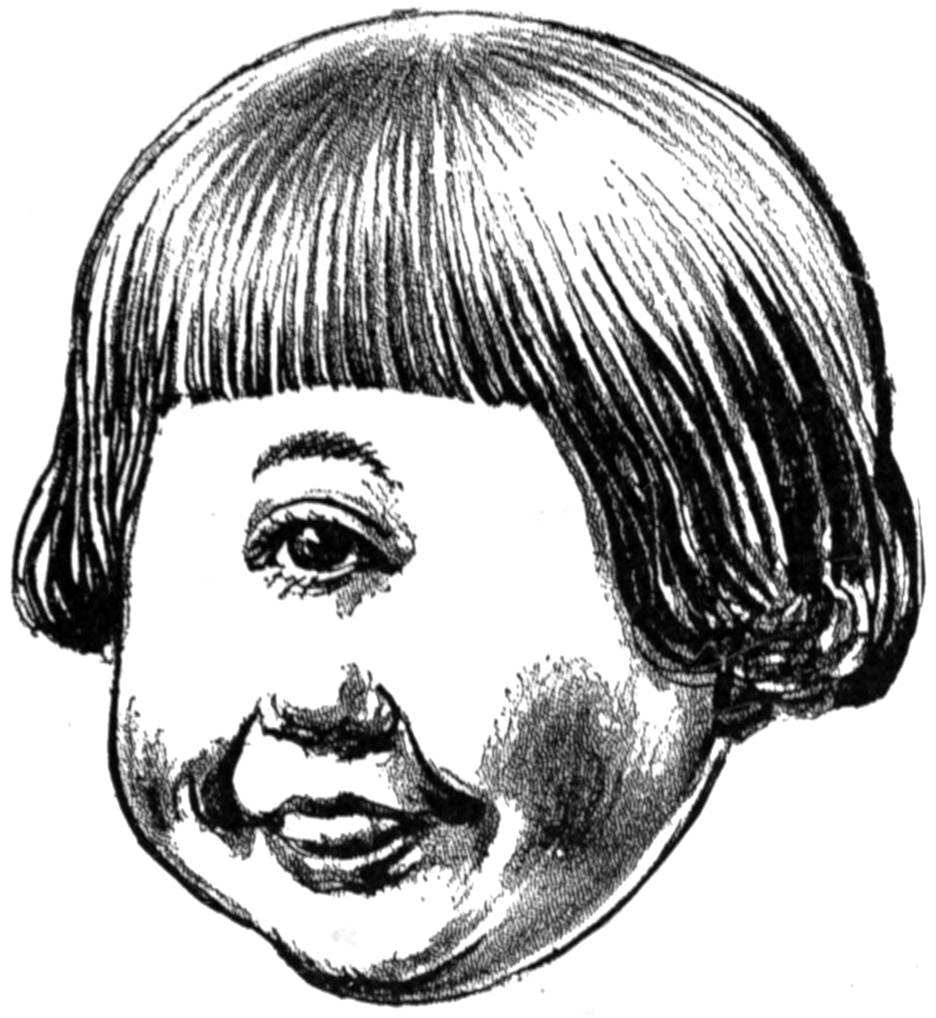
THE CHILD CYCLOPS
The famous Clement child of Tourcoing, France, was born (1793) with only one eye located in the center of her forehead. She was perfectly normal in every other way, and lived to the age of fifteen.
Reported by Buffon in his Natural History, Vol. II.
* * *
THE TRANSPARENT MAN
Hsieh Hsuan, a native of Yu-t’ien in Chihli, China (1389-1464) was born with transparent flesh. The bones and organs of his body were plainly visible.
Hsieh was a profound scholar and attained his Chu Jen Degree. He entered upon an official career, but became implicated in a bribery case, and was sentenced to death. He continued his studies in prison and calmly studied a book even when led out to execution. He was reprieved and later canonised, and in 1572 his tablet was placed in the Confucian Temple.
Ref.: Chinese Biographical Dictionary, by Herbert A. Giles.
* * *
THE CRAB-TOED TRIBE
In the western part of New York State dwells a community of crab-toed people whose peculiar affliction has puzzled scientists. The hands and feet of this group of people resemble claws of a crab or lobster.
Here is the report of the Superintendent of the Rome State School, of New York, Dr. Charles Bernstein:
“The Rome State School sent a field worker into the community where this strange progeny existed and the descriptive matter showed that there have been 184 cases of crab-toes—most of whom were social outcasts in the community, presenting many alcoholics, prostitutes, etc.
“It was discovered that an English woman came over in the year 1800 and settled in Western New York. Later she married and the male offsprings of this union were crab-toed. Later it was found that this was a sex-linked affair through which the females never presented the symptoms but transmitted it to their male offspring, no females ever having it but all females transmitted it to their male children.
“While the intelligence status of these people is very low it is sufficient to enable them to become successful workers and often skilled mechanics. They do not seem especially sensitive about their situation as they readily submit to having their pictures taken, etc.”
* * *
Bidault, a French peasant, was born with two noses.
* * *
Leone, the Athenian courtesan, bit off her own tongue to prevent herself from revealing the conspiracy between Harmodius and Aristogiton.
A statue in the form of a lioness without a tongue was erected in her honor by the Athenians.
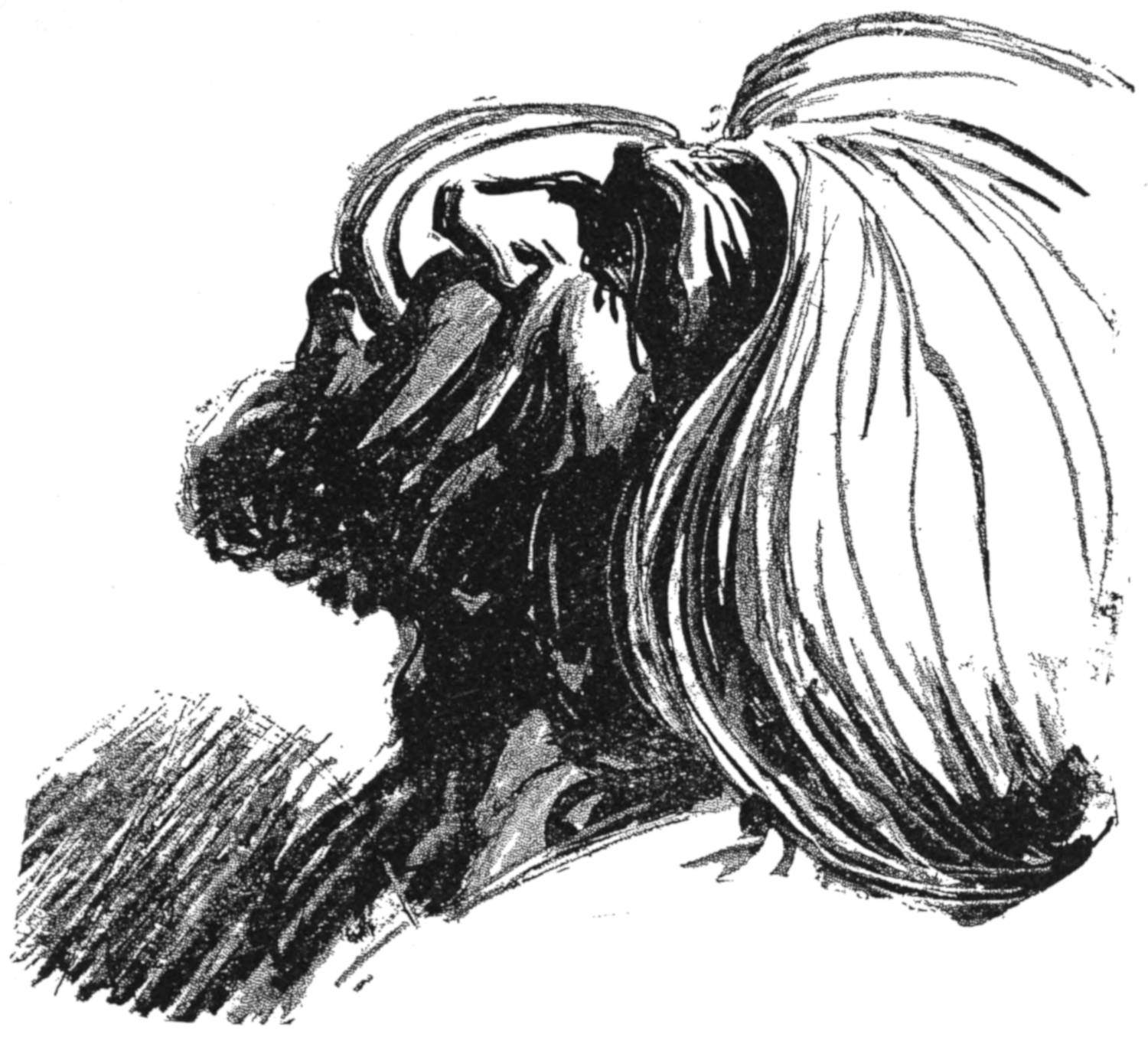
YOGI HARIDAS
This famous Ascetic could touch his forehead with his tongue. It is a form of high Hindoo heroics. In other words Haridas could touch his caste mark with his tongue. This required years of practice and many painful surgical operations on the roots of his tongue.
* * *
General Townsend, of London, could control the palpitation of his heart and suspend its action entirely at will.
This unnatural phenomenon is attested to by the well-known English physicians, Doctors Cheyne and Bayard.
The General died eight days after suspending his heart action for half an hour.
* * *
Leach, the noted dwarf, (1789-1818) had arms so long that he could touch the ground while standing upright.
* * *
THE FORK-TONGUED FRÄULEIN
Surely there never lived a more unfortunate young woman than this Frankfort Fräulein. She had two tongues but could not speak a word! Her case is reported by both the Medical Record, and the Courrier Médical of France. This peculiar mistake of nature is extremely rare although it has happened before.
THE GLASS SNAKE
The glass snake is not made of glass nor is it a snake. It is so-called because of its odd propensity of snapping into pieces at the slightest touch. It is a lizard, but it is indeed so singularly like a serpent that it can only be distinguished from one by certain anatomical marks, such as the presence of eyelids, and the solid jawbones.
To catch a perfect specimen of the glass snake is very difficult business for when alarmed it has the remarkable habit of contracting the muscles of its tail with such exceeding force that the member snaps off the body. The snake will sometimes break into several pieces if struck slightly with a switch. It is found only in North America.
THE LEFT-HANDED FAMILY
The family of Colombière, Nancy, France, were all born with two left hands—that is, both hands were left hands. This peculiarity was transmitted through the males; the females were exempt. They are perfectly normal in every other way.
THE MAN FAMILY
The Bossant family of Gijon, Spain, have had no girls born to them for more than one hundred years. They are a large family but for some reason no girls.
* * *
John Sinclair, of Halkirk, Caithness-shire, England, was married three times, and each wife bore him ten sons. He died in 1890.
* * *
Vaclav Kratochwil, of Prerau, Czechoslovakia, has blue eyelashes.

THE FORKED-TONGUED FRÄULEIN of FRANKFORT. GRETEL MEYER WHO HAD 2 TONGUES —BUT COULD NOT SPEAK.
SIEGMUND KLEIN weight ... 146 lbs. PRESSED 233¹⁄₂ LBS. TO ARMS LENGTH OVER HIS HEAD H. HANSON LOST A POUND A DAY FOR 100 DAYS LONDON’S HONKING PEDESTRIAN HONKS TO WARN AUTOS ASIDE
THE GLASS SNAKE SNAPS INTO PIECES AT THE SLIGHTEST TOUCH
* * *
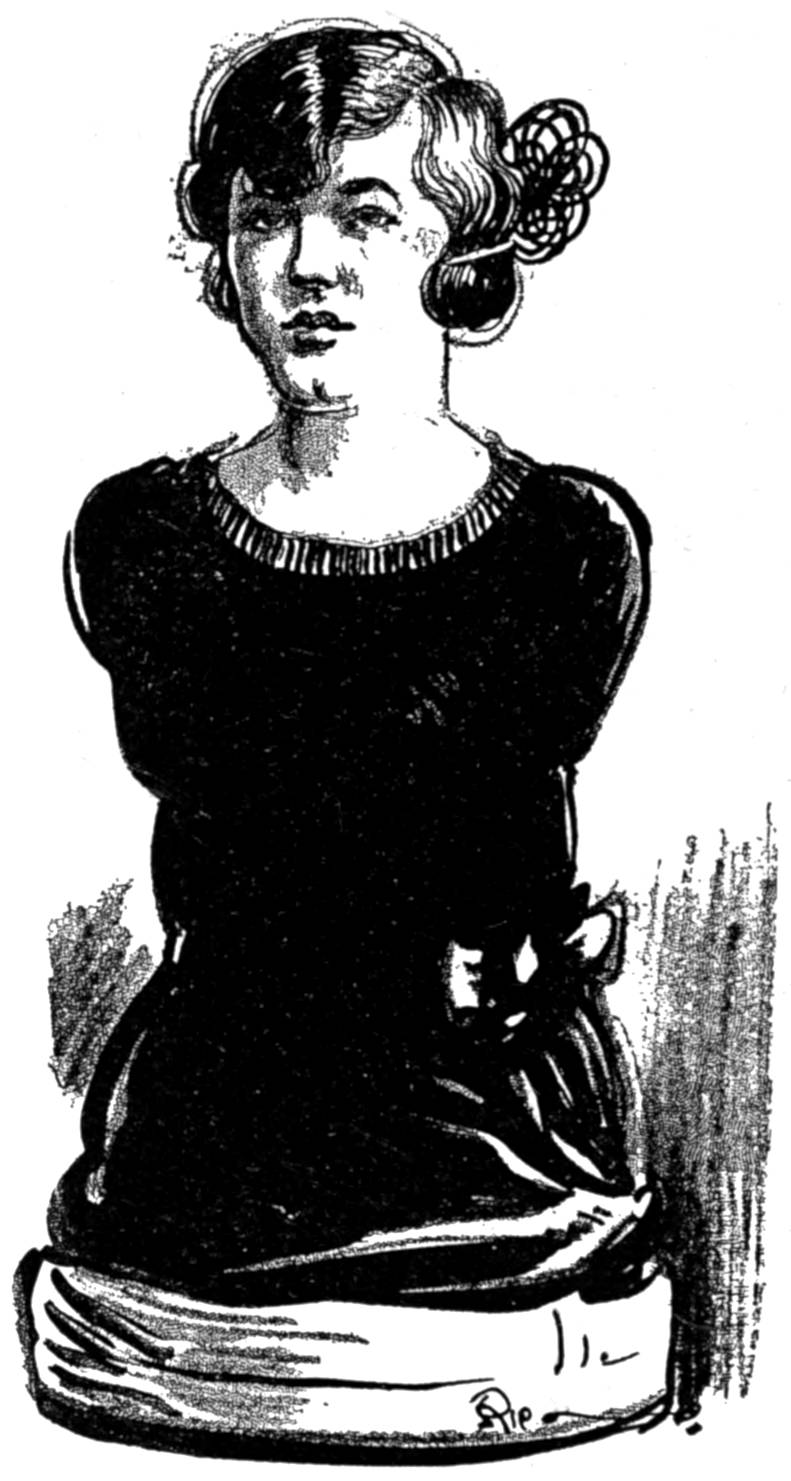
THE HALF WOMAN
“Violetta,” as she prefers to be known, was born without arms or legs, of normal parents less than thirty years ago in Germany. She is a lady of perennial good nature—realizing that what one never possesses one never misses. Her body is well formed otherwise, she enjoys perfect health, and her senses of sight, hearing, smell, taste and touch are all developed and perfected in their separate and various functions far beyond the average normal person’s.
Violetta’s accomplishments in overcoming the unkindness of Mother Nature are astounding. She rarely needs the assistance of anyone, and is able to get about with remarkable facility. She can dress herself, comb her own hair, thread a needle, sew, and perform other feats apparently bordering on the impossible.
* * *

LIU CH‘UNG Governor of Shansi AD 955 HAD DOUBLE EYES
THE DOUBLE-EYED MAN
Liu Ch‘ung, or Liu Min, as he was sometimes known, was born with double pupils in each eye. This strange freak of nature did not in the least deter this active man. He became Governor of Shansi, Minister of State, and through intrigue with the Dowager Empress, had his son proclaimed Heir Apparent. He also loved wine and gambling.
I refer you to Herbert A. Giles’ book on China.
* * *
THE MAN WITHOUT EARS
Ezechiel Eads, of Athens, New York, who died in 1884, was born without ears. The sides of his head bore no trace of ears whatever; neither had he openings for ears.
However, he was able to hear through his mouth which he opened wide for the purpose.
* * *
THE FAMILY PHYSICIANS
The Curtis family of London has maintained an unbroken line of doctors for 224 years, until September 25, 1927. Until this date there has always been a member of the family with an M.D. Degree. The last of this long line was Doctor William Curtis who died at the age of eighty-seven.
* * *
LION-HEARTED
The lion has the smallest heart of all predatory animals.
Philip II, of Spain, one of the most cowardly of all tyrants, possessed the largest heart of any known man.
* * *
Joseph de Mai, of Naples, was born with two hearts. He sold his own body to the English Academy of Medicine for $3,000.
* * *
Plinius tells of the child called Eutimenius who was sexually mature at the age of three years.
* * *
Magdalena Strumarczuk, of Tobolsk, Russia, had her breasts on her back. She was the mother of three children and nursed them normally.
* * *
Sophie Bunnen, wife of a Pomeranian farmer of Prussia, gave birth to eleven children in sixteen months. She had sextuplets and quintuplets. (1880-1881.)
Reported by Dr. Gottlob, famous German obstetrician.
* * *
Duke Leopold Eberhart, of Württemberg, married his seventeen children with each other.
* * *
THE DUSTY OCEAN
Oh! Yes it is! The ocean is often very dusty. A recent account of a dust storm at sea was reported in June, 1928, by Captain Nemaru of the Japanese steamship “Montreal Maru” on arrival in Tacoma from the Orient.
Captain Nemaru stated that two buckets full of dust were swept from the decks on several mornings in succession, and that the dust powdered the passengers, decks, and lifeboat coverings.
A few months before, the Captain of the steamship “Justin” reported a sand storm in the North Atlantic ocean about midway across.
Recently the crew of the “Jaden,” a Roosevelt Line steamer, came into Calcutta with stories of a dust storm in the Red Sea. The red dust or sand hung so thick over the ship as to make navigation difficult, and the ship was forced to slow down as though in a dense fog. The whole sky was obscured by a reddish haze of sand from the desert.
Darwin writes of the “Beagle’s” experience off Porto Praya, Brazil. He collected several packets of the dust and had them analyzed by Professor Ehrenberg, who found that the dust contained no less than 67 different organic forms. These infusoria, with the exception of two marine species, were all the inhabitants of fresh water.
Darwin arrived at the conclusion that this dust had been raised high in the air and blown over from Africa.
* * *
The Monthly Weather Review reports Red Rain on the coast of Newfoundland in 1890 (Vol. 29, page 121) and snowflakes 15 inches across and 8 inches thick that fell in Montana 1887 (page 73).
* * *
Black Rain fell in Ireland over an area of 400 square miles on May 14, 1849.
Ref.: “Annals of Scientific Discovery.”
* * *
Red, white and blue hailstones fell in Russia, June 14, 1880.
Ref.: “Annals of Philosophy,” Prof. Schwedoff.
* * *
The report of the Smithsonian Institute for 1870 (page 479) states that hailstones the size of elephants fell at Seringpatan, India.
* * *
RAINING FISHES AND FROGS
There are numerous accounts of showers of fishes and frogs—and even rats. And such things actually happened. A friend of mine wrote me that he witnessed a fall of fishes in the town of Longreach, Queensland, Australia, in March, 1924. “I picked some of them up and found that they were 1¹⁄₂ inches to 3 inches long, and very much alive.”
Such showers are easily explained.
Tornadoes and waterspouts passing over bodies of shallow water are quite apt to suck up fish, frogs, tadpoles, etc., into the clouds, later despositing them at distant places along the path of the storm.
There are many cases of so-called miraculous showers in which the substances found on the ground did not actually fall from aloft. Thus some alleged rains of blood are due to the deposit of red fluid ejected by certain species of lepidoptera emerging simultaneously in large numbers from their cocoons, and others to the rapid multiplications in rain pools of algae and rotifers containing red coloring matter. The well-known red snow of polar regions results from the presence of similar organisms.
* * *
THE RED SEA
In 1823, the waters of the bay and seaport of Tor, not far from Mount Sinai, turned blood red three times. This phenomenon is described by Darwin and Ehrenberg as being caused by a marine plant, the Trichodesium. This minute organism is also the probable explanation of the first of the Egyptian plagues mentioned in Exodus.

MANNA FROM HEAVEN
Manna, the bread from the skies, that the Lord sent down to the starving hosts of Israel was not only a miracle but a scientific fact.
Believe me, for I have tasted of it myself. It is gathered by the Arabs today and sold to the tourists in the Holy Land. It is a resinous gum exuding from the fragile twigs of the tamarisk, an evergreen shrub, which is found in several valleys of the Mid-Sinai. The honey-like drops appear usually during June and July just before sun-up while the air is cold and dewy.
I found it sweet-tasting and gummy, but for the life of me I cannot imagine anybody growing very fat on it.
Recently several organizations have attempted to search out the source of this sweet somewhere in the shadow of Mount Sinai. According to the news from Jerusalem, it is believed that this Heaven-sent nourishment has commercial possibilities; so don’t be surprised if in the near future we find these famous agglutinized tears for sale in every candy store.
* * *
WHISTLING TREES
If you would listen to trees that whistle, you must go to the melodious Acacia groves in the land of “Fuzzy Wuzzy”—the Sudan.
This freak of nature is caused by the larvae of insects which work their way inside the ivory-white shoots and cause them to swell out at their base like globular bladders to the extent of an inch or more. After this mysterious insect has unaccountably managed to glide out of its circular hole, this thorn-like shoot becomes a sort of musical instrument upon which the wind, as it blows, produces the regular sound of a flute.
* * *
SHIRTS GROWING ON TREES
Humboldt describes the “shirt trees.”
“We saw on the slope of the Cerra Dnida shirt trees fifty feet high. The Indians cut off cylindrical pieces two feet in diameter, from which they peel the red and fibrous bark without making a longitudinal incision. This bark affords them a sort of a garment which resembles a sack without a seam. The upper opening serves for the head, and the two lateral holes are cut to admit the arms.”
* * *
OYSTERS GROWING ON TREES
“Oysters growing on trees? Impossible,” everybody said upon my return from a South American jaunt.
Yet the oyster tree, that is considered such a curiosity, is very common on the islands of the Caribbean and the Spanish Main. I have seen many such trees in Cuba, Trinidad, Barbados, and Colombia, with their lower stems and branches literally covered with the festive oyster. These peculiar shell-fish are found in lagoons and swamps along the coast, and they attach themselves to the lower parts of the Mangrove trees as far up as the tide will rise and the spray will fly. When the tide is out, the Mangrove trees, which, by the way, are one of the very few trees that flourish in salt water, present a strange appearance with their oyster crop.
* * *
THE COW TREE
The tree that gives milk is one of the most famous phenomena of nature. It is found most frequently along the northern Cordillera of South America, and is called by the natives “the milk tree” (arbol de leche).
Humboldt made a special study of this tree. Let him tell it:
“We can scarcely conceive how the human race could exist without farinaceous substances, and without that nourishing juice which the breast of the mother contains. The amylaceous matter of corn, the object of religious veneration among so many nations, ancient and modern, is diffused in the seeds, and deposited in the roots of vegetables; milk, which serves as an aliment, appears to us exclusively the produce of animal organization. Such are the impressions we have received in our earliest infancy: such is also the source of that astonishment created by the aspect of the cow tree. A few drops of vegetable juice recall to our mind all the powerfulness and fecundity of nature. On the barren flank of a rock grows a tree with coriaceous and dry leaves. Its large woody roots can scarcely penetrate into the stone. For several months of the year not a single shower moistens its foliage. Its branches appear dead and dried; but when the trunk is pierced there flows from it a sweet and nourishing milk. It is at the rising of the sun that this vegetable fountain is most abundant. The negroes and natives are then seen hastening from all quarters, furnished with large bowls to receive the milk, which grows yellow and thickens at the surface. Some empty their bowls under the tree itself, others carry the juice home to their children.
“In examining the physical properties of animal and vegetable products, science displays them as closely linked together. Nothing appears isolated; the chemical principles that were found to be peculiar to animals are found in plants; a common chain links together all organic nature.”
* * *
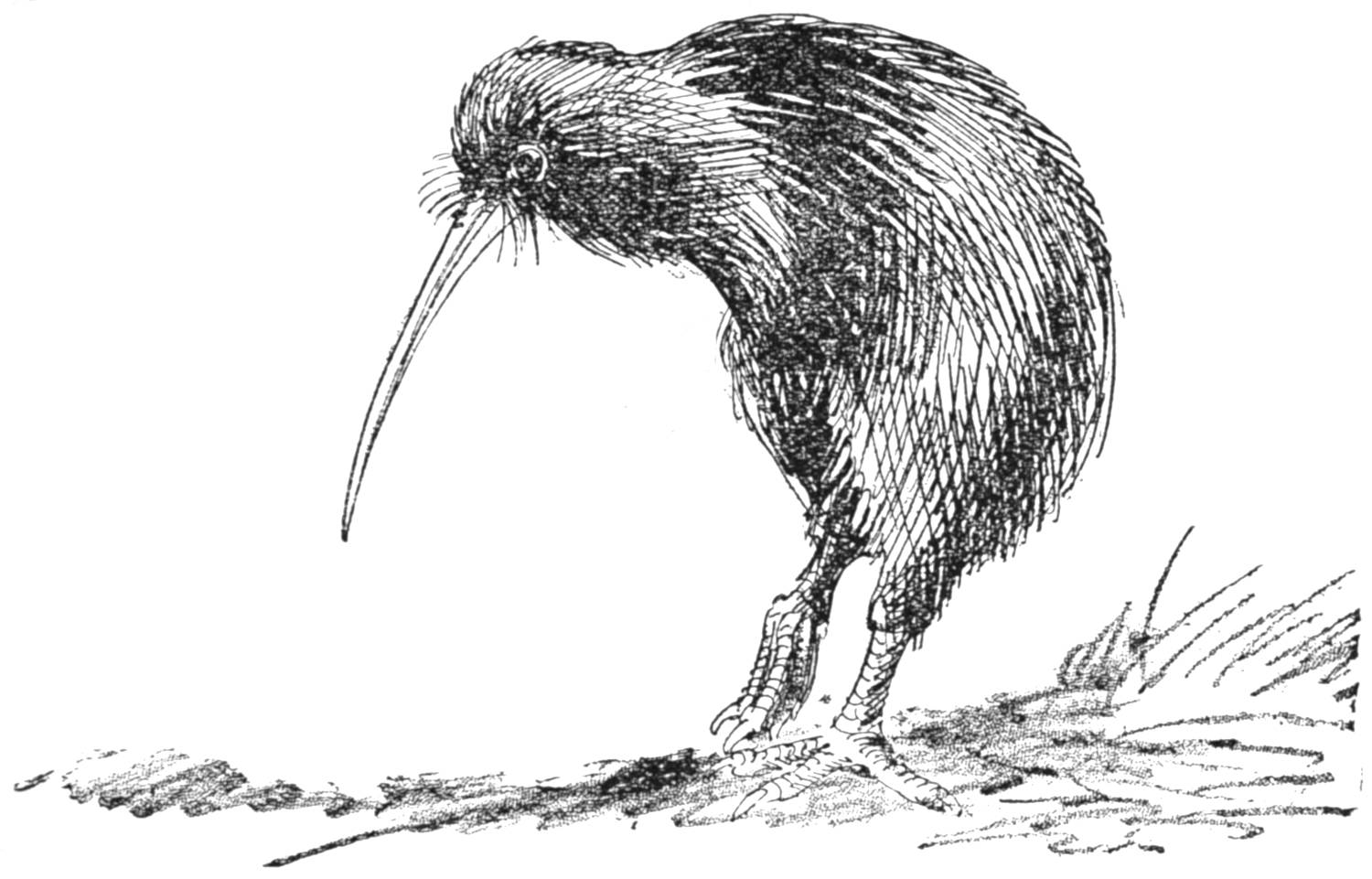
THE WINGLESS BIRD
Perhaps the very strangest and most weird of all living birds is the apteryx, or Kiwi-kiwi. This bird has scarcely the slightest trace of wings, a peculiarity which has gained for it the name of Apteryx, or “wingless.” The common cognomen “Kiwi-kiwi” is adapted from its peculiar repetitious call.
This singular bird is a native of New Zealand, where it was once very common, but is slowly becoming extinct, a fate from which it has been hitherto preserved by its nocturnal and retiring habits. The bird lives mostly among the ferns and always remains concealed during the day. It is remarkably fleet of foot, diving among the leaves with singular adroitness. It feeds upon insects of various kinds, particularly worms which it attracts to the surface by striking on the ground with its powerful feet.
The kiwi-kiwi is a little larger than an ordinary domestic fowl.
* * *
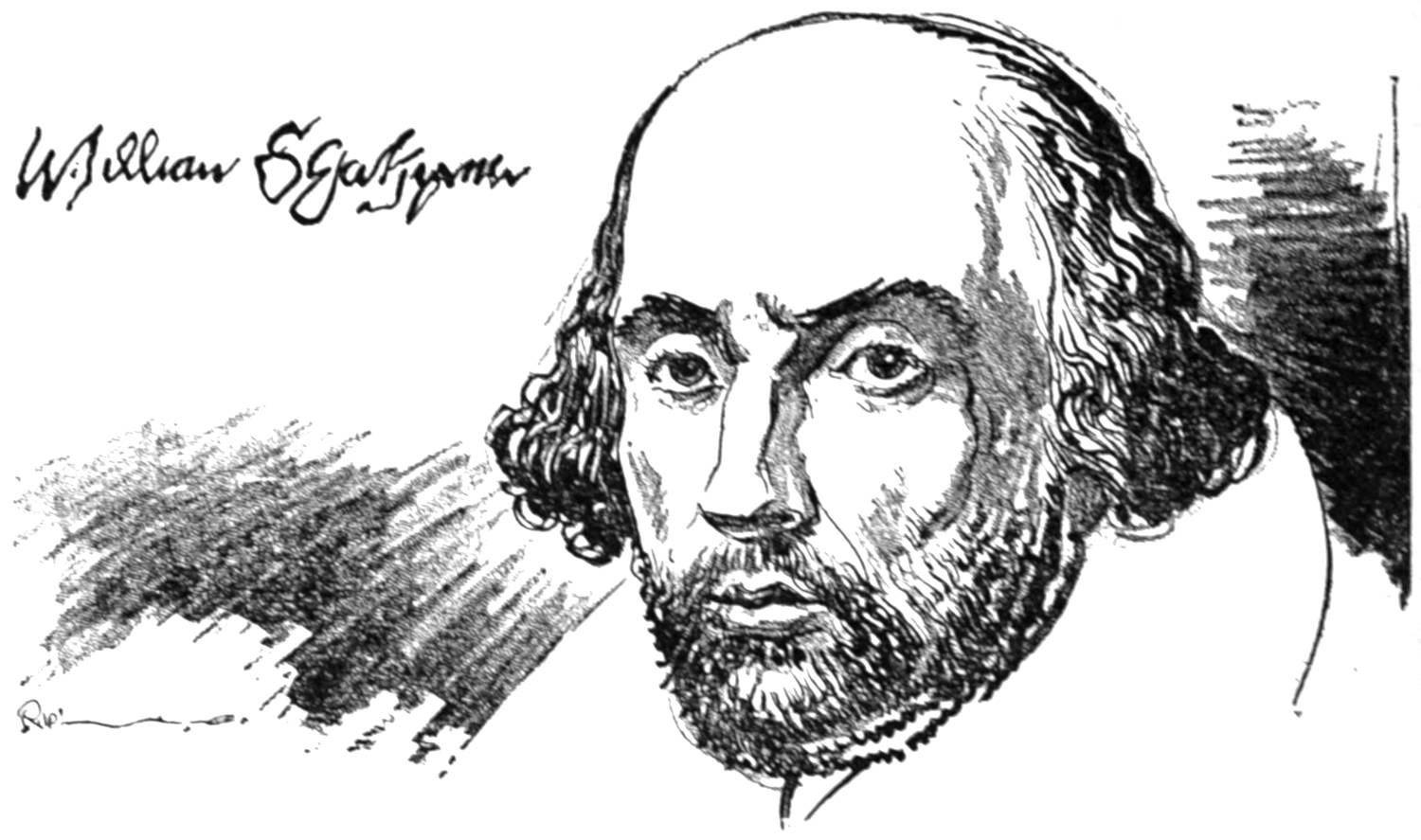
THERE ARE MORE THAN 4,000 DIFFERENT WAYS OF SPELLING THE NAME SHAKESPEARE
Most of the literary people who believe that Bacon is Shakespeare—and they are many—also maintain that the Stratfordian was so uneducated that he could not write so much as his own name!
There are only five pieces of writing in the world that may be supposed to have been written by Shakespeare’s pen, and if these be authentic then it is certain that the famous bard has spelled his own name in several different ways. In his own Will, he has written it “I William Shackspeare.” Another time he writes it “Shakspeare.” And again “Wilm Shaxpr.”
Evidently there is no authentic way of spelling the name so I append a few of the 4,000 different ways.
SHAKESPEARE SHAXPUR SHAKESPEYRE
SHAKSPARE SHAXKSPERE SHAXSPERE
SCHAKESPERE SHAKSPEYR SAXSPEAR
SCHAKSPEARE SHAXPEARE SCHACKSPERE
SHAKESPEAR SAXPERE SAXPEARE
CHACSPER SHAKESPER SCHAKESPEIRE
SHAXPERE SHACKSPER SCHAKSPERE
SHACKSPEARE SHAXSPEARE SHAKSPER
SHAXKSPERE SHACKESPUR SCHACKSPUR
SHAXPUR SHAXXPEARE SHAXEPER
SHAXSPER SHACKESPEIR SHAXPER
SHAKESPERE SCHAXESPER SAXSPERE
SHAXKESPERE SCHAXSPEIR SHACKSPUR
SHAGSPERE SCHAXESPEARE CHACSPEAR
SHAXSPERE SAXESPEYRE SHAKESPAIRE
SHACKSPIRE CHACKESPEARE SHAXPEYRE
SHAKEYSPEERE SAXPEARE SHAKSPEARE
SHAKESPEYRE SHAXESPUR SHAKESPEIRE
SHAKESPEARE SHAKSPERE SCHAXESPEAR
SHAKSPEYR SHAKESPEER SCHAXSPEARE
SHACSPERE SHAXPERE SHACHESPEAR
SHAKYSPER SHAKESPEYR SAXSPEARE
SHACESPEARE SHACKSPERE SHAXESPEIRE
SHAXESPUR SHACKESPEYRE SCHAXPEIRE
SHAXKESPEYR SHAKISPERE Etc.
The full list can be found in “A Plea for Reformed Spelling,” by Alexander John Ellis.
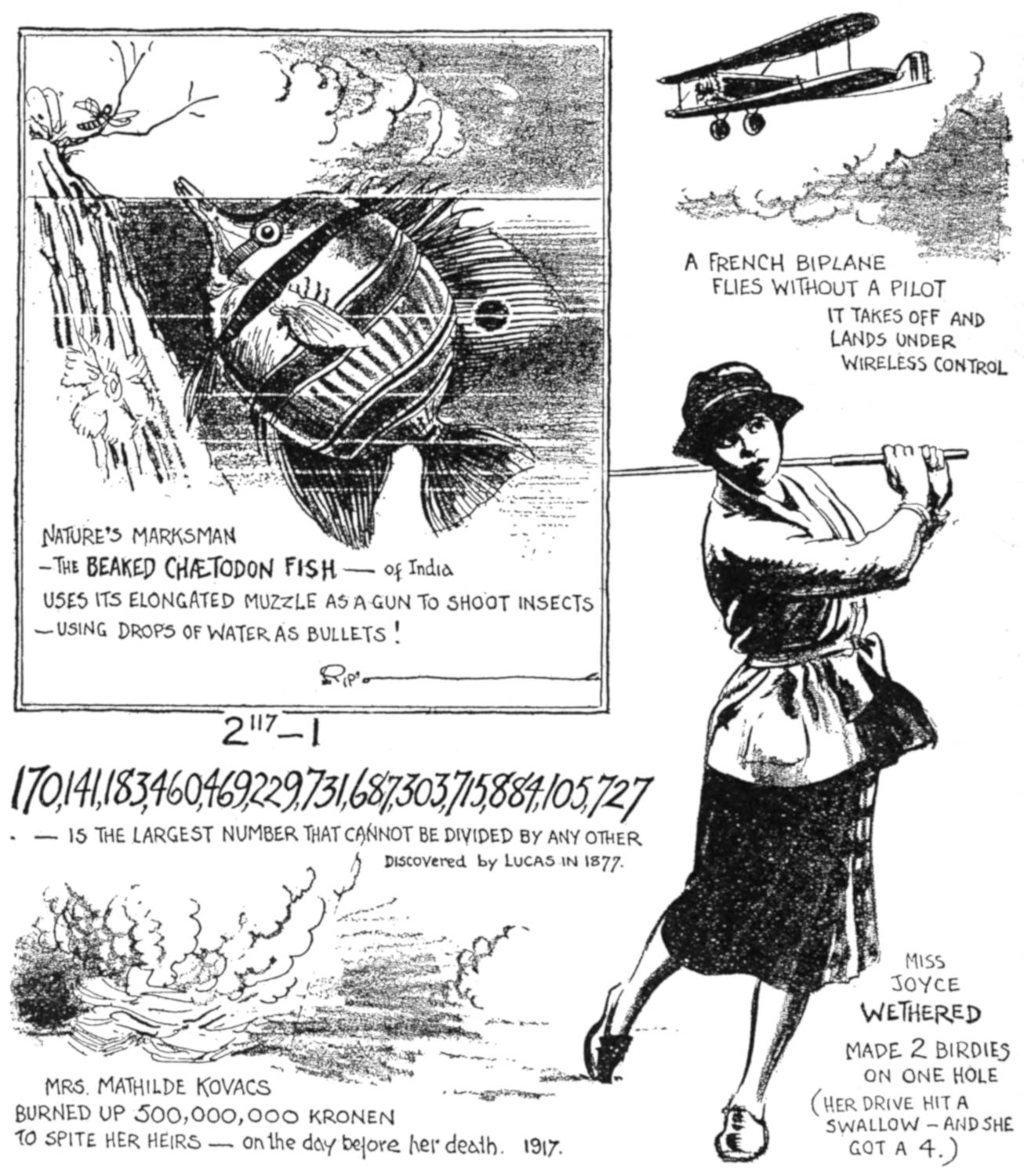
A FRENCH BIPLANE FLIES WITHOUT A PILOT IT TAKES OFF AND LANDS UNDER WIRELESS CONTROL
NATURE’S MARKSMAN—THE BEAKED CHÆTODON FISH—of India USES ITS ELONGATED MUZZLE AS A GUN TO SHOOT INSECTS—USING DROPS OF WATER AS BULLETS! [signature]
2¹¹⁷ - 1 170,141,183,460,469,229,731,687,303,715,884,105,727—IS THE LARGEST NUMBER THAT CANNOT BE DIVIDED BY ANY OTHER Discovered by Lucas IN 1877.
MRS. MATHILDE KOVACS BURNED UP 500,000,000 KRONEN TO SPITE HER HEIRS—on the day before her death. 1917. MISS JOYCE WETHERED MADE 2 BIRDIES ON ONE HOLE (HER DRIVE HIT A SWALLOW—AND SHE GOT A 4.)
* * *
NATURE’S MARKSMAN
The Beaked Chaetodon, the fish of heavenly hues that goes hunting with a gun, is found in the mouths of rivers emptying into the East Indian and Polynesian Seas.
The curiously elongated muzzle is used by this fish as a gun with which it shoots drops of water. If it sees a fly or another insect resting on a twig or grass-blade overhanging the water, the Chaetodon approaches very quietly, the greater part of its body submerged, and its long nose just showing above the surface with its point aimed at the victim. Suddenly, it shoots a drop of water at the unsuspecting insect with such accuracy that it is knocked off its perch into the water where it is instantly snapped up.
This habit it continues even in captivity, and is in consequence in great estimation as a household pet in Japan. The Japanese keep the fish in a large bowl of water, and amuse themselves by holding towards it a fly upon the end of a slender rod and watching the finny marksman shoot its prey into the water.
* * *
GOLF BIRDIES
Scoring birdies at golf is a worthy achievement anytime, but to get two birdies on one hole is indeed a rarity.
Miss Joyce Wethered, who is probably the greatest woman golfer the game has yet produced, accomplished this feat in a practice game last year (1927). Her drive struck a swallow that flew over the fairway, but despite this accident, Miss Wethered was successful in breaking par for the hole.
Miss Wethered held the women’s golf championship at the same time that her brother, Roger Wethered, held the British amateur championship.
* * *
BURNING ANGER
Because her relatives were discourteous to her pet cats, Mrs. Mathilde Kovacs revenged herself by burning up her fortune just before her death. This bit of spite work was reported extensively in the Vienna newspapers during March, 1917.
* * *
FIGURES DON’T LIE
Numbers have a magic lure and there is no end to the marvels that can be performed by one who is proficient. Figures may never lie but they can make you think that they do. The potency of numbers is alarming. The enormous totals reached by geometrical progressions and ordinary transpositions is almost beyond comprehension.

THE MAGIC BLOCKS ALL THE PEOPLE ON EARTH— WORKING DAY AND NIGHT —FOR A MILLION YEARS COULD NOT ARRANGE 5 LETTER-BLOCKS INTO ALL POSSIBLE COMBINATIONS
Five letter-blocks contain a total of 30 letters. There are 620, 448, 401, 735, 259, 439, 369, 000 different transpositions possible with 30 letters. At the rate of one transposition a second, it would take one man 1, 967, 428, 975, 879, 120 years to arrange the blocks into all the possible combinations.
If all the 1,800,000,000 people on earth helped him it would still require 1,093,016 years to do it.
* * *
An old story that will give you an idea of the startling fecundity of figures is that one about the boy who innocently offered to go to work for one cent the first day if his employer would double his salary each day for a month. The employer innocently agreed, and dropped dead when he learned that on the last day of the month the salary of his office boy would amount to $5,368,709.12 for that day alone, and a total of $10,737,418.23 for the month.
* * *
1 × 91 = 091 2 × 91 = 182 3 × 91 = 273 4 × 91 = 364 5 × 91 = 455 6 × 91 = 546 7 × 91 = 637 8 × 91 = 728 9 × 91 = 819
* * *
3 × 37 = 111 6 × 37 = 222 9 × 37 = 333 12 × 37 = 444 15 × 37 = 555 18 × 37 = 666 21 × 37 = 777 24 × 37 = 888 27 × 37 = 999
* * *
33 × 3367 = 111111 66 × 3367 = 222222 99 × 3367 = 333333 132 × 3367 = 444444 165 × 3367 = 555555 198 × 3367 = 666666 231 × 3367 = 777777 264 × 3367 = 888888 297 × 3367 = 999999
* * *
CAN YOU WRITE THE ANSWER?
9(9⁹) = ?
The above figure expresses 9 raised to the 9th power of 9, or 9 raised to the 387,420,489th power. It is the largest sum that can be indicated by 3 figures.
The final answer will contain 369 millions of digits. Allowing for 5 digits to the inch, the length of tape required to write down the answer would be 1,164 miles, and the ordinary human span of life would be sadly insufficient to accomplish the task.
Ref.: “Mathematische Mussestunden,” by Dr. Herman Schubert.
* * *
MAGIC SEVEN
Seven is the holy number. There are 7 days in creation, 7 days in the week, 7 phases of the moon, every 7th year was sabbatical, and 7 times 7 years was the jubilee. There are 7 ages in the life of man, 7 divisions in the Lord’s Prayer, 7 bibles, 7 churches of Asia, 7 Graces, 7 Deadly Sins, 7 Senses, 7 Sorrows of the Virgin, 7 Virtues, 7 Joys of the Virgin, 7 Precious Things of the Buddhas, 7 Sleepers of Ephesus, 7 Lamps of Architecture. The apostles chose 7 deacons, Enoch, who was translated, was 7th from Adam; Jesus Christ was the 77th in a direct line. Our Lord spoke 7 times on the cross, on which He was 7 hours; He appeared 7 times; and after 7 times 7 days He sent the Holy Ghost. There appeared 7 golden candlesticks and 7 stars in the hand of Him that was in the midst; 7 lambs before the 7 spirits of God; the book with the 7 seals; the lamb with 7 horns and 7 eyes; 7 angels bearing 7 plagues, and 7 vials of wrath. The vision of Daniel was 70 weeks; and the elders of Israel were 70. There were also 7 heavens, 7 planets, 7 stars, 7 wise men, 7 champions of Christendom, 7 notes in music, 7 primary colors, 7 sacraments of the Catholic Church, and 7 wonders of the world. The 7th son was considered endowed with pre-eminent wisdom; and the 7th son of a 7th son is still thought to possess the power of healing diseases spontaneously.
And the opposite sides of the dice total 7.
* * *
CAN YOU CHANGE FIVE DOLLARS?
“Certainly!” you will say.
But you can’t do it!
If you changed a five-dollar bill into all the different ways possible—cents, nickels, dimes, quarters, halves, and dollars—it would require exactly 2, 305, 843, 009, 213, 693, 951 different changes; and if you made a change each second—day and night—it would take you 103 years to do it!
* * *
142857
The mystic number. All the figures appear in the sum when multiplied as follows:
142857 × 2 = 285714 142857 × 3 = 428571 142857 × 4 = 571428 142857 × 5 = 714285 142857 × 6 = 857142 and then 142857 × 7 = 999999
* * *
PALINDROMATIC FIGURES
11² = 121 111² = 12321 1111² = 1234321 11111² = 123454321 Etc.
* * *
The following legend is told in connection with the invention of the game of chess. An East Indian Potentate was so pleased with the game that he promised the inventor, a slave, the fulfillment of any wish. The slave asked for the number of grains of wheat which would result, if one grain were placed on the first square of the chess-board, two on the second, four on the third, etc., i.e., each time twice as many as on the last. At first glance, this wish seemed to be a modest one, but calculations showed that it would be impossible for the king to keep his promise, even if he owned the whole earth and spent his entire life growing wheat on it. The result is: 18 quintillions, 446 quadrillions, 744 trillions, 73 billions, 709 millions, 551,615 grains.
* * *
THE 100 SYMBOLS
All the books ever written in all the libraries of the world containing all the wit, wisdom, poetry, fiction, history and scientific knowledge ever offered to humanity—or ever apt to be offered in the future—are expressed in letters.
It is all done with about 100 symbols. By symbols I mean the ordinary letters of the alphabet—both cases, figures, interpunctions, and mathematical signs. The number of symbols is limited, and of course the number of possible transpositions of these 100 symbols is limited.
Since the number of transpositions of 100 symbols is limited the printed word must be limited and therefore all literature imaginable must be rendered in a limited number of volumes.
Assume that it is possible to write exhaustively about a subject in a volume of the size of “Believe It or Not.” Assume that 1,000,000 transpositions of symbols are used in printing this book. By combining to the limits of possibility the 100 symbols in lots of 1,000,000 we can determine the number of volumes ever written or ever likely to be written in the future.
With 1,000,000 symbols to a volume, you will have as many volumes as will equal the original number of symbols 100 raised to the 1,000,000th power. The answer will contain a figure with 2,000,000 noughts after it, and would require a strip of paper 2 miles long to write it out in type the size of this. If the books were each one inch thick and placed side by side the number of inches would equal the number of books—in other words this shelf of books would be as many inches long as indicated by a figure of 2,000,0001 digits. Reduced to miles, it would be as many miles long as a figure of 1,999,996 digits.
Suppose you want a book at the opposite end of this book shelf, you would have to travel as fast as light if you ever got there in any comprehensible length of time. If you traveled as fast as light—180,000 miles a second—you would travel 6 quadrillion miles in a year, and to reach the book at the end of the line will take as many years as the figure 6,000,000,000,000,000 is contained in the figure of the distance—or as many years as are to be expressed in a figure written with 1,999,980 noughts. It is beyond human conception.
And the book would probably be gone when you got there.
Raimundus Lullus, Giordano Bruno, Kurt Lasswitz, Leibnitz, and others devoted lifetimes to these calculations.
* * *
1 × 9 + 2 = 11 12 × 9 + 3 = 111 123 × 9 + 4 = 1111 1234 × 9 + 5 = 11111 12345 × 9 + 6 = 111111 123456 × 9 + 7 = 1111111 1234567 × 9 + 8 = 11111111 12345678 × 9 + 9 = 111111111 123456789 × 9 + 10 = 1111111111 1 × 8 + 1 = 9 12 × 8 + 2 = 98 123 × 8 + 3 = 987 1234 × 8 + 4 = 9876 12345 × 8 + 5 = 98765 123456 × 8 + 6 = 987654 1234567 × 8 + 7 = 9876543 12345678 × 8 + 8 = 98765432 123456789 × 8 + 9 = 987654321 65359477124183 × 17 × 1 = 1111111111111111 65359477124183 × 17 × 2 = 2222222222222222 65359477124183 × 17 × 3 = 3333333333333333 65359477124183 × 17 × 4 = 4444444444444444 65359477124183 × 17 × 5 = 5555555555555555 Etc.
* * *
THE PERSISTENT NUMBER
526,315,789,473,684,210
You may multiply the above figure with any number you choose and the original figures will always reappear in the result.
* * *
THE LARGEST PRIME KNOWN
170,141,183,460,469,231,731,687,303,715,864,105,727
This figure is the largest known number that cannot be divided by any other. It was discovered by Arthur Lucas in 1877. It is 2¹²⁷ - 1.
* * *
MAGIC SQUARES
These numbers—as per number of squares in the diagrams—are so placed that all columns add the same, horizontally, vertically, and diagonally.
15
6 1 8
7 5 3
2 9 4
34
1 14 15 4
8 11 10 5
12 7 6 9
13 2 3 16
* * *
“PI”
The letter π (pi) indicates the incommensurable relationship between the diameter of any circle and its circumference. The number is usually given as 3.14159+. Here is the value worked out to 707 decimal places. The figures are not to be found in many places and they may be desired as a curiosity by some amateur mathematicians:
3.14159 26535 89793 23846 26433 83279 50288 41971 69399 37510 58209 74944 59230 78164 06286 20899 86280 34825 34211 70679 82148 08651 32823 06647 09384 46095 50582 23172 53594 08128 48111 74502 84102 70193 85211 05559 64462 29489 54930 38196 44288 10675 66593 34461 28475 64823 27867 83165 27120 19091 45648 56692 34603 48610 49432 66482 13393 60226 02491 41273 72458 70066 06315 58817 48815 20920 96282 92540 91715 36436 78925 90360 01133 05354 88204 66521 38414 69519 41511 60943 30572 70365 75959 19530 92186 11738 19326 11793 10511 85480 74462 38798 34749 56735 18857 52724 89122 79381 83011 94912 98336 73362 44193 66430 86021 39501 60924 48077 23094 36285 53096 62027 55693 97986 95022 24749 96206 07497 03041 23669 86199 51100 89202 38377 02131 41694 11902 98858 25446 81639 79990 46597 00081 70029 63123 77381 34208 41307 91451 18398 05709 85+.
* * *
ONE PROBLEM NEVER PROVED
Mathematicians have been able to prove most of the problems submitted to them, but there is one for which no mathematical proof has even been devised, and that is why a mapmaker need use but four colors to print his maps. The fact has been known for centuries, but no one has ever determined a method by which it could be proved. If you try drawing you will soon find that it is impossible to draw any figure of five districts each of which touches the other four, the only circumstance under which more than four colors would be necessary to mark the divisions.
* * *
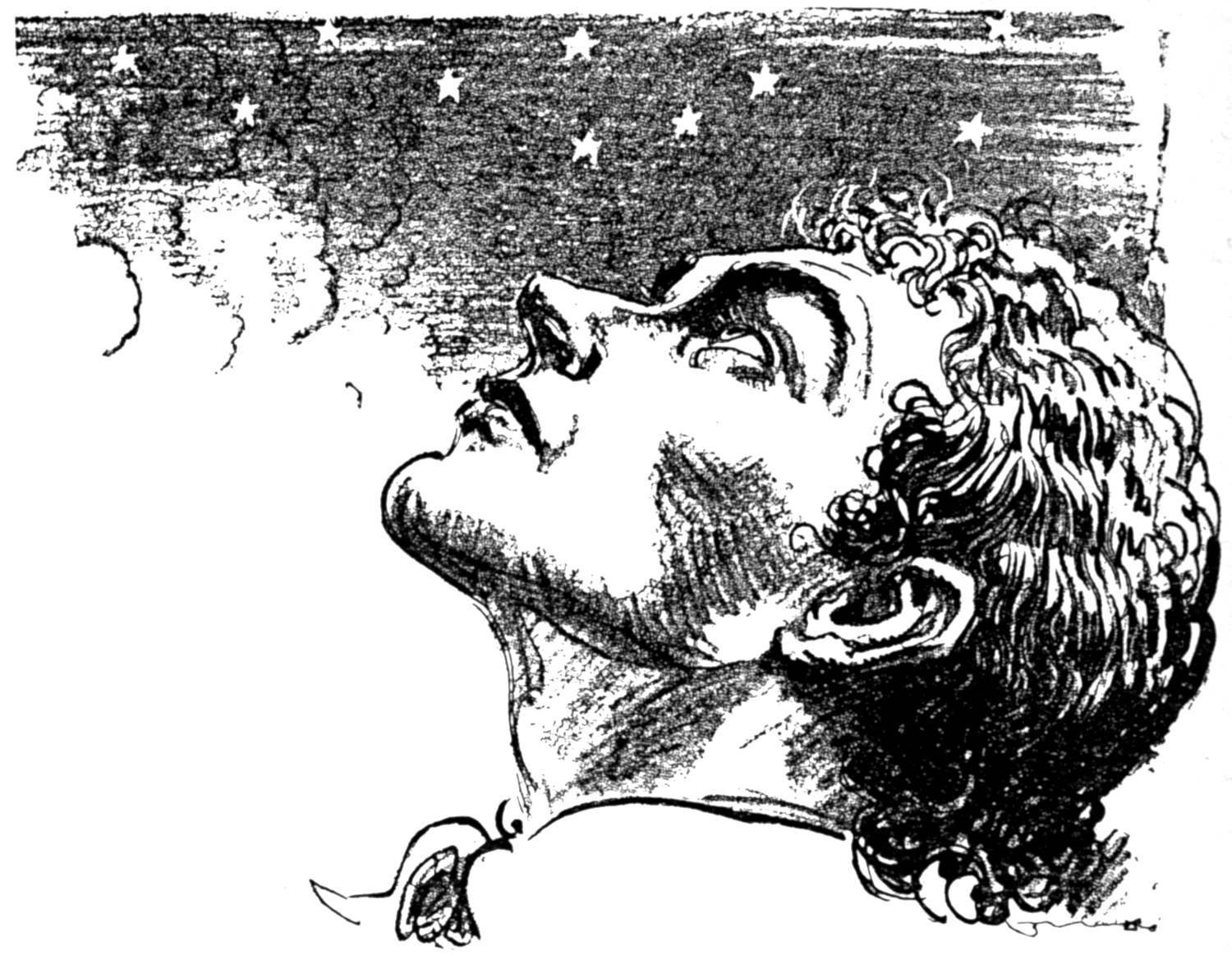
KASPAR HAUSER COULD SEE THE STARS IN THE DAY TIME
Kaspar Hauser, the mystery child of Europe who has been written about so often by authors of the past and present, could see the stars shining at noon without mechanical aid. The stars never really disappear you know, and the eyes of this famous boy were abnormal.
Kaspar Hauser was said to be the Heir to the throne of the Grandduchy of Baden. He was abducted in infancy and placed in solitary confinement in a dark room for 18 years. He first saw the light of day when he wandered from his cell and apparently appeared from nowhere in Anspach, Bavaria. Although he was nearly a grown man, his mental development was that of a two-year-old child. The mystery surrounding him, and his curious behavior, aroused a great deal of interest at the time ... and since.
* * *
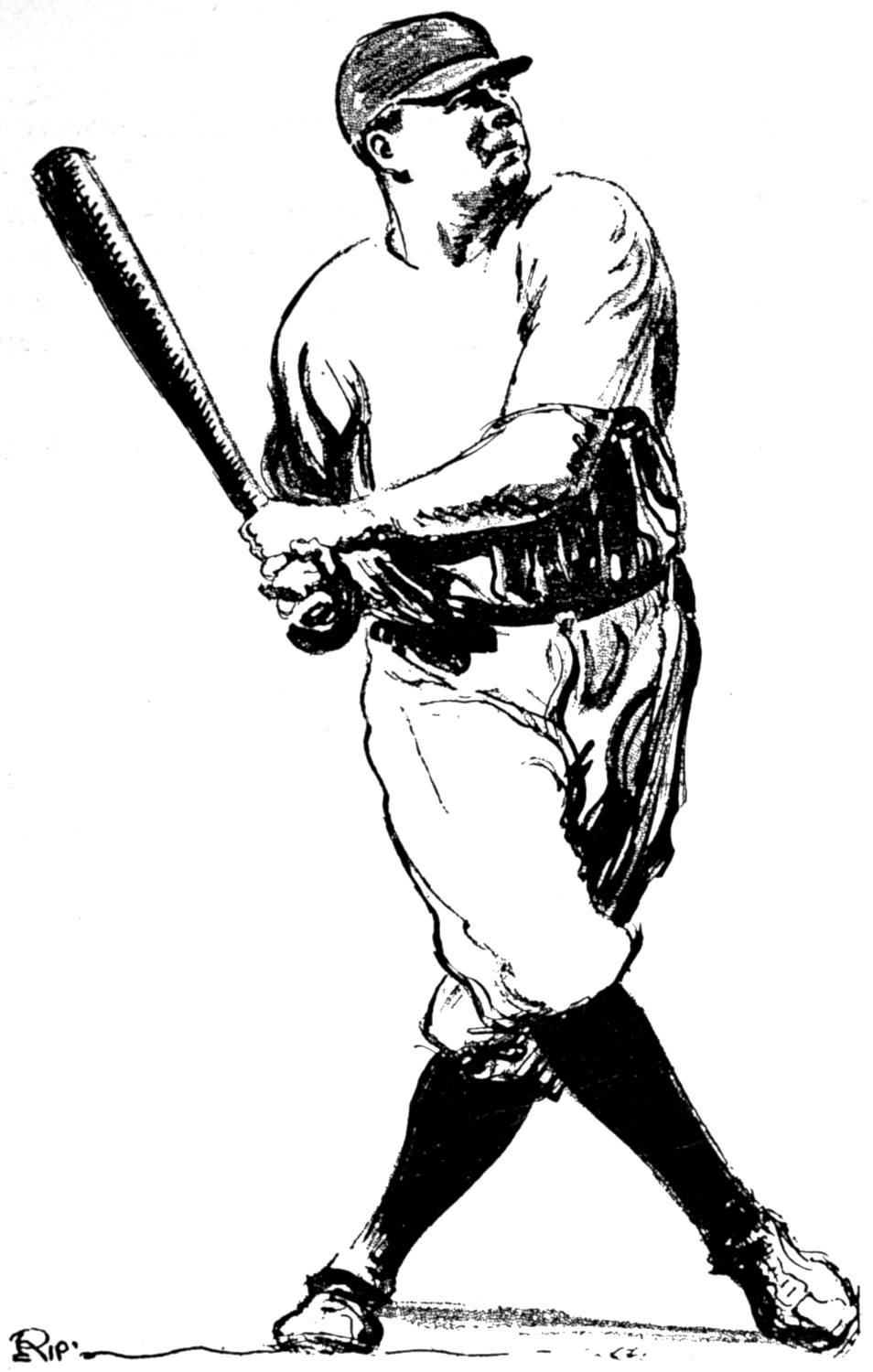
BABE RUTH HIT 125 HOME RUNS IN ONE HOUR
Ruth, greatest of all baseball players, performed this prodigious clouting feat in an exhibition game on Wrigley Field, Los Angeles, February, 1927. Babe, who always aims to please, stood at the plate for an hour while several pitchers tossed balls at him which he walloped over the fence—125 in all.
* * *
THE HANDY LETTER WRITER
Herr Kurtz received an anonymous letter daily for twenty years! He is the owner of one of the Government tobacconist’s stores of Vienna in the 2nd ward, and after a few years of receiving the letter he tried to induce the Minister of Post and Telegraphs of Austria to refrain from delivering his mail altogether but his efforts were unsuccessful. The letters arrived daily from 1901 to 1921 and then ceased suddenly as though the tireless sender had died at last.
Curiously enough the contents of the letter were entirely innocent.
Ref.: “Neue Freie Presse” of Feb. 1921.
* * *
THE BOOK WORM
Gustave Lebair, who, for 60 years read the same book daily at the Bibliothèque Nationale, was a famous bibliomaniac and well known to frequenters of the Bibliothèque Nationale of Paris. The particular book he read, “St. Appolonius of Tiane,” was in some way connected with an event in his youth.
The book “Bibliomania” by Hertzen, where I found the statement about Lebair, goes to some lengths to explain his persistence on psychological grounds. Bibliomaniacs are book lovers whose passion manifests itself in some strange way.
* * *
A BEAVER’S DAM
François I, King of France, issued a decree making the wearing of whiskers punishable by death.
“Qu’ils aient dedans 3 jours a faire ou oster leur dite Barbe sous peine de la hart.”
Receuils des Ordinances Folio 48 Paris, 1557.
* * *
“THE PLACE OF DRUNKENNESS”
The Indian word for New York is Manhattan, or Manna-ha-ta, and means “The Place of Drunkenness.” This name is traceable to the year 1524 when Giovanni Verrazzano, the Florentine explorer, landed for the first time at what is now the lower extremity of New York City and gave the Indians their first taste of firewater. A good time was had by all, and ever after the natives referred to the island as “Manna-ha-ta” or “place of drunkenness.”
Ref.: Rev. John Gottlieb E. Heckewelder’s “History of Early Manhattan.”
* * *
THE IDEAL LANDLORD
Frau C. Worth, owner of a large apartment house in Berlin, did not collect any rents from her tenants for twenty years.
* * *
A WEEK WITH TWO THURSDAYS
On an occasion in 1147, Pope Eugene III reached Paris on a Friday. Inasmuch as Friday was a fast day, and to enable the populace properly to celebrate his entry into the city, the Pope decreed that Friday was Thursday!
Hence a week with two Thursdays.
* * *
ENDURING FAME
“Chauffeurs” were a famous band of brigands in France in 1793. They were so called because they tortured their victims by burning their feet.
* * *
The following is a news item from the Barstow (Cal.) Times. It reads:
“Bill Jarrett has just returned to Barstow from the Death Valley country. Bill worked for six weeks on the graveyard shift for the Corpse Mining Company in the Coffin mine, located in Dead Man’s Canyon in Funeral Range at the end of Death Valley. Bill is leaving next week for a prospecting trip to the Devil’s Playground in Hell’s Half Acre.”
* * *
THE BOBBING ISLAND
In Lake Ilfungen, in Livonia, is a small island that does a disappearing act once each year. Toward the end of October, or early in November, the island sinks beneath the surface of the lake.
In the spring the island reappears and remains all summer, so that farmers raise and cut hay on it.
* * *
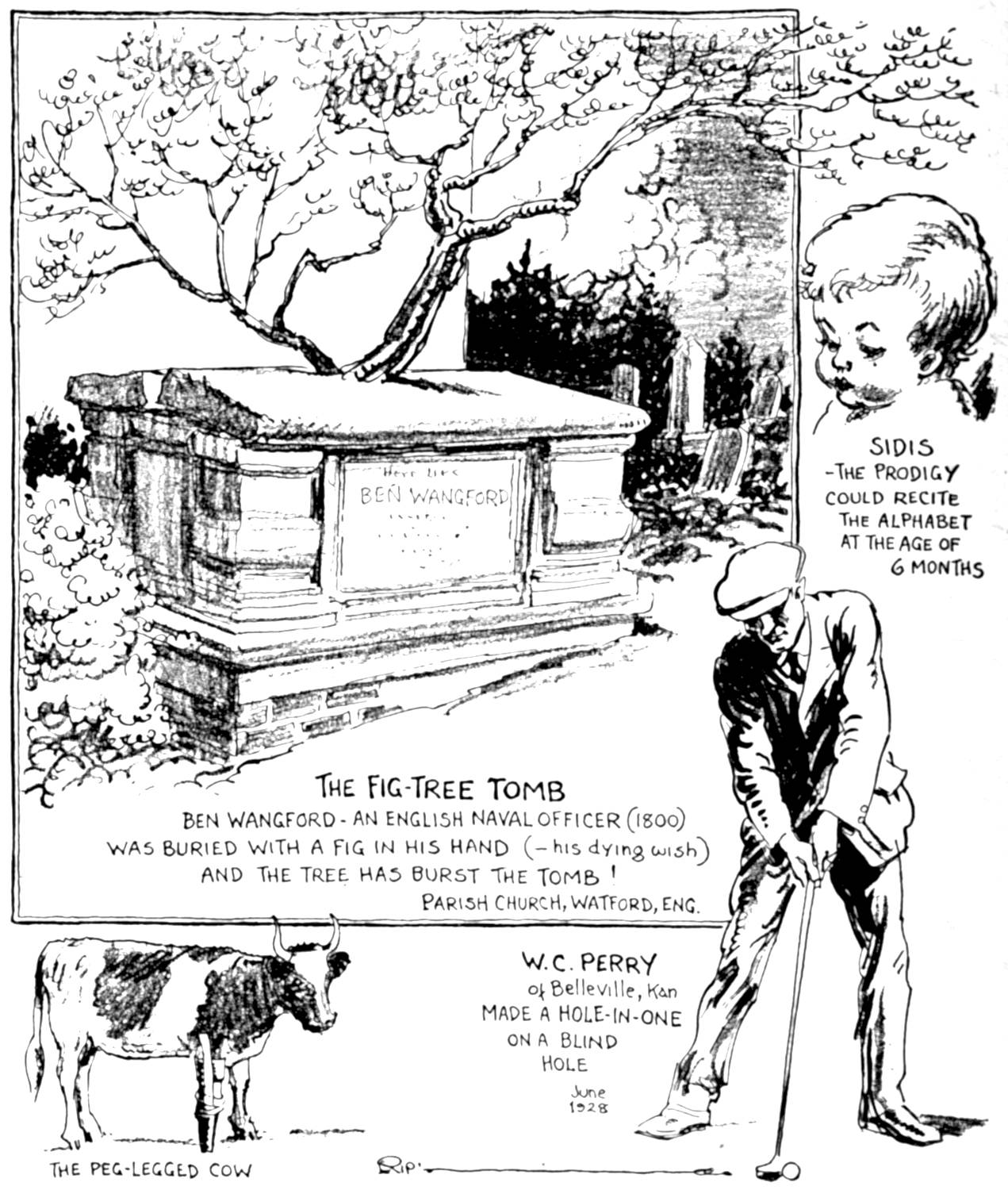
SIDIS—THE PRODIGY COULD RECITE THE ALPHABET AT THE AGE OF 6 MONTHS
THE FIG-TREE TOMB BEN WANGFORD—AN ENGLISH NAVAL OFFICER (1800) WAS BURIED WITH A FIG IN HIS HAND (—his dying wish) AND THE TREE HAS BURST THE TOMB! PARISH CHURCH, WATFORD, ENG.
W. C. PERRY of Belleville, Kan. MADE A HOLE-IN-ONE ON A BLIND HOLE June 1928
THE PEG-LEGGED COW [signature]
* * *
THE FIG-TREE TOMB
This celebrated curiosity can be seen in a little churchyard a few miles outside of London. It is located close beside the Parish Church (St. Mary) in Watford, an ancient shrine of faith where “Prayer and Praise have been offered to God for seven hundred years.”
The Rev. Henry Edwards, Vicar, sent me the following information about the man who was buried with a fig in his hand. The Vicar concluded with a prayer.
“The Fig-Tree Tomb, near the S. wall of the Parish Church of Watford, is the source of many old tales, the most authentic being that of Ben Wangford, a naval officer, who did not believe in the future life, and wished when buried to have something placed with his remains that might germinate and burst the tomb, in order that, if it did, his friends would know that his opinion was wrong.”
* * *
SIDIS—THE PRODIGY
Sidis was one of the four noted American prodigies; Winifred Stoner II, Edward Harvey, Jr., and John Trumbull, the poet, were the other three.
Dr. Boris Sidis, professor at Harvard, was his father.
At the age of six months Sidis could recite the alphabet; at two he could read and write; and at the age of eleven he matriculated in Harvard and astounded his professors by discussing the fourth dimension.
* * *
THE ILLITERATE CALCULATOR
Jedediah Buxton, the illiterate calculator, in a month’s time, without the aid of paper or pencil, figured out that a cubical mile could contain 586,040,972,673,024,000 human hairs. It took him three months to multiply an English farthing 140 times with itself, arriving at the figure of 725, 958, 238, 096, 074, 907, 868, 531, 656, 993, 638, 851, 106 Pounds, 2 Shillings, 8 pence.
He was then asked to multiply this stupendous sum by itself and after two and one-half months announced the result to be 527, 015, 363, 459, 557, 385, 673, 733, 542, 638, 591, 721, 213, 298, 966, 079, 307, 524, 904, 381, 389, 499, 251, 637, 423, 236 pounds.
* * *
THE GIRAFFE GIRL
“—On the road to Mandalay, Where the flyin’-fishes play, An’ the dawn comes up like thunder outer China ’crost the Bay!”
If you follow the above road to Toungoo and then ascend the hills to the west you will come to the land of the Giraffe women, the long-necked Burmese belles of Padaung. The Kewawngdu, as they call themselves, are remarkable for the extraordinary collars of brass that they weld around their necks from time to time until a giraffe-like effect is obtained.
In Burma “Her throat is like the swan” is not a mere poetic figure of speech in so far as length is concerned. Some of the women brought down to Mandalay to be gazed at by the Great King of Righteousness and the Dwellers in the Palace, have necks fourteen and fifteen inches long.
The neckband consists of brass rods, as thick as your little finger, commencing with a wide base on the shoulder blades and reaching up to the chin. Little girls begin wearing them as early as possible usually starting with five rings, which are as much as most of them can manage, but as the neck is kept constantly on the stretch, additional ones are added from time to time until the ordinary limit of twenty-one coils is reached. Twenty-five and more have been worn, however.
At the back of the neck, fastened through the main coil, is a large heavy ring which is used for tying up these rubber-necked ladies whenever the occasion demands such procedure.
If the family be well-to-do, similar coils of brass are added to the arms and legs; and the length of these seems only limited by the ability to pay for the rings—for brass is very expensive. Sometimes the total weight of brass carried by Padaung flappers is as much as sixty or seventy pounds: yet burdened with this weight, they hoe the fields, carry water for domestic use, and brew liquor.
The brass-collar fashion has no apparent effect on their health, and the only noticeable effect is that the women speak as if someone had them tight around the neck.

A KEWAWNQDU
* * *
GOD’S HEAVEN
Of course you expect to go to Heaven when you die. We all do. The hope is in all of us, that when we die, we will go to Heaven and rejoin the other members of our family who have passed on.
Take my advice: make a reservation. Heaven is becoming very crowded and it is extremely doubtful whether you can get in; and should you manage to squeeze yourself past the pearly gates it is even more doubtful whether you could find your family among all that crowd.
We will say that you go to Heaven to meet your father and mother and the rest of your kith and kin. When you meet your father and mother, they will be with their father and mother, for they would have the same desire to be with their parents as you have to be with them. And their parents in turn would be with their parents; so on back through the countless generations of mankind.
So you will have to meet them all. You cannot be snooty in Heaven, you know, and snub anybody.
Now, if we take 25 years as a generation, we find that there have been 77 generations since the time of Christ. And if we count only your parents, their parents, and so on backward for that length of time, we find that you will have to meet 302, 231, 454, 903, 657, 293, 676, 543 different relatives.
Our own little world would not hold that stupendous number.
If that many people were on earth today they would have to be stacked up on each others’ heads. Allowing them two feet to stand on this would make a stack of one solid mass of folks 113,236 miles high all over the earth’s surface.
Suppose you wanted to say “hello” to your dear old grandfather who happened to be located some 113,000 miles up the heap. Of course you would have to climb—there would be no other way except to scramble up this human bean-stalk like little Jack. Let us assume that you can climb one-half as fast as the U. S. Army marches—which is 15 miles a day. If you climbed at the rate of 8 miles a day you would reach your old grandpap about 39 years later—providing you didn’t get yourself knocked off meanwhile for stepping on somebody’s ear in the ascent. Of course you will be able to slide down faster and should reach your own place in Heaven about 50 years after you left it.
That is 2 generations—which means that maybe your children and some of your children’s children will have squeezed in and been looking around for you. You really couldn’t expect anybody to hold your place for you for 50 years, so do not be surprised if you are out all around and not able to find your own children anywhere ... which means that you will have a hell of a time in Heaven.
Mind you, the above figures do not include brothers, sisters, uncles, aunts, nieces, nephews, cousins and other relatives. Also I am allowing only for 1928 years, although scientists tell us that man has been on earth for countless generations before that time—some estimate it as 100,000 years. And, since science has proved so conclusively that you are related to all animals with four legs or a long tail that have lived on this earth for the last 100,000,000 years, you will have to include them too. They are all your ancestors!
As a social proposition the celestial outlook appears a bit embarrassing, doesn’t it?
St. John records the limits of Heaven in Revelations, XXI., 16:
“... He measured the city with the reed, twelve thousand furlongs. The length, and the breadth, and the height of it are equal.”
Twelve thousand furlongs is 7,920,000 feet, and when cubed this is equal to 496, 793, 088, 000, 000, 000, 000 cubic feet—in other words Heaven as visualized by St. John is about 15 miles long in each dimension. If you allow 10 cubic feet as ample space for a human being, you will find that Heaven can hold about 49, 679, 308, 800, 000, 000, 000 persons if packed in tight. This calculation does not allow for the streets of gold or the trees of marvelous leaves and fruits, or the “pure river of water of life, clear as crystal, proceeding out of the throne of God and of the Lamb.”
It is apparent that Heaven was filled up several hundred years ago—or about the time that Columbus was discovering America.
What to do?
Obviously there is but one way out. You must die sometime, and since it is so evident that you cannot go to Heaven, where shall you go——?
You said it.
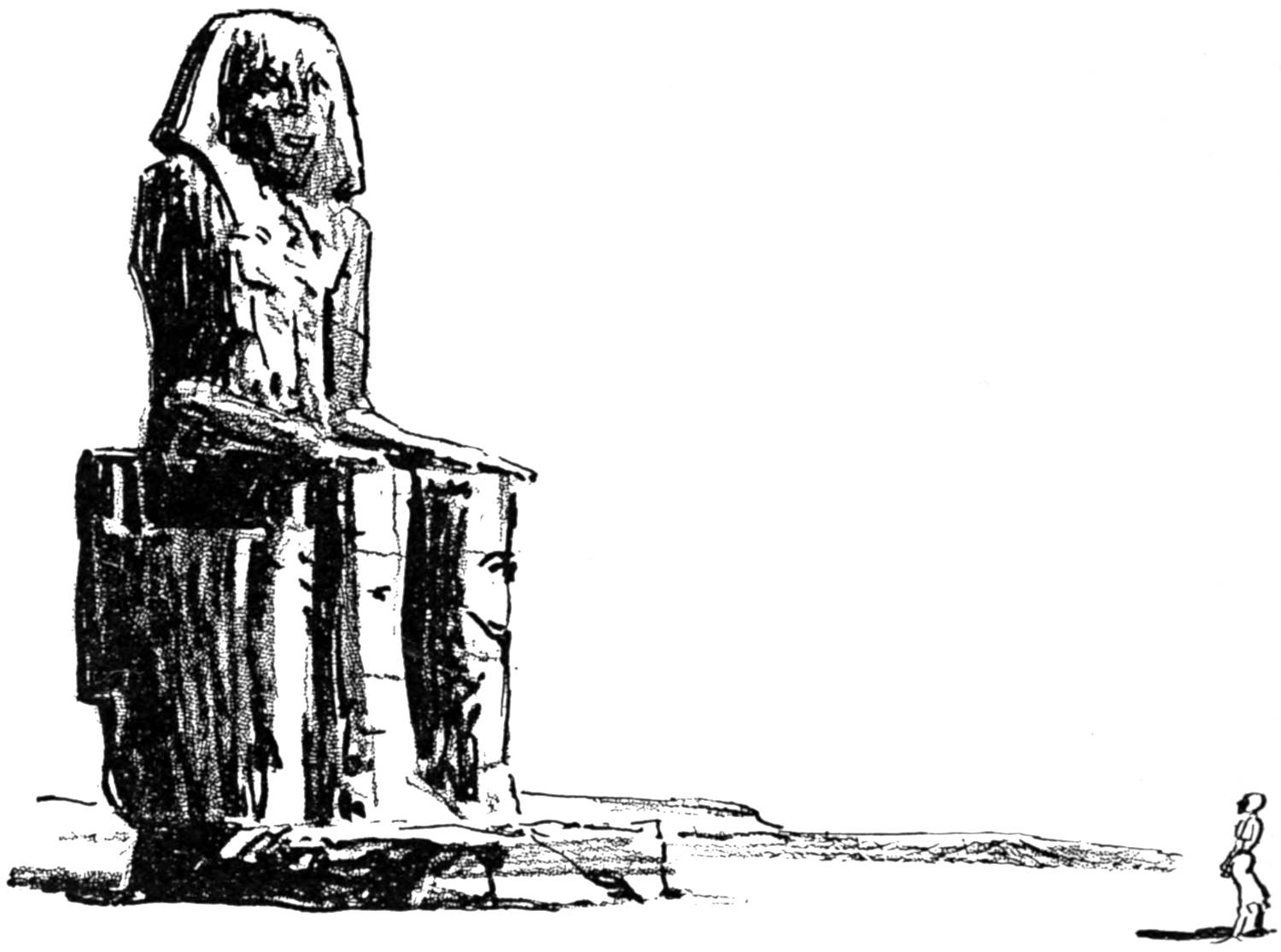
THE VOCAL MEMNON The Statue That Speaks
A mile from the Nile on the opposite shore from the ruins of Karnak two huge stone figures sit in staring isolation. Each represents a colossal king 64 feet high, seated upon a throne, which is itself supported by a pedestal. Though the faces of both have been hacked out of all human resemblance, everyone knows that these statues are the effigies of the same King—Amunoph, or Amenhotep, whose son’s daughter married King Tut.
One of the colossi is mute, but the other is the famous Vocal Memnon, the statue that speaks!
That is—it did speak. There are 87 legible Greek and Latin inscriptions upon the legs of Memnon which testify to the time and hour of the day at which the phenomenon was heard. Famous men of many ages listened. There are the words of Emperor Hadrian, Sabina, his wife, Tacitus, Pliny, Pausanias, Lucian, and Strabo describing the miraculous musical sound emanating from the stone ... “like the snapping of a huge harp string” ... “like the sound of smitten brass.” Some heard the voice of the image several times. According to the inscriptions February and March seemed to be by far the most propitious months, and the morning hour the most favored vocally—as soon indeed as the sun’s rays fell upon the statue—as though “Aurora kissing her son upon the lips received an articulate reply.”
The explanation?
Two alone of the many hypotheses put forward are worth considering. A multitude of wild conjectures, based principally on imagination, but claiming pseudo-scientific or mechanical interest, crumble away when touched by the merciless finger of fact. There, remain the rival theories that the voice of Memnon was a fraud practised by the ancient Egyptian priests; and the other that it was a natural phenomenon to be explained by physical causes. The latter theory has the most credence—the conclusion irresistibly suggests itself that the sound was due to some peculiar relation between the warmth of the rising sun and the great block of cracked and sundered stone.
It has been a long time since our hero has spoken, and it seems that
Memnon’s lyre has lost the chord That breathed the mystic tone.
Certainly they do not recognize the cartoonist’s profession. I was stared at in stony silence on the occasion that I stood before the Vocal Memnon and his mute companion and waited patiently for a word from them. It was near dusk, and the glowing sun was sinking suddenly down behind the hills that enclose the Valley of the Tombs of the Kings as it caused the images to darken hugely and throw out long-streaking shadows that emphasized the size of them and made their silence louder than words.
THE KING WHO WAS CROWNED BEFORE HE WAS BORN
Apparently such a thing could never happen.
But it did.
In Persia, during the 4th century, the wife of Shah Hormouz remained pregnant at the time of her husband’s death, and the uncertainty of the sex of the unborn child, as well as the event, excited the ambitious hopes of the princes of the house of Sassan who were moved to seize the throne.
The apprehensions of civil war were at length removed by the positive assurances of the Magi that the widow of Hormouz had conceived and would safely produce a son. Obedient to the voice of superstition, the Persians prepared, without delay, the ceremony of his coronation. A royal bed on which the Queen lay in state was exhibited in the midst of the palace in the presence of the assembled multitude, and the crown of the Sassanids was placed on the spot which might be supposed to conceal the future heir. Meanwhile the prostrated assembly adored the invisible and insensible sovereign.
The magi proved to be correct in their prophecies, and the crowned child was a boy who lived to rule an extraordinary length of time under the name of Sapor II.
Ref.: Gibbon’s “Decline and Fall.”
* * *
Chou Kung, who invented the compass, had a swivel wrist on which he could turn his hand completely around.
* * *
Lollia Paulina, wife of Caesar Caligula, wore a dress valued at $2,000,000 and a pearl necklace worth $3,500,000.
Ref.: Pliny the Elder.
* * *
A small toy balloon was released in New Jersey by A. Perry and was found later in Venezuela by J. Quintero of Maracaibo.
* * *
Leon Avazian, of New York, climbed the stairs to the top of the Woolworth Building in 9 minutes. 55 stories. 1520 steps.
* * *
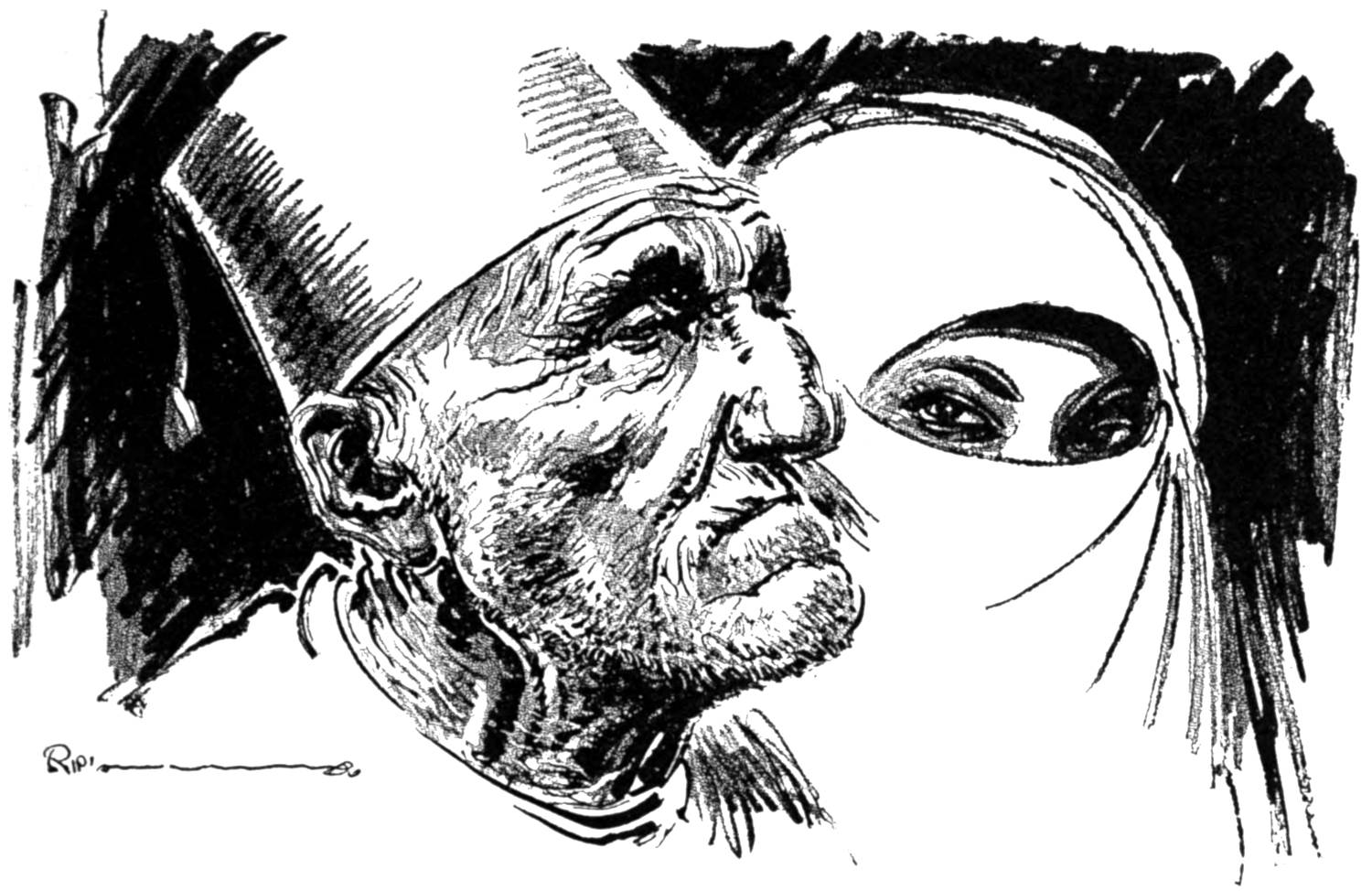
THE 153-YEAR-OLD BRIDEGROOM
Zaro Agha is never too old to yearn.
The stalwart old Turk, who is probably the oldest person alive, was married in 1927 despite his 153 years. During his long and eventful life, Agha has buried ten wives and twenty-seven children, but he was not discouraged and his spirit is ever young—and the mystery of a woman’s veil allured him.
Zaro possesses a keen memory which enables him to tell tales of events that reach back to our Revolutionary War days. He makes an annual visit to President Kemal who always gives him a hearty handshake and several hundred liras. The Governor of the city of Constantinople has presented him with a house, and last year the Prefect made him Municipal Doorkeeper for life.
* * *
THE EYELESS INFANT
This child is now four years old and normal in every way except for the complete absence of eyes. He was born with his frontal bone joining to the cheek bones which eliminated even the eye sockets which are but slightly indicated by two small depressions.
The boy was born in Sablonceaux (Charente Inférieure), France, and has six brothers and sisters who are all normal.
Ref.: Gazette Médicale de Paris.
* * *
Robert Jones who performs this remarkable feat of strength and balance is worthy of a place among the famous Joneses of athletic history. Young Robert is a pupil of the celebrated Paulinetti, and is an accomplished acrobat and gymnast.
He stands on his thumbs on Indian clubs with ease—and he is ready to do it anytime.
Jones lives in Philadelphia where he is attached to the editorial staff of the Strength Magazine.
* * *
THE LYRE BIRD
This beautiful bird is obviously so-called from the shape of its tail. The extraordinary tail of this bird is often upwards of two feet in length, and consists of sixteen feathers, formed and arranged in a very graceful and curious manner. The two outer feathers are broadly webbed, and, as may be seen, in the illustration, are curved in a manner that produces the appearance of an ancient lyre. The two central tail-feathers are narrowly webbed, and all the others are modified with long slender shafts, bearded with alternate feathery filaments which well represent the strings of the lyre.
The tail is seen in its greatest beauty between the months of June and September after which time it is shed. The bird is a native of New South Wales.
* * *
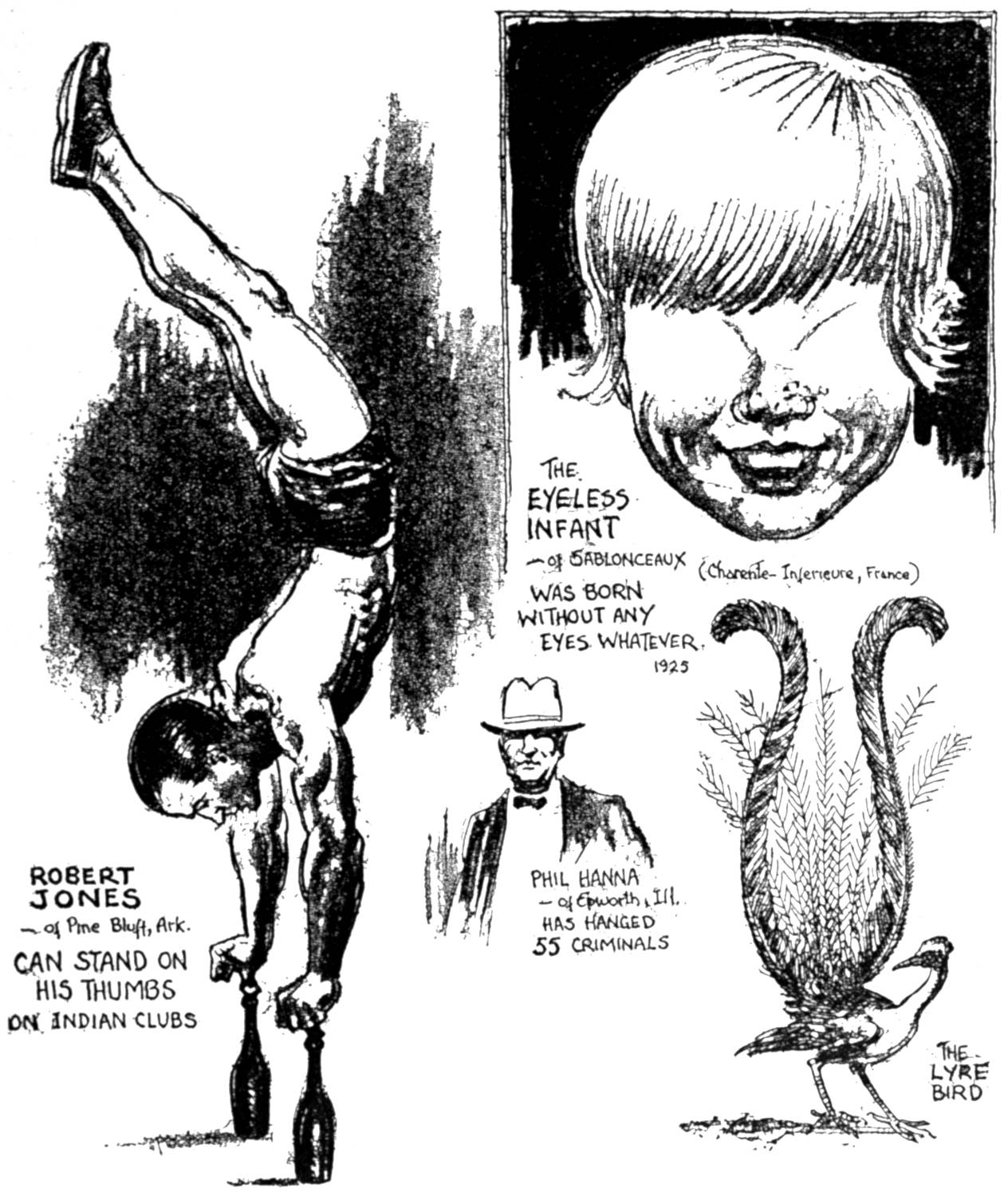
ROBERT JONES —of Pine Bluff, Ark. CAN STAND ON HIS THUMBS ON INDIAN CLUBS THE EYELESS INFANT —of SABLONCEAUX (Charente-Inferieure, France) WAS BORN WITHOUT ANY EYES WHATEVER. 1925
PHIL HANNA —of Epworth, Ill. HAS HANGED 55 CRIMINALS THE LYRE BIRD
* * *
SINGING SANDS
One warm afternoon in Honolulu—it seems to be always afternoon there—I was stretched full-length on the sands of Waikiki doing nothing—as is my wont—except watching the two Kahanomoku boys and Kealoha do tricks on their surf boards when the Duke casually suggested “Why don’t you draw a picture of the Barking Sands?”
What?
“Sure,” continued the Duke, “the sands of Kauai over yonder actually bark when you step on them.”
Sands that bark, eh? I had to see the doggone place. Kauai is one of the western islands of the Hawaiian group about 75 miles from Honolulu. Along the shore at Nahili is this series of wind-blown sand-hills about 60 feet high and stretching along for about a half mile. The front wall is quite steep. The bright white sand is composed of coral, shells and particles of lava, and true enough it possessed the particular property of emitting a sound, when stepped on, like the barking of a dog. Two handsful when clapped together produce the same phenomenon. The sound varies with the degree of heat, the dryness of the sand, and the amount of friction employed. The drier the sand the louder the sound—and our running foot steps sounded like rolling thunder.
Since then I have learned that this strange caper of nature is known in other parts of the world under different names such as Singing Sands, Sounding Sands, Rumbling Sands, Musical Sands, etc.
Marco Polo wrote of the musical sand-hills of Tunyang in Central Asia. Ibn Batutah, the Moor of Tangier, speaks of the Hill of Drums near Mecca. The famous Friar Odoric tells of the Reg-i-Ruwan, or Moving Sands of Kabul, and Lord Curzon writes of many of them in his “Tales of Travel.”
The exact cause of this sonorous quality in sand has not been fully agreed upon. The scientific explanation is rather difficult. The American researchers, Doctors Bolton and Julien arrived at the following conclusion:
“The true cause of the sonorous property is connected with thin pellicles or films of air or of gases thence derived, deposited, and condensed upon the surface of the sand-grains during gradual evaporation, after wetting by the sea, lakes or rains. By virtue of these films the sand-grains become separated by elastic cushions of condensed gases, capable of considerable vibration. The extent of the vibration and the amount and tone of the sound thereby produced after quick disturbance of the sand, is largely dependent upon the forms, structures, and surfaces of the sand-grains, and especially upon their purity or freedom from fine silt or dust.”
OYSTERS THAT CATCH MICE
Irish oysters of course! Probably bi-valves of any other nationality would not be so pugnacious.
Be that as it may; there has been a battle royal going on this year on the northeast coast islands off Donegal. Thus far the limpets have had far the better of it and thousands of rats have fallen in the unequal struggle.
The armies of rats which infest this district have been adventuring to the waterside in quest of food. At low tide the rats insert their noses between the partly opened shells of the oysters, hoping to make a meal off the edible shell-fish, but the latter are exceedingly sensitive to the slightest touch and instantly close on their enemies with a vise-like grip. The rats are held tight as in traps, and soon the rising tide creeps in and crowns the oysters victors.
* * *
Here is a letter from Mr. Henry C. Avery, of Fishers Island, New York.
“Dear Rip:
Yesterday at low tide my family and I were witnesses to a tragedy of unusual nature. A pair of kingfishers had been our friends for weeks, making our dock their headquarters, and flying around us without fear.
My daughter and I were digging clams in about an inch of water, when one of the kingfishers darted down within a few feet of us and struck at something in the water. He struggled with it as a robin often does with a worm. The struggle lasted not more than half a minute as we walked toward the bird. As I drew near the bird was still. I tried to lift it from the water but it held fast. I then dug deep into the mud and brought up a large clam of the hard-shell variety which had clamped firmly to the bird’s bill. The bird was dead, either drowned or died of fright.
Believe It or Not, Henry C. Avery. Aug. 7, 1925.”
* * *

A Billion Dollars in London is Worth a Thousand Times As Much As a Billion Dollars in New York
Strange as it may seem, an English billionaire is many times richer than an American billionaire.
And why not?
A billion in England is a million million (1,000,000,000,000), but in the United States a billion is considered to be a thousand million (1,000,000,000). See any dictionary.
* * *
A SPIDER IS NOT AN INSECT
Are you surprised?
So was I until I discovered that a Spider is an Arachnide. The Arachnida family consists of Spiders, Scorpions, and Mites. These beings breathe atmospheric air, have no antennae, and have four pairs of legs attached to the fore parts of the body. The fact that they have more than the normal number of six legs is alone sufficient to separate them from insects.
* * *
ST. PATRICK WAS NOT AN IRISHMAN
The patron Saint of the emerald isle was a born Frenchman, having first seen the light of day in Tours, France. His real name was Succat. His father’s name was Calpurnius, and his mother was a sister of St. Martin, the Bishop of Tours.
* * *
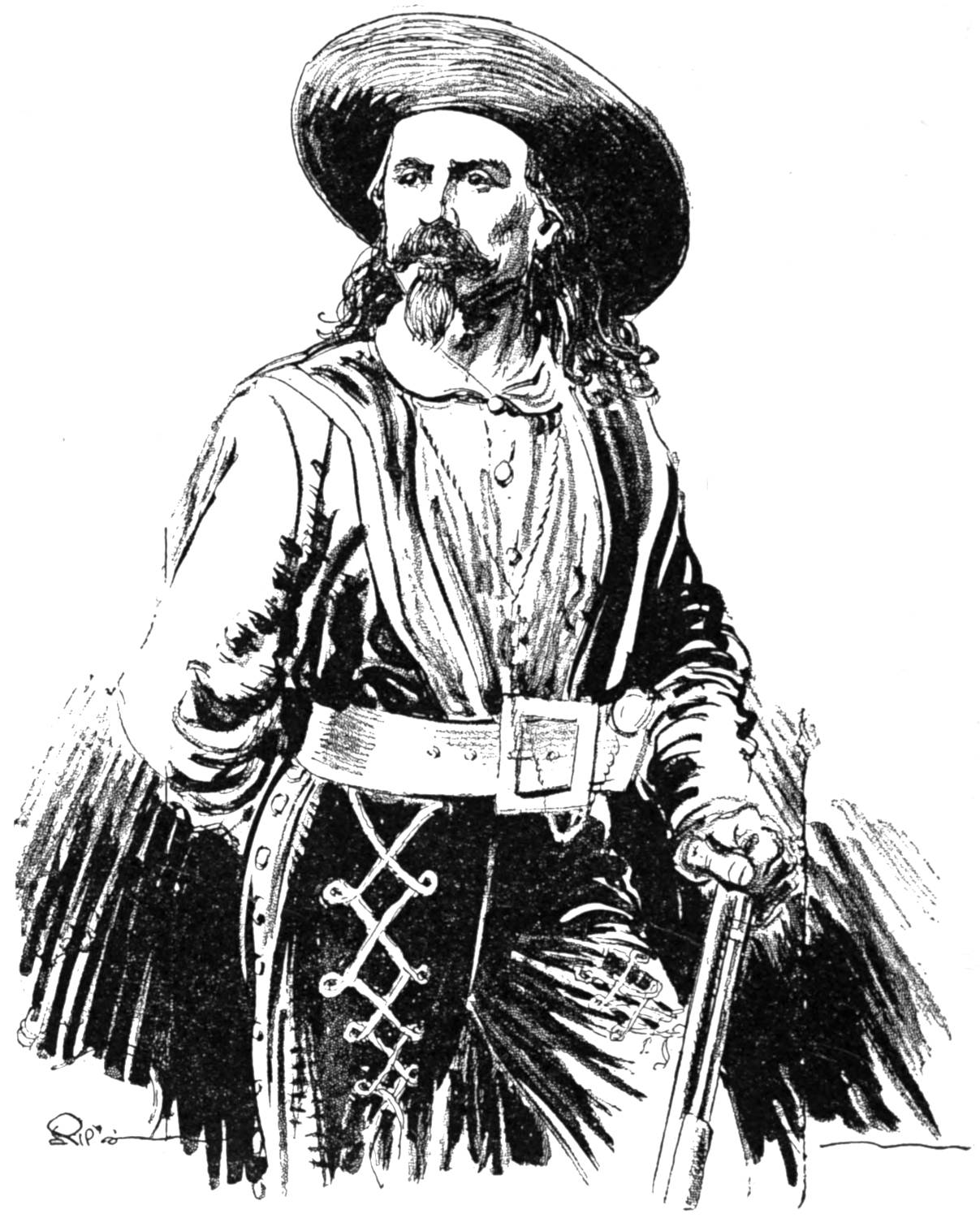
BUFFALO BILL NEVER SHOT A BUFFALO IN HIS LIFE
It is not my intent to cast aspersions on the famous name of Bill Cody, but it is nevertheless a fact that the valiant old warrior never shot a single buffalo in his long career along the frontiers.
Buffalo Bill was not to blame. He earned his name—but not the name of “Buffalo” Bill, because the only true buffaloes are found in the old world, principally in Africa and India.
The American animal is the bison and is distinctly indigenous to North America.
The bison differs greatly from the buffalo, both in appearance and habits. The buffalo resembles an ox more than a bison, and has short hair besides being very fond of the water.
* * *
SEX APPEAL
Lady Gough, distinguished blue-nose of England, wrote a book on Etiquette in 1863; and on page 80 I find this paragraph:
“The perfect hostess will see to it that the works of male and female authors be properly separated on her bookshelves. Their proximity unless they happen to be married should not be tolerated.”
* * *
“THE QUEEN OF SPAIN HAS NO LEGS”
When Margaret of Austria, Queen of Philip III, entered Spain in 1599 she passed through a town celebrated for the manufacture of silk stockings; and the authorities, wishing to show her courtesy, presented her with a costly pair. The offer was indignantly refused and the delegates were sternly informed that the “Queen of Spain had no legs.”
Since that day of rigid etiquette it has been customary to say that, officially, “the Queen of Spain has no legs.”
* * *
A PHILADELPHIAN COMMITTED SUICIDE AND LEFT THE FOLLOWING NOTE:
I married a widow with a grown daughter. My father fell in love with my step-daughter and married her—thus becoming my son-in-law, and my step-daughter became my mother because she was my father’s wife.
My wife gave birth to a son, who was, of course, my father’s brother-in-law, and also my uncle for he was the brother of my step-mother.
My father’s wife became the mother of a son, who was, of course, my brother, and also my grand-child for he was the son of my daughter. Accordingly, my wife was my grandmother because she was my mother’s mother—I was my wife’s husband and grandchild at the same time—and, as the husband of a person’s grandmother is his grandfather—I AM MY OWN GRANDFATHER!
Mark Twain.
* * *
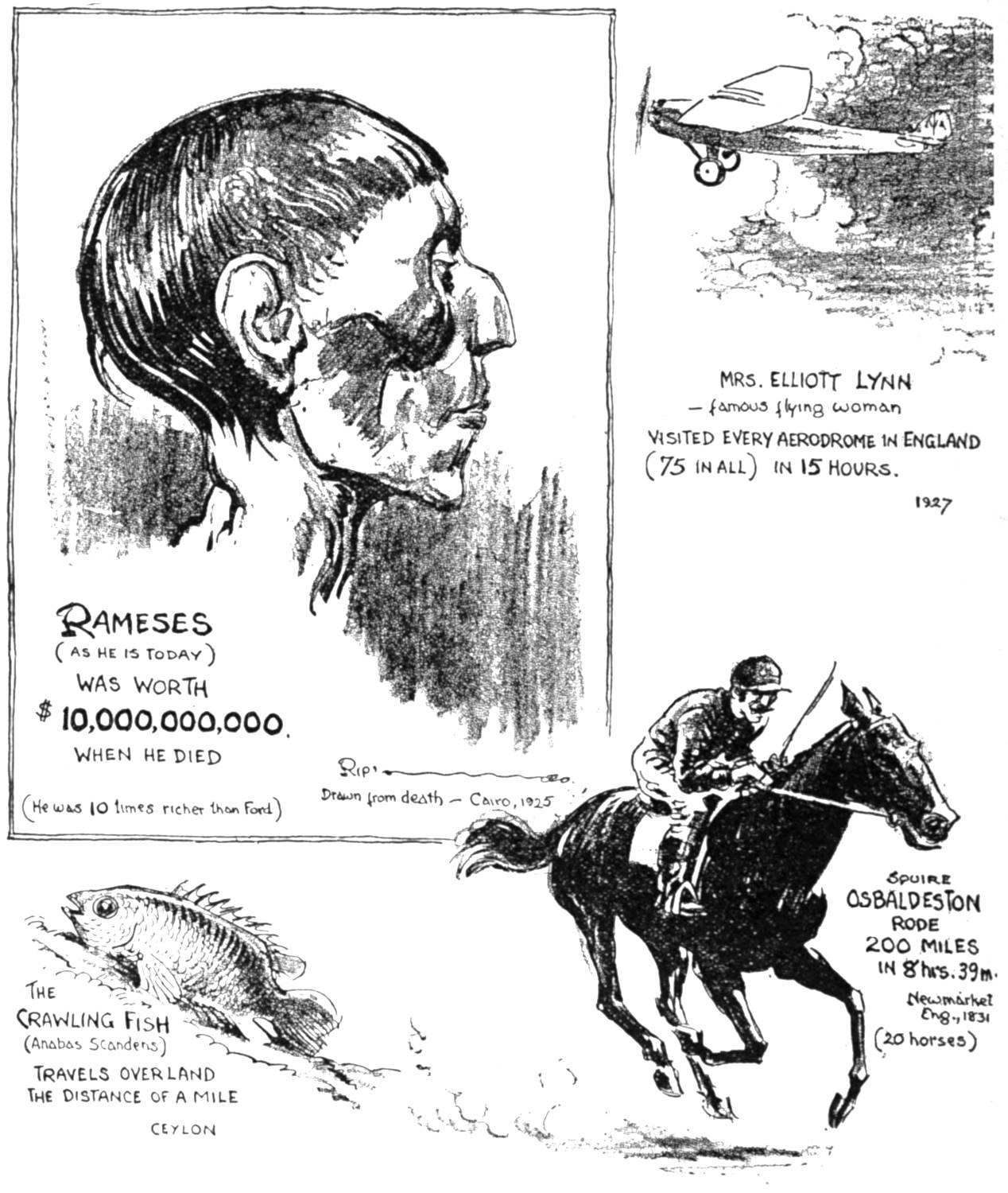
MRS. ELLIOTT LYNN —famous flying woman VISITED EVERY AERODROME IN ENGLAND (75 IN ALL) IN 15 HOURS. 1927
RAMESES (AS HE IS TODAY) WAS WORTH $10,000,000,000. WHEN HE DIED (He was 10 times richer than Ford) [signature] Drawn from death—Cairo, 1925
THE CRAWLING FISH (Anabas Scandens) TRAVELS OVERLAND THE DISTANCE OF A MILE CEYLON SQUIRE OSBALDESTON RODE 200 MILES IN 8 hrs. 39 m. Newmarket Eng., 1834 (20 horses)
* * *
RICHEST MAN WHO EVER LIVED
Rameses II, who now serves as a peep-show in the Cairo Museum and as an ad for cigarettes, was once a “ten-billionaire.” Ford, Rockefeller, Croesus, and others, were only pikers when compared with the “sunset glory of the royal dynasties of Egypt.”
The most famous of the Pharaohs conquered all the kings from Nubia to Syria and exacted great tribute from them. He exploited the gold mines of Nubia for the benefit of his own purse during a period of 67 years. The entire known world of that time contributed to his great wealth and magnificence.
* * *
THE CRAWLING FISH
This crawling fish is a native of Asia, and is remarkable for its apparent disregard of certain natural laws. This singular creature has long been noted for its powers of voluntarily leaving the failing streams, ascending the banks, and proceeding over dry land toward some spot where its unerring instinct tells it that water is yet to be found. They sometimes cover a distance of a mile or more, and can live for a period of a week out of water.