Chapter VI · (continued 2)
Reading edition
The erection of stable State Governments greatly diminished the power and the prestige of federal authority. Insensibly the Congress and the Continental army found themselves dependent upon thirteen sovereign masters. The feebleness with which the war was supported sometimes strikes one as incredible; but the amazing difficulty of maintaining an army of ten thousand troops for the achievement of independence, in the very colonies which had raised twenty-five thousand for the conquest of Canada, was due less to the lack of resources, or to indifference to the result, than to the uncertain authority of Congress, the republican fear of military power, and the jealous provincialism which had everywhere been greatly accentuated by the establishment of the new state constitutions. Washington's army naturally looked with contempt upon a Government that could not feed or clothe its own soldiers. Congress, jealous of its authority for the very reason that it had none, criticized the army in defeat and feared it in victory. The State Governments, refusing to conform to the recommendations of Congress, alternately complained of its weakness and denounced it for usurping unwarranted power. Each State wished to maintain control of its own troops, and was offended if, in the Continental forces, its many military experts were not all major-generals. The very colony which gave little support to the army when war raged in another province, cried aloud for protection when the enemy crossed its own sacred boundaries; and, with perhaps one eighth of its proper quota of men at the front, with its requisitions in taxes unpaid, wished to know whether it was because of incompetence or timidity that General Washington failed to win victories.
After all the wonder is rather that Congress accomplished anything than that it did so little. A Frenchman, asked what he did during the Terror, replied that he lived. It was no small merit in the Continental Congress that it held together and maintained even the tradition of union; a higher merit still that in the midst of war it fashioned a federal constitution which the thirteen States, more divided by jealousy and their newly won authority than they were united by a common danger, could be induced to approve. Yet this task the Congress with difficulty got accomplished. In 1777, after months of debate, it adopted the Articles of Confederation. Leaving political sovereignty in the several states, they provided for a federal legislature with a very limited authority to make laws, but no federal executive to enforce them. Hopelessly inadequate as this constitution was to prove, the small States, notably Maryland, refused to approve it until the larger States ceded their Western lands to the common Government. Virginia, possessed of the most extensive domain, held out longest, but finally renounced her claims January 2, 1781; and in March of that year it was announced that Maryland had ratified the Articles of Confederation, which thus became the first constitution of the United States.
In 1779, while the States were wrangling over their Western lands, a little band of valiant backwoodsmen won a victory which gave substance to their claims and made their cessions something more than waste paper. Throughout the war the frontier communities were most loyal supporters of the Revolution. Their expert riflemen, organized in companies, of which that of Daniel Morgan is perhaps the most famous, served in the army of Washington, helped Gates to win the battle of Saratoga, and were of indispensable service in driving Clinton out of North Carolina in 1780, and Cornwallis in 1781. The borderers of Pennsylvania and Virginia, and the little settlements at Watauga and Boonesboro, maintained a heroic defense against the Indians, who were paid by General Hamilton, the British commander at Detroit, to wage a war of massacre and pillage on the frontier. Against intermittent Indian raids the backwoodsmen could defend their homes; but so long as the British held Detroit and Vincennes and the Mississippi forts, there could be no peace in the interior, and even if the colonies won independence, it was likely that the Alleghanies would mark the boundary of the new State. Under these circumstances, George Rogers Clark, trapper and expert woodsman and Indian fighter, set himself, with the confident idealism of the frontiersman, to achieve an object which must have seemed to most men no more than a forlorn hope. It was in 1777 that he crossed the mountains to Virginia, secured the secret and semi-official authorization of Patrick Henry, the Governor of the State, and raised a company of one hundred and fifty men with which to undertake nothing less than the destruction of British power in the great Northwest.
In May, 1778, the little band floated from Redstone down the Ohio, at the falls built a fort which they named Louisville in honor of the French King, and finally, on July 4, reached Kaskaskia. Guided by some hunters who had joined them, they took the fort by stratagem. The Indians, for the moment a greater danger than the British, were overawed by the skill and the masterful personality of Clark; and the Creoles, conciliated by his moderation, gladly joined in the capture of Cahokia. Not until February, 1779, was the intrepid commander ready to march on Vincennes. General Hamilton had recently come there with a small force, and there he proposed to remain until spring before marching to the recapture of Kaskaskia and the destruction of the settlements south of the Ohio, never dreaming that men could be found to cross the "drowned lands" of the Wabash in the inclement winter months. This fearful challenge was what Clark and his men accepted; marching two hundred and thirty miles over bogs and flooded lowlands; without tents, and sometimes without food or fire; as they neared Vincennes breaking the thin ice at every step, often neck-deep in water; yet succeeding at last, they took the fort and sent Hamilton to Virginia a prisoner of war. Detroit remained in British hands; but the possession of Vincennes and the Mississippi forts probably saved the Kentucky and Tennessee settlements from destruction, and doubtless had some influence in disposing England to cede the Western country at the close of the war.
Yet in spite of this signal victory, in spite of the French alliance, the darkest days of the war were yet to come. In the year 1780 the Revolution seemed fallen from a struggle for worthy principles to the level of mean reprisals, a contest of brigands bent on plunder and revenge. That it had come to this pass was partly due to Clinton's policy of detached raids; but the policy of raids was a practical one precisely because in nearly every colony there was a large body of active Loyalists, a larger number still who were indifferent, wishing only to be left alone, ready to submit to whichever side might win at last. Driven from their homes, plundered by British or patriot raiders, they in turn organized for revenge, sought plunder where they could find it, caring not whether they served under Loyalist or Revolutionist banners. In South Carolina, laid waste by the light troops of Tarleton and the partisans of Marion and Sumpter, in all the regions round New York, in the Jerseys, on Long Island and in parts of Connecticut, even the semblance of government and the customary routine of ordered society disappeared. The issues that had once divided men were forgotten while bands of Associated Loyalists and bands of Liberty Boys plundered the inhabitants indiscriminately, hailed each other as they passed in the night, or agreed, with the honor that prevails among thieves, to an equitable division of the spoils.
And few victories came in this disastrous year to cheer the remnant of tried Americans. Clinton's invasion of North Carolina was, indeed, a failure; and at the close of 1780, after the frontier troops had overwhelmingly defeated General Ferguson at King's Mountain, the British were forced to evacuate that strongly revolutionary colony. But Washington could do little more than hold with the desperation of despair to West Point, where his army had lain helpless and almost passive since the battle of Monmouth. Congress, barely able to hold together, could not maintain even that "verbal energy" which had once distinguished it. In this year as never before men served their country with one hand and with the other filled their pockets by manipulating the currency which had fallen to be a worthless scrip. And it was in this year, when fidelity seemed a forgotten virtue, when men enlisted in the army and deserted to the enemy with equal indifference, that Benedict Arnold, entrusted at his own request with the command of West Point, forswore his trust and wrote treason across the fair record of a patriot's achievements. Well might Washington write, "I have almost ceased to hope"; and Laurens, "How many men there are who in secret say, could I have believed it would come to this!"
Yet at last a happy combination of circumstances enabled the American and French forces, for the first time operating in complete accord, to bring this disastrous war to a most successful conclusion. Well aware of the importance of the Southern campaign, Washington had procured for Greene, the ablest of his generals, command of the forces which were gathering in North Carolina to resist the advance of Cornwallis in 1781. Defeated at the Cowpens and checked at Guilford, the British commander was forced to retire to Wilmington; but instead of returning to Charleston he moved into Virginia to join Arnold, convinced that the conquest of the Old Dominion must precede that of North Carolina. In May and June he carried ruin to all the prosperous towns of the province; but in July, when the American forces under Lafayette had been greatly strengthened, it was no longer safe for the British commander to divide his army. Acting under orders from Clinton, Cornwallis accordingly retired to the coast and fortified the neck of land at Yorktown. Washington had scarcely been apprised of this circumstance before he received a letter from the Count de Grasse, commander of the French naval forces in the West Indies, proposing joint operations in Virginia during the summer, and promising to bring his fleet to the Chesapeake sometime in August. The opportunity was a rare one. Abandoning the projected attack on New York, Washington and Rochambeau joined their forces and marched rapidly through New Jersey, entering Philadelphia the very day that De Grasse appeared at the mouth of the bay. They had already joined Lafayette before Admiral Graves arrived from New York with a British fleet to rescue the British general. Had Graves been a Rodney or a Nelson he might have given a different issue to the American Revolution; but he was not the man to win against great odds, and after an indecisive engagement he sailed away, leaving Cornwallis to his fate. Hemmed in by 16,000 American and French troops, the unhappy general, who never met Washington but to be defeated, surrendered his army of 7000, men on the 19th of October, 1781.
"It is all over!" cried Lord North when Germaine told him of the surrender of Cornwallis. The loss of 7000 men was not in itself an irremediable disaster; but the effort of the king and the "King's Friends" to establish the personal rule of the monarch had alienated the nation, while their attempt to subjugate the colonies had embroiled England with all Europe. In armed conflict with France, Spain, and Holland, opposed by the "armed neutrality" of Russia, Sweden, Denmark, the Empire, Portugal, the Two Sicilies, and the Ottoman Empire, never had the isolation of the little island kingdom been more splendid, or British prestige so diminished. The demand of the nation for peace could no longer be resisted, and the Whig party came into power over the king's will, and entered into negotiation with the enemies he had made. The American ambassadors were instructed by Congress and bound in honor not to make a treaty without the knowledge and consent of France. But in spite of Franklin's protest, Jay and Adams, who suspected, not without some show of reason but contrary to the fact, that Vergennes would oppose the extension of the United States beyond the Alleghanies, broke their instructions as readily as Jay broke his pipe, and without consulting their faithful ally arranged the terms of peace with England.
Independence was acknowledged as the indispensable preliminary to negotiation. John Adams declared that he "had no notion of cheating anybody," and it was agreed that British creditors should "meet with no lawful impediment to the recovery of all ... bona fide debts heretofore contracted" in the colonies. The skill of Franklin and the resolute persistence of Jay and Adams, together with the desire of the English Government to make a peace without delay, enabled the Americans to gain, in every other disputed point, all they could hope for and more than they had any reason to expect. It was conceded that they should enjoy the customary right of fishing in Northern waters. The best effort of England to secure a restoration of property and of the rights of citizens to the Loyalists was unavailing, and the compensation of that unhappy class fell to the Government whose losing cause it had supported. But of all the provisions of this Peace of Paris, the most important, next to the acknowledgment of independence, was the one which gave to the new State that incomparably rich woodland and prairie country extending from the thirty-first, degree of north latitude to the Great Lakes, and as far west as the Mississippi River. With these as its main provisions, the definitive treaty was signed on September 3, 1783, and ratified by Congress January 14, 1784.
Before the treaty of peace was signed, the cessation of hostilities had been formally declared and announced to Washington's army on the 19th of April, eight years to a day after the battle of Lexington. British troops occupied New York until November 29, when the evacuation of the city was finally completed, and the United States of America entered the company of independent nations, the exhausted and half-ruined champion of those principles of liberty and equality which were soon to transform the European world. With the British troops there sailed away, never to return, a great company of Loyalist exiles; part of the thousands who renounced their heritage and their country in defense of political and social ideals that belonged to the past. America thus lost the service of many men of ability, of high integrity, and of genuine culture; clergymen and scholars, landowners and merchants of substantial estate, men learned in the law, high officials of proved experience in politics and administration. The great achievements of history have their price; and American independence was won only by the sacrifice of much that was best in colonial society. Something fine and amiable in manners, something charming in customs, much that was most excellent in the traditions of politics and public morality disappeared with the ruin of those who thought themselves, and who often were in fact, of "the better sort."
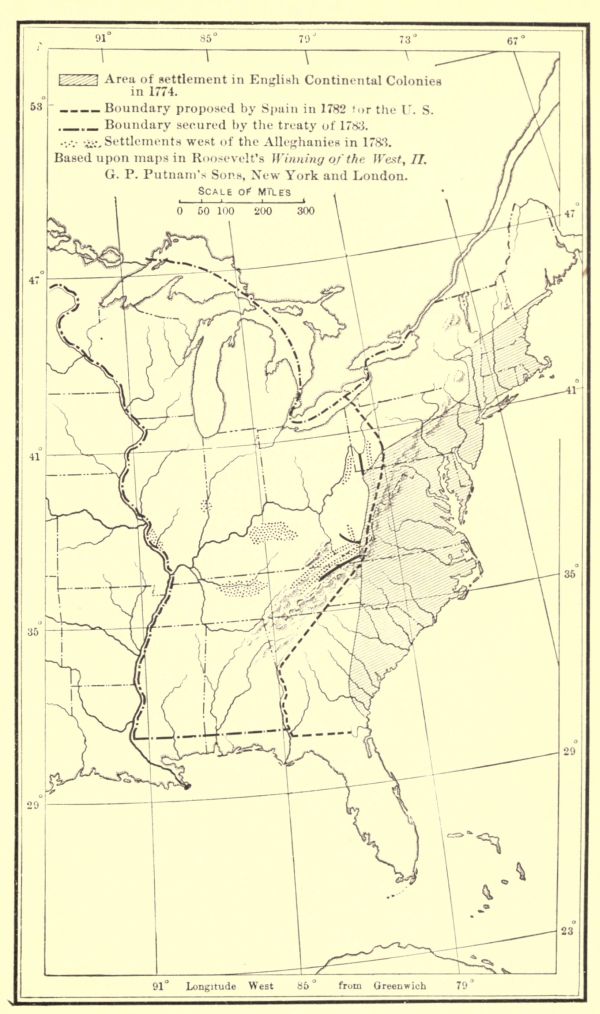
Area of Settlement in 1774; Boundary proposed by Spain in 1782; Boundary secured by Treaty of 1783; and Settlements West of Alleghanies in 1783
Happily for America not all of the "better sort" deserted their country. On the 4th of December, five days after the last British ship cleared New York Harbor, a little company of officers was gathered in the Long Room of Fraunce's Tavern. They were waiting to bid farewell to General Washington. No sign of rejoicing greeted the entrance of the familiar figure; and this masterful man of proved courage and inflexible will, this self-contained soul who endured calumny in silence, who accepted victory in even temper and defeat with high fortitude, was now strangely moved as he looked upon his beloved companions. Lifting a glass of wine he said simply: "With a heart full of love and gratitude I now take leave of you, most devoutly wishing that your latter days may be as prosperous and happy as your former ones have been glorious and honorable." When all had taken the general's hand and received his embrace, they walked together through the narrow street to Whitehall Ferry, where a barge lay waiting. As the oars struck the water Washington stood and lifted his hat; and his comrades, returning the salute in silence, watched the majestic figure until it disappeared from sight. Less than two years before, in the spring of 1782, the army would have made Washington king. He was now on his way to Annapolis, to present himself before Congress in order to resign the high office which eight years before he had accepted with so much diffidence, and to claim the indulgence of retiring from the service of his country. This, as it happened, came to pass on the 23d of December. On the day following he rode away to his home at Mount Vernon, a private citizen of the Republic which he had done so much to establish; a citizen of the Republic, and of the world's heroes one of the most illustrious.
BIBLIOGRAPHICAL NOTE
A good brief account of the Revolution is in Smith's The Wars Between England, and America (1914), chaps, I-VI; a fuller and better account in Channing's History of the United States, III, chaps. I-XII; all things considered the ablest summary is Lecky's The American Revolution. An able and suggestive work is Fisher's The Struggle for American Independence, 2 vols. 1908. Sir George Otto Trevelyan, with wide information, strong Whig sympathies, and great charm of style, has written the most fascinating work on the subject. The American Revolution, 4 vols. 1905. The best study of British measures which precipitated the struggle is Beer's British Colonial Policy, 1754-1765. 1907. For bibliography and summary of contemporary literature, Tyler's Literary History of the American Revolution. Selections from newspapers and contemporary documents are in Moore's Diary of the American Revolution, 2 vols. 1860. For the Loyalists, see Tyler, in American Historical Review, I; Van Tyne, The Loyalists in the American Revolution. 1902. For the attitude of the clergy, and the influence of religious and sectarian forces, see Van Tyne, in American Historical Review, XIX; Cross, The Anglican Episcopate. 1902. Thornton (The Pulpit of the American Revolution. Boston, 1860) reprints a number of contemporary sermons by New England clergy. For the Western settlements see Roosevelt, Winning of the West, 4 vols.; Alden, New Governments West of the Alleghanies, in Wisconsin Historical Bulletin, II; Turner, in American Historical Review, I; Thwaites, How George Rogers Clark Won the North West. 1903. The opposition between the interior and the coast regions, and the bearing of this on the formation of radical and conservative parties in the Revolution, are well brought out in Lincoln's The Revolutionary Movement in Pennsylvania (University of Pennsylvania Studies. 1901); and Henry's Patrick Henry, 3 vols. 1891. The letters, journals, and papers of leading Americans in the Revolution have been very fully printed. The ablest of the radicals was John Adams (Works of John Adams, 10 vols. 1856); Franklin became increasingly radical with the progress of events (Writings of Benjamin Franklin, 10 vols. 1903-07); Dickinson was the ablest of the conservatives who joined the Revolution, but with great reluctance (Writings of John Dickinson, 3 vols. 1895); the extreme conservative and Loyalist view is best represented by Hutchinson (Diary and Letters of Thomas Hutchinson, 2 vols. 1884). For the period of the war perhaps the most illuminating writings of all are the letters of Washington (The Writings of George Washington, 14 vols. 1889-93).
FOOTNOTES:
[2] Professor C.H. Van Tyne, of the University of Michigan, has recently found new material in the Paris Archives, notably a Vergennes memoir of 1782 and memoirs presented by the ministers at the time of forming the treaty, which to his mind proves conclusively that the Government would never have formed the alliance with America had it not been convinced that otherwise the colonies were prepared to join England in the conquest of the French West Indies.