Symphony II. Opus 36.
Reading edition
THE ADAGIO.
The worn-out despot offered a premium for a new pleasure; the critic would often do so for a new epithet. How shall I characterize this exquisite prelude? It is as the portico to the Walhalla of the gods. Here we have the real Beethoven in his divine profundity—profound, because beautiful; its very beauty constituting the depth, as it were, thickening into it, like the ocean and heaven. This beauty, the true Proteus, is evasive; its import was not clear to the utterer himself, no message of the Divine is, to the human vehicle—
"A coral conduit ivory cisterns filling."
We cannot exactly translate or interpret it, only we feel that were it translated, we should have a divine poem in a divine language. One could spend hours going into the details of it—for every note demands a word; those two opening ones namely. How characteristic! There is the Emperor Tone-Poet, Napoleon of music, commanding "Attention!" and not—God forbid!—for himself, but for his message. It is the "Thus saith the Lord" of the prophet (some Elijah) of old. Utterance so simple—so all-compelling! Those two notes, merely, are, as it were, like the slightest scratch of an apostle. Then the next three bars! They at once usher us into that ineffability of Beethoven's which we spoke of. We have no reluctance to admitting that originality is not particularly studied here. Nay, we are inclined to say something higher—the modesty and moral courage to reject originality is displayed. Beethoven had to deliver that "Thus saith the Lord!" and he did it. First feel, and then study, the unstudied eloquence of it. It is one of the beautiful instances whose name is legion in Beethoven, of simplicity—
"In its simplicity sublime."
To me it says—"There! the storms are all fought out. Peace, after all, is at the bottom, and in the heart." Or it is like a high man—say Beethoven himself—after the despicable petty disgusts, as well as chaotic horrors of life, falling back upon nature, the eternal star-glimmering universe—"they will not repel and deceive me, they are everlasting and sublime!" The phrase—like every great message—is really indescribable except by itself; the profound peace, or rather peaceful profundity of it, are unutterable—
"O that my tongue could utter"—
It is a great instance of height towering out of depth, high because deep, a peak in music, yet not clad with eternal glacier, except for its purity of heart, but eternal sunbeams.
After an interesting passage of "harmonious breathing" interposed, and the still more interesting one of chromatic part-repetition, the shakes—which are ultimately to play a great part—first make their appearance. The taste for the shake can soon degenerate; and Beethoven himself sometimes used it incontinently. But, when properly introduced, as here, and especially at the last, it is an ornament that has a more or less magical charm.
The next noble bit reminds us a little of the "Funeral March" in the A flat Sonata. Thereupon Beethoven, in his unconscious or conscious unconscious progress, promulgates some of these characteristic utterances of his—those harmonious and melodic breathings, so profound and pregnant with we know not what. Who or what moved him to his wonderful "progressions?" Truly indescribable tone-poet! so deep with tenderness, so rich with glow—glow is where Beethoven exceeded all of them, especially the Saxon school; he added glow to height, breadth, and depth; or, rather, his glow and depth—as in the sun—are like cause and effect, one.
Now follow those warblings—
"Wild bird! whose warble liquid sweet Rings Eden through the budded quicks,"
and "deep answering unto deep," which we mentally alluded to at the outset, hard to decipher, seraphically beautiful. In what a musical river, to employ another figure, or concourse of confluences, the inspired orchestra rolls on; for yes, verily, the river is inspired with utterance, big with its message. And this is no merely European river, but rather some tropical Zambesi or Amazon with its colossal origin and surroundings; or, again, the river that rolls from the throne of the Fountain of Life—which truth it seems to declare, in the magnificent emphatic passage (anticipating the choral symphony?) so originally grand, in D minor, in unison, mark that. It seems to say—"Hear that, and believe it. The rolling river which this universe is, does not flow from Chaos and Diabolus, but from Eternal Self-Justified Will—humanly named, in short, 'God'; as it were, takes its course through the bosom of God, as 'King John' wished the rivers of his realm to, through his." After this colossal passage, we seem to be invited to listen to the warblings and happy murmurs in the halls of heaven—the habitation of the blest, of just spirits made perfect. It is all delicately, crystallinely ineffable; and the language of imaginative sympathy itself can scarcely transcend the beauty and exceeding excellence of the whole movement—that profound inspiration—any more than it can transcend the beauty and exceeding excellence, amounting to divinity, of the universe, that "Midsummer Night's Dream!"
The Allegro.
I often doubt, war can never cease, for its element is so great and potent in art—especially music and her twin-sister, poetry. Carlyle specially speaks of the "great stroke, too, that was in Shakespeare, had it come to that;" and, indeed, makes this—together with the "so much unexpressed in him to the last"—in short, his infinitude, the very thing which Schubert's kindred eye saw in Beethoven, differentiating him, his two chief points of admiration and test in general of a man. Besides, in our great historian himself—in Milton, too—we feel that there was a great stroke, as of the sublime Ironside; before him, in Dante; before him, in Homer—perhaps, Virgil; but not Horace. In our own day, the noble ring of our poet-laureate's verse, to mention no more, is at once a voucher for the same fact, apart from his "Maud," and more than one indignant utterance. The poetic imagination and classic beauty of all such men is not only concomitant with, but inseparable from, a "good stroke in them" (Dante and Cervantes were actually on the battle-field)—from an heroic element, the best thing they have. The greatest utterance—inspiration—cannot possibly come from any other. The hero is dear to God; the coward perhaps most despised of all. And why? The reason is philosophical enough. Because the soul of the universe is power—and without courage there can be no goodness. The grand doctrine of evolution, penetrating everywhere, has brought home to us, and borne in upon us, that there is not a field or a grove which is not the theatre of perpetual struggle—not one manifestation exempt from it. Vae victis is the word of Nature herself, and the "struggle" is divinely ordained (competition is the salt of existence) for the elaboration of energies—the eventuation in higher life. What man would wish for the dolce far niente of the Fool's Paradise? The world hath been groaning and travailing until now, and must for a long, long time to come; only one-fourth of it is even now "civilized," and in that civilisation what dregs and dens of barbarism seem ineradicable. All sorts of wrong still tyrannise; therefore, spiritually and physically, the warrior must stand forth great to wage war against the bad everywhere, politically and intellectually—against social evils, and art-darkness—against lies, and for truth—against weakness, and for strength; for Might is Right in the universe—weakness is one with evil, strength with good. Only the good is strong; only the bad is weak.
We have been led into these remarks by dwelling on the fact, how frequently the warlike spirit manifests itself forth in our Beethoven—indeed, is irrepressible; nay, I am urged to say, cardinal. In spite of Beethoven's truly divine beauty, he is stamped and distinguished by power. When he issues young into the arena, we see "victorious success" gleaming on his brows. Handel is distinguished in the same way. Hence the secret of Beethoven's own hero-worship for him. Apollo is great, but Jupiter is greater—Jupiter Optimus Maximus. If Mozart, Weber, Schubert may, more or less, figure as the sun-god, they cannot figure as the god of the sun-god. We might almost say, the first notes of Beethoven proclaimed power. He had to go forth and do battle with things. Nor is his own struggle for existence (not mere being, but immortality—a life in immortality here; that is existence to your Beethoven) in his own life-element, so strong and chaotic, in his own soul progress, undepicted, or shadowed forth. With unconscious-consciousness did he do it—on, right on to the end, the bitter end; on the verge of blindness, insanity—we know not what. Rushing as he did, into the conflict, conscious only of power, Beethoven would have been struck had he seen what, through the long vista of "stifled splendour and gloom," that power boded and implied: he would have been awed, had it been revealed to him what that power represented—little short of the Nineteenth Century itself, with all its Hamlet doubts, and chaotic, yet germ-rich smouldering of transition, whereof more anon.
If the ineffable adagio—prelude of preludes (?), out, as Marx says, the last movement is the finale of finales—shows us the young God-disguised athlete, with the morning light on his brow, making ready to enter only the Olympian Games, the allegro con brio shows him to us rushing into battle! The "heroic symphony" is by no means the first or last symphony heroic—indeed, could not have been written but for the pre-existence and exercise of that full power in the inspired young composer. Here is a grand epic outburst and onrushing worthy of that immortal masterpiece, and essentially one with it. We could almost say, not only the same power, but the same sort of power, is indiscernible in Haydn and Mozart. The style (which is truly the man—that to the man what the bark is to the tree) is so different—the man's dialect, as well as message; the phraseology altogether. These modulations are not those of Haydn and Mozart! (beyond praise grand is the ff on the dominant of A minor—one of those glorious bursts and surprises of Beethoven's—we expect D minor); nor is the masculine fancy (god-like shall we say? and a Mozart's, goddess-like) theirs; and the great broad, quasi-Titanic strains and themes. This movement (Op. 36) is an advance on that of the symphony No. 1 (Op. 21), if in grade only, not kind. Here we see the young giant, not yet done growing, a little riper. There is no strain in it which we feel inclined to qualify, which "gives us pause," like the second motiv in its predecessor; all is homogeneous, epically great. But let us descend a little to details. At bars 1, 2, and 3, we imagine the firm tread of the warriors, singing (like the Ironsides before Dunbar—the 68th Psalm, "Let God arise,") on their way to victory, which they never doubt for a moment, not only because they are triumphant veterans, but on account (and more) of their cause. At bar 4 what a poetic rush (inrush) of fifes is suggested! then the great step is heard again; a great strain joins in; the chaunt of the warrior basses becomes more and more ominous; preliminary thunder is heard, and at last, with Olympian pæan and war-cry battle is joined;—great is the shock, and glorious is the struggle!
The second subject in A is ushered in by those grand third-less chords (long before our modern writers):—
[Listen]
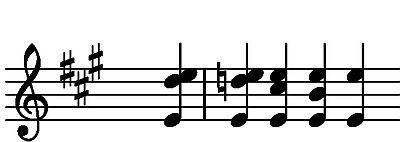
the chromatic passage being doubled two octaves below by the basses. The new subject, more absolutely melodious, still keeps up the same theme—(for, apropos, we may also look upon this allegro as some Homeric or Shakespearian recital of a great victory—recall the superb opening lines of "Richard the Third," the "warriors' wreathed brows, and their bruised arms hung up for monuments"). At first it is heard softly—like a reinforcement in the distance (we think of the Prussians at Waterloo, in the westering summer sun)—then as it were in a blaze of music bursts in. Immediately after, where its exquisite first half (so simple—mark that—but so eloquent and picturesque) reappears in the basses (high), we are rather reminded of Mendelssohn's "Huntsman's Song without Words," in A (the same key), Book 1; but—we need not say—Mendelssohn has not gilded gold, or improved the lily; for his fancy was distinctly lighter and smaller than Beethoven's—or, let us say, he had fancy, Beethoven imagination. And now a happy spirit of triumph sings in the basses; and then burst out some crashing Beethoven-chords, of which I will but point to the one ff (5th bar of them); it is characteristically the 6—4 of D—not, as anticipated, the 5—3 of F sharp minor.
Then, after a foreboding crescendo—characteristic growth out of an initial fragment—and these two emphatic notes:—
[Listen]
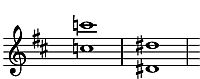
—Beethoven all over—the first part closes, so to say, in a breadth of thunder-peals and fiery rain. Technically, note the grand entry of D minor, and mi—do—si—la—mi in unison, with the 3rd omitted; and the minor-seventh chords, resolving into the tonic dominant of the minor (D1), so exquisitely expressive—alike of the pangs of victory and the heroic resolution to endure them.
In the 2nd Part, on the way to G minor (Beethoven himself often never knew whither he was taking us, or at least the precise route—and so much the better!), we soon meet with a remarkable juncture of notes, viz., do and mi of the chord (G minor), with fa superadded:—
[Listen]
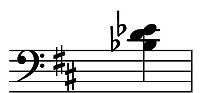
This fa, at first sight perplexing, turns out to be a stray note (as it seems) of the minor seventh chord on its way to the seventh, which, however, ultimately appears (with beautiful effect) as the 3rd of the dominant-seventh chord (to C minor). This powerfully, painfully expressive dissonance is likewise to be found in his "Lied Vom Tode" (Op. 48), amongst other instances; and the opening to Schubert's "Wanderer" owes its intense expression to the same. The raison d'être of such discords is perhaps to be found in the enhancement they give to the resolution. We could not bear them too long, or too frequent; but, as a passing reminder of the tragedy of life, they profoundly move and interest us; and, perhaps, discords in life (likewise instituted by no Dryasdust) have essentially the same raison d'être and explanation—life is agro-dolce, not dolce alone, and better so. Thereupon we have a new idea, surely as playfully felicitous and characteristic as the scherzo of the "Eroica" itself—like the warriors at sport after victory; or like a glimpse of the same by them, back in a pause in the battle, which soon recommences, with the shouts of the combatants and groans of the wounded and dying. A page farther on, we have a truly sublime episode; great is the chaunt on the earnest theatre (proclaiming Right must and shall win) made up of the sufficient chord of F sharp minor, and the basses moving in such a way as served as a model for Wagner; this is epic, heroic, indeed! and—even greater—Pelion upon Ossa, piled by this Titan fighting on the side of the gods, is the culmination. Semitone by semitone mount the basses; and over all the great clouds become richer in the setting sun, and pealing hosts of heaven (as it were) join in the shouts of the victors, crying—"Hosanna in excelsis! Alto trionfo del regno verace! Right is done!"
"Glory of warrior, glory of orator, glory of song, Paid with a voice flying by, to be lost on an endless sea. Glory of virtue to fight! to struggle, to right the wrong, Give her the glory of going on, and still to be."
The Larghetto.
At the moment we write, all round us we see nature emerged—
"Nobler and balmier for her bath of storm."
The grim tempests of early winter have passed over, and after a South-Italian night—a perfect blaze of constellations, with the Evening Star incredible in the west, large, lustrous, evanescent—and Orion sublime in the forehead of the Night over the mountain—with Jupiter passed over, Mars and Sirius not far off, and the eternal cluster of the Pleiades (those beautiful heralds) winging its flight towards the north-west, and the leading star of the Ursus Major plunging through the dusk (yet shining) over Naples; after such a night, lo! the great amphitheatre of the world is a spectacle indeed! The mountain-island sweeps like a garden at our feet to the sea; the sea itself like an unspeakable floor or carpet spread out for us, bearing the islands—the "great globe itself"—so proudly on its nourishing bosom; and all round, out of a tender dusk (as it were, like Compassion) rises the snow-peaked world (like virtue clothing beauty, reason crowning power), the magnificent spur of the Alps—showing what mountains can do at an effort—called the Apennines, stretching down and around from Gaeta to Alicote, towering over treasures, as it seems, of unearthly beauty; Monte St. Angelo, with his colossal foot in the sea and roots in the world, his wrinkles lined with snow, looms and towers before us; on the right sweeps and bares itself the grand Bay of Salerno, and on the left the proud Bay of Naples, with its eternal Watch-fire, like a sentinel over all. Stupendous scene of beauty and power! and all that—on this heavenly morning, when the world once more seems made again, and to overpower us with its reiteration of Immortality—all that comes before us as a grand subject set to music in this larghetto of Beethoven's; all that, too—if the fancy may be allowed—seems in the key of A natural. Before it, we should like to hear this exquisite masterpiece—this, I will not say, Song without Words, but rather Te Deum laudamus—adequately performed, say by the Künstler of his "Vaterland." Here we have a sweetness and a serenity the more touching, because they are not those of a Mozart, but a Beethoven; those of nature, "nobler and balmier for her bath of storm" (human as well as physical nature); whether Mozart do or do not represent the storm already fought out, this is the sweetness, not of sweetness, but depth—the serenity, not of serenity, but power. And, indeed, we must hold, and urge, that however the objective may be of value, and rank pre-eminent in poetry, the greatest music has come down to us from perhaps the greatest subjective soul; and essentially, much of contemporary, morbidly-conscious music seems in comparison not only objective but material, not only material but sensational; the delusively brilliant (phosphorescently brilliant) product of a decaying time—we had almost said the elaborate effeteness of a written-out age.
This larghetto is of Beethoven's first period, ripened of course (strive as refiners may, they will scarcely be able to alter the time-honoured division, so obviously founded in truth). Haydn and Mozart are distinctly discerned glimmering through it, but not very much more; it is Haydn and Mozart plus Beethoven, which makes all the difference. We repeat, it is his serenity and sweetness, his youth (so full and rich—of such infinite promise), not theirs. Theirs be the grace, but his the grandeur; theirs the amiability, but his the milk of human kindness—so broad and deep (as of a yet unsoured Hamlet, an Othello, a King Lear; for there are great characters in Shakespeare which we can blend Beethoven with, but not the others). The details of the larghetto must be studied (say, at the organ). I will here only advert to its reminiscence of the andante (the exquisite episode) in the pastoral sonata, written about the same period, truly worthy of symphonic treatment, with the deliciously-delicate passage, as it were like a shower of sunbeams, of gold sparkles—
"In the æther of Deity"
(as the manifestations named men have been called). The movement is rich both in the great strokes and tender touches of genius—of genius which is power; and what we call the phraseology of the man as a whole, and in its parts, is again beautifully Beethovenian. Here is a lovely bit:—
[Listen]
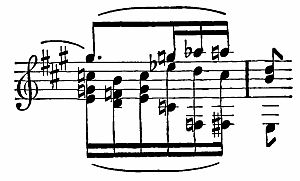
The movement is not so great as the preceding, and is perhaps too long (which is a decided art-fault—not merely a mistake in judgment); but, as a whole, it reminds us of Shakespeare's "entire and perfect chrysolite;" we greet it (and other movements of Beethoven's) with feelings of profound affection; as though we had realised those words "Yet a little while and ye have me with ye"; as though we had been living, for at least a breathing space, in the atmosphere and society of higher life, out of the sphere of time and in the sphere of the eternal. We have had such pleasure that we feel more good; we issue grateful and earnest, happier, better men. There have been sighs of regret that Beethoven did not write more music like his Symphony in F; but not only this movement, but these two first symphonies, the sonatas in E flat, "Adelaide"—nay, almost all his first period compositions. And here our glances at this symphony must cease. The trio, with its delicious strain, pleases us more than the scherzo (a strain that might be made much more of). The scherzo itself is less sympathetic than that of No. 1: seems, in fact, rather heavily frolicsome. The finale is a masterpiece, though decidedly inferior to the first movements. Do composers often write their finale when they are jaded? they should make this their golden rule, toutes les choses ont leur matinée.
Symphony No. III., Op. 55.
"Lo Motor primo a lui si volge licto, Soora tant'arte di natura, e spira Spirito nuovo, di virtù repleto"—
When we stand before this Symphony, like Death, it "gives us pause"; it looms so great, so vast. It was no wonder that it was not comprehended at first; and this should be not a subject of regret, but gratification, to the genius. Genius implies non-comprehension at first, and all sorts of "cold obstruction"; and here it may at once be said that, on the whole, genius, like virtue, is its own reward, and perfect compensation for all drawbacks. This should be borne in mind when uncalled-for lamentations are, not unnaturally, yet rather thoughtlessly made. Certainly, Beethoven would not have been satisfied had this phenomenal work, this prodigy, this spiritual Labour of Hercules (type of all the great Helpers and Saviours of mankind), been immediately grasped. To comprehend, in some small measure, the prodigy called the Universe around us, men and things have had to evolve for countless ages; it is the same, on a miniature scale, with individual works; and every poet rids himself of his message in the great spirit of the great Kepler:—"I may well wait a century for a reader, as God has waited six thousand years for an observer." To no man not rich in such a spirit will any great message be whispered and entrusted.
Beethoven was, in his sphere, and with his vehicle of utterance, a prophet—a coming event that threw its shadow before. He revealed to men, if they could but have seen it, the Nineteenth Century—its inner life, plus the nature and passions of the present (his own day) and the past. No wonder, then, that the men of his own day—the great mass, the local majority—could not understand what really is a truer mirror of us—our doubts, and fears, and struggles, and hopes. And the Sinfonia Eroica, I take it, must be so interpreted—in a spiritual sense (at least as well as in the physical, or literal)—as much as the Symphony in C minor, at least as much as the Pastoral Symphony which Beethoven himself said was really emotional rather than descriptive. And it little matters whether or not Beethoven himself consciously uttered these manifold messages of his in this or that sense; he has as perfect a right as Shakespeare to be deemed full of all that can be packed into him; nay, it is all the better if he was not conscious: to repeat—unconsciousness was the soul of his consciousness, as it ever is, and must be, of all higher speech and performance.
No mere battle, or ordinary warfare—certainly Napoleonic—can adequately explain, is solely depicted in, this grand work; though they become far more satisfactory, so applied, when we consider them as coarse manifestations of the higher qualities; in fact, as backgrounds for and revelations of heroism. By dwelling on this, we get nearer to the soul of the symphony; spiritual warfare, rather, is what it proclaims. [A] Of Beethoven's notes, it may be quite as much said as of Luther's words—his notes are like other men's battles. Better than any poem this symphony (especially the first movement—facile princeps) seems to hold the mirror up to Man in his Warfare, specially and generally, physically and spiritually, with and in his own inscrutable self, and with and in the unspeakable elements of time. It is not without special beauty, in the last but one, or Faust sense (we were struck and pleased to come across Bendel's words, corroborating our own notion, that Beethoven was in some sort a Faust); and, before this symphony, we feel Beethoven was that good man, struggling with adversity, the spectacle of which is a benefit to the very gods; and, under this feeling, the symphony does us double good. The fact on the face of it is, its Titanic power in maturity. The first two symphonies, also rich in power, are stamped by a spirit of youth. This gives them a delicious charm which makes them extra dear; and which Beethoven himself (let alone others) was fundamentally mistaken (we feel) in underrating, nay, disparaging, as he was afterwards wont to do (really, when his mighty powers were waning, and he was perhaps in secret aware of that; it is the common melancholy trick of men). That peculiar spirit of freshness here at length we seem to miss, or are no longer struck by. Here we may draw the line. Here we see the ripe man, or very nearly so; at least in the prime and plenitude of his powers; not quite so happy as before, but stronger; and as yet with no serious threatening shadow of gloom—though there may be clouds "as big as a man's hand," and even occasionally, perhaps, hints, like the mole "cinque-spotted i' the bottom of a cowslip," of tragedy and aberration among the most melancholy in the history of men.
Beethoven was an emphatically conscious, but profoundly unconceited man. We are sure, therefore, that he entitled his symphony "Heroic" (if he did do so) with no unpardonable vanity; nevertheless, we regret that (as also in his "Grand" sonatas) he did not leave it to others—for itself to call itself that. Truly, he did not exceed much in betitling and programming—his sense of the infinitude of music was too profound, of that as being the charm; but even in the few cases where he did, perhaps the breach would have been better than the observance. One great disadvantage of betitling music is, that it does not allow us to approach it afterwards without preoccupation and convention; whereas, we should approach it utterly free, except from our own nature, and previous existence. Moreover, if the work correspond ever so to the title or description, it is discounted beforehand. To say afterwards, "that is heroic!"—"this is pastoral!" is an added charm. But to details.
It will at once be noticed that Beethoven begins this symphony quite differently from its predecessors; allegro con brio, two emphatic chords, and then in medias res; the bass, however, leading off, as in No. II., with, moreover, the same well-balanced poise (delicate, yet firm as that of planet in its orbit), springy step, and self-contained power. A characteristic originality is the C sharp, where the bass breaks off, hardly begun, and the
"Upper air bursts into life,"
with glorious breadth and soaring—soaring to the primum mobile through obstructive cloud (discords of the dim. 7th on pedal tonic) with only increased éclat! Thereupon, the basses worthily show forth the heroic confidence of the nobly unstudied theme—great and gay with the certainty of final victory; as it were, the warriors of Israel advancing to conquer the Promised Land. Then, from none knows where—from the very heart of heaven—fall shafts of light indeed, as it were through the bosom of fragrance; which exquisite strain, perhaps, contradicts what we said about the absence of youth in this work. In any case, it is one of those many melodies which so movingly proclaim Beethoven a profoundly good man, and how he wrote them so from above, or rather they poured through him from infinite heights (depths overhead) of ineffability. In this, in the power of his sweetness, he has never been surpassed, hardly equalled.
There are melodies by later men very beautiful too, which seem, however, to come (we are almost tempted to write) like certain later poetry, from a profoundly bad source; they have demoniac, not divine beauty. The strain in question:—
[Listen]
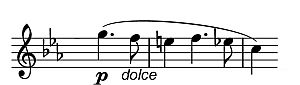
Certainly a
"Dolce melodia in aria luminosa,"
seems the spirit of Love itself pure and simple—as it were, a glance from the "young-eyed cherubim" into the Warrior's—into Beethoven's own heart. But, in this "painfully earnest world," such blessedness cannot long last, and the sunshafts are soon again obscured in the smoke of battle—the mystic whisperings drowned in the din of artillery. Apropos, it struck us that, if we like the warlike figure, this grand battlepiece (by Rubens? or Tintonello?—Rembrandt, we would rather say) gains, if we consider it as a sea-battle, in a storm, with wizard lights and seams of fire all along the horizon. Nay, in the second part—those wonderful strokes of genius where the chord of the sub dominant (?) is piled on to and clashes against that of the relative minor A—we fancy it vividly depicting "Nelson falls!" (the true hero, whose pole-star is duty; not pleasure, nor ambition); and the unspeakable passage a little further on (in E minor—Beethoven alone capable of it—never dreamt of in the philosophy of his predecessors), suggested his death—(or rather, more stupendously, that of the Christian Hero, when He "gave up the ghost," crying, "Finitus est!").
More than one modern work has attempted to depict the world-old great subject: Virtue and Vice contending for (or within) a human soul—the struggle of Good and Evil. Methinks, as long ago as this Heroic Symphony the same struggle is represented, or shadowed forth (for its great text, like music in general, and more so with Beethoven, has many meanings). The third (?) subject in this theme-rich movement, where Beethoven from his full heart pours forth one motiv after another, is especially suggestive of conflict—what shocks, clashes, contentions!—but the "good angel fires the bad one out," and bears the precious prize aloft in a whirl of triumph—resounding, as it were, through the halls of heaven—
"Whose Titan angels, Gabriel, Abdiel, Starr'd from Jehovah's gorgeous armouries, Tower, as the deep-domed empyrean Rings to the roar of an angel onset."
But then—
"Me rather all that bowery loveliness, The brooks of Eden mazily murmuring, And bloom profuse and cedar arches Charm, as a wanderer out in ocean," "Where some refulgent sunset of India Streams o'er a rich ambrosial ocean isle, And, crimson-hued, the stately palm-woods Whisper, in odorous heights, of even."
Then we have a strain which seems to anticipate Schumann himself, the greatest symphonist after Beethoven—a singular repose, of almost unearthly loveliness, after the high commotion.
A little later, and ecco! a new idea:—
[Listen]
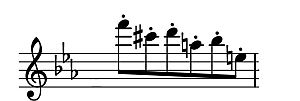
exquisite in its lightness and strength (like a giant at play, or a river disporting in its banks); and thereupon, after bold progressions, six remarkable iterations—also like "So Fate knocketh at the portals!" or like blow after blow of virtuous resolutions; where all is characteristic, this is strikingly so. Then follows another of his ineffable thoughts (supremely); and then, after another whirl of the sacred fury, which seems to be the soul of this unexampled movement, we are brought back to the original subject, which re-enters in its own colossal continence; and these truly "stupendi pagine" (and not those about Goethe's Frederika of Sessenheim, in his "Autobiography,") are repeated. The second part, or elaboration (as it is called) is likewise, and par excellence, stupendous, especially the part before adverted to, in A and E minor. Here, truly, the music quite transcends ordinary language and thought; to bring ideas worthy to it, we must recur to Him who cried "Lama, Lama, Eli Sabbacthani!" This is the anguish of a Redeemer-soul. But to such, also, is the victory; and to such the Father sendeth legions of angels. See, also, especially the passage further on, in G flat (should it not be andante?)—which, as it were, almost overcomes us with enchantment. Here, methinks, the Invisible Auxiliaries already bear the poor shell, and whisper at the same time a word of comfort to the Mother—whom no Power strikes into stone, like Niobe.
"He that hath ears to hear, let him hear!"—ears that are but the outwork of the soul. Let him go, even as it were, prepared and attuned, in some sort like a Communicant—and receive music's banquet mysteriously provided for him. The message of a Beethoven is not trifling, but earnest; speaks inarticulately (more divinely so) of the greatest, solemnest, things; whispers and thunders from the Altar. If "the value of no word is known till the greatest master of it has arrived," so also the value of no utterance is known till the greatest receiver—understander—of it has arrived. Plato said, Poets speak greater things than they know. Of none was this ever truer than of Beethoven. He alone, in his day, most knew the value and import of his music; others come after (and will come) who know more. This is his greatest praise. There is no more congenial occupation to a sympathetic imagination than throwing together some of the images, thoughts, or ideas which his mighty music suggests. Goethe was displeased when importuned for the key idea (more Germanico) of his "Wilhelm Meister;" thought that itself should be sufficient of itself. It is the same with Beethoven and this symphony. No rigid principle must be sought, or insisted on. The first movement especially does indeed stand very four-square and homogeneous; but the fiery soul of it (sun-fire, passion and beauty,) is very various in its manifestation; and unless we understand and apply the term "heroic" in its amplest sense, we are fettered and injured rather than benefitted and helped. The greatest Hero we yet wot of was personified self-sacrifice, love—who did not flame abroad over that world a devastation, but made his life answer the queries of philosophy, and the doubts of the sceptic; the greatest Hero was one who "went about doing good."
Tennyson's eloquent alcaics on Milton—
"O mighty-mouth'd inventor of harmonies, O skill'd to sing of Time or Eternity"—
the rest of which have been already quoted, seems not inapplicable to Beethoven and this his symphony. Many others would do as well, or better. Of general application—when we think of its melodious rush of ideas (one of the distinguishing features between it and the first two symphonies), great republican spirit (in the highest sense), Sun-god beauty, and Jove-like power; of its intellect, superior to that of Bach's (it seems to us), as Carlyle well says Shakespeare's was to that of the author of "Novum Organum," and of its grace and sweetness, profounder than, not only of Haydn's and Mozart's, but any other composer's, then the beautiful words of Dante, at the head of this chapter, may apply.
The Prime Mover turns joyfully unto him, and, surpassing nature, breathes into him a new spirit, replete with virtue and power.
The Funeral March.
Beethoven was a gloomily profound soul;—herein differentiated from Shakespeare, who was pellucidly, cheerfully profound; and unlike Schopenhauer (whom he otherwise rather suggests), who was profoundly gloomy—one of the most so who ever lived; therefore he composed a "Marcia Funèbre" specially con amore, and therefore it is specially characteristic of him. In the present instance, this, as it were, unfathomably profound inspiration, gains, as in every other case, if we interpret it liberally rather than literally, and consider it to depict and deplore rather the death of a great Principle (such as Faith, Virtue, Truth,) than a great man; or the great man, the hero, plus the heroic, buried with him, ultimus Romanorum. If we would realize the depths of this utterance—as it were almost speechless—choked with tears—we shall think of it in connection with such words as the following:—
"Tired with all these, for restful death I cry— As to behold desert a beggar born, And needy nothing trimm'd in jollity, And purest faith unhappily forsworn, And gilded honour shamefully misplaced, And maiden virtue rudely strumpeted, And right perfection wrongfully disgraced, And strength by limping sway disabled, And art made tongue-tied by authority, And folly (doctor-like) controlling skill, And simple truth miscall'd simplicity, And captive good attending captain ill; Tired with all these, from these I would be gone, Save that, to die, I leave my love alone."
Speaking of Schopenhauer, the difference between him and Beethoven seems to be this:—the latter shows us Optimism victorious over Pessimism; his works, indeed, seem specially and wonderfully to mirror the struggle, as indeed, the whole of this century at least is profoundly tinctured, nay seems almost characteristically stamped by Pessimism; but Beethoven does not, and will not give way to, and end in the rayless paralysis of Pessimism; he fights through, and soars triumphant; in Mr. Picton's words, re Materialism, "comes out at the other side." In this, methinks, the deadly struggle betwixt Optimism and Pessimism around us and within us; but the victory of the former, and the triumph of Immortality over Doubt and Denial, we have the key to Beethoven's music (of course unconsciously, and, as we say, so much the better; it would have been worse expressed had it been conscious). At a moment when Pessimism was uppermost, he might have sat down to write this Dead March: that it was to celebrate Napoleon Buonaparte was never the case, though it might have been to celebrate the Napoleon of Beethoven's imagination, a Hero, to bewail whose departure from among us no tones can be too pregnant and profound, especially if we think we have "fallen on evil times," and that we shall "never look upon his like again." And here a word about Beethoven's (the true hero) immortal act, when he heard that Napoleon had made himself crowned—(the other hero we spoke of refused a crown, and hid himself); was not that a repudiation of Tyranny and Quackery? was not that a royal piece of Iconoclasm? to me it is one of the highest private scenes of History. Summon it up one moment:—Beethoven's eye flashing fire; the lion locks almost shaking flames, as he tears the superscription in half (and Napoleon's fame with it), and dashes the "carefully written out" symphony on the floor, "put his foot down on that." So, I should like to see Beethoven painted; or still better, sculptured. Dr. Nohl has taken occassion to draw an elaborate parallel or comparison between Beethoven and another great contemporary of his, Goethe—(we would draw it also to the advantage of the former;) Carlyle has done so, between Napoleon and Goethe; we would do so between Napoleon and Beethoven, and call the latter in our great Sage's words, a "still white light shining far into the centuries," while the other was meteoric flame and volcanic glare—not wholly, solely, for he too was an instrument—an able, and necessary one, but in comparison. Let anyone ask himself how he feels at the mention of the two names. Is he not expanded, cheered, comforted, and made better—unconsciously made surer of goodness, truth, immortality, and all high things, at the name of Beethoven; and is he not repelled, if dazzled, by that of Napoleon? The good was not buried with Beethoven's bones. Think of the amount he has done after his death (like Handel and his "Messiah"); think of his industrious great life and character—so originally grand; and contrast it with the portentous mass of lies and murders, the conflagrations and widow's tears, the hideous battle-fields of the heartless, semi-conscious, semi-quack, diabolically selfish Napoleon, and the good he has done after him. No! the good Wolfe had rather have been Gray than the victor of Quebec, and we would rather have been Beethoven than Napoleon—whose very genius, moreover, is over-rated; for we decidedly think with Madame de Stäel, that had he met with an able and honest adversary early, he would have been checked or defeated; nay, he was, when he met Sydney Smith at Acre; and, curiously enough, after, when he met another Briton, who was never defeated—Wellington. Napoleon will always be marvelled at and written about, but it will never be said of him—"in his works you will find enrichers of the fancy, strengtheners of virtue, a withdrawing from all selfish and mercenary thoughts, a lesson of all sweet and honourable thoughts and actions, to teach them courtesy, benignity, generosity, humanity; for, of examples teaching these virtues, his pages are full;"—as it was said of the author of "Hamlet," and as it is here repeated of the mighty composer of this "Dead March," with its wails from the deepest and strains from the highest thing known—the heart of man.
The Scherzo.
With a glance at the Scherzo, we will bring our remarks to a close, the more especially as the Finale seems less interesting, relevant, and original (Beethoven seems more to have copied himself,) than the rest.
The Scherzo, with its obbligato constituent element, the "Trio," is on the same great scale, and in the same epic spirit (we see no particular need, with Wagner, to seek a connection,) as the first movement. Here we see the gods and heroes, the immortals, at sport in their own high hall—green-hill'd theatre, and "deep-domed empyrean." Here Optimism is not only victor, but full of play and humour. Such Olympian sport, such great picturesque music, was inconceivable to Beethoven's predecessors; and we get some idea of his merit when we reflect that the ground, when he began to write quartets and symphonies, seemed already occupied, the sphere exhausted; and when we reflect, how, of all Haydn's 119 symphonies (!) not one, in some seasons, is performed; whereas, Beethoven's are the feature of almost every performance, and are found now to be "favourite with all classes," as the Sydenham programme asserts—a statement which, otherwise, rather provokes an elevation of the eyebrows. The trio, especially, is of exceeding original beauty; there are few more grateful pages in Beethoven; none where his peculiarly characteristic healthy sweetness (freshness-and-power—depths of purity, beyond plummet's sound,) is so strikingly, so enchantingly displayed. At the base of a great mountain in Switzerland, with his foot in two lakes, and with sides that might almost have been an envy in Eden, there runs—from one magical sheet of water to the other—a heavenly valley. There we once saw a local military Fest, with flying banners and echoing music; and, as we walked along, under the eternal brow of that immense emerald bastion, with the spring sun before us, we thought of this Trio, and said—"Here is where it ought to sound, by a noble army on its return, laurel-laden, from righteous victory;" and Shakespeare's lines again festeggiavano in the memory:—
"Now is the winter of our discontent Made glorious summer by this sun of York; And all the clouds that lower'd upon our house In the deep bosom of the ocean buried. Now are our brows bound with victorious wreaths; Our bruisèd arms hung up for monuments; Our stern alarums chang'd to merry meetings; Our dreadful marches to delightful measures. Grim-visag'd war hath smooth'd his wrinkled front; And now, instead of mounting barbèd steeds, To fright the souls of fearful adversaries, He capers nimbly in a lady's chamber, To the lascivious pleasing of a lute."
How exquisitely we can fancy the horns making those mountain-walls and woodlands ring! and the hautboys in response, gladdening the pastures; while the flutes (later) curl the wave; and the bassoons, along with the other two epico-pastoral instruments, after the maiden welcome of the violins—welcome by maidens:—
"Oneste e leggiadre in ogni atto."— "Set all the bells a-ringing—over lake and lea, Merrily, merrily, along with them in tune."
It is all enchanting; no greater epico-lyric poem in Beethoven—who, even in the midst of this triumph and beauty, cannot (thank inspiration!) but speak from the profundities of him. I allude to that wonderful passage where he brings in (hitherto reserved) the clarinets (that voice of heroic women, as Berlioz finds it), over the intensely expressive progression of the strings, in response to the breathings of the horns. In music perhaps there is no profounder interchange of heart and soul, of sorrow and affection, touching reminiscence from the lowest well-spring. This, perhaps, is a glance at the "happy autumn days that are no more;" or an heroic wail over the dead and desolated; a glance back at the horrors of war—a thought for the widows and orphans' tears falling even now around; and yet, under all, a stern determination to brook no tyranny, love of duty, and a high submission, cost what it might, to the Supreme Will.
Symphony in B Flat, No. 4, Op. 60.
This Symphony is only another proof of Beethoven's kinship with Shakespeare. The terrible romance of "Romeo and Juliet" (where the atmosphere seems loaded with love and doom); the classic grandeur of "Coriolanus" and "Julius Cæsar"; the passionate intensity of "Othello"; the fearful sublimity (depth, as well as height and breadth) of "Macbeth" and "Lear;" the beautiful greatness of the "Tempest"; and the subtlety (seraphic, not demoniac), tragic picturesqueness, inner life, and almost superhuman power and insight of "Hamlet," are all, more or less (and, indeed, more rather than less), to be found reproduced in Beethoven; and truly, as it is borne in on us, in him, the tone-poet, more than in speech-poet, certainly more than in Schiller and Goethe; more also than in our own men, of whom none after Shakespeare can compare with Beethoven except Milton—and him we reckon inferior. There are indeed two elements of Shakespeare which Beethoven lacks, his characteristic serenity and humour; besides that, Beethoven's tragedy is the tragedy of his own soul, whereas Shakespeare wrote outside himself. Beethoven was a colossally subjective storm-tossed spirit (though also eminently objective—none surpasses him in broad vivid painting of images, as well as "the life of the soul";)—the dove of whose ark (to speak figuratively) never found soil for her foot after youth had died out, and the flood fairly set in. But, in his prime, also in the "April of his prime", and at his best, he bears a greater family likeness to the great ancestor than any other man, though he really resembles no one but himself, just like Shakespeare, as we feel after long but futile efforts to pair him with somebody—a fact highly curious and interesting! The kinship, however, is equally striking and fascinating; and nowhere, perhaps, is it more fascinating than in this B flat Symphony, which we are inclined to term par excellence beautiful; as its predecessors are powerful and great. Indeed there seems something of the opaline varnish—or rather, lustre, like a leaf's—from within—of Mozart; specially beautiful, as he is specially beautiful, and is not powerful or great, profound and earnest, grand. But, again, plus the grace, there is also, below, the characteristic depth; after all, and as ever, power is doch the soul of the beauty—as—and here is our point—in the "Tempest" (and "Midsummer Night's Dream"), as in Shakespeare, rather than in Mozart; indeed, we know not but what Haydn's beauty has more a soul of power.
The enchanting spirit of Shakespeare's fairy plays, and the enchanting spirit world, seems that too of this symphony. Here are Puck and Blossom, Oberon and Titania; here are Ferdinand and Miranda—above all, Ariel and Prospero. Prospero, whose sublime spirit shines and rules in this inaugural adagio—adumbration of Chopin (?) which dwarfs Chopin indeed!—is much nearer akin to Schumann. It is like an inspired dream (a Jacob's, or Elijah's, or Daniel's). It seems a great foreshadowing of his later style; in its vagueness it is vast—as it were, a vestibule or forecourt of the Infinite, of higher life; of that beyond, methinks, whereinto Prospero (our own great dear, sad Beethoven, tired of all, and of himself,) sinks his dreamy glance, when he casts away for ever his magic wand (magic only in a lower sphere, where life and character are inferior); "deeper than did plummet sound," and cries, wrapt from the bystanders:—
"The cloud-capp'd towers, the gorgeous palaces, The solemn temples, the great globe itself, Yea, all which it inherit, shall dissolve; And, like this insubstantial pageant faded, Leave not a wrack behind."
In the allegro we seem to continue our analogy—in the wondrous isle itself (Isle of Formosa), "full of strange sights and sounds." Here, not Greek Naiads and Dryads, but Christian sprites and fairy-things, or both in loving rivalry, flit and trip invisibly and visibly; here is freshness! here are sunbeams! here simplicity and sweetness (woodland and pastoral beauty)! And if, in the matchless adagio the sea murmurs round the "still-vext Bermoothes," and Ariel fetches thence dew; here we have all-compelling Prospero commanding the most exquisite airy sport—but not for himself—but for the lovers.
The scherzo (to take that next), forces upon us once more the question—how far did Beethoven, in composing, draw upon his early treasures? This delicious burst—or gush—of inspiration, as it were a moment flashing over, might have been written in the same spring months as that other delicious morsel—specially cherished by us; the scherzo ("Allegro") in E flat, in the early sonata of the same key—which has always seemed to us the very breath of spring itself—a page of nature in April. And why should a Beethoven disparage his early works? were they not doch the works of a Beethoven! Alas, he can never be young again, never after equal them, for their breath and spirit, for the April of their prime.
We should like to hear Liszt or Rubinstein play this morsel arranged. It is as delicate as Heller (whom it indeed anticipates) and Mendelssohn, and strong as Wagner;—but nay, Beethoven will compare only with himself. It is originally exquisite and exquisitely original. It has, too, the same magical, nay, mystical beauty whose glamour is over all this musical mirror of the "Tempest." The imaginative Sonata in D minor, which Beethoven himself referred to the enchanting drama—especially the first movement—reflects, I take it, the deeper bases and significance of the poem; tempest-tossed man, with his cries to the Unknowable, almost like a wounded animal, and rays of sunshine pouring still through storm; man, at war with the elements and himself, the elements without and within him; man, so little on this stupendous stage; man, so great with his alone-perception of it; man, so mean and hateful in his baser parts, so colossal, so divine in his higher; so low as animal (lower than they), so high as hero and sage. Indeed, the tremendous conflict of outer and inner life, this appalling discrepancy we seem to meet with everywhere; man's struggle with nature, and the struggle of both with themselves, seems to be the inner picture both of Shakespeare and Beethoven—especially the latter, who was a mighty brooding fermenting soul—how far transcending our Byron and his "Manfreds"!—more allied to "Faust," yet greater, nobler, dearer, difficult to arrive at harmony with others and himself ("perplext in faith, yet pure in deeds"), who seems happy only in the first part of his progress (expedition, undertaking, crusade), and victorious in the middle; and whom, alas! we fancy almost as despairing of solving the problem (é pure troppo per me) in the end, and going down in the tempest—yet, like the traditional Vengeur, with guns all shooting, and flag at the mast-head flying, and glorified in the setting sun.
I will not dwell on the finale, but conclude with some fancies suggested by the rarely beautiful adagio—like a lovely bird from another world, like the phœnix new born. Here is what Elterlein says of the finale:—"The truly phantastic, airy, sprite-like (elfenartige), at times even boding twilight" (the Scotch uncanny gloaming would more approach the original, Unheimlicht Düstere—Scotch, by the way, would often marvellously translate German—they have a mass of expressive words which we have not)—"boding twilight, nay, wild culminates, however, only in the fourth movement. How light and vanishing do these tone-pictures hover and pass, what characteristic glooming (Helldenkel) does not envelope this scene too."
Of course, this symphony cannot compare one moment with the Eroica and C minor, for grandeur, opulence, and power; but it is a lovely interlude, giving us a divine moment of gratification and repose—an Italian spring day by a lake, to a tropical one, with its Himalayas and interwoven forest, "like a cathedral with service on the blazing roof."
And now for the adagio! which I will only preface by this admonition, always to be recollected; viz., that whatever fancies or figures music may suggest, and however the abstract terms—such as sweet, tender, vigorous, grand, &c.—may, and must be applied in common to all composers, yet each composer has a special individuality; and the music that suggests the figures and fancies, the ideas, has, apart from this, for ever a special charm of its own, which cannot be lost, nor yet transcribed. To those who do not, and to those who do approve the fancies, this charm per se remains.
The Adagio.
A work of supererogation, the adagio is still sometimes executed at concerts, which rejoices in the sensational title of "Le trille du Diable;" founded, it is said, on a dream of the composer's (Tartini); this, simply-named "Adagio," of Beethoven's, then—in considering which, I mean to surrender myself wholly to poetry—might be a reminiscence of his of music, in a dream, by the angel, Gabriel; or such, for instance, as might have escorted the seraph when he descended, and said, "Ave Maria!"—or it might be an unconscious reminiscence of previous existence of the great and good man; or the strain the Shepherds heard, in the field, watching their flocks by night—again, and more specially, a
"Dolce melodia in aria lumino,"
through the purple air, mingled with ambrosia, and the beams of that evening star. Nay, it might have lulled that head which had nowhere to rest, when perchance it did find some rocky corner; or Saul of Tarsus, or Jonah below on the raging sea. It puts us in mind of the immortal line—
"After life's fitful fever, he sleeps well."
Ah! we see therein the great weary spirit of its own eternal messenger, for once at least, rocked on its waves and soothed by its balm, in the sea of immortality. It is a pleasure to throw together all the ideas with which it inspires us. It seems a foretaste of Schumann and Ernst ("Elegy"); it has their glimmering romance, and Beethoven's own peculiar profound sweetness, not tainted (at least here and yet) by anything morbid, or the suspicion of it. It, too, suggests earlier years—"Ach!" a reminiscence of childhood in Rhineland. It is glamorous, but with the glamour of Ariel—a spirit of good—the spirit of Shakespeare. It is tender and beautiful as Jean Paul; deep, sweet, unutterably. Methinks it paints this:—
"Oh sea! that lately raged and roared— Art now unruffled by a breath?— So shall it be, thou Mighty Teacher, With us—after Death."
And this:—
"And balmy drops in summer dark Slide from the bosom of the stars."
And this:—
"When summer's hourly mellowing change May breathe with many roses sweet, Upon the thousand waves of wheat That ripple round the lovely grange."
And this—with peculiar propriety:—
"Fair ship, that from the Italian shore Sailest the placid ocean-plains With my lost Arthur's loved remains, Spread thy full wings and waft him o'er. So draw him home to those that mourn In vain; a favourable speed Ruffle thy mirror'd mast, and lead Through prosperous floods his holy urn. All night no ruder air perplex Thy sliding keel till Phosphor, bright As our pure love, through early light Shall glimmer on thy dewy decks. Sphere all your lights around, above, Sleep, gentle heavens, before the prow; Sleep, gentle winds, as he sleeps now, My friend, the brother of my love."
(Note especially the truly seraphic ineffability of the passage in G flat). It is such music as might have accompanied Him who made the storm his mere mantle, and the raging sea the mere pathway of power; of Him who had the right of all men to say—out of whose mouth the word sounded fullest—Peace!
Symphony in C Minor, No. 5, Op. 67.
Beethoven might well write an Heroic Symphony, for the very soul of his symphonies is heroism. He named one "heroic," but he wrote many, including the sonatas, which are unfortunately limited to the piano, whose powers they utterly transcend. Heroism is the soul, and antagonism the substance, through which heroism ultimately fights its way. Beethoven is the Hercules of music (Hercules was in some sort also the Pagan Christ), undertaking labours for men's emancipation and help; beating Hydros down; conquering all sorts of opposition—unconquerable except by love; and, like the antique hero, alas! with an end as tragic. Such comparisons we are obliged to have recourse to, to explain Beethoven's music—its might and significance. "What, then, does this eternal conflict, and victorious heroism storming through, mean?" Ah! how they still paint the conflict of rule and anarchy, of the intellect and reason, of passion and prejudice!
Man is called the microcosm of nature, and music is the microcosm of man; his antagonism and heroism, internal as well as external, are herein mirrored. Music is the highest art; because the most spiritual, infinite, self-existent (creating, not copying), and comprehensive. No statue, picture, or pile, can compare with the power of a symphony—which, indeed, all but rivals that of nature herself, of the great world and starry heavens; the secret of whose power is also the Infinite, with its whispered promise—its soul—Immortality. Art is the shadowing forth of the infinite: music does this most, and Beethoven's is most music. Music, as we said, is the microcosm of man. As the world is comprised in him—alone realized by him, and therefore in some sort alone existent in him, so are his nature and history comprised in music—his depths and heights, beauties and deformities, aspirations and passions, circumstances and powers. It is the "might, majesty, and dominion," inarticulateness, profound beauty—as it were searching flower-cups with star-beams: the effluence of a soul deep as heaven (beyond the other side of earth)—of man (not "etwas," of a man) that Beethoven shadows forth. That one, also, who struggled in the womb—what was he but a type of man in the all-comprising womb of nature? And this, also, Beethoven's music suggests; not least the music of this stupendous symphony—only another "Eroica," and greater, without the name (better so). More suo, Beethoven himself flashed a meaning more or less on it. "So knocketh Fate at the portal;" yes! with the portentousness of the "knocking at the gate" (see Lamb's remarks), in "Macbeth;" yes! fate in the form of duty. And truly, what higher subject—subject dear to the ancients as they are called—subject constantly treated in his own inspired way (Nature's), by Shakespeare—could be chosen? And Beethoven has rivalled Aiskulos and Shakespeare. Here is battle! here is victory!—here, too, the air seems almost oppressive with love and doom; and here, too, in the background, and from the deepest deeps, are wreaths and similes of celestial beauty. "Well done, good and faithful servant; enter thou into the joy of thy Lord." Another thing the first movement suggests is, that it is the greatest of "Dies Iræ." That passage, especially on the second page of the second part, where one half the orchestra answers the other with the same terrific unisons—
[Listen]
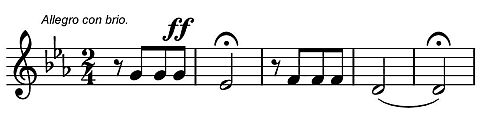
(en passant, did ever reiteration play such a part?), prompts the wildest fancies. We think of
"The glooms of hell Echoed with thunder, while the angels wailed;"
or again, echoes of deserted hell on the day of doom—the fiends summoned to the judgment-seat. But let us recur to Beethoven's more human suggestion. Fate knocketh in the form of Duty; Promethean free-will, human passion, rebels and struggles for a time, but at last yields; and heroic resolve is triumphant—heroic love. For, "Ach!" methinks these terrible blows are indeed those of Fate; but also those, viz., which nailed Heroic Love (comprehend both words) to the cross—heroic love that made even
"Destiny coincide with Choice;"
—that from the horrible instrument of torture and death itself, cried, "Father! forgive them, for they know not what they do;" and in the midst of the greatest of struggles and temptations (viz., with himself), wrestled and conquered, and cried, "Not my will (the local), but Thine (the universal) be done."—Such is the colossal difference between the pictures of Christ submitting, and Prometheus cursing the gods.
It is a remarkable fact, that this symphony is so great—indeed, the greatest; and yet, it is a fact fundamentally, instructively natural; for, not premeditating it beforehand, Beethoven sat down to write about the greatest thinkable subject out of his inmost own heart—nay, as it were, with his own heart's blood. Another remarkable fact is, that the so much abused public soon realized that this symphony was the greatest. This symphony paints Beethoven's life—especially inner life—which "life" properly means. Here we see genius struggling with fate, in which his life was sunk (like every life); wherewith our little life is rounded, as with a sleep. Fate! What had it done for Beethoven? What does it mean?
In the first place—mysteriously great fact—Fate had from the outset given him her own answer, had put into his hands the weapon for defeating her, viz., Genius. Armed with this, he can bide his time, and take all the drawbacks plus; especially as with him genius implies, what, properly, it always implies, Valour—or, in the valuable Latin double-sense or many-sense of the word, Virtue. The drawbacks—disagreeables, obstacles, from drunken father, aye, and own character, downward—in no wise fail to come. Amongst the gravest are the physical, deafness; one mixed, unsatisfied heart; and one spiritual, unsatisfied soul—all sunk in the adamantine environment of Fate. But then, as observed, Fate equips her adversary for the battle. And mark how Beethoven quits himself in the encounter. In early morning, in the burden and heat of the day, and by declining sun, he—like every true man, (like the Son of Man, or Brother of Man)—fights Fate with his life; makes his life answer doubts; and queries; and despair, the crucial questions which Fate forces on him. It is in this sense Emerson's saying applies. Beethoven thus answered questions he was not conscious enough to put; as, on the other hand, he also put questions he had not the power to answer—like the nineteenth century itself—questions which the twenty-ninth will probably be seeking a solution for. When Fate buffeted Beethoven at home (bitter mockery!), he worked in the direction, and with the instrument, which nature gave him; when she appeared as grim Vièrge de Fer, commanding him to earn his bread, he worked; when she appeared (more cruelly) as syren (mocking him), he worked (not went away and rioted); when—the most unkind cut of all—she made him deaf (him, Beethoven the grandest representation of man for the constituency, Music), he worked harder than ever; and all through the time, down to the end, when he could not, though he could not, satisfy the most irrepressible and unsatisfiable of all inquirers, his own unsettled soul—incapable of grasping eternity, knowing it must exist; incapable of proving immortality, feeling it is the very breath of life and beauty, and must be—from first to last, he worked. For this, he could dispense with going to hear Immanuel Kant; though, assuredly, their understanding of the "Categorical Imperative" was one, viz., Conscience(?). "Two things strike me dumb,—the heavens by night, and the moral law in man." Let Fate knock as she may,—unannounced, her loudest, long-sustained—as in these portentous notes (was ever chord of the dim. 7th so treated—so inspiredly?):—
[Listen]
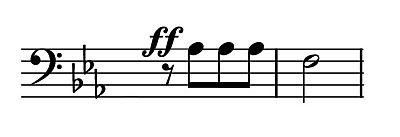
in these notes—whose indefinite dwelling seems to say, "I pause for a reply." Fate confronts man—a being repleto di virtù; a being bound by will, but with an unique sense of freewill: here she meets consciousness-and-conscience. Her blows are hard; but "a soft answer (the p ensuing) turneth away wrath"—Beethoven turns her blows (her blows) into beauty. I am also here struck by the reflection, that we may consider these as the blows of death (cum æquo pede)—that form of fate; and they are answered by the soft whisper—"immortality." This soft whisper rises into storm-loudness, at its grandest (further on), that is, where man cries, "Aye, and though personal immortality be a vain dream, I will be immortal here, and thus answer thee, thou bug-bear, Death! Suffice it for me to be here great and good!"
Mark especially, somewhat further on, after the stormy passage, the strain in the major (E flat). I have no words for its beauty (especially if played andante); it is like star-dew fallen into the bosom of a lily. Or, again, "deep answering unto deep," he rises and strikes her back with power. Every depth into which her blows fell him, only confers on this Antæus new power. Though o'er him, in the words of the Greek Beethoven (Aiskulos—in the Greek Macbeth, Agamemnon)—
"Billow-like, woe rolls on woe, In the light of heaven,"
they
"Cannot bring him wholly under, more Than loud south-westerns, rolling ridge on ridge, The buoy that rides at sea, and dips and springs For ever;"
—to use our own poet's magnificent image—(type, as here applied, of character; or of immortality—the eternal hope of it in man). Such we figure the conduct of this Titan in the stupendous conflict—Titan, who made the very gods tremble:—
"Fialte.—La nome; e fece le gran prove, Quando i giganti fer paura ai Dei."—
He conquers, because
"Soleva la lancia D'Achille e del suo padre esser cagione Prima di triste e poi di buona mancia,"
to quote the Italian Beethoven; the spear of Achilles, and his father, heals its wounds. The cruel blows of Fate and Temptation (to error and despair) are resisted, cured, and beaten, as before said, by her own gift, or by herself, in the form of character and genius. In the light of the higher reading before-mentioned, Fate, under the terrible but divine form of duty (divine necessity), knocks at man's heart, and bids it open; but that being human—
"Frailty, thy name is Man,"—
hesitates, protests, rebels, in all the strength of selfish passion, of full-armed nature. As before thrown out, the grand lesson (whatever dialect man may speak or think), the tremendous spectacle, is in the Garden of Gethsemane and in Golgotha. Thither we must repair, if we would realize the force of this idea—of this music. In the light of morning we have once again played it (gewiss not like a Rubinstein), and find our words no whit too strong (after orchestral performance one is simply overpowered). We are struck with the impression that it is the most dramatic work, not only in music, but human performance (no painting, even, can so evoke all the feelings of the Cross); and we would use the higher imaginings we have to give our brother musicians an idea of the true greatness, the sacred grandeur, of their art: it knows no rival but poetry.
Let us, then, with a final glance at that stupendous drama, close. Fate, in the thunder-pregnant darkness, over all the cypress-bowers and cedar-glooms, "commends" the fearful chalice to the lips. Ensues the highest of struggles—godlike; but, finally, with the most immortal of earth's words, Character, the softly invincible heroism of self-sacrificing love, the grandeur of filial submission to the Universal Will, conquers; and a strain of seventh-heaven triumph bears away the words—"Father, not my will, but Thine be done!" It is the same in the fell scene of Golgotha. As we said, these blows are the nails driven home; but they cannot nail down the spirit; and the spouting blood is a fountain of glory; the cross by magic, made the highest symbol of men. Fate may do her worst now—from without or within; temptation was trampled under foot; and, lo! Fate is conquered!—or rather, one with apotheosis and immortality.
The Andante.
I recollect reading, some one exclaimed, in natural rapture on hearing this andante of andantes (the only rival of the sonata theme in A flat—?) "Oh! what must that man have felt who wrote this!" Yes; felt when he wrote it, and all through life. What inner life was not his! "It comes before me," as the Germans say, that this movement should be played before the distant sea, in the westering sun of a summer's day. Methinks, on its heavenliest of dreams, in view of that suggested sea of immortality, Beethoven's own spirit might pass away; had a sanctioned longing so to do; not in misanthropic disgust (nothing Byronic, à la Manfred) but at peace—with all, all. This is the celestial Nunc Dimittis: the life and worship, including work, in the temple—this infinite—is over; the Messiah is come; higher life dawns upon men—therefore, "Lord, now lettest thou thy servant depart in peace!"
It is impossible to express, only possible in some sort to feel, the unfathomable peace shadowed forth in this music. Or, again, it is a Kinderscene, greater than any of any Schumann. As for "Songs without words," they are tinsel to it. Here is a reverie by one of the highest, dearest, of men, from the summit where he first sees his shadow slope towards the grave, back into the holy dreamland of childhood. Here is its mystic infinitude reflected and shadowed forth by a heart that almost dies in the process for yearning and love. Dies heisst Sehnsucht, dies Liebe!
If Shakespeare, in his marvellous serenity, implies all the storms fought out beforehand (a description difficult to mend); here we have, at least, "the Peace of God which passeth understanding" (is superior to—as Goethe reads it—as well as, baffles), when they have been fought out by the man, the sight of whom struggling with adversity (inner as well as outer, faults of character as well as blows of fate) benefits the gods. Here we have a spirit sunk in such peace as Petrarch's departed Laura speaks of—
"Mio ben non cape in intelletto umano"—
in the sphere Mamiani's "Ithuriel" describes, where there reigns an eternal
"Santa armonia di voglie e di pensieri"—
sacred harmony of thought and will—which is the eternal desideratum, which so few men have, even the greater ones; sphere wherein our Beethoven himself, that
"Anima alpestre,"
storm-tossed soul, buffeted spirit, out of harmony with himself and others, did not most reside (Shakespeare, on the contrary, did—seemed a native of it, nay, dwelling in it, and speaking thence of the tragedies and annoys of earth); but of whose profoundest heart in compensation he knew the deepest secret, in whose bosom's centre he nestled (in his happy hours), repairing thither from the disgusts and battles of the world, or expatiating in the blessed hope of everlasting life, after the raging conflict of doubts and queries, to whose inmost holy of holies he penetrated, and was welcomed; he, the wayward child—to extend the idea—leaving all his toys, and running in a passion of sobs to the Eternal Bosom, with a more peculiar smile than that other who dwelt for ever in its courts, or lingered round his mother's (the Madonna's) knee; for Mozart I fancy the Mother's favourite, Beethoven the Father's; o'er Mozart's music one would inscribe this—
"Madre, fonte d'amore Ove ogni odio s'ammorza Che su dal ciel tanta dolcezza stille,"
but over Beethoven's—
"Ma sovra Olimpo ed Ossa Trona il gran Giove."
Here, in this andante of andantes, we have, as in the bosom of spring after the storms of winter—as over cerulean seas in a southern clime after them,—that effluence, which is like the satisfaction of a good conscience; that breath which went up from the dominated ocean, when One said—"Be Still!"
The Allegro.
"Quando Giove fu arcanamente giusto." "Ich glaube, nur Gott versteht unser Musik."
These two mottoes, from Dante and Jean Paul, give some sort of expression to the feelings excited by this music—music which makes rather premature that offer of a premium for a new epithet, at Symphony, No. 2. And yet it is distinctly the same Beethoven here, only full grown; not only serpent-strangling, but hydra-killing and labour-doing Hercules. Jove, left for ever the society of the nymphs, and speaking from the central throne, orcanamente giusto. One is certain, Beethoven himself could not have explained this music; there is such a mysterious pregnancy in it, such a holy ominousness (if not played too fast), such a shadowy sorrow, such other-world tones of pathos and resolution and triumph. This is a message the prophet does not dream of daring to try and comprehend; an utterance which oracle itself would never attempt to explain. This is the sort of music Jean Paul alluded to, when he declared that it was above our own understanding, clear only to the Divine. This is the sort of music which might illustrate his sublime utterance, "Women are beautiful, because they suffer so much." Here (once more), we have the Invisible Host chaunting in almost appalling mournfulness round the cross, or the tomb—"It is over; it is over. The Man of Sorrows, and acquainted with grief! Thus have they 'done to death' their Highest among them!" But then—
[Listen]
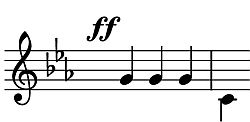
ensues such high retrospect and encouragement—
"Love bears it out even to the end of doom;"
then such angelic clamour of triumph—"O grave, where is thy victory! O death, where is thy sting?" This, too, is a walk "over the field of battle by night" (Marx, re the Funeral March, Eroica); but it is another battle-field than a Napoleonic one—the world is the field, and Heroic Love has gone down on it, like a cloven star at sea. The world is the field, and the highest and the lowest in us doing battle therein, amidst heaps of slain. Poor humanity!
It has been a fearful conflict. What do we not deplore? But, lo! as the infernal volumes roll sluggishly away, as though loth to quit the hateful banquet, high above all an unspeakable orb shines through, the orb of promise and peace. "Ach!" poor man, there is enough, indeed, to root pessimism in thee; evil seems to have nestled in every pore; life seems to try how hard she can make it to live; thou thyself shudderest at thy self; art tortured by appetites, goaded by passions, infested by thoughts, distracted by doubts, almost driven to despair. But, no! do not despair. Progress is slow, but sure. All is justified at last; and higher life lightens in the dawn. Nay, even if thy dearest hope be a dream—that word too great for any mouth, Immortality—be good (great and strong) here; that, if not so happy, is a still higher immortality—
"Then what could death do, if thou should'st depart, Leaving thee living in posterity?"
In such a sea of thoughts—such a thousand-path'd forest—does Beethoven's music plunge us; such a branching piece of the Infinite is it. For the rest, apart from ideas and images, the mere notes have an eternal self-charm. Who fore-ordered this collocation and sequence? Who suggested these harmonious mysteries? How minor and major here phrase and fall together! Never did they do so before; rarely will they do so again. Beethoven was a divine kaleidoscope in a divine hand.
The fugato page takes us into another order of ideas. Here it would almost seem as though tragedy, which threatened to take entire possession of the spirits, were shaken off, and cheerful activity resumed. Here we seem to have the chase, or a military festival, or the resolute alacrity which precedes a patriotic war. The climax, those klingende concords, in C alt., are very fresh and brilliant; and the imitation is a very interesting characteristic bit of Beethoven (proof amongst many that he studied Handel, if he studied anybody); nevertheless, though the resumption of the original inspired motive is simply grand (peculiar to Beethoven), a slightly uncomfortable feeling is occasioned by this music, in juxtaposition with its predecessor. A certain violence seems done to us; we feel "Is not this rather an incongruous intercalation?" Contrast it certainly is, and excellent in itself; but, had it not been better to have left it out altogether? nay, to have been content with the wonderful allegro as it stood—in those continent bars sublime, and not to be eclipsed. Are we not here too suddenly transported from sub-tropical to temperate zone; or, rather, from some undiscovered inter-world, where is the highest discourse on the
"Issues of Life and Death"
to every-day life? In any case, the music is curiously lighter than the preceding; nay, almost suggests the thought that Beethoven might have here made use of a more youthful idea. And, in strict justice, we must say, it is below the level—if not, indeed, unworthy of, incompatible with, this stupendous symphony. In one word, it does not seem to exist of inner necessity (the eternal test), like its marvellous predecessor: it was written, but not inspired.
The Finale.
[Listen]
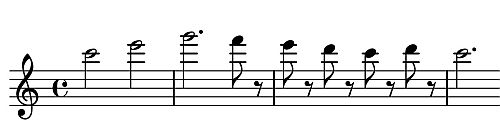
This, rather than, as Marx says, the last movement of Symphony No. 2, might be designated the finale of finales (?)—"The most sublime chaunt of triumph ever pealed forth by an orchestra." Multum in parvo I have put a mark against the D, because that one touch (of nature) makes all the difference; nay, I had almost said, stamps the passage. Substitute a B, and the emphasis is lost, together with the originality. Nevertheless, the movement is hardly of equal value throughout; it has its "worser half;" and is also, unfortunately, too long. As in so many other cases, ideas are repeated, repeated already. But this is not the worst; the worst is, that the overwhelming effect of the stupendous burst is seriously impaired. It should have
"Smitten once, to smite no more."
This terrible "elaboration," so superfluously "necessary"; such a fancied sine quâ non! Here, we must seriously repeat the protest against the conventional custom; nay, almost raise the question, whether it is not rather a reproach to Beethoven (the original) that he did not get out of this thoughtless old groove. Here, the idea did not extrude the form, but rather conformed to it; was, as it were, poured into the traditional mould. But the form should be the eventuation of the idea, of the germ-soul ("pensiero di Dio"), as in a living organism (tree, e.g., or man). [B] With regard to the "worser half" we ventured to speak of, it is simply, as in so many cases, even in Beethoven himself, and notably (as we have so often felt) in the Lieder ohne Worte; there, very rarely is the second motive equal to the first; the first was motive—the "germ-soul," inner necessity of the piece, perforce giving birth to it; the second was factitious. In the present case, does not this subject—
[Listen]
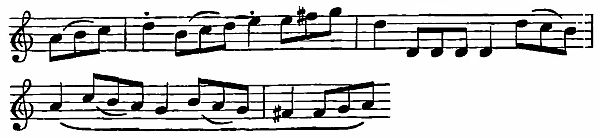
seem really trifling (nay, almost jiggy) by the side of the grand opening, so broad and victorious? We are rather reminded of that traditional movement, whose ambling hilarity is our special horror, viz., the Rondo—we hope by now decently dead and buried; nay, we think, too, of the Sonata in G (Op. 31). This unlucky subject seems to us as unworthy its glorious predecessor as the last movement of that sonata is unworthy of the first—that burst of inspiration, like water from the rock, rolling on into broad Symphonische Dichtung. (In the course of the present motiv, consecutive octaves are prominent). A little further on—one bar and a half, true Beethoven, is worth a page of such undignified Tonspiel. It is one of those bars which convey a "shock of delight" whenever they catch the musician's eye—
[Listen]
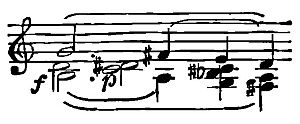
Few pleasures could be more elegant than to extend such an idea ad lib. as an andante on the organ. (We can imagine its effect as a prelude in some old rural church—say on a mellow Sunday afternoon).
Another notable point is, the "grinding out" (long before Berlioz) of the minor second against the tonic; an effect of extraordinary resolution and power—
[Listen]
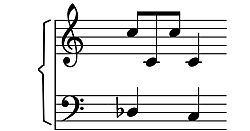
eloquently expressive, indeed, of a determination to bear it out against the shocks of doom. In this and other traits, we have the true Beethoven—such spiritual energy as (except in Handel, and with him it was less human) had not yet been dreamt of; such suffering in strife, and yet such glorying in it; such temptations in the wilderness (of his own heart, as well as elsewhere); such final victorious success! And, here we are brought back into our old more genial vein and strain; we forget the spots on the sun, and lose ourselves in his overpowering effulgence. This "erhabensten Triumphgesang" is, to us, that of resurrection; when the ponderous lid was burst from within with light, which at once—so the great fancy expatiates—redoubled the splendour of day all over the world. Handel's selected words—nay, and very remarkably, the great flash-of-chorus itself (one could, indeed, imagine it as having suggested Beethoven's, they are so much alike)—come into the mind,—
"By Man came also the Resurrection of the Dead."
[Listen]
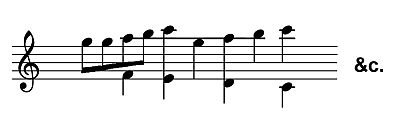
And these—
"La Risurrezione." "Viva l'eterno Dio: sconfilto e vinto D'Averno il crudo regnator sen giace: L'empio pur sente il fiero braccio avvinte. E l'aspra morte abbassa it ciglio, e tace. Cade all'uom la catena onde fu cinto Per fallo antico di pensiero audace: Iddio, dell'nom vendicatore ha vinto! Il ciel canta vittoria, e annunzia pace. Io veggo gia sovra l'eterea mole Erger di Croce trionfale insegna, Primo terror d'ogni tartarea trama. E veggo in alto soglio il sommo Sole, Che a regnare in eterno ov'egli regna I redenti mortali aspetta, e chiama."
In Teutonic language, which finds in the highest imaginings only the symbol and apotheosis of human worth and endeavour; which believes, indeed, that by man came and comes the resurrection from the dead; and which regards that life as the most priceless page in human history, to be for ever applied and interpreted by sympathy at will; and first becoming truly divine when we regard it as truly human—in Teutonic thought and dialect, we will conclude with this eloquent and intrinsic application to the greatest of Beethoven's symphonies:—"Nohl names the work the musical Faust of the moral will and its conflicts; a work whose progress shows that there is something greater than Fate, namely, Man, who, descending into the abysses of his own self, fetches counsel and power wherewith to battle with life; and then, re-inforced through his conviction of indestructible oneness with the god-like, celebrates, with dythyrambic victory, the triumph of the eternal Good, and of his own inner Freedom."
The Pastoral Symphony, No. VI, Op. 68.
"Here (in Heiligenstadt, near Vienna, in the summer of 1808, lying by the brook with nut-trees, listening to the birds singing), I wrote the 'Scene by the Brook,' and the goldhammers there up above me, the quails and cuckoos round about me, helped compose."—Beethoven to Schindler. These last words throw a light on the oft-abused passage where the birds are imitated. We should not judge a Beethoven hastily—especially not assign to his action low grounds. We here see that the passage was not introduced in mere material imitation, but rather as a genial tribute and record; so the passage becomes beautiful, and the opposite of superficial. Emerson says, "Yon swallow weaving his straw into his nest should weave it into my poem." No doubt, in the savage—in his passionate love of freedom and roaming—we already find the germ of the poetic love of nature; and some two thousand years ago we find such sublime celebration as this (and what ages of evolution does it imply!)—
"As when in heaven the stars about the morn Look beautiful, when all the winds are laid, And every height comes out and jutting peak And valley, and the immeasurable heavens Break open to their highest." —Iliad (Tennyson).
"A rock-wall'd glen, water'd by a streamlet, And shadowed o'er with pines." —Euripides (Milman).
"Yon starry conclave Those glorious dynasts of the sky, that bear Winter and summer round to mortal man." —Aiskulos (Idem).
"Smooth lies the surface of the purple seas, Nor curl'd, nor whiten'd, by the gentle breeze; No more, hoarse dashing from the breakers steep, The heavy waves recoil into the deep; The zephyrs breathe, the murm'ring swallow weaves Her straw-built chamber 'neath the shadowy eaves." —Agathias (Idem).
And yesterday, was written—
"Vesuvius wears his brilliant plume Above a sun-lit dome of snow; And darkly thro' the illumin'd gloom Extends his mighty base below: On Mount St. Angelo's ponderous crest, And in his furrows, snow, too, sleeps; Great glitt'ring clouds are piled o'er that: All rises out of glamourous deeps; For, glinting up, thro' olive bowers, And many an arm-outstretching tree, Is the sun-tipt, early-winter-morning, Slumberous, breathing sea."
In the sister arts—sister graces—painting and music, down to Turner and the Turner of music, Beethoven (he also would have given us the Python slaying Apollo, and the going home of the Teméraire, the Plague of Darkness, Æneas leaving Carthage, and Italy, Ancient and Modern: Schumann, too, is very Turner-like, perhaps more so, has more of that mystical glamour—Beethoven, like Rembrandt, only ideal); in the sister arts, Nature could not fail to be celebrated, or rather let us say ideally reproduced, and even transfigured, through the geniuses of these arts, her eldest children—nay, herself (made man). In Beethoven, then—a tone-poet, German, and born on the Rhine, at, perhaps, its grandest part—as we might expect, this worship and celebration of nature, this apotheosis in tone, culminates. Her sweetness and her grandeur, coloured, too, by his own Beethoven-soul, are by him sublimely revealed—in many a page and passage dear to the sympathetic knower. It was, then, impossible that Beethoven should not write (betitled or not) a Pastoral Symphony; and this, if only as one manifestation of his (like nature) many-sidedness. Moreover, though the Greek poesy reads as fresh as if written yesterday, nevertheless nature-worship, such as we understand it—an overpowering sense of her mysticism, a rapturous losing of ourselves in her—seems a thing not only specially Teutonic and modern, but modern even among the Teutonic peoples themselves, dating after the Reformation; and, indeed, almost as though nature-worship was to supply the place of religion (in the narrow sense, worship of an anthropomorphic maker of nature), rapture in her to supply the place of religious rapture, no longer possible; if so, a beautiful ordinance! Hence, then, if we go a little way below the surface, the present masterpiece, Beethoven's universally favourite (though far from greatest, indeed, the Symphony in D is superior—much more powerful, especially the first movement, and at least equally fresh) "Pastoral Symphony." It does not, indeed (at least the opening allegro), celebrate that peculiar, that sacred sentiment we have been speaking of; it does not utter the unutterable, but it is a true and lovely nature-poem nevertheless, worthy of all acceptation; without it the splendid series of symphonies would have been incomplete. Let us approach it.
What Strikes us in this "household-word" work, especially in the first movement, is its significant simplicity. It is wonderful, as revealing to us how profoundly simple a great man can be, and is; sublime in that, as well as in his opulence and power; indeed, simplicity is an inevitable concomitant and sine quâ non of power; even in a Napoleon, let alone a Shakespeare, a Newton, and a Beethoven.
So simple is the allegro, that it almost seems studiously so—almost as though Beethoven thereby wished to convey a reproach, at least a monition, to the artificial, and said, "Thus I hold the mirror up to Nature!" Musically, the piece (as it has always seemed to us) rather suffers by this. The ideas are more than usually re-repeated; and, remarkably, reiterations (though perhaps there was a psychological reason for this in the soul of Beethoven, as instinctively expressive, over and over again, of the one great joy he felt, or as saying—"After all, the essence and compelling spirit of this great Nature is one"). Moreover, the ideas, though in themselves beautifully pure and characteristic, seem almost too simple, nay we had almost said languid, for they rather suggest to us the gratification of a convalescent than of a passionately profound (aye, and profoundly passionate) lover of nature, such as all Germans are, such as Schumann intensely was, and such as Beethoven must have exceptionally been. (Brendel says, Haydn's love of nature, as revealed in his music, was that of her very child, unconscious; Beethoven's, that of a town-dweller, conscious. But to this I would reply, town-dweller by compulsion). On the other hand, if Beethoven wished to enter a protest against Schwärmerei, for nature, none could be more effective than this movement. But nature ever was and remains mystic, and no celebration of her, above all by a Beethoven, can satisfy us which does not shadow forth, is not overpowered by, a sense of this—sense peculiar to this latter age; more so, even, than the similar companion-sense of love. Love without Schwärmerei were not love; no more is love of nature. For these profounder realizations of nature, "glances into the deepest deeps of beauty," (Carlyle, on the remark about "the lilies of the field") reflected adumbrations of her wizardry, a sense of her intoxicating aroma, the ecstasy in her bosom, that mesmerizing infinitude of hers, we must look to Beethoven's sonatas, or other portions of his symphonies; and to such music as Schumann's; hardly in his Pastoral Symphony (except somewhat in the andante); more in his Pastoral Sonata—that first movement is profound, as well as richer. There we see the poet-philosopher, nay, high-priest of nature; and the movement, four-square, almost perfect, is one of the masterpieces, and most precious legacies of Nature's Eldest Child. In the present movement we have peaceful pleasure, but not rapture, if even joy, or delight (in the Sonata Pastorale we have contemplative joy)—though Beethoven may possibly have expressly chastened the expression of feeling, as being, so, more "pastoral." Be that as it may, here we have sweetness rather than power (except, indeed, behind all); nay, rather the gratification of an habitual dweller in the country (and he no longer a young man), than the burst of rapture we might have expected from a lover of nature only just let loose from town. However, Beethoven has written over the movements—"Awakening of cheerful emotions on arrival in the country." He further said, the symphony was feeling rather than painting. This is a matter of course from a Beethoven; and note, it is a Beethoven's feelings that are depicted. What we have in the work is Nature plus Beethoven—nature photographed after passing through him, and so becoming idealised. We have, however, both scene-painting and soul-painting through the emotions here excited and described; we see also the landscape which to a great extent occasioned them; (thus, this, like Goethe's, is an occasional poem). It is a truly pastoral district; quiet, sunny scenery, with a scent of the earliest hay; but nature in her splendour, with, say, in the distance, the great sea; nature, a blaze of flowers embosomed in hills, as in our own beautiful England in May; let alone nature in spring, with her background of Alps and Appenines. Nature, whose greatest hint—the secret of whose greatest power is, Immortality; a promise of that is hardly here celebrated; or, rather, that hint is not, for it is in every landscape:—"I, too, have looked upon the hills in their hazy veil, but their greatest charm, to me, was their promise." Neither, in spite of Elterlein's charming allusion, have we the scenery where, or the time when (soust) as Goethe so truly, sublimely expresses it (in two of his most inspired lines)—
"Stürzte sich der Himmelsliebe Kuss Auf mich herab in ernsber Sabbath stille."
When Beethoven wrote this music he had not in mind his revered Shakespeare's magnificent—
"Full many a glorious morning have I seen Flatter the mountain-tops with sovereign eye, Kissing with golden face the meadows green, Gilding pale streams with heaving alchemy."
This, rather, the immortal Symphony in A suggests; or such lines as these:—
"My other mighty passion was for thee, Thou glimmering, glamouring, manifestation of God! Unspeakable Nature, with thy distant sea, Wave-framing hills, dim woods, and flowery sod; My haziest, sweetest memories, are of you, Where inland-county beauty guards its stream; Oh! 'violet' memory 'dim' with my tears' dew; Oh! shadowy pausing, touch'd with earliest beam; And sea-side recollections stir my heart, The calm's majestic cheerfulness, the storm, The bluff that through the vapours seem'd to start, A thousand miracles of tint and form; And ever as I yearn'd on wave and hill, The unconscious secret was thy Promise still."
The "Scene by the Brook"—
"I draw them all along, and flow To join the brimming river; Men may come and men may go, But I go on for ever."
(exquisite image of immortality bearing along mortality)—is richer in significance. There, indeed, we do get some of those deep glimpses, far glances (and tender ones into flower-cups)—those unspeakable hints (note especially, as usual, the passage in the extra-poetic key of G flat; where, however, also as usual, Beethoven lingers too little; indeed, even he seems rather to deviate into such keys, and to be afraid of dwelling in them). We see Beethoven, the colossally unhappy soul, here at least happy, nay, blessed; lapped in flowers; caressed by the stream; soothed and tended by all the "angels and ministers of grace" of nature; while the everlasting heaven pronounces its benediction over him.
For our own part, we are specially affected, because we call to mind a brook where we also were wont to be happy. But, it was not in quiet scenery, but in a Swiss mountain-valley; the brook came from heaven, and coursed through pine-woods and pastures into a stupendously beautiful lake, the shadows of whose mighty guardian Alps are reflected also in the Moonlight Sonata; while, afar off, as it were in colossal admonition, towered those eternal reminders, the peaks of the Bernese Oberland.
The Scherzo has always seemed to us an inspiration—as much as the storm; so original and powerful, so tuneful in its picturesque, spontaneous gaiety. It is Beethoven at his genialist. The sublimity of the storm may speak for itself: I will only remark, in reply to the German Hume, who rather cavils and carps, and is no Beethoven-worshipper (but Mozart), and says "the cause for such a very loud storm is too trifling"—that the storm also perchance broke over crowned heads and the fate of empires (Napoleon died in a storm, and so, just as curiously characteristic, did Beethoven). Storms do, too, come up in the brightest summer day (without or within us); and, in short, though the criticism is truly philosophical, that it should be left doubtful whether the storm was a physical or moral one—of nature or human nature—Beethoven, as ever, is entitled to a genial interpretation, a liberal application. In the meanwhile, as a storm—storm of music, as well as musical storm—it is as grand as original; shaking us with the fullness of those sublime emotions of the natural storm (and surely our German Hume would not disparage these!), and its introduction is a happy felicity.