Chapter XIII · THE FIRST PAIR OF LEGS
Reading edition
THE first pair of legs, or those nearest the head, are the shortest of all. The most interesting feature about these legs is a little semi-circular notch, and I have made this sketch of it.
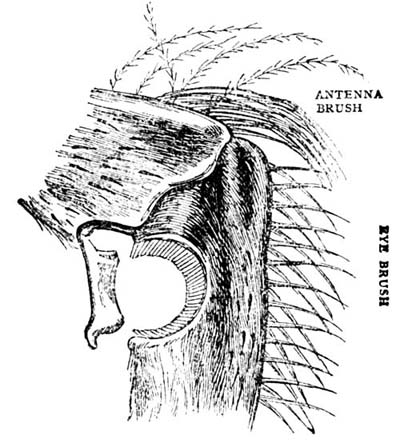
Under the microscope we see that around the semi-circular opening is a row of about eighty teeth. These are not biting teeth, but are more like the teeth of a comb, and indeed this notch is a comb which is used for cleaning the antennæ. You may sometimes see a bee bring up its front leg to its head, and then move the leg outwards. By this movement the antenna is drawn into, and through the comb, the teeth of which soon remove any dirt or pollen which may be sticking to it. Just above the antenna comb, there is a kind of little hinge or lid. This is called the “velum,” and its name comes from a Latin word meaning “to cover,” for the lid covers the antenna when it is drawn into the comb, and holds it there whilst it is being pulled through. When we know that each antenna is only 1⁄125th of an inch in diameter, we can understand what a wonderful little tool the comb is.
When we mention a comb, we generally think of a brush too, so it is interesting to find that the front leg of a bee has two brushes, which are shown in the sketch. The first of these is used for cleaning the comb after the antenna has been passed through it. The other keeps the hairs of the eye free from pollen.
Plate X
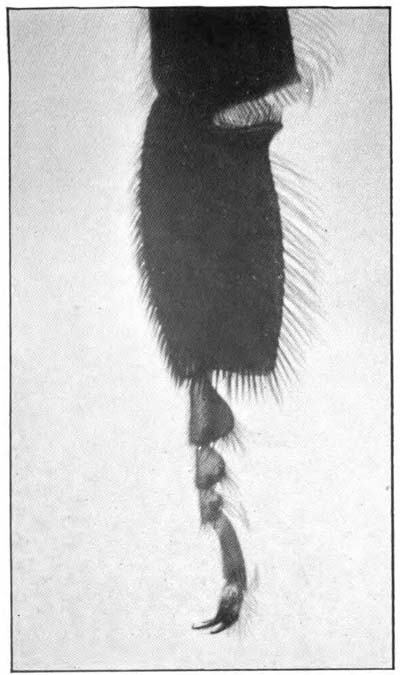
(a) From a photo-micrograph by] [E. Hawks Hind Leg of Bee (showing Wax Pincers)
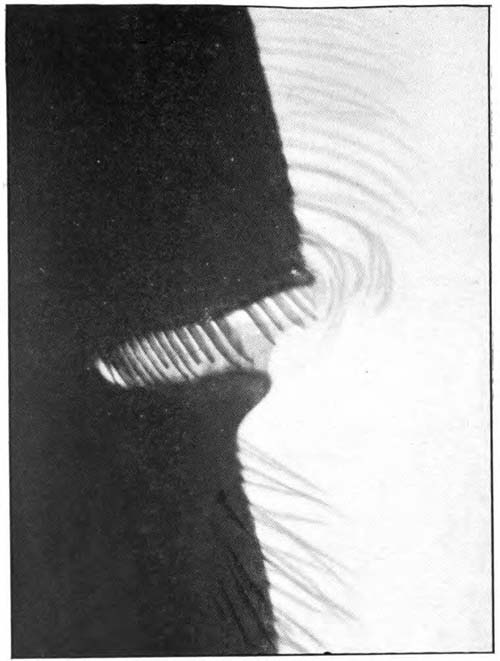
(b) From a photo-micrograph by] [E. Hawks Wax Pincers on Hind Leg