REFERENCES TO THE CHROMO-PLATES.
Reading edition
In the frontispiece is represented the polished section of a pebble which the author picked up on the beach at Bonchurch, in the Isle of Wight. This is an unusually large and perfect specimen, the body of the Choanite lying nearly central. The pebble contains one or two blotches of native iron. The “cuticle” is uninjured.
PLATE I.
Fig. 1. This is a slice from a lump of “conglomerate” found on the beach at Sidmouth. The white parts are sections of the nodules of quartz, the red and yellow are jasper.
Fig. 2. A section of an “Alcyonite” from the bay of Sandown. It formed part of a large pebble.
PLATE II.
Fig. 1. This is, I have no doubt, a fossil “Actinia.” I have often looked on the exact living resemblance of it at the fish-house in the “Zoological Gardens,” where it is fond of clinging like a limpet against the vertical pane of glass in an aquarium.—(Found in Sandown Bay.)
Fig. 2. I suppose this half of a pebble to represent the internal structure of some creature which dwelt in a bivalve shell.—(Sandown Bay.)
PLATE III.
Fig. 1. This sponge, a faultless specimen of the kind, is from the Brighton beach. It was the first pebble I ever picked up there.
Fig. 2. The body and arms of this Choanite are in white Agate; the remainder of the stone is a dark moss, formed chiefly of Manganese, and surrounded by a yellow flinty rim.—(Brighton Beach.)
PLATE IV.
Fig. 1. A Nondescript: but, probably, the creature was of the vermicular kind.—(Brighton Beach.)
Fig. 2. A handsome Choanite, uncut, but polished over, so as to show the points of some of the feelers.—(Found at Eastbourne.)
PLATE V.
Fig. 1. An “Eyed” Jasper, from the beach near Shoreham. It contains yellow “oxide of iron,” and some dark green flint.
Fig. 2. A “Myriapod.” This fossil is a very handsome one, and I have another, closely resembling it, from the same locality, in Sandown Bay. The dark, reddish spot, is of the nature of Molluskite.
PLATE VI.
Fig. 1. A Spindle, or Fusiform Choanite, when the pebble was entire. I do not possess a more perfect specimen: the Chalcedony is remarkably fine, and the “oxide” of a rich tint.—(Sandown Bay.)
Fig. 2. Pyriform Choanite, uncut. Here, again, the creature lies over the surface; and, as I conceive, from the position which it occupies, was swimming for its life.—(Found at Rottingdean.)
PLATE VII.
Fig. 1. An “Asterid.” This is different from all the other creatures in these fossils. Its position in the heart of a solid limestone pebble is singular.—(Beach at Hove.)
Fig. 2.—“Terebratula.” The entire pebble was formed inside of a “Pecten”-shell, and inside the pebble lies this formation, which was a living organism connected with the hinge.—(Beach near Luccombe.)
EXPLANATION OF CERTAIN TERMS used in this Volume.
“Hard:” that which will cut or scratch other substances.
Example.—A diamond will cut glass.
“Tough:” tenacious; whose particles are difficult to separate from one another.
Example.—Jasper, though not nearly so hard, is more “tenacious” than diamond.
“Transparent:” through which we can see objects.
“Translucent:” through which we see light.
“Opaque:” through which we can see nothing.
“Brilliant:” reflecting or refracting the light in rays and flashes.
“Vitreous:” glassy in its texture.
“Conchoidal:” convex, like the outside of a shell.
“Momentum:” the result of the combined weight and velocity of a body in motion.
GEOLOGICAL STRATA referred to in this Volume, arranged in their descending order.
Names of Strata. Mineral products.
Lava Pumice-stone, which is its froth or scum.
Granite Corundum, sapphires, felspar.
Old Red Sandstone Fossil ichthyolites.
Carboniferous Series Coal, lignites, jet.
New Red Sandstone Jaspers, fossilized wood.
Lias of the Oolite Fossil “Saurians.”
Wealden Fossil reptiles and mammals.
Gault Crystals, flint-nodules, choanites, echini, cray-fish, lignites.
Greensand
Chalk
Tertiary Sands Amber, carnelians, fossil shells.
Clays
GLOSSARY of Gases, Minerals, Gems, Crystals, and Fossils, named in this Volume.
Simple Substances.
Oxygen: a gas.
Silicon Elements allied to the gases.
Boron
Carbon
Alumina Soluble in acids.
Magnesia
Sulphur
Manganese Metals.
Iron
Gold
“Steel” is Iron which has been “carbonized.”
Derived or Compounded.
Diamond These are termed “gems” or “precious stones.”
Sapphire
Ruby
Emerald
Topaz
Amethyst
Aquamarine
Garnet
Pearl
Turquoise
Jargoon
Onyx
Sardonyx
Quartz These are crystallizations.
Rock-crystal
Tourmaline
Spar
Asbestos
Jasper These are concretions.
Chalcedony
Agate
Carnelian
Flint
Bloodstone
Moss-agate
Weed-agate
Mocha-stone
Jet These are exudations, depositions, or fossils.
Amber
Clay
Chalk
Coal
Rock-salt: a chloride of sodium.
Kaolin: this is from “felspar.”
Echinus These are fossil animals, for the most part belonging to extinct species of “zoophytes.”
Ammonite
Alcyonite
Troglodyte
Choanite
Ventriculite
Icthyolite
Cray-fish
Sharks’ teeth
Sand of the Desert: this is powdered quartz.
Sand of the Sea-shore: sandstone dust, mixed and penetrated with salt.
Sea-weed: a compound of vegetable carbon, salt, and siliceous particles.
MINERALOGICAL AND CHEMICAL KEY to the Glossary.
Oxygen. This is a pure gas, and the most universally diffused substance in nature.
Silicon These elements will combine permanently with the principal gases.
Carbon
Boron
Alumina These elements, when dissolved in certain acids, yield a colourless solution.
Magnesia
Sulphur
Manganese These elements, dissolved in acids, yield a coloured solution.
Iron
Gold
Delessite is a chloride of iron.
Silica comprises only 2 species:—1. Quartz; 2. Opal.
From Quartz, come
Rock-crystal which are “vitreous,”
Cairn-gorums
Sand
and
Chalcedony which are “concretions.”
Agate
Onyx
Carnelian
Sard
Bloodstone
Jasper
Flints
Opal is a “hydrate” of Silica, containing 7 per cent. of water.
Precious, or “noble.”
Iridescent.
Common (colourless).
“Silicates.”
Of Alumina Feldspar.
Kaolin.
Of do. with Glucina Emerald.
Beryl
Garnet
Pyrope, or “precious garnet.”
Of Magnesia Chrysolite.
Meerschaum.
Asbest.
Of do. with Fluorine Topaz.
Tourmaline.
Of do. with Zircon Jargoon, or “Hyacinth.”
The colour of “emerald” is due to the oxide of chrome; that of “beryl” to the oxide of iron.
Carbon comprises only 2 species:—1. Diamond; 2. Graphite.
“Diamond” is a perfect crystallization, and is the hardest substance known.
“Graphite” (sometimes called “Black-lead”) is a carbonate of iron. The iron, however, enters in very small quantities, and is now supposed to be accidental. “Graphite” is a concretion, and is never met with in the form of crystals.
“Carburets.”
Of Hydrogen Bitumen.
Coal.
Bituminized wood is Lignite, which, when very compact, is Jet.
“Amber” is a vegetable resin. It is obtained from rivers in Sicily, and from mines in Russia.
“Carbonates” of Lime Limestone.
Calc-spar.
Chalk.
The “marbles” of Paros and Carrara are crystalline Limestone: those of Siena are compact Limestone.
Alumina comprises 2 species:—1. Corundum; 2. Sapphire.
1. “Corundum” is a very hard crystal, the common type of all the Sapphires.
2. Oriental “Sapphires.” These embrace 6 kinds.
The blue Sapphire.
” red or “Ruby.”
” green or Emerald.
” purple or Amethyst.
” golden or Topaz.
” sea-green or Aquamarine.
These are pure Alumina.
“Emery” is a coarse variety of Corundum.
“Aluminates.”
Of Magnesia Spinel ruby.
Balas do.
A Phosphate of Alumina and Magnesia Turquoise.
The “Spinel” ruby is scarlet; the “Balas,” of a faint pink. The “Oriental” ruby alone has the “pigeon’s blood” hue.
Localities of sundry “Fossils.”
(Name of Fossil.) (Proper locality.)
Echini Galerites Albogalerus Found in the Upper Chalk, and, occasionally, in the Greensand.
Ananchytes Ovatus
Cor Anguinum
Ammonite The Lias.
Alcyonite The Chalk.
Troglodyte
Choanite
Ventriculite
Ichthyolite The Old Red Sandstone.
Cray-fish The Gault.
Shark’s teeth The Tertiary Strata.
Plate I.
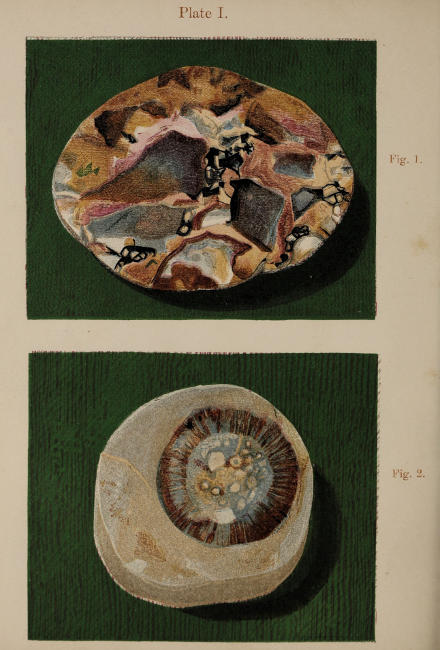
Fig. 1. Fig. 2.
Plate II.
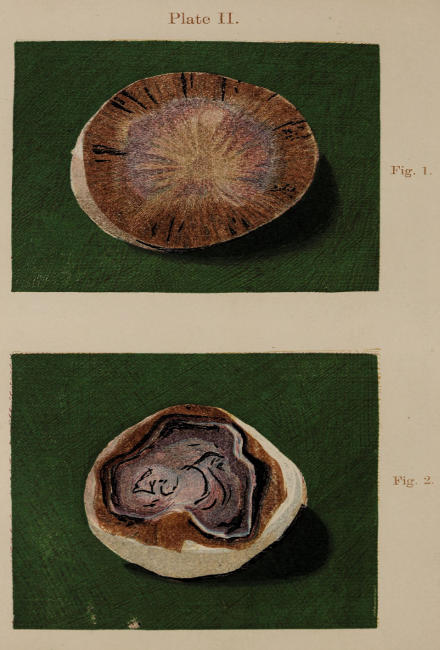
Fig. 1. Fig. 2.
Plate III.
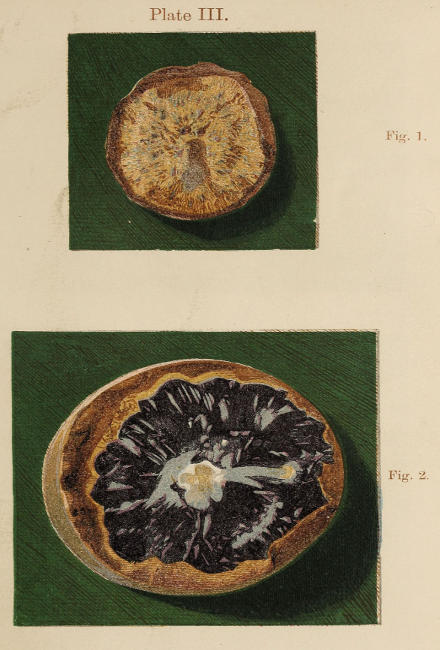
Fig. 1. Fig. 2.
Plate IV.
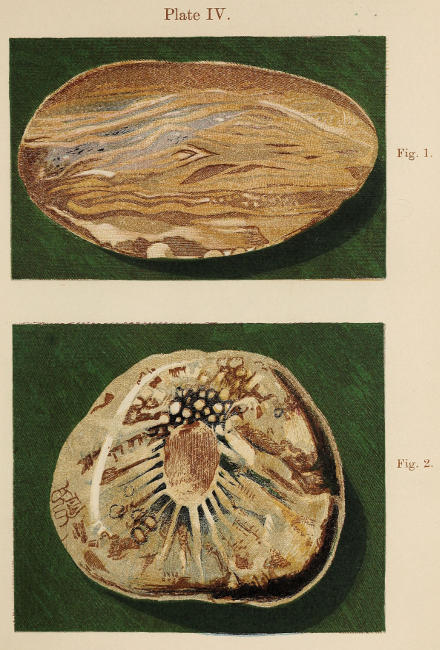
Fig. 1. Fig. 2.
Plate V.
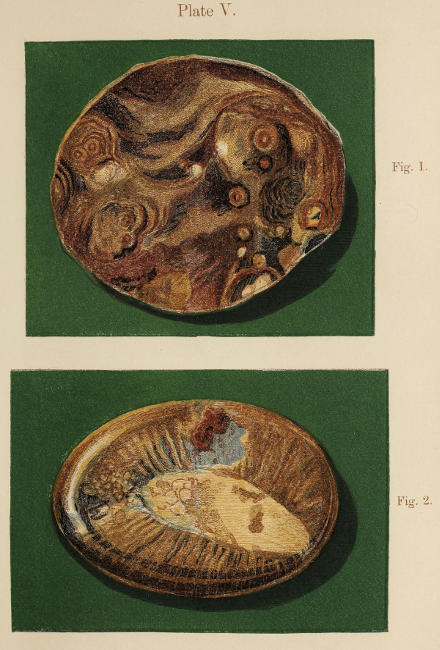
Fig. 1. Fig. 2.
Plate VI.
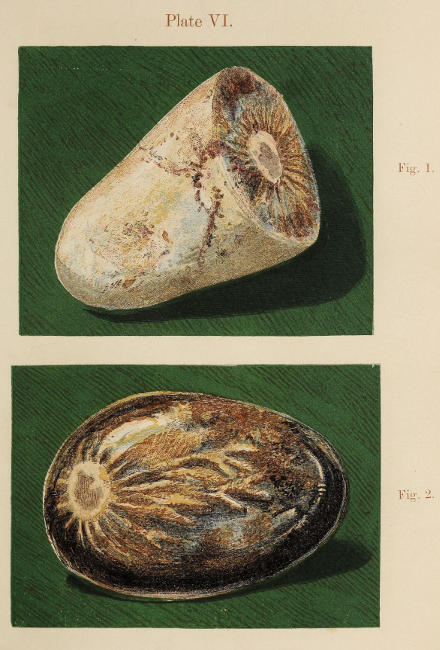
Fig. 1. Fig. 2.
Plate VII.
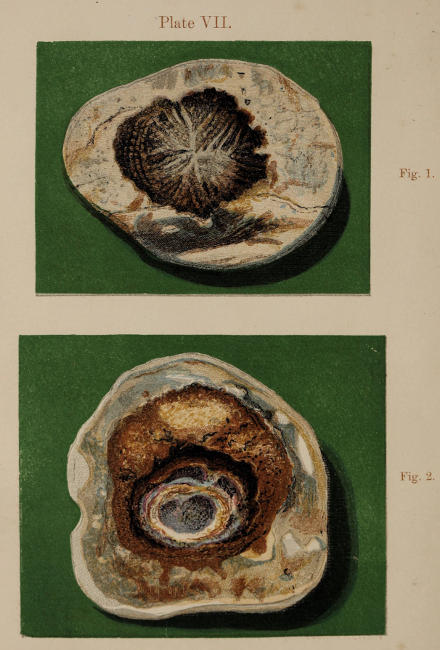
Fig. 1. Fig. 2.