THE BATTLE OF LOOKOUT MOUNTAIN AND MISSIONARY RIDGE
Reading edition
After the battle of Chickamauga, Rosecrans' army was cooped up in Chattanooga, and his sources of supplies were entirely cut off by Bragg, except from the north of Chattanooga, by which he received his supplies over mountainous wagon roads, and, on account of heavy rains which fell during October, the roads became almost impassable. These trains were attacked by Confederate cavalry under General Forest, and in one day 300 wagons were destroyed and about 1,800 mules were either killed or captured. One soldier said "the mud was so deep that we could not travel by the road, but we got along pretty well by stepping from mule to mule as they lay dead by the way." Starvation threatened the camp, and the army must be relieved.
Vigorous measures were now taken. General Grant was now made commander of the western armies. He had about 80,000 men in addition to Burnside's force at Knoxville. The Confederates had about 60,000. General Sherman was directed to reënforce Grant at Chattanooga from Vicksburg and transported his forces by boat to Memphis, and from there marched overland.
The authorities at Washington also determined to reënforce Rosecrans from the Army of the Potomac, and 23,000 men, under General Hooker, were transported by rail to Chattanooga. This brought the Army of the Cumberland to numbers far exceeding those of the Confederates. The immediate command of all the Federal forces was given to General Thomas until such time as General Grant should arrive. Grant telegraphed to Thomas to hold Chattanooga at all hazards. Thomas replied, "I will do so till we starve."
The first and great question of the Federals was to relieve their line of supplies. General Hooker was sent with a portion of his troops against a strong position taken by some Confederates in Lookout Valley, and, after a short but decisive battle succeeded in driving the Confederates back, which left him in possession of the immediate country, and thus opened up a route to Brown's Ferry, over which a route for abundant supplies was at once available. This relieved the Army of the Cumberland of its perilous position.
Thomas was being reënforced from all sides; Hooker was already on the ground; Sherman was advancing rapidly from Memphis, while Burnside's forces at Knoxville offered protection for the left flank of the Federal army.
General Bragg had his forces in a line extending a distance of twelve miles across to Missionary Ridge, and was strengthened by entrenchments throughout the lowlands. He determined to attack Burnside at Knoxville, and dispatched Longstreet over his protest with 20,000 men to do this, thus weakening his extended lines. This has been considered a very great mistake of Bragg, as his total force was much less than had opposed Rosecrans at Chickamauga. Grant had now arrived and had assumed command of the entire Federal forces, and had planned to attack Bragg on November 24th, but on receiving information, which proved to be unreliable, that Bragg was preparing to retreat, he decided to make the attack on the 23d, and ordered Thomas to advance upon Bragg's center. This attack took the Confederates by surprise. After some severe fighting, they fell back more than a mile and left the Federals in command of some advantageous positions, thus ending the first day's battle.
Preparations were made during the night for a general engagement the next day.
Sherman was in command of the left wing, while Thomas held the center, and Hooker the right, and they had planned to sever communications between Bragg and Longstreet, and thus keep the Confederate army divided.
Early on the 24th Sherman moved against the Confederate right, and with little opposition occupied the northern end of Missionary Ridge. The Confederates, after discovering this advantageous position taken by Sherman, fought desperately in the afternoon to regain it, but were finally repulsed.
While this was going on, General Hooker, with a division of Sherman's army, was making a desperate struggle for the capture of Lookout Mountain, whose rugged crests towered above the clouds. This mountain was ably defended by the Confederates, but they were finally pushed back by overwhelming numbers and made their final stand within the breastworks about the Craven house, but were finally dislodged from this place and retired within their entrenchments in the valley.
This has been termed "The Battle in the Clouds."
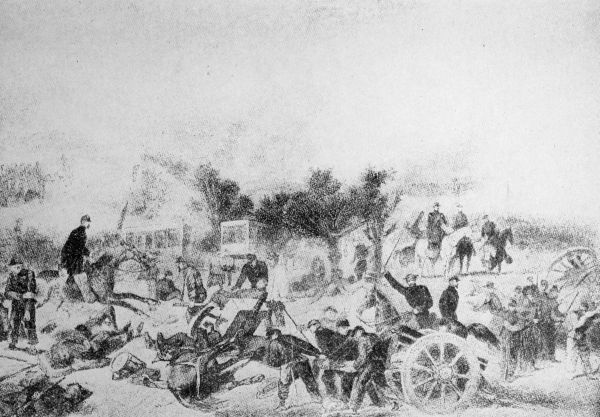
BATTLE OF GETTYSBURG
On the morning of the 25th preparations were made for the final battle on Missionary Ridge. The attack was made by General Sherman, and it seemed that the Confederates must recede from the terrific onslaught, but they succeeded, after a stubborn struggle, in repulsing the Federals at this particular time, and they were pushed back by General Hardy, who captured several hundred prisoners. The Federals, quickly re-forming their lines, renewed the assault and, after waiting for Hooker to bring up his division, Grant ordered a general advance, and the battle was now on in earnest. Bragg opened on them from the crest of Missionary Ridge with fifty pieces of artillery and a line of musketry. Even this did not stop the impetuous charge. The first line of entrenchments of the Confederates was carried with little opposition, and, as the Confederates retired through other brigades, the confusion was great, and the retreat became almost a rout.
Had it not been for a division of North Carolinan soldiers under Major Weaver, who succeeded in rallying his troops, and was successful in holding the Federals in check, the retreat would have become a rout of the entire Confederate army.
This gave the Confederates a little time to rally their lines, and they were able to retire from the field in good order.
The battle was now over, and the field was left in possession of the Federals, Bragg retiring with his army into Georgia.