Chapter XI
Reading edition
CHAPTER XI
BATTLE HONOURS FOR SERVICES IN THE PENINSULAR WAR, 1808-1814
Roleia—Vimiera—Sahagun—Corunna—The Douro—Talavera—Busaco—Barrosa—Fuentes d'Onor—Albuera—Almaraz—Arroyos dos Molinos—Tarifa—Ciudad Rodrigo—Badajos—Salamanca—Vittoria—Pyrenees—San Sebastian—Nivelle—Nive—Orthes—Toulouse.
-
The campaign was entered upon with a view of preventing the Iberian Peninsula from falling under the domination of Napoleon, who, prior to the landing of our troops in Portugal in August, 1808, had brought about the abdication of the King of Spain, and placed his brother Joseph on the throne of Madrid. Portugal had been invaded also by the French. The King, taking refuge on an English squadron, had sailed to Brazil, and Lisbon was at the moment in possession of the French Army, commanded by Marshal Junot.
The honour "Peninsula" was granted to all regiments which served under the Duke of Wellington from the date of his first landing in Figueras Bay in August, 1808, to the Battle of Toulouse, in April, 1804. Regiments which served under Sir John Moore and were present at Corunna in January, 1809, but were not fortunate enough to return to Spain, were debarred from this "distinction," the 14th Foot (now the West Yorks) and the 26th Cameronians being cases in point.[15] Gold medals and crosses were conferred on field and general officers during the operations, but it was not until the year 1847 that the Duke of Richmond was enabled to carry out the project of inducing Her Majesty Queen Victoria to grant to the few remaining survivors a silver medal with clasps for the various actions, as below:
Roleia. Vimiera. Sahagun. Benevente. Corunna. Talavera. Busaco. Barrosa. Fuentes d'Onor. Albuera. Ciudad Rodrigo. Badajoz. Salamanca. Vittoria. Pyrenees. San Sebastian. Nivelle. Nive. Orthes. Toulouse.
Roleia, August 17, 1808.
This was the opening action of the Peninsular War, which, commencing with Roleia in August, 1808, lasted until the final defeat of Soult by the Duke of Wellington at Toulouse in March, 1814.
The following regiments have been authorized at different times to carry the word "Roleia" on their colours and appointments, and the Land General Service Medal, with clasp "Roleia," was granted to all survivors on June 1, 1847:
Northumberland Fusiliers. Royal Warwick. Norfolk. Worcester. Cornwall Light Infantry. South Stafford. South Lancashire. Sherwood Foresters. King's Royal Rifles. Highland Light Infantry. Argyll Highlanders. Rifle Brigade.
They were brigaded as under, the chief command being held by Lieutenant-General the Honourable Sir Arthur Wellesley:
First Brigade—Hill:
5th (Northumberland Fusiliers)990
1st Batt. 9th (Norfolk)833
38th (South Staffords)957
——2,780
Second Brigade—Fergusson:
36th (Worcester)591
40th (South Lancashire)926
71st (Highland Light Infantry)903
——2,420
Third Brigade—Nightingale:
29th (Worcester)806
82nd (South Lancashire)929
——1,735
Fourth Brigade—Bowes:
6th (Royal Warwick)946
32nd (Cornwall Light Infantry)874
——1,820
Fifth Brigade—C. Crawford:
50th (West Kent)948
91st (Argyll Highlanders)917
——1,865
Sixth Brigade—Fane:
45th (Sherwood Foresters)670
5th Batt. King's Royal Rifles936
2nd Batt. Rifle Brigade400
——2,060
———
12,626
20th Light Dragoons240
Royal Artillery226
Opposed to these, the French had, under General Delaborde, not more than 6,000 men. The odds, therefore, were considerably in our favour; but the opposition was nowhere very determined, and our casualties were slight. Three regiments, it will be seen from the accompanying return, suffered no loss.
Casualties at Roleia.
Regiments.Officers.Men.
K.W.K.W.
20th Hussars---3
Royal Artillery1-1-
Roy. Engineers-1--
5th Northumberland Fus.-2341
6th R. Warwick-1-2
29th Worcester-733111
32nd Cornwall L.I.--13
36th Worcester----
38th S. Stafford--4-
40th S. Lancs--12
45th Sherwood Foresters11-9
50th West Kent--21
60th K.R.R-2839
71st Highland L.I.--11
82nd S. Lancs-1618
91st Argyll Highlanders----
95th Rifle Brig.-21730
Note.—The riflemen of the 60th and 95th (Rifle Brigade) had been engaged on August 15, when the latter regiment lost one officer killed and another wounded.
Vimiera, August 21, 1808.
Four days after Roleia, Sir Arthur Wellesley, at the head of the following regiments, inflicted a second defeat on the French army under Junot, capturing three guns and many prisoners. The following regiments bear the honour:
20th Hussars. Queen's. Northumberland Fusiliers. Royal Warwicks. Norfolk. Lancashire Fusiliers. Worcesters. Cornwall Light Infantry. South Stafford. South Lancashire. Oxford Light Infantry. Sherwood Foresters. West Kent. King's Royal Rifles. Highland Light Infantry. Argyll Highlanders. Rifle Brigade.
The casualties incurred were as follows:
Casualties at Vimiera.
Regiments.Officers.Men.
K.W.K.W.
20th Hussars1-1924
Royal Artillery-2-2
2nd Queen's---7
5th Northumberland Fus.----
6th Royal Warwicks----
9th Norfolk (2nd Batt.)----
20th Lancs Fus.11-5
29th Worcester-1211
32nd Cornwall L.I.----
36th Worcester-5736
38th S. Staffs----
40th S. Lancs-2630
43rd Oxford L.I.-32751
45th Sherwood Foresters----
50th West Kent141963
52nd Oxford L.I.-2533
50th K.R.R.-21422
71st Highland L.I.-71292
82nd S. Lancs1-753
91st Argyll Highlanders----
95th Rifle Brig.-43743
Immediately after the action negotiations were entered into with the French to secure their evacuation of Portugal. The Convention of Cintra, the result of these negotiations, raised a storm of indignation in England. The three Generals—Harry Burrard, Sir Howard Dalrymple, and Sir Arthur Wellesley—were recalled, and their conduct submitted to a Court of Inquiry held at the Royal Hospital, Chelsea, under the presidency of Sir Henry Dundas. The Times took a strong line against Wellesley, but the Court of Inquiry to a great extent exonerated him. Subsequently he returned to Portugal, as we know, to carry the war to a successful conclusion, thus belying his detractors.
The troops engaged at Vimiera were brigaded as under:
20th Light Dragoons240
Royal Artillery (three batteries)226
First Brigade—Hill:
5th (Northumberland Fusiliers)944
1st Batt. 9th (Norfolk)761
38th (South Staffords)953
——2,658
Second Brigade—Fergusson:
36th (Worcester)591
40th (South Lancashire)923
71st (Highland Light Infantry)935
——2,449
Third Brigade—Nightingale:
29th (Worcester)616
82nd (South Lancashire)904
——1,520
Fourth Brigade—Bowes:
6th (Royal Warwick)943
32nd (Cornwall Light Infantry)870
——1,813
Fifth Brigade—C. Crawford:
45th (Sherwood Foresters)915
91st (Argyll Highlanders)917
——1,832
Sixth Brigade—Fane:
50th (West Kent)945
5th Batt. 60th (King's Royal Rifles)604
2nd Batt. Rifle Brigade456
——2,005
Seventh Brigade—Anstruther:
2nd Batt. 9th (Norfolk)633
43rd (Oxford Light Infantry)721
52nd (Oxford Light Infantry)654
97th (West Kent)695
——2,703
Eighth Brigade—Acland:
2nd (Queen's)731
20th (Lancashire Fusiliers)401
1st Batt. Rifle Brigade200
——1,332
———
Total British16,712
To which must be added about 2,000 Portuguese troops. Of the French forces it is not so easy to speak. Wellesley estimated their strength at 14,000, inclusive of 1,500 cavalry, with 23 guns. Professor Oman's figures are 13,056, including 1,850 cavalry. Whatever their strength may have been, they made but a poor stand against Sir Arthur's troops.
MOORE'S CAMPAIGN IN SPAIN.
When the three Generals responsible for the Convention of Cintra were recalled to England, Sir John Moore was nominated to the chief command in Spain. The appointment was a popular one, for Moore had greatly distinguished himself in command of a brigade at the capture of the Island of St. Lucia, and later still at the Battle of Egmont-op-Zee and in Egypt. His masterly advance from Lisbon to the relief of Madrid, and his still more masterly retreat from Salamanca to Corunna, are ably recounted in Professor Oman's monumental work on the Peninsular War, and by General Maurice in his Life of Moore. With not more than 30,000 men Moore held at bay five times that number, and finally, at Corunna, covered the embarkation of his worn-out army in the face of 25,000 French, commanded by Marshal Soult. The one episode during that famous retreat which is emblazoned on the colours and appointments of our army is the brilliant cavalry action of Sahagun, for which, as well as for the cavalry action of Benevente a few days afterwards, the medal and clasps were granted.
Sahagun, December 21, 1808.
This honour has been awarded to the 15th Hussars only, and commemorates a brilliant little engagement, when the 15th attacked and routed a far superior body of French cavalry. With the trifling loss of 2 Hussars killed and 18 wounded, they captured 13 officers and 150 men of the enemy. Sahagun and Benevente—a similar action which took place a few days subsequently, in which the 10th and 18th Hussars bore their share, but for which no battle honour was granted, though a clasp "Benevente" was added to the Peninsular medal—bore testimony to the admirable manner in which our light cavalry was handled during Moore's retreat to Corunna.
Corunna, January 16, 1809.
Authority to assume this battle honour was given in April, 1823, and the medal and clasp were granted June 1, 1847.
This honour has been conferred on the following regiments:
Grenadier Guards. Royal Scots. Queen's R.W. Surrey. King's Own. Northumberland Fusiliers. Royal Warwicks. Norfolks. West Yorkshires. Lancashire Fusiliers. Royal Welsh Fusiliers. Cameronians. Gloucesters. Worcesters. East Lancashire. Cornwall Light Infantry. West Riding. South Staffords. South Lancashire. Black Watch. K.O. (Yorkshire Light Infantry). Oxford Light Infantry. North Lancashire. Royal West Kent. Highland Light Infantry. Gordon Highlanders. Cameron Highlanders. Argyll and Suth. Highlanders. Rifle Brigade.
The following table gives the strength of Sir John Moore's army at the commencement of the retreat. Unfortunately, no complete list of casualties exists to show the exact losses at the Battle of Corunna, but we know that on that day we had forty French guns opposed to nine English, and that the losses inflicted on the enemy were little short of 1,500, ours being about 800 only.
Cavalry Division: Lord Paget.
7th Hussars497
10th Hussars514
15th Hussars527
18th Hussars565
——2,103
Royal Artillery1,297
First Division: Sir David Baird.
Brigade of Guards—Ward:
1st Batt. Grenadiers1,300
2nd Batt. Grenadiers1,027
——2,327
First Brigade—Bentinck:
1st Batt. 4th (King's Own)754
1st Batt. 42nd (Royal Highlanders)880
1st Batt. 50th (Royal West Kent)794
——2,428
Third Brigade—Manningham:
3rd Batt. Royal Scots597
1st Batt. 26th (Cameronians)745
2nd Batt. 81st (North Lancashire)615
——1,957
Second Division: Sir James Hope.
Third Brigade—Leith:
51st King's Own (Yorkshire Light Infantry)516
2nd Batt. 59th (East Lancashire)557
2nd Batt. 76th (West Riding Regiment)654
——1,727
Fourth Brigade—Hill:
2nd (Queen's)616
1st Batt. 5th (Northumberland Fusiliers)835
2nd Batt. 14th (West Yorkshire)550
1st Batt. 32nd (Cornwall Light Infantry)756
——2,757
Fifth Brigade—C. Crawford:
1st Batt. 36th (Worcester)736
1st Batt. 71st (Highland Light Infantry)724
1st Batt. 92nd (Gordon Highlanders)900
——2,360
Third Division: Lieutenant-General Fraser.
Sixth Brigade—Beresford:
1st Batt. 6th (Royal Warwicks)783
1st Batt. 9th (Norfolk)607
2nd Batt. 23rd (Royal Welsh Fusiliers)496
2nd Batt. 45th (Oxford Light Infantry)411
——2,297
Seventh Brigade—Fane:
1st Batt. 38th (South Stafford)823
1st Batt. 79th (Cameron Highlanders)838
1st Batt. 82nd (South Lancashire)812
——2,473
Reserve Division: Major-General E. Paget.
Eighth Brigade—Anstruther:
20th (Lancashire Fusiliers)499
1st Batt. 52nd (Oxford Light Infantry)828
1st Batt. Rifle Brigade820
——2,147
Ninth Brigade——Disney:
1st Batt. 28th (Gloucester)750
1st Batt. 91st (Argyll Highlanders)698
——1,448
Light Brigade——R. Crawford:
1st Batt. 43rd (Oxford Light Infantry)817
2nd Batt. 52nd (Oxford Light Infantry)381
2nd Batt. Rifle Brigade702
——1,900
———
Total British 27,221
Casualties at Corunna.
Regiments.Officers.Men.
K.W.K.W.
General Staff1---
7th Hussars----
10th Hussars----
15th Hussars----
18th Hussars----
Royal Artillery----
Grenadier Gds. (2nd Batt.)--1340
1st Royal Scots----
2nd Queen's----
4th K.O. Lancaster Regt.13--
5th Northumberland Fus.----
6th Royal Warwick----
9th Norfolk----
14th W. Yorks--1030
20th Lancs F.----
23rd Royal Welsh Fus.----
26th Cameronians----
28th Gloucester----
32nd Corn. L.I.----
36th Worcester----
38th S. Stafford----
42nd Royal Highlanders-639105
43rd Oxfd. L.I. (two batts.)----
50th Royal West Kent23--
51st K.O. Yorks L.I.--520
52nd Oxf. L.I. (1st and 2nd Batts.)-2533
59th E. Lancs----
71st Highld. L.I.----
76th West Riding Regiment--16
79th Cameronian Highdrs.----
81st L. North Lancashire31127113
82nd S. Lancs----
91st Argyll Highlanders----
92nd Gordon Highlanders11315
Rifle Brigade (1st and 2nd Batts.)--1233
It is useless disguising the fact that the French claim Corunna as a victory. Moore, who fell during the action, and who, with General Anstruther, was buried within the precincts of the work, had been compelled to destroy the greater number of his horses and to bury some of his guns prior to giving the order for embarkation, and a large number of his sick were left behind. Nothing, however, can detract from the magnificent manner in which he conducted the retirement in the face of enormous odds, nor from the gallant way in which his men pulled themselves together after the hardships endured during the retreat, and stood at bay outside Corunna. It was not a victory in the fullest sense of the word, but Corunna was a grand military achievement.
THE PENINSULAR WAR (SECOND PHASE), 1809-1814.
To give even a summary of the campaign would be beyond the limits of this work. It is the campaign which more than any other has formed the theme for countless books, and is more or less known to every schoolboy. My scheme is merely to bring before the regimental officer and those interested in the "price of blood" the losses sustained by each corps in each action, and so to bring home to the army the anomalies that exist in the system under which battle honours have been awarded.
We have seen that the Convention of Cintra, which was the closing act of the successful campaign of Vimiera, had been received with a storm of indignation in England. When it became known that Sir Arthur Wellesley, one of the Signatories of that Convention, had been appointed to succeed the late Sir John Moore in command of the troops in Portugal, the attacks broke out afresh. The result, however, gave the lie to the arm-chair critics, for the "Sepoy General" proved a consummate master of the art of war. Landing at Lisbon on April 22, Sir Arthur struck at once. There was one French army still in Portugal, at Oporto, where Soult lay with a considerable force. Leaving a portion of his army under Beresford to watch the French main army, who were near Talavera, Wellesley moved swiftly to the north. By a masterly stroke, he threw one brigade across the Douro, and, with the loss of but 190 killed and wounded, drove Soult out of Oporto.
Douro.
is inscribed on the colours and appointments of the
14th Hussars. Buffs. Northamptons. Royal Berkshires.
and commemorates this, Wellington's first victory after he had been entrusted with the supreme command in the Peninsula. In addition to the regiments which are entitled to bear this battle honour, there was a battalion of detachments engaged made up of the light companies of the 29th (Worcesters), 38th (South Staffords), 43rd and 52nd (Oxford Light Infantry), and the Rifle Brigade. The 16th Lancers, who were generally to the fore when fighting was expected, also suffered some casualties. Soult was not only surprised; he was, despite the smallness of our losses, badly beaten, and it was only Wellesley's want of cavalry which prevented his being overwhelmed with disaster. As it was, Soult only succeeded in effecting a junction with Ney by burning his baggage, throwing his guns over the mountain-side, and, by following goat-tracks, he at last escaped the English pursuit.
Casualties at the Passage of the Douro, May 10, 11, and 12, 1809.
Regiments.Officers.Men.
K.W.K.W.
14th Hussars-41319
16th Lancers-3--
20th Hussars--1-
Royal Artillery----
3rd Buffs-1--
29th Worcester--27
38th S. Staffs (detachment)-1--
48th N'ampton-1--
52nd Oxf. L.I. (detachment)-1--
66th Berkshire-3926
Note.—No detailed list of the casualties in the three days' skirmishing on the Douro is appended to Sir Arthur Wellesley's despatch. On May 11 we lost 19 men killed and 62 wounded, and on the 12th 23 killed and 86 wounded. The despatch alludes to the conduct of the 20th Hussars, and of the light companies of the 29th, 43rd, and 52nd, and the riflemen of the 95th Regiment. None of these regiments have been awarded the honour. A detachment of the 83rd (Royal Irish Rifles) was present, and lost 14 men wounded.
Returning south after the success at the Douro, Wellesley at once took steps to attack the main French army, which, under Marshal Victor, with King Joseph himself as nominal leader, lay at Talavera, to the north-east of Lisbon, across the Spanish frontier.
This battle honour is borne by the
3rd Dragoon Guards. 4th Hussars. 14th Hussars. 16th Lancers. Coldstream Guards. Scots Guards. Buffs. Royal Fusiliers. South Wales Borderers. Gloucesters. Worcesters. East Surrey. South Lancashire. Sherwood Foresters. Northamptons. Royal Berkshires. Shropshire Light Infantry. King's Royal Rifles. Royal Irish Rifles. Royal Irish Fusiliers. Connaught Rangers.
Talavera was a very different stamp of fight to anything in which our troops had been previously engaged in the Peninsula. We had but 20,000 men present, and our losses amounted to 4,000 killed and wounded, those of the French to over 7,000. The full fruits of the victory were lost owing to the failure of our Spanish allies to afford us proper support, and the British army was compelled to retire on the following day, leaving its wounded in the hands of the French. It is true that we captured 17 guns, but the fact of our retreat, coupled with the abandonment of the sick and wounded, have induced the French to claim Talavera as a French victory. Marshal Victor was created Duke of Talavera by King Joseph, while Sir Arthur Wellesley was raised to the peerage under the title of Lord Wellington,—of Wellington, in the county of Somerset, and of Talavera. The fighting was exceedingly severe, and on more than one occasion matters looked very doubtful. Sir Arthur, however, had every reason to be proud of the manner in which his men faced the tried veterans of France.
Casualties at the Battle of Talavera, July 27 and 28, 1809.
Regiments.Officers.Men.
K.W.K.W.
3rd Drag. Gds.11--
4th Hussars-3-9
14th Hussars-637
16th Lancers-165
23rd Lt. Drag.244746
Royal Artillery13723
Roy. Engineers-2--
Coldstream Gds.2933253
Scots Guards5649261
3rd Buffs-26107
7th Royal Fus.13653
24th S. Wales Borderers-1045274
29th Worcesters-736140
31st E. Surrey1734190
40th S. Lancs-11790
45th Sherwood Foresters-313147
48th N'ampton-1234280
53rd Shropshire L.I.-2636
60th K.R.R.-71029
61st Gloucesters31146196
66th R. Berks-111688
83rd Royal Irish Rifles41138282
87th R. Irish Fus.11335170
88th Connaught Rangers331985
97th West Kent--625
Note.—There were two battalions of detachments at Talavera. The one composed of the flank companies of the 52nd, 79th, and 91st lost an officer, and 74 men killed and wounded. The other, made up from the 28th, 35th, 38th, 42nd, and 43rd, had 194 casualties.
The Cameron Highlanders lost 9 killed and 28 wounded at Talavera.
Busaco, September 27, 1810.
At Talavera Wellington realized that he was too weak to cope in the field with the immense forces that France had poured into the Peninsula. His plan of campaign now was to wear the enemy down until he should have organized the Portuguese and Spanish armies. He therefore retired once more into Portugal, and commenced that systematic defence of the kingdom which ultimately led to the destruction of French pretensions in the Iberian Peninsula. By the summer of 1810 Napoleon had 300,000 men in Spain. By that time Wellington had thrown up the famous lines of Torres Vedras, behind the shelter of which the task of reorganizing the Portuguese army proceeded apace. The winter of 1809-10 was passed without any open conflict. It was not until the end of September, 1810, that the next great fight was fought, when Wellington, with 50,000 men, barred Massena's advance at the Ridge of Busaco.
This battle honour has been conferred on the
Royal Scots. Northumberland Fusiliers. Royal Fusiliers. Norfolks. South Wales Borderers. Gloucesters. Royal Highlanders. South Staffords. Oxford Light Infantry. Sherwood Foresters. King's Royal Rifles. Highland Light Infantry. Cameron Highlanders. Connaught Rangers. Royal Irish Rifles. Rifle Brigade.
Our losses are tabulated below. Those of the French amounted to 4,400 killed and wounded, including 5 General Officers.
Casualties at the Battle of Busaco, September 27, 1810.
Regiments.Officers.Men.
K.W.K.W.
Royal Artillery--17
14th Hussars---3
16th Lancers-1--
1st Royal Scots---2
5th Northumberland Fus.--17
7th Royal Fus.-1122
9th Norfolk-1518
24th S. Wales Borderers-1--
38th S. Stafford-1517
42nd Black Watch---7
43rd Oxf. L.I.---7
45th Sherwood Foresters3425109
50th Royal W. Kent-1--
52nd Oxf. L.I.-2310
60th K.R.R.-5316
74th Highl. L.I.11621
79th Cameron Highlanders121141
83rd Royal Irish Rifles-1-4
88th Connaught Rangers172995
95th Rifle Brig.--922
Wellington had once more shown his men that they were more than a match for the French in the field, but he still clung to his old plan of campaign, and, retiring behind the lines of Torres Vedras, prepared to wear the enemy down. The winter was passed with the English secure within their formidable entrenchments at Torres Vedras, the French starving outside. We held the command of the sea, and, with the Tagus in his rear, Wellington was able to feed his men without difficulty, to replenish supplies, and to continue the reorganization and training of the Portuguese army. In the South of Spain the French were showing renewed activity and Wellington detached a division under General Graham to afford support to the garrison of Cadiz. This the stout old Scotsman did most effectually by attacking Victor at Barrosa.
Barrosa, March 4, 1811.
This distinction is borne on the colours of the
Grenadier Guards. Coldstream Guards. Scots Guards. Gloucesters. Hampshires. Royal Irish Fusiliers Rifle Brigade.
Here a little British division not 4,000 strong overthrew double the number of Frenchmen, capturing six guns and two eagles. The subjoined list of casualties shows that others besides the regiments which are authorized to emblazon this battle honour on their colours did their duty as Englishmen on that March day. There seems no valid reason why the Norfolks, North Lancashires, South Lancashires, and the Rifle Brigade should not be permitted to assume this honour, albeit the headquarters of those regiments were not present in the engagement.
Casualties at the Battle of Barrosa, March 4, 1811.
Regiments.Officers.Men.
K.W.K.W.
Grenadier Gds.2833177
Coldstream Guards12846
Scots Guards111485
Royal Artillery-8640
Roy. Engineers--12
28th Gloucester-816135
67th Hampshire-41030
87th R. Irish F.1444124
9th Norfolk (flank cos.)-4856
47th N. Lancs (flank cos.)112049
82nd S. Lancs (flank cos.)-2889
95th Rifle Brig.131448
Note.—A battalion composed of the flank companies of the 9th (Norfolk), 28th (Gloucester), and 82nd (South Lancashire) went into action 475 bayonets; its losses were 225 non-commissioned officers and men killed and wounded. A fellow battalion of the flank companies of the 47th and three companies of the 95th (Rifle Brigade) lost 130 men out of 594.
Fuentes d'Onor, May 5, 1811.
In March, 1811, Massena, with his army much worn with the hard winter blockade outside Torres Vedras, fell back into Spain, closely followed by Wellington. Then ensued a number of rearguard actions which are not inscribed on our colours, but which brought out, on the one hand, the capacity of Ney as a rearguard commander, and, on the other, the admirable handling of our own Light Division of immortal fame. Pressing Massena back, Wellington endeavoured to relieve the beleaguered garrison of Ciudad Rodrigo with his own army, and detached Beresford to perform the same action with regard to Badajoz, and so it came about that within a few days of each other two general actions were fought.
Fuentes d'Onor is borne on the colours or appointments of the
1st Royal Dragoons. 16th Lancers. 14th Hussars. Scots Guards. Coldstream Guards. Royal Highlanders. Oxford Light Infantry. South Wales Borderers. King's Own (Yorkshire Light Infantry). Sherwood Foresters. Shropshire Light Infantry. Highland Light Infantry. King's Royal Rifles. Cameron Highlanders. Gordon Highlanders. Connaught Rangers. Royal Irish Rifles. Rifle Brigade.
Casualties at the Battle of Fuentes d'Onor, May 3-5, 1811.
Regiments.Officers.Men.
K.W.K.W.
1st Roy. Drag.-4136
14th Hussars-5428
16th Lancers-2716
Royal Artillery-3622
Roy. Engineers----
Coldstream Gds.-1449
Scots Guards11552
24th S. Wales B.1-621
42nd Black Wat.-1329
45th Sherwood Foresters--31
51st K.O. Yorks L.I.---5
King's Roy. R.-4321
71st Highl. L.I.3828105
74th Highl. L.I.13363
79th Cameron Highlanders31158166
85th Shropshire L.I.131237
83rd R. Irish R.11636
88th Connaught Rangers121253
92nd Gordon Highlanders-3743
95th Rifle Brig.11319
The feature of the action was the marvellous gallantry of a troop of horse artillery under Norman Ramsay, which, though surrounded by the French, cut its way through the hostile hosts, and, amidst the tumultuous applause of the whole army, rejoined Wellington, with guns intact, but with the loss of half its men.
The following regiments appear in the casualty returns published in the London Gazette, but do not yet bear the battle honour:
Regiments.Officers.Men.
K.W.K.W.
Royal Scots---9
5th Northumberland Fus.---7
9th Norfolk---4
30th E. Lancs---4
50th West Kent-2324
94th Connaught Rangers---7
Albuera, May 16, 1811.
Ten days after Wellington had defeated Massena at Fuentes d'Onor, Beresford, at the head of 32,000 men, of whom only 8,000 were English, repulsed a determined attack on the part of Soult at Albuera. This battle, which was one of the most severe ever fought by British troops, is recorded on the colours of the
3rd Dragoon Guards. 4th Hussars. 13th Hussars. Buffs. Royal Fusiliers. Royal Welsh Fusiliers. Gloucester. Worcesters. East Surrey. Border Regiment. Dorsets. Northamptons. Royal Berkshire. Middlesex. King's Royal Rifles.
The Allies were undoubtedly superior in numbers, but the brunt of the fighting fell on the British division, which lost 3,500 out of 8,000 engaged. The French losses amounted to upwards of 8,000 killed and wounded.
The following table, published in the London Gazette, shows once more that battle honours are bestowed in a very capricious fashion:
Casualties at the Battle of Albuera.
Regiments.Officers.Men.
K.W.K.W.
3rd Drag. Gds.1-99
4th Hussars-2317
13th Hussars---1
Royal Artillery-1310
Roy. Engineers22-3
Buffs414212234
2nd Batt. Royal Fusiliers228112563
Royal Welsh Fusiliers21174245
29th Worcesters51275232
31st E. Surrey-729119
34th Border Regiment343091
39th Dorsets141477
48th N'ampton (2nd Batt.)723116276
57th Middlesex22187318
King's Roy. R.-1218
66th R. Berks31252104
Note.—In the casualties for Albuera I have included the losses on May 15, the previous day.
The following regiments figure in the official casualty returns, but they have not as yet been authorized to assume the battle honour:
Regiments.Officers.Men.
K.W.K.W.
27th Inniskillgs.-3866
28th Gloucester-627131
40th S. Lancs-31018
97th R.W. Kent--721
It will be remarked that, whereas the 13th Hussars, with the loss of one man wounded, has been awarded the distinction, the Gloucesters, which lost a total of 164 killed and wounded, has been denied it.
Almaraz, May 19, 1811.
Royal West Kent. Highland Light Infantry. Gordon Highlanders.
This battle honour is borne on the colours and appointments of the above regiments for their conduct in one of the many sharp little engagements under that brilliant tactician General, afterwards Viscount, Hill, who in his despatch calling special attention to the services of the 50th (West Kent) and 71st (Highland Light Infantry), added: "Nor can I avoid mentioning the steadiness of the 6th Portuguese Regiment and two companies of the 60th Rifles." Particular stress also was laid on the conduct of the 13th Hussars in capturing some of the enemy's guns. Neither the 13th Hussars nor the King's Royal Rifles have as yet been permitted to assume this distinction.
Casualties at the Action of Almaraz, May 19, 1811.
Regiments.Officers.Men.
K.W.K.W.
Royal Artillery---3
Roy. Engineers-1--
28th Gloucesters---2
50th West Kent172793
71st Highland L.I.-4828
92nd Gordon Highlanders---2
Note.—Our trophies at Almaraz included the Standard of the 4th Battalion of the "Corps Etrangères," taken by the 71st, and eighteen guns.
Arroyos dos Molinos, October 28, 1811.
This distinction is only to be found on the colours of the Border Regiment.
Like Almaraz, it was one of the many engagements fought by Hill's division single-handed, and it has always been a matter of keen jealousy—if such a word can be used—on the part of the other regiments present that they have been denied the privilege of inscribing this battle honour on their colours. Lord Hill in his despatch laid no especial stress on the conduct of the 34th; indeed, his highest praise was reserved for the two Highland regiments, the 71st and the 92nd. Hill's division consisted of:
Howard's Brigade: The 50th (West Kent), 71st (Highland Light Infantry), and the 92nd (Gordon Highlanders).
Wilson's Brigade: The 28th (Gloucesters), 34th (Border Regiment), 39th (Dorsets), and a Portuguese battalion.
Erskine's Brigade of Cavalry: The 9th and 16th Lancers, with a couple of batteries of artillery.
The French occupied the town of Arroyos dos Molinos, when, to use Hill's own words, "The 71st and 92nd charged into the town with cheers, and drove the enemy out at the point of the bayonet." Wilson's brigade had been sent round to attack the enemy in the rear, and the 50th (West Kent) supporting the Highlanders, secured the prisoners, whilst the 28th (Gloucesters) and the 34th (Borderers) pursued the flying French until the arrival of the cavalry enabled them to follow up the enemy. One general and 35 other officers, with upwards of 1,000 men, were taken, our total casualties being but 65 of all ranks killed and wounded. On more than one occasion the Gordon Highlanders have applied to be permitted to assume this distinction, but whilst conceding the valuable part they played at Arroyos dos Molinos, the War Office have declined to accede to their request on the plea that the battle honour was conferred on the 34th in lieu of a particoloured pom-pom to their shako. As the present generation of soldiers apply the term "pom-pom" to a man-destroying weapon, and not to the ornament of infantry headgear, and as shakos have been relegated to museums, it might be fitting to reopen the vexed question of this battle honour.
Casualties of the Action of Arroyos dos Molinos, October 28, 1811.
Regiments.Officers.Men.
K.W.K.W.
9th Lancers----
13th Hussars----
Royal Artillery----
28th Gloucesters----
34th Border----
50th West Kent----
60th King's Roy. Rifles----
71st Highland L.I.----
92nd Gordon Highlanders-437
Note.—I have been unable to trace any record of the losses of individual regiments, except in the case of the 92nd.
Tarifa, December, 1811.
This distinction is borne on the colours of the North Lancashire Regiment and the Royal Irish Fusiliers, in recognition of their services in the gallant defence of the fortress of Tarifa in the month of December, 1811. General Skerrett in his despatch drew particular attention to the conduct of the companies of the Rifle Brigade which were also present. The casualty list which I append shows that this battle honour was earned without a great effusion of blood.
Casualties at Tarifa, December, 1811.
Regiments.Officers.Men.
K.W.K.W.
Royal Engineers---1
47th Loyal N. Lancashires12-5
Royal Artillery---2
87th Roy. Irish Fusiliers-2521
95th Rifle Brig.--317
Ciudad Rodrigo, January, 1812.
This hardly-earned battle honour has been awarded to the
Northumberland Fusiliers. Oxford Light Infantry. Sherwood Foresters. Middlesex Regiment. King's Royal Rifles. Highland Light Infantry. Royal Irish Rifles. Connaught Rangers. Rifle Brigade.
It will be seen from a glance at the appended casualty returns that a great many other regiments were present during the operations connected with the siege and capture of this fortress from the French, notably the Coldstream and Scots Guards. The losses of the two Battalions of Guards and of the Northamptons were far heavier than those of some of the regiments to whom the distinction of this battle honour has been granted.
Casualties at the Siege and Capture of Ciudad Rodrigo.
Regiments.Officers.Men.
K.W.K.W.
Royal Artillery-2119
Roy. Engineers15-2
Coldstream Gds.--110
Scots Guards--417
Northumberland Fusiliers183558
Roy. Fusiliers--28
Royal Welsh Fusiliers--218
South Wales Borderers--319
40th S. Lancs--319
42nd Royal Highlanders--114
43rd Oxford L.I.-3945
45th Sherwood Foresters341529
48th N'amptons-41543
52nd Oxford L.I.15752
King's Roy. R.-115
74th Highland L.I.-4517
77th Middlesex-51431
83rd Roy. Irish Rifles-21031
88th Connaught Rangers-61047
94th Connaught Rangers271151
95th Rifle Brig.-6947
Note.—The Coldstream and Scots Guards figure in the casualty returns for Ciudad Rodrigo, but do not bear the honour.
Badajoz, March and April, 1812.
The losses incurred by the army under Wellington during the siege and at the assault of this fortress were most severe. The battle honour is borne by the
King's Own (Lancaster). Northumberland Fusiliers. Royal Fusiliers. Royal Welsh Fusiliers. Inniskilling Fusiliers. East Lancashire. South Staffords. South Lancashire. Oxford Light Infantry. Essex. Sherwood Foresters. Northamptons. Middlesex. King's Royal Rifles. Highland Light Infantry. Royal Irish Rifles. Connaught Rangers. Rifle Brigade.
In the year 1811 Wellington had made an unsuccessful attempt to seize Badajos, in which we suffered heavy loss. Now, with this fortress and Ciudad Rodrigo in his hands, the French were deprived of any rallying-point on the road to Madrid, and the English Commander-in-Chief at once opened a determined offensive campaign. The gallantry displayed by our men at the assault are graphically described by Napier and by many contemporary historians, French and English; it only remains for me to record the part played by each unit in the memorable siege.
Casualties at the Siege and Assault of Badajoz.
Regiments.Officers.Men.
K.W.K.W.
Royal Artillery242748
Roy. Engineers37521
Royal Scots---2
K. O. Lancs21540173
Northumberland Fusiliers142055
Roy. Fusiliers51250147
Royal Welsh Fusiliers31531123
27th Roy. Inniskilling Fus.[16]52051303
30th E. Lancs-63888
38th S. Staffs141225
40th S. Lancs[16]22483387
43rd Oxford L.I.31574255
44th Essex273788
45th Sherwood Foresters41146132
51st K.O. Yorks L.I.[16]132675
52nd Oxford L.I.51666295
King's Royal Rifles14637
74th Highland L.I.21120104
77th Middlesex-4326
83rd Royal Irish Rifles373176
88th Connaught Rangers51055180
92nd Gordon Highlanders-1--
94th Connaught Rangers131477
97th W. Kent[16]-51680
95th Rifle Brig.81661297
Salamanca, July 22, 1812.
This was the first battle on a large scale ever fought by Wellington, and its name is borne on the colours and appointments of the
5th Dragoon Guards. 3rd Hussars. 4th Hussars. 11th Hussars. 14th Hussars. 16th Lancers. Royal Scots. Queen's. King's Own. Northumberland Fusiliers. Royal Fusiliers. Norfolks. Devons. Royal Welsh Fusiliers. South Wales Borderers. Inniskilling Fusiliers. Gloucesters. Worcester. East Lancashires. Cornwall Light Infantry. South Staffords. South Lancashire. Oxford Light Infantry. Essex. Sherwood Foresters. Northamptons. King's Own (Yorkshire Light Infantry). Shropshire Light Infantry. King's Royal Rifles. Durham Light Infantry. Highland Light Infantry. Cameron Highlanders. Royal Irish Rifles. Connaught Rangers. Rifle Brigade.
Casualties at the Battle of Salamanca, July 22, 1812.
Regiments.Officers.Men.
K.W.K.W.
General Staff25--
5th Drag. Gds.-2942
3rd Hussars1-611
4th Hussars-1721
12th Lancers1-22
14th Hussars--17
16th Lancers----
Royal Artillery--26
Coldstream Gds.-1722
Scots Guards-1120
Royal Scots-823131
Queen's161377
K.O. Lancs.-1240
N'umberland F.-811131
Royal Fusiliers11019168
Norfolk-1342
Devon11544281
Royal Welsh Fusiliers16990
27th Inniskilling Fusiliers-117
30th E. Lancs-1322
32nd Cornwall L.I.2915111
36th Worcester441674
38th S. Staffs21423155
40th S. Lancs-512115
42nd Bk. Watch---3
43rd Oxford L.I.-1115
44th Essex2-423
45th Sherwood Foresters-5545
48th N'ampton-10960
51st K.O. Yorks L.I.---2
52nd Oxford L.I.---2
53rd Shropshire L.I.-1126105
58th N'ampton---3
60th K.R.R.-3624
61st Gloucester51938303
68th Durham L.I.12314
74th Highland L.I.-2341
79th Cameron Highlanders---1
83rd Roy. Irish Rifles-21330
88th Connaught Rangers2411110
94th Connaught Rangers13321
95th Rifle Brig.--324
Note.—It will be remarked that both the Coldstream and the Scots Guards figure in the casualty returns, but they have not been authorized to bear the honour.
In actual numbers the two armies were evenly matched, Wellington having some 42,000 men against an equal number of the French. There were, however, nearly 15,000 Portuguese in the allied army, and no one could assert that they were the equal of 15,000 British. The victory was complete. Our casualties, though severe, were little more than half of those sustained by the French, who lost upwards of 8,000 killed and wounded, whilst twelve cannon and two eagles remained in our hands. The road was now open to Madrid, and on August 12 Wellington entered that capital in triumph.
In the month of October came a damper in the shape of a decided reverse at Burgos, and the winter was spent by Wellington in reorganizing his forces for the final struggle in the coming summer. The French were heavily engaged in Eastern Europe, and Napoleon was unable to spare large bodies of men for the war in Spain. The stars in their courses were fighting for Wellington.
Vittoria, June 21, 1813.
This victory, which gave Wellington his baton of Field-Marshal, is borne on the colours of the
3rd Dragoon Guards. 5th Dragoon Guards. 3rd Hussars. 4th Hussars. 13th Hussars. 14th Hussars. 15th Hussars. 16th Lancers. Royal Scots. Queen's. Buffs. King's Own. Northumberland Fusiliers. Royal Warwicks. Norfolk. Lancashire Fusiliers. South Wales Borderers. Royal Fusiliers. Royal Welsh Fusiliers. Inniskilling Fusiliers. Gloucesters. East Lancashire. East Surrey. Border. South Staffords. Dorsets. South Lancashire. Oxford Light Infantry. Sherwood Foresters. Northamptons. North Lancashire. Royal Berkshires. Royal West Kent. King's Own (Yorkshire Light Infantry). Shropshire Light Infantry. Middlesex. King's Royal Rifles. Durham Light Infantry. Highland Light Infantry. Gordon Highlanders. Royal Irish Rifles. Royal Irish Fusiliers. Connaught Rangers. Rifle Brigade.
Casualties at Vittoria, June 21, 1813.
Regiments.Officers.Men.
K.W.K.W.
General Staff-8--
3rd Dragoon Guards-133
5th Dragoon Guards---1
3rd Hussars---1
10th Hussars--610
11th Hussars-1--
12th Lancers1-38
13th Hussars--11
15th Hussars-21047
16th Hussars-2712
18th Hussars121021
Royal Artillery-1953
Roy. Engineers-1--
Royal Scots-7896
King's Own Lancaster261172
Northumberland Fusiliers2622132
Royal Fusiliers--22
Lancs Fusiliers--31
Royal Welsh Fusiliers--13
27th Inniskilling Fusiliers-3732
28th Gloucester-1712171
31st E. Surrey-1113
34th Border-31063
38th S. Staffs-2-6
39th Dorset-828181
40th S. Lancs-3534
43rd Oxford L.I.-2225
45th Sherwood Foresters-4466
47th N. Lancs241888
48th N'ampton--118
50th Roy. West Kent-72770
51st K.O. Yorks. L.I.111020
52nd Oxford L.I.11318
53rd Shropshire L.I.--46
57th Middlesex-2521
59th E. Lancs-811125
60th K.R.R.-2247
66th Berkshire-1222
68th Durham L.I.2102391
71st Highland L.I.31241260
74th Highland L.I.-51364
82nd S. Lancs13522
83rd Royal Irish Rifles343274
87th Royal Irish Fusiliers1784177
88th Connaught Rangers-523187
92nd Gordon Highlanders--416
94th Connaught Rangers-7559
95th Rifle Brig.161161
In this battle Wellington, for the first time, had a decided superiority in numbers, having close on 80,000 men opposed to but 62,000 of the French; but it must be conceded that the 20,000 Portuguese were by no means of the same value as 20,000 British infantry. The victory was undisputed. Practically the whole of the French artillery—no less than 143 guns, with 1,000 prisoners—fell into our hands, and upwards of a million in treasure was the booty. The personal effects of King Joseph and an immense quantity of material was also taken. Our casualties amounted to more than 4,000 killed and wounded; those of the French to upwards of 6,000.
Amongst the cavalry regiments which suffered losses at Vittoria, but which have not yet been authorized to assume the battle honour, are the 12th Lancers and 15th and 18th Hussars.[17]
Pyrenees, July 28 to August 2, 1813.
This battle honour was granted as a distinction commemorative of the three days' hard fighting in the Pyrenees between July 28 and August 1, 1813. It is borne by the following regiments:
14th Hussars. Queen's. Buffs. Royal Fusiliers. Royal Warwicks. Lancashire Fusiliers. Devons. South Wales Borderers. Royal Welsh Fusiliers. Gloucesters. Royal Inniskilling Fusiliers. East Surrey. Worcesters. Border. Cornwall Light Infantry. South Lancashire. Dorsets. Oxford Light Infantry. Royal Highlanders. Sherwood Foresters. Northamptons. Royal Berkshire. Royal West Kent. King's Own (Yorkshire Light Infantry). Middlesex. Shropshire Light Infantry. King's Royal Rifles. Durham Light Infantry. Highland Light Infantry. Gordon Highlanders. Cameron Highlanders. Argyll Highlanders. Rifle Brigade.
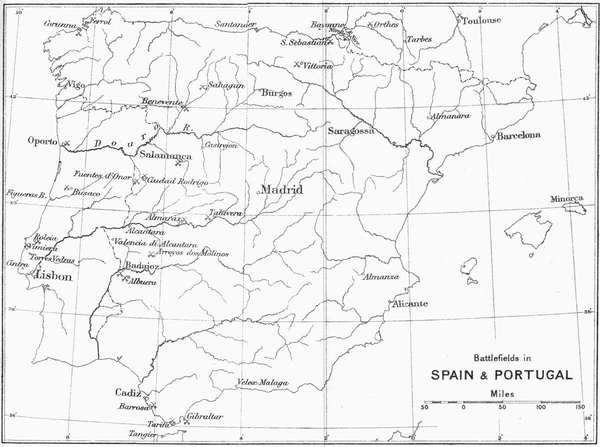
Battlefields in SPAIN & PORTUGAL
There were many reasons which compelled Wellington to refrain from prosecuting a vigorous pursuit after the decisive victory of Vittoria. The French were in possession of the two fortresses of Pampeluna and San Sebastian in the north, and they were far superior in numbers to the Allies in the south of the Peninsula. He pushed the enemy back slowly to the frontier, and at the same time he detached two of his own divisions, under Sir Thomas Graham, to reduce San Sebastian, whilst he entrusted the task of besieging Pampeluna to the Spaniards, resolving that, as soon as these two fortresses were in his possession, he would continue the work of expelling the French from the Peninsula. Emboldened by Lord Wellington's tactics, Soult turned and attacked the English at Roncesvalles and in the Maya Pass. At the latter engagement we were compelled to fall back, leaving some prisoners in the hands of the French; but reinforcements coming up, Wellington resumed the offensive, and by August 1 had once more driven the French to the north of the Pyrenees. The fighting during these few days was excessively severe, our casualties amounting to upwards of 4,000 of all ranks killed and wounded.
Casualties in the Actions in the Pyrenees, July 25 to August 2, 1813.
Regiments.Officers.Men.
K.W.K.W.
Royal Artillery-1119
2nd Queen's-119
3rd Buffs11327
6th Royal Warwicks1714140
7th Royal Fus.11052187
11th Devons-4762
20th Lancs Fusiliers31738189
23rd Royal Welsh Fus.382385
24th S. Wales Borderers---1
27th Royal Inniskillings31158228
28th Gloucester169121
31st E. Surrey-3237
32nd Cornwall L.I.-4451
34th Border R.1548122
36th Worcesters-3835
39th Dorsets2711118
40th S. Lancs21022197
42nd Royal Highlanders--426
45th Derbysh.-1-7
48th N'amptons21012109
50th West Kent31230198
51st K.O.Y.L.I.--762
53rd Shrops. L.I.-1120
57th Middlesex-3468
58th N'ampton-61061
60th Royal R.26872
61st Gloucesters-4338
68th Durham L.I.13841
71st Highland L.I.2728181
74th Highland L.I.14638
79th Cameron H.-1547
82nd S. Lancs4617146
91st H'landers-713100
92nd Gordon Highlanders-2655363
95th Rifle Brig.-2728
San Sebastian, August, 1813.
On July 18, 1817, the following regiments were permitted to assume the battle honour for their services at the siege and capture of this fortress:
Royal Scots. King's Own (Lancaster). Norfolks. East Lancashire. South Staffords. North Lancashire.
Immediately after the Battle of Vittoria, Lord Wellington detached two divisions to besiege this fortress, the possession of which was a necessary prelude to his further pursuit of the French. Unfortunately, our army was ill-provided with material for a siege, and two months were spent before the place was taken. Our losses during the siege and in the two assaults were very severe, as the accompanying casualty returns prove:
Casualties at the Siege and Assault of San Sebastian, July and August, 1813.
Regiments.Officers.Men.
K.W.K.W.
Royal Artillery47420
Roy. Engineers3314111
Coldstream Gds.-1320
Scots Guards--124
Royal Scots815118310
2nd Queen's--11
4th K.O. Lancs.56117170
7th Royal Fus.---6
9th Norfolks61262177
20th Lancashire Fusiliers1129
23rd Roy. Welsh Fusiliers-144
27th Roy. Inniskilling Fusiliers1-52
38th South Staffords51233174
40th South Lancashires-138
43rd Oxford L.I.1-210
47th Loy. North Lancs76106130
48th N. Staffs-141
52nd Oxford L.I.1217
53rd Shropshire L.I.--21
59th E. Lancs812109208
95th Rifle Brig.-271
Nivelle, November 10, 1813.
The battle honour for this hard-fought action is borne by the
Queen's. Buffs. Northumberland Fusiliers. Royal Warwicks. Devons. Royal Welsh Fusiliers. South Wales Borderers. Inniskilling Fusiliers. Gloucesters. Worcesters. East Surrey. Cornwall Light Infantry. Border. Dorsets. South Lancashire. Royal Highlanders. Oxford Light Infantry. Sherwood Foresters. Northamptons. Royal Berkshires. King's Own (Yorkshire Light Infantry). Shropshire Light Infantry. Middlesex. King's Royal Rifles. Durham Light Infantry. Highland L.I. Royal Irish Rifles. Royal Irish Fusiliers. Cameron Highlanders. Argyll Highlanders. Connaught Rangers. Rifle Brigade.
Casualties at the Battle of the Nivelle, November 13, 1813.
Regiments.Officers.Men.
K.W.K.W.
General Staff5---
Royal Artillery1---
12th Lancers---1
Coldstream Guards-1-9
2nd Queen's--226
Buffs-138
K.O. Lancs.-114
5th Northumberland Fus.-215109
Roy. Warwicks--16
Devons-5338
S. Wales Bord.-2-5
27th Inniskilling Fusiliers13951
28th Gloucester---2
31st E. Surrey-1113
34th Border R.--12
38th S. Staffs-2-2
39th Dorsets--15
40th S. Lancs161580
42nd B. Watch-2-25
43rd Oxford L.I.29660
45th Sherwood Foresters---1
48th N'amptons-4757
51st K.O. Yorks L.I.222273
52nd Oxford L.I.-634202
53rd Shropshire L.I.-1320
57th Middlesex27550
58th N'ampton---3
59th E. Lancs--12
King's Roy. R.13758
61st Gloucester25537
66th Berkshire-2532
68th Durham L.I.26732
76th W. Riding---1
79th Cameron Highlanders-1644
82nd S. Lancs.-6958
83rd Royal Irish Rifles-4736
84th York and Lancaster--25
85th Shropshire L.I.1--13
87th Roy. Irish Fusiliers1574133
91st Argyll Highlanders1613105
94th Connaught Rangers121060
95th Rifle Brig.-81176
Wellington had made all his preparations for a general advance so soon as he should be in possession of the two fortresses of San Sebastian and Pampeluna. The former fell into our hands on August 31, but Pampeluna held out until the last days of October. Directly he was apprised of its fall, Wellington commenced his advance. Soult had profited by the delay, and had constructed three strongly entrenched positions, each of which was held with determination. The first has not been inscribed on our colours; the second was on the banks of the River Nivelle, and before the French were driven from it Wellington had lost upwards of 1,200 men. It is worthy of note that, though the Coldstream Guards figure in the casualty return, they have not been awarded the battle honour of Nivelle.
Nive, December 9 to 13, 1813.
This distinction is borne on the colours of the
16th Lancers. Grenadier Guards. Coldstream Guards. Scots Guards. Buffs. Royal Scots. Norfolk. King's Own (Lancaster). Gloucesters. Devons. East Lancashire. Worcesters. Cornwall Light Infantry. East Surrey. Border. West Riding. Dorset. Royal Highlanders. South Staffords. Loyal North Lancashires. Oxford Light Infantry. Royal Berkshire. West Kent. Shropshire Light Infantry. Middlesex. King's Royal Rifles. Wiltshires. York and Lancaster. Highland Light Infantry. Gordon Highlanders. Cameron Highlanders. Argyll Highlanders. Rifle Brigade.
This was Soult's last stand before he was driven across the frontier, and, as the casualty lists show, a very gallant stand did he make on those four December days. The heavy losses incurred by the Grenadier and Scots Guards failed to obtain for the Household Brigade this well-merited battle honour until the month of August, 1910, but full justice has not yet been done to the Brigade of Guards for its gallant services at Ciudad Rodrigo, Salamanca, and Sebastian.
Casualties during the Crossing of the Nive, December 9 to 13, 1813.
Regiments.Officers.Men.
K.W.K.W.
General Staff76--
Royal Artillery--215
13th Hussars---3
14th Hussars--23
16th Lancers--25
Grenadier Gds.2221126
Coldstream Gds.-1-13
Scots Guards13754
Royal Scots-137111
K.O. Lancs-1513154
Norfolk2626160
Devons-1116
28th Gloucester-513129
31st E. Surrey-2232
32nd Cornwall L.I.--25
34th Border R.--112
36th Worcesters---3
38th S. Staffs-41290
39th Dorsets-1326
42nd B. Watch21-11
43rd Oxford L.I.--1222
47th N. Lancs-21253
50th West Kent-112092
52nd Oxford L.I.-3215
57th Middlesex347113
59th E. Lancs-1118136
60th K.R.R.-2976
61st Gloucesters-2-4
66th Berkshire-1968
71st Highland L.I.3927100
76th W. Riding--115
79th Cameron Highlanders-1526
84th York and Lancaster2624100
85th K.O. Shrop. L.I.-1111
91st Argyll Highlanders--747
92nd Gordon Highlanders41027140
95th Rifle Brig.11971
Orthes, February 27, 1814.
This, the first battle fought by Wellington on French soil, is borne on the colours of the
7th Hussars. 13th Hussars. 14th Hussars. Buffs. Northumberland Fusiliers. Royal Warwicks. Royal Fusiliers. Devons. Lancashire Fusiliers. Royal Welsh Fusiliers. South Wales Borderers. Inniskilling Fusiliers. Gloucesters. Worcesters. East Surrey. Border. Cornwall Light Infantry. Dorsets. South Lancashire. Royal Highlanders. Oxford Light Infantry. Sherwood Foresters. Royal Highlanders. Northamptons. Royal Berkshires. West Kent. King's Own (Yorkshire Light Infantry). King's Royal Rifles. Durham Light Infantry. Royal Irish Fusiliers. Highland Light Infantry. Gordon Highlanders. Royal Irish Rifles. Royal Irish Fusiliers. Connaught Rangers. Argyll Highlanders. Rifle Brigade.
The casualties fell heavily on the Sherwood Foresters and on the two Irish regiments which then bore the numbers 87th and 88th.
Casualties at the Battle of Orthes, February 27, 1814.
Regiments.Officers.Men.
K.W.K.W.
General Staff-6--
7th Hussars-346
10th Hussars---1
13th Hussars-1215
14th Hussars---2
15th Hussars---9
Royal Artillery11323
Roy. Engineers1---
N'umberland F.1-531
Roy. Warwick2824111
Royal Fusiliers-4656
Lancs Fusiliers261697
Roy. Welsh F.-31675
27th Royal Inniskilling F.-114
40th S. Lancs--14
42nd B. Watch14490
45th Sherwood Foresters1914106
48th N'ampton--113
52nd Oxford L.I.-6776
58th N'ampton-3325
King's Roy. R.-2331
61st Gloucesters--16
68th Durham L.I.-1327
74th Highland L.I.-5821
82nd S. Lancs-2224
83rd Roy. Irish Rifles-61147
87th Roy. Irish Fusiliers1592116
88th Connaught Rangers21141214
91st Argyll Highlanders-7327
94th Connaught Rangers-1112
Note.—In following up the retreating French the army had been sharply engaged on February 14, 17, 23, and 26, and subsequently to Orthes. A general action was fought at Tarbes on March 20, 1814, the brunt of the work falling on the Rifle Brigade.
Toulouse, April 10, 1814.
This, the closing action of the Peninsular War, was fought after the abdication of Napoleon, and was the final act of the campaign which Sir Arthur Wellesley opened at the combat of Roleia on August 17, 1808. There are ten regiments which bear on their colours the names of the earliest and the last engagements, Roleia and Toulouse. Of these, only five suffered any loss in both engagements. The King's Royal Rifles, Highland Light Infantry, and Rifle Brigade take pride of place, each having fifteen Peninsular battle honours on their appointments. Those to whom the battle honour "Toulouse" has been awarded are the
5th Dragoon Guards. 3rd Hussars. 4th Hussars. 13th Hussars. Queen's. Buffs. Northumberland Fusiliers. Royal Fusiliers. Devons. Lancashire Fusiliers. Royal Welsh Fusiliers. Inniskilling Fusiliers. Gloucesters. Worcesters. South Lancashire. Royal Highlanders. Oxford Light Infantry. Sherwood Foresters. Northamptons. Shropshire Light Infantry. King's Royal Rifles. Highland Light Infantry. Cameron Highlanders. Royal Irish Rifles. Connaught Rangers. Argyll Highlanders. Rifle Brigade.
Casualties at the Battle of Toulouse, April 10, 1814.
Regiments.Officers.Men.
K.W.K.W.
General Staff-3--
5th Drag. Gds.-112
3rd Hussars-1-5
4th Hussars-125
10th Hussars1146
15th Hussars---4
Royal Artillery--731
Queen's (four companies)---12
N'umberland F.---3
Royal Fusiliers--13
Devon1414121
Lancs Fusiliers--29
Roy. Welsh F.--17
27th Inniskilling Fusiliers252376
28th Gloucesters-3325
34th Border R.-1211
36th Worcester1938104
39th Dorsets-1-4
40th S. Lancs-8771
42nd B. Watch42250337
45th Sherwood Foresters18772
48th N'ampton-4539
50th W. Kent-228
52nd Oxford L.I.---5
53rd Shropshire L.I. (two cos.)-5214
60th K.R.R.-31148
61st Gloucesters11816140
71st Highland L.I.--313
74th Highland L.I.-73272
79th Cameron H.31526179
83rd Roy. Irish Rifles---1
87th Roy. Irish Fusiliers12717
88th Connaught Rangers12776
91st Argyll Highlanders-61898
94th Connaught Rangers--15
95th Rifle Brig.-11075
In this fight the 42nd (Royal Highlanders) was wellnigh annihilated.
Peninsula, 1808-1814.
The following regiments bear this battle honour:
1st Life Guards. 2nd Life Guards. Royal Horse Guards. 3rd Dragoon Guards. 4th Dragoon Guards. 5th Dragoon Guards. 1st Royal Dragoons. 3rd Hussars. 4th Hussars. 7th Hussars. 9th Lancers. 10th Hussars. 11th Hussars. 12th Lancers. 13th Hussars. 14th Hussars. 15th Hussars. 16th Lancers. 18th Hussars. 20th Hussars. Grenadier Guards. Coldstream Guards. Scots Guards. Royal Scots. Queen's (Royal West Surrey). Buffs. K.O. (Royal Lancaster). Northumberland Fusiliers. Royal Warwicks. Royal Fusiliers. Norfolk. Lincoln. Devons. Lancashire Fusiliers. Royal Welsh Fusiliers. South Wales Borderers. Royal Inniskilling Fusiliers. Gloucester. Worcester. East Lancashire. East Surrey. Cornwall Light Infantry. West Riding. Border. South Staffordshire. Hampshire. Dorset. South Lancashire. Black Watch. Oxford Light Infantry. Essex. Sherwood Foresters. Loyal North Lancashire. Northampton. Royal Berkshire. Royal West Kent. K.O. (Yorkshire L.I.). King's (Shropshire L.I.). Middlesex. King's Royal Rifles. Wiltshire. Manchester. York and Lancaster. Durham L.I. Highland L.I. Gordon Highlanders. Cameron Highlanders. Royal Irish Rifles. Royal Irish Fusiliers. Connaught Rangers. Argyll Highlanders. Rifle Brigade.
Roll of the Principal Actions during the Peninsular War.
Action.Date.Casualties.Honours.
Officers.Men.
K.W.K.W.
Roleia1808August 1742065315Medal, clasp,and battle honour.
Vimiera"August 21437185497"""
Sahagun"December 21--218"""
Benevente"December 29-3523""No battle honour.
Corunna1809.January 16????Medal, clasp, and battle honour.
Douro"May 24-102386No medal or clasp. Battle honour.
Talavera"July 27271716433,295Medal, clasp, and battle honour.
Busaco1810.Sept. 27535102408"""
Barrosa1811.March 4745182881"""
Fuentes d'Onor"May 51162157576"""
Albuera"May 16391658502,567"""
Arroyos dos Molinos"October 28-7751No medal or clasp. Battle honour.
Tarifa"December23724"""
Ciudad Rodrigo1812.January860122436Medal, clasp, and battle honour.
Badajos"March, April602697512,539"""
Almaraz"May 1921232131No medal or clasp. Battle honour.
Salamanca"July 22281783602,536Medal, clasp, and battle honour.
Vittoria1813.June 21221734902,704"""
Pyrenees"July, August282215103,295"""
San Sebastian"September35705351,038"""
Nivelle"November 10211212371,031"""
Nive"December 9-13191402002,055"""
Orthes1814.February 27151051921,291"""
Toulouse"April 10161342981,661"""