Chapter XIX
Reading edition
THE ASSAULT ON HILGARD
It was three o'clock in the morning. Only from the left wing of Fowler's Division was the booming of cannon occasionally heard. From the mountain-pass above came the noise of passing trains, the clash of colliding cars and the dull rumble of wheels. On the right all was still.
A low whistle went through all the trenches! And then the regiments intended for the assault on Hilgard crept slowly and carefully out of the long furrows. The front ranks carried mattresses, straw-bags, planks and sacks of earth to bridge the barbed wire barricades in case they should not succeed in chopping down the posts to which the wires were fastened. A few American batteries behind La Grande began firing. The other side continued silent.
Suddenly two red rockets rose quickly one after the other on the right near the mountain, and they were followed directly by two blue ones; they went out noiselessly high up in the air. Was it a signal of friend or foe? The regiments came to a halt for a moment, but nothing further happened, except that the two searchlights beyond Hilgard kept their eyes fixed on the spot where the rockets had ascended. A dog barked in the town, but was choked off in the middle of a howl. Then death-like stillness reigned in front once more, but several cannon thundered in the rear and a few isolated shots rang out from the wooded valleys on the left.
The front ranks had reached the wire barricades. Suddenly a sharp cry of pain broke the silence and red flames shot forth from the ground, lighting up the posts and the network of wires. Several soldiers were seen to be caught in the wires, which were apparently charged with electricity. Now was the time! The pioneers provided with rubber gloves to protect them against the charged wires went at it with a vengeance, and were soon hacking away with their axes. Loud curses and cries of pain were heard here and there. "Shut up, you cowards!" yelled some one in a subdued voice. The black silhouettes of the men, who were tossing long boards and bags of earth on top of the wires, stood out sharply against the light of the explosives with which the Americans were attempting to loosen the supporting posts.
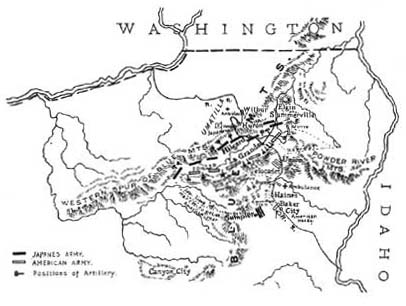
Diagram of the Battle of Hilgard
The light of the dancing flames fell on swaying, leaping figures. Shots rang out constantly, millions of sparks flew all around and through all the din could be distinguished the short, sharp rattatattatt—rrrrr—rattatattatt of the machine-guns, sounding more like cobble-stones being emptied out of a cart than anything else.
Hell had meanwhile broken loose on the other side. The attacking regiments were exposed to a perfectly terrific rifle-fire from the houses and streets of Hilgard, which was accompanied by a destructive cannonade. But on they went! Over the corpses of the slain who had breathed their last jammed in among the deadly wires, over the swaying planks and through the gaps made by the exploding bombs, the battalions swept on with loud shouts of Hurrah! What mattered it that the machine-guns, which they had brought along, were sometimes dragged through furrows of blood! On they went! The field-batteries to the right and left of the first houses and two of the enemy's machine-guns just in front of the barricade were in the hands of the 28th Regiment, and now they advanced against the houses themselves. But it was utterly impossible to get a foot further. A whole battalion was sacrificed before the high barricade at the entrance to the main street, but still they went on! There were no storming-ladders, and after all they were hardly needed, for human pyramids were speedily run up against the walls, and up these soldiers scrambled, assisted from below, until at last they were high enough to shoot into the loop-holes. Others aided in the work with axes and the butt-ends of their guns, and before long the Americans had gained possession of several houses. All of the enemy's searchlights concentrated their glare on the town, so that the fighting was done in a brilliant light. The white top of the church-tower seemed strangely near, while reddish-gold reflections played on the torn copper roof.
But no reënforcements came from the rear, and it was no wonder, for a furious fire from the enemy's artillery and machine-guns swept across the space in front of Hilgard, raining bullets and balls upon the trenches, out of which new battalions climbed again and again; the shots plowed up the land into glowing furrows and created an impassable fire-zone between the trenches and the nearest houses of Hilgard, whence shrieking bugle-calls begged for immediate assistance. If the enemy should succeed in throwing reënforcements into Hilgard, he would have no difficulty in dislodging the Americans from the positions they had won. Suddenly an attack from the wooded valley on the left at last brought relief. It was the Irish brigade under General O'Brien that came on like a whirlwind, quite unexpectedly, and joined in the fight.
This attack threw back the advancing Japanese reënforcements. The regiments could be seen retreating in the pale light of dawn, and then they were seen to form in line on the rising ground behind. Between them and the rear of the town lay the Irish sharpshooters, who went forward by leaps and bounds. But the furious artillery fire from the enemy brought the fighting temporarily to a stand-still.
Wild confusion reigned on all sides as dawn broke. The 17th Japanese Infantry Regiment was still battling with the two American regiments for the possession of the front houses of Hilgard, and the two Japanese battalions in the rear of the town directed their fire on the compact columns of the Third Irish Regiment, which had not yet been formed into line for shooting. It was a critical moment, and everything depended upon the rapidity with which the Japanese resistance in Hilgard could be overcome.
In the houses and on the illuminated streets a furious hand-to-hand encounter was going on, the men rushing at one another with bayonets and the butt-ends of their guns. No effort was made to keep the men or regiments together. Where the weapons had been destroyed or lost in the mad scramble, the soldiers fought like gorillas, tearing one another's flesh with teeth and nails. On all sides houses were on fire, and the falling beams and walls, the bursting flames, the showers of descending sparks, and the bursting shrapnels killing friend and foe alike, created an indescribable jumble.
At last reënforcements arrived in the shape of a regiment which had lost more than half its men in passing through the fire-zone in front of Hilgard.
"Where is Colonel Johnson?"
"Over there, on the other side of the street."
"A prisoner?" asked some one.
"I guess not, they're not making prisoners and we aren't either."
Slowly it grew lighter.
The Irish in the rear of Hilgard had hard work to maintain their position. To dislodge the enemy, it was absolutely necessary to turn his flank; otherwise there was no chance of advancing further. Each line of sharpshooters that leaped forward was partially mowed down by the terrible machine-guns. The enemy didn't budge an inch.
General O'Brien had already dispatched five orderlies to Fowler's division with instructions to attack the enemy from the left, but all five had been shot down the moment they left their cover. Something had to be done at once, or the entire brigade would be destroyed.
Suddenly Corporal Freeman, who had crept up along the ground, appeared beside the General.
"Here, sir," he cried, his face beaming, "here's the connection for you." And he shoved a telephone apparatus towards O'Brien. He had dragged the connecting wire behind him through the entire fire-zone.
"You must be a wizard!" cried the General, and then seizing the instrument he called: "Throw all the troops you can possibly get hold of against the right wing of the Japanese in front of us! The enemy's position is weakened, but we can't attack the ridge in the front from here."
Several minutes passed—minutes pregnant with destruction. The bursting shells thinned the ranks terribly, while the infantry fire continued to sweep along the ground, but worst of all, the ammunition of the Irish regiments was getting low. Several batteries were planted between the ruins of the houses in Hilgard, but even then the enemy did not budge.
Then came a great rush from the left: Cavalry, Indian scouts, regular cavalry, cavalry militia, volunteer regiments, and behind them all the machine-guns and the field-artillery—a perfect avalanche of human beings and horses wrapped in thick clouds of smoke from which showers of sparks descended.
That was our salvation. A wild shout of joy from the Irishmen rose above the din of battle, and after that there was no restraining them. The front ranks of the cavalry were mown down like sheaves of corn by the bullets of the enemy's machine-guns; but that made no difference, on they went, on, ever on! Whole regiments were cut to pieces. Hundreds of saddles were emptied, but the riders came on just the same, and even before they had reached the Irish sharpshooters, every man who wore the green was headed for the ridge almost without waiting for the word of command!
It was an assault the enemy could not possibly repulse. The Irish and the cavalry were right among their firing lines; a battery galloped up into the hostile ranks, crushing dead and wounded beneath its wheels. Bloody shreds of flesh were sticking to the gun-barrels, and torn limbs and even whole bodies were whirled round and round in the spokes of the wheels.
Shrill bugle-calls resounded. The horses were wheeled around and the battery unlimbered. A hostile shell suddenly struck the shaft of the gun-carriage, and in a second the horses were a bloody mass of legs wildly beating the air and of writhing, groaning bodies.
But the gun was in position. And now out with the ammunition! Bang! went the first shot, which had been in the barrel, and then everybody lent a hand; an Indian scout, bleeding at the shoulder, and an engineer helped pass the shells, while a mortally wounded gunner shoved the cartridge into the barrel.
"Aim up there to the left, near the two detached pine-trees, six hundred yards," roared a lieutenant, whose blood-covered shirt could be seen beneath his open uniform.
"The two pines to the left," answered the gunner, lying across the bracket-trail. Bang! off went the shot, and a line of Japanese sharpshooters rose like a flock of quail.
More cannon, more machine-guns, more ammunition-carts rushed up in mad haste; the batteries kept up a continual fire.
The battle moved on farther to the front. The houses of Hilgard were all in flames; only the white top of the church-tower still projected above the ruins. On the right of the town one column after another marched past to the strains of regimental music.
An orderly galloped past, and some one called out to him: "How are things in front?" "Fine, fine, we're winning!" came the answer, which was greeted with jubilant cheers. Gradually the enemy's shots became scarcer as the battle advanced up the slopes.
Engineers were hard at work getting the streets of Hilgard cleared so as to save the troops the detour round the outside of the town. The burning houses were blown up with dynamite, and a temporary hospital was established near the city, to which the wounded were brought from all parts of the battle-field.
By noon Hilgard was sufficiently cleared to allow the 36th Militia Regiment (Nebraska) to pass through. On both sides of the streets were smoking ruins filled with dead and dying and charred remains. The steps of the battalion sounded strangely hollow as the first company turned into the square where the white church still stood almost intact in the midst of the ruins. A wounded soldier was calling loudly for water.
What was that? Were the bells tolling? The soldiers involuntarily softened their step when they heard it. Yes, the bells were tolling, slowly at first and low, but then the peals rang out louder and louder until a great volume of sound burst through the little windows in the white church-spire. Ding—dong, ding—dong——
The flag-bearer of the first company lowered his flag and the soldiers marched past in silence. The captain rode over to the entrance to the tower and looked in. A little boy, about ten years old, was tugging and straining at the heavy bell-ropes. There seemed to be a number of wounded soldiers in the church, as loud groans could be heard through the half-open door.
The captain looked about him in astonishment. Near a post he saw two Japanese, presenting a fearful spectacle in the convulsions of death. Close to them lay an American foot-soldier, writhing with pain from a bayonet-wound in the abdomen; and over in the farther corner he could distinguish a woman, dressed in black, lying on a ragged mattress. Ding—dong, ding—dong, rang the bells up above, but the noise of battle did not penetrate here.
"What are you doing, sonny?" asked the captain.
"I'm ringing the bells for mother," said the little fellow.
"For mother?"
"General," called a weak voice from the corner, "please let the boy alone. I want to hear our bells just once more before I die."
"What's the matter, are you wounded?" asked the captain.
"I feel that I'm dying," was the answer; "a bullet has entered my lung; I think it's the lung."
"I'll send you a doctor," said the captain, "although we——"
"Don't bother, general; it wouldn't do any good."
"How did you get here?"
"My husband," came the answer in a weak voice, "is lying across the street in our burning home. He was the minister here in Hilgard. These last days have been fearful, general; you have no idea how fearful. First they shot my husband, and then our little Elly was killed by a piece of shell when I was running across the street to the church with her and the boy." She paused a moment, and then continued with growing agitation: "It's enough to make one lose faith in the wisdom of the Lord to see this butchery—all the heartrending sorrow that's created in the world when men begin to murder one another like this. You don't realize it in the midst of the battle, but here— And as God has seen fit to spare His church in the battle, I asked the boy to ring the bells once more, for I thought it might be a comfort to some of those dying out there to hear a voice from above proclaiming peace after these awful days. Let him keep on ringing, general, won't you?"
"Can I help you in any way?" asked the captain.
"No, only I should like some water."
The captain knelt down by the side of the poor, deserted woman and handed her his flask.
She drank greedily, and then thanked him and began to sob softly. "What will become of my boy? My poor husband——"
"My good woman," said the captain, forcing himself to speak bluntly, "it's not a question of this boy, or of a single individual who has fallen in battle, but rather of a great people which has just defeated the enemy. The widows and orphans will be taken care of by the survivors, now that the Lord has given us the victory. Those who are lying outside the town and those here have surrendered their lives for their country, and the country will not forget them."
Ding—dong, ding—dong, went the bells as the captain left the church, deeply affected. Ding—dong, ding—dong. Thousands out on the battle-field in the throes of death, and the many unfortunates lying with broken limbs in the burning houses and watching the flames creeping towards them, heard that last call from on high, like a call from God, Who seemed to have turned away from our people.
And then evening came, the evening of the sixteenth of August, which is recorded with bloody letters on the pages of our country's history. Soon all the reserves were engaged in battle. Our splendid regiments could not be checked, so eager were they to push forward, and they succeeded in storming one of the enemy's positions after the other along the mountain-side. At last the enemy began to retreat, and the thunder of the cannon was again and again drowned in the frenzied cheers. General MacArthur was continually receiving at his headquarters reports of fresh victories in the front and on both wings.
The telegraph wires had long ago spread the glad tidings over the length and breadth of the land. Great joy reigned in every town, the Stars and Stripes waved proudly from all the houses, and the people's hearts were fluttering with exultation.
General MacArthur, whose headquarters were located near Hilgard, was waiting for news of Fowler's Division, which had orders to advance on the pass through the valleys on the left wing. They were to try and outflank the enemy's right wing, but word was sent that they had met with unexpected resistance. It appeared, therefore, that the enemy had not yet begun to retreat at that point.
On the other hand, things were going better in the center. But what was the good of this reckless advance, of this bold rush, which built bridges of human bodies across the enemy's trenches and formed living ladders composed of whole companies before the enemy's earthworks—what was the good of all this heroic courage in the face of Marshal Nogi's relentless calculations? He was overjoyed to see regiment after regiment storm towards him, while from his tent he gave directions for the sharp tongs of the Japanese flanks to close in the rear of General MacArthur's army.
About seven o'clock in the evening the surprising news came from the right wing that the batteries which had begun firing on the enemy's lines retreating along the railway line were suddenly being shelled from the rear, and begged for reënforcements. But there were no reserves left; the last battalion, the last man had been pushed to the front! How did the enemy manage to outflank us?
Imploringly, eagerly, the telephone begged for reënforcements, for batteries, for machine-guns, for ammunition. The transport section of the army service corps had been exhausted long ago, and all the ammunition we had was in front, while a wide chasm yawned between the fighting troops and the depots far away in the blue distance. General MacArthur had nothing left to send.
And now from Indian Valley came the request for more machine-guns, but there wasn't one left. General MacArthur telegraphed to Union, the terminus of the field-railway, but the answer came that no assistance could be given for several hours, as the roadbed had first to be repaired. From Toll Gate, too, came stormy demands for more ammunition—all in vain.
And then, at eight o'clock, when the sun had sunk like a ball of fire in the west, and the Blue Mountains, above which hovered puffs of smoke from the bursting shrapnel, were bathed in the golden evening light and the valley became gradually veiled in darkness, the crushing news came from Baker City that large, compact bodies of Japanese troops had been seen on the stretch of broken-down railroad near Sumpter. Soon afterwards Union reported the interruption of railway communication with the rear and an attack with machine-guns by Japanese dismounted cavalry, while Wood's division in the front continued to report the capture of Japanese positions.
With relentless accuracy the arms of the gigantic tongs with which Nogi threatened to surround the entire Army of the North began to close. The American troops attacking both flanks had not noticed the Japanese reserves, which had been held concealed in the depressions and shallow valleys under cover of the woods. Two miles more to the right and left, and our cavalry would have come upon the steel teeth of the huge tongs, but there was the rub: they hadn't gone far enough.
About ten o'clock in the evening Baker City, which was in flames, was stormed by the Japanese, Indian Valley having already fallen into their hands. The attack in front, high up in the mountains, began to waver, then to stop; a few captured positions had to be abandoned, and down in the valley near La Grande, whence the field-hospitals were being removed to the rear, the ambulances and Red Cross transports encountered the troops streaming back from Baker City. One retreating force caught up with the other, and then night came—that terrible night of destruction. Again the cannon thundered across the valley, again the machine-guns joined in the tumult, while the infantry fire surged to and fro.
You may be able to urge an exhausted or famished troop on to a final assault, you may even gain the victory with their last vestige of energy, their last bit of strength, provided you can inspire them with sufficient enthusiasm; but it is impossible to save a lost cause with troops who have been hunted up and down for twenty-four hours and whose nerves are positively blunt from the strain of the prolonged battle.
The exhausted regiments went back, back into the basin of the Blue Mountains, into a flaming pit that hid death and destruction in its midst. The headquarters, too, had to be moved back. General MacArthur lost his way in the darkness, and, accompanied by a single officer, rode across the bloody battle-field right through the enemy's line of fire.
He soon ran across a cavalry brigade belonging to Longworth's division, and at once placed himself at its head and led an onslaught on a Japanese regiment. A wild mêlée ensued in the darkness, and, although only a few hundred riders remained in their saddles, the attack had cleared the atmosphere and the wavering battalions gained new courage.
General MacArthur ordered a retreat by way of Union, employing Wood's division, which was slowly making its way back to Hilgard, to cover the retreat. Regiment after regiment threatened to become disbanded, and only the determined action of the officers prevented a general rout. The decimated regiments of Wood's division stood like a wall before the ruins of Hilgard; they formed a rock against which the enemy's troops dashed themselves in vain. In this way Fowler's and Longworth's divisions succeeded in making a fair retreat, especially as the enemy's strength was beginning to become exhausted. The uncertainty of a night attack, when the fighting is done with bandaged eyes, as it were, and it becomes impossible to control the effect of one's own firing, contributed also towards weakening the Japanese attacks. The thin lines of hostile troops from Baker City and from the north, which had threatened to surround our army, were pierced by the determined assaults of the American regiments; and although our entire transport service and numerous guns remained in possession of the enemy, our retreat by way of Union was open.
At dawn on the seventeenth of August the remains of Wood's division began to leave Hilgard, which they had so bravely and stubbornly defended, the heroes retreating step by step in face of the enemy's artillery fire.
General MacArthur stopped just outside of Union and watched the regiments—often consisting only of a single company—pass in silence. He frowned with displeasure when he saw Colonel Smeaton riding alone in the middle of the road, followed by two foot-soldiers. The colonel was bleeding from a wound in his forehead.
General MacArthur gave spurs to his horse and rode towards the colonel, saying: "Colonel, how can you desert your regiment?"
Colonel Smeaton raised himself in his stirrups, saluted, and said: "I have the honor to report that only these two, Dan Woodlark and Abraham Bent, are left of my regiment. They are brave men, general, and I herewith recommend them for promotion."
The general's eyes grew moist, and, stifling a sigh, he held out his hand to Colonel Smeaton: "Forgive me," he said simply, "I did not intend to hurt your feelings."
"Nonsense!" cried the colonel. "We'll begin over again, general, we'll simply start all over again. As long as we don't lose faith in ourselves, nothing is lost."
Those were significant words spoken that seventeenth day of August.