FOUNDING AND EARLY HISTORY OF THE BANK
Reading edition
On April 17, 1799, a committee of the Directors was appointed
"to consider the most proper means of employing the capital of the Company."
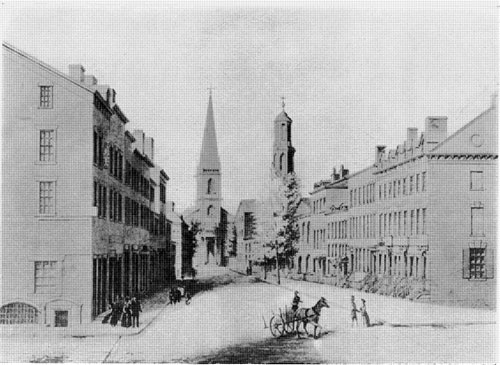
The committee reported on June 3, 1799, in favor of opening an office of discount and deposit, and a house was bought on the site of the present No. 40 Wall Street, in which, on September 1, 1799, the "Bank" of the Manhattan Company began business.
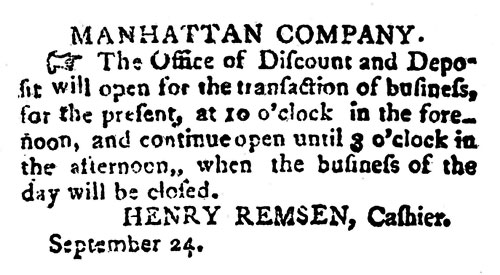
The following is one of the earliest advertisements, reproduced from the Mercantile Advertiser, October 9, 1799:
WALL STREET IN 1803 Present No. 40 Wall Street
The first action of the Directors after the opening of the Bank was:
Resolved, That this Board will hereafter meet twice a week, to wit, on Mondays and Thursdays of each week, at 11 o'clock.
The policy of semi-weekly meetings still prevails in the Manhattan Company, and its Board of twelve Directors keeps in close touch with all its affairs.
MANHATTAN COMPANY CURRENCY
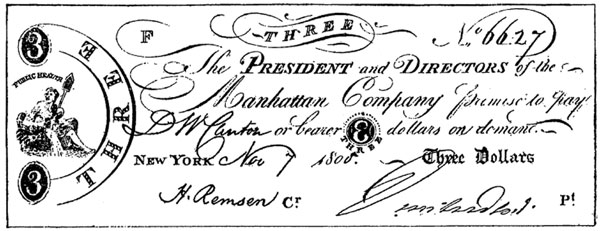
Two months after the Bank was opened the Directors
Resolved, That a committee be appointed to visit the vaults and examine the cash and look over the effects of the Manhattan Company deposited therein.
Thus, at the outset, the Manhattan Company required its Directors periodically to examine its cash and securities, a safeguard which, 106 years later, the State of New York made compulsory for all State banking institutions.
The Bank of the Manhattan Company was profitable from the start and commenced paying dividends in July 1800. The total dividends to and including January, 1913, have aggregated $19,726,000.
FRACTIONAL CURRENCY USED IN UTICA
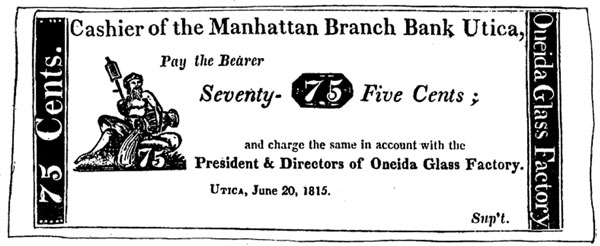
Although the main office of the Bank has always been at the present No. 40 Wall Street, in the autumn of 1805 all the banks moved temporarily to the Village of Greenwich to escape the usual autumn fever epidemic. The Directors then determined to provide a country office for use during the "sickly season." Many persons offered sites; among them "Mr. Astor proposed verbally to cede eight lots of ground near Greenwich, being part of his purchase from Gov. Clinton." Finally land was acquired between the "Bowery Road" and the East River. From 1809 to 1819 branches of the Bank were maintained in Utica and Poughkeepsie.
In 1805 negotiations were consummated for a "union of the capitals and interests" of the New York State Bank of Albany and the Manhattan Company. A bill authorizing the consolidation was offered in the Legislature, but it failed to pass, and the plan was abandoned.
In 1808 the Legislature, in enacting certain amendments to the Charter of the Manhattan Company, reserved for the State the right to take 1,000 shares of its capital stock. This right was exercised and the capital stock was increased for the purpose from $2,000,000 to $2,050,000. Both the State and the City of New York are still stockholders, this being the only bank stock which the State holds.
In 1833, as shown in the cartoon reproduced on the following page, the Manhattan Company was one of the banks to receive the Government deposits when they were withdrawn from the second United States Bank by President Jackson.
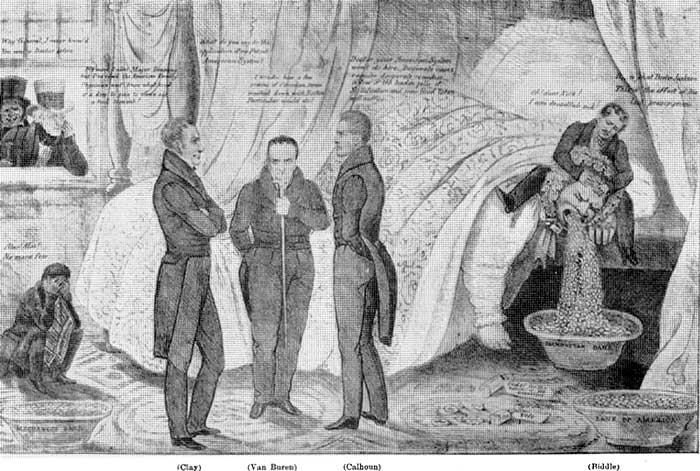
(Clay) (Van Buren) (Calhoun) (Biddle)
THE DOCTORS PUZZLED OR THE DESPERATE CASE OF MOTHER U. S BANK.
Published and for sale wholesale and retail by A Imbert at his Caricature Store No 106 Broadway