A Sermon in Praise of Thieves and Thievery.
Reading edition
[MS. Cott. Vesp. A xxv. leaf 53]
A sermo of parson Hyberdyne which he made att the commandemente of certen theves, after thay had Robbed hym, besydes hartlerowe, in hamshyer, in the feldes, ther standinge vpon a hy where as a wynde myll had bene, in the presens of the theves that robbed hym, as followithe.


the sermon as followethe
I greatly merve that any man wy presume to dysprase theverie, and thynke the dooeres therof to be woorthy of deathe, consyderinge itt is a thynge that cumithe nere vnto vertue, beinge vsed of many in a contries, And commendid and allowed of god hym selfe; the which, thinge, by-cause I cannot compendiously shew vnto yow at soo shorte a warnynge and in soo sharpe a wether, I sha desyer yow, gentle audiens of theves, to take in good parte thes thynges that at thys tyme cumythe to my mynde, not mysdowtynge but that yow of yowre good knowledge are able to add mutch more vnto ytt then this which I sha nowe vtter vnto yow. ffyrst, fortitude, and stowtnes of corage, and also bowldnes of minde, is commendyd of sume men to be a vertue; which, beinge grawnted, who is yt then that wy not iudge theves to be vertused? for thay be of a men moste stowte and hardy, and moste withowte feare; for thevery is a thynge moste vsua emonge a men, for not only yow that be here presente, but many other in dyuerse places, bothe men and wemen and chyldren, rytche and poore, are dayly of thys facultye, {95} as the hangman of tyboorne can testyfye: and that yt is allowed of god hym selfe, as it is euydente in many storayes of [the] scriptures; for yf yow looke in the hole cowrse of the byble, yow shall fynde that theves haue bene beloued of gode; for Iacobe, whan he came owte of Mesopotamia, dyd steale his vncle labanes kyddes; the same Iacobe also dyd steale his brothe[r] Esaues blessynge; and yett god sayde, “I haue chosen Iacobe and refused Esau.” The chyldren of ysrae, whan they came owte of Egypte, dyd steale the egiptians iewelles of syluer and gowlde, as god commawnded them soo to doo. Davyd, in the days of Abiather the hygh preste, did cume into the temple and dyd steale the hallowed breede; and yet god saide, “Dauid is a ma euen after myne owne harte.” Chryste hym selfe, whan he was here on the arthe, did take an asse and a cowlte that was none of hys; and yow knowe that god said of hym, “this is my beloued soone, in whome I delighte.” thus yow may see that god delightithe in theves. but moste of a I marve that men can dispyse yow theves, where as in a poyntes almoste yow be lyke vnto christe hym selfe: for chryste had noo dwellynge place; noo more haue yow. christe wente frome towne to towne; and soo doo yow. christe was hated of a men, sauynge of his freendes; and soo are yow. christe was laid waite vpon in many places; and soo are yow. chryste at the lengthe was cawght; and soo sha yow bee. he was browght before the iudges; and soo sha yow bee. he was accused; and soo sha yow bee. he was condempned; and soo sha yow bee. he was hanged; and so sha yow bee. he wente downe into he; and soo sha yow dooe. mary! in this one thynge yow dyffer frome hym, for he rose agayne and assendid into heauen; and soo sha yow neuer dooe, withowte godes greate mercy, which gode grawnte yow! to whome with the father, and the soone, and the hooly ghoste, be a honore and glorye, for euer and euer. Amen!

Thus his sermon beinge endyd, they gaue hym his money agayne that thay tooke frome hym, and ijs to drynke for hys sermon.
finis.
{96}
[Blank Page]
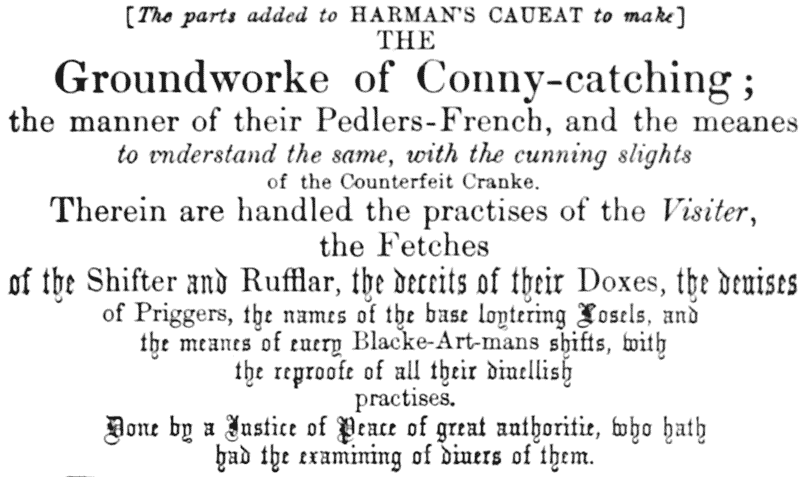

[The parts added to HARMAN’S CAUEAT to make]
THE
Groundworke of Conny-catching;
the manner of their Pedlers-French, and the meanes to vnderstand the same, with the cunning slights of the Counterfeit Cranke. Therein are handled the practises of the Visiter, the Fetches of the Shifter and Rufflar, the deceits of their Doxes, the deuises of Priggers, the names of the base loytering Losels, and the meanes of euery Blacke-Art-mans shifts, with the reproofe of all their diuellish practises. Done by a Justice of Peace of great authoritie, who hath had the examining of diuers of them.
Printed at London by Iohn Danter for William Barley, and are to be sold at his shop at the vpper end of Gratious streete, ouer against Leaden-hall, 1592.
7
{98}
[Blank Page]
{99}
[Headnote: THE GROUNDWORKE OF CONNY-CATCHING.]
[leaf 2]
To the gentle Readers health.
Gentle reader, as there hath beene diuers bookes set forth, as warnings for all men to shun the craftie coossening sleights of these both men and women that haue tearmed themselues Conny-catchers; so amongst the rest, bestow the reading ouer of this booke, wherin thou shalt find the ground-worke of Conny-catching, with the manner of their canting speech, how they call all things in their language, the horrible coossening of all these loose varlots, and the names of them in their seuerall degrees,
First, The Visiter.
2. The Shifter.
3. The Rufflar.
4. The Rogue.
5. The wild Rogue.
6. A prigger of Prauncers.
7. A Pallyard.
8. A Frater.
9. An Abraham man.
10. A freshwater Marriner, or Whipiacke.
11. A counterfait Cranke.
12. A Dommerar.
13. A Dronken Tinkar.
14. A Swadder, or Pedler.
15. A Iarkeman & Patrico.
16. A demander for glimmar.
17. The baudy Basket.
18. An Autem Mort.
19. A walking Mort.
20. A Doxe.
21. A Dell.
22. Kinchin Mort.
23. A Kinchin Co.
All these playing their coossenings in their kinde are here set downe, which neuer yet were disclosed in anie booke of Conny-catching. {100}
[Headnote: SHIFTERS AT INNS.]
[leaf 2, back]
A new kind of shifting sleight, practised at this day by
some of this Cony-catching crue, in Innes or vitualling
houses, but especially in Faires or Markets,
which came to my hands since the im-
printing of the rest.
Whereas of late diuers coossening deuises and deuilish deceites haue beene discouered, wherby great inconueniences haue beene eschewed, which otherwise might haue beene the vtter ouerthrowe of diuers honest men of all degrees, I thought this, amongst the rest, not the least worthie of noting, especially of those that trade to Faires and Markets, that therby being warned, they may likewise be armed, both to see the deceit, and shun the daunger. These shifters will come vnto an Inne or vittailing house, that is most vsed in the towne, and walke vp and downe; and if there come any gentleman or other, to lay vp either cloke, sword, or any other thing woorth the hauing, then one of this crue taketh the marks of the thing, or at least the token the partie giueth them: anone, after he is gone, he likewise goeth forth, and with a great countenance commeth in againe to the mayde or seruant, calling for what another left: if they doubt to deliuer it, then hee frets, and calles them at his pleasure, and tels them the markes and tokens: hauing thus done, hee blames their forgetfulnes, and giues them a couple of pence to buy them pinnes, bidding them fetch it straight, and know him better the next time, wherewith they are pleasd, and he possest of his pray. Thus one gotte a bagge of Cheese the last Sturbridge Faire; for in such places (as a reclaimd fellow of that crue confessed) they make an ordinary practise of the same.
[The Pedler’s French follows, taken word for word from Harman’s book, p. 82–7 above.]
[leaf 5]
THE VISITER.
An honest youth, not many yeares since, seruant in this City, had leaue of his master at whitsontide to see his friends, who dwelt some fifty miles from London. It hapned at a Country wake, his mother and hee came acquainted with a precise scholler, that, vnder colour of strickt life, hath bin reputed for that hee is not: hee is well {101} knowen in Paules Churchyard, and hath beene lately a visiting in Essex; for so he presumes to tearme his cosening walks: and therefore wee will call him here a Visiter. This honest seeming man must needes (sith his iourney lay to London) stay at the yong mans mothers all the holy daies: where as on his desert hee was kindly vsed; at length, the young man, hauing receiued his mother’s blessing, with other his friendes giftes, amounting to some ten poundes, was to this hypocrite as to a faithful guide committed, and toward London they ride: by the way this Visiter discourses how excellent insight he had in Magick, to recouer by Art anything lost or stolne. Well, to sant Albons they reach; there they sup together, and, after the carowsing of some quarts of wine, they go to bed, where they kindly sleepe,—the Visiter slily, but the young man soundly. Short tale to make—out of his bed-fellow’s sleeue this Visiter conuaid his twenty Angels, besides some other od siluer, hid it closely, and so fell to his rest. Morning comes—vp gets this couple—immediately the money was mist, much adoo was made; the Chamberlaine with sundry other seruants examined; and so hot the contention, that the good man, for the discharge of his house, was sending for a Constable to haue them both first searcht, his seruants Chests after. In the meane time the Visiter cals the yong man aside, and bids him neuer grieue, but take horse; and he warrants him, ere they be three miles out of towne, to helpe him to his money by Art, saying:—“In these Innes ye see how we shall be out-faced, and, beeing vnknowne, how euer we be wrongd, get little remedy.” The yong man, in good hope, desired him to pay the reckoning, which done, together they ride. Being some two miles from the towne, they ride out of the ordinary way: there he tels this youth how vnwilling hee was to enter into the action, but that it was lost in his company, and so forth. Well, a Circle was made, wondrous words were vsed, many muttrings made: at length hee cries out,—“vnder a greene turfe, by the East side of an Oake; goe thither, goe thither.” This thrice he cryed so ragingly, as the yuong man gest him mad, and was with feare almost beside himself. At length, pausing, quoth this Visiter, “heard ye nothing cry?” “Cry!” said the yong man, “yes; [leaf 5, back] you cride so as, for twise ten pound, I would not heare ye {102} again.” “Then,” quoth he, “’tis all well, if ye remember the words.” The yong man repeated them. With that this shifter said, “Go to the furthest Oke in the high-way towards S. Albons, and vnder a greene turfe, on the hither side, lyes your mony, and a note of his name that stole it. Hence I cannot stirre till you returne; neyther may either of our horses be vntide for that time: runne yee must not, but keepe an ordinary pace.” Away goes the yong man gingerly; and, being out of sight, this copesmate takes his cloke-bag, wherein was a faire sute of apparel, and, setting spurres to his horse, was, ere the Nouice returned, ridde cleane out of his view. The yong man, seeing himselfe so coossened, made patience his best remedie, tooke his horse, and came to London, where yet it was neuer his lucke to meet this visiter.
[Headnote: A SHIFTER DESCRIBED.]
A SHIFTER.
A Shifter, not long since, going ordinarily booted, got leaue of a Carrier to ride on his owne hackney a little way from London, who, comming to the Inne where the Carier that night should lodge, honestly set vp the horse, and entred the hal, where were at one table some three and thirty clothiers, all returning to their seuerall countries. Vsing, as he could, his curtesie, and being Gentleman-like attirde, he was at all their instance placed at the vpper end by the hostesse. After hee had a while eaten, he fel to discourse with such pleasance, that all the table were greatly delighted therewith. In the midst of supper enters a noise of musitions, who with their instruments added a double delight. For them hee requested his hostesse to laye a shoulder of mutton and a couple of capons to the fire, for which he would pay, and then mooued in their behalfe to gather. Among them a noble was made, which he fingring, was well blest; for before he had not a crosse, yet he promist to make it vp an angel. To be short, in comes the reckoning, which (by reason of the fine fare and excesse of wine) amounted to each mans halfe crown. Then hee requested his hostesse to prouide so many possets of sacke, as would furnish the table, which he would bestow on the Gentlemen to requite their extraordinary costs: and iestingly askt if she would {103} make him her deputie to gather the reckoning; she graunted, and he did so: and on a sodaine, (faining to hasten his hostesse with the possets) he tooke his cloke, and, finding fit time, hee slipt out of doores, leauing the guestes and their hostesse to a new reckoning, and the musitians to a good supper, but they paid for the sauce. This iest some vntruly attribute to a man of excellent parts about London, but he is slandered: the party that performed it hath scarce any good qualitie to liue. Of these sort I could set downe a great number, but I leaue you now vnto those which by Maister Harman are discouered.
[Then follows Harman’s book, commencing with a Ruffelar, p. 29. The woodcut of Nicolas Blunt and Nicolas Geninges (p. 50, above) is given, and another one representing the Cranke after he was stripped and washed. The volume ends with the chapter “Their vsage in the night,” p. 76–8 above,—the woodcuts and verses at the end of Harman’s book being omitted in the present Groundworke of Conny-catching. The last words in the latter are, “And this must the poore Farmer suffer, or els they threaten to burne him, and all that he hath.”]