PREFACE.
Reading edition
n this little book the attempt has been to trace Greek History so as to be intelligible to young children. In fact, it will generally be found that classical history is remembered at an earlier age than modern history, probably because the events are simple, and there was something childlike in the nature of all the ancient Greeks. I would begin a child’s reading with the History of England, as that which requires to be known best; but from this I should think it better to pass to the History of Greece, and that of Rome (which is in course of preparation), both because of their giving some idea of the course of time, and bringing Scripture history into connection with that of the world, and because little boys ought not to begin their classical studies without some idea of their bearing. I have begun with a few of the Greek myths, which are absolutely necessary to the understanding of both the history and of art. As to the names, the ordinary reading of them has been most frequently adopted, and the common Latin titles of the gods and goddesses have been used, because these, by long use, have really come to be their English names, and English literature at least will be better understood by calling the king of Olympus Jupiter, than by becoming familiar with him first as Zeus.
CHARLOTTE M. YONGE.
CONTENTS.
chap. page
I. Olympus 11
II. Light and Dark 18
III. The Peopling of Greece 26
IV. The Hero Perseus 35
V. The Labours of Hercules 42
VI. The Argonauts 51
VII. The Success of the Argonauts 59
VIII. The Choice of Paris 68
IX. The Siege of Troy 76
X. The Wanderings of Ulysses 84
XI. The Doom of the Atrides 94
XII. After the Heroic Age 102
XIII. Lycurgus and the Laws of Sparta. b.c. 884–668 110
XIV. Solon and the Laws of Athens. b.c. 594–546 118
XV. Pisistratus and his Sons. b.c. 558–499 126
XVI. The Battle of Marathon. b.c. 490 134
XVII. The Expedition of Xerxes. b.c. 480 142
XVIII. The Battle of Platæa. b.c. 479–460 151
XIX. The Age of Pericles. b.c. 464–429 159
XX. The Expedition to Sicily. b.c. 415–413 167
XXI. The Shore of the Goat’s River. b.c. 406–402 174
XXII. The Retreat of the Ten Thousand. b.c. 402–399 181
XXIII. The Death of Socrates. b.c. 399 189
XXIV. The Supremacy of Sparta. b.c. 396 196
XXV. The Two Theban Friends. b.c. 387–362 203
XXVI. Philip of Macedon. b.c. 364 210
XXVII. The Youth of Alexander. b.c. 356–334 217
XXVIII. The Expedition to Persia. b.c. 334 224
XXIX. Alexander’s Eastern Conquests. b.c. 331–328 231
XXX. The End of Alexander. b.c. 328 238
XXXI. The Last Struggles of Athens. b.c. 334–311 245
XXXII. The Four New Kingdoms. b.c. 311–287 252
XXXIII. Pyrrhus, King of Epirus. b.c. 287 258
XXXIV. Aratus and the Achaian League. b.c. 267 265
XXXV. Agis and the Revival of Sparta. b.c. 244–236 272
XXXVI. Cleomenes and the Fall of Sparta. b.c. 236–222 279
XXXVII. Philopœmen, the Last of the Greeks. b.c. 236–184 286
XXXVIII. The Fall of Greece. b.c. 189–146 293
XXXIX. The Gospel in Greece. b.c. 146–a.d. 60 300
XL. Under the Roman Empire 308
XLI. The Frank Conquest. 1201–1446 315
XLII. The Turkish Conquest. 1453–1670 322
XLIII. The Venetian Conquest and Loss. 1684–1796 328
XLIV. The War of Independence. 1815 334
XLV. The Kingdom of Greece. 1822–1875 340

LIST OF ILLUSTRATIONS.
page
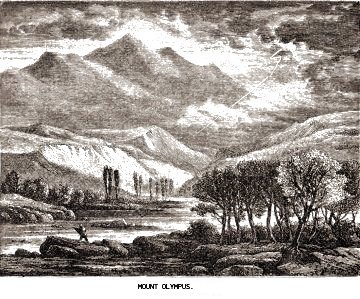
Mount Olympus 11
Head of Jupiter 14
Supposed Temple of Jupiter Panhellenius in Ægina 19
Head of Pallas 21
Triptolemus 23
Mars and Victory 25
Mount Parnassus 27
The World according to the Greeks 30
Perseus and Andromeda 38
Cyclopean Wall 41
Scene in the Arachnæan Mountains near Argos 44
Building the Argo 53
Corinth 62
Plains of Troy 69
Greek Ships 73
Achilles binding his Armour on Patroclus 78
Sepulchral Mound, known as the Tomb of Ajax 80
Laocöon 82
Funeral Feast 83
Ulysses tied to the Mast 89
Port of Ithaca 91
Plain of Sparta, with Mount Taygetus 97
Greek Interior 106
Greek Robe 107
Male Costume 108
Gate of Mycenæ 119
Shores of the Persian Gulf 129
View in the Vicinity of Athens 141
Pass of Thermopylæ 145
Salamis 148
Persian Soldier 152
Tombs at Platæa 153
The Acropolis, Athens 162
Propylæa, Athens 163
The Academic Grove, Athens 168
Athens 180
Babylon 182
Greek Armour 188
Socrates 190
Plato 193
View on the Eurotas in Laconia 202
Thessalonica 209
Demosthenes 212
Diana of Ephesus 218
Alexander 222
Bacchanals 223
Alexander the Great 225
Second Temple of Diana at Ephesus 227
Princes of Persia 234
Supposed Walls of Babylon 242
Site of Susa, ancient Metropolis of Persia 244
Gate of Hadrian in Athens 247
Macedonian Soldier 255
Delphi and the Castalian Fount 262
Corinth 267
View looking across Isthmus of Corinth 269
Ruins of a Temple at Corinth 271
Temple of Neptune 285
Crowning the Victor in the Isthmian Games 290
Livadia, the ancient Mideia in Argolis 292
Sappho 295
Lessina, the ancient Eleusis, on the Gulf of Corinth 297
View from Corinth 301
Parthenon and Erectheum 304
Distant View of Parnassus 307
Plains of Philippi 309
Obelisk of Theodosius, Constantinople 313
An Amphitheatre 314
Promontory of Actium 318
Mount Helicon 321
Cathedral of St. Sophia 323
Temple of Minerva, on the Promontory of Sunium 330
Ancyra, Galatia 332
The Acropolis, Restored 337
The Isles of Greece 344
Plain of Marathon 346