CAMILLE MAUCLAIR (continued 2)
Clementina Black translation
"I do not deny that there is exaltation in my works; but that exaltation existed not in me, but in nature, in movement. The divine work is naturally exalted. As for me, all I do is to be true; my temperament is not 'exalted'; it is patient. I am not a dreamer, but a mathematician; and if my sculpture is good it is because it is geometrical."
From these fragments of conversation the reader will conceive how Rodin's generalising spirit leads him from the realism of his daily work to the synthesis of a sort of ideo-realistic metaphysical system. He has the sense (belonging only to genius) of the continuity of the universe, and he certainly had it at a time when, unlettered as he was, he would not have known how to explain it specifically to himself. He constantly formulates this metaphysical system, as I have seen it formulated by Stéphane Mallarmé, who could never see anything without instantly bringing together two ideas or images that no one would ever have thought of connecting. Spontaneous analogy is the mark of genius and the secret of all real poetry. This is why I consider Rodin as a very great poet—not in the sense that he dislikes, but on the contrary, by giving to the word "poet" its deep etymological significance according to the Greek, that of "making, creating, vivifying." We may understand, too, in how great a degree an intellectuality of this kind offers a living challenge to the ideas of the "École." The man who thinks thus is necessarily isolated and has struggled all his life, never making a concession and saying nobly, "The artist, like the woman, has an honour to preserve." I will further quote from Rodin the following reflection[6]: "Where you follow nature, you get everything. When I have a beautiful woman's body for a model the drawings that I make from it give me images of insects, birds, and fishes. That seems improbable, and I had no suspicion of it myself. Formerly I used to be seeking shapes for vases, either to use them at Sèvres, where I used to work, or elsewhere.... I never succeeding in finding a beauty of proportions and lines such as I had the feeling of, because I only founded my attempts upon imagination. Since that time I have drawn women's bodies, and one of these bodies gave me, in the synthesis of it, a magnificent shape for a vase, with true and harmonious lines. The point is not to create. Creation and improvisation are useless words. Genius only comes to the man who understands with his eye and his brain. Everything is in the things about us. Manufacture and ornamental art want reforming according to these ideas. I should have liked to see that. Everything-is contained in nature. There is an harmonious, continual, uninterrupted movement. A woman, a mountain, a horse, in conception they are all the same thing, they are made on the same principles. Young artists compose instead of following their models and understanding that therein lies infinity." Here Rodin directly touches a scientific truth—the relative monotony of Nature's productive forms. Nature does everything with very few forms: the variations are so infinite that there are no two leaves alike, but the nerves of a leaf, the lines of a vein, an artery, a bird's wing, a fishbone, a nerve-cell, are identical; multiplicity derives from identity and returns to it, so that everything is reduced to a fundamental geometry which perhaps is but the effect of a single cellular generation. In this respect the laws of art and of science are the same, even as among all the arts there is a synthesis of common laws, an identity where we seem to behold a difference. Recent work in science, by establishing the existence of states of radiation (Crookes, Röntgen, Hertz) is busy undermining our old conception of matter, showing us the identity of it with the immaterial, and thereby abolishing our preconceptions about the idea and the fact, music and sculpture, considered as different manifestations. I remember that I one day kept Rodin's curiosity excited for a long time by explaining the details of this theory to him; he was not acquainted with it, and listened to me as to a writer in love with general ideas. But it was clear that in his mere province as a sculptor he knew far better and had penetrated far more deeply into this enthralling problem of identity. His is a luminous mind, of the same kind as the electric rays; it rather penetrates than surrounds what is obscure to it. On that day he was disturbed, and I was irritated by certain declamations which had been written about his "philosophy," and of which the author had assuredly not comprehended the logical consequences; and we came to the conclusion that it would be much better for Rodin's peace of mind to keep silent upon these points, for his "philosophy" could only be made comprehensible to those who could understand the method of his sculpture.
It is time, however, to pause in this path and to return simply to the question of sculpture. Nor was it my purpose to tire the reader by these abstractions when I began to say a few words about Rodin's opinions concerning the antique. It must be understood, then, that the Balzac and even the Hugo, as well as some figures, were the result of all these preceding reflections. "When I saw my Balzac brought into the yard from the storehouse of the statues in order to go to the Salon," says Rodin, "I had it purposely placed beside The Kiss, which had been finished rather earlier. I was not dissatisfied with the simplified vigour of that group, to which I had already applied these experiments. But I saw that it looked slack, that it did not hold its place beside the Balzac as Michael Angelo's torso does beside a fine antique, and then I understood that I was in the right path. I have had hesitations, you know, pangs that I do not speak of. And then, little by little, as I looked at nature, as I came to understand it better and to throw aside my prejudices more frankly, I took courage. It seemed to me that I was doing better. When I began I did skilful things, things that were smartly done, but they were thin and dry, but I felt there was something beyond, and that something is amplification. I only ventured on it when I was over fifty years old, but do you not think I have a right now to disregard the objections of the mob and the newspapers? I have taken time to know why I was doing as I did. The essential things of my modelling are there, and they would be there in less degree if I 'finished' more. As to polishing or repolishing a toe or a curl, I find no interest in it; it impairs the large line, the soul of what I desired to do, and I have nothing more to say to the public on that point. There the line of demarcation comes between the confidence that the public ought to have in me and the concessions that I ought not to make to the public." To this firm and discreet resolution Rodin has kept in all the works wrought out by him since 1898.
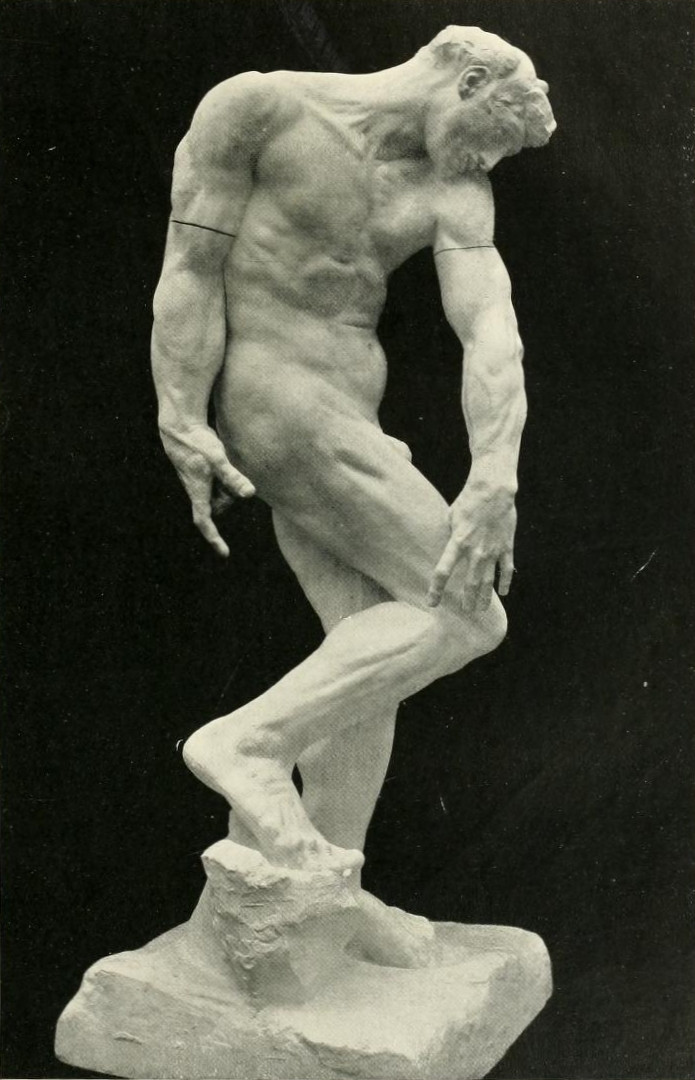
PRIMITIVE MAN.
I cannot better set forth his opinions about the antique than by quoting the following fragments from two articles that he wrote for the Musée, a review of ancient art, in January and February, 1904; for Rodin sometimes writes, quite unpretentiously, but with the same lucidity of thought that he shows in his familiar conversation. One of these articles refers to a Greek statuette in the Museum of Naples, the other to the lesson that the ancients give us.
"In the first place, the Antique is Life itself. Nothing is more alive, and no style in the world has rendered life as it has. The ancients were the greatest, most serious, and most admirable observers of nature who have ever existed. The antique was able to render life because the ancients saw the essential thing in it—large blocks. They confined themselves to the large shadows cast by these large blocks, and as truth itself lies in that, their figures being so made could never be feeble. Moreover, the antique is simple, and that gives it astonishing energy. And then there is much more study in it than appears; that was brought home to me once. When I had finished my Age of Brass, I went to Italy and I found an Apollo whose leg was in exactly the same position as one in The Age of Brass that had taken me six months' work. Then I saw that though on the surface everything seems to be done at a stroke, in reality all the muscles are built up and one sees the details come to light one by one. That is because the ancients studied everything in its successive profiles, because in any figure and every part of a figure no profile is like another; when each has been studied separately the whole appears simple and alive.
"The great error of the neo-Greek school is really this: it is not type that is antique, but modelling. For want of having understood that, the neo-Greek school has produced nothing but papier-mâché. It is bad to put the antique before beginners; one should end, not begin with it. If you wanted to teach someone to eat, you would give him fresh food, that he might learn to chew; it would never occur to you to give him food already triturated to exercise his teeth upon. Well, when you want to teach sculpture to anyone, set him face to face with nature, and when he has gained plenty of power to deal with nature, then say to him: 'Now, here is what the antique has done.' And that will give him a new source of energy. Whereas if you give the antique to the beginner who has never struggled with nature, he does not understand anything about it, and loses his individuality over it. You make a plagiarist of him, and instead of making his own prayer to nature he will repeat the prayer of the antique without understanding the words of it. He will die an old pupil; he will not die a man.
"To teach the antique at the outset of a man's studies is to render the antique incomprehensible. In the first place, no one can teach the antique, it is not possible; that art of truth and simplicity cannot be taught. The sculptor works from nature, and afterwards he goes to look, in the galleries, and see how the antique rendered what he has been trying for from the life. But if he goes straight to the antique, shutting his eyes to nature, as the antique has always been done from nature, our sculptor will only be able to carry that vision into his own work in a factitious way; he will be neither antique nor modern, but bad.
"A man may do antique work in our day, not in the false sense of producing the antique type, but in the true sense of modelling like the antique. Such a man (painter, etcher, or sculptor) will take nature, and if he has the power of the antique he will produce antique work, which will entirely disagree with what is taught as such, but will agree with that in the museums. The 'École' begins at the end; when a man begins with nature, he may go on to the most improbable inventions; the antiques themselves show that. Do you know of anything more impossible than the centaur? But is there anything finer in Olympia? The ancients knew nature so well that they became her fellow-workers and created, not phantoms, but beings that were alive in spite of physical impossibilities. To my mind it would be better not to study the antique than to study it wrong. It is not the artist's alphabet, but the reward of his work. The command which it gives us is not to copy it, but to do like it.
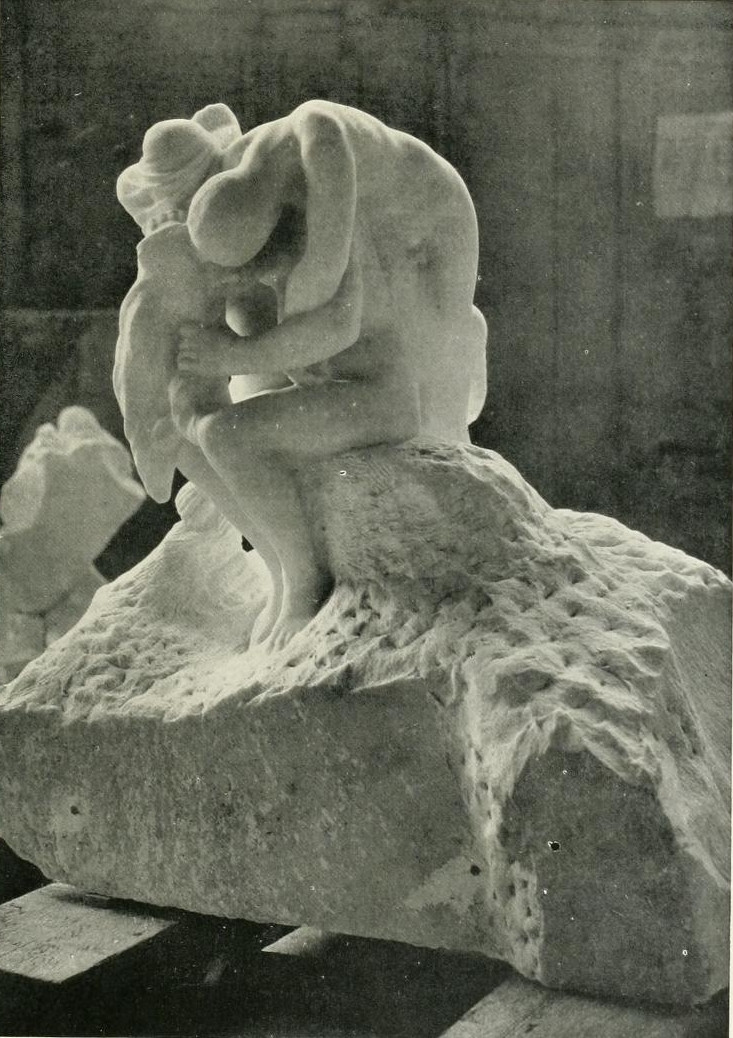
YOUNG WOMAN BETWEEN GOOD AND EVIL COUNCIL.
"To say that the antiques, which portray the plain marvel of life, are beautiful is a superficial sort of praise. Beauty is not the starting-point, but the point of arrival; a thing can only be beautiful if it is true. Truth itself is only a complete harmony, and harmony is finally only a bundle of utilities. The miracle of life could not be perpetuated but for the constant renewal of universal balance. The ancients felt that vast rhythm, and their art, being modelled upon it, appears to us as a natural and sublime expression of beauty.... One of the ancients made a statue. How did he set about it? It is useless to bring in rules that only grew up in the brains of commentators dissecting a series of works, centuries afterwards. The antique remains uncomprehended because we have not a simple enough spirit. It is not by studying the antique that we shall learn its secret; in order to understand, not its nomenclature, but its spirit, we must begin by studying nature. Rembrandt cannot be understood by copying him at the Louvre, he can only be understood when we travel through nature to him. Well, nature is always there, waiting patiently for antiques to be made afresh; the model is there waiting for someone to come at last, no matter whence. For it is an error to think the antique comes from the south: it comes from everywhere. The antique can be produced from a Dutch woman or an American woman; the type is nothing, the modelling is everything.
"What makes the strength of the antique is the plan, the connection of all the profiles. The neo-Greeks say: 'The antiques are line, and their works, in which all the lines, except two, dance about, show their error. The antiques, we will say, are lines or rather plan. Look at an antique; you can guess the full face from the profile. The eye cannot grasp the shape on the opposite side to that which it beholds, but it deduces it from this side: walk round, and the study of the profiles will afford you an irrefragable proof by rule of three. The sculptor swells the half-tones by slight exaggerations, so as to heighten the light by a tone. The drapery lives; like the body that it hides, it receives life from that body without needing the subterfuge of wetted drapery.'[7]
"There is in the antiques an astonishing mystery of life which causes all idea of dimension to disappear. A figure an inch or two high might just as well be life-size; when a thing is well organised, the greatness is in the modelling and not in the size. If one were to photograph a Tanagra figure and the Eiffel Tower, and were to show the two photographs to some person unacquainted with either object, I am sure he would declare the Tanagra figure to be larger than the tower. A pear or an apple, from the point of view of modelling, is as large as the celestial sphere. Thus the splendour of truth is such that finding no word to render it, we have called it 'Ideal.'"
These quotations will suffice, I hope, to show Rodin's inmost thought. These judgments are implicit condemnations of the "École"; they are also definitions of his classical art, which is by no means "literary," and which is governed, even in its lyrical and tragic developments, by good sense, that is to say, by an inborn taste for balance in the midst of boldness. If I am anxious to insist so strongly upon Rodin's profound normality, this is, I repeat, in order to forewarn the public against the declamations of some of his untoward admirers, who reckon one of his merits to be an "originality" which they confound with that exaggeration, that emphasis and eccentricity that never mark the great artist. Whatever tragic or passionate subject a great artist may treat, to whatever height of strangeness his imagination may rise, beauty of form will, if he is, like Rodin, a master of technique, confer upon t him an exalted and permanent serenity. Rembrandt and Delacroix come from the depth of their vastly differing worlds to meet Raphael and Watteau in that conciliatory region where we admire the great masters—and Rodin is already placed in that region.
IV
WORKS SINCE THE "BALZAC"—SMALL WORKS IN MARBLE—PLAN OF THE MONUMENT TO LABOUR—DRAWINGS AND ETCHINGS
"I shun father and mother and wife and brother, when my genius calls me. I would write on the lintels of the door-post, Whim. I hope it is somewhat better than whim at last, but we cannot spend the day in explanation.... Whoso would be a man must be a nonconformist ... must not be hindered by the name of goodness, but must inquire if it be goodness. Nothing is at last sacred but the integrity of our own mind. Absolve you to yourself, and you shall have the suffrage of the world."
I quoted these high-minded words of Emerson's to Rodin at the time of the Balzac incident. "They are," I said to him, "the very epigraph of your whole life." Nor have they ceased to epitomise the man and the artist. From the time of the Balzac Rodin's work has proceeded very regularly and on the same principles. The Victor Hugo is being finished in marble, in its two versions, in the studio of the Rue de l'Université. The group in which Hugo, his extended arm commanding silence of the waves, sits surrounded by Muses is almost ready; the other, in which Hugo, dreamily listening to the counsels of Iris, stands on the edge of a rock washed by waves, amid which Nereids are entwined, is not quite so far advanced. The Gate of Hell is ready to receive its finally chosen and ordered figures. In the Salon of 1902 Rodin exhibited the three Shades from its summit, inspired by the celebrated Lasciate ogni speransa. In 1900 Rodin only showed two or three old productions at the Universal Exhibition, because his work was collected in a special pavilion at the Rond-point de l'Alma, the concession of which pavilion was made uncomfortable for him by his colleagues, so much so that the artist was obliged to remove on the very day of closing, with less delay and consideration allowed to him than to the most unimportant industrial exhibitor. This special exhibition was, nevertheless, a great international success for Rodin, and the amazing development of his fame may be said to date from it. Before 1900 Rodin stood in the position of an exceptional artist, celebrated but envied, isolated and challenged, whose relations with the Government were strained, whom a minority upheld, but on whom the official world looked coldly. Since that time his eminence is so firmly established that he now holds the rank that Puvis de Chavannes held in the estimation of all artists. His triumphant journey to Prague (1901-2), London's enthusiastic reception, and Rodin's recent election to be President of the Society over which Whistler presided, have finally given him the acknowledgment so long looked for. In 1903 his marble bust of Hugo aroused enthusiasm, and at the Salon of 1904 the colossal bronze Thinker had a most flattering reception, and disarmed the last of his former detractors.
A woman's bust accompanied The Thinker to the Salon. Rodin, who does portraits now and again, had previously made an admirable one of Mme. Fenaille, wife of the art-patron who had been of such great service to him; and he is attempting a curious variation of it. He has just finished a bust of a helmeted Minerva, as impressive as a Donatello, and this, too, is a portrait.
Various works have been produced by Rodin since the Balzac, in addition to the Monument of President Sarmiento, which shows an admirable bas-relief of a radiant Apollo. These works are nearly all in marble, and small. It is almost impossible to describe and classify them; a much larger book would be required, and my main purpose here has been to give a general idea of Rodin's art and an explanation of principles. I have spoken about some of his poems of the flesh, especially that Eternal Idol, which will be the glory of thought in modern sculpture. Rodin's recent works in marble have the same inspiration. Some demand special notice: The Hand of God, a gigantic hand, between the fingers of which, and amid a handful of clay, two beings are tenderly embracing; Icarus, falling from the sky to be crushed on the earth amid his whirling wings; several groups of lovers, entwined, and breathing immeasurable tenderness, the most celebrated of which is Spring or Love and Psyche. Another Psyche, alone, is discovering Love asleep, with extraordinary restrained emotion; and there are several attempts at Poets and Muses, embracing or consoling one another, as well as a splendid sketch of the Magdalen wiping Christ's Body with her Hair. Rodin has thus sometimes touched religious subjects, but with an undogmatic symbolism, philosophic and wide. We may also enumerate another version in marble of the Nereids of the Hugo monument, a winged Inspiration coming to breathe upon the sleeping poet, and holding back the tips of her wings with one hand lest she should make a sound in closing them; a faun drawing towards him a nymph, who struggles in silent, fierce resistance; two high-reliefs of Summer and Autumn in stone; tall women with children, intended for the town of Evian, where Baron Vitta is accumulating treasures of modern art; Pygmalion beholding his statue come to life, who, as soon as she feels herself live, turns from him with a surprising movement of coquetry and aversion. Such works as these cannot be described in words. In them Rodin has excelled to an unparalleled degree in rendering the profoundest psychological complexities, refined intentions, and the hesitations of feeling. I will further note a sketch of Sappho, seated at rest, with her arms leaning upon two little naked women, which is a work inspired equally by the Greeks and by the eighteenth century; it bears witness to the artist's wish of avoiding the massive, and making as many holes as possible within the general block, so as to give lightness and to allow a circulation of light, as the Greeks did in works that were meant to stand against a background of sea or of sky. Many studies of men and women crouching, or squatting, in curious attitudes, recall the art of the Japanese bronzes, which Rodin immensely admires. We must further note some groups of Women Damned, in which Rodin's art attains the highest point of voluptuous tension, audacious suggestiveness, and tragic eagerness of the flesh aspiring to impossible delight. This whole world of figures is ruled by the same lyrical and poetic imagination, the same symbolism incarnated in impeccable forms. Everywhere we find the same nervous art, agitating, sad, and ardent in its voluptuous character, expressing the insatiability of human souls; the aspiration of a troubled time towards an ideality which would deliver it from the solicitations of pessimism; the hope of escape by the way of desire; and love sought for in the over-excitement of neurosis. Rodin, gloomy psychologist of passion, understands the disease of the age, and at the same time pities it; a true thinker, he extracts its mournful beauty without ceasing to retain faith, admiration, and affection for the human creature. Bending over life and over his work, he is himself his own Thinker, attentive and reverent before an unknown and terrible divinity. Never did any other sculptor attempt to vivify his art with such intellectual superiority and by such meditations, and Rodin is at once the most realistic and most metaphysical of poets in stone and bronze.
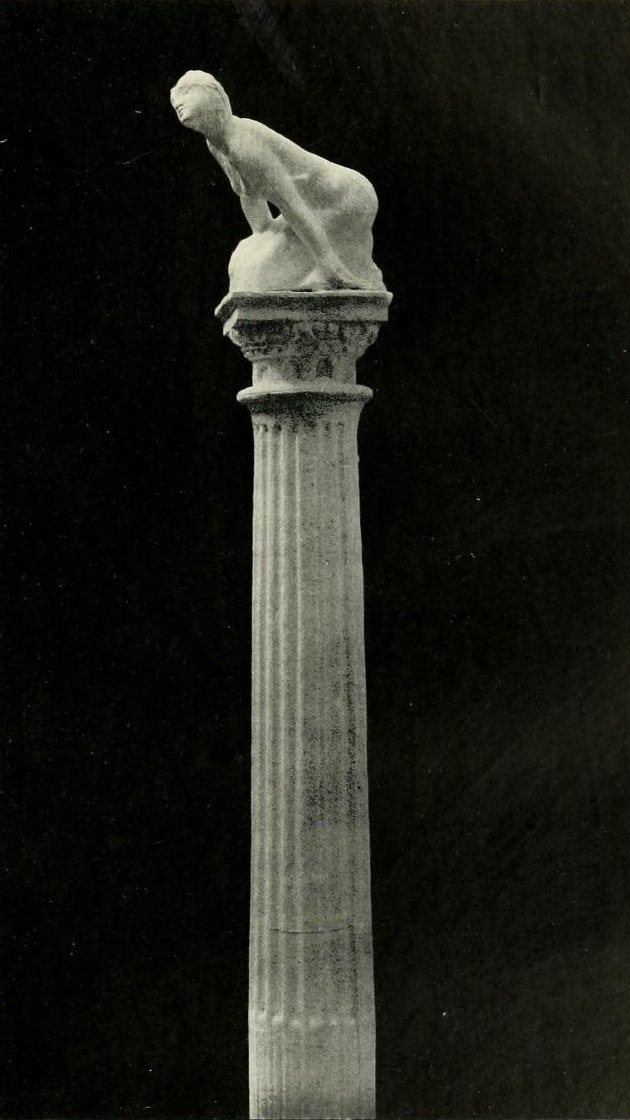
ISIS
Two or three works of more important dimensions stand out from his recent productions; besides a nude female torso (in bronze) of startling truthfulness, and two plaster studies that astonished at the Salons, and besides The Christian Martyr, so masterly in its modelling, Rodin has continued to work at his Ugolino, taken out of The Gate of Hell, and has put the finishing touch to two plans. One of these is the Monument to Labour, a grand conception, which one may dream of seeing carried out and rising up in some square of busy Paris, but which want of money will prevent from ever being realised. It is a column upon a vast rectangular base, with a crypt in it. Two colossal figures of Night and Day would stand at the entrance. In the crypt would be shown, in bas-relief, different subterranean works—mining, etc. Around the column would run a covered spiral staircase, and upon the column itself would be figured in bas-reliefs all the various manifestations of labour, so that as one ascended the stairs all the divers phases of human genius could be successively studied. On the top would hover the Benedictions, two—winged spirits, descended from heaven, which are already executed in marble on a small scale, and are among Rodin's finest conceptions. This colossal project was conceived as long ago as 1897. The rough model is in the studio at Meudon-Val-Fleury.
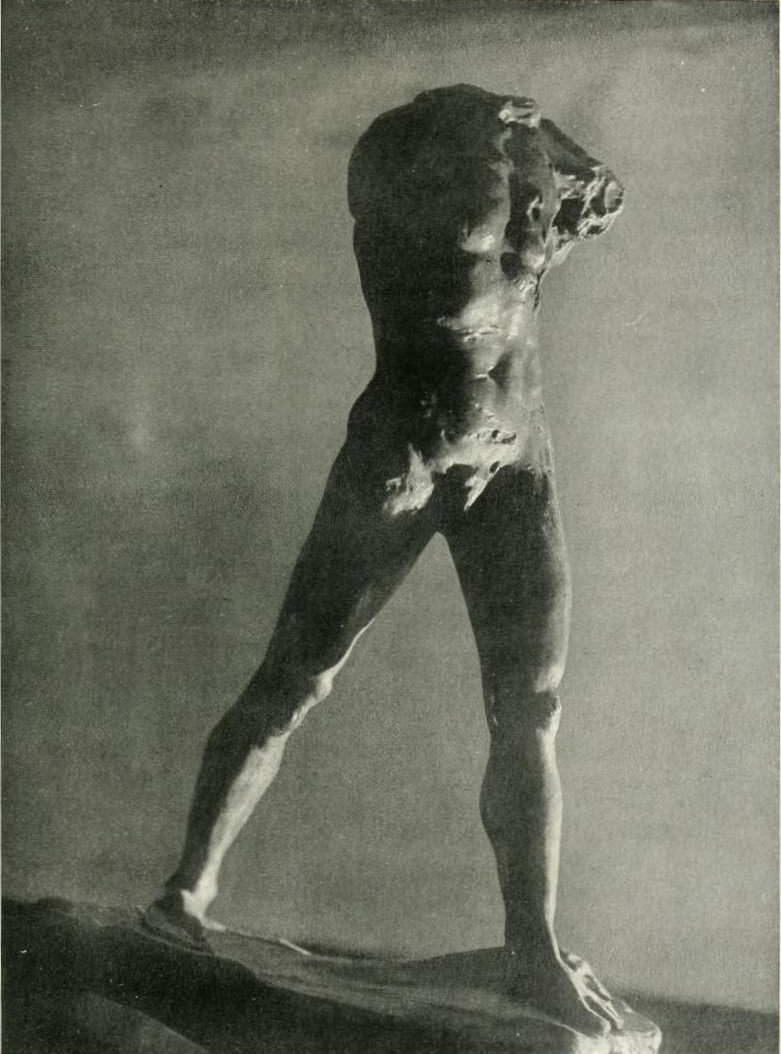
NUDE STUDY
The monument to Puvis de Chavannes was entrusted to his friend Rodin, and is already finished. Rodin conceived it in an original and charming way. Instead of making the customary statue, he considered the purely Greek quality of Puvis' genius and chose to pay homage to him in a form reproduced from the antique. The bust of the great painter is placed on a plain table, as the ancients placed those of their dead upon little domestic altars. A fine tree loaded with fruit bends over and shades the head. Leaning on the table behind the bust is a beautiful naked youth, who sits dreaming in a well-chosen supple attitude. The whole design is intimate, gentle, and pure. Placed on the ground in a garden this votive monument would show how much delicacy and caressing lightness sometimes lies in Rodin's sombre and pathetic thoughts.
Another important group is that of Orpheus and Eurydice. Orpheus has fallen on one knee and is lifting his great lyre towards the gods whom he has just implored. Above him, almost on his back, suspended in a way that would appear to contradict the laws of equilibrium and the material conditions of sculpture, soars Eurydice, compassionate and almost vaporous, truly an immaterial shade, with a smile of despair. I regret that the unfinished condition of this model does not allow me to publish a photograph of it, for nothing would give a clearer impression of Rodin's originality in the matter of contour and in the mutual relation of figures. The extreme freedom of his attitudes and his caprices of balance are, indeed, the newest features that he has brought into his art and are not to be found in anyone else in any country or time. In these is his true signature, and by them his work might be recognised among a hundred statues of all periods. As to the expressive beauty of the faces and bodies, that is supreme. No one has better comprehended than Rodin all that can be rendered by the naked human body and all the intellectual significations that it can hide. The nude is to Rodin a whole language.
In his latest spiritualised works there is something Correggio-like in the vibration of light upon the softened forms and amplified surfaces. They suggest the Antiope, at once soft and muscular, and Rodin often speaks of "morbidezza" as a quality which he no longer distrusts, whereas he formerly banished it from his ascetic, sinewy, and dry figures. He gives his women the pulpy flesh of fruits. The lines of landscape seem to him to correspond to the planes of the body; he lately said to me that since he has lived at Meudon, opposite the flowing Seine, the wooded hills and the fields, he has found useful resemblances between the modelling of the body and that of a horizon. I have even once suggested to him the title of "The Hill" for the body of a young man reclining, the outline of which did in truth resemble the undulations of a hill, and he retained the name and the analogy, for he delights in everything that binds the human being to the earth, and, like a true metaphysician, conceives of nothing isolated or distinct in nature.
I come now to Rodin's drawings, drawings which were not made to be shown, but which, having nevertheless become known, have surprised and puzzled people. Rodin's drawings, like some other drawings by sculptors, are not themselves works of art; they are thoughts noted down, and are not comprehensible unless they are seen with the statues of which they indicate the first idea, or some variation.
Rodin has published some of his sketches; and has produced some dry-points (in particular the Ronde,[1] Antonin Proust, the three portraits of Henry Becque, full face and two profiles upon the same sheet, and two heads of Hugo), some drawings for books by M. Mirbeau and M. Bergerat, and a complete set of illustrations of the Fleurs du Mal, in the form of marginal drawings for a unique copy belonging to M. Gallimard. Many drawings in black or colour have been published (by the clever lithographer Clot), and M. Fenaille has superintended an admirable edition de luxe of 142 drawings by Rodin.[2] Notwithstanding this partial publicity, these works must be considered as standing apart; and to consider them by themselves would actually be to injure Rodin with the public at large, since they form an integral part of his statues. For this reason I have not chosen to reproduce any of them here, studies so purely professional not seeming to fall within the scope of a work intended to give a general idea of an artist's work.
Having said so much, I wish to dwell upon the great beauty of these drawings—a special and terrible beauty. Many deal with Dante. Rodin did some painting under Lecoq de Boisbaudron, landscapes, a portrait of his father, and sketches after Rubens; but there has never been any danger of painting intruding upon his vocation, and his sketches rapidly became nothing but notes for sculpture. The objective reality of his Dantesque figures is vague, if their subjective reality is intense. Rodin, anxious to note down his impressions, and not to illustrate, made his sketches into a sort of passionate writing, only devoting himself to the scheme and to the contrasts of black and white, and neglecting every detail. In these violent washes, these pencillings and pen-scribbles, the spectator who is not forewarned sees nothing, but the lover of art, who knows beforehand what to seek, follows the creative thought. Nothing can be less like what is generally known as "a drawing." After the regular drawings, the "painter's drawings" of his first period, which have but a restricted interest, and which are no longer known, those of his second manner are confusions of light and shadow, and show fantastically. I will quote at this point a passage from an essay by M. Clément Jasmin, a discerning critic, whose noisy rivals do not give him his due place, and who has described these works excellently.
"These sketches are altogether the work of a sculptor, even in their colour, which seems to have sunk into plaster or clay, and especially in the firmness of their modelling, which is imparted by shaded touches of body-colour, on grey paper, or rendered by spaces left white. These blanks, these white spaces, are the extreme point of the modelling, the 'high light' of some projection, which lower down is wrapped in half-tints that carry the eye to the shadows of the inflections or the hollows. There is a constant relation between the contour and the interior modelling. A thrill is communicated by the fantastic lighting of some sketches. Rodin adds further strength to this dramatic distribution of lights and shadows by one or two tones that accentuate the impression or fix a plan. Often his ink will become blue or yellow, (water-colours, sepia, or coloured inks being employed), in order to settle a value or intensify a feeling. Such is the case in the Fenaille publication, with the gloomy red in the face of the Ugolino, of the Dantesque Mahomet, whose entrails are hanging out, and of some other figures dashed in, in black, on a violet background. One plainly feels the material in which the work, of which the sketch is the first idea, will be executed. It is always a sculptor who is at work, even when he exchanges the chisel for the pen or the brush."
Painters would scorn these drawings. They commonly believe that sculptors cannot express upon a plane surface the mass and movement of a body. In reality a painter's sketch and a sculptor's sketch differ in intention and execution. Rodin's are translations of movements, in no way decorative and not attempting to express either modelling or detail, but, if we may say so, the abstract geometry, the thought that commands the movement. The use of coloured inks, which are solely meant to modify certain values that black or white would not express to Rodin's mind, has given rise to mistakes. These colours are not there to express real tints, as is the case in ordinary drawings thus touched up; inaccurate things have been said about these colourings, and about the fantastic and almost Japanese appearance of some of the plates. Rodin is certainly not thinking of prints in colour. He makes these notes instinctively, and displays not so much a deliberate thought as a natural faculty of transcription.
In his early drawings Rodin refers to—for I must insist upon the point that the drawings do not represent things—many of Dante's persons and many fanciful animals, and later, to his statues. Now he does not draw at all from literary impressions, but solely from the living model. He uses ordinary cheap paper, a pencil or a pen; he makes his model take some transitory, absolutely free position, often in the rest between two sittings, and rapidly draws contour without taking his eyes from the model and without looking at his sketch. Sometimes the stroke will fall upon emptiness, the sheet of paper will be too small, a head or a limb will fail to find its place. Naturally this instantaneous sketch will be deformed in the most unexpected way; the proportions are false, but the scheme of the contour and the modelling of each piece are true. Often the hurrying pencil will miss the curve of a breast or a leg. Then the artist will return to that point with hasty, intermingled, impatient strokes that play around the true line. His only concern is to fix the first view, the absolutely living impression. Afterwards, in tracing his sketch, he rectifies, but his chief aim is to amplify the impression of the life, taken spontaneously, according to his principle of enlarging the form, in order to place it better in the atmosphere (about in the proportion of 5/4 instead of 4/4). Then he connects the contours and further enlarges the modelling, filling the outline with a wash of burnt-sienna, which gives the general value, or sometimes with blue or red water-colour. Rodin likes this practice in catching movements, and he has in his studio hundreds of drawings of this kind that differ from his early ones. Those aimed at the imaginative transcription of tragic and literary elements under strange illuminations, and were almost like the drawings of Odilon Redon; the later ones are merely graphic notes of movements, and are incapable of having any direct aim or meaning.
I must add a few words upon a delicate point of which I should not have spoken if others had not spoken mistakenly upon the subject. Rodin's drawings, especially those of the present time, have shocked some people who have seen them by their licentious character. Why should we assume embarrassment in explaining this? In all Rodin's work there is a profound and violent sense of the voluptuous, and the stern painter of the vices and damnations of hell does not need to think of prudery. The elevation and dramatic character of his conceptions clothe the most daring attitudes with the severe chastity of the beautiful. In his sketches, made for himself alone, and in the privacy of his studio, Rodin no more fears erotic positions than did Hokusai. Beneath the original animality he perceives nature; and feminine sexuality, its movements, and impulses interest him, because therein woman is psychologically revealed. Everything, in physical desire, that exalts, maddens, contorts, and fevers the human body is, for the sculptor, the object of an intensely interested study that he does not communicate to the general public; nor is he the only one among the great artists of form whom the erotic has interested from this point of view. Only mediocre minds and minds capable of low intentions see anything low in the movements of life. Rodin's studies from the model, naked and free, without spectators, in the serious presence of work, never sully his grand and melancholy inspiration; and his daring art is assuredly that which most leads away the beholder from erotic ideas, because it notes in every human being the melancholy of the insatiable, and makes the pleasure of the senses a suffering of the flesh and the spirit. By this point he touches the profound morality of art, and his consciousness is free from any equivocation. The recent drawings in which he catches the animal attitudes of the model are thus no more questionable, from the delicate point of view of which I am speaking, than anatomical plates, or the sad immodesties of a post-mortem examination. He adds to them the power of expressing passion with which he is endowed, but since he only shows these drawings to friends and artists in whom nudity does not arouse silly thoughts, this concerns no one else. A comparison cannot even be ventured between these drawings and the masterly etchings of Rops, which are deliberate illustrations of licentious subjects, relieved only by beauty of execution, and which should only be shown with express reservations. Rodin admires certain bronzes in the secret museum at Naples, and certain Japanese prints, because in these, too, art has done its work by expressing a secret and essential spring of the nervous and psychological life of humanity; a fierce and serious subject which only fools consider laughable or indecent, because their minds approach it with indecorum and ridicule. But I do not know that Rodin ever even yielded to the fancy of modelling one of these subjects for himself, as Rubens and many others did not forbid themselves to do. It is time, therefore, to have done with this question in regard to the great French sculptor. I do not know for whom he intends these recent drawings, a whole framed collection of which occupies one of the storerooms of his country house. Perhaps he will have them destroyed; in any case, they are but studies of movements and masses, and in no way direct representations of life.
Rodin's drawings are "rough drafts" to be compared with those of a writer. Some are very impressive, and all constitute precious evidence of his psychological preoccupations and of his desire for simplification. But they remain on the margin of his work, and neither the public nor the critics have those rights over them that belong to biographers and friends. That is a point to be plainly specified, and I desire to repeat that that is the reason this book contains none of them.
V.
RODIN'S PRIVATE LIFE—HIS PERSON, STUDIO, AND HOME—HIS INFLUENCE; SCULPTORS INSPIRED BY HIS IDEAS—RODIN'S PLACE IN THE FRENCH SCHOOL—HIS PRESENT POSITION IN RESPECT TO ACADEMIC SCULPTURE
Auguste Rodin is in person a man of middle height, with an enormous head upon a massive torso. At first sight one sees nothing of him but this leonine bust, the head with its strong nose, flowing grey beard, and small, keen, light-coloured eyes, slightly veiled by short sight and by a gentle irony. The impression of power is accentuated by the rolling gait, the rocky aspect of the troubled brow under the rough brush of hair, the bony thickness of the aquiline nose and the ample curls of beard. But the first impression is partly contradicted by the reticent line of the mouth, the quick look, penetrating, simple, and arch, (one of the most composite glances I have ever seen), and especially by the voice, which is hollow, not easily modulated, with deep inflections and sudden returns to a dental pronunciation, and of which the meaning and intention are further modified by certain very expressive tossings of the head. He appears simple, precise, reserved, courteous, and cordial, without liveliness. Little by little his shyness gives place to a calm and remarkable tone of authority. He is neither emphatic nor awkward, and would seem rather dispirited than inspired. An immense energy breathes in his sober and measured gestures. The slowness and apparent embarrassment of his speech and the pauses in his conversation give especial significance to what he says; moreover, Rodin has acquired of late years a genuine case as a talker and even as a writer, which previously he did not possess. I was intimately acquainted with Stéphane Mallarmé, who, measured by Rodin, was incomparably eloquent, and I often associate these two men in my thoughts. The voices were alike, and Rodin, too, with his improvised phrases, has the same veiled circumspect way of speech, hitting suddenly upon words that illuminate the idea.
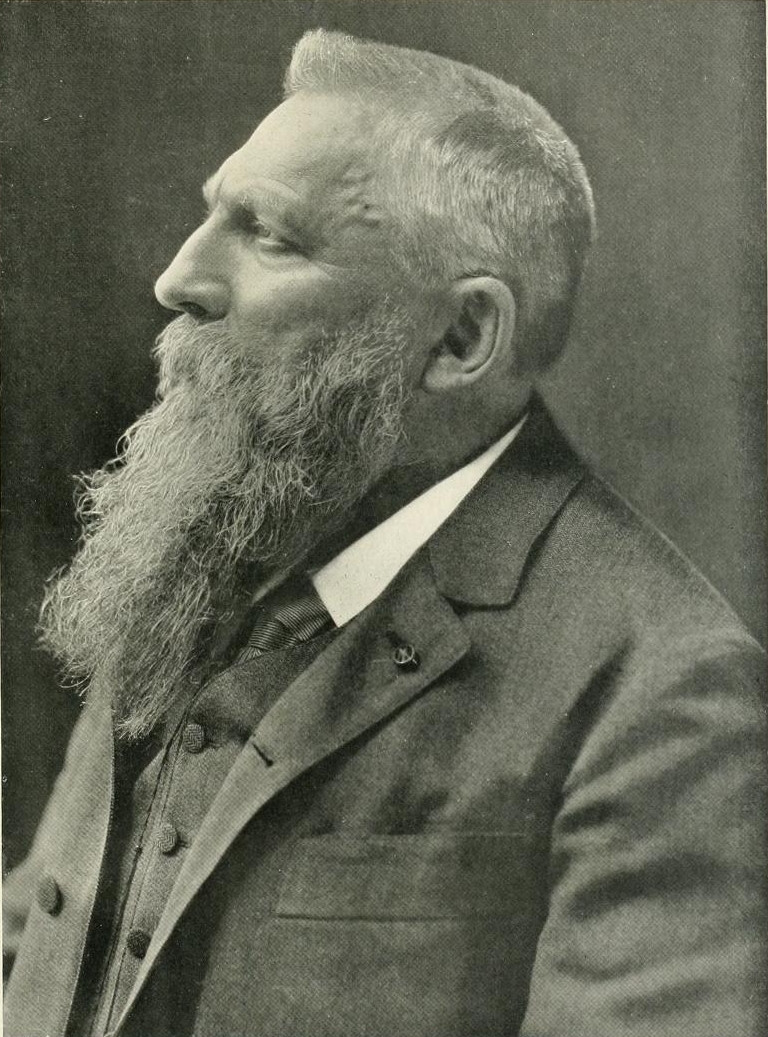
AUGUSTE RODIN
Rodin, in speaking of any work of his, has a way of explaining it that is very elliptical, but very clear, and which has caused some brilliant chatterers to say, because he did not offer a prolix commentary, that he did not know what he had done. In reality he utters the essential, and his gesture, which seems to model his thought in space, completes his words. He looks lovingly on his creations, and sometimes seems to meditate in astonishment at the idea of having created them; he speaks of them as though they existed apart from himself.
Gradually, beneath Rodin's essential simplicity, one discovers features that were at first hidden; he is ironical, sensuous, nervous, proud. He contains as possibilities all the passions that he expresses with so vibrating a magnificence, and one begins to perceive the secret links between this calm, almost cheerful man and the art that he reveals. At certain moments his clear and rather vague eyes become full of phosphorescent points, the face grows sardonic and almost faunlike; at others it saddens and discloses a sickness for infinity. This man is the comrade of his dumb white creatures; he loves them, follows their abstract life, has moral obligations towards them. Fundamentally the one thing with which Rodin is really concerned is the life of permanent forms. Of late celebrity, age, and experience have disposed him to become an adviser, a master, and he has begun to talk æsthetics. But his ideas and opinions are restricted. He perceives human beings only very summarily, his cordiality is a way of fulfilling his social duties hastily. He has, if I may venture the expression, very fine moral antennae, and they serve to recognise the persons whom he will like. Very capable of friendship, Rodin reduces friendship to tacit agreements upon the essential subjects of thought, and it is only if one meets him upon one of these points that one takes a place in his remembrance or his liking. He does not put his faith in individuals, but in general ideas. He loves nothing but his work, and endures everything else with civil boredom. He has a horror of debates and disturbances. I have never heard him speak ill of bad artists; he neglects, but does not criticise. He has a silent humour which leads him to make busts of official and mediocre sculptors, with an amusing good grace. Uncompromising in everything that touches his art, Rodin has throughout his whole career endured severe struggles and grave injustices, and, too proud to dispute, has never shown his secret revolts. At the time when the Balzac was refused all Rodin's friends said to him: "Resist, force your work upon them; you ought, for the work's sake, and a court would surely decide for you, for your agreement is definitely in your favour." He listened and thanked them, always good-tempered, and then withdrew his statue without saying anything.
It is not weakness, for Rodin has had an excessively hard life and is strong and patient; it is dignity of the inner life and profound indifference for the life about him. Rodin is a high dignitary of the Legion of Honour, a president of the judges of sculpture of an important society of artists (the Société Nationale), he is honoured all over Europe, has been received in England as a genius, and has succeeded Whistler as the head of a chosen band of artists; but he remains the man that he was when he was unknown and poor in his solitude at Brussels.
He likes few things, but likes those thoroughly. He reads little, but what he reads strikes home to him as to no one else; Baudelaire and Rousseau, in whom he delights, are instances. He is passionately fond of music, especially of Gluck, but seldom speaks of it. He simplifies everything, sees only the main lines in morality as in art, lives by two or three principles, and has an aversion for everything that is not essential.
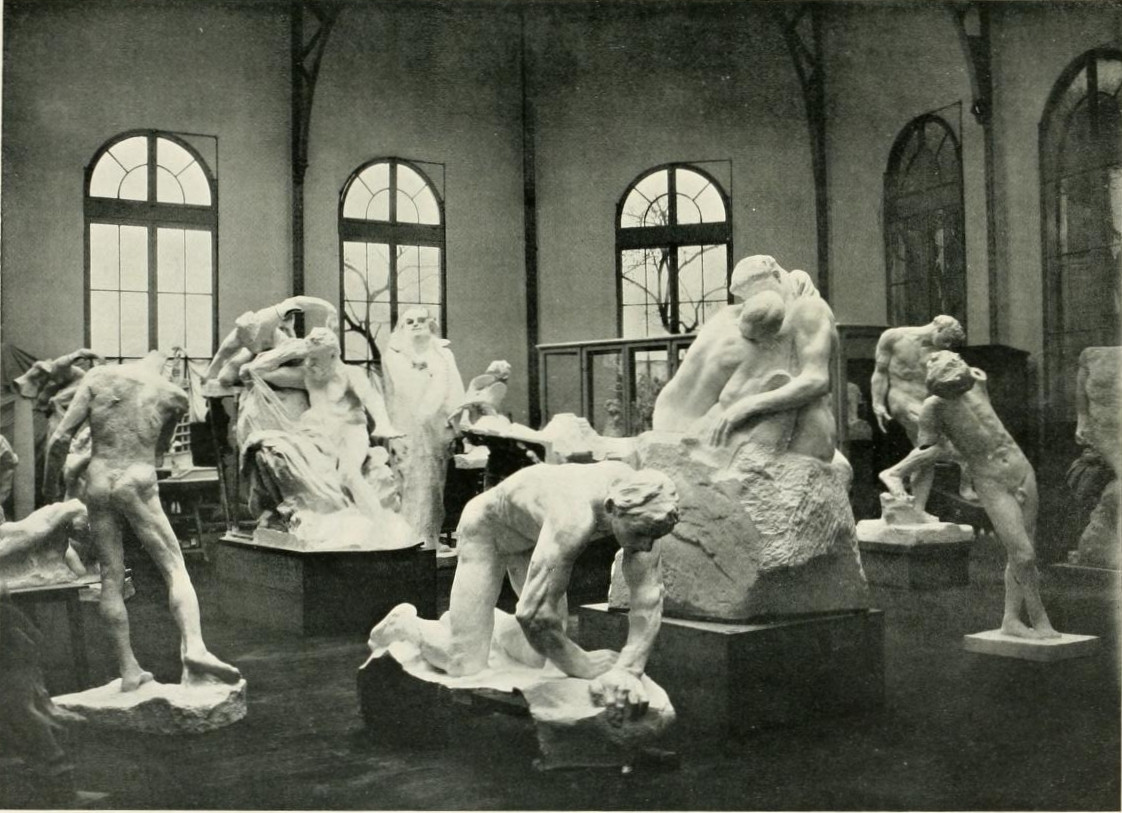
A CORNER OF RODIN'S STUDIO AT MEUDON
When one knows Rodin well one ceases to be able to separate him from his work. He can no longer think otherwise than symbolically by slow deposits of accumulated sensation which work on in the deep strata of his consciousness and suddenly blossom and take a name. His statues are states of the soul. He is himself a representative being, surprised at his own immanence, and his intelligence is outdone by his instinct. That is how it comes about that he does not always know how to name the beings that he has discovered, as we discover, by means of pain, corners of our consciousness that we had not suspected. In the same way that Rodin seems to break away the fragments of a block from around an already existing statue hidden in it, he is himself a sort of rock concealing shapes within it and embracing in its secret recesses immense crystallised arborescences. With a simple enough personal psychology he expresses infinite shades and inflexions of emotion. His thought is like the monad of Leibnitz; it seems, when one sees the man, to have no window to the outer world.
Rodin's opinions upon social life are vague. He contents himself with repeating that work lovingly done is the secret of all order and all happiness. To love life and natural forms, and to attempt nothing disobedient to Nature or her aims, that is his whole morality.
He sees very few people and visits nobody. He would baffle visitors accustomed to elegant, literary, well-informed, brilliant artists. His studio in the Rue de l'Université, at the end of an old yard encumbered by blocks of marble and shaded by aged chestnut trees, is like the work-place of a poor beginner. Neither a carpet nor an ornament is to be seen; the stone floor, the bare walls, a few rush chairs, some modelling stands, some cloths, a shabby deal table loaded with papers, sketches piled up on shelves, blouses hanging on nails, a cast-iron stove—these and nothing more are found by the many foreign admirers who come to see Rodin, and whom he receives with invariable amiability amid his assistants at work upon the Hugo monument or upon some smaller piece of marble.
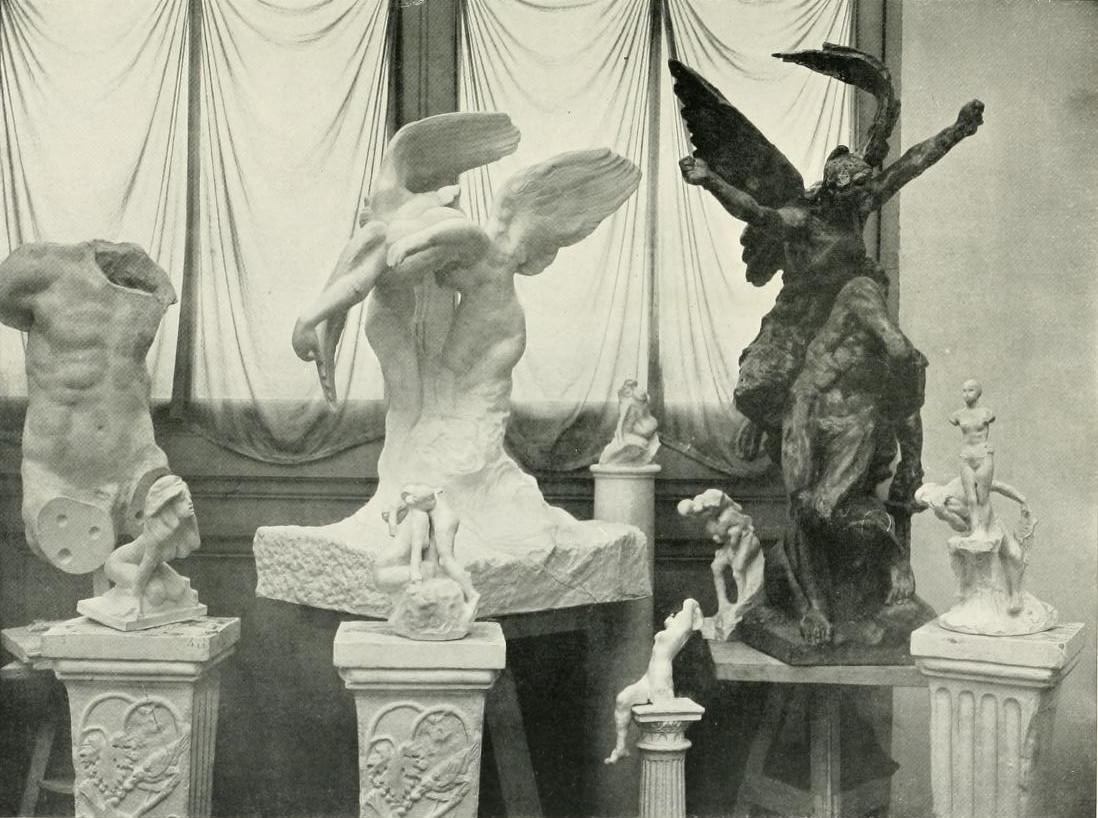
A CORNER OF RODIN'S STUDIO AT MEUDON
Setting aside his journeys to London and Prague and his travels in Germany and Italy, Rodin leads an extremely retired life in Paris, and is rarely to be met. He invariably lunches at his own house at Meudon, then goes to the Rue de L'Université to work, and goes home again to dinner. Formerly, before he had his house at Meudon, he used to lunch at a café in the Place de L'Alma, where he was to be seen for twenty years, and to which people used to go to see him, rather as people go to see Ibsen in Christiania. The house, of a sixteenth-century style, that Rodin has inhabited at Meudon since 1900, is situated amid vineyards, and stands alone at the end of a sort of cliff, overlooking all Paris, the Seine, and the Bois de Boulogne, and facing the wooded heights of Saint Cloud and Bellevue. The site is open and fine; Rodin enjoys immense expanses of sky, sunsets, storms, and moonlight nights that delight him. The house is spacious, light, furnished with extreme simplicity, and adorned by a few pictures, the works of friends (in particular his portraits by Sargent and Legros). Rodin has added to it the pavilion in iron and glass, in which he exhibited all his work, at the Rond-point de l'Alma, in the exhibition of 1900. This pavilion, rebuilt and full of brilliant sunlight, contains all the artist's statuary. There are also several small studios, in which Rodin has his marble rough-hewn, keeps the casts of his statues or accumulates the collections of bronzes, marbles, antique or Gothic, and fragments which he is never tired of finding out and buying. In this place, which, after a life of difficulties and worries, Rodin has been able to purchase, he leads a life that fully suits his tastes, among beautiful trees and flowers, with a majestic landscape before him. It is touching to see the man, here, amid the enormous mass of his work, a whole world of statues, with which he lives and which sums up all his labours and all his existence. A photograph which I am able to add to the illustrations of this volume will give a partial idea of that surprising and imposing cohort of figures in clay, marble, and bronze—that impassioned or tragic throng. Rodin receives very few visitors at Meudon—hardly any but old friends, and he spends his mornings in his garden or in his light and cheerful studio drawing or superintending his workmen. It is chiefly at Meudon that he prepares his rough drafts, the main lines of his compositions; and in order to see an effect he will often hastily put together with clay some of the plaster limbs that he keeps in a number of glass cases—quite an anatomical museum in fact, filling a whole storey, and containing hundreds of pieces and of attitudes piled together.
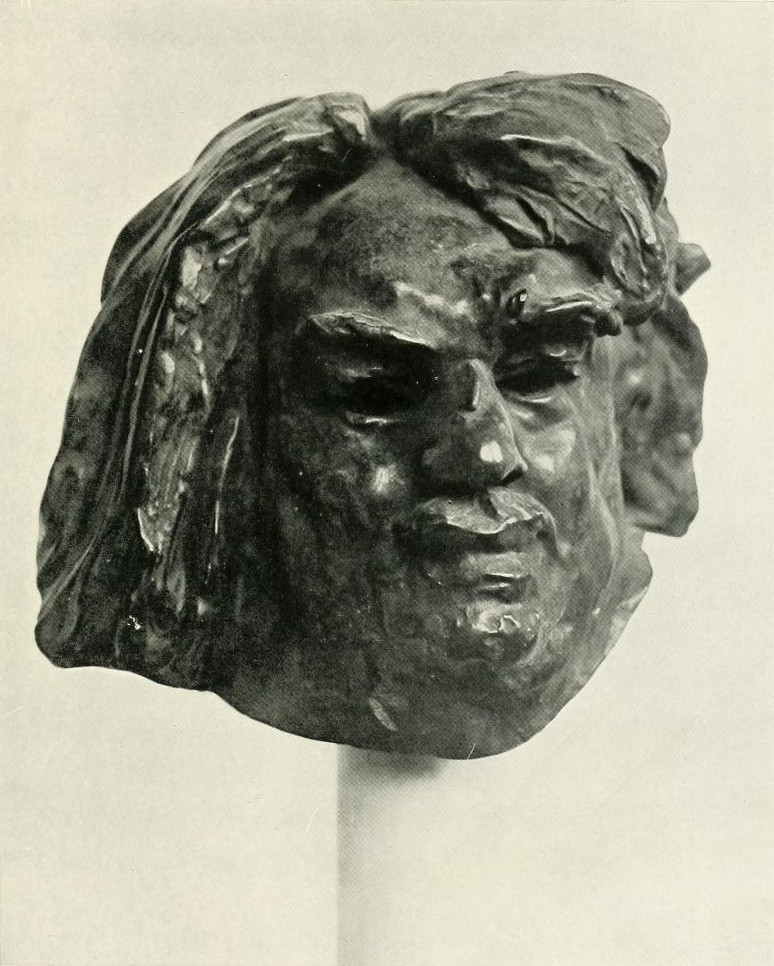
STUDY (IN BRONZE) FOR THE "BALZAC"
Rodin appears to stand alone in his own time; first, by his genius; and secondly, by the special character of his artistic conception. This solitude, however, is only apparent. Rodin's ideas, as opposed to the teaching of the "École," form a body of logical principles which are slowly attracting the adhesion of young artists. The long struggle of impressionism against academism has now entered upon its last phase: the return to the French tradition, to national affiliation in opposition to the Roman neo-classicism. That idea, which is the programme of all independent and interesting critical intelligence in our country, finds in Rodin its perfect demonstration, and the only one afforded by contemporary sculpture. Until now Rodin has preached only by example, and we know how slow the critics and the public are in extracting from a work the ideas that it contains. But the extraction is now begun, and Rodin himself speaks with undisputed authority. Since the exhibition of 1900 his moral position stands ten times higher. Youth greets him as a chieftain and his detractors are silent. While the synthetic and symbolic mind of Rodin arouses the enthusiasm and inspires the thoughts of writers, the theory of the amplification of the modelling is making its way in the studios of sculptors. "Rodin has opened a large window in the pale house of contemporary sculpture," declares Pierre Roche, the sculptor; "out of the timid and much impaired craft that was before his day he has shown that a bold art full of hope can be made." This opinion of one of the most delicate artists of our generation is precisely that of many independent sculptors. Among these we must quote Emile Bourdelle, Rodin's pupil and friend, an impassioned, vibrating, and generous artist, whose works are among those first looked for in each Salon. Others are the two brothers Gaston and Lucien Schnegg, the latter of whom exhibited in the Salon of 1904 so beautiful a head of Aphrodite, almost worthy in the mysterious and vaporous beauty of its planes, of the ancients, and of Rodin; Jules Desbois, of the first rank in technical skill and of a violently original temperament; Alexandre Charpentier, a former collaborator of Rodin's, whose success in applied art has not turned him aside from his expressive and vigorous work in statuary; Mlle. Camille Claudel, Rodin's pupil, who is the first woman sculptor of existing-art in France, and whose name has appeared upon admirable works; and finally, Pierre Roche, although his supple and decorative fancy denies itself the expression of the tragic. The Swiss sculptor Niederhausern-Rodo, George Minne, the sculptor of Ghent, who has a powerful creative genius, not understood, and the Italian sculptor Rosso, are also partisans of Rodin's art, and so is the Englishman Bartlett. In another direction it is very interesting to note the curious reciprocal influence of Auguste Rodin and Eugène Carrière, who are united by friendship and by the same aesthetic creed. Eugène Carrière, the most profound painter of the inner life existing in the French school of to-day, has great analogies with Rodin, both as a man and as an artist. He, too, reduces his art to essentials, to the main lines and the deliberate amplification of surfaces. Thus his figures, bathed in shadow, are akin to Rodin's statues, while the latter, bathed with dewy light, seem to be pictures by Carrière. The painter becomes massive and powerful, the sculptor becomes vaporous. Rodin seeks the bland, half-shadows of Correggio, and Carrière desires that his figures should have the powerful relief of bronze. The painter sacrifices colour to the sole study of values, and by his black-and-white comes back to sculpture. Very curious is this point of junction between two great artists. Rodin is beginning to explain himself with the pen; and Eugène Carrière has, for some years past, been writing—too rarely—passages upon art of which the style is admirable and the concentration of thought astonishing, passages which recall Mallarmé and Baudelaire, and leave far behind the commonplaces of journalistic criticism. Rodin and Carrière have their school, their circle of chosen admirers, and their double influence may soon be the most decisive, if not the most brilliant and the noisiest, in French art of to-day.
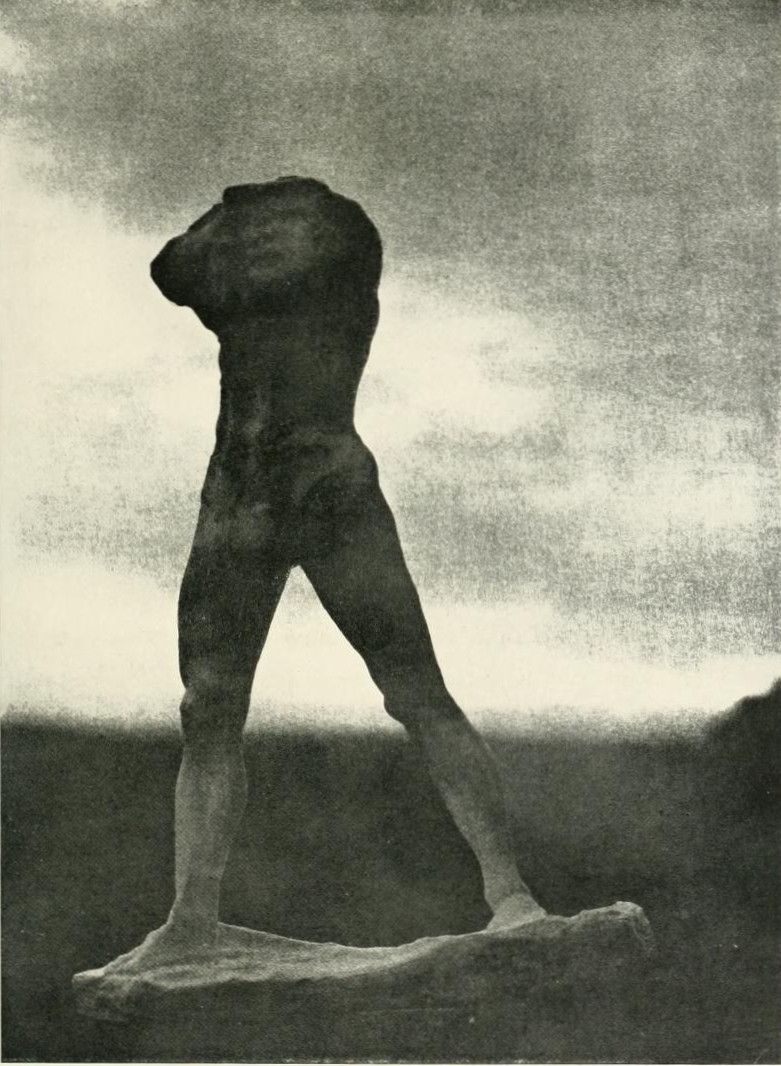
NUDE FIGURE (PHOTOGRAPHED IN THE OPEN AIR AT TWILIGHT IN THE GARDEN AT MEUDON)
The prevailing note of opinion about Rodin among his friends and his detractors is that he is like no one else, and that no statue can, in a manner, be looked at beside his, so individual is the conception from which they spring. By the mere fact that they exist, they compel us to choose between them and the others. Their silhouettes, their planes, the quality of their shadows, and their lights, make them technically works apart. If such a man understands sculpture thus, either he is right, against everybody, or he is totally mistaken; we cannot like him and also approve of ordinary statuary. His psychological and tragic genius conquers the admiration even of those who oppose his material execution. Rodin does not set himself up as a chief, nor recognise followers; yet he is a chief by his very work.
He is the greatest living French artist, and one of the most complex and powerful movers of thought in modern art. He does not found a school, but he influences the soul of a generation. He remains alone, not susceptible of imitation; but if he did not exist sculpture would be deprived of its greatest regenerator.[1] By inscribing passions in symbols, he touches the sensibilities of all, and is a master to poets as much as to sculptors, because his subjects are moral, affecting, never commanded by an anecdote, bathed in the universally lyric. Attempts have been made to blame him because of the admiration of writers; it has been said, with an inflexion of scorn (especially in the circles of his fellow-artists), "he is a littéraire." An injustice easily committed at a time when the intellect of painters and sculptors seems to blush at itself, and when they make it a sort of false merit to show that their eye and hand are separate from their brain. Rodin's splendid technical power annuls the reproach and retains the praise. Resting firmly upon nature, his symbols may rise high. Rodin delights poets because he makes the infinite emanate from the most finite of arts.
Everything has been patiently meditated by him. He dares, but is never overbold; his balance and his taste are those of a classic, despite the uncomprehending astonishment of the academic sculptors, hypnotised by the sophistry of finish and elegance, and confusing the exact with the true. There is a synthesized form, that corresponds to reality synthesized in symbols, a second truth; and that proportion is observed by very few artists. Most of them, contenting themselves with an immediate, momentary, anecdotic truth, translate it by picturesque observation, or by minutely detailed copying. This attempt of a sterile cleverness to transcribe the instantaneous is the very contrary of art, the first character of which is to display the laws of vital permanence underlying fugitive aspects. Herein lies the reason why sculptors become uneasy over Rodin, while writers, more familiar with general ideas, become enthusiastic. The impressionist crisis—the study, that is to say, of instantaneous lights and actions—hardly got over, he brings in this second truth, the transcription of general and permanent feelings into a form that speaks as much to the mind as to the senses. Such a man dominates impressionism as much as he does academism.
A whole order of curious and fundamental relations between nervous sensibility and thought has arisen out of his work. Rodin's personality is specially representative in the line of French sculptors. He goes back, as I have said, to the Egyptians and the Greeks in the matter of technical ideas. In his tragic feeling he proceeds directly from the Gothic artists. It is from them that he descends, and especially from the sculptors of the French Renascence, in particular Germain Pilon; and he blends his Greek remembrances, passed through an Italian influence, with a conception altogether national, vigorous, and decorative. Rodin's actual part is to take up sculpture exactly at the moment of the French evolution.[2] Since that time we have had some great masters; native genius has been triumphantly upheld, in opposition to the false school that came from the Alps, by Coysevox, Houdon, Puget, Pajou, Pigalle, Clodion, Falconet, Couston, Rude, Carpeaux, and Barye, a line of splendid inventors of shapes, all of whom, in contradistinction to the official school, have represented the inmost qualities of their race. All these men Rodin emulates by the importance of his work; perhaps the future may regard him as the magnificent outcome of their efforts carried on through three centuries. In this succession of artists, Puget, Rude, and Barye are those with whom his technical relations are closest.[3] But he has been less decorative than Puget and less hampered by the themes imposed upon him; he has gone further than the great Rude in the expression of inward emotion, and he surpasses even Barye in power of modelling and boldness of silhouette. He has created a world which is fully his own, a feeling and a pathos not to be found elsewhere, which are the very soul of his time.
Rodin, then, can be set only beside Puget and Rude. Like Puget, he is overflowing with vitality and with passionate frenzy; he worships power and heroic beings; but his are sad, and nearer to Gothic asceticism and to the nervous derangement of Baudelaire than to the resplendent pomp of the seventeenth century, into which Puget transposed his heroes of Rome and of Corneille. Like Rude, he is attracted by deep things, by soul tragedies; but he is more abstract than the creator of the Napoleon Awakening to Immortality, the Joan of Arc, or the Marseillaise. Rodin is more general, more synthetic; he turns his mind to permanent symbols, outside of ages and races. Taking up, as if in challenge, the mythological subjects that the "École" had most spoiled, he has shown how a great mind can renew all things and impress upon them the magic of its vision. He is the most symbolic of our men of genius; and if the modelling of the Greeks, Gothic austerity, the strength of Puget and of Rude, have helped Rodin to make up his personality, the fusion of these elements and the addition of a personal imagination and an extraordinary contemplative faculty have enabled him, like Wagner, who descended from Bach, Beethoven, and Liszt, to create, after and apart from all of them, work that resumes them and forgets them, to become in its turn an initiator. The point in which Rodin is inimitable is the expression of the voluptuous with all its latent woes; and this point strongly recalls to memory Tristan and Isolde, which is such a paroxysm as might touch the most perilous region of exceptional art; but Rodin is kept within the bounds of the normal, and protected from the audacities of his strange and troubled imagination, by his imperturbable technical certainty and by his admiration for some few masters. As was the case with Baudelaire and with Poe, his purity and grandeur of form save him; like Dante, this lover of gloomy beauty hangs over the verge of passion's hell without falling into it.
Rodin's art is healthy because it feeds upon natural truth and general logic. He is the supreme painter of man bowed by intense, melancholic, feverish, constricting thought; but also, with a candid tenderness unknown to Wagner, he is the caressing creator of women in love, the poet of youth, embracing and radiant. Only a genius can have the diversity of mind that produces The Burghers of Calais, ascetic and mediæval, the spasmodic Hell, the almost abstract Balzac, the bronze busts worthy of Donatello, and the images of women carved in the radiant and golden marble of Attica by a sensuous and subtle enthusiast who has rediscovered the soul of Hellenic beauty. This union of technical skill, evolved according to the secrets of the antique with a power of expressing all human sentiments from gentleness to lewdness, from the mystic to the pathetic, from nervous disorganisation to carnal frankness, this union of contraries and this universality are not to be found in any of our forerunners. Not Puget, nor Rude, nor any of our masters has had such intellectual ubiquity, such strength of condensation; in these points it is allowable, even in our own day, to acknowledge Rodin as supreme in the rich French school, and thus to anticipate the judgment of the future, in whose eyes he will loom yet larger.
In any case it was high time he should appear; he has been as useful as was Manet by his intervention in French art. In spite of Dalou, sculpture had fallen very low after the death of Carpeaux and Barye; the deplorable school of the Second Empire had brought it into degeneracy, and we could reckon no one in sculpture to correspond to the great impressionists. Such men as Dujalbert, Chapu, Mercié, Frémiet, Saint Marceaux, and Falguière, are but sham great sculptors, nothing of whose work will last; the "École" group, from Paul Dubois to Barrias, Aube and Guillaume, is a mere example of pretentious insignificance. The few vigorous temperaments, or workers of genuine technical merit, like Denys Puech, Jean Dampt, Gardet, Camille Lefèvre, Devillez, and Jean Bassier, did not know how to put together their efforts in such a way as to found a real school. They produced without attaining a cohesion of thought capable of guiding a fresh generation. Bartholomé, thoughtful, pure, dreamy, and proud, stands apart. Mme. Besnard and M. Théodore Rivière are charming, but without influence. I have spoken of the group that has spontaneously placed itself around Rodin. Amid this interesting, unequal, and scattered sculpture he appeared with the authority of a master and a prophet; his work set the question upon its true basis again, showing whence we came, what was to be avoided, and whither we were to go; and all this with such clearness of evidence that the appearance of Rodin becomes, in like degree with that of Goujon and that of Puget, a capital date in the history of the French school, I declared in the Preface my intention to avoid any extravagant eulogy of Rodin, and have uttered my dislike of the idolatry by which some people think it necessary publicly to emphasise their admiration, with its snobbish accretions. But I should fall into the opposite fault if I did not declare the truth and the importance of what such an artist brings to his art, and did not mark his exact place in the line of his country's sculpture. Henley has called Rodin the Michael Angelo of the modern world. That opinion of a foreign critic, a critic justly esteemed one of the most upright in contemporary literature, France may justly make her own, far from extravagant and puerile praises, and in the face of the work accomplished. I shall be but too happy if I have contributed to make clearer to the public certain secret reasons, certain inner frameworks, of that logical and beautiful work.
VI
APPENDIX—CHRONOLOGICAL LIST OF RODIN'S PRINCIPAL WORKS—LIST OF THE PRINCIPAL BOOKS OR ARTICLES WRITTEN ABOUT HIM—QUOTATIONS REFERRING TO HIM—AN OPINION OF EUGÈNE CARRIÈRE'S; AN OPINION OF HENLEY'S—VARIOUS NOTES
Chronological catalogue of Rodin's works is almost impossible to draw up. I do not think Rodin himself could do it. It must be remembered that before 1877 he made a quantity of studies which he destroyed, and such a producer as he is willing to neglect things of which others would keep count. In his poor and wandering days Rodin must have abandoned many things. How would it be possible to recount the figures that were retouched or even executed at Carrier-Belleuse's, the earliest independent works, the characters executed by him at Brussels, the statues that were planned and left unfinished for lack of money, those that were broken or that failed—all the immense store of work accomplished in the course of twenty years by a man who worked every day? How would it be possible even to enumerate the sketches and varied renderings of different subjects piled up in the studio at Meudon, in the Clos Payen, in the Rue des Fourneaux, and at Vaugirard? It is a whole world. I will confine myself, therefore, to a statement of known and exhibited works: and these, indeed, are what is essential.
LIST OF THE PRINCIPAL EXHIBITED WORKS
1864. The Man with a Broken Nose.
1865-70. Works in the studio of Carrier-Belleuse.
1872-77. Friezes upon the Bourse and various works at Brussels.
1877. The Primitive Man (The Age of Brass). Decorative work on the Trocadéro.
1878-80. Saint Jerome. Saint John the Baptist. Works in the manufactory of Sèvres. Competition for the National Defence Monument.
1881. Adam (destroyed). Eve.
1882. Ugolino (a sketch taken up again later). Busts of Alphonse Legros and IV. E. Henley. Studies for The Gate of Hell.
1883. Bellona. General Lynch (equestrian statue). The Genius of War.
1884. Monument of President Vicunha. Bust of a Young Woman.
1885. The Man and the Serpent. Busts of Dalou, Hugo, and Antonin Proust.
1886. First sketch of the Hugo monument. Drawings dealing with The Gate of Hell. Bust of Henry Becque. The Kiss (a small group).
1887. Perseus and the Gorgon. Head of St. John beheaded.
1888. The Danaid. Alan Walking. Nude study for one of the Burghers of Calais. Several little groups.
1889. Studies for the Gate of Hell and the monument to Claude Lorraine. Torso of a Woman. Group of The Dream. The Dream of Life. Women Damned (in marble). Hecuba. Bust of Roger Marx. Destitution. Thought (in marble).
1890. Bust of a Young Woman (in silver). Torso of Saint John. Brother and Sister.
1891. The Caryatid. The Young Mother. A Nymph.
1892. Busts of Puvis de Chavannes and Henri Rochefort. Grief. Claude Lorraine. The Burghers of Calais.
1893. The Death of Adonis. Medallion of César Franck. Galatea. Bust of Séverine. The Crest and the Wave. Resurrection. The Child Achilles (group in clay).
1894. Eternal Spring. Hope (a reclining figure in back view.) Orpheus and Eurydice (first version). Christ and Magdalen.
1895. Inauguration of The Burghers of Calais. Illusion, the Daughter of Icarus. Medallion of Octave Mirbeau. Nude studies for the Balzac. Man Crouching.
1896. The Inner Voice. The Muse of Anger (for the Hugo monument). The Conqueror. Minerva. The Poet and the Life of Contemplation. Women Bathing. Studies for the Balzac.
1897. Victor Hugo. Balzac. Monument of President Sarmiento.
1898. Statue of Balzac. Bust of a Young American. Bust of Madame F. Statue of Sarmiento, with a high relief of Apollo in marble. Monument of Labour. The Benedictions (marble). Twilight. Clouds. The Parcæ and the Young Girl.
1899. Works for the Hugo monument.
1900. Marble groups. Exhibition at the Rond-point de l'Alma.
1901. Shades (for The Gate of Hell).
1902. Groups in marble. The Hand of God. Busts.
1903. Bust of Hugo. The Poet and the Muse. Various sketches. Ugolino (fresh version). The Prodigal Son.
1904. The Thinker, and various works in marble in process of execution.[1]
The work of Rodin may thus be estimated at about ten works on a grand scale, forty groups or statues, some thirty important busts, and perhaps two hundred figures or portraits, without counting sketches, from 1877 to 1904.
I come now to the mention of some significant writings that deal with his aesthetic theory or with his work; and, as may be supposed, I leave out of question a quantity of valueless articles, for Rodin has been directly or indirectly the pretext for a great mass of writings, and is the modern French artist who has been most talked of, justly or unjustly. The works quoted are such as may be consulted with advantage.
ARTICLES OR BOOKS RELATING TO RODIN
"Balzac and Rodin," by Roger Marx (Le Voltaire, March, 1892).
"Claude Lorraine," by Roger Marx (Le Voltaire, June, 1892). (Excellent studies in the criticism of sculpture.)
"Auguste Rodin," by Roger Marx (Pan, and The Image, September, 1897).
Drawings by Rodin, 129 plates, containing 142 heliogravures (Goupil and Co., 1897), from the suggestions and loans of M. Fenaille.
"Rodin's Studio," by Edouard Rod (Gazette des Beaux Arts, May, 1898).
"Rodin," by Gabriel Mourey (Revue illustrée, October, 1899)
Exhibition of 1900: Rodin's Works, with four prefaces by Eugène Carrière, Jean Paul Laurens, Claude Monet, and Albert Besnard.
"Rodin and Legros," by Arsène Alexandre (Figaro, June, 1900).
"The Gate of Hell," by Anatole France (Figaro, June 1st, 1900).
La Revue des Beaux Arts et des Lettres, January 1st, 1900.
La Plume, 1900. Special number.
Les Maîtres Artistes, special number, October 15th, 1903. (Illustrated collections, containing a certain number of critical studies by various authors.)
Rodin, by Léon Riotor: a pamphlet, reproducing in French, German, English, Italian, Spanish, and Russian, a study that appeared in the Revue populaire des Beaux Arts, April 8th, 1899.
Rodin, the Sculptor, a volume of criticism, illustrated; by Léon Maillard (Floury); 1899.
The Sculptor Rodin, drawn from life. A volume by Mlle. Judith Cladel (La Plume office, 1903).
Rodin, a study by L. Brieger-Wasser (Vogel. Strassburg; 1903).
Rodin, by George Treu (Jahrbuch der bildenden Kunst. Berlin, Marstersteig, 1903).
Rodin, by R. M. Rilke (Berlin, Bard, 1903).
"Rodin." Articles upon, by W. E. Henley, 1890; D. S. MacColl, 1902; Henri Duhem, 1890; Karel B. Made (Prague); Vittorio Pica (Rome).
Of these various writings devoted to Rodin, those of Roger Marx should be particularly noted, on account of their technical understanding; Léon Maillard's volume is a sincere, well-informed, well-illustrated book, produced by a man who comprehends. The book by Mlle. Judith Cladel, daughter of the distinguished novelist, is an originally conceived volume, the only one that relates certain conversations, and attempts, with charming acuteness, to present Rodin in his private character. It is a work that deserves to be much better known and appreciated, and of which Rodin's first panegyrists, jealous of being the only "inventors" of the artist, have been very careful not to speak. The article by the graceful painter, Henri Duhem, is likewise excellent; and I consider Mr. MacColl's very remarkable, on account of its elevation and precision of judgment. The others have such value as belongs to admiring articles written hurriedly in newspapers: they express sympathetic feelings, or comment in a poetical way upon the subjects, but their critical value is négligeable, and there is nothing to be quoted from them for the information of my readers. The Balzac gave rise to a shoal of newspaper articles. Georges, Rodenbach, and France, on that occasion, said the acute and witty thing's about Rodin that they say about all manifestations of thought, and M. Mirbeau made Rodin the theme of some of those polemical variations, conjoining hyperbolical praise with abuse of his adversaries, which he is accustomed to offer as art-criticisms, and which have gained him a reputation of a certain kind. There is nothing to note in these pamphlets mixed with eulogistic effusions, the whole of which do not contain the substance of twenty lines by Henley or of Eugène Carrière's admirable Preface, which I am desirous of reproducing here because it is a masterpiece of synthetic divination.[1]
"THE ART OF RODIN
"Rodin's art comes from the earth and returns to it, like those giant blocks—rocks or dolmens—which mark deserts, and in the heroic grandeur of which man recognises himself.
"The transmission of thought by art, like the transmission of life, is the work of passion and of love.
"Passion, whose obedient servant Rodin is, makes him discover the laws that serve to express it; she it is that gives him the sense of volumes and proportions, the choice of the expressive prominence.
"Thus the earth projects external apparent forms, images, and statues that fill us with a sense of its internal life.
"These terrestrial forms were the real guides of Rodin. They have set him free from scholastic traditions, in them he found his being and the creative instinct of men whom humanity celebrates.
"Trees and plants revealed to him their likeness to those fair women, with sleek limbs rising, like delicate columns, to the moving torso and swelling breast, above which the head hangs heavily in the company of a strong and supple neck, even as a fine fruit full of savour weighs down its branch.
"The massive brow overshadows the eyes, and the cheek brings the lip softly to the lover's entreaty.
"Forms seek and meet in voluptuous desires of violence and of resignation, rebellious and obedient to laws from which nothing escapes; everywhere conscious logic triumphs.
"The generalising spirit of Rodin has imposed solitude upon him. It has not been his lot to work upon the cathedral that is not, but his desire of humanity links him to the eternal forms of nature."
After such a passage, in which every word is significant and eloquent, and is a great artist's reflection, everything seems pale. I will not, however, confine myself to a mere dry mention of the essay by Vittorio Pica, the great Italian critic, who generously arranged for Rodin's participation in the Venetian Exhibition (Gallery of Modern Art, 1897), and I should have liked to quote Anatole France's fine article, and some assertions of Mr. MacColl's, who very logically recalls to our memory the sculptor Auguste Préault, who is too much forgotten, and who was, indeed, a sort of imperfect precursor of Rodin. I must at least transcribe a few lines from W. E. Henley, who was, from the very beginning, a clear-sighted admirer of Rodin, and who spoke of him with eloquence and passion:—
"M. Dalou ... has declared that when the century goes out it will remember the aforesaid doors" (i.e. The Gate of Hell) "as its heroic achievement in sculpture. And if that be true—as I believe it to be true—then where, between himself and Michael Angelo, is there so lofty a head as Rodin's?... His busts alone were enough to place him in the future, the style of them is so complete, the treatment so large and so distinguished, the effect so personal, yet so absolute in art.... Here, if you will, are a thousand hints of the possibilities of human passion: from Paolo and Francesca melting into each other:
"'La bocca mi bacio tutta tremante'
as no man and woman have done in sculpture since sculpture began.... Here is sculpture in its essence.... You may read into it as much literature as you please, or as you can; but the interpolation is not Rodin's, but your own.... It is not literature in relief, nor literature in the round; it is sculpture pure and simple.... Passion is with him wholly a matter of form and surface and line, and exists not apart from these.... He is our Michael Angelo; and if he had not been that, he might have been our Donatello. And with Phidias and Lysippus all these some-and-twenty centuries afar, what more is left to say of the man of genius whose art is theirs?"
We see that Henley's admiration returns to the comparison of Michael Angelo and Rodin. I persist in thinking that the resemblance rather lies in moral identity, in conception than in technicalities. The muscular enlargement of the Italian hero is not Rodin's amplification nor his expressiveness, which is altogether nervous. It is none the less true that these two men are the only ones who have imagined and realised a sculpturesque conception of so vast a reach. Not even Puget and Rude, who came between them, ventured such wholes as The Tomb of the Medici or The Gate of Hell.
MUSEUMS
Rodin has in the Luxembourg Museum (Paris) the following works:—
The Age of Brass, originally placed in the Luxembourg Gardens near the School of Mines.
The Danaid (marble).
Thought (marble).
St. John the Baptist Preaching (bronze).
The Fair Helmet-maker (bronze).
Bust of Jean Paul Laurens (bronze).
The Kiss (marble).
Bust of Mme. V. (marble).
At the Petit Palais (Ville de Paris), one work.
At Beziers, Cognac, Dijon, Douai, Lille, and Lyons, several works.
At Brussels, one work.
At Copenhagen, several works.
At New York, Boston, Chicago, and Philadelphia, works. At Helsingfors, one work.
At Rotterdam, one work.
At Geneva (Rath Museum), three works.
At Venice, Christiania, St. Petersburg, Stockholm, Düsseldorf, Munich, Weimar, Vienna, Prague (town hall), one work in each town.
At Hamburg, three works.
At Hagen, three works.
At Berlin (new gallery of Charlottenburg), five works.
At Crefeld, two works.
At Buda-Pest, five works.
In London (Victoria and Albert Museum), two works; (British Museum), one work.
At Glasgow, one work.
Museum of Marseilles, The Inner Voice (clay).
The new works in these various museums are originals or casts.
PRIVATE COLLECTIONS
M. Vever (Eve, in marble).
M. Pontremoli (the National Defence.)
M. Antony Roux (The Kiss).
M. Roger Marx (bust, The Young Mother).
M. Blanc (The Eternal Idol.)
M. Desmarais (the Idyll.)
Mme. Durand (Thought, in marble, given to the Luxembourg).
M. Peytel (various groups).
Mme. Russell (Minerva.)
M. Fenaille (The Spring, Bust of Mme. F., The Poet and the Life of Contemplation, a twisted column with figures, surmounted by a mask).
Baron Vitta (high-reliefs in stone).
The Marquise de Carcano (Head of St. John beheaded, marble).
This, of course, is a very cursory list, and includes only collections in Paris.
I must add separately to the works published about Rodin those for which I am responsible: (1) a study, called "The Art of M. Rodin," Revue des Revues, 15th June, 1898; this has been approved by the artist, and very frequently reproduced. (2) A lecture delivered on the 31st of July, 1900, at the Rodin exhibition, and published by La Plume, with four unpublished drawings. (3) An essay upon the surroundings, personality, and influence of Rodin, which appeared in the Revue Universelle in 1901, and has likewise been reprinted, particularly in the Maîtres Artistes (special number, 15th October, 1903).
The high price of the work published by Messrs. Goupil (A Hundred and Fort-two Drawings by Rodin) prevents that fine volume from being accessible to the public. The amateur photographer Druet has taken photographs of all Rodin's work, which are rather misty, but which render admirably the caressing touch of light on the main planes, and which in a measure reproduce the artistic atmosphere of the statues. Messrs. Haweis and Coles have likewise taken some beautiful and curious proofs. More classic, but also more definite, are the fine photographs which the art publisher Buloz has recently taken, and which have been employed to illustrate this volume.
PORTRAITS
There is a remarkable portrait of Rodin by Mr. John Sargent (dating from about twenty years ago). Another, by M. Alphonse Legros (a profile), is more of a fancy head, and wears a sort of tiara. A more recent portrait has been produced by Mr. Alexander. There is a very forcible bust by Mile. Camille Claudel, as well as a bust by J. Desbois, a lithograph by Eugène Carrière, and some amusing studio sketches by Mile. Cladel. An interesting lithograph of "Rodin in his Studio," by W. Rothenstein, appeared in the Artist-Engraver, April, 1904.
A curious photograph, taken by M. Steichen; a poster for the Rodin exhibition, containing a portrait, and drawn by Carrière; and some excellent photographs taken at Prague (of which the one here reproduced is astonishingly faithful) complete this list of likenesses.
INDEX Achilles, The Education of, 33 Adam (destroyed), 14 Adonis, The Death of, 33 Age of Brass, The, 7, 8, 9, 10, 11, 51, 60, 75, 135 Antiope (of Correggio), The, 91 Antique, The, influence of, on Rodin, 27; Rodin's analysis of, 74-80; its right use, 74-77; its truth and beauty, 78, 79 Aphrodite (by Lucien Schnegg), 111 Apollo, the two reliefs, 32, 33, 85 Aube, 121 Autumn (stone), 86 Avarice and Lewdness, 26 Balzac, Statue of, 9, 11, 27, 34, 41, 43-51, 72, 75, 82, 85, 104, 120, 130 Barrias, 121; his monument to Hugo, 20 Bartholomé, 121 Bartlett, 112 Barye, 2, 39, 117, 121 Bassier, Jean, 121 Bastien-Lepage, Statue of, 29, 30, 49 Baudelaire, 16, 17, 22, 24, 26, 42, 105, 113, 118, 119 Beauvais, 1 Becque, Henry, Bust of, 21; dry-point portraits of, 92 Bellona, 17 Benedictions, The, 89 Bergerat, M., Rodin's drawings for his book, 92 Besnard, Mme., 121 Boisbaudron, Lecoq de, 5, 93 Boucher, the sculptor, 8 Bourdelle, Emile, 111 Broken Nose, The Man with the, 3, 4, 6, 7 Brother and Sister, 31 Brussels, 4, 5, 6, 7, 16, 28, 123 Burghers of Calais, The, 15, 27, 28, 30, 31, 33, 34-39, 49, 51, 120 Burgundian sculptors, 38 Busts, Rodin's portrait, 17, 18, 21, 29, 31, 33, 84 Carcano, Marchioness of, 28 Carpeaux, 39, 117, 121 Carrier-Belleuse, 3, 4, 6, 8, 123 Carrière, Eugène, 112, 113; his opinion of Rodin's art, 131-133 Caryatid, The, 31 Celtic genius, The, 63 Chaplin, 8 Chappe, A statue of, 49 n. Chapu, 8, 121 Charpentier, Alexandre, 111 Chartres, The cathedral of, 61 Christ and the Magdalen, 33 Christian Martyr, The, 88 Cladel, Mlle., 70 n., 112, 130 Classicism, Rodin's, 38, 59, 63 Clodion, 117 Clot, lithographer, 92 Conqueror, A, holding a Statue of Victory, 40 Corneille, 118 Correggio, 91, 112 Costume in sculpture, The question of, 47-50 Couston, 117 Coysevox, 117 Crouching Man, The, 33 Dalou, 121, 133; Rodin's bust of, 18, 31 Dampt, Jean, 121 Danaid, The, 28 Dante, 8, 16, 21, 22, 23, 26, 93, 96, 119 David of Angers, 18 Devillez, 121 Day, 88 Delacroix, 81 Delaplanche, 8 Desbois, 7, 111 Donatello, 31, 66, 84, 120 Drawings and sketches, Rodin's, 18, 21, 28, 40, 58, 91-100 Dream-Group, 29 Dry-points, Rodin's, 92 Dubois, Paul, 8, 121 Duhem, Henri, 130 Dujalbert, 121 Dutch painting, 66 Egyptian sculpture, 59 Eiffel Tower, 80 Emerson quoted, 82 Erotic subjects, Rodin's treatment of, 98-100 Etchings, Rodin's, 19, 21 Eternal Idol, The, 40, 85 Eve, 14 Exhibited works, 7, 10, 16, 17, 19, 21, 28, 30, 83, 84, 88 Exhibition with Claude Monet, the, 30 Fagel, 7 Falconet, 117 ?? Falguière, 8, 121; his "Balzac," 44, 45; Rodin's bust of, 31, 45 Faun and Nymph,86 Fauns and Bacchantes, 30 Fenaille, Bust of Mme., 84 Fenaille, M., 40; his edition of Rodin's drawings, 92, 95 Fiennes, Jean de, 35 Finish, False notions of, 61, 115 Flemish primitives, 6, 38 Fleurs du Mal, Baudelaire's, 16; Rodin's illustrations to, 92 Florence Baptistery Gates, as model of The Gate of Hell, 22 France, Anatole, 129, 130, 133 Franck, Medallion of Cæsar, 33 Frémiet, 121 Fuller, Loïe, 79 n. Galatea, 33 Gallé, Emile, 31, 33 Gallimard, M., 92 Gardet, 121 Gate of Hell, The, 9, 14, 15, 21-27, 29, 30, 41, 83, 88, 120 Genius of War, The, 17 Gluck, 105 Gothic sculptures, Rodin's study of, 6, 27, 38, 61, 63 Goujon, 122 Greek sculpture, 59, 60 Guillaume, 121 Hand of God, The, 85 Hecuba, 29 Helmet-maker, The Fair, 29 Henley, W. E., 17, 122, 131; his opinion of Rodin's art, 133-134 Hokusai, 98 Houdon, 117 Hugo, Victor, Bust of, 18, 31, 84; dry-point portraits of, 92; the Monument to, 15, 19, 30, 40, 50, 72, 83 Icarus, 85 Illusion, the Daughter of Icarus, 33 Inferno, Dante's, 16, 22 Inspiration, 86 Iris, 19 Italy, Rodin's travels in, 55, 65, 75 Japanese bronzes and prints, Rodin's admiration of, 87, 99 Jasmin, Clément, 94 Joan of Arc, Rude's, 118 Kiss, The, 23 n., 29, 73 Labour, Monument to, 88, 89 Lamartine, 46 Laurens, Jean Paul, Bust of, 31 Lavoisier, A statue of, 49 n. Lefèvre, Camille, 7, 121 Legros, Alphonse, 5, 108; bust of, 17 Lorraine, Claude, The Monument to, 29, 31, 32, 49 Louvre, the, 38, 78 Love and Psyche, 85 Lovers, Groups of, 85 Luxembourg, The, 7, 20, 23 n., 29, 135 Lynch, Statue of, 17, 49 MacColl, D. S., 130, 133 Magdalen, The, 85 Mahomet (drawing), 95 Mallarmé, Stéphane, 69, 102 Manet, 52, 121 Man Walking, 28 Man with the Broken Nose, The (clay head), 3, 4, 6; (marble), 7 Marseillaise, Rude's, 118 Marx, Roger, 31, 33, 130; bust of, 29 Meditation, 19 Meudon, Rodin's house and studio at, 13, 108, 109 Michael Angelo, 23, 62, 63, 64, 65, 66, 73, 117 n., 122 Minerva (helmeted bust), 84; (marble and silver), 40 Minne, George, 112 Mirbeau, Octave, 114 n.; bust of, 29; medallion of, 34; Rodin's drawings for his books, 92 Monet, Claude, 30 Monument to the Defenders of the Nation, 14 Morbidezza, 91 Mother, The Young, 31 Muse of Anger, 19, 40 Muse of the Inner Voice, 19, 40 Museums, 135 Nancy, 29, 32, 33 Naples Museum, 74, 99 Napoleon Awakening to Immortality, Rude's, 118 Neo-Greek School, Errors and defects of, 75, 79 Nereids, The, 86 Niederhausern-Rodo, 112 Night, 88 Nude, The, 11, 90, 91 Nymph, A, 31 Orpheus and Eurydice, 33, 90 Paintings, Rodin's, 93 Pajou, 117 Pantheon, The, 20 Perseus and the Gorgon, 28 Pica, Vittorio, 133 Pigalle, 117 Pilon, Germain, 116 Poe, 119 Poet and the Life of Contemplation, The, 40 Poets and Muses, 85 Préault, Auguste, 133 Private Collections, 137 Proust, Antonin, Bust of, 18; dry-point of, 92 Psyche, 85 Puech, Denys, 121 Puget, 117, 118, 119, 120, 122, 135 Puvis de Chavannes, 84; bust of, 31; monument to, 89, 90 Pygmalion, 86 Raphael, 66, 81 Redon, Odilon, 97 Rembrandt, 78, 81 Renascence, Rodin's admiration for the, 63-5 Rimini, Paolo and Francesca da, 22, 23 Rivière, Théodore, 121 Rochefort, Bust of, 31 Roche, Pierre, in, 112 Rodin, Auguste, birth, parentage, and schooling, 1; early art-training, 1, 2; under Barye, 2; works for ornament-maker, 2, 3; in Carrier-Belleuse's studio, 3, 4; early works in sculpture, 3, 4, 6; goes to Brussels, 4; work there, 4, 5, 6, 7; friendship with Legros, 5; takes painting lessons from Lecoq de Boisbaudron, 5; accepted at Salon, 7; accused of casting from life, 7, 11; his first sale, 7; cleared of accusations, 8; sudden emergence from obscurity, 9, 10; slow development, 9; attitude to academic art, 10, 38, 69; his originality and power noticed, 11, 12; studios granted him by Government, 13; works at Sèvres, 13, 70; his stay in Brussels a formative time, 4, 5, 6, 16, 27, 123; deeply impressed by Dante and Baudelaire, 16 (and see under these names); monument to Hugo described, 15, 19, 20; impatience of officialism, 21, 34; Gate of Hell described, 21-27; exhibition with Claude Monet in 1889, 30; monument to Claude Lorraine described, 32; Burghers of Calais described, 34-39; friendship with M. Fenaille, 40; the Balzac and the controversy it excited, 44-52, 104, 105, 130; visits to Italy, 55, 65, 75; articles in the Musée quoted at length, 74-80; at the Paris Exhibition of 1900, 83; visit to Prague, 84; welcomed in London, 84; elected President of the International Society, 84; honours, 105; personal appearance, 101; portraits of him, 108, 139; private life and home, 107-109; house and studios, 13, 107-110; tastes, 105, 106; travels, 55, 65, 75, 84, 107; as a talker, 102, 103; social opinions, 107; influence, 113, 114; friends and pupils, 111, 112; characteristics of his art, 115, 116; artistic descent and affinities, 116-119; place in the French school, 113-122; lost works, 17 n.; paintings, 93; dry-points, 92; drawings and treatment of voluptuous subjects, 98-100; photographs of his works, 138, 139; essentially a poet, 68,69; as thinker, 87; classicism, his, 38, 59, 63; his symbolism, 65, 87; his composition, 43; his conception of his art analysed, 52-81; fondness for small groups, 41, 42; his treatment of costume, 46, 49; his treatment of flesh, 37, 42; his principles of portraiture, 47, 48; his endeavour to give atmosphere, 56, 57; his works treated to be viewed from all sides, 37, 43, 54-6; his modelling, 28, 42, 65, 89, 90; his study and power of representing movement, 27, 42, 43, 53, 54; dynamic character of his art, 27, 42, 43; his synthetic power, 16, 32, 38, 60, 61, 69, 115; his veracity, 36, 37; his favourite type of woman, 42; influence and value of the antique, 27, 55, 74-80 Ronde, The (dry-point), 92 Rops. 45, 99 Rosso, 112 Rousseau, 105 Rubens, 93, 100 Rude, 4, 39, 117, 118, 119, 120, 135 St. John Baptist, 7, 8, 10, 11 St. John Baptist (torso), 31 St. John, Head of the Beheaded (marble), 28, 30 Saint Marceaux, 121 St. Pierre, Eustacede, 34, 35 Salon, the, 7, 30, 43, 44, 83, 84, 88, 111 Sappho, 86 Sargent, 108 Sarmiento, Monument to President, 41, 85. Schnegg, Gaston and Lucien, 111 Séverine, Bust of Madame, 33 Sèvres, 13, 14, 70 Shades, The, 22, 83 Société des Gens de Lettres, 44 Spring, Eternal, 33 Spring, 85 Summer, 86 Tanagra figures, 80 Thinker, The, 22, 23, 26, 84, 88 Thomas, 8 Thought, 29 Torso (nude female bronze), 88 Turquet, 7, 8 Ugolino, 16, 17, 26, 88; (drawing), 95 Values in painting and sculpture, 56, 57 Van der Meer, 66 Van Rasbourg, 4, 6 Venus and Adonis, 33 Vicunha, Monument to the President, 17 Villon, 29 Wagner, 119, 120 Watteau, 81 Wave, The, 33 Whistler, 84, 105 Wissant, Jacques and Pierre de, 36 Woman, Bust of, 84 Woman, Bust of a Young, 17 Woman, Bust of a Young (silver) 31 Women and Children, 86 Women Bathing, 41 Women Damned, 30, 87