A WINTRY WILDERNESS.
Reading edition
North of the Sandwich Mountains, inclosed by a circle of sombre peaks, there once lay a beautiful lake. Centuries ago its outflowing stream, now called Swift River, cut so deeply between the spurs of Chocorua and Bear mountains that the greater part of the lake drained away into the Saco at Conway, leaving its level bed a fair and rich-soiled intervale.
By the road upon which the lake went out man in time came in, and founded in the bosom of the spruce-grown mountains a small but comparatively prosperous settlement. Having seen this hidden valley in summer, and taken account of its rare beauty and its remoteness from the wearisome machinery of the world, I yearned to know its winter charms, feeling sure that they would surpass those of summer as the fairness of snow surpasses the fairness of grass. Accordingly, in the latter part of December, 1891, I went by rail with a friend to Chatauque Corner, and thence by sleigh up the weird pass between Chocorua on the south and Moat and Bear mountains on the north, gaining at nightfall 231 a warm haven in one of the snug farmhouses in the middle of the intervale.
The township of Albany knows no priest or physician, squire or shopkeeper, and in its coat of arms, if it had one, the plow and rifle, axe and circular saw, would be quartered with bear and porcupine, owl and grouse. From the head of the intervale the people are forced to travel nearly thirty miles to reach and bring home their mail and groceries. In spite of these drawbacks, the permanent residents are intelligent, thrifty, well-housed, and well informed of the world’s doings. Though their only road to the outside is long and rough, they let no moss gather on it in summer, and no snowdrifts blockade it in winter.
Setting out for this far valley in midwinter, I felt something of the explorer’s thrill as he turns towards the unknown, and leaves home and comforts behind. The distant and the difficult of attainment are always seen by the mind through a golden haze, and although no fair Lorna drew me to her rescue, and no lawless Doones barred my way through the grim passes which led to the valley, romance and the spice of danger seemed mingled with my enterprise. As the journey progressed, and one stage of it after another slipped past, unreal gave way to real, and commonplace supplanted marvelous. 232 Even when night fell, as we entered the valley, the light which gleamed afar through the spruces told of hospitality as truly as the sleigh’s ample furs spoke of comfort, and the keen wind of health.
We reached the valley on the evening of Saturday, December 19, and enjoyed every moment of our stay, which was prolonged until Saturday, the 26th. From my journal, written on the evening of each day, I take the following account of our wanderings.
We left Chatauque Corner (Conway) at three o’clock, well packed in the fur robes of a comfortable two-seated sleigh and drawn by a skinny graduate of a race-course. It was an ideal winter afternoon, blessing an ideal Northern landscape. There were the broad Saco intervales flat with snow, the pale blue sky with a fringe of cloud-banks, and between intervale and sky, mountains of marble and ramparts of dark evergreens. Straight up the Saco valley the immense mass of Mount Washington rose against the sky. It was wholly covered by snow. On its left, Moat, like a breaking wave of the sea, was close at hand. On its right, Carter Notch, with walls of dull purplish-black spruce, reached to where stately Mount Pequawket reared its dark cone on high. The Saco splashed in its rocky bed. Every boulder was glazed with white ice, and from the two banks of the stream, borders of ice reached towards each other, half concealing the greenish waters which lapped their edges.
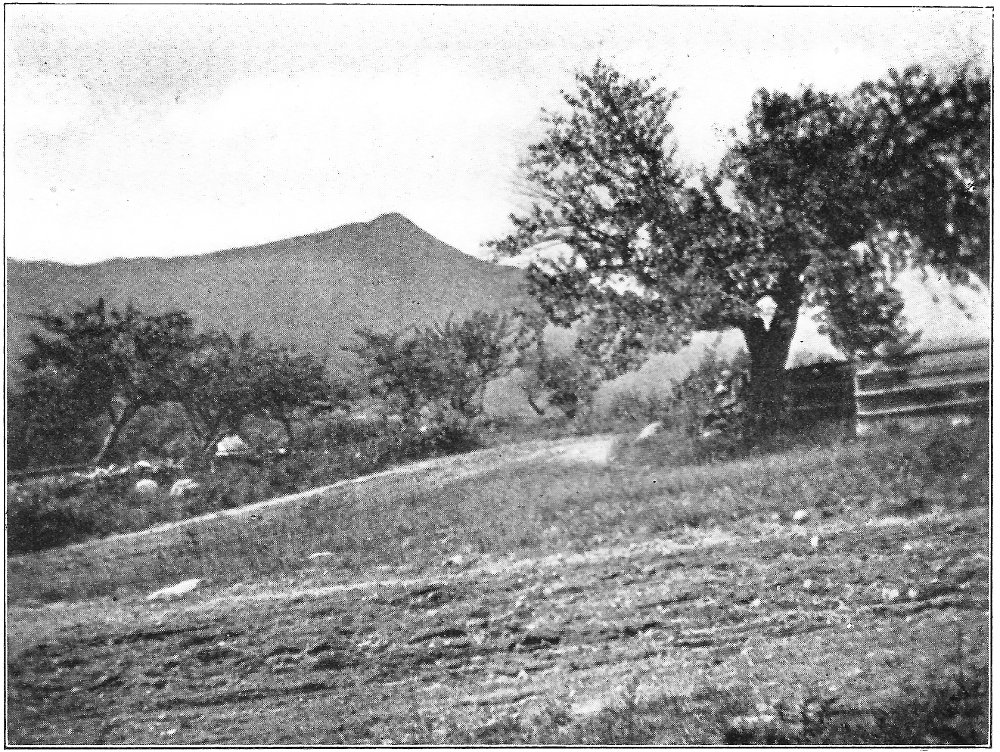
“MOAT, LIKE A BREAKING WAVE”
233
The sleighing was excellent. Not more than eight inches of snow had fallen during the week, and it was the first enduring fall of the season. It had been followed by a dash of rain and then a sudden freeze. After going a mile on the North Conway road, we turned to the left into a road leading westward towards the narrow pass between Chocorua and Moat. The immense crags of Moat frowned upon us. Then we plunged into a pine forest and felt the first chill of night. As we sped through the shadow, we passed the skinned carcass of an ox hung by its fore-legs to the limb of a pine. A strange slaughtering-place, and one to tempt sniffing foxes when night falls. A mile farther on, the skull of a bear grinned on the tip of a pole in the brush fence by the roadside.
Music sounded in our ears, and far below the narrow road, which was grooved in the mountain-side, we saw Swift River plunging from ledge to pool on its way to the Saco. The Saco had seemed wild when we saw it in Conway intervale, but this stream’s madness left it placid by comparison. Two steep slopes, glare with crusted snow, led down to the narrow channel. 234 At their foot boulders of every shape and size fought the progress of the water. The stream dashed itself against them, hurling spray into the air; the spray fell upon the snow and froze, fell upon the boulders and froze, or drained back into the stream, freezing in icicles of marvelous forms. The water, colored doubtless by the mosses and weeds below its surface, was green,—a cold, pale green,—with something of the cruelty of a winter ocean in its tones. Now and then we met and passed sleds heavily laden with lumber or logs. One load of birch logs was on fire at the hinder end, and the driver was warming his hands at the blaze. A few poor farms lined the road at points where small patches of tillable land were to be found between the rocky fingers of Moat. As we passed one of these farms a flock of two dozen or more snow-buntings rose from a field full of tall weed-stalks and whirled over us singing. Their sweet notes fell on us as holy water falls on a kneeling congregation.
The road grew steeper, and then it crossed the river, passing through a huge covered bridge, and soon we found ourselves inside of the portals of Chocorua and Moat, with the high ridge of Bear Mountain, covered with black spruces, barring our westward way. The wall of sullen forest seemed without a cleft, yet 235 the raging river which met us told of a way somewhere, to be found by retracing its channel.
In the midst of this gloomy hollow in the hills we found a slab village. A dozen or fifteen houses stood here, but no smoke curled from their chimneys. Last September every house was occupied; now the foxes roam through the deserted settlement unmolested. The sawmill which had created the village had been burned and the whole population had vanished almost as swiftly as the smoke of the ruins. Not so the hideous scars left by the lumberman’s axe. They will remain for many a day.
By a series of sharp ascents we gained and passed through the rift in the mountain wall made centuries ago by the imprisoned waters. In this rift at the eastern foot of Bear Mountain, only a few steps from the roadside, are the picturesque falls of Swift River. The treacherous ice and the gathering darkness forbade our going to the giddy margin of the fall, and we dashed on into the hidden valley, the narrow, mountain-girdled intervale of which we were in search. As we left the forest fringes of Bear Mountain behind us and emerged in the plain, a gorgeous winter sunset gave us welcome. Over the blue of the upper sky, in which Jupiter alone sparkled faintly, were scattered countless flakes of rosy cloud. Below 236 them a broad black band of cloud cut the sky at the level of several mountain peaks, and below this sinister bar, showing only in the gaps between the mountains, was a space of greenish silver, into which thousands of spruces reared their slender spires.
Taking fresh courage, our horse carried us over the fifteenth mile at racing speed. The road was level. On the right the flat, white intervale shone in the pale light as in distant ages the face of the great mountain lake shone in silent winter nights. Westward, across the end of the intervale, were Tripyramid, Kancamagus, and Osceola mountains; northward, Green’s Cliffs, Carrigain, Lowell, Owl’s Head, and Tremont Mountain stood shoulder to shoulder in double rank. Behind us, dark Bear Mountain concealed Moat, while spurs of Chocorua reached down to the road. On the left was Paugus, crouching at the foot of Passaconaway, which dominated over the valley with gloomy majesty. A bright light gleamed through the spruces, the Carrigain House lay there between black forest and pale snow, Mayhew’s lantern swung to and fro, and his deep voice welcomed us to his cheerful home in the heart of the wintry wilderness.
Those who live in the city have an idea that it is hard to keep warm in these northern farm-houses, 237 with their single windows, thin walls, and wood fires. They are wrong. There is a degree of heat attainable in a small room, armed with an air-tight stove, which burns birch sticks or slabs almost as fast as they can be fed to it, that is able to hold its own against the equator at midsummer. It takes courage, on a cold morning before sunrise, to leave a warm bed to start a fire in one of these stoves; but when the fire is fully aroused, cold is put out of the question, or at least out of doors.
After a hot supper we put on our coats and furs and went out into the night. I had the same feeling of reverence and quiet that I have in going into a dimly-lighted cathedral. The stars flickered on high, the snow gleamed below, on every side mountain peaks guarded the narrow valley. In the spruce woods, which reach from the road back to Paugus, the darkness was intense. We listened. At first there seemed to be no sound to hear. Then the whisper of Swift River came out of the north, and the bark of a dog far up the valley told of a fox prowling too near the farmyard. Suddenly, from a bank of silver light back of Carrigain, two long tongues of pallid fire shot upward into the sky and trembled there, only to disappear as abruptly as they came. Although the dim auroral glow stayed in the north for some time, I saw no more radiating light.
238
It was but little after eight o’clock when we sought sleep and found it quickly between feathers below and mighty piles of blankets and comforters above.
Untroubled moonlight flooded Swift River intervale all night, and there was still more of moonlight than of daylight when our host came into our room in the morning to light our fire. The winter working-costume of our host deserves mention. His brown cardigan jacket was not remarkable, but his legs were marvelously encased. They began at the body with ample woolen trousers, half way between the hip and knee gave way to tightly-fitting scarlet wrappings which reached to low rubbers, covering the feet. Nimble of foot, and of wiry frame, the wearer of these remarkably unpuritanical nether garments was a most enlivening figure in the snow.
Encouraged by our fire, we arose with the sun. The mountains in the north were bathed in rosy light. Dark as were their forests, each of these mountains presented snow-covered ledges, or avalanche scars white with snow. Upon these white surfaces the sunlight fell with that soft blush which makes a winter sunrise so charmingly full of promise. We hastened out of doors as soon as dressed, and were at once greeted by joyous voices. A red squirrel in 239 the dark spruces was whirling his watchman’s rattle; far away in the forest a woodpecker was drumming on a resonant tree-trunk; but near at hand, only across one snow-covered field, a chorus of bird voices quivered in the still, cold air. The air was cold, that was true. Zero was the point the mercury held to, and as we took long breaths of the pure air we spouted forth columns of white steam through our ice-hung beards. Trotting up the road, we sought the birds. We found them at the next farmhouse, perched by dozens on plum-trees, maple saplings by the road, and on the tips of a row of spruces opposite the farmyard. Some were in the road, others in the dooryard on the soiled snow where oxen had stood. In all, over a hundred were present. As we drew near, they rose and flew in waving circles over us, every bird singing until the whole air seemed tingling with sound. Then they came down in undulating lines, curves, angles, and plunges, which turned aside into a second flight in the sunlight. As they settled in groups in the various trees, I swept my glass over one cluster after another. Crossbills were the most numerous species, with goldfinches a close second, and pine finches third. The crossbills were in all stages and conditions of plumage, from rich red males blazing like dull coals plucked from the fire, to 240 dingy brown. No white-winged crossbills seemed to be among them. Three months before, on a cold dewy morning in September, I stood on this spot and saw a flock of thirty crossbills in these same trees. Then a number of them were feeding in the edge of the pasture at a place where cattle had been salted in a shallow trough. I saw the birds tearing off fibres from the wood of the trough, so eager were they to get the salt which the wood had absorbed. This morning the salt trough was covered with snow, save one edge which protruded; but all around it the crossbills had trodden the snow into a path, showing that they were still salt-hungry. Acting upon this hint, I sprinkled the ground with grain and rock salt; but although birds were in all the trees, they paid no heed to my offerings.
After watching the crossbills for nearly an hour we walked westward. The birds had been more restless than we. Few of them remained still more than two or three minutes at a time. With sharp calls the crossbills would dash off, followed by the finches, and together, or in scattered detachments, they would wheel from one quarter of the heavens to another, perhaps returning in a moment to the same perch, perhaps vanishing in distance, not to reappear for many minutes. All the time that they were on the wing the air was full of their fragments of music.
241
Our way led for a mile through the level fields of the intervale. Five or six farmhouses or wood-cutters’ huts faced the straight road. At almost every house a few birds were seen, probably parts of the main flock. We also caught a glimpse of a large flock of snow-buntings flying helter-skelter over a field where yellow grasses were waving above the snow. At length our road came to an end at the banks of Swift River near the upper end of the intervale. The river was shallow, and so was a broad brook flowing into it at this point. The latter we found no great difficulty in crossing dry-shod, by going from one pile of stones and ice to another. Beyond the stream we entered a bit of primeval forest, only partly destroyed by lumbermen of an earlier generation, who seem to have been less grasping than their successors. In these woods we heard bird voices, and recognized the “quank, quank” of the red-bellied nuthatch, and the “chick-a-dee-dee-dee” of the titmouse. To call them nearer I hooted like an owl, and soon after, sharp alarm whistles almost exactly like those of a robin came from some unknown birds in a bunch of firs at a distance. Upon hooting again, I was pleasantly surprised to get a reply from a barred owl. A moment or so later we heard blue jays scolding him not far away.
242
After strolling through these woods and along the edge of Sabba Day Brook for an hour we turned towards home, treading in our previous footprints and thus avoiding crashing through the brittle crust of the snow. On reaching the spot where the owl had hooted, I used my metallic bird whistles and drew a crowd of chickadees, kinglets, nuthatches, and blue jays. Then I hooted, the jays scolded noisily, and soon the owl replied. He came nearer by degrees, I hooting occasionally, he frequently. Finally he alighted in a tree just over us, but saw us at once and flew away. I continued hooting and he replied again, and came back within sight. Whenever he moved, the jays pursued him scolding, and they were still watching him when we resumed our march towards home.
243