Front matter (continued 2)
Reading edition
V.
I think that both of us simultaneously cried out in mixed awe, wonder, terror, and disbelief in our own senses as we finally cleared the pass and saw what lay beyond. Of course, we must have had some natural theory in the back of our heads to steady our faculties for the moment. Probably we thought of such things as the grotesquely weathered stones of the Garden of the Gods in Colorado, or the fantastically symmetrical wind-carved rocks of the Arizona desert. Perhaps we even half thought the sight a mirage like that we had seen the morning before on first approaching those mountains of madness.
We must have had some such normal notions to fall back upon as our eyes swept that limitless, tempest-scarred plateau and grasped the almost endless labyrinth of colossal, regular, and geometrically eurythmic stone masses which reared their crumbled and pitted crests above a glacial sheet not more than forty or fifty feet deep at its thickest, and in places obviously thinner.
The effect of the monstrous sight was indescribable, for some fiendish violation of known natural law seemed certain at the outset. Here, on a hellishly ancient table-land fully twenty thousand feet high, and in a climate deadly to habitation since a prehuman age not less than five hundred thousand years ago, there stretched nearly to the vision's limit a tangle of orderly stone which only the desperation of mental self-defense could possibly attribute to any but a conscious and artificial cause.
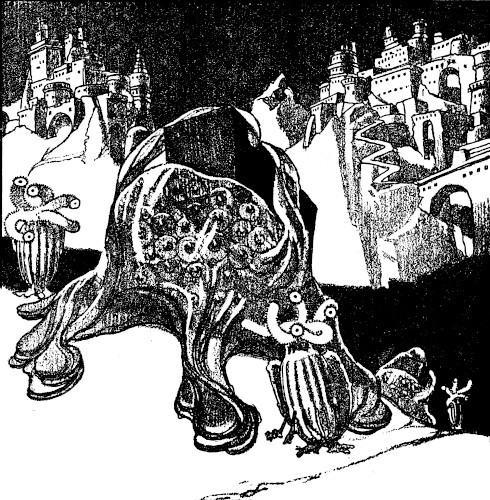
The effect of the monstrous sight was indescribable! Some fiendish violation of natural law!
We had previously dismissed, so far as serious thought was concerned, any theory that the cubes and ramparts of the mountainsides were other than natural in origin. How could they be otherwise, when man himself could scarcely have been differentiated from the great apes at the time when this region succumbed to the present unbroken reign of glacial death?
Yet now the sway of reason seemed irrefutably shaken, for this Cyclopean maze of squared, curved, and angled blocks had features which cut off all comfortable refuge. It was, very clearly, the blasphemous city of the mirage in stark, objective, and ineluctable reality. That damnable portent had had a material basis after all—there had been some horizontal stratum of ice dust in the upper air, and this shocking stone survival had projected its image across the mountains according to the simple laws of reflection. Of course, the phantom had been twisted and exaggerated, and had contained things which the real source did not contain; yet now, as we saw that real source, we thought it even more hideous and menacing than its distant image.
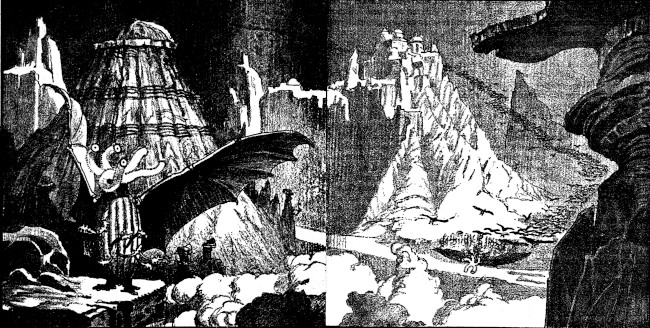
It was, very clearly, the blasphemous city of the mirage—in stark, objective reality!
Only the incredible, unhuman massiveness of these vast stone towers and ramparts had saved the frightful thing from utter annihilation in the hundreds of thousands—perhaps millions—of years it had brooded there amidst the blasts of a bleak upland. "Corona Mundi—Roof of the World——" All sorts of fantastic phrases sprang to our lips as we looked dizzily down at the unbelievable spectacle.
I thought again of the eldritch primal myths that had so persistently haunted me since my first sight of this dead antarctic world—of the demonic plateau of Leng, of the Mi-Go, or Abominable Snow Men of the Himalayas, of the Pnakotic Manuscripts with their prehuman implications, of the Cthulhu cult, of the Necronomicon, and of the Hyperborean legends of formless Tsathoggua and the worse than formless star spawn associated with that semientity.
For boundless miles in every direction the thing stretched off with very little thinning; indeed, as our eyes followed it to the right and left along the base of the low, gradual foothills which separated it from the actual mountain rim, we decided that we could see no thinning at all except for an interruption at the left of the pass through which we had come. We had merely struck, at random, a limited part of something of incalculable extent.
The foothills were more sparsely sprinkled with grotesque stone structures, linking the terrible city to the already familiar cubes and ramparts which evidently formed its mountain outposts. These latter, as well as the queer cave mouths, were as thick on the inner as on the outer sides of the mountains.
The nameless stone labyrinth consisted, for the most part, of walls from ten to one hundred and fifty feet in ice-clear height, and of a thickness varying from five to ten feet. It was composed mostly of prodigious blocks of dark primordial slate, schist, and sandstone—blocks in many cases as large as 4 × 6 × 8 feet—though in several places it seemed to be carved out of a solid, uneven bed rock of pre-Cambrian slate.
The buildings were far from equal in size, there being innumerable honeycomb arrangements of enormous extent as well as smaller separate structures.
The general shape of these things tended to be conical, pyramidal, or terraced; though there were many perfect cylinders, perfect cubes, clusters of cubes, and other rectangular forms, and a peculiar sprinkling of angled edifices whose five-pointed ground plan roughly suggested modern fortifications. The builders had made constant and expert use of the principle of the arch, and domes had probably existed in the city's heyday.
The whole tangle was monstrously weathered, and the glacial surface from where the towers projected was strewn with fallen blocks and immemorial débris. Where the glaciation was transparent we could see the lower parts of the gigantic piles, and we noticed the ice-preserved stone bridges which connected the different towers at varying distances above the ground. On the exposed walls we could detect the scarred places where other and higher bridges of the same sort had existed.
Closer inspection revealed countless largish windows; some of which were closed with shutters of a petrified material originally wood, though most gaped open in a sinister and menacing fashion.
Many of the ruins, of course, were roofless, and with uneven though wind-rounded upper edges; whilst others, of a more sharply conical or pyramidal model or else protected by higher surrounding structures, preserved intact outlines despite the omnipresent crumbling and pitting. With the field glass we could barely make out what seemed to be sculptural decorations in horizontal bands—decorations including those curious groups of dots whose presence on the ancient soapstones now assumed a vastly larger significance.
In many places the buildings were totally ruined and the ice sheet deeply riven from various geologic causes. In other places the stonework was worn down to the very level of the glaciation. One broad swath, extending from the plateau's interior to a cleft in the foothills about a mile to the left of the pass we had traversed, was wholly free from buildings. It probably represented, we concluded, the course of some great river which in Tertiary times—millions of years ago—had poured through the city and into some prodigious subterranean abyss of the great barrier range. Certainly, this was above all a region of caves, gulfs, and underground secrets beyond human penetration.
Looking back to our sensations, and recalling our dazedness at viewing this monstrous survival from æons we had thought prehuman, I can only wonder that we preserved the semblance of equilibrium which we did. Of course, we knew that something—chronology, scientific theory, or our own consciousness—was woefully awry; yet we kept enough poise to guide the plane, observe many things quite minutely, and take a careful series of photographs which may yet serve both us and the world in good stead.
In my case, ingrained scientific habit may have helped; for above all my bewilderment and sense of menace there burned a dominant curiosity to fathom more of this age-old secret—to know what sort of beings had built and lived in this incalculably gigantic place, and what relation to the general world of its time or of other times so unique a concentration of life could have had.
For this place could be no ordinary city. It must have formed the primary nucleus and center of some archaic and unbelievable chapter of earth's history whose outward ramifications, recalled only dimly in the most obscure and distorted myths, had vanished utterly amidst the chaos of terrene convulsions long before any human race we know had shambled out of apedom.
Here sprawled a Palæogæan megalopolis compared with which the fabled Atlantis and Lemuria, Commoriom and Uzuldaroum, and Olathoë in the land of Lomar are recent things of to-day—not even of yesterday; a megalopolis ranking with such whispered prehuman blasphemies as Valusia, R'lyeh, Ib in the land of Mnar, and the Nameless City of Arabia Deserta.
As we flew above that tangle of stark Titan towers my imagination sometimes escaped all bounds and roved aimlessly in realms of fantastic associations—even weaving links betwixt this lost world and some of my own wildest dreams concerning the mad horror at the camp.
The plane's fuel tank, in the interest of greater lightness, had been only partly filled; hence we now had to exert caution in our explorations. Even so, however, we covered an enormous extent of ground—or rather, air—after swooping down to a level where the wind became virtually negligible.
There seemed to be no limit to the mountain range, or to the length of the frightful stone city which bordered its inner foothills. Fifty miles of flight in each direction showed no major change in the labyrinth of rock and masonry that clawed up corpselike through the eternal ice.
There were, though, some highly absorbing diversifications; such as the carvings on the canyon where that broad river had once pierced the foothills and approached its sinking place in the great range.
The headlands at the stream's entrance had been boldly carved into Cyclopean pylons; and something about the ridgy, barrel-shaped designs stirred up oddly vague, hateful, and confusing semiremembrances in both Danforth and me.
We also came upon several star-shaped open spaces, evidently public squares, and noted various undulations in the terrain. Where a sharp hill rose, it was generally hollowed out into some sort of rambling stone edifice; but there were at least two exceptions. Of these latter, one was too badly weathered to disclose what had been on the jutting eminence, while the other still bore a fantastic conical monument carved out of the solid rock and roughly resembling such things as the well-known Snake Tomb in the ancient valley of Petra.
Flying inland from the mountains, we discovered that the city was not of infinite width, even though its length along the foothills seemed endless. After about thirty miles the grotesque stone buildings began to thin out, and in ten more miles we came to an unbroken waste virtually without signs of sentient artifice. The course of the river beyond the city seemed marked by a broad, depressed line, while the land assumed a somewhat greater ruggedness, seeming to slope slightly upward as it receded in the mist-hazed west.
So far we had made no landing, yet to leave the plateau without an attempt at entering some of the monstrous structures would have been inconceivable. Accordingly, we decided to find a smooth place on the foothills near our navigable pass, there grounding the plane and preparing to do some exploration on foot.
Though these gradual slopes were partly covered with a scattering of ruins, low flying soon disclosed an ample number of possible landing places. Selecting that nearest to the pass, since our next flight would be across the great range and back to camp, we succeeded about twelve thirty p.m. in coming down on a smooth, hard snow field wholly devoid of obstacles and well adapted to a swift and favorable take-off later on.
It did not seem necessary to protect the plane with a snow banking for so brief a time and in so comfortable an absence of high winds at this level; hence we merely saw that the landing skis were safely lodged, and that the vital parts of the mechanism were guarded against the cold.
For our foot journey we discarded the heaviest of our flying furs, and took with us a small outfit consisting of pocket compass, hand camera, light provisions, voluminous notebooks and paper, geologist's hammer and chisel, specimen bags, coil of climbing rope, and powerful electric torches with extra batteries; this equipment having been carried in the plane on the chance that we might be able to effect a landing, take ground pictures, make drawings and topographical sketches, and obtain rock specimens from some bare slope, outcropping, or mountain cave.
Fortunately, we had a supply of extra paper to tear up, place in a spare specimen bag, and use on the ancient principle of hare and hounds for marking our course in any interior mazes we might be able to penetrate. This had been brought in case we found some cave system with air quiet enough to allow such a rapid and easy method in place of the usual rock-chipping method of trail blazing.
Walking cautiously downhill over the crusted snow, toward the stupendous stone labyrinth that loomed against the opalescent west, we felt almost as keen a sense of imminent marvels as we had felt on approaching the unfathomed mountain pass four hours previously.
True, we had become visually familiar with the incredible secret concealed by the barrier peaks; yet the prospect of actually entering primordial walls reared by conscious beings perhaps millions of years ago—before any known race of men could have existed—was none the less awesome and potentially terrible in its implications of cosmic abnormality.
Though the thinness of the air at this prodigious altitude made exertion somewhat more difficult than usual, both Danforth and I found ourselves bearing up very well, and felt equal to almost any task which might fall to our lot.
It took only a few steps to bring us to a shapeless ruin worn level with the snow, while ten or fifteen rods farther on there was a huge, roofless rampart still complete in its gigantic five-pointed outline, and rising to an irregular height of ten or eleven feet. For this latter we headed; and when at last we were actually able to touch its weathered Cyclopean blocks, we felt that we had established an unprecedented and almost blasphemous link with forgotten æons normally closed to our species.
This rampart, shaped like a star and perhaps three hundred feet from point to point, was built of Jurassic sandstone blocks of irregular size, averaging 6 x 8 feet in surface. There was a row of arched loopholes or windows about four feet wide and five feet high, spaced quite symmetrically along the points of the star and at its inner angles, and with the bottoms about four feet from the glaciated surface.
Looking through these, we could see that the masonry was fully five feet thick, that there were no partitions remaining within, and that there were traces of banded carvings or bas-reliefs on the interior walls—facts we had indeed guessed before, when flying low over this rampart and others like it. Though lower parts must have originally existed, all traces of such things were now wholly obscured by the deep layer of ice and snow at this point.
We crawled through one of the windows and vainly tried to decipher the nearly effaced mural designs, but did not attempt to disturb the glaciated floor. Our orientation flights had indicated that many buildings in the city proper were less ice-choked, and that we might perhaps find wholly clear interiors leading down to the true ground level if we entered those structures still roofed at the top.
Before we left the rampart we photographed it carefully, and studied its mortarless Cyclopean masonry with complete bewilderment. We wished that Pabodie were present, for his engineering knowledge might have helped us guess how such titanic blocks could have been handled in that unbelievably remote age when the city and its outskirts were built up.
The half-mile walk downhill to the actual city, with the upper wind shrieking vainly and savagely through the skyward peaks in the background, was something of which the smallest details will always remain engraved on my mind. Only in fantastic nightmares could any human beings but Danforth and me conceive such optical effects.
Between us and the churning vapors of the west lay that monstrous tangle of dark stone towers, its outré and incredible forms impressing us afresh at every new angle of vision. It was a mirage in solid stone, and were it not for the photographs I would still doubt that such a thing could be. The general type of masonry was identical with that of the rampart we had examined; but the extravagant shapes which this masonry took in its urban manifestations were past all description.
Even the pictures illustrate only one or two phases of its endless variety, preternatural massiveness, and utterly alien exoticism. There were geometrical forms for which an Euclid could scarcely find a name—cones of all degrees of irregularity and truncation, terraces of every sort of provocative disproportion, shafts with odd bulbous enlargements, broken columns in curious groups, and five-pointed or five-ridged arrangements of mad grotesqueness.
As we drew nearer we could see beneath certain transparent parts of the ice sheet, and detect some of the tubular stone bridges that connected the crazily sprinkled structures at various heights. Of orderly streets there seemed to be none, the only broad open swath being a mile to the left, where the ancient river had doubtless flowed through the town into the mountains.
Our field glasses showed the external, horizontal bands of nearly effaced sculptures and dot groups to be very prevalent, and we could half imagine what the city must once have looked like—even though most of the roofs and tower tops had necessarily perished.
As a whole, it had been a complex tangle of twisted lanes and alleys, all of them deep canyons, and some little better than tunnels because of the overhanging masonry or overarching bridges.
Now, outspread below us, it loomed like a dream phantasy against a westward mist through whose northern end the low, reddish antarctic sun of early afternoon was struggling to shine; and when, for a moment, that sun encountered a denser obstruction and plunged the scene into temporary shadow, the effect was subtly menacing in a way I can never hope to depict. Even the faint howling and piping of the unfelt wind in the great mountain passes behind us took on a wilder note of purposeful malignity.
The last stage of our descent to the town was unusually steep and abrupt, and a rock outcropping at the edge where the grade changed led us to think that an artificial terrace had once existed there. Under the glaciation, we believed, there must be a flight of steps or its equivalent.
When at last we plunged into the town itself, clambering over fallen masonry and shrinking from the oppressive nearness and dwarfing height of omnipresent crumbling and pitted walls, our sensations again became such that I marvel at the amount of self-control we retained.
Danforth was frankly jumpy, and began making some offensively irrelevant speculations about the horror at the camp—which I resented all the more because I could not help sharing certain conclusions forced upon us by many features of this morbid survival from nightmare antiquity.
The speculations worked on his imagination, too; for in one place—where a débris-littered alley turned a sharp corner—he insisted that he saw faint traces of ground markings which he did not like; whilst elsewhere he stopped to listen to a subtle, imaginary sound from some undefined point—a muffled musical piping, he said, not unlike that of the wind in the mountain caves, yet somehow disturbingly different.
The ceaseless five-pointedness of the surrounding architecture and of the few distinguishable mural arabesques had a dimly sinister suggestiveness we could not escape, and gave us a touch of terrible subconscious certainty concerning the primal entities which had reared and dwelt in this unhallowed place.
Nevertheless, our scientific and adventurous souls were not wholly dead, and we mechanically carried out our program of chipping specimens from all the different rock types represented in the masonry. We wished a rather full set in order to draw better conclusions regarding the age of the place.
Nothing in the great outer walls seemed to date from later than the Jurassic and Comanchean periods, nor was any piece of stone in the entire place of a greater recency than the Pliocene age. In stark certainty, we were wandering amidst a death which had reigned at least five hundred thousand years, and in all probability even longer.
As we proceeded through this maze of stone-shadowed twilight we stopped at all available apertures to study interiors and investigate entrance possibilities. Some were above our reach, whilst others led only into ice-choked ruins as unroofed and barren as the rampart on the hill.
One, though spacious and inviting, opened on a seemingly bottomless abyss without visible means of descent. Now and then we had a chance to study the petrified wood of a surviving shutter, and were impressed by the fabulous antiquity implied in the still discernible grain. These things had come from Mesozoic gymnosperms and conifers—especially Cretaceous cycads—and from fan palms and early angiosperms of plainly Tertiary date. Nothing definitely later than the Pliocene could be discovered.
In the placing of these shutters—whose edges showed the former presence of queer and long-vanished hinges—usage seemed to be varied—some being on the outer and some on the inner side of the deep embrasures. They seemed to have become wedged in place, thus surviving the rusting of their former and probably metallic fixtures and fastenings.
After a time we came across a row of windows—in the bulges of a colossal five-edged cone of undamaged apex—which led into a vast, well-preserved room with stone flooring; but these were too high in the room to permit descent without a rope. We had a rope with us, but did not wish to bother with this twenty-foot drop unless obliged to—especially in this thin plateau air where great demands were made upon the heart action.
This enormous room was probably a hall or concourse of some sort, and our electric torches showed bold, distinct, and potentially startling sculptures arranged round the walls in broad, horizontal bands separated by equally broad strips of conventional arabesques. We took careful note of this spot, planning to enter here unless a more easily gained interior was encountered.
Finally, though, we did encounter exactly the opening we wished; an archway about six feet wide and ten feet high, marking the former end of an aërial bridge which had spanned an alley about five feet above the present level of glaciation. These archways, of course, were flush with upper-story floors, and in this case one of the floors still existed.
The building thus accessible was a series of rectangular terraces on our left facing westward. That across the alley, where the other archway yawned, was a decrepit cylinder with no windows and with a curious bulge about ten feet above the aperture. It was totally dark inside, and the archway seemed to open on a well of illimitable emptiness.
Heaped débris made the entrance to the vast left-hand building doubly easy, yet for a moment we hesitated before taking advantage of the long-wished chance. For though we had penetrated into this tangle of archaic mystery, it required fresh resolution to carry us actually inside a complete and surviving building of a fabulous elder world whose nature was becoming more and more hideously plain to us.
In the end, however, we made the plunge, and scrambled up over the rubble into the gaping embrasure. The floor beyond was of great slate slabs, and seemed to form the outlet of a long, high corridor with sculptured walls.
Observing the many inner archways which led off from it, and realizing the probable complexity of the nest of apartments within, we decided that we must begin our system of hare-and-hound trail blazing. Hitherto our compasses, together with frequent glimpses of the vast mountain range between the towers in our rear, had been enough to prevent our losing our way; but from now on, the artificial substitute would be necessary.
Accordingly we reduced our extra paper to shreds of suitable size, placed these in a bag to be carried by Danforth, and prepared to use them as economically as safety would allow. This method would probably gain us immunity from straying, since there did not appear to be any strong air currents inside the primordial masonry. If such should develop, or if our paper supply should give out, we could of course fall back on the more secure though more tedious and retarding method of rock chipping.
Just how extensive a territory we had opened up, it was impossible to guess without a trial. The close and frequent connection of the different buildings made it likely that we might cross from one to another on bridges underneath the ice, except where impeded by local collapses and geologic rifts, for very little glaciation seemed to have entered the massive constructions.
Almost all the areas of transparent ice had revealed the submerged windows as tightly shuttered, as if the town had been left in that uniform state until the glacial sheet came to crystallize the lower part for all succeeding time. Indeed, one gained a curious impression that this place had been deliberately closed and deserted in some dim, bygone æon, rather than overwhelmed by any sudden calamity or even gradual decay. Had the coming of the ice been foreseen, and had a nameless population left en masse to seek a less doomed abode?
The precise physiographic conditions attending the formation of the ice sheet at this point would have to wait for later solution. It had not, very plainly, been a grinding drive. Perhaps the pressure of accumulated snows had been responsible, and perhaps some flood from the river, or from the bursting of some ancient glacial dam in the great range, had helped to create the special state now observable. Imagination could conceive almost anything in connection with this place.
VI.
It would be cumbrous to give a detailed, consecutive account of our wanderings inside that cavernous, æon-dead honeycomb of primal masonry—that monstrous lair of elder secrets which now echoed for the first time, after uncounted epochs, to the tread of human feet.
This is especially true because so much of the horrible drama and revelation came from a mere study of the omnipresent mural carvings. Our flash-light photographs of those carvings will do much toward proving the truth of what we are now disclosing, and it is lamentable that we had not a larger film supply with us. As it was, we made crude notebook sketches of certain salient features after all our films were used up.
The building which we had entered was one of great size and elaborateness, and gave us an impressive notion of the architecture of that nameless geologic past. The inner partitions were less massive than the outer walls, but on the lower levels were excellently preserved. Labyrinthine complexity, involving curiously irregular differences in floor levels, characterized the entire arrangement; and we should certainly have been lost at the very outset but for the trail of torn paper left behind us.
We decided to explore the more decrepit upper parts first of all, hence climbed aloft in the maze for a distance of some one hundred feet, to where the topmost tier of chambers yawned snowily and ruinously open to the polar sky. Ascent was effected over the steep, transversely ribbed stone ramps or inclined planes which everywhere served in lieu of stairs.
The rooms we encountered were of all imaginable shapes and proportions, ranging from five-pointed stars to triangles and perfect cubes. It might be safe to say that their general average was about 30 x 30 feet in floor area, and twenty feet in height, though many larger apartments existed.
After thoroughly examining the upper regions and the glacial level we descended, story by story, into the submerged part, where indeed we soon saw we were in a continuous maze of connected chambers and passages probably leading over unlimited areas outside this particular building.
The Cyclopean massiveness and giganticism of everything about us became curiously oppressive; and there was something vaguely but deeply unhuman in all the contours, dimensions, proportions, decorations, and constructional nuances of the blasphemously archaic stonework. We soon realized, from what the carvings revealed, that this monstrous city was many million years old.
We cannot yet explain the engineering principles used in the anomalous balancing and adjustment of the vast rock masses, though the function of the arch was clearly much relied on. The rooms we visited were wholly bare of all portable contents, a circumstance which sustained our belief in the city's deliberate desertion. The prime decorative feature was the almost universal system of mural sculpture, which tended to run in continuous horizontal bands three feet wide and arranged from floor to ceiling in alternation with bands of equal width given over to geometrical arabesques.
There were exceptions to this rule of arrangement, but its preponderance was overwhelming. Often, however, a series of smooth cartouches containing oddly patterned groups of dots would be sunk along one of the arabesque bands.
The technique, we soon saw, was mature, accomplished, and æsthetically evolved to the highest degree of civilized mastery, though utterly alien in every detail to any known art tradition of the human race. In delicacy of execution no sculpture I have ever seen could approach it. The minutest details of elaborate vegetation, or of animal life, were rendered with astonishing vividness despite the bold scale of the carvings; whilst the conventional designs were marvels of skillful intricacy.
The arabesques displayed a profound use of mathematical principles, and were made up of obscurely symmetrical curves and angles based on the quantity of five.
The pictorial bands followed a highly formalized tradition, and involved a peculiar treatment of perspective, but had an artistic force that moved us profoundly notwithstanding the intervening gulf of vast geologic periods.
Their method of design hinged on a singular juxtaposition of the cross section with the two-dimensional silhouette, and embodied an analytical psychology beyond that of any known race of antiquity. It is useless to try to compare this art with any represented in our museums. Those who see our photographs will probably find its closest analogue in certain grotesque conceptions of the most daring futurists.
The arabesque tracery consisted altogether of depressed lines, whose depth on unweathered walls varied from one to two inches. When cartouches with dot groups appeared—evidently as inscriptions in some unknown and primordial language and alphabet—the depression of the smooth surface was perhaps an inch and a half, and of the dots perhaps a half inch more. The pictorial bands were in countersunk low relief, their background being depressed about two inches from the original wall surface.
In some specimens marks of a former coloration could be detected, though for the most part the untold æons had disintegrated and banished any pigments which may have been applied. The more one studied the marvelous technique the more one admired the things. Beneath their strict conventionalization one could grasp the minute and accurate observation and graphic skill of the artists; and indeed, the very conventions themselves served to symbolize and accentuate the real essence or vital differentiation of every object delineated.
We felt, too, that besides these recognizable excellences there were others lurking beyond the reach of our perceptions. Certain touches here and there gave vague hints of latent symbols and stimuli which another mental and emotional background, and a fuller or different sensory equipment, might have made of profound and poignant significance to us.
The subject matter of the sculptures obviously came from the life of the vanished epoch of their creation, and contained a large proportion of evident history. It is this abnormal historic-mindedness of the primal race—a chance circumstance operating, through coincidence, miraculously in our favor—which made the carvings so awesomely informative to us, and which caused us to place their photography and transcription above all other considerations.
In certain rooms the dominant arrangement was varied by the presence of maps, astronomical charts, and other scientific designs on an enlarged scale—these things giving a naïve and terrible corroboration to what we gathered from the pictorial friezes and dados.
In hinting at what the whole revealed, I can only hope that my account will not arouse a curiosity greater than sane caution on the part of those who believe me at all. It would be tragic if any were to be allured to that realm of death and horror by the very warning meant to discourage them.
Interrupting these sculptured walls were high windows and massive twelve-foot doorways; both now and then retaining the petrified wooden planks—elaborately carved and polished—of the actual shutters and doors. All metal fixtures had long ago vanished, but some of the doors remained in place and had to be forced aside as we progressed from room to room.
Window frames with odd transparent panes—mostly elliptical—survived here and there, though in no considerable quantity. There were also frequent niches of great magnitude, generally empty, but once in a while containing some bizarre object carved from green soapstone which was either broken or perhaps held too inferior to warrant removal.
Other apertures were undoubtedly connected with bygone mechanical facilities—heating, lighting, and the like—of a sort suggested in many of the carvings. Ceilings tended to be plain, but had sometimes been inlaid with green soapstone or other tiles, mostly fallen now. Floors were also paved with such tiles, though plain stonework predominated.
As I have said, all furniture and other movables were absent; but the sculptures gave a clear idea of the strange devices which had once filled these tomblike, echoing rooms. Above the glacial sheet the floors were generally thick with detritus, litter, and débris, but farther down this condition decreased.
In some of the lower chambers and corridors there was little more than gritty dust or ancient incrustations, while occasional areas had an uncanny air of newly swept immaculateness. Of course, where rifts or collapses had occurred, the lower levels were as littered as the upper ones.
A central court—as we had seen in other structures, from the air—saved the inner regions from total darkness; so that we seldom had to use our electric torches in the upper rooms except when studying sculptured details. Below the ice cap, however, the twilight deepened; and in many parts of the tangled ground level there was an approach to absolute blackness.
To form even a rudimentary idea of our thoughts and feelings as we penetrated this æon-silent maze of unhuman masonry one must correlate a hopelessly bewildering chaos of fugitive moods, memories, and impressions. The sheer appalling antiquity and lethal desolation of the place were enough to overwhelm almost any sensitive person, but added to these elements were the recent unexplained horror at the camp, and the revelations all too soon effected by the terrible mural sculptures around us.
The moment we came upon a perfect section of carving, where no ambiguity of interpretation could exist, it took only a brief study to give us the hideous truth—a truth which it would be naïve to claim Danforth and I had not independently suspected before, though we had carefully refrained from even hinting it to each other. There could now be no further merciful doubt about the nature of the beings which had built and inhabited this monstrous dead city millions of years ago, when man's ancestors were primitive archaic mammals, and vast Dinosauria roamed the tropical steppes of Europe and Asia.
We had previously clung to a desperate alternative and insisted—each to himself—that the omnipresence of the five-pointed motif meant only some cultural or religious exaltation of the archæan natural object which had so patently embodied the quality of five-pointedness; as the decorative motifs of Minoan Crete exalted the sacred bull, those of Egypt the scarabæus, those of Rome the wolf and the eagle, and those of various savage tribes some chosen totem animal.
But this lone refuge was now stripped from us, and we were forced to face definitely the reason-shaking realization which the reader of these pages has doubtless long ago anticipated. I can scarcely bear to write it down in black and white even now, but perhaps that will not be necessary.
The things once rearing and dwelling in this frightful masonry in the age of Dinosauria were not indeed Dinosauria, but far worse. Mere Dinosauria were new and almost brainless objects—but the builders of the city were wise and old, and had left certain traces in rocks even then laid down well nigh a thousand million years—rocks laid down before the true life of earth had advanced beyond plastic groups of cells—rocks laid down before the true life of earth had existed at all.
They were the makers and enslavers of that life, and above all doubt the originals of the fiendish elder myths which things like the Pnakotic Manuscripts and the Necronomicon affrightedly hint about. They were the great "Old Ones" that had filtered down from the stars when earth was young—the beings whose substance an alien evolution had shaped, and whose powers were such as this planet had never bred. And to think that only the day before Danforth and I had actually looked upon fragments of their millennially fossilized substance—and that poor Lake and his party had seen their complete outlines——
It is, of course, impossible for me to relate in proper order the stages by which we picked up what we know of that monstrous chapter of prehuman life. After the first shock of the certain revelation, we had to pause a while to recuperate, and it was fully three o'clock before we got started on our actual tour of systematic research.
The sculptures in the building we entered were of relatively late date—perhaps two million years ago—as checked up by geological, biological, and astronomical features—and embodied an art which would be called decadent in comparison with that of specimens we found in older buildings, after crossing bridges under the glacial sheet.
One edifice hewn from the solid rock seemed to go back forty or possibly even fifty million years—to the lower Eocene or upper Cretaceous—and contained bas-reliefs of an artistry surpassing anything else, with one tremendous exception, that we encountered. That was, we have since agreed, the oldest domestic structure we traversed.
Were it not for the support of those flashlights soon to be made public, I would refrain from telling what I found and inferred, lest I be confined as a madman. Of course, the infinitely early parts of the patchwork tale—representing the preterrestrial life of the star-headed beings on other planets, in other galaxies, and in other universes—can readily be interpreted as the fantastic mythology of those beings themselves; yet such parts sometimes involved designs and diagrams so uncannily close to the latest findings of mathematics and astrophysics that I scarcely know what to think. Let others judge when they see the photographs I shall publish.
Naturally, no one set of carvings which we encountered told more than a fraction of any connected story, nor did we even begin to come upon the various stages of that story in their proper order. Some of the vast rooms were independent units so far as their designs were concerned, whilst in other cases a continuous chronicle would be carried through a series of rooms and corridors.
The best of the maps and diagrams were on the walls of a frightful abyss below even the ancient ground level—a cavern perhaps two hundred feet square and sixty feet high, which had almost undoubtedly been an educational center of some sort.
There were many provoking repetitions of the same material in different rooms and buildings, since certain chapters of experience, and certain summaries or phases of racial history, had evidently been favorites with different decorators or dwellers. Sometimes, though, variant versions of the same theme proved useful in settling debatable points and filling up gaps.
I still wonder that we deduced so much in the short time at our disposal. Of course, we even now have only the barest outline—and much of that was obtained later on from a study of the photographs and sketches we made.
It may be the effect of this later study—the revived memories and vague impressions acting in conjunction with his general sensitiveness and with that final supposed horror-glimpse whose essence he will not reveal even to me—which has been the immediate source of Danforth's present breakdown.
But it had to be; for we could not issue our warning intelligently without the fullest possible information, and the issuance of that warning is a prime necessity. Certain lingering influences in that unknown antarctic world of disordered time and alien natural law make it imperative that further exploration be discouraged.
VII.
The full story, so far as deciphered, will eventually appear in an official bulletin of Miskatonic University. Here I shall sketch only the salient highlights in a formless, rambling way. Myth or otherwise, the sculptures told of the coming of those star-headed things to the nascent, lifeless earth out of cosmic space—their coming, and the coming of many other alien entities such as at certain times embark upon spatial pioneering.
They seemed able to traverse the interstellar ether on their vast membranous wings—thus oddly confirming some curious hill folklore long ago told me by an antiquarian colleague. They had lived under the sea a good deal, building fantastic cities and fighting terrific battles with nameless adversaries by means of intricate devices employing unknown principles of energy.
Evidently their scientific and mechanical knowledge far surpassed man's to-day, though they made use of its more widespread and elaborate forms only when obliged to.
Some of the sculptures suggested that they had passed through a stage of mechanized life on other planets, but had receded upon finding its effects emotionally unsatisfying. Their preternatural toughness of organization and simplicity of natural wants made them peculiarly able to live on a high plane without the more specialized fruits of artificial manufacture, and even without garments, except for occasional protection against the elements.
It was under the sea, at first for food and later for other purposes, that they first created earth life—using available substances according to long-known methods.
The more elaborate experiments came after the annihilation of various cosmic enemies. They had done the same thing on other planets, having manufactured not only necessary foods, but certain multicellular protoplasmic masses capable of molding their tissues into all sorts of temporary organs under hypnotic influence and thereby forming ideal slaves to perform the heavy work of the community.
These viscous masses were without doubt what Abdul Alhazred whispered about as the "Shoggoths" in his frightful Necronomicon, though even that mad Arab had not hinted that any existed on earth except in the dreams of those who had chewed a certain alkaloidal herb.
When the star-headed Old Ones on this planet had synthesized their simple food forms and bred a good supply of Shoggoths, they allowed other cell groups to develop into other forms of animal and vegetable life for sundry purposes, extirpating any whose presence became troublesome.
With the aid of the Shoggoths, whose expansions could be made to lift prodigious weights, the small, low cities under the sea grew to vast and imposing labyrinths of stone not unlike those which later rose on land. Indeed, the highly adaptable Old Ones had lived much on land in other parts of the universe, and probably retained many traditions of land construction.
As we studied the architecture of all these sculptured Palæogæan cities, including that whose æon-dead corridors we were even then traversing, we were impressed by a curious coincidence which we have not yet tried to explain, even to ourselves. The tops of the buildings, which in the actual city around us had, of course, been weathered into shapeless ruins ages ago, were clearly displayed in the bas-reliefs, and showed vast clusters of needlelike spires, delicate finials on certain cone and pyramid apexes, and tiers of thin, horizontal scalloped disks capping cylindrical shafts.
This was exactly what we had seen in that monstrous and portentous mirage, cast by a dead city whence such sky-line features had been absent for thousands and ten of thousands of years, which loomed on our ignorant eyes across the unfathomed mountains of madness as we first approached poor Lake's ill-fated camp.
Of the life of the Old Ones, both under the sea and after part of them migrated to land, volumes could be written. Those in shallow water had continued the fullest use of the eyes at the ends of their five main head tentacles, and had practiced the arts of sculpture and of writing in quite the usual way—the writing accomplished with a stylus on waterproof waxen surfaces.
Those lower down in the ocean depths, though they used a curious phosphorescent organism to furnish light, pieced out their vision with obscure special senses operating through the prismatic cilia on their heads—senses which rendered all the Old Ones partly independent of light in emergencies. Their forms of sculpture and writing had changed curiously during the descent, embodying certain apparently chemical coating processes—probably to secure phosphorescence—which the bas-reliefs could not make clear to us.
The beings moved in the sea partly by swimming—using the lateral crinoid arms—and partly by wriggling with the lower tier of tentacles containing the pseudofeet. Occasionally they accomplished long swoops with the auxiliary use of two or more sets of their fan-like folding wings.
On land they locally used the pseudofeet, but now and then flew to great heights or over long distances with their wings. The many slender tentacles into which the crinoid arms branched were infinitely delicate, flexible, strong, and accurate in muscular-nervous coördination—ensuring the utmost skill and dexterity in all artistic and other manual operations.
The toughness of the things was almost incredible. Even the terrific pressure of the deepest sea bottoms appeared powerless to harm them. Very few seemed to die at all except by violence, and their burial places were very limited. The facts that they covered their vertically inhumed dead with five-pointed inscribed mounds set up thoughts in Danforth and me which made a fresh pause and recuperation necessary after the sculptures revealed it.
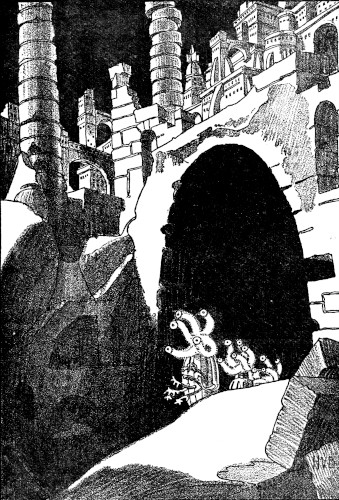
The toughness of the things was almost incredible. Even terrific pressures were powerless to harm them!
The beings multiplied by means of spores—like vegetable pteridophyta, as Lake had suspected—but, owing to their prodigious toughness and longevity, and consequent lack of replacement needs, they did not encourage the large-scale development of new prothallia except when they had new regions to colonize.
The young matured swiftly, and received an education evidently beyond any standard we can imagine. The prevailing intellectual and æsthetic life was highly evolved, and produced a tenaciously enduring set of customs and institutions which I shall describe more fully in my coming monograph. These varied slightly according to sea or land residence, but had the same foundations and essentials.
Though able, like vegetables, to derive nourishment from inorganic substances; they vastly preferred organic and especially animal food. They ate uncooked marine life under the sea, but cooked their viands on land. They hunted game and raised meat herds—slaughtering with sharp weapons whose odd marks on certain fossil bones our expedition had noted.
They resisted all ordinary temperatures marvelously, and in their natural state could live in water down to freezing. When the great chill of the Pleistocene drew on, however—nearly a million years ago—the land dwellers had to resort to special measures, including artificial heating—until, at last, the deadly cold appears to have driven them back into the sea.
For their prehistoric flights through cosmic space, legend said, they had absorbed certain chemicals and become almost independent of eating, breathing, or heat conditions—but by the time of the great cold they had lost track of the method. In any case, they could not have prolonged the artificial state indefinitely without harm.
Being nonpairing and semivegetable in structure, the Old Ones had no biological basis for the family phase of mammal life, but seemed to organize large households on the principles of comfortable space-utility and—as we deduced from the pictured occupations and diversions of codwellers—congenial mental association.
In furnishing their homes they kept everything in the center of the huge rooms, leaving all wall spaces free for decorative treatment. Lighting, in the case of the land inhabitants, was accomplished by a device probably electro-chemical in nature.
Both on land and under water they used curious tables, chairs and couches like cylindrical frames—for they rested and slept upright with folded-down tentacles—and racks for the hinged sets of dotted surfaces forming their books.
Government was evidently complex and probably socialistic, though no certainties in this regard could be deduced from the sculptures we saw. There was extensive commerce, both local and between different cities—certain small, flat counters, five-pointed and inscribed, serving as money. Probably the smaller of the various greenish soapstones found by our expedition were pieces of such currency.
Though the culture was mainly urban, some agriculture and much stock raising existed. Mining and a limited amount of manufacturing were also practiced. Travel was very frequent, but permanent migration seemed relatively rare except for the vast colonizing movements by which the race expanded.
For personal locomotion no external aid was used, since in land, air, and water movement alike the Old Ones seemed to possess excessively vast capacities for speed. Loads, however, were drawn by beasts of burden—Shoggoths under the sea, and a curious variety of primitive vertebrates in the later years of land existence.
These vertebrates, as well as an infinity of other life forms—animal and vegetable, marine, terrestrial, and aërial—were the products of unguided evolution acting on life cells made by the Old Ones, but escaping beyond their radius of attention. They had been suffered to develop unchecked because they had not come in conflict with the dominant beings. Bothersome forms, of course, were mechanically exterminated.
It interested us to see in some of the very last and most decadent sculptures a shambling, primitive mammal, used sometimes for food and sometimes as an amusing buffoon by the land dwellers, whose vaguely simian and human foreshadowings were unmistakable. In the building of land cities the huge stone blocks of the high towers were generally lifted by vast-winged pterodactyls of a species heretofore unknown to palæontology.
The persistence with which the Old Ones survived various geologic changes and convulsions of the earth's crust was little short of miraculous. Though few or none of their first cities seem to have remained beyond the Archæan Age, there was no interruption in their civilization or in the transmission of their records.
Their original place of advent to the planet was the Antarctic Ocean, and it is likely that they came not long after the matter forming the moon was wrenched from the neighboring South Pacific. According to one of the sculptured maps, the whole globe was then under water, with stone cities scattered farther and farther from the antarctic as æons passed.
Another map shows a vast bulk of dry land around the south pole, where it is evident that some of the beings made experimental settlements, though their main centers were transferred to the nearest sea bottom.
Later maps, which display this land mass as cracking and drifting, and sending certain detached parts northward, uphold in a striking way the theories of continental drift lately advanced by Taylor, Wegener, and Joly.
With the upheaval of new land in the South Pacific, tremendous events began. Some of the marine cities were hopelessly shattered, yet that was not the worst misfortune. Another race—a land race of beings shaped like octopi and probably corresponding to the fabulous prehuman spawn of Cthulhu—soon began filtering down from cosmic infinity and precipitated a monstrous war which for a time drove the Old Ones wholly back to the sea—a colossal blow in view of the increasing land settlements.
Later, peace was made, and the new lands were given to the Cthulhu spawn whilst the Old Ones held the sea and the older lands. New land cities were founded—the greatest of them in the antarctic, for this region of first arrival was sacred.
From then on, as before, the antarctic remained the center of the Old Ones' civilization, and all the cities built there by the Cthulhu spawn were blotted out.
Then, suddenly, the lands of the Pacific sank again, taking with them the frightful stone city of R'lyeh and all the cosmic octopi, so that the Old Ones were again supreme on the planet, except for one shadowy fear about which they did not like to speak.
At a rather later age their cities dotted all the land and water areas of the globe—hence the recommendation in my coming monograph that some archæologist make systematic borings with Pabodie's type of apparatus in certain widely separated regions.
The steady trend down the ages was from water to land—a movement encouraged by the rise of new land masses, though the ocean was never wholly deserted. Another cause of the landward movement was the new difficulty in breeding and managing the Shoggoths upon which successful sea life depended.
With the march of time, as the sculptures sadly confessed, the art of creating new life from inorganic matter had been lost, so that the Old Ones had to depend on the molding of forms already in existence. On land the great reptiles proved highly tractable; but the Shoggoths of the sea, reproducing by fission and acquiring a dangerous degree of accidental intelligence, presented for a time a formidable problem.
They had always been controlled through the hypnotic suggestion of the Old Ones, and had modeled their tough plasticity into various useful temporary limbs and organs; but now their self-modeling powers were sometimes exercised independently, and in various imitative forms implanted by past suggestion. They had, it seems, developed a semistable brain whose separate and occasionally stubborn volition echoed the will of the Old Ones without always obeying it.
Sculptured images of these Shoggoths filled Danforth and me with horror and loathing. They were normally shapeless entities composed of a viscous jelly which looked like an agglutination of bubbles, and each averaged about fifteen feet in diameter when a sphere. They had, however, a constantly shifting shape and volume—throwing out temporary developments or forming apparent organs of sight, hearing, and speech in imitation of their masters, either spontaneously or according to suggestion.
They seem to have become peculiarly intractable toward the middle of the Permian Age, perhaps one hundred and fifty million years ago, when a veritable war of resubjugation was waged upon them by the marine Old Ones. Pictures of this war, and of the headless, slime-coated fashion in which the Shoggoths typically left their slain victims, held a marvelously fearsome quality despite the intervening abyss of untold ages.
The Old Ones had used curious weapons of molecular disturbance against the rebel entities, and in the end had achieved a complete victory. Thereafter the sculptures showed a period in which Shoggoths were tamed and broken by armed Old Ones as the wild horses of the American west were tamed by cowboys.
Though during the rebellion the Shoggoths had shown an ability to live out of water, this transition was not encouraged—since their usefulness on land would hardly have been commensurate with the trouble of their management.
During the Jurassic Age the Old Ones met fresh adversity in the form of a new invasion from outer space—this time by half-fungous, half-crustacean creatures—creatures undoubtedly the same as those figuring in certain whispered hill legends of the north, and remembered in the Himalayas as the Mi-Go, or Abominable Snow Men.
To fight these beings the Old Ones attempted, for the first time since their terrene advent, to sally forth again into the planetary ether; but, despite all traditional preparations, found it no longer possible to leave the earth's atmosphere. Whatever the old secret of interstellar travel had been, it was now definitely lost to the race.
In the end the Mi-Go drove the Old Ones out of all the northern lands, though they were powerless to disturb those in the sea. Little by little the slow retreat of the elder race to their original antarctic habitat was beginning.
It was curious to note from the pictured battles that both the Cthulhu spawn and the Mi-Go seem to have been composed of matter more widely different from that which we know than was the substance of the Old Ones. They were able to undergo transformations and reintegrations impossible for their adversaries, and seem therefore to have originally come from even remoter gulfs of cosmic space.
The Old Ones, but for their abnormal toughness and peculiar vital properties, were strictly material, and must have had their absolute origin within the known space-time continuum—whereas the first sources of the other beings can only be guessed at with bated breath. All this, of course, assuming that the nonterrestrial linkages and the anomalies ascribed to the invading foes are not pure mythology. Conceivably, the Old Ones might have invented a cosmic framework to account for their occasional defeats, since historical interest and pride obviously formed their chief psychological element. It is significant that their annals failed to mention many advanced and potent races of beings whose mighty cultures and towering ethics figure persistently in certain obscure legends.
The changing state of the world through long geologic ages appeared with startling vividness in many of the sculptured maps and scenes. In certain cases existing science will require revision, while in other cases its bold deductions are magnificently confirmed.
As I have said, the hypothesis of Taylor, Wegener, and Joly that all the continents are fragments of an original antarctic land mass which cracked from centrifugal force and drifted apart over a technically viscous lower surface—an hypothesis suggested by such things as the complimentary outlines of Africa and South America, and the way the great mountain chains are rolled and shoved up—receives striking support from this uncanny source.
Maps evidently showing the Carboniferous of a hundred million or more years ago displayed significant rifts and chasms destined later to separate Africa from the once continuous realms of Europe (then the Valusia of primal legend), Asia, the Americas, and the antarctic continent.
Other charts—and most significantly one in connection with the founding fifty million years ago of the vast dead city around us—showed all the present continents well differentiated. And in the latest discoverable specimen—dating perhaps from the Pliocene Age—the approximate world of to-day appeared quite clearly despite the linkage of Alaska with Siberia, of North America with Europe through Greenland, and of South America with the antarctic continent through Graham Land.
In the Carboniferous map the whole globe—ocean floor and rifted land mass alike—bore symbols of the Old Ones' vast stone cities, but in the later charts the gradual recession toward the antarctic became very plain.
The final Pliocene specimen showed no land cities except on the antarctic continent and the tip of South America, nor any ocean cities north of the fiftieth parallel of South Latitude. Knowledge and interest in the northern world, save for a study of coast lines probably made during long exploration flights on those fan-like membranous wings, had evidently declined to zero among the Old Ones.
Destruction of cities through the up-thrust of mountains, the centrifugal rending of continents, the seismic convulsions of land or sea bottom, and other natural causes was a matter of common record; and it was curious to observe how fewer and fewer replacements were made as the ages wore on.
The vast dead megalopolis that yawned around us seemed to be the last general center of the race—built early in the Cretaceous Age after a titanic earth buckling had obliterated a still vaster predecessor not far distant.
It appeared that this general region was the most sacred spot of all, where reputedly the first Old Ones had settled on a primal sea bottom. In the new city—many of whose features we could recognize in the sculptures, but which stretched fully a hundred miles along the mountain range in each direction beyond the farthest limits of our aërial survey—there were reputed to be preserved certain sacred stones forming part of the first sea-bottom city, which were thrust up to light after long epochs in the course of the general crumpling of strata.
VIII.
Naturally, Danforth and I studied with special interest and a peculiarly personal sense of awe everything pertaining to the immediate district in which we were. Of this local material there was naturally a vast abundance.
On the tangled ground level of the city we were lucky enough to find a house of very late date whose walls, though somewhat damaged by a neighboring rift, contained sculptures of decadent workmanship carrying the story of the region, much beyond the Pliocene map, whence we derived our last general glimpse of the prehuman world. This was the last place we examined in detail, since what we found there set upon us a fresh, immediate objective.
Certainly, we were in one of the strangest, weirdest, and most terrible of all the corners of earth's globe. Of all existing lands it was infinitely the most ancient. The conviction grew upon us that this hideous upland must indeed be the fabled nightmare plateau of Leng which even the mad author of the Necronomicon was reluctant to discuss.
The great mountain chain was tremendously long—starting as a low range at Luitpold Land on the coast of Weddell Sea and virtually crossing the entire continent. The really high part stretched in a mighty arc from about Latitude 82°, E. Longitude 60° to Latitude 70°, East Longitude 115°, with its concave side toward our camp and its seaward end in the region of that long, ice-locked coast whose hills were glimpsed by Wilkes and Mawson at the antarctic circle.
Yet even more monstrous exaggerations of nature seemed disturbingly close at hand. I have said that these peaks are higher than the Himalayas, but the sculptures forbid me to say that they are earth's highest. That grim honor is beyond doubt reserved for something which half the sculptures hesitated to record at all, whilst others approached it with obvious repugnance and trepidation.
It seems that there was one part of the ancient land—the first part that ever rose from the waters after the earth had flung off the moon and the Old Ones had seeped down from the stars—which had come to be shunned as vaguely and namelessly evil. Cities built there had crumbled before their time, and had been found suddenly deserted.
Then when the first great earth buckling had convulsed the region in the Comanchean Age, a frightful line of peaks had shot suddenly up amidst the most appalling din and chaos—and earth had received her loftiest and most terrible mountains.
If the scale of the carvings was correct, these abhorred things must have been much over forty thousand feet high—radically vaster than even the shocking mountains of madness we had crossed. They extended, it appeared, from about Latitude 77°, E. Longitude 70° to Latitude 70°, E. Longitude 100°—less than three hundred miles away from the dead city, so that we would have spied their dreaded summits in the dim western distance had it not been for that vague, opalescent haze. Their northern end must likewise be visible from the long antarctic circle coast line at Queen Mary Land.
Some of the Old Ones, in the decadent days, had made strange prayers to those mountains—but none ever went near them or dared to guess what lay beyond. No human eye had ever seen them, and as I studied the emotions conveyed in the carvings I prayed that none ever might.
There are protecting hills along the coast beyond them—Queen Mary and Kaiser Wilhelm Lands—and I thank Heaven no one has been able to land and climb those hills. I am not as sceptical about old tales and fears as I used to be, and I do not laugh now at the prehuman sculptor's notion that lightning paused meaningfully now and then at each of the brooding crests, and that an unexplained glow shone from one of those terrible pinnacles all through the long polar night. There may be a very real and very monstrous meaning in the old Pnakotic whispers about Kadath in the Cold Waste.
But the terrain close at hand was hardly less strange, even if less namelessly accursed. Soon after the founding of the city the great mountain range became the seat of the principal temples, and many carvings showed what grotesque and fantastic towers had pierced the sky where now we saw only the curiously clinging cubes and ramparts.
In the course of ages the caves had appeared, and had been shaped into adjuncts of the temples. With the advance of still later epochs all the limestone veins of the region were hollowed out by ground waters, so that the mountains, the foothills, and the plains below them were a veritable network of connected caverns and galleries. Many graphic sculptures told of explorations deep underground, and of the final discovery of the Stygian sunless sea that lurked at earth's bowels.
This vast nighted gulf had undoubtedly been worn by the great river which flowed down from the nameless and horrible westward mountains, and which had formerly turned at the base of the Old Ones' range and flowed beside that chain into the Indian Ocean between Budd and Totten Lands on Wilkes's coast line. Little by little it had eaten away the limestone hill base at its turning, till at last its sapping currents reached the caverns of the ground waters and joined with them in digging a deeper abyss.
Finally its whole bulk emptied into the hollow hills and left the old bed toward the ocean dry. Much of the later city as we now found it had been built over that former bed. The Old Ones, understanding what had happened, and exercising their always keen artistic sense, had carved into ornate pylons those headlands of the foothills where the great stream began its descent into eternal darkness.
This river, once crossed by scores of noble stone bridges, was plainly the one whose extinct course we had seen in our aëroplane survey. Its position in different carvings of the city helped us to orient ourselves to the scene as it had been at various stages of the region's age-long, æon-dead history, so that we were able to sketch a hasty but careful map of the salient features—squares, important buildings, and the like—for guidance in further explorations.
We could soon reconstruct in fancy the whole stupendous thing as it was a million or ten million or fifty million years ago, for the sculptures told us exactly what the buildings and mountains and squares and suburbs and landscape setting and luxuriant Tertiary vegetation had looked like.
It must have had a marvelous and mystic beauty, and as I thought of it I almost forgot the clammy sense of sinister oppression with which the city's inhuman age and massiveness and deadness and remoteness and glacial twilight had choked and weighed on my spirit.
Yet, according to certain carvings the denizens of that city had themselves known the clutch of oppressive terror; for there was a somber and recurrent type of scene in which the Old Ones were shown in the act of recoiling affrightedly from some object—never allowed to appear in the design—found in the great river and indicated as having been washed down through waving, vine-draped cycad forests from those horrible westward mountains.
It was only in the one late-built house with the decadent carvings that we obtained any foreshadowing of the final calamity leading to the city's desertion. Undoubtedly there must have been many sculptures of the same age elsewhere, even allowing for the slackened energies and aspirations of a stressful and uncertain period; indeed, very certain evidence of the existence of others came to us shortly afterward. But this was the first and only set we directly encountered.
We meant to look farther later on; but as I have said, immediate conditions dictated another present objective. There would, though, have been a limit—for after all hope of a long future occupancy of the place had perished among the Old Ones, there could not but have been a complete cessation of mural decoration. The ultimate blow, of course, was the coming of the great cold which once held most of the earth in thrall, and which has never departed from the ill-fated poles—the great cold that, at the world's other extremity, put an end to the fabled lands of Lomar and Hyperborea.
Just when this tendency began in the antarctic it would be hard to say in terms of exact years. Nowadays we set the beginning of the general glacial periods at a distance of about five hundred thousand years from the present, but at the poles the terrible scourge must have commenced much earlier. All quantitative estimates are partly guesswork, but it is quite likely that the decadent sculptures were made considerably less than a million years ago, and that the actual desertion of the city was complete long before the conventional opening of the Pleistocene—five hundred thousand years ago—as reckoned in terms of the earth's whole surface.
In the decadent sculptures there were signs of thinner vegetation everywhere, and of a decreased country life on the part of the Old Ones. Heating devices were shown in the houses, and winter travelers were represented as muffled in protective fabrics. Then we saw a series of cartouches—the continuous band arrangement being frequently interrupted in these late carvings—depicting a constantly growing migration to the nearest refuges of greater warmth—some fleeing to cities under the sea off the far-away coast, and some clambering down through networks of limestone caverns in the hollow hills to the neighboring black abyss of subterrane waters.
In the end, it seems to have been the neighboring abyss which received the greatest colonization. This was partly due, no doubt, to the traditional sacredness of this special region, but may have been more conclusively determined by the opportunities it gave for continuing the use of the great temples on the honeycombed mountains, and for retaining the vast land city as a place of summer residence and base of communication with various mines.
The linkage of old and new abodes was made more effective by means of several gradings and improvements along the connecting routes, including the chiseling of numerous direct tunnels from the ancient metropolis to the black abyss—sharply down-pointing tunnels whose mouths we carefully drew, according to our most thoughtful estimates, on the guide map we were compiling.
It was obvious that at least two of these tunnels lay within a reasonable exploring distance of where we were—both being on the mountainward edge of the city, one less than a quarter of a mile toward the ancient rivercourse, and the other perhaps twice that distance in the opposite direction.
The abyss, it seems, had shelving shores of dry land at certain places, but the Old Ones built their new city under water—no doubt because of its greater certainty of uniform warmth. The depth of the hidden sea appears to have been very great, so that the earth's internal heat could insure its habitability for an indefinite period.
The beings seem to have had no trouble in adapting themselves to part-time—and eventually, of course, whole-time—residence under water, since they had never allowed their gill systems to atrophy.
There were many sculptures which showed how they had always frequently visited their submarine kinsfolk elsewhere, and how they had habitually bathed on the deep bottom of their great river. The darkness of inner earth could likewise have been no deterrent to a race accustomed to long antarctic nights.
Decadent though their style undoubtedly was, these latest carvings had a truly epic quality where they told of the building of the new city in the cavern sea. The Old Ones had gone about it scientifically—quarrying insoluble rocks from the heart of the honeycombed mountains, and employing expert workers from the nearest submarine city to perform the construction according to the best methods.
These workers brought with them all that was necessary to establish the new venture—Shoggoth tissue from which to breed stone lifters and subsequent beasts of burden for the cavern city, and other protoplasmic matter to mold into phosphorescent organisms for lighting purposes.
At last a mighty metropolis rose on the bottom of that Stygian sea, its architecture much like that of the city above, and its workmanship displaying relatively little decadence because of the precise mathematical element inherent in building operations.
The newly bred Shoggoths grew to enormous size and singular intelligence, and were represented as taking and executing orders with marvelous quickness. They seemed to converse with the Old Ones by mimicking their voices—a sort of musical piping over a wide range, if poor Lake's dissection had indicated aright—and to work more from spoken commands than from hypnotic suggestions as in earlier times.
They were, however, kept in admirable control. The phosphorescent organisms supplied light with vast effectiveness, and doubtless atoned for the loss of the familiar polar auroras of the outer-world night.
Art and decoration were pursued, though, of course, with a certain decadence. The Old Ones seemed to realize this falling off themselves, and in many cases anticipated the policy of Constantine the Great by transplanting especially fine blocks of ancient carving from their land city, just as the emperor, in a similar age of decline, stripped Greece and Asia of their finest art to give his new Byzantine capital greater splendors than its own people could create. That the transfer of sculptured blocks had not been more extensive, was doubtless owing to the fact that the land city was not at first wholly abandoned.
By the time total abandonment did occur—and it surely must have occurred before the polar Pleistocene was far advanced—the Old Ones had perhaps become satisfied with their decadent art—or had ceased to recognize the superior merit of the older carvings. At any rate, the æon-silent ruins around us had certainly undergone no wholesale sculptural denudation, though all the best separate statues, like other movables, had been taken away.
The decadent cartouches and dados telling this story were, as I have said, the latest we could find in our limited search. They left us with a picture of the Old Ones shuttling back and forth betwixt the land city in summer and the sea-cavern city in winter, and sometimes trading with the sea-bottom cities off the antarctic coast.
By this time the ultimate doom of the land city must have been recognized, for the sculptures showed many signs of the cold's malign encroachments. Vegetation was declining, and the terrible snows of the winter no longer melted completely even in midsummer.
The saurian live stock were nearly all dead, and the mammals were standing it none too well. To keep on with the work of the upper world it had become necessary to adapt some of the amorphous and curiously cold-resistant Shoggoths to land life—a thing the Old Ones had formerly been reluctant to do. The great river was now lifeless, and the upper sea had lost most of its denizens except the seals and whales. All the birds had flown away, save only the great, grotesque penguins.
What had happened afterward we could only guess. How long had the new sea-cavern city survived? Was it still down there, a stony corpse in eternal blackness? Had the subterranean waters frozen at last? To what fate had the ocean-bottom cities of the outer world been delivered? Had any of the Old Ones shifted north ahead of the creeping ice cap? Existing geology shows no trace of their presence. Had the frightful Mi-Go been still a menace in the outer land world of the north? Could one be sure of what might or might not linger, even to this day, in the lightless and unplumbed abysses of earth's deepest water?
Those things had seemingly been able to withstand any amount of pressure—and men of the sea have fished up curious objects at times. And has the killer-whale theory really explained the savage and mysterious scars on antarctic seals noticed a generation ago by Borchgrevingk?
The specimens found by poor Lake did not enter into these guesses, for their geologic setting proved them to have lived at what must have been a very early date in the land city's history. They were, according to their location, certainly not less than thirty million years old, and we reflected that in their day the sea-cavern city, and indeed the cavern itself, had had no existence.
They would have remembered an older scene, with lush Tertiary vegetation everywhere, a younger land city of flourishing arts around them, and a great river sweeping northward along the base of the mighty mountains toward a far-away tropic ocean.
And yet we could not help thinking about these specimens—especially about the eight perfect ones that were missing from Lake's hideously ravaged camp. There was something abnormal about that whole business—the strange things we had tried so hard to lay to somebody's madness—those frightful graves—the amount and nature of the missing material—Gedney—the unearthly toughness of those archaic monstrosities, and the queer vital freaks the sculptures now showed the race to have——Danforth and I had seen a good deal in the last few hours, and were prepared to believe and keep silent about many appalling and incredible secrets of primal nature.
IX.
I have said that our study of the decadent sculptures brought about a change in our immediate objective. This, of course, had to do with the chiseled avenues to the black inner world, of whose existence we had not known before, but which we were now eager to find and traverse.
From the evident scale of the carvings we deduced that a steeply descending walk of about a mile through either of the neighboring tunnels would bring us to the brink of the dizzy, sunless cliffs about the great abyss, down whose side paths, improved by the Old Ones, led to the rocky shore of the hidden and nighted ocean. To behold this fabulous gulf in stark reality was a lure which seemed impossible of resistance once we knew of the thing—yet we realized we must begin the quest at once if we expected to include it in our present trip.
In was now eight p.m., and we had not enough battery replacements to let our torches burn on forever. We had done so much of our studying and copying below the glacial level that our battery supply had had at least five hours of nearly continuous use, and despite the special dry cell formula would obviously be good for only about four more—though by keeping one torch unused, except for especially interesting or difficult places, we might manage to eke out a safe margin beyond that.
It would not do to be without a light in these Cyclopean catacombs, hence in order to make the abyss trip we must give up all further mural deciphering. Of course, we intended to revisit the place for days and perhaps weeks of intensive study and photography—curiosity having long ago gotten the better of horror—but just now we must hasten.
Our supply of trail-blazing paper was far from unlimited, and we were reluctant to sacrifice spare notebooks or sketching paper to augment it, but we did let one large notebook go. If worst came to worst, we could resort to rock chipping—and, of course, it would be possible, even in case of really lost direction, to work up to full daylight by one channel or another if granted sufficient time for plentiful trial and error. So, at last, we set off eagerly in the indicated direction of the nearest tunnel.
According to the carvings from which we had made our map, the desired tunnel mouth could not be much more than a quarter of a mile from where we stood; the intervening space showing solid-looking buildings quite likely to be penetrable still at a subglacial level. The opening itself would be in the basement—on the angle nearest the foothills—of a vast five-pointed structure of evidently public and perhaps ceremonial nature, which we tried to identify from our aërial survey of the ruins.
No such structure came to our minds as we recalled our flight, hence we concluded that its upper parts had been greatly damaged, or that it had been totally shattered in an ice rift we had noticed. In the latter case the tunnel would probably turn out to be choked, so that we would have to try the next nearest one—the one less than a mile to the north.
The intervening river course prevented our trying any of the more southern tunnels on this trip; and indeed, if both of the neighboring ones were choked it was doubtful whether our batteries would warrant an attempt on the next northerly one—about a mile beyond our second choice.
As we threaded our dim way through the labyrinth with the aid of map and compass—traversing rooms and corridors in every stage of ruin or preservation, clambering up ramps, crossing upper floors and bridges and clambering down again, encountering choked doorways and piles of débris, hastening now and then along finely preserved and uncannily immaculate stretches, taking false leads and retracing our way (in such cases removing the blind paper trail we had left), and once in a while striking the bottom of an open shaft through which daylight poured or trickled down—we were repeatedly tantalized by the sculptured walls along our route.
We had wormed our way very close to the computed site of the tunnel's mouth—having crossed a second-story bridge to what seemed plainly the tip of a pointed wall, and descended to a ruinous corridor especially rich in decadently elaborate and apparently ritualistic sculptures of late workmanship—when, about eight thirty p.m., Danforth's keen young nostrils gave us the first hint of something unusual.
If we had had a dog with us, I suppost we would have been warned before. At first we could not precisely say what was wrong with the formerly crystal-pure air, but after a few seconds our memories reached only too definitely. Let me try to state the thing without flinching. There was an odor—and that odor was vaguely, subtly, and unmistakably akin to what had nauseated us upon opening the insane grave of the horror poor Lake had dissected.
Of course, the revelation was not as clearly cut at the time as it sounds now. There were several conceivable explanations, and we did a good deal of indecisive whispering. Most important of all, we did not retreat without further investigation; for having come this far, we were loath to be balked by anything short of certain disaster.
Anyway, what we must have suspected was altogether too wild to believe. Such things did not happen in any normal world. It was probably sheer irrational instinct which made us dim our single torch—tempted no longer by the decadent and sinister sculptures that leered menacingly from the oppressive walls—and which softened our progress to a cautious tiptoeing and crawling over the increasingly littered floor and heaps of débris.
Danforth's eyes as well as nose proved better than mine, for it was likewise he who first noticed the queer aspect of the débris after we had passed many half-choked arches leading to chambers and corridors on the ground level. It did not look quite as it ought after countless thousands of years of desertion, and when we cautiously turned on more light we saw that a kind of swath seemed to have been lately tracked through it. The irregular nature of the latter precluded any definite marks, but in the smoother places there were suggestions of the dragging of heavy objects. Once we thought there was a hint of parallel tracks, as if of runners. This was what made us pause again.
It was during that pause that we caught—simultaneously this time—the other odor ahead. Paradoxically, it was both a less frightful and a more frightful odor—less frightful intrinsically, but infinitely appalling in this place under the known circumstances—unless, of course, Gedney——For the odor was the plain and familiar one of common petrol—every-day gasoline.
Our motivation after that is something I will leave to psychologists. We knew now that some terrible extension of the camp horrors must have crawled into this nighted burial place of the æons, hence could not doubt any longer the existence of nameless conditions—present or at least recent—just ahead. Yet in the end we did let sheer burning curiosity—or anxiety—or autohypnotism—or vague thoughts of responsibility toward Gedney—of what not—drive us on.
Danforth whispered again of the print he thought he had seen at the alley turning in the ruins above; and of the faint musical piping—potentially of tremendous significance in the light of Lake's dissection report, despite its close resemblance to the cave-mouth echoes of the windy peaks—which he thought he had shortly afterward half heard from unknown depths below.
I, in my turn, whispered of how the camp was left—of what had disappeared, and of how the madness of a lone survivor might have conceived the inconceivable—a wild trip across the monstrous mountains and a descent into the unknown, primal masonry——
But we could not convince each other, or even ourselves, of anything definite. We had turned off all light as we stood still, and vaguely noticed that a trace of deeply filtered upper daylight kept the blackness from being absolute.
Having automatically begun to move ahead, we guided ourselves by occasional flashes from our torch. The disturbed débris formed an impression we could not shake off, and the smell of gasoline grew stronger. More and more ruin met our eyes and hampered our feet, until very soon we saw that the forward way was about to cease. We had been all too correct in our pessimistic guess about that rift glimpsed from the air. Our tunnel quest was a blind one, and we were not even going to be able to reach the basement out of which the abyssward aperture opened.
The torch, flashing over the grotesquely carved walls of the blocked corridor in which we stood, showed several doorways in various states of obstruction; and from one of them the gasoline odor—quite submerging that other hint of odor—came with especial distinctness. As we looked more steadily, we saw that beyond a doubt there had been a slight and recent clearing away of débris from that particular opening. Whatever the lurking horror might be, we believed the direct avenue toward it was now plainly manifest. I do not think any one will wonder that we waited an appreciable time before making any further motion.
And yet, when we did venture inside that black arch, our first impression was one of anticlimax. For amidst the littered expanse of that sculptured crypt—a perfect cube with sides of about twenty feet—there remained no recent object of instantly discernible size; so that we looked instinctively, though in vain, for a farther doorway.
In another moment, however, Danforth's sharp vision had discovered a place where the floor débris had been disturbed. We turned on both torches full strength. Though what we saw in that light was actually simple and trifling, I am none the less reluctant to tell of it because of what it implied.
It was a rough leveling of the débris, upon which several small objects lay carelessly scattered, and at one corner of which a considerable amount of gasoline must have been spilled lately enough to leave a strong odor even at this extreme superplateau altitude. In other words, it could not be other than a sort of camp—a camp made by questing beings who, like us, had been turned back by the unexpectedly choked way to the abyss.
Let me be plain. The scattered objects were, so far as substance was concerned, all from Lake's camp, and consisted of: tin cans as queerly opened as those we had seen at that ravaged place, many spent matches, three illustrated books more or less curiously smudged, an empty ink bottle with its pictorial and instructional carton, a broken fountain pen, some oddly snipped fragments of fur and tent cloth, a used electric battery with circular of directions, a folder that came with our type of tent heater, and a sprinkling of crumpled papers.
It was all bad enough, but when we smoothed out the papers and looked at what was on them we felt we had come to the worst. We had found certain inexplicably blotted papers at the camp which might have prepared us, yet the effect of the sight, down there in the prehuman vaults of a nightmare city, was almost too much to bear.
A mad Gedney might have made the groups of dots in imitation of those found on the greenish soapstones, just as the dots on those insane five-pointed grave mounds might have been made; and he might conceivably have prepared rough, hasty sketches—varying in their accuracy—or lack of it—which outlined the neighboring parts of the city and traced the way from a circularly represented place outside our previous route—a place we identified as a great cylindrical tower in the carvings and as a vast circular gulf glimpsed in our aërial survey—to the present five-pointed structure and the tunnel mouth therein.
He might, I repeat, have prepared such sketches; for those before us were quite obviously compiled, as our own had been, from late sculptures somewhere in the glacial labyrinth, though not from the ones which we had seen and used. But what this art-blind bungler could never have done was to execute those sketches in a strange and assured technique perhaps superior, despite haste and carelessness, to any of the decadent carvings from which they were taken—the characteristic and unmistakable technique of the Old Ones themselves in the dead city's heyday.
There are those who will say Danforth and I were utterly mad not to flee for our lives after that; since our conclusions were now—notwithstanding their wildness—completely fixed, and of a nature I need not even mention to those who have read my account as far as this. Perhaps we were mad—for have I not said those horrible peaks were mountains of madness? But I think I can detect something of the same spirit—albeit in a less extreme form—in the men who stalk deadly beasts through African jungles to photograph them or study their habits. Half paralyzed with terror though we were, there was nevertheless fanned within us a blazing flame of awe and curiosity which triumphed in the end.
Of course, we did not mean to face that—or those—which we knew had been there, but we felt that they must be gone by now. They would by this time have found the other neighboring entrance to the abyss, and have passed within, to whatever night-black fragments of the past might await them in the ultimate gulf—the ultimate gulf they had never seen. Or if that entrance, too, was blocked, they would have gone on to the north seeking another. They were, we remembered, partly independent of light.
Looking back to that moment, I can scarcely recall just what precise form our new emotions took—just what change of immediate objective it was that so sharpened our sense of expectancy. We certainly did not mean to face what we feared—yet I will not deny that we may have had a lurking, unconscious wish to spy certain things from some hidden vantage point.
Probably we had not given up our zeal to glimpse the abyss itself, though there was interposed a new goal in the form of that great circular place shown on the crumpled sketches we had found. We had at once recognized it as a monstrous cylindrical tower in the carvings, but appearing only as a prodigious, round aperture from above.
Something about the impressiveness of its rendering, even in these hasty diagrams, made us think that its subglacial levels must still form a feature of peculiar importance. Perhaps it embodied architectural marvels as yet unencountered by us. It was certainly of incredible age, according to the sculptures in which it figured—being indeed among the first things built in the city. Its carvings, if preserved, could not but be highly significant. Moreover, it might form a good present link with the upper world—a shorter route than the one we were so carefully blazing and probably that by which those others had descended.
At any rate, the thing we did was to study the terrible sketches—which quite perfectly confirmed our own—and start back over the indicated course to the circular place; the course which our nameless predecessors must have traversed twice before us. The other neighboring gate to the abyss would lie beyond that. I need not speak of our journey—during which we continued to leave an economical trail of paper—for it was precisely the same in kind as that by which we had reached the cul-de-sac, except that it tended to adhere more closely to the ground level and even descend to basement corridors.
Every now and then we could trace certain disturbing marks in the débris or litter underfoot; and, after we had passed outside the radius of the gasoline scent, we were again faintly conscious—spasmodically—of that more hideous and more persistent scent. After the way had branched from our former course, we sometimes gave the rays of our single torch a furtive sweep along the walls; noting in almost every case the well-nigh omnipresent sculptures, which indeed seem to have formed a main æsthetic outlet for the Old Ones.
About nine-thirty p.m., while traversing a vaulted corridor whose increasingly glaciated floor seemed somewhat below the ground level and whose roof grew lower as we advanced, we began to see strong daylight ahead and were able to turn off our torch. It appeared that we were coming to the vast, circular place, and that our distance from the upper air could not be very great.
The corridor ended in an arch, surprisingly low for these megalithic ruins, but we could see much through it even before we emerged. Beyond, there stretched a prodigious round space—fully two hundred feet in diameter—strewn with débris and containing many choked archways corresponding to the one we were about to cross. The walls were—in available spaces—boldly sculptured into a spiral band of heroic proportions; and displayed, despite the destructive weathering caused by the openness of the spot, an artistic splendor far beyond anything we had encountered before. The littered floor was quite heavily glaciated, and we fancied that the true bottom lay at a considerably lower depth.
But the salient object of the place was the titanic stone ramp which, eluding the archways by a sharp turn outward into the open floor, wound spirally up the stupendous cylindrical wall like an inside counterpart of those once climbing outside the monstrous towers or zikkurats of antique Babylon. Only the rapidity of our flight, and the perspective which confounded the descent with the tower's inner wall, had prevented our noticing this feature from the air, and thus caused us to seek another avenue to the subglacial level.
Pabodie might have been able to tell what sort of engineering held it in place, but Danforth and I could merely admire and marvel. We could see mighty stone corbels and pillars here and there, but what we saw seemed inadequate to the function performed. The thing was excellently preserved up to the present top of the tower—a highly remarkable circumstance in view of its exposure—and its shelter had done much to protect the bizarre and disturbing cosmic sculptures on the walls.