APPENDIX.
Reading edition
GOVERNMENT AND THE FIJIANS.
Among the many difficult problems which awaited solution when Sir Arthur Gordon assumed the task of government, none seemed more hopeless than that of devising a system of native taxation which should be at once just and remunerative. The atrocious wrongs connected with the poll-tax, devised by Thakombau’s government, had led to its abolition in favour of a labour-tax, the working of which, however, was found to be impracticable. It was therefore necessary to devise some system which should be more acceptable to the people, and more satisfactory in its results. After mature consideration, Sir Arthur decided to adopt the course so strongly recommended by Mr Thurston—namely, to cause every district to make a garden or plantation, the produce of which should be sold to the highest bidder. From the money thus received the Government should claim the sum at which the district had been assessed, and the surplus should be restored to the cultivators. The promulgation of this scheme led to a storm of the most virulent abuse. It was said that Government was about to absorb the whole trade of the isles; that the measure was cruelly antagonistic to every interest of the white planters; that it was certain to prove a gigantic failure; and, in short, it was about as unpopular a measure as was ever devised.
Sir Arthur is, however, one who has been well described as “doing his own thinking for himself.” Unheeding the storm of tongues, he caused the chiefs to establish gardens in every district, and though, at first, from many causes beyond control, they seemed in danger of utter failure, which should fulfil the prophecies of the unfriendly, after a while they prospered to such a degree as to astonish even the keenest advocates of the scheme, and became not only a large source of revenue, but also produced a surplus which has greatly enriched the several districts.
The matter is one of such importance to the colony that a few further particulars may prove interesting.
The following extracts from the ‘Fiji Times’ reveal something of the manner in which the poll-tax was collected, and the labour market supplied, immediately prior to annexation—i.e., in 1874.
“The native poll-tax, and the manner of enforcing it, is creating considerable dissatisfaction on all sides. Only last week, it appears, a whole town was summoned for arrears of taxes. Nineteen men and twenty women were sentenced, in default of payment, to hard labour—the former for 35 weeks, and the latter to 19 weeks; subsequently they were hired to planters at 1s. per week, until the amount of the tax, together with 5s. for summons, and 10s. for serving it in each case (although only one summons was issued), be fully paid. This is collecting taxes with a vengeance, and such proceedings are eminently calculated to engender ill-feeling on the side of the natives, and to create disturbances in retaliation for such extraordinary treatment. It is no wonder that Her Britannic Majesty’s Consul and the Commodore were everywhere met by natives, imploring to be relieved from the severe rule of the de facto Government, and beseeching those high officers to annex the islands to Great Britain.
“We know that but a few weeks back one minor chief proposed, and was with difficulty prevented from, the commission of suicide, simply because he and his people were deprived of liberty under these most atrocious regulations.”
“To the Editor of the ‘Fiji Times.’
“Levuka, September 19, 1874.
“Sir,—At the risk of being troublesome, I have again to draw attention to the manner in which this Government are oppressing the unfortunate Ra Coast natives. From two labour boats which arrived here this morning from that district, I gather the following reliable information. My informant states labourers are obtained as follows:—
“‘Any men and women whose taxes are in arrear are summoned to appear before the warden, to answer to the same. The usual method pursued is to send a general summons, embracing perhaps all the adult population of a large town, and 1s. mileage is charged individually for service of summons—a summons which in many cases has never been served. These unfortunate natives are compelled to attend the court, and, in the absence of any advocate, are mulct in the sum of 5 or 1 dol., as the case may be (male or female), together with the costs of court, including the mileage, which amounts to about 4 dollars per man: of course they cannot pay, and are then sentenced to work out the amount, at the rate of 1s. per week, and are compelled to engage with planters for one year. Then what follows? Husbands and wives are dragged away from their homes, their little surroundings become lost and destroyed. They have to endure a bitter and compulsory bondage of twelve months, with the prospect of returning to their cold and desolate hearths—with fresh taxes in view, ad infinitum.’”
Another correspondent writes—
“I am informed that the wretched natives who are unable to pay their taxes are made to work on plantations at the rate of forty days for 4s., sixty days for 6s. At this rate, the unfortunate wretches would have to work for 280 days in the year to pay the yearly tax imposed upon a man and his wife.”
And yet another—
“The vile atrocious wrongs which have been perpetrated in connection with the labour traffic and the collection of taxes upon the helpless, frightened natives—of both sexes—by a cowardly set of officials, assisted by a brutal, licentious soldiery, and connived at by the executive, because the money—blood money, with God’s curse surely stamped upon every coin—flows into the treasury, are a foul blot, even upon the worst Government with which this unhappy country has been afflicted; and yet, sir, we are met on all sides with the canting cry, ‘Oh! what a good thing for these poor natives to be taken away to the cotton plantations. You must civilise them first, and then Christianise them.’”
In Sir Arthur Gordon’s report on this subject, he says:
“The tax imposed on natives by Cakobau’s government was a uniform poll tax of £1 per man and 4s. per woman throughout the group. I, however, find it difficult, and indeed impossible, to suppose that revenue was the object contemplated in the imposition of this tax, or that its payment was ever seriously looked for. If any such expectations existed, they were doomed to disappointment. The largest sum ever obtained in any one year from a population of, at one time, certainly not less than 150,000, was £6000, and of this sum a large part, as I will presently explain, was not, in fact, received from natives as payment of their tax, or indeed from natives at all.
“I believe that the main design of the native poll-tax, when first imposed, and as it existed on the arrival of the British Commissioners in Fiji in 1874, was that of furnishing through its instrumentality a large supply of labour to the plantations of the white settlers. And in this respect it no doubt worked successfully. The unknown consequences of disobedience to the ‘Matanitu’ (the equivalent of the Indian ‘Sircar’) exercised a mysterious terror over the minds of the natives, which induced them in many cases, in consideration of the advance of their taxes on the part of a planter, to contract with him for a year or more of gratuitous service. These, however, were of course the exceptions. In the majority of cases, the tax was simply not paid, and could not be paid. When this happened the legal penalty for default was six months’ imprisonment, which was spent in labour on the plantation of any settler who would pay to the Government the amount of the defaulter’s tax. But though six months was the limit allowed by law for such assignment, the magistrates of that day were not very scrupulous in their reading of the Act, and sentences of a year, and even eighteen months, seem to have been pronounced; while by the imposition of heavy costs, and the assumption that the default of their payment might be similarly punished by ‘imprisonment on a plantation,’ even these periods were almost indefinitely extended.
“Sir H. Robinson felt strongly the impossibility of maintaining such a system, which he rightly described as one by which the services of the entire male population of whole districts had been in effect sold to European planters in other and distant islands. He at once abolished it, and substituted an arrangement by which all but adult males were excused from taxation, and the tax of these men fixed at twenty days’ labour in the year, redeemable by money payments of various amounts, according to the supposed wealth, or poverty, of the district in which they lived.
“This, therefore, was the problem which I had presented to me: Should I continue the labour-tax of 1874; should I re-enact and attempt to enforce the direct tax in money of the old Fijian Government; or should I endeavour to provide some substitute for the existing system which should bring larger returns to the treasury, and yet be neither oppressive nor opposed to the traditionary habits and feelings of the people?
“The labour-tax in its existing form was clearly unsustainable. It is impossible to transport the whole population for twenty days to those places where public works are being carried on. Such places are few, and in most districts of the colony there are really no public works on which the inhabitants can be employed. In such cases either works have to be invented which are not needed, and which lead to an employment—(or rather a waste)—of labour in no way beneficial to the colony, as well as an expense of supervision wholly thrown away, or the tax must be quietly permitted to fall into disuse.
“The practical alternative, therefore, was the renewal of the poll-tax of the old Fijian Government, or the substitution of some as yet untried system.
“If the idea of re-enacting a poll-tax be abandoned, no other direct money-tax could be imposed. In fact, there is a species of absurdity in the imposition of pecuniary taxation on a population, nine-tenths of which possess no money. I know it has been said that if they do not possess money, they, at least, might all become possessed of it by engaging to work for planters. I confess I am unable to see the force of this assumption. The ordinary wages given by a planter to an able-bodied man were, in 1875, 1s. a week, or £2, 12s. per annum. This is a small sum from which to pay a tax ranging from £1 downwards, even if the wages be paid in money, and not, as was invariably the case, in ‘trade,’ of often questionable value. Whether it is to the native’s advantage to leave his taro patch and yam plantations, his own village, his generally comfortable home, and his family, to work on some distant estate for 52s. a-year, may be questioned; nor do I think he can reasonably be expected to do so, except under strong compulsion.”
Sir Arthur proceeds to give some of the reasons which led to his deciding on the “district garden” scheme. With regard to its practical working, he adds—
“The receipts from the native taxes, which in 1875, under the old system of collection, amounted to but £3499, 2s. 5d., reached in 1876 (during only a part of which year the new scheme was in operation) the sum of £9342, 16s. 3d., in 1877 that of £15,149, 14s. 8d., and in 1878 amounted to nearly £19,000. The exact figures for this last year have not yet reached me.
“The expenses incurred in 1877 in collecting and shipping the produce to Levuka, and in payment of the eighteen persons engaged in these duties, amounted to £1341, 11s. 9d. A further expenditure was also incurred for the purchase and gratuitous distribution of seed, tools, bags, &c., amounting to £386, 5s. 10d. I have not yet received the accounts for 1878, but if the expenses be assumed as equal to those of 1877, there will be a clear profit to the Treasury on this tax of over £17,000, while the expenses of collection will not have reached £2000.
“Let us turn, however, to the more important question of the social influence of the new law.
“To answer this question, the nature and working of its machinery must be first described.
“The amount of the tax to be paid by each province, estimated in pounds sterling, is annually assessed by the Legislative Council, the assessment being based, as regards each province, on mixed considerations of the amount of the population, the nature and productiveness of the soil, and the degree of civilisation which the province has attained.
“There are twelve such provinces, not including the two highland districts of Viti Levu.
“Tenders are called for, for the purchase of the articles of produce in which the tax may be paid.
“These articles have hitherto been: coppra, cotton, candle-nuts, tobacco, and maize; to these, coffee, which the natives have now begun to grow largely, will soon be added. Bêche de mer has also been accepted from some places.
“The highest tender is accepted in the case of each article, and to the successful tenderer all the produce delivered or collected in discharge of the tax is transferred on its receipt by Government.
“The amount of the assessment fixed, and the prices offered for various articles of produce by the successful tenderer or tenderers, are intimated to the Roko Tui or native governor of each province.
“The apportionment of the shares to be borne by each district in the province, and the selection of the article or articles of produce to be contributed, are then made, nominally and according to law, by a Board appointed under the Ordinance, but practically by the Bose vaka Yasana, or Provincial Council, which, as I have previously explained, consists of chiefs of districts, styled ‘Bulis,’ under the presidency of the Roko Tui, frequently, though not always, aided by the presence of the Governor’s Commissioner.
“The next stage is the apportionment of the tax of each district by the Bose ni Tikina, or District Council, consisting of the town chief of the district, under the presidency of the Buli. By this body the share of each several township in the district is determined.
“Lastly, the individual share of produce to be contributed or work done by each family in each village is settled by the town chief, aided by the elders of the township.
“The mode in which the articles are raised is left to the people themselves to determine, and the methods adopted have been very various. In some places each village has grown its own tax produce along with what it grew for sale or domestic use; in others, several villages have combined to grow their produce in one large plantation. These latter are what, by those who wish to discredit the scheme, are called ‘Government gardens,’ but, in fact, no such gardens exist. The soil and the produce both belong to the people themselves.
“This machinery recognises the primitive community system, on which all political and social institutions in Fiji are based, and which, even in the matter of taxation, I found to be still in use as regarded the rates for local purposes, such as payment of school-masters and village police, which, quite irrespectively of the Government (and, as some would say, illegally), were imposed by the Provincial Councils in a species of voluntary assessment.
“This species of taxation is, consequently, familiar to the natives, and thoroughly understood by them,—a fact which causes the pressure of the impost to be more lightly felt than it would be if demanded directly from the individual by the Government. It, moreover, renders the natives themselves, to a very large extent, active and responsible agents in the collection of revenue.
“Both of these are, I need hardly say, points of very considerable importance.
“But these were not the only results which the system was aimed to effect, nor are they the only objects which have been attained by its adoption.
“As was anticipated by the framers of the Ordinance, the cultivation of articles of export by the natives has been largely promoted.
“Fijians are by no means habitually indolent, as by many careless observers they are supposed to be; and they are passionately fond of agriculture: but their cultivation, though very neat and careful, is chiefly that of food plantations and articles for domestic use.
“Sugar, tobacco, and the paper mulberry are, and have long been, almost universally grown in addition to root crops and plantains; but they are not, as a rule, grown with a view to exportation; although cocoa-nuts have been manufactured into coppra, and yams in large quantities have long been sold, or rather bartered, by the natives, to the white traders.
“Under the new system, the area of native cultivation is rapidly increasing, and the lesson which it was desired to inculcate has been already more than partially learnt.
“Another consequence of the adoption of this law has been that of giving to the people a juster idea of the value of the produce which they raise.
“When a money-tax was insisted on, it was necessary that at certain fixed periods every man should make a payment in cash to the tax collector.
“Very few natives (except perhaps in the province of Lau) hoard or possess coin. Their wealth consists in the accumulation of masses of property, not in money; and as the day on which the coin had to be produced came round, an unscrupulous itinerant trader (and such traders are not always remarkable for a high tone of commercial morality) could obtain almost anything, and almost any amount of anything in the possession or under the control of natives, in exchange for the coveted and indispensable piece of coin necessary to pay the tax. That coin the trader sold as an article of barter on his own terms, and those terms were usually hard ones.
“Even at the best of times, when this pressure did not exist, the native only received about half the price which the very same traders, with the knowledge they still will obtain a handsome profit by their purchase, are now ready to give to the Government for a similar amount of produce.
“This has opened the eyes of the natives, and in their private trading transactions they now in many cases ask and obtain prices more nearly resembling the true market value of the article; while for the surplus produce raised by them of those articles in which the tax is paid, beyond what is required to meet it, the Government practically obtains for them a price equal to that which it receives itself from the contractor for the tax produce; and that too paid in cash, and not (as had previously been the case) in goods which the trader valued at his own discretion. As I have before observed, the details of last year’s operations have not yet reached me, but I know that several hundred pounds were in this manner gained by one locality alone in 1877.
“Since this paragraph was written—indeed this very morning—I have received letters from Fiji which inform me that the amount of tax produce sent in during 1878 in payment of taxes, in excess of the amount required to meet the demands of the assessment, and which has been sold for the benefit of those contributing to it, has realised between £1500 and £2000.
“It may seem strange when thus speaking of apparently large transactions between the natives and white traders, that there should have been any difficulty on the part of the former in finding money to pay a money-tax; but in point of fact hardly any money was received by them. Objectionable as it seems to be thought by some to receive produce instead of money from the natives, these same parties see no objection to forcing on the natives as payment for their produce imported goods estimated at a wholly fictitious value.
“A native, we will suppose, makes and wishes to dispose of coppra, which he offers to the white trader who ‘works’ that district. Say he has got half a ton. This, according to present prices paid to the Government, would be worth £6, 10s.
“The trader probably offers about £3 (until, perhaps, very lately, it certainly would not have been more, and probably less), and this he pays in cloth, knives, &c., of which he estimates the value at perhaps double the proper amount; so that he obtains £6, 10s. worth of produce from the native for goods worth £1, 10s.
“The native was often aware he was imposed on; but until the new system of taxation was introduced he had no alternative but to take what was offered, or leave his produce unsold.
“He can now sell at the prices which have been publicly tendered.
“The system of making an unduly large profit is so regularly recognised, that, in most of the shops in Levuka itself, there was in 1875 a ‘native price’ on articles, which was usually double the amount which would be asked of a European. There is still, I am informed, a ‘native price;’ but whether the disproportion between it and that asked of white customers is as great as formerly, I am not aware.
“The action of the Government affords a most valuable protection to the native producer, by insuring him a market where he will receive cash for his produce at a fair rate; and, paradoxical as it may seem, it is, nevertheless, strictly true that the reception by the Government of produce in payment of taxes has been an important step towards the introduction of cash transactions in the dealings between the traders and the natives....
“It does not require half an eye to perceive that the people have thriven under the new system. Everywhere the increased areas of cultivation, the enlarged towns, the good new houses, the well-kept roads, the cheerful and healthy-looking population, present the strongest possible contrast to the aspect of the country in 1875. This was fully admitted to me, not long before I left Fiji, by a leading planter, who said that nobody who had eyes in his head could deny that the natives were very much better off than they were three years ago; but he added (and there was much significance in the admission), that this was by no means an advantage to the planter, whose difficulties in obtaining labour were thereby materially increased.
“Not three years have since passed by, and already we see that it has secured an ample revenue, that it has stimulated the industry, and has doubled the produce, of the colony; that under it the population are more prosperous than they have been for a long time, and are, notwithstanding the incessant efforts of mischief-makers, content and trustful, as they will, I firmly believe, continue to be.
“I am especially desirous that it should not be forgotten that this is but one in a series of measures which should be regarded together as a whole, and which have for their objects the preservation and social development of the native race.
“A. H. G.”
THE END.
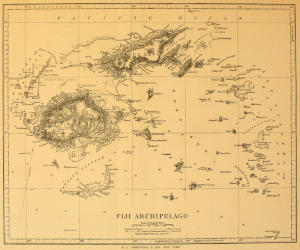
FIJI ARCHIPELAGO
A. C. ARMSTRONG & SON. NEW YORK.