Giants of the Ray
Reading edition
By Tom Curry
Madly the three raced for their lives up the shaft of the radium mine, for behind them poured a stream of hideous monsters—giants of the ray!

tell you I'm not crazy," insisted the tall man. "Durkin, they got a big mine."
Bill Durkin laughed roughly, and sneered openly at his partner, Frank Maget. "G'wan, you're drunk."
"Well, I was last night," admitted Maget. "But I'd slept it off this morning. I was lying under that table in the Portuguee's, and when I opened my eyes, there were these three birds sitting near me. They hadn't spotted me. I heard 'em talking of wealth, how their mine was of unbelievable richness and greater than any other deposit in the world. Well, that means something, don't it?"
"That's all right," said Durkin. "But whoever saw a cricket fifteen inches long?"
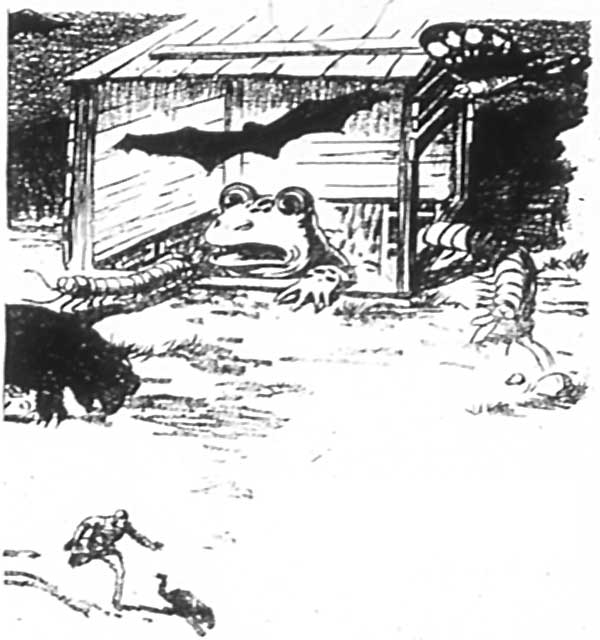
Its form was that of a gigantic frog, and from its throat sounded the terrific bellowing which rivaled thunder.
"Listen. There were three of these guys. One was a hell of a looking fellow: his face was piebald, with purple spots. His skin was bleached and withered, and one eye looked like a pearl collar button! They called him Professor, too, Professor Gurlone. Well, he takes out this damn cricket thing and it was sort of reddish purple but alive, and as long as your forearm. This professor guy says his son had taken an ordinary cricket and made it grow into the one he had. But the mine was what interested me. I kept my mouth shut and my ears open, and it's in the Matto Grosso. May be emeralds, diamonds, or gold. Boy, I'm heading for it, right now. The old guy's going back to-morrow, get me?"
"It's a lot of bunk," growled Durkin, who was stout and red of countenance.
"Yeh? Well, Otto Ulrich don't put fifty thousand into bunk."
Durkin whistled. "You mean the German loosened up that much?" he asked, and his eyes showed interest.
"Sure. He paid this Gurlone fifty thousand dollars—credit, of course."
"Well—maybe there's something in the mine story. But boy, you were drunk when you saw that cricket. No cricket ever grew that big. You always see things when you get too much rum in you."
"The hell you say," cried Maget. "I saw it, I tell you!"

urkin feigned elaborate politeness. "Oh, all right, Frank. Have it your own way. You saw a cricket that big and this Gurlone feller took a couple of pink elephants out of his pocket to pay the check. Sure, I believe you."
But money never failed to attract the two tropical tramps. They were looking for trouble, not work, and the idea of a raid on a rich mine in the Matto Grosso was just what they would enjoy.
An hour later, they had cornered a small, inoffensive peon named Juan. Juan, Maget and Durkin had discovered, had come out of the wilderness with Professor Gurlone, the strange looking gentleman who spoke of a fabulously wealthy mine and commanded checks for fifty thousand dollars from a reputable banking firm. Such a man was worth watching.
The two rascals were expert at pumping the little half-breed. They knew peons, and the first thing that happened was that Durkin had slipped Juan several dollars and had pressed a large glass of whiskey on the little man.
The conversation was in broken English and Spanish.
"Quien sabe?"
Durkin and Maget had this phrase flung at them often during the course of the talk with Juan, and there were many elaborate shrugs.
There was a mine, way back in the Matto Grosso, said Juan. He thought it might contain silver: there had been the shaft of an old mine there. But now they were deep down in the ground, digging out reddish brown ore, and the cavern smoked and smelled so badly a man could work but an hour or two before being relieved. But the pay was very high. Also, Juan, in his rambling way, spoke of grotesque animals. What were these creatures like? asked Durkin. Then came a shrug, and Juan said they were like nothing else on earth.
urkin discounted the part of the story having to do with the strange animals. He thought it was peon superstition. But now he was sure there was a rich mine to be raided.
"It's a tough part of the Grosso," he said, turning to Maget.
"Sure. Hard to carry enough water and supplies to make it. Say, Juan, who was that big Portuguee with Professor Gurlone? He's blind, ain't he? His eyes were white as milk, and his face tanned black as river mud. Surely is a great big guy, and tough looking, too."
Durkin drummed on the table, considering the matter, while Juan spoke of the big Portuguese. The swarthy man with the colorless blind eyes was Espinosa, former owner of the mine. He had sold part of his claim to the Gurlones, but had remained with them as an assistant. Though blind, he knew the depths of the mine and could feel his way about, and direct the peons in their labors.
"I've got it," said Durkin, turning back to Juan and Maget. "Juan, it's up to you. You've got to blaze the trail so we can follow you in. And you can steal food and cache it for use on the way, see? We'll come along a day or so after the Gurlones."
It took some persuading to make Juan consent to their plot, but the peon yielded at last to money and the promise of part of the spoils. "Maybe you can steal Gurlone's samples and they'll give us a line on what he's up to out there. Whether it's emeralds or diamonds or gold that they're taking out of the mine."
Juan was stupid and superstitious, like most of his fellows. He had obeyed orders, digging out the red ore, and that was all he knew. But prompted by the two tramps, he was ready for trouble, too.
Juan told them that Professor Gurlone carried a small lead case which he seemed to prize greatly.
"Get it, then," ordered Durkin.
The two tramps saw Gurlone's party start on the morrow. There were many cases of supplies loaded into launches, some marked Glass, Acids, and so on. Then there were boxes of food and various things needed in a jungle camp.

uan, their tool, was working with the other peons, and at ten o'clock in the morning the launches set out, pushing into the current of the Madeira.
Old Gurlone, of the livid face, was in charge of one boat, and the gigantic Portuguese, with his colorless eyes and burned complexion, sat beside him.
That night, the two tropical tramps stole a small boat with a one-cylinder motor, and started up the river.
It was a hard journey, but they were used to river and jungle work, and the object they had in view was enough to make them discount trouble. They speculated upon what manner of treasure it was they would find in the cavern of the Matto Grosso mine. It might be precious stones, it might be gold. Certainly it was something very valuable.
They carried little supplies, but they were heavily armed. For food, they might hunt and also depend on the caches left by their friend, Juan the peon.
Three hundred miles from Manaos, they came to the landing where old Gurlone had unloaded his boats. The two tramps drew their own craft up on shore a quarter of a mile away, keeping out of sight, and hid the boat in dense brush. Then they crept up the river bank, keeping out of sight of the boatmen, who were preparing for the return voyage, and cut into the jungle so as to strike the trail of the caravan ahead.
For several hours they followed the path easily. They found palm trees blazed with new marks, and these they were sure their friend Juan had left for them. But the trail was easy to keep without these. The supplies had been loaded on burros, which had been awaiting the boats.
That night, they camped beside a small stream. They were but twenty-four hours behind Professor Gurlone and his party, and the food Juan had cached for them was in good condition.

hey were up at daybreak, and pressed on, armed to the teeth and ready for a fight.
"What's that?" said Durkin, stopping so suddenly that Maget ran into him.
They had been walking at a swift pace along the jungle path, the giant trees forming a canopy overhead. Monkeys screamed at them, birds flitted a hundred feet above them in the roof of the forest.
The sun beat on the jungle top, but few rays lightened the gloom beneath.
From up ahead sounded a frightful scream, followed by a long drawn out wailing. Maget glanced at Durkin, and the latter shrugged, and pressed on. But he gripped his rifle tightly, for the cries were eery.
From time to time the two stopped to catch better the direction of the wails. At last, they located the spot where the injured person lay.
It was under a great bombax tree, and on the shaded ground writhed a man. The two stopped, horrified at the squirming figure. The man was tearing at his face with his nails, and his countenance was bloody with long scratches.
He cursed and moaned in Spanish, and Durkin, approaching closer, recognized Juan the peon.
"Hey, Juan, what the hell's the matter? A snake bite you?"
The bronzed face of the sturdy little peon writhed in agony. He screamed in answer, he could not talk coherently. He mumbled, he groaned, but they could not catch his words.
At his side lay a small lead container, and closer, as though he had dropped it after extracting it from its case, lay a tube some six inches in length. It was a queer tube, for it seemed to be filled with smoky, pallid worms of light that writhed even as Juan writhed.
"What's the trouble?" asked Durkin gruffly, for he was alarmed at the behavior of the peon. It seemed to both tramps that the man must have gone mad.
hey kept back from him, with ready guns. Juan shrieked, and it sounded as though he said he was burning up, in a great fire.
Suddenly the peon staggered to his feet; as he pushed himself up, his hands gripped the tube, and he clawed at his face.
Perplexity and horror were writ on the faces of the two tramps. Maget was struck with pity for the unfortunate peon, who seemed to be suffering the tortures of the damned. He was not a bad man, was Maget, but rather a weakling who had a run of bad luck and was under the thumb of Durkin, a really hard character. Durkin, while astounded at the actions of Juan, showed no pity.
Maget stepped forward, to try and comfort Juan; the peon struck out at him, and whirled around. But a few yards away was the bank of the stream, and Juan crashed into a black palm set with spines, caromed off it, and fell face downward into the water. The glass tube was smashed and the pieces fell into the stream.
"God, he must be blind," groaned Maget. "Poor guy, I've got to save him."
"The hell with him," growled Durkin. He grasped his partner's arm and stared curiously down at the dying peon.
"Let go, I'll pull him out," said Maget, trying to wrench away from Durkin.
"He's done for. Why worry about a peon?" said Durkin. "Look at those fish!"
The muddy waters of the stream had parted, and dead fish were rising about the body of Juan. But not about the dying man so much as close to the spot where the broken tube had fallen. White bellies up, the fish died as though by magic.
"Let's—let's get the hell back to Manoas, Bill," said Maget in a sickly voice. "This—this is too much for me."

nameless fear, which had been with Maget ever since the beginning of the venture, was growing more insistent.
"What?" cried Durkin. "Turn back now? The hell you say! That damn peon got into a fight with somebody and maybe got bit by a snake later. We'll go on and get that treasure."
"But—but what made those fish come up that way?" said Maget, his brows creased in perplexity.
Durkin shrugged. "What's the difference? We're O. K., ain't we?"
In spite of the stout man's bravado, it was evident that he, too, was disturbed at the strange happenings. He kept voicing aloud the question in his mind; what was in the queer tube?
But he forced Maget to go on. Without Juan, the peon, to leave them caches of food on the trail, they would have a difficult time getting provender, but both were trained jungle travelers and could find fruit and shoot enough game to keep them going.
Day after day they marched on, not far from the rear of the party before them. They took care to keep off Gurlone's heels, for they did not wish their presence to be discovered.
When they had been on the journey, which led them east, for four days, the two rascals came to a waterless plateau, which stretched before them in dry perspective. Before they came to the end of this, they knew what real thirst was, and their tongues were black in their mouths before they caught the curling smoke of fires in the valley where they knew the mine must be.
"That's the mine," gasped Durkin, pointing to the smoke.
he sun was setting in golden splendor at their backs; they crept forward, using great boulders and piles of reddish earth, strange to them, for cover. Finally they reached the trail which led to the hills overlooking the valley, and a panorama spread before them which amazed them because of its elaborateness.
It seemed more like a stage scene than a wilderness picture. Straight ahead of them, as they lay flat on their stomachs and peered at the big camp, yawned the black mouth of a large cavern. This, they were sure, was the mine itself. Close by this mouth stood a stone hut. It was clear that this building had something to do with the ore, perhaps a refining plant, Durkin suggested.
There were long barracks for the peons, inside a barbed wire enclosure, and they could see the little men lounging now about campfires, where frying food was being prepared. Also, there was a long, low building with many windows in it, and houses for supplies and for the use of the owners of the camp.
"Looks like they were ready in case of a fight," said Durkin at last. "That fence around the peons looks like they might be havin' trouble."
"Some camp," breathed Maget.
"We got to find somethin' to drink," said Durkin. "Come on."
They worked their way about the rim of the valley, and in doing so caught glimpses of Professor Gurlone, the elderly man they had spotted in Manaos, and also saw the big Portuguese with his sightless eyes.
At the other side of the valley, they came on a spring which flowed to the east and disappeared under ground farther down.
"Funny water, ain't it?" said Durkin, lying down on his stomach to suck up the milky water.
But they were not in any mood to be particular about the fluids they drank. The long dry march across the arid lands separating the camp from the rest of the world had taken all moisture from their throats.

aget, drinking beside his partner, saw that the water glinted and sparkled, though the sun was below the opposite rim of the valley. It seemed that greenish, silvery specks danced in the milky fluid.
"Boy, that's good," Durkin finally found time to say, "I feel like I could fight a wildcat."
The water did, indeed, impart a feeling of exhilaration to the two tramps. They crept up close to the roof of the parallel shaft which they had seen from the other side of the valley, and looked down into the camp again.
Professor Gurlone of the livid face and Espinosa the blind Portuguese, were talking to a big man whose golden beard shone in the last rays of the sun.
"That's the old bird's son," said Durkin, "that Juan told us about. Young Gurlone."
A rumbling, pleasant laugh floated on the breeze, issuing from the big youth's throat. The wind was their way, now, and the valley breathed forth an unpleasant odor of chemicals and tainted meat.
"Funny place," said Maget. "Say, I got a hell of a headache, Bill."
"So've I," grunted Durkin. "Maybe that water ain't as good as it seemed at first."
hey lay in a small hollow, watching the activity of the camp. The peons were in their pen, and it was evident that they were being watched by the owners of the camp.
As purple twilight fell across the strange land, the two tramps began to notice the dull sounds which came to their ears from time to time.
"That's funny thunder," said Maget nervously. "If I didn't know it was thunder, I'd swear some big frogs were around here."
"Oh, hell. Maybe it's an earthquake," said Durkin irritatedly. "For God's sake, quit your bellyachin'. You've done nothin' but whine ever since we left Juan."
"Well, who could blame me—" began Maget. He broke off suddenly, the pique in his voice turned to a quiver of fear, as he grasped Durkin's arm. "Oh, look," he gasped.
Durkin, seeing his partner's eyes staring at a point directly behind him, leaped up and scrambled away, thinking that a snake must be about to strike him.
He turned round when he felt he was far enough away, and saw that the ground was moving near the spot where he had been lying.
The earth was heaving, as though ploughed by a giant share; a blunt, purplish head, which seemed too fearful to be really alive, showed through the broken ground, and a worm began to draw its purple length from the depths. It was no snake, but a gigantic angleworm, and as it came forth, foot after foot, the two watched with glazed eyes.
Maget swallowed. "I've seen 'em two feet long," he said. "But never like that."
Durkin, however, when he realized that the loathsome creature could not see them and was creeping blindly towards them with its ugly, fat body creasing and elongating, picked up rocks and began to destroy the monstrous worm. He cursed as he worked.
Dull red blood spattered them, and a fetid odor from the gashes caused them to retch, but they finally cut the thing in two, and then they moved away from there.
he dull rumblings beneath them frightened Maget, and Durkin too, though the latter tried to brazen it out.
"Come on, it's gettin' dark. We can take a look in their mine now."
Maget, whimpering, followed. The booming sounds were increasing.
But Durkin slipped down the hillside, and Maget followed into the valley. They crept past the stone shack, which they noticed was padlocked heavily.
Durkin stopped suddenly, and cursed. "I've cut my foot," he said. "These damn shoes are gone, all right, from that march. But come on, never mind."
They crept to the mouth of the cavern and peered in. "Ugh," said Maget.
He drew back with a shudder. The floor of the mine was covered with a grey slush, in which were seething white masses of slugs weaving in the slime. A powerful, rotten odor breathed in their faces, as though they stood in the mouth of a great giant.
"Ah!" yelled Durkin, throwing his arms across his face.
The greenish, ghostly light which emanated from the slime was weaker than moonlight, just enough to see by; a vast shadow hovered above their heads, as though a gigantic bat flew there. The sweep and beat of great wings drove them back, and they fled in terror from such awful corruption.
But the flying monster, with a wing spread of eight feet, dashed past them, and silhouetted against the rising moon like a goblin. Then came another, and finally a flock of the big birds.
Durkin and Maget ran away, passing the stone house which stood near the cavern's mouth. The booming sounds from the bowels of the earth filled their ears now, and it was not thunder; no, it issued from the depths of the mine.
"We—we got to get somethin' to eat," said Durkin, as they paused near one of the shacks, in which shone a light.

ounds of voices came from the interior. They crept closer, and listened outside the window. Inside, they could see Espinosa, Gurlone senior, and the big youth with the golden beard, Gurlone junior.
"Yes, father," the young man was saying. "I believe we had better leave, at once. It's getting dangerous. I've reached the five million mark now, with the new process, and it is ready to work with or sell, just as we wish."
"Hear that?" whispered Durkin triumphantly. "Five million!"
"It's all ready, in the stone house," said young Gurlone.
"Why should we leave now?" said old Gurlone, his livid face working. "Now, when we are just at the point of success in our great experiments? So far, while we have struck many creatures of abnormal growth, still, we have overcome them."
"Well, father, there is something in the mine now which makes it too dangerous to work. That is, until they are put out of the way. You can hear them now."
The three inside the shack listened, and so did Durkin and Maget. The booming sounds swelled louder and the earth of the valley shook.
"I t'ink we better go," said Espinosa gruffly. "I agree with your son, Professor."
"No, no. We can conquer this, what ever it is."
"You see, father, while you were away, we broke through into a natural cavern, an underground river. It was then that the trouble started. You know the effect of the stuff on the insects and birds. It enlarged a cricket one hundred times. You saw that yourself. Six of the peons have disappeared—they didn't run away, either. They went down the shaft and never came back."
"Oh, they probably fell into the water and drowned," said old Gurlone impatiently. "Even if they did not, we can kill anything with these large bore rifles."
"We'd better pull out and let it alone for a while," said young Gurlone gravely. "The peons have been trying to bolt for several days. They'd be gone now if I hadn't penned them in and electrified the fence."
aget put his hand on his friend's shoulder. "I'm starving," he whispered.
Durkin nodded, and they turned away, toward what they had marked as a supply shack. They heard a low murmur from the peons' pen, as they began to break off the hasps of the lock which held the door of the storehouse.
They got inside with little trouble, and began to feel about in the dark for food. They located biscuits and canned goods which they split open, and these they wolfed hungrily, listening carefully for sounds from outside.
"Here they come," said Maget, gripping Durkin's arm.
They looked out the window of the supply shack, and saw old Gurlone issue from the building outside which the two tramps had been listening. In one hand, the old Professor, brave as a lion, carried an old fashioned double-barreled elephant gun, and the rays from a powerful electric torch shone across the barrel.
At least, they thought the bizarre figure was old Gurlone, from the size. For the man was clad in a black, shiny suit, and over his head was a flapping hood of the same material in which were large eyeholes of green glass. Behind this strange form came a larger one, armed also with a big bore rifle and with another powerful flashlight.
The blind Portuguese was armed, too, but he was not clad in the black suit. He took his stand beside the mouth of the cavern, and waited while the two Gurlones entered the mine.
"My foot hurts," said Durkin suddenly, breaking the silence.
"I'm going out and see what happens," said Maget.
urkin limped after Maget, who now took the lead. They crept close as possible to the mine opening, and saw the big Portuguese standing there in silence, listening carefully. Any sounds the two might have made were drowned in the great bellowing from within the cavern.
These noises, so like the croak of bullfrogs but magnified a thousand times, were terrifying to the heart.
The sweep of wings sounded on the night air, and Espinosa drew back and squatted close to the ground, as immense green creatures, flying on dusty wings, issued from the mine.
"God, those are moths," breathed Maget.
Yes, unmistakably, they were moths, as large as condors. The green ones, but for their size, were lunar moths, familiar enough to the two tramps. More bats came, disturbed by the entrance of the two Gurlones.
Durkin broke, then. "I'm—I'm—I guess you're right, Maget," he whispered, in a terrified voice. "We should have never come. If my foot wasn't hurt, I'd start for the river now. Curse it, what a place!"
The booming, vast croaks filled the whole valley, reverberating through the hills. Wails sounded from the peon camp.
The big Portuguese was shouting to the Gurlones. "Come out, come out!"
Maget gripped his own rifle, and stood up, bravely. His fear, though it was great, seemed to have brought out the better side of the man, while Durkin, so brave at first, had cracked under the strain.
"Look out, they'll see you," whimpered Durkin.
Maget strode forward. A blast of fetid, stinking air struck his face, and he choked. The noises were now ear-splitting, but above the bellows came the sounds of the big rifles, the echoes booming through the recesses of the cavern.
Then the two Gurlones, running madly, burst from the mine entrance.
"Run," they screamed. "Run for your life, Espinosa!"
"I'll help you," cried Maget, and Durkin could detain him no longer.
he Gurlones hardly noticed the newcomer, as they ran madly towards the shelter of their houses. Espinosa joined them, going swiftly in spite of his blind eyes.
The croaking made Maget's brain scream with the immensity of the sound. Luminous, white disks, three feet in diameter, glared at him, and the creature, which progressed with jerky leaps toward him, almost filled the mouth of the mine.
It was hot in pursuit of the fleeing Gurlones. It squatted and then jumped, and presently it was out in the night air.
Its form was that of a gigantic frog, but it stood some twenty feet in height, and from its throat sounded the terrific bellowing which rivalled the thunder.
Maget bravely stepped forward, and began to fire into the huge, soft body. The great mouth opened, and as the dum-dum bullets tore gashes in the blackish green batrachian, the thunderous croaks took on a note of pain.
The odor of the creature was horrible. Maget could scarcely draw his breath as he fired the contents of the magazine into the big animal. Two more jumps brought the frog almost to Maget's feet, and the tropical tramp felt a whiskerlike tentacle touch his face, and bad smelling slime covered him.
The frog was blind, without doubt, from its underground life, but the tentacles seemed to be the way it finally located its prey, for it turned on Maget and made a final snap at him. The great jaws closed like the flap of hell, and Maget leaped back with a cry of triumphant terror.
he bullets had finally stopped the big frog, but at its heels came a strange, jellylike creature, not quite as bulky as the frog, but pushing along on its legs and with a tail some eight feet thick and fifteen feet in length. This, too, evidently a polywog, was blind, with whitened discs for eyes, but it slid along at a rapid rate because of its size. Maget's gun was empty; he turned so flee, but the polywog stopped and sniffed at the thick blood of its fellow. Then, to Maget's relief, it began to hungrily devour its companion.
Utterly filthy, and ferocious, the polywog in silence snapped great chunks from the dead giant frog.
"Hello. Who are you?"
Maget turned, having forgotten the amenities of life in the excitement. Professor Gurlone and his son, still clad in their black suits, but with their helmets off, were standing beside him, clutching their guns and lights.
The big Portuguese, Espinosa, appeared, and Durkin was beside him.
"Why," said Maget, between gasps, "we just happened to be out exploring, and we saw your camp. We were on our way in when we heard the noises and came to investigate."
"I see," said old Gurlone. "What made you head in this direction, and where's your outfit?"
"Oh, we cached most of it back there," said Maget. "My partner's hurt his foot, so he can't walk well. Isn't that so, Durkin?"
"Yeh," growled Durkin. "I got a sore foot, all right."

ld Gurlone was suspicious of the vague story which Maget and Durkin concocted as the explanation of their presence in the valley. But evidently the Professor was too worried about the situation in which he and his friends were, to question the two tramps very closely. In fact, he seemed rather glad that he had two more pairs of hands to aid him and he thanked Maget for his bravery.
They dispatched the great polywog as it tore its parent to bits, and then the five men, the two Gurlones, Espinoza, Maget, and the limping, cursing Durkin, retired to one of the shacks.
The living quarters of the Gurlones was quite elaborate. There were many books on rough shelves, and there was a small bench filled with glass phials and chemicals, though the main laboratory was in one of the long buildings.
Professor Gurlone poured drinks for the five, and welcomed Durkin and Maget as allies.
"We'll need every man we can get, if we are to cope with these great creatures," said old Gurlone. "The peons are too frightened to be of use. Luckily, it was a frog we came upon on the banks of the subterranean river. There is no telling how many more creatures of the same or greater size may be down there. We will have to destroy them, every one."
Maget and Durkin shuddered. "Say," blurted Durkin, his face working nervously, "how the hell did that frog get so big? I thought I was seein' things, Professor."
"No, no," said Professor Gurlone. "You see, the ore in the mine contains radium, that is, salts of radium. It is a pitchblende deposit, and it happens to be so rich in radium content that throughout the ages it has affected all the life in the cavern. The arid land surrounding the ore—this has been, generally, one of the characteristics of radium deposits—has kept most of the jungle creatures away, but underground beings such as reptiles, worms and frogs, have gradually become immune to the effects of the ore and have grown prodigiously and abnormally under the stimulation of the rays given off by the radium.
"Now, this is nothing strange in itself, but never before has such a rich deposit been discovered, so that the amounts of radium available have been too small to really check its effect on growth in animals. That is our chief scientific object in coming here: we realized, from Senor Espinosa's description of the played-out silver mine he had, and from his loss of sight, that he had stumbled upon a valuable deposit of radium. It usually occurs with silver, that is, the uranium mother ore does, through the disintegration of which radium is formed. The content of radium per ton in this ore proved unbelievably rich: we were delighted. I have always suspected that the animal cell might be stimulated into abnormal growth by exposure to radium salts, for such a thing already has been hinted at in the scientific world. Not till our chance came here, however, has enough radium been available for the experiments."
aget and Durkin listened with open mouths. Radium meant but vague things to them. They had heard of radium paint which shone in the dark on the dials of watches and clothes, but of the properties of the metal and its salts they were utterly ignorant.
"That radium stuff is what makes the funny light in that mine, then?" asked Maget.
"Exactly. The radio-activity of the elements in the ore give off the light. There are three rays, the alpha, beta and gamma, and—"
The professor forgot himself in a lecture on the properties of radium.
Durkin, breaking in, asked, slyly. "Is this radium worth as much as silver?"
Young Kenneth Gurlone laughed, and even old Professor Gurlone smiled. "Radium is worth more than gold or diamonds or platinum. Its value is fabulous. We have five million dollars worth already, in the form of the chloride."
"Whew," whistled Durkin.
He glanced sidewise at Maget.
"Yes," said Professor Gurlone, "five million dollars worth of it! Those great monsters who have been developed throughout the ages by the action of the radium rays on their bodies, causing them to grow so prodigiously, are but incidents. We must destroy them, so that our work cannot be interfered with. We must use dynamite, blow them to bits. They are powerful enough to crush the stone bank by the mine mouth and ruin the labors of the past two years, gentlemen."
Armed, and once more fortified with whiskey, the five made their way outside. The moon was darkened by an immense shadow, as one of the giant bats winged its way over their heads. But there were no more monster frogs. The ugly, bulky shapes of the dead polywog and its parent lay before them.
"We are safe for the moment," said Professor Gurlone. "Go and quiet the peons, Espinosa: they will listen to you."
he peons still wailed in terror; the blind Espinosa slipped silently away.
"Come," said Professor Gurlone, to his son and to Maget and Durkin. "I will show you the laboratory, so that you can understand better the effects of radium on growth."
The professor led them to the long, low, many-windowed building nearby, and flooded it with light. It contained cage after cage in which were monkeys, pumas, and various jungle folk. These creatures set up a chattering and howling at the light and intruders.
Maget glanced curiously about him. He saw shining vials and glassware of queer shapes on long black tables, and tubes of chemicals. There were immense screens of dull lead. "Those are for protection," said Professor Gurlone, "as are the lead-cloth suits we wear. Otherwise we would be burned by radium rays."
Maget looked about, to see if his partner was listening, but he had gone away.
However, Maget was intensely interested. He went from cage to cage as Professor Gurlone, rather in the manner of a man giving a lecture to students, pointed out animal after animal that had been treated by the radium.
"This," said the professor, "is a monkey which usually attains a height of two feet. You can see for yourself that it is now larger than a gorilla."
he horrible, malformed creature bared its teeth and shook its bars in rage, but it was weak, evidently, from the treatment accorded it. Its hair was burned off in spots, and its eyes were almost white.
There was a jaguar, and this beast seemed to have burst its skin in its effort to grow as large as three of its kind.
"You see, we have not so much time as nature," said Professor Gurlone. "These beasts cannot be enlarged too rapidly, or they would die. They must be protected from the direct rays of the radium, which is refined. In the ore, the action is more gradual and gentle, since it is less concentrated. But the metal itself would burn the vital organs out of these creatures, cause them to be struck blind, shrivel them up inside and kill them in a few minutes in the quantity we have. We expose them bit by bit, allowing more and more time as they begin to grow immune to the rays. Here, you see, are smaller creatures which have grown some eight or ten times beyond normal size."
All the animals seemed the worse for wear. Maget, his brain reeling, yet was beginning to grasp what radium did to one. It was not gold that you could pick up and carry away.
"If a man touched that radium," he asked, "what would happen to him?"
"Just what I said would happen to the animals if we did not give it to them gradually," said Gurlone, with a wave of his hand. "It would kill him, strike him down as though by invisible poison gas. His heart and lungs would cease to function, pernicious anemia would set in, as the red corpuscles in his blood perished by millions. He would be struck blind, fall down and die in agony."
To Maget came the picture of the unfortunate Juan. As though answering his unasked question, Professor Gurlone went on. "We had a peon coming up with us," he said. "His name was Juan. He stole my sample-case, which contained an ounce of radium chloride, and ran off with it. If he opens it, it will kill him in just that way."
aget shivered. "But—but didn't it hurt you to carry it?" he asked.
"No. For it was incased in a lead container some two inches in thickness, and the rays cannot penetrate such a depth of lead. They are trapped in the metal."
"Father, father, you're wasting time," broke in Kenneth Gurlone, shaking his yellow head. "We must act at once. The peons are almost mad with fear. Even Espinosa cannot quiet them. And every moment is precious, for the monsters may break forth."
But Maget was looking nervously about for Durkin. Where was he? Durkin had his mind on the treasure, and—
As they turned toward the door, the professor saying. "The rays from the ore, which is not so concentrated as the purified metal, do not kill—" Durkin suddenly appeared.
He carried his rifle at his hip, and he limped and cursed angrily. "Come across," shouted Durkin. "Give me the key to that stone house. Snap into it, and no argument."
"The key—to the stone bank?" repeated old Gurlone.
"Yes. I'll give you five counts to throw it over—then I'll shoot you and take it," snarled Durkin savagely. "I want that treasure, whatever it is, and I'll have it. One ... two ... three...." The tramp sent a shot over their heads as a warning.
"Hey, Bill, easy, easy," pleaded Maget. "That stuff is radium. It'll ruin you, boy!"
"Shut up, you yeller-bellied bum," snarled Durkin. "Four...."
A tinkle of metal came on the stone floor of the laboratory, as old Gurlone tossed his keys to Durkin.
"Don't go in that shack," cried young Gurlone. "It'll be your death, man—"
"Liars," yelled Durkin, and backed out the door.
"H'm," said old Gurlone, turning to Maget. "So you came to rob us, eh?"

ut Maget thought of Juan, and then he knew he did not want Durkin, in spite of his failings, to perish so. He ran for the door, and across the clearing.
"Durkin—Bill—wait, it's Frank—"
Great bellowings sounded from the bowels of the earth, but Maget ignored these in his effort to save his partner. Durkin had the padlock off the stone shack, and pulled back the door.
As the door disclosed the interior, Maget could see that a greenish haze filled the entire building. Wan liquid light streamed forth like heavy fluid.
Bravely, to save his pal from death, Maget ran forward. But Durkin had entered the stone shack.
Maget went to the very door of the building. Durkin was inside, and Maget could see his partner's thick form as a black object in the strange, thick air.
An eery scream came suddenly from Durkin's lips; Maget wrung his hands and called for help.
"Come out, Bill, come out," he cried.
Durkin evidently tried to obey, for he turned toward the door. But his knees seemed to give way beneath him, he threw his arm across his eyes as he sank to the ground, crying in agony, incoherent sounds issuing from his lips.
Shriek after shriek the unfortunate man uttered. As Maget made a dash forward to take a chance with death and rescue his friend, Professor Gurlone and his son Kenneth ran up and threw a black cloak over the tramp.
The three entered the shack of death. Maget, not entirely covered, felt his heart give a terrific jump, and he gasped for breath. Durkin was quivering on the floor which was lined with lead.

ound vials stood about the room like a battery of search-lights, and from these emanated the deadly green haze.
But almost before Maget touched his pal, Durkin was dead. Curled up as though sewed together by heavy cords. Durkin lay in a ball, a shaking mass of burned flesh.
The two Gurlones pushed out ahead of them, and raised their hands. They had on their black suits and their helmets.
"It is too late to do anything for him now," said Kenneth Gurlone sadly. "He was headstrong. You can see for yourself that the five million dollars takes care of itself. Certain death goes with it if you are unprotected. These lead-cloth suits will keep off the rays for a short time. We always wear them when we are working with the metal, even when we have a lead screen."
"Poor Bill," sobbed Maget. "It's terrible!"
Professor Gurlone shrugged. "It was his own fault. He was a thief and he would not let us stop him. I hope it's been a lesson to you, Maget."
"Yes, I want to help you," said Maget. "If you'll keep me with you, I'll work for you and be straight. Give me a chance."
"Good. Then shake hands on it," said Kenneth, and they clasped hands firmly.
Espinosa appeared from the darkness. "The peons are mad with terror," he said morosely. "They cannot be held much longer. They will revolt."
"Well, we must kill the creatures in the cavern: that will quiet them more than anything else," said Professor Gurlone.
"Better close the stone shack," said Kenneth.
But as he spoke, a vast shape, another giant frog, appeared in the entrance of the shaft.
"Get some dynamite and fuses," ordered Professor Gurlone quietly. "Come on Kenneth, and you, Maget, if you care to risk your life. You need not do so unless you wish to."
Bravely, the older man led the way towards the croaking monster. The ground shook at its approach. It was heading for the bodies of the dead frog and polywog, bent on a search for food. Evidently these vast creatures were forced to prey upon one another for sustenance.
he rifles spoke, and Maget and the professor, in their black suits, protected by the lead-cloth and helmets from the rays, advanced. They poured bullet after bullet into the frog.
Kenneth came running to join them, and Espinosa stood by. Kenneth had dynamite bombs with fuses ready for lighting and throwing. He also brought more ammunition, and the three armed themselves to the teeth.
It was well after midnight when they started into the mine. They knew they must act quickly or retreat, for the bellowing sounded nearer and nearer the surface of the earth.
Each man carried big, powerful flashlights, and the three entered the mine shaft and walked across the seething slugs into the bowels of the earth.
"Stay close together," ordered old Gurlone.
The mine was easy to descend for the first hundred yards. It led in a gentle slope downward. The way, save for a few giant bats and moths, and the big maggots, was clear. The greenish haze, not so bright as that in the death shack, enveloped them, but they needed their flashes to see clearly.
"Slowly, take it easy," counseled old Gurlone.
The mine spread out now, and began a steeper descent. The air was poor, and it was hard to breathe through the mask. Maget, his heart thumping mightily, listened to the roaring within the depths of the mine.
Now the ground seemed to drop away before them. Maget could hear the running of water, the underground river, and every now and then there came an immense splash, as if some great whale had thrown itself about in the water.
A terrifically loud hissing filled their ears, and suddenly, before them, showed an utterly white snake with a head as big as a barrel. Its white eyes glared sightlessly, but its tongue stuck forth for several feet.
Kenneth Gurlone coolly tossed a lighted bomb at the creature: the explosion shattered their ear-drums, but it also smashed the serpent.
he writhing, wriggling coils, bigger than the body of a horse, slashed about, dangerously near. They picked themselves up, and pushed on, keeping close to the right wall.
A great bat smashed against Maget, and knocked the light out of his hand, but the blow was a glancing one, and he was able to retrieve his light and hurry on.
They were far from the entrance now. The hole which had been broken through by the peons showed before them, and they could see milky water dashing over black rocks.
Pallid eyes looked at them, and they knew they gazed upon another of the giant frogs. They tossed a bomb at the creature, and blew a jagged hole in his back. No sooner had he begun to die than there came a sudden rush of other monsters and a feast began.
"Throw, all together," yelled Kenneth Gurlone.
Into the vast mass of creatures, who crowded one another in the river for their share of the spoils, they threw bomb after bomb. The dynamite deafened them, and acrid fumes choked them, but they fired their rifles at the prodigious animals and there, in the big river cavern, was a seething mass of horrible life, dying in agony.
The bellowings and hissings sounded louder, so loud that the earth shook as if actuated by a mighty earthquake.
Maget gripped Kenneth Gurlone's arm. "My bombs are gone," he shouted.
He had but a few rounds of ammunition left, and still more of the giant reptiles appeared. A centipede with its creeping, horrible legs topped the mass of squirming matter; they could see the terrific sting of the creature, so deadly when but a fraction of an inch long, and which was now at least a foot, armed with poison.
There came the rush of more bats and moths, a rush that threw the three men off their feet.
"We must have opened the hole more with our bombs," shrieked old Gurlone. "The dead bodies attract the other creatures, more and more of them are coming. It is impossible; we cannot deal with them all."
he vast gobbling of the great animals in the river below them was so prodigious they could not grasp it. It seemed it must be optical illusion. In a few moments, the dead had been eaten, swallowed whole, and fights were progressing between the victors.
They tossed the rest of their bombs, fired the remaining ammunition, and as they prepared to retreat, several of the big creatures slopped over and started up the river bank into the mine shaft.
They ran for their lives, the three. Madly, with the earth shaking behind them as they were pursued by a hopping monster of a beetle with immense mandibles reaching out at them, they dashed for the open air.
Giant moths and bats struck at them, and Maget fell down several times before he reached the outside, and he was bruised and out of breath.
"Come on, there are too many to fight," gasped old Gurlone, throwing off the lead suit.
But there was no need to talk. The creatures, disturbed by the bombs, had collected in one spot and, shown the way out by one of their number, were coming.
Espinosa, with Kenneth Gurlone holding his hand, ran swiftly for the hills surrounding the valley. Maget helped old Professor Gurlone, who was so out of breath that he could scarcely move.
The great beetle which had been pursuing them was the first to break forth into the valley. Turning back for a look over his shoulder, Maget saw the thing pause, but the cavern belched forth a vast array of monsters, the beasts roaring, hissing, bellowing, in an increasing mass of sound.
They swarmed over the ground, and giant bats and moths winged their way about the heads of the monsters.
At the rim of the valley, the four men paused.
"God help the peons," said Kenneth Gurlone.

ow the horde of monsters swelled more and more; the bats and moths winged in mad frenzy about the open door of the radium shack. There were great beetles, centipedes, ants, crickets, hopping, crawling things, and grotesquely immense in size. Fights progressed here and there, but the majority of them were carried along in the sweep of the multitude.
"See, the radium kills those who get too close," said Professor Gurlone, in a hushed voice.
The giant moths and bats were unable to withstand the lure of the green light. They flew with mad beatings of wings straight for the open door of the death house, and many of the great creatures, attracted by the light and urged on by an unexplainable force which sent them to death like gnats and moths in a flame, crowded near to the death-dealing radium.
Not until the whole shack was covered with quivering forms of the dead, did the other creatures veer off and with hops, creepings and myriad giant legs, begin to cover the whole valley.
The stone walls of the death shack had crumpled in with the weight; the other buildings, more lightly built, gave at once, with crackings and crashings.
The four men were powerless to assist the unfortunate peons, who were trapped in their barracks. The charged wires stopped many of the big beasts, but soon the electric light was short-circuited, and the valley, in the moonlight, was a seething mass of fighting, dying, feasting monsters.
ther sounds, besides those made by the big creatures, came to the ears of the stricken men on the hillside. The breaking of glass, the cries of the jungle animals trapped in their cages, the shrieks of dying peons who were eaten at a gulp by the big frogs or stung to death, impaled on the mandibles of some great stinging centipede.
In the spot where the radium death shack had been, was a pulpy mass of livid, smoky light.
Now the bowl of the valley was filled as by some vast jelly. The creatures were slopping over the walls, and battling together.
The shambles was not yet over, but the four could remain no longer. They made their way down the hillside and struck out across the arid lands.
Maget, the tramp, became the leader. He was a trained jungle man, and it was he who finally brought them safely to the Madeira.
He was their strong man, the one who found the trail and located roots and fruit for the party to subsist on. They nearly perished in the trip for lack of water, but again, Maget was able to supply them with roots which kept them from dying in agony.
hey lay upon the river bank now, exhausted but alive. Maget had assisted old Gurlone, acted as his staff, half carried him the last miles of the trip.
Their clothes were almost gone, they were burned to crisps by the tropic sun. Flies and other insects had taken their toll. But Maget had brought them through.
The tall, thin fellow's hair had turned utterly white. But so had his soul.
"You're a good man, Maget," said Professor Gurlone. "You have saved us, and you have been brave as a lion."
Maget shook his head. "Professor," he said. "I came into the jungle to rob you. Durkin and I bribed Juan to steal that radium, and I feel responsible for his death. We thought you had diamonds or gold in the Matto Grosso, and we were after it. That's why I am here."
"You have repaid your debt to us, more than fully," said Kenneth, holding out his hand.
"Yes," said Espinosa.
"Will you keep me with you, then?" asked Maget anxiously. "Are—will you go back there?"

rofessor Gurlone stared at him, and then said, in a surprised tone, "Why, of course!"
"But the monsters?" asked Maget.
"Many of them will die in the outer air," said Gurlone. "The survivors of the battles will start eating the dead. They will finally clear away the debris of dead creatures about the radium shack. As each is exposed to the rays of the concentrated metal, it will die. The others will eat it, and be killed in turn. Thus, they will be destroyed. If there are any survivors after this evident turn of events, then we will cope with them when we return, reinforced. Dynamite, enough of it, will finish them off. And, Maget, in your next pursuit after knowledge of strange things, you may get a few earthly riches. The radium is still there, and you will share in it."
"Thank you," said Maget humbly. "I'm with you to the end."
"You must keep quiet about this," cautioned Kenneth Gurlone. "We do not want the world to know too much of our vast store of radium. It would attract adventurers and we would be annoyed by ignorant men. But we're thankful you lay drunk in that saloon when my father spoke of the millions, Maget."
In Manzos, Maget found himself a changed man. To his surprise, in spite of his white hair, brought on by the horror of what he had seen, he found that he had gained two inches in height, and that he was larger of girth. This, Professor Gurlone told him, was the effect of the radium rays.
Never again did Maget lie drunk on the floor of a saloon. The events through which he had gone had seared the tramp's soul, and he kept close to his new master, Professor Gurlone.
The Moon Master
By Charles W. Diffin

ow that's a mighty queer noise." Jerry Foster told himself. He dropped the pack from his shoulders and leaned closer to the canyon rim.
Through infinite deeps of space Jerry Foster hurtles to the Moon—only to be trapped by a barbaric race and offered as a living sacrifice to Oong, their loathsome, hypnotic god.
Miles behind him was the last beaten trail: Jerry wanted peace and solitude and quiet. And now the quiet of the silent mountains was disturbed.
From far below came a steady, muffled roar. Faint it was, and distant, but peculiar in its unvarying, unceasing rush.
"Not water," Jerry concluded; "not enough down there. Sounds like—like a wind—like a wind that can't quit.
"Oh well—" He shrugged his shoulders and slipped into the straps of his pack. Then he went back again to the granite ledge. "I wonder if there's a way down," he said.
There was, but it took all of Jerry's strength to see him safely through. On a fan-shaped talus of spreading boulders he stopped. There was a limestone wall beyond. And at its base, from a crevice that was almost a cave, came a furious rush of air and steam.
It touched him lightly a hundred feet away, and he threw himself flat to escape the hot blast. Endlessly it came, with its soft, rushing roar, a ceaseless, scorching blast from the cold rocks.
"That's almighty funny," mused Foster, and sniffed the air. There was no odor.
"And is it hot!" he said. "Nothing like that in my geology book. And what is beyond? Looks like concrete work, as if someone had plastered up the cave." He picked his way quickly across the rock slope.
It was hard going. Below him the rocks and dirt went steep to the canyon floor. At its foot the blast swept diagonally over the slope. He must see what lay beyond....
"Curious," he thought; "curious if that is nature's work—and a lot more so if it isn't."
A rock rolled beneath his feet. Another! He scrambled and fought desperately for foothold in the slipping earth. Then, rolling and clawing, he rode helpless on the slide straight toward the mysterious blast. He felt it envelop him, hot and strangling. His lungs were dry and burning ... the blazing sun faded from the rocks ... the world was dark....
arkness was still about him when he awoke. But it was cool; the air was sweet on his lips. And it was not entirely dark.
He turned his head. He was in a room. On a rough-hewn table a candle was burning. Its light cast flickering shadows on walls of stone. Rumbling in his ears was the sound of the blast that had overwhelmed him. It echoed, seemingly, from far back in the stone cliff.
Jerry made a move to sit up. He found that his hands and feet were tied, his body bound to the rough board bed.
At the sound of his stirring, a figure came out from the farther shadow. It was that of a man. Jerry looked at him in silence. He was tall, his thin erectness making him seem abnormal in the low room. The lean face was unshaven, and from under a thatch of black hair a pair of deep-set eyes stared penetratingly at the figure on the rude bed.
"Well," asked Jerry, at length, "what's the big idea?"
There was no reply. Only the intent, staring eyes.
"You got me out of that man-trap of yours," Jerry continued. "You saved my life."
he tall man finally spoke. "Yes, I saved your life. You missed the hottest part of the exhaust. I pumped you full of oxygen."
"Then why tie me up like this?" Jerry Foster was frankly puzzled.
"You are lucky to be alive. Spies are not always allowed—" He interrupted himself abruptly. "You are a reporter," he stated.
"Wrong," said Jerry Foster.
"Who sent you?"
"Nobody sent me. I heard the noise of your infernal blast-furnace and came down to have a look."
"Who sent you?" repeated the man. "Goodwin? The Stillwater crowd? Who was it?"
"I don't know what you are talking about," protested Jerry. "I don't know who your Goodwin or Stillwater people are. I don't know who you are—I don't give a damn. Take these ropes off and cut out the melodrama. I'll go on my way, and I don't care if I never see you again."
"That's a lie." The tall figure leaned over to shake a bony fist. "You'd report to Goodwin. He stole my last invention. He'll not get this."
Jerry considered the wild figure carefully. "He's a nut," he thought. When he spoke, his voice was controlled.
"Now, see here," he said: "I don't know anything about this. I'm Jerry Foster, live in San Francisco—"
"So does Goodwin."
"Confound you and your Goodwin! So do a million other people live there! I'm getting away from there; I'm heading into the hills for a short vacation. All I want is to get away from the world. I'm looking for a little peace and quiet."
he thin man interrupted with a harsh laugh.
"Come here spying," he said, "and tell me you want to get away from the world." Again he laughed shrilly.
"And I am going to be your little fairy godmother. I wish you were Goodwin himself! I wish I had him here. But you'll get your wish—you'll get your wish. You'll leave the world, you shall, indeed."
He rocked back and forth with appreciation of his humor.
"Didn't know I was all ready to leave, did you? All packed and ready to go. Supplies all stowed away; enough energy stored to carry me millions of miles. Or maybe you did know—maybe there are others coming...." He hurried across the room to open a heavy door of split logs in the rock wall.
"I'll fool them all this time," he said; "and you'll never go back to tell them." The door closed behind him.
"Crazy as a bed-bug," Jerry told himself. He strained frantically at the ropes that bound him. "Looks bad for me: the old bird said I'd never go back. Well, what if I die now ... or six months from now? Though I know that doctor was wrong."
He tried to accept his fate philosophically, but the will to live was strong. And one of his wrists felt looser in its bonds.
cross the room his pack lay on the floor, and in it was a heavy forty-five. If he could get the pistol.... A knot pulled loose under his twisting fingers. One hand was free. He worked feverishly at the other wrist.
The ropes were suddenly loose. He pulled himself to his feet, took a moment to regain control of cramped muscles, then flung himself at the pack. When the heavy door opened he was behind it, his pistol in his hand.
There was no struggle: the lanky figure showed no maniacal fury. Instead, the man did a surprising thing. He sank weakly upon the rough bunk where Jerry had lain, his face buried in his thin hands.
"I should have let you die," he said slowly, hopelessly. "I should have let you die. But I couldn't do that.... And now you'll steal my invention for Goodwin."
Jerry was as exasperated as he was amazed.
"I told you," he almost shouted. "I never knew anyone named Goodwin! I don't care a hoot about your invention. And as for letting me die—why didn't you? That's a puzzle: you were about to kill me, anyway."
"No," said the other patiently. "I wasn't going to kill you."
"You said I'd never go back."
"I was going to take you with me."
"Take me where?"
"To the moon," said the drooping figure.
Jerry Foster stared, open-mouthed. The pistol lagged in his limp hand. "To the moon!" he gasped.
Then: "See here," he said firmly. "I've got you where I want you."—he held the pistol steady—"and now I'm going to learn what's back of this. I think you are crazy, absolutely crazy. But, tell me, who are you? What do you think you're doing? What was the meaning of that roaring blast?"
he man looked up. "You don't know?" he asked eagerly. "You really don't?"
"No," said Jerry; "but I'm going to find out."
"Yes," the other agreed. "Yes, you can, now that you've got the upper-hand. I guess I was half crazy when I thought I had been spied out. But I'll tell you."
He sat erect. "I am Thomas J. Winslow," he said, and made the statement as if it were an explanation in itself.
"Well," said Jerry, "that's no burst of illumination to my ignorance. Come again."
The man called Winslow was ready—anxious—to talk.
"I am an inventor. I have made millions of dollars"—Jerry looked at the disheveled apparel of the speaker and smiled—"for other people. The Stillwater syndicate stole my valveless motor. Then I developed my television set. Goodwin beat me out of that: he will have it on the market inside of a year. I swore they should never profit by this, my greatest invention."
Jerry was impressed in spite of himself by the man's earnest simplicity.
"What is it?" he asked.
"I've broken the atom," said Winslow. "First tore the atoms of hydrogen and oxygen apart—dissociated them in the molecule of water—and have resolved them into their energy components. That's what you heard—the reaction. It it self-sustaining, exothermic. That hot blast carried off the heat of my retort."

inslow rose from the bunk. Gone was his listless despondency.
"Put up that gun," he said: "you don't need it now. I think we understand each other better than we did." He crossed with quick strides to the door leading into the cliff.
"Come with me," he told Foster. "I am leaving to-day. You will not stop me. But before I go I will show you something no other man than myself has ever seen."
He led the way through the doorway. There was another room beyond, Jerry saw. It was a cave. Plainly Winslow had taken these caves in the rocks and had made of them a laboratory.
A lantern gave scant illumination: Jerry made out a small electric generator, and that was all. He felt a keen disappointment. Somehow this thin-faced man had communicated to him something of his own belief, his own earnestness.
"What kind of a laboratory do you call this?" he demanded. But the other was busy.
In the wall an opening had been closed with a small iron door, with cement around it. Winslow opened it and reached through. He was evidently adjusting something.
The little dynamo began to hum. There was a crackling hiss from beyond the iron doorway. The opening was flooded with a clear blue light.
Then the roar began. It was tremendous, deafening, in the echoing cave.
"You may look now," said Winslow, and stood aside.
erry peered through. There was another cave beyond. In it was a small metal cylinder, a retort of some kind. The blue light came from a crooked bulb beyond. The retort itself was white-hot, despite a stream of water flowing upon it. A cloud of steam drove continuously out and up through a crevice in the rocks.
The water flowed steadily from some subterranean stream in the limestone formation. It was diverted for its cooling purposes, but a portion also flowed continuously into the retort. Jerry's eyes found this, and he could see nothing else. For, before his eyes, the impossible was occurring.
The retort was small, a couple of feet in diameter. It had no discharge pipes, could hold but a few gallons. Yet into it, in a steady stream, flowed the icy water. Gallons, hundreds of gallons, flowing and flowing, endlessly, into a reservoir which could never hold it.
The inventor watched Foster with complacent satisfaction.
"Where does it go?" Jerry asked incredulously.
"Into nothingness," was the reply. "Or nearly that!"
"See?" He held up a flask of pale green liquid. "And this," he added, exhibiting another that was colorless.
"I have worked here for many months. I have converted thousands of thousands of gallons of water. It has flowed into that retort, never to return. I have gathered this, the product, a few drops at a time.
"The protons and the electrons," he explained, "are re-formed. They are static now, unmoving. Call this what you will—energy or matter—they are one and the same."
"Still," said Jerry, gropingly, "what has all that to do with the moon? You said you were going there."

es," agreed the inventor. I am going, and this is the driving force to carry me there. I pass a certain electric current through these two liquids. I carry the wires to two heavy electrodes. Between them resolution of matter occurs. The current carries these two components to again combine them and form what we call matter, the gases hydrogen and oxygen.
"Do I need to tell you of the constant, ceaseless and tremendous explosion that follows?
"But enough of this! You said I was crazy. I gave you a few bad hours. I have shown you this much as a measure of recompense. You have seen what no other man has ever seen. It is enough."
He motioned Foster through the door. The roaring ceased. The inventor returned shortly, the two flasks of liquid in his hands. He transferred both to two metal containers that were ready for the precious load. He carried them with the utmost care as he went out of doors.
Once he returned, and Jerry knew by the crashes from the inner room that the laboratory work was indeed done. There would be nothing left to tell the secret to whomever might come.
He followed Winslow outside, trailing him toward a wooded knoll. There was a clearing among the trees. And in it, hidden from all sides, his eyes found another curious sight.
On the ground rested a dirigible in miniature. Still, it was small, he reasoned, only by comparison with its monster prototype: actually it was a sizable cylinder of aluminum that shone brightly in the sun. It was bluntly rounded at the ends. There were heavy windows, open exhaust ports, a door in the side, pierced through thick walls. Winslow vanished within, while Jerry watched in pitying wonder.
espite its size, it was a toy, an absurd and pitiful toy. Real genius and lunacy had many an over-lapping line, Jerry reflected as he approached to look inside. But he found Winslow in a room surrounded by a network of curving, latticed struts. The machine was no makeshift of a demented builder: it was a beautiful bit of construction that Jerry Foster examined.
"How did you ever get it here?" he marveled. "What you had in the cave you could pack in, but this—all these parts—castings—cases of supplies—"
The inventor did not even turn. He was busy with some final adjustments.
"Flew it in," he said shortly. "Built it in an old shop I owned out near Oakland."
"And it flew?" Jerry was still incredulous.
"Certainly it flew! On a drop or less of the liquids you saw." He pointed to a heavy casting at the center of the machine. There were braces tying it strongly to the entire structure, braces designed to receive and transmit a tremendous thrust.
"This is the generator. Blast expelled through the big exhaust at the stern. These smaller exhausts go above and below—right and left at the bow. Perfect control!"
"And you flew it here!" Jerry was still trying to grasp that incontrovertible fact. "And you were going to take me to the moon, you said."
He looked above him where a pale, silvery segment showed dimly in the sky. "But why the moon?" he questioned. "Even granting that this will fly through space...."
"It will," the other interrupted. "I tried it. Went up to better than fifty miles."
Jerry Foster took a minute to grasp that statement, then continued: "Granting that, why go to the moon? There is nothing there, no air to speak of, no water! It's all known."
he inventor turned to face the younger man in the doorway.
"There is nothing known," he stated. "The modern telescopes reach out a million light years into space. But the one place they have never seen—can never see—is less than two hundred and fifty thousand miles away. The moon, as of course you know, always keeps the same side toward us. The other side of the moon has never been seen.
"Listen," he said, and his deep-set eyes were afire with an intense emotion. "The moon is no tiny satellite; it is a sister planet. It is whirled on the end of a rope (we call it gravitation), swung around and around the earth. How could there be water or anything fluid on this side? It is all thrown to the other side by the centrifugal force. Who knows what life is there? No one—no one! I am going to find out."
Jerry Foster was silent. He was thinking hard. He looked about him at the clean hills, the trees, the world he knew. And he was weighing the secure life he knew against a great adventure.
He took one long breath of the clear air as one who looks his last at a familiar scene. He exhaled slowly. But he stepped firmly into the machine.
"Winslow," he said, "have you any rope handy?"
The inventor was annoyed. "Why, yes, I guess so. Why? What do you want of it?"
"I want you to tie me up again," said Jerry Foster. "I want you to carry me off as you planned. I want to go with you."
The tall man stared at the quiet, determined face before him. Slowly his own strained features smoothed into kindly lines. He grasped tight at Jerry's hand.
"I was dreading that part of it," he confessed slowly: "going alone. It would have been lonely—out there...."
he shining cylinder of aluminum alloy was hurtling through space. No longer was it a ship of the air; it had thrown itself far beyond that thin gaseous envelope surrounding the earth; out into the black and empty depths that lay beyond. And in it were two men, each reacting in his own way to an adventure incredible. One was deep in the computation of astronomical data; the other athrill with a quivering, nerve-shaking joy that was almost breath-taking.
A metal grating that had formed the rear wall of their cabin was now the floor. Winslow had thrown the ship into a vertical climb that made of their machine a projectile shooting straight out from the earth. Gravitation held them now to the grating floor. And, stronger even than the earth-pull, was the constant acceleration of motion that made their weight doubled again and again.
The inventor moved ponderously, with leaden limbs, to take sights from the windows above, to consult his maps of the sky, check and re-check his figures. But Jerry had eyes only for the earth they had left.

lat on the grating he lay, his eyes over a thick glass in a proturbance of the shell that allowed him to stare and stare at what lay directly below. He watched the familiar things of earth vanish in fleecy clouds; through them there formed the great ball, where oceans and continents drew slowly into focus.
And now he was filled with a sense of great solitude. The world, in its old, familiar companionship, was gone—probably forever. The earth—his earth—his world—that place of vast distances on land and on sea, of lofty mountain ranges and heaving oceans, of cities, countries, continents—was become but a toy. A plaything from the nursery of some baby god, hanging so quiet in space he could almost reach and take it in his hands.
Beyond it the sun was blaring, a hard outlined disc in the black sky. Its rays made shining brilliance of a polar ice-cap.
Jerry Foster closed his eyes and drew back from the glass. Again he was aware of the generator, whose endless roar reverberated in their compartment. A smaller but similar apparatus was operating on one of the liquids from the inventor's laboratory to generate oxygen and release it inside the room. An escape valve had been set to maintain one atmosphere of pressure about them. Water dripped from a condenser where both gases were formed to burn into water vapor and cool to liquid form.
ne of the windows below admitted a shaft of direct sunlight; it illumined their room with a faint glow. It would never cease, Jerry knew. They were in a place of eternal sunshine, yet a realm of an endless night. Above him, as Jerry raised his head, the windows framed nothing but utter blackness, save where some brilliant point marked the presence of a star. He missed the soft diffusion of light that makes daylight on earth. Here was only the one straight beam that entered one window to make a circle of light on the opposite wall.
Jerry looked from a window of heavy glass at the side. This had been the bottom of their ship when they left. And he found in the heavens the object of their quest. Clear-cut and golden was half the circle; the rest glowed faintly in the airless void. He tried to realize the bewildering fact—the moon, this great globe that he saw, was rushing, as were they, to their trysting-place in space.
Jerry stared until his eyes were aching. His mind refused to take hold upon the truth he knew was true. He was suddenly tired, heavy with weariness that was an aftermath of his emotional turmoil. He let his heavy body relax where some blankets had piled themselves upon the grated floor. The roar of the generator faded into far silence as he slipped into that strange spaceless realm that men call sleep.
he human mind is marvelous in its power of adjustment, its adaptability to the new and the strange. The unbelievable is so soon the commonplace. Jerry Foster was to sleep more than once in this tiny new world of Winslow's creating, this diminutive meteor, inside which they lived and moved and thought and talked. The fact of their new existence soon ceased as a topic of wonder.
They alternated in their rest. And they counted the passage of time by the hours their watches marked, then divided these hours into days out there where there were no days. Seven of them had passed when the hour came that Winslow chose for checking their speed.
They were driving directly toward the moon, which was assuming proportions like those of earth. The pilot admitted a portion of the blast to a bow port, and the globe ahead of them gradually swung off. The pilot was reversing their position in space to bring the powerful blast of their stern exhaust toward the moon, so as to resist somewhat its increasing pull.
Now their stern windows showed the approaching globe. It was slowly expanding. They were falling toward it. The inventor moved a rheostat, and from behind them the stern blast rose to a tremendous roar. The deceleration held them with unbearable weight to the rear of the cabin.
No thought now for the shining earth, yellow and brilliant in the velvet sky above. Jerry Foster watched through the slow hours as the globe beneath them enlarged and expanded in ever-increasing slowness. Slowly their falling motion slackened as they cushioned against the terrific thrust of the exhaust below.
he globe ceased to grow and held constant. Winslow cut the exhaust to a gentler blast. They were definitely within the moon's gravitational field; their last hold upon the earth was severed. The great globe was revolving beneath them.
"How about it?" Foster asked breathlessly. "It doesn't revolve like that—not the moon!"
"We have approached from the earth side," said the other, "but we have overshot it. Say that the moon is revolving, or say that we are swinging about it in an orbit of our own—it is all the same thing."
"And soon," he added slowly, "we shall see...." He faltered and his lips trembled and refused to frame the words of a dream that was coming true. "We shall see ... the lost side of the moon. What will it be ... what—will—it—be...?"
To Foster the whole experience had now the unreality of a dream. He could not bring himself into mental focus. His thoughts were blurred, his emotions dead.
They were approaching the moon, he told himself. It was the moon that was there below them, slowly enlarging now, as their own earth had hung below them, but dwindling, when they left.
"The moon!" he told himself over and over. "The moon—it is real!" But the numbness in his brain would not be shaken off.
His voice, when he spoke, was casual. He might have been speaking of any commonplace—a ball-game, or a good show.
"The sun is coming from my right," he said. "We are going around toward the dark side of the moon. Shall you land there?"
Winslow shook his head. "Wait," he said, "and watch."
Jerry returned to his circle of glass.
here was a shading of light on the surface below him. From the right the sun's brilliance threw black shadows and bright beams transversely over a wilderness of volcanic waste. And beyond, where the rays could not reach, was a greater desolation of darkness, its blackness relieved only by a dim light. He realized with a start of amazement that the dim light he saw was that of their own earth far above: it was lighting their approach to this sister orb.
Their side-motion was swift as they drew nearer. Another hour and more, and they were drawing toward an expanse of utter darkness. The earth-light was fading where they passed. They were approaching, in very fact, the other side of the moon.
What was below? What mysteries awaited them? He shivered, despite the warmth of the generator, cherry-red, that heated the snug cabin; shivered with unformed thoughts of unknown terrors. But he forced his voice to calm steadiness when he repeated his question to Winslow.
"Must we land there?" he asked. "In the dark?"
The inventor was piloting his ship with ceaseless concentration. Their falling speed was checked; they were close enough so that the whistling of air was heard merging with the thunder of their exhaust. He moved the rheostat under his hand, and the thunder slackened.
"No," he said. "You are forgetting your astronomy. This 'other side' is subject to the same conditions as the near side. The sun shines on them alike, but alternately. We are rounding the limb away from the sun. We find, as you see, a darkness that is absolute except for the light of the stars. Here the earth never shines, and the sun only during the lunar day. But the sun is creeping down this other side. Their day, equal to fifteen of our days, is beginning. We shall come into the light again. I am checking our motion across the surface. We shall land, when it seems best, later on. There will be light."
he thin strong hands of the pilot played over the current and valve controls. Their ship slowly swung and dipped to a horizontal position. A blast from below held them off from the moon. A bow port was roaring as their speed slowly decreased.
Minutes merged endlessly into long hours as Jerry's eager eyes strained to detect some definite form on the surface beneath. Dimly a glow appeared far ahead; slowly the darkness faded. They were moving ahead, but their wild speed was checked. And slowly the new earth below took on outline and form as the sun's glow crept over it.
What would the light disclose? His mind held irrationally to thoughts his reason would have condemned. He found himself watching for people, for houses, lights gleaming from windows. This, in a region of cold that approached the absolute zero. The reality came as a shock.
The first rays that crept into vision were silvery fingers of light. They reflected up to the heights in glittering brilliance. They gathered and merged as the ship drove on toward the sunrise, and they showed to the watching eyes a wondrous, a marvelous world. A world that was snowbound, weighted and blanketed with a mantle of white.
o Jerry the truth came as a crushing, a horrible blow. He turned slowly to look at his companion; to look and be startled anew by the happiness depicted on the lean face.
"I knew it," the pilot was saying. "I always knew it. But now—now...." He was speechless with joy.
"It's terrible!" said Foster. He almost resented the other's elation. "It's a hell! Just a frozen hell of desolation."
"Man—man!" was the response, "can't you see? Look! The whiteness we see is snow, a snow of carbon dioxide. The cold is beyond guessing. But the clear places—the vast fields—it's ice, man, it's ice!"
"Horrible!" Jerry shuddered.
"Beautiful," said the other. "Marvellous! Think, think what that means. It means water in the hot lunar day. It means vapor and clouds in the sky. It means that where that is there is air—life, perhaps. God alone knows all that it means. And we, too, shall know...."
The ship settled slowly to the surface of the new world. Black blobs of shadow become distinct craters; volcanoes rose slowly to meet them, to drift aside and rise above as they sank to the floor of a valley. They came to rest upon a rocky floor.
On all sides their windows showed a waste of torn and twisted rock. Volcanic mountains towered to the heights, their sides streaked with masses of lava, frozen to stillness these countless years from its molten state. The rising sun, its movement imperceptible, cast long slanting rays between the peaks. It lighted a ghostly world, white with thick hoar-frost of solid carbon dioxide. A silent world, locked in the stillness of cold near the absolute zero. Not a breath of air stirred; no flurry of snow gave semblance of life to the scene. Their generator was stillen, and the silence, after the endless roaring of endless days, was overpowering.
ut Winslow pointed exultantly from one window, where an icy expanse could be seen. "That will be water," he said; "water, when the sun has risen."
He turned on the generator for warmth. The cold was striking through the thick insulated walls. They sat silent, peering out upon that boundless desolation, upon a world's breathless nakedness, exposed for the first time in all eternity to human eyes.
Jerry's mind was searching for some means of expression, but the words would not come. There were neither words nor coherent thoughts to give vent to the emotions that surged within him.
Their watches showed the passage of nearly two earth days before they dared venture forth. They watched the white mantle of frost vanish into gas. From the darkness that they called "west," winds rushed shriekingly into the sunrise.
"Convection currents," Winslow explained; "off under the sun. In the direct rays the heat grows intense; the air rises. This is rushing in to fill the void. It will serve our ends, too. It will churn the air into a mixture we can breathe, dispel the thick layer of CO_2 that must have formed close to the ground."
More hours, and the icy sheet was melting. A film of water rippled in the gusts of wind. Winslow opened the release valve that would permit the escape of air from their chamber, equalizing the pressures within and without. The air hissed through the valve, and he closed it so the escape was gradual.
"We must exercise," he told Jerry. "We will decompress slowly, like divers coming up from deep-sea work. But watch yourself," he warned. "Remember you are six times as strong as you were on the earth. Don't jump through the roof."
he valve had ceased to hiss when Winslow opened it wide. The air in their cabin was thin; their lungs labored heavily at first. Jerry felt as he had felt more than once at some great elevation on earth. But they lived, and they could breathe, and they were about to do what never man had done—to set foot on this place men called the unknown side of the moon.
Earth habits were strong: Jerry brought his pistol and a hunting knife out of his pack and hung them at his belt, as the inventor opened the door and sniffed cautiously of the air.
Jerry Foster's blood was racing; the air was cold on his face as he rushed out. But it brought to his nostrils odors strange and yet strangely familiar. He was oddly light-headed, irresponsible as a child as he shouted and danced and threw himself high in the air, to laugh childishly at the pure pleasure of his light landing.
The sun made long shadows of two ludicrous figures that went leaping and racing across the rocks. Their strength was prodigious, and they were filled with an upwelling joy of living and the combined urge of an eternity of spring-times. The very air tingled with life; there was overpowering intoxication in this potent, exhilarating breath from a world new-born.
The ground that they crossed so recklessly was a vast honeycomb of caves. Between the rocks the soil was soft with the waters from melting ice, and the men laughed as they floundered at times in the oozing mud. Beyond was a lake, and it was blue with a depth of color that was almost black, a reflection of the deep, velvet blackness of the sky overhead. And beyond that was the sloping side of an extinct volcano.
"Up—up!" Jerry shouted. "From up there we will see the whole world—the whole moon!" He laughed as he repeated the exultant phrase: "The moon—the whole moon!"
espite their strength which carried them in wild bounds across impassable chasms, their laboring lungs checked them in the ascent. The joyous inebriation was wearing off. Winslow met his companion's eyes sheepishly as they stopped where a sheer cliff of basalt above caught and held the warmth of the sun's rays. Behind them it rose a straight hundred feet, and before stretched a vast panorama. The sun was mounting now in the sky. It brought into strong relief the welter of volcanic waste that extended in bold detail through the clear air far out to the horizon, where, misty and dim, the first vaporous clouds were forming from the steaming earth.
And as they watched, the depressing bareness and emptiness of that gray-black expanse was changing. Far to the east a pink flush was spreading on the hills. It wavered and flowed, and it changed, as they watched, to deep areas of orange and red. The delicate pink swept in waves over valleys and hills, a vast kaleidoscopic coloration that rioted over a strange world.
In silence it spilled into the valley below. The slope they had traversed was radiant with color.
At their feet the ground was in motion: it heaved and rolled in countless places. Rounded shapes in myriads were emerging. Plants—mushroom growths—poured up from the earth to drink in the sunshine of their brief summer. They burst the earth to show unfolding leaves or blunted, rounding heads, that grew before the men's incredulous eyes.
Winslow was the first to recover from the stupefying beauty of the spectacle.
"The machine!" he gasped. "Back to the ship! We'll be swamped, overwhelmed...." He rushed madly back down the slope.
erry was beside him, a revulsion of feeling driving him to frantic efforts. The piercing beauty that had enthralled him has become a thing of terror. The soft, pulpy, growing things that crushed beneath his feet were a menace in their lust for life.
They were a mile and more from the machine. Could they ever find it, Jerry wondered. The whole landscape was changed; bare rocks were half-hidden now under clinging, creeping vines. Only the sun remained as a guide. They must go toward the sun and a little north.
He followed Winslow, who was circling a huge area of weird growths that already were waist high. They leaped across a gaping chasm and fought their way over a low hill, rank with vegetation, only to be confronted by a maze of great stalks—stalks that sprouted as they watched, dismayed, and threw out grotesque and awkward branches.
They made one futile effort to force their way, but the trunks, though pliant, were unyielding. To attempt to find their way through the labyrinth was folly.
"We've got to keep on trying," said Jerry Foster. "We've got to get back, or...."
Winslow, as the look in his eyes showed, needed no ending to that sentence. There was the summer of a lunar day ahead; the inventor did not need to be told of the scorching, broiling heat that would wither the land when the sun struck from straight overhead. And in their ship was food and water and a means of transport to the cooler heights above.

t was Jerry who took charge of the situation. Here was a prodigious laboratory in which Winslow's science was useless, but in fighting with nature—even nature in as weird and terrifying a mood as this—Jerry felt himself not entirely incompetent.
He looked about him. It had been but an hour since they watched the first onslaught of this life that engulfed them. And now they were cut off. Through an opening, where bare rocks made a rift in the vegetation, he saw again the high ground where they had stood. There was more rock there on the volcanic slope: the growing things were in clumps—islands, rather than continents of rank growth.
"We must go back," he told Winslow, "and climb while we can. Get to the high ground, take bearings on the place where we left the ship. We'll look over the ground and figure some way to get there."
Winslow nodded. He was plainly bewildered, lost in the new jungle. He followed Jerry, who bounded across a crevice in the earth. The ground was rotten with the honeycomb of caves and cracks.
Jerry forced his way through and over a rock heap, where the thick trunks of nightmare trees were spaced farther apart. There was an opening ahead; he started forward, then stopped abruptly and motioned the other to silence.
rom beyond there came sounds. There was rending of soft, pliant tissue. The sound came through the thin air from a grove up ahead, where big plants were waving, though the wind had long since ceased. To their ears came a snoring, blubbering snuffle. A stone was dislodged, to come bounding toward them from the hillside; the soft plants were flattened before it. The men cowered in the shelter of a giant fungus.
Beyond the rocks, above the mottled reds and yellows of the grotesque trees, a head appeared. It waved at the end of a long, leathery neck. All mouth, it seemed to the watchers, as they saw a pair of short forelegs pull the succulent tops of the giant growth into a capacious maw. Below, there was visible a part of a gigantic, grayish body. It was crashing down toward them, eating greedily as it came.
"Back," said Jerry softly. "Go back to that cave. We will hide there in some crack in the ground."
They picked their way noiselessly over the rocks. The cave they had crossed offered a refuge from the beast. It went slantingly down into the ground, a great tunnel, deep in the rock. They dropped into the opening and started forward, only to recoil at the fetid stench that assailed their nostrils.
"A bear pit," gasped Jerry. "Great Heavens! What a smell!"
They stopped, dismayed. Far below them in the bowels of some subterranean passage was the crashing of loose stone; a scrambling and scratching of great claws came echoing to them. They leaped madly for the outer air.
"Over here," Jerry directed, and led the way, crouching, to the concealment of great stalks and vine-covered rocks. He pointed toward the open ground where they had been a few moments before. The tree-eater was out in full view. Its flabby, barrel-like body was squatted like that of some unearthly, giant toad, on massive hind legs. It sat erect, its forelegs hung in air, as a hoarse, snarling cry came from the cave. The great head, perched on the long leathery neck, waved from side to side.