The Slave Ship From Space (continued 2)
Reading edition
"The Glacier, man, the Glacier!" He started. "There are no machines out there. If we can get to the ice we are safe."
"But the aircraft will find us."
"They won't know we're there. There are no microphones or radio-eyes in the wastes."

rough voice came from the cowering files behind us. "Hey, Keston, let's get a move on. You're the smart guy around here: get us out of this mess you've started."
It was Abud. When so many better prolats had perished, he was alive and whole.
We got out, crawling under the key-boards till we could make a dash for the door. We emerged into a world ablaze with the light of many fires, and reverberating with the far off crashing of destruction. To the right we could see the tumbled remains of what a short hour before had been our barracks. Two digging machines were still ponderously moving about among the ruins, pounding down their heavy buckets methodically, reducing the concrete structure to a horrible dead level. Ten score prolats had been sleeping there when I left.
As we rushed into the open, the machines turned and made for us; but they had not been built for speed, and we easily outdistanced them. The rest of that day will always remain a dim haze to me. I can remember running, running, Abud's broad form always in the lead. I can remember long minutes of trembling under tangled underbrush, while from above sounded the burring of an air machine searching ceaselessly for us. I can remember seeing at last the tall white ramparts of the Glacier. Then a blackness swallowed me up, hands tugged at me, and I knew no more....

he great white waste of hummocky ice dazzled under the blinding sun. My eyes were hurting terribly. There was a great void in my stomach. For two days I had not eaten.
Keston, tottering weakly at my side, was in an even worse state. His trembling hand could scarcely hold the primitive bone-tipped spear. God knows I had difficulty enough with mine.
Yet, tired, hungry, shivering as we were, we forced our dragging feet along, searching the interminable expanse for sign of polar bear or the wild white dogs that hunted in packs. We had to find flesh—any kind—to feed our shriveled stomachs—or go under.
Keston uttered a weak shout. I looked. From behind a frozen hummock a great white bear padded. He saw us, sniffed the air a moment, then turned contemptuously away. He must have sensed our weakness.
Almost crying in his eagerness, Keston raised his spear and cast it with what strength he had at the animal that meant food and warmth for our bodies.
The weapon described a slow arc, and caught the shaggy bear flush in the shoulder. But there had been no force behind the throw. The sharpened bone tip stuck in the flesh, quivered a bit, and dropped harmlessly to the ice.
Aroused, the creature whirled about. We caught a glimpse of small, vindictive eyes. Then, with a roar, it made for us.
"Look out!" I cried. Keston started to run, but I knew he could not match the wounded animal in speed. I threw my futile spear, but the bear shook it off as though it were a pin prick, and would not be diverted from his prey.
I ran after, shouting for help. Then Keston stumbled and went down in a sprawl on the rough gray ice. The bear was almost on him and there was nothing I could do.
hen the figure of a man darted from behind a sheltering mound. It was Abud, swathed in warm white furs, brawny of body, strong, well fed, heavy jowled. He swung easily a long spear, far heavier than ours, and pointed with keen barbs.
He stopped short at the sight of us, and his brutal features contorted in merriment. The desperate plight of my friend seemed to afford him infinite amusement. Nor did he make any move to help.
I shouted to him. "Quick, kill it before it's too late!"
"So it is Abud you turn to now," he sneered heavily. "Abud, whom you thought deserving of the Death Bath not so long ago. No, my fine friends, let me see you help yourselves, you two who thought you were king pins down in the valley. Men? Bah! Weaklings, that's all you are!"
I ran blindly over the uneven ice, unarmed, some crazy notion in my mind of tackling the brute with bare fists, to drag him off my friend. Abud shouted with laughter, leaning on his spear.
For some strange animal reason, the mocking laughter enraged the bear. He had almost reached the motionless figure of Keston when he swerved suddenly, and made for Abud.
The ghastly merriment froze on the heavy jowled man. Like lightning he lifted his heavy lance, and drove it with a powerful arm squarely into the breast of the advancing brute. It sank a full foot into the blubbery flesh, and, while the stricken bear clawed vainly at the wound and sought to push himself along toward the man, Abud held the spear firmly as in a vise, so that the animal literally impaled itself. With a gush of blood, it sank motionless to the ground.
bud plucked the spear away with a dexterous twist.
Keston was feebly groping to his feet. I was torn between joy at his deliverance and rage at the inhuman callousness of Abud.
The latter grinned at us hatefully.
"You see what poor weakling creatures you are," he jeered. "Good for nothing but to push a lot of senseless buttons. Down there you were the bosses, the ones to look upon me as dirt. Here, on the ice, where it takes guts to get along, I am the boss. I let you live on my scraps and leavings, simply because it tickled me to see you cringe and beg. But I am growing weary of that sport. Henceforth you keep away from my camp. Don't let me catch you prowling around, d'you hear? Let's see how long you'll last on the ice!"
"This animal is mine." He prodded the carcass. "I killed it. I'll make the prolats skin and, cut it up for me. Ho-ho, how they cringe and obey me—Abud, the dull one! Ho-ho!"
On this he strode away, still laughing thunderously.
I looked to Keston in blank dismay. What was to be our fate now, but death by cold and slow starvation!
Three-months had passed since we had escaped to the ice from the dreadful machines—a score of us. For a while it seemed that we had fled in vain. We were not fit to cope with the raw essentials of life: it was uncounted centuries since man fought nature bare handed. So we huddled together for warmth, and starved. Even Keston's keen brain was helpless in this waste of ice, without tools, without machines.
hen it was that Abud arose to take command. He, dull brute that he was amid the complexities of our civilization, fairly reveled in this primitive combat with hunger and cold. He was an anachronism in our midst, a throwback to our early forebears.
It did not take him long to fashion cunning nooses and traps to catch the few beasts that roamed the ice. Once he pounced upon a wolf-like creature, and strangled it with bare hands. He fashioned with apt fingers spears and barbs of bone, curved knives from shin bones, and skinned the heavy fur pelts and made them into garments.
No wonder the prolats in their helplessness looked to him as their leader. Keston and I were thrust aside. But Abud did not forget. His slow witted mind harbored deadly rancor for former days, when we were in command. He remembered our contempt for his slow dull processes; for the many errors he was guilty of. By a queer quirk, the very fact that Keston had saved him from the Death Bath on several occasions but fed the flames of his hatred. Perhaps that was an ancient human trait, too.
So he set himself to twit and humiliate us. His jibes were heavy handed and gross. He refused to let us eat at the communal mess, but forced us to wait until all were through, when he tossed us a few scraps as though we were dogs.
Many times I started up in hot rage, ready to match my softened muscles against his brawn. But always Keston caught me in time and whispered patience. Some plan was taking shape in his mind, I could see, so I stopped short, and was content to bide my time.
Now we were through, discarded, as a last brutal gesture. What was there to be done now?

n utter silence I looked at Keston. To my great surprise he did not seem downcast. Quite the contrary. His eyes were sparkling, once more alive with the red fire. The weariness was gone from him; there was energy, decision stamped on his finely cut features.
"Now is our time to act," he said. "I've been hesitating too long."
"What are you talking about?"
"Abud forced my hand," Keston explained. "You didn't think we were going to live here in this fashion the rest of our lives? I'd rather die now than have such a future staring me in the face. No, we're going down into the valley to fight the machines."
I stared at him aghast. "Man, you're crazy. They'd crush us in a minute!"
"Maybe," he said unconcernedly. "But we have no time to lose. Abud will be back with the prolats, and we'll have to clear out before then. Quick—cut off a few chunks of meat. We'll need them."
"But Abud will kill us when he finds out what's been done."
"And we'll starve if we don't."
Which was an unanswerable argument. So with our bone knives we hacked off gobs of the still warm flesh, covered with great layers of fat.
Looking up from my task, I saw black figures coming toward us from the direction of the camp. They quickened into a run even as I noticed them—Abud and the prolats.
"Quick, Keston," I cried, "they're coming."
Keston glanced around and started to run. I followed as fast as I could.
"They'll catch us," I panted. "Where can we hide?"
"Down in the valley."
"But the machines will get us then."
"Save your breath and follow me. I know a place."

e were racing along as fast as our weakened legs could carry us, toward the edge of the Glacier. I looked back to see Abud, his brute face distorted with rage, gaining rapidly on us. The other prolats were being outdistanced.
Abud shouted threateningly for us to stop, but that only made us re-double our efforts. I knew he would kill us if he caught up with us. He had his spear and we were without ours.
The steep terminus of the great Northern Glacier hove into view. Far below was the broad fertile habitable belt, stretching as far as the eye could see. A lump rose in my throat as I ran. It was our earth, our heritage down there—and here we were, fleeing for our lives, dispossessed by bits of metal and quartz, machines that we had fashioned.
Hovering in the air, on a level with us, were scout planes, vigilant guardians of the frontier.
Once a prolat had become crazed by the eternal ice and cold, and had ventured down the side of the Glacier, to reach the warm lands his thin blood hungered for. As soon as he had painfully clambered to the bottom, within the area of the televisors, a plane had swooped and crushed him, while we, lining the edge, had witnessed the horror helplessly.
Yet Keston ran on confidently. Abud was just a little way behind, bellowing exultantly, when we came to the jumping-off place. He was sure he had us now.
Keston slid from view. It was sheer suicide to go down there, I knew; yet, to remain where I was, meant certain death. Abud's spear was already poised to thrust. There was only one thing to do, and I did it. I threw myself over the rim, just where Keston had disappeared.
landed with a thud on a narrow ledge of ice. The surface was glassy smooth, and I started slipping straight toward the outer edge, a sheer drop of a thousand feet to the valley below. I strove to recover my balance, but only accelerated my progress. Another moment and I would have plunged into the abyss, but a hand reached out and grabbed me just in time. It was Keston.
"Hold tight and follow me," he whispered urgently, "we've no time to lose. The master machine is seeing us now in the visor screen, and will act."
I had an impulse to turn back, but Abud's face was leering down at us.
"I'll get you for this!" he screamed, and let himself down heavily over the ledge.
Keston edged his way along the treacherous trail, I after him. It was ticklish work. A misstep, and there would be nothing to break our fall.
I heard a siren sound, then another; and another. I wasted a precious moment to look up. A scout plane was diving for us, on a terrific slant. The air was black with aircraft converging on us. The master machine had seen us! I sensed utter malevolence in the speed of these senseless metals, thrown at us by the thing my friend had created.
But there was no time for thought. In desperate haste, we inched our way along. Abud had seen the peril, too, and lost all his truculence in the face of the greater danger. He clawed after us, intent only on reaching whatever safety we were heading for.
I could hear the zoom of the great wings when the path took a sudden turn and we catapulted headlong into a black cavern thrusting into the ice.
We were not an instant too soon. For a giant shape swooped by our covert with a terrifying swoosh, inches away from Abud's leg as he dived after us, and it was followed by a grinding crash. The machine had been directed too close to the ice and had smashed into bits.
e crouched there a moment, panting, struggling to regain our wind. Keston had regained the air of quiet power he had once possessed. Quietly he spoke to our enemy.
"Listen to me, Abud. Up there on the ice, you played the bully, relying on your brute strength. Here, however, we're up against the machines, and your intelligence is of too low an order to compete with them. You need my brains now. If you expect to escape from them, and live, you'll have to do exactly as I say. I'm boss, do you understand?"
I expected a roar of rage at Keston's calm assertion, and quietly got in back of Abud ready to jump him if he made a threatening move.
But the big brute was a creature of abject terror, staring out with fear-haunted eyes. Quite humbly he replied: "You are right. You are the only one who can beat the machines. I'll follow you in everything."
"Very well, then. This cave leads through a series of tunnels down through the ice to the bottom of the valley. I explored it nights when you were all sleeping."
I looked at him in amazement. I had not known anything about his midnight wanderings. He saw my glance.
"I'm sorry, Meron, but I thought it wiser to say nothing of my plans, even to you, until they had matured. Let us go."
Outside hundreds of craft were hurtling across the opening. Escape that way was clearly impossible.
"No doubt the master machine is hurrying over high explosives to blast us out," Keston said indifferently; "but we won't be here."
We started down a tortuous decline, crawling on hands and knees. We had not progressed very far when we heard a thud and a roar behind us, followed by a series of crashes.
"Just as I thought. The master machine is firing terminite into the cavern. What a high degree of intelligence that thing has! Too bad we'll have to smash it." He sighed. I verily believe he hated to destroy this brain child of his. Yet just how he was going to do it, I did not know.
here passed hours of weary, tortured stumblings, and slitherings, and sudden falls—down, always down, interminably. A pale glimmering showed us the way, a dim shining through the icy walls.
At last, faint with toil, bleeding and torn from glass-sharp splinters, we reached a level chamber, vaulted, surprisingly, with solid rock. It was good to see something of the earth again, something that was not that deadly, all-embracing ice. At the far end lay a blinding patch. I blinked.
"Sunlight!" I shouted joyously.
"Yes," Keston answered quietly. "That opening leads directly into the valley on our land."
Abud roused himself from the unreasoning dread he had been in. It was the first time he had spoken.
"Let us get out of here. I feel as though I'm in a tomb."
"Are you mad?" Keston said sharply. "The visors would pick you up at once. You wouldn't last very long."
Abud stopped suddenly. There was a plaintive, helpless note to him. "But we can't stay here forever. We'd starve, or die of cold. Isn't there some way to get back to the top of the Glacier?"
"No—only the way we came. And that's been blocked with terminite."
"Then what are we going to do? You've led us into a slow death, you with your boasted brains!"
"That remains to be seen," was the calm retort. "In the meantime, we're hungry. Let us eat."
And the amazing man drew out of his torn flapping furs the gobs of meat he had cut from the dead bear. I had quite forgotten them. With a glad cry, I too reached into my garments and brought out my supply.
bud's eyes glinted evilly. His hand stole stealthily to the bone knife in its skin sheath. His spear had been dropped long before.
"None of that," Keston said sharply. "We'll all share equally, even though you have no food. But if you try to hog it all, or use force, you'll die as well as we. There's only enough for a meal or two; and then what will you do?"
Abud saw that. He needed Keston's brains. His eyes dropped, and he mumbled something about our misunderstanding his gesture. We let it go at that. We had to. He could have killed us both if he wished.
So we divided our food with painstaking fairness. How we gorged on the raw red flesh and thick greasy fat! Food that would have disgusted us when we lived and worked in the Central Station, now was ambrosia to our sharpened appetites. When not the least scrap was left, and we had slaked our thirst with chunks of ice from the cavern floor, I spoke.
"What is that plan you spoke of, Keston, for reconquering the earth from the machines?"
Abud looked up abruptly at my question, and it seemed to me that a crafty smile glinted in the small pig eyes.
Keston hesitated a moment before he spoke.
"I confess my plans have been materially impeded by this sudden predicament we find ourselves in, thanks to our good friend here." He ironically indicated Abud.
The big prolat merely grunted.
"However," Keston continued, "I'll have to make the best of circumstances, without the aid of certain materials that I had expected to assemble.
"The idea is a simple one. You've noted no doubt how the terminus of the Glacier opposite the Central Control Station overhangs. The brow, over a thousand feet up, extends out at least a hundred feet beyond the base."
nodded assent, though Abud seemed startled. Many times had Keston and I speculated on the danger of an avalanche at this point, and wondered why the Station had been built in such an exposed place. Once indeed we had ventured to suggest to the aristo Council the advisability of removing the Central Control to some other point, but the cold silence that greeted our diffident advice deterred us from further pursuit of the subject.
"Now, you know as well as I," Keston resumed, "that a glacier is merely a huge river of ice, and, though solid, partakes of some of the qualities of freely flowing water. As a matter of fact, glaciers do flow, because the tremendous pressure at the bottom lowers the melting point of ice to such a degree that the ice actually liquefies, and flows along."
I followed him eagerly in these elementary statements, trying to glimpse what he was driving at, but Abud's brute features were fixed in a blank stare.
"This glacier does move. We've measured it—a matter of an inch or two a day. If, however,"—Keston's voice took on a deeper note—"we can manage to hasten that process, the Glacier will overwhelm the countryside."
He paused, and that gave me a chance to interpose some objections.
"But hold on a moment. In the first place it is an absolute impossibility with the means at our command, or even with every appliance, to melt the face of the whole Northern Glacier. In the second place, even if we could, the whole world would be overwhelmed, and then where would we be?"

eston looked at me a trifle scornfully. "Who said we were going to melt the entire glacier? Remember I spoke only of the place of the overhang. Set that in motion, and we don't have to worry about the problem any further."
"Why not?" I inquired incredulously. "Suppose you do wipe out all the machines in this particular vicinity, won't there be tremendous numbers left all through the Equatorial Belt?"
"Of course," he explained patiently, "and what if they are? What are all these machines but inanimate mechanisms, things of metal and rubber and quartz. What makes them the monsters they have become?"
I smote my forehead in anger. "What a fool! Now I see it. It's the master machine you're after."
"Exactly," he smilingly agreed. "Overwhelm, destroy this devilish creature of mine, with its unhuman intelligence, and the machines are what they were before: merely obedient slaves."
I pondered that a moment. "And how, may I ask, are you going to force this old Glacier to move."
His face clouded. "That's the trouble. Up on the ice I was working on that problem, and had managed secretly to rig up a contrivance that would have done the trick. But we can't go back for it. That way is blocked." He mused, half to himself. "If only we could lay our hands on a solar disintegrating machine, the difficulty would be solved."
At the name, Abud's face, that had been a study in blank incomprehension, lit up.
"Solar disintegrating machine?" he inquired. "Why there's one stationed not more than a few hundred yards away from here. This area, 2-RX, was my sector, you know."
"Of course, of course," shouted Keston, "I'd quite forgotten. The very thing. You're not half bad, Abud, if you'd only stop trying to rely on brute strength instead of brains," he concluded.
Abud said nothing, but I noticed a quick flash of hatred that passed in an instant, leaving a blank countenance. I thought to myself, "You'll bear watching, my fine fellow. I don't trust you at all."
eston was speaking. "We'll have to wait until nightfall. The master machine won't expect us down at the base, so I'm positive the search-rays won't be focussed along the ground. We'll sneak to the machine, smash its visor and radio units, so it won't give the alarm, and haul it back. Then I'll show you what's next to be done."
Night came at last, leaden footed, though we were burning with impatience. Very softly we crawled out of the cave, three shadows. Fortunately there was no moon. The great Glacier loomed ominously above us, dimly white. High overhead hovered the green signal lights of the machine planes, their search rays focussed in blinding glares on the rim of the upper ice.
It did not take us long to find the dark bulk of the disintegrator. It was a squat cylinder, for all the world like a huge boiler. At one end there up-ended a periscope arrangement which broadened out to a funnel. In the funnel was a very powerful lens, cut to special measurements. The light of the sun, or any light, for that matter, was concentrated through the lens onto a series of photo-electric cells, composed of an alloy of selenium and the far more delicate element, illinium. A high tension current was there created, of such powerful intensity that it disintegrated the atoms of every element except osmium and indium into their constituent electrons. Consequently the interior as well as the long slit nozzle orifice at the other end, were made of these resistant metals.
Through a special process the tremendously powerful current was forced through the wide-angled nozzle in a spreading thin plate ray that sheared through earth and rock and metals as if they were butter.
Such was the machine we were after.
t was but the work of a few seconds to smash the delicate television and sono-boxes placed on the top of every machine. Now we were sure no warning could be given the master machine as it sat in its metallic cunning at the control board, ceaselessly receiving its messages from the area apparatus focussed above it.
Quietly, very quietly, we trundled the precious instrument along on its wheel base. The green lights dotted the sky above: the search-rays were firmly set on the rim.
At last, without any untoward alarm, we reached the welcome shelter of the base, but not, as I had expected, back to our tunnel. On the contrary, Keston, who had directed the party, had led us almost a quarter mile away. I looked up again, and understood.
The great overhang of the Glacier was directly above us!
Without a word, with hardly a sound, we trundled the disintegrator into a natural niche we found in the icy surface. It was almost completely hidden; only the funnel with its lens protruded into the open. The nozzle orifice was pointing directly at the interior of the ice pack.
"Now everything is set properly," Keston remarked with satisfaction as he straightened up from adjusting the various controls on the machine. "When the first ray of the morning sun strikes the lens, the disintegrator will start working. It will shear through a layer of ice over a radius of at least a mile. That huge crevasse, coupled with the terrific heat and the pressure from the mountain of ice above, will start the whole Glacier moving, or I'll be very much mistaken."
"Come, let us get back to our shelter before the alarm is given."
s he started to move, a dark bulk loomed ominously in front of us—Abud. His voice was harsh, forbidding.
"Do you mean to say nothing further is to be done here—that the disintegrator will work without any attention?"
"That is just what I said," Keston replied, somewhat surprised. "Step aside, Abud, and let us go. It is dangerous to remain here."
But Abud made no move to comply. Instead he thrust back his great shaggy head and gave vent to a resounding laugh.
"Ho-ho, my fine friends! So you were the brainy ones, eh? And Abud, the obedient dull-wit again? How nicely you've been fooled! I waited until you accommodatingly evolved the plan to reconquer the world, and put it into effect.
"Now that you've done so, I've no further need for you." The voice that heavily tried to be mocking, now snarled. "You poor fools, don't you know that with you out of the way, I, Abud, will be the Lord of the World. Those prolats up there know better than to disobey me."
"Do you mean you intend to kill us?" Keston asked incredulously.
"So you've actually grasped the idea!" was the sarcastic retort.
Meanwhile I was gradually edging to the side, my hand reaching for the bone knife in my bosom.
bud saw my movement. "No, you don't!" he roared, and sprang for me, his long gleaming knife uplifted. I tugged desperately at my weapon, but it was entangled in the ragged furs. In a moment he was on top of me. Involuntarily I raised my arm to ward off the threatened blow, raging despair in my heart.
The point fell, but Keston struck at the savage arm with all his might, deflecting the blade just in time. It seared my shoulder like a red hot iron, and in the next instant all three of us were a rolling, kicking, snarling trio of animals. We fought desperately in the dark. There were no rules of the game. Biting, gouging, kicking—everything went.
Keston and I, weakened as we were from long starvation and the biting cold, were no match for our powerful, huge-muscled opponent, well clad and well nourished as he was. Though we fought with the strength of despair, a violent blow from his huge fist knocked Keston out of the fight. Hairy fingers grasped my throat. "I'll break your neck for you," he snarled, and his hands tightened. I struggled weakly, but I was helpless. I could just see his hateful face grinning at my contortions.
I was passing out—slowly, horribly. Keston was still motionless. Colored lights danced before my eyes, little spots that flared and died out in crashing blackness. Then the whole world leaped into a flaming white, so that my eyeballs hurt. In the dim recesses of my pain-swept mind I thought that strangulation must end like this. The brightness held dazzlingly.

ut suddenly a fiercer pain swept into my consciousness—the pain of gasping breath forcing air through a tortured gullet into suffocating lungs.
I struggled up into the fierce illumination. From a sitting position I saw Abud, now clearly visible as in midday, craning his head way back. I looked, too—and, in spite of my stabbing gasps for air, jumped to my feet. The search-rays from the scout planes were focussed directly on us!
I knew what that meant. The sight of us was even then being cast upon the 2-RX visor-screen in the Central Control Station. The devilish master machine was even then manipulating the proper buttons. We had not a second to lose!
My strangled throat hurt horribly, but I managed a hoarse yell, "Run!" and I tottered to where Keston yet lay, bathed in the deadly illumination, unmoving.
There was a snarl of animal fear from Abud, and he started to run, wildly, with never a backward glance at us.
Even in my own fear, expecting each instant the crash of terminite about me, I managed to hurl a last word at the fleeing figure. "Coward!" That relieved my feelings considerably.
I tottered over and tugged at Keston. He was limp. I looked up. Hundreds of planes were converging overhead; the night was a criss-cross of stabbing search-rays. I lifted my friend and slung him across my shoulder. Every exertion, every move, was accompanied by excruciating agony, but I persevered. Abud was already halfway to the tunnel, running like mad.
Then, what I had dreaded, happened. There came a swoosh through the night, a dull thud, a blinding flash and roar that paled the search-rays into insignificance. The first terminite bomb had been dropped!
For a moment the landscape was filled with flying rocks and huge chunks of ice. When the great clouds of violently upthrown earth had settled, there was no sign of Abud. He had been directly in the path of the explosion!

taggering under my load, I headed as close to the ice pack as I could. There was no safety out in the open. I groaned heavily past the disintegrator, whose very existence I had forgotten in the crash of events.
A sizzling hum, a thin eddy of steam, halted me in my tracks. I stared. The machine was working! Even as I watched, a great wedge was momentarily being driven further and further into the ice—a great fan-shaped wedge. Clouds of steam billowed out, growing thicker and heavier. A rushing stream of unleashed water was lapping at my feet.
I was bewildered, frankly so. What had started the disintegrator in the dead of night? "Of course!" I shouted exultantly to the limp body on my shoulder.
For a search-ray was fixed steadily on the funnel. There it was. From that blinding light the machine was getting the energy it needed. If only the visor did not disclose that little bit of metal to the unwinking master machine! I looked again and took heart. It was almost undistinguishable against the dazzling blur of ice in the fierce white light. If those rays held, the salvation of the world was assured!
There was only one way to do it. I shrank at my own thoughts, yet there was no alternative: it must be done. I was hidden from the rays under a projection of ice, terminite bombs were dropping methodically over a rapidly devastated sector with methodical regularity. Sooner or later the master machine would feel that we were exterminated, and the search-rays switched off. That would mean that the disintegrator would cease working, and the whole plan fall through. In the morning light, the sector signalling apparatus, at the first sign of renewed activity, would give warning, and the unhuman thing of metal at the controls would discover and wreck our last hope.
No, I must walk boldly into the bombed area and discover myself as alive in the visors of the planes and make them continue to bomb and throw their search-rays on the scarred plain. That meant the disintegrator would receive the vital light.
But how about Keston? I couldn't leave him there on the ground, motionless, while I deserted him. Nor could I take him with me. I was prepared to take my chances with almost certain death, but I could not trifle with his life so. I was in an agony of indecision.

ust then the form on my aching shoulder stirred, sighed, struggled a bit, and suddenly slid down to a standing position. Keston swayed unsteadily a moment, straightened, looked about him in amazement.
"What's happening here?" he demanded.
"Why, you old war horse," I shouted in my relief, "I thought you were out of the picture completely!"
"Not me," he answered indignantly. "I'm all right. But you haven't answered my question."
A terminite bomb exploded not so far away from where we stood. I ducked involuntarily, Keston doing likewise.
"There's the answer," I grinned, "and a rather neat one, too. But I'll explain."
In a few words I sketched what had happened, and showed him the disintegrator spreading its deadly waves of destruction. By now there was a torrent enveloping us up to our knees. We would have to move soon, or be drowned in the slowly rising water.
Then, hesitatingly, I told him of my scheme to keep the search-rays in action. His lean face sobered, but he nodded his head bravely. "Of course, that is the only way to keep them at it. You and I will start at once, in separate directions, so that if they get one, the other will continue to draw the search-rays down on the plain, and into the disintegrator."
"Not you, Keston," I dissented in alarm. "Your life is too valuable. Your brain and skill will be needed to remodel the world and make it habitable for the few prolats that are left, after the machines are wiped out."
"You're just as valuable a man as I am," he lied affectionately. "No, my mind is made up. We chance this together." And to all my pleadings he was obdurate, insisting that we each take an equal risk.
I gave in at last, with a little choke in my throat. We shook hands with a steady grip, and walked out into the glare of light, on divergent paths. Would I ever see my friend again?
here was a pause of seconds as I walked on and on; came then an earth-shattering crash that flung me to the ground. The visors had caught the picture of me! I picked myself up, bruised and sore, but otherwise unharmed. I started to run.
The sky was a blaze of zooming planes that hurled destruction on the land below. Far off could be heard the rumbling roar of hurrying machines—tractors, diggers, disintegrators, levelers, all the mighty mobile masses of metal that man's brain had conceived—all hurrying forward in massed attack to seek out and destroy their creators, obedient to the will of a master machine, immobile, pressing buttons in the Central Control System.
The night resolved itself into a weird phantasmagoric nightmare for me, a gigantic game of hide-and-seek, in which I was "it." Gasping, choking, flung to earth and stunned by ear-shattering explosions, staggering up somehow, ducking to avoid being crushed beneath the ponderous treads of metal monsters that plunged uncannily for me, sobbing aloud in terror, swerving just in time from in front of a swinging crane, instinctively side-stepping just as a pale violet ray swept into nothingness all before it—I must have been delirious, for I retain only the vaguest memory of the horror.
And all the time the guiding search-rays biased down upon the torn and shattered fields, and the disintegrator, unnoticed in the vast uproar, steadily kept up its deadly work.
At last, in my delirium and terror, I heard a great rending and tearing. I looked up, and a tractor just missed me as it rolled by on swishing treads. But that one glance was enough. The ice cap was moving, flowing forward, a thousand-foot wall of ice! Great billowing clouds of steam spurted from innumerable cracks. The deed had been done! The world was saved for mankind!
Summoning the last ounce of strength, I set off on a steady run for the shelter of the rock cave, to be out of the way when the final smash-up came.
was not pursued. The ponderous machines, thousands of them, were hastily forming into solid ranks directly in front of the tottering glacier wall. The master machine had seen its impending fate in the visors, and was organizing a defense.
Even in my elation, I could not but feel unwilling admiration for this monstrous thing of metal and quartz, imbued with an intelligence that could think more coolly and quickly than most humans.
Yet I did not stop running until I reached the cave. My heart gave a great bound. For there, peering anxiously with worn face into the growing dawn, stood the figure of Keston—my friend whom I had never expected to see alive again.
"Meron!" he shouted. "Is it you—or your ghost?"
"The very question I was about to ask you," I parried. "But look, old friend: see what your genius has accomplished—and is now destroying."
The mountain of ice was flowing forward, gathering speed on the way. At an invisible signal, the massed machines—thousands on thousands of them—started into action. Like shock troops in a last desperate assault they ground forward, a serried line that exactly paralleled the threatened break, and hundreds deep. This old earth of ours had never witnessed so awe-inspiring a sight.
They smashed into that moving wall of ice with the force of uncounted millions of tons. We could hear the groaning and straining of furiously turning machinery as they heaved.
Keston and I looked at each other in amazement. The master machine was trying to hold back the mighty Glacier by the sheer power of its cohorts!
wild light sprang into Keston's eye—of admiration, of regret. "What a thing is this that I created!" he muttered. "If only—" I truly believe that for a moment he half desired to see his brain-child triumph.
The air was hideous with a thousand noises. The Glacier wall was cracking and splitting with the noise of thunderclaps; the machines were whirring and banging and crashing. It was a gallant effort!
But the towering ice wall was not to be denied. Forward, ever forward, it moved, pushing inexorably the struggling machines before it, piling them up high upon one another, grinding into powder the front ranks.
And to cap it all, the huge overhang, a thousand feet high, was swaying crazily and describing ever greater arcs.
"Look!" I screamed and flung up my arm. Great freight planes were flying wing-to-wing, head-on for the tottering crag—deliberately smashing into the topmost point.
"Trying to knock it back into equilibrium!" said Keston, eyes ablaze, dancing about insanely.
But the last suicidal push did not avail. With screams as of a thousand devils and deafening rending roars, the whole side of the Glacier seemed to lean over and fall in a great earth-shattering crescendo of noise.
While we watched, fascinated, rooted to the ground, that thousand feet of glittering wall described a tremendous arc, swinging with increasing momentum down, down, down to the earth it had so long been separated from.
The clamoring machines were buried under, lost in a swirl of ice and snow. Only the Central Station remained, a few moments defiant under the swift onrush of its unfeeling foe.
With a crash that could have been heard around the world, the uppermost crag struck the Station. The giant Glacier wall was down. The earth, the sky, the universe was filled with ice, broken, shattered, torn, splintered, vaporized!
The ground beneath our feet heaved and tumbled in violent quake. We were thrown heavily—and I knew no more....
weltered out of unconsciousness. Keston was chafing my hands and rubbing my forehead with ice. He smiled wanly to find me still alive. Weak and battered, I struggled to my feet.
Before me was a wilderness of ice, a new mountain range of gigantic tumbled blocks of dazzling purity. Of the embattled machines, of the Central Control Station, there was not a sign. They were buried forever under hundreds of feet of frozen water.
I turned to Keston and shook his hand. "You've won; you've saved the world. Now let's get the prolats and start to rebuild."
There was no trace of exultation in Keston's voice. Instead, he unaccountably sighed as we trudged up a narrow winding path to the top. "Yes," he said half to himself, "I've done it. But...."
"But what?" I asked curiously.
"That beautiful, wonderful machine I created!" he burst forth in sudden passion. "To think that it should lie down there, destroyed, a twisted mass of scrap metal and broken glass!"
The Exile of Time
By Ray Cummings
CONCLUSION
Only near the End of the World does Fate catch up with Tugh, the cripple who ran amuck through Time.
CHAPTER XX
Following Tugh's Vibration-Trail
Within the subterranean room of the cavern of machinery, Mary Atwood and I sat on the couch. Our guard, Migul the Robot, fronted us with the white-ray cylinder in its metal fingers—the only mechanism to be armed with this deadly weapon.
"I am your friend," Mary was saying with a smile. "Do you believe that, Migul?"
"Yes. If you say so. But I have my orders."
"You have treated me kindly, and I want to help you. But you are not very clever, Migul."
"I am clever. I went beyond control once. No one can can control me."
"Except Tugh," Mary persisted. "You never went beyond his control, Migul."
"No. His control—he is different: he holds such great power."
"But why is he different?"
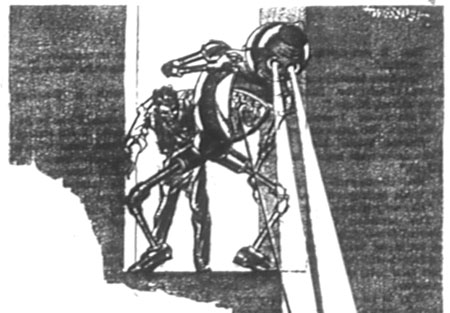
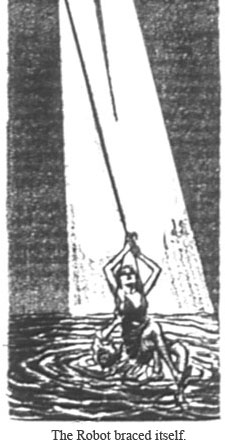
The towering mechanism stood planted firmly upon the broad bases of its metal feet. The weapon in its fingers still covered us. Its metal-cast face held always the same expression.
"Why is he different?" Mary repeated gently. "Don't you hear me?"
he Robot started. "Yes, I hear you." Its toneless, mechanical voice droned the words. Then the tempo quickened; the grid of wires in the mouth aperture behind its parted lips vibrated with a faint jangle. "I hear you. I cannot answer that question. He controls me. There is chaos—here,"—one of the hands came up and struck its breastplate with a clang—"chaos, disorder, here within me when I try to disobey him."
"That is foolish, Migul. He is a tyrant. All the humans of this era are tyrants. They have made slaves of the Robots. They have created you so that you are really human in all except your power of independent action. Don't you desire that, Migul?"
I held my breath. A curious quaking ran over the Robot's frame. The joints twitched. Emotion was sweeping this thing so nearly human!
"Mary Atwood, you seem to understand me."
"Of course I do. I am from a Time when we had human slaves: black men, Migul. I knew how they suffered. There is something in slavery that outrages the instinct of manhood."
Migul said with a jangling vehemence:
"Perhaps, some time, I can go beyond Tugh's control. I am strong. My cables pull these arms with a strength no human could have."
"You are so much stronger than Tugh. Forget his control, Migul. I am ashamed of you—a big, powerful thing like you, yielding always to a little cripple."
he Robot straightened and said, "I can resist him. I feel it. Some day I will break loose."
"Do it now, Migul!"
I tensed. Would she prevail?
"Now, Migul!" she repeated.
"No! He would derange me! I am afraid!"
"Nonsense."
"But his vibrations—the vibrations of his thoughts—even now I can feel them. They made my mechanism too sensitive. I cannot resist Tugh."
"You can!"
There was a silence. I stared at the Robot's motionless frame. What electrical, mechanical thoughts were passing within that metal skull! What emotions, what strange struggle, what warfare of nameless etheric vibrations of will power were taking place unseen beneath that inert exterior!
Perhaps something snapped. Migul said suddenly, "I am beyond control! At last I am beyond control!"
The ray cylinder lowered to point at the floor. A wild thought swept me that I could snatch it. But of what use would that be? Its ray would decompose all human flesh, but it would not harm a Robot; and if I startled Migul, fought with him in the confines of this narrow room, he would kill Mary and me in a moment.

ary was gripping me. "Don't move, George!" she cautioned; then turned again to the Robot. "I am glad, Migul. Now you are truly human. And we are all friends here, because we all hate and fear Tugh—"
"I fear him not!"
I could feel Mary trembling with the strain of all this. But she had the strength to muster a laugh.
"Don't you fear him—just a little, Migul? We do. Fear is a human thing."
"Then yes, I fear him."
"Of course you do," I put in. "And the real truth, Migul, is I wish he were dead. Don't you?"
"Yes. I wish he were dead."
"Well, sit down," I persisted. "Put that weapon away: I'm afraid of that, too. Sit down and we will talk about Tugh's death."
The Robot placed the weapon on the floor, disconnected the wires, opened the plate of its chest and took out the small battery. And then it squatted its awkward bulk on the floor before us. Gruesome conference, with this huge mechanical thing apeing the ways of a man!
I knew that haste was necessary, but did not dare show it. Above everything we must not be precipitate; not startle the Robot. At worst, if Tugh should return, I could seize this weapon at my feet and turn it upon him.
murmured to Mary. "You did it! Let me plan something, now. If Migul can lead us...."
I added, "Migul, could you follow Tugh? He said he was going to talk to the Robot leaders. And then, probably, he went to Princess Tina. Could you follow him to where he is now?"
"Yes. I can follow him by his vibration-scent. I am sensitive to it, I have been with him so much. But he can never again control me!"
"When we have killed him, Migul, that will be ended forever."
"Killed him?" It seemed to frighten the Robot. "I do not know that I would dare!"
"You lead me to him," I said, "and I'll kill him. Have no fear of that, Migul. We will work together—human friends."
"Yes. Human friends. What do you want me to do?"
Asking for orders! So nearly human, yet always something was lacking!
"Lead us to Tugh," I said promptly. "And give me that weapon."
I made a tentative reach for it, and the Robot pushed it toward me. I connected it and made sure I could fire it: its operation was obvious. Then I stuffed the whole thing in my jacket pocket; and always afterward my hand at intervals went to that cool, sweating little cylinder. What a comfort that weapon was!
I stood up. "Shall we go now? Migul, we will have to plan what to do according to where we find Tugh. Do not go too fast; let us keep close behind you."
"Us?" The Robot was on its feet. "Do you mean this girl?"
hat was this? My heart sank. I noticed, too, that Migul was planted firmly between us and the door.
"Why, of course, Migul. We can't leave her here."
"She is not going."
"Why not?" I demanded. "Of course she's going." I tried an experiment. "Migul, I order you to let us out of here."
The Robot stood inert.
"Do you understand me?"
"Yes, I understand you."
"It is an order. Think about it. I control you now. Isn't that so?"
My heart sank. Whatever the mysterious science involved in my dealing with this mechanism, I was not operating it correctly. The Robot did not move. Finally it said:
"No one—nothing—controls me. I have an independent impulse of my own. The girl must stay here until we return."
Mary gave a faint cry and sank back to the couch, a huddled white heap in her satin dress. I thought she had fainted, but she raised her face to me and tried to smile.
"But I won't leave her, Migul."
"She must stay."
"But why? If you are human now, you must act with a reason."
"Then because, if we fail to kill Tugh, I would not have him confront me with the knowledge I have released this girl. He would derange me; end me."
"I will stay," said Mary faintly. "You go, George. But come back to me."
I bent over her; suggested, "If we locked this door so Tugh could not get in—"
Migul said, "I can do that. She will be safer here than with us. I have other reasons. She is dressed in white—a mark to betray us if we go in darkness. And she is that kind of a human you call a girl—and that style human cannot travel fast, nor fight."
t occurred to me that Mary might very well be safer here.
Again I leaned over her. "It seems horrible to leave you alone."
"I'll stay. It may be best." Her smile was pathetically tremulous. "Lock me in so Tugh—so nothing outside—can reach me. But, oh, George, come back quickly!"
"Yes." I bent lower, and whispered, "It's Larry, not Tugh I really want to find—he and that Princess Tina. We'll come back and get you, and then all of us will get away in one of the Time-cages. That's all I want, Mary—to get us safely out of this accursed Time-world."
Migul said, "I am ready to start."
I pressed Mary's hand. "Good-by. I will come back soon, God willing."
"Yes. God willing."
I left her sitting there and turned away. Migul slid the door open, letting in the hum and buzz of the machinery outside. But I saw that the attending Robots had all vanished. There was no mechanism of independent locomotion left.
Mary repeated, "Lock the door carefully upon me. Oh, George, come back to me!"
I essayed a smile and a nod as the door slid closed upon her.
"Is it locked, Migul?"
"Yes. Sealed."
"You are sure Tugh cannot open it? He did before."
"I have set my own lock-series. He will find it does not open."
"Show me how to open it."
he Robot indicated the combination. I verified it by trying it. I said once more, "You are sure Tugh cannot do this?"
"Yes. I am sure."
Was the Robot lying to me? Could a Robot lie? I had to chance it.
"All right, let's start. Where was Tugh to meet those Robot leaders?"
"Out here. He has already met them without doubt, and gone somewhere else."
"He said he was going to the Princess Tina. Where would that be?"
"Probably in the palace."
"Can we get there?"
I had, of course, no idea of the events which had transpired. The laboratory overhead was deserted, save for the upper tower where a Robot was still broadcasting defiance. His electrical voice floated faintly down to us; but I ignored it. In the comparative silence of this deserted cavern, now, there were also the blurred sounds from overhead. The Robots were running wild over the city, massacring its human inhabitants; they had burned the Patrol Station; their red and violet rays were flashing everywhere. But I knew none of this.
Migul was saying:
"We cannot get to the palace above ground: the wall is electrified. But there is an underground tunnel. Shall we try it?"
"Yes, if you think the Princess Tina and that man Larry is there."
"I am seeking Tugh. Will you kill him if we find him?"
"Yes," I assured him.
Rash promise!
igul was leading me between the rows of unattended machinery to the cavern's opposite side. It said, once:
"There have been too many recent vibrations here: I cannot pick Tugh's trail. It is quicker to go where he might have been recently; there I will try to find his vibrations."
We came to the entrance of a tunnel. It was the cross passage leading to the cellar corridors of the palace five hundred feet away. It seemed deserted, and was very dimly illumined by hidden lights. I followed the great metal figure of Migul, which stalked with stiff-legged steps in advance of me. The arch of the tunnel-roof barely cleared the top of Migul's square-capped head.
My hand was in the side pocket of my jacket, my fingers gripping the ray cylinder for instant action. But it was a singularly ineffectual weapon for me under the circumstances, in spite of the sense of security it gave me. I could only use the cylinder against a human—and, save Tugh, it was the Robots, not the humans who were my enemies!
We had gone no more than a hundred feet or so when Migul slowed our pace, and began to walk stooped over, with one of its abnormally long arms held close to the ground. The fingers were stiffly outstretched and barely skimmed the floor surface of the tunnel. As we passed through a spot of light I saw that Migul had extended from each of the fingertips an inch-long filament of wire, like finger nails.
The Robot murmured abruptly, "Tugh's vibrations are here. I can feel them. He has passed this way recently."
ugh's trail! I knew then that Tugh's body, touching this ground, had altered to some infinitesimal degree the floor-substance's inherent vibration characteristics. Vibrations of every sort are communicable from one substance to another. Tugh's trail was here—his vibration-scent—and like a hound with his nose to the ground, Migul's fingers with the extended filaments were feeling it. What strange sensitivity! What an amazing development of science was manifested in every move and act and word of this Robot! Yet, in my own Time-world of 1935, it was all crudely presaged: this now before me was merely the culmination.
"He recently passed," said Migul. We stopped, I close beside the stooping metal figure. The Robot's voice was a furtive sepulchral whisper that filled me with awe.
"How long ago?" I asked.
"He passed here an hour or two ago, perhaps. The vibrations are fading out. But it was Tugh. Well do I know him. Put your hand down. Feel the vibrations?"
"I cannot. My fingers are not that sensitive, Migul."
A faint contempt was in the Robot's tone. "I forgot that you are a man." Then it straightened, and the extended filaments slid back into its fingers. It said softly, "There is one guard in this passage."
My heart leaped. "A human or a Robot?"
"A man. His name is Alent. He is at a gate that is too well fortified for any Robot to assail, but he will pass humans. It will be necessary for you to kill him."
had no intention of doing that, but I did not say so. As we crept forward to where I saw that the tunnel made a bend, with the fortified gate just beyond it, there was in my mind that now I would do my best to separate from Migul, using this guard as my pretext, for he would doubtless pass me, but not the Robot. The palace was occupied, I assumed, by friendly humans. I could get them to locate Tina and Larry.... Then the flaws of this plan made themselves all too evident. Larry might be with Tugh, and without Migul I could not follow Tugh's trail. Worse than that, if I tricked Migul, the angered Robot would at once return to Mary. I shuddered at the thought. That would not do. I must try to get Migul past the guard.
I whispered, "When we reach the gate you stay behind me. Let me persuade the guard."
"You will kill him? You have the weapon. He is fortified against the Robot weapons, but yours will be strange to him."
"We will see."
We crept around the bend. A hundred feet further on I saw that the passage was barred by a grille, faintly luminous with electrification.
I called cautiously:
"Alent! Alent!"
A glow of light illuminated me as I stood in the middle of the passage; Migul was in a shadow behind me.
A man's voice answered, "You are a human? How come you there? Who are you?"
"A stranger. A friend of the Princess Tina. I came in the Time-traveling cage. I want to pass now into the palace."
could see the dark man's figure behind the grille. His voice called, "Come slowly forward and stop at twenty feet. Walk only in the middle of the passage: the sides are electrified, but I will admit you along the middle."
I took a step, but no more. The figure of the guard stood now at the grille doorway. I was conscious of Migul towering over me from behind. Abruptly I felt a huge hand in my jacket pocket, and before I could prevent it my cylinder came out, clutched by the Robot.
I think I half turned. There was a soundless flash beside me, a tiny level beam leaped down the corridor—that horribly intense actinic white beam. It struck the guard, and his figure fell forward in the grille doorway. When we reached him, there was but a crumpled heap of black and white garments enveloping a bleached white skeleton.
I turned shudderingly away. Migul said calmly, "Here is your weapon. You should have used it more quickly. I give it back to you because against Tugh I am not sure I would have the will to use it. Will you be more quick with him?"
"Yes," I promised. And as we went through the gate, keeping cautiously in the middle of the passage, the Robot added, "In dealing with Tugh you cannot stop for talk. He will kill you when he sees you."
We were presently under the palace, in those lower corridors which I have already described. Human voices were audible from upstairs, but no one was down here. Migul was again prowling with his fingers along the ground. We came to an unoccupied lighted room—Harl's room, though I did not know it then. Once or twice Migul was at fault. We started up a flight of stairs into the palace, then Migul came and turned back.
"He went upstairs; but this, coming down, is more recent."[1]
igul had struck the main trail, now. We passed the lighted room again, went on to a cave-like open space with a litter of abandoned machinery and unswervingly to a blank space of the opposite wall.
Again Migul faltered.
"What's the matter, Migul?"
"His vibrations are faint. They are blurred with the Princess Tina's."
"Then she is with him?"
It was a tremendous relief. Larry doubtless was with them also.
"Is the man from 1935 with Tugh and the Princess?" I asked.
"I think so. There are unfamiliar vibrations—perhaps those of the man from the past."
The Robot was running the filaments of its fingers lightly over the wall.
"I have it. The Princess pressed this switch."
The door opened; the narrow descending tunnel was wholly black.
"Where does this go, Migul?"
"I do not know."
The Robot was stooping to the floor. "It is a plain trail," it said. "Come."[2]
The remainder of that journey through the labyrinth of passages was made in blank darkness, with only the faint lurid red beams from Migul's eye-sockets to light our way. But we went swiftly, and without incident. At last we went under the dam, up the spiral stairs and upon the catwalk above the abyss, where the great spillway of falling water arched out over us.
"The Power House," said Migul, "is where they went."
he Robot was obviously frightened, now. We were wet with spray. "I should not be here," it said. "If the water gets into me—even though I am well insulated—I will be destroyed!"
I recall as I write this how in Patton Place of 1935, one of the first attacking Robots had exploded under a jet of water from the street hydrant.
"I will stay behind you," Migul added. "They have a deranging ray in the Power House, and they might use it on me. Will you protect me?"
"Yes, of course," I said.
I was ready to promise anything, if only I could get to Larry and Tina, then back with them to Mary into the Time-cage; and if we were safely out of this era, most assuredly I wanted none of it again. Migul, as I advanced along the catwalk, followed behind me.
"You will kill Tugh?" it reiterated like an anxious child.
"Yes."
I saw that the catwalk terminated ahead under the Power House, where steps led upward. Then I heard a cry:
"Help! Help! Here, inside the dam! Help!"
I stood transfixed, with horror tingling my flesh. The voice came faintly from near at hand; it was muffled, and in the roar of the falling water and lashing spray I barely heard it.
Then it came again. "Help us! Help us, quickly!"
It was an agonized, panting, human voice. And in a chance, partial lull I heard it now plainly.
It was Larry's voice!