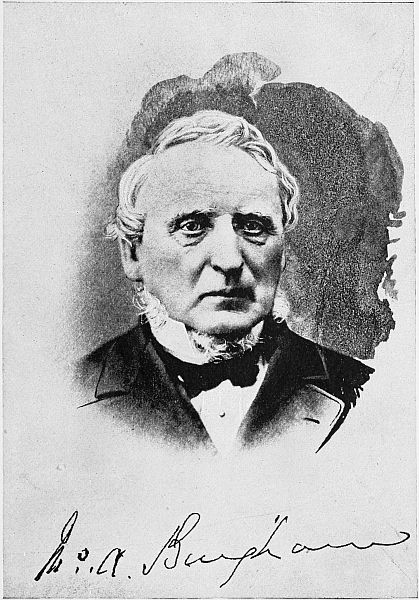
Part 2 — PREFACE TO APPENDIX.
Reading edition
In presenting the great argument of the Hon. John A. Bingham, Assistant Judge-Advocate, on the trial of the assassins, the author feels that he does not need to offer an apology to his readers, notwithstanding its length.
In addition to what he has already said by way of commending it to the careful perusal of his readers, he will add by way of preface, the following extracts from Barnes's 40th Congress, Vol. 1, showing the light in which that great effort was viewed by competent judges at the time; and also giving extracts from his great argument before the United States Senate on the articles of impeachment found against Andrew Johnson, President of the United States, for high crimes and misdemeanors, in vindication of the high encomiums bestowed by him on this distinguished statesman and advocate.
Extracts from "The Fortieth Congress of the United States." By William H. Barnes:—1st Vol., 40th Congress.
Mr. Bingham served as Special Judge Advocate in the great trial of the conspirators, who were tried for the assassination of Abraham Lincoln, etc. Immense labor devolved upon him during this difficult and protracted trial, and for eight weeks his arduous duties allowed him but brief intervals of rest. He occupied nine hours in the delivery of the closing arguments, in which he ably elucidated the law and the testimony in the case, and conclusively proved the guilt of the conspirators. Mr. Bingham's success in this great trial attracted general attention, and awakened a wide-spread curiosity to know his history. Soon after the close of the trial, a correspondent of the Philadelphia Press, having expressed the deep interest he had felt in arriving at a well founded conclusion as to "the guilt of the conspirators and the constitutionality of the court," wrote as follows:—
"Grant me space in your columns to give expression to my most unqualified admiration of the great arguments, on these two main points, presented to the court by the Special Judge Advocate, Gen. John A. Bingham. In the entire range of my reading, I have known of no productions that have so literally led me captive. For careful analysis, logical argumentation, profound and most extensive research; for overwhelming unravelment of complications that would have involved an ordinary mind only with inextricable bewilderment, and for a literal rending to tatters of all the metaphysical subtleties of the array of legal talent engaged on the other side, I know of no two productions in the English language superior to these. They are literally as the spear of Ithuriel, dissolving the hardest substances at their touch; as the thread of Dædalus, leading out of the labyrinths of error, no matter how thick and mazy. Not Locke or Bacon were more profound; not Daniel Webster was clearer and more penetrating; not Chillingworth was more logical. I feel sure that the author of these two unrivalled papers must possess a legal mind unrivalled in America, and must be, too, one of our rising statesmen. But who is John A. Bingham, who by his industry and learning displayed on this wonderful trial, has placed the country under such a heavy debt of obligation? He may be well known to others moving in a public sphere, like yourself, but to me, so absorbed in a different line of duty, he has appeared so suddenly, and yet with such vividness, that I long to know some, at least, of his antecedents."
Upon which the editor remarked:—
"The question of our esteemed correspondent is natural to one who has not, probably, watched the individual actors on the great stage of public affairs with the interest of the historical and political student. We are not surprised that the arguments of Mr. Bingham before the military commission should have filled him with delight. It was worthy of the great subject confided to that accomplished statesman by the Government, and of his own fame. When the assassins of Mr. Lincoln were sent for trial before the military court by President Johnson, the Government wisely left the whole management to Judge Holt and his eloquent associate, Mr. Bingham, and to the latter was committed the stupendous labor of sifting the mass of evidence, of replying to the corps of lawyers for the defence, of setting forth the guilt of the accused and of vindicating the policy and the duty of the executive in an exigency so novel and so full of tragic solemnity. The crime was so enormous, and the trial of those who committed it so important in all its issues, immediate, contingent and remote, as to awaken an excitement that embraced all nations. The murder itself was almost forgotten by those who wished to screen the murderers, and the most wicked theories were broached and sown broadcast by men, who, under cloak of reverence for what they called the law, toiled with herculean energy to weaken the arm of the Government, extended in time of war to save the servants of the people from being slaughtered by assassins in public places, and tracked even to their firesides by the agents and friends of slavery. These poisons of plausibility, blunting the sharpest horrors of any age, and sanctifying the most hellish offenses, required an antidote as swift to cure. Mr. Bingham's two great arguments, alluded to by our correspondent, have supplied the remedy. They are monuments of reflection, research, and argumentation; and they are presented in the language of a scholar and with the fervor of an orator. In the great volume of proof and counter-proof, rhetoric, and controversy that forever preserves the record of this great trial, the efforts of Mr. Bingham will ever remain to be first studied with an eager and admiring interest. That they came, after all that has and can be said against the Government, is rather an inducement to their more satisfactory and critical consideration. For from that study the American student and citizen must, more than ever, realize how irresistible is Truth when in conflict with Falsehood, and how poor and puerile are all the professional tricks of the lawyer when opposed to the moral power of the patriot."
In Congress Mr. Bingham has had a distinguished career, marked by important services to the country. In the XXXVIIth Congress he was earnest and successful in advocating many important measures to promote the vigorous prosecution of the war, which had just begun. Returning to Congress in 1865, after an absence of two years, he at once took a prominent position. Upon the formation of the joint committee on Reconstruction, December 14th, 1865, he was appointed one of the nine members on the part of the House. He was active in advocating the great measures of Reconstruction, which were proposed and passed in the XXXIXth and XLth Congresses. The House of Representatives having resolved that Andrew Johnson should be impeached for "high crimes and misdemeanors," Mr. Bingham was appointed on the committee to which was intrusted the important duty of drawing up the Articles of Impeachment. This work having been done to the satisfaction of the House, Mr. Bingham was elected chairman of the managers to conduct the impeachment of the President before the Senate.
On him devolved the duty of making the closing argument. His speech on this occasion ranks among the greatest forensic efforts of any age. He began the delivery of his argument on Monday, May 4th, and occupied the attention of the Senate, and a vast auditory on the floor and in the galleries, during three successive days. At the close of his argument, the immense audience in the galleries, wrought up to the highest pitch of enthusiasm, gave vent to such an unanimous and continued outburst of applause as has never before been heard in the Capitol. Ladies and gentlemen, who could not have been induced deliberately to trespass on the decorum of the Senate, by whose courtesy they were admitted to the galleries, overcome by their feelings, joined in the utterance of applause, knowing that for so doing the Sergeant-at-arms would be required to expel them from the galleries. The history of the country records no similar tribute to the oratorial efforts of the ablest advocates or statesmen. From so long and so well-sustained an argument, it is impossible to select particular passages which would give an adequate idea of the whole. The following historical argument for the supremacy of the law will always be read with interest, whether as an extract, or in its original setting:—
"Is it not in vain, I ask you, Senators, that the people have thus vindicated by battle the supremacy of their own Constitution and laws, if, after all, their President is permitted to suspend their laws and dispense with the execution thereof at pleasure, and defy the power of the people to bring him to trial and judgment before the only tribunal authorized by the Constitution to try him? That is the issue that is presented before the Senate for decision by these articles of impeachment. By such acts of usurpation on the part of the ruler of a people, I need not say to the Senate, the peace of nations is broken, as it is only by obedience to law that the peace of nations is maintained, and their existence perpetuated. Law is the voice of God and the harmony of the world:—
"'It doth preserve the stars from wrong, Through it the eternal heavens are fresh and strong.'
"All history is but philosophy, teaching by example. God is in history, and through it teaches to men and nations the profoundest lessons which they learn. It does not surprise me, Senators, that the learned counsel for the accused asked the Senate, in the consideration of this question, to close that volume of instruction, not to look into the past, and not to listen to its voices. Senators, from that day when the inscription was written upon the graves of the heroes of Thermopylæ, 'Stranger, go tell the Lacedemonians that we lie here in obedience to their laws,' to this hour, no profounder lesson than this has come down to us: that through obedience to law comes the strength of nations and the safety of men.
"No more fatal provision ever found its way into the Constitutions of States than that contended for in this defense which recognizes the right of a single despot or of the many to discriminate in the administration of justice between the ruler and the citizen, between the strong and the weak. It was by this unjust discrimination that Aristides was banished because he was just. It was by this unjust discrimination that Socrates, the wonder of the Pagan world, was doomed to drink the hemlock because of his transcendant virtues. It was in honorable protest against this unjust discriminati that the great Roman Senator, father of his country, declared that the force of the law consists in its being made for the whole community. Senators, it is the pride and boast of that great people from whom we are descended, as it is the pride and boast of every American, that the law is the supreme power of the State, that it is for the protection of each, by the combined power of all. By the Constitution of England the hereditary monarch is no more above the law than the humblest subject; and by the Constitution of the United States, the President is no more above the law than the poorest and most friendless beggar in your streets. The usurpations of Charles I. inflicted untold injuries upon the people of England, and finally cost the usurper his life. The subsequent usurpations of James II., and I only refer to it because there is between his official conduct and that of this accused President, the most remarkable parallel that I have ever read in history, filled the heart and brain of England with conviction that new securities must be taken to restrain the prerogatives asserted by the crown, if they would maintain their ancient Constitution and perpetuate their liberties. It is well said by Hallam that the usurpations of James swept away the solemn ordinances of the legislature. Out of those usurpations came the great revolution of 1688, which resulted in the dethronement and banishment of James, in the elevation of William and Mary, and in the immortal Declaration of Rights.
"I ask the Senate to notice that these charges against James are substantially the charges presented against this accused President, and confessed here of record, that he has suspended the laws, and dispensed with the execution of laws, and in order to do this has usurped authority as the executive of the nation, declaring himself entitled under the Constitution to suspend the laws and dispense with their execution. He has further, like James, attempted to control the appropriated money of the people contrary to law. And he has further, like James, although it is not alleged against him in the Articles of Impeachment, it is confessed in his answer, and attempted to cause the question of his responsibility to the people to be tried, not in the King's Bench, but in the Supreme Court, when that question is alone cognizable in the Senate of the United States. Surely, Senators, if these usurpations, if these endeavors on the part of James thus to subvert the liberties of the people of England, cost him his crown and kingdom, the like offenses committed by Andrew Johnson ought to cost him his office, and to subject him to that perpetual disability pronounced by the people through the Constitution upon him for his high crimes and misdemeanors.
"I ask you, Senators, how long men would deliberate upon the question whether a private citizen arraigned at the bar of one of your tribunals of justice for a criminal violation of the law, should be permitted to interpose a plea in justification of his criminal act, that his only purpose was to interpret the Constitution and laws for himself, that he violated the law in the exercise of his prerogative to test its validity hereafter at such a day as might suit his own convenience in the courts of justice. Surely it is as competent for the private citizen to interpose such justification in answer to crime in one of your tribunals of justice, as it is for the President to interpose it, and for the simple reason that the Constitution is no respecter of persons, and rests neither in the private citizen judicial power.
"Can it be that by your decree you are at last to make this discrimination between the ruler of the people and the private citizen, and to allow him to interpose his assumed right to interpret judicially your Constitution and laws? Are you to solemnly proclaim by your decree:—
"'Plate sin with gold, And the strong lance of justice heartless breaks; Arm it in rags and a pigmy's straw doth pierce it?'
"I put away the possibility that the Senate of the United States, equal in dignity to any tribunal in the world, is capable of recording any such decision even upon the petition and prayer of the accused and guilty President. Can it be that by reason of his great office the President is to be protected in his high crimes and misdemeanors, violative alike of his oath, of the Constitution and of the express letter of your written law, enacted by the legislative department of the government?
"I ask you, Senators, to consider that I speak before you this day in behalf of the violated law of a free people, who commission me. I ask you to remember this, that I speak this day under the obligations of this my oath. I ask you to consider that I am not insensible to the significance of the words of which mention was made by the learned counsel from New York; justice, duty, law, oath. I ask you to remember that the great principles of constitutional liberty for which I speak this day, have been taught to men and nations by all the trials and triumphs, by all the agonies and martyrdoms of the past; that they are the wisdom of the centuries uttered by the elect of the human race.
"I ask you to consider that we stand this day pleading for the violated majesty of the law, by the graves of half a million of martyred hero-patriots who sacrificed themselves for their country, the Constitution, and the laws, and who by their sublime examples have taught us that all must obey the law; that none are above the law; that no man lives for himself alone, but each for all, that some must die that the State may live; that the citizen is but for to-day, that the commonwealth is for all time, and that position, however high, patronage however powerful, cannot be permitted to shelter crime to the peril of the Republic."