Chapter VIII · EMBROIDERED BOOKS AND OTHER ARTICLES.
Reading edition
“And often did she look On that which in her hand she bore, In velvet bound and broidered o’er— Her breviary book.” Marmion.
When books were regarded as precious treasures, and the purchase of a single volume involved as much outlay as a rare painting, before the art of printing became established, the caskets that held such valuable possessions were deemed worthy of much labor and expense.
Rare old carved ivory, gold and silver plates, and precious stones, were often used on book-covers; and the most ancient existing specimen of this gorgeous style of book-making is written in silver and gold letters on a purple ground. Rich and curious devices were often wrought with the needle on the velvet, or brocade, which last became more exclusively the fashionable material for binding.
The new passion for books which was at its height in Queen Elizabeth’s day made the ornamentation of book-covers a favorite employment of the high-born dames of England. A book of rhetoric of that time has been preserved as much for the sake of the outside as for its contents. The cover is of crimson satin, on which is embroidered a coat-of-arms: a lion rampant in gold thread on a blue field, with a transverse badge in scarlet silk, the minor ornaments all wrought in fine gold thread.
A MAROON-VELVET BOOK.
Another old book is bound in rich maroon velvet, with the royal arms, the garter and motto embroidered in blue; on a ground of crimson, the fleur-de-lys, leopards, and letters of the motto are worked in gold thread. A coronet, or crown of gold, is inwrought with pearls; at the corners are roses in red silk and gold; the cover is finished with a narrow border in burnished gold thread.
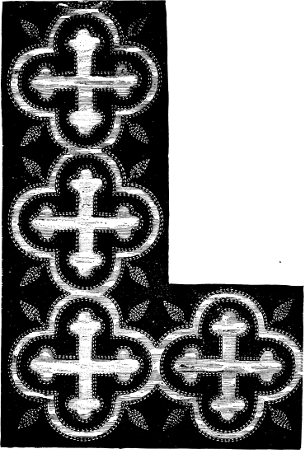
Fig. 42.—Border for Cover of Bible, Prayer-Book, etc.
A QUEEN’S NEEDLEWORK.
A book of prayers copied out by Queen Elizabeth before she ascended the throne is covered with canvas wrought all over, in a kind of tent-stitch, with rich crimson silk and silver thread intermixed. Elizabeth’s own needle worked the ornaments, consisting of the letters “H. K.,” intertwined in the middle—a smaller “K” above and below—and roses in the corners—all very much raised, and worked in blue silk and silver.
PETRARCH’S SONNETS.
An edition of Petrarch’s Sonnets, printed at Venice in 1544, is still in beautiful preservation. The back is of dark crimson velvet; and on each side is worked a large royal coat-of-arms in silk and gold highly raised. The book belonged to Edward VI.
ANOTHER ROYAL BOOK
has a cover of crimson silk with a Prince’s feather worked in gold thread in the centre. The three feathers are bound together with large pearls and wreathed with leaves and flowers. Round the edge of the cover there is a broader wreath; and corner-sprigs in gold thread are thickly interspersed with spangles and gold leaves.
These elegant volumes,
“In velvet bound and broidered o’er,”
are to be seen in the British Museum; and although the day is past for adorning book-covers in so showy a fashion, these articles may be more modestly ornamented with very good effect.
Kid, or leather, makes a very suitable cover for a Bible or Prayer-Book. Two shades of brown may be used for the border pattern in Figure 42—the figures in the lighter shade to be worked around with gold thread, either in chain-stitch or in stalk-stitch. Silk may be substituted for the gold thread.
A ground of gray kid, with the figures in black edged with gold, would be equally suitable. On one side of the cover, a small cross to match the border—and on the other, the owner’s monogram would make an appropriate finish for either book.
The rich design in Figure 43 is on a foundation of black velvet, to which white faille is applied around the cross.
The figures of the design being outlined, the lines are run on the edges with maize-colored silk—going back and forth, and overcasting them with gold bullion. The passion-flowers, wheat, leaves, and ornaments of the cross, are worked in satin-stitch with gold thread. For the stems and vines, gold cord is sewed on with gold-colored silk.
A BOOK OF ENGRAVINGS
would be very ornamental with an embroidered cover. Crimson or maroon-colored velveteen, brown kid, or gray canvas, could be handsomely worked with silk and gold thread. Borderings of catalogues and circulars might be copied to advantage—some of these being very rich: black, with gold bars and dots, pink, crimson, or blue.
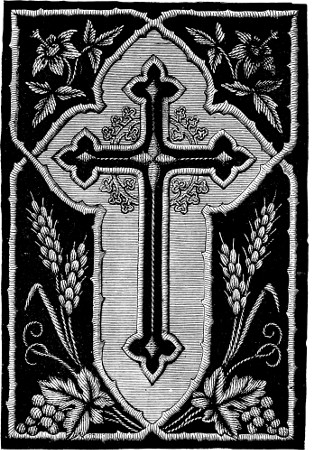
Fig. 43.—Cover for Prayer-Book.
Heraldic devices, rich monograms, dainty corners, all look well in this kind of work; and a bordering of gold acorns, or clover leaves, on a brown or olive ground, is always handsome.