Front matter
Reading edition
THERE IS AN EXPANDED EDITION OF THIS TITLE WITH LINKED FOOTNOTES AND INDEX WHICH MAY VIEWED AT EBOOK [# 45851 ]
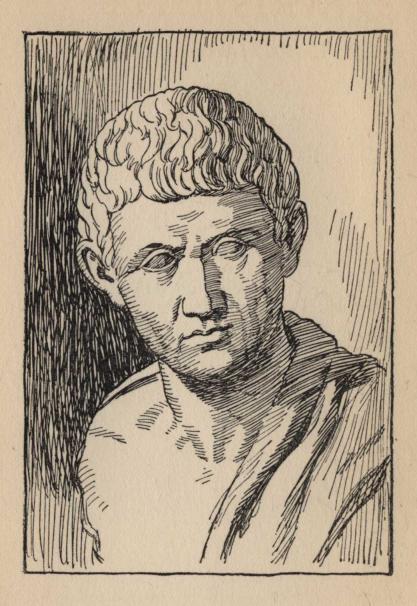
Aristotle
ARISTOTLE
BY A. E. TAYLOR, M.A., D.LITT., F.B.A.
LONDON: T. C. & E. C. JACK 67 LONG ACRE, W.C., AND EDINBURGH NEW YORK: DODGE PUBLISHING CO.
CONTENTS
CHAP.
I. LIFE AND WORKS
II. THE CLASSIFICATION OF THE SCIENCES: SCIENTIFIC METHOD
III. FIRST PHILOSOPHY
IV. PHYSICS
V. PRACTICAL PHILOSOPHY
BIBLIOGRAPHY
ARISTOTLE
CHAPTER I
LIFE AND WORKS
It has not commonly been the lot of philosophers, as it is of great poets, that their names should become household words. We should hardly call an Englishman well read if he had not heard the name of Sophocles or Molière. An educated man is expected to know at least who these great writers were, and to understand an allusion to the Antigone or Le Misanthrope. But we call a man well read if his mind is stored with the verse of poets and the prose of historians, even though he were ignorant of the name of Descartes or Kant. Yet there are a few philosophers whose influence on thought and language has been so extensive that no one who reads can be ignorant of their names, and that every man who speaks the language of educated Europeans is constantly using their vocabulary. Among this few Aristotle holds not the lowest place. We have all heard of him, as we have all heard of Homer. He has left his impress so firmly on theology that many of the formulae of the Churches are unintelligible without acquaintance with his conception of the universe. If we are interested in the growth of modern science we shall readily discover for ourselves that some knowledge of Aristotelianism is necessary for the understanding of Bacon and Galileo and the other great anti-Aristotelians who created the "modern scientific" view of Nature. If we turn to the imaginative literature of the modern languages, Dante is a sealed book, and many a passage of Chaucer and Shakespeare and Milton is half unmeaning to us unless we are at home in the outlines of Aristotle's philosophy. And if we turn to ordinary language, we find that many of the familiar turns of modern speech cannot be fully understood without a knowledge of the doctrines they were first forged to express. An Englishman who speaks of the "golden mean" or of "liberal education," or contrasts the "matter" of a work of literature with its "form," or the "essential" features of a situation or a scheme of policy with its "accidents," or "theory" with "practice," is using words which derive their significance from the part they play in the vocabulary of Aristotle. The unambitious object of this little book is, then, to help the English reader to a better understanding of such familiar language and a fuller comprehension of much that he will find in Dante and Shakespeare and Bacon.
Life of Aristotle.--The main facts of Aristotle's life may be briefly told. He was born in 385-4 B.C. at Stagirus, a little city of the Chalcidic peninsula, still called, almost by its ancient name, Chalcis, and died at the age of sixty-two at Chalcis in Euboea. Thus he is a contemporary of Demosthenes, his manhood witnessed the struggle which ended in the establishment of the Macedonian monarchy as the dominant power in Hellas, and his later years the campaigns in which his pupil Alexander the Great overthrew the Persian Empire and carried Greek civilisation to the banks of the Jumna. In studying the constitutional theories of Aristotle, it is necessary to bear these facts in mind. They help to explain certain limitations of outlook which might otherwise appear strange in so great a man. It throws a great deal of light on the philosopher's intense conviction of the natural inferiority of the "barbarian" intellect and character to remember that he grew up in an outlying region where the "barbarian" was seen to disadvantage in the ordinary course of life. Hence the distinction between Greek and "barbarian" came to mean for him much what the "colour-line" does to an American brought up in a Southern State. So, again, when we are struck by his "provincialism," his apparent satisfaction with the ideal of a small self-contained city-state with a decently oligarchical government, a good system of public education, and no "social problems," but devoid alike of great traditions and far-reaching ambitions, we must remember that the philosopher himself belonged to just such a tiny community without a past and without a future. The Chalcidic cities had been first founded, as the name of the peninsula implies, as colonies from the town of Chalcis in Euboea; Corinth had also been prominent in establishing settlements in the same region. At the height of Athenian Imperial prosperity in the age of Pericles the district had fallen politically under Athenian control, but had been detached again from Athens, in the last years of the Archidamian war, by the genius of the great Spartan soldier and diplomat Brasidas. Early in the fourth century the Chalcidic cities had attempted to form themselves into an independent federation, but the movement had been put down by Sparta, and the cities had fallen under the control of the rising Macedonian monarchy, when Aristotle was a baby. A generation later, a double intrigue of the cities with Philip of Macedon and Athens failed of its effect, and the peninsula was finally incorporated with the Macedonian kingdom. It is also important to note that the philosopher belonged by birth to a guild, the Asclepiadae, in which the medical profession was hereditary. His father Nicomachus was court physician to Amyntas II., the king for whose benefit the Spartans had put down the Chalcidic league. This early connection with medicine and with the Macedonian court explains largely both the predominantly biological cast of Aristotle's philosophical thought and the intense dislike of "princes" and courts to which he more than once gives expression. At the age of eighteen, in 367-6, Aristotle was sent to Athens for "higher" education in philosophy and science, and entered the famous Platonic Academy, where he remained as a member of the scientific group gathered round the master for twenty years, until Plato's death in 347-6. For the three years immediately following Aristotle was in Asia Minor with his friend and fellow-student Hermeias, who had become by force of sheer capacity monarch of the city of Atarneus in the Troad, and was maintaining himself with much energy against the Persian king. Pythias, the niece of Hermeias, became the philosopher's wife, and it seems that the marriage was happy. Examination of Aristotle's contributions to marine biology has shown that his knowledge of the subject is specially good for the Aeolic coast and the shores of the adjacent islands. This throws light on his occupations during his residence with Hermeias, and suggests that Plato had discerned the bent of his distinguished pupil's mind, and that his special share in the researches of the Academy had, like that of Speusippus, Plato's nephew and successor in the headship of the school, been largely of a biological kind. We also know that, presumably shortly after Plato's death, Aristotle had been one of the group of disciples who edited their teacher's unpublished lectures. In 343 Hermeias was assassinated at the instigation of Persia; Aristotle honoured his memory by a hymn setting forth the godlikeness of virtue as illustrated by the life of his friend. Aristotle now removed to the Macedonian court, where he received the position of tutor to the Crown Prince, afterwards Alexander the Great, at this time (343 B.C.) a boy of thirteen. The association of the great philosopher and the great king as tutor and pupil has naturally struck the imagination of later ages; even in Plutarch's Life of Alexander we meet already with the full-blown legend of the influence of Aristotle's philosophical speculations on Alexander. It is, however, improbable that Aristotle's influence counted for much in forming the character of Alexander. Aristotle's dislike of monarchies and their accessories is written large on many a page of his Ethics and Politics; the small self-contained city-state with no political ambitions for which he reserves his admiration would have seemed a mere relic of antiquity to Philip and Alexander. The only piece of contemporary evidence as to the relations between the master and the pupil is a sentence in a letter to the young Alexander from the Athenian publicist Isocrates who maliciously congratulates the prince on his preference for "rhetoric," the art of efficient public speech, and his indifference to "logic-choppers." How little sympathy Aristotle can have had with his pupil's ambitions is shown by the fact that though his political theories must have been worked out during the very years in which Alexander was revolutionising Hellenism by the foundation of his world-empire, they contain no allusion to so momentous a change in the social order. For all that Aristotle tells us, Alexander might never have existed, and the small city-state might have been the last word of Hellenic political development. Hence it is probable that the selection of Aristotle, who had not yet appeared before the world as an independent thinker, to take part in the education of the Crown Prince was due less to personal reputation than to the connection of his family with the court, taken together with his own position as a pupil of Plato, whose intervention in the public affairs of Sicily had caused the Academy to be regarded as the special home of scientific interest in politics and jurisprudence. It may be true that Alexander found time in the midst of his conquests to supply his old tutor with zoological specimens; it is as certain as such a thing can be that the ideals and characters of the two men were too different to allow of any intimate influence of either on the other.
When Alexander was suddenly called to the Macedonian throne by the murder of his father in 336 B.C., Aristotle's services were no longer needed; he returned to Athens and gave himself to purely scientific work. Just at this juncture the presidency of the Academy was vacant by the death of Speusippus, Aristotle's old associate in biological research. Possibly Aristotle thought himself injured when the school passed him over and elected Xenocrates of Chalcedon as its new president. At any rate, though he appears never to have wholly severed his connection with the Academy, in 335 he opened a rival institution in the Lyceum, or gymnasium attached to the temple of Apollo Lyceus, to which he was followed by some of the most distinguished members of the Academy. From the fact that his instruction was given in the peripatos or covered portico of the gymnasium the school has derived its name of Peripatetic. For the next twelve years he was occupied in the organisation of the school as an abode for the prosecution of speculation and research in every department of inquiry, and in the composition of numerous courses of lectures on scientific and philosophical questions. The chief difference in general character between the new school and the Academy is that while the scientific interests of the Platonists centred in mathematics, the main contributions of the Lyceum to science lay in the departments of biology and history.
Towards the end of Alexander's life his attention was unfavourably directed on his old teacher. A relative of Aristotle named Callisthenes had attended Alexander in his campaigns as historiographer, and had provoked disfavour by his censure of the King's attempts to invest his semi-constitutional position towards his Hellenic subjects with the pomp of an Oriental despotism. The historian's independence proved fatal. He was accused of instigating an assassination plot among Alexander's pages, and hanged, or, as some said, thrown into a prison where he died before trial. Alexander is reported to have held Aristotle responsible for his relative's treason, and to have meditated revenge. If this is so, he was fortunately diverted from the commission of a crime by preoccupation with the invasion of India.
On the death of Alexander in 323 a brief but vigorous anti-Macedonian agitation broke out at Athens. Aristotle, from his Macedonian connections, naturally fell a victim, in spite of his want of sympathy with the ideals of Philip and Alexander. Like Socrates, he was indicted on the capital charge of "impiety," the pretext being that his poem on the death of Hermeias, written twenty years before, was a virtual deification of his friend. This was, however, only a pretext; the real offence was political, and lay in his connection with the Macedonian leader Antipater. As condemnation was certain, the philosopher anticipated it by withdrawing with his disciples to Chalcis, the mother city of his native Stagirus. Here he died in the following year, at the age of sixty-two or sixty-three.
The features of Aristotle, familiar to us from busts and intaglios, are handsome, but indicate refinement and acuteness rather than originality, an impression in keeping with what we should expect from a study of his writings. The anecdotes related of him reveal a kindly, affectionate character, and show little trace of the self-importance which appears in his work. His will, which has been preserved, exhibits the same traits in its references to his happy family life and its solicitous care for the future of his children and servants. He was twice married, first to Pythias, and secondly to a certain Herpyllis, by whom he left a son Nicomachus and a daughter. The "goodness" of Herpyllis to her husband is specially mentioned in the clauses of the will which make provision for her, while the warmth of the writer's feelings for Pythias is shown by the direction that her remains are to be placed in the same tomb with his own. The list of servants remembered and the bequests enumerated show the philosopher to have been in easier circumstances than Plato.
The Works of Aristotle.--The so-called works of Aristotle present us with a curious problem. When we turn from Plato to his pupil we seem to have passed into a different atmosphere. The Discourses of Socrates exhibit a prose style which is perhaps the most marvellous of all literary achievements. Nowhere else do we meet with quite the same combination of eloquence, imaginative splendour, incisive logic, and irresistible wit and humour. The manner of Aristotle is dry and formal. His language bristles with technicalities, makes little appeal to the emotions, disdains graces of style, and frequently defies the simplest rules of composition. Our surprise is all the greater that we find later writers of antiquity, such as Cicero, commending Aristotle for his copious and golden eloquence, a characteristic which is conspicuously wanting in the Aristotelian writings we possess. The explanation of the puzzle is, however, simple. Plato and Aristotle were at once what we should call professors and men of letters; both wrote works for general circulation, and both delivered courses of lectures to special students. But while Plato's lectures have perished, his books have come down to us. Aristotle's books have almost wholly been lost, but we possess many of his lectures. The "works" of Aristotle praised by Cicero for their eloquence were philosophical dialogues, and formed the model for Cicero's own compositions in this kind. None of them have survived, though some passages have been preserved in quotations by later writers. That the "works" are actually the MSS. of a lecturer posthumously edited by his pupils seems clear from external as well as from internal evidence. In one instance we have the advantage of a double recension. Aristotle's Ethics or Discourses on Conduct have come down to us in two forms--the so-called Nicomachean Ethics, a redaction by the philosopher's son, Nicomachus, preserving all the characteristics of an oral course of lectures; and a freer and more readable recast by a pupil, the mathematician Eudemus, known as the Eudemian Ethics. In recent years we have also recovered from the sands of Egypt what appears to be our one specimen of a "work" of Aristotle, intended to be read by the public at large, the essay on the Constitution of Athens. The style of this essay is easy, flowing, and popular, and shows that Aristotle could write well and gracefully when he thought fit.
CHAPTER II
THE CLASSIFICATION OF THE SCIENCES: SCIENTIFIC METHOD
Philosophy, as understood by Aristotle, may be said to be the organised whole of disinterested knowledge, that is, knowledge which we seek for the satisfaction which it carries with itself, and not as a mere means to utilitarian ends. The impulse which receives this satisfaction is curiosity or wonder, which Aristotle regards as innate in man, though it does not get full play until civilisation has advanced far enough to make secure provision for the immediate material needs of life. Human curiosity was naturally directed first to the outstanding "marvellous works" of the physical world, the planets, the periodicity of their movements, the return of the seasons, winds, thunder and lightning, and the like. Hence the earliest Greek speculation was concerned with problems of astronomy and meteorology. Then, as reflection developed, men speculated about geometrical figure, and number, the possibility of having assured knowledge at all, the character of the common principles assumed in all branches of study or of the special principles assumed in some one branch, and thus philosophy has finally become the disinterested study of every department of Being or Reality. Since Aristotle, like Hegel, thought that his own doctrine was, in essentials, the last word of speculation, the complete expression of the principles by which his predecessors had been unconsciously guided, he believes himself in a position to make a final classification of the branches of science, showing how they are related and how they are discriminated from one another. This classification we have now to consider.
Classification of the Sciences.--To begin with, we have to discriminate Philosophy from two rivals with which it might be confounded on a superficial view, Dialectic and Sophistry. Dialectic is the art of reasoning accurately from given premisses, true or false. This art has its proper uses, and of one of these we shall have to speak. But in itself it is indifferent to the truth of its premisses. You may reason dialectically from premisses which you believe to be false, for the express purpose of showing the absurd conclusions to which they lead. Or you may reason from premisses which you assume tentatively to see what conclusions you are committed to if you adopt them. In either case your object is not directly to secure truth, but only to secure consistency. Science or Philosophy aims directly at truth, and hence requires to start with true and certain premisses. Thus the distinction between Science and Dialectic is that Science reasons from true premisses, Dialectic only from "probable" or "plausible" premisses. Sophistry differs from Science in virtue of its moral character. It is the profession of making a living by the abuse of reasoning, the trick of employing logical skill for the apparent demonstration of scientific or ethical falsehoods. "The sophist is one who earns a living from an apparent but unreal wisdom." (The emphasis thus falls on the notion of making an "unreal wisdom" into a trade. The sophist's real concern is to get his fee.) Science or Philosophy is thus the disinterested employment of the understanding in the discovery of truth.
We may now distinguish the different branches of science as defined. The first and most important division to be made is that between Speculative or Theoretical Science and Practical Science. The broad distinction is that which we should now draw between the Sciences and the Arts (i.e. the industrial and technical, not the "fine" arts). Speculative or Theoretical Philosophy differs from Practical Philosophy in its purpose, and, in consequence, in its subject-matter, and its formal logical character. The purpose of the former is the disinterested contemplation of truths which are what they are independently of our own volition; its end is to know and only to know. The object of "practical" Science is to know, but not only to know but also to turn our knowledge to account in devising ways of successful interference with the course of events. (The real importance of the distinction comes out in Aristotle's treatment of the problems of moral and social science. Since we require knowledge of the moral and social nature of men not merely to satisfy an intellectual interest, but as a basis for a sound system of education and government, Politics, the theory of government, and Ethics, the theory of goodness of conduct, which for Aristotle is only a subordinate branch of Politics, belong to Practical, not to Theoretical Philosophy, a view which is attended by important consequences.)
It follows that there is a corresponding difference in the objects investigated by the two branches of Philosophy. Speculative or Theoretical Philosophy is concerned with "that which cannot possibly be other than it is," truths and relations independent of human volition for their subsistence, and calling simply for recognition on our part. Practical Philosophy has to do with relations which human volition can modify, "things which may be other than they are," the contingent. (Thus e.g. not only politics, but medicine and economics will belong to Practical Science.)
Hence again arises a logical difference between the conclusions of Theoretical and those of Practical Philosophy. Those of the former are universal truths deducible with logical necessity from self-evident[#] principles. Those of the latter, because they relate to what "can be otherwise," are never rigidly universal; they are general rules which hold good "in the majority of cases," but are liable to occasional exceptions owing to the contingent character of the facts with which they deal. It is a proof of a philosopher's lack of grounding in logic that he looks to the results of a practical science (e.g. to the detailed precepts of medicine or ethics) for a higher degree of certainty and validity than the nature of the subject-matter allows. Thus for Aristotle the distinction between the necessary and the contingent is real and not merely apparent, and "probability is the guide" in studies which have to do with the direction of life.
[#] Self-evident, that is, in a purely logical sense. When you apprehend the principles in question, you see at once that they are true, and do not require to have them proved. It is not meant that any and every man does, in point of fact, always apprehend the principles, or that they can be apprehended without preliminary mental discipline.
We proceed to the question how many subdivisions there are within "theoretical" Philosophy itself. Plato had held that there are none. All the sciences are deductions from a single set of ultimate principles which it is the business of that supreme science to which Plato had given the name of Dialectic to establish. This is not Aristotle's view. According to him, "theoretical" Philosophy falls into a number of distinct though not co-ordinate branches, each with its own special subjects of investigation and its own special axiomatic principles. Of these branches there are three, First Philosophy, Mathematics, and Physics. First Philosophy--afterwards to be known to the Middle Ages as Metaphysics[#]--treats, to use Aristotle's own expression, of "Being quà Being." This means that it is concerned with the universal characteristics which belong to the system of knowable reality as such, and the principles of its organisation in their full universality. First Philosophy alone investigates the character of those causative factors in the system which are without body or shape and exempt from all mutability. Since in Aristotle's system God is the supreme Cause of this kind, First Philosophy culminates in the knowledge of God, and is hence frequently called Theology. It thus includes an element which would to-day be assigned to the theory of knowledge, as well as one which we should ascribe to metaphysics, since it deals at once with the ultimate postulates of knowledge and the ultimate causes of the order of real existence.
[#] The origin of this name seems to be that Aristotle's lectures on First Philosophy came to be studied as a continuation of his course on Physics. Hence the lectures got the name Metaphysica because they came after (meta) those on Physics. Finally the name was transferred (as in the case of Ethics) from the lectures to the subject of which they treat.
Mathematics is of narrower scope. What it studies is no longer "real being as such," but only real being in so far as it exhibits number and geometrical form. Since Aristotle holds the view that number and figure only exist as determinations of objects given in perception (though by a convenient fiction the mathematician treats of them in abstraction from the perceived objects which they qualify), he marks the difference between Mathematics and First Philosophy by saying that "whereas the objects of First Philosophy are separate from matter and devoid of motion, those of Mathematics, though incapable of motion, have no separable existence but are inherent in matter." Physics is concerned with the study of objects which are both material and capable of motion. Thus the principle of the distinction is the presence or absence of initial restrictions of the range of the different branches of Science. First Philosophy has the widest range, since its contemplation covers the whole ground of the real and knowable; Physics the narrowest, because it is confined to a "universe of discourse" restricted by the double qualification that its members are all material and capable of displacement. Mathematics holds an intermediate position, since in it, one of these qualifications is removed, but the other still remains, for the geometer's figures are boundaries and limits of sensible bodies, and the arithmetician's numbers properties of collections of concrete objects. It follows also that the initial axioms or postulates of Mathematics form a less simple system than those of First Philosophy, and those of Physics than those of Mathematics. Mathematics requires as initial assumptions not only those which hold good for all thought, but certain other special axioms which are only valid and significant for the realm of figure and number; Physics requires yet further axioms which are only applicable to "what is in motion." This is why, though the three disciplines are treated as distinct, they are not strictly co-ordinate, and "First Philosophy," though "first," is only prima inter pares.
We thus get the following diagrammatic scheme of the classification of sciences:--
Science | +-----------+------------+ | | Theoretical Practical | +---+---------+-----------+ | | | First Philosophy Mathe- Physics or matics Theology
Practical Philosophy is not subjected by Aristotle to any similar subdivision. Later students were accustomed to recognise a threefold division into Ethics (the theory of individual conduct), Economics (the theory of the management of the household), Politics (the theory of the management of the State). Aristotle himself does not make these distinctions. His general name for the theory of conduct is Politics, the doctrine of individual conduct being for him inseparable from that of the right ordering of society. Though he composed a separate course of lectures on individual conduct (the Ethics), he takes care to open the course by stating that the science of which it treats is Politics, and offers an apology for dealing with the education of individual character apart from the more general doctrine of the organisation of society. No special recognition is given in Aristotle's own classification to the Philosophy of Art. Modern students of Aristotle have tried to fill in the omission by adding artistic creation to contemplation and practice as a third fundamental form of mental activity, and thus making a threefold division of Philosophy into Theoretical, Practical, and Productive. The object of this is to find a place in the classification for Aristotle's famous Poetics and his work on Rhetoric, the art of effective speech and writing. But the admission of the third division of Science has no warrant in the text of Aristotle, nor are the Rhetoric and Poetics, properly speaking, a contribution to Philosophy. They are intended as collections of practical rules for the composition of a pamphlet or a tragedy, not as a critical examination of the canons of literary taste. This was correctly seen by the dramatic theorists of the seventeenth century. They exaggerated the value of Aristotle's directions and entirely misunderstood the meaning of some of them, but they were right in their view that the Poetics was meant to be a collection of rules by obeying which the craftsman might make sure of turning out a successful play. So far as Aristotle has a Philosophy of Fine Art at all, it forms part of his more general theory of education and must be looked for in the general discussion of the aims of education contained in his Politics.
The Methods of Science.--No place has been assigned in the scheme to what we call logic and Aristotle called Analytics, the theory of scientific method, or of proof and the estimation of evidence. The reason is that since the fundamental character of proof is the same in all science, Aristotle looks upon logic as a study of the methods common to all science. At a later date it became a hotly debated question whether logic should be regarded in this way as a study of the methods instrumental to proof in all sciences, or as itself a special constituent division of philosophy. The Aristotelian view was concisely indicated by the name which became attached to the collection of Aristotle's logical works. They were called the Organon, that is, the "instrument," or the body of rules of method employed by Science. The thought implied is thus that logic furnishes the tools with which every science has to work in establishing its results. Our space will only permit of a brief statement as to the points in which the Aristotelian formal logic appears to be really original, and the main peculiarities of Aristotle's theory of knowledge.
(a) Formal Logic.--In compass the Aristotelian logic corresponds roughly with the contents of modern elementary treatises on the same subject, with the omission of the sections which deal with the so-called Conditional Syllogism. The inclusion of arguments of this type in mediæval and modern expositions of formal logic is principally due to the Stoics, who preferred to throw their reasoning into these forms and subjected them to minute scrutiny. In his treatment of the doctrine of Terms, Aristotle avoids the mistake of treating the isolated name as though it had significance apart from the enunciations in which it occurs. He is quite clear on the all-important point that the unit of thought is the proposition in which something is affirmed or denied, the one thought-form which can be properly called "true" or "false." Such an assertion he analyses into two factors, that about which something is affirmed or denied (the Subject), and that which is affirmed or denied of it (the Predicate). Consequently his doctrine of the classification of Terms is based on a classification of Predicates, or of Propositions according to the special kind of connection between the Subject and Predicate which they affirm or deny. Two such classifications, which cannot be made to fit into one another, meet us in Aristotle's logical writings, the scheme of the ten "Categories," and that which was afterwards known in the Middle Ages as the list of "Predicaments" or "Heads of Predicates," or again as the "Five Words." The list of "Categories" reveals itself as an attempt to answer the question in how many different senses the words "is a" or "are" are employed when we assert that "x is y" or "x is a y" or "xs are ys." Such a statement may tell us (1) what x is, as if I say "x is a lion"; the predicate is then said to fall under the category of Substance; (2) what x is like, as when I say "x is white, or x is wise,"--the category of Quality; (3) how much or how many x is, as when I say "x is tall" or "x is five feet long,"--the category of Quantity; (4) how x is related to something else, as when I say "x is to the right of y," "x is the father of y,"--the category of Relation. These are the four chief "categories" discussed by Aristotle. The remainder are (5) Place, (6) Time, (7) and (8) Condition or State, as when I say "x is sitting down" or "x has his armour on,"--(the only distinction between the two cases seems to be that (7) denotes a more permanent state of x than (8)); (9) Action or Activity, as when I say "x is cutting," or generally "x is doing something to y"; (10) Passivity, as when I say "x is being cut," or more generally, "so-and-so is being done to x." No attempt is made to show that this list of "figures of predication" is complete, or to point out any principle which has been followed in its construction. It also happens that much the same enumeration is incidentally made in one or two passages of Plato. Hence it is not unlikely that the list was taken over by Aristotle as one which would be familiar to pupils who had read their Plato, and therefore convenient for practical purposes. The fivefold classification does depend on a principle pointed out by Aristotle which guarantees its completeness, and is therefore likely to have been thought out by him for himself, and to be the genuine Aristotelian scheme. Consider an ordinary universal affirmative proposition of the form "all xs are ys." Now if this statement is true it may also be true that "all ys are xs," or it may not. On the first supposition we have two possible cases, (1) the predicate may state precisely what the subject defined is; then y is the Definition of x, as when I say that "men are mortal animals, capable of discourse." Here it is also true to say that "mortal animals capable of discourse are men," and Aristotle regards the predicate "mortal animal capable of discourse" as expressing the inmost nature of man. (2) The predicate may not express the inmost nature of the subject, and yet may belong only to the class denoted by the subject and to every member of that class. The predicate is then called a Proprium or property, an exclusive attribute of the class in question. Thus it was held that "all men are capable of laughter" and "all beings capable of laughter are men," but that the capacity for laughter is no part of the inmost nature or "real essence" of humanity. It is therefore reckoned as a Proprium.
Again in the case where it is true that "all xs are ys," but not true that all "ys are xs," y may be part of the definition of x or it may not. If it is part of the definition of x it will be either (3) a genus or wider class of which x forms a subdivision, as when I say, "All men are animals," or (4) a difference, that is, one of the distinctive marks by which the xs are distinguished from other sub-classes or species of the same genus, as when I say, "All men are capable of discourse." Or finally (5) y may be no part of the definition of x, but a characteristic which belongs both to the xs and some things other than xs. The predicate is then called an Accident. We have now exhausted all the possible cases, and may say that the predicate of a universal affirmative proposition is always either a definition, a proprium, a genus, a difference, or an accident. This classification reached the Middle Ages not in the precise form in which it is given by Aristotle, but with modifications mainly due to the Neo-Platonic philosopher Porphyry. In its modified form it is regarded as a classification of terms generally. Definition disappears from the list, as the definition is regarded as a complex made up of the genus, or next highest class to which the class to be defined belongs, and the differences which mark off this particular species or sub-class. The species itself which figures as the subject-term in a definition is added, and thus the "Five Words" of mediæval logic are enumerated as genus, species, difference, proprium, accident.
The one point of philosophical interest about this doctrine appears alike in the scheme of the "Categories" in the presence of a category of "substance," and in the list of "Predicaments" in the sharp distinction drawn between "definition" and "proprium." From a logical point of view it does not appear why any proprium, any character belonging to all the members of a class and to them alone, should not be taken as defining the class. Why should it be assumed that there is only one predicate, viz. man, which precisely answers the question, "What is Socrates?" Why should it not be equally correct to answer, "a Greek," or "a philosopher"? The explanation is that Aristotle takes it for granted that not all the distinctions we can make between "kinds" of things are arbitrary and subjective. Nature herself has made certain hard and fast divisions between kinds which it is the business of our thought to recognise and follow. Thus according to Aristotle there is a real gulf, a genuine difference in kind, between the horse and the ass, and this is illustrated by the fact that the mule, the offspring of a horse and an ass, is not capable of reproduction. It is thus a sort of imperfect being, a kind of "monster" existing contra naturam. Such differences as we find when we compare e.g. Egyptians with Greeks do not amount to a difference in "kind." To say that Socrates is a man tells me what Socrates is, because the statement places Socrates in the real kind to which he actually belongs; to say that he is wise, or old, or a philosopher merely tells me some of his attributes. It follows from this belief in "real" or "natural" kinds that the problem of definition acquires an enormous importance for science. We, who are accustomed to regard the whole business of classification as a matter of making a grouping of our materials such as is most pertinent to the special question we have in hand, tend to look upon any predicate which belongs universally and exclusively to the members of a group, as a sufficient basis for a possible definition of the group. Hence we are prone to take the "nominalist" view of definition, i.e. to look upon a definition as no more than a declaration of the sense which we intend henceforward to put on a word or other symbol. And consequently we readily admit that there may be as many definitions of a class as it has different propria. But in a philosophy like that of Aristotle, in which it is held that a true classification must not only be formally satisfactory, but must also conform to the actual lines of cleavage which Nature has established between kind and kind, the task of classificatory science becomes much more difficult. Science is called on to supply not merely a definition but the definition of the classes it considers, the definition which faithfully reflects the "lines of cleavage" in Nature. This is why the Aristotelian view is that a true definition should always be per genus et differentias. It should "place" a given class by mentioning the wider class next above it in the objective hierarchy, and then enumerating the most deep-seated distinctions by which Nature herself marks off this class from others belonging to the same wider class. Modern evolutionary thought may possibly bring us back to this Aristotelian standpoint. Modern evolutionary science differs from Aristotelianism on one point of the first importance. It regards the difference between kinds, not as a primary fact of Nature, but as produced by a long process of accumulation of slight differences. But a world in which the process has progressed far enough will exhibit much the same character as the Nature of Aristotle. As the intermediate links between "species" drop out because they are less thoroughly adapted to maintain themselves than the extremes between which they form links, the world produced approximates more and more to a system of species between which there are unbridgeable chasms; evolution tends more and more to the final establishment of "real kinds," marked by the fact that there is no permanent possibility of cross-breeding between them. This makes it once more possible to distinguish between a "nominal" definition and a "real" definition. From an evolutionary point of view, a "real" definition would be one which specifies not merely enough characters to mark off the group defined from others, but selects also for the purpose those characters which indicate the line of historical development by which the group has successively separated itself from other groups descended from the same ancestors. We shall learn yet more of the significance of this conception of a "real kind" as we go on to make acquaintance with the outlines of First Philosophy. Over the rest of the formal logic of Aristotle we must be content to pass more rapidly. In connection with the doctrine of Propositions, Aristotle lays down the familiar distinction between the four types of proposition according to their quantity (as universal or particular) and quality (as affirmative or negative), and treats of their contrary and contradictory opposition in a way which still forms the basis of the handling of the subject in elementary works on formal logic. He also considers at great length a subject nowadays commonly excluded from the elementary books, the modal distinction between the Problematic proposition (x may be y), the Assertory (x is y), and the Necessary (x must be y), and the way in which all these forms may be contradicted. For him, modality is a formal distinction like quantity or quality, because he believes that contingency and necessity are not merely relative to the state of our knowledge, but represent real and objective features of the order of Nature.
In connection with the doctrine of Inference, it is worth while to give his definition of Syllogism or Inference (literally "computation") in his own words. "Syllogism is a discourse wherein certain things (viz. the premisses) being admitted, something else, different from what has been admitted, follows of necessity because the admissions are what they are." The last clause shows that Aristotle is aware that the all-important thing in an inference is not that the conclusion should be novel but that it should be proved. We may have known the conclusion as a fact before; what the inference does for us is to connect it with the rest of our knowledge, and thus to show why it is true. He also formulates the axiom upon which syllogistic inference rests, that "if A is predicated universally of B and B of C, A is necessarily predicated universally of C." Stated in the language of class-inclusion, and adapted to include the case where B is denied of C this becomes the formula, "whatever is asserted universally, whether positively or negatively, of a class B is asserted in like manner of any class C which is wholly contained in B," the axiom de omni et nullo of mediæval logic. The syllogism of the "first figure," to which this principle immediately applies, is accordingly regarded by Aristotle as the natural and perfect form of inference. Syllogisms of the second and third figures can only be shown to fall under the dictum by a process of "reduction" or transformation into corresponding arguments in the first "figure," and are therefore called "imperfect" or "incomplete," because they do not exhibit the conclusive force of the reasoning with equal clearness, and also because no universal affirmative conclusion can be proved in them, and the aim of science is always to establish such affirmatives. The list of "moods" of the three figures, and the doctrine of the methods by which each mood of the imperfect figures can be replaced by an equivalent mood of the first is worked out substantially as in our current text-books. The so-called "fourth" figure is not recognised, its moods being regarded merely as unnatural and distorted statements of those of the first figure.
Induction.--Of the use of "induction" in Aristotle's philosophy we shall speak under the head of "Theory of Knowledge." Formally it is called "the way of proceeding from particular facts to universals," and Aristotle insists that the conclusion is only proved if all the particulars have been examined. Thus he gives as an example the following argument, "x, y, z are long-lived species of animals; x, y, z are the only species which have no gall; ergo all animals which have no gall are long-lived." This is the "induction by simple enumeration" denounced by Francis Bacon on the ground that it may always be discredited by the production of a single "contrary instance," e.g. a single instance of an animal which has no gall and yet is not long-lived. Aristotle is quite aware that his "induction" does not establish its conclusion unless all the cases have been included in the examination. In fact, as his own example shows, an induction which gives certainty does not start with "particular facts" at all. It is a method of arguing that what has been proved true of each sub-class of a wider class will be true of the wider class as a whole. The premisses are strictly universal throughout. In general, Aristotle does not regard "induction" as proof at all. Historically "induction" is held by Aristotle to have been first made prominent in philosophy by Socrates, who constantly employed the method in his attempts to establish universal results in moral science. Thus he gives, as a characteristic argument for the famous Socratic doctrine that knowledge is the one thing needful, the "induction," "he who understands the theory of navigation is the best navigator, he who understands the theory of chariot-driving the best driver; from these examples we see that universally he who understands the theory of a thing is the best practitioner," where it is evident that all the relevant cases have not been examined, and consequently that the reasoning does not amount to proof. Mill's so-called reasoning from particulars to particulars finds a place in Aristotle's theory under the name of "arguing from an example." He gives as an illustration, "A war between Athens and Thebes will be a bad thing, for we see that the war between Thebes and Phocis was so." He is careful to point out that the whole force of the argument depends on the implied assumption of a universal proposition which covers both cases, such as "wars between neighbours are bad things." Hence he calls such appeals to example "rhetorical" reasoning, because the politician is accustomed to leave his hearers to supply the relevant universal consideration for themselves.
Theory of Knowledge.--Here, as everywhere in Aristotle's philosophy, we are confronted by an initial and insuperable difficulty. Aristotle is always anxious to insist on the difference between his own doctrines and those of Plato, and his bias in this direction regularly leads him to speak as though he held a thorough-going naturalistic and empirical theory with no "transcendental moonshine" about it. Yet his final conclusions on all points of importance are hardly distinguishable from those of Plato except by the fact that, as they are so much at variance with the naturalistic side of his philosophy, they have the appearance of being sudden lapses into an alogical mysticism. We shall find the presence of this "fault" more pronouncedly in his metaphysics, psychology, and ethics than in his theory of knowledge, but it is not absent from any part of his philosophy. He is everywhere a Platonist malgré lui, and it is just the Platonic element in his thought to which it owes its hold over men's minds.
Plato's doctrine on the subject may be stated with enough accuracy for our purpose as follows. There is a radical distinction between sense-perception and scientific knowledge. A scientific truth is exact and definite, it is also true once and for all, and never becomes truer or falser with the lapse of time. This is the character of the propositions of the science which Plato regarded as the type of what true science ought to be, pure mathematics. It is very different with the judgments which we try to base on our sense-perceptions of the visible and tangible world. The colours, tastes, shapes of sensible things seem different to different percipients, and moreover they are constantly changing in incalculable ways. We can never be certain that two lines which seem to our senses to be equal are really so; it may be that the inequality is merely too slight to be perceptible to our senses. No figure which we can draw and see actually has the exact properties ascribed by the mathematician to a circle or a square. Hence Plato concludes that if the word science be taken in its fullest sense, there can be no science about the world which our senses reveal. We can have only an approximate knowledge, a knowledge which is after all, at best, probable opinion. The objects of which the mathematician has certain, exact, and final knowledge cannot be anything which the senses reveal. They are objects of thought, and the function of visible models and diagrams in mathematics is not to present examples of them to us, but only to show us imperfect approximations to them and so to "remind" the soul of objects and relations between them which she has never cognised with the bodily senses. Thus mathematical straightness is never actually beheld, but when we see lines of less and more approximate straightness we are "put in mind" of that absolute straightness to which sense-perception only approximates. So in the moral sciences, the various "virtues" are not presented in their perfection by the course of daily life. We do not meet with men who are perfectly brave or just, but the experience that one man is braver or juster than another "calls into our mind" the thought of the absolute standard of courage or justice implied in the conviction that one man comes nearer to it than another, and it is these absolute standards which are the real objects of our attention when we try to define the terms by which we describe the moral life. This is the "epistemological" side of the famous doctrine of the "Ideas." The main points are two, (1) that strict science deals throughout with objects and relations between objects which are of a purely intellectual or conceptual order, no sense-data entering into their constitution; (2) since the objects of science are of this character, it follows that the "Idea" or "concept" or "universal" is not arrived at by any process of "abstracting" from our experience of sensible things the features common to them all. As the particular fact never actually exhibits the "universal" except approximately, the "universal" cannot be simply disentangled from particulars by abstraction. As Plato puts it, it is "apart from" particulars, or, as we might reword his thought, the pure concepts of science represent "upper limits" to which the comparative series which we can form out of sensible data continually approximate but do not reach them.
In his theory of knowledge Aristotle begins by brushing aside the Platonic view. Science requires no such "Ideas," transcending sense-experience, as Plato had spoken of; they are, in fact, no more than "poetic metaphors." What is required for science is not that there should be a "one over and above the many" (that is, such pure concepts, unrealised in the world of actual perception, as Plato had spoken of), but only that it should be possible to predicate one term universally of many others. This, by itself, means that the "universal" is looked on as a mere residue of the characteristics found in each member of a group, got by abstraction, i.e. by leaving out of view the characteristics which are peculiar to some of the group and retaining only those which are common to all. If Aristotle had held consistently to this point of view, his theory of knowledge would have been a purely empirical one. He would have had to say that, since all the objects of knowledge are particular facts given in sense-perception, the universal laws of science are a mere convenient way of describing the observed uniformities in the behaviour of sensible things. But, since it is obvious that in pure mathematics we are not concerned with the actual relations between sensible data or the actual ways in which they behave, but with so-called "pure cases" or ideals to which the perceived world only approximately conforms, he would also have had to say that the propositions of mathematics are not strictly true. In modern times consistent empiricists have said this, but it is not a position possible to one who had passed twenty years in association with the mathematicians of the Academy, and Aristotle's theory only begins in naturalism to end in Platonism. We may condense its most striking positions into the following statement. By science we mean proved knowledge. And proved knowledge is always "mediated"; it is the knowledge of conclusions from premisses. A truth that is scientifically known does not stand alone. The "proof" is simply the pointing out of the connection between the truth we call the conclusion, and other truths which we call the premisses of our demonstration. Science points out the reason why of things, and this is what is meant by the Aristotelian principle that to have science is to know things through their causes or reasons why. In an ordered digest of scientific truths, the proper arrangement is to begin with the simplest and most widely extended principles and to reason down, through successive inferences, to the most complex propositions, the reason why of which can only be exhibited by long chains of deductions. This is the order of logical dependence, and is described by Aristotle as reasoning from what is "more knowable in its own nature,"[#] the simple, to what is usually "more familiar to us," because less removed from the infinite wealth of sense-perception, the complex. In discovery we have usually to reverse the process and argue from "the familiar to us," highly complex facts, to "the more knowable in its own nature," the simpler principles implied in the facts.
[#] This simple expression acquires a mysterious appearance in mediæval philosophy from the standing mistranslation notiora naturæ, "better known to nature."
It follows that Aristotle, after all, admits the disparateness of sense-perception and scientific knowledge. Sense-perception of itself never gives us scientific truth, because it can only assure us that a fact is so; it cannot explain the fact by showing its connection with the rest of the system of facts, "it does not give the reason for the fact." Knowledge of perception is always "immediate," and for that very reason is never scientific. If we stood on the moon and saw the earth, interposing between us and the sun, we should still not have scientific knowledge about the eclipse, because "we should still have to ask for the reason why." (In fact, we should not know the reason why without a theory of light including the proposition that light-waves are propagated in straight lines and several others.) Similarly Aristotle insists that Induction does not yield scientific truth. "He who makes an induction points out something, but does not demonstrate anything."
For instance, if we know that each species of animal which is without a gall is long-lived, we may make the induction that all animals without a gall are long-lived, but in doing so we have got no nearer to seeing why or how the absence of a gall makes for longevity. The question which we may raise in science may all be reduced to four heads, (1) Does this thing exist? (2) Does this event occur? (3) If the thing exists, precisely what is it? and (4) If the event occurs, why does it occur? and science has not completed its task unless it can advance from the solution of the first two questions to that of the latter two. Science is no mere catalogue of things and events, it consists of inquiries into the "real essences" and characteristics of things and the laws of connection between events.
Looking at scientific reasoning, then, from the point of view of its formal character, we may say that all science consists in the search for "middle terms" of syllogisms, by which to connect the truth which appears as a conclusion with the less complex truths which appear as the premisses from which it is drawn. When we ask, "does such a thing exist?" or "does such an event happen?" we are asking, "is there a middle term which can connect the thing or event in question with the rest of known reality?" Since it is a rule of the syllogism that the middle term must be taken universally, at least once in the premisses, the search for middle terms may also be described as the search for universals, and we may speak of science as knowledge of the universal interconnections between facts and events.
A science, then, may be analysed into three constituents. These are: (1) a determinate class of objects which form the subject-matter of its inquiries. In an orderly exhibition of the contents of the science, these appear, as in Euclid, as the initial data about which the science reasons; (2) a number of principles, postulates, and axioms, from which our demonstrations must start. Some of these will be principles employed in all scientific reasoning. Others will be specific to the subject-matter with which a particular science is concerned; (3) certain characteristics of the objects under study which can be shown by means of our axioms and postulates to follow from our initial definitions, the accidentia per se of the objects defined. It is these last which are expressed by the conclusions of scientific demonstration. We are said to know scientifically that B is true of A when we show that this follows, in virtue of the principles of some science, from the initial definition of A. Thus if we convinced ourselves that the sum of the angles of a plane triangle is equal to two right angles by measurement, we could not be said to have scientific knowledge of the proposition. But if we show that the same proposition follows from the definition of a plane triangle by repeated applications of admitted axioms or postulates of geometry, our knowledge is genuinely scientific. We now know that it is so, and we see why it is so; we see the connection of this truth with the simple initial truths of geometry.
This leads us to the consideration of the most characteristic point of Aristotle's whole theory. Science is demonstrated knowledge, that is, it is the knowledge that certain truths follow from still simpler truths. Hence the simplest of all the truths of any science cannot themselves be capable of being known by inference. You cannot infer that the axioms of geometry are true because its conclusions are true, since the truth of the conclusions is itself a consequence of the truth of the axioms. Nor yet must you ask for demonstration of the axioms as consequences of still simpler premisses, because if all truths can be proved, they ought to be proved, and you would therefore require an infinity of successive demonstrations to prove anything whatever. But under such conditions all knowledge of demonstrated truth would be impossible. The first principles of any science must therefore be indemonstrable. They must be known, as facts of sense-perception are known, immediately and not mediately. How then do we come by our knowledge of them? Aristotle's answer to this question appears at first sight curiously contradictory. He seems to say that these simplest truths are apprehended intuitively, or on inspection, as self-evident by Intelligence or Mind. On the other hand, he also says that they are known to us as a result of induction from sense-experience. Thus he seems to be either a Platonist or an empiricist, according as you choose to remember one set of his utterances or another, and this apparent inconsistency has led to his authority being claimed in their favour by thinkers of the most widely different types. But more careful study will show that the seeming confusion is due to the fact that he tries to combine in one statement his answers to two quite different questions, (1) how we come to reflect on the axioms, (2) what evidence there is for their truth. To the first question he replies, "by induction from experience," and so far he might seem to be a precursor of John Stuart Mill. Successive repetitions of the same sense-perceptions give rise to a single experience, and it is by reflection on experience that we become aware of the most ultimate simple and universal principles. We might illustrate his point by considering how the thought that two and two are four may be brought before a child's mind. We might first take two apples, and two other apples and set the child to count them. By repeating the process with different apples we may teach the child to dissociate the result of the counting from the particular apples employed, and to advance to the thought, "any two apples and any two other apples make four apples." Then we might substitute pears or cherries for the apples, so as to suggest the thought, "two fruits and two fruits make four fruits." And by similar methods we should in the end evoke the thought, "any two objects whatever and any other two objects whatever make four objects." This exactly illustrates Aristotle's conception of the function of induction, or comparison of instances, in fixing attention on a universal principle of which one had not been conscious before the comparison was made.
Now comes in the point where Aristotle differs wholly from all empiricists, later and earlier. Mill regards the instances produced in the induction as having a double function; they not merely fix the attention on the principle, they also are the evidence of its truth. This gives rise to the greatest difficulty in his whole logical theory. Induction by imperfect enumeration is pronounced to be (as it clearly is) fallacious, yet the principle of the uniformity of Nature which Mill regards as the ultimate premiss of all science, is itself supposed to be proved by this radically fallacious method. Aristotle avoids a similar inconsistency by holding that the sole function of the induction is to fix our attention on a principle which it does not prove. He holds that ultimate principles neither permit of nor require proof. When the induction has done its work in calling attention to the principle, you have to see for yourself that the principle is true. You see that it is true by immediate inspection just as in sense-perception you have to see that the colour before your eyes is red or blue. This is why Aristotle holds that the knowledge of the principles of science is not itself science (demonstrated knowledge), but what he calls intelligence, and we may call intellectual intuition. Thus his doctrine is sharply distinguished not only from empiricism (the doctrine that universal principles are proved by particular facts), but also from all theories of the Hegelian type which regard the principles and the facts as somehow reciprocally proving each other, and from the doctrine of some eminent modern logicians who hold that "self-evidence" is not required in the ultimate principles of science, as we are only concerned in logic with the question what consequences follow from our initial assumptions, and not with the truth or falsehood of the assumptions themselves.
The result is that Aristotle does little more than repeat the Platonic view of the nature of science. Science consists of deductions from universal principles which sensible experience "suggests," but into which, as they are apprehended by a purely intellectual inspection, no sense-data enter as constituents. The apparent rejection of "transcendental moonshine" has, after all, led to nothing. The only difference between Plato and his scholar lies in the clearness of intellectual vision which Plato shows when he expressly maintains in plain words that the universals of exact science are not "in" our sense-perceptions and therefore to be extracted from them by a process of abstraction, but are "apart from" or "over" them, and form an ideal system of interconnected concepts which the experiences of sense merely "imitate" or make approximation to.
One more point remains to be considered to complete our outline of the Aristotelian theory of knowledge. The sciences have "principles" which are discerned to be true by immediate inspection. But what if one man professes to see the self-evident truth of such an alleged principle, while another is doubtful of its truth, or even denies it? There can be no question of silencing the objector by a demonstration, since no genuine simple principle admits of demonstration. All that can be done, e.g. if a man doubts whether things equal to the same thing are equal to one another, or whether the law of contradiction is true, is to examine the consequences of a denial of the axiom and to show that they include some which are false, or which your antagonist at least considers false. In this way, by showing the falsity of consequences which follow from the denial of a given "principle," you indirectly establish its truth. Now reasoning of this kind differs from "science" precisely in the point that you take as your major premiss, not what you regard as true, but the opposite thesis of your antagonist, which you regard as false. Your object is not to prove a true conclusion but to show your opponent that his premisses lead to false conclusions. This is "dialectical" reasoning in Aristotle's sense of the word, i.e. reasoning not from your own but from some one else's premisses. Hence the chief philosophical importance which Aristotle ascribes to "dialectic" is that it provides a method of defending the undemonstrable axioms against objections. Dialectic of this kind became highly important in the mediæval Aristotelianism of the schoolmen, with whom it became a regular method, as may be seen e.g. in the Summa of St. Thomas, to begin their consideration of a doctrine by a preliminary rehearsal of all the arguments they could find or devise against the conclusion they meant to adopt. Thus the first division of any article in the Summa Theologiæ of Thomas is regularly constituted by arguments based on the premisses of actual or possible antagonists, and is strictly dialectical. (To be quite accurate Aristotle should, of course, have observed that this dialectical method of defending a principle becomes useless in the case of a logical axiom which is presupposed by all deduction. For this reason Aristotle falls into fallacy when he tries to defend the law of contradiction by dialectic. It is true that if the law be denied, then any and every predicate may be indifferently ascribed to any subject. But until the law of contradiction has been admitted, you have no right to regard it as absurd to ascribe all predicates indiscriminately to all subjects. Thus, it is only assumed laws which are not ultimate laws of logic that admit of dialectical justification. If a truth is so ultimate that it has either to be recognised by direct inspection or not at all, there can be no arguing at all with one who cannot or will not see it.)
CHAPTER III
FIRST PHILOSOPHY
First Philosophy is defined by Aristotle as a "science which considers What Is simply in its character of Being, and the properties which it has as such." That there is, or ought to be, such a science is urged on the ground that every "special" science deals only with some restricted department of what is, and thus considers its subject-matter not universally in its character of being, or being real, but as determined by some more special condition. Thus, First Philosophy, the science which attempts to discover the most ultimate reasons of, or grounds for, the character of things in general cannot be identified with any of the "departmental" sciences. The same consideration explains why it is "First Philosophy" which has to disentangle the "principles" of the various sciences, and defend them by dialectic against those who impugn them. It is no part of the duty of a geometer or a physicist to deal with objections to such universal principles of reasoning as the law of contradiction. They may safely assume such principles; if they are attacked, it is not by specifically geometrical or physical considerations that they can be defended. Even the "principles of the special sciences" have not to be examined and defended by the special sciences. They are the starting-points of the sciences which employ them; these sciences are therefore justified in requiring that they shall be admitted as a condition of geometrical, or physical, or biological demonstrations. If they are called in question, the defence of them is the business of logic.
First Philosophy, then, is the study of "What Is simply as such," the universal principles of structure without which there could be no ordered system of knowable objects. But the word "is" has more than one sense. There are as many modes of being as there are types of predication. "Substances," men, horses, and the like, have their own specific mode of being--they are things; qualities, such as green or sweet, have a different mode of being--they are not things, but "affections" or "attributes" of things. Actions, again, such as building, killing, are neither things nor yet "affections" of things; their mode of being is that they are processes which produce or destroy things. First Philosophy is concerned with the general character of all these modes of being, but it is specially concerned with that mode of being which belongs to substances. For this is the most primary of all modes of being. We had to introduce a reference to it in our attempt to say what the mode of being of qualities and actions is, and it would have been the same had our illustrations been drawn from any other "categories." Hence the central and special problem of First Philosophy is to analyse the notion of substance and to show the causes of the existence of substances.
Next, we have to note that the word "substance" itself has two senses. When we spoke of substance as one of the categories we were using it in a secondary sense. We meant by substances "horse," "man," and the rest of the "real kinds" which we find in Nature, and try to reproduce in a scientific classification. In this sense of the word "substances" are a special class of predicates, as when we affirm of Plato that he is a man, or of Bucephalus that he is a horse. But in the primary sense a substance means an absolutely individual thing, "this man," or "this horse." We may therefore define primary substances from the logician's point of view by saying that they can be only subjects of predication, never predicates. Or again, it is peculiar to substances, that while remaining numerically one a substance admits of incompatible determinations, as Socrates, remaining one and the same Socrates, is successively young and old. This is not true of "qualities," "actions," and the rest. The same colour cannot be first white and then black; the same act cannot be first bad and then good. Thus we may say that individual substances are the fixed and permanent factors in the world of mutability, the invariants of existence. Processes go on in them, they run the gamut of changes from birth to decay, processes take place among them, they act on and are acted on by one another, they fluctuate in their qualities and their magnitude, but so long as a substance exists it remains numerically one and the same throughout all these changes. Their existence is the first and most fundamental condition of the existence of the universe, since they are the bearers of all qualities, the terms of all relations, and the agents and patients in all interaction.
The point to note is that Aristotle begins his investigation into the structure of What Is and the causes by which it is produced by starting from the existence of individual things belonging to the physical order and perceived by the senses. About any such thing we may ask two questions, (1) into what constituent factors can it be logically analysed? (2) and how has it come to exhibit the character which our analysis shows it to have? The answer to these questions will appear from a consideration of two standing antitheses which run through Aristotle's philosophy, the contrast between Matter and Form, and that between Potential and Actual, followed by a recapitulation of his doctrine of the Four Causes, or four senses of the word Cause.
Matter and Form.--Consider any completely developed individual thing, whether it is the product of human manufacture, as a copper bowl, or of natural reproduction, as an oak-tree or a horse. We shall see at once that the bowl is like other articles made of the same metal, candlesticks, coal-vases, in being made of the same stuff, and unlike them in having the special shape or structure which renders it fit for being used as a bowl and not for holding a candle or containing coals. So a botanist or a chemist will tell you that the constituent tissues of an oak or horse, or the chemical elements out of which these tissues are built up are of the same kind as those of an ash or an ox, but the oak differs from the ash or the horse from the ox in characteristic structure. We see thus that in any individual thing we can distinguish two components, the stuff of which it consists--which may be identical in kind with the stuff of which things of a very different kind consist--and the structural law of formation or arrangement which is peculiar to the "special" kind of thing under consideration. In the actual individual thing these two are inseparably united; they do not exist side by side, as chemists say the atoms of hydrogen and oxygen do in a drop of water; the law of organisation or structure is manifested in and through the copper, or the various tissues of the living body. Aristotle expresses this by saying that you can distinguish two aspects in an individual, its Matter, (hyle, materia) and its Form (eidos, forma). The individual is the matter as organised in accord with a determinate principle of structure, the form. Of these terms, the former, hyle (materia, matter) means literally timber, and more specifically ship's timbers, and his selection of it to mean what is most exactly rendered by our own word "stuff" may perhaps be due to a reminiscence of an old Pythagorean fancy which looked on the universe as a ship. The word for form is the same as Plato's, and its philosophical uses are closely connected with its mathematical sense, "regular figure," also a Pythagorean technicality which still survives in certain stereotyped phrases in Euclid. Aristotle extends the analysis into Matter and Form by analogy beyond the range of individual substances to everything in which we can distinguish a relatively indeterminate "somewhat" and a law or type of order and arrangement giving it determination. Thus if you consider the relatively fixed or "formed" character of a man in adult life, we may look upon this character as produced out of the "raw material" of tendencies and dispositions, which have received a specific development along definite lines, according to the kind of training to which the mind has been subjected in the "formative" period of its growth. We may therefore speak of native disposition as the matter or stuff of which character is made, and the practical problem of education is to devise a system of training which shall impress on this matter precisely the form required if the grown man is to be a good citizen of a good state. Since a man's character itself is not a substance but a complex of habits or fixed ways of reacting upon suggestions coming from the world around him, this is a good instance of the extension of the antithesis of Matter and Form beyond the category of substance. We see then that Matter in the Aristotelian sense must not be confounded with body; the relatively undetermined factor which receives completer determination by the structural law or Form is Matter, whether it is corporeal or not. This comes out with particular clearness in the metaphysical interpretation put on the logical process of definition by genus and difference. When I define any real kind by specifying a higher and wider class of which it is a sub-kind, and adding the peculiar characteristics which distinguish the sub-kind under consideration from the other sub-kinds of the same genus, the genus may be said to stand to the "differences" as Matter, the relatively indeterminate, to the Form which gives it its structure.
We further observe that Matter and Form are strictly correlative. The matter is called so relatively to the form which gives it further determination. When the words are used in their strictest sense, with reference to an individual thing, the Form is taken to mean the last determination by which the thing acquires its complete character, and the Matter is that which has yet to receive this last determination. Thus in the case of a copper globe, the spherical figure is said to be its Form, the copper its material. In the case of the human body, the Matter is the various tissues, muscles, bones, skin, &c. But each of these things which are counted as belonging to the Matter of the globe or the human body has, according to Aristotle, a development behind it. Copper is not an "element" but a specific combination of "elements," and the same thing is even more true of the highly elaborate tissues of the living body. Thus what is Matter relatively to the globe or living body is Matter already determined by Form if we consider it relatively to its own constituents. The so-called "elements" of Empedocles, earth, water, air, fire, are the matter of all chemical compounds, the Form of each compound being its specific law of composition; the immediate or "proximate" Matter of the tissues of the animal body is, according to Aristotle's biology, the "superfluous" blood of the female parent, out of which the various tissues in the offspring are developed, and the Matter of this blood is in turn the various substances which are taken into the body of the parent as food and converted by assimilation into blood. Their Matter, once more, is the earth, air, fire, and water of which they are composed. Thus at every stage of a process of manufacture or growth a fresh Form is superinduced on, or developed within, a Matter which is already itself a combination of Matter and Form relatively to the process by which it has itself been originated. Fully thought out, such a view would lead to the conclusion that in the end the simple ultimate matter of all individual things is one and the same throughout the universe, and has absolutely no definite structure at all. The introduction of Form or determinate structure of any kind would then have to be thought of as coming from an outside source, since structureless Matter cannot be supposed to give itself all sorts of specific determinations, as has been demonstrated in our own times by the collapse of the "Synthetic Philosophy." Aristotle avoids the difficulty by holding that "pure Matter" is a creation of our thought. In actual fact the crudest form in which matter is found is that of the "elements." Since the transmutability of the "elements" is an indispensable tenet in Aristotle's Physics, we cannot avoid regarding earth, water, fire air as themselves determinations by specific Form of a still simpler Matter, though this "prime Matter" "all alone, before a rag of Form is on," is never to be found existing in its simplicity.[#]
[#] Hudibras, Pt. 1, Canto 1, 560.
"He had First Matter seen undressed; He took her naked all alone, Before one rag of Form was on."
The Potential and the Actual.--So far we have been looking at the analysis of the individual thing, as the current jargon puts it, statically; we have arrived at the antithesis of Matter and Form by contrasting an unfinished condition of anything with its finished condition. But we may study the same contrast dynamically, with special reference to the process of making or growth by which the relatively undetermined or unfinished becomes determined or finished. The contrast of Matter with Form then passes into the contrast between Potentiality and Actuality. What this antithesis means we can best see from the case of the growth of a living organism. Consider the embryos of two animals, or the seeds of two plants. Even a botanist or a physiologist may be unable to pronounce with certainty on the species to which the germ submitted to him belongs, and chemical analysis may be equally at a loss. Even at a later stage of development, the embryo of one vertebrate animal may be indistinguishable from that of another. Yet it is certain that one of two originally indistinguishable germs will grow into an oak and the other into an elm, or one into a chimpanzee and the other into a man. However indistinguishable, they therefore may be said to have different latent tendencies or possibilities of development within them. Hence we may say of a given germ, "though this is not yet actually an oak, it is potentially an oak," meaning not merely that, if uninterfered with, it will in time be an oak, but also that by no interference can it be made to grow into an elm or a beech. So we may look upon all processes of production or development as processes by which what at first possessed only the tendency to grow along certain lines or to be worked up into a certain form, has become actually endowed with the character to which it possessed the tendency. The acorn becomes in process of time an actual oak, the baby an actual man, the copper is made into an actual vase, right education brings out into active exercise the special capacities of the learner. Hence the distinction between Matter and Form may also be expressed by saying that the Matter is the persistent underlying substratum in which the development of the Form takes place, or that the individual when finally determined by the Form is the Actuality of which the undeveloped Matter was the Potentiality. The process of conception, birth, and growth to maturity in Nature, or of the production of a finished article by the "arts" whose business it is to "imitate" Nature, may be said to be one of continuous advance towards the actual embodiment of a Form, or law of organisation, in a Matter having the latent potentiality of developing along those special lines. When Aristotle is speaking most strictly he distinguishes the process by which a Form is realised, which he calls Energeia, from the manifestation of the realised Form, calling the latter Entelechy (literally "finished" or "completed" condition). Often, however, he uses the word Energeia more loosely for the actual manifestation of the Form itself, and in this he is followed by the scholastic writers, who render Energeia by actus or actus purus.
One presupposition of this process must be specially noted. It is not an unending process of development of unrealised capacities, but always has an End in the perfectly simple sense of a last stage. We see this best in the case of growth. The acorn grows into the sapling and the sapling into the oak, but there is nothing related to the oak as the oak is to the sapling. The oak does not grow into something else. The process of development from potential to actual in this special case comes to an end with the emergence of the mature oak. In the organic world the end or last state is recognised by the fact that the organism can now exercise the power of reproducing its like. This tendency of organic process to culminate in a last stage of complete maturity is the key to the treatment of the problem of the "true end" of life in Aristotle's Ethics.
The Four Causes.--The conception of the world involved in these antitheses of Form and Matter, Potential and Actual, finds its fullest expression in Aristotle's doctrine of the Four Causes or conditions of the production of things. This doctrine is looked on by Aristotle as the final solution of the problem which had always been the central one for Greek philosophy, What are the causes of the world-order? All the previous philosophies he regards as inadequate attempts to formulate the answer to this question which is only given completely by his own system. Hence the doctrine requires to be stated with some fullness. We may best approach it by starting from the literal meaning of the Greek terms aitia, aition, which Aristotle uses to convey the notion of cause. Aition is properly an adjective used substantially, and means "that on which the legal responsibility for a given state of affairs can be laid." Similarly aitia, the substantive, means the "credit" for good or bad, the legal "responsibility," for an act. Now when we ask, "what is responsible for the fact that such and such a state of things now exists?" there are four partial answers which may be given, and each of these corresponds to one of the "causes." A complete answer requires the enumeration of them all. We may mention (1) the matter or material cause of the thing, (2) the law according to which it has grown or developed, the form or formal cause, (3) the agent with whose initial impulse the development began--the "starting-point of the process," or, as the later Aristotelians call it, the efficient cause, (4) the completed result of the whole process, which is present in the case of human manufacture as a preconceived idea determining the maker's whole method of handling his material, and in organic development in Nature as implied in and determining the successive stages of growth--the end or final cause. If any one of these had been different, the resultant state of things would also have been different. Hence all four must be specified in completely accounting for it. Obvious illustrations can be given from artificial products of human skill, but it seems clear that it was rather reflection on the biological process of reproduction and growth which originally suggested the analysis. Suppose we ask what was requisite in order that there should be now an oak on a given spot. There must have been (1) a germ from which the oak has grown, and this germ must have had the latent tendencies towards development which are characteristic of oaks. This is the material cause of the oak. (2) This germ must have followed a definite law of growth; it must have had a tendency to grow in the way characteristic of oaks and to develop the structure of an oak, not that of a plane or an ash. This is form or formal cause. (3) Also the germ of the oak did not come from nowhere; it grew on a parent oak. The parent oak and its acorn-bearing activity thus constitute the efficient cause of the present oak. (4) And there must be a final stage to which the whole process of growth is relative, in which the germ or sapling is no longer becoming but is an adult oak bearing fresh acorns. This is the end of the process. One would not be going far wrong in saying that Aristotle's biological cast of thought leads him to conceive of this "end" in the case of reproduction as a sub-conscious purpose, just as the workman's thought of the result to be attained by his action forms a conscious directing purpose in the case of manufacture. Both in Nature and in "art" the "form," the "efficient cause," and the "end" tend to coalesce. Thus in Nature "a man begets a man," organic beings give birth to other organic beings of the same kind, or, in the technical language of the Aristotelian theory of Causation, the efficient cause produces, as the "end" of its action, a second being having the same "form" as itself, though realised in different "matter," and numerically distinct from itself. Thus the efficient cause (i.e. the parent) is a "form" realised in matter, and the "end" is the same "form" realised in other matter. So in "products of art" the true "source of the process" is the "form" the realisation of which is the "end" or final cause, only with this difference, that as efficient cause the "form" exists not in the material but by way of "idea" or "representation" in the mind of the craftsman. A house does not produce another house, but the house as existing in "idea" in the builder's mind sets him at work building, and so produces a corresponding house in brick or stone. Thus the ultimate opposition is between the "cause as matter," a passive and inert substratum of change and development and the "formal" cause which, in the sense just explained, is one with both the "efficient" or starting-point, and the "end" or goal of development. It will, of course, be seen that individual bearers of "forms" are indispensable in the theory; hence the notion of activity is essential to the causal relation. It is a relation between things, not between events. Aristotle has no sense of the word cause corresponding to Mill's conception of a cause as an event which is the uniform precursor of another event.
Two more remarks may be made in this connection. (1) The prominence of the notion of "end" gives Aristotle's philosophy a thorough-going "ideological" character. God and Nature, he tells us, do nothing aimlessly. We should probably be mistaken if we took this to mean that "God and Nature" act everywhere with conscious design. The meaning is rather that every natural process has a last stage in which the "form" which was to begin with present in the agent or "source of change" is fully realised in the matter in which the agent has set up the process of change. The normal thing is e.g. for animals to reproduce "their kind"; if the reproduction is imperfect or distorted, as in monstrous births, this is an exception due to the occasional presence in "matter" of imperfections which hinder the course of development, and must be regarded as "contrary to the normal course of Nature." So hybrid reproduction is exceptional and "against Nature," and this is shown by the sterility of hybrids, a sort of lesser monstrosity. Even females, being "arrested developments," are a sort of still minor deviation from principle. (2) It may just be mentioned that Aristotle has a classification of efficient causes under the three heads of Nature, Intelligence (or Man), and Chance. The difference between Nature and Man or Intelligence as efficient causes has already been illustrated. It is that in causation by Nature, such as sexual reproduction, or the assimilation of nutriment, or the conversion of one element into another in which Aristotle believed, the form which is superinduced on the matter by the agent already exists in the agent itself as its form. The oak springs from a parent oak, the conversion of nutriment into organic tissue is due to the agency of already existing organic tissue. In the case of human intelligence or art, the "form" to be superinduced exists in the agent not as his characteristic form, but by way of representation, as a contemplated design. The man who builds a house is not himself a house; the form characteristic of a house is very different from that characteristic of a man, but it is present in contemplation to the builder before it is embodied in the actual house. A word may be added about the third sort of efficient causality, causation by chance. This is confined to cases which are exceptions from the general course of Nature, remarkable coincidences. It is what we may call "simulated purposiveness." When something in human affairs happens in a way which subserves the achievement of a result but was not really brought about by any intention to secure the result, we speak of it as a remarkable coincidence. Thus it would be a coincidence if a man should be held to ransom by brigands and his best friend should, without knowing anything of the matter, turn up on the spot with the means of ransoming him. The events could not have happened more opportunely if they had been planned, and yet they were not planned but merely fell out so: and since such a combination of circumstances simulating design is unusual, it is not proper to say that the events happened "in the course of Nature." We therefore say it happened by chance. This doctrine of chance has its significance for mediæval Ethics. In an age when the Protestant superstition that worldly success is proof of nearness to God had not yet been invented, the want of correspondence between men's "deserts" and their prosperity was accounted for by the view that the distribution of worldly goods is, as a rule, the work of Fortune or Chance in the Aristotelian sense; that is, it is due to special coincidences which may look like deliberate design but are not really so. (See the elaborate exposition of this in Dante, Inferno, vii. 67-97.)
Motion.--We have seen that causation, natural or artificial, requires the production in a certain "matter" of a certain "form" under the influence of a certain "agent." What is the character of the process set up by the agent in the matter and culminating in the appearance of the form? Aristotle answers that it is Motion (kinesis). The effect of the agent on the matter is to set up in it a motion which ends in its assuming a definite form. The important point to be noted here is that Aristotle regards this motion as falling wholly within the matter which is to assume the form. It is not necessary that the agent should itself be in motion, but only that it should induce motion in something else. Thus in all cases of intentional action the ultimate efficient cause is the "idea of the result to be attained," but this idea does not move about. By its presence to the mind it sets something else (the members of the body) moving. This conception of an efficient cause which, not moving itself, by its mere presence induces movement in that to which it is present, is of the highest importance in Aristotle's theology. Of course it follows that since the motion by which the transition from potentiality to actuality is achieved falls wholly within the matter acted upon, Aristotle is not troubled with any of the questions as to the way in which motion can be transferred from one body to another which were so much agitated in the early days of the modern mechanical interpretation of natural processes. Aristotle's way of conceiving Nature is thoroughly non-mechanical, and approximates to what would now be called the ascription of vital or quasi-vital characteristics to the inorganic. As, in the causality of "art" the mere presence of the "form" to be embodied in a given material to the mind of the craftsman brings about and directs the process of manufacture, so in some analogous fashion the presence of an efficient cause in Nature to that on which it works is thought of as itself constituting the "efficiency" of the cause. As Lotze phrases it, things "take note of" one another's compresence in the universe, or we might say the efficient cause and that on which it exercises its efficiency are en rapport. "Matter" is sensitive to the presence of the "efficient cause," and in response to this sensitivity, puts forth successive determinations, expands its latent tendencies on definite lines.