NOTES.
Reading edition
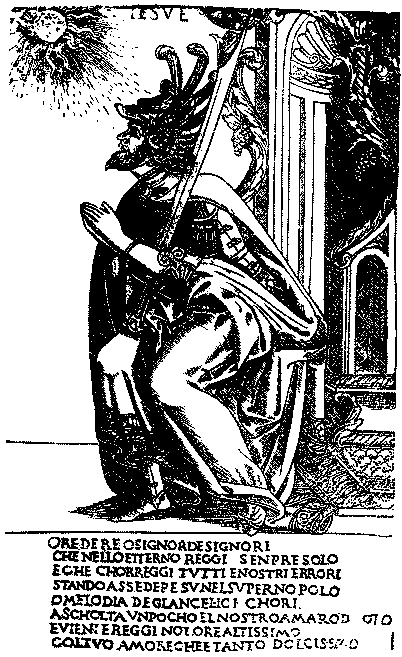
228. I. The following letter, from one of my most faithful readers, corrects an important piece of misinterpretation in the text. The waving of the reins must be only in sign of the fluctuation of heat round the Sun's own chariot:—
"Spring Field, Ambleside,
"February 11, 1875.
"Dear Mr. Ruskin,—Your fifth lecture on Engraving I have to hand.
"Sandro intended those wavy lines meeting under the Sun's right[BH] hand, (Plate V.) primarily, no doubt, to represent the four ends of the four reins dangling from the Sun's hand. The flames and rays are seen to continue to radiate from the platform of the chariot between and beyond these ends of the reins, and over the knee. He may have wanted to acknowledge that the warmth of the earth was Apollo's, by making these ends of the reins spread out separately and wave, and thereby inclose a form like a flame. But I cannot think it.
"Believe me,
"Ever yours truly,
"Chas. Wm. Smith."
II. I meant to keep labyrinthine matters for my Appendix; but the following most useful by-words from Mr. Tyrwhitt had better be read at once:—
"In the matter of Cretan Labyrinth, as connected by Virgil with the Ludus Trojæ, or equestrian game of winding and turning, continued in England from twelfth century; and having for last relic the maze[BI] called 'Troy Town,' at Troy Farm, near Somerton, Oxfordshire, which itself resembles the circular labyrinth on a coin of Cnossus in Fors Clavigera. (Letter 23, p. 12.)
"The connecting quotation from Virg., Æn., V. 588, is as follows:
'Ut quondam Creta fertur Labyrinthus in alta Parietibus textum cæcis iter, ancipitemque Mille viis habuisse dolum, qua signa sequendi Falleret indeprensus et inremeabilis error. Haud alio Teucrün nati vestigia cursu Impediunt, texuntque fagas et prœlia ludo, Delphinum similes.'"
Labyrinth of Ariadne, as cut on the Downs by shepherds from time immemorial,—
Shakespeare, 'Midsummer Night's Dream,' Act ii., sc. 2:
"Oberon. The nine-men's morris[BJ] is filled up with mud; And the quaint mazes in the wanton green By lack of tread are undistinguishable."
The following passage, 'Merchant of Venice,' Act iii., sc. 2, confuses (to all appearance) the Athenian tribute to Crete, with the story of Hesione: and may point to general confusion in the Elizabethan mind about the myths:
"Portia. ... with much more love Than young Alcides, when he did reduce The virgin-tribute paid by howling Troy To the sea monster."[BK]
Theseus is the Attic Hercules, however; and Troy may have been a sort of house of call for mythical monsters, in the view of midland shepherds.
FOOTNOTES:
XI.
"Obediente Domino voci hominis."