Chapter XI
Reading edition
RENAISSANCE ARCHITECTURE IN GREAT BRITAIN
It was only by very slow degrees that the Renaissance style was introduced into England, native architects and those for whom they worked having clung with almost pathetic devotion to the traditions of the past. At the end of the 15th century the Gothic style was still in full vigour on this side of the Channel, and although early in the 16th century it was to a great extent modified by the influence of the foreign artists who were attracted to the court of Henry VIII by the lavish patronage of the young monarch, it continued to the end of the century to check the development of pure Renaissance, the two styles to a great extent neutralising each other.
It is significant of the change of the attitude of rulers and ruled towards religion that took place in England during the 16th and 17th centuries, that it was no longer in churches and cathedrals that architecture achieved its greatest triumphs, but in palaces, manor-houses, colleges, and places of public entertainment. No longer was the soaring Gothic style to voice in stone the aspirations of worshippers for closer intercourse with the divine; the best energies of architects were henceforth to be directed to the promotion of comfort and luxury in private life, and for the realisation of this comparatively ignoble aim the revived classic style was peculiarly adapted. True, the spirit of the Renaissance did not display itself so fully in architecture as in other branches of human endeavour, but for all that its working was very apparent, assuming a certain character of its own in England.
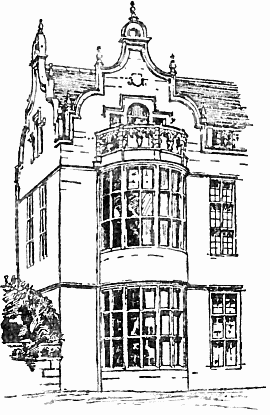
Portion of Lilford Hall, Northants
First Italians, amongst whom the most distinguished were Torregiano, designer of the tomb of Henry VII in Westminster Abbey, Giovanni da Majano, and Giovanni da Padua, the architect of Longleat in Wiltshire, then Flemings and Germans, none of whom, however, except John of Cleves, designer of Caius College, Cambridge, rose to any special eminence, endeavoured to graft their own upon English methods, succeeding with rare exceptions only so far as the minor details of ornamentation were concerned.
It is not to these men of alien birth but to the builders and masons of rural England that the country owes the many noble residences, dating from the late 16th and early 17th centuries, that, Gothic so far as their principles of construction are concerned, are enriched or spoiled, according to the point of view from which they are considered, by Renaissance ornamentation. Amongst these builders Thomas Holt, author of the Divinity School of Oxford, and Robert Smithson and John Thorpe, joint designers of Wollaton Hall, Northamptonshire, were especially distinguished. To the last named many critics also attribute Holland House, London, Rushton, Kirkby and Apethorpe Halls in Northamptonshire, and Knowle House in Kent, all of which are truly typical examples of English 16th or early 17th domestic or academic architecture at its best. To about the same period belong Lilford Hall, Northants, Westwood, Bolsover, Charlton, and Hatfield Houses, all somewhat wanting in the dignified simplicity of plan of the work of the men quoted above, but with an undoubted charm of their own.
The master-builders who alike designed and executed the many beautiful mansions and colleges of the Elizabethan age—with whom must be associated the later John Abel, designer of several fine market-halls, including those of Kingston, Hereford, and Leominster—may justly be said to have paved the way for Inigo Jones, the first Englishman to introduce pure Renaissance architecture into his native land. Already before his advent these humble predecessors had partly evolved, out of the mediæval castle and the mediæval cottage, what was to become the typical English home, bringing about something like a revolution in planning by the innovations introduced by them with a view to admitting more air and light, and rendering access to the upper floors easier by the substitution of an internal staircase, for the external flight of steps leading up to each separate room hitherto the fashion.
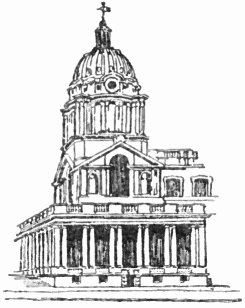
Gifted with a vivid imagination and a rare faculty of design, Inigo Jones succeeded in so adapting Italian ideals, especially those of Palladio, to English needs, that he may justly be said to have founded something approaching to a national style. Unfortunately few of the many schemes evolved by him were carried out in their entirety, but his plans and drawings prove him to have been the equal and, in some respects, even the superior of his great successor, Sir Christopher Wren. Of his grand design for the new Palace of Whitehall after the fire of 1619, the Banqueting Hall, considered his masterpiece, alone was completed, but he was the real architect of the equally successful Greenwich Hospital, for it was his plan that was followed after his death by Wren.
Although it is the custom to dwell much on the unique opportunity afforded to Sir Christopher Wren by the great fire of 1666, there is no doubt that even without it he would have set his seal on the period during which he lived. His additions to Hampton Court Palace are most dignified and appropriate, his semi-Gothic Tom Tower at Oxford well illustrates his keen sense of environment, and his design for a Royal Palace at Winchester, had it been carried out, would have given to that city a building worthy to rank with its cathedral. As it is, his fame rests chiefly on his work in London, although the masterly scheme he drew up for the rebuilding of the whole town had to be considerably modified.
Portion of Greenwich Hospital
S. Paul's Cathedral, that dominates the vast agglomeration making up the modern capital, reflects, in its solemn and dignified beauty, almost as clearly as did a mediæval ecclesiastical Gothic edifice, the spirit of its age, during which the Puritan replaced the Roman Catholic ideal, and a rigid Protestantism became the religion of the people. Of noble and most harmonious proportions, S. Paul's is cruciform in plan, every portion of its exterior and interior subordinated to the great central dome, that, consisting as it does of an outer and inner vault, is equally impressive whether seen from within or from without. From whatever point of view, the dome, with its graceful lantern surmounted by a cross, remains the central feature of a structure at unity with itself, consistent in every detail, the western towers and the great central portico with their appropriate classic pilasters and columns all being in complete and satisfying accord.
The Churches of S. Stephen, Walbrook, S. Andrew, Holborn, S. James, Piccadilly, S. Clements Danes, S. Bride's, Fleet Street, and Bow are amongst the finest designed by Wren. The steeples of the last three are especially noteworthy as the earliest examples in England of the use of that feature in Renaissance buildings.
Sir Christopher did not pass away until the 18th century, which was to witness a rapid decline of architecture in England. His influence had begun to wane even before his death, and few of his immediate successors, with the exceptions of his pupils, Nicholas Hawkesmoor, architect of S. George's, Bloomsbury, and other London churches of similar design, and Sir John Vanburgh, who designed Castle Howard and Blenheim Palace, rose to eminence. James Gibbs, designer of the Ratcliffe Library at Oxford, also did some good work; the brothers Adam successfully imitated classic forms in certain London and Edinburgh buildings, and Sir Robert Taylor won some distinction by the Halls erected by him in Herefordshire and Essex.
Towards the close of the century a classic revival inaugurated by Sir William Chambers, designer of Somerset House, took place in England, and it became the fashion to add a Greek portico to every important public or private building. Typical examples of the new departure are S. Pancras Church, London, that is a kind of compilation from the Parthenon, the Erectheum, and the Temple of the Winds at Athens, and S. George's Hall, Liverpool, a skilful adaptation of the design of a hall of one of the great Thermæ of Rome.
Early in the 19th century a reaction took place against the classic style, which was not really adapted to the English climate, and architects began to show a desire to revert to Gothic traditions. In this new movement Sir Charles Barry took the lead. The Houses of Parliament, in the latest phase of the style, considered his masterpiece, is specially successful in its general plan and in the picturesqueness of its exterior. With Sir Charles Barry must be associated Augustine Pugin, a man of fine genius and originality, with a genuine feeling for mediæval Gothic, Norman Shaw, and Bodley, all of whom have done much to leaven the utilitarian tendencies of modern times.
INDEX
Alhambra, the, 42
Amiens Cathedral, 65
Amphitheatres, Roman, 28
Anglo-Norman style, 54
Anglo-Saxon style, 53
Arch, vi
Arches, Roman, 30
Architecture, definition of, v
Asiatic architecture, 9
Assyrian architecture, 9
Babylonian architecture, 9
Baptisteries, 35
Basilicas, Roman, 26
Baths, Roman, 27
Buddhist architecture, 12
Buvards, v
Byzantine architecture, 24, 36
Caryatid Porch, 21
Castles, Norman, 59
Cathedrals. See Churches
Chaityas, 11
Chartres Cathedral, 64
Chinese architecture, 13
Christian architecture, Early, 31
Churches, Anglo-Norman, 54
Anglo-Saxon, 53
Byzantine, 37
Early Christian, 31
Gothic, 62, 68, 76
Renaissance, 84
Romanesque, 47
Coliseum, 29
Cologne Cathedral, 70
Coptic architecture, 35
Corinthian style, 16, 18, 21
Doric style, 16, 18-21
Durham Cathedral, 58
Egyptian architecture, 7
Etruscan architecture, 22
Flamboyant Gothic style, 62, 65, 67
Gothic style, 50, 60
British, 72
Decorated, 73, 74, 78, 79, 80
Early English, 73, 78, 79
French, 62
German, 70
Italian, 69
Perpendicular, 73, 75, 80, 81
Spanish, 68
Greek architecture, 13
Hindu architecture, 12
Indian architecture, 11
Ionic style, 16, 18, 21
Jones, Inigo, 90
Keystone, vi
Lâts, 11
Lintel, vi
Mansions, English Renaissance, 90
Mastabas, 7, 10
Materials employed, v, 9, 23
Mosques, 40
Nineveh, 10
Norman style, 54
Notre Dame of Paris, 63
Palaces, Greek, 14
Persian, 10
Palaces, Renaissance, 86
Roman, 29
Pantheon, 26
Parthenon, 19
Persian architecture, 9, 10
Peruvian architecture, 13
Pyramids, 7
Rayonnant Gothic style, 62, 67
Renaissance style British, 88
European, 83
French, 87
Italian, 83
Rococo style, 88
Roman architecture, 22
Romanesque style, 45
Roofing, arcuated and trabeated, vi
S. Ambrogio, Milan, 48
S. Marco, Venice, 39
S. Paul's Cathedral, 91
S. Peter's Cathedral, Rome, 84
S. Sophia, Constantinople, 38
Saracenic architecture, 40
Stambhas, 11
Stupas, 11
Taj Mahal, 44
Temples, Babylonian, 10
Egyptian, 8
Greek, 15, 18
Indian, 11
Tombs, Egyptian, 7
Greek, 21
Persian, 10
Topes, 11
Tudor style, 73, 76
Tuscan style, 24
Vaulting, Gothic, 61
Roman, 24
Romanesque, 45
Viharas, 11
Voussoirs, vi
Westminster Abbey, 76, 78, 81
Wren, Sir Christopher, 90
THE PEOPLE'S BOOKS
General Editor—H. C. O'NEILL
"With the 'People's Books' in hand there should be nobody of average intelligence unable to secure self-education."—Sunday Times.
NOW READY (February 1914)
THE FIRST NINETY-SIX VOLUMES
1. The Foundations of ScienceBy W. C. D. Whetham, M.A., F.R.S.
2. Embryology—The Beginnings of LifeBy Prof. Gerald Leighton, M.D.
3. BiologyBy Prof. W. D. Henderson, M.A.
4. Zoology: The Study of Animal LifeBy Prof. E. W. MacBride, M.A., F.R.S.
5. Botany; The Modern Study of PlantsBy M. C. Stopes, D.Sc., Ph.D., F.L.S.
7. The Structure of the EarthBy Prof. T. G. Bonney, F.R.S.
8. EvolutionBy E. S. Goodrich, M.A., F.R.S.
10. HeredityBy J. A. S. Watson, B.Sc.
11. Inorganic ChemistryBy Prof. E. C. C. Baly, F.R.S.
12. Organic ChemistryBy Prof. J. B. Cohen, B.Sc., F.R.S.
13. The Principles of ElectricityBy Norman R. Campbell, M.A.
14. RadiationBy P. Phillips, D.Sc.
15. The Science of the StarsBy E. W. Maunder, F.R.A.S.
16. The Science of LightBy P. Phillips. D.Sc.
17. Weather ScienceBy R. G. K. Lempfert, M.A.
18. Hypnotism and Self-EducationBy A. M. Hutchison, M.D.
19. The Baby: A Mother's BookBy a University Woman.
20. Youth and Sex—Dangers and Safeguards for Boys and GirlsBy Mary Scharlieb, M.D., M.S., and F. Arthur Sibly, M.A., LL.D.
21. Marriage and MotherhoodBy H. S. Davidson, M.B., F.R.C.S.E.
22. Lord KelvinBy A. Russell, M.A., D.Sc., M.I.E.E.
23. HuxleyBy Professor G. Leighton, M.D.
24. Sir William Huggins and Spectroscopic AstronomyBy E. W. Maunder, F.R.A.S., of the Royal Observatory, Greenwich.
26. Henri BergsonBy H. Wildon Carr, Litt.D.
27. PsychologyBy H. J. Watt, M.A., Ph.D., D.Phil.
28. EthicsBy Canon Rashdall, D.Litt., F.B.A.
29. Kant's PhilosophyBy A. D. Lindsay, M.A. of Balliol College, Oxford.
32. Roman CatholicismBy H. B. Coxon. Preface, Mgr. R. H. Benson.
33. The Oxford MovementBy Wilfrid Ward.
34. The Bible and CriticismBy W. H. Bennett, D.D., Litt.D., and W. F. Adeney, D.D.
36. The Growth of FreedomBy H. W. Nevinson.
37. Bismarck and the Origin of the German EmpireProfessor F. M. Powicke.
38. Oliver CromwellBy Hilda Johnstone, M.A.
39. Mary Queen of ScotsBy E. O'Neill, M.A.
40. Cecil John Rhodes, 1853-1902By Ian D. Colvin.
41. Julius CæsarBy Hilary Hardinge.
42. England in the MakingBy Prof. F. J. C. Hearnshaw, M.A., LL.D.
43. England in the Middle AgesBy E. O'Neill, M.A.
44. The Monarchy and the PeopleBy W. T. Waugh, M.A.
45. The Industrial RevolutionBy Arthur Jones, M.A.
46. Empire and DemocracyBy G. S. Veitch, M.A., Litt.D.
47. Women's SuffrageBy M. G. Fawcett, LL.D.
51. ShakespeareBy Prof. C. H. Herford, Litt. D.
52. WordsworthBy Rosaline Masson.
53. Pure Gold—A Choice of Lyrics and SonnetsBy H. C. O'Neill.
54. Francis BaconBy Prof. A. R. Skemp, M.A.
55. The BrontësBy Flora Masson.
56. CarlyleBy L. MacLean Watt.
57. DanteBy A. G. Ferrers Howell.
60. A Dictionary of SynonymsBy Austin K. Gray, B.A.
61. Home RuleBy L. G. Redmond Howard. Preface by Robert Harcourt, M.P.
62. Practical AstronomyBy H. Macpherson, Jr., F.R.A.S.
63. AviationBy Sydney F. Walker, R.N.
64. NavigationBy William Hall, R.N., B.A.
65. Pond LifeBy E. C. Ash, M.R.A.C.
66. DieteticsBy Alex. Bryce, M.D., D.P.H.
67. AristotleBy Prof. A. E. Taylor, M.A., F.B.A.
68. Friedrich NietzscheBy M. A. Mügge.
69. Eucken: A Philosophy of LifeBy A. J. Jones, M.A., B.Sc., Ph.D.
70. The Experimental Psychology of BeautyBy C. W. Valentine, B.A., D.Phil.
71. The Problem of TruthBy H. Wildon Carr, Litt.D.
72. The Church of EnglandBy Rev. Canon Masterman.
74. The Free ChurchesBy Rev. Edward Shillito, M.A.
75. JudaismBy Ephraim Levine, M.A.
76. TheosophyBy Annie Besant.
78. Wellington and WaterlooBy Major G. W. Redway.
79. Mediaeval SocialismBy Bede Jarrett, O.P., M.A.
80. SyndicalismBy J. H. Harley, M.A.
82. Co-operationBy Joseph Clayton.
83. Insurance as a Means of InvestmentBy W. A. Robertson, F.F.A.
85. A History of English LiteratureBy A. Compton-Rickett, LL.D.
87. Charles LambBy Flora Masson.
88. GoetheBy Prof. C. H. Herford, Litt.D.
92. The Training of the ChildBy G. Spiller.
93. TennysonBy Aaron Watson.
94. The Nature of MathematicsBy P. E. B. Jourdain, M.A.
95. Applications of ElectricityBy Alex. Ogilvie, B.Sc.
96. GardeningBy A. Cecil Bartlett.
98. Atlas of the WorldBy J. Bartholomew, F.R.G.S.
101. Luther and the ReformationBy Leonard D. Agate, M.A.
103. Turkey and the Eastern QuestionBy John Macdonald, M.A.
104. ArchitectureBy Mrs. Arthur Bell.
105. Trade UnionsBy Joseph Clayton.
106. Everyday LawBy J. J. Adams.
108. ShelleyBy Sydney Waterlow, M.A.
110. British BirdsBy F. B. Kirkman, B.A.
111. SpiritualismBy J. Arthur Hill.
112. Kindergarten Teaching at HomeBy Two Members of the National Froebel Union.
113. SchopenhauerBy Margrieta Beer, M.A.
114. The Stock ExchangeBy J. F. Wheeler.
115. ColeridgeBy S. L. Bensusan.
116. The CrusadesBy M. M. C. Calthrop.
117. Wild FlowersBy Macgregor Skene, B.Sc.
118. Principles of LogicBy Stanley Williams, B.A.
119. The Foundations of ReligionBy Stanley A. Cook, M.A.
120. History of RomeBy A. F. Giles. M.A.
121. Land, Industry, and TaxationBy Frederick Verinder.
LONDON AND EDINBURGH: T. C. & E. C. JACK NEW YORK: DODGE PUBLISHING CO.