ARCHANGEL (continued 2)
Reading edition
There were six principal American battlefronts: Pinega, Onega, the Vologda Railway, Kodish, the Vaga River, and the Dvina. Each of these in the war of North Russia formed a distinct episode quite apart from the others. The soldiers on the Dvina were entirely in ignorance of the fate of their companions on the Railway. At other points in the interior many did not even know that there were American outposts at Onega and Pinega; and so the history of the expedition must of necessity be a series of disjointed apparently fragmentary accounts of each separated battleground—in truth a description of six little campaigns with only one point of contact, that all Americans went out from Archangel in the fall of 1918 and in spring the following year those who still lived quit (under orders), from the same quarter.
Twice during the expedition an attempt at liaison was made between the Railway and its theoretical supporting flanks, Onega and Kodish, and Shred Mekrenga, but both occasions demonstrated that cooperation was impossible. The other forces on the rivers and at Pinega were as unrelated as if they had been situate at opposite poles. Each operated an independent, unconnected war, learning about the other fronts only through wild and distorted rumors of disasters, and hearing from far off Archangel only intermittently.
Thus the Allied North Russian Expedition melted away in the snows, and the first flushed extravagant egoistic ambition of conquest and aggression was followed by a sober appraisal of the grave peril of annihilation.
When the policy of aggression had been carried so far that it was too late to change, General W. E. Ironside assumed command. He was a great tower of a man, the embodiment of soldierly force and resolution. He directly announced that all ideas of a further offensive were abandoned and that all fronts from thenceforward would be content to hold their ground.
General Ironside has been criticised adversely for not withdrawing his scattered troops to Archangel to await the breaking up of ice in spring, when ships could enter the harbor and the fiasco be terminated by evacuation of Russia. But this criticism is unfair and unwarranted.
It was too late for such a change of policy. It would have been disheartening to the defenders of these distant fronts after the costly toll of the defense to have abandoned their hard fought posts. It would have been a giving of ground that would have heartened the enemy and thrilled him with new life; for the Bolsheviks were never exalted by victory, they paid dearly for every inch they gained, and our men, except when overwhelmed on the Vaga, never retreated from a position which they had fortified and determined to hold.
There were no prepared defenses on the outskirts of Archangel, and the defensive garrisons between the front lines and the city were far separated and inadequately fortified to withstand an extensive assault. Transportation of the retreat over the deep snowed roads would have been beset with terrible and afflicting hardship. There were long, cruel snow spaces between the villages that lay along the backward way and very scanty opportunities for shelter.
The task given to General Ironside, to retrieve the North Russian Expedition, was not within the range of human accomplishment. He did the best he could with the means at hand, which was to hold grimly on until those who directed from far off Europe, and who knew nothing of the gravity of the situation, or did not appear concerned if they did know, came to some sort of decision.
General Ironside conducted his defensive campaign with inspiring leadership, with unfailing heartsome courage; and he won the sympathy of all by his rare tact and understanding, and the affection of all by his consideration for the men, his efforts to stay the casualty lists.
4. The want of a definite moral purpose.
Since the days of Thermopylae, the effect of spiritual stimulus upon the fighting qualities of fighting men has been known the world over. The military people make a concrete thing of this, and attempt to diagram it, analyze and classify it in their treatises, where they call it morale.
As well might one try to reach out and touch any other manifestation of the soul. This exaltation that comes over soldiers and makes them glad to die, firm in their faith of the sacred character of their cause is above all finite measurements.
It is the purging light of the spirit that floods men's souls and raises them aloft from the restraining imprisonment of physical being to the heights of the gods. On no other grounds can one explain the superhuman valor of the lone Cheshire Company of the "Contemptibles," which, in the retreat from Mons, held up until dusk a German column of three battalions.
The French had morale at Verdun when they said, "They shall not pass," and fulfilled the eloquence of their words by the offering of their bodies.
The Americans had morale at Chateau-Thierry.
SITUATION MAP—Showing principal battlefronts
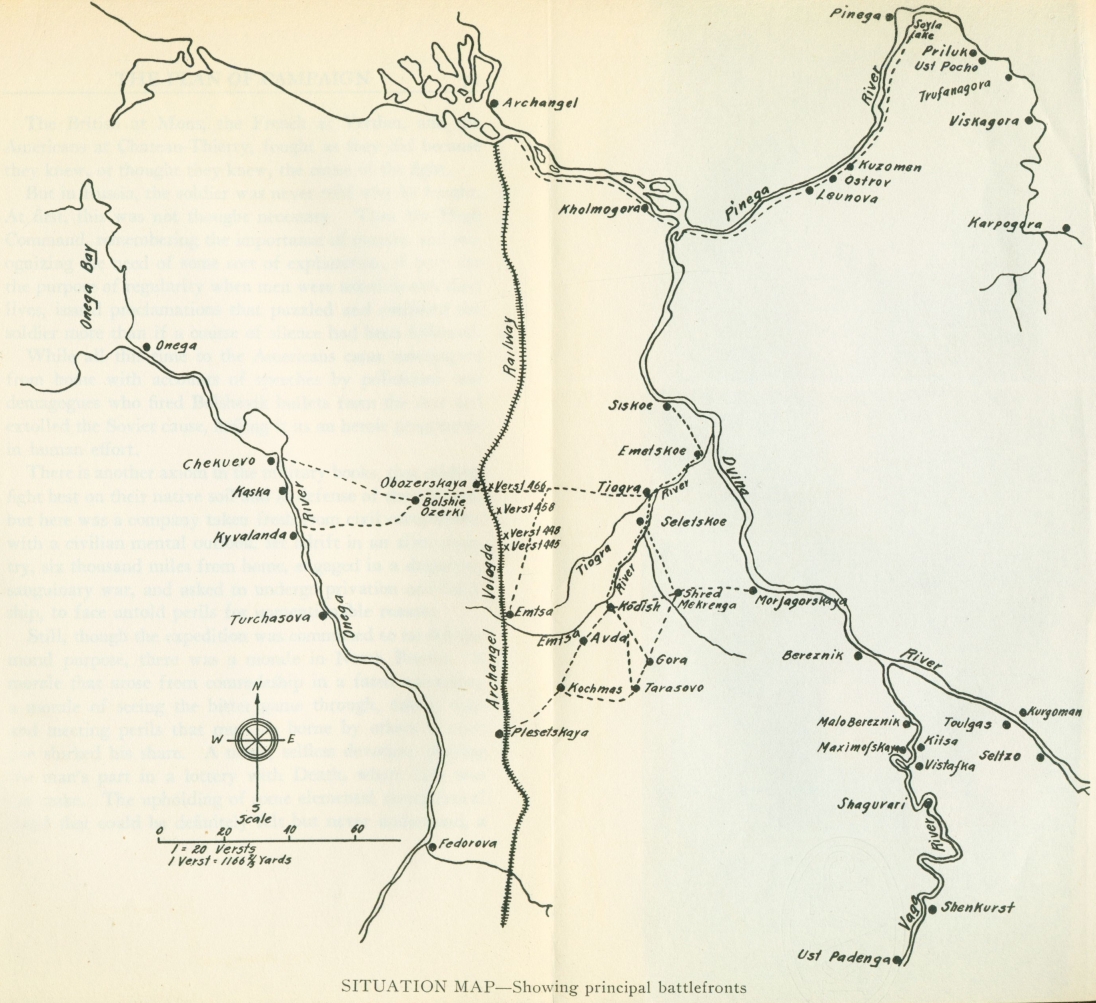
The British at Mons, the French at Verdun, and the Americans at Chateau-Thierry, fought as they did because they knew, or thought they knew, the cause of the fight.
But in Russia, the soldier was never told why he fought. At first, this was not thought necessary. Then the High Command, remembering the importance of morale, and recognizing the need of some sort of explanation, if only for the purpose of regularity when men were asked to risk their lives, issued proclamations that puzzled and confused the soldier more than if a course of silence had been followed.
While all this time to the Americans came newspapers from home with accounts of speeches by politicians and demagogues who fired Bolshevik bullets from the rear and extolled the Soviet cause, hailing it as an heroic progression in human effort.
There is another axiom in the military books, that soldiers fight best on their native soil and in defense of their homes; but here was a company taken fresh from civil occupations, with a civilian mental outlook, set adrift in an alien country, six thousand miles from home, engaged in a desperate, sanguinary war, and asked to undergo privation and hardship, to face untold perils for unmentionable reasons.
Still, though the expedition was committed to no definite moral purpose, there was a morale in North Russia. A morale that arose from comradeship in a fated enterprise, a morale of seeing the bitter game through, taking risks and meeting perils that must be borne by others if even one shirked his share. A noble, selfless devotion, playing the man's part in a lottery with Death, where Life was the stake. The upholding of some elemental metaphysical creed that could be definitely felt but never understood, a code of challenged manhood that had come down through many generations of warring ancestors—this was the morale of North Russia; it brought forth the best and the purest in our manhood, and recorded deeds that no survivor can recall without quickening heart beats, and a profound belief from what he saw, that the spirit is supreme and triumphs over the body of man.
5. The Russian people did not rally to the Allied Cause.
If the fight was for Russia, the Russian people were cold and apathetic, the worst of ingrates. Many Russians had the impression that we had come to restore another Romanoff to the throne.
The statement of the American government, with respect to the reasons for military intervention, put the case as if the Allies were engaged in a high-minded, selfless service for Russia, but the great mass of moujiks were indifferent to our immolation, and showed undisguised relief when we finally and ignominiously quitted their country.
During early August, a government of the north had been installed at Archangel by a coalition of Cadets, Minimalists, members of the People's Party and Social Democrats, with a bourgeois cabinet and with an old man, Nicolai Tschaikovsky, as President of the province. But it was a fact known to all that the Allies determined the policies of this government, that it was in fact merely a guise for an Allied Protectorate.
This government of the North it was that had invited military intervention; but had a plebiscite been called, the people would have registered their voice in unmistakable terms and volubly Russian "Let us alone. Nitchevoo."
Thus the campaign was another effort of England to impose her will upon an inferior people, and bring them for their own good to a higher order of things, disregardful of their volition in the premises. It was an echo of South Africa and Egypt, Mesopotamia and India, inspired by that lofty faith in Britain and the immortal commission of the Empire to rule an afflicted world and bring the blessings of sustained order, where only trouble and chaos prevailed before.
In Archangel, an ambitious attempt was made to recruit Russians under the high sounding name of The Slavo British Allied Legion, and after most energetic efforts, about two thousand starved moujiks, seeking something to eat, joined the ranks; indifferent mercenaries never to be trusted in the tight positions. They were given the khaki of the Tommy, but there all resemblance to the British men of war ended. Their pay was in worthless rubles. They were given an inferior ration, were treated patronizingly. Between them and the Allied soldiers there never was that generous comradeship that leaps the restraints of divergent language and manners when men fight shoulder to shoulder for life and some things that are more dear than life itself. It was a case of alien spirit above all else. British officers never could understand why the Russian officers, with the acute, sensitive nature of the Slav, were quick to feel and keen to resent, seemingly studied slights and snubs and discourtesies. Russians of culture and refinement never could penetrate the unfailing reticence and frigid unsympathetic exterior in which gentlemen of England have been schooled for generations beyond memory, habitually to conceal the emotions.
When the utter failure of the volunteer system became certain, thousands of Russians were coerced into the army by a draft system; but these failed too, because their hearts were cold to Russian patriotic British appeals; because there was no great moral issue, no moving cause for the fight.
The war with Russia was in fact a typical British show, conducted by that conquering people who have spread the dominions of the mother country to every shore of the far seas. A war that was waged with the invincible will, that noble effacement of physical comfort; that indomitable purpose and masterful determination; that courage and careless naivete, and contempt of danger and risk; that splendid sportsmanship, that love of fair play; and all the sublime self sufficiency, all the muddling, blundering and fuddling, the lack of understanding, the brutal arrogance and cold conceit, and apparent heartlessness and want of sympathy that are forever British.
Naturally, the British assumed direction, just as in France when the first Americans came Clemenceau and the Earl Haig demanded that they be fed piece meal to the French and British front divisions; but the soldier, Pershing, sensing the important moral value of having his men go to battle under the American flag and directed by American officers, waited and would not yield to the strongest pressure. And it was an American army that brought us to glory at Saint Mihiel and Chateau-Thierry and the Argonne forest; an all-American army led by American divisional commanders.
There are racial differences, racial prejudices, racial disparities, and racial asperities that cannot be gainsaid even under the influence of impersonal military discipline, and experience has shown that soldiers yield a more ready obedience to leaders who speak their own language; understand the philosophy of their daily lives, and at no other time did General Pershing so demonstrate his greatness, his complete understanding of the perplexities in Allied military organization as by his courageous insistence upon the solidarity of the American army on the battlefields of France.
But in Russia the American regiment was at once merged with the British Command, and from first action until the end of the campaign, British Headquarters directed and controlled the dispositions and conduct of the Americans.
At Archangel there is a modern, spacious white building, and here from steam-heated headquarters Colonel George W. Stewart commanded the United States 339th Infantry, here were quartered his staff officers, the unemployed "brains" of our Northern American army. He never saw any part of his regiment in action. For a long time I believe he had not even a vague notion regarding the location of his British dissipated troops.
Embassies of France and Serbia, Poland, and Italy were in Archangel, and the American Ambassador, David R. Francis, came from Vologda there early in August, and stayed until sickness compelled him to leave for England during the winter. And there was an American Military Attache who developed into a Military Mission with Colonel James A. Ruggles as chief, and a staff of officers to assist him. Also there was an American Consulate, with an American Consul General, Dewitt C. Poole, who at times appeared to take over a supervision of the American share in this strange, strange war with Russia.
And over across the harbor at Bakaritza, a well-fed Supply Company watched over mountains of rations and supplies that had been brought all the way from far off America; supplies and little good things and comforts that would have heartened and brought new life and hope to the lonely, abandoned men on the far fighting lines in the snow. These supplies never reached the front, but the Supply Company, with American business shrewdness and American aptitude for trading, acquired great bundles of rubles, and at the market place converted these into stable sterling, and came out of Russia in the springtime with pleasant memories of a tourist winter; likewise a small fortune securely hid in their olive drab breeches. But there were others who ate their hearts away, fretting and chafing, in Archangel, whose petitions to go to the front to play the man's game were denied by those in command.
British G.H.Q. brought six hundred surplus officers and forty thousand cases of good Scotch whiskey. Some of the officers had come frankly in search of a "cushy job" in a zone they thought safely removed from poison gases and bombardments and all the hideous muck of the trenches. Others, much to their disgust, had been sent to the polar regions because some one in Headquarters had thought they possessed some peculiar qualification to command or "get on" with imaginary Russian regiments that were to spring to the Allied Standard.
So it was that Archangel became a city of many colors, as gallant, uniformed gentlemen strode down the Troitsky Prospect, whipping the air with their walking sticks, and looking very stern and commanding, as they answered many salutes, in a bored, absent-minded way.
There were officers of the Imperial Army, weighed down with glittering, ponderous honor medals, and dark Cossacks with high gray hats, and gaudy tunics, and murderous noisy sabers. Handsome gentlemen of war from England, from Serbia, Italy, Finland, France, and Bohemia, and many other countries, all arrayed in brilliant plumage, and shining boots, and bright spurs, and every other kind of "eye wash." And, of course, there were large numbers of batmen to shine the boots and burnish the spurs, and keep all in fine order, and other batmen to look after the appointments of the officers' club, and serve the whiskey and soda.
In the afternoons there were teas, and receptions and matinees, and dances in the evening, when the band played and every one was flushed with pleasure and excitement. Such flirtations with the pretty barishnas, such whispered gossip and intrigue and scandal in light-hearted Archangel!
At Kodish, at Onega on the Vaga, and at Toulgas, far off across the haunting snows, sick men and broken men, men faint from lack of nutrition, and men sickened in soul, were doing sentry through the numbing, cold nights, because there were none to take their places in the blockhouses, and no supports to come to their relief, no reserves to hearten them and give them courage.
The blockhouses so far away, where men were maimed and crippled and shell shocked, and the black hopelessness that crept into men's hearts, and strangled men's hearts, and overcame their soldier spirit—in the blockhouses—far, so far off from gala Archangel.
THE RAILWAY
"We are not declaring war, nor making war on the Lenine and Trotsky government, because it is not our affair."
SENATOR HITCHCOCK, Chairman of Foreign Relations Committee in the Senate of the United States. 13th February, 1919.
V
THE RAILWAY
When the troops of Poole's first expedition divided at Archangel, and one group was sent up the Dvina; another which was a part of the French Colonial battalion was told off for pursuit of the Bolsheviks down the Archangel-Vologda railway.
Hot and eager for first blood, the French hurried forward until the Kayama River was reached, where the enemy made an unexpected stand. There was a sharp engagement, the Bolsheviks were severely punished, and one hundred and fifty prisoners fell to the Allies.
But a little further, at Obozerskaya, some hundred miles south of Archangel, the despised fugitives turned again and displayed an amazing disposition for combat, entirely at variance with the cowed spirit of the feeble rear guard that had surrendered Archangel.
They came back in force and greatly outnumbered the Allies, and there was in the defiant attitude of the Red troops reason to believe that the Soviet chieftains had taken stock of the military situation, had verified the preposterous intelligence that the Three Great Powers—Great Britain, France, and the United States—were definitely bent upon war and seriously intended to invade the great domain of Russia with scarcely two infantry combat regiments!
Reports came of fast gathering Bolshevik armies at all fronts massing for attack, prepared to take offensive action on a grand scale, and, hardly had the campaign entered upon its initial phase, when the utter inadequacy of General Poole's numbers made egregiously evident the impossibility of the proposed investment by River and Railway.
The two "Columns" were in simple truth little patrol parties, and, as they drove further into the interior, the ridiculous audaciousness of their ambition to sweep the enemy from Archangel Province, and south even beyond Vologda Province, seemed almost beyond the purview of sane contemplation.
Highways for flank envelopment, and byways for encirclement, commenced to appear with discouraging frequency the further the advance developed in this unknown, speculative, shadowy hinterland, and all of these avenues for surprise attack had to be watched and safeguarded. One of these was the Vaga river, which meets the Dvina near the Allied subsidiary base at Bereznik; where an auxiliary, flanking expedition was detailed from the River Column, for this tributary is capable of floating substantial craft that could transport artillery and many infantry from the Bolshevik stronghold at Velsk in Vologda Province, and north of Velsk is Shenkurst, the second city of Archangel, with a political significance that could not be neglected by this politico-military excursion into the interior of Russia.
If left unguarded, the Vaga would be an open invitation for the Bolsheviks to capture this supply depot, Bereznik, and gain the rear of the Allied Dvina forces.
Many other routes for enemy movement developed as the invasion paused, undecided whether to retire for consolidation, or to try to plug up these many openings for enemy movement, and as the Command stood hesitant, still other approaches by flank and rear were revealed.
It was (or became) known that the headquarters of the Sixth Bolshevik Army was stationed at the city of Vologda, from which its commander could send troops north along the railway, and assail the Allied frontal position, or detrain, and move his men on roads and trails that took off along this route and led to the Allies' flanks and rear.
One of these roads follows down the Onega valley north to the port of Onega.
At Chekuevo, it is nearly opposite the Allied advanced railway position, Obozerskaya, and these two villages are joined, fifty miles cross-country, by a good roadway that in winter is capable of supporting artillery carriage. Some fifteen miles west from Obozerskaya, on the same road, Bolshie Ozerki, several groups of moujik huts, lies in sprawling confusion.
Late in the winter, a pitiful little outpost of French and friendly Russians, an immolation to this campaign of invincible folly, was destroyed at Bolshie Ozerki in a massed enemy effort that sought to annihilate the whole Expedition.
A few platoons of American infantry were stationed at Onega to shield Archangel from the west, and to watch this Onega, Chekuevo, Bolshie Ozerki, Obozerskaya communication line, which linked up Archangel with Murmansk, and, during the frozen months, was the only outlet to the world beyond the Arctic Sea.
The main Bolshevik stronghold north of Vologda was at Plesetskaya, some fifty miles south of the furthermost position of the Allies on the railway, from which an Imperial Government highway reached out through Archangel Province northeast as far as Emetskoe, on the Dvina, passing through the villages Kochmas, Avda, Kodish, and Seletskoe, near the Emtsa river. At Kochmas, another road branched east to Tarasovo, thence north through Gora and Shred Mekrenga.
From Shred Mekrenga and Seletskoe, the enemy could have access to the lower Dvina, head off all supply convoys for the Dvina and Vaga columns; and hold the Allies trapped far up stream. Therefore, two more auxiliary expeditions were organized, and, instead of two invading "Columns," the Allied forces, woefully insufficient at the outset, were operating in seven columns, separated detachments, advance parties, outguards, outposts, flanking forces, and all along the Dvina, from Kholmogora to Bereznik, a stretch of one hundred miles, were still other detached soldier groups watching the treacherous way from Archangel, a Cossack Post in one village, a squad in another, in still another a platoon, all without communication and completely undefended in case of real attack.
There was unlimited chance for rear movements along that tenuous, unprotected, communication line. General Ironside would have massacred the Bolsheviks had positions been reversed. The Germans would have annihilated the Allied North Russian Expedition with half the numbers that the Bolsheviks had.
During the winter, several circling movements were essayed, but never on a scale of comprehensive organization; at Morjagorskaya, in February, and at Shred Mekrenga, the enemy came closest to success, but at both places was stopped by the gallant British, and when spring came his chances vanished, the bogging quagmire precluded any further offensive. But while the Bolsheviks did not destroy the Expedition, they soon reduced the invasion to a series of desperate, detached, outguard actions, and the River and Railway Columns that were to have entered Kotlas and Vologda with the coming of the first snow, were flung far and broad over vast Archangel, as the effort "to stage a real show with two men and an orange" wilted with the first snow, a dismal, ghastly "washout."
Even when the Americans reached Archangel in September, the campaign had already assumed a defensive character. Indeed, so serious was the outlook that they were rushed from the troop-ships, shunted off to Russian box cars, and consigned with expeditious haste to the Railway Front.
Nothing of this was known to these new zealous soldiers off from a brief military training encampment to the very heart of war's purple, glamourous adventure. And it is doubtful whether they could have realized the significance of the military situation, even had it been communicated to them. In a few crowded weeks, so many stirring events had thronged their heretofore placid lives that these recruits from Michigan and Wisconsin were buried beneath a bewildering wilderness of amazing impressions through which confused, alien scenes and persons and places trooped in phantom and fantastic multicolored parade, until their minds were stunned beyond the power of further reception.
During the long voyage, a few still civilian in mind, had recovered sufficient equipoise to inquire about the connection between a war in Russia against Germany, but the inquiry was so unproductive, so futile, and there were so many eccentric twists and turns to this stupendous world madness that in most part they soon fell into that fatalistic philosophy of all soldiers; most of them were content to place their unbounded trust in those who sat in the high places and whose omniscience guided from afar. It was far more quieting, vastly more satisfactory.
Once, during that swaying night journey, from Archangel to the battle line, the decrepit Russian locomotive gasped convulsively and stood still by an old station of huge logs, and, under the lurid light of a flaming torch, was revealed a trainload of prisoners, passing north from the scene of hostilities somewhere below. They made an unheroic spectacle, with their shrinking countenances and unsoldierly, nondescript uniforms, so that some American wag, in a spirit of bantering patronage, called them "Bolo wild men," a name that clung to the enemy throughout all the days of the campaign.
But the shabby prisoners, first living sign of real battle, sent a thrill up and down the spines of these young men, who were so ardent for war and knew so little about it. They sniffed the air of conflict, yearned to give the "Bolos" a taste of their quality, and promised themselves that the folks back home would have nothing to be ashamed of when they came under fire.
The next morning the depressing aspect of the dirty, unkempt group of huts where the soldiers detrained almost passed unnoticed alongside the captivating spectacle that stood on the track nearby, a ferocious war monster, with massive plates of steel like dragon's scales, huge funneled naval guns, and locomotive set in rear of trucks which were piled with sand bag barricades where Lewis automatics poked out murderously, manned by a hodge-podge Polish-Russian crew, who were themselves manned by competent appearing, war-weathered British N.C.O's.
A narrow threadlike swath trailed through the stunted starveling forest to the lowering gloom of dull, laden skies, and the hearts of the fresh, battle eager soldiers swelled big as they gazed far down the gleaming rails to the murky mystery of No Man's Land.
There was in the air a peculiar, dispiriting quality, a brooding, pensive, Russian note that cannot be made known except to those who have felt it. Stillness, heavy almost to the point of suffocation, the shroud of skies that hover mourning on the trees, and the shadow of unlifted gloom that reaches out from the forest and bears down upon the spirit with deep intangible melancholy.
Suddenly the quiet was broken by the distant boom of a heavy gun. Then an ominous whine circled from the ground, approached snarling stridently high in air, and fell with a crumbling roar seemingly very near the new soldiers, who, on command, scampered to cover from their erect column of twos on the naked embankment.
A cordon of strongpoints had been constructed around the village, Obozerskaya, and these the Americans took over, tensed for the impending battle.
But inexplicable days passed, and the Bolo did not come. There was not even a feint of attack, and the Allied Command, with short memory for the hazardous nature of its extended position, the apprehension it had felt only a little while before, began to chafe for action, became impatient; again the military fetish of an "offensive campaign" grew, waxed strong, became assertive once more, and again the ambitious vision arose to take Vologda before the snow.
"All patrols must be aggressive," directed a secret order of the officer in command, "and it must be impressed on all ranks that we are fighting an offensive war and not a defensive one."
So American officers, directed by ranking British officers, moved their companies forward to the "offensive war," and four miles beyond Obozerskaya, where a post on the railway bore the Russian characters "Verst Four Sixty Six," they closed with the Bolos and drove them beyond the bridge at Verst Four Sixty Four.
In the counter-attack that soon followed, one platoon of the Americans, separated in the swamps of the woods, was nearly enveloped. It fought until all ammunition was exhausted, and then the officer, Lieutenant Gordon Reese, had no thought of submission. After the last cartridge was gone, the bayonets still remained, and after the bayonet, came doubled fists. At word of command, the platoon fixed bayonets, went forward with a yelling charge, broke down the Bolsheviks by their sheer courage and impetuosity, and the endangered men were able to join the main body of their comrades, repulsing the attack.
Before Verst Four Fifty Eight, Allied aggressive operations were resumed when one of the French companies came back from Archangel to assist in moving against the strong enemy works. There was a bridge at Verst Four Fifty Eight. If this was destroyed, it would take a long time to rebuild and seriously impede the "offensive war" down the Railway. It was, therefore, intended to drive the Bolos back so violently that they would have no chance to detonate the important bridge.
The plan of attack was for a three-fold movement: front, right flank and rear. The French company, supported by the artillery of the armored train, an American machine gun section, and twenty-one Americans, with three Stokes mortars (who were not entirely sure of the use of these weapons) were to hit out at front. The rest of the Americans, two infantry companies, were to form as many detachments and rush the enemy from his east flank and rear at his furthermost trench back at Verst Four Fifty Five.
The frontal assault would wait on these circling movements; a bivouac in the woods, and at dawn, timed together, the three parties would move to the three-quartered battle. The distance through the woods to the enemy rear was "estimated at from six to eight miles."
But, in execution, the plan failed dismally, like many an operation that carries through flawlessly around the military council table, for "estimates" are of little use in the service of battle conduct, where time is reckoned in seconds, and victory measured in minutely fluctuating scales.
The contemplated operation was to approach the enemy flank through one of those lofty, forest aisles, which were cut with masterful, precise woodcraft by the engineers of Peter the Great, entirely transverse Archangel Province. Regularly, narrow lanes intersect these forest aisles, and it seemed to the officer planning this attack a simple thing to follow one of these lanes, and take the course of a north and south aisle until a point was reached opposite the enemy position. He did not know that those forest paths were deep with clinging, slimy morass, and bog that gave no footing, that frequently the main cuttings opened before shallow lakes of open water. There was no reliable map to show these things, and no native would admit that he knew the way.
So the attackers went forth over unknown ground, and soon were stumbling in a blackness so dense that one file could not see even the outline of the preceding file. The sinking bog made the march distressingly arduous, yet for hours the company kept resolutely on, when, without warning, the forest parted and the sodden way terminated in a wide sheet of open water.
It is impossible in the night blindness to know position or location, or how far the exhausting, laborious pace has made. Startlingly near comes the coughing exhaust of a locomotive, doubtless the armored train standing by the Bolshevik defenses on the tracks.
In their jaded and spent condition, the men are ill fit to engage in battle, yet there is nothing to do but have a go at it, so plowing through waist deep swamp and awful, oozing quagmire, they lurch on. Struggling forward, still forward, they are caught and tripped, and sprawl splashing in the cold water and the bog, but they get up and drag on until all are breathing with heavy, sobbing gasps; and under the strain of terrible exertion, all are weakened, some so done in, that they lie in the water like wounded animals on their haunches, and have to be helped forward by others of more physical strength or greater will.
In this agonizing way, perhaps a few hundred wallowing yards are made, but it is clear that the company cannot go on, and there is no hope of end to the miserable, sinking marsh; so the officers hold council, and decide, not without great reluctance, to abandon their mission, and the word is passed on to the scattered troops to follow back over the way they came.
In the darkness and the trackless morass, this is not easy, as through the endless black night the lost company struggles flounderingly and with little hope, until the heart of all is cold with despair; but more blighting than the knowledge of being lost in the wilderness of Russian swamps, and the depression of abject, physical exhaustion, is the mordant disappointment of failing the expectant French in the coming fight.
At dawn, two soldiers, who, in days of peace, had been timber cruisers in the pine woods of the Michigan Peninsula, led their comrades to ground firm enough for footing, and half dead from fatigue, brought them back to the railway, but too late, for hours before the tumult and shots of battle had reverberated from far advanced ground on the railway tracks; for, at the appointed hour, hoping that the cooperating actions would still develop, the French went in to the attack, supported by the American trench mortars and machine guns, and smashed the enemy from his foremost lines. Directly he rallied and returned in force to the counter-attack in which many French were killed, the trench mortar section was decimated and lost most of the guns, the machine gunners put out of action, and the whole little force was shoved back over much of the freshly won ground to the bridge at Verst Four Fifty Eight, where the Americans stood with braced backs and would not yield.
For two days, the Bolo armored train showered them with shrapnel, and upcasted tons of high explosives that tore glaring, wide wounds in the railway track, till theoretically they were hammered into submission, but when the Bolshevik infantry, in the gray hours of dawn and dusk, approached to take the crucial position, they were always driven to cover by a heroic defense that never failed. So the bridge was held under difficulties that would have shaken ordinary troops and caused them to fall back, but not in Russia, for that was the way of this queer little war. Priceless lives would be lost, much blood run, and stirring exploits of courage and noble sacrifices be performed, to safeguard a little bridge like Verst Four Fifty Eight, or a dirty village that objectively meant nothing. Yet what sacrilege to have breathed this to the soldiers who bled for them; for to those who risked their lives and yielded up their lives, rather than desert some little bridge or moujik village, these signified the shibboleth of North Russia.
For inordinate stress was placed upon these inconsequential, hard contended spots; they became graphic in the imagination, cardinal precepts in some strange soldier creed, altars upon which friends had given all as proof of a comradeship triumphant over self and self desire. Indeed, with the fresh recollection of courageous comrades now dead, their abiding faith in him, and the thought of those far back at home, whose eyes watched from afar with undimmed loyalty, did he not stamp himself as a craven if he failed, a mongrel thing unfaithful to his breeding?
Thus has it always been. The race has carried on by dimly understood, irrational traditions that move men to the profoundest depths and challenge elemental impulses that have descended in transmuted ancestral determinism, we know not how or why. And if we are to endure, it must be by these same primal emotions, that cause men the world over to scorn soft ease and security for the sake of a vague, inexplicable ideal; inchoate conceptions of service; passionate, stirring impulses lacking definition, which are born with life itself, reach down to the bottommost depth of nature and transcend all feeble efforts of analysis and artificial ratiocination.
So it came that the momentous bridge at Verst Four Fifty Eight stood fast, and the Bolshevik attack beat against an unyielding rock until it spent itself by its own fury. Then the position was consolidated, Allied headquarters moved nearly three miles down the railbed, and the dead, in order that there might be no interruption of the renewed offensive, were laid away in white Obozerskaya churchyard, beneath rough crosses of wood, such harsh emblems of life's surcease, and so fitting in this inflexible, cold, repellent north world.
After a fortnight of more scheming and preparation, the forest was carefully reconnoitered, a path that could be traversed was found through the swamps, in a three cornered attack, the Allied position advanced to Verst Four Fifty Five; and pressing on, the Americans and French went forward to still further battle. But now occurred an event more baneful to the Expedition than all the enemy attacks. The month was only October, but in some mysterious way, the French had already received word of the pending Armistice, and entirely unmoved by the disaster that might befall their abandoned comrades, the whole French company quit the front and went back to Obozerskaya in an ugly mood.
"The war is over in France," they argued, "why should we be fighting here in Russia when France has declared no war on Russia or the Bolsheviki?"
Ninety of the mutineers were placed under arrest, and returned to Archangel for confinement.
It is not known whether or not the Bolsheviks were directly apprised of the mutiny, but hardly had the French retired, when the enemy artillery laid down a shaking barrage, and when night came, the lone group of Americans were standing off a great horde of Bolo infantry that only waited for dawn to continue an overwhelming assault.
Clearings occurred at intervals of several miles all along the Vologda railway. Usually they were in the shape of large squares, a half mile or more across, with log stations, several woodchoppers' houses in the center, and near them piles of corded pine to feed the wood burning locomotives. The next day when the supports came up they nearly blundered on a large Bolshevik force massed for a surprise attack in one of these clearings.
With unerring, quick-witted appraisal, the American officer saw that he was outnumbered three to one, but losing no time, he divided his company into three parts and struck out from three directions of the woods, firing rapid fire, making a great commotion and noise, to give the impression of great numbers.
Most of the enemy troops were poorly disciplined and poorly led in these days of the Fall campaign, and this ruse of the three-cornered attack was carried through with such colored theatrical effect that it scored complete success. There was a brief fight, some good Americans shooting at open, closely grouped targets, and the frightened Bolshviks fled in disorder. Not only were the Americans able to relieve their threatened comrades, but the scattered Bolsheviks were followed up to Verst Four Forty Five.
Where a mill flaps its awkward wings
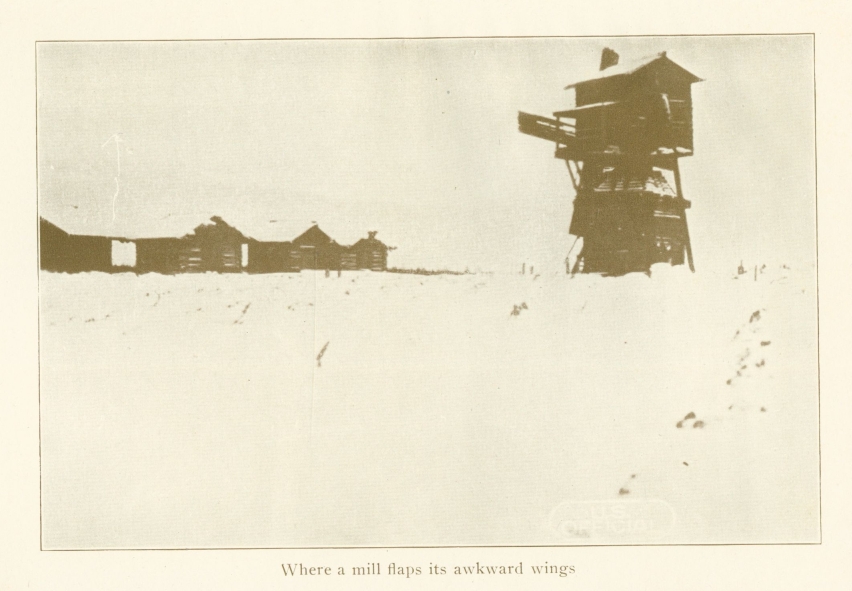
This was the furthermost point of the advance, for soon General Ironside assumed the office of Commander-in-Chief, and the "offensive war" was heard of no more. The campaign became a stalemate, each side awaiting the opponent's next move, and not till November did the Bolsheviks become aggressive again. Then they stormed the positions with great determination, but all posts held and they were thrown back with frightful loss.
The succeeding month, it was decided by the Allied Command to capture Plesetskaya, so that the enemy might be denied a base for winter movement, and the divergent Allied forces of the Railway brought together. But the effort failed. The Russian contingent that was to go on skis around the left, fifteen miles to Emtsa, floundered helplessly, became exhausted and funked out in the deep snow many miles from their objective; also the auxiliary force at Shred Mekrenga could not gain its ground; but most of all, the failure was caused by the members of the Slavo-British Allied Legion, who faithlessly deserted in large numbers and went over to their countrymen, the Bolsheviks, with full information of the Allied plans.
This marked the collapse of the invasion of Archangel, and when the cold of winter had settled, the Red leaders set busily about the task of planning the destruction of the over-extended Allied lines on six unsupported fronts, which could neither retire beyond Archangel, nor be reinforced until the remote coming of spring. It looked as if the great military machine which Trotsky assembled, would speedily crush Ironside's men, and the Moscow newspapers announced that a million Red bayonets would hurl the foreigners to the White Sea, and into it (although the sea was then solid ice), but inexplicably strange, after the failure of Plesetskaya, there were few stirring, winter days on the Railway Front, except once, when a daring Bolshevik raiding excursion on skis snatched one of the rear guns from the French (who had been shamed into returning to the front), destroyed it, and got away in the snow.
Major J. B. Nichols was at this Railway Front, a civilian officer, and the only one of the Americans in senior authority who appeared to possess a heart, and courage, and unfogged discernment. He early grasped the vain futility of the whole campaign and no cajoling or flattery or threats from Archangel could sway his refusal to engage a single man in unavailing patrols through the ambushed forests or in hazardous "blow-offs" between the contested lines, that accomplished nothing save the sacrifice of life. So for the most part the winter defense was a routine of work on the defenses, the dugouts and the fortifications, and necessary reconnaissance parties over the trails, to watch the flank approaches and to keep an eye on dangerous Bolshie Ozerki.
With ready methods of quick transportation, and an increase in the garrison by the coming of the King's Own Liverpools, it became possible to arrange spells of relief, and in March the Americans went back to Archangel.
At the front it was different. There was a tautness, a hushed, dread expectancy in the air, and life, an uncertain thing, was to be lived, like the Hedonist, for the day; there was no time to analyze the causes of one's misery or even to be more than dully conscious of it; pressing urgencies, actual or imaginary, were always occurring, and they crowded out all opportunities for contemplation and introspection.
But there was no pressure in careless Archangel, where harrowing care and disgusting, swinelike filth vanished with a wave of fairy wand and lo, the war with Russia became a magical heroic pageant. Large numbers of unemployed officers strolled the Troitsky Prospect, very merry and bright, an array of bright, varicolored ribbons, like flower gardens, flourishing on their well-arched military chests.
There was the American Supply Company at full strength, which looked very sleek and smug, and groomed well, and well fortified to withstand the rigors of the Arctic winter, who displayed extraordinary capacity for trading with the natives and astounding dexterity in the acquisition of an affluent wealth of Russian rubles.
It made a soldier sick at heart to see the good things stacked high at Bakaritza, the sweets and dainties and tobacco that would have meant so much to the homesick Vaga men and the far Dvina men who were never relieved—the cases and cases of whisky piled in mountainous piles in the warehouses at Bakaritza!
There were other cases (empty ones) outside the Officers' Club. And in the happy city, parties were held, with sparkling jollity, and entertainments, and dances, and jingling sleigh rides, and down the long toboggan run near the domed cathedral roistering funmakers with screaming laughter would glide through the exhilarating Arctic air to the white world below. The varied military were having a rather unique and amusing time of it in jaunty galliard Archangel, and none of the impassive Slavs there seemed agitated or even interested in this war to bring peace to "sad, distressed, and afflicted Russia," which had ended life for many Americans and broken the lives of many more. Russian soldiery was everywhere, Russian officers, with gaudy uniform and restored Imperialistic hauteur; and Russian soldiers drilling on the parade grounds, with a snap and a smartness that was oddly British, all fit and well-fed looking, capable of destroying untold American rations, with the appearance of being able to shoulder a musket in defense of their country if they were so minded, but with no apparent intention of being so disposed.
Every soldier knew of the scene at Alexandra Nevsky Barracks, where American machine guns were turned on the S.B.A.Ls. to put down the revolt that occurred when our Russian allies were ordered to the fighting front. And poignantly fresh was the memory of the faithless conduct that had lost Plesetskaya in December. Treachery at the front, and treachery stabbing in rear! Why should American soldiers die and suffer exposure and hardship for these heedless, indifferent people?
And if the fight was not for Russia, what was it for?
There were persistent rumors of a war to collect imperialistic claims and money obligations, and other passing rumors as errant and disordered as the Red Bolo Bolshevik propaganda that begot them. But was it altogether strange, that after this had gone on for months and months, when the soldier asked for the facts and the facts were denied him, that he should begin to wonder, and to grow almost embittered; that, in fact, one of the companies should give audible expression to its turbulence?
During the last part of March, a convoy of sleighs drew up before Smolny Barracks to carry this company and its equipment over the frozen bay of Archangel to the station where a train was waiting to take them to the Railway Front. But the men did not stir from their barracks, and the equipment was not loaded, so that the colonel of the American regiment came (somewhat hastily) from his warm quarters to learn the reason for the delay.
The colonel assembled his soldiers in a large Y.M.C.A. hall, and read them that Article of War which pronounces death as the penalty for mutiny. Then, following an impressive stillness, he asked if there were any questions. There were no inquiries concerning the Article of War, which is terse, succinct and unequivocal, but one soldier arose very respectfully and said:
"Sir, what are we here for, and what are the intentions of the U.S. Government?"
The colonel very frankly replied he could not give a definite answer to the question, but added, that regardless of the purposes of the Expedition, it was now in acute jeopardy of extinction, and the lives of all depended upon successful resistance. More silence followed.
There is a favorite disciplinary method of the military based upon basic, elementary psychics. It is invoked by all, from the drill sergeant to the general officer. The principle is the antithesis of mob psychology, and goes upon the presumption that man is a gregarious being.
At the first rumor of incipient disorder, soldiers are assembled at attention, and any man holding to minority views is commanded to step forward (usually three paces) from the ranks and expound his convictions.
Great heroes and those capable of the highest, unparalleled courage, quail at this test, for it is one thing to rebel in company, or in the secret counsels of one's inner conscience; quite another to stand out stark alone and unsupported against the strong arm of the military, the harsh, punitive, martial law of an intolerant warring nation, that can brook no infringement of combat discipline.
Therefore, when the colonel had finished, no one accepted his invitation to stand forth and declare his opposition, and the meeting was dismissed with an order to load packs and proceed to the railway.
The next day, the fury of the Bolshevik offensive which swept the Vaga, and strove to realize Moscow's boast of annihilation for the Expedition, burst at Verst Four Forty Five where this "mutinous" company took the brunt of the attack and never wavered during the ceaseless, storming battles that followed, until, at the end of the third day, the enemy sullenly retired, repulsed and defeated, and another company relieved the exhausted American line.
And often before had these same men proved their mettle. There was no finer company in the regiment than this, and no more gallant officer than its commander. It is not the nature of the American to become "cannon fodder" without a question. Theirs was only the voice of sanity raised in this madman's war; yet when they saw that all in Russia were in the same plight, that no one knew the reason why, that all were caught in the same meshes of inextricable folly, they were soldiers, and played the soldier's part unfalteringly until the untried Russian conscripts came in May.
Many Russians had been killed as enemies; so like these simple peasants in soldier uniform that came to relieve the contested lines in May; so like the bearded host under whose foul-smelling roof the American dwelt. They did not seem soldiers; so spiritless, so immobile, so unmoved by firing emotions in this civil war wherein foreign defenders had died for Russia. If they felt any gratitude, it was covered beneath an exterior of impenetrable, Slavic lethargy, that defied all effort to disrobe. Life had been a thing of rote with these moujiks, as constant as the law of seasons and of stars, and the violent change from opaque darkness to the dazzling light, left them blinded, befuddled, groping for moral support. Before they had commenced to grasp the tremendous significance of the Revolution, swift came the Bolsheviks, crashing to earth every vestige of law, stability, the social structure, property rights.
Now followed these foreign invaders, warring upon the Bolsheviks and speaking with high sounding, noble phrases of saving Russia, as they burned moujik homes and turned moujik women and children out upon the cold snows. It was too much for the poor serf's imagination. From fatalistic refuge he looked out on a howling storm-tossed universe and abandoned all hope of comprehension.
Nitchevoo. There was no reason left on earth. All had gone crazy; all were stark, raving madmen in a madman's world!
So did the curtain fall on this lurid melodrama and its fretful Railway scene, and now that the heyday of the fight was done, disquieting reflections took possession of the Americans. Their dead had died for a scant few miles on this Railway battle ground, but what the paltry little gain meant now not one could tell, nor why the fearful price was paid, and ever came distracted thoughts of the futility of it all, thoughts like howling, evil genie that ever recurred to haunt and taunt those that came away.
ONEGA
13th Feb., 1919
"Americally Sowest London for H A E F France. Due to primitive conditions of life and continuous service in the field under Arctic conditions, officers and men are beginning to feel the strain. Practically the whole Allied Command has been on continuous duty in the field all winter with no reserves in Archangel. Limited Allied reserves are now being supplied from Murmansk, a few coming on ice breakers and others by rail to Kem and then by horses and sleighs to destination. Recommend present force be entirely replaced as early as practicable in the spring, with an adequate force commensurate with its mission, supplied and equipped so that it can operate in an American way." STEWART
VI
ONEGA
General Ironside became Commander-in-Chief of the North Russian Expedition at the commencement of winter, and the "offensive war" forthwith came to an abrupt termination, without ceremony.
At that time, one company of Americans and ninety-three Slavic Legionaires composed the Onega or right wing of the Allied army which was at Chekuevo, some hundred and forty miles from Archangel on the Onega River.
A landing party of the original Poole force, expert rifle marines from the United States warship, Olympia, had taken the port of Onega after a noisy fight in September, and a few days later, gave it over to this Russo-American detachment, three hundred strong, whose object was to accord right lateral support to the Railway Column, and above all to safeguard the significant winter road connecting the Railway with Onega, along which the winter mail came sporadically, and the only reinforcements, three companies of British Yorks, were brought from Murmansk during the cold days of February.
As the Americans, verst post to verst post, fought their way south along the Railway line, so this detachment went forward at bloody experience and kept abreast, until the Bolsheviks, following the Railway victory at Verst Four Forty Five, grew cautious, and drew back up the Onega Valley to Turchasova.
And when winter came, the forty miles between Turchasova and Chekuevo, were a shadowy No Man's Acre along the twisting, snow highway of the river, where hostile patrols prowled, and life was held by uncertain tenure; but the disputed ground was narrowed by half when the Americans moved up part of their small number nearly midway to the Bolshevik village, and took station at Kyvalanda, in order to watch a southern trail inlet to the important Railway road, along which were regularly dispatched visiting patrols to the scattered villages of Bolshie Ozerki, that they might hearten and keep contact with the few pathetic Frenchmen and Allied Russians who made an audacious pretense of maintaining a post there, and far off on the snow, deserted many miles from the Railway, reminded one of a choice morsel of tenderloin, baited for puma.
The Onega detachment joined in the operation for Plesetskaya, which the new Commander-in-Chief, in furtherance of his defensive policy of consolidation, was anxious to take before the intense cold.
Plesetskaya was an important base, and had they lost it, the Bolsheviks would have encountered great, almost insurmountable obstacles, in bringing troops from Vologda, and concentrating them in an aggressive winter warfare, for this point was a junction of the principal highways leading from the Railway line to Onega, Kochmas, Tarasovo and Shenkurst.
But this Allied advance failed, primarily for the same cause that the whole Expedition failed, through ridiculous paucity of numbers, and in the second instance (although there were several more), because it was impossible to maintain any semblance of liaison over the difficult lateral terrain which separated the five Columns, theoretically converging in the push for Plesetskaya.
So on New Year's day, after they had met the enemy and soundly punished him in two sharp engagements, and standing to, were about to drive him from his Turchasova stronghold, the Onega Americans were given the disappointing order to fall back and resume post at Chekuevo, where long, black months followed, and life took on a grinding, monotonous, drab, depressing atmosphere, lifted only by an occasional, welcomed brush or "wind up," till lo, in March, the sun shone high and streamed in extravagant, effulgent light on the glaring snow fields, the days grew longer and still longer, in this eccentric, topsy-turvy, North world, and finally there were as few hours of darkness as there had been of light a few months before.
Late in the month, a patrol was driven off from Bolshie Ozerki by the shot from many rifles, and a combat party the next day ran counter machine gun emplacements, was extricated only by adroit leadership, and after worming a long distance through the piling drifts.
It was learned then that the little garrison at Bolshie Ozerki had been annihilated, but it was thought by a strong raiding party, bent upon capture of the ration and ammunition convoys between Onega and the Railway. Not yet was there a suspicion of the enemy's surprising, gigantic manoeuvre, which with incomparable, superior force, sought to turn the Allied flank at Obozerskaya, carry through to the Dvina, fuse with the Bolshevik Vaga army, then sweep on to Archangel and make good the Moscow boast to cast every foreigner in North Russia into the White Sea.
The British Colonel, irritated by the enemy resistance at Bolshie Ozerki, was determined to chastise "the raiders" thoroughly, and felt very confident when his seventy Americans were joined by the three companies of Murmansk Yorks, which had marched one hundred and seventy miles from Soroka on the Murman railway in the hope of reaching the hard pressed Vaga Column, before it was too late.
The only access to Bolshie Ozerki from the west is a wagon road, eighty feet wide, which cuts a swath through the ambient forest. Passing sleighs had packed this road so that it gave good going, but at either side among the trees was a hopeless, floundering snow bog nearly four feet, and two miles out from the village, the Bolsheviks had improvised an outguard, which swept this only approach with machine guns that had the concentrated fire of three battalions.
At dawn, on the twenty-fourth day of March, the Americans, supported by the Yorks on either flank, crept through the trees by the roadside to the attack on Bolshie Ozerki. At five hundred yards, the enemy opened fire, a murderous plunging storm of steel and lead that must completely quell all thought of further approach, still none turned back; dragging and pushing themselves through the snow by knees and feet and elbows, the men made four hundred yards; here the American officer was killed, two of the British officers were hit and went down as if struck by lightning, and it was seen by volume of the fire that the odds were hopeless, yet the little company, facing utter massacre, burrowed in the deep snow, and, in the stiffening cold, hung on to the last round, till the retirement order came at dusk; the sacrifice was a heavy one, but not in vain, for by this devoted stand the stupendous nature of the enemy operations to overwhelm the whole Expedition at Bolshie Ozerki was fully revealed, and every man at the rear position, vividly conscious of the desperate character of the fight, steeled himself for the grim business in hand.
Back in Archangel, General Ironside saw in a flash that the life of his army fluttered in the balance. He scoured the city for every available fighting man, collected the few he could, a varicolored assemblage of Americans, British, Allied Russians and a platoon of French mounted on skis—Le Legion Courier du Bois—all counted, five hundred eighty men, and rushed with them to the battle. There, this iron General, well knowing himself to be faced by great unknown numbers, tossed caution high to the four winds. He dragged his artillery over the snow from the railway at Obozerskaya, and set it twelve miles off in the woods, daring the enemy to capture it. He brought out his handful of divergent troops, and, smashing down trees, built up rough barricades, a cordon about his guns; then, cut off from all hope of accessible retreat, this fighting man, whose fighting stuff had been welded among the Northwest Mounted Police of the Canadian frontier, threw down the challenge of wild death battle to the Slavs.
Very close, not even a mile away, down the Bolshie Ozerki trail, the Bolsheviks had concentrated their artillery and thrown out their advance works, and now commenced a blasting duel between the opposing batteries that tossed skyward mountainous geysers of snow, made fragments of the trees, and, through every lighted hour, shook the forest end to end with a ceaseless, reverberating roar, that pounded upon the ear with the vindictive echoes of tortured damned souls.
Fortune is a fickle mistress, but she loves the strong and smiles her favor on the brave, and in this strange mad Arctic forest fight, the Briton gained her countenance by thus handsomely risking all at a throw, and by his dashing courage, his magnificent, irresistible, reckless courage.
The Slav, more cautious, and overestimating the strength opposing him (as the Bolsheviks did time after time), did not strike while the iron was hot, but held off until he had gathered together three regiments; the 2nd Moscow, the 96th Saratov, the 2nd Kasan and several companies of ski troops; and the road that paralleled the Railway line to the Bolshevik camp at Shelaxa, near Plesetskaya, became a pitiful trailing havoc of dead and dying horses, driven to exhaustion in hysterical haste to bring still more artillery, more supplies, more ammunition to the waiting assault.
But every day spent by the Bolshevik chief, in fortifying his attack, was bringing victory to Ironside. In this winter campaign, with lack of transportation and dwelling quarters, it was always impossible to concentrate overmastering numbers of troops without costly postponement of the striking assault. The most troops that could be assembled were assembled by the Bolsheviks at the Vaga and Bolshie Ozerki—probably eight thousand to ten thousand at each place, and these were brought together with enormous labor, incredible striving, heroic suffering in the cold, which plundered the soldiers' strength, so that they were weakened by privation and shaken by much exposure, and in the case of Bolshie Ozerki, came to the fight too late.
So this battle that might have taken the life of the Allied North Russian Expedition was lost, the fleeting opportunity for success sped away when after the first fell stroke the precious element of surprise was profligately squandered. And the Americans, bracing themselves for the storm, fell to under the engineers, and working night and day, erected a citadel in the woods, strengthened the barricades and actually finished two bullet proof blockhouses before the first battle shock. Immense stores of ammunition were stacked high about the guns, and as the men labored, their confident enthusiasm grew; every soldier, under the stimulating, mesmeric influence of his great chief, knew, with unwavering faith, that the fight was won, grew impatient in the blood lust, and whetting his bayonet, waited like a primitive savage, serene in the unshakable conviction "that one Allied soldier was the equal of twenty Bolsheviks." So, in truth, he had to be in the battles of Bolshie Ozerki.
It was a tactical custom of the enemy to attack the front and rear positions, sometimes he struck both simultaneously, but seldom the flanks. Therefore, General Ironside placed his Americans forward and back, where the gun emplacements were, and then stood poised for the onslaught. If the law of averages traversed its orbital course, all might be well, but if the Bolsheviks forsook their usual custom, these dispositions might well prove fatal; for although the Yorkmen were scattered among them as bolsters, the green, Russian, Archangel troops on the flank positions were as yet untried, and the presumption was against them in the pending death fight that would give no quarter.
But when the enemy came at last, on the seventh day, he came just as the General had speculated he would come in an attack on the rear guns; then in greater strength followed through at the front barricades. The next dawn, at three thirty o'clock, the full fury of the assault was uncovered, as three swaying rows of men hurled themselves forward like swelling, tidal waves, and when this forward attack was at its climax, a wild horde stormed the rear.
In such an encounter, the great chance of success is in overwhelming the weaker adversary by sheer preponderance of numbers, to palsy his intelligence by bearing down on him with an awesome multitude, and before he has recovered, sweep him off his feet. But with these Americans, there was no such terror wrought hiatus, for the very intensity of the situation seemed to electrify their fiber, and fire their brains with the steady, blue flame of coordinated intelligence; under these overwhelming tidal attacks these fighting men were never so alert, never so keenly and appraisingly aware of every event, never so thoroughly mindful of every tense situation as it transpired; for they knew that piling cumbersomely through those bogging snow depths, the oncoming Bolsheviks were shackled nearly as effectually as if bound with ankle ropes, and they were acutely conscious of the verity, that in the circumstances, one steady man behind a bullet proof barricade, deliberately directing a functioning machine gun, had the weight of three hundred rifles.
So now it was a glorious thing to be in the blockhouses and the log barriers and to witness those human multitudes surge on, then slacken, and falter and fail and shrivel as they came, while machine guns swept them line to line, and flank to flank, and piled the dead and left crumpled, moaning heaps of men, where red, ugly blotches widened on the snow.
The blockhouses where men were crippled and maimed and shell-shocked, far away from gala Archangel.
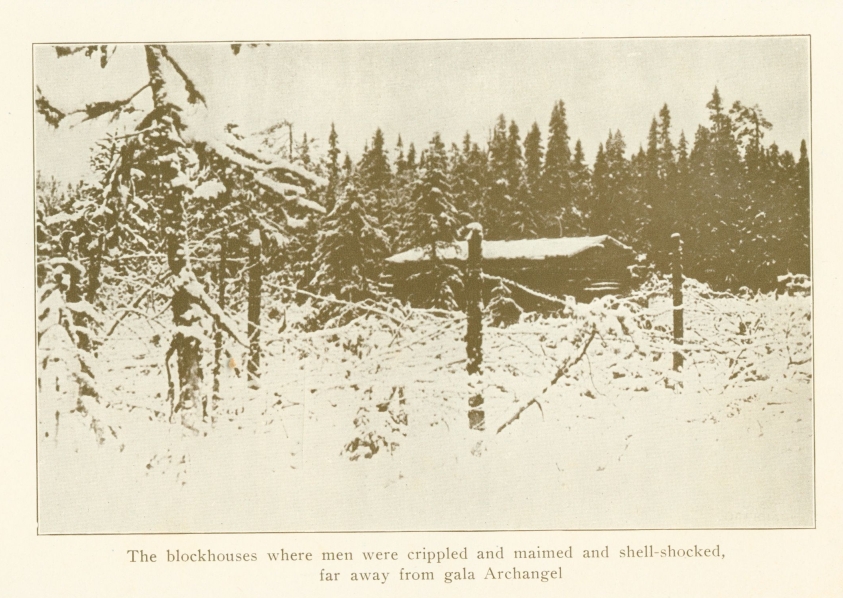
By noon, the fury of the storm had nearly subsided, the Commander of the Saratov Regiment, thinking his troops had won their ground, rode on his white horse nearly into the defenses and was shot down as he came, and from this time, the firing became desultory, except when some violent commissar drove small groups forward to be killed, or others, made desperate by despair, sneaked creeping out, and so were killed, and the rest lay flattened on the snow, not daring to go forward or back.
At nine, the sun went down upon the tumult of a bloody, grewsome day; it became cold again, and there followed dusky, unnatural silence, shattered occasionally by the rasping crack of snipers' shots, where in that night of horrors, the unfortunate Bolsheviks passed the acme of mortal misery. For if defeated, they returned to their own camp, death was waiting for them, and ahead were the remorseless Americans ready to shoot on sight, without stint of mercy. So, fairly caught between two fires, they lay out through the endless, black hours of terrible cold and frost, and gangrene took a greater toll than all the gunshot wounds.
Yet great as was the enemy distress, all knew that when the next day dawned, new forces would come up and press on to another determined assault, and it was to divert as many of these reinforcements as possible, that General Ironside ordered the Onega Detachment to move against Bolshie Ozerki from the west.
That same night, one of the York companies left the Onega Detachment and followed an unreconnoitred trail through the forest to strike again the hostile village from the north at daybreak; but long before dawn, became confused in the darkness and was hopelessly lost when the attack began on the road where another British company was to move against the village. A Polish company of Archangel volunteers, who were to execute a corresponding south flank movement, came from Chekuevo too late, so that the brunt of the fight fell upon the unsupported Yorks on the road.
Thirty minutes after the first faint light, dogs, tied to trees by the Bolsheviks, sighting the approaching front attack, gave boisterous, barking alarm, and, on the instant, the woods were made hideous with the rasping rattle of many machine guns. Many of the little band were hit in this first storm, but the rest kept on, dragging themselves through the yielding, four foot snow, while inches over their heads, the air howled hideously with the passage of flying death. In the snow, rifles became clogged in the breeches, so that the bolts would not drive home, and men had to dig them clean with fingers stiffening from cold, but still, a little at a time, the attack wormed on and on. At one hundred yards, the gallant, British captain rose to lead a rush at the machine gun positions and was killed in his tracks; then the second officer was hard hit, and when the delayed Polish company came forward in support, and two of its number got shot through the bowels, the others bolted like sheep and could not be driven to the battle again.
Then the Yanks went in and stood manfully to the fight by the side of their distressed comrades, but against heart sickening, desperate, despairing odds, as the merging Bolsheviks came from both sides and massed in a vicious, determined counter attack that would have overcome all, but when doom seemed certain, the lost York Company emerged from the woods, by some act of a benevolent Providence, to meet and stay the fullness of the thrust, until darkness came down to save the valiant, little band on the snows.
This last, noble effort of the Onega Detachment had been made with a single thought—that of baring their breasts to the blow that otherwise would have fallen on their tired comrades in the barricades out in the forest from Obozerskaya; and great as the cost, its effect had been the final discouragement to the Bolsheviks who made one more ineffectual effort to gain the Allied Railway flank, then drew back in full retirement to the south.
The enemy sustained great losses in these battles of Bolshie Ozerki, upwards of two thousand casualties, many of them from the frost, for the villages could shelter but a fraction of the large forces, and many had to live in such makeshift quarters as could be devised.
Time was of the essence in this undertaking of the Bolshevik commander, and he had paused when he should have struck out with every man in his control, but by his dalliance, spring joined the league of his enemies. Soon the freezing clutch of winter would be broken in the warm sun, and, unless he hastened to withdraw to the south, his artillery would be mired in the yielding roads.
In June, the new, conscripted, Russian soldiers came to take Onega's posts, and the heavily-tired Americans went back to assembly at Archangel, buoyant and bright-eyed at the prospect of home, till they met on the city streets a few invalided Category B Scots going back to the battle lines, because the Bolo droves were gathering again and every man was needed there. Then the light smile passed from the lips of the Americans, a blush came to their cheek, home was forgotten and all thought of home; for there was a man's work out in the forest swamps far to the south—where death lurked and misery waited; and hardly a man who would not have chosen the swamps with their physical suffering and their ambushed death than escape and bear the stinging reproach of deserting a mate in distress. Better to play the wretched game through to the uttermost end than to be faithless to the traditions of one's blood, to quit the field with the honor of a nation stained and shamed in burning disgrace.
For was this such a flagitious, disgraceful brawl in which their mates had bled their manhood blood away that American soldiers should sneak from it thus, like cuffed and beaten mongrel curs?
Time, soothing time, will smooth with gentle, cooling fingers, the harsh lines of fretful hardship, the distressful burdens of campaign and trying vigils of sleepless peril, and even burn a purple halo of romance about this miserable, petty, little war, but some hurts the assuaging balm of time can never heal.
Many had cast off at the call of country and given all with generous unstinting affection, and those who were coming back did not begrudge the sacrifice; but rankling deep forever in the living consciousness of every Archangel soldier is the thought of this ignoble quitting and the weak abandonment by his country of everything to which he had pledged his manhood faith.—The causelessness of it all—Alarming, unbalancing reflections, a moral devastation that will not be quieted—Corroding grief for those who flushed with promise were "taken from life when life and love were young" in a shabby brawl for nothing.—A dangerous cynical bitterness is with the soldier of North Russia, mordant and enduring, that grows ever more bitter with the years.
KODISH
January 30, 1919.
MEMORANDUM FOR COLONEL HOUSE.
SUBJECT: Withdrawal of American troops from Archangel.
Dear Colonel House:
The 12,000 American, British and French troops at Archangel are no longer serving any useful purpose. Only 3,000 Russians have rallied around this force.
Furthermore, they are in considerable danger of destruction by the Bolsheviki.
The appended memorandum and map which General Churchill has prepared show that unless the ice in the White Sea suddenly becomes thicker, it is possible at present, with the aid of six icebreakers, which are now at Archangel, to move these troops by water to Kem on the Murmansk Railway, whence they may be carried by train to Murmansk.
The situation at Archangel is most serious for the soldiers, but it is also serious for the Governments which seem to have abandoned them. Unless they are saved by prompt action, we shall have another Gallipoli.
Very respectfully yours, WILLIAM C. BULLITT.
Abridgment of communication from William C. Bullitt of the American State Department, delivered to Colonel E. M. House at the Paris Peace Conference, on 30th January, 1919.
VII
KODISH
Kodish was the epitome of North Russia. Bought with toiling effort, incredible privation and cruel losses, to be lost and won again time following time in the bitter-most winter days with moving heroism and a moral grandeur that at times reached a sublime estate—it was in the end abandoned as "of no especial military significance."
The village lay in the course of the Imperial road from Petrograd that parted from the Vologda railway at Plesetskaya and cut a diagonal lane through the province north-easterly to Emetskoe on the Dvina. Both Commands stressed its importance. In the early days of the campaign the Allied leaders, bent upon conquest, seized upon it as an opportune route to support the railway invasion by surprising the enemy in rear, while the Bolshevik Staff saw a chance to drive a wedge between the two advancing Columns and effectually deny the River forces all communications.
A typical polyglot group of French, British, friendly Russians, and a few American marines, some two hundred in all, had gone out from Archangel in the first days of the Expedition to Seletskoe on the Emtsa river determined to drive south from this subsidiary base along this Petrograd road to Plesetskaya. This group, designated "D Force" to distinguish it from "A Force" on the Railway and "C Force" on the Dvina, and the Vaga, had hardly commenced its daring operation when an urgent call for succor caused British, French and Americans to hurry across a trail through the swamps to Obozerskaya, leaving the loyal Russians as rear guard before Kodish. But the former never reached their goal. Days passed and nothing was heard from them until a relief contingent, out a day's journey from the Railway front in the forest swamps, found in the midst of scattered infantry gear and other signs of desperate encounter the soiled diary of an American sailor with the epitaph of this illfated "B Force" written on 30th August.
The rescue party continued east through the swamps to Seletskoe as the pursuing Bolsheviks closed in on that village, but the Americans, reinforced by a slender garrison, drove them south over the Emtsa, where they stood their ground behind a destroyed bridge. It was suicidal to attempt a passage of the open river in the face of machine guns, so the Americans dug in the cold sodden ground, and in the grim siege that followed the suffering was intense; no doctor was at hand to care for the many casualties who were given crude first aid (when they were reached), and bumped and jolted thirty torturing miles to Seletskoe, yet, in the face of all these things, none at Kodish knew thought of weakening or turning back.
On the ninth day, long awaited supports came up, a crossing was effected at an unexpected point below the Bolshevik position, and Kodish succumbed to a courage that would not be denied. Exposed baldly in a broad clearing and flanked by three dominating hills, this moujik village was helpless against modern artillery. The French colonel pronounced it "strategically untenable," but the worst feature was its opportunity for complete encirclement. This was brought vividly to the consciousness of the Americans soon after their occupation when great Bolshevik bands converged on them from villages to the south and the Shred-Mekrenga trail, and following a four days' battle, they fought for their lives in a night flight nearly two miles along the road back across the river.
There the old familiar siege tactics were resumed. The engineers with a genius of adaptitude built a fortress of blockhouses on the north Emtsa embankment, and in these, one company of Americans, augmented by a few British infantry and a section of Canadian Field Artillery, stood off the Bolsheviks from the crucial Petrograd road. In December, with Plesetskaya the objective of three Allied fronts, this little group, now 450 strong, led by the impetuous "Major Mike" Donaghue forced twenty-seven hundred Bolsheviks out of Kodish, but could make little progress on the road beyond. So the contested village was held as an advanced post for the main Allied force on the Emtsa, and exposed to unremitting bombardment from many superior guns, became an inferno of bursting shells.
Once on a black January night, it was abandoned by the little outpost and set aflame, but before dawn, Donaghue was back with his men to a chaos of charred ruins, like the skeleton of a beast of prey in a desert of snow, through which the bitter, chill winds wailed dolefully. In these deserted Kodish streets of abject desolation, the American soldier knew the uttermost depths of physical misery experienced during the whole winter campaign.
The Commander-in-Chief came to the Kodish front when British soldiers evinced a truant disposition and would not "carry on" unless certain interrogatories concerning this evasive war with Russia were answered. The interrogatories were addressed to Premier Lloyd George and were such as might arise from the mental consciousness of any men who still have well poised, wholesome regard for life and the pursuit of happiness as they understand it. These British soldiers had come from the winter murk of Murmansk, had emerged from four years' hell in France, and saw themselves the hapless forfeit in a confused international melee without wit or reason at a time when all were thoroughly sickened with war and thought they merited restoration to their homes. But when the soldier Ironside, six feet four, with "an eye like Mars to threaten and command" had spoken, the interrogatories were all forgotten and these disgruntled men, who had uttered mutiny, returned to the fight with a matchless valor; with a steadfastness that gave never ceasing wonderment that they could so freely offer all with every instinct and inclination opposed.
An outpost on the Railway
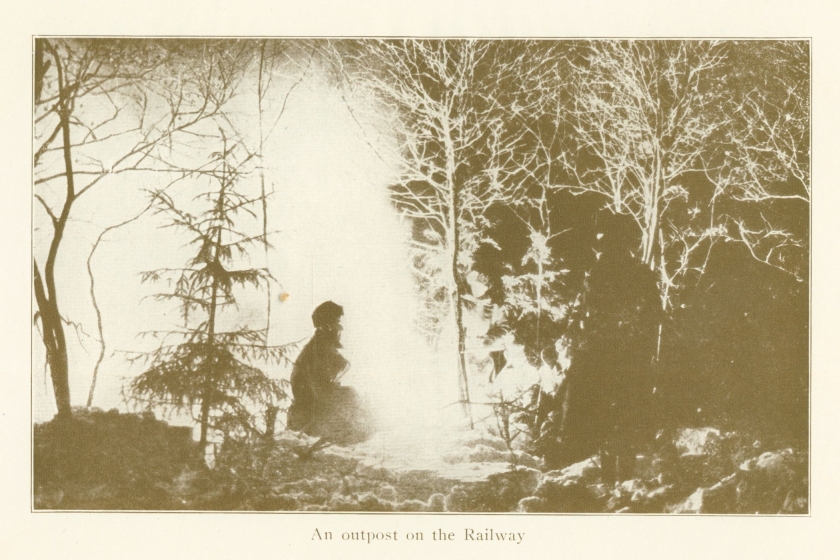
It was at Kodish that the Bolsheviks strove their uttermost with propaganda, that insidious, warring weapon of which so often they have revealed themselves the masters. Thousands and thousands of pamphlets, leaflets, circulars, manifestoes, announcements, proclamations, appeals—an amazing collection of vitriolic, eloquent literature, were left along the patrol routes in the snow forests. This was true at all fronts, but especially at Kodish, where these persuasive methods were concentrated like a great verbal bombardment, a veritable war of scarifying words, Russian, French, German and English. Many messages of hate and fire, with frank artlessness, urged the Allied soldier to desert and join the Soviet; others, more subtle, displayed a masterful knowledge of human weakness and human passions and prejudices.
The following is taken from The Call published in Moscow and printed in English:
Do you British working men know what your capitalists expect you to do about the war? They expect you to go home and pay in taxes figured into the price of your food and clothing, eight thousand millions of English pounds or forty thousand millions of American dollars. If you have any manhood, don't you think it would be fair to call all these debts off? If you think this is fair, then join the Russian Bolsheviks in repudiating all war debts....
Do you realize that the principal reason the British-American financiers have sent you to fight us for, is because we were sensible enough and courageous enough to repudiate the war debts of the bloody, corrupt old Tsar?...
You soldiers are fighting on the side of the employers against us, the working people of Russia. All this talk about intervention to "save" Russia amounts to this, that the capitalists of your countries are trying to take back from us what we won from their fellow capitalists in Russia. Can't you realize that this is the same war that you have been carrying on in England and America against the master class? You hold the rifles, you work the guns to shoot us with, and you are playing the contemptible part of the scab. Comrade, don't do it!...
You are kidding yourself that you are fighting for your country. The capitalist class places arms in your hands. Let the workers cease using these weapons against each other, and turn them on their sweaters. The capitalists themselves have given you the means to overthrow them, if you had but the sense and the courage to use them. There is only one thing that you can do: Arrest your officers. Send a committee of your common soldiers to meet our own workingmen, and find out yourselves what we stand for.
The following is from the same publication:
The Bolshevik Revolution marked the culmination of the world struggle to set us all free. Strike off your shackles, comrades, we are your friends not enemies, and the only reason we seek to stamp out the parasitical capitalists by force is because force is the only language they can understand. This is the beginning of a great world revolution which knows no national limitations. It will set the producers free. Join the Soviet Party. We are fighting your fight against the unprincipled capitalistic class. Comrades, you know the meaning of "scab," well, that is the part you are acting in Russia. For shame, comrades! Kill your officers, then shoulder your rifles and come over to our lines which are your own.
These extracts have been taken at random from a hundred others of like incendiary tenor, most of which had little effect on the Americans except to impress them with the coincidence of a striking similarity in style and sentiment between them and many public addresses of American politicians printed in the newspapers that came from home, where a soft going government tolerated perversions of free speech, as hostile to American soldiers in Russia as the most violent preachments from the enemy.
A huge bulletin board was erected on the Bolshevik bank of the Emtsa river, which conducted daily classes in doctrines of International Revolution, and the first confirmation of the Armistice news came in a weird preternatural voice which startled the night stillness of Kodish by announcing in sonorous tones the cessation of infamous war and the restoration of peace to the afflicted peoples of earth. There on the Emtsa bridge, a Bolshevik orator, shrouded by the phantom shadow of a waning moon, delivered in excellent English, almost academic in polish, a rhetorical harangue on the glories of communism, the injustice of soldiers suffering in cold swamps while others sat back in Archangel in soft ease. Also the speaker described most persuasively the abundant, bountiful hospitality awaiting all within the Soviet lines. It was all very diverting, but nevertheless gave audible utterance to many of the disquieting reflections which rankled deep in the heart of every man in the Allied ranks and did not go towards helping Allied morale. Later that same night, when this extraordinary speech was ended, two captives, a Scot and an American, came out on the bridge to tell their comrades of benevolent treatment at the hands of the unspeakable enemy; in the darkness their voices were like those from the grave, for many soldiers were led to believe that the barbarous Bolos killed all prisoners after torturing them with frightful savagery.
In the first stages of the campaign, the French on the Railway killed those that could not be carried off the field to spare them the grewsome horrors which would have been visited upon them by the enemy, yet at Ust Padenga, volunteers brought in wounded not a hundred yards in front of Bolshevik machine guns, and at Toulgas, after a disastrous ambush, the enemy mysteriously withheld his fire from a relief party that was entirely exposed. There was, in fact, only one recorded instance of atrocity. This was on the Vaga where the bodies of an officer and several Americans were found hacked and mutilated with hideous debauchery, but there was nothing to show that this barbarism was approved by the Bolshevik leaders, and it may have been only an uncontrollable manifestation of primal cruelty which underlies all war.
Several months after the last troops left Archangel, a number of Americans "missing in action" were expatriated through the efforts of the Red Cross by way of Finland, and these men spoke very favorably of their considerate treatment in Moscow.
THE RIVER
"There ought to be an efficient American Hell Raiser from one end of the front to the base, with a rank of lieutenant colonel."
DOCTOR JOHN HALL (Major Medico 339th U.S. Infantry). 21st October, 1918.
"The Government of the United States has never recognized the Bolshevik authorities and does not consider that its effort to safeguard supplies at Archangel or to help the Czechs in Siberia have created a state of war with the Bolsheviki."
Cablegram, State Department, Washington, D.C., to David R. Francis, American Ambassador, Archangel, Russia. 27th September, 1918.
VIII
THE RIVER
Half of the original Poole Expedition was selected for the punitive pursuit down the railway, a garrison was left to guard Archangel, and the trifling group that remained followed the dark course of the Dvina into the unknown region of the interior. There were told off for this river expedition two depleted companies of the Tenth Royal Scots Regiment, and twenty-five of the American marines crowded into merchant barges and towed slowly up-stream by small tugs. The only escort was an armored British monitor, and seen from the shore, as they made their toilsome struggling way against the swift racing river course, conspicuous, unshielded targets on its broad surface, the dauntless little band looked tempting ambush prey.
At Chamova, some one hundred and eighty miles from Archangel, the enemy gave sign of having abruptly recovered from his first stampede. He turned and showed his fangs, and the pursuit stopped short.
It now grew apparent that the retreat had not been as riotous as first supposed; in fact, there was good reason to believe that it was a part of Bolshevik strategy, and evidence was accumulating that Trotsky had ordered the withdrawal from Archangel to make certain of the millions of American made supplies and ammunition, had taken a careful appraisal of the military situation, and elected to give battle in the interior. When the Americans arrived they were met at the wharf by an agitated Brass Hat who said the Allies at both fronts were standing at bay and the situation had assumed a very precarious phase.
The Third Battalion was rushed to the Railway, and the First Battalion, in dirty, ill-smelling barges, followed the pioneer Poole Expedition up the river one hundred and fifty miles to Bereznik. These barges had carried many cargos on Dvina's waters, cargos of livestock and flax and other agricultural produce, but were new to human freight, and in their cramped, miserable, dank quarters, the scourging influenza broke out afresh among the troops, and those who had already been weakened by the disease grew fainter and fainter as they followed up the unknown waterway till a day came when one after one they quietly passed to the bourne of that country of gentle unwaking sleep, and sometimes off on the gloomy foreboding river the passage of this antic caravel seemed more a funeral processional than an aggressive expedition of war.
The tired comrades who were even denied the vibrant thrill of the fight, and its doubtful glory, were with simple soldier ceremonials given to the soil of Russia, ceremonials, moving because of their simplicity and that wholesome, fullhearted sentimentalism which has always marked the American character—and always must be of our America.
Here in these little churchyards, tragic death seemed robed in sorrow more sacred with the brown, barren embankments like a shroud of mourning, the grave skies drooping and disconsolate and the sombre recesses of the forest where taps trailed in grieving cadences and echoed within the soldier's spirit long after its last note had been lost in the gloom. Laden with inarticulate depression and confused melancholy, thoughts of life's crazy theatre, the crushing power and immensity of fate, the tragedy of all, these men fresh from the fields and shops of Michigan and Wisconsin groped their dazed way back to the barges where dark shadows with ominous fingers reached over the waters and death, in this haunting, melodramatic land waited, suspended in the alien air like a pestilential vapor.
The first stop was five days out from Archangel at Bereznik, near the junction of the Dvina and its main tributary, the Vaga. Here there was a group of commodious, well constructed log buildings, which had served as hunting lodges for the Tsar Nicholas and his retinue during the days of the Romanoff dynasty. It was decided to make use of these buildings for storage purposes, and to have Bereznik as the subsidiary base of the Dvina expedition until progress was made so far up the river that practical considerations would impel the movement of the subsidiary base to a more advanced position.
So from the time of the arrival of the Americans on the 13th September, until the close of water at the end of October, rations, munitions, clothing and other accouterments of war, in value over one million pounds sterling, which had been brought all the way from England, were loaded on every craft that could be commandeered at Archangel and transported the one hundred and fifty miles to Bereznik.
One of the American companies was left to guard these precious supplies and the others hurried on to take up the gage of offensive campaign. There was a brush at Chamova, but the enemy did not make his first stand until he came to Seltzo, nearly thirty miles further upstream, and now well over two hundred miles from far away Archangel. Except on the Vaga, this was the furthermost south achieved by the Allied troops.
At Seltzo, it became clear that the Soviets had no intention of running further, and that the foreigners would be fortunate if they held the ground already gained. The tactical abandonment of Archangel having accomplished the effective seizure and retention of everything of value in that port and extended the invader far into the interior, revealing with obliging frankness his numerical weakness, had realized the ends sought by the Bolsheviks, and the signs were now many that they intended to strike back and strike back hard.
Why did not Poole retire to Archangel?
The futility of the attempt to reach the distant Siberian railway with the ridiculously small force at the disposal of the Allied Commander was glaringly apparent to every common soldier.
Why did not Poole, like Joffre at the Marne, shift his policy to meet the exigencies of the military situation, draw in his far scattered fronts to Archangel, construct an enceinte of defenses about the city, and hold on until help came in the spring, or until some definite action was determined for Russia?
Many lives would have been spared and much misery averted had this been done, but the lives of a few men, and the permanent impairment of the lives of many more, do not weigh heavily in the scales with those who sit in the councils of the inner sanctum at General Headquarters and think nothing of the spending of divisions and even army corps. Perhaps it would have been too galling to Anglo-Saxon pride to admit being on the defensive before an inferior people like these poor Slavs who were to be chastised with thoroughness and dispatch. Then, too, it was always safer for Archangel to have the outposts far into the country, and flattered the Allied Command in the belief of still being the aggressor.
When Ironside took command he not only conceded that the Allies were conducting a defensive campaign, but with soldier bluntness declared that the Expedition was in gravest peril. It was too late then to draw in the far dispersed battalions. They would have to fight it out on the wide separated snowbound fronts, and show by deeds the superiority of the Anglo-Saxon. If they failed, if they were faint hearted and even so much as faltered, the entire force was doomed.
On the morning of 19th September battle was joined at Seltzo. A mile of open marsh lies outside, through which the stream at the border of the village meanders from the forest to pay tribute to the mighty Dvina. The only easy approach is along a narrow road that parallels the river and crosses a bridge over this deep icy stream. On this morning of battle the Americans waded the swamp until within fifteen hundred yards, when suddenly from the scattered concealment of the houses there burst such a furious fusillade of musketry and machine guns and Pom Pom guns that they dropped low in their tracks and could go no further.
Two other companies moved through the woods on the flank to assist the frontal attack, but their location was determined by the enemy batteries, and his infantry laid down such a withering fire, that the battalion, exhausted from a day of fighting and a heart-breaking march, without rations and with no cover from the cold and the drizzling rain, was compelled to bivouac that night in the soaking morass, hopeful that with next morning would come promised artillery support, for without it further advance was unthinkable.
All through the night the Bolshevik guns searched for the Americans who were new to combat, ignorant of the ground, and had not an inkling of the enemy strength or his fortifications or dispositions. And at dawn a reconnaissance patrol stumbled into a large enemy force, was scattered and came back with no information, save that the Bolsheviks had assembled in superior numbers and were well supplied with ammunition. As daylight broadened, the shelling from the river became so violent that the attackers had to choose between a further advance or complete retirement; to stay where they were meant destruction.
So with grave misgivings the attack was renewed, although there was still no sign of promised artillery support; machine guns guarding a trench system in the woods killed and wounded many Americans, but the advance would not give ground, and supporting comrades at flank and rear kept up such a sustained unfailing fire that the Bolsheviks were led to believe that the attack had been replenished during the night.