Chapter VII · OBERON (continued 2)
Reading edition
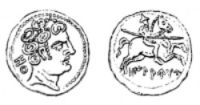
Fig. 223.—Iberian. From Akerman.
The yew (Irish eo), named in all probability after Io, or Hu the Jupiter,[398] or Ancient Sire of Britain, is found growing profusely in company with the box on the white chalky brow of Boxhill overlooking Juniper Hall. The foot of this slope around which creeps the placid little river Mole is now entitled Burford Bridge, but before the first bridge was here built, the site was seemingly known as Bur ford. The neighbouring Dorking, through which runs the Pipbrook, is equivalent to Tor King, Tarchon, or Troy King, and there is a likelihood that the Perseus who redeemed Andromeda, the Ancient Troy Maid, was a member of the same family. In the Iberian coin herewith inscribed Ho, which is ascribed to Ilipa or Ilipala, one may perhaps trace Hu, i.e., Hugh the mind or brain in transit to these islands.
To the yews on Boxhill one may legitimately apply the lines which Sir William Watson penned at the neighbouring Newlands or the lands of the self-renewing Ancient Yew:—
Old Emperor Yew, fantastic sire, Girt with thy guard of dotard Kings, What ages hast thou seen retire Into the dusk of alien things?
From Newlands Corner where the yews—the self-seeded descendants of immemorial ancestors—are thickly dotted, is a prospect unsurpassed in England.
The beech trees which are also a feature in the neighbourhood of Boxhill irresistibly turn one’s mind to the immortal beeches at Burnham in Bucks. Bucks supposedly derives its name from the patronymic Bucca or Bucco, and this district was thus presumably a seat of the Bucca, Pukka, or Puck King, alias Auberon, to whom at Burnham the beech or boc would appear to have been peculiarly dedicated. There is a Burnham near Brightlingsea; a Burnby near Pocklington, a Burnham on the river Brue, a Burn in Brayton parish, Yorks; a river Burn or Brun in Lancashire, a river Burry in Glamorganshire, and in Norfolk a Burnham-Ulph. In Brancaster Bay are what are termed “Burnham Grounds”; hereabouts are Burnham Westgate, Burnham Deepdale, Burnham Overy, etc., and the local fishermen maintain “there are three other Burnhams under Brancaster Bay”.[399] Doubtless the sea has claimed large tracts of Oberon’s empire, but from Brean Down, Brown Willy, and Perran Round in the West to the famous Birrenswerk in Annandale, and the equally famous Bran Ditch in Cambridgeshire, the name of the Tall Man is ubiquitous. Among the innumerable Brandons or Branhills, Brandon Hill in Suffolk, where the flint knappers have continued their chipping uninterruptedly since old Neolithic times, may claim an honourable pre-eminence.