Chapter I · A DAY AT SCHOOL
Margaret Payson Waterman translation
The boys had just finished a grammar lesson, and as a reward for paying attention their master was reading them a bit of history. Jousif hodja (schoolmaster) was a tall young man of twenty, very slight, and frail in appearance, with dreamy black eyes. Perfect silence reigned in the smoky old schoolroom while he read in a strong, clear voice:
“But I don’t want him to die,” sobbed a boy of twelve. “Oh, master, why did God let him?”
Some of the older boys began to laugh, but Jousif hodja sternly silenced them, and going to the child, said to him:
“Come, Archag, quiet yourself; envy our Vartan, if you will, admire him, but don’t give him pity. His martyr’s death has sustained and fortified thousands of Armenians; even to-day, after so many centuries of oppression and sorrow, to whom should we lift our eyes if not to our national hero? We all love him, and in the hour of danger we shall fight and die as worthy sons of Vartan.”
At these words the child gradually became quiet, dried his tears and said:
“I want to follow his example.”
The master stroked Archag’s black curls; then, the bell having already rung, he dismissed his pupils with the benediction. In the twinkling of an eye the boys had put on their pretty red slippers, strapped up their books, and were running through the streets of Van, shouting, and chattering like a flock of sparrows. Archag was among the first to scamper out; he ran like a shot as far as the Cathedral, then turning at the back of the Bishop’s house, he followed a lane which led to the shore of the lake.
His parents lived outside the city in one of those flat-roofed dwellings so common in Asia Minor. His father owned a great deal of livestock, herds of sheep and goats, as well as droves of horses and camels; Archag breathed a sigh of content as he caught sight of his father’s house at a turn of the road. A young girl of sixteen was coming to meet him; it was his sister Nizam, who made a great pet of him. He threw his arms about her neck, and asked in a wheedling tone:
“Tell me, have you been making something good for my supper?”
“Fie! you greedy boy,” replied the young girl. “You think of nothing but eating. Tell me instead what you did at school to-day.”
At these words a shadow came over the child’s face.
“Oh! Nizam, to-day is Vartan’s Day, so Jousif hodja read us a description of the battle of Avaraīr. Only think! Three thousand Persians fell upon the Armenians, who had only five hundred soldiers, and they killed Vartan and all his men. Don’t you think our hero must have been like Jousif hodja?”
Nizam blushed at the name of the schoolmaster; for, to tell the truth, the two young people were secretly in love.
“Now Archag, stop; what are you talking about? Come along to supper. Mamma has been making tomato pilaaf for us.”
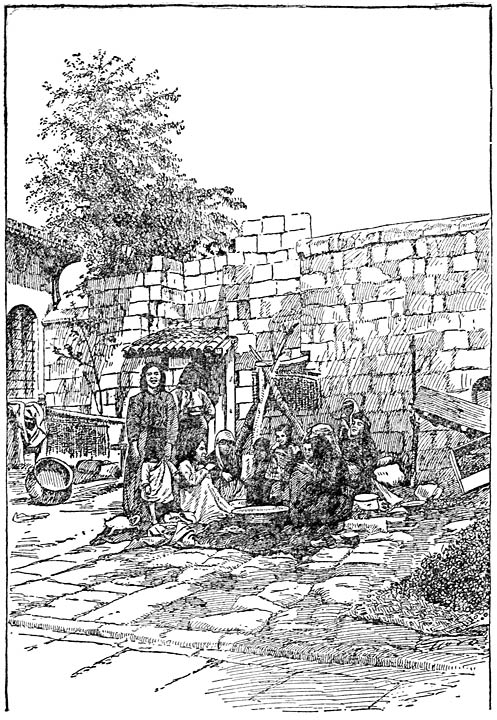
At Van, as in other remote towns in Asia Minor, chairs and tables were still objects of luxury, and were rarely seen. People just sat down on the floor.
HAPPY ARMENIA
After supper, Archag and Levon ran off together to the stable to say good-night to their favorite little goat. Because of the terrible cold which prevails in Asia Minor during several months of the year, the stables are built under the ground; in this way they have the advantage of being warm in winter and very cool in summer. Boghos Effendi had a stable for the horses, one shed for the sheep and another for the goats. Our two children had brought a handful of salt from the kitchen, and the pretty Belette seemed to consider it a treat. Levon amused himself by pulling the long silky hairs of the little animal, a magnificent Angora goat. They would no doubt have stayed all night with their horned friends if their mamma had not called them in to go to bed. And even when called they did not obey very promptly; it was so delightful in the stable.
After supper Nizam had gone, as was her habit, to sit on a great rock high above the house. At her feet was spread the lake, with its marvelous frame of high mountains whose snow-crowned peaks, now flushing red in the rays of the setting sun, seemed to be in the heart of a vast fire. But the young Armenian girl had no eyes for the beauty of the landscape; she was thinking of her mother whose delicate health caused her great anxiety.
Twilight falls rapidly in the Orient, and now the jackals were yelping, and the dogs were howling in reply, and the moon, a pale yellow crescent, was reflected in the dark waters of the lake. Aroused from her reverie by the growing darkness, Nizam hurried back to the house, where her parents were waiting for her that they might close the doors. Orientals go to bed soon after the sun, and before long perfect stillness reigned in the solitary house.