Part III. Post-Darwinian Questions Isolation and Physiological Selection
William Morton Wheeler translation
Pp. 181. With portrait of Mr. Gulick. Cloth, $1.00.
The three volumes of “Darwin and After Darwin” supplied to one order $4.00 net.
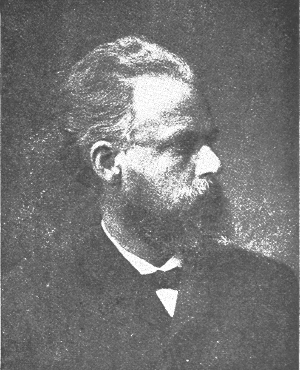
August Weismann Professor in the University of Freiburg in Breisgau. (Born January 17, 1834.)
Darwinism Illustrated
(Reprint of illustrations from Darwin and After Darwin, Part I.)
Wood engravings explanatory of the Theory of Evolution, selected by and drawn under the direction of Prof. G. J. Romanes. Designed for use in class and home instruction. Pp. 94. Paper, $1.00.
An Examination of Weismannism
By George John Romanes. With Portrait of Weismann, and a Glossary of Scientific Terms. Thoroughly indexed. Pp. ix., 221. Cloth, $1.00 net.
“The best criticism of the subject in our language.”—The Outlook, N. Y.
“The reader of this work will appreciate from this discussion, better than from the writings of Weismann himself, the significance of the final position adopted by Weismann.”—Science.
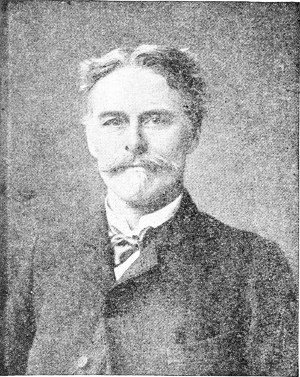
E. D. Cope. 1840-1897. “One of the Great Men of Science of the World.” —Science,New York, Sept., 1896.
The Primary Factors of Organic Evolution
By E. D. Cope. 121 illustrations. Pp. 550. Tables, bibliography and index. Cloth, net, $2.00. (10s.).
A comprehensive handbook of the Neo-Lamarckian theory of Evolution, drawing its main evidence from paleontology, as distinguished from œcology (Darwin) and embryology (Weismann). Discusses the “Energy of Evolution,” and lays special emphasis on the function of consciousness in organic development.
“Will stand as the most concise and complete exposition of the doctrines of the Neo-Lamarckian school hitherto published. A most valuable text-book for teachers and students.”—Science, N. Y.
“A work of unusual originality. No one can read the book without admiring the intimate knowledge of facts and the great power of generalization which it discloses.”—Prof. J. McK. Cattell.
On Germinal Selection
As a Source of Definitely Directed Variation. By August Weismann. Translated by Thomas J. McCormack. Pp., xii, 61. Paper, 25c. (1s. 6d.).
“Professor Weismann considers this one of the most important of all his contributions on the evolution problem.... important as marking some fundamental changes in Weismann’s position.”—Science, New York.
“Forms the crown and capsheaf of Weismann’s theory of heredity.”—Exchange.
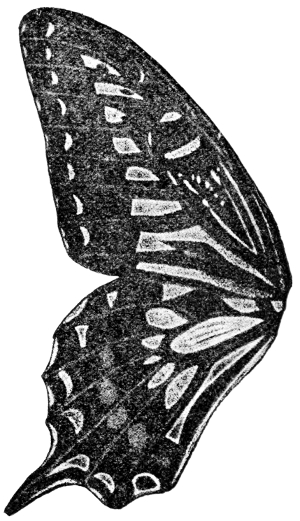
Butterfly’s Wing from Eimer’s Orthogenesis. Illustrating the Definite Character of Evolution.]
On Orthogenesis (Definite Evolution)
Or the Impotence of Darwinian Selection in the Formation of Species. By Th. Eimer, Professor of Zoology in the University of Tuebingen. Translated by Thomas J. McCormack. 19 cuts. Pp., 56. Paper 25c. (1s. 6d.).
This little brochure was written in reply to Weismann’s “Germinal Selection.” Prof. Eimer argues upon the same lines as the American Neo-Lamarckians, Cope, Hyatt, etc. His doctrine of orthogenesis, which he declares to be a universally valid law, has been framed to show that organisms develop in definite directions, without regard for utility, through purely physiological causes, through the transmission of acquired characters, through the combined agency of the constitution of the animal and the effects of outward influences.
A Mechanico-Physiological Theory of Organic Evolution
Summary. By Carl von Naegeli, Translated by V. A. Clark and F. A. Waugh, of the University of Vermont. The only original account of Naegeli’s theories in English. Pp., 52. Price, paper, 15 cents. (9d.)
Naegeli was the first to propose the general theory of cell-formation accepted to-day. The present little brochure, which is a synopsis of his great work on evolution, will render his difficult theories accessible to English-speaking students, to whom they have hitherto been almost a sealed book.
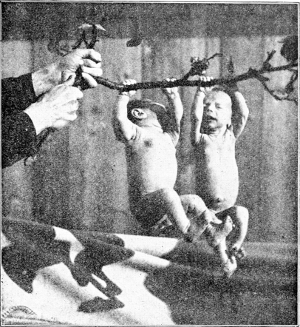
The Grasping Power of Infants. (From Shute’s Organic Evolution.)