"Antony Waymouth" (continued 2)
Reading edition
“I say nothing against the powers that be; and her gracious majesty may have had her reasons for honouring Sir Francis; but there are persons who consider his expedition round the world as worthy only of a sea-rover of old or of a downright pirate,” observed the minister.
“Let be, let be, Master Walker,” exclaimed Waymouth petulantly; “I can brook more from you than from any man alive, but I have heard enough.”
The minister was too wise to proceed, but he shook his head mournfully.
The prisoners were now all collected on board one ship. Among the wild spirits found among the English crews some were not wanting who suggested that they should be sent adrift without compass, guns, or provisions; some even hinted that to bore holes in the ship’s bottom would be the surest way of disposing of them; others considered that it would be wise to keep them as prisoners, and to insure their keeping with the fleet they should only be furnished day by day with the necessary provisions, and that two ships should be appointed especially to watch them. More generous counsels, however, prevailed.
“No, no, by my halidom!” exclaimed Captain Wood; “Portugals though they are, they have fought bravely, and like honest gentlemen shall be treated. We’ll give them arms to defend their lives, and provisions to fill their insides, and a compass to find their way to some one of their own ports or factories on the coast of the Indies, and all we’ll demand of them is that if they find any Englishmen in the same plight as they are themselves that they treat them in the same way as they are treated by us.”
Waymouth warmly seconded the admiral’s proposal; so did several of the superior officers, though others grumbled at letting the prisoners off without a ransom, or trusting to their honour to return the favour they were to receive.
Away sailed the Portugal ship with all the prisoners on board; not, however, without Waymouth having extracted a promise from all the officers to make inquiries for his friend Raymond, and to let him know, if alive, where he was to be found. Waymouth hoped that among them some at least would do their utmost to redeem their promise.
Once more the English fleet was sailing proudly over the seas, but sadly diminished in the number of their men. The wealth collected seemed prodigious in the eyes of the crews, and little short of that obtained by Drake of the Spaniards. Still their success only made them greedy for more, and the seamen especially expressed their aversion to the trading part of the enterprise, and loudly proclaimed their desire to cruise against any enemy to be found—Dutch, if Portugals could not be found, or Spaniards if they could be fallen in with. Waymouth, especially, found that he had a very mutinously inclined crew to deal with. Who was the chief instigator he determined to discover, in the hope that by punishing him he might bring the rest under better discipline.
The officer next in command to him was Miles Carlingford, an honest, straight-forward seaman, on whom he knew that he could depend as well as he could on Master Walker and the surgeon Ap Reece as to faithfulness; but Master Walker was a non-combatant, and would be averse to any stringent measures; and Ap Reece, from his hot-headed impetuosity, would be likely to betray any counsel with which he was intrusted.
Captain Wood had brought two cabin-boys with him—or, as they would now be called, midshipmen—and these he had left under Waymouth’s especial care. Poor fellows! early indeed were they to be initiated into the stern realities of life. It would have been difficult to find a stronger contrast than between the two lads, and yet they were great friends. The eldest, Alfred Stanhope, was of high birth, of which he was fully conscious. He was refined in appearance and manners, and was light-hearted and gay in the extreme. He was never out of spirits or out of humour, and was utterly indifferent to danger. His talents, however, were not great, and the knowledge he did possess was very superficial. His father was a spendthrift and a ruined man, and had allowed him to come to sea in the hope of his being provided for in one way or another.
His companion, Oliver Marston, was the son of a stout English yeoman to whom Captain Wood’s family was under some obligations, and, as a way of repaying him, he had offered to take Oliver, one of ten sons, on an adventure through which he would be certain to secure his fortune. The lad, though he had never seen a ship except worked on tapestry, had no objection to go to sea. He was a short, stout, strongly-built little fellow, able to hold his own with all competitors. While poor Alfred Stanhope had been nurtured in the lap of luxury, Oliver had been brought up in the roughest style, and was therefore much better able than his companion to buffet with the storms of life they were doomed to encounter. He had much more sense and shrewdness in his round little head than might have been supposed, while all about him was sterling stuff of the toughest nature, except his heart, in one respect, and that was as soft and gentle as that of a true sailor is said to be. Oliver was a favourite with Waymouth, who, though he did not spoil him, encouraged him to speak more openly to him than he allowed any one else to do except Master Walker.
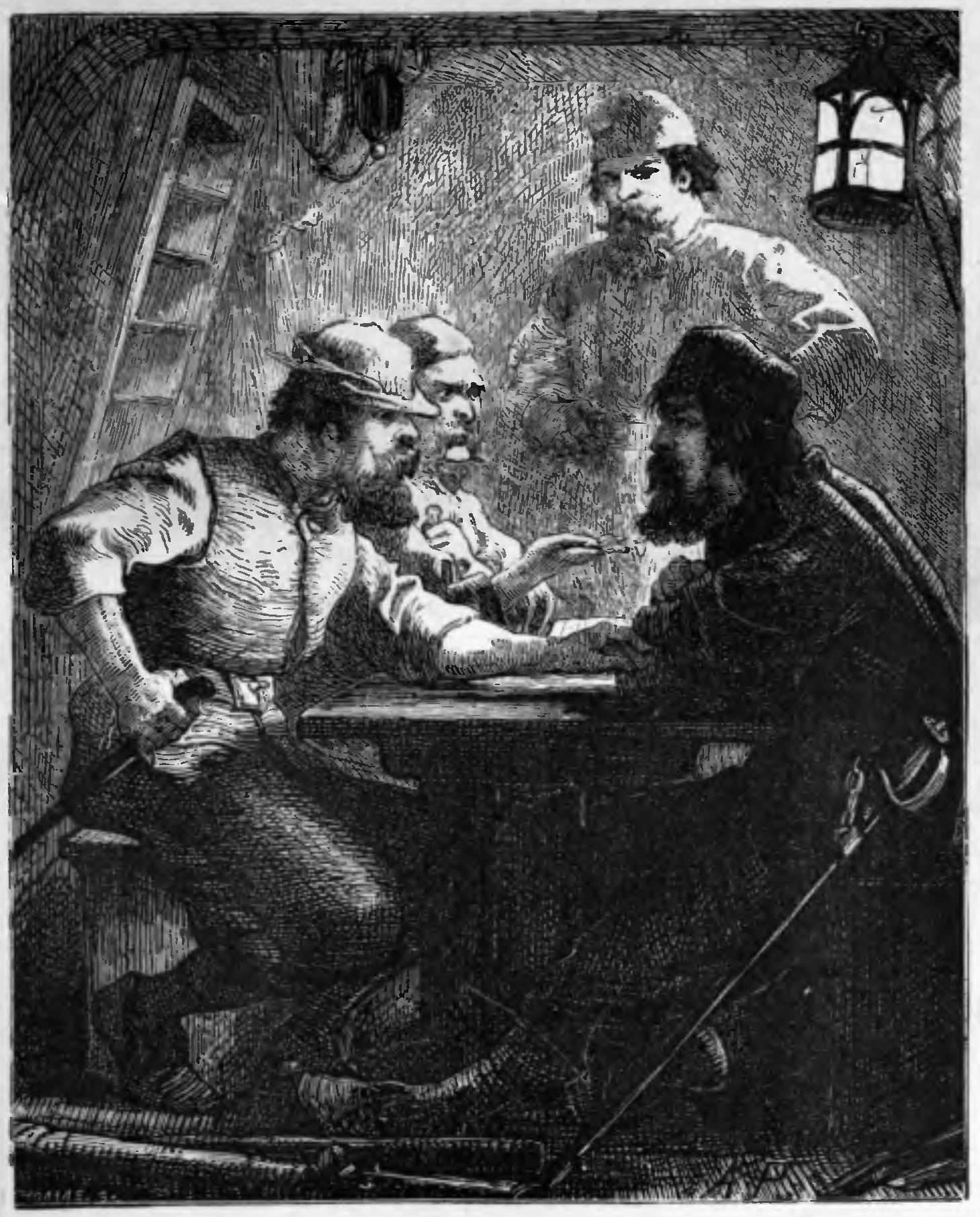
It was night. Waymouth was seated in his cabin. A lamp hung from the beam above, the light of which fell on a chart he was anxiously scanning. Unwonted cares oppressed even his buoyant spirit. His ship had suffered much; he had a large amount of wealth on board; his crew was much weakened, some were disaffected, and he was about to enter seas difficult of navigation, and where typhoons might be expected. He mourned, too, his friend Raymond’s loss, though he did not believe that he was dead, but that he had been carried off a prisoner by the enemy. Still, how could he hear of him, and how rescue him if he was a prisoner? He fell into a reverie. He was aroused by the sentry at the announcement that an officer wished to see him.
“Let him come,” was the answer; and Oliver Marston stood before him.
“What now, Oliver?” asked the captain.
“You know, Captain Waymouth, that I am not a tale-bearer; but I’ve just heard some matters which I bethought me I ought to convey to you without delay,” answered Marston. “There’s mutiny in the ship, sir, or what may come to worse.”
“Ah! how come you to know that, boy?” asked the captain anxiously, for the announcement somewhat confirmed his own suspicions.
The youngster answered promptly—“It is my first watch, sir, and as I had no fancy for turning in for a short time, I lay down for a snooze on a chest outside the boatswain’s cabin. I was afraid of oversleeping myself, so quickly awoke, and was about to jump up, when I heard voices near me. The words were spoken in an undertone, as if the speakers desired not to be overheard. Who the speakers were, I am not certain; they talked of the wealth that was on board, and how you and the other captains would get the lion’s share, but that if they acted with spirit and stuck together they might have the whole of it.”
“And you heard the whole of this, and were not dreaming, boy?”
“Every word, sir, and I was wide awake,” answered Oliver.
“You have done well to come to me at once,” said the captain. “Speak to no one of what you have heard, and appear even to your messmates as if all were going on right. To-morrow morning I will communicate with the admiral, and we will soon have these would-be mutineers in limbo. Have you no idea who were the speakers?”
“I like not, sir, to bring an accusation against any man without perfect certainty, but to the best of my belief there were Peter Hagger, the boatswain, and John Moss, his mate, among the chief speakers,” answered Oliver. “As to the rest I might be mistaken, but I think not of those two. I recognised also Dick Soper’s voice, and he is not likely to be left out if such work is proposed.”
“He’ll swing ere long at the yard-arm, an’ I mistake not; but enough now, lad,” said the captain. “Keep counsel and your eyes about you, and we’ll defeat the rebels. They’ll attempt nothing while we are with the admiral; they know him, and I thought they knew me too. Who has the first watch?”
“Mr Carlingford, sir,” said Marston.
“Tell him to keep close up with the admiral, as I want to speak him at dawn,” said Waymouth; “and call me should the weather give signs of change. You have acted most commendably.”
The lad took his leave well pleased with the praise bestowed on him by his captain, and very indifferent to the danger to which he as well as all the officers on board were exposed.
The young captain sat for some time meditating on the matter. He could not tell how many of the crew might be engaged in the plot, and on what support the conspirators depended. He might discover who were the ringleaders, but find that the greater part of the crew sided with them. Caution, courage, and decision would be required—he trusted he should not be wanting in either of the three. The last few days had been a time of unusual exertion and care. He required rest to restore his well-nigh exhausted energies. Examining his fire-arms with more care than usual, and placing his sword by his side ready for instant use, though he firmly believed that no attempt would be made by the mutineers, he threw himself on his bed. He had resolved to take the Lion next morning under the guns of the Red Dragon, and having informed Captain Wood of what he knew, call out the three men whose voices young Marston recognised, and send them on board the flagship for punishment. He soon, however, forgot his anxieties in a sound sleep. He was awoken by the voice of Oliver Marston loudly calling him.
“What is it?” he asked, starting up with his sword grasped in his hand.
Chapter Four.
“What is it?” exclaimed the young captain of the Lion, as he sprang from his bed, on which he had thrown himself without undressing. He did not require the cabin-boy’s answer, for by the way the ship was heeling over he knew that it was blowing a heavy gale. “I bade you call me the instant there were signs of a change of weather,” he observed as he hurried towards the cabin-door to gain the deck.
“The ship but this instant was struck by a squall, sir, and we are shortening sail as fast as we can,” said Marston, though the captain did not stay to hear his last words.
The deck of the Lion appeared, as the captain reached it, to be a scene of the greatest confusion. Showers of spray, torn up from the ocean by the sudden squall, were thrown over her in dense masses. The wind howled and whistled through the rigging, the sails were flapping loudly in the gale—some torn from their bolt-ropes, others with the sheets let go, which were lashing and slashing wildly and twisting into a thousand knots. Huge blocks, too, were swinging to and fro, threatening the seamen with destruction, while some of the spars wounded in the action now gave way, and their fragments came thundering down on deck, sweeping all before them. The sea roared, the thunder in crashing peals rattled along the sky, and the forked lightning ran hissing in vivid flashes from out of the dark clouds along the foaming waves, and played round the ship. The officers were shouting to the men—many, with axes and knives in their hands, rushing here and there at the risk of their lives to cut clear the blocks and the wreck of the spars, without which it was scarcely possible to go aloft to furl the remaining sails.
Waymouth at once saw that the only safe course to pursue was to put the ship before the wind. As he issued the required orders he looked out for the admiral’s ship, but the signal lanterns at her stern were nowhere to be seen. Mr Carlingford asserted that they were close to them when the squall struck the ship; so did Stanhope, who did the duty of a signal midshipman. The captain could only hope, therefore, that the admiral had at once bore up when the hurricane struck his ship. Two lights were still visible in the direction the other ships were supposed to be, but at some distance, and the Lion was apparently fast leaving them. Her crew had indeed enough to do to attend to themselves—their own safety demanded all their energies. Waymouth’s firm, commanding voice soon called order out of chaos. The ship answered her helm, and, getting before the wind once more, rose on an even keel, and flew rushing on through the darkness. Sail after sail was taken in—the loftier masts and spars had been carried away by the wind, and were mostly cut clear of the ship. The foretopmast had escaped being hit in the action, and had stood. The hurricane was increasing in power, rolling up the ocean into huge seas; higher and higher they grew, their crests curling masses of foam, following eagerly astern as wild beasts in pursuit of their flying prey. Often, while the forked lightning played round the ship, had the captain gazed anxiously at the foretopmast to ascertain how it stood the increasing pressure deprived of its usual support. He scarcely hoped to save it. The hurricane gave no signs of abating; on the contrary, it was increasing in strength.
“It must be done!” he exclaimed, seizing a sharp axe; “better choose our time than let it fall when we are unprepared. Volunteers to cut away the foretopmast!”
“I’ll go,” cried Miles Carlingford, and his words were echoed by several others.
“No, Carlingford; you stay to take care of the ship. I can let no man lead but myself in a task of such peril.”
Marston and Stanhope both volunteered, but the captain ordered them to remain with the lieutenant.
Followed by a daring crew, Waymouth sprang aloft, each man armed with axe or knife. Some remained on deck to cut the ropes which led down there. All had their tasks assigned them. The least important ropes and stays were first severed.
“Remember, lads, wait till I give the word, and then cut with a will,” cried the captain. As he stood on the top his axe was lifted in the air. “Cut!” he shouted, as, gleaming in the lightning, it descended with a force which half severed through the spar. Over it fell with a crash into the sea, and, free from all ropes, floated clear of the ship. The crew uttered a hearty cheer as the captain descended on deck after the performance of this gallant and skilful act without the loss of a man. None cheered more loudly than the boatswain and his two mates.
The ship drove on before the hurricane, but, relieved of so much top hamper, she laboured far less than she had been doing. The storm had not abated its fury; the mad waves followed fiercely after the ship, and leaped up, foam-covered, on either side, threatening to fall down on her decks and sweep everybody from off them, or to send the stout bark herself to the bottom. The thunder roared loudly as at first, the lightning flashed vividly as ever, and ran its zigzag course crackling and hissing through the air, and along the summits of the waves, and round the storm-driven ship, now seeming to dart along her spars, and then to light with a lambent flame the summit of her masts.
The crew were collected on deck ready for any work required of them, sheltering themselves as best they could under the bulwarks for fear of being washed away. Waymouth stood with his first lieutenant on the aftercastle away from the crew. He told him of the conspiracy of which he had gained information.
“What think you, Carlingford?” he added. “Shall we seize the villains now, tax them with their intended crime, and call on all who are for discipline and order to rally round us; or let them go on plotting till they find a fit occasion to put their plots into execution? It were a bold stroke at such a moment, and would be sure of success.”
“No one would be found willing to differ from you now,” answered the lieutenant; “I doubt, therefore, that you would ascertain who are the conspirators, and it would only give them a certain vantage-ground by showing them that you doubt their honesty.”
Waymouth yielded to this advice, and allowed the opportunity of seizing the supposed mutineers to pass. He had no fear that they would make any attempt to gain possession of the ship while the gale might last. In spite of the danger in which his own ship was placed, he turned his thoughts more than once to the rest of the squadron. What had become of them? Were they still afloat, driven here and there before the hurricane, or had they all met the fate from which the Lion herself had so narrowly escaped, and foundered? He could not help dreading that the latter might have been the case.
Hour after hour passed by, and the wind blew fiercely as at the commencement of the storm. No fire could be lighted. Scarcely any one had even tasted food, and the fierce spirits who had been before inclined to mutiny must have been considerably tamed by the buffeting and fasting they had been compelled to undergo.
“I’ve heard say that it’s an ill wind that blows no one good,” observed Carlingford to his captain. “I doubt if the knaves who so notably were proposing to take possession of the ship will be inclined to make the attempt for some time to come.”
“We will keep an eye on them, at all events,” said Waymouth. “In the present battered condition of our good ship, they will be too wise to wish to run away with her, or all the labour of putting her to rights would fall on their hands. Ah, no, the rogues! they will let us first do the work for them, and then cut our throats. I have met before with villains such as these, and know how to tackle them.”
Although occasionally brave villains are found, as a rule ill-doers are cowards; and the would-be mutineers on board the Lion were no exception to the rule. The captain and his lieutenant noted those who on that awful night showed most fear, and they proved to be the very men Marston had mentioned. Even the boatswain, who was generally a bold fellow, evidently shrank from the performance of any duty of especial danger, and while the captain went aloft to cut away the topmast was not one of those who had volunteered to accompany him, though under ordinary circumstances it would have been his duty to perform the work.
Morning broke at length upon the wide waste of foam-covered heaving waters, but in vain did the anxious officers of the Lion look around for any of her consorts. She herself was labouring heavily. The well was sounded. There were three feet of water in the hold; that was much in a ship of the Lion’s build. There must be a leak. The pumps were manned; all hands must work spell and spell. Even then scarcely could the leak be kept under. Those men who had shown the greatest courage during the night laboured the hardest now; the conspirators worked with an air of desperation.
When the water still gained on them, “Let’s to the spirit-room, and die jovial,” cried one.
“Ay, ay, to the spirit-room; a last glass before we quit the world,” was echoed by several.
Deserting their stations, they rushed tumultuously to the hold. They found three soldiers stationed there, with their muskets ready to fire. Strange that the very men who were about to stupefy themselves with liquor, and so to go out of the world, were afraid of dying by the hands of their countrymen! Growling like cowed mastiffs they shrank back, some returning to the deck, and others turning into their hammocks, where they intended to remain while the ship sank.
But a few only behaved thus. The greater number, as true British seamen always have done, remained at their posts to face the danger. Their perseverance was rewarded. About noon the gale began to abate, the sea to decrease. As the ship laboured less there was a hope that the leaks might be got under, and the carpenters, after sounding, reported that there was not more than the usual quantity of water in the well. The news was received with loud cheers by the crew, but they soon found that continued exertion would be necessary to keep the ship afloat. The skulkers were accordingly routed out of their berths, and compelled to take their turn at the pumps.
Waymouth well knew that idleness is the mother of many a crime, and he determined that his crew should have no such excuse. As soon as the sea became calm, there was ample work to employ all hands in repairing the damages the ship had received in the battle and the storm.
“Any day we may meet an enemy, and the ship must be in a state to fight him, lads,” the captain was continually remarking, especially when he saw the men slacken at their work. A course had been shaped for the Island of Java, where in the Harbour of Bantam he still entertained hopes of falling in with the rest of the squadron.
Day after day the Lion continued her voyage without further adventure, and every day saw some advance made in restoring her to her former condition, so that, had she encountered a Portugal ship, she would have been as ready as ever for the fight.
In appearance, however, she still wore a very battered and forlorn state. Such was the guise in which she at length entered the harbour of Bantam, making the best show that was possible, with banners and streamers flying, and drums and fifes, and other music, playing. Very different, however, was the figure they made from what they had expected, and what it would have been, had the whole English squadron sailed in at the same time. Very different also was the reception they received from the King of Bantam, in those days a powerful sovereign with a magnificent court of nobles dressed in rich robes. Perceiving the coldness of their reception, Waymouth, habiting himself in his most imposing attire, and taking a number of followers, attired in all the bravery they could command, went on shore, and, on obtaining admission to the palace, informed his majesty that his ship was only the first of a large fleet which had just obtained a glorious victory over the Portugals, and that he hoped they would soon enter the harbour and spend a large portion of their wealth among him and his people. When this fact became clear to the royal mind, the king’s conduct underwent a considerable alteration, and he seemed now only anxious to ascertain how he could best please his guests. There was no lack of entertainments of all sorts—fights of wild animals, shows, and dances. These served to amuse the men, and to prevent them from thinking of the future. But Waymouth and his chief officers could not get rid of their anxiety for their companions. They still, however, lived on in hopes. In the mean time, the captain’s chief uneasiness arose from the conduct of the boatswain, who was clearly endeavouring to ingratiate himself with the crew by overlooking their faults and shielding them from punishment. The consequence was that the discipline of the ship, spite of all the captain and superior officers could do to prevent it, became worse than it had ever been before. Miles Carlingford advised Waymouth to have Hagger and his supposed associates seized, and run up to the yard-arm, or shot; but there were many reasons against this summary proceeding. They were in the port of a treacherous people, who would very likely take advantage of any dissensions among themselves, and it was impossible to say how many of the crew might join Hagger.
“We must either wait the arrival of the rest of the fleet or seize the fellow in blue water, with no one to interfere with us,” answered Waymouth.
However, day after day passed by, and week after week, and the fleet did not appear. It became at last too probable that they had all foundered. Still it was possible that they might have put into some other port to refit, and might arrive at the rendezvous after all.
The time passed pleasantly enough on shore, as great respect was shown to the strangers by the king and chiefs. The English, in return, tried to make themselves popular with all classes, and traded successfully with them, taking care not to allow them to know the amount of wealth they had on board. Hope grew meantime fainter and fainter, and it struck Waymouth that the behaviour of the natives towards them had of late changed for the worse. Among the merchants with whom he had dealings was one who appeared to be especially honest, and more disposed to be friendly than any of his countrymen. One day he made his appearance on board, saying that he had come to trade, and he began in the usual way, but while so engaged he contrived with a peculiar gesture to give a paper to Waymouth, on which was drawn a ship under full sail. Above the ship was a hand, showing the very gesture the merchant had just made. Waymouth could scarcely fail to understand the hieroglyphic. That the merchant wished the Lion to sail away there could be no doubt. The expression of the man’s countenance convinced him that he was friendly and in earnest. Some danger threatened. Perhaps the king had got information of the wealth contained in the ship, and intended to seize her. Whatever enemies they might have on shore, there was one who could not be kept out of the ship. The unhealthy season was approaching. Fever made its appearance on board; several were struck down with it; one after the other died; the surgeon declared that the only way of saving the lives of all on board was to put forthwith to sea.
Once more the Lion was ploughing the waters of the deep. “A sail! a sail!” was the cry. A vessel was seen making for the harbour of Bantam. She might be one of the long-missing squadron. Sail was made in chase. As the Lion approached, the stranger showed the Portugal flag. Hurrah! another prize was to be made. The thought put every one in high spirits. Even the sick came up from their beds to have a look at the enemy. The object of the Portugal was to enter the harbour of Bantam before the Lion, under the belief that he would there find protection. On sprang the king of beasts. It soon became obvious, unless there was a change of wind, that the prey would have little chance of escape. The officers and crew of the Lion eagerly watched the Portugal ship, speculating on the value of her cargo, and whether she was likely to offer resistance. Such an idea was generally treated with scorn. What was the surprise, therefore, of all on board to see the chase suddenly haul up her courses and heave her maintopsail aback to await the coming of her pursuer!
“Can it be that any on board are treacherous, and wish thus to gain our favour?” said Waymouth.
“More likely that they are cowards all, and think discretion the best part of valour,” observed Carlingford: “we shall soon learn, though.”
“Ay, that shall we,” answered Waymouth. “But, see, what flags are those? They look not as if the Portugal was in a humble mood.”
As he was speaking, several flags were hoisted to the mast-heads of the stranger, conspicuous among all being that of Portugal flying above the flag of England. The sight caused a general shout of indignation among the English crew, and doubled their desire to get alongside the foe. As they got still nearer, the Portugal once more let fall his sails and stood boldly towards them, letting fly a shot in defiance.
“Now this is what does the heart good,” exclaimed Waymouth in high glee. “Yonder is a brave fellow and a worthy foe. I had ten times rather meet such a one than the coward who runs away and then yields when he is caught without striking a blow. We shall take yonder gentleman—of that there is no doubt; and it will be a satisfaction to treat him as a brave man should be treated—with honour and distinction.”
“I would that we could avoid fighting,” said Master Walker. “Here are we both from Europe—two ships, the remnant, probably, of the proud fleets which left our native shores—and we must needs set to work to knock each other to pieces. What, prithee, is to be gained by it?”
“Honour, good Master Walker! honour, which we gentlemen of the sword sigh for and live for, not to speak of the golden doubloons and other articles of value with which these Portugals think fit to freight their ships,” answered Waymouth with a laugh which showed the cool if not light spirit with which he could enter into the deadly fight.
Nearer and nearer drew the two ships. The Portugal was the first to fire, and all his guns were aimed high, as if he was anxious to cripple his opponent. The reason was obvious. His decks were crowded with men, and he hoped by running on board the English ship to take her easily with his overwhelming numbers. Waymouth saw that his proper plan was to give the Portugals a wide berth and keep firing away till he had thinned those numbers, at the same time that it was very much against his usual system and inclination, as it was against that of his followers.
Now the guns of the Lion began to play vigorously, some of them being, according to the captain’s orders, fired high, and others low. Although now and then her spars and ropes were hit, she was inflicting equal injury on the rigging of her opponent, while such of her guns as were trained low were making fearful havoc among the people on the deck of the Portugal. She, in return, was employing every manoeuvre to close with the Lion, till it appeared as if the English were actually afraid of her.
“This must not last longer,” exclaimed Waymouth. “British steel has seldom failed, however great the odds. We’ll give the Portugals their way.”
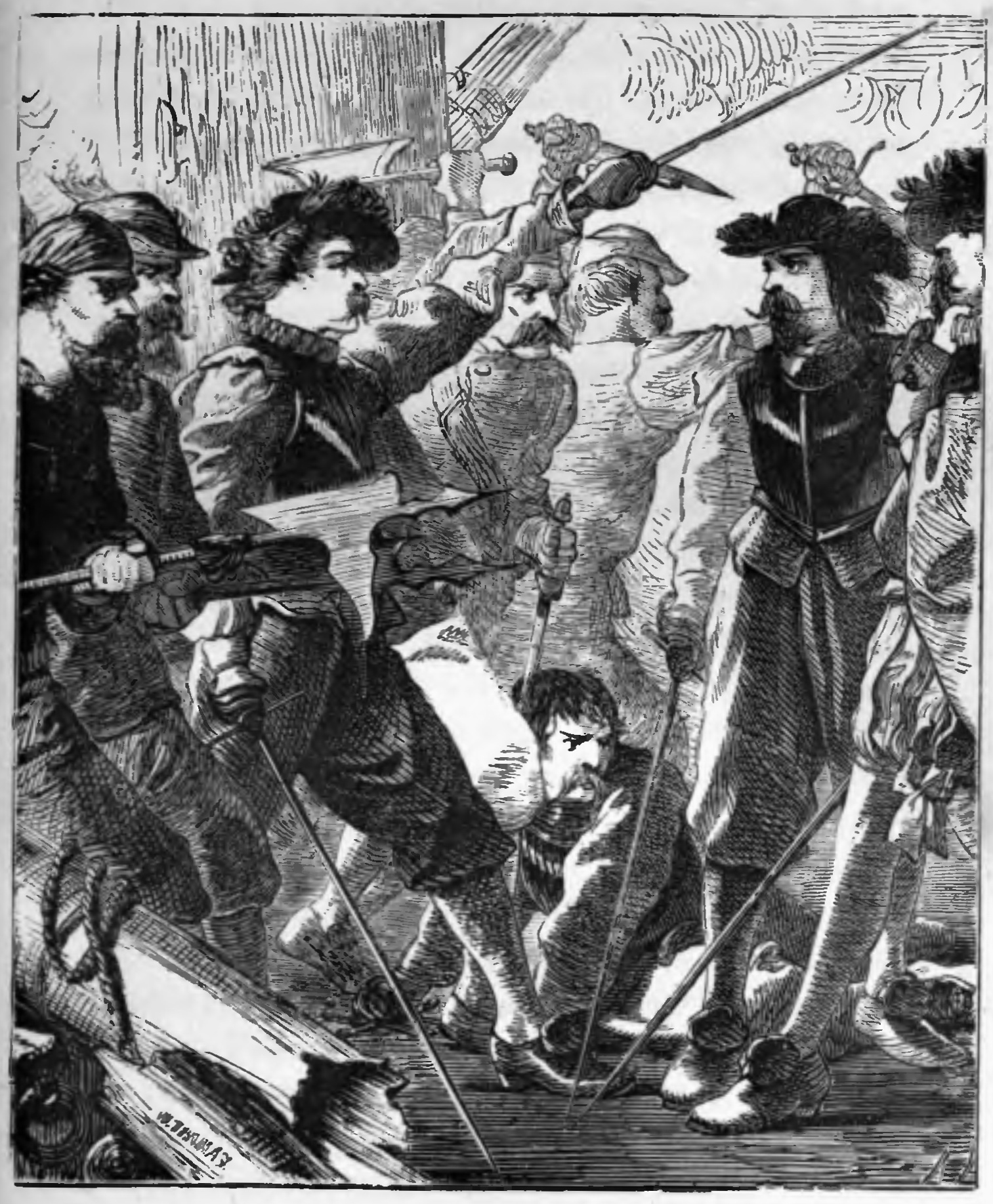
The remark was received with a loud shout by his men, on which he ordered the Lion to be steered to close with her antagonist. The two ships met with a crash; and before the Portugals, who had been mustering on purpose, could reach the side of the Lion, her gallant crew, led by Waymouth, had boarded the enemy. And now, in truth, was shown what English steel could do; and well as many of the Portugals fought, the decks were soon cleared of all but a gallant few, who, surrounding the Portugal captain, stood at bay. That Portugal captain was a young man of a noble bearing; though wounded, he seemed resolved to resist to the last.
“Yield thee—yield thee, brave senhor!” cried Waymouth. “Life and liberty shall be yours. I would fain not kill thee.”
“To you, brave Captain Waymouth, I will yield me, if you will order your men to refrain from striking,” was the answer. “Truly, they strike so hard and fast, that otherwise not one of my comrades will remain alive.”
“You are a brave gentleman. It shall be as you desire. We have met before, I suspect,” shouted the English captain, ordering his men to let drop the points of their weapons.
The deck, so lately the scene of a fierce conflict, was in an instant quiet, though the planks, slippery with gore, and the human forms strewed thickly from one end to the other, showed the desperate nature of the drama which had there been enacted. The Portugal captain delivered his sword to Waymouth, who courteously returned it, recognising him as the bravest of those captains who had been captured in the great battle fought by the whole fleet—Don Antonio de Mello by name. The prize was richly freighted, and as the Lion would require some repairs after the battle, it was resolved to carry her back to Bantam.
The return of the English so soon with a captured enemy raised them very much in the estimation of the people of Bantam, and proportionately lowered the Portugals. The repairs of both ships were soon completed, and the more valuable part of the cargo of the prize transferred to the Lion. Waymouth’s generous feelings prompted him to restore the captured ship to Don Antonio, taking his word that neither he nor his officers or men would again serve against the English. He made the proposal, however, first to his own officers, who all, with the exception of Peter Hagger, readily agreed to forego their share of the prize that the prisoners might have an opportunity of returning to their own country. The boatswain, on the contrary, vowed, that, as they had won the booty by hard fighting, they would keep it, and that he and many other good men that he knew of would not give up a nail of what was their own.
“Well said, Master Hagger; let me know who are these good men of whom you speak, and your share and theirs of what is restored to the Portugals shall be calculated and given to you,” said Captain Waymouth, looking sternly at the boatswain. “I wish to deprive no man of what he considers his own; but it strikes me that when a fair estimate is made of the real value of your share it will not be worth disputing about.”
Notwithstanding these remarks of the captain, Hagger insisted on having his share, but he was only able to send in the names of rather more than a dozen men who agreed with him. The supercargo, or accountant, of the Lion, was therefore summoned, and directed to make out an estimate of the value of the shares in question.
“Now deduct therefrom,” said Waymouth, “wages of officers and crew of the Portugal to conduct her home; risk of capture or loss; increased risk of loss or capture of the Lion in consequence of her being short-handed.”
“In that case, sir, the balance is against Master Hagger and the rest,” remarked the accountant.
“I thought as much,” observed Waymouth, laughing.
The boatswain’s anger and disappointment were very great when he found how the tables had been turned, and that, instead of gaining any thing, he had merely shown who were the men among the crew plotting with him.
The Portugals’ satisfaction was very great when they found that they were not to be detained at Bantam, where, from the unhealthiness of the climate during the hot months, they could expect only to find graves. Don Antonio warmly expressed his gratitude.
“I had some information, noble captain, which I purposed giving before parting, at all events, but which I have now a double gratification in affording,” he said, addressing Waymouth. “During that dreadful fight, when your fleet destroyed so many of ours, some few Englishmen were carried off prisoners by those which escaped. Among them was an officer who belonged to the Lion. I saw him but once, and his name I did not hear, though I doubt not that he is the friend whose fate you so much desired to learn. He is now a prisoner in the Castle of San Pedro, to the south of Goa. I had resolved to take the earliest opportunity of sending you this information according to my promise, little supposing that I should be able to deliver it under, to me, such unfortunate circumstances.”
This news raised Waymouth’s spirits higher than they had been for some time. It made him feel almost sure that Raymond had survived the battle, because, as all the other officers of the Lion had been accounted for, it could be only him of whom Don Antonio spoke. On hearing this, it at once flashed across Waymouth’s thoughts that he had done unwisely in giving the prisoners their liberty with so few conditions.
“I ought to have bargained that any English who might be in the hands of their countrymen should promptly be liberated without ransom; but yet—no; I have done a liberal deed, and I will not regret it. If these Portugals have any feeling of honour, they will let my friend go free when I demand him.”
From a subsequent conversation with Don Antonio, Waymouth was compelled to abandon the last expressed hope. It appeared that the governor of the castle of San Pedro was a certain Don Lobo, who was noted for his ferocity and avarice, so that he was well called Lobo, which means in the Portugal tongue a wolf.
Don Antonio stated that he was never known to do a noble or generous act, and that he was not likely to deliver up his prisoner unless a heavy ransom was paid, and that so bitter was his animosity against the English that it was possible he would not even set him at liberty.
“Then the Lion shall force the wolf to succumb,” exclaimed Waymouth. “I will not ask you, Don Antonio, to fight against your countrymen, but I must beg you to give me such information as may assist me in liberating my friend, and I must then exact a promise from you that you will not return to San Pedro, or by any means allow notice of our approach to be carried there.”
Don Antonio, without hesitation, gave the promise required, the more readily, perhaps, that the Lion would have the start of him for some days, and, being short of provisions and water, he could not attempt to make so long a passage as that from Bantam to Goa without being amply supplied with both. Yet further to prevent the chance of Don Lobo being informed of the approach of the Lion, Waymouth afterwards extracted an additional promise from Don Antonio that he would not attempt to sail for a week after her.
“Ned, dear coz, we shall once more shake hands, and drink a bowl together to the health of thy lady love,” he exclaimed, apostrophising his friend while walking his quarter-deck, as the Lion, under all sail, clove her way towards the west through the limpid ocean.
Chapter Five.
Our chronicle takes us back to the time when the fight between the English and Portugal fleets was raging most furiously, and when, to an inexperienced eye like that of Edward Raymond, on finding his ship surrounded, it might naturally have appeared that victory was siding with his foes rather than with his own party. He believed, however, that by a desperate effort the day might be retrieved, and he gallantly resolved on his part to make the effort, trusting that others would be doing the like at the same moment. Just then he caught sight of Waymouth repelling the boarders from one of the Portugal ships, and so calling on all the men near to follow, he led them on to the deck of another of the enemy’s ships which had at that moment run alongside. So fierce was his attack, that the foe gave way, and before many minutes were over he found himself master of the ship; but in the mean time she had broken clear of the Lion, and was drifting down on another Portugal ship coming freshly into the fight. The two were soon locked together, and while he with his handful of followers was endeavouring to defend his prize at one end of the ship, a party of Portugals rushed on board at the other. In vain he fought with the greatest heroism. Most of his followers were cut down. Pressed on all sides, he had not a prospect of success. Another Portugal ship came up. His prize, so gallantly taken, was already recaptured. Unable to parry a stroke made at him, he was severely wounded, and dropping the point of his sword, he yielded himself a prisoner to the reiterated demands of a Portugal captain who had headed the chief body of his assailants. The three Portugal ships had, however, fallen within the fire of the Red Dragon and the Serpent, whose shot crashing on board made them glad to set all the sail they could spread and draw off. As Edward stood on the deck and saw the shattered condition of the English ships, he could scarcely believe that the enemy were really drawing off; but when he afterwards saw some of the Portugals actually sinking, and others with their masts gone, he could not refrain from uttering a cheer, faint though it was, at the thought that his countrymen had gained the hard-fought victory. In this he was joined by the few survivors of his brave followers, all of whom were more or less wounded. On hearing the cheer, some of the Portugals came towards them with threatening gestures, one of them exclaiming, in tolerably good English—“You are impudent fellows indeed to cheer when you are miserable prisoners on board the ship of an enemy. Do not you see that we are victorious?”
“Running away is a funny mode of proving it, Senhor Portugal,” answered Dick Lizard, one of the seamen, cocking his eye at the speaker. “If you had cheered, now, we might have thought you had won the day; but I sticks to my opinion that it’s we have won the day; and so I say, one cheer more for Old England. Old England forever!”
The Portugal’s rage was so great that he would have given Dick a clout on the head which would have finished his shouting, had not Raymond, weak as he was, stepped forward to defend his follower, who was much hurt.
“Shame on you, Senhor Portugal,” he exclaimed, standing over Dick with a broken spar which he had grasped to defend him. “What! would you strike a wounded man simply because he knows the satisfaction he feels that our countrymen are free, if not the victors, and not as we are, prisoners?”
“You crow loudly for a cock with his leg tied,” said the man, desisting, however, from his attempt to strike poor Dick.
Some more seamen had now assembled, threatening to punish the English for their audacity, when their captain made his appearance among them, inquiring the cause of the disturbance.
“Senhor,” he said, turning to Edward, “you are my prisoner, though I wish to treat you as a brave man and a gentleman; but I cannot always restrain my people, who are somewhat lawless in their notions; and I must therefore request that, whatever may be the feelings of your countrymen, they will keep them within bounds.”
So many of the Portugals were wounded, that it was some time before the not very skilful surgeons of the ship could attend to the English, who had, and perhaps fortunately for themselves, to doctor their own hurts, which they did, one helping the other in their own rough but efficacious way. It was pleasant to see the hardy tars helping each other like brethren, washing and cleansing each other’s wounds—several of them tearing up their shirts to bind up their comrades’ limbs, or letting their heads rest with tender care in their laps. Those who had still strength to stand anxiously watched the fast-receding fleet of the English till their loftier masts sank below the horizon, and all hope of being pursued and retaken was abandoned.
“Troth, sir, I suppose, then, we must make the best of a bad job,” said Lizard, shrugging his shoulders. “That’s my philosophy. I learned it when I was a little chap from my father, who was a great philosopher, seeing that he was a cobbler, and have stuck to it ever since, and never found it fail. What’s the odds? says I. Why should a man sigh and groan if he can laugh? why should he cry and moan if he can sing? If things are bad, they can be mended—just as my father used to say of the old shoes brought to him. If that isn’t a comfort, I don’t know what is.”
Most of the Portugal ships escaping from the fight kept together; but meeting the same hurricane which caused such fearful havoc among the English fleet, they also were separated, some going where so many proud argosies have gone—to the bottom—the Santa Maria, the ship on board which Edward found himself, being left alone to pursue her voyage. Edward suffered much from his wound, and had far from recovered his strength when the Santa Maria arrived at Goa. Goa was at that time the largest European settlement in the East; and here the Portugals, to impress the natives with the beauty of the faith they professed, had established that admirable institution, the benign Inquisition. Here those edifying spectacles, autos-da-fé, frequently took place, when men of all ages, women, and even children, were paraded forth, dressed in hideous garments, to be burned alive in consequence of their unwillingness to confess their belief in the doctrines held by the Church. Our chronicle does not decide whether the Portugal priesthood were right or wrong in their proceedings; but, undoubtedly, very few converts were made to the Christian faith, and the influence of their country in the East has long since decreased to zero. The appearance of the place, though deceptive, was in its favour, and innumerable large churches, monasteries, and other public buildings reared their heads on its sandy shores. Those were the days of old Goa’s grandeur and magnificence, soon to depart for ever.
Instead, however, of being landed here, the prisoners were conveyed to the Fort of San Pedro, to the south, lest inconvenient questions might be too often asked as to how they came to be there, and what had become of the rest of the fleet which captured them.
The Castle of San Pedro was a strong fortress with high walls and towers—a gloomy-looking place, as gloomy as any spot in that land of sunshine can be, but gloomy undoubtedly it appeared to poor Edward and his companions, as, strongly guarded, they were conducted through its portals, not knowing when they might repass them and obtain their liberty. They were first conducted into the presence of the governor, a surly old don of the most immovable character; his face was like smoke-dried parchment, with beard of formal cut, and eyes so sunk that nothing could be seen but two small spots of jetty hue, overhung with grey shaggy eyebrows. Without the slightest expression of courtesy or commiseration, he at once commenced interrogating Edward in the Portugal tongue, ordering a yellow-skinned trembling clerk, who squatted at his side with a huge book before him, to write down his replies.
Edward answered succinctly to all the questions put to him, requesting that, as prisoners of war, he and his men might be treated with the courtesy usually awarded to persons in their position, by civilised nations, among whom the Portugals stood prominent.
“Call yourselves prisoners of war!” exclaimed Don Lobo, pulling his moustaches vehemently. “You are pirates—you and your countrymen—nothing better; and as such deserve to be thrown from the top of one of the towers of this castle, or dangled from one of the turrets by a rope, or shot, or drowned—any death is too good for you; burning at the stake as heretics—ay, vile heretics as you are—is most fit for you. See that such is not your lot.”
Edward made no reply to this address, feeling that such would only too probably exasperate the petty tyrant. Dick Lizard was, however, not so judicious. Having had a good deal of intercourse with the Portugals, he knew enough of their language to understand what was said; so, putting his left arm akimbo, and doubling his right fist, he exclaimed—
“Call us pirates! I’ll tell you what you and your dastardly crew are, Senhor Don Governor: you are a set of garlic-eating, oil-drinking sons of sea-cooks, who rob the weak when you can catch them, and run away from the strong like arrant knaves and cowards as you are. You are—”
What other complimentary remarks poor Dick might have uttered it is impossible to say; for as he was beginning his next sentence, a blow from the butt-end of an arquebuse laid him prostrate on the floor. Edward, afraid that his bold countryman had been killed, knelt down by his side. But Dick’s head was too hard to succumb to the strength of a Portugal’s arm, even when wielding a heavy weapon.
“All right, sir,” he said, opening his eyes. “I’ll be at them again, and give ’em more of my mind, and my fist too, if I can get at them.”
Edward, however, advised him under the circumstances to keep both one and the other to himself, and, as he did not feel disposed to be polite to his masters, to hold his tongue.
“Masters! Marry, masters, indeed!” cried Dick. “If you says they are masters, sir, I suppose they be; but they’ll find me a terrible obstinate servant to deal with, let me tell them.”
“No, don’t tell them, Lizard, that or any thing else,” said Edward soothingly. “You see that at all events we are in their power, and unless they let us go we may have some difficulty in escaping.”
“Not if we can get some planks to float on, sir,” whispered Lizard. “That notion of yours, sir, has brought me to sooner nor any thing. I thinks as how now, sir, I can keep a civil tongue in my head to those baboon-faced, sneaking, blackguard scoundrels.”
“Get up, then, man, and remember not to speak a word while I explain your sentiments,” said Edward, glad by any means to save his follower from ill treatment.
The Portugals, who fully believed that the blow must have inflicted a mortal injury on the man, fancied that his officer was receiving his last dying words, a message to his distant home, and did not interfere with him. Their surprise, therefore, was proportionately great when they saw him got up on his legs, give a hitch to his waistband, and, after sundry scratches and pulls at his shaggy locks, once more address the governor.
“An’ may it please your honour, Senhor Don Governor, I axes your reverence’s pardon for calling you and your people yellow-faced sons of sea-cooks (because as how to my mind your fathers and mothers were never any thing so respectable,” he added in a low tone). “Howsomdever, as your honour knows, I am but a rough seaman who’s followed his calling on the salt water all the days of his life, and will follow it, maybe, to the end, and therefore much manners can’t be expected; and so, Senhor Scarecrow, or whatever is your name, I hope you’ll not log down against my officer here or my shipmates any thing you’ve heard.”
Edward, as soon as he could put in a word, began to offer an interpretation of what had been said. It was not very literal, but interpreters are seldom exact in translation. He remarked that his follower had forgotten himself, that the blow had brought him to his senses, and that he now wished to render every apology in his power to one like Senhor Don Lobo, who so greatly merited his respect.
The old governor pulled away at his beard for some time, and twirled his moustaches, but was at length pacified sufficiently to order the prisoners to be carried off to the ward prepared for them.
Edward, determined to maintain a courteous demeanour in spite of the harshness with which he was treated, bowed to the governor as he was marched off between two guards, who seemed to think that the pugnacious Englishmen would by some means or other break away from them, and effect their escape. For that reason Dick Lizard had no less than six guards, one on each side, and two in front, and two behind; and certainly, as he rolled along with his sea cap stuck on the back of his head, his brawny arms bare, and his broad chest exposed, he appeared capable of successfully accomplishing any design he might conceive on his captors. The rest of the seamen imitated him with more or less effect, and were evidently customers of whom the Portugals stood greatly in awe.
The ward in which the English prisoners were placed was a room in a tower on a third floor overlooking the sea. It might have made a not unpleasant chamber if nicely fitted up, but as the only aperture to admit light and air was strongly barred, as the walls were of rough stone, the floor dirty, and heaps of not the cleanest straw were made to do duty for beds, the state of the case was very different. There were no chairs or tables; so that when the prisoners got tired of walking about they were obliged to betake themselves to their heaps of straw. Here day after day passed by. Edward, however, with the aid of Dick, who firmly believed in his power of escaping, kept up the spirits of the party by inducing them to tell their long and astounding yarns, and singing a variety of songs. Sometimes their guards came in to inquire why they were making so much noise, but they were not generally interfered with. Occasionally they received a visit from the surly old governor, when Edward, instead of asking for better quarters, as he might reasonably have done, treated him with the same respect as at first. Dick Lizard pretended to do the same; but as soon as the stately don had passed him the expression of his features and his gestures showed that his respect was not of an enduring quality. As the governor passed along the ward, Dick would imitate his strut and would give a stately bow, now on one side, now on the other, his countenance all the time in a broad grin. Even the warders and guards were amused by his antics, and for fear of putting a stop to them only gave way to their laughter when they saw that the governor was not looking towards them.
“All right, sir,” said Dick to Edward one day, after he had been indulging in more than his usual facetiousness, and the governor had taken his departure. “To my mind these Portugals care very little for their old don, or they wouldn’t laugh at him as they do; and it’s my belief that we shall be able to bribe them to let us slip out one of these fine nights without making any noise about it, and when the morning comes we shall be gone.”
Edward’s heart beat with joy at the thought, but after reflecting a little he answered, with a sigh—
“A bright idea, Dick, but I fear me much the wherewithal to bribe is sadly wanting. The rogues have left us little else but the clothes on our backs.”
The seaman gave a well-satisfied hitch to his waistband—a movement indicative of satisfaction or hesitation, as well as other emotions of the mind, among nautical characters in all ages—and observed—
“The dons are not quite as clever as they think, sir. They left us our clothes, but I and two more of us had lined them pretty thickly with good lots of yellow-boys, and there they are all safe. You know, sir, a seaman never knows what may happen, and to my mind it’s a wise custom among some of us. To be sure, if we comed to be cast away on a desolate island, all the gold in the world wouldn’t help a man to get off so much as a sharp axe and a chest of carpenter’s tools; but among people with manners and customs, though I can’t say much for either one or the other of those hereabouts, there’s nothing like gold!”
“True indeed, Lizard,” said Edward, partaking somewhat of the confidence of his follower, at the same time that he saw more clearly, probably, the difficulties in their way. He therefore entreated Dick and the rest to act with the greatest circumspection, and to appear to submit with perfect readiness to the rules and regulations of the place. The good effect of this conduct was apparent by the greater liberty which the prisoners obtained, and they were now allowed to take their exercise in the open air on the flat roof of part of the castle. Thence in a short time they were allowed to descend to a terrace overlooking the sea, where, however, they were watched by several lynx-eyed guards stationed above them.
It is seldom that those shores are visited by storms, but when the wind does blow it makes ample amends for its usual state of quiescence. In spite of a gale which had sprung up, Edward, with Dick Lizard and several of the other prisoners, was walking up and down on the said terrace, when Dick, whose eyes were of the sharpest, exclaimed that he saw a tall ship driving on before the gale, which set directly on the coast.
“Alas for the hapless crew!” exclaimed Edward. “I fear me they will all be lost!”
“Not a doubt about it, sir, unless some true-hearted seamen venture out to their rescue when the ship strikes, as strike she must before many hours are over.”
“Are you ready to go, Lizard?” asked Edward.
“An’ that I am, sir, and all the rest of us, I’ll warrant, if a boat can be found to swim in such a sea,” answered Dick.
“Then I’ll lead you, my brave lads!” said Edward warmly. “I’ll go seek the governor and get from him a boat fit for our purpose. Whoever they are, I could not bear to see our fellow-creatures perish without an effort to save them. But perhaps the Portugals themselves will be eager to go, and not thank us for making the offer.”
“Not a bit of it,” answered Dick sturdily. “I’ve seen brave Portugals, I’ll allow, but when they come out to this country all the good gets burnt out of them.”
Dick was not far from right. Edward got access to the governor, who at once inquired if any one was ready to volunteer to go to the rescue of the crew of the ship now closely approaching the land; but when it was understood that the English prisoners had offered to risk their lives in the undertaking, no one was found willing to deprive them of the honour.
A fine seaworthy boat was placed at Edward’s disposal, and at the head of his men, who were in the highest spirits, he walked out once more from prison.
Of what nation was the approaching ship was the question. To the honest tars and the brave gentlemen they followed it mattered nothing whether she was friend or foe. The Portugals had, however, discovered her to belong to their own people, and this, although it did not make them the more disposed to risk their own lives, induced them the more willingly to allow the English to do so to any extent they might see fit. Great was the eagerness they exhibited in bringing oars, and tholes, and boathooks, and ropes down to the boat, and still more, when the English had got into her, in launching her into deep water. This could not have been done on the open beach, on which the sea broke with terrific force, but she was hauled up on the shore of a natural harbour formed by two ledges of rocks rising a considerable height above the water. As the outer ends circled round and overlapped each other, the water inside the basin thus formed was comparatively smooth. Outside, however, the sea broke with terrific fury, threatening to overwhelm any boat or other floating machine which might get within its influence.
Some way to the north was another wide extending ledge of rocks, towards which it appeared that the unfortunate ship was drifting; but even should she escape that particular lodge and drive on the beach, the chance that any of those on board would escape was small indeed, for so high were the rollers and so powerful the reflux that once within their influence the stoutest ship could not hold together many minutes, and should any living beings washed towards the shore escape being dashed to pieces or killed by the broken planks and spars, they would be carried again out to sea and lost. Edward and Dick Lizard saw clearly this state of things, but they were not in consequence deterred from attempting to perform their errand of mercy. They also saw that if they would be successful there must be no delay. Each man having secured his oar with a rope, and himself to his seat by the same means, Edward gave the sign to the Portugals to shove off the boat. With loud shouts they placed their shoulders under her sides, and then, shrieking and grunting in concert, they almost lifted her along the sand till she floated, when the English prisoners bringing their oars into play shoved her off into the middle of the basin. Dick Lizard took the helm, while Edward stood up to judge of the best moment for crossing through the breakers. The crew went, steadily to their work. No one was ignorant of the danger to be gone through. At the entrance of the little harbour a white wall of water rose up before them, curling round and topped with masses of glittering foam, which fell in dense showers, blown by the gale over them, tending to blind and bewilder even the most experienced seaman of the party. Edward was at first in despair of finding a channel through which the boat could by any possibility pass and live. Some of the Portugals had, however, assured him that at times between the intervals of the heavier seas he would be able to get through, and he resolved to persevere if his men were ready to do so.
“Ready, ay, ready, every one of us, Master Raymond,” answered Dick Lizard, after the briefest of consultations with his comrades. “Where’s the odds? We can but die once, whether with a Portugal’s bullet through us, or by the vomito prèito or under yonder foaming seas—what matters it? An’ you wish to go, we, to a man, will go too.”
“Thanks, my brave lads; and now, when I order you to give way, give way you must, or be ready to back water at the word,” exclaimed Edward, standing up in the stern-sheets of the boat so as to command a view over the mass of seething, raging, roaring water which rose before him. Sea after sea rolled in, and with a voice of thunder broke on the rocks with a force sufficient, it seemed, to dash them to fragments; but, placed there by the hand of Omnipotence to curb the fury of the wild ocean, the proud waters were hurled back upon themselves again and again, unable to gain a foot on their fixed confines, shattered into minute atoms of foam which the wind bore far away on its fleet wings, while the iron rocks remained fixed as of old, laughing to scorn their reiterated attacks.
The ship meantime was approaching nearer and nearer to the shore. Had she been drifting directly on it, she would by that time have been cast helpless on the stern rocks, but happily part of her foremast was still standing, on which a sail being set, her course was somewhat diagonal, and she was therefore longer in reaching her impending fate than had at first appeared likely to be the case. Now she rose on the summit of a foaming sea, now she sank into the hollow, seemingly as if never to appear again; but bravely she struggled on, like a being endued with life, resolved to battle to the last, yet knowing that destruction was inevitable. Edward observed that although at first there appeared to be no difference in the height of the rollers, yet that after a time several of less apparent strength came tumbling in unbroken till they actually touched the rocks, leaving a narrow yet clear space between them. Through this space he determined to urge his boat. He pulled down to the very mouth of the harbour; the crew lay on their oars. A huge sea came roaring on majestically, and breaking into foam almost overwhelmed the boat. Directly afterwards the clear channel appeared.
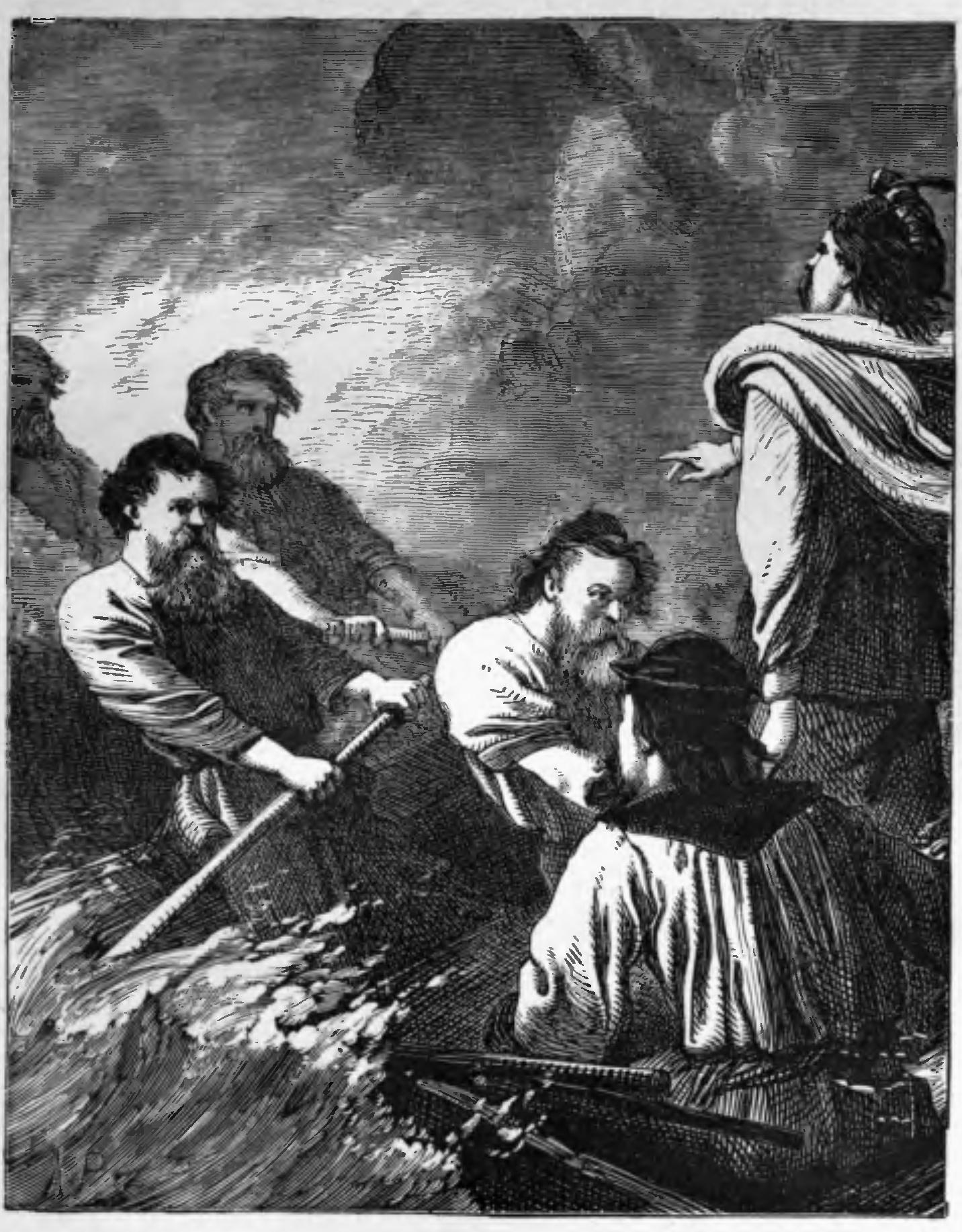
“Give way, give way, brave lads!” shouted Edward.
The boat sprang on. Immediate destruction or success awaited them. The blades of the oars were concealed amid the seething waters on either side, and the foam came bubbling up over the gunwales, but the boat still held her course outward. She rose towards the summit of a lofty sea; the men strained every nerve. Up she climbed; then downward she slid rapidly to meet another sea, up which she worked her way as before. Another and another appeared in rapid succession; she surmounted them all, and the open ocean was gained.
Having gained a sufficient distance from the land, they had to keep along shore with the sea stream—a dangerous position, as, should the boat be caught by a roller, she would most certainly be turned over and over till she was dashed in fragments on the beach. On they came to the ship, plunging through the seas, and appearing as if every instant would be her last, even before she could reach the fatal strand. As they drew near they could distinguish the people on board in various attitudes indicative of despair. There were many hapless beings—sailors, soldiers, civilians, and women and children, some infants in arms, all full of life, and yet, ere many fleeting minutes could pass away, to be numbered with the dead. One last desperate effort was, it was seen, now made by the crew of the ship to save their lives. Two anchors were let go, the cables flying out like lightning from the bows, while at the same moment gleaming axes cut away the remaining part of the foremast, which plunged free of the ship into the sea. It was a well-executed, seamanlike manoeuvre. The stout ship was brought up, and although she plunged with her lofty bow almost under the seas, it seemed that her anchors were about to hold her. Hope revived in the breasts of those on board. Edward and his brave companions pulled alongside; ropes were hove to them, and they maintained the position they had gained, although in the greatest possible peril of being swamped. To climb up to the deck of the ship was almost impossible, but Raymond shouted out that he was ready to convey as many of the passengers to the shore as were willing to trust themselves to his charge. Many of those who but a short time before had given way to despair were now unwilling to leave the stout ship which still floated under them for a small open boat. Some who had less confidence in the power of the anchors to hold the ship, hurried to the side, and showed by their gestures that they wished to enter the boat. Without assistance, however, to make the attempt were madness, and the Portugal seamen exhibited no intention of helping them.
“I’ll do it, Master Raymond,” cried Dick Lizard, seizing a rope which hung over the side, and with a nimbleness which alone prevented him from being crushed between the boat and the ship he climbed up over her bulwarks. Two seamen followed his example.
Several more persons came crowding to the side of the vessel on seeing the hardihood of the British seamen in venturing to their assistance. Dick seized the person he found nearest to him as he leaped on deck. It was a young girl. She was clasping the arm of a grey-headed, tall old man, who seemed to be her father.
“No time for ceremony, fair lady,” cried Dick; “bless your sweet face, I’ll make all square when we gets you safe on shore; just now, do you see, you mustn’t mind a little rough handling. There! there! let go the old gentleman’s fist; we’ll lower him after you, never fear. Hold on taut by the rope, as you love me. A drop of tar won’t hurt your pretty hands. There! there! away you go! Look out below there! Gingerly, lads, lower away. Now, old gentleman, you follows your daughter, I suppose?”
These exclamations were all uttered while Dick and his companions were securing a rope round the young lady’s waist, and lowering her into the boat. She gazed upward at her father with a look of affection as she felt herself hanging over the raging ocean while the boat seemed receding from her. A loud shriek of terror escaped her. Dick waited till the boat had again risen, and just as it was about to descend into the trough, he let the young girl drop into the arms of Raymond, who stood ready to receive her, and with a sharp knife cut the rope above her head, not waiting to cast it loose. The next comer was, as Dick promised, the old gentleman, who, even less able to help himself than the young lady, was treated much in the same way.
A young mother with her child, whom with one arm she clutched convulsively to her bosom, while with the other with a parent’s loving instinct she endeavoured to prevent the infant from being dashed against the ship’s side, was next lowered. Not a sound did she utter. Once the ship, gave an unexpected roll, and she was thrown rudely against the side, but she only clasped her infant the tighter, and heeded not the cruel blows she was receiving. Barely could Edward with all his strength secure her and free her from the rope before the boat was dashed off to a distance from the ship. Again, however, the boat was hauled up alongside. Lizard had now slung two little boys together. Though pale with terror, they bravely encouraged each other as they hung over the foaming ocean till the position of the boat enabled them to be lowered into her.
Their father stood on the bulwarks watching them with all a father’s affection, he himself wishing to follow immediately, but being prohibited from making the attempt till some more women and children had been lowered. Lizard and his companions laboured on unceasingly, for none of the Portugal’s crew would render them any assistance. Several other people were thus conveyed to the boat, but many who seemed at first inclined to leave the ship lost courage as they saw the hazard of the undertaking. Some, again, as they gazed towards the foam-covered shore, and heard the roar of the seas as they dashed on the wild rocks, or rolled up on the shingly beach, showed that they would rather trust their safety to the boat than to the labouring ship. Among them was a young man who pushed forward requesting to be lowered.
“No, no, senhor don,” said Lizard. “Do ye see that there are more women and children to go first? We must look after the weaker ones, who can’t help themselves. That’s the rule we rovers of the ocean stick to.”
The young man, either not comprehending him, or so eager to escape as to forget all other considerations, sprang up on the bulwarks, and, seizing a rope, attempted to lower himself without assistance. Miscalculating the time, he descended rapidly; the ship gave a sudden lurch, the boat swung off, and the foaming sea surging up tore him from the rope, and with a fearful cry of despair he sank for ever. He was the first victim claimed by the ocean. His fate deterred others from making a like attempt.
“Come, senhor,” said Lizard to the father of the little boys, “if you wish to go with us it’s fair you should, seeing that others are thinking about the matter instead of acting. You just trust to me, and I’ll land you safely.”
Comprehending what Lizard meant by his gestures, rather than by his words, he submitted himself to his guidance, and was placed by the side of his boys. At that instant a cry arose on board the ship that the anchors were dragging. Lizard soon saw that the report was too true. Now numbers were eager to jump into the boat. She might have carried three more persons, but in the attempt to receive them scores might have leaped in, and the boat would have been swamped. Dick and his companions had no fancy to be wrecked with the ship; so, seizing ropes, they swung themselves into the boat. The next moment the rope which held the boat was cut, and she floated clear of the ship. The oars were got out and hastily plied by the sturdy seamen. Good reason had they to exert all their strength, for the ship, while dragging her anchors, had already carried them fearfully near the roaring line of breakers among which she herself was about to be engulfed. With horror those who had been rescued contemplated the impending fate of their late companions. Slowly the boat worked her way out to sea, while the ship, with far greater rapidity, drove towards the shore. Now the wind, which appeared for an instant to have lulled, breezed up again. Hardly could the boat hold her own. Edward and Lizard had to keep their eyes seaward to watch the waves in order to steer their boat amid their foaming crests. The hapless people on board too well knew what must be their own fate. In vain they shrieked for help; in vain they held out their arms; vain, truly, was the help of man. A furious blast swept over the ocean. A mass of foam broke over the boat. Raymond believed that she could not rise to the coming sea, but, buoyantly as before, she climbed up its watery side, struggling bravely. As she reached its summit a cry escaped the rowers—“The anchors have parted! Good God! the anchors have parted!”
In an instant more the raging seas, foaming and hissing, broke over the stout ship, ingulfing in their eager embrace many of those who were till then standing on the deck full of life and strength. Still the waters seemed to cry out for more. Each time they rushed up more and more were torn from their hold. Some strong swimmers struggled for a few moments amid the boiling surges for dear life, but the shrieks of most of them were speedily silenced in death. The stout ship, too, stout as she was, quickly yielded to the fury of the breakers. The high poop was torn away as if made of thin pasteboard; the wide forecastle, with the remainder of the crew still clinging to it, was carried off and speedily dashed to fragments; the stout hull next, with a wild crash, was rent asunder, and huge timbers, and beams, and planks were dashed to and fro amid the foaming billows, speedily silencing the agonised shrieks of those who yet hoped—though hoped in vain—to reach the land where hundreds upon hundreds of their fellow-creatures stood bewailing their fate, but unable to render them assistance. But a few minutes had passed by since the tall ship had struck on those cruel rocks, and now her shattered fragments strewed the ocean, some carried back by the receding waves, others cast, torn and splintered, on the beach with tangled masses of ropes, and spars, and seaweed. Here and there a human form, mangled, pallid, and lifeless, could be discerned, surrounded by the remnants of the wreck, now approaching, now again dashed off suddenly from the shore; now an arm might be seen lifted up as if imploringly for help; now the head, now the very lips, might be seen to move, but it was but the dead mocking at the living. No sound escaped those lips; for ever they were to be silent. Most of those thus momentarily seen were swept off again to become the prey of the ravenous monsters of the deep. A few of the poor remnants of frail mortality were cast up and left upon the shore, whence they were carried up by the pitying hands of charity to be interred in their mother earth, but by far the greater number were among those who shall rest in their ocean graves till the time arrives when the sea shall give up her dead, and all, from every land and every clime throughout all ages since the world was peopled, shall meet together for judgment.
Chapter Six.
“How fares it with the good ship, Dick?” asked Edward, fearing for one moment to withdraw his eyes from off his arduous task of steering the boat amid the raging seas.
The answer came not from the British seaman, but from one of the passengers taken from the ship:—
“Mother of Heaven! they are lost—all lost!”
The words, uttered by the young lady who had been the first received into the boat, were followed by a heart-rending shriek as she sank fainting into the arms of her father. Many of those who had been saved had relatives, all had friends and acquaintances, on board the ship. Some others cried out and expressed their horror or regret, but the greater number looked on with stolid indifference, satisfied that they had themselves escaped immediate destruction, or absorbed in the selfish contemplation of their own pending fate. It seemed even now scarcely possible that the boat, heavily laden as she was, could escape being swamped. Humanly speaking, her safety depended on the bone and muscle and perseverance of her crew. None but true British seamen could have held out as they did. Many hours had elapsed since the ship was first seen; night was approaching, and the sea still ran so high that it would be next to madness to attempt re-entering the little harbour—a task far more difficult than getting out of it, as the slightest deviation to the right or left would have caused the instant destruction of the boat and of all on board her. There was nothing, therefore, but to continue at sea. There was no other harbour for many miles either to the north or south which they could hope to reach within many days.
“An’ we had but provender aboard, Master Raymond, we might give the Portugals the slip, and never let them see our handsome faces again,” observed Dick, after keeping silence for a considerable time.
“True, Dick,” answered Edward, and hope rose in his heart at the bare mention of escaping; but with a sigh he added, “First, though, we have no provender, and had we, in duty we are bound to land these poor people as soon as we can with safety venture so to do. Already they are almost worn out, and a few hours more of exposure may destroy their lives, which we have undergone this peril to preserve. Then, again, the Portugals allowed us to take the boat on the faith that we were to return. Duty is duty, Dick; the temptations to neglect it do not alter its nature, whatever the old tempter Satan may say to the contrary. Let us stick to duty and never mind the consequences.”
“That’s all true, no doubt, Master Raymond, what you say,” replied Lizard. “But it would be hard, if there was a chance of getting away, to go back to prison. Liberty is sweet, especially to seamen.”
“Duty is duty, Dick,” repeated Raymond. “What is right is the right thing to do ever since the world began. Maybe the gale will go down, and by dawn we may land these poor people without danger. It will be a happy thing to us to have saved them; and, to my mind, even our prison will be less dreary from having done it.”
All hands were soon brought round to their officer’s opinion. The sun was now setting, and darkness in that latitude comes on immediately afterwards. Their prospect was therefore dreary and trying in the extreme. It was difficult to keep the boat free from water in the day; still more difficult would it be while night shrouded the ocean with her sombre mantle. Hunger, too, was assailing the insides of the crew; but, still undaunted, they prepared to combat with all their difficulties. Rest they must not expect; their safety depended on their pulling away without ceasing at the oars. Pull they did right manfully. Now one broke into a song; now another cheered the hearts of his companions with a stave, which he trolled forth at the top of his voice. The example was infectious, and in spite of hunger and fatigue, jokes and laughter and songs succeeded each other in rapid succession. The jokes were none of the most refined, nor were the songs replete with wisdom; but the laughter, at all events, was loud and hearty; above all things, it had the effect of raising the drooping spirits of the poor beings who had been confided to them by Providence.
As they sang, and joked, and rowed, the sea began to go down, and thus, as their strength decreased, the necessity of exerting it became less; still they were compelled to pull on to keep the boat off the land and her head to the sea. At length the singers’ voices grew lower and lower, and the jokers ceased their jokes, and the heads of some as they rowed dropped on their bosoms for an instant, but were speedily raised again with a jerk and a shake as they strove to arouse their faculties. Edward had need of all his energies to keep himself to his task, and he told Dick to warn him should he show any signs of drowsiness.
The hours as the morning approached appeared doubly long. The dawn came at last, and then the sun in a blaze of glory shot upward through the sky and cast his burning rays across the waters upon the boat, with her living but almost exhausted freight yet struggling bravely. The wind had fallen. There was a perfect calm, but yet the billows rolled on, moved, it seemed, by some mysterious power unseen to human eye—not, as before, broken and foaming, but in long, smooth, glassy rollers. Smooth as they were, they would have proved fatally treacherous to the boat had Raymond ventured to land. As they approached the beach they gained strength and height, and then broke with tremendous fury on the smooth sand or rugged rocks, as if indignant at being stayed in their course. Again and again Edward and his companions gazed wistfully at the coast. That formidable line of breakers still prohibited approach. He and his companions had before been suffering from hunger. As the sun rose higher and became hotter and hotter, thirst assailed them—thirst more terrible and more fatal than hunger. The poor passengers suffered most; it seemed as if they had escaped a speedy death on the previous day, to suffer one more painful and lingering. Raymond had been unable till now to pay them much attention personally, leaving them to assist each other as best they could. He was now attracted by the affectionate manner in which the young lady who had been at first saved tended her aged father, and at length, when he could with safety leave the helm, on stooping down to aid her, he recognised in her features, careworn as they were, those of Donna Isabel d’Almeida. He addressed her by name.
“What! then our gallant deliverer is the Englishman Don Edoardo, the friend of Don Antonio!” she exclaimed. “Father, father, we are safe among friends; they will surely take us to the shore when they can. I perceived the likeness from the first, but, overcome with terror and confusion, I could not assure myself of the fact. You will forgive me, Don Edoardo.”
“Indeed, fair lady, I have nothing to forgive,” said Edward. “I rejoice to have been the means of thus far preserving one for whom I have so high an esteem from a dreadful fate. I cannot but believe that Providence, which has saved us thus far, will enable us yet to reach the shore in safety.”
“Heaven and all the saints grant that we may! and under your guidance I have no fear,” answered Donna Isabel. “But, Don Edoardo—”
The young lady stopped and hesitated, and then continued in a faint voice—
“There was another brave officer of your ship I would ask after—Don Antonio. I could never pronounce his family name. How is it that he is not with you?”
This question very naturally led Edward to describe the battle, and how he had been taken prisoner and brought to Goa, and thence transferred to the safe keeping of Don Lobo, and how he and his companions had been treated, and how they had been enabled to come off to the assistance of the ship in consequence of the cowardice of her countrymen, who were glad to get others to do the work which they were afraid to attempt.
This account was listened to with interest by the rest of the passengers, who all exclaimed against the cruelty and injustice of Don Lobo, and promised, should they be preserved, to use their influence in obtaining the liberty of the brave Englishmen.
“See, Dick, did I not say right when I told thee that we should do our duty, and leave the consequences to Providence?” Raymond could not help remarking to Lizard. “We shall now have many friends about us on shore, and some of them will get us set free, depend on that.”
“I hope you are right, Master Raymond; but to my mind the Portugal chaps haven’t much gratitude in their nature, and out of sight with them is out of mind,” was Dick’s reply.
As the day drew on, the anxiety of all in the boat to reach the land increased; indeed, it was very evident that without water several would be unable to exist through another night. Accordingly, about four hours after noon, as was guessed by the height of the sun, Raymond announced his intention of making the attempt to run into the harbour. He had carefully noted the bearings of the marks at the entrance on coming out, so that he was able to steer a direct course for the spot. The long swells still rolled in, and broke along the coast in sheets of foam, and all he hoped to find were a few yards of green water through which he might steer his boat. The belief that their toils were to come to an end roused up even the most exhausted of the crew. On glided the boat. Now those on board looked down on the shore full in view before them—now a smooth green wall of water rose up and shut it from their sight. Even the bravest held their breath as they approached the rocks, and the loud roar of the breakers sounded in their ears. Edward and Lizard stood up, grasping the tiller between them. There was no going back now. Had they allowed the boat to come broadside to one of those watery heights she would instantly have been rolled over and over, and cast helpless on the rocks. Many a silent prayer was offered up that such a fate might be averted. Nearer and nearer the boat approached the rocks. “Back water—back water, lads!” cried Raymond, and a huge roller lifted the boat high above the shore, but failed to carry her forward. It broke with a thundering roar into sheets of foam, and then opened before them a smooth channel. “Pull—pull for your lives, lads!” cried Edward. The seamen obeyed with a will. The boat shot on, and, amid showers of spray on either hand ere a breath could be completely drawn, she was gliding forward, all dangers passed, towards the beach, where hundreds of persons, Portugals and natives, stood ready to receive them. The boat was hauled up on the beach, and, this task accomplished, even Edward and Lizard sank down, unable to support themselves. They and their companions were carried up to the castle, and, although somewhat better chambers were provided for them, they found themselves still prisoners, and strictly guarded.
“I told you so, Master Raymond—I told you so!” exclaimed Dick. “There’s no gratitude in these Portugals.”
However, after the lapse of a few days their condition was altered very much for the better, and provisions and luxuries of various sorts were sent in as presents from those who had heard of their brave exploit. Raymond also received visits from Don Joao d’Almeida, as also from various other persons of influence. He was himself allowed rather more liberty than before, and was even permitted to ride out in a morning with an escort, in company with some of the officers of the fort, and to enter into such society as the place afforded. He thus constantly met the young Donna Isabel, whom he could not help regarding with interest. At the same time, whatever might have been his private opinion regarding the attractions of that fair lady, even had they been far greater than he esteemed them, he would not have allowed himself to be influenced by them; first because there was one in his far-off home to whom his troth was plighted, and secondly because he fancied that her affections were fixed on Waymouth, and though he devoutly hoped that his friend would never marry her, yet he considered that as a messmate and a friend he was not the person to stand between them. These were the very reasons which suggested themselves to his mind as an excuse, as it were, for not following the rules of all romances, and falling desperately in love with the young lady whom he had been the means of preserving from a dreadful death.
It is possible that even had Edward not been influenced by these two reasons for not falling in love, as the phrase goes, with Donna Isabel, he might have found others—indeed, that she was a Romanist and of a different nation would have had great power with him alone—but it is not necessary to enter into them; the fact remains, he did not in the slightest degree set his affections on her. He, however, believing firmly that she was in love with Waymouth, and having a true and honest heart himself, placing full confidence in the constancy of woman, undoubtedly paid her great attention—such courteous attention as a brother would pay a sister, or an honest man his friend’s wife, certainly thinking no evil, or that evil could arise therefrom.
Now it happened that Don Lobo, the governor of the Castle of San Pedro and its dependencies, was a bachelor, and, although a surly, cruel, and morose fellow, had a heart susceptible of the tender passion, or rather of what he fancied was the tender passion, for it would be difficult to suppose any thing tender connected with him. It had been very long since he had seen anybody so young and so beautiful as Donna Isabel, and no sooner did he set eyes on her after she had recovered from the effects of her voyage and exposure in the open boat than he began to be unusually agitated, nor could he rest night or day for thinking of her. His siestas in his hammock at noon, with slaves fanning his face, brought him no rest, nor was it afforded by his couch at night. He resolved to make Donna Isabel his wife. He did all he could to exhibit his feelings towards her; but, powerful as they might have been, and although she might have discovered what they were, she certainly did not return them.
Notwithstanding this, matters went on smoothly enough for some time. Don Lobo was not a despairing lover, and he knew enough of the female sex to be aware that their feelings are not altogether immutable, even if they change only by slow degrees. Donna Isabel’s sentiments might alter, and he might reach a high point in her favour. Time, however, passed on as it has done ever since the world began, and no such change as the governor anticipated took place; on the contrary, as the young lady’s eyes were more and more opened to the true state of the case, so did her dislike to the don the more and more increase. Indeed, whenever she looked at him, or thought about him, or heard him spoken of, it was with a feeling rather akin to disgust than to devotion. She did not, nevertheless, exhibit these uncomplimentary sentiments as forcibly as under other circumstances she might have done. She and her father were, in the first place, guests of Don Lobo, and dependent on him. Poor Don Joao had also lost all his property in the ship, and, it having been supposed that he was lost, another person had been appointed to his proposed government, and he had to wait till he could receive a fresh appointment from home. Don Lobo was also rich, and had pressed money on Don Joao, which he had accepted, and had thus become still more indebted to him. All these circumstances would have made it very impolitic in Donna Isabel to exhibit her real sentiments, which she was thus in part compelled to disguise, though she could not do so altogether; nor did she afford the slightest encouragement to her unattractive admirer. At first the surly don was very indifferent to this state of things.
“She’ll yield—she’ll yield before long to my powerful persuasions and personal attractions,” he observed to his confidant and factotum, Pedro Pacheco, a worthy always ready to do his master’s behests, whatever they might be. “I’ll put on my new doublet and hose, and my jewel-hilted sword, and I’ll attack her again this day manfully.”
“Certainly, most certainly, Senhor Don Lobo. A man of your excellency’s superlative qualities, no female heart, however hard, can possibly long withstand,” observed Pedro.