Front matter (continued 2)
Reading edition
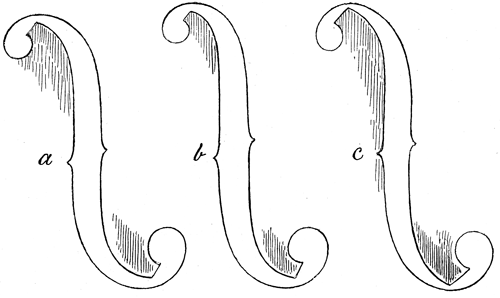
SEE PAGE 48.
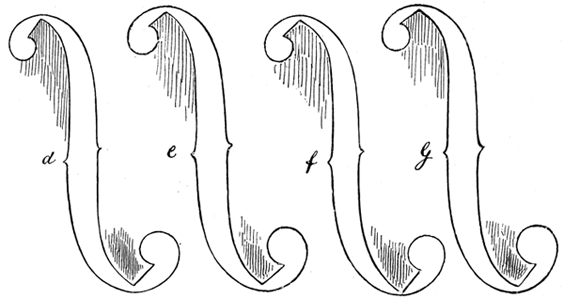
SEE PAGE 48.
History does not relate which of those parties who may have practically followed up the experiments were successful in arriving at the goal of their ambition; they may even still be continuing the struggle for supremacy with their master.
We have not to look far for ascertaining whether these assertions have borne fruit. There has been time enough for works built upon these so-called discoveries of fixed principles to have settled down, and the popular verdict now is—that those which guided Antonio Stradivari have yet to be discovered. The numbers of announcements of fresh discoveries—repeated ad nauseam—are in themselves some evidence that what has gone before was founded on deceptive evidence, and therefore to begin anew was the only course left.
The illustrations of scrolls by Nicolas Amati and Antonio Stradivari, being from good specimens by the masters, will be interesting as showing the progression of the modification in detail under the hands of the latter. In fig. a, Nicolas Amati, c. 1670, it will be seen that the first or smallest turn after leaving the axis or "eye" is kept for some distance rather close. Every effort seems to have been made for keeping the turns or winding from being too circular, there being a general dip downward and forward. The gouging is deep from the commencement. The aim of the artist in the whole design appears to have been towards perfection of gracefulness.
Fig. b. Antonio Stradivari, 1683, the openness and bold swing of the first turn at once on leaving the "eye" is very striking, it also commences higher up, there is almost an absence of flow or downward tendency. The throat underneath the volute is very massive, although all the edges are finished off with the utmost delicacy and sharp tooling. All the details of scroll carving by Stradivari at this period are marvels of mechanical dexterity of handling. The different depths of the gouging are carefully calculated for solidity of effect, each portion being deep in proportion to its width, the smaller turns thus having less depth than the larger. With the Amatis there seemed to be a striving after attainment of the greatest depth possible in the smaller gougings, those nearest the axis reaching frequently to almost the same depth of level as the outer or broadest one. In no part of his work does Stradivari show more clearly the result of careful calculation after closely studying the work of his master and others that had gone before.
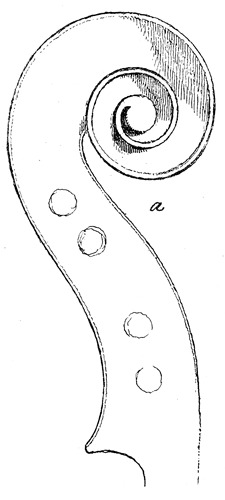
Fig. a. See Page 49.
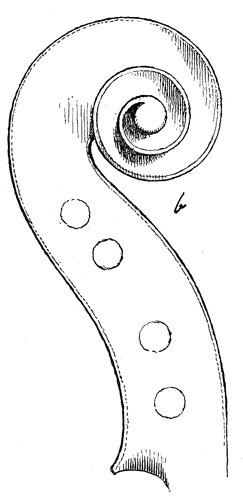
Fig. b. See Page 49.
Fig. c. The period 1715 shows the result of further calculation for general effect and a consequent modification in respect of minor details; there is present, as always, the sufficiently bold swing of the first turn from the axis. In choice specimens the point of commencement is as sharply and clearly defined as the mitreing of the purfling at the four corners of the body of the violin and which it seems impossible to excel. The throat, with the whole of the peg-box, is reduced slightly but consistently with strength and beauty of appearance. The public verdict has remained unshaken with regard to these scrolls being in respect of the combination of excellencies the best carvings of the great artist. They are in the most trifling degree smaller than those carved before the period of 1700. Among those cut about the 1710-15 period, or even later, are a few that seem to have been intentionally both smaller and more upright. Although having all the essential excellencies of detail they can scarcely be considered as coming up to the standard of the others in respect of refined grandeur. This type may be said to be mixed up and continued with more or less persistency to the last, and of this Fig. d gives a good representation. There is frequently a more emphatic or energetic gouging at the commencement of the turns, a more developed "ear" as it is often termed. It is gouged with quite as much care as the rest. Speculation has been rife as to the possible influence or even personal help of Joseph Guarneri at this point, but there is no solid foundation for surmising the presence of one or the other. If the gouging of this part may be said to bear any sort of resemblance to the emphatic or impetuous touch of Joseph, it is confined strictly to this portion; other essentials are wanting that would be absolutely necessary for crediting artists of distinctly opposite tendencies with—it might be almost rightly termed—tampering with each other's designs.
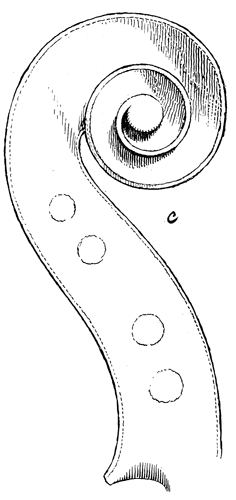
Fig. c. See Page 50.
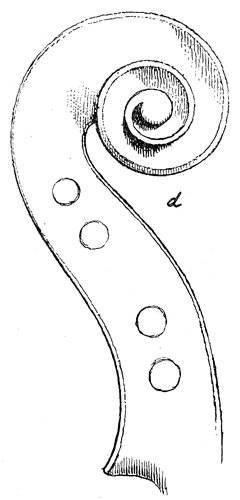
Fig. d. See Page 50.
But if the name of Carlo Bergonzi is brought into the field of speculation—granting for a moment that Stradivari was not very likely to step aside occasionally from his accustomed groove—then we have much more of a possibility or even probability in the matter. It has always been asserted, and I believe never contradicted, that Carlo Bergonzi was for a time actually working in the atelier of Stradivari—whether as pupil or only assistant matters not—but we have in the fact of his presence a distinct factor in any of the supposed anomalies of the later periods of the grand Cremonese master. To this, however, we may put some consideration further on. There is further in these later scrolls a modification, alteration, or supposed attempt at improvement in the edging of the turns, these being left a trifle stouter than at the commencement of Stradivari's career.
This is continued along over the top and down the back of the scroll to the shell, which seems to be a little less elongated than the early specimens. It may be more apparent than real in most instances in consequence of the bolder edging. The hollowing of the "shell" is seemingly less delicate, but this may be taken as a natural result of the foregoing. Further on these details will come in again for review.
To continue our remarks on the question of "thicknesses and their adjustment" with each other. This is a department of the luthier's art, to which perhaps much more attention has been directed by theorisers than by practical workers. The latter class have no doubt been influenced by the former to a considerable extent, oftentimes having their views expressly carried out under their personal supervision. By musical amateurs it is found to be a good theme for conversation when the excellencies of the works of various masters are dilated upon. That the richness of quality in a "Joseph" is the result of his having left "his wood" thick in certain parts and not so much in others, and that this, combined with the flat modelling, was the secret, and that it was written that some of the Josephs were too thick in the back, and therefore the freedom of the vibration was checked and the tone to some degree stifled and deficient in penetrative power.
Among my early musical acquaintances, I remember an amateur violinist who would "wax eloquent" on the power of his Strad, asserting that it was owing in a great measure to its having been "left thick by the maker" all round near the border. This, no doubt, many other amateurs, acquainted with what used to be in print on the subject, will recognise as being in opposition to what had been accepted as being the rule generally observed by Stradivari, that the arching in its thickness gently decreased towards the border where it was about a third less than at the centre. This gentle gradation was said to be the cause of the beautiful "silky" and "sympathetic" quality so prominently characteristic of his instruments. The explanation of "the thing in action," as mechanicians would term it, was thus—the greatest thickness being at the part all round by the feet of the bridge, was able to sustain the vibration, or the successive shocks caused by the bow, which were transmitted through the wood of the upper table and were gradually lessened in intensity as the thickness decreased toward the border, where they subsided, or were lost.
I do not know what explanation was given, if any, of the "system" of thickness adopted much by some of the Milanese school, which was that of hewing away the wood until it was thinnest at the part all round by the feet of the bridge and thickest by the lower wings of the sound holes. Judging by the before mentioned assertions as to the association of power of energetic vibration with the thickest wood under the bridge, these Milanese makers were acting very wrongly, but, strange to say, many instruments of very great power were made by them under these conditions.
Many years ago I was conversing on the subject of thicknesses with an English maker of experience and who seemed to believe in certain "thicknesses," and having then as yet made no practical experiments myself in the matter, I put the following to him. There are many violins to be met with that through ill-usage and pressure on the bridge have depressions instead of the level wood at the part we should expect it to be, and yet the tone is considered fine, how is this? The answer was remarkable, and not unworthy of the class of makers to which he belonged—that although the wood had become thinner from pressure, "the original amount was all there," it was only squeezed closer together. The instruments were, no doubt, "rightly gauged" in the first instance. "Now there," he said, pointing to a 'cello hanging up almost out of reach and looking in rather a woe-begone condition, is a bass that "never would go well because it was badly gauged when first made." Age and usage were to be of no avail in bringing this wretched piece of workmanship up to the standard of the average.
This last assertion might have been of considerable weight had the maker been a personal pupil of Stradivari, but the public verdict has been that there was a great gulf between the two, and that the first had not been initiated into the secret of the others. Foreign as well as English makers have announced in the most impressive manner at their command that their instruments were identical in all respects, including the system of thicknesses in the originals, buy them, use them, and be convinced that in time they would be just as good as the real thing.
The foregoing is perhaps enough to indicate whether or not the secret of Stradivari, or indeed any of the other Italian masters, great or small, had been discovered by caliper measurement. It is strange that the impression has held sway so strongly that the genius of the great master lay in his manner of distribution of the thick and thin parts of the upper and lower table. The first thought in this direction would be that if the theory was good, its practical application with ordinary skill and care would be sure to bring about the desired result. But more than this has been done in experimenting on originals and copies from time to time. We have within a mile of Charing Cross no lack of workmen capable of gauging and copying with sufficient exactness the thicknesses of any Stradivari brought to them, if that were all, or the principal means necessary for reproducing the famous qualities of the great Cremonese. It seems to be forgotten that hundreds of clever workmen have lived since his time, in his own as well as other countries, who have given the most assiduous application to the making of exact copies and with a like result—that of total failure. For a moment let us turn our thoughts to the nature of the materials comprised in the sum total of the structure known as a violin. We have for the upper table, or front, a thin slab of wood known as pine, from a species of tree that grows all over the world. The varieties are, however, innumerable and the purposes to which they are put, equally so. For the lower table, or back, a more dense and tough wood is used. That the particular kind used in the construction of the famous instruments of the great masters, and mostly that known as curled maple or "hare wood," was chiefly on account of its beauty, is evident from the fact that all the best Italian makers had recourse at times to other and less showy wood. Beech was occasionally used by Carlo Bergonzi. Other tough woods grown in Italy, even poplar, have been used by some makers, seemingly when the supply of better looking material ran short. That there are extant some "Strads" with backs of some plain wood other than maple is more than likely. We have, then, for the upper table of the violin a wood of soft but elastic consistency, the strength of which lies mainly in the threads running lengthwise, and which, when the wood is cut in the manner usual with all violin makers since its invention, serve the purpose of small joists running from end to end of the upper table. The soft material lying between these is very susceptible to damp, especially when fresh cut. Thus, if a piece of pine be cut ever so smooth with a sharp gouge or chisel, a slightly wetted brush drawn along the surface will at once cause the softer parts to swell and so leave a ribbed or "corduroy" appearance when it is dry. This will serve to show how far this wood is suitable for regulating by such very minute differences as would be necessary when the thicknesses theory is confided in and efforts made to reduce it to practice. The exactness reasonably expected of such a master of quality as Stradivari would be upset in an instant by the application of a little moisture, and which either by accident or during the process of repairing would be fairly certain to occur some time or other to every violin that left the hands of its maker.
CHAPTER VII.
Stradivari's Tone and System—Those of his Pupils and Assistants—Qualities of Tone Produced in Different Localities.
WE may now refer to actual observation or close examination of Stradivari's work with reference to the question of system, whether there is evidence of its presence and how followed by him. That his violins should have been from time to time well measured by the very numerous army of identical imitators, fair copyists, and all sorts of connoisseurs and theorists during the present century will be at once admitted, and the results may be summed up in a few words. Stradivari did not leave clearly defined any evidence of a system of gauging which he strictly followed, at any rate in such a manner as to enable the least approach by such to be made by any followers in his steps with any measure of success. In short, he was guided by the exigencies of the moment as to the amount of wood left in his ordinary or choicer specimens.
It has been stated before that his quality of tone was one, not several, and for these his patrons flocked to him, as his admirers have also more and more earnestly sought for him since the supply has ceased. But it was not desirable that the greatest possible power should be given to instruments that were in many cases to simply charm a small family circle of friends in an apartment of modest dimensions. He would, therefore, naturally enough vary the amount of wood left. This would be quite in accordance with what is perfectly well known to all makers and repairers of experience—that with a violin if very "thickly timbered," the tone is less easy of emission, or actually weak. On the other hand, if too thin the emission is comparatively easy, but lacks intensity and is termed "hollow." Under these circumstances we should expect to find a variation in the thicknesses of different violins of Stradivari, which is in accordance with fact.
Some connoisseurs have been in their enthusiasm too hasty in their reference of general principles from a few particular instances and their researches—as time thereafter showed—did not bear the fruit so anxiously looked forward to.
An instance comes to mind of two well known dealers, one British, the other foreign, meeting together one day and opening some half-a-dozen Strads, that appeared up to that moment to have had their interiors undisturbed, or perhaps it might be said untampered with. What a meeting! and what a parting! let us hope that each table, upper or lower, that had so long been working in harmony, eventually became again properly mated and gave no cause for lawyers to "put their fingers in the pie." The results of the examination is related thus:—"In no two of the instruments were thicknesses alike; some had thick places and thin places; some were thicker on one side than the other; all were thicker in the centre of the upper table and all had these as three to five for the back."
Another is that of a well known continental repairer in his day, relating how he had repaired a very large number of real Strads and found the upper tables to be of the same thickness, two and a half m's. all over, but that the backs varied in thickness. Some discrepancies here seemingly. To add to this, a correspondent says the Strads he has measured "have certainly not been thickest in the centre of the upper table."
My own observations as to thicknesses I am afraid will not afford much comfort to those who have been hopeful at any time that the calipers would drag forth the precious secret. I recollect many years back seeing a very fresh Strad, and a hasty measurement possible at the time revealed too much wood, that is judging according to our modern ideas of regulation.
One instance of a Strad, once my own property, comes to my mind. It had something wrong with the interior that necessitated opening. The violin was of good reputation for its tone of fine quality, quantity and ease of emission. There was no help for it; much against my inclination the separation of the upper table from the ribs would have to take place, either by my own hands, or those of some other person, the rectification being impossible from the exterior as it sometimes may be. With all necessary care, guided by past experience, the opening was safely accomplished, and after a very interesting examination of the interior, which to an ordinary observer would have seemed but peering into a dirty old wooden box, having nothing perceptibly different from any other, was in what would be called a fair state of preservation. I took the calipers in hand, expecting to learn something, but found all the original thicknesses had been lost under the hands of numerous repairers.
The supposed system or rule followed by Stradivari—that is, according to what critics and writers have declared was his habit—was certainly not demonstrated in this instance: in fact the eyesight alone was sufficient to perceive that whatever theory the master had believed in as necessary for the production of his inimitable quality, or whatever rule as to gauging should be followed in order to obtain enough power and freedom of emission were, in the present instance, we will not say ignored, but quite imperceptible; and why? because the fiddle at one time had been what we moderns—with our ideas of regulation and fitting—would term "too thick in the wood." The instrument had undergone much affliction from various physicians, but, judging from various little details of evidence, been at almost all times highly prized. Here and there were the studs or buttons of various kinds of pine stuck by repairers of different nationalities and degrees of skill, some placed with apparent good intention, others without reason at all, while several parts bore indications of studs having at one time rested there and been afterwards removed by succeeding repairers. Now all these men had a thought of doing their work properly, and in finishing off their studs with gouge or glass-paper, had whipped off around each spot some of the precious wood of Stradivari, with a general result of a series of hollows and gentle prominences not at all pleasing to the eye of the believer in the thickness theory, but nevertheless instructive.
Other instances in which the master's work—while still good and serviceable, with much evidence of unskilful repair, or want of proper attention at the time of accident, have come under my notice, enough, long ago, to have, as the saying is, "knocked into a cocked hat," all that has been put forth regarding the mathematical precision of the thicknesses over the different parts of a violin by Antonio Stradivari. One or two further remarks may be interesting on this part of our subject. The fact must not be lost sight of that the pupils of the now well established master of his art in Cremona were working either at that place likewise, or in the large cities of Italy, and had become famous, or were soon to be so and themselves surrounded by learners of the art. All these had been initiated in the secrets, if any, of their craft and in the particulars which distinguished them from others, or we may say, they were of the Stradivari school, showing in a more or less degree the same species of tone which the master had brought to maturity, and which he retained with consistency and never swerved from to his latest day.
It is quite a reasonable supposition that most, if not all, of the personal pupils were taught by the master, or had the way pointed out to them by which they might, with the right ear for discrimination of tone quality and enough of industry, impart to their works the identical qualities of those of their teacher. But what are the facts left for our consideration in connection with caliper measurement? the pupils admittedly of his teaching, among whom we may mention Lorenzo Guadagnini, his son Joannes Battista, Alexandri Gagliano, one or two of his sons and Carlo Bergonzi, as the best known, each adopted their own, or shall we say, left no more evidence for us of having a set rule for thicknesses than their master. The nearest approach to the asserted system of Stradivari, that of a gentle declination of substance in the wood down to the edge, was made by Lorenzo Guadagnini in his extra sized violins; but then the tone, wonderfully fine, is not Stradivari, but Guadagnini. Carlo Bergonzi's system, if we may for a moment call it, was quite unlike Stradivari, and yet connoisseurs have frequently credited him with having got "the same beautiful quality of tone." From these few references it will be sufficiently plain that the grand secret of tone quality must not be sought for with the aid of calipers, so we will dismiss this part of our subject and proceed to other considerations.
Besides those who have pinned their faith to the thicknesses, there are those who take up with the "air mass" theory. I am afraid the arguments in favour of this last will not bear even so much knocking about as those just considered.
We have in the first place to take into account the fact of the larger modern bar taking up more room than the old obsolete one of, not only Stradivari, but all the other masters of his time and before. The upper and lower end blocks have been enlarged in many instances to obtain a better hold on the upper and lower table. These alterations have been each of necessity, not of ignorance or mere whim, and moreover have proved efficacious for the end in view. The restorers, or regulators who have performed these operations must—according to the "air mass" theory—have been acting quite "in the teeth" of it and Stradivari's regulation, further there is not one fiddle in a hundred—perhaps not that—which has been in use for a generation but what shows a sinking one side or the other, or, when the modelling is full, a depression in the middle of the upper table, and very frequently a greater fulness at the back where the sound post touches and presses from the inside. These alterations, individually or collectively, alter the "air mass" of the interior, and the violin thus, according to the theory, contains within itself the elements of its own early dissolution, so far as fine quality is concerned. Facts, however, go to prove the contrary, and with the modern regulator's efforts to obtain the best amount of a good thing known to be present, it is quite probable that Stradivari himself never heard his instruments to such advantage as they may be now, notwithstanding the unreasonably high pitch to which violinists are obliged to conform their tuning.
There was another theory promulgated many years back by certain people of some degree of eminence in their own walk in life. A grand discovery was announced, that the excellence of the violins of Stradivari consisted in the tonal difference between the upper and lower tables peculiar no doubt to that master. This sort of committee of scientific experimenter, violin dealer and author, did not—while centralising their efforts on the violins of one master—say whether the same relationship existed between the back and front of a Nicola Amati, Maggini or Gasparo de Salo, they made something of a slip when they mentioned the violins of the great Joseph Guarnerius as showing the same tonal difference.
It would have been very interesting to have heard of results after further trials by the same experimenters upon upper or lower tables of violins by now not very much less celebrated makers, who, although of the same class or school, were living—for those times—far away from the central luminary of the Cremonese art. What would have been said of Montagnana of Venice? a star of the first magnitude, curiously near in quality and quantity to the great centre to which he was willing to pay obeisance and throw out a reflected light; of Gobetti, perhaps more "Straddy" than any other Italian, Gofrilleri, Seraphino, two or three of the Tononis, besides other lights of lesser magnitude, with exceedingly fine qualities, but perhaps open to the charge of intermittency. Further, several of the Milanese school,—offshoots of the Amati and Stradivari,—of Lorenzo Guadagnini, a master of his art in all its details, if ever there was one, his son Joannes Battista, steadier in his working, but more uncertain in his results—shifting from place to place, may have had some connection with this—and the occasionally fine artificers of the same place, Landolfi, the Grancinos and Testores and later on Balestrieri of Mantua and Storioni of Cremona. These men, always good, and when circumstances were favourable, great in their art, often grand in their individuality and power, were, by these modern scientific interrogators placed aside or quietly ignored, apparently either as unworthy of their recognition, or of such inferior renown as not to come within the scope of their investigations.
A close and searching inquiry into the causes that enabled different masters of their art to bring about the desirable end of their labours, that of imparting a distinct quality and individuality of tone, might have enabled them to get at least a hint as to the means whereby Stradivari gratified the tastes of his patrons at the time and connoisseurs in general of the present day. As indicated before, the Venetian masters were—probably by the same means—able to put before their patrons that kind of tone most in agreement with the luxurious surroundings of the Venetian nobility, or offered and found acceptable to the musical public generally there.
A prolonged, earnest examination of the peculiarities of tone attached to the violins of the makers of the chief seats of violin making, has led to the inference that the difference in kind or degree was not from individual choice, but chiefly owing to outside influence.
What is known as the old Brescian type of tone was doubtless suitable to the tastes of musical circles, among whom the then new style of musical instrument was introduced in Brescia. When settled down, the Amati family, a group of thorough artists, proved themselves alive to the requirements of the fresh district that was henceforth to be the scene of their labours for generations. The Brescian quality had either been found by them, or was known beforehand, to be too ponderous or insufficiently endowed with the more feminine quality desirable in the minds of the Cremonese. The Amatis seem to have been in full possession of the means necessary for producing the kind of violin in demand and supplied it.
As time went on, musical compositions changed in style, advancing by degrees towards the culminating point of nearly a century later. The simple, oft-times wondrously sweet, yet quaint effusions of the early composers for the violin, were gradually giving more and stronger indication of what was possible and likely to follow soon and in its turn, like all other things, become antiquated and old-fashioned. Undoubtedly, it was this progressive condition of the music of the period that induced Stradivari, early in his career, if not at the time he was with Nicolo Amati, to take up the study of tone calibre as a matter of essential importance, in order not only to keep pace with the times, but if possible, anticipate further advances in musical development.
It was daily becoming more evident that the qualities of refinement and sympathy would not in themselves be sufficient in an instrument with such a future as the violin seemed to have. Melodic forms were being modified, while harmony was becoming more varied and divided.
The art of appropriate phrasing was also being studied, while practical musicians were bowing to the necessity of leaving old stereotyped forms for those having more emotional qualities. In short, the violin wanted in Cremona was one of substantial power and suitable for more dramatic expression on the part of the performer. To bring forth a violin of this desirable type, Stradivari directed his energies. With what measure of success, the whole musical world up to the present day have emphatically declared.
Now, we may ask, was the difference of tone between the violins of Stradivari and those of the other makers of the Brescian, Cremonese, Venetian, Milanese, or Neapolitan school, in consequence of the tonal difference between the upper and lower table, as supposed to have been discovered by the modern Parisian investigator? was it resulting from the correct air mass inside? the relative thickness of the tables, or we may as well include the straight and fine grain theorists, the amber varnish in the wood theorists, the wood of great age theorists, and the generations of use theorists, and lastly those who mix them altogether. If Stradivari practically worked upon one, some or all of these theories, there is still more mystery concerning the close proximity at which his pupils or assistants arrived, several of whom we might conclude were possessed of all necessary means of acquiring to the full their master's excellencies.
Just for a moment or two we may turn aside and notice the kind of variation or the distinguishing difference between the tone in the general acceptation of the term—of Antonio Stradivari and other makers, or, as time has proved, masters of their art, if not on an equal standing with him. There is frequently among musicians a disposition to set down as inferior any tone that may seem to differ in degree or kind with that of Stradivari; that is the ideal type, it must be Stradivari and no other; some have even gone so far as to say, "there is only one quality," that of Stradivari, and when other masters did not produce it, they were unable to do so; this is more than a hint at condemnation of the head of the Cremona school as having been very lax in the proper and thoughtful training of his number of pupils; this latter an almost necessary consequence of eminent rank, taken apart from the usual assistance found to be obligatory from pressure of work. If we glance over the Italian schools taken one after another, the facts, if acknowledged, will be seen to point in other directions. Taking for instance the Milanese master, Lorenzo Guadagnini, who tells us himself that he learnt his art under Antonio Stradivari, we find distinct traces of it in his tone, the general calibre is the same and most of the fine, distinguishing features noticed in the tone produced by his master; the difference, however, is that which is peculiar to the master makers of Milan, that of a slightly less reedy emission of sound. Some have called it harder, which is not a correct description. Chords are produced with it as easily and roundly as with any other, the individual notes blend beautifully and give an impression of homogeneousness in no wise inferior to anything produced in Italy. There was no apparent difficulty in the way of Milan acquiring and cultivating the variety of Italian tone known as the Cremonese had they been so disposed; we are therefore led to infer that each place with its musical world held its own opinions as to the most satisfactory quality of tone for its purpose and considered it the best. Milan is situated in Lombardy, north-west of Cremona, and distant from it between forty and fifty miles; not a very long way at any time, but quite sufficient for each place to cultivate or indulge in any artistic or musical fancies or whims independently of the other. We find maker after maker in Milan keeping within certain limits as regards the quality of tone produced there; I do not know of one whose instruments emitted other than the Milanese quality.
We may, I think, safely assume that so far from loosely and superficially instructing his pupils, Stradivari's tuition was of a deeper, far-reaching kind than has ever been suspected. If the tone of Lorenzo Guadagnini is compared with that of the makers who were working in Milan when he arrived, it will not be difficult to perceive that the Milanese type is still retained, although much enlarged and matured, in fact become freshly developed, throwing out the additional qualities for the obtaining of which the great master of Cremona had carefully trained his gifted pupil. All this is not in the least interfered with by the fact of Joannes Battista Guadagnini's tone differing in some respects—and more at times—with that of his father, but rather helped by it; both assert on their tickets that they were instructed by Stradivari, and both show the results of their training in that largeness and impressiveness which is so much beloved of violinists and which without doubt came from their great teacher. Josef, the son of Joannes Battista Guadagnini, appears also to have either been instructed by Stradivari or to have assisted under his personal supervision—which would amount to much the same thing. We may perceive in the tone of this maker also the influence of the great master in the same directions as are manifested in the works of his father and grandfather, they are all of the Stradivarian school.
Let us now turn in another direction. Alexandri Gagliano of Naples tells us that he too was a pupil of Stradivari, and looking at his work there is nothing about it inconsistent with his statement; his typical design is formed upon that of Stradivari, and many of his details of workmanship are such as can only have been carried out as the result of either a lengthy study, or from being under the immediate supervision of the master.
The quality of tone produced by the Neapolitans is as distinct as possible from that of Milan, it is clear, lively, suggestive of a sunny clime, and free in its emission, but leaves an impression on the ear of a lack of sufficient profundity, nearly the opposite in fact of the early Brescian school. Here the best of the Gaglianos—for it is not at all certain that there were not more than two of them assisting at different times in Stradivari's atelier—brought the same kind of improvement to Naples as the Guadagninis did to Milan, the scale was better regulated so as to give greater breadth of effect, notwithstanding the general quality—seemingly native to the place—being uninterfered with. Here then was the influence of Stradivari having taught his pupils the means whereby the particular tone quality most appreciated in the locality could be brought forward in its most developed, or mature condition.
Carlo Bergonzi we shall have to consider more fully further on, and for the present only refer to him as a pupil or assistant much more in immediate connection with the atelier of Stradivari than any maker known to us. Irregular workman as he was, swayed about this way and that by matters unknown to us, he kept steadfast to the Stradivarian lines to the end. The rest of his family were either his own pupils, or they may have even been at times with his master, as they all—so far as I am acquainted with them—are of the same school. These particulars all point in one direction—that Stradivari was not anxious and made no special efforts at introducing any new kind of tone—development of that already in existence was his aim, and on this line he appears to have led his immediate or personal pupils.
There is great probability that some very clever workmen whose names are lost to us, were with Stradivari for a time, long or short, and were able to imbibe the valuable precepts enjoined similarly on the other disciples. It is not at present known whether the sons of Stradivari had pupils or assistants, the rarity of their work seems to point to the contrary; their father having been so successful from the commercial point of view, apart from the higher aspect of his career, there may have been—we might say—the usual disposition amongst sons of successful fathers to take life more easily and repose among the laurels won for them, requiring only a little caretaking. There is some possibility of Thomas Balestrieri, of Mantua, having worked for a time under Stradivari, but not as a pupil; there is much in his work suggestive of this theory. His tone quality does not belong to the Amati school, in which tradition has it he was trained. He may have gone as help to Stradivari—for loose as was his general tendency, he could work finely when the fit was on him. Whether he went or not, there remains tone quality evidence of the strong influence of Stradivari, besides the throwing aside of the Amati traditions concerning proportions, curves and archings.
Of the other places to which personal pupils of the master went, we may take a passing glance at Genoa, a city not replete with makers of refinement, or numerous, but nevertheless with some sterling qualities. Among them and the most "Straddy" is Bernardus Calcanius; his earliest dates, if we can rely upon them, and they may prove at any moment to have been earlier than hitherto known, almost preclude the possibility of his having worked under Stradivari except as a youth. The influence of the master is, however, decidedly paramount in his work and no other tendency being noticeable, if not an immediate pupil, he took all possible pains to acquire the excellencies that were to his knowledge peculiar to Stradivari alone.
Among the Venetian makers there does not seem to be one that can—from his style and workmanship—be picked out as showing all necessary evidence of his having qualified under the great Cremonese as a personal pupil. Nevertheless there is much indication, and such as cannot be passed over, of the influence of Stradivari among the aristocracy of the business there. This was not, as in the instances of the other schools of violin making outside Cremona, in the first ten years of the century, but after the different individuals of the group of eminent Venetians must have been well known and of established reputation. In this there is some apparent indication of one if not more of the party having taken a trip to Cremona and brought back a few hints of no inconsiderable value, perhaps received personally from the master. On the other hand, if this was not the case, his works must have been brought into Venice and their merits artistically as well as acoustically well thought over. The outcome was a change, the Amati genius hitherto presiding uninterfered with, seemingly immutable, had to give way to that which was pronounced an improvement or a step higher in the progress of the liutaro's art. As in Cremona, the Amati characteristics were too deeply rooted in the affections of the Venetians to be eradicated, and we consequently find in the designs of a few of the prominent makers the strong influence of Stradivari in conflict with that of Nicolas Amati, and the two swaying in balance with the settled convictions of the followers of Jacobus Stainer.
Having now taken a glance round at the chief centres of violin making that had during Stradivari's lifetime been strongly influenced by him, directly by means of his pupils or indirectly by the arrival there of his works, we may note that his qualities artistically or acoustically considered, while giving him a commanding position, did not reach so far as to annihilate, during competition, those of the Amatis, especially where the latter had been of long standing and followed earnestly in detail, they kept side by side as in Cremona. The influence of Stradivari beyond the borders of Italy had yet to receive its due acknowledgment from the crowds of imitators which have now become known or have pushed themselves in front of the public gaze.
CHAPTER VIII.
The Reputed Golden Period of Stradivari Late in Life—His Later Modifications of Design—Signs of Old Age Appearing—The Help He Received.
WE can now return back to Cremona, where we left the master in what might almost be termed the heydey of success, as he seems to have had full obeisance as the reigning chief among liutaros. The amount of work put forward—estimating carefully by what remains to us after the lapse of some hundred and eighty years or more—must have been possibly larger than is suspected and now might appear incredible if it were catalogued in detail, were it not for the extreme probability that minor or mere mechanical parts of the many instruments other than violins, violas, or violoncellos were effectively carried out under the supervision of Antonio Stradivari, his sons and assistants, of these probably what under the circumstances might even be termed a numerous staff.
The period 1700 to 1725 has been referred to by some writers as "the golden period" of Stradivari, not inaptly if we are to understand it in a pecuniary sense, as his income at the time was no doubt of a very satisfactory nature, but if taken from the standpoint of artistic elegance and finish in detail the master himself seems to have had some slight misgivings, as there are well-known indications in his latter days of having used some of his early patterns, as if a desire had arisen in his mind to return to his old love.
That some signs of advancing age should not be apparent in Stradivari's work during the period of 1715 to 1725 would scarcely be expected. It is just at this time, however, that he gives the strongest evidence of being the extraordinary man that he was. In 1715 and thereabouts, a time of all others, some critics might put it, when his most magnificent gems of art were sent out into the world, he was a veteran seventy-one years, a time of life that few people would look forward to as being appropriate for executing unrivalled masterpieces, but rather as having for some time retired for final rest after a full complement of working days; here, however, was a peerless artist actually in his prime! and as busy, possibly so, as at any early times.
At 1720 to 1725 a close student of his work of hand may discern some signs of what was to follow, it might be said naturally. In the first place the purfling gradually assumes a heavier aspect, it is a trifle bolder or thicker in substance, although sent round the borders of the instrument with apparently the same masterly handling and iron nervousness of the preceding years. The edging is also a degree stouter. Occasionally the corners are made to a more obtuse angle, adding to the whole design a more stolid look, as if mere elegance was about to be thrown aside and more simplicity and grandeur were being sought for. This was not continued, the master seemed afraid of going too far towards heaviness, he therefore cautiously withdrew to his own old lines. Sometimes—possibly taking up and constructing upon some of his old and early moulds—the corners are brought out more prominently, but with more substance than in his early days; the result is delightful for the connoisseur's eye. Accompanying these minute modifications there will be noticed an increase slight and gradual in the expression of heaviness in the sound holes. If possible there is more freedom from mere symmetrical proportion, they are placed less accurately level, one being a trifle higher than the other, this by the bye was common with him at all times, although usually with a subtlety that left them unnoticed by an ordinary observer. This slight irregularity has been sometimes misinterpreted as one of the little secrets of the master whereby he obtained his excellent sonority; "discovered" was the exclamation, and a new rule laid down on Stradivari's lines—never place your sound holes on the same level, always one a trifle higher and you will get what the master was so famous for. The result, so far, has been a disappointment which laid bare some evidence that these over zealous enthusiasts were not sufficiently acquainted with the canons of Italian art. There was another peculiarity creeping on with regard to these sound holes—that of an enlargement of the curve opposing the lower wing, at first it gave a more staid aspect to the part, there was less sprightliness and youth about it, nevertheless it was fine at times, even magnificent, there being still the same determination of purpose, that of combining maturity of elegance with strength. Afterwards, the change—and if all the works of these later years could be seen, saved from the destructive ravages of time and wear, it would be pronounced scarcely perceptible in its progressive degrees—came creeping on, old age gradually insinuating itself in the mechanical part of the design.
From 1725 to 1737 was a time forming a proportion of Stradivari's career during which, if he arouses less enthusiasm among his admirers for the "work of hand," he outbalances it by far in exciting our astonishment at the man himself. In the year 1725, he was then eighty-one years of age, and his work, regarded from the standpoint of "periods" as given, or arbitrarily laid down by critics of the first half of the present century, was what is now known as just past the "golden" or "grand" period; that is, some signs of decadence in the finish of the instruments which he sent forth were for the first time becoming apparent. It is generally believed that Stradivari was still industriously engaged in constructing instruments of different kinds and sizes as before, and that his time was occupied to the full in producing works in rapid succession, as in an uninterrupted stream. That the first part of this was probably quite true we can readily agree to, also that the out-put was continuous. Both, however, will need a little qualification when the surrounding circumstances are carefully weighed. Allowing the master possession of unusual mental and physical powers, with zeal unabated at the period included within the dates 1725 and 1735, it would be too much for us to believe him capable of working with the certainty and celerity of former years; with all his extraordinary abilities he would now be a less prolific worker.
This is in agreement with the number of works that have come down to us, and as the time advanced it became less and less until a veritable specimen of his latest period is extremely rare.
It has before been referred to that the sons of Stradivari worked with him for many years. They must have, from continual practice, been able to fit their own workmanship on to the designs of their father to a nicety that could not be surpassed. Their own individual designs are very seldom seen, consequent, no doubt, on so much of their time being devoted to helping their father, and until his death they must have rarely made on their own account.
There were other assistants who lent a helping hand in different branches of the work, among whom we will not omit mention of Carlo Bergonzi, a great master himself, but little inferior to Stradivari, and a good deal better than either of the sons.
The circumstances under which Carlo Bergonzi worked in the Stradivari establishment are not known; it is by no means certain that he received his early tuition in the place, but that he became an influence of considerable weight admits of no question. Whether he worked on the premises, or—his own being at one time or other next door—was an outside help no data is to hand that we can rely on, certain it is that his talent must have been fully recognised by the younger Stradivaris as their work declares.
Many years back there was some discussion about concerning the extent to which Carlo Bergonzi helped, or what part he undertook, if it were admitted that some of the Stradivari violins of the latest period were not entirely the work of the master. There was much said for and against the possibility or probability of there being any of Carlo Bergonzi's handiwork to be seen on any of the late Strads. No one seems to have questioned the presence of the influence of Bergonzi's style in the work of Franciscus Stradivari, the eldest of the sons, who, after labouring for many years on his father's moulds and patterns, might have reasonably been tempted to take a "leaf from the book" of such a master in designing as his friend and fellow-assistant, Carlo Bergonzi.
To take any sort of hint from that wonderful, although fitful genius, Giuseppe Guarneri, working within earshot, was not to be entertained for a moment, as the style of workmanship, the calibre and quality of tone belonging to his manner, was quite opposed to Stradivarian teaching, and besides which there are no records or traditions indicating even usual social intercourse. We are therefore thrown upon our own resources in estimating any connection of Carlo Bergonzi with the late work of Antonio Stradivari. The instruments themselves will be the only guide and, without doubt, in the face of other evidence, had it been present, the best. Stradivari's work during the last ten or more years of his life was showing exactly what we should expect of the man when working at a patriarchal age. The stamp of the veteran handicraftsman may be traced not unfrequently on the works of other eminent makers of Cremona, including Andreas, Hieronymus, Nicolas, and his son Hieronymus and others down to the latest period of Cremonese art, when Laurentius Storioni was proving that if in its last struggles it was not quite dead.
The distinguishing characteristics of old age work may be briefly summed up in a few words—heaviness in design and uncertainty of execution. Good, even brilliant, conceptions may be started on new work, but the execution of them shows weakness, or even inability to carry them out well. We will apply this as a kind of test when overlooking the specimens handed down to us as being the production of the great Cremonese master at the age of between eighty and ninety-three years of age. If doing this simply from the connoisseur's point of view, without admitting any such influences as present or past monetary value, former ownership, in short, thrusting aside all considerations of pedigree, we shall soon have to divide them into two sections, one of which will be acknowledged by all connoisseurs to be really representative of the true Stradivarian manner adhered to strictly through a long working career, but with the only fault of not quite so well being said of it. Thus the sound holes, as before referred to in the tracings, were becoming heavier at the lower part and with a tendency in other details towards ruggedness. The varnish has a thicker and less dainty aspect, although of excellent quality still, but there is an impression of heaviness. In the carving of the scroll the same character prevails, the edges of the turns are stouter and at the back the grooves down to the shell are less refined in their execution. All these little specialities of touch, but no modifications, are the natural manifestation of the peculiar physical condition of the master at a very advanced age.
Let us now turn to the other section, that over some of which there is excellent reason for disputation, over others none.
It will be readily acceded that Stradivari at no time during his career ever favoured any exaggeration of curve in the design of his sound holes, there was always present the indication of a desire for a fine balance of parts, in fact, his ideal seems always to have been that of increasing, if possible, the elegance of the Amati sound holes while adding to its substantial aspect.
In some of what we have called the second section we find a lively, fine and rich transparent varnish such as Carlo Bergonzi was particularly an adept at; on the same instrument will be sound holes, that a moment's consideration will remove any hesitation as to the design being other than Carlo Bergonzi. As this remarkable artist had several types of sound holes, and no one knows how many subtypes, at his finger ends, a little knowledge of his two most opposite ones will bring at once to mind that he must have had a hand in no inconsiderable portion of what is called Stradivari's late work, as here is found the inclining inwards of his sound holes with the smaller upper part and heavier lower end. This will be found accompanied by the square looking upper part of the waist curve, the two things being alone almost sufficient to stamp the whole as being by Carlo Bergonzi, but here pedigree has stepped in and it was always called a Stradivari.
This is the one type of sound holes which has to be placed aside for a moment; the other type is of an opposite kind and very often to be seen accompanying the longer looking pattern of Carlo Bergonzi: it is free in design, having the upper and lower wings fully developed, that is, the straight cut of the wing is of full length, this individuality coming from Stradivari.
It is this portion of the details of the design that has led so many Students of the works of the Cremonese masters astray, they see the Stradivarian design, or we may call it peculiarity, and too hastily conclude as to its being the actual work of hand of the master. A little further consideration of the adjoining portions of the sound holes would bring to mind how little Stradivari was disposed towards any thinness of the opening out of the part leading from the wing to the nicks: if he had a tendency one way or the other, it would be towards more fulness, but his ideal being a beautiful equilibrium of all parts, this is clearly a point telling against the work as coming from his hand entirely. There is another part, too, that Stradivari seems to have most earnestly avoided, that of making the top portion of the sound hole design reach over towards the centre, somewhat after the tendency of Andrea Guarneri, this causes the lower part to seem turned up more suddenly, it is, however, only by contrast between the two parts that this is so. Carlo Bergonzi's sound holes are more sprightly and vertical, and with their more mature style should not be confused with those of the preceding maker. Here, then, are two distinct types of sound holes independently of those referred to of earlier periods, to be seen attached to violins that have perhaps through several generations of owners been attributed to Antonio Stradivari, and in consequence been sold again and again for large sums. Here is evidence of there being something in a name. Had these instruments been carefully and properly analysed, with a strict regard to the habit of the master in respect of intention in design and execution at early and later periods, the mistake would not have occurred. The conclusions rushed at seem to have been that there was the proper age of the instrument, the varnish was of fine Cremonese type, the pattern and sound holes thought to be "Straddy," therefore it must be a Stradivari.
On the other hand, there is no obtainable evidence that these violins did not issue in new condition from Stradivari's atelier; we have in previous pages considered the amount of help at his elbow, and that this would be more and more called into requisition is but a reasonable conjecture: that it was actually the case is helped by the fact of violins being extant in which the age of the master is stated on the ticket—presumably written by himself. Possibly he felt some degree of pride in having accomplished, at the patriarchal age of about ninety years, work generally associated with the time and vigour of middle age. The existence of these violins, there may have been several more made than are known, has much significance, for the fact of his age being inserted may be fairly taken as indirect evidence not to be lightly put aside, that they were by himself looked upon as an accomplished work quite out of his usual way. Had he been constantly putting forth instruments made by his own hands, there would not have been anything unusual about them, but these, with date and age marked, seem to be a declaration of the master—see—I have made a violin at the age here stated! In these there is present exactly what would be expected in such work—indication of insufficiency of the physical powers for carrying into execution the dictates of the mental. The intellect of this wonder of humanity appears to have remained unclouded to the last.
The other violins of about the same epoch, and going under the master's name, have a manner of work that ought to have been perceived as being also distinct. Mere hastiness or slovenliness of work is not identical with the effect of inability to achieve mechanical neatness. It is this slovenliness of handiwork which Carlo Bergonzi gave way to so frequently; he could, when in the humour, work beautifully; this, with his fine perception of elegance of line, was possibly the secret of his being admitted into the atelier of Stradivari and of his influence over the sons. There may have been other special particulars regarding him that helped in the matter of which there does not appear to be any record.
CHAPTER IX.
Evidences in Stradivari's Work of Old Age—His Death and Burial—Work Left by Him—The Advance in Value of His Work Since His Decease.
RETURNING to the analysis of the individuality of the mechanical work on the violins of the latest epoch of Stradivari, one or two further details are worth consideration. The size, style and tool work of the scroll have always been admitted to take up a large share in the estimation of evidence present for identification of authorship. In some of the late specimens of Stradivari we can see at once that the hand has become less firm, the bold turns seem to have lost much of their former vigorous expression, and although thick enough in edge are closer, and impress the connoisseur of the inability of the artificer to spend more time and attention than was absolutely necessary. The groove down the back to the shell is less refined than previously, besides being more heavily gouged at the termination. Almost in contrast with these parts there are seen on other "very late Strads" a neatly cut shell widening out a trifle and minus the thick edging; an examination of the turns of the scroll will reveal the fact of its having been gouged in quite a different manner, the declevity being more concave, the result of running the gouge along the course instead of towards the centre which was the manner of the Amatis. This hollowing out of the turns was so frequently done by Carlo Bergonzi that it might be called his most natural mode of treatment; we can here see what evidence there is of this maker's probable help in the work of his master. If we admit the possibility of these being entirely Antonio Stradivari's handiwork, then there were more phenomenal aspects of the master's working powers left for our consideration than he had hitherto given the slightest hint of during his extraordinarily long career.
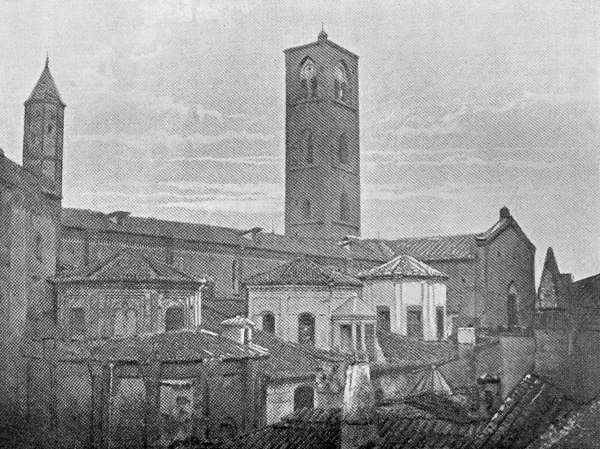
THE CHURCH OF ST. DOMENICO.
Taking therefore all the facts at our command in connection with the circumstances of the time, and the artist himself with his extended life, sifting these carefully we find the residue left is,—that his working powers gradually lessened in a perfectly natural way and that such entire work as left his hands during the last few, say six or seven years was, taken at the best, small in quantity; they came forth as from the last flickering embers of a decaying power whose influence, bequeathed to the world at large, was destined to increase indefinitely and whose secrets were left unrevealed, to be sought for earnestly, but in vain, by generation after generation.
Time, he with his hour glass, passing by the home of Antonio Stradivari in Cremona, found him full of years and honour among his own little world of friends and acquaintances, for beyond the borders of his country his name could have been known to few, and those only recognising him as a clever and successful practitioner in perhaps their own craft; his world wide fame had as yet received but a slight impetus when it became known that no more of the unapproachable gems of art were to issue from the unassuming house in the square of S. Domenico, Cremona.
Antonio Stradivari died in his 94th year at Cremona on the 18th of December, 1737, and was buried in the chapel of the Rosary in the Church of San Domenico. This church was situated exactly opposite his house, where, standing at his door—as he must have done many a time—the tomb which was to be his final resting-place came directly on the line of vision in front of him, but within the third recess or chapel past the intervening wall. So far as our scanty knowledge goes, there were no circumstances connected with his death that called for any special notice at the time. Possibly little more was remarked by the neighbours than that the aged musical instrument maker of the Piazza di San Domenico had died, and his two sons were to carry on the business. Perhaps none of them gave a thought to the immensely enhanced value of each of his works of art—or as they may have described them—the goods that he sold—that might be remaining two centuries forward.
He had lived to an almost patriarchal age, over ninety-three years. It is rare to find in the world's history a leading light among professors of science or art completing such a career of almost incessant labour both mental and physical. It is still more so to find the work of such a genius, large as was the quantity, increasing in value by "leaps and bounds" as time progressed after his decease. Most probably at the present day—supposing there to be extant as much as one-eighth of what he put forth—and that may be very much over the mark, the market value of what is recognised as his handiwork would still be a very long way above that of the whole of the work put forth throughout his life. It is on record that when he died there were ninety violins remaining unsold. There may be several good reasons for this; among them the fact that Carlo Bergonzi and Joseph Guarneri were working in rivalry at the time, and bidding for public favour less on account of fine workmanship than force and magnificence of style and general aspect, and that public attention was to some extent diverted in their direction; further, and perhaps more cogent, the recognition of the great brilliancy and largeness of Joseph Guarneri's tone, that must have seemed to the musical cognoscenti of Cremona remarkably fresh and vigorous.
But when the master had departed it was not long before the loss was seen to be irreparable. His work was sought for, there being none other of the kind to supply its place; further and further as time advanced it was becoming more and more evident that his like was not to be hoped for, notwithstanding the favour with which the public viewed the two rivals who were destined to work for a comparatively short period. When these two at last disappeared, it was a signal for another rise in the monetary value of Stradivari's work, and which was to continue progressing indefinitely until such time when there may be signs of an approaching renaissance.
FOOTNOTE:
ADVERTISEMENTS
ELEVENTH YEAR OF ISSUE.
The Largest Circulation in the World of any paper amongst Violinists.
THE STRAD
A Monthly Journal for Professionals and Amateurs of all Stringed Instruments played with the Bow.
Published on the First of every Month. Price 2d., Annual Subscription, Post Free, 2s. 6d.
THE STRAD is the only recognised organ of the string family and has subscribers in every country of the civilised world. Our circulation has increased to so great an extent that we are enabled to engage as contributors
THE LEADING WRITERS in the VIOLIN WORLD.
The following eminent Authors, Critics and Players are writing for the paper: Basil Althaus, Esq., Arthur Broadley, Esq., Lancastrian, Andre la Tarche, Esq., Robin H. Legge, Esq., J. Matthews, Esq., Walter H. Mayson, Esq., Rev. Meredith Morris, Horace Petherick, Esq., Dr. T. L. Phipson, E. van der Straeten, Esq., &c., &c.
THE STRAD contains technical articles by the leading artists.
THE STRAD, in the Answers to Correspondents column, gives minute information on every detail connected with the Violin by Experts.
THE STRAD gives all the important doings of Violinists at home and abroad all the year round.
THE STRAD gives early critical notices of all important New Music for Stringed Instruments, with numbers to show the grade of difficulty of every piece.
THE STRAD gives every month a beautifully executed portrait on fine art paper, of some leading celebrity in the violin world, together with a biographical sketch.
Now appearing,
VIOLIN MAKING. By Walter H. Mayson.
Copiously Illustrated.
This important work goes minutely into every detail of the Luthier's Art, and is the only work on Violin Making that has ever been actually written by a Violin Maker.
This series of articles commenced in the January issue, 1900.
All Subscriptions, Advertisements, etc., to be addressed to the Manager, Harry Lavender, 3. Green Terrace, Rosebery Avenue, London, E.C.
London:
"STRAD" OFFICE, 3. Green Terrace, Rosebery Avenue, E.C.
"THE STRAD" LIBRARY, No. I.
Crown 8vo., Cloth, 2/6, Post Free, 2/9.
"THE STRAD" LIBRARY EDITION is the only Authorised Edition of
Technics of Violin Playing
ON JOACHIM'S METHOD
BY CARL COURVOISIER.
With Folding Plates, Containing Fifteen Illustrations.
LETTER FROM DR. JOACHIM
[Copy].
My Dear Mr. Courvoisier: I have read the book on Violin Playing you have sent me, and have to congratulate you sincerely on the manner in which you have performed a most difficult task, i.e., to describe the best way of arriving at a correct manner of playing the violin.
It cannot but be welcome to thoughtful teachers, who reflect on the method of our art, and I hope that your work will prove useful to many students.
Believe me, my dear Mr. Courvoisier, to be most faithfully yours,
JOSEPH JOACHIM.
Berlin, November 3rd, 1894.
The New and Revised Edition of "Technics of Violin Playing" issued by The Strad is the only authorised edition of my work. The several English editions which have all appeared without my knowledge are incomplete and faulty.
CARL COURVOISIER.
London: "STRAD" OFFICE, 3. Green Terrace, Rosebery Avenue, E.C.
"THE STRAD" LIBRARY, No. II.
Crown 8vo., Cloth, 2/6, Post Free, 2/9.
HOW TO STUDY THE VIOLIN
By J. T. CARRODUS
CONTENTS.
Strings and Tuning. The Bow and Bowing. Faults and their Correction. Scales and their Importance. Course of Study. Advice on Elementary Matters. Concerning Harmonics, Octaves, etc. Orchestral Playing. Some Experiences as a Soloist. With full page portraits of Carrodus, Molique, Paganini, Spohr, Sivori, De Beriot, Blagrove and Sainton, and a photo-reproduction of Dr. Spohr's testimonial to Carrodus.
"An interesting series of articles 'How to Study the Violin,' which Carrodus contributed to The Strad, and completed only a week or two before his death, have now been collected in cheap book form. The technical hints to violin students, which are practical, plainly worded, and from such a pen most valuable."—Daily News.
"But a few weeks before his sudden death the most distinguished of native violinists completed in The Strad a series of chats to students of the instrument associated with his name. These chats are now re-issued, with a sympathetic preface and instructive annotations. All who care to listen to what were virtually the last words of such a conscientious teacher will recognise the pains taken by Carrodus to render every detail as clear to the novice as to the advanced pupil. Pleasant gossip concerning provincial festivals at which Carrodus was for many years 'leader,' of the orchestra, ends a little volume worthy a place in musical libraries both for its practical value and as a memento of the life-work of an artist universally esteemed."—Daily Chronicle.
"It is surely, hardly necessary to direct the attention of students to the unique value of the hints and advice given by so experienced and accomplished a virtuoso as the late Mr. Carrodus, so that it only remains to state that the 'Recollections' make delightful reading, and that the book, as a whole, is as entertaining as it is instructive. The value of the brochure is enhanced by an excellent portrait of Mr. Carrodus, as well as of a number of other violin worthies, and the printing, paper, and get up generally are good as could possibly be."—Musical Answers.
London: "STRAD" OFFICE, 3, Green Terrace, Rosebery Avenue, E.C.
"THE STRAD" LIBRARY, No. III.
Crown 8vo., Cloth 2/6, Post Free 2/9.
THE BOW
Its History, Manufacture and Use
BY HENRY SAINT-GEORGE.
With Full Page Illustrations (exact size) by Photo Process.
MONS. EMILE SAURET writes—"I have read it with great interest, and think that it supplies a real want in giving musicians such an excellent description of all matters referring to this important instrument."
SIGNOR GUIDO PAPINI writes—"Thanks so much for your splendid and interesting book. You are quite successful and all the artists and amateurs are indebted to you for a so exact and correct 'Texte' on the subject."
ADOLF BRODSKY writes—"I am delighted with the book and find it very instructive, even for those who think to know everything about the bow. It is very original and at times very amusing. No violinist should miss the opportunity to buy it."
THE TIMES.—"A useful treatise on the Bow, in which the history, manufacture and use of the bow are discussed with considerable technical knowledge."
DAILY TELEGRAPH.—"To the student there is much of interest in the work, which has the advantage of being copiously illustrated."
DAILY NEWS.—"This book seems practically to exhaust its subject."
London: "STRAD" OFFICE, 3. Green Terrace, Rosebery Avenue, E.C.
"THE STRAD" LIBRARY, No. IV.
Crown 8vo., Cloth 5/-, Post Free 5/4.
CELEBRATED VIOLINISTS, PAST AND PRESENT
Translated from the German of
A. EHRLICH.
And Edited with Notes and Additions by
ROBIN H. LEGGE.
WITH EIGHTY-NINE PORTRAITS.
PRESS NOTICES.
"Those who love their fiddles better than their fellows, and who treasure up every detail that can be found and recorded about their favourite and cherished players will not fail to provide themselves with a copy of this book."—Musical Opinion.
"This book of 280 pages is a most interesting and valuable addition to the violinist's library. It contains 89 biographical sketches of well-known artists, ancient and modern, of all nations. This is not intended to be a perfect dictionary of violinists; the aim of the Editor of the present volume being merely to give a few more up-to-date details concerning some of the greatest of stringed instrument players, and we must concede that no name of the first importance has been omitted. Germany is represented by 21 names, Italy by 13, France by 10, England by 4, Bohemia by 8, Belgium by 7, and the fair sex by seven well-known ladies, such as Teresina Tua, Therèse and Marie Milanollo, Lady Hallé, Marie Soldat, Gabrielle Wietrowetz, and Arma Senkrah. Altogether this is most agreeable reading to the numerous army of violinists, both professionals and amateurs, and after careful examination we can find nothing but praise for this translation into English of a book well-known on the Continent."—The Piano, Organ and Music Trades Journal.
London: "STRAD" OFFICE, 3. Green Terrace, Rosebery Avenue, E.C.
"THE STRAD" LIBRARY, No. V.
Crown 8vo., Cloth 2/6, Post Free 2/9.
TECHNICS OF VIOLONCELLO PLAYING
BY E. VAN DER STRAETEN.
COPIOUSLY ILLUSTRATED.
Copy of Letter received by the Author from the great 'cellist, SIGNOR ALFRED PIATTI.
Cadenabbia, Lake of Como, March 9th, 1898.
Dear Sir,—I received the book you kindly sent me on "The Technics of Violoncello Playing," which I found excellent, particularly for beginners, which naturally was your scope. With many thanks for kindly remembering an old ex-violoncello player.
Believe me, yours sincerely, ALFRED PIATTI.
Copy of Letter received by the Author from the eminent 'cellist, HERR DAVID POPPER.
Budapest, February 22nd, 1898.
Dear Sir,—In sending me your book on "The Technics of Violoncello Playing" you have given me a real and true pleasure. I know of no work, tutors and studies not excepted, which presents so much valuable material, so much that is absolutely to the point, avoiding—I might say, on principle—all that is superfluous and dispensable. Every earnest thinking violoncello student will in future make your book his own and thereby receive hints which will further and complete the instructions of his master.
I congratulate you and ourselves most heartily on the new violoncello book. With kind regards,
Yours most sincerely, DAVID POPPER.
London: "STRAD" OFFICE, 3. Green Terrace, Rosebery Avenue, E.C.
"THE STRAD LIBRARY," No. VI.
Crown 8vo., Cloth, 2/6, Post Free 2/9.
VIOLIN PLAYING
BY JOHN DUNN
CONTENTS
Introductory—Qualities indispensable to the ideal Violinist—Hints on the Choice of a Teacher—Some Tricks of pretending professors exposed.
On the Choice of a Violin and Bow—Advice regarding general adjustment and repairs.
On the Choice of Strings—Stringing the Instrument and keeping the Pegs in Order.
On the General Posture—The manner of holding the Violin and Bow as accepted by the leading artists of the day.
On Fingering Generally—The various positions—Scales recommended—The Modern Orchestral "Principal" or (so-called) Leader.
On Gliding—Special Characteristics of some of the most Eminent Players.
Double Stopping—The main difficulty in Double Stopping—How to gain independence of Finger.
Bowings—Smooth Bowings—Solid Staccato—Spiccato—Spring Bow—Mixed Bowings.
Tone Production—Character of Tone—Rules and Conditions necessary to produce a good tone—Style and Expression.
London: "STRAD" OFFICE, 3. Green Terrace, Rosebery Avenue, E.C.
"THE STRAD" LIBRARY, No. VII.
Crown 8vo, Cloth, 2/6, Post Free 2/9.
CHATS TO 'CELLO STUDENTS
BY ARTHUR BROADLEY.
CONTENTS.
Preliminary remarks—'Cello Difficult to Master—Choice of a Teacher—Choice of an Instrument and Bow. How to Hold the Instrument—Attitude of the Player—Use of a Sliding Pin Recommended—Correct Way of Holding the Bow—Some Incorrect Sketches of Same. General Knowledge—Eccentricity not Necessarily a Mark of Genius—Musical Notation—Common Errors with Respect to the Actual Position of the Various Clefs—Tenor Clef Indispensable to the 'Cellist. Early Attempts at 'Cello Playing—Firmness in Fingering—The Left Hand—Correct Method of Placing the Left Hand Fingers. General Remarks on Bowing—Useful Method of Combining Scale Practice with Study of Various Bowings—Smooth Bowings—Crescendo—Diminuendo—The Slur. Bowing Continued—Martelé—Detached Stroke—Mixed Bowings—The Various Divisions of the Bow. On "Staccato" Bowing-Spiccato—Slurred Springing-Bow—Varieties of Phrasing Occasioned by the Portion of Bow Used—Sautillé—Dotted Notes. On the Positions—The Individual Requirements of the Orchestral Player and Soloist—The Necessity of "Stretching" for the Intervals—Locality of the Neck Positions—The Enharmonic Difference of Sharp and Flat Keys—Absolute Pitch—How to Leap any Awkward Interval—The Positions not Determined by Mathematical Rules, but by the "Ear"—Shifting—"Economy of Motion" v. "Effect"—Choice of Positions. Portamento—The Various Uses of Gilding—Some Exaggerations Exposed—How to Leap Great Intervals without "Howling"—Combination of Glissando and Sforzando. Double-Stopping—Useful in Developing the Hand—How to Determine the Fingering of Various Intervals—Gliding in Double Stops—Chords—A Correct Manner of Playing Chords. Arpeggios—Their Evolution from Various Chords—The Bowing of Arpeggios. Graces and Embellishments—The Use of the Thumb—Extensions—Octaves. Scientific Basis of Harmonics—Some Peculiar Laws which Govern a Vibrating String—"Natural" and "Artificial" Harmonics—Manner of Bowing Harmonics—Special Effects—"Trick Staccato"—Various Methods of Producing Chromatic Scale Passages—"Sul Ponticello" Bowing and "Bowed" Harmonics—Flautando—Pizzicato Glide and Grace Notes! Delivery—Style—"Form" v. "Feeling"—Conception—Essentials of a "Fine" Delivery—Orchestral Playing.
London: "STRAD" OFFICE, 3. Green Terrace, Rosebery Avenue, E.C.
TRANSCRIBER'S NOTES:
Inconsistencies in spelling and hypenation have been retained from the original.
Obvious typographical errors have been corrected as follows: Page 3: occured changed to occurred Page 22: be changed to he Page 31: connoissiers changed to connoisseurs Page 39: ignominous changed to ignominious Page 60: Guadaguini changed to Guadagnini
Page numbers in the List of Plates for the ILLUSTRATIONS OF SCROLLS have been retained, but illustrations have been moved to be next to the paragraph in which they are referred.