ANTIQUITIES OF THE MESA VERDE NATIONAL PARK (continued 2)
Reading edition
From these two centers radiated in ancient times two types of pottery symbols expressive of two distinct cultures, each ceremonially distinct and, architecturally speaking, characteristic. The line of junction of the influences of these two subcultural areas practically follows the Little Colorado river, the valley of which is the site of a third ceramic subculture area; this is mixed, being related on one side to the northern, on the other to the southern, region. The course of this river and its tributaries has determined a trail of migration, which in turn has spread this intermingled ceramic art far and wide. The geographical features of the Little Colorado basin have prevented the evolution of characteristic ceramic culture in any part of the region.
Using color and symbolism of pottery as a basis of classification, the author has provisionally divided the sedentary people of the Southwest into the following divisions, or has recognized the following ceramic areas: (1) Hopi area, including the wonderful ware of Sikyatki, Awatobi, and the ruins on Antelope mesa, at old Mishongnovi, Shumopavi and neighboring ruins; (2) Casa Grande area; (3) San Juan area, including Mesa Verde, Chaco canyon, Chelly canyon as far west as St. George, Utah, and Navaho mountain, Arizona; (4) Little Colorado area, including Zuñi. The pottery of Casas Grandes in Chihuahua is allied in colors but not in symbols to old Hopi ware. So little is known of the old Piros ceramics and of the pottery from all ruins east of the Rio Grande, that they are not yet classified. The ceramics from the region west of the Rio Grande are related to the San Juan and Chaco areas.
The Spruce-tree House pottery belongs to the San Juan area, having some resemblance and relationship to that from the lower course of the Little Colorado. It is markedly different from the pottery of the Hopi area and has only the most distant resemblance to that from Casas Grandes.[26]
HOPI AREA
The Hopi area is well distinguished by specialized symbols which are not duplicated elsewhere in the pueblo area. Among these may be mentioned the symbol for the feather, and a band representing the sky with design of a mythic bird attached. As almost all pueblo symbols, ancient and modern, are represented on old Hopi ware, and in addition other designs peculiar to it, the logical conclusion is that these Hopi symbols are specialized in origin.
The evolution of a ceramic area in the neighborhood of the modern Hopi mesas is due to special causes, and points to a long residence in that locality. It would seem from traditions that the earliest Hopi people came from the east, and that the development of a purely Hopi ceramic culture in the region now occupied by this people took place before any great change due to southern immigration had occurred. The entrance of Patki and other clans from the south strongly affected the old Hopi culture, which was purest in Sikyatki, but even there it remained distinctive. The advent of the eastern clans in large numbers after the great rebellion in 1680, especially of the Tanoan families about 1710, radically changed the symbolism, making modern Hopi ware completely eastern in this respect. The old symbolism, the germ of which was eastern, as shown by the characters employed, almost completely vanished, being replaced by an introduced symbolism.
In order scientifically to appreciate the bearing on the migration of clans, of symbolism on pottery, we must bear in mind that a radical difference in such symbolism as has taken place at the Hopi villages may have occurred elsewhere as well, although there is no evidence of a change of this kind having occurred at Spruce-tree House.
The author includes under Hopi ware that found at the Hopi ruins Sikyatki, Shumopavi, and Awatobi, the collection from the first-named being typical. Some confusion has been introduced by others into the study of old Hopi ware by including in it, under the name “Tusayan pottery,” the white-and-black ware of the Chelly canyon.[27] There is a close resemblance between the pottery of Chelly canyon and that of Mesa Verde, but only the most distant relationship between true Hopi ware and that of Chelly canyon. The latter belong in fact to two distinct areas, and differ in color, symbolism, and general characters. In so far as the Hopi ware shares its symbolism with the other geographical areas of the eastern region, to the same extent there is kinship in culture. In more distant ruins the pottery contains a greater admixture of symbols foreign to Mesa Verde. These differences are due no doubt to incorporation of other clans.
The subceramic area in which the Mesa Verde ruins lie embraces the valleys of the San Juan and its tributaries, Chelly canyon, Chaco canyon, and probably the ruins along the Rio Grande, on both sides of the river. Whether the Chaco or the Mesa Verde region is the geographical center of this subarea, or not, can not be determined, but the indications are that the Mesa Verde is on its northern border. Along the southwestern and western borders the culture of this area mingles with that of the subcultural area adjoining on the south, the resultant symbolism being consequently more complex. The ceramic ware of ruins of the Mesa Verde is little affected by outside and diverse influences, while, on the contrary, similar ware found along the western and southern borders of the subcultural area has been much modified by the influence of the neighboring region.
LITTLE COLORADO AREA
Although the decoration on pottery from Spruce-tree House embraces some symbols in common with that of the ruins along the Little Colorado, including prehistoric Zuñi, there is evidence of a mingling of the two ceramic types which is believed to have originated in the Gila basin. The resemblance in the pottery of these regions is greater near the sources of the Little Colorado, differences increasing as one descends the river. At Homolobi (near Winslow) and Chevlon, where the pottery is half northern and half southern in type, these differences have almost disappeared.
This is what might be expected theoretically, and is in accordance with legends of the Hopi, for the Little Colorado ruins are more modern than the round-kiva culture of Chaco canyon and Mesa Verde, and than the square-ceremonial-house culture of the Gila. The indications are that symbolism of the Little Colorado ruins is a composite, representative in about equal proportions of the two subcultures of the Southwest.[28]
As confirmatory of this suggested dual origin we find that the symbolism of pottery from ruins near the source of the Little Colorado is identical with that of the Salt, the Verde, and the Tonto basins, from which their inhabitants originally came in larger numbers than from the Rio Grande. In the ruins of the upper Salt and Gila the pottery is more like that of the neighboring sources of the Little Colorado because of interchanges. On the other hand, the ancient Hopi, being more isolated than other Pueblos, especially those on the Little Colorado, developed a ceramic art peculiar to themselves. Their pottery is different from that of the Little Colorado, the upper Gila and its tributary, the Salt, and the San Juan including the Mesa Verde.
The Zuñi valley, lying practically in the pathway of culture migration or about midway between the northern and southern subceramic areas, had no distinctive ancient pottery. Its ancient pottery is not greatly unlike that of Homolobi near Winslow but has been influenced about equally by the northern and the southern type. Whatever originality in culture symbols developed in the Zuñi valley was immediately merged with others and spread over a large area.[29]
MESA VERDE AREA
While there are several subdivisions in the eastern subcultural area, that in which the Mesa Verde ruins are situated is distinctive. The area embraces the ruins in the Montezuma valley and those of Chelly canyon, and the San Juan ruins as far as Navaho mountain, including also the Chaco and the Canyon Largo ruins. Probably the pottery of some of the ruins east of the Rio Grande will be found to belong to the same type. That of the Hopi ceramic area, the so-called “Tusayan,” exclusive of Chelly canyon, is distinct from all others. The pottery of the Gila subculture area is likewise distinctive but its influence made its way up the Verde and the Tonto and was potent across the mountains, in the Little Colorado basin. Its influence is likewise strong in the White Mountain ruins and on the Tularosa, and around the sources of the Gila and Salt rivers.
An examination of the decoration of pottery from Spruce-tree House fails to reveal a single specimen with the well-known broken encircling line called “the line of life.” As this feature is absent from pottery from all the Mesa Verde ruins it may be said provisionally that the ancient potters of this region were unfamiliar with it.
This apparently insignificant characteristic is present, however, in all the pottery directly influenced by the culture of the southwestern subceramic area. It occurs in pottery from the Gila and the Salt River ruins, in the Hopi area, and along the Little Colorado, including the Zuñi valley, and elsewhere. Until recorded from the northeastern subceramic area, “the line of life” may be considered a peculiarity of ceramics of the Gila subarea or of the pottery influenced by its culture.
Among the restored food bowls from Spruce-tree House, having characteristic symbols, may be mentioned that represented in plate 16, d, d′, which has on the interior surface a triangular design with curved appendages to each angle. The triangular arrangement of designs on the interior surface of food bowls is not uncommon in the Mesa Verde pottery.
Another food bowl has two unusual designs on the interior surface, as shown in plate 18, c, c′. The meaning of this rare symbolism is unknown.
In plates 16-19 are represented some of the most characteristic symbols on the restored pottery.
The outer surfaces of many food bowls are elaborately decorated with designs as shown, while the rims in most cases are dotted.
STONE IMPLEMENTS
Stone implements from Spruce-tree House include axes, mauls, stone hammers, and grinding stones, in addition to other objects of unknown uses. As a rule these stone implements are rudely made, although some of them are as fine as any known from the Southwest. It is but natural that these implements should have been manufactured from more compact and harder rock than that of which the walls of the buildings were constructed. Apparently these objects were not picked up in the neighborhood but brought to the site of the ruin from a great distance.
Axes
The author collected several stone axes (pl. 21 and fig. 11) from Spruce-tree House, some of which (a-f) are fine specimens. These are all of the same general type, sharpened at one end and blunt at the opposite end, with a groove midway for attachment of the handle. In no case is there a ridge bordering this groove which in one specimen (pl. 21, g) is partially duplicated.
One ax has a cutting edge at each end, while another (fig. 12) has the handle still attached, recalling the two specimens figured by Nordenskiöld.
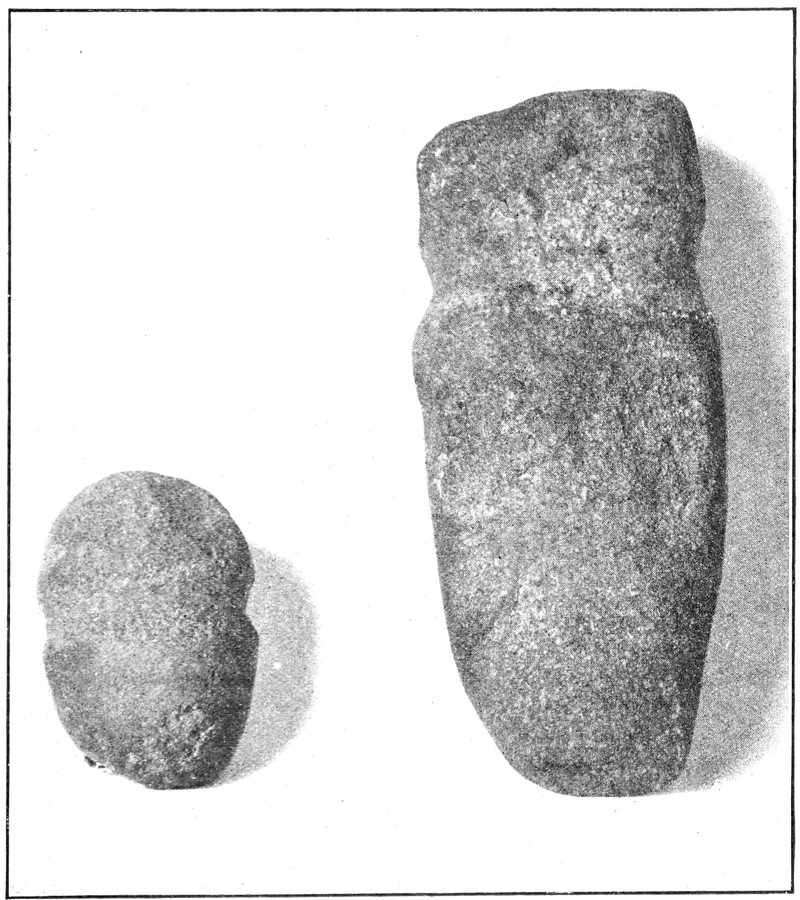
Fig. 11.
Stone axes.
Among the objects of stone taken from Spruce-tree House are several similar to those called by the Hopi tcamahias (pl. 21, h). These implements are as a rule long, with smooth surfaces; they are sharpened at one end and pointed at the opposite end. Generally they have no groove for the attachment of a handle; in one instance, however, there is an indentation on opposite borders. The use of these objects is unknown; they may have been axes or planting implements.
Stone objects of precisely the same type are highly prized by the Hopi and play important parts in their ceremonials. A number of these objects are arranged about the sand picture of the Antelope altar in the Snake dance at Walpi.[30]
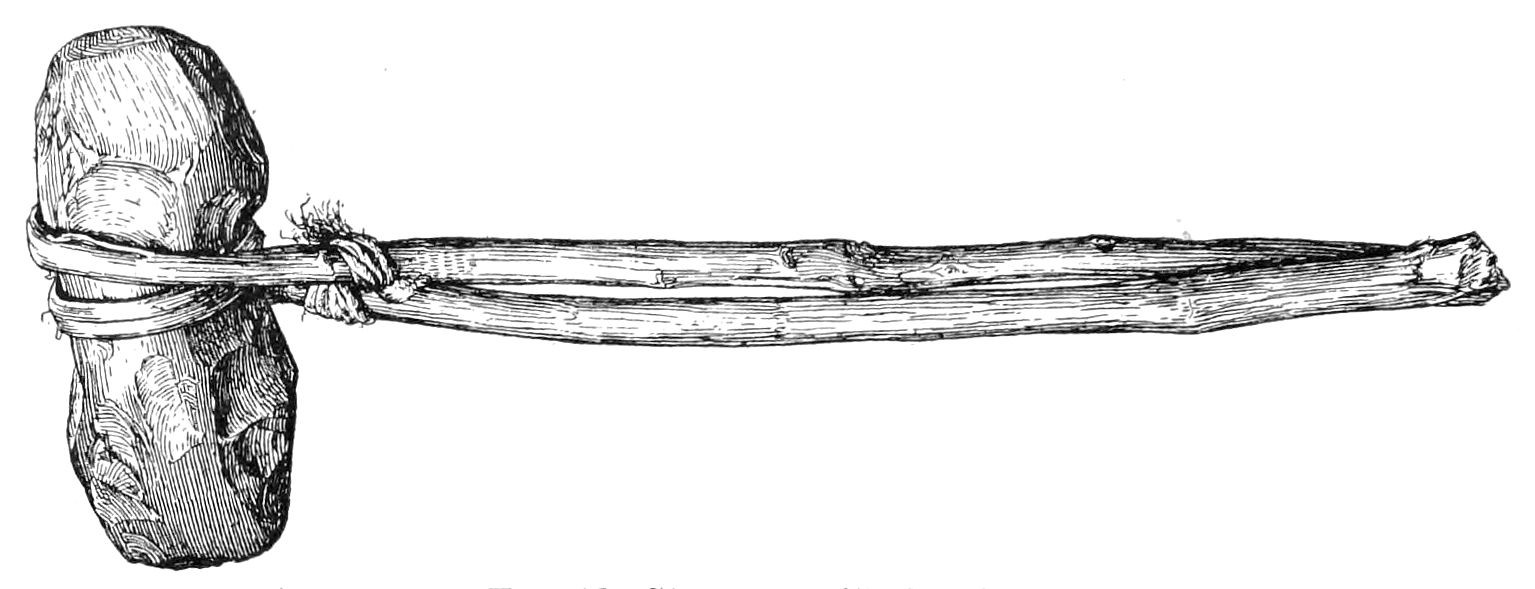
Fig. 12.
Stone ax with handle.
Similar specimens are attached by the Hopi to their most sacred palladium, called the tiponi, or badge of office of the chief of a priesthood. The tiponi of the Antelope society has one of these projecting from its top. The meaning of this association may be even greater than at first would be suspected, for according to legends the Snake family, which is the guardian of the fetishes used in the snake ceremonies, originally lived at Tokonabi, near Navaho mountain, at the mouth of the San Juan river. The culture of the ancient inhabitants of the ruins at that place was not very different from that of the people of the Mesa Verde.
Grinding Stones
Both pestles and hand stones used in grinding maize were excavated, the latter in considerable numbers. There were found also many stone slabs having rounded depressions, or pits, on opposite sides, evidently similar to those now used by the Hopi in grinding the paints for their ceremonials. In some places peckings or grooves in the surfaces of the rocks show where these grinding stones were used, and perhaps flattened to the desired plane. These grinding places are found in the plazas, on the sides of the cave back of the village, and elsewhere. A number of these grooves in a lower ledge of rock at the spring indicate that this was a favorite spot for shaping the hand grinders, possibly for grinding corn or other seeds.
The hand stones are of several types: (1) Polygonal, having corners somewhat worn, but flat on both sides, and having grooves on opposite edges to insure a firm hold for the hand; (2) convex on one face and flat on the opposite; (3) having two faces on each side, separated by a sharp ridge. The third type represents apparently the last stage in the life of a grinding stone the surfaces of which have been worn to this shape by constant use.
Several flat stones, each having a slight depression on one side, were found to be covered with pigments of various colors, which were ground on their surfaces by means of conical stones, as shown in figure 13. Two rectangular flat stones (pl. 21, i, j) with finely polished surfaces and rounded edges have a notch on the rim. Their use is unknown. Nordenskiöld refers to similar stones as “moccasin lasts,” but there seems no valid reason thus to identify these objects except that they have the general form—although larger—of the sole of the foot. The Spruce-tree House aborigines wore sandals and had no need for lasts. Moreover, so far as known, the Pueblo Indians never made use of an object of this kind in fashioning their moccasins.
Pounding Stones
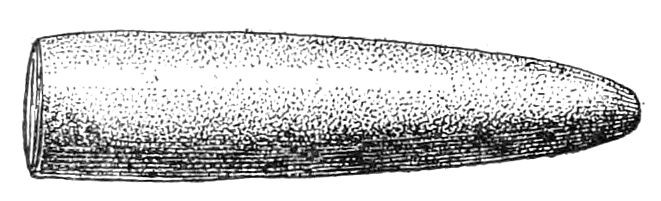
Fig. 13.
Stone pigment-grinder.
In the course of the excavations a large number of stones having pits in the sides were exhumed, but these are so heavy that they were not sent to Washington. Several of these stones are cubical in form and have lateral pits, one on each of four faces. Some are thick, while others are thin and sharpened at the end like an ax. These stones are probably the mauls with which the masons dressed the rocks used in the construction of the buildings. With such mauls the surfaces of the floors of some ceremonial rooms were cut down several inches below the original level. Some of the pounding stones resemble in a measure the grinding stones, but in them pits replace grooves commonly found in the edge of the latter.
Corn was usually ground on flat stones called metates which were found in considerable numbers. These metates commonly show wear on one or both surfaces, and a few specimens have a ridge on each border resulting from the wearing down of the middle of the stone.
Cylinder of Polished Hematite
Among the objects from the ruins of Mesa Verde figured by Nordenskiöld is one designated a “cylinder of polished hematite, perhaps a fetish.” Another stone cylinder closely resembling this was found by the present author at Spruce-tree House. This object closely resembles a bead, but as the author has seen similar stones used on Hopi altars, especially on the altar to the cardinal points, he is inclined to accept the identification suggested by Nordenskiöld. On altars to the cardinal points small stones of different shapes and colors are arranged near ears of corn surrounding a medicine bowl. As black is the symbolic color of the underworld, a stone of this color is found on the black ear of corn representing the nadir. If this cylinder is a fetish it may have been somewhat similarly used.
BASKETRY
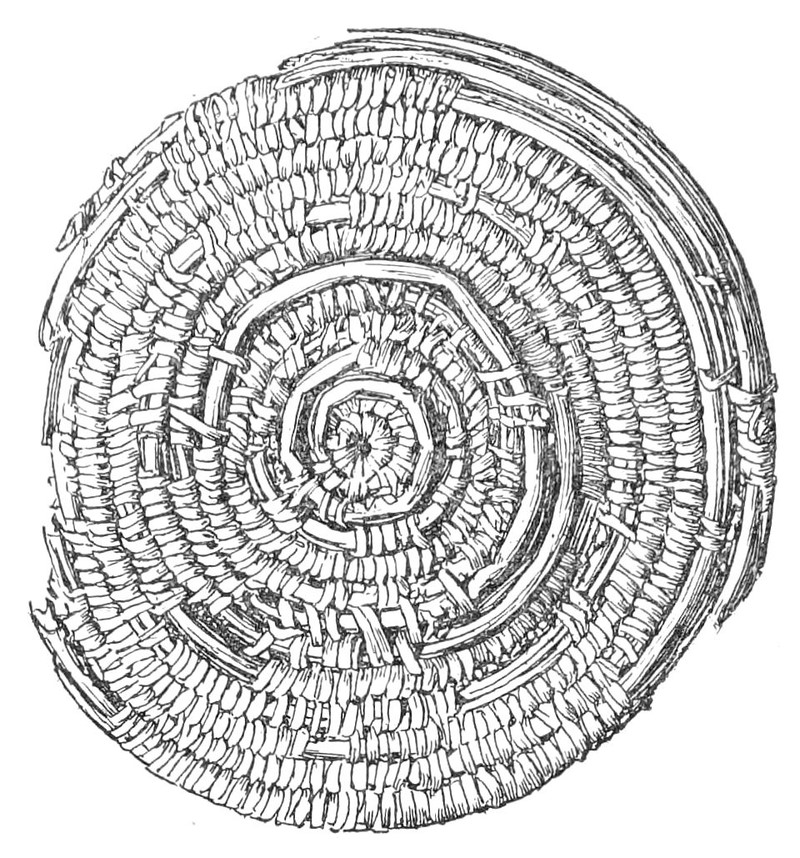
Fig. 14.
Fragment of basket.
Not a single entire basket was found, although a few fragments of baskets made of woven rushes or osiers were obtained (fig. 14). It would appear, however, from a fine basket figured by Nordenskiöld, which he ascribes to Spruce-tree House and from other known specimens, figured and unfigured, that the Mesa Verde people were skillful basket makers. None of the fragments obtained by the author, and the same holds true regarding the basket figured by Nordenskiöld, are decorated.
WOODEN OBJECTS
Few objects made of wood were obtained at Spruce-tree House, but those which were found are well made and reveal the existence of interesting aboriginal customs. Wooden objects closely resembling some of these were used until a few years ago by the Hopi and other Pueblo tribes.
Sticks Tied Together
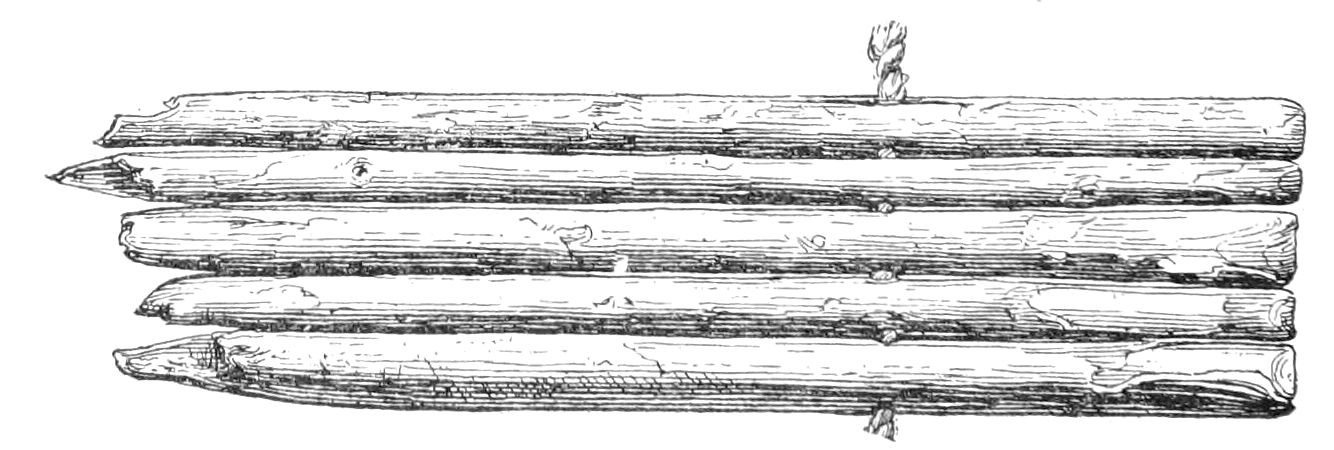
Fig. 15.
Sticks tied together.
Among the wooden objects found are many perforated sticks tied together by strings. This specimen (fig. 15) is not complete, but enough remains to show that it is not unlike the covering in which the Hopi bride rolls her wedding blankets. From the place where the object was found, it appears that the dead were wrapped in coverings of this kind. Although the specimen is much damaged, it is not difficult to make out from the remaining fragment the mode of construction of the object.
Slabs
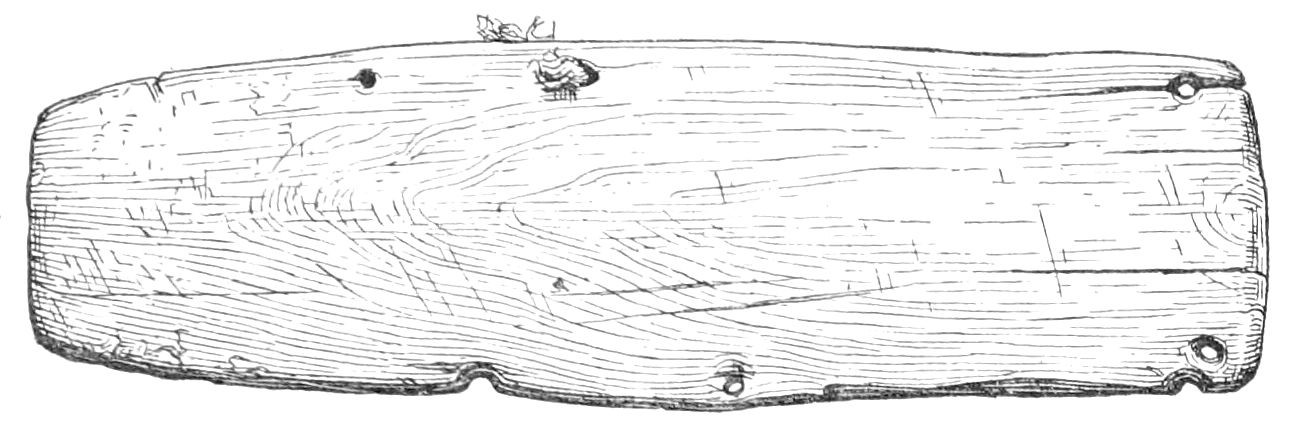
Fig. 16.
Wooden slab.
Nordenskiöld figures a wooden object of rectangular shape, slightly concave on one side and more or less worn on the edges. Two similar wooden slabs (fig. 16) were found at Spruce-tree House. The objects occasioned much speculation, as their meaning is unknown. It has been suggested they are cradle-boards, a conjecture which, in view of the fact that similar specimens are sometimes found in child burials, is plausible. In this interpretation the holes which occur on the sides may have served for attachment of blankets or hoops. These boards, it may be said, are small even for the most diminutive Indian baby.
Another suggestion not without merit is that these boards are priest’s badges and were once carried in the hands suspended by strings tied to the holes in their edges.
Still another theory identifies them as parts of head dresses called tablets, worn in what the Pueblos call a tablita dance.
The upright portions of some of the Hopi altars have similar wooden slabs painted with symbolic figures and tied together. Altars having slabs of the same description are used in ceremonials of certain Tewan clans living in New Mexico.
Spindles

Fig. 17.
Spindle and whorl.
There were found at Spruce-tree House a complete spindle with stick and whorl (fig. 17), and a whorl without the spindle, both of which are practically identical in type with the spinning apparatus of the Hopi Indians. When in use this spindle was made to revolve by rubbing it on the thigh with one hand, while the other held the unspun cotton, the fiber being wound on one end of the spindle. This implement affords still another indication that the arts of the people of Spruce-tree House were similar to those still practised by the Pueblos.
Planting-sticks
A few sticks which resemble those used by the Hopi as dibbles were collected at Spruce-tree House. These measure several feet in length; they are flat at one end, while the opposite end is pointed and rubbed down to a sharp edge. Some of these implements were slightly bent at one extremity.
Miscellaneous Objects
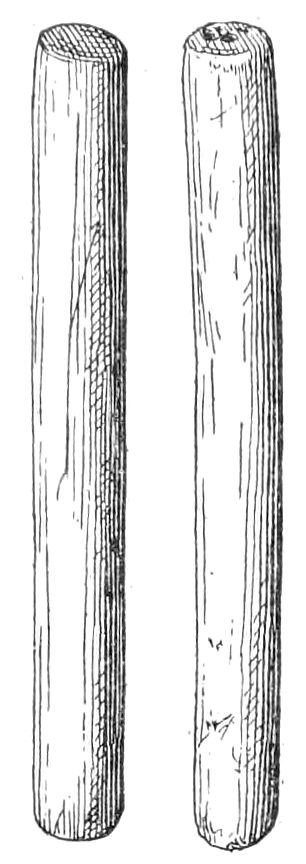
Fig. 18.
Ceremonial sticks.
Among various wooden objects found at Spruce-tree House may be mentioned sticks resembling prayer offerings and others which may have been employed in ceremonials (fig. 18.)
A fragment of a primitive fire-stick (fig. 19) was obtained from the northern refuse-heap and near it were straight sticks that undoubtedly served as fire-drills. There were one or two needles (fig. 20), made of hard wood, suggesting weaving or some similar process. A fragment of an arrow was unearthed in the débris of the northern refuse-heap.

Fig. 19.
Primitive fire-stick.

Fig. 20.
Wooden needle.
FABRICS
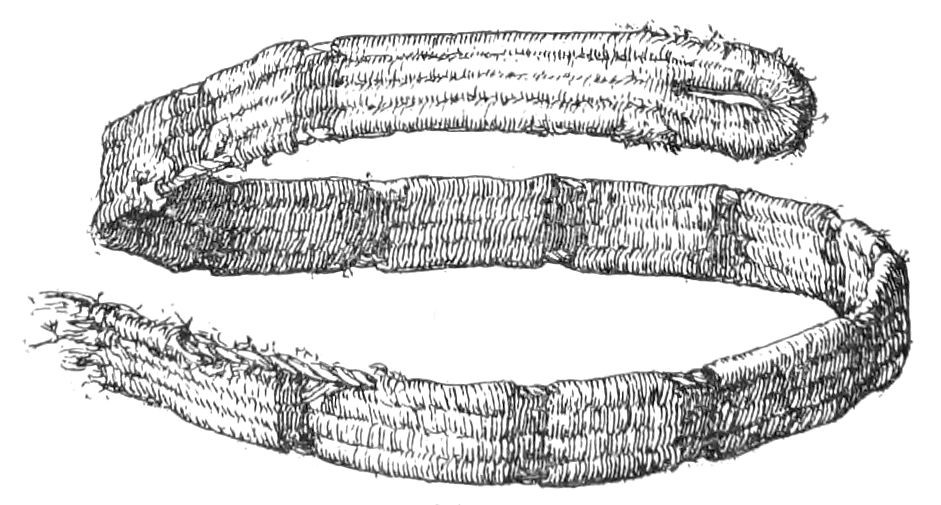
Fig. 21.
Belt.
The yucca plant, which grows wild in the canyons and level places of the Mesa Verde, furnishes a tough fiber which the prehistoric people of Spruce-tree House used in the manufacture of various fabrics. Small packages of this fiber and cords made of the same material were found in the refuse-heap and in the houses; these were apparently obtained by heating and chewing the leaves, after which the fiber was drawn out into cords or braided into strings.
A braided cord was also found attached to the handles of jars, and this fiber was a favorite one in mending pottery. It was almost universally employed in weaving cloth netting and other fabrics, where it was combined with cotton fiber. Belts (fig. 21) or headbands (figs. 22, 23) show the best examples of this weaving. Native cotton fiber is not as common as yucca, being more difficult apparently to procure. There is some doubt regarding the cultivation of the cotton plant, and no cotton seeds were identified; the cloth woven from this fiber shows great skill in weaving.
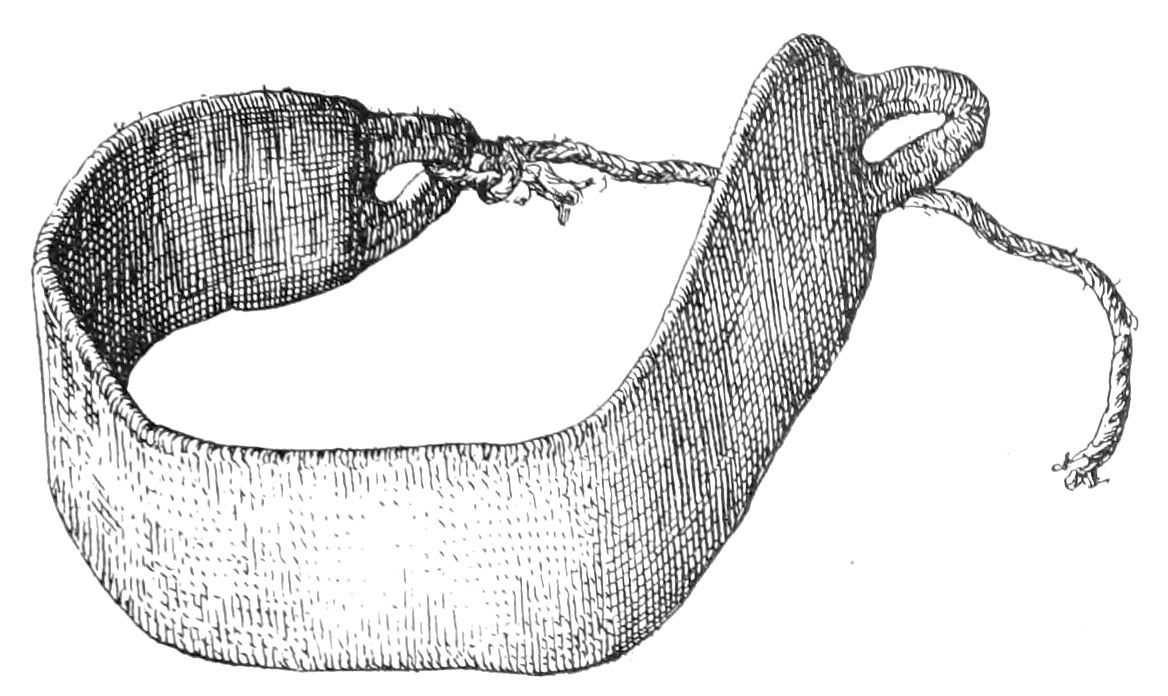
Fig. 22.
Headband.
The bark of willows and alders was utilized for fabrics, but this furnished material for basketry rather than for cloth.
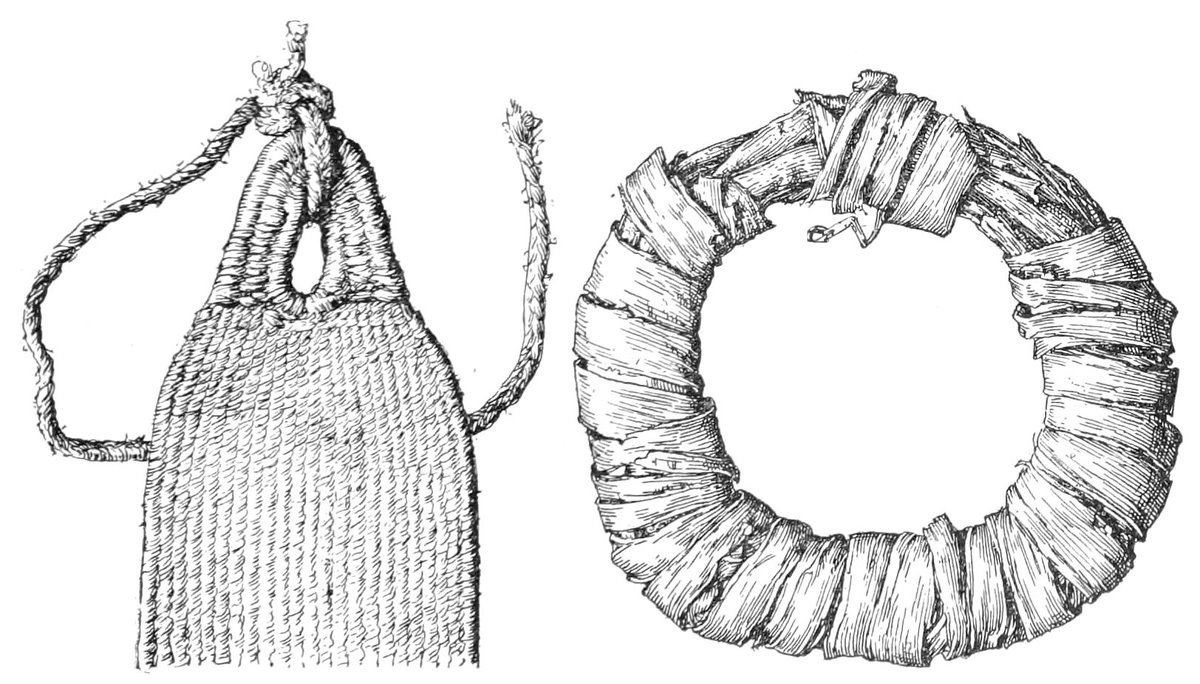
Fig. 23.
End of headband.
Fig. 24.
Head ring.
One of the most beautiful specimens of woven cloth yet obtained in the Mesa Verde ruins was taken from room 11; this is apparently a headband for carrying bundles.
Among the objects obtained in the northern refuse-heap were rings made of the leaf and fiber of yucca and other plants, sometimes blackened as if by fire (fig. 24). These rings may have been used for carrying jars on the head, although some are too large and flat for that purpose. It has been suggested that the largest were used in some game, but this theory lacks confirmation.
Small fragments of matting were found, but no complete specimen came to light. These fragments resemble those referred to by Nordenskiöld as “objects used in carpeting the floors.” It was customary among some of the sedentary Indians of the Southwest to sleep on rectangular mats, and in one building of compound B of Casa Grande impressions of these mats were found on the floor.
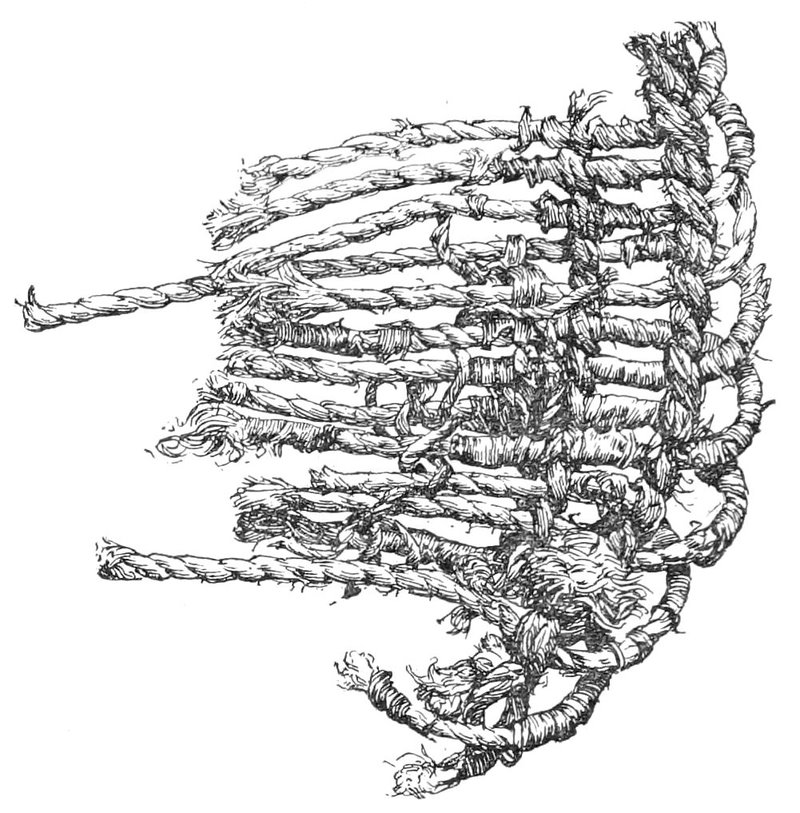
Fig. 25.
Yucca-fiber cloth with attached feathers.
Fragments of cloth made of yucca fiber (fig. 25), in which feathers are woven, are abundant in the refuse-heaps of Spruce-tree House. There were found also many strings in which feathers were woven (fig. 26), but of these nothing but the midribs remain.
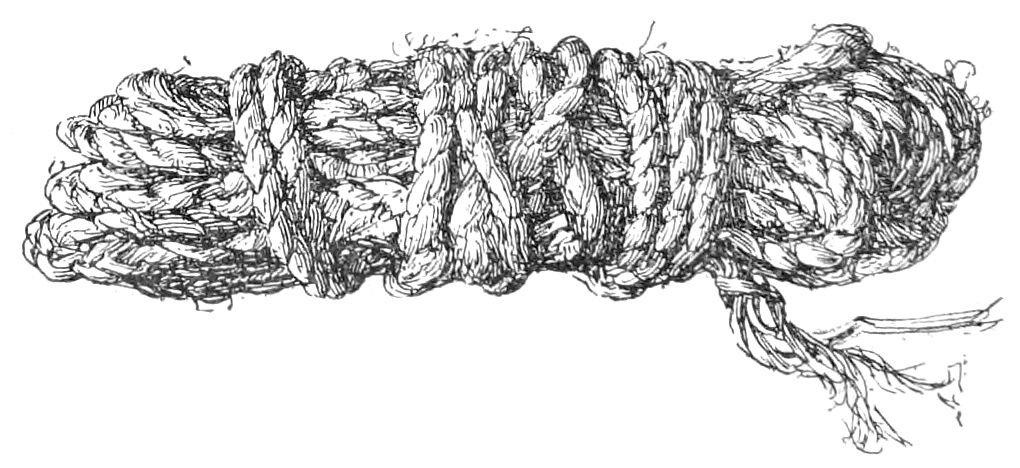
Fig. 26.
Woven cord.
The object shown in figure 27 is made of agave fiber tied in a series of loops. Its use is unknown.
Several sandals were excavated at Spruce-tree House, the majority from the refuse-heap in the rear of the dwellings. One of these specimens, figure 28, is in good condition; it is evidently a mortuary object, being found near a skeleton. The other specimen (fig. 29) is fragmentary, consisting of a sole of a sandal with attached toe cords.
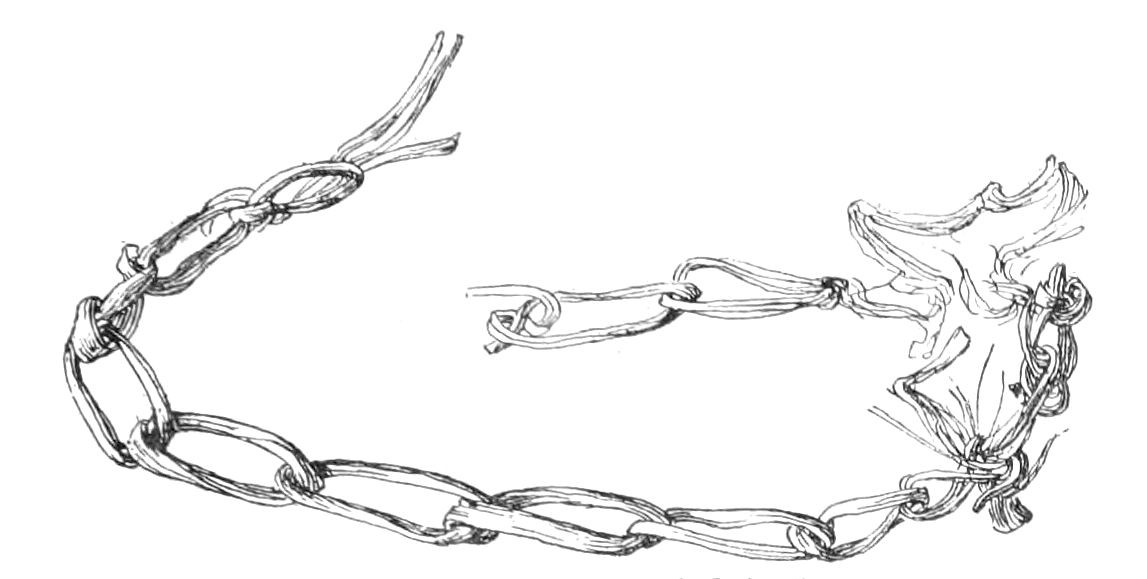
Fig. 27.
Agave fiber tied in loops.
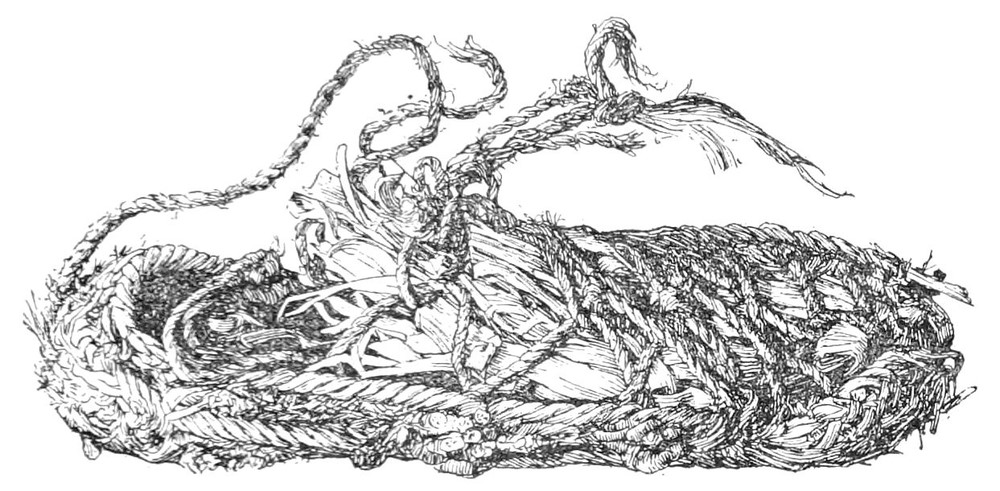
Fig. 28.
Woven moccasin.
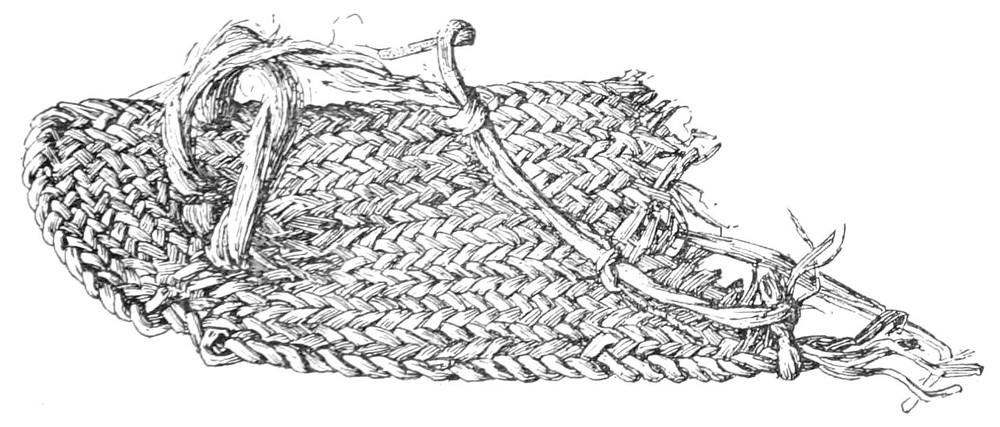
Fig. 29.
Fragment of sandal.
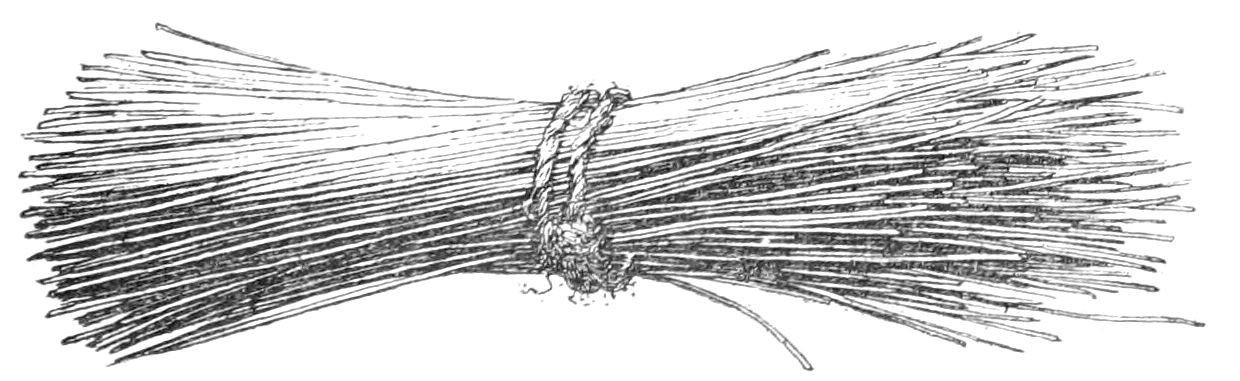
Fig. 30.
Hair-brush.
Several specimens of slender yucca leaves bound in a bundle were found. One of these (fig. 30) served as a hair-brush, or was used in stirring food. One brush made of finer material was collected.
BONE IMPLEMENTS
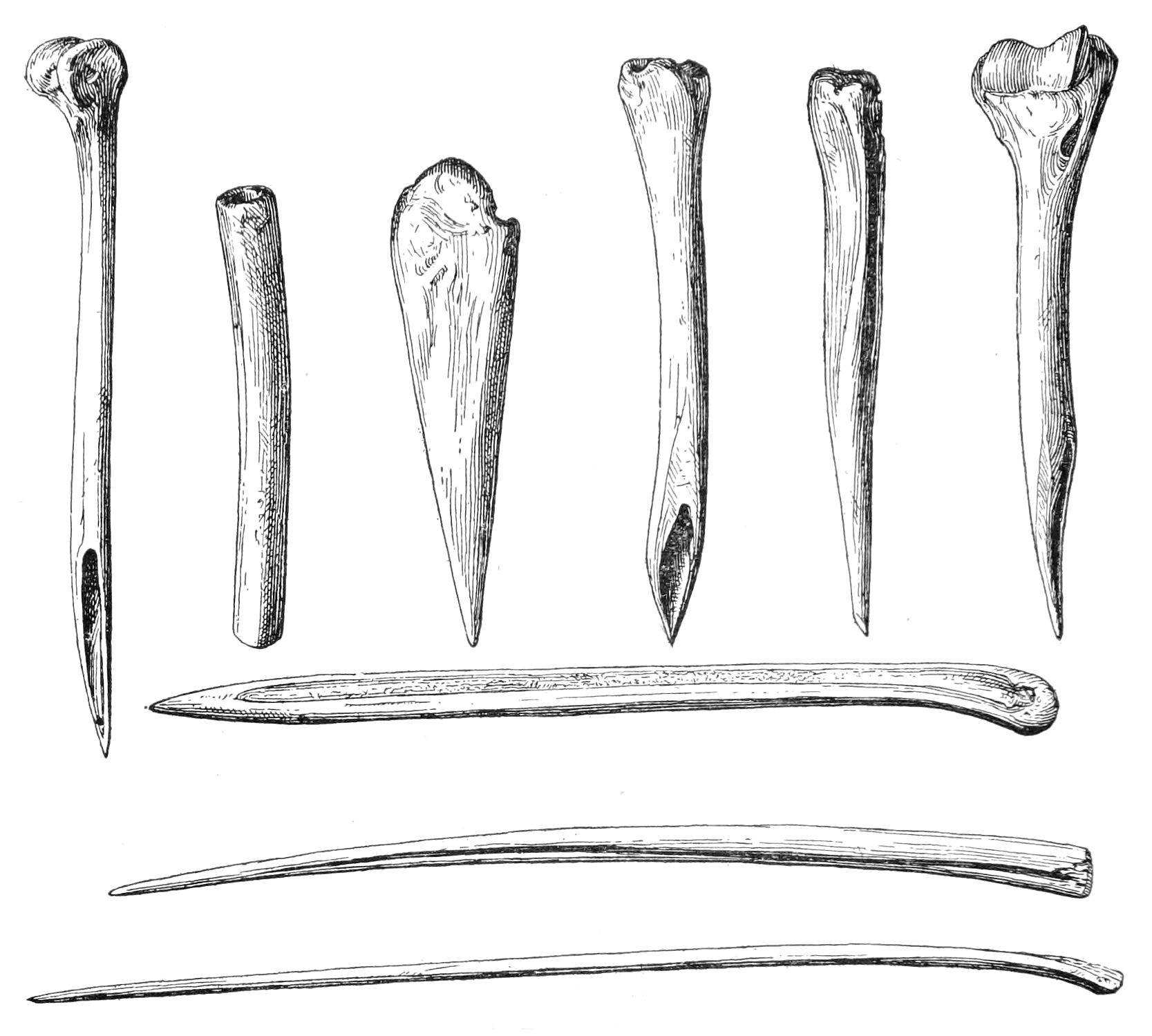
Fig. 31.
Bone implements.
A large collection of beautiful bone implements (see fig. 31)—needles, awls, tubes, and dirks—rewarded the work at Spruce-tree House. Some of these show the effects of fire throughout their length, while others are smoked only at one end. When unearthed, one of these dirks was still in the original sheath of cedar bark (fig. 32).
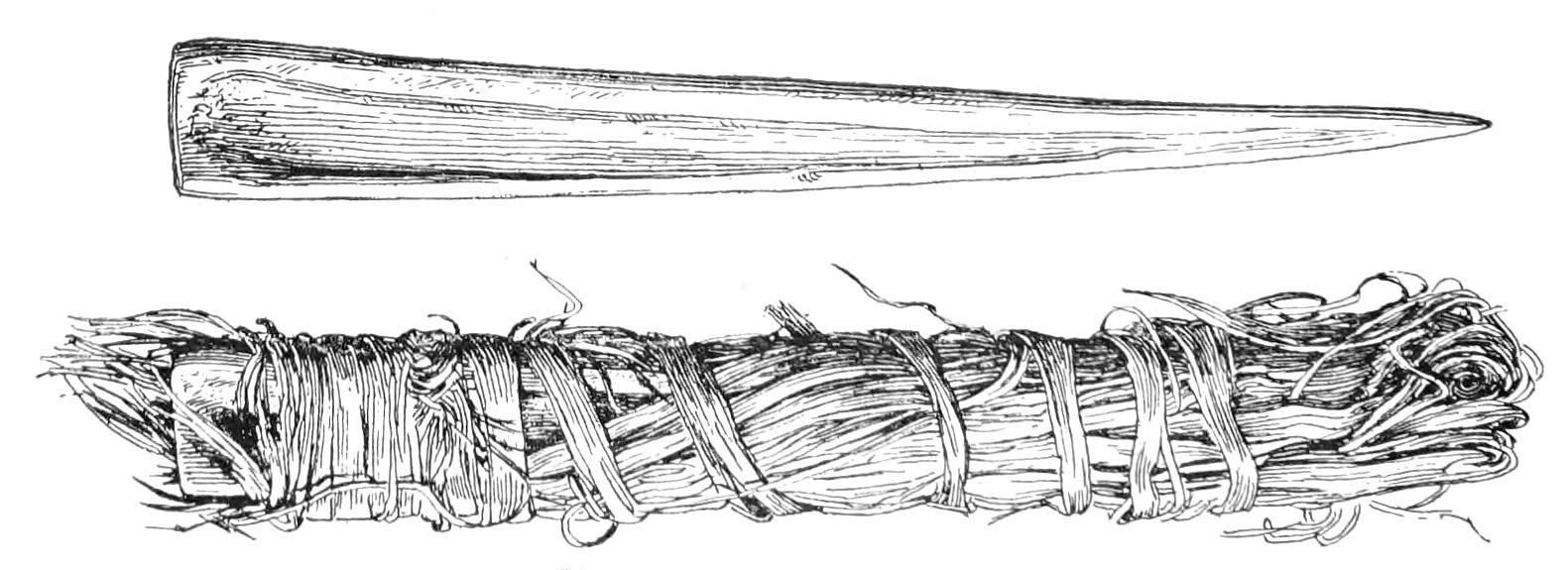
Fig. 32.
Dirk and cedar-bark sheath.
Most of the needles, bodkins, and awls are made of bones of birds or small animals. These were apparently rubbed down and pointed on stone implements or on the sides of the cliff, where grooves are often found (fig. 33).

Fig. 33.
Bone implement.
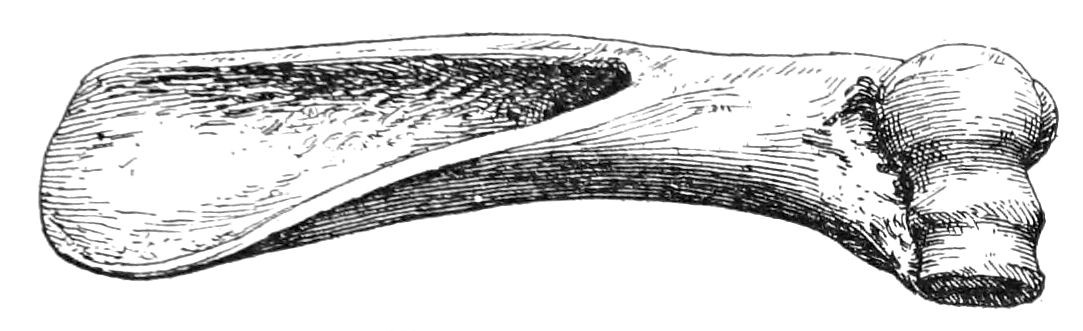
Fig. 34.
Bone scraper.
Several fine bone scrapers (figs. 34, 35) were dug out of the débris covering the floors of the rooms. These are beveled to a sharp edge at one end, the trochanter of the bone serving as a handle.
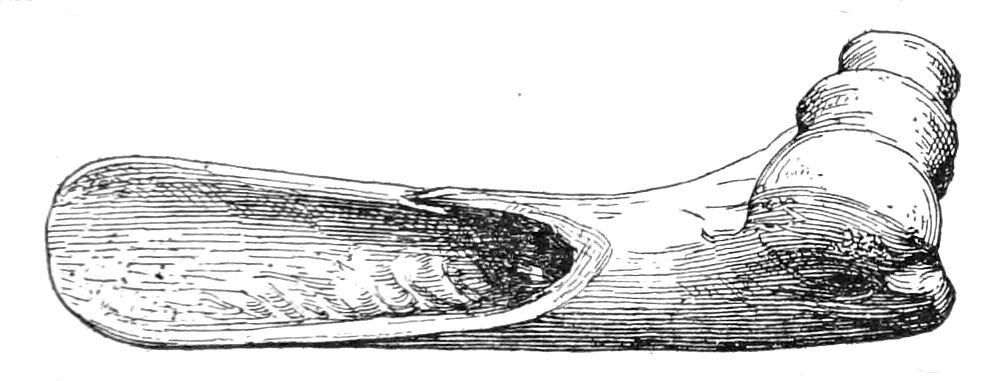
Fig. 35.
Bone scraper.
FETISH
Only one fetish in the form of a human being was obtained at Spruce-tree House, this being found in the débris near the floor of kiva G. So far as the objects from Mesa Verde ruins have been figured or described, this is the first record of the finding of a fetish of human shape in any of these ruins. Moreover, such a fetish is a rarity in cliff-house ruins elsewhere in the Southwest, a fact which imparts to this specimen more than usual interest.
LIGNITE GORGET
In the author’s account of his excavations in ruins in the Little Colorado valley there was figured a large fragment of a disk made of cannel coal or lignite. This disk is convex on one side and plain on the side opposite, the latter having an eyelet, or two holes for suspension. A lignite gorget, similar for the most part to the above-mentioned specimen, but differing therefrom in having the eyelet in the convex instead of in the flat side, was found at Spruce-tree House. Probably both objects were formerly used as ornaments, being suspended about the neck. No similar specimen has thus far been described from Mesa Verde ruins.
CORN, BEANS, AND SQUASH SEEDS
All indications point to maize, or Indian corn, as the chief food plant of the prehistoric people of this cliff-dwelling. This is evident not only from the presence in the ruins of metates and grinding stones, but also from the abundance of corn ears and other fragments discovered; corn husks and seed corn were especially plentiful in rooms and in the refuse-heaps. As in the case of the modern Pueblos, the corn appears to have been of several colors, while the size of the cobs indicates that the ears were small with but few rows of seeds. In addition to cobs, fragments of corn stalks, leaves, and even tassels were found in some of the rooms. Beans of the brown variety, specimens of which were numerous in one room, were the most esteemed. There were obtained also stalks and portions of gourds some of which are artificially perforated, as well as a gourd the rind of which is almost complete. Apparently these gourds were used for ceremonial rattles and for drinking vessels. The form suggests that of a Hopi netted gourd in which sacred water is brought from distant springs for use in the kivas, or ceremonial rooms.
HOOP-AND-POLE GAME
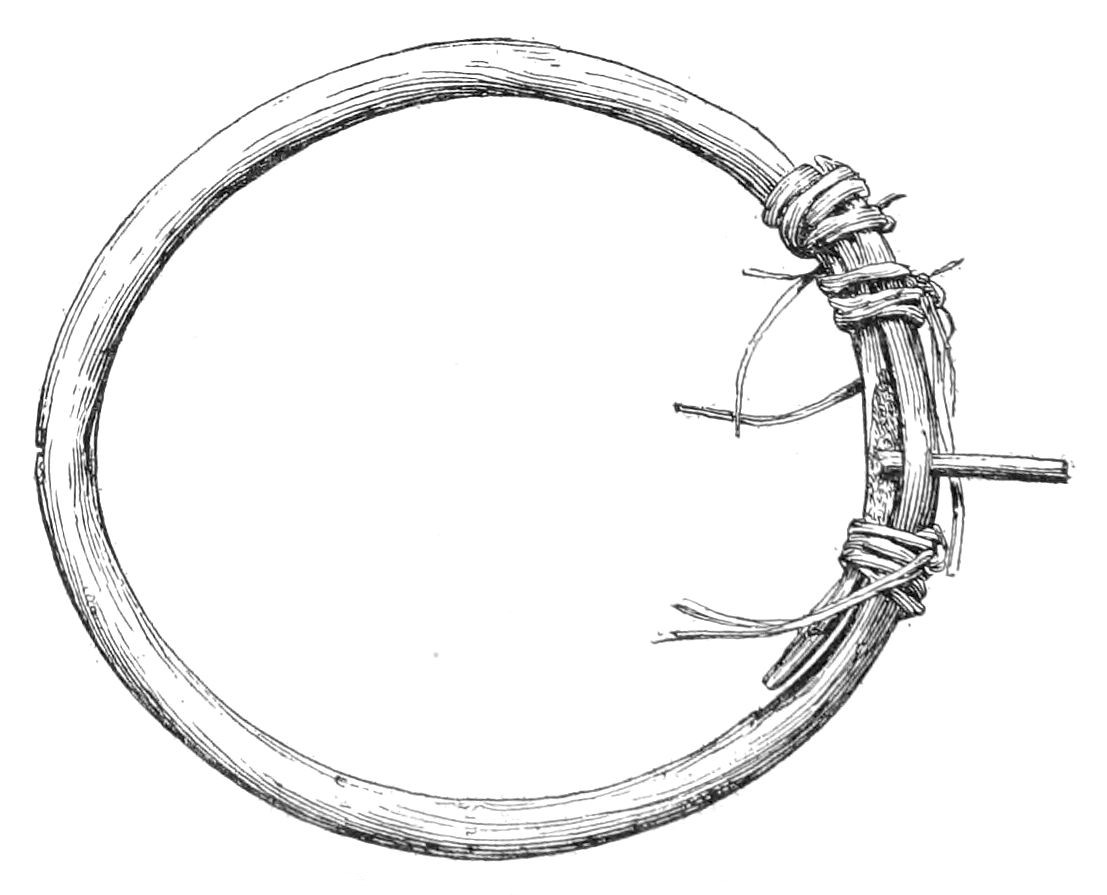
Fig. 36.
Hoop used in hoop-and-pole game.
It appears from the discovery of a small wooden hoop in one of the rooms that the prehistoric people of Spruce-tree House were familiar with the hoop-and-pole game (fig. 36) so popular among several of our aboriginal tribes. But whether or not the individual hoop obtained was used in a secular game or a ceremony may be open to differences of opinion. The author is inclined to connect the specimen above referred to with basket dances, one of which is called by the Hopi the Owakulti.[31] In this dance the hoop is rolled on the ground and the players throw or attempt to throw darts through it.
LEATHER AND SKIN OBJECTS
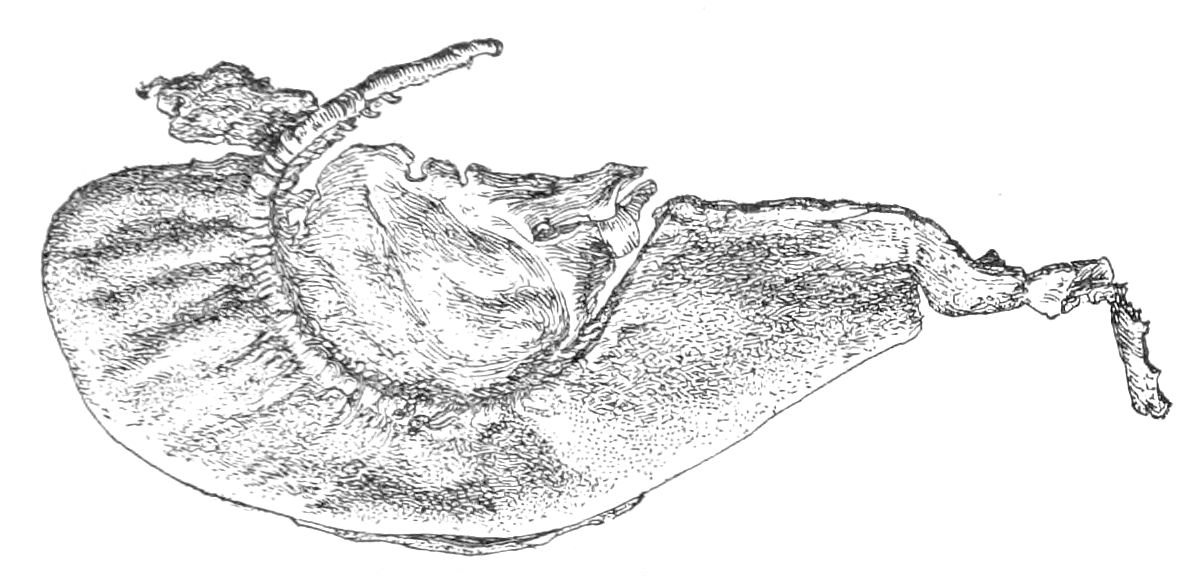
Fig. 37.
Portion of leather moccasin.
Fragments of leather or dressed skin (fig. 37) were found in several of the rooms. These are apparently parts of moccasins or sandals, but may have been pouches or similar objects. A strip of rawhide by means of which an ax was lashed to its handle was picked up in the dump, where also was a fragment of what may have been a leather pouch with a thong of hide woven in one edge. If skins of animals were used for clothing, as they probably were, but slight evidence of the fact remains.
ABSENCE OF OBJECTS SHOWING EUROPEAN CULTURE
In the excavations which were necessary to clean out the rooms of Spruce-tree House no object of European make was discovered. There was no sign of any metal, even copper being unrepresented; no object discovered shows traces of cutting by knives or other implements made of metal. Evidently European culture exerted no influence on the aborigines of Spruce-tree House.
PICTOGRAPHS
Near Spruce-tree House, as elsewhere on the Mesa Verde, are found examples of those rock-etchings and other markings known as pictographs. Some of these represent human beings in various attitudes, and animals, as deer, mountain sheep, snakes, and other subjects not yet determined. As seems to be true of the other rock-inscriptions just mentioned, some of those near Spruce-tree House are religious symbols, some are totems, while others are mere scribblings.
These pictographs are so rude that they give little idea of the artistic possibilities of their makers, while many are so worn that even the subjects intended to be depicted are doubtful.
The walls of some of the rooms in the Mesa Verde cliff-dwellings still show figures painted while the rooms were inhabited. Among these the favorite designs are of triangular form.
The walls of the secular rooms and kivas of Spruce-tree House were formerly covered with a thin wash of colored sand which was well adapted for paintings of symbolic or decorative character. The colors (yellow, red, and white), were evidently put on with the hands, impressions of which can be found in several places. In some cases, as with the upper part of the wall painted white and the lower part red, the contrast brings out the colors very effectively. The walls of some of the rooms are blackened with smoke.
Among the designs used are the triangular figures on the upper margin of the dados and pedestals of kivas. Figures similar in form, but reversed, are made by the Hopi, who call them butterfly and raincloud symbols.
Birds and quadrupeds.—Nordenskiöld (pp. 108-9) thus writes of one of the ancient paintings:
The first of them, fig. 77, is executed in a room at Sprucetree House. Here too the lower part of the mural surface is dark red, and triangular points of the same colour project over the yellow plaster; above this lower part of the wall runs a row of red dots, exactly as in the estufa at Ruin 9. To the left two figures are painted, one of them evidently representing a bird, the other a quadruped with large horns, probably a mountain sheep. [Elsewhere, as quoted on p. 5, Nordenskiöld identifies these figures as “two birds.”] The painting shown in fig. 78 is similar in style to the two just described.
In this room the dado bears at intervals along its upper edge the triangular figures already noticed, and rows of dots which appear to be a symbolic decoration, occurring likewise on pottery, as an examination of the author’s collection makes evident.
Square figures.—On the eastern wall of the same room in which occur the figures of a bird and a horned mammal there is a square figure on the white surface of the upper wall. This figure is black in outline; part of the surface bears an angular meander similar to decorations on some pieces of pottery. Similar designs, arranged in series according to Mindeleff’s figures, form the decoration band of one of the kivas in Chelly canyon.
The significance of this figure is unknown but its widespread distribution, especially in that region of the Southwest characterized by circular kivas, adds considerable interest to its interpretation.
Terraced figure.—Covering almost the whole side of a wall north of kiva C and overlooking the plaza of which this room forms in part the northern wall, is a conspicuous figure painted white. If we regard the building of which this is a side as formerly two stories high, this painting would have been on the inside of a room, otherwise we have the exceptional feature of a painting on an outer wall. The purpose of this painting is not clear to the author, but similar figures, reversed, signify rain clouds. The figure recalls in form a representation of a T-shaped doorway and appears to be a unique one among Mesa Verde ruins.
CONCLUSIONS
From the preceding facts it is evident that the people who once inhabited Spruce-tree House were not highly developed in culture, although the buildings show an advanced order of architecture for aborigines of North America. Architecturally the cliff-dwellings excel pueblos of more recent construction.
The pottery is not inferior to that of other parts of the Southwest, but has fewer symbols and is not as fine or varied in colors as that from Sikyatki or from Casas Grandes in Sonora. It is better than the pottery from the Casa Grande and other compounds of the Gila and about the same in texture and symbols as that from Chelly canyon and Chaco canyon.
The remaining minor antiquities, as cloth, basketry, wood, and bone, are of the same general character as those found elsewhere in the Southwest. Shell work is practically lacking; no objects made from marine shells have been found.
The picture of culture drawn from what we know of the life at Spruce-tree House is practically the same as that of a pueblo like Walpi at the time of its discovery by whites, and until about fifty years ago. The people were farmers, timid, industrious, and superstitious. The women were skillful potters and made fine baskets. The men made cloth of good quality and cultivated corn, beans, and melons.
In the long winters the kivas served as the lounging places for the men who were engaged in an almost constant round of ceremonies of dramatic character, which took the place of the pleasures of the chase. They never ventured far from home and rarely met strangers. They had all those unsocial characteristics which an isolated life fosters.
What language they spoke, and whether various Mesa Verde Houses had the same language, at present no one can tell. The culture was selfcentered and apparently well developed. It is not known whether it originated in the Mesa Verde canyons or was completely evolved when it reached there.
Although we know little about the culture of the prehistoric inhabitants of Mesa Verde, it does not follow that we can not find out more. There are many ruins awaiting exploration in this region and future work will reveal much which has been so long-hidden.
The pressure of outside tribes, or what may be called human environment, probably had much to do originally with the choice of caves for houses, and the magnificent caverns of the Mesa Verde naturally attracted men as favorable sites for their houses. The habit of huddling together in a limited space, necessitated by a life in the cliffs, possibly developed the composite form which still persists in the pueblo form of architecture.