DESCRIPTION OF PLATE XX.
Reading edition
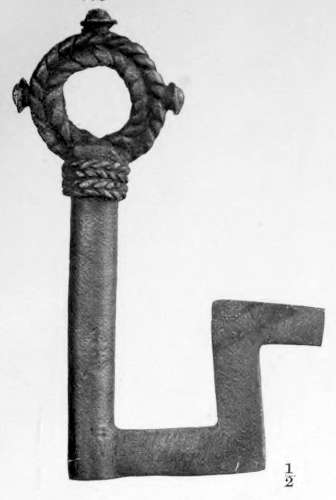
Fig. 115.—Brass key, a good deal filed and tooled all over. Handle ornamented with twisted rope pattern. The form of this key cannot be identified as Roman, and is probably European.
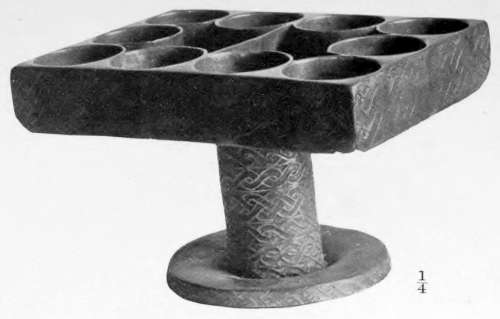
Fig. 116.—Bronze stand for the game of mancala, with ten holes and two irregular-shaped cavities in the centre. It is the same game as Figs. 184 and 185, Plate XXVIII, but with fewer holes. The sides are ornamented with interlaced strap-work, and the stem and the edge of the base with varieties of guilloche pattern. This game is distributed nearly all over Africa, and is said to be found wherever Arab influence is seen. It is also found in Palestine, Syria, Arabia, Maldive Islands, India, Ceylon, Malay Peninsula, Java, and the Philippine Islands.
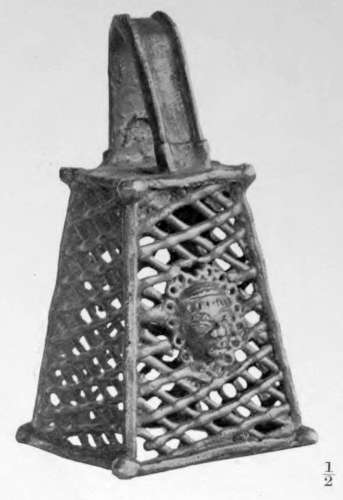
Fig. 117.—Brass bell, with reticulated pierced work. Negro head on front. This bell is interesting as being a survival of the bells so often seen hanging from the necks of the figures on the plaques. It is evident that it never could have emitted any sound.
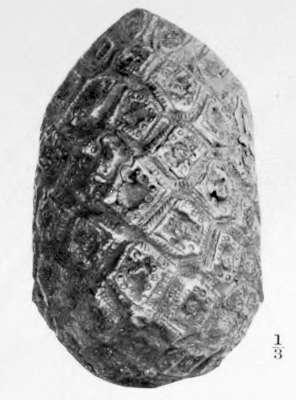
Fig. 118.—Entire tortoise shell, upper and under sides, in brass; ornamented on the upper side with geometrical pattern; each figure inlaid with a copper bolt or stud in the centre.
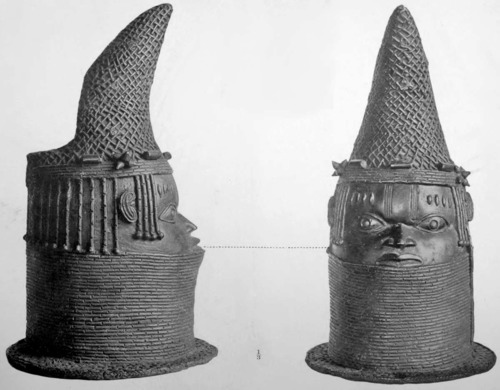
Figs. 119 and 120.—Bronze human head for holding carved elephants’ tusks. The head-dress, pointed and reticulated, representing coral or agate. Four tribal marks over each eye. Six vertical bands of inlaid iron-work over the nose. The pupils of the eyes are of iron. The head-dress resembles Figs. 100 and 101, Plate XVII. Coral choker. Guilloche pattern on projecting base.