Chapter XV · THE GROWTH OF CIVILIZATION: OLD WORLD HISTORY AND ETHNOLOGY
Reading edition
238. The early focal area.—239. Egypt and Sumer and their background.—240. Predynastic Egypt.—241. Culture growth in dynastic Egypt.—242. The Sumerian development.—243. The Sumerian hinterland.—244. Entry of Semites and Indo-Europeans.—245. Iranian peoples and cultures.—246. The composite culture of the Near East.—247. Phœnicians, Aramæans, Hebrews.—248. Other contributing nationalities.—249. Ægean civilization.—250. Europe.—251. China.—252. Growth and spread of Chinese civilization.—253. The Lolos.—254. Korea.—255. Japan.—256. Central and northern Asia.—257. India.—258. Indian caste and religion.—259. Relations between India and the outer world.—260. Indo-China.—261. Oceania.—262. The East Indies.—263. Melanesia and Polynesia.—264. Australia.—265. Tasmania.—266. Africa.—267. Egyptian radiations.—268. The influence of other cultures.—269. The Bushmen.—270. The West African culture-area and its meaning.—271. Civilization, race, and the future.
238. The Early Focal Area
The prehistoric archæology of Europe and the Near East, outlined in the last chapter, besides arriving at a tolerable chronology, reveals a set of processes of which the outstanding one is the principle of the origin of culture at focal centers and its diffusion to marginal tracts. Obviously this principle should apply in the field of history as well as prehistory, and should be even more easily traceable there.
In the Western Hemisphere it is plain that the great hearth of cultural nourishment and production has been Middle America—the tracts at the two ends of the intercontinental bridge, the Isthmus of Panama. That a similarly preëminent focal area existed in the Eastern Hemisphere has been implied over and over again in the pages that immediately precede this one, in the references to the priority of Egypt and Babylonia—the countries of the Nile and of the Two Rivers. These two lands lie at no great distance from each other: they are closer than Mexico and Peru. Like these two, they are also connected by a strip of mostly favorable territory—the “Fertile Crescent” of Palestine, Syria, and northern Mesopotamia. Curiously, the two countries also lie in two continents connected by a land bridge: the Isthmus of Suez is a parallel to that of Panama.
Both in Egypt and in Babylonia we find a little before 3000 B.C. a system of partly phonetic writing, which, though cumbersome by modern standards, was adequate to record whatever was spoken. Copper was abundant and bronze in use for weapons and tools. Pottery was being turned on wheels. Economic life was at bottom agricultural. The same food plants were grown: barley and wheat; similar beer brewed from them. The same animals were raised: cattle, swine, sheep, goats; with the ass for transport. Architecture was in sun-dried brick. Considerable walled cities had arisen. Their rulers struggled or attained supremacy over one another as avowed kings with millions of subjects. A regulated calendar existed by which events were dated. There were taxes, governors, courts of law, police protection, and social order. A series of great gods, with particular names and attributes, were worshiped in temples.
239. Egypt and Sumer and Their Background
It is scarcely conceivable that these two parallel growths of civilization, easily the most advanced that had until then appeared on earth, should have sprung up independently within a thousand miles of each other. Had Sumerian culture blossomed far away, say on the shores of the Pacific instead of the lower Euphrates, its essential separateness, like that of Middle American civilization, might be probable. But not only is the stretch of land between Babylonia and Egypt relatively short: it is, except in the Suez district, productive and pleasant, and was settled fairly densely by relatively advanced nations soon after the historic period opens or even before. The same is true of the adjoining regions. Canaan, Syria, Mesopotamia, Troy, Crete, Elam, southwestern Turkistan, had all passed beyond barbarism and into the period of city life during the fourth and third millenia B.C. This cannot be a series of coincidences. Evidently western Asia, together with the nearest European islands and the adjacent fertile corner of Africa, formed a complex but connected unit, a larger hearth in which culture was glowing at a number of points. It merely happened that a little upstream from the mouths of the Nile and of the Euphrates the development flamed up faster during the fifth and fourth millenia. The causes can only be conjectured. Perhaps when agriculture came to be systematically instead of casually conducted, these annually overflowed bottom lands proved unusually favorable; their population grew, necessitating fixed government and social order, which in turn enabled a still more rapid growth of numbers, the fuller exploitation of resources, and division of labor. This looks plausible enough. But too much weight should not be attached to explanations of this sort: they remain chiefly hypothetical. That culture had however by 3000 B.C. attained a greater richness and organization in Egypt and in the Babylonian region than elsewhere, are facts, and can hardly be anything but causally connected facts. These two civilizations had evidently arisen out of a common Near Eastern high level of Neolithic culture, much as the peaks of Mexico and Peru arose above the plateau of Middle American culture in which they were grounded.
Of course this means that Egypt and Sumer did not stand in parental-filial relation. They were rather collateral kin—brothers, or better, perhaps, the two most eminent of a group of cousins. Attempts to derive Egyptian hieroglyphic from Babylonian Cuneiform writing, and vice versa, have been rejected as unproved by the majority of unbiased scholars. But it is likely that at least the idea of making legible records, of using pictorial signs for sounds of speech, was carried from one people to the other, which thereupon worked out its own symbols and meanings. Just so, while the Phœnician alphabet has never yet been led back to either Egyptian, Cuneiform, Cretan, or Hittite writing with enough evidence to satisfy more than a minority fraction of the world of scholarship, it seems incredible that this new form of writing should have originated uninfluenced by any of the several systems which had been in current use in the near neighborhood, in part in Phœnicia itself, for from one to two or three thousand years. Such a view denies neither the essentially new element in Phœnician script nor its cultural importance. It does not consider the origin of the alphabet explained away by a reference to another and earlier system of writing. It does bring the alphabet into some sort of causal relation with the other systems, without merging it in them. It is along lines like this that the relation of early Egypt and Babylonia to each other and to the other cultures of the ancient Near East must be conceived.
240. Predynastic Egypt
Egyptian civilization was already in full blown flower at the time of the consolidation of Lower and Upper Egypt under the first dynasty in the thirty-fourth century. Its developmental stages must have reached much farther back. Hieroglyphic writing, for instance, had taken on substantially the forms and degree of efficiency which it maintained for the next three thousand years. An elaborate, conventional system of this sort must have required centuries for its formative stages. A non-lunar 365-day calendar was in use. This was easily the most accurate and effective calendar developed in the ancient world, and furnished the basis of our own. It erred by the few hours’ difference between the solar and the assumed year. This difference the Egyptians did not correct but recorded, with the result that when the initial day had slowly swung around the cycle of the seasons, they reckoned a “Sothic year” of 1,461 years. One of these was completed in 2781; which gives 4241 B.C. as the date of the fixing of the calendar. This is considered the earliest exactly known date in human history. Of course, a calendar of such fineness cannot be established without long continued observations, whose duration will be the greater for lack of astronomical instruments. Centuries must have elapsed while this calendar was being worked out. Nor would oral tradition be a sufficient vehicle for carrying the observations. Permanent records must have been transmitted from generation to generation; and these presuppose stability of society, enduring buildings, towns, and a class with leisure to devote to astronomical computations. It is safe therefore to set 4500 B.C. as the time when Egypt had emerged from a tribal or rural peasant condition into one that can be called “civilized” in the original meaning of that word: a period of city states, or at least districts organized under recognized rulers. From 4500 on, then, is the time of the Predynastic Local Kingdoms.
Beyond this time there must lie another: the Predynastic Tribal period, before towns or calendars or writing or metal, when pottery was being made, stone ground, boats built, plants and animals being domesticated—the typical pure Neolithic Age, in short. Yet with all its prehistoric wealth, Egypt has not yet produced any true Neolithic remains. It is hardly likely that the country was uninhabited for thousands of years; much more probably have Neolithic remains been obliterated. This inference is strengthened by the paucity and dubiousness of Upper Palæolithic artifacts in Egypt. Lower Palæolithic flint implements are abundant, just as are remains from the whole of the period of metals. What has happened to the missing deposits and burials of the Upper Palæolithic and Neolithic that fell between?
Apparently they have been buried on the floor of the Nile valley under alluvial deposits. The Eolithic and Lower Palæolithic implements are found on the plateau through which the valley stretches; also cemented into conglomerate formed of gravel and stone washed down from this plateau and cut into terraces by the Nile when it still flowed from 30 to 100 feet higher than at present; and on the terraces. Just when these terraces were formed, it is difficult to say in terms of European Pleistocene periods; but not later than the third glacial epoch, it would seem, and perhaps as early as the second. As the Chellean of Europe is put after the third glaciation in the chronology followed in this book, the antiquity of the first flints used, and perhaps deliberately shaped, in Egypt, is carried back to an extremely high antiquity by the specimens imbedded in the terrace cliffs.
About the time of the last glaciation—the Mousterian or end of the Lower Palæolithic in Europe—the Nile ceased cutting down through the gravels that bordered it and began to build up its bed and its valley with a deposit of mud as it does to-day. From excavations to the base of dated monuments it is known that during the last 4,000 years this alluvium has been laid down at the rate of a foot in 300 years in northern Egypt. As it there attains a depth of over a hundred feet, the process of deposition is indicated as having begun 30,000 or more years ago. Of course no computation of this sort is entirely reliable because various factors can enter to change the rate; but the probability is that, other things equal, the deposition would have been slower at first than of late, and the time of the aggrading correspondingly longer. In any event geologists agree that their Recent—the last 10,000 years or so—is insufficient, and that the deposition of the floor of the Nile valley must have begun during what in Europe was part of the Würm glaciation.
This is the period of transition from Lower to Upper Palæolithic (§ 69, 70, 213) in Europe. The disappearance of Upper Palæolithic remains in Egypt is most plausibly explained by the fact that the Upper Palæolithic, just as later the Neolithic, was indeed represented in Egypt, very likely flourishingly, but that in the mild climate its artifacts were lost or interred on or near the surface of the valley itself and have therefore long since been covered over so deep that only future lucky accidents, like well-soundings, may now and then bring a specimen to light.
For the Neolithic, there actually are such discoveries: bits of pottery brought up from borings, 60 feet deep in the vicinity of one of the monuments referred to, 75 and 90 feet deep at other points in lower Egypt. The smallest of these figures computes to a lapse of 18,000 years—nearly twice as long as the estimated age of the earliest pottery in Europe. It is always necessary not to lay too much reliance on durations calculated solely from thickness of strata, whether these are geological or culture-bearing. But in this case general probability confirms, at least in the rough. In 4000 B.C., when Egypt was beginning to use copper, western Europe was still in its first phase of stone polishing; in 1500 B.C., when Egypt was becoming acquainted with iron, Europe was scarcely yet at the height of its bronze industry. If the fisher folk camped on their oyster shells on the Baltic shores were able to make pottery by 8000 B.C., there is nothing staggering in the suggestion that the Egyptians knew the art in 16,000 B.C. They have had writing more than twice as long as the North Europeans.
The dates themselves, then, need not be taken too literally. They are calculated from slender even though impressive evidence and subject to revision by perhaps thousands of years. But they do suggest strongly the distinct precedence of northern Africa, and by implication of western Asia, over Europe in the Neolithic, as precedence is clear in the Bronze and early Iron Ages and indicated for the Lower Palæolithic.
If, accordingly, the beginning of the Early Neolithic—the age of pottery, bow, dog—be set for Egypt somewhere around 16,000 B.C., about coeval with the beginning of the Magdalenian in middle western Europe (§ 215), the Full Neolithic, the time of first domestication of animals and plants and polishing of stone, could be estimated at around 10,000 B.C., when Europe was still lingering in its epi-Palæolithic phase (§ 216). One can cut away several thousand years and retain the essential situation unimpaired: 8000, or 7000 B.C., still leaves Egypt in the van; helps to explain the appearance of eastern grains and animals in Europe around 6000-5000 B.C.; and, what is most to the point, allows a sufficient interval for agriculture and the allied phases of civilization to have reached the degree of development which they display when the Predynastic Local Kingdoms drift into our vision around 4500 B.C. A long Full Neolithic, then, is both demanded by the situation in Egypt and indicated by such facts as there are; a long period in which millet, barley, split-wheat, wheat, flax, cattle, sheep, and asses were gradually modified and made more useful by breeding under domestication. This Full Neolithic, or its last portion, was the Predynastic Tribal Age of Egypt; which, when it passed into the Predynastic Local Kingdoms phase about 4500 B.C., had brought these plants and animals substantially to their modern forms, and had increased and coördinated the population of the land to a point that the devising of calendar, metallurgy, writing, and kingship soon followed.
241. Culture Growth in Dynastic Egypt
The story of the growth of Egyptian civilization during the Dynastic or historic period is a fascinating one. There were three phases of prosperity and splendor. The first was the Old Kingdom, 3000-2500, culminating in the fourth dynasty of the Great Pyramid builders, in the twenty-ninth century. The second was the Middle or Feudal Kingdom, with its climax in the twelfth dynasty, 2000-1788. After the invasion of the Asiatic Hyksos in the seventeenth century, the New Empire of the eighteenth and nineteenth dynasties arose, whose greatest extension fell in the reign of Thutmose III, 1501-1447, although the country retained some powers of offensive for a couple of centuries longer. There followed a slow nationalistic decline, a transient seventh century conquest by Assyria, a brief and fictitious renascence supported by foreign mercenaries, and the Persian conquest of 525 B.C., since which time Egypt has never been an independent power under native rulers. A waning of cultural energy, at least relatively to other peoples, had set in before the military decline. By 1000 B.C. certainly, by 1500 perhaps, Egypt was receiving more elements of civilization than she was imparting. She still loomed wealthy and refined in contrast with younger nations; but these were producing more that was new.
Copper smelted from the ores of the Sinai peninsula had apparently come into use by 4000, but remained scarce for a long time. The first dynasty had some low grade bronze; by 2500 bronze containing a tenth of tin was in use. Iron was introduced about 1500 or soon after, but for centuries remained a sparing Asiatic import. In fact, the conservatism that was settling over the old age of the civilization caused it to cling with unusual tenacity to bronze. As late as Ptolemaic and Roman times, when the graves of foreigners abounded in iron, those of Egyptians were still prevailingly bronze furnished.
Quite different must have been the social psychology three thousand years earlier. The first masonry was laid in place of adobe brick to line tomb walls in the thirty-first century; and within a century and a half the grandest stone architecture in human history had been attained in the Pyramid of Cheops. This was a burst of cultural energy such as has been equalled only in the rise of Greek art or modern science.
Glass making seems to have been discovered in Egypt in the early dynasties and to have spread from there to Syria and the Euphrates. The earliest glass was colored faïence, at most translucent, and devoted chiefly to jewelry, or to surfacing brick. Later it was blown into vessels, usually small bottles, and only gradually attained to clearness. From western Asia the art was carried to Europe, and, in Christian times, to China, which at first paid gem prices for glass beads, but later was perhaps stimulated by knowledge of the new art into devising porcelain—a pottery vitrified through.
The horse first reached Egypt with the Hyksos. With it came the war chariot. Wheeled vehicles seem to have been lacking previously. The alphabet, the arch, the zodiac, coinage, heavy metal armor, and many other important inventions gained no foot-hold in Egypt until after the country had definitely passed under foreign domination. The superior intensity of early Egyptian civilization had evidently fostered a spirit of cultural self-sufficiency, analogous to that of China or Byzantine Greece, which produced a resistance to innovation from without. At the same time, inward development continued, as attested by numerous advances in religion, literature, dress, the arts, and science when the Old Kingdom and New Empire are compared. In the eleventh and twelfth dynasties, for instance, the monarchy was feudal; in the eighteenth lived the famous monotheistic iconoclastic ruler Ikhnaton.
The civilization of ancient Egypt was wholly produced and carried by a Hamitic-speaking people. This people has sometimes been thought to have come from Asia, but its Hamitic relatives hold Africa from Somaliland to Morocco even to-day, and there is no cogent reason to look for its ancestors outside that continent.
242. The Sumerian Development
The story of Babylonia is less completely known than that of Egypt because as a rockless land it was forced to depend on sun-dried brick, because the climate is less arid, and also because of its position. Egypt was isolated by deserts, Babylonia open to many neighbors, and so was invaded, fought over, and never unified as long as Egypt. The civilization was therefore never so nationally specific, so concentrated; and its records, though abundant, are patchy. Babylonia, the region of the lower Euphrates and Tigris, was the leading culture center of Asia in the third and second millenia before Christ; and while mostly a Semitic land in this period, its civilization was the product of another people, the Sumerians, established near the mouth of the two rivers in the fourth millenium. It was the Sumerians who in this thousand years worked out the Cuneiform or wedge-shaped system of writing—mixedly phonetic and ideographic like the Egyptian, but of wholly different values, so far as can be told to-day, and executed in straight strokes instead of the pictorial forms of Hieroglyphic or the cursive ones of its derivative Hieratic. It was the Semites who, coming in from the Arabian region, took over this writing, together with the culture that accompanied it. Their dependence is shown by the fact that they used characters with Sumerian phonetic values as well as by their retention of Sumerian as a sacred language, for which, as time went on, they were compelled to compile dictionaries, to the easement of modern archæologists.
Of the local origins of this Sumerian city-state civilization with its irrigation and intensive agriculture, nothing is known. It kept substantially abreast of Egypt, or at most a few centuries in arrears. In certain features, as the use of metals, it seems to have been in advance. Egypt is a long-drawn oasis stretched through a great desert. Babylonia lies adjacent to desert and highland, steppe and mountains. Within a range of a few hundred miles, its environment is far more varied. Not only copper but tin is said to have been available among neighboring peoples. So, too, Babylonia is likely to have had the early domestic animals—except perhaps cattle—earlier than Egypt, because it lay nearer to what seem to have been their native habitats. The result is that whereas Egyptian culture makes the superficial impression of having been largely evolved on the spot by the Egyptians, Sumerian culture already promises to resolve, when we shall know it better, into a blend to which a series of peoples contributed measurably. The rôle of the Sumerians, like that of their Semitic successors, was perhaps primarily that of organizers.
243. The Sumerian Hinterland
There are some evidences of these cultures previous to the Sumerian one or coeval with it. In Elam, the foot-hill country east of Sumer, a mound at Susa contains over 100 feet of culture-bearing deposits; in southern Turkistan, at Anau, 300 miles east of the Caspian sea, one is more than fifty feet deep. The date of the first occupancy of these sites has been set, largely on the basis of the rate of accumulation of the deposits—an unsafe criterion—at 18,000 and 8000 B.C. respectively. These dates, particularly the former, are surely too high. But a remote antiquity is indicated. Both sites show adobe brick houses and hand-made, painted pottery at the very bottom. Susa contains copper implements in the lowest stratum; Anau, three-fourths way to the base—in the same level as remains of sheep and camels. Still lower levels at Anau yielded remains of tamed cattle, pigs, and goats, while wheat and barley appear at the very bottom, before domesticated animals were kept. Whatever the date of the introduction of copper in these regions, it was very likely anterior to the thirty-first century, when bronze was already used by the Sumerians. These excavations therefore shed light on the Full Neolithic and Eneolithic or Transition phases of west Asiatic culture which must have preceded the Sumerian civilization known to us.
The languages of these early west Asiatic peoples have not been classified. Sumerian was non-Indo-European, non-Semitic, non-Hamitic. Some have thought to detect Turkish, that is Ural-Altaic, resemblances in it. But others find similarities to modern African languages. This divergence of opinion probably means that Sumerian cannot yet be safely linked with any other linguistic group. The same applies to Elamite, which is known from inscriptions of a later date than the early strata at Susa. What the Neolithic and Bronze Age people of Anau spoke there is no means of knowing. The region at present is Turkish, but this is of course no evidence that it was so thousands of years ago. The speech of the region might conceivably have been Indo-European, for it lies at the foot of the Persian plateau, which by the Iron Age was occupied by the Iranian branch of the Indo-Europeans, who are generally thought to have entered it from the north or northwest. But again there is not a shred of positive evidence for an Indo-European population at this wholly prehistoric period. The one thing that is clear is that the early civilization of the general west Asiatic area was not developed by the Semites who were its chief carriers later. This is a situation parallel to that obtaining in Europe and Asia Minor, whose civilization in the full historic period has been almost wholly in the hands of Indo-Europeans, whereas at the dawn of history the nations who were culturally in the lead, the Hittites, Trojans, Cretans, Lydians, Etruscans, and Iberians, were all non-Indo-European.
244. Entry of Semites and Indo-Europeans
The Semitic invasions seem to have proceeded from the great motherland of that stock, Arabia, whose deserts and half-deserts have been at all times like a multiplying hive. Some of the movements were outright conquests, others half-forceful penetrations, still others infiltrations. Several great waves can be distinguished. About 3000 there was a drift which brought the Akkadians, Sargon’s people, into Babylonia, perhaps the Assyrians into their home up the Tigris, the Canaanites and Phœnicians into the Syrian region. About 2200 the Amorites flowed north: into Babylonia, where Babylon now sprang up and the famous lawgiver Hammurabi ruled; into Mesopotamia proper; and into Syria. Around 1400, the Aramæans gradually occupied the Syrian district, and the Hebrews began to dispossess the Canaanites. Around 700 still another wave brought the Chaldæans into Babylonia, to erect a great Semitic kingdom once more—that of Nebuchadnezzar. Then, for more than a thousand years, Arabia lay contained within herself, dammed perhaps by the Persian, Macedonian, Parthian, and Roman empires, until in the seventh century after Christ Mohammedanism led forth her peoples. A much earlier movement, at an unknown time, had brought the forefathers of the Abyssinians across the mouth of the Red Sea into Africa, and the Hyksos who overthrew the Middle Kingdom of ancient Egypt may have been Semites.
The Indo-Europeans entered southwest Asia later and permeated it more locally than the Semites. Soon after 2000 the Kassites or Kossæans intruded into Babylonia; they seem to have been Indo-Europeans, perhaps Iranians. Around 1500 the Mitanni were a power on the upper Euphrates between the Assyrians and the Hittites of Asia Minor. Their personal and god names as preserved in Assyrian Cuneiform inscriptions show them to have been an Iranian people. The latter are not recognizably referred to in their permanent home on the Iranian plateau until about 1000, but may well have settled there a thousand years earlier. Their close relatives, the Indic branch, are believed to have begun their entry of India about 2000-1500 B.C. or soon after.
245. Iranian Peoples and Cultures
By the seventh century B.C., the Iranians were civilized and strong enough to participate in the overthrow of Semitic Assyria, whose principal inheritors they became. From then on for over twelve hundred years, with only a century of interruption due to Alexander and his successors, a succession of Iranian powers dominated not only the plateau but Babylonia and Mesopotamia: Medes, Achæmenian Persians, Parthians, Sassanian Persians. A strong national consciousness was evolved and reinforced by a national religion—Zoroastrianism, Magism, Fire-worship, the Avestan faith, are some of its names. This Iranian religion endured nearly three thousand years, and still survives among a shrunken number of followers, notably the emigrant Parsis—that is, “Persians”—of India; and its basic ideas of the eternal conflict of good and evil, truth and lie, and of a single supreme deity of righteousness, have influenced many other cults, including Christianity. The long contact between Iran and the Tigris-Euphrates valley and their frequent political unity since 600 B.C. reacted favorably to the intensification of culture in the highlands; with the result that when the Arabs and later the Turks broke from their marginal homes into the old civilized parts of western Asia, they absorbed heavily from the long established cultures of Iran. Much of Arab and Turkish civilization is really Persian, and goes back ultimately to Semitic Babylonian and Sumerian origins.
Soon after the Iranians pushed southward out of the steppe on to the plateau east of the Caspian, other Indo-Europeans drove southward west of the Caspian and Black Sea; the Armenians into the seats which they have held ever since, the Kardouchoi into the Kurd country, tribes allied to the Balkan Thracians and the Phrygians into Asia Minor. The centuries before and after 1000 B.C. were the period of these movements, all of which failed to penetrate as deeply into the heart of the west Asiatic cultural center as had the Semitic inflows. Nor was the Indo-Europeanization of all the newly occupied territories as permanent as the corresponding Semitization. Asia Minor, which is now prevailingly Turkish, is the one area of consequence that in the historic period has been de-Indo-Europeanized in speech (§ 50).
246. The Composite Culture of the Near East
In this western end of Asia, then, from the Hellespont to Persia and from the Caucasus to the Arabian desert, beginning five thousand years ago and probably more, a motley of nations was thrown together—autochthonous peoples of several sorts, Semites, Indo-Europeans, possibly Ural-Altaians. Their contacts enabled each to acquire many of the new devices developed by the others, to combine these with their own attainments, and thus to be a source of culture stimulation over again for the others. The largest tract of rich lowland in the area was the Fertile Crescent which bowed from Jerusalem northward and eastward into Mesopotamia and then down the course of the Tigris and Euphrates to their mouths, and here, for several millenia, civilization tended to advance most intensively. Within this Crescent, again, its southeastern end, the drainable and irrigable alluvial plain of Babylonia, averaged in the lead from the earliest known Sumerian times until shortly before the Christian era. Yet political dominance often shifted elsewhere: to Egypt, which conquered to the Euphrates in the fifteenth century B.C.; to the Hittites of Asia Minor in the fourteenth and thirteenth; to the Assyrians of the middle Tigris in the twelfth and eleventh and again in the eighth and seventh centuries. Culturally, too, almost every one of the many nations or tracts comprised within the west Asiatic area developed a degree of independence; each added features or modified those which it borrowed; each gave to its local civilization a cast of its own, without losing touch with the others.
247. Phœnicians, Aramæans, Hebrews
Thus, the Phœnicians, or some Semitic people closely related and geographically near them, by 1000 B.C. developed, presumably out of one of the several part-phonetic or syllabic writings in use about or among them, the true alphabet (§ 134). In the two or three centuries following, they established a commercial and maritime supremacy over the Mediterranean that led to the founding of Carthage, direct trade as far as Spain and indirect to Britain, and transmission of the alphabet and other knowledge to the Greeks.
Another trading people, although an inland one, were the Aramæans, Semites of the same wave as the Hebrews but established north of Palestine in Syria, with Damascus as their greatest center. Never more than a secondary political power, they penetrated other countries peacefully, brought in their system of measures and weights, their writing, and even their language. Assyria had become half Aramaic speaking by the time of her fall, and the every-day language of Palestine in the days of Jesus and for some centuries before was Aramaic. Aramæan script, a cursive form of the Phœnician alphabet, gradually replaced Cuneiform writing, first for business and then for official purposes, throughout western Asia and beyond. In the fourteenth century, the Syrian and Palestinian city rulers had written their reports and dispatches to the Egyptian overlord in Cuneiform, which a corps of clerks in the Foreign Office or Dependencies Department at Tell-el-Amarna transcribed into Hieroglyphic or Hieratic. In the fourth century, Persian officials were employing Aramæan for official communications. As the Cuneiform more and more died out, derivatives of Aramæan became the alphabets of Persia; of at least part and possibly the whole of India; of the Jews; of the Arabs; of the Nestorian Christians; and of the ancient Turks, the Mongols, and the Manchus. Practically all Asia except perhaps India, so far as it writes alphabetically, thus derives its letters from an Aramæan source (§ 146).
Equally profound was the influence of the neighboring Hebrews in another phase of civilization. At the time they first entered history, about 1400 B.C., the Hebrews worshiped a tribal god Jahveh. They believed that there were many gods beside him, but that they were his people and he their god. A growing national consciousness led them more and more to emphasize the special relation between him and them, to the exclusion of worship of other deities which was constantly creeping in from their Canaanite, Phœnician, Aramæan, and Egyptian neighbors. Thus they grew into the stage of monolatry, or worship limited to one god. As however Assyria and Babylonia first threatened and then engulfed them, and their national impotence became more and more evident, they confided less in themselves, as they had done in the brief days of their little tenth century glory, and trusted increasingly in their god as their salvation. National hopes fell and divine ones rose; until the Hebrew people passed from thinking of the Lord as all powerful to thinking of him as one and sole: monotheism had evolved out of monolatry as this had grown out of a special tribal cult. Historically the monotheistic idea was not new. Ikhnaton of Egypt had proclaimed it more than half a thousand years before the Hebrew prophets. The concept may actually have been carried over; but it certainly drew sustenance of its own on Hebrew soil and first became established there as a cardinal, enduring element of a national civilization. The Hebrews adhered to monotheism with an ever-increasing insistence; until the concept was taken over by Christianity and Islam—two of the three great international religions; Buddhism, the third, being essentially atheistic. Here then is another tremendously spread cultural element of deep significance that originated as a local west Asiatic variant.
248. Other Contributing Nationalities
Almost every people in the area, in fact, made its special contribution. In Asia Minor evolved the concept of a great primal mother goddess, known to the Greeks as Cybele. Lydia, in western Asia Minor, coined the earliest money about 700 B.C. Some people near the Black Sea in eastern Asia Minor seem to have been the first to develop the working of iron and perhaps of steel. The Kassites from the north or east probably introduced the horse into Babylonia, soon after 2000 B.C. Thence it spread, as the animal of royalty, aristocracy, and the special arm of chariot warfare, until it reached Egypt some three hundred years later. The first domestication of the horse was apparently in central Asia; the transmission to Europe may have been direct rather than through Mediterranean Asia. The camel had been tamed earlier, also in central Asia. Its remains appear in Turkistan in the copper period; and in Israel the Arab Midianite raiders whom Gideon defeated rode camels, while some generations later, in David’s time, about 1000 B.C., horses were still scarce.
249. Ægean Civilization
On the island of Crete, almost equidistant from Asia, Africa, and Europe, there began to grow up with the introduction of bronze, about 3000 B.C., a civilization most of whose elements were imported, but which added to them and molded the whole of its mass with unusual originality. Three great periods, named the Early, Middle, and Late “Minoan” after the legendary Cretan king Minos, are distinguishable in the abundant remains which excavation has brought to light; each of these is divisible into three sub-periods designated I, II, III. At some sites, such as Knossos, the remains of successive sub-periods are separated by layers of packed-down earth deposited when an old settlement was obliterated and serving as floor for the next occupation. Underneath the Bronze Age deposits were thick strata from the Neolithic, with unpainted pottery. With the Early Minoan, about 3000 B.C., painted pottery as well as bronze came in, to be followed by the potter’s wheel and a system of hieroglyphic writing unrelated to the Egyptian. In the Middle Minoan the pottery became polychrome, palaces were built, art took a remarkable naturalistic turn in pottery and fresco painting and carving, and the hieroglyphics evolved into a linear, probably syllabic, script. The beginning of the Late Minoan, from the sixteenth to the fourteenth century B.C., saw the culmination of Cretan civilization. Then something violent happened, the palaces were destroyed, and after a brief decadence Minoan culture passed out at the arrival of the first of the historic Greeks, at the opening of the Iron Age, about 1250 B.C.
The Minoans left no chronology of their own and their writing is unread. But datable Egyptian objects found in Cretan strata of identified period, and Cretan objects characteristic of particular periods found at datable Egyptian sites as the result of trade, have made possible an indirect but positive chronology for Minoan culture. The second sub-periods of Early, Middle, and Late Minoan respectively were contemporary with the Sixth, Twelfth, and Eighteenth Dynasties on the Nile. From 2000 B.C. on, Minoan dates are therefore reliable within a century and sometimes less. Industry, commerce, games, a light, practical style of architecture, above all a graceful realistic art, flourished particularly from Middle Minoan III to Late Minoan II. There was evidently considerable wealth, a leisure class, and life was prevailingly peaceful and surrounded with charm.
The Minoans were a Caucasian people of Mediterranean race. Their language is unknown, but seems to have been distinct from the later Greek, and therefore probably non-Indo-European. When their home power crumbled, a fragment appears to have taken refuge in Asia and founded the Philistine cities which for a time pressed the tribal Hebrews and which gave their name to Palestine.
A related culture appears in the ruins of the successive cities of Troy; on the islands of the Ægean Sea; and in mainland Greece, where it has been called Mycenæan, after the citadel and town attributed to Agamemnon. Ægean perhaps is the name least likely to confuse, for this larger culture of which the Cretan Minoan was long the most illustrious representative. The table outlines the principal correlations.
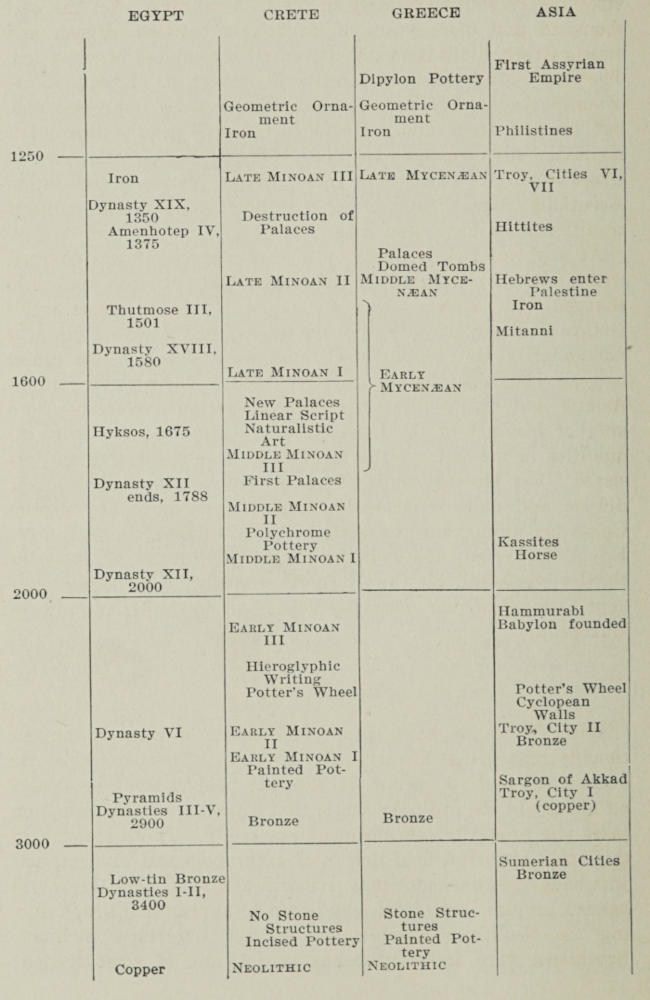
The thirteenth century brought the Greeks, then a rude, hardy, and at first non-maritime people, fighting their way south and wrecking or sapping the Ægean civilization. Culture lost its bloom, life became hard, the outlook contracted. Art shriveled into crude geometric ornamentation, the forms became childishly inept, intercourse with the Orient sank to a minimum, and when trade and foreign stimulation revived they were at first in Phœnician hands. It is not until the seventh century that true history begins in Greece, and in the main only to the sixth that the rudiments of that characteristic Hellenic philosophy, literature, and art can be traced, which were released after the Persian wars early in the fifth century. Yet the half thousand and more years of dark ages between Ægean and classic Greek civilization did not entail a complete interruption. The Greek often enough smote the Mycenæan or Minoan. More often, perhaps, he settled alongside him, possibly oppressed him, but learned from him. He choked out Ægean culture, but nourished his own upon it. The Homeric poems, composed in Greek during this period of retrogression, picture a civilization essentially Ægean; and along with them much other cultural tradition must have been passed on.
At any rate, when Greek culture reëmerged, it was charged with Oriental elements and influences, but perhaps even more charged with Ægean ones. Its games, its unponderous architecture, its open city life, the free quality of its art, its political particularity, its peculiar alert tenseness and feeling for grace, had all flourished before on Greek soil. Their flavor is un-Asiatic and un-Egyptian of whatever period. We have here another instance of the tenacity of the attachment of cultural qualities to the soil; of the faculty, at once absorptive and resistive, that for thousands of years, however inventions might diffuse and culture elements circulate, succeeded in keeping China something that can fairly be called Chinese, India Indian, Egypt Egyptian, the Northwest and Southwest of America Northwestern and Southwestern respectively; in a degree even kept Europe, so long culturally dependent on the Orient, always European.
250. Europe
With Greece we have entered the realm of what is conventionally regarded as history. For the rest of Europe, prehistoric archæology and its record of illiterate peoples abut so closely on history in the ordinary sense, that a tracing of the transition takes one promptly into documentary study. There is much in this early historical field that is of anthropological interest, and just back of it lies more that is specifically so: where the round headed peoples came from who began to appear in Europe during the Neolithic; whether peoples like Ligurians, Sicilians, Scythians, were Indo-Europeans or not, and of what branch; where the blond Nordic type took shape and whether it originally spoke dialects of the Germanic group; who built Stonehenge and the other megalithic monuments of western Europe; where the first home of the Indo-Europeans lay. But such problems are intricate, and usually answerable, if at all, from stray indications scattered among masses of literary and historical data controllable only by the specialist, whose primary interests tend in other directions. Where these documented indications fail, the problems become speculative. We have no clear record of any indubitable Indo-European people, in or out of Europe, before the second millenium B.C. When they appear in history, they are already differentiated into their familiar main divisions. The Bronze Age Scandinavians seem likely to have been Indo-Europeans and perhaps of the Germanic branch; for the Neolithic an identification would be mere guessing. The LaTène Iron culture is characteristically Keltic, that of the Hallstadt period and area less certainly Illyrian and Keltic. And after all, such considerations concern speech, or race, which can be associated with any culture. Our present concern being primarily with the latter, it will be more profitable to pass on from these questions and turn to regions remote from those in which Occidental civilization assumed its modern form.
251. China
China, far from Europe and known to the outside world only recently, possesses a civilization so different from ours in a multitude of aspects, that thought of connection between the cultures seems at first unreasonable. One thinks of rice, pagodas, bound feet, queues, silk, tea, ancestor worship, a strange, chopped, singing speech, and writing in still stranger characters. Yet the Chinese have long had a civilization identical in many of its constituents with our own: civil government, rimed poetry, painting, trousers, wheat and barley, our common domestic animals, bronze and iron, for instance. Since most of these culture elements are wanting in Africa and Oceania, as well as in native America, there is no inherent reason why they should be expectable in China. Their repetition in China and in the West as the result of independent causes would be remarkable. Evidently many if not all of this group of common traits represent absorptions into the civilization of China, or diffusions out of it into the West, much as the larger part of early European civilization was imported out of the nearer Orient.
In the broader perspective of culture history, then, China no longer stands aloof. The roots of her civilization are largely the same as those of our own. In this light, understanding of Chinese civilization involves two steps. The first is the tracing of the elements derived from the west or imparted to it. The second is the recognition of how these were remodeled and combined with elements of local growth and thereby given their peculiarly Chinese cast and setting.
Authentic historical records of China go back only three thousand years, and her archæology is little known. Beyond the beginning of the Chou dynasty, about 1100 B.C., or more exactly, beyond a point when this dynasty was about three centuries old, in 827 B.C., the Chinese possess only legendary history, in which slight strands of fact are interwoven with fabricated or fabulous constituents. Then, too, the Chinese have long been genuinely more advanced than their neighbors, than all of their world, in fact; with the result that they could hardly escape the conviction of their own superiority and self-sufficiency, and the belief that they had devised almost everything in their own culture. This presumption led to the conscientious manufacture by native historians of dates for inventions which were really made outside of China.
Beginning, then, in the ninth century B.C., we find the Chinese a settled and populous people in the lower valley of the great Yellow river, in what is now the northeastern corner of the “Eighteen Provinces” or China proper, from about Si-an-fu to Peking. They may have come from middle Asia or still farther west by a national migration, as has sometimes been conjectured: there is nothing to show that they did, and a great deal to suggest that they had lived in or near their seats of that period long before. It is difficult to imagine that the Chinese could have moved out of central Asia without leaving a part of their number behind, or without leaving conspicuous traces of their culture among their former neighbors. Of this there is no evidence. For one of the most advanced peoples of its time to remove itself and its civilization complete and unimpaired would be without parallel in history, and indeed is inconceivable as soon as one turns from the vague idea to face specific details of the process.
Nevertheless the Chinese as we first know them had the principal grains and tamed animals, the metals and plow and wheel of contemporary Eastern Asia and Europe. While it is scarcely thinkable that this great complex of culture traits should not have been due to connections with the west, there is every probability that these connections were of the sort that have been traced so frequently in foregoing pages: diffusions unaccompanied by populational drifts, or at least in the main independent of them. When it is recalled that western Turkistan held cereal-growing and animal-raising inhabitants far back in the Neolithic, and that the Bronze period is definitely represented in Siberia,[36] such transmission will not seem far fetched. It is also well to remember that all through the historic period central Asia contained farming populations, cities, traders, and skilled artisans, some measure of which evidences of higher culture it is only necessary to project a few thousand years backward to complete the link in the cultural chain between China and the west. We tend to overlook this fact because it is the transient Hun and Mongol invasions that chiefly obtrude into both western and Chinese history. Whenever the nomads ceased boiling over, they receded from the historians’ view. Obviously they could not have migrated and fought and burnt and slain among each other continuously. The more settled life at home, which they led most of the time, and into which they were always inclined to take over the religion, writing, and arts of the Orient, India and China, is the phase of their existence most likely to be overlooked, but which, from the point of view of the history of civilization, is far more important than their evanescent conquests. In this underlying phase they were the connectors of Near and Far East.
It is interesting in this connection that so far as more recent transmissions between China and the west are datable or positively traceable, they took place chiefly by the long land route through central Asia. The first trade between the Roman empire and China of the Han dynasty was overland; so was the introduction of Buddhism and cotton from India. In each case sea communication came later. It was scarcely before Mohammedan times that ocean trade between China and the west became important.
On the other hand, the Chinese and other east Asiatics always lacked, and still lack, several aspects of the grain-cattle-horse-wheel-metals cluster that are very ancient and practically universal in Europe, the Near East, and even central Asia. They do not use milk or its products, wool, nor bread-leaven. It has been suggested that the cluster was transmitted to China before these traits had been added to it; and that when they finally might have reached China, they found its people satisfactorily established in a culture containing substitutes for these traits, and therefore resistive to them.
It is significant that even to-day northern China, within which the oldest known China lay, still cultivates wheat, barley, and millet, and breeds cattle, horses, sheep, goats, and swine, as did the Swiss lake-dwellers; whereas in southern China the typical grain and animal are rice and the buffalo, as in Indo-China and Malaysia. There are evidently two fundamentally distinct economic systems here, characteristic respectively of Europe and west and north Asia, and of southeastern Asia; and evolving in the main independently. The first civilized China, that of the Chou period, that which produced Confucius as its literary standardizer, and has chiefly shaped Chinese traditions and institutions ever since, belonged to the great northern and western cycle; was in fact its easternmost outpost.
This brings up the question whether Chinese writing could not also have sprung from a western source, notably the Sumerian Cuneiform, which it superficially resembles in its linear, non-pictorial strokes, and in its mixed ideographic-phonetic method. The connection has indeed been asserted, but no satisfactory evidence of specific correspondences has been adduced. The most that it seems valid to maintain is that a remote connection is thinkable; a connection not extending beyond a limited number of characters or the idea or method of writing. The earliest Chinese characters preserved on bronzes are nearly two thousand years younger than the most ancient inscriptions of the system which developed into the classic Cuneiform. Both systems are fairly crystallized when they first come to our knowledge. Their formative stages, in which such connection as they might have would be most apparent, are obscure. It is well to remember that Cuneiform and Egyptian hieroglyphic, which were virtually contemporaneous and much nearer to each other geographically, have not yet been brought into specific relation as regards their origins.
252. Growth and Spread of Chinese Civilization
Chou China at first embraced most of Shensi and Honan, southern Shansi and Chihli, and western Shantung. It was feudal, and practically as separatist as mediæval Germany. The chief functions of the over-king were to perform sacrifices, to admonish the kings and princes, and to govern his small dynastic domain. Unity lay not so much in an effective organization as in an idea, the feeling of a common race and especially of a common civilization. This idea has persisted to the present. It is adhesion to the culture of China, to its deep roots, its permanence, its humanities, that has always made Chinamen feel themselves Chinamen; has in fact sooner or later turned into Chinamen all alien elements, whether they were intrusive conquerors or primitive folk, that came to be included within the limits of the realm. In this way common customs and ideals already united the dozen or more larger Chou states and hundreds of dependencies; and chronic internal warfare did not prevent this era from being the age of Confucius, Laotse, Mencius and the other great sages that from the sixth to the fourth centuries formulated the typical Chinese character and attitude.
During the latter part of the Chou period began a gradual reduction of the number of feudal states, due to the larger swallowing the smaller. By the middle of the third century, two of these had emerged as preponderant: Ts’in in the west, centering about the Wei valley, and Ch’u on the south, along the middle Yangtse. Both were frontier states, less cultivated and hardier than the others, and regarded as barbarian or only half Chinese. Ts’in may have included some Hunnish absorptions; Ch’u very likely represented the rule of a Chinese dynasty over a native population whose original affiliations may have been either with the non-Sinitic Anamese of to-day, with the Shan-Siamese division, or with some closer branch of the Sinitic family, but who were gradually assimilating the culture and speech of the northern old China. At last, in 223 B.C., Ch’u fell before Ts’in, and within two years the remaining states in the northeast collapsed. For the first time China, from nearly its present frontier to south of the Yangtse, was effectively under one active ruler, Shi Hwang-ti, the “first emperor.” His dynasty crumbled almost at his death, but only to be succeeded by the famous Han line, under which, in the two centuries before and the two after Christ, China extended, consolidated, and prospered. The boundaries of the empire were pushed, in name at least, to virtually their present limits; and though political control may often have been slight, cultural influence progressed rapidly south of the Yangtse, much as Gaul became Romanized at the same time. Even the survival of half-independent barbarian groups here and there in the south and west has its parallel in the persistence of Keltic speech in French Brittany. By the seventh to ninth centuries after Christ, when the empire flourished once more under the Tang dynasty, the mass of southern China may be considered to have been substantially assimilated. Even the southern coast, which was the last area to be integrated, and which retains to-day the greatest dialectic differentiations and autonomous tendencies, had become part of the Chinese polity and civilization. The consequence was that when in the thirteenth century the Mongols and in the seventeenth the Manchus conquered the empire, they accomplished little more than the overthrow of one dynasty by another. The course of Chinese culture went on undisturbed, as it had in several previous historic periods when half of the realm passed temporarily under the sway of nomads or barbarians from the north.
A considerable measure of the cultural predominance of China over her neighbors is to be ascribed to her more numerous population, which in turn was partly due to the cultural advance. The Chinese were the first nation to maintain a system of fairly reliable census records. In the first century and a half after Christ, under the Hans, ten censuses showed from 29 to 83 million inhabitants, the average being 63 millions, or about the same as the estimated population of the Roman empire at its height; somewhat more than that of Europe when America was discovered. A thousand years later, between 1021 and 1580, eight censuses yielded from 43 to 100 millions, with an average of 62 millions. Under the Manchus the population gradually rose from 125 millions in 1736 to 380 in 1881. To-day, the northern half of China is about twice as populous as the southern, and the eastern half exceeds the western in the same ratio. This superior density of population in the northeast reflects the fact that ancient China was the northeast. The same grounding in the past is evident in the fact that from the time of the Chous until the Mongol conquest in 1268, the imperial capitals lay mainly in Shensi or Honan, the core of the old kingdom.
Many ingredients of modern Chinese civilization, and most of its distinctive color, have been present in it since the opening of the historic period. Such are the use of hemp and silk as the typical textile materials; of jade as the precious stone of the nation; the tremendous, life-long moral authority accorded to parents, and the associated worship of ancestors; the unusual respect and rewards for learning; a professed contempt for war and emotional activity; aversion for mythological and metaphysical, scientific, or any other sort of speculation, and coupled therewith an unflagging interest in practical ethics, in the cultivation of character, in the finer shaping of the relations of individuals. These and other leanings endow Chinese civilization with something persistently idiomatic, with a quality of coherent originality. If this civilization were less great, China and the countries influenced by it would be spoken of as constituting what among barbarous and savage peoples we call a culture-area. In the widest perspective, they are such. China, India, the West—which in this view of course includes the Near East as well as Europe—are the three great focal centers of civilization in the eastern hemisphere. Their cultures have risen far above those of the intervening and peripheral nations. Until quite recent centuries, the three have run their courses with approximately equal achievement. And while exchanging elements since prehistoric times, they have each molded both what they borrowed and what they devised into a unified and distinctive design, have stamped it with original patterns. In short, culture development in China, India, and the Occident has been coördinate.
Of course, this distinctness of the three great regions of Old World civilization does not imply that diffusion of culture elements between them ever ceased. It is the form more than the content of civilization that is peculiar to the three areas. From India, for instance, China derived Buddhism, which was accorded a reception under the Hans and cultivated with fervor in the following centuries. Cotton came in the wake of the religion—first as a rare and valuable textile, then to be grown. The West, within the historic period, gave glass and perhaps the impulse toward a Chinese “invention”—porcelain, a glazed-through pottery. In recent centuries the West acted as transmitter for several elements of American origin, tobacco, for example, and maize, which quickly became an important food-plant in parts of China. There have even been reimportations. Gunpowder is said to have been used for fireworks in China in the fifth century, for war in the twelfth, but its employment for the propulsion of missiles from firearms is due to introduction by the Altaic nations in the fifteenth century. From the fourth century B.C. on, there are repeated references in Chinese sources to the magnetic needle and to “south-pointing chariots”—apparently a compass-like device used on land, though probably only as a mechanical toy. Then the needle was applied to geomantic purposes, until Arab or other foreign sailors took it up as a true mariner’s compass, and in the eleventh or twelfth century reintroduced it to the Chinese as an instrument of navigation.
Nor was civilization as stagnant in China as the outsider is likely to think, who becomes aware first of all of its persistent native flavor. The old war chariot, for instance, went out of use about contemporaneously in China and the West. Printing from engraved blocks was in vogue in the sixth century after Christ, from movable clay types in the dynasties between the Tangs and the Mongols, from metal types not much later, since the art was established among the imitating Koreans in the fifteenth century. A system of classifying the numerous characters was invented before the Tangs; the modern one of grouping them according to 214 radicals, under the Mings. True encyclopædias were first compiled in the fourteenth century—four hundred years earlier than in the West. The system of awarding office on the basis of literary examinations took root under the Hans and became organized under the Tangs. The earliest poetry, three thousand years ago, was rimed, and had four or five monosyllabic words in the line. In the Tang time, the line became extended to seven words; and still later was the origin of the peculiar rhythm of alternating tones—a system by which every other word was one bearing the “even” tone and those between any of the other tones. Paper making is said to date from the Hans, and paper money was first issued—disastrously as in some of the first Western attempts—under the Mongols. These and dozens of other instances that might be compiled exemplify, as does the history of ancient Egypt, that even those cultures constantly move to which one is tempted to apply the stigma “conservative” or “tradition-bound.”
253. The Lolos
Scattered in the mountains of southern and western China are a number of barbarous, semi-independent peoples of distinctive ways and speech who maintain their national or tribal status. They seem on first contact to promise a picture of the pre-Chinese culture of the area, but examination shows their customs to be a blend of primitive and advanced, ancient and recent elements. The Lolos of Szechuan may serve as an example. They eat meat from their herds, use no milk, but wear woolen clothing. They grow neither cotton nor rice. They raise oats, buckwheat, maize, and potatoes. Two of these plants are of north or west Asiatic origin; the others are American. Plows are used. Houses are of lashed bamboos, and rain-coats of palm-fiber. No pottery is made, but iron is worked into weapons and tools by native smiths. The Lolos are warlike. They fight like Malaysians with lance and sword. They are organized “feudally,” into nobility and commoners, with tribal heads or lords. They marry cousins. Religion resembles that of the more backward Indo-Chinese and Malaysian peoples. Sorcerer-priests cure disease; sacrifice animals for their blood, the flesh being eaten; offer also fermented liquor; divine the future by observing parts of the sacrificed animals—the cracks that develop in heated shoulder-blades (§ 97). There is a native system of writing, which seems to derive from Chinese stimulus, if not sources. It is obvious that this culture has fused together very old elements that are characteristic of southeastern Asia, with elements that have flowed in from remote sources or during the most recent centuries. It is also clear that certain ingredients of Chinese culture have been freely absorbed and others rejected by this mountain people.
Such cultures as that of the Lolos may be described as internally marginal or peripheral. They differ from externally marginal cultures, like those of the Bushmen, Australians, Fuegians, in that the latter, on account of their geographical remoteness, have retained their ancient level with relative purity. Included marginal cultures, on the contrary, being of necessity exposed to subsequent influences, are regularly a mixture of belated and recent ingredients, no matter how well integrated these may have become.
254. Korea
Korea has repeatedly been under the political authority of China, more often autonomous, but for three thousand years has been dependent on China culturally. Non-Chinese influences have also reached it: such as an alphabet of Indian origin (§ 149); and probably the earliest iron industry came in from Altaic sources. In its turn, the peninsula transmitted to Japan: until about a thousand years ago, Chinese writing and culture reached Japan mainly via Korea. The spread of Chinese civilization was perhaps largely of the usual, slow, diffusing kind, but was several times accelerated by the settlement in Korea of groups of Chinese refugees, colonists, or adventurers; for instance in Chou and Han times. The center of power and civilization within Korea has gradually moved southwards, which suggests the waning of original central Asiatic affiliations as Chinese ones became stronger. The first realm to be defined was Fuyu on the Sungari river. Then followed Kokorai or Korai, whence our name Korea. In the centuries immediately before and after Christ, Shinra and then Hiaksai, farther south on the peninsula, came into the lead. By the beginning of this period not only the writing but the classic books of China had been introduced. Since the fourteenth century Confucianism has been the state religion—though the people had long before become Buddhists—and literary examinations for office of the Chinese type have been in vogue.
255. Japan
Japan is the one country of eastern Asia from which considerable prehistoric data are available. There are indeed no indubitable evidences of any Palæolithic culture or race, but shellheaps and burial mounds abound and have been explored. The shell deposits, of which 4,000 have been found, are probably the accumulation of refuse of occupation by the Ainu, the first known inhabitants of Japan, now surviving only in the extreme north of the island chain and in Sakhalien, and still a primitive people. This race is different from the Japanese, and has often been classified as Caucasian (§ 27). The shell deposits show the aborigines to have been fishers and hunters, without agriculture or edible domestic animals. They had the bow, dog, incised hand-made pottery, and ground stone axes, and were thus approximately in an early Neolithic stage.
A somewhat dubious bronze age is sparsely represented in southern Japan. It has been ascribed to an invasion about the seventh century B.C., but is perhaps only an early phase of the iron age. Iron was brought in at a time not precisely determined, but likely to have been about the fourth century B.C., by the so-called Yamato people—evidently the ancestors of the Japanese of to-day—who seem to have come from Korea and at any rate occupied the southern islands first. Thence they fought their way northward, gaining territory at the expense of the natives but slowly. Fifteen centuries ago the northern third of the main island was still in Ainu possession. These early Japanese erected megalithic chambers or corridors as tombs for their princes, covering them with mounds of earth. More than 3,000 of these structures are known. The early emperors were buried in double mounds, some of them of great area. From the fifth to the seventh century Korean influence was strong; the Chinese writing and classics were imported from that country. Later relations between the two nations were more intermittent, perhaps because of the growing consolidation and strength of Japan from the eighth century on.
The cultural debt of Japan to China is great, but less than that of Korea. The Japanese added 47 purely phonetic syllabic characters to the Chinese writing, in order to represent their own proper names, grammatical forms, and the like. These characters would have sufficed for a simple, efficient, and purely native script, but have remained a mere supplement to the ideographic Chinese system (§ 105). The mandarin and examination system of China were never taken over by the Japanese, who clung to their feudal customs more than two thousand years later than China. The ancestor worship of the Chinese and the official Confucian religion also did not become established in Japan, the state cult being Shinto, the crystallization of a primitive set of rites and of a mythology which has parallels in the Occident, in the East Indies and Oceania, and even in North America, rather than in China.
An early Malaysian strain in both Japanese race and culture has been alleged, but this is a subject on which more evidence is needed. Japanese speech does not elucidate the origins of the nation, the language—like that of Korea—not being determined as related to any other. The physical type, on the other hand, and this applies also to Korea, is allied to that of China.
256. Central and Northern Asia
It has become a habit to regard central and northern Asia as a hive for humanity, as the area from which nations and races have chronically swarmed. Whenever the origin of a people remains obscure, be they Neandertals, Alpines, Sumerians, Chinese, Japanese, Aryans, or what not, some one propounds the convenient hypothesis of deriving them from this vast interior land, which in many cases amounts to an explanation of the half-known by the unknown. Of late there has been added the fashion of attributing the expansions to climatic drying-up of central Asia, which forced the population out. There appears to be considerable evidence of such progressive desiccation; but its degree, and still more the extent of its influence upon culture and emigration, remain to be ascertained.
A more balanced view would concede the recurrence and occasional destructiveness of the invasions out of central Asia, but would view them rather as transient and relatively superficial phenomena from the point of view of civilization; and on the other hand would recognize that under all the boiling of tribes and peoples, the growth and spread of culture went steadily on, even in the tracts which one is wont to associate only with the perpetual breeding of elusive and devastating nomads. In short, it is wise to guard against a natural overestimation of the sensational, cataclysmic aspects of the history of the interior Asiatic peoples. It is their spasmodic irruptions which the self-centered nations of the West, of India, and of China, have been chiefly concerned with. Their attempts at achieving stability, their increments to the world’s culture, their rôle as peaceful transmitters, have lain at home, largely out of vision of the peoples clustered about the foci of civilization.
It may be added that the temptation to the outsider to burst by force into the seats of wealth and splendor as soon as firmness of guard slackens, is not confined to Ural-Altaians, but is ever present in history. Amorites, Hebrews, Arabs, Æthiopians, Lybians, Greeks, Kelts, Germans, Hindus, and Malays have all played this part at one time or another. Semite, Hamite, and Aryan are no different in such regard from Ural-Altaian, except that in the short span conventionally known as history the former have happened more often to be the ins and haves, the central Asiatics the outs and have-nots. Further, the destructive effect of nomad migrations, even where accompanied by mass settlement of population, is everywhere transient so far as civilization is concerned. Hebrew and Hellenic, Arab and Germanic tribes did crash cities and empires before them, but they tore down only what was already moribund, and brought in new systems of thought, new methods of feeling and organization, which, however crude at first, soon added new qualities to culture. The chief distinction of the north Asiatics is that, excepting some terror-striking massacres, they were both less subversive and less constructive culturally than Semites and Indo-Europeans. They barely dented the civilization of the West as they barely dented that of India and China. If Russia is backward as compared with western Europe, it is not from having been Tatar-ruled a few centuries, but because Russia has long been peripheral to the Mediterranean focus of civilization and therefore chronically belated. It was the very thinness of her culture that made mediæval Russia succumb to the Mongol wave which pounded vainly against the more consolidated civilization of central Europe and quickly drew off.
To define the exact contribution of the North Asiatics to civilization is difficult: partly because of the comparative paucity of available archæological and historical records; partly because their habitat did not contain one of the greater hearths of civilization at which its most distinctive forms were sweated out. The area has always been relatively though not extremely peripheral. The horse, indeed, can be set down as one important gift of the Ural-Altaic peoples or their predecessors to general civilization. It is only in central Asia that a wild horse—not a tame breed that has run wild—is to be found; and it seems to have been from the north that soon after 2000 B.C. the animal was introduced into Mesopotamia and India. Biological considerations also point to interior Asia as the most likely area of first domestication of several of the earlier fundamental animals of culture, especially the sheep and goat. The comparatively advanced culture of Anau in Turkistan in the Neolithic and early Bronze periods is also significant, even though this site lies only just within the great steppe and plateau country. Some of the jade and jade-like stone used for tools and ornaments in the Swiss lake-dwellings appears to have come from inner Turkistan. The probability of the central Asiatic peoples having been the transmitters of metals, cattle, grains and other important groups of culture elements from the Near to the Far East has already been mentioned, as has the established trade between China and the Mediterranean world in Roman times (§ 251). Indeed the very character of the country and cultural conditions which favored a considerable degree, though not an absolute prevalence, of nomadism in interior Asia, seem also to have fostered, in many periods, a longer range of trade than flourished elsewhere. Finally, it appears that the Turks and Mongols had at least a hand in the early use of gunpowder for firearms; and, as already mentioned, the first state paper money, that of China, was issued by a Mongol dynasty. It is scarcely rash to predict that the intensive study of the interior Asiatic peoples from both prehistoric and historic sources, without speculative bias or plunging of opinion, will prove one of the most illuminating contributions to the history of general civilization.
The original unity of the Ural-Altaians—with the Turks, Mongols, and Tungus-Manchu as the Altaic or definitely Asiatic group, Finno-Ugrians as Uralic or Eurasian, and Samoyeds as specifically Arctic representatives—is accepted on linguistic grounds by almost all authorities in the field. Yet the career of the several divisions has been diverse. The Finno-Ugrians have mainly been peaceful: the Finns definitely so for two thousand years: the Hungarian Magyars were exceptional when they terrorized central Europe a thousand years ago. Both these nations have long since become integrally absorbed into European culture. They are the only Ural-Altaic peoples with this experience. The remainder of the Finno-Ugrians have for some centuries become increasingly submerged under Russian civilization; much as in the Far East the Manchu-Tungus have gradually fallen more and more under either Chinese or, of late, Russian cultural influence. As between the Turks and Mongols, the greatest single conquest, that of Djengis Khan and his successors, falls to the record of the latter; but the Turks have been the more numerous, stable, and advanced people. They have frequently settled as well as invaded; and are the only known stock, as previously mentioned (§ 245), that has ever seriously and permanently encroached on territory once held by Indo-Europeans—in Asia Minor and the Caspian region. The later so-called Mongol conquests, those of Tamerlane and the Indian Moguls, were made by armies mainly of Turks under dynasties tracing back to former Mongol leaders. The Turks in general have inclined to Mohammedanism on coming into contact with the world religions, the Mongols to Buddhism, although Christianity in its Nestorian form once made considerable numbers of converts among both.
Several important historic peoples cannot yet be assigned with certainty to one or the other of the Ural-Altaic divisions, or are variously classified: thus the Huns, most likely to have been Turks; the White Huns or Ephthalites; the Avars; and the ancient Bulgars.
In northern and eastern Siberia there live, besides the Samoyed, a series of non-Ural-Altaic peoples, truly peripheral and retarded in culture, who seem once to have occupied larger areas but to have shrunk or been partially absorbed before Ural-Altaic expansion. These include the tribes sometimes grouped as Yeniseian; the Yukaghir; the Kamchadal-Koryak-Chukchi group; a few Eskimo who have either failed to cross Behring strait or have come across it from America; and perhaps the Ainu of Japan and Sakhalien. These have been called the Palæo-Asiatic peoples, though their diverse languages render their community of origin dubious. How far they may be considered as following a positively similar culture, except in direct response to an extreme climate, is also doubtful. Their rigorously marginal position and depriving environment stamp their culture with a preponderance of negative traits. The possession of domesticated reindeer is common to several of these peoples as well as to the Tungus and the Finno-Ugric Lapps of northern Russia and Scandinavia. Reindeer-breeding among these groups appears to be due to a transmission, in the sense of being a reflex of contact, an imitation of the cattle or horse breeding of the more favorably situated nations to the south. It is also interesting and probably significant that the American Eskimos never domesticated the reindeer, although they depended largely upon its hunt.
Racially the array of north and central Asiatic peoples shades from pronounced Caucasian to extreme Mongoloid type. The Mongols have given name to their whole larger racial stock, and the Tungus-Manchu and northeast Siberian savages clearly form part thereof. The Turks in the main are rather Caucasian, although all intergradations occur according to region; as also among the Finno-Ugrians. The Hungarians to-day are not only Caucasians but Alpines; the Finns definite Nordics; the Lapps a strange partial graft of Nordic traits on broad faced and broad headed Mongolian physique.
257. India
India is not a country, but a connected block of lands shut off from the remainder of the world by lofty mountains and harboring a population approximating those of Europe and of China. Its 300,000,000 inhabitants constitute nearly a fifth of humanity. Historically, India forms a continent as fully as does Africa. Culturally, it must be equated with the Occidental or Mediterranean area and with China as one of the three great and substantially coördinate focal points which civilization developed in the eastern hemisphere.
Racially the peoples of India are prevailingly Caucasian, but both the two other great stocks are represented. Nearly everywhere, but especially in the south, there is an evident admixture of a dark skinned, broad nosed, long headed type. This is more likely to have had Australoid than Negro affinities before its absorption; remnants of it, like the Veddas of Ceylon and Irulas and some other tribes of the Deccan, are often grouped with more easterly peoples as representatives of an original Indo-Australoid race (§ 24, 27, 260). So far as this race can be reconstructed, it seems to have been less Negroid than the Australian of to-day; that is, it possessed more Caucasian resemblances. In fact, it might almost be described as proto-Caucasian. In this light the modern Hindu[37] would be a varying mixture of two related strains—the undifferentiated proto-Caucasian, approximating the Australian and perhaps having ultimate Negroid relations without being Negroid; and the specialized Caucasian typical of the Occident; the former strongest in the south, the latter almost pure in the northwest of India. This hypothesis has this to commend it: it squares with the facts that the Hindu in spite of his dark complexion makes almost universally the impression of being essentially “white” in race; and that he differs outstandingly from what a mulatto-like blend of Negro and Caucasian would be.
In the north and east of India, Mongolian resemblances begin to appear, as the natural result of thousands of years of contact of two stocks.
It would seem that the proportions of racial blood in India, and in the rough their geographical distribution, parallel the proportions of the numbers of speakers of tongues belonging to the several families. More than three-fourths of the Hindus speak Indo-European dialects. Most of the remainder are Dravidas in the south and Kolarians in the east central parts—the same regions in which the Indo-Australoid or proto-Caucasian element is most conspicuous. Along the northeastern edge, Tibeto-Burman speech has spilled in with the Mongolian type. However, while the races have blended, the languages have remained distinct. As almost everywhere, the linguistic classification is therefore clearer cut in India than the racial one. Consequently it is misleading to infer from a Hindu’s speaking a Sanskrit-derived language that his Caucasian blood is pure, or conversely to conclude that all Dravidians have broad noses and black skins.
The Kolarians have been thought by some to possess ancient linguistic relatives to the east (§ 50), and certainly possess cultural ones in this direction (§ 262). Dravidian speech has not been thus connected, even tentatively, and one indication points to its former westward extension: the Brahui language in Beluchistan, which appears to be the remnant of an old Dravidian offshoot.
The ancient culture of India is inadequately known. Archæological exploration and analysis have been insufficient; yet they have gone far enough to suggest that the prehistoric development followed different lines from those in the West, so that the findings of European prehistory cannot be applied to interpret such knowledge as there is on India. Thus the Lower Palæolithic stage is well represented in India, but there is nothing to show whether or not it was contemporaneous with that of Europe. There is some possibility that it passed into the Neolithic without the intervening Upper Palæolithic which is so important in western Europe (§ 213). It seems dubious whether there was a true Bronze Age in India. More pre-iron implements of pure copper seem to have been found than of tin bronze.
The early Kolarian culture seems preserved in considerable degree among the modern Kolarians, who are backward hill or forest tribes, that is, internally peripheral to the prevalent higher civilization. At any rate, their culture resembles that of many less advanced populations to the east, well out into Oceania. This presumably ancient and partly surviving “Indo-Oceanic” culture is discussed below (§ 262). As regards its history within India, this is almost certain: the old culture is nowhere any longer pure, but has regularly absorbed elements of the advanced civilization that surrounds it; and conversely has contributed to the latter. For instance, one of the great recognized cults of India is Sivaism, which tends frequently to bloodiness and obscenity and is a strange mixture of philosophical rationalization and crass superstition. One of the most frequent attributes of Siva is a necklace of skulls; a feature that looks as if it might go back to the skull cult which is a typical ingredient of Indo-Oceanic culture.
The old Dravidian culture was probably more advanced than the Kolarian but is more difficult to reconstruct because of its extensive blending with the culture brought in or developed by Indo-Europeans. The Dravidians, perhaps because they were the more advanced and populous, were able to accept the intrusive culture and yet maintain themselves, whereas the Kolarians either preserved themselves by resisting civilization or had their speech and identity absorbed by it. When the Dravidians first begin to creep into history, shortly before the Christian era, they already possess cities, kingdoms, commerce, writing, and philosophy. They have on the whole contributed less to Indian civilization than the Indo-Europeans: its center always lay in the north; but they have long formed an integral part of it.
The Indo-Europeans are first known to us from their religious hymns, the Vedas, which have been preserved as sacrosanct by succeeding ages, and constitute the oldest continuously transmitted documents in history. They date from 2000 or 1500 to not after 1000 B.C., and are in Sanskrit, which is fairly close to Avestan or Old Persian, the two languages and their descendants constituting the Indo-Iranian or proper Aryan branch of Indo-European. When Indo-European as a whole is designated as Aryan, it is by an extension of the term. The region of India to which the Vedas almost wholly refer is the Indus drainage, that is the northwest, the parts adjoining the Iranian highland, whence the invaders came or through which they passed.
Vedic Aryan culture was of late Bronze Age type. Whether the bronze was really such, or copper, it is mentioned more frequently than iron, as in Homer and the older books of the Bible. Grains, cattle, horses, chariots and wagons, the plow, wool and weaving, gold, patriarchal chieftains and a tribal society, a nature mythology, non-communal rituals with constant but prevailingly bloodless sacrifices, are the characteristics of this culture. It smacks more of the Europe of its time than of the contemporary Orient. It is unbound, ready to pack up and move without being essentially nomadic; half peasant-like and half aristocratic; an uncitified semi-civilization, pioneer rather than backwoods. The temples and writing, walled towns and kingdoms, district gods and royal tombs of Egypt, Babylon, Canaan, Minoan Greece are wanting. The picture is that of the first historic Indo-Europeans elsewhere, in eastern and central Europe; with whom the Aryans undoubtedly were or had been in connection through the countries north of the Black and Caspian seas.
A few centuries after the Vedas, the culture depicted by the literary remains is profoundly altered. The scene has shifted to the Ganges valley. There are cities and palaces, wealth and pomp. There are kings, priests, townsmen, peasants, hermits and ascetics. Caste is in vogue. Cotton and rice are in use. There is a deal of philosophizing; life appears complex and difficult; pessimism is abroad, soul rebirth taken for granted, spirituality emphasized. Concepts to which western science later returned, the atom and ether, are familiar. In all essentials, post-Christian Hinduism had been blocked out in this pre-Christian period. Only a few elements like money and writing are lacking.
This change from the Vedic age is not fully accounted for, and the time usually allowed for its occurrence is insufficient. Buddha was born B.C. 563 or 557. His religion assumes ideas which are part of the Sankhya philosophy—in many ways the subtlest philosophy of all India and one of the great thought systematizations of the world. Its founder Kapila is placed about 600 B.C., and must have had predecessors. Caste seems a thing of development. It is absent in the Vedas, but Buddhism is already in a measure a protest against it. It seems difficult to squeeze such growths into a few hundred years. It is true that the florescence of Greece came with a rush; but Greek civilization rose from the debris of the older Minoan one and was in contact with the cultures of Asia. In India there is no sign of an antecedent high civilization, and a greater dearth of known foreign influences between 1000 and 600 B.C. than at any other period. The transposition of the cultural center eastward must enter into the problem. Perhaps a larger and wealthier pre-Aryan population was encountered by the Aryans along the Ganges, contact and mixture with whom proved provocative of innovation. Or possibly the movement and development in the east began while the Vedas were still being composed along the Indus, and were ignored by them. Or, conceivably, the Aryans on the Ganges may have been the first comers, who quickly altered in the direction of their future civilization but remained obscure to our vision during the period in which the Vedas were being made or retained by the later comers of the Punjab, in whose memories and sub-arid environment their former steppe culture remained more unmodified. These are only speculations: they emphasize the gap in our understanding of this important chapter of world culture history.
258. Indian Caste and Religion
Caste is peculiarly Indian. Nowhere else is it so complex, so systematically worked out and endlessly reinforced by ritual and taboo, so pervasive of conduct and thought. It has been ascribed to the conflict of races, to the drawing of a color line by conquerors in order to keep their lineage and culture pure. If so, it has failed egregiously, as the physical anthropology of modern India shows. The explanation is obviously inadequate. Castes do represent race to a certain extent, but they also represent nationalities, tribes, common residence, religious distinctness, occupations, cultural status. Whatever sets off a group in any way may be sufficient to make it a caste in India. If groups diverge within an established caste, they become recognized as sub-castes, perhaps finally to develop into wholly separate castes. Priests, nobles, clerks, fishermen, street-sweepers are castes; so are the Parsis; so are hill tribes that maintain their primitive customs—the Dravidian Todas for instance are reckoned a high caste. Clearly we have here a generic system, a pattern of organizing society, into which every sort of group as it actually forms is fitted. Caste is a way of thought which the Hindu has tried to universalize.
All Indian castes are in theory strictly endogamous: intermarriage is intolerable. All possess an intrinsic, unchangeable worth. Thus they automatically rank themselves. Each possesses an occupation, a mode of life and customs, a set of prescribed rituals, inherently peculiar to it. The greater the restrictions and prohibitions incumbent upon it, the less it relaxes to comfort and indifference, and the more spiritual it is, the higher its grade. In consequence it is also the more pollutable, and so its restrictions are drawn the closer. The wider the gap of non-intercourse, of non-contact with lower castes, the greater becomes its purity. Caste observance is thus a virtue, an aid to religion and morality; breaking caste an ultimate indecency; the offspring of inter-caste unions necessarily lower than either parent, and their descendants, unless from matings with their own miserable kind, lower still, in an infinitely descending series. There is no elevating a caste. The very attempt to rise is a vice that brings degradation as a result, since castes are eternal, founded in nature, absolute, so that alteration is of necessity a sullying.
Such is the Hindu scheme—which in actuality is lived up to in no single point. Perverse as the system seems to men reared in other cultures, it must be admitted to possess completeness, self-consistency, and the desire to preserve inward worth. It differs from the basic assumptions of our civilization in that it sees value as something already existing and therefore to be maintained, not to be created; it tries to fit life into a theoretical pattern; it is futureless. Yet all the facts show that as historical realities castes have changed enormously and are changing now. Obviously therefore each generation ignores the changes last made and repeats its insistence on caste perpetuity and unalterability. Such is the hold of patterns on men’s minds.
The theorizing which the Hindu does about caste is characteristic of him in all cultural manifestations. The relation which can be thought out between one fact or act and others, the compartment to which it can be assigned in a system, are of more interest to him, as compared with the fact itself, than to peoples of other civilizations. Hence philosophy has flourished in India, but native history has been inadequate and disorderly. Hence too the abstract sciences of logic, mathematics, grammar enjoyed an early original development, equal for a long time and in part antecedent to that which they attained in the West. On the other hand the astronomical and still more the physical and biological sciences remained backward: they were concerned with concrete objects. The Hindus seem never to have made a move of their own toward devising a system of writing; but once the Semitic alphabet had been introduced, they modified, expanded, and rearranged it into a more logical scheme, a more consistent one phonetically, than any other people has given it (§ 146). It is probably no accident that chess and our “Arabic” position numerals with a symbol for zero (§ 109) are Hindu inventions, and that it is only in India that priests have for age after age been ranked higher than rulers.
It is natural that a culture of such inclinations should exalt the mind and soul above the body. Hence the extraordinary development of asceticism in Indian religion; its deep pessimism as regards life on this earth; its insistence on the superior reality of soul, with which is connected the universal assumption of rebirths; the working out of a system of unescapable moral causality called karma in place of a scheme of mechanical causation; the tendencies toward pantheistic identification of soul and God, or atheistic denial of divinity as distinct from soul; and the thoroughly anti-materialistic bent of almost all Hindu philosophy. It is also intelligible that these qualities should have imparted to Indian religion a superior degree of spiritual intensity which was appreciated by the nations to the north and east when Buddhism was presented to them, and caused them to embrace it.
Like Christianity, however, Buddhism found no permanent favor among the people and in the land of its origin. It flourished in India for a time, but was rarely looked upon as more than a sect; after something over a thousand years it died out completely, except in Ceylon, at the very period that its hold on non-Indian nations to the north and east was strengthening. Its place was taken in India by the miscellaneous assemblage of cults, all theoretically recognizing Brahman ascendancy, that in the aggregate constitute what is known as Hinduism. Hinduism is not a religion in the sense that Christianity, Mohammedanism, Buddhism are “religions.” It recognizes no personal founder, no head or establishment; it tends to exclude foreigners rather than to convert them; it is national instead of universal. It accepts and reinforces the existing institutions of its particular culture: caste, for instance, which Buddhism tried to transcend. Hinduism is therefore comparable to the ancient Greek and early west Asiatic religions in consisting of a series of locally or tribally different cults never integrated or fully harmonized, conscious and tolerant of one another, resting on common assumptions and similar in content, everywhere in accord with tradition and usage, resistive to organization into a larger whole but tied into a certain unity through reflecting a more or less common civilization.
Hinduism is also comparable to Confucianism and Shintoism with this difference. These grew up analogously, but early became associated with the central government or imperial authority, to which India never attained. They gradually became official religions, as which they survive; such religious piety as the population of China and Japan experiences finding its outlet chiefly through Buddhism. Buddhism may be said to have failed in India because it aimed at being a world religion; because it tried to be international instead of national, to overlie all cultures instead of identifying itself with one. The Hindu like the Jew preferred remaining within the limits of his nationality and particular civilization.
259. Relations Between India and the Outer World
The first culture influence whose entry into India can be traced in any detail was that carried by the Vedic Aryans from the northwest. In fact, as already mentioned, more is known about this importation than of what it encountered in India. In the post-Vedic period, the introduction of the Semitic alphabet suggests that other cultural ingredients also flowed into India from the west without direct record being preserved of their transmission. The Persian and Macedonian conquests extended only over the westernmost margin of India and were of little direct influence. But the latter was followed by a semi-Hellenization of southwestern Asia, including for instance the establishment of a Græco-Bactrian kingdom in southern Turkistan and Afghanistan, adjacent to India; and for several centuries a stream of Greek culture elements trickled into the heart of India. Sculpture, architecture, astronomy, drama, coinage, derived new impetus, in some cases even their origin, from this source. In some instances the Hindus were no more than copiers of Hellenistic models: Greek hangs and folds were given to sculptured garments, Greek astronomical measurements taken over without change. Yet as the centuries wore on and new imports along these lines lessened and then died out, the introduced elements became more deeply incorporated into Indian civilization, modified and encrusted more and more heavily by distinctive Hindu styles, until now their superficial appearance makes an impression of independent native growth. The working over of the Semitic alphabet into its Hindu forms may be taken as typical of the nature and degree of this remodeling of the Hellenistic culture imports.
Soon after 700 A.D. commenced a series of Mohammedan invasions and conquests—Arab, Afghan, and Mongol-Turkish—also from the northwest, and of course accompanied by a new series of culture influences—firearms, for instance, and the true arch—which in their turn underwent absorption and partial transformation.
The flow of culture between India and the Mediterranean world has not been wholly eastward. Cotton; the common domestic fowl; probably the buffalo and rice; perhaps asceticism, monastic life, and certain mystic points of view; position numerals with zero; chess; and some of the concepts of modern philology, were transmitted westward. Eastern Africa was influenced, largely through the medium of Arab sea trade. Towards the north and northeast as far as Mongolia and Japan, India has been a dispenser of culture content and has taken little in return. Toward the southeast, Indian influence has been the largest component in the civilization of Indo-China and the East Indian archipelago, which as regards their higher attainments may be regarded as cultural dependencies or extensions of India.