PART V.—GELATINE AND GLUE. (continued 2)
Reading edition
A further advance in solving this problem was the application of the principle of multiple-effect evaporation. The vapour driven off during evaporation possesses of course many heat units, and is of very considerable volume. In multiple-effect evaporators this vapour is used to work a similar evaporator, and the evaporated liquor passes immediately into what is practically a second machine, and is further evaporated by the heat from the vapour just driven from it. Such an arrangement would be termed a double-effect evaporator. The vapour from the second effect may of course be similarly used to operate a third effect, and the vapour from this to work a fourth effect, and so on. Thus, we may have triple effect, quadruple effect, etc., even up to octuple effect. The great advantage of multiple-effect evaporation is in the saving of costly steam. Reavell gives the following figures to illustrate the economy thus obtained:—
WATER EVAPORATED PER 100 UNITS STEAM.
Single. Double. Triple. Quadruple.
95 150 220 300
There is naturally a limit beyond which the capital cost of the machine neutralizes the advantage of steam economy, and it is seldom that octuple effects are used. There are probably more triple effects in use than any other machine.
An essential and important part of the modern evaporator is the "condenser," in which the vapour from the last effect is conducted into water (jet condensers) or over cooled surfaces (surface condensers), with a view to producing and maintaining the vacuum.
A lasting vacuum cannot be maintained without an air-pump, as air is often introduced (1) with the steam, having entered the boiler dissolved in the feed water; (2) by leakage from the atmosphere into the condenser and the connected vacuous spaces; and (3) in jet condensers, in solution with the circulating condenser water. That from the first two sources may be reduced, but the third is beyond control: hence if high vacua are necessary, surface condensers are to be preferred. Dissolved air is usually 5-20 per cent. of the water volume, and is least for sea-water. It should be noted that water leaving a surface condenser is in a very air-free state, and therefore particularly suitable for boiler supply. Apart from the capital cost of a condenser the chief cost of maintaining a vacuum is in pumping the circulating water, of which up to 70 lbs. is usual per lb. of steam condensed.
If : W = weight of steam condensed (lbs. per hour); Q = weight of cooling water circulated (lbs. per hour); Ti = inlet temperature (°F.) of cooling water; To = outlet temperature (°F.) of cooling water; then To = Ti + 1050 (W/Q)
It will be understood that for high vacua, low temperature of cooling water (Ti) is more important than copious supply (Q/W). It is advantageous, however, to choose a site yielding plenty of cold water, such as a river or canal side. Otherwise it is often necessary to use cooling towers or spray nozzles. The cooling is by evaporation (= 60 to 80 per cent. of W), cold water replacing that evaporated, and yielding water 75° to 80° F. If Ti = 80° F. and Q/W = 70°, a vacuum of 28.34" is possible, but the 0.34" should be allowed for the partial pressure of the air, determined exactly by the air entering and by the displacement of the air-pump.
Another feature of the modern evaporator is the "heater" or "calorifier," by which the liquor to be evaporated is led in a continuous rapid stream through heated tubes immediately prior to its entry into the first effect. It is the aim of the heater to raise the temperature of the liquor to the temperature of evaporation, and so to avoid this being necessary in the first effect. The heater thus further avoids stewing, ensures steady running, and effectively increases the capacity of a machine.
It is noteworthy that superheated steam is not desirable for working an evaporator. The principle of evaporation by steam is not merely that the temperature of the liquor is raised to boiling point; it is that in the condensation of the heating steam its latent heat is yielded to the liquor being evaporated. To evaporate quickly, therefore, the heating steam must condense rapidly. Hence, as superheated steam has a rate of condensation 20-30 times slower than saturated steam, the latter is much to be preferred. A slight superheating, however, may be justifiable where the steam has any distance to travel before use. It is the fact that it is the latent heat of steam which is mainly utilized which gives steam its great practical advantage over hot non-condensable gases. Steam in condensing yields an enormously greater number of heat units per lb. than hot waste gases. Steam has also the advantage of more constant temperature.
The capacity and efficiency of an evaporator depends upon a good many factors, some of which are worthy of discussion at this point.
The transference of heat and the amount of evaporation are directly proportional to the mean temperature difference between the heating steam and the liquor being evaporated. These temperatures, however, both vary somewhat, the steam losing part of its pressure and temperature as it passes along the heating surface; the liquid generally increases in temperature. The mean difference in temperature, moreover, is not the arithmetic mean between the smallest and largest temperature differences, but is given by the following expressions, which yield results not wide apart:—
If θa = temperature difference at commencement; θe = " " " end; and θm = mean temperature difference; then
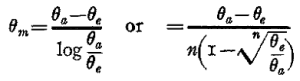
This mean temperature difference is in practice usually spoken of as the "temperature head" or "heat drop." It will be clear that this temperature head is increased by using steam at higher pressure (temperature), and by evaporating under reduced pressure. Since most liquids have their boiling points reduced about 40° C. by operating in vacuo, the advantage of the vacuum is apparent. It should be remembered that the temperature head has not the same value in any part of the scale: it has more value higher up the scale, because the steam is denser and more heat units come in contact with a given area in a given time. It must also be remembered that whilst the pressure gauge is a most useful indicator of steam temperature, it is not necessarily accurate. The pressure in the hot space is the sum of the pressures of air and steam, and since the temperature (the important condition) of the hot space depends upon the pressure of the steam, and not on the sum of the pressures, the temperature in a steam space is always rather lower than would be supposed from the pressure indicated by the gauge.
The transference of heat is influenced by the velocity of both the heating fluid and the fluid being heated over the heating surface. The more rapidly each fluid moves, the more rapid is the transference of heat, because a greater number of particles of both fluids are brought to the heating surface in any given time. This is popularly known as the effect of "circulation," and is illustrated by the advantage of stirring a liquid being heated in bulk. In the film evaporators the circulation is through tubes at high speed (up to 2 miles a minute), and the maximum effect in this sense is thus obtained. The increase in heat transference is not directly proportional to the increase in velocity, but in a lower ratio, sometimes approximately the square root of the velocity. In such a case, if either velocity be quadrupled, the heat transference is doubled. Other advantages of high velocity are that the heating steam more readily sweeps away condensed steam from the heating surface, and the high-speed film similarly "scours" away "incrustations" on the interior of the tubes.
The transference of heat is also proportional to the conductivity of the metal forming the heating surface. For gelatine liquors, copper tubes are almost invariably employed, the advantage being great even when price is taken into consideration. The following conductivity coefficients illustrate this point (calories per hour through 1 sq. metre of metal 1 metre thick, with a temperature difference of 1° C.):—
Copper 330
Tin 54
Iron 56
Zinc 105
Steel 22-40
Lead 28
The coefficient of heat transmission decreases the more with increasing thickness of wall, the worse conductor is the metal. For copper tubes, however, this decrease is usually unimportant.
The transference of heat is also much influenced by the viscosity of the liquor being evaporated; the greater the viscosity, the lower the coefficient of heat transmission. Unfortunately for this process of evaporation, gelatine sols are exceedingly viscous, and thus the difficulty in obtaining a concentrated sol is thus greatly enhanced.
The transference of heat is often greatly hindered by incrustations of the tubes, which incrustations generally conduct heat very badly. Thus the relative heat conductivities of copper and chalk are as 1000:5.
The amount of heat transferred is of course determined also by the area of the heating surface. The amount of evaporation needed thus determines the number of tubes (of standard size) in the evaporator, and thus the capacity of the machine. An evaporator should have its heating surface area chosen with a view to the duty required of it.
In practice the working of an evaporator is often not a very difficult matter, and large numbers of machines are operated by unskilled labour. Troubles generally arise from inconstant steam pressure, incrustation, leakages of air, which reduce the vacuum, the temperature head, and hinder heat transmission. For the evaporation of gelatine liquors the Yaryan, the Kestner, and the Blair-Campbell film evaporators are the most widely used. The velocity of the liquor through some of these machines is so great that occasionally no vacuum is used. The temperature obtained is high (200° F.), but the time is very short, if rapid cooling of the evaporated liquor is arranged.
REFERENCES. "Evaporating, Condensing and Cooling Apparatus," by E. Hausbrand. Scott, Greenwood & Son (1916 Ed.). "Evaporation," by E. Kappeschaar. Norman Rodger (1914). "Evaporation in the Chemical Industry," by J.A. Reavell, M.I.Mech.E., J.S.C.I., 1918, April 11th. "Glue and Glue Testing," S. Rideal, D.Sc., pp. 56-59. "Gelatine, Glue, and their Allied Products," T. Lambert, pp. 26-29. "Notes on Condensing Plant," J.M. Newton, B.Sc., J. Junior Inst. Engineers, Aug., 1912.
SECTION VII.—COOLING AND DRYING
The conversion of a gelatine sol into cakes of gelatine has been much simplified by the advent of the evaporator. Before this machine was used much trouble was experienced with putrefaction, and in hot and thundery weather, especially on the Continent, it was often necessary to suspend operations. Evaporation has, however, materially contributed to the possibility of rapid and satisfactory cooling and drying.
From the time the weak sol is decolorized and bleached, the finishing processes consist essentially in the removal of water. This is now usually done partly by evaporation of the sol, and partly by the desiccation of the gel. There is an obvious elasticity in method, and factory practice does actually vary considerably in the relative proportions of these two alternatives. Some factories evaporate to a 20 per cent. sol, approximately, and rely upon drying sheds and lofts to complete the desiccation: other factories evaporate up to a 55 per cent. gelatine sol, and so can manage with less shed room. Something depends upon local conditions, but the main issue is between the cost of steam in evaporation and the cost of land and buildings required for sheds. On the whole the modern tendency is to evaporate more, for this course has the additional advantage of speed, involving both a quicker turnover and less liability of putrefaction. Lower-grade products need relatively greater evaporation to form a gel of equal rigidity.
After evaporation and bleaching, the concentrated sol is first cooled rapidly until it has set to a stiff gel, then cut up into cakes according to the size required, these being dried out on network frames arranged in tiers, through which a draught of air is usually forced or induced. This general description is of course applicable to many factories with innumerable variations in detail, most of which variations originate in local convenience and are unessential parts of the manufacture.
An essential principle is that the cooling or gelation should be done rapidly, not only to avoid putrefaction but also to avoid the action of heat on the elasticity of the gel. A hot sol or gel is liable to hydrolysis and loss of setting power, and should have its temperature quickly reduced, but a warm sol or gel (say 100° F.) is most liable to putrefaction, so that the cooling should be continued quickly. On the other hand, the gel should not be frozen. For cooling purposes a copious supply of cold water is most usually employed, but some factories have installed refrigerators. These plants operate by the rapid evaporation of liquefied gases such as carbon dioxide, sulphur dioxide, or ammonia, so arranged as to cool a solution of common salt, which forms the circulating liquor and is returned after use to the refrigerator. Where such plants are used, it is natural that their use should be extended to the drying sheds to cool the air entering in the height of summer. In some factories the cooling is attained neither by cold water nor cooled brine, but merely by cold air.
The kind of vessel in which gelation is induced varies widely in different factories. For lower-grade products metal boxes are used, heavily galvanized iron being the most common material. If the liquor be muddy, deep boxes are preferred, but if clear, rapid cooling is best attained by having them long and shallow, and so exposing a relatively greater area to the cooling action. In either case the boxes may contain up to ½ cwt. of jelly. Lambert mentions boxes 24" × 6", which are 5" deep; Cavalier suggests rectangular moulds holding 30 litres. In place of galvanized sheet iron, boxes of sheet zinc or of wood lined with zinc are sometimes used. In any case the most scrupulous cleanliness should be observed in all cooling-house work, and in some factories the most elaborate precautions are taken for cleansing vessels, tools, floors, etc., and even for their disinfection and sterilization. Iron, tinned iron, and copper cooling vessels are ruled out on account of their tendency to rust and tarnish, and the last is unjustifiably expensive. Many of these vessels are unsuitable for pure food gelatines in which traces of copper, zinc and arsenic are held to be very objectionable. For the best gelatines, therefore, a very shallow vessel (¼" to ½" deep) with a sheet glass bottom is preferred, and the concentrated sol is run on to this for gelation.
Glue (or gelatine) which has set in this way is sometimes called "cast glue." That which sets in metal boxes in blocks is termed "cut glue," because the blocks of jelly need subsequently to be cut into slabs of the desired size and shape. Jelly blocks may be cut by hand with the "wire knife" which yields a characteristic wavy appearance to the finished product. This may also be done by machinery, the block of gel being placed on a series of correctly spaced wires and forced through the network by hydraulic pressure. A cutting machine (Schneible) has also been used to cut up blocks of jelly into slices of the required thickness, but these machines have not made great headway in this country. It will be clear that cast glue is cooled more rapidly than glue in blocks; it is therefore not surprising to note Lambert's statement that the former comprises the larger proportion on the market.
The cut or cast cakes are next placed upon network frames, and a series of such frames are placed on a bogey. The bogey is run along tram lines into the drying tunnel, through which air is forced or induced by a fan. Many such bogeys are, of course, passed into each tunnel, and as many tunnels as required may be constructed. Care is necessary to expose the cakes evenly to the action of the air. It is mostly necessary to warm the air at the inlet by means of steam pipes and so increase its drying power. This is especially necessary in winter or wet weather. In summer, however, it is often arranged that the air is cooled before entering the sheds. This is accomplished by passing the air through pipes from a refrigerator. When heated air is used, it is stated by Lambert that the maximum temperature should be 25.5° C. (78° F.); Rideal considers 21° C. (70° F.) should be the maximum. In all cases the drying power of the air is easily ascertained from a wet-and-dry bulb thermometer, and the amount of air passing along the shed from a wind gauge. Lambert states that drying normally occupies four to five days. The final product is still a gel, of course, and contains from 10 to 18 per cent. of water. It appears, however, very hard and solid. The dried cakes are removed from the frames and transferred to the warehouse, where they are sorted according to quality and packed in bags or tin-lined boxes. Some material is ground to powder.
The network of the drying frames has been made from many materials. Cotton or string netting is very common, but is liable to sag and to get dirty. It also has a short life. Ordinary galvanized iron soon loses its galvanizing cover, and the iron then is liable to rust. Attempts have been made to use sheet zinc and other alloys, which are cut or punched into nets with square or diamond-shaped holes. These were found to warp and break. Rideal's conclusion, which is confirmed by the general experience, is that the best material is a heavily galvanized iron wire netting. He suggests that it should have 15 to 25 per cent. of its weight of zinc, and that it should be strengthened by stiffer ribs arranged both longitudinally and transversely.
Many attempts have been made, and many patents taken out, with the object of making the cooling, cutting, and drying processes as continuous and as quick as possible, and with a view to saving labour, which is rather costly at this stage. These attempts, however, have only met with indifferent success. A common idea is that a continuous supply should fall upon a revolving appliance, and be instantly congealed in a thin state, which last lends itself to more rapid desiccation. Vacuum drying has also been attempted.
REFERENCES. "Glue and Glue Testing," S. Rideal, D.Sc., pp. 68-74. "Glue, Gelatine, and Allied Products," T. Lambert, pp. 30-35. Chem. Zeit., 1911, 85, 17 (Cavalier). PATENTS. Eng. Patent (1894) 11,426 (Hewitt). Eng. Patent (1898) 2,400 (Brauer). Fr. Patent (1909) 398,598 (Lehmann), J.S.C.I., 1909, 897. U.S. Patent (1912) 1,047,165 (American Glue Co.).
SECTION VIII.—USES OF GELATINE AND GLUE
Gelatine and glue have both been put to an immense variety of uses, and the list is constantly extending. Indeed, no one who considers the following account of their applications can doubt that gelatine and glue have become a necessary part of our civilization.
Gelatine for edible purposes certainly forms a very considerable part of the total used, and great pains are now taken to obtain a pure product. Thus, a gelatine with more than 1.4 parts per million of arsenic, or more than 30 parts per million of copper, is not considered good enough for "pure food." The food value of gelatine, compared with other proteids, is exceedingly low; its use in this connection has no connection with the "calories" of heat energy it will yield. It is used almost entirely because of its property of forming a gel. Table jellies form, of course, one popular use of gelatin, but the manufacture of sweets makes also a great demand upon the gelatine trade. Culinary operations often require a little gelatine, especially is it used in pies and soups. An extension of the same idea is found in its employment for many manufactured foods, e.g. tinned meats, meat extracts, and the concentrated foods. The use of gelatine in connection with the first of these received a big impetus during the war period. In gelatine for any of these purposes, the presence of excess of sulphurous acid is objectionable, as its taste is easily noticed.
Gelatine for medicinal purposes finds an ever-growing number of applications. Gelatine capsules for holding greasy liquids and solutions of nauseous drugs are increasingly popular, for the dose may be swallowed without unpleasantness. In making these capsules some sugar is also used, and the finished article is often protected from atmospheric moisture by treatment with a weak solution of alum. In a similar way pills are often coated with a 33 per cent. gelatine sol. Such pills are not only pleasanter to swallow, but are less liable, after being dried, to stick together in the box. Alcohol solutions of drugs (or essences, perfumes, etc.) may be suitably stored in gelatine instead of metal tubes. Medicated wines are detannated by gelatine before the addition of drugs which would have been precipitated by the tannin. The British Pharmacopœia specifies four kinds of "Lamellæ," which are small discs of gelatin and glycerin, each containing a minute but definite dose of some powerful alkaloid. Glycerin jelly is a mixture of gelatin glycerin with some water. It is used for chapped and rough hands; the mixture is also used for glycerin suppositories, and for mounting microscopic sections. The mixture also forms the basis of gelato-glycerin, used in nasal bougies, and of glyco-gelatin for medicated lozenges. Gelatine insolubilised by formalin (formo-gelatin) has been used for making tabloids, wound dressings, and artificial silk.
Gelatine is in constant demand for bacteriological work, for which purpose a high-grade product is desired. Nutrient media for the culture of bacteria are solidified by 10-15 per cent. of gelatin, and the growth of colonies of bacteria often show typical formations. By inoculating into a melted and sterile quantity and setting quickly in a flat dish after mixing, the number of bacteria in the volume introduced can be judged from the number of colonies which develop. Bacteria are also distinguished often as "liquefying" or "non-liquefying" according to their type of culture on nutrient gelatine media. Gelatine for such work should be neutral and of high clarity.
The gelatine required for photographic purposes is also a high-class product. It should be neutral, colourless, and free from chlorides and other mineral salts. Grease also is objectionable. Gelatine is used in the numerous carbon processes, in which the principle is that gelatine is made insoluble in water by the action of potassium dichromate under the action of light. It is used also in Poiteoin process for copying engineering drawings, which is based upon the power of a ferric salt to render gelatine insoluble so long as it is not exposed to the actinic rays.
Gelatine is used in the manufacture of the "crystalline glass" used for decorative purposes. Advantage is taken of the immense contractile force it exerts on drying. When ground glass is coated with gelatine, and the latter dried, it tears away the surface of the glass itself, and leaves peculiar fern-like patterns. Inorganic salts dissolved in the sol influence the nature of the pattern obtained.
Gelatine is used also very largely in the textile trades, for finishing coloured yarns and threads, for sizing woollen and worsted warps, and for thickening the dyestuffs used in printing fabrics. It is also used for finishing white straw hats; as a size in the manufacture of high-class papers, and as a wax substitute for covering corks and bottle necks.
Glue is used instead of gelatine in all cases where colour is not a matter of much moment. The fact that it has not been bleached makes no difference to its suitability in such a case, and the cost is substantially reduced. Thus, for dark-coloured straw hats, textiles, sweets, papers, and in all suitable woolwork, glue is used in place of the more expensive article.
A very large quantity of glue is used in the manufacture of matches, where it functions as the material binding the "head" to the stem. A 15-50 per cent. sol is used, containing nitrate or chlorate of potash as oxidizing agent. The mixture is kept at 38° C. and the phosphorus cautiously added, and when this is emulsified, the friction ingredients (sand, glass, etc.) are also added. The glue acts also in preventing premature oxidation. Glue is also used in making the match-boxes, and similarly in making sand, emery, and glass papers and cloths.
There is a large consumption of glue by joiners, carpenters, cabinet-makers, and all kinds of woodwork and fancy work. It is used in the manufacture of furniture of all kinds, of pianos, organs, billiard tables, panels, picture frames, and of toys and brushes. Mixed with white lead, chalk, and sawdust, it forms a composition used for mirror frames, rosettes, etc. Glue is used for veneering, for mosaics, plaques, trays, fingerplates, leather wall coverings, and for staining floors.
There is also a considerable sale for glue in bookbinding, for which a sweet, light-coloured, and strong product is required. It has been found particularly suitable for leather bindings where the grain has been artificially printed or embossed (see pp. 97 and 117), and in finishing and gilding.
The compositions used for printing rollers all contain gelatine or glue together with sugar or glycerin and possibly oil and soap. They are often hardened with formalin. Similar mixtures are used for the beds of hectographs.
Glue (together with waste leather) is used in the manufacture of imitation leather and leather substitutes. Cotton and wool fibres are often incorporated, and sometimes textile fabrics.
Much glue is converted into "size," which is a weak gel used as a filling rather than as an adhesive agent. A low-grade glue is often therefore preferred for such purposes, as having "body" rather than "strength." Size is often sold in cake, but sometimes in the form of the gel itself, in which case it may never have been evaporated. Indeed, size is often overboiled glue, made by crude and out-of-date methods. It is largely used in the paper trade, and for wallpapers, millboards, papier-mache, paper and cardboard boxes, etc. Mixed with logwood and iron, and possibly alum, it formed the "blue size" once largely used by bootmakers as a foundation for blacking, and is similarly used in currying (p. 82). Size is also used in making oil paints and varnishes. Distemper is a size with which is incorporated whiting or gypsum and coloured pigments. In all applications of size, it is common to use antiseptics. Salicylic acid has been widely used in this sense. Low-grade glue is used for the manufacture of cheap brushes and for fly-papers.
Innumerable patents have been taken out and mixtures invented for the production of plastic materials, which frequently involve gelatine or glue. Thus, gelatine and glue are used in making plaster casts, and for imitation ivory, wood, stone, and rubber. Many of these inventions have been investigated by Rideal, who points out the features common to most of them. Usually a viscous sol is thickened by the addition of inert fibres and powders, and with the object of making the preparation more waterproof it is customary to incorporate oils, fats, waxes, tars, and resins before the gel is set. The surface is hardened by "tanning" with formalin or tannin solution, finally painted or varnished.
Equally innumerable are the inventions, recipes, and patents for making glues that shall remain liquid. The convenience of this ideal is obvious, but many of the suggestions are useless. It is quite easy to incorporate into a gel substances which keep it liquid—any soluble substances with a lyotrope influence of the iodide type will do this—but these also prevent the glue setting when used. Even in small quantity they will influence the tenacity of the joint. Other methods depend upon a partial hydrolysis of the protein. Amongst the most successful of these attempts are to dissolve 3 parts of glue either in 12-15 parts saccharate of lime, or in 9 parts of 33 per cent. acetic acid.
Many special glues and cements are made from commercial glue, according to the purpose required. "Marine glue" contains no glue; it is made from shellac and rubber mixed with benzene or naphtha. Its advantage is waterproofness.
REFERENCES. "Glue and Glue Testing," S. Rideal, D.Sc., 2nd ed. "Uses of Glue," chap. iii. p. 83. "Uses of Gelatine," chap. iv. p. 100. "Special Glues," p. 108. "Liquid Glues," p. 119. "Gelatine, Glue, and their Allied Products," T. Lambert. "Uses of Glue and Gelatine," chap. ix. p. 80. "Liquid Glues and Cements," chap. viii. p. 69.
SECTION IX.—THE EVOLUTION OF THE GELATINE AND GLUE INDUSTRY
The manufacture of gelatine and allied products has received a great stimulus in this country from the circumstances arising from the European War. The large restriction of continental—especially French and Belgian—supplies of gelatine, led to greater demands for the British-made product, and resulted not merely in a period of greater prosperity, but in a period in which much greater efforts were made to supply a high-grade article in larger quantities. Most manufacturers strove to make high-class gelatine rather than low-grade glue, great extensions were made, and many new businesses were established. The development of the leather trades, more particularly in respect of greater production, caused a bigger supply of raw material for skin gelatine, and the slaughter of home animals for food caused a more plentiful supply of bones. At the same time it was realized that greater production not only reduced working costs, but also that a bigger turnover in any one factory involved a proportionately less capital outlay. These facts tend to counterbalance the heavy freight on the raw materials. Production is thus not only on a larger scale but more intensive.
One of the greatest difficulties of this industry is to produce a regular or standard article, for the raw material is so exceedingly variable in quality; that for skin gelatine tends also to become less valuable. In such a case, as Rideal has truly remarked, to ensure that supplies to customers shall be always "up to sample," which is often a matter of contract—"exact and regular working, strict cleanliness, observance of temperatures and other physical data, and scientific supervision", are clearly necessary. "Rule of thumb" is never quite certain to produce the same article twice. In past years British methods of manufacture have been far too empirical. As in other industries, "rule of thumb" must inevitably be replaced by scientific principle. The advances in colloid chemistry of this last decade or so have, in the author's opinion, supplied the clue to this line of development. In the preceding pages emphasis has been laid upon the importance of the adsorption law, the lyotrope series, and the valency rule. The manufacturer or supervisor who understands and can apply these generalizations will find his task vastly easier and his factory more efficient. Much remains to be learnt, however, and the industry would certainly benefit by research work, for which there is a fertile field.
There is also considerable room for improvement in the methods of chemical engineering usually employed. Whilst the heat engineers have certainly done much to solve the question of evaporation and drying, there is still great scope in the more economical application of heat in extraction, and the last word can hardly have been said on the problem of clarification and decolorization. There is indeed almost as much scope for research by the chemical engineer as by the colloid chemist.
The industry also exhibits, in common with the leather and many other trades, the same tendency to save labour, both by careful arrangement of the factory and by the installing of mechanical labour-saving devices. Thus, lifts, runaways, hoists, trucks are increasingly used to move the solids, and pipes and pumps to move the liquors. As ever, there is scope for the mechanical engineer.
If some of these problems are vigorously tackled during the present reconstruction period, there is little doubt that the gelatine and glue industry will be in a much better position to cope with all possible competition in the future.
From what has been said in Section VIII. as to the wide uses of gelatine and glue, it will be seen that general prosperity in trade is conducive to better trade conditions in the gelatine and glue industry. It is similarly true that a general trade slump affects the glue trade adversely. The severe trade depression which commenced in 1920 has had this effect, and has made economic production much more difficult as well as more essential. As often is the case, the larger factories and firms can better face the difficulties, and there can be little doubt that if the depression be long continued there will be a tendency for the smaller factories to be closed down and for the larger firms to unite. As in the leather trade, both the War boom and the Peace slump have caused the gelatine and glue trade to develop along the lines of the great trusts. It may be reasonably expected, moreover, that these will be intimately connected with the leather trusts. This fact, together with the heavy freight charges on the raw material, tends also to make the skin glue factories gravitate towards the leather centres.