Chapter II · Animal Intelligence; an Experimental Study of the Associative Processes in Animals[4]
Reading edition
CHAPTER II Animal Intelligence; an Experimental Study of the Associative Processes in Animals[4]
This monograph is an attempt at an explanation of the nature of the process of association in the animal mind. Inasmuch as there have been no extended researches of a character similar to the present one either in subject-matter or experimental method, it is necessary to explain briefly its standpoint.
Our knowledge of the mental life of animals equals in the main our knowledge of their sense-powers, of their instincts or reactions performed without experience, and of their reactions which are built up by experience. Confining our attention to the latter, we find it the opinion of the better observers and analysts that these reactions can all be explained by the ordinary associative processes without aid from abstract, conceptual, inferential thinking. These associative processes then, as present in animals’ minds and as displayed in their acts, are my subject-matter. Any one familiar in even a general way with the literature of comparative psychology will recall that this part of the field has received faulty and unsuccessful treatment. The careful, minute and solid knowledge of the sense-organs of animals finds no counterpart in the realm of associations and habits. We do not know how delicate or how complex or how permanent are the possible associations of any given group of animals. And although one would be rash who said that our present equipment of facts about instincts was sufficient or that our theories about it were surely sound, yet our notion of what occurs when a chick grabs a worm are luminous and infallible compared to our notion of what happens when a kitten runs into the house at the familiar call. The reason that they have satisfied us as well as they have is just that they are so vague. We say that the kitten associates the sound ‘kitty kitty’ with the experience of nice milk to drink, which does very well for a common-sense answer. It also suffices as a rebuke to those who would have the kitten ratiocinate about the matter, but it fails to tell what real mental content is present. Does the kitten feel “sound of call, memory-image of milk in a saucer in the kitchen, thought of running into the house, a feeling, finally, of ‘I will run in’”? Does he perhaps feel only the sound of the bell and an impulse to run in, similar in quality to the impulses which make a tennis player run to and fro when playing? The word ‘association’ may cover a multitude of essentially different processes, and when a writer attributes anything that an animal may do to association, his statement has only the negative value of eliminating reasoning on the one hand and instinct on the other. His position is like that of a zoölogist who should to-day class an animal among the ‘worms.’ To give to the word a positive value and several definite possibilities of meaning is one aim of this investigation.
The importance to comparative psychology in general of a more scientific account of the association-process in animals is evident. Apart from the desirability of knowing all the facts we can, of whatever sort, there is the especial consideration that these associations and consequent habits have an immediate import for biological science. In the higher animals the bodily life and preservative acts are largely directed by these associations. They, and not instinct, make the animal use the best feeding grounds, sleep in the same lair, avoid new dangers and profit by new changes in nature. Their higher development in mammals is a chief factor in the supremacy of that group. This, however, is a minor consideration. The main purpose of the study of the animal mind is to learn the development of mental life down through the phylum, to trace in particular the origin of human faculty. In relation to this chief purpose of comparative psychology the associative processes assume a rôle predominant over that of sense-powers or instinct, for in a study of the associative processes lies the solution of the problem. Sense-powers and instincts have changed by addition and supersedence, but the cognitive side of consciousness has changed not only in quantity but also in quality. Somehow out of these associative processes have arisen human consciousnesses with their sciences and arts and religions. The association of ideas proper, imagination, memory, abstraction, generalization, judgment, inference, have here their source. And in the metamorphosis the instincts, impulses, emotions and sense-impressions have been transformed out of their old natures. For the origin and development of human faculty we must look to these processes of association in lower animals. Not only then does this department need treatment more, but promises to repay the worker better.
Although no work done in this field is enough like the present investigation to require an account of its results, the method hitherto in use invites comparison by its contrast and, as I believe, by its faults. In the first place, most of the books do not give us a psychology, but rather a eulogy, of animals. They have all been about animal intelligence, never about animal stupidity. Though a writer derides the notion that animals have reason, he hastens to add that they have marvelous capacity of forming associations, and is likely to refer to the fact that human beings only rarely reason anything out, that their trains of ideas are ruled mostly by association, as if, in this latter, animals were on a par with them. The history of books on animals’ minds thus furnishes an illustration of the well-nigh universal tendency in human nature to find the marvelous wherever it can. We wonder that the stars are so big and so far apart, that the microbes are so small and so thick together, and for much the same reason wonder at the things animals do. They used to be wonderful because of the mysterious, God-given faculty of instinct, which could almost remove mountains. More lately they have been wondered at because of their marvelous mental powers in profiting by experience. Now imagine an astronomer tremendously eager to prove the stars as big as possible, or a bacteriologist whose great scientific desire is to demonstrate the microbes to be very, very little! Yet there has been a similar eagerness on the part of many recent writers on animal psychology to praise the abilities of animals. It cannot help leading to partiality in deductions from facts and more especially in the choice of facts for investigation. How can scientists who write like lawyers, defending animals against the charge of having no power of rationality, be at the same time impartial judges on the bench? Unfortunately the real work in this field has been done in this spirit. The level-headed thinkers who might have won valuable results have contented themselves with arguing against the theories of the eulogists. They have not made investigations of their own.
In the second place, the facts have generally been derived from anecdotes. Now quite apart from such pedantry as insists that a man’s word about a scientific fact is worthless unless he is a trained scientist, there are really in this field special objections to the acceptance of the testimony about animals’ intelligent acts which one gets from anecdotes. Such testimony is by no means on a par with testimony about the size of a fish or the migration of birds, etc. For here one has to deal not merely with ignorant or inaccurate testimony, but also with prejudiced testimony. Human folk are as a matter of fact eager to find intelligence in animals. They like to. And when the animal observed is a pet belonging to them or their friends, or when the story is one that has been told as a story to entertain, further complications are introduced. Nor is this all. Besides commonly misstating what facts they report, they report only such facts as show the animal at his best. Dogs get lost hundreds of times and no one ever notices it or sends an account of it to a scientific magazine. But let one find his way from Brooklyn to Yonkers and the fact immediately becomes a circulating anecdote. Thousands of cats on thousands of occasions sit helplessly yowling, and no one takes thought of it or writes to his friend, the professor; but let one cat claw at the knob of a door supposedly as a signal to be let out, and straightway this cat becomes the representative of the cat-mind in all the books. The unconscious distortion of the facts is almost harmless compared to the unconscious neglect of an animal’s mental life until it verges on the unusual and marvelous. It is as if some denizen of a planet where communication was by thought-transference, who was surveying humankind and reporting their psychology, should be oblivious to all our intercommunication save such as the psychical-research society has noted. If he should further misinterpret the cases of mere coincidence of thoughts as facts comparable to telepathic communication, he would not be more wrong than some of the animal psychologists. In short, the anecdotes give really the abnormal or supernormal psychology of animals.
Further, it must be confessed that these vices have been only ameliorated, not obliterated, when the observation is first-hand, is made by the psychologist himself. For as men of the utmost scientific skill have failed to prove good observers in the field of spiritualistic phenomena,[5] so biologists and psychologists before the pet terrier or hunted fox often become like Samson shorn. They, too, have looked for the intelligent and unusual and neglected the stupid and normal.
Finally, in all cases, whether of direct observation or report by good observers or bad, there have been three other defects. Only a single case is studied, and so the results are not necessarily true of the type; the observation is not repeated, nor are the conditions perfectly regulated; the previous history of the animal in question is not known. Such observations may tell us, if the observer is perfectly reliable, that a certain thing takes place; but they cannot assure us that it will take place universally among the animals of that species, or universally with the same animal. Nor can the influence of previous experience be estimated. All this refers to means of getting knowledge about what animals do. The next question is, “What do they feel?” Previous work has not furnished an answer or the material for an answer to this more important question. Nothing but carefully designed, crucial experiments can. In abandoning the old method one ought to seek above all to replace it by one which will not only tell more accurately what they do, and give the much-needed information how they do it, but also inform us what they feel while they act.
To remedy these defects, experiment must be substituted for observation and the collection of anecdotes. Thus you immediately get rid of several of them. You can repeat the conditions at will, so as to see whether or not the animal’s behavior is due to mere coincidence. A number of animals can be subjected to the same test, so as to attain typical results. The animal may be put in situations where its conduct is especially instructive. After considerable preliminary observation of animals’ behavior under various conditions, I chose for my general method one which, simple as it is, possesses several other marked advantages besides those which accompany experiment of any sort. It was merely to put animals when hungry in inclosures from which they could escape by some simple act, such as pulling at a loop of cord, pressing a lever, or stepping on a platform. (A detailed description of these boxes and pens will be given later.) The animal was put in the inclosure, food was left outside in sight, and his actions observed. Besides recording his general behavior, special notice was taken of how he succeeded in doing the necessary act (in case he did succeed), and a record was kept of the time that he was in the box before performing the successful pull, or clawing, or bite. This was repeated until the animal had formed a perfect association between the sense-impression of the interior of that box and the impulse leading to the successful movement. When the association was thus perfect, the time taken to escape was, of course, practically constant and very short.
If, on the other hand, after a certain time the animal did not succeed, he was taken out, but not fed. If, after a sufficient number of trials, he failed to get out, the case was recorded as one of complete failure. Enough different sorts of methods of escape were tried to make it fairly sure that association in general, not association of a particular sort of impulse, was being studied. Enough animals were taken with each box or pen to make it sure that the results were not due to individual peculiarities. None of the animals used had any previous acquaintance with any of the mechanical contrivances by which the doors were opened. So far as possible the animals were kept in a uniform state of hunger, which was practically utter hunger.[6] That is, no cat or dog was experimented on, when the experiment involved any important question of fact or theory, unless I was sure that his motive was of the standard strength. With chicks this is not practicable, on account of their delicacy. But with them dislike of loneliness acts as a uniform motive to get back to the other chicks. Cats (or rather kittens), dogs and chicks were the subjects of the experiments. All were apparently in excellent health, save an occasional chick.
By this method of experimentation the animals are put in situations which call into activity their mental functions and permit them to be carefully observed. One may, by following it, observe personally more intelligent acts than are included in any anecdotal collection. And this actual vision of animals in the act of using their minds is far more fruitful than any amount of history of what animals have done without the history of how they did it. But besides affording this opportunity for purposeful and systematic observation, our method is valuable because it frees the animal from any influence of the observer. The animal’s behavior is quite independent of any factors save its own hunger, the mechanism of the box it is in, the food outside, and such general matters as fatigue, indisposition, etc. Therefore the work done by one investigator may be repeated and verified or modified by another. No personal factor is present save in the observation and interpretation. Again, our method gives some very important results which are quite uninfluenced by any personal factor in any way. The curves showing the progress of the formation of associations, which are obtained from the records of the times taken by the animal in successive trials, are facts which may be obtained by any observer who can tell time. They are absolute, and whatever can be deduced from them is sure. So also the question of whether an animal does or does not form a certain association requires for an answer no higher qualification in the observer than a pair of eyes. The literature of animal psychology shows so uniformly and often so sadly the influence of the personal equation that any method which can partially eliminate it deserves a trial.
Furthermore, although the associations formed are such as could not have been previously experienced or provided for by heredity, they are still not too remote from the animal’s ordinary course of life. They mean simply the connection of a certain act with a certain situation and resultant pleasure, and this general type of association is found throughout the animal’s life normally. The muscular movements required are all such as might often be required of the animal. And yet it will be noted that the acts required are nearly enough like the acts of the anecdotes to enable one to compare the results of experiment by this method with the work of the anecdote school. Finally, it may be noticed that the method lends itself readily to experiments on imitation.
We may now start in with the description of the apparatus and of the behavior of the animals.[7]
Description of Apparatus
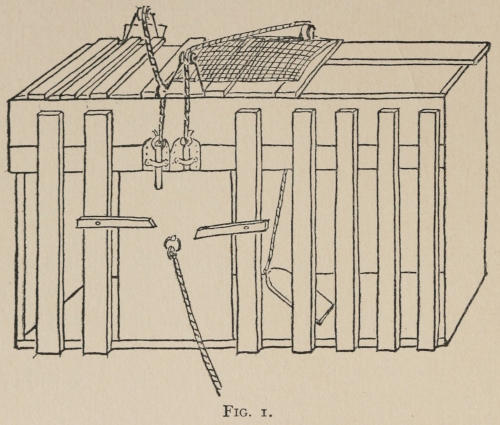
Fig. 1.
The shape and general apparatus of the boxes which were used for the cats is shown by the accompanying drawing of box K. Unless special figures are given, it should be understood that each box is approximately 20 inches long, by 15 broad, by 12 high. Except where mention is made to the contrary, the door was pulled open by a weight attached to a string which ran over a pulley and was fastened to the door, just as soon as the animal loosened the bolt or bar which held it. Especial care was taken not to have the widest openings between the bars at all near the lever, or wire loop, or what not, which governed the bolt on the door. For the animal instinctively attacks the large openings first, and if the mechanism which governs the opening of the door is situated near one of them, the animal’s task is rendered easier. You do not then get the association-process so free from the helping hand of instinct as you do if you make the box without reference to the position of the mechanism to be set up within it. These various mechanisms are so simple that a verbal description will suffice in most cases. The facts which the reader should note are the nature of the movement which the cat had to make, the nature of the object at which the movement was directed, and the position of the object in the box. In some special cases attention will also be called to the force required. In general, however, that was very slight (20 to 100 grams if applied directly). The various boxes will be designated by capital letters.
A. A string attached to the bolt which held the door ran up over a pulley on the front edge of the box, and was tied to a wire loop (2½ inches in diameter) hanging 6 inches above the floor in front center of box. Clawing or biting it, or rubbing against it even, if in a certain way, opened the door. We may call this box A ‘O at front.’
B. A string attached to the bolt ran up over a pulley on the front edge of the door, then across the box to another pulley screwed into the inside of the back of the box 1¼ inches below the top, and passing over it ended in a wire loop (3 inches in diameter) 6 inches above the floor in back center of box. Force applied to the loop or to the string as it ran across the top of the box between two bars would open the door. We may call B ‘O at back.’
B1. In B1 the string ran outside the box, coming down through a hole at the back, and was therefore inaccessible and invisible from within. Only by pulling the loop could the door be opened. B1 may be called ‘O at back 2d.’
C. A door of the usual position and size (as in Fig. 1) was kept closed by a wooden button 3½ inches long, ⅞ inch wide, ½ inch thick. This turned on a nail driven into the box ½ inch above the middle of the top edge of the door. The door would fall inward as soon as the button was turned from its vertical to a horizontal position. A pull of 125 grams would do this if applied sideways at the lowest point of the button 2¼ inches below its pivot. The cats usually clawed the button round by downward pressure on its top edge, which was 1¼ inches above the nail. Then, of course, more force was necessary. C may be called ‘Button.’
D. The door was in the extreme right of the front. A string fastened to the bolt which held it ran up over a pulley on the top edge and back to the top edge of the back side of the box (3 inches in from the right side) and was there firmly fastened. The top of the box was of wire screening and arched over the string ¾ inch above it along its entire length. A slight pull on the string anywhere opened the door. This box was 20 × 16, but a space 7 × 16 was partitioned off at the left by a wire screen. D may be called ‘String.’
D1 was the same box as B, but had the string fastened firmly at the back instead of running over a pulley and ending in a wire loop. We may call it ‘String 2d.’
E. A string ran from the bolt holding the door up over a pulley and down to the floor outside the box, where it was fastened 2 inches in front of the box and 1½ inches to the left of the door (looking from the inside). By poking a paw out between the bars and pulling this string inward the door would be opened. We may call E ‘String outside.’
In F the string was not fastened to the floor but ended in a loop 2½ inches in diameter which could be clawed down so as to open the door. Unless the pull was in just the right direction, the string was likely to catch on the pulley. This loop hung 3 inches above the floor, and 1¾ inches in front of the box. We may call F ‘String outside unfastened.’
G was a box 29 × 20½ × 22½, with a door 29 × 12 hinged on the left side of the box (looking from within), and kept closed by an ordinary thumb latch placed 15 inches from the floor. The remainder of the front of the box was closed in by wooden bars. The door was a wooden frame covered with screening. It was not arranged so as to open as soon as the latch was lifted, but required a force of 400 grams, even when applied to the best advantage. The bar of the thumb latch, moreover, would fall back into place again unless the door were pushed out at least a little. The top of this box was not of bars or screening, but solid. We may call G ‘Thumb latch.’
H was, except for the opening where the door was situated, a perfectly solid and dark box. In the front was cut an opening about 9 × 7 inches. A wooden frame covered with wire netting hung in front of this. It was fastened to the box only by a screw through the middle of the frame’s top piece, and could therefore be pushed to either side so as to permit escape from the box if it were prevented from swinging back into place.
I was a box 12 × 14 × 23. The door was 8 inches wide, 4 high, and hinged at the left side. It was held closed by a wooden bar which moved easily on a pivot and which could be pushed up by another bar which projected 5 inches into the box. This second bar was pivoted so that downward pressure on it pushed the first bar up and let the door swing open. The second bar entered the box at a point 4 inches above the floor and 2½ inches in from the right side of the box. In its normal position its inner end was 5½ inches above the floor. A depression of 2 inches at that end was necessary to open the door. Of course, nearer the pivot a shorter depression would do. The front of the box was closed by bars, but the rest by solid boards. We may call I ‘Lever.’
J was the same as B except that the door was not opened by a weight as soon as the bolt was pulled up. On the contrary, the door was held closed by a small piece of board (4 × 3½ × ¾ thick) placed against it outside. After pulling the loop at the back the cat had to knock down this support and push the door open. We may call J ‘Double.’
K was a box arranged so that three separate acts were required to open the door, which was held by two bolts at the top and two bars outside. One of the bolts was connected with a platform in the back center of the box so that depressing the platform raised the bolt. The other was raised by a string which ran up over a pulley in the front, across the box 1 inch above the bars, over a pulley near the corner of the box, and down to the floor, where it was fastened. Pulling on this string, either by clawing at it where it was running vertically from the last pulley to the floor, or by putting the paw out between the bars which covered the top of the box, and clawing the string downward, would raise the bolt. If both bolts were raised and either bar was pushed up or down far enough to be out of the way, the cat could escape. K, or ‘Triple,’ as it may be called, is the box reproduced in Figure 1.
L was a box that also required three acts to open the door. It was a combination of A (O at front), D (string), I (lever). The lever or bar to be depressed was 2 inches to the right of the door, which was in the front center. The string to be clawed or bitten ran from front center to back center 1 inch below the top of the box.
Z was a box with back and sides entirely closed, with front and top closed by bars and screening, with a small opening in the left-hand corner. A box was held in front of this and drawn away when the cats happened to lick themselves. Thus escape and food followed always upon the impulse to lick themselves, and they soon would immediately start doing so as soon as pushed into the box. The same box was used with the impulse changed to that for scratching themselves. The size of this box was 15 × 10 × 16.
Experiments with Cats
In these various boxes were put cats from among the following. I give approximately their ages while under experiment.
No. 1. 8-10 months.
No. 2. 5-7 months.
No. 3. 5-11 months.
No. 4. 5-8 months.
No. 5. 5-7 months.
No. 6. 3-5 months.
No. 7. 3-5 months.
No. 8. 6-6½ months.
No. 10. 4-8 months.
No. 11. 7-8 months.
No. 12. 4-6 months.
No. 13. 18-19 months.
The behavior of all but 11 and 13 was practically the same. When put into the box the cat would show evident signs of discomfort and of an impulse to escape from confinement. It tries to squeeze through any opening; it claws and bites at the bars or wire; it thrusts its paws out through any opening and claws at everything it reaches; it continues its efforts when it strikes anything loose and shaky; it may claw at things within the box. It does not pay very much attention to the food outside, but seems simply to strive instinctively to escape from confinement. The vigor with which it struggles is extraordinary. For eight or ten minutes it will claw and bite and squeeze incessantly. With 13, an old cat, and 11, an uncommonly sluggish cat, the behavior was different. They did not struggle vigorously or continually. On some occasions they did not even struggle at all. It was therefore necessary to let them out of some box a few times, feeding them each time. After they thus associate climbing out of the box with getting food, they will try to get out whenever put in. They do not, even then, struggle so vigorously or get so excited as the rest. In either case, whether the impulse to struggle be due to an instinctive reaction to confinement or to an association, it is likely to succeed in letting the cat out of the box. The cat that is clawing all over the box in her impulsive struggle will probably claw the string or loop or button so as to open the door. And gradually all the other non-successful impulses will be stamped out and the particular impulse leading to the successful act will be stamped in by the resulting pleasure, until, after many trials, the cat will, when put in the box, immediately claw the button or loop in a definite way.
The starting point for the formation of any association in these cases, then, is the set of instinctive activities which are aroused when a cat feels discomfort in the box either because of confinement or a desire for food. This discomfort, plus the sense-impression of a surrounding, confining wall, expresses itself, prior to any experience, in squeezings, clawings, bitings, etc. From among these movements one is selected by success. But this is the starting point only in the case of the first box experienced. After that the cat has associated with the feeling of confinement certain impulses which have led to success more than others and are thereby strengthened. A cat that has learned to escape from A by clawing has, when put into C or G, a greater tendency to claw at things than it instinctively had at the start, and a less tendency to squeeze through holes. A very pleasant form of this decrease in instinctive impulses was noticed in the gradual cessation of howling and mewing. However, the useless instinctive impulses die out slowly, and often play an important part even after the cat has had experience with six or eight boxes. And what is important in our previous statement, namely, that the activity of an animal when first put into a new box is not directed by any appreciation of that box’s character, but by certain general impulses to act, is not affected by this modification. Most of this activity is determined by heredity; some of it, by previous experience.
My use of the words instinctive and impulse may cause some misunderstanding unless explained here. Let us, throughout this book, understand by instinct any reaction which an animal makes to a situation without experience. It thus includes unconscious as well as conscious acts. Any reaction, then, to totally new phenomena, when first experienced, will be called instinctive. Any impulse then felt will be called an instinctive impulse. Instincts include whatever the nervous system of an animal, as far as inherited, is capable of. My use of the word will, I hope, everywhere make clear what fact I mean. If the reader gets the fact meant in mind it does not in the least matter whether he would himself call such a fact instinct or not. Any one who objects to the word may substitute ‘hocus-pocus’ for it wherever it occurs. The definition here made will not be used to prove or disprove any theory, but simply as a signal for the reader to imagine a certain sort of fact.
The word impulse is used against the writer’s will, but there is no better. Its meaning will probably become clear as the reader finds it in actual use, but to avoid misconception at any time I will state now that impulse means the consciousness accompanying a muscular innervation apart from that feeling of the act which comes from seeing oneself move, from feeling one’s body in a different position, etc. It is the direct feeling of the doing as distinguished from the idea of the act done gained through eye, etc. For this reason I say ‘impulse and act’ instead of simply ‘act.’ Above all, it must be borne in mind that by impulse I never mean the motive to the act. In popular speech you may say that hunger is the impulse which makes the cat claw. That will never be the use here. The word motive will always denote that sort of consciousness. Any one who thinks that the act ought not to be thus subdivided into impulse and deed may feel free to use the word act for impulse or impulse and act throughout, if he will remember that the act in this aspect of being felt as to be done or as doing is in animals the important thing, is the thing which gets associated, while the act as done, as viewed from outside, is a secondary affair. I prefer to have a separate word, impulse, for the former, and keep the word act for the latter, which it commonly means.
Starting, then, with its store of instinctive impulses, the cat hits upon the successful movement, and gradually associates it with the sense-impression of the interior of the box until the connection is perfect, so that it performs the act as soon as confronted with the sense-impression. The formation of each association may be represented graphically by a time-curve. In these curves lengths of one millimeter along the abscissa represent successive experiences in the box, and heights of one millimeter above it each represent ten seconds of time. The curve is formed by joining the tops of perpendiculars erected along the abscissa 1 mm. apart (the first perpendicular coinciding with the y line), each perpendicular representing the time the cat was in the box before escaping. Thus, in Fig. 2 on page 39 the curve marked 12 in A shows that, in 24 experiences or trials in box A, cat 12 took the following times to perform the act, 160 sec., 30 sec., 90 sec., 60, 15, 28, 20, 30, 22, 11, 15, 20, 12, 10, 14, 10, 8, 8, 5, 10, 8, 6, 6, 7. A short vertical line below the abscissa denotes that an interval of approximately 24 hours elapsed before the next trial. Where the interval was longer it is designated by a figure 2 for two days, 3 for three days, etc. If the interval was shorter, the number of hours is specified by 1 hr., 2 hrs., etc. In many cases the animal failed in some trial to perform the act in ten or fifteen minutes and was then taken out by me. Such failures are denoted by a break in the curve either at its start or along its course. In some cases there are short curves after the main ones. These, as shown by the figures beneath, represent the animal’s mastery of the association after a very long interval of time, and may be called memory-curves. A discussion of them will come in the last part of the chapter.
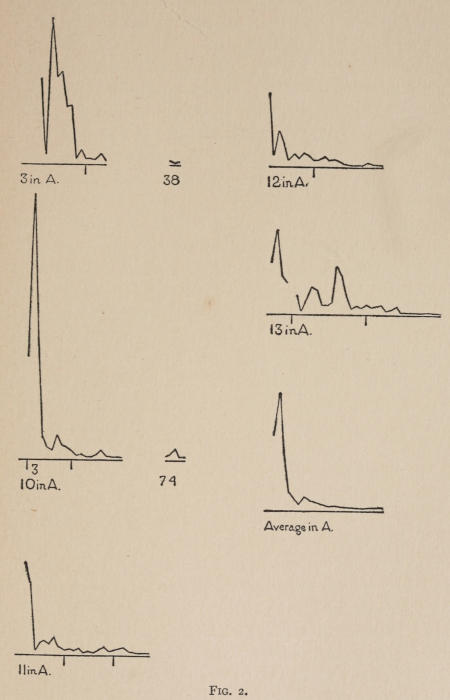
Fig. 2.
The time-curve is obviously a fair representation of the progress of the formation of the association, for the two essential factors in the latter are the disappearance of all activity save the particular sort which brings success with it, and perfection of that particular sort of act so that it is done precisely and at will. Of these the second is, on deeper analysis, found to be a part of the first; any clawing at a loop except the particular claw which depresses it is theoretically a useless activity. If we stick to the looser phraseology, however, no harm will be done. The combination of these two factors is inversely proportional to the time taken, provided the animal surely wants to get out at once. This was rendered almost certain by the degree of hunger. Theoretically a perfect association is formed when both factors are perfect,—when the animal, for example, does nothing but claw at the loop, and claws at it in the most useful way for the purpose. In some cases (e.g. 2 in K on page 53) neither factor ever gets perfected in a great many trials. In some cases the first factor does but the second does not, and the cat goes at the thing not always in the desirable way. In all cases there is a fraction of the time which represents getting oneself together after being dropped in the box, and realizing where one is. But for our purpose all these matters count little, and we may take the general slope of the curve as representing very fairly the progress of the association. The slope of any particular part of it may be due to accident. Thus, very often the second experience may have a higher time-point than the first, because the first few successes may all be entirely due to accidentally hitting the loop, or whatever it is, and whether the accident will happen sooner in one trial than another is then a matter of chance. Considering the general slope, it is, of course, apparent that a gradual descent—say, from initial times of 300 sec. to a constant time of 6 or 8 sec. in the course of 20 to 30 trials—represents a difficult association; while an abrupt descent, say in 5 trials, from a similar initial height, represents a very easy association. Thus, 2 in Z, on page 57, is a hard, and 1 in I, on page 49, an easy association.
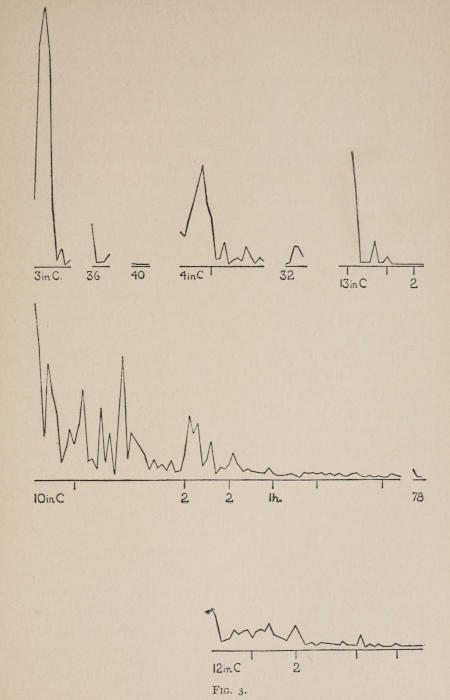
Fig. 3.
In boxes A, C, D, E, I, 100 per cent of the cats given a chance to do so, hit upon the movement and formed the association. The following table shows the results where some cats failed:—
Table 1
No. Cats Tried No. Cats Failed
F 5 4
G 8 5
H 9 2
J 5 2
K 5 2
The time-curves follow. By referring to the description of apparatus they will be easily understood. Each mm. along the abscissa represents one trial. Each mm. above it represents 10 seconds.
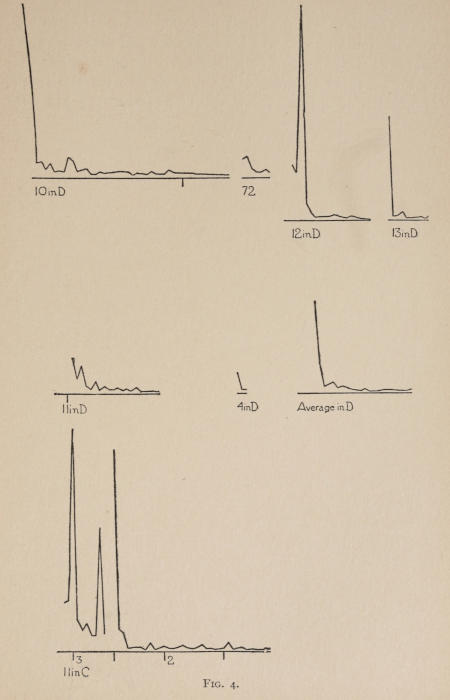
Fig. 4.
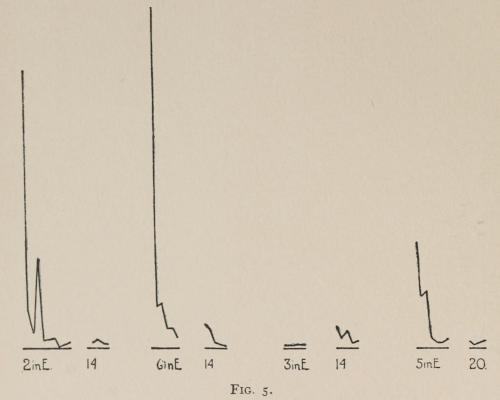
Fig. 5.
These time-curves show, in the first place, what associations are easy for an animal to form, and what are hard. The act must be one which the animal will perform in the course of the activity which its inherited equipment incites or its previous experience has connected with the sense-impression of a box’s interior. The oftener the act naturally occurs in the course of such activity, the sooner it will be performed in the first trial or so, and this is one condition, sometimes, of the ease of forming the association. For if the first few successes are five minutes apart, the influence of one may nearly wear off before the next, while if they are forty seconds apart the influences may get summated. But this is not the only or the main condition of the celerity with which an association may be formed. It depends also on the amount of attention given to the act. An act of the sort likely to be well attended to will be learned more quickly. Here, too, accident may play a part, for a cat may merely happen to be attending to its paw when it claws. The kind of acts which insure attention are those where the movement which works the mechanism is one which the cat makes definitely to get out. Thus A (O at front) is easier to learn than C (button), because the cat does A in trying to claw down the front of the box and so is attending to what it does; whereas it does C generally in a vague scramble along the front or while trying to claw outside with the other paw, and so does not attend to the little unimportant part of its act which turns the button round. Above all, simplicity and definiteness in the act make the association easy. G (thumb latch), J (double) and K and L (triples) are hard, because complex. E is easy, because directly in the line of the instinctive impulse to try to pull oneself out of the box by clawing at anything outside. It is thus very closely attended to. The extreme of ease is reached when a single experience stamps the association in so completely that ever after the act is done at once. This is approached in I and E.
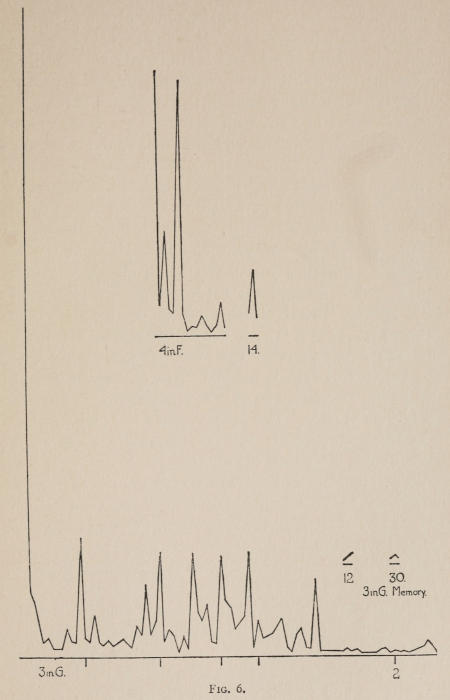
Fig. 6.
In these experiments the sense-impressions offered no difficulty one more than the other.
Vigor, abundance of movements, was observed to make differences between individuals in the same association. It works by shortening the first times, the times when the cat still does the act largely by accident. Nos. 3 and 4 show this throughout. Attention, often correlated with lack of vigor, makes a cat form an association more quickly after he gets started. No. 13 shows this somewhat. The absence of a fury of activity let him be more conscious of what he did do.
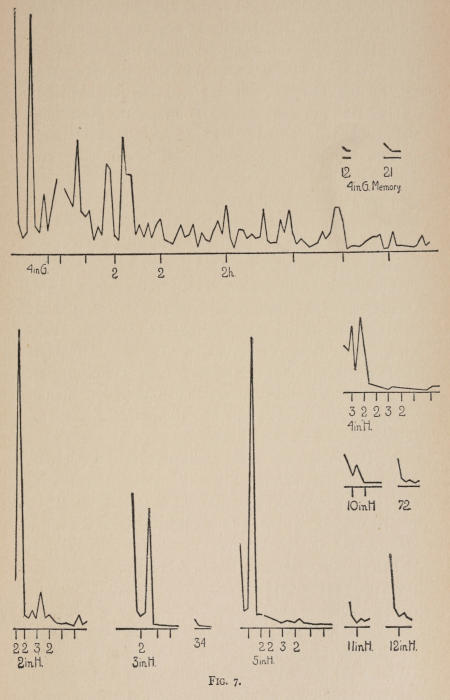
Fig. 7.
The curves on pages 57 and 58, showing the history of cats 1, 5, 13 and 3, which were let out of the box Z when they licked themselves, and of cats 6, 2 and 4, which were let out when they scratched themselves, are interesting because they show associations where there is no congruity (no more to a cat than to a man) between the act and the result. One chick, too, was thus freed whenever he pecked at his feathers to dress them. He formed the association, and would whirl his head round and poke it into his feathers as soon as dropped in the box. There is in all these cases a noticeable tendency, of the cause of which I am ignorant, to diminish the act until it becomes a mere vestige of a lick or scratch. After the cat gets so that it performs the act soon after being put in, it begins to do it less and less vigorously. The licking degenerates into a mere quick turn of the head with one or two motions up and down with tongue extended. Instead of a hearty scratch, the cat waves its paw up and down rapidly for an instant. Moreover, if sometimes you do not let the cat out after this feeble reaction, it does not at once repeat the movement, as it would do if it depressed a thumb piece, for instance, without success in getting the door open. Of the reason for this difference I am again ignorant.
Previous experience makes a difference in the quickness with which the cat forms the associations. After getting out of six or eight boxes by different sorts of acts the cat’s general tendency to claw at loose objects within the box is strengthened and its tendency to squeeze through holes and bite bars is weakened; accordingly it will learn associations along the general line of the old more quickly. Further, its tendency to pay attention to what it is doing gets strengthened, and this is something which may properly be called a change in degree of intelligence. A test was made of the influence of experience in this latter way by putting two groups of cats through I (lever), one group (1, 2, 3, 4, 5) after considerable experience, the other (10, 11, 12) after experience with only one box. As the act in I was not along the line of the acts in previous boxes, and as a decrease in the squeezings and bitings would be of little use in the box as arranged, the influence of experience in the former way was of little account. The curves of all are shown on page 49.
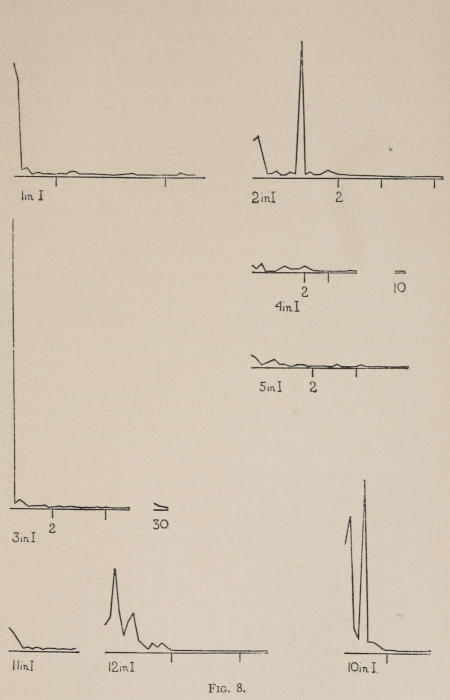
Fig. 8.
If the whole set of curves are examined in connection with the following table, which gives the general order in which each animal took up the different associations which he eventually formed, many suggestions of the influence of experience will be met with. The results are not exhaustive enough to justify more than the general conclusion that there is such an influence. By taking more individuals and thus eliminating all other factors besides experience, one can easily show just how and how far experience facilitates association.
When, in this table, the letters designating the boxes are in italics it means that, though the cat formed the association, it was in connection with other experiments and so is not recorded in the curves.
Table 2
Cat 1 A B C D₁ D Z I
Cat 2 C D₁ D E Z H J I K
Cat 3 A C E G H J Z I K
Cat 4 C F G D Z H J I K
Cat 5 C E Z H I
Cat 6 A C E Z
Cat 7 A C
Cat 10 C I A H D L
Cat 11 C I A H D L
Cat 12 C I A H D L
Cat 13 A C D G Z
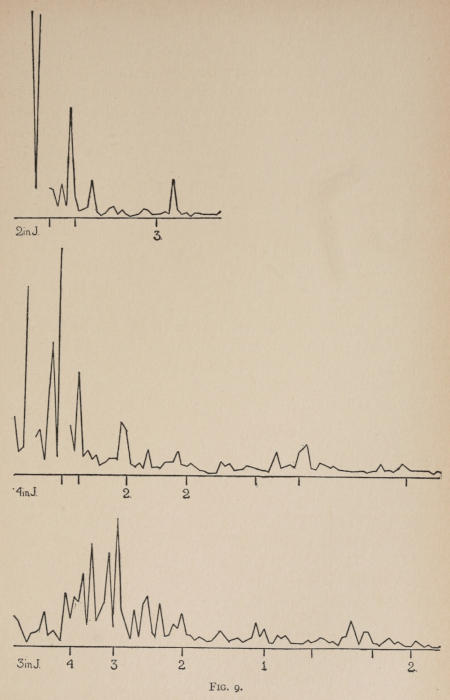
Fig. 9.
The advantage due to experience in our experiments is not, however, the same as ordinarily in the case of trained animals. With them the associations are with the acts or voice of man or with sense-impressions to which they naturally do not attend (e.g. figures on a blackboard, ringing of a bell, some act of another animal). Here the advantage of experience is mainly due to the fact that by such experience the animals gain the habit of attending to the master’s face and voice and acts and to sense-impressions in general.
I made no attempt to find the differences in ability to acquire associations due to age or sex or fatigue or circumstances of any sort. By simply finding the average slope in the different cases to be compared, one can easily demonstrate any such differences that exist. So far as this discovery is profitable, investigation along this line ought now to go on without delay, the method being made clear. Of differences due to differences in the species, genus, etc., of the animals I will speak after reviewing the time-curves of dogs and chicks.
In the present state of animal psychology there is another value to these results which was especially aimed at by the investigator from the start. They furnish a quantitative estimate of what the average cat can do, so that if any one has an animal which he thinks has shown superior intelligence or perhaps reasoning power, he may test his observations and opinion by taking the time-curves of the animal in such boxes as I have described.
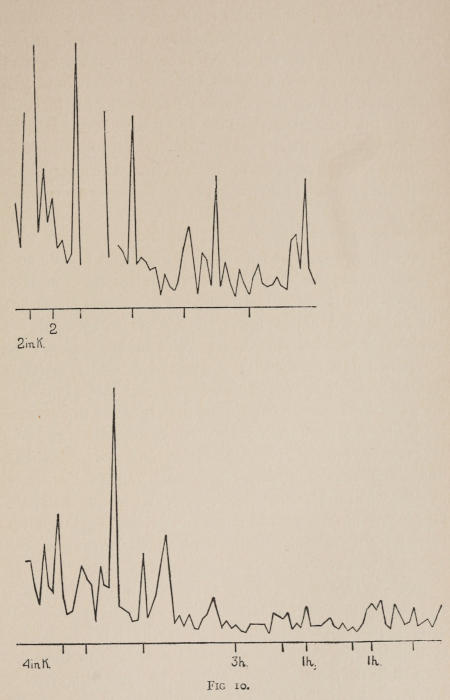
Fig. 10.
If his animal in a number of cases forms the associations very much more quickly, or deals with the situation in a more intelligent fashion than my cats did, then he may have ground for claiming in his individual a variation toward greater intelligence and, possibly, intelligence of a different order. On the other hand, if the animal fails to rise above the type in his dealings with the boxes, the observer should confess that his opinion of the animal’s intelligence may have been at fault and should look for a correction of it.
We have in these time-curves a fairly adequate measure of what the ordinary cat can do, and how it does it, and in similar curves soon to be presented a less adequate measure of what a dog may do. If other investigators, especially all amateurs who are interested in animal intelligence, will take other cats and dogs, especially those supposed by owners to be extraordinarily intelligent, and experiment with them in this way, we shall soon get a notion of how much variation there is among animals in the direction of more or superior intelligence. The beginning here made is meager but solid. The knowledge it gives needs to be much extended. The variations found in individuals should be correlated, not merely with supposed superiority in intelligence, a factor too vague to be very serviceable, but with observed differences in vigor, attention, memory and muscular skill. No phenomena are more capable of exact and thorough investigation by experiment than the associations of animal consciousness. Never will you get a better psychological subject than a hungry cat. When the crude beginnings of this research have been improved and replaced by more ingenious and adroit experimenters, the results ought to be very valuable.
Surely every one must agree that no man now has a right to advance theories about what is in animals’ minds or to deny previous theories unless he supports his thesis by systematic and extended experiments. My own theories, soon to be proclaimed, will doubtless be opposed by many. I sincerely hope they will, provided the denial is accompanied by actual experimental work. In fact, I shall be tempted again and again in the course of this book to defend some theory, dubious enough to my own mind, in the hope of thereby inducing some one to oppose me and in opposing me to make the experiments I have myself had no opportunity to make yet. Probably there will be enough opposition if I confine myself to the theories I feel sure of.
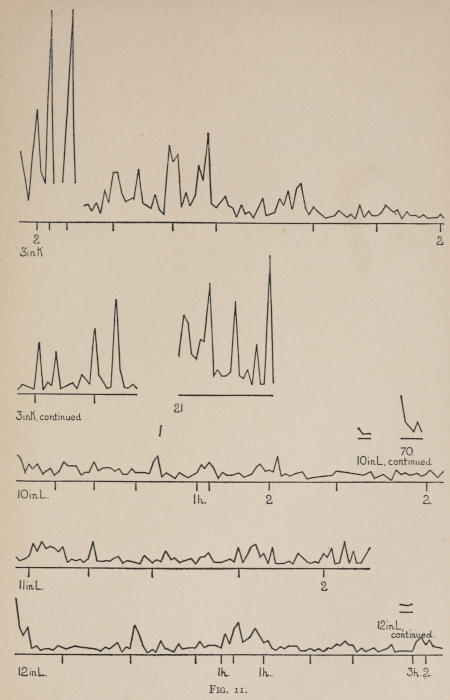
Fig. 11.
Experiments with Dogs
The boxes used were as follows:
AA was similar to A (O at front), except that the loop was of stiff cord ⅜ inch in diameter and was larger (3½ inches diameter); also it was hung a foot from the floor and 8 inches to the right of the door. The box itself was 41 × 20 × 23.
BB was similar to B, the loop being the same as in AA, and being hung a foot from the floor. The box was of the same size and shape as AA.
BB1 was like BB, but the loop was hung 18 inches from the floor.
CC was similar to C (button), but the button was 6 inches long, and the box was 36½ × 22 × 23.
II was similar to I, but the box was 30 × 20 × 25 inches; the door (11 inches wide, 6 high) was in the left front corner, and the lever was 6 inches long and entered the box at a point 2 inches to the right of the door and 4 inches above the floor.
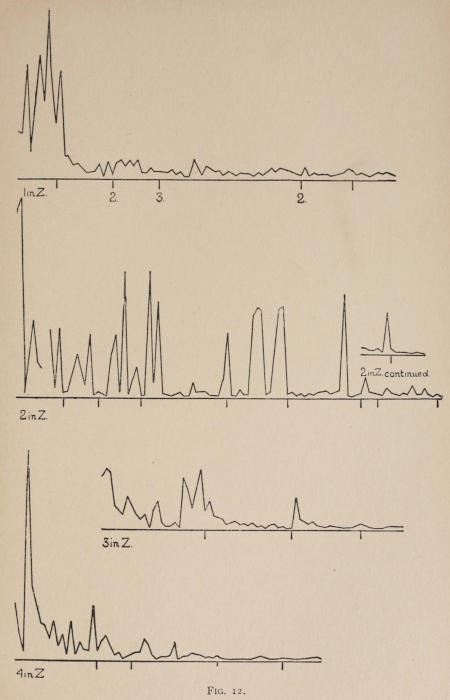
Fig. 12.
In M the same box as in II was used, but instead of a lever projecting inside the box, a lever running outside parallel to the plane of the front of the box and 18 inches long was used. This lay close against the bars composing the front of the box, and could be pawed down by sticking the paw out an inch or so between two bars, at a point about 15 inches high and 6 inches in from the right edge of the front. We may call M ‘Lever outside.’
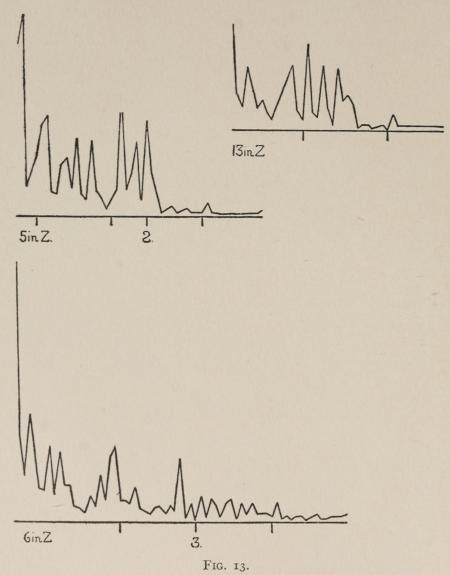
Fig. 13.
N was a pen 5 × 3 feet made of wire netting 46 inches high. The door, 31 × 20, was in the right half of the front. A string from the bolt passed up over a pulley and back to the back center, where it was fastened 33 inches above the floor. Biting or pawing this string opened the door.
O was like K, except that there was only one bar, that the string ran inside the box, so that it was easily accessible, and that the bolt raised in K by depression of the platform could be raised in O (and was by the dog experimented on) by sticking the muzzle out between two bars just above the bolt and by biting the string, at the same time jerking it upward. O was 30 × 20 × 25 in size.
The box G was used for both dogs and cats, without any variation save that for dogs the resistance of the door to pressure outwards was doubled.
In these boxes were put in the course of the experiments dog 1 (about 8 months old), and dogs 2 and 3, adults, all of small size.
A dog who, when hungry, is shut up in one of these boxes is not nearly so vigorous in his struggles to get out as is the young cat. And even after he has experienced the pleasure of eating on escape many times he does not try to get out so hard as a cat, young or old. He does try to a certain extent. He paws or bites the bars or screening, and tries to squeeze out in a tame sort of way. He gives up his attempts sooner than the cat, if they prove unsuccessful. Furthermore his attention is taken by the food, not the confinement. He wants to get to the food, not out of the box. So, unlike the cat, he confines his efforts to the front of the box. It was also a practical necessity that the dogs should be kept from howling in the evening, and for this reason I could not use as motive the utter hunger which the cats were made to suffer. In the morning, when the experiments were made, the dogs were surely hungry, and no experiment is recorded in which the dog was not in a state to be willing to make a great effort for a bit of meat, but the motive may not have been even and equal throughout, as it was with the cats.
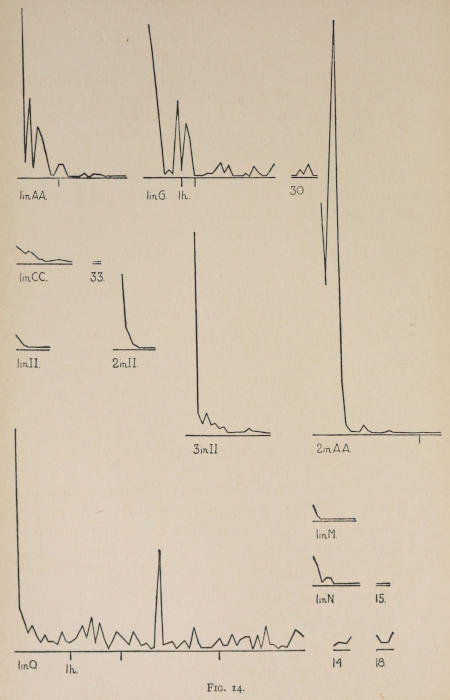
Fig. 14.
The curves on page 60 are to be interpreted in the same way as those for the cats, and are on the same scale. The order in which No. 1 took up the various associations was AA, BB, BB1, G, N, CC, II, O.
The percentage of dogs succeeding in the various boxes is given below, but is of no consequence, because so few were tried, and because the motive, hunger, was not perhaps strong enough, or equal in all cases.
In AA 3 out of 3.
In BB 0 out of 2 (that is, without previous experience of AA).
In CC 1 out of 2.
In II 3 out of 3.
In M 1 out of 2.
In N 1 out of 3.
In G 1 out of 3.
Experiments with Chicks
The apparatus was as follows:
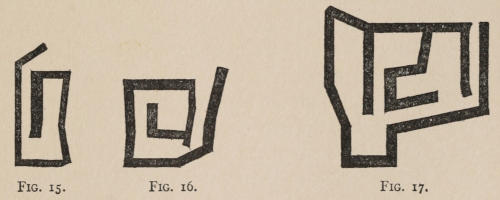
Fig. 15. Fig. 16. Fig. 17.
P was simply a small pen arranged with two exits, one leading to the inclosure where were the other chicks and food, one leading to another pen with no exit. The drawing (Fig. 15 on this page) explains itself. A chick was placed at A and left to find its way out. The walls were made of books stuck up on end.
Q was a similar pen arranged so that the real exit was harder to find. (See Fig. 16.)
R was still another pen similarly constructed, with four possible avenues to be taken. (See Fig. 17.)
S was a pen with walls 11 inches high. On the right side an inclined plane of wire screening led from the floor of the pen to the top of its front wall. Thence the chick could jump down to where its fellows and the food and drink were. S was 17 × 14 in size.
T was a pen of the same size as S, with a block of wood 3 inches by 3 and 2 inches high in the right back corner. From this an inclined plane led to the top of the front wall (on the right side of the box). But a partition was placed along the left edge of this plane, so that a chick could reach it only via the wooden block, not by a direct jump.
U was a pen 16 × 14 × 10 inches. Along the back toward the right corner were placed a series of steps 1½ inches wide, the first 1, the second 2, and the third 3 inches high. In the corner was a platform 4 × 4, and 4 high, from which access to the top of the front wall of the pen could be gained by scrambling up inside a stovepipe 11 inches long, inclined upward at an angle of about 30°. From the edge of the wall the chick could, of course, jump down to food and society. The top of the pen was covered so that the chick could not from the platform jump onto the edge of the stovepipe or the top of the pen wall. The only means of exit was to go up the steps to the platform, up through the stovepipe to the front wall, and then jump down.
The time-curves for chicks 90, 91, 92, 93, 94 and 95, all 2-8 days old when experimented on, follow on page 65. The scale is the same as that in the curves of the cats and dogs. Besides these simple acts, which any average chick will accidentally hit upon and associate, there are, in the records of my preliminary study of animal intelligence, a multitude of all sorts of associations which some chicks have happened to form. Chicks have escaped from confinement by stepping on a little platform in the back of the box, by jumping up and pulling a string like that in D, by pecking at a door, by climbing up a spiral staircase and out through a hole in the wall, by doing this and then in addition walking across a ladder for a foot to another wall from which they jump down, etc. Not every chick will happen upon the right way in these cases, but the chicks who did happen upon it all formed the associations perfectly after enough trials.
The behavior of the chicks shows the same general character as that of the cats, conditioned, of course, by the different nature of the instinctive impulses. Take a chick put in T (inclined plane) for an example. When taken from the food and other chicks and dropped into the pen he shows evident signs of discomfort; he runs back and forth, peeping loudly, trying to squeeze through any openings there may be, jumping up to get over the wall, and pecking at the bars or screen, if such separate him from the other chicks. Finally, in his general running around he goes up the inclined plane a way. He may come down again, or he may go on up far enough to see over the top of the wall. If he does, he will probably go running up the rest of the way and jump down. With further trials he gains more and more of an impulse to walk up an inclined plane when he sees it, while the vain running and pecking, etc., are stamped out by the absence of any sequent pleasure. Finally, the chick goes up the plane as soon as put in. In scientific terms this history means that the chick, when confronted by loneliness and confining walls, responds by those acts which in similar conditions in nature would be likely to free him. Some one of these acts leads him to the successful act, and the resulting pleasure stamps it in. Absence of pleasure stamps all others out. The case is just the same as with dogs and cats. The time-curves are shown in Fig. 18.
Coming now to the question of differences in intelligence between the different animals, it is clear that such differences are hard to estimate accurately. The chicks are surely very much slower in forming associations and less able to tackle hard ones, but the biggest part of the difference between what they do and what the dogs and cats do is not referable so much to any difference in intelligence as to a difference in their bodily organs and instinctive impulses. As between dogs and cats, the influence of the difference in quantity of activity, in the direction of the instinctive impulses, in the versatility of the fore limb, is hard to separate from the influence of intelligence proper. The best practical tests to judge such differences in general would be differences in memory, which are very easily got at, differences in the delicacy and complexity attainable, and, of course, differences in the slope of the curves for the same association. If all these tests agreed, we should have a right to rank one animal above the other in a scale of intelligence. But this whole question of grading is, after all, not so important for comparative psychology as its popularity could lead one to think. Comparative psychology wants first of all to trace human intellection back through the phylum to its origin, and in this aim is helped little by knowing that dogs are brighter than cats, or whales than seals, or horses than cows. Further, the whole question of ‘intelligence’ should be resolved into particular inquiries into the development of attention, activity, memory, etc.
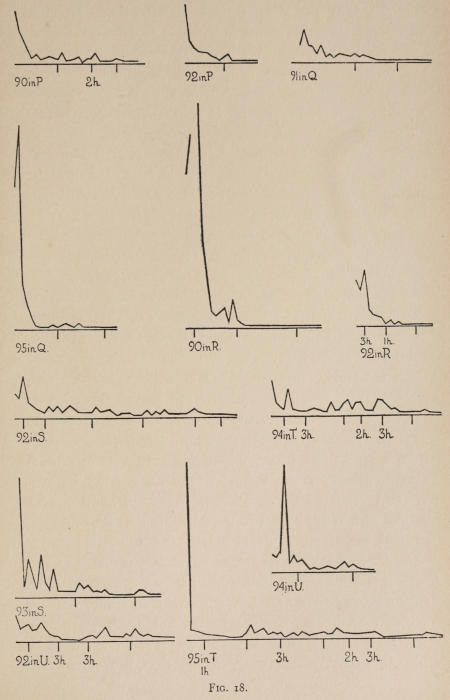
Fig. 18.
So far as concerns dogs and cats, I should decide that the former were more generally intelligent. The main reason, however, why dogs seem to us so intelligent is not a good reason for the belief. It is because, more than any other domestic animal, they direct their attention to us, to what we do, and so form associations connected with acts of ours.
Having finished our attempt to give a true description of the facts of association, so far as observed from the outside, we may now progress to discuss its inner nature. A little preface about certain verbal usages is necessary before doing so. Throughout I shall use the word ‘animal’ or ‘animals,’ and the reader might fancy that I took it for granted that the associative processes were the same in all animals as in these cats and dogs of mine. Really, I claim for my animal psychology only that it is the psychology of just these particular animals. What this warrants about animals in general may be left largely to the discretion of the reader. As I shall later say, it is probable that in regard to imitation and the power of forming associations from a lot of free ideas, the anthropoid primates are essentially different from the cats and dogs.
The reasons why I say ‘animals’ instead of ‘dogs and cats of certain ages’ are two. I do think that the probability that the other mammals, barring the primates, offer no objections to the theories here advanced about dogs and cats is a very strong probability, strong enough to force the burden of proof upon any one who should, for instance, say that horse-goat psychology was not like cat-dog psychology in these general matters. I should claim that, till the contrary was shown in any case, my statements should stand for the mammalian mind in general, barring the primates. My second reason is that I hate to burden the reader with the disgusting rhetoric which would result if I had to insert particularizations and reservations at every step. The word ‘animal’ is too useful, rhetorically, to be sacrificed. Finally, inasmuch as most of my theorizing will be in the line of denying certain relatively high functions to animals, the evidence from cats and dogs is sufficient, for they are from among the most intelligent animals, and functions of the kind to be discussed, if absent in their case, are probably absent from the others.
Reasoning or Inference
The first great question is whether or not animals are ever led to do any of their acts by reasoning. Do they ever conclude from inference that a certain act will produce a certain desired result, and so do it? The best opinion has been that they do not. The best interpretation of even the most extraordinary performances of animals has been that they were the result of accident and association or imitation. But it has after all been only opinion and interpretation, and the opposite theory persistently reappears in the literature of the subject. So, although it is in a way superfluous to give the coup de grâce to the despised theory that animals reason, I think it is worth while to settle this question once for all.
The great support of those who do claim for animals the ability to infer has been their wonderful performances which resemble our own. These could not, they claim, have happened by accident. No animal could learn to open a latched gate by accident. The whole substance of the argument vanishes if, as a matter of fact, animals do learn those things by accident. They certainly do. In this investigation choice was made of the intelligent performances described by Romanes in the following passages. I shall quote at some length because these passages give an admirable illustration of an attitude of investigation which this research will, I hope, render impossible for any scientist in the future. Speaking of the general intelligence of cats, Romanes says:
“Thus, for instance, while I have only heard of one solitary case ... of a dog which, without tuition, divined the use of a thumb latch so as to open a closed door by jumping on the handle and depressing the thumb-piece, I have received some half-dozen instances of this display of intelligence on the part of cats. These instances are all such precise repetitions of one another that I conclude the fact to be one of tolerably ordinary occurrence among cats, while it is certainly rare among dogs. I may add that my own coachman once had a cat which, certainly without tuition, learnt thus to open a door that led into the stables from a yard into which looked some of the windows of the house. Standing at these windows when the cat did not see me, I have many times witnessed her modus operandi. Walking up to the door with a most matter-of-course kind of air, she used to spring at the half hoop handle just below the thumb latch. Holding on to the bottom of this half-hoop with one fore paw, she then raised the other to the thumb piece, and while depressing the latter finally with her hind legs scratched and pushed the door posts so as to open the door....
“Of course in all such cases the cats must have previously observed that the doors are opened by persons placing their hands upon the handles and, having observed this, the animals act by what may be strictly termed rational imitation. But it should be observed that the process as a whole is something more than imitative. For not only would observation alone be scarcely enough (within any limits of thoughtful reflection that it would be reasonable to ascribe to an animal) to enable a cat upon the ground to distinguish that the essential part of the process consists not in grasping the handle, but in depressing the latch; but the cat certainly never saw any one, after having depressed the latch, pushing the door posts with his legs; and that this pushing action is due to an originally deliberate intention of opening the door, and not to having accidentally found this action to assist the process, is shown by one of the cases communicated to me; for in this case, my correspondent says, ‘the door was not a loose-fitting one, by any means, and I was surprised that by the force of one hind leg she should have been able to push it open after unlatching it.’ Hence we can only conclude that the cats in such cases have a very definite idea as to the mechanical properties of a door: they know that to make it open, even when unlatched, it requires to be pushed—a very different thing from trying to imitate any particular action which they may see to be performed for the same purpose by man. The whole psychological process, therefore, implied by the fact of a cat opening a door in this way is really most complex. First the animal must have observed that the door is opened by the hand grasping the handle and moving the latch. Next she must reason, by ‘the logic of feelings’—‘If a hand can do it, why not a paw?’ Then strongly moved by this idea she makes the first trial. The steps which follow have not been observed, so we cannot certainly say whether she learns by a succession of trials that depression of the thumb piece constitutes the essential part of the process, or, perhaps more probably, that her initial observations supplied her with the idea of clicking the thumb piece. But, however this may be, it is certain that the pushing with the hind feet after depressing the latch must be due to adaptive reasoning unassisted by observation; and only by the concerted action of all her limbs in the performance of a highly complex and most unnatural movement is her final purpose attained.” (Animal Intelligence, pp. 420-422.)
A page or two later we find a less ponderous account of a cat’s success in turning aside a button and so opening a window:—
“At Parara, the residence of Parker Bowman, Esq., a full-grown cat was one day accidentally locked up in a room without any other outlet than a small window, moving on hinges, and kept shut by means of a swivel. Not long afterwards the window was found open and the cat gone. This having happened several times, it was at last found that the cat jumped upon the window sill, placed her fore paws as high as she could reach against the side, deliberately reached with one over to the swivel, moved it from its horizontal to a vertical position, and then, leaning with her whole weight against the window, swung it open and escaped.” (Animal Intelligence, p. 425.)
A description has already been given on page 31 of the small box (C), whose door fell open when the button was turned, and also of a large box (CC) for the dogs, with a similar door. The thumb-latch experiment was carried on with the same box (G) for both cats and dogs, but the door was arranged so that a greater force (1.3 kilograms) was required in the case of the dogs. It will be remembered that the latch was so fixed that if the thumb piece were pressed down, without contemporaneous outward pressure of the door, the latch bar would merely drop back into its catch as soon as the paw was taken off the door. If, however, the door were pushed outward, the latch bar, being pressed closely against the outer edge of its catch, would, if lifted, be likely to fall outside it and so permit the door to open if then or later sufficient pressure were exerted. Eight cats (Nos. 1, 2, 3, 4, 5, 6, 7 and 13) were, one at a time, left in this thumb-latch box. All exhibited the customary instinctive clawings and squeezings and bitings. Out of the eight all succeeded in the course of their vigorous struggles in pressing down the thumb piece, so that if the door had been free to swing open, they could have escaped. Six succeeded in pushing both thumb-piece down and door out, so that the bar did not fall back into its place. Of these five succeeded in also later pushing the door open, so that they escaped and got the fish outside. Of these, three, after repeated trials, associated the complicated movements required with the sight of the interior of the box so firmly that they attacked the thumb latch the moment they were put in. The history of the formation of the association in the case of 3 and of 4 is shown in the curves in Figs. 6 and 7. In the case of 13 the exact times were not taken. The combination of accidents required was enough to make No. 1 and No. 6 take a long time to get out. Consequently, weariness and failure inhibited their impulses to claw, climb, etc., more than the rare pleasure from getting out strengthened them, and they failed to form the association. Like the cats who utterly failed to get out, they finally ceased to try when put in. The history of their efforts is as in Table 3: the figures in the columns represent the time (in minutes and seconds) the animal was in the box before escaping or before being taken out if he failed to escape. Cases of failure are designated by an F after the figures. Double lines represent an interval of twenty-four hours.
Table 3
No. 1. No. 6.
13.00 F 17.50
9.30 3.30
1.40 9.00
.50 2.10
15.00 1.45
6.00 F 1.55
14.00 13.00
20.00 F 5.00
4.30 2.30
20.00 F 15.00
20.00 F 10.00 F
15.00 F 5.00
60.00 F 15.00 F
10.00 F
10.00 F
It should be noted that, although cats 3 and 4 had had some experience in getting out of boxes by clawing at loops and turning buttons, they had never had anything at all like a thumb latch to claw at, nor had they ever seen the door opened by its use, nor did they even have any experience of the fact that the part of the box where the thumb piece was was the door. And we may insert here, what will be stated more fully later, that there was displayed no observation of the surroundings or deliberation upon them. It was just a mad scramble to get out.
Three dogs (1, 2 and 3) were given a chance to liberate themselves from this same box. 2 and 3, who were rather inactive, failed to even push the thumb piece down. No. 1, who was very active, did push it down at the same time that she happened to be pushing against the door. She repeated this and formed the association as shown in the curve on page 60. She had had experience only of escaping by pulling a loop of string.
Out of 6 cats who were put in the box whose door opened by a button, not one failed, in the course of its impulsive activity, to push the button around. Sometimes it was clawed to one side from below; sometimes vigorous pressure on the top turned it around; sometimes it was pushed up by the nose. No cat who was given repeated trials failed to form a perfect association between the sight of the interior of that box and the proper movements. Some of these cats had been in other boxes where pulling a loop of string liberated them, 3 and 4 had had considerable experience with the boxes and probably had acquired a general tendency to claw at loose objects. 10, 11 and 12 had never been in any box before. The curves are on pages 41 and 43.
Of two dogs, one, when placed in a similar but larger box, succeeded in hitting the button in such a way as to let the door open, and formed a permanent association, as shown by the curves on page 41. No one who had seen the behavior of these animals when trying to escape could doubt that their actions were directed by instinctive impulses, not by rational observation. It is then absolutely sure that a dog or cat can open a door closed by a thumb latch or button, merely by the accidental success of its natural impulses. If all cats, when hungry and in a small box, will accidentally push the button that holds the door, an occasional cat in a large room may very well do the same. If three cats out of eight will accidentally press down a thumb piece and push open a small door, three cats out of a thousand may very well open doors or gates in the same way.
But besides thus depriving of their value the facts which these theorizers offer as evidence, we may, by a careful examination of the method of formation of these associations as it is shown in the time-curves, gain positive evidence that no power of inference was present in the subjects of the experiments. Surely if 1 and 6 had possessed any power of inference, they would not have failed to get out after having done so several times. Yet they did. (See p. 71.) If they had once even, much less if they had six or eight times, inferred what was to be done, they should have made the inference the seventh or ninth time. And if there were in these animals any power of inference, however rudimentary, however sporadic, however dim, there should have appeared among the multitude some cases where an animal, seeing through the situation, knows the proper act, does it, and from then on does it immediately upon being confronted with the situation. There ought, that is, to be a sudden vertical descent in the time-curve. Of course, where the act resulting from the impulse is very simple, very obvious, and very clearly defined, a single experience may make the association perfect, and we may have an abrupt descent in the time-curve without needing to suppose inference. But if in a complex act, a series of acts or an ill-defined act, one found such a sudden consummation in the associative process, one might very well claim that reason was at work. Now, the scores of cases recorded show no such phenomena. The cat does not look over the situation, much less think it over, and then decide what to do. It bursts out at once into the activities which instinct and experience have settled on as suitable reactions to the situation ‘confinement when hungry with food outside.’ It does not ever in the course of its successes realize that such an act brings food and therefore decide to do it and thenceforth do it immediately from decision instead of from impulse. The one impulse, out of many accidental ones, which leads to pleasure, becomes strengthened and stamped in thereby, and more and more firmly associated with the sense-impression of that box’s interior. Accordingly it is sooner and sooner fulfilled. Futile impulses are gradually stamped out. The gradual slope of the time-curve, then, shows the absence of reasoning. They represent the wearing smooth of a path in the brain, not the decisions of a rational consciousness.
In a later discussion of imitation further evidence that animals do not reason will appear. For the present, suffice it to say, that a dog, or cat, or chick, who does not in his own impulsive activity learn to escape from a box by pulling the proper loop, or stepping on a platform, or pecking at a door, will not learn it from seeing his fellows do so. They are incapable of even the inference (if the process may be dignified by that name) that what gives another food will give it to them also. So, also, it will be later seen that an animal cannot learn an act by being put through it. For instance, a cat who fails to push down a thumb piece and push out the door cannot be taught by having one take its paw and press the thumb piece down with it. This could be learned by a certain type of associative process without inference. Were there inference, it surely would be learned.
Finally, attention may be called to the curves which show the way that the animal mind deals with a series of acts (e.g. curves for G, J, K, L and O, found on pages 45 to 55 and 60). Were there any reasoning the animals ought early to master the method of escape in these cases (see descriptions on pages 31 to 34) so as to do the several acts in order, and not to repeat one after doing it once, or else ought utterly to fail to master the thing. But, in all these experiments, where there was every motive for the use of any reasoning faculty, if such existed, where the animals literally lived by their intellectual powers, one finds no sign of abstraction, or inference, or judgment.
So far I have only given facts which are quite uninfluenced by any possible incompetence or prejudice of the observer. These alone seem to disprove the existence of any rational faculty in the subjects experimented on. I may add that my observations of all the conduct of all these animals during the months spent with them, failed to find any act that even seemed due to reasoning. I should claim that this quarrel ought now to be dropped for good and all,—that investigation ought to be directed along more sensible and profitable lines. I should claim that the psychologist who studies dogs and cats in order to defend this ‘reason’ theory is on a level with a zoölogist who should study fishes with a view to supporting the thesis that they possessed clawed digits. The rest of this account will deal with more promising problems, of which the first, and not the least important, concerns the facts and theories of imitation.
Imitation
To the question, ‘Do animals imitate?’ science has uniformly answered, ‘Yes.’ But so long as the question is left in this general form, no correct answer to it is possible. It will be seen, from the results of numerous experiments soon to be described, that imitation of a certain sort is not possible for animals, and before entering upon that description it will be helpful to differentiate this matter of imitation into several varieties or aspects. The presence of some sorts of imitation does not imply that of other sorts.
There are, to begin with, the well-known phenomena presented by the imitative birds. The power is extended widely, ranging from the parrot who knows a hundred or more articulate sounds to the sparrow whom a patient shoemaker taught to get through a tune. Now, if a bird really gets a sound in his mind from hearing it and sets out forthwith to imitate it, as mocking birds are said at times to do, it is a mystery and deserves closest study. If a bird, out of a lot of random noises that it makes, chooses those for repetition which are like sounds that he has heard, it is again a mystery why, though not as in the previous case a mystery how, he does it. The important fact for our purpose is that, though the imitation of sounds is so habitual, there does not appear to be any marked general imitative tendency in these birds. There is no proof that parrots do muscular acts from having seen other parrots do them. But this should be studied. At any rate, until we know what sort of sounds birds imitate, what circumstances or emotional attitudes these are connected with, how they learn them and, above all, whether there is in birds which repeat sounds any tendency to imitate in other lines, we cannot, it seems to me, connect these phenomena with anything found in the mammals or use them to advantage in a discussion of animal imitation as the forerunner of human. In what follows they will be left out of account, will be regarded as a specialization removed from the general course of mental development, just as the feathers or right aortic arch of birds are particular specializations of no consequence for the physical development of mammals. For us, henceforth, imitation will mean imitation minus the phenomena of imitative birds.
There are also certain pseudo-imitative or semi-imitative phenomena which ought to be considered by themselves. For example, the rapid loss of the fear of railroad trains or telegraph wires among birds, the rapid acquisition of arboreal habits among Australian rodents, the use of proper feeding grounds, etc., may be held to be due to imitation. The young animal stays with or follows its mother from a specific instinct to keep near that particular object, to wit, its mother. It may thus learn to stay near trains, or scramble up trees, or feed at certain places and on certain plants. Actions due to following pure and simple may thus simulate imitation. Other groups of acts which now seem truly imitative may be indirect fruits of some one instinct. This must be kept in mind when one estimates the supposed imitation of parents by young. Further, it is certain that in the case of the chick, where early animal life has been carefully observed, instinct and individual experience between them rob imitation of practically all its supposed influence. Chicks get along without a mother very well. Yet no mother takes more care of her children than the hen. Care in other cases, then, need not mean instruction through imitation.
These considerations may prevent an unreserved acceptance of the common view that young animals get a great number of their useful habits from imitation, but I do not expect or desire them to lead to its summary rejection. I should not now myself reject it, though I think it quite possible that more investigation and experiment may finally reduce all the phenomena of so-called imitation of parents by young to the level of indirect results of instinctive acts.
Another special department of imitation may be at least vaguely marked off: namely, apparent imitation of certain limited sorts of acts which are somewhat frequent in the animal’s life. An example will do better than further definition.
Some sheep were being driven on board ship one at a time. In the course of their progress they had to jump over a hurdle. On this being removed before all had passed it, the next sheep was seen to jump as if to get over a hurdle, and so on for five or six, apparently sure evidence that they imitated the action, each of the one in front. Now, it is again possible that among gregarious animals there may be elaborate connections in the nervous system which allow the sight of certain particular acts in another animal to arouse the innervation leading to those acts, but that these connections are limited. The reactions on this view are specific responses to definite signals, comparable to any other instinctive or associational reaction. The sheep jumps when he sees the other sheep jump, not because of a general ability to do what he sees done, but because he is furnished with the instinct to jump at such a sight, or because his experience of following the flock over boulders and brooks and walls has got him into the habit of jumping at the spot where he sees one ahead of him jump; and so he jumps even though no obstacle be in his way. If due to instinct, the only peculiarity of such a reaction would be that the sense-impression calling forth the act would be the same act as done by another. If due to experience, there would be an exact correspondence to the frequent acts called forth originally by several elements in a sense-impression, one of which is essential, and done afterwards when only the non-essentials are present. These two possibilities have not been sufficiently realized, yet they may contain the truth. On the other hand, these limited acts may be the primitive, sporadic beginnings of the general imitative faculty which we find in man. To this general faculty we may now turn, having cleared away some of the more doubtful phenomena which have shared its name.
It should be kept in mind that an imitative act may be performed quite unthinkingly, as when a man in the mob shouts what the others shout or claps when the others clap; may be done from an inference that since A by doing X makes pleasure for himself, I by doing X may get pleasure for myself; may, lastly, be done from what may be called a transferred association. This process is the one of interest in connection with our general topic, and most of my experiments on imitation were directed to the investigation of it. Its nature is simple. One sees the following sequence: ‘A turning a faucet, A getting a drink.’ If one can free this association from its narrow confinement to A, so as to get from it the association, ‘impulse to turn faucet, me getting a drink,’ one will surely, if thirsty, turn the faucet, though he had never done so before. If one can from an act witnessed learn to do the act, he in some way makes use of the sequence seen, transfers the process to himself; in the common human sense of the word, he imitates. This kind of imitation is surely common in human life. It may be apparent in ontogeny before any power of inference is shown. After that power does appear, it still retains a wide scope, and teaches us a majority, perhaps, of the ordinary accomplishments of our practical life.
Now, as the writers of books about animal intelligence have not differentiated this meaning from the other possible ones, it is impossible to say surely that they have uniformly credited it to animals, and it is profitless to catalogue here their vague statements. Many opposers of the ‘reason’ theory have presupposed such a process and used it to replace reason as the cause of some intelligent performances. The upholders of the reason theory have customarily recognized such a process and claimed to have discounted it in their explanations of the various anecdotes. So we found Mr. Romanes, in the passage quoted, discussing the possibility that such an imitative process, without reason, could account for the facts. In his chapter on Imitation in ‘Habit and Instinct,’ Principal C. Lloyd Morgan, the sanest writer on comparative psychology, seems to accept imitation of this sort as a fact, though he could, if attacked, explain most of his illustrations by the simple forms. The fact is, as was said before, that no one has analyzed or systematized the phenomena, and so one cannot find clear, decisive statements to quote.
At any rate, whether previous authorities have agreed that such a process is present or not, it is worth while to tackle the question; and the formation of associations by imitation, if it occurs, is an important division of the formation of associations in general. The experiments and their results may now be described.
Imitation in Chicks
No. 64 learned to get out of a certain pen (16 × 10 inches) by crawling under the wire screening at a certain spot. There was also a chance to get out by walking up an inclined plane and then jumping down. No. 66 was put in with 64. After 9 minutes 20 seconds, 66 went out by the inclined plane, although 64 had in the meantime crawled out under the screen 9 times. (As soon as he got out and ate a little he was put back.) It was impossible to judge how many of these times 66 really saw 64 do this. He was looking in that direction 5 of the times. So also, in three more trials, 66 used the inclined plane, though 64 crawled under each time. 67 was then tried. In 4 minutes 10 seconds, he crawled under, 64 having done so twice. Being then put in alone, he, without the chance to imitate, still crawled under. So probably he went under when with 64 not by imitation but by accident, just as 64 had learned the thing himself.
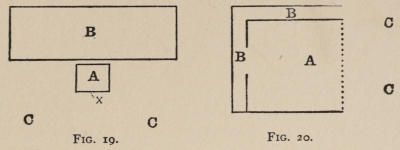
Fig. 19. Fig. 20.
The accompanying figure (19) shows the apparatus used in the next experiment. A represents the top of a box (5 × 4 inches), 13 inches above the level of the floor C. On the floor C were the chicks and food. B is the top of a box 10 inches high. Around the edges of A except the one next B a wire screen was placed, and 65 was repeatedly put upon A until he learned to go quickly back to C via B. Then the screen was bent outward at X so that a chick could barely squeeze through and down (A to C). Eleven chicks were then one at a time placed on A with 65. In every case but one they went A-C. In the case of the chick (75) who went A-B-C, there could have been no imitation, for he went down before 65 did. One other went through the hole before 65 went to B. The remaining nine all had a chance to imitate 65 and to save the uncomfortable struggle to get through the hole, 65 going A-B-C 8 times before 68 went A-C, 2 times when with 66 and 76, once in the case of each of the others.
In still another experiment the apparatus was (as shown in Fig. 20) a pen 14 inches square, 10 inches high, with a wire screen in front and a hole 3½ inches square in the back. This hole opened into a passageway (B) leading around to C, where were the other chicks and food. Chicks who had failed, when put in alone, to find the way out, were put in with other chicks who had learned the way, to see if by seeing them go out they would learn the way. Chick 70 was given 4 trials alone, being left in the box 76 minutes all told. He was then given 9 trials (165 minutes) with another chick who went out via B 36 times. 70 failed to follow him on any occasion. The trials were all given in the course of two days. Chick 73 failed in 1 trial (12 minutes) to get out of himself, and was then given 4 trials (94 minutes) with another chick who went out via B 33 times. In this experiment, as in all others reported, sure evidence that the animals wanted to get out, was afforded by their persistent peckings and jumpings at the screen or bars that stood between them and C. Chick 72, after 8 unsuccessful trials alone (41 minutes), was given 8 trials with a chance to imitate. After the other chick had gone out 44 times, 72 did go out. He did not follow the other but went 20 seconds later. It depends upon one’s general opinion whether one shall attribute this one case out of three to accident or imitation.
I also took two chicks, one of whom learned to escape from A (in Fig. 19) by going to B and jumping down the side to the right of A, the other of whom learned to jump down the side to the left, and placed them together upon A. Each took his own course uninfluenced by the other in 10 trials.
Chicks were also tried in several pens where there was only one possible way of escape to see if they would learn it more quickly when another chick did the thing several times before their eyes. The method was to give some chicks their first trial with an imitation possibility and their second without, while others were given their first trial without and their second with. If the ratio of the average time of the first trial to the average time of the second is smaller in the first class than it is in the second class, we may find evidence of this sort of influence by imitation. Though imitation may not be able to make an animal do what he would otherwise not do, it may make him do quicker a thing he would have done sooner or later any way. As a fact the ratio is much larger. This is due to the fact that a chick, when in a pen with another chick, is not afflicted by the discomfort of loneliness, and so does not try so hard to get out. So the other chick, who is continually being put in with him to teach him the way out, really prolongs his stay in. This factor destroys the value of these quantitative experiments, and I do not insist upon them as evidence against imitation, though they certainly offer none for it. I do not give descriptions of the apparatus used in these experiments or a detailed enumeration of the results, because in this discussion we are not dealing primarily with imitation as a slight general factor in forming experience, but as a definite associational process in the mind. The utter absence of imitation in this limited sense is apparently demonstrated by the results of the following experiments.