CHAP. I. STATE OF PARISH CHILDREN—ANECDOTES OF VARIOUS DESCRIPTIONS OF CHARITY EXERCISED IN LONDON, BETWEEN THE YEARS 1700 AND 1800.
Reading edition
There is something in the composition of the British atmosphere highly congenial to human and animal life: the clouded air and frequent humidity, and consequent coolness, prevent the violent perspirations the natives of finer climates experience; hence the fluids remain in full effect, and expand every part of the frame to its full proportion.
The habits and manner of living at various periods of our history had great influence on the exteriors of our ancestors: when men were forced into armies to repel invaders from Saxony and Denmark, the whole race of Englishmen became either hardened into almost supernatural exertion and strength, or were victims to those chronic diseases which deform the body and destroy the regularity of features; then the youth of each sex experienced privations incident to war, and the whole population must have suffered in the gracefulness of their persons. It required many years of quiet to restore the disorders of the body politic; and those of individuals recovered in the same slow proportion. In the reign of Edward III. Englishmen had again expanded into full military vigour; they marched with the front of Hercules against their enemies, and they maintained their strength and courage beyond the period of our Henry V.
After that reign, I should imagine, their stature diminished, and their countenances assumed a less pleasing form; and we find them bending under the most profligate despotism through the reigns of Henry VII. and VIII. Elizabeth, possessed of equal power, but inclined to use it for the benefit of her subjects, as far as the confined ideas of the time permitted, raised the people nearer to manhood; and her young soldiers waited for the enemy on their coasts, not yet as volunteers, but as defenders of their metropolis for a virtuous arbitrary Monarch.
The sentiments imbibed during this auspicious period, contributed to render domestic life more cheerful than it had hitherto been; the person was enlarged, and became more graceful; discontent fled from the features; and the Londoner, still nearer perfection, at last accomplished those two Revolutions which have for ever banished Despotism, and secured his home—nay made it his castle. See the consequences in the myriads of beautiful infants that smile on every side of him, with the regular and placid lines that mark their faces, and the strait and truly proportioned limbs that distinguish vast numbers of all ranks of people of both sexes.
Still the deformed and pallid are numerous; but deformity and disease in London generally proceed from causes which may be prevented; very confined residences destroy the health of parents and their offspring; the lowest class of inhabitants drink away their comforts, and suffer their children to crawl into manhood.
The highest classes sometimes trust infants to mercenaries; crooked legs and injured spines are too often the consequence: yet we find thousands of males and females, who appear to have been nursed by the Graces, and as far surpass the celebrated statues of the Venus de Medicis and the Apollo Belvidere, as the works of the Creator ever will those of man. When a female of high rank emerges from the controul of her governess, and receives the last polish, I pronounce her an ornament to any Court in Europe.
Those favoured with an opportunity of seeing the 30,000 volunteers assembled at Hyde-park in 1804, determined to fight for their homes, must agree with me that no nation ever produced an equal number together so finely proportioned and handsome.
In confirmation of my assertion that part of the deformity observable in the lower class of people might be prevented, I shall insert a Parliamentary report concerning their children, and show how numbers taken from parents have been disposed of.
"Mr. Whitworth reported from the Committee appointed to inquire into the state of the parish poor infants, under the age of 14 years, within the bills of mortality, and to report their opinion to the House; that the Committee had inquired accordingly, and had come to several resolutions which they had directed him to report to the House. The said Report was read, and is as follows:
"The Committee having examined the registers of the several parishes referred to them by the House, have collected from them the state of the parish infant poor; and find, that taking the children born in workhouses or parish houses, or received of and under 12 months old in the year 1763, and following the same into 1764 and 1765, only seven in one hundred appeared to have survived this short period.
"That having called for the registers of the years 1754, 1755, 1761, 1762, of the children placed out apprentices by the parishes within the bills of mortality, it appears that there have been apprenticed out the number of 1419; but, upon examining the ages at which the said children so placed out were received in the seven years from 1741 till they grew up to be placed out, it appears that only 19 of those born in the workhouses, or received into them under 12 months old, compose any part of the 1419; and even of those received as far as three years old, only 36 appear to have survived in the hands of the said parishes to be placed out apprentices. It appears that the children are kept in the several workhouses in town, or in the hands of parish nurses in town, only a small portion of them being sent into the country to be nursed, and the price of 3s. and 2s. 6d. per week first paid, is often reduced so low as 1s. 6d. and 1s. per week; that it cannot be presumed to be equal to the necessary care of infants.
"Your Committee find the conduct of parish nurses was taken notice of by Parliament in the year 1715; and upon examining also into the recent facts above related, it doth not appear to your Committee that the evil is or can be remedied, unless proper regulations are established by legislative authority. It appears from the evidence of the parish officers of St. Andrew, Holborn (called within the City liberties), and also from Mr. Hutton, a principal inhabitant of that parish, that the sum of 2s. 6d. a week for the article of nursing, is as little as a child can be nursed at to have justice done it; but at the same time, they being sensible of the good conduct and management of the Hospital for the maintenance and education of exposed and deserted young children, they have proposed to the governors and guardians thereof, to receive their infant parish poor at a certain rate, which, by the minutes of the general court of the said Hospital, dated Feb. 18, 1767, which was produced to your Committee and read, the said governors and guardians are ready to comply with, and likewise to forward any general purpose the Legislature may think proper to direct, in relation to the preservation of the infant parish poor within the bills of mortality.
"It appears upon the examination of Saunders Welch, esq. that great inconveniences have been found from parish boys being placed out apprentice so long as till the age of 24; and upon reading the clause in the 43d of Elizabeth, cap. 2, intituled, 'An Act for the relief of the Poor,' in the 5th section thereof it is said, 'Parish officers are to bind their man child to the age of 24, but the woman child to the age of 21, or time of marriage.' This, your Committee thinks, checks marriage, and discourages industry. It appears to your Committee, that the usual sum given by parishes with apprentices, has been generally from 20 to 40s. only, which your Committee think inadequate to the procuring good masters.
"It appears that the register directed to be made out by the Act of the 2d of His present Majesty, intituled, 'An Act for keeping a regular, uniform, and annual register of all parish poor infants under a certain age, within the bills of mortality,' is deficient, by not setting forth how children are disposed of after the age of four years.
"Upon the whole, your Committee came to the following resolutions: That it is the opinion of this Committee, that the parish infant poor, within the bills of mortality, should be sent into the country to be nursed, at a distance not less than a certain number of miles from any part of the town: That it is the opinion of this Committee, that the parish officers should allow and pay a certain sum for nursing each child: That it is the opinion of this Committee, that a proper number of principal inhabitants should be chosen in every parish respectively, under the denomination of Guardians of the parish infant poor, to inspect into the treatment of the said children nursed as above: That it is the opinion of this Committee, that the parish officers, governors, and directors of the poor, should have the alternative of sending such children to the Hospital, for the maintenance and education of exposed and deserted young children; and the governors and guardians thereof be permitted to take them at a certain sum, and to be paid by the said officers for nursing such children out of the parish rates: That it is the opinion of this Committee, that parish children should be placed out apprentice for a shorter time than is by law prescribed: That it is the opinion of this Committee, that a proper sum should be given as apprentice fees with the said parish children: That it is the opinion of this Committee, that the register of infant poor under four years of age, should be continued on till the children are in the same manner disposed of in the world.
"These resolutions were agreed to by the House, and a bill ordered."
It appears from a return inserted in the Journals of the House of Commons, 1778, that, in the preceding eleven years, the following was the state of the reception and discharge of parish children in the parishes mentioned, from which an accurate estimate may be formed for the rest of London.
Children under 6 years old. Died. Returned to their parents. Apprenticed.
St. Giles in the Fields, and St. George Bloomsbury 1479 177 956 319
St. Margaret and St. John, Westminster 1109 181 766 172
St. Anne, Westminster 324 100 152 76
St. James, Westminster 861 215 250 243
St. Clement Danes 257 113 84 89
St. Andrew, Holborn, and St. George Martyr 756 137 308 207
Saffron Hill 231 30 82 95
St. James, Clerkenwell 701 104 456 116
St. Mary, Whitechapel 449 69 102 286
St. Saviour's, Southwark 539 105 205 187
St. Leonard, Shoreditch 586 99 178 185
St. John, Southwark 154 48 65 127
St. Luke, Old-street 421 103 103 234
St. Botolph, Aldgate 297 90 130 101
St. Martin in the Fields 1512 463 736 321
St. Paul, Covent-garden 51 8 27 36
—— —— —— ——
9727 2042 4600 2794
—— —— —— ——
Children, nursed as the above authentic documents prove they were, cannot but have been checked in their growth; and perhaps many of them are at this moment part of the miserable objects we daily see in the streets. The exercise of a little humanity may prevent similar evils in future.
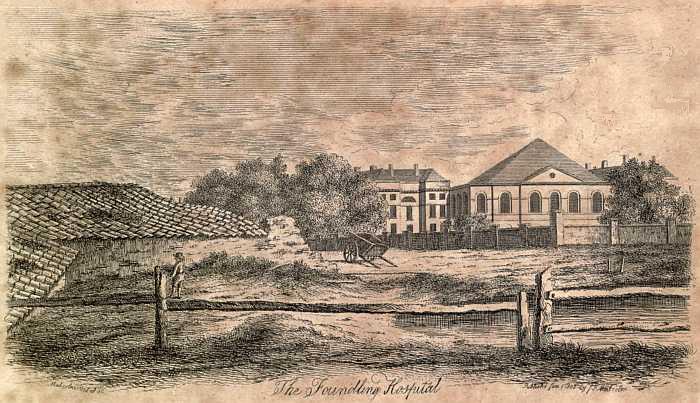
There is an admirable example, which has long been established for our imitation, where the offspring of vice and humble virtue, equally innocent, are received and nurtured with the utmost care, and where human nature is rescued from debasement, corporeal and mental. Let the reader reflect on the thousands originally preserved, and their descendants rendered happy, through the god-like benevolence of Captain Coram; and he will immediately recollect the Foundling Hospital.
In consequence of that worthy man's petition, George II. granted a Charter of incorporation, which authorised Charles duke of Richmond, and several other eminent persons, to purchase lands, &c. in mortmain, to the annual amount of 4000l. to be applied to the maintenance and education of exposed and deserted infants.
The first quarterly general meeting of the Corporation was held December 26, 1739, when subscription-books were ordered to be opened at the Bank of England and various bankers, for inserting the names of annual contributors. The governors and guardians then amounted to near 400, who unanimously determined to vote their thanks to Captain Coram; but he declined them, and modestly requested they might be transferred to those ladies whose subscriptions had enabled him to procure the Charter. This proposal was acceded to, and the benevolent Captain deputed to convey them.
Montague house, now the British Museum, had been thought by the governors in 1740, an eligible receptacle for the objects of the intended charity; but Messrs. Fazakerly, and the Attorney and Solicitor Generals, to whom the matter was referred, gave it as their opinion that the expence of obtaining those extensive premises would be too great. The governors resolved, in consequence, to open subscriptions for the purchase of land on which to erect an hospital, and in the mean time to receive sixty children in a temporary receptacle.
They accomplished their wishes in the following December, by obtaining 56 acres North of Ormond-street, of the earl of Salisbury, for 7000l. the present site of the Foundling hospital, Guildford-street, &c. On the 25th of March, 1741, 19 male and 11 female infants were received, all of whom were less than two months old; their baptism took place the ensuing Sunday, when two were honoured with the names of Thomas and Eunice Coram; others of robust frames and apparently calculated for future seamen, were called Drake, Blake, and Norris.
John Milner, esq. vice-president of the corporation, assisted by many governors, laid the first stone of the new hospital in 1742, when a copper plate, secured between two pieces of milled-lead, was deposited in a cavity; the plate is thus inscribed: "The foundation of this hospital for the relief of exposed and deserted young children, was laid 16th September, 16 George II. 1742."
The Corporation, laudably attentive to the future happiness of the orphans committed to their care, determined to have them inoculated for the small-pox in 1744; a process then as much condemned as vaccination is at present.
The first stone of the Chapel was deposited by —— Jacobson, esq. and contains the following inscription: "The foundation of this Chapel was laid the 1st day of May, A. D. 1747, and in the 20th year of his most sacred Majesty King George II." At the same time a successful attempt to obtain farther pecuniary assistance was made, by a public breakfast for ladies, at 2s. 6d. per ticket, when a collection for the Chapel amounted to 596l. 13s. and another for the hospital produced 110l. 9s. 6d.
The Prince and Princess of Wales honoured the governors with their presence at the Chapel, Saturday, May 27, 1749, to hear one of Handel's compositions performed for the benefit of the hospital; the audience is said to have consisted of 1000 persons, who each paid 10s. 6d. for their tickets. The King sent 2000l. and an unknown benefactor 50l.
The worthy and veteran Coram died March 29, 1751, aged 83, and was buried April 2d, in the vault beneath the chapel of his hospital. The honours due to this excellent philanthropist were paid by the Corporation to the utmost extent; and the choirs of St. Paul's and St. Peter's Westminster chaunted Dr. Boyce's funeral service over the body, which was covered by a pall borne by many persons of distinction, followed by the charter of the foundation carried on a velvet cushion; and the infants preserved by his exertions closed the procession. The present governors, fully sensible of the public debt of gratitude still in arrears, have recently given his name to Great and Little Coram streets, erected on the surplus ground belonging to the charity[13:A].
Frequent repetitions of Handel's music, and contributions of every description, enabled the governors to receive 1240 children from 1742 to 1754. They, however, thought proper to petition the legislature for assistance two years afterwards, and obtained 10,000l. to be applied for the reception of infants under two months old. On the 2d June, 1756, 117 were admitted[13:B].
The governors found it necessary to publish the following notice on this occasion: "The governors and guardians of this Hospital thinking it incumbent on them to expose the falsity of what has been propagated in several newspapers, that out of 10,000l. granted by Parliament to this Corporation, 1200l. was deducted in several offices for fees; do hereby assure the publick, that all fees whatsoever were charitably remitted by all the noblemen and gentlemen through whose offices the proper warrants pass, so that the clear sum of 10,000l. was paid into the Bank of England on account of the Hospital. By order of the general Committee,
J. Collingwood, Sec."
Sept. 7, 1757.
In 1757, the House of Commons granted the enormous sum of 20,000l. to enable the governors to take all children under six months of age, brought to them before Jan. 1, 1758.
A general statement of the proceedings published in 1758, declared, that from the opening of the Hospital, March 25, 1741, to Dec. 31, 1757, 6894 children had been received, 5510 of whom were taken from the 1st of June, 1756, in consequence of the grant of 10,000l. The number of deaths to the 31st of Dec. 1757, was 2821. The sums presented to the charity in 1757, including 30,000l. from the legislature, amounted to 38,002l. 1s. 2d.; 2806l. 10s. 3d. of which was bequeathed to the Hospital, 508l. 4s. 6d. given in annual benefactions, and 96l. 14s. 6d. benefactions towards the charges of the Chapel.
The expences of this eventful year, in the annals of the charity, was 33,832l. 13s. 2d.; 502l. 4s. 6d. of which was paid in fees, when passing the warrants for 20,000l. the second grant from Parliament.
In 1797, there were 357 children on the establishment, 175 in the house, and 182 at nurse, principally received from the metropolis. From 1770 to 1797, 1684 were received, of which number, 482 died under the age of twelve months; their age when received is generally under two months, and the limitation is twelve months, unless in particular cases or when 100l. is sent with the child, and except the children of soldiers or sailors in the service of their country. Children are admitted on petition, and the mother is examined as to the truth of her statements, who is placed, if practicable, in a proper situation to obtain a livelihood[15:A].
WELSH CHARITY SCHOOL.
This school was established in 1718 for the reception, maintenance, education, and apprenticing poor children of Welsh parents, born in and near London, who have no settlement; the school was originally held at the Hat, Shire-lane, then on Clerkenwell-green; but the trustees finding it insufficient for the purpose, and it having been patronized by the Prince of Wales, and enriched by the donations of the publick, the governors were enabled in 1772, to purchase the piece of freehold ground in Gray's-inn lane, where the school is now situated; on which and other buildings for the reception of 42 boys and 14 girls, they expended 3695l. From the foundation to 1779, 642 boys were entered upon the establishment, of whom, 511 were apprenticed to captains of vessels and various trades[15:B].
Such have been part of the proceedings of the inhabitants of London, in endeavouring to preserve the lives of infants; to which might be added many collateral means, particularly those which adopt the offspring of criminals, and thus render them useful members of society.
The subject might now be spread into various ramifications; but as brevity should be preferred when practicable, I shall confine my information and observations to the last century, and present the reader with the most material occurrences in the still greater work of preserving the population of London from degenerating in every point of view, and even from starvation, during their progress to maturity, and in the decline of life.
The commencement of the century was remarkable for a grand effort of charity, not the passing charity which provides for temporary wants of the body, that may recur almost immediately upon the disposal of the gift, nor that which removes the possibility of penury from the residents of alms and workhouses; but that which rendered the infant mind the seat of innocence, morality, and knowledge. The reader will fully appreciate the importance of this event, when I mention the schools established by one divine impulse in every quarter of the metropolis, and when he compares the chaos of ideas which must have composed the minds of the poorest classes of children, previous to the existence of these institutions, with the instructed infant comfortably cloathed, clean, and regular in attending divine worship.
The next general act of beneficence originated from a forcible appeal to the feelings of the Londoners, who beheld many hundreds of deluded Germans or Palatines, deserted by those who had promised to convey them to America, houseless, and without food, and relieved them from the pressure of those evils.
Cavendish Weedon, esq. issued the following advertisement in 1701, which does him immortal honour: "His Majesty having been pleased by his late most gracious proclamation to signify his desires for the encouraging of piety and morality and suppression of vice, Mr. Weedon of Lincoln's-Inn, for the better promoting the honour of God and such his pious intentions, hath established a monthly entertainment of Divine Musick at Stationers-hall, on Monday, the 5th day of January next, and intended to be kept and continued there every first Monday in every month, excepting the Lent season, and the months of July, August, and September. The same to consist of Anthems, Orations, and Poems, in honour and praise of God, religion, and virtue, one day; and in discouragement of irreligion, vice, and immorality, the other, alternately: to be performed by the best masters in each faculty; for which purpose all ingenious persons skilled in those qualifications that shall think fit to send in any composition in prose or verse to Mr. Playford, bookseller in the Temple-change in Fleet-street, free from all manner of reflections on parties and persons in particular, such as shall be approved of, Mr. Playford shall have orders to gratify the authors, and to return the others with thanks for the Author's kind intentions. The performance to begin exactly at eleven of the clock in the morning; and tickets to be had at Mr. Playford's, Garraway's, the Rainbow, and at most of the chief coffee-houses in town. The benefit of the Tickets, being only 5s. a-piece, the common price of other Musick-tickets, is to be disposed of amongst decayed gentry, and the maintenance of a school for educating of children in Religion, Musick, and Accompts."
Mr. Weedon advertised in the Gazette of May 4, 1702, that his Musical and other entertainments would be performed at Stationers-hall on the 7th with Anthems by Dr. Blow, an Oration by Mr. Collier, and Poems by Mr. Tate, her Majesty's Poet Laureat, in praise of Religion and Virtue. The receipts to be applied as before-mentioned.
In 1711, British charity extended beyond the bounds of the realm, through an application from the Society for the propagation of the Gospel in foreign parts to her Majesty, who was pleased, in consequence, to permit a collection to be made from house to house in all the parishes and precincts within the bills of mortality, to be applied to the purposes of the institution; which was announced from the reading-desks on Trinity Sunday.
Exclusive of the annual meetings of the charity children, there were opportunities taken to impress the publick with a due sense of the value of the institutions.
In 1713, they were assembled in the Artillery-ground, where the duke d'Aumont the French resident, and other distinguished characters attended to inspect them; the ambassador evinced his approbation by handsome presents of money to buy them books, &c. And on the thanksgiving day 4000 of these youths were seated upon elevated benches, which extended 600 feet in the Strand, where they saluted the two Houses of Parliament and the great officers of state, with hymns sung in unison.
The trustees adopted a plan in 1713, that seems well worth imitation at present, which was a Sermon preached by the Rev. Dr. Waugh, at St. Bride's, from the 12th verse of the 27th Psalm, "When my father and my mother forsake me, the Lord taketh me up," before 1400 of those children, of 2250 who had been placed with persons as apprentices and servants. An impressive discourse addressed to young persons, under such circumstances, must be attended with the best effects.
The gifts of private individuals to the poor cannot often be ascertained, but, that they are generally considerable, may be accidentally collected through the death of common beggars: one of those who lived in Barbican, died in October, 1713, when 80 years of age, and seems to have perished through the chill occasioned by some sour beer given to her in Smithfield; her pockets contained eight farthings, but the rags that covered her concealed 150 broad pieces and guineas.
In 1714, the King gave the Sheriffs 1000l. for the relief and discharge of poor prisoners for debt.
Mr. Feast, brewer, of Whitecross-street, set a most brilliant example of charity in the dreadful winter of 1715-16, by purchasing 400 chaldrons of coals, which he distributed to such poor persons as were deprived of work by the severity of the winter.
In the following year 4400 persons formed a Society for insurance upon Lives, with a monthly dividend; but that which distinguished this association, and rendered it a proper subject for this Chapter, was, their requesting the rectors, vicars, and wardens of St. Martin in the Fields, St. James, St. Margaret's, St. Giles, St. Andrew's Holborn, and St. Clement Danes, "to recommend two boys out of each parish to the Society, which shall be put forthwith to school, cloathed, and 10l. given to put them out apprentices; and as the Society receives encouragement, the same method will be used to the great parishes, within the bills of mortality, that are overburthened with poor; and that a monthly stock is kept, and security given to the trustees for the security of the stock, to put several hundred children apprentices, and the 10l. charity. Each subscriber pays only 1s. per week; and if the person dies in a month after entrance, you are entitled to a dividend of 500 months to be made; but, if your life should continue one year, you are entitled to 15l. to put out a child apprentice, or 10l. to be disposed of to charitable uses as you shall judge proper; and 125l. per month laid by as a stock to sink your weekly payments," &c. &c.[23:A]
4800 children attended the anniversary of the charity-schools in 1716, at St. Sepulchre's church; on which occasion the bishop of Lincoln preached from Dan. iii. 12. The number of schools of this description had increased from the reign of king William III. in England and Ireland to 1221, and near 30,000 children received the benefit of instruction, and in many instances food and cloathing; those of London were 124, the number of boys educated in them 3131, the girls 1789; the children apprenticed from them, boys 2513, girls 1056[24:A].
A most dreadful fire occurred at Limehouse in the month of December, 1716, by which near 200 houses were destroyed, and infinite distress occasioned; the Prince Regent, agitated with strong sentiments of compassion, ordered the sum of 1000l. to be distributed immediately to the most pitiable objects; which laudable example was promptly followed by others to a considerable amount. A more disinterested charity was prosecuting at the same period for the Episcopal Protestants of Poland; towards which, 60l. was obtained in the inconsiderable parish of St. Helen's, Bishopsgate[24:B].
The Prince of Wales, actuated by the same impulse which now operates in the Society for the relief of prisoners confined for Small Debts, sent 350l. at Christmas, for the discharge of those at Ludgate and the two Compters.
In the year following a person, unknown, sent a 50l. note to the treasurer and trustees of the Blue-coat school, near Tothill-fields, the receipt of which was acknowledged in an advertisement, stating the agreeable fact, that this sum enabled them to receive four additional scholars, whom they promised to cloath at the periods mentioned in the statutes of the institution.
Another, or perhaps the same person, released 30 persons from Whitechapel prison, in August, 1717, cloathed them, gave them a dinner, and 2s. 6d. each; six months afterwards, the same benevolent unknown, repeated his charities at Whitechapel, and released all confined for small debts, one of whom was imprisoned near six months for 5s. 6d. which had been swelled by charges and fees to 40s.
Jan. 1717-18, the King gave 1000l. for the discharge of insolvent debtors, in the gaols of London and the county of Middlesex.
The King gave 1000l. per annum, towards the relief of poor housekeepers in London and Westminster[25:A]; that sum was increased to 1900l. in 1718, by collections under his Majesty's letters patent for the same purpose.
The Prince appears to have given 250l. annually to the Charter-house.
A repetition of the liberality of the unknown occurred again in September 1719, at Whitechapel, when he released 35 prisoners, besides giving them money.
1720, the earl of Thanet gave 1000l. to the widows and children of clergymen.
The Society for the relief of the Widows and Children of Clergymen has been already noticed, in the first volume of "Londinium Redivivum;" it will therefore only be necessary to state their gifts in 1720, which amounted to 2645l. 10s. exclusive of a considerable sum expended in placing out apprentices.
Mrs. Mary Turner, in the same year, commenced that noble foundation, which has since flourished with so much success, for the reception of incurable lunatics at Bethlehem hospital, by a handsome legacy.
Shortly after an examination of the Marshalsea books took place, when it was found that upwards of eleven hundred persons confined for small debts had been discharged within three years, by the charitable contributions of Roman catholics.
Amongst the charities of 1720, was that of lady Holford, who left 10l. each to 27 clergymen, on condition they attended her funeral; and eleven exhibitions of about 10l. each to as many boys, educated at the Charter-house upon the foundation.
The collection for the Sons of the Clergy amounted to 239l. 10s. in 1720, which was distributed to 16 children, in sums from 10l. to 20l. each; the annual contributions generally average now at 1000l.[27:A]
The year closed with the unequalled donation of Thomas Guy, who then determined to found that hospital on the site of the antient St. Thomas's, in Southwark, which has immortalized his name.
Certain charitable persons established an Infirmary in 1719. Two years afterwards they published one year's statement of their proceedings, from which it appears 108 patients had been received, of whom 52 were cured, 6 incurable, 8 died, 19 discharged for non-attendance, 1 for irregularity, 11 out-patients, and 11 within the infirmary, who received, with food and medicines, the exhortations of such clergymen as the Society could procure.
The London Workhouse received from March 1720 to March 1721, 683 vagabonds, beggars, pilferers, and young vagrants, and lewd and disorderly persons, of whom 620 were discharged, 2 buried, and 61 remained. In the same period, 27 children were bound to tradesmen, 2 were buried, and 86 remained; the latter were religiously educated in the doctrines of the Established Church; and were employed in spinning wool, sewing, and knitting, and taught to read, write, and cast accompts.
A treaty was completed in 1721, between the British Government and the Emperor of Morocco, by means of which, 280 persons were restored to their country; who went in procession, clad in the Moorish habit, to St. Paul's, where a Sermon suited to the occasion was preached by Mr. Berriman, chaplain to the bishop of London. The curiosity of the citizens to see the emancipated slaves was such, that the benevolent intentions of many charitable persons were frustrated; the collectors however obtained about 100l. After the Sermon, they proceeded to St. James's, and were admitted to the garden, where the King did them the honour of viewing their grateful countenances, and afterwards ordered them 500l. The captives went thence to Leicester-house, and received 250l. from the Prince of Wales.
The newspapers of December 1721, mention the revival of an antient custom upon the eve of great festivals; which was the Lord Mayor's visiting the Markets in person, to solicit contributions of provisions for the poor. It is said that his lordship was very successful at this period.
The spring of 1725 was extremely wet, and serious apprehensions of a total failure of the crops very generally prevailed. Those fears fortunately proved fallacious; but the useful body of labourers who resort to the neighbourhood of London as haymakers suffered dreadfully, and several actually died for want of food and lodging. One sentiment of compassion seems to have prevailed for these wretched people, and 20 and 30l. at a time was collected at the Exchange and in several parishes: the duke of Chandos gave 150 of them 2s. 6d. and a sixpenny loaf each, at his gate at Canons. Mr. Carey, vicar of Islington, went to every house in the parish soliciting for them; and, having received a handsome sum, he afterwards distributed it in the church.
The following January was very propitious to the funds of Bethlehem hospital, several gentlemen having subscribed towards the erection of the wings for incurables. One of these gifts was 500l. a second 200l. and another 100l. with a promise of the same sum annually for four years; they unanimously concealed their names.
M. Mahomet, a Turk, and a valet-de-chambre to George I. died in 1726, of whom it was said, "He wore the habit of a Turk, but had many Christian virtues, being profusely liberal to the poor; and is said to have discharged near 300 debtors from prison for small sums, since his coming into England."
A Mrs. Palmer died in 1727, who bequeathed the following large sums in charities: 4000l. for propagating the Gospel abroad; 4000l. for promoting Christian knowledge in the Highlands of Scotland; 2000l. to queen Anne's bounty; 2000l. to Bethlehem hospital; 500l. to the charity school of St. Andrew's, Holborn; and 500l. to poor widows, who received no alms from the parish. She resided in the parish of St. Andrew; but was buried at St. Giles's, Cripplegate.
The King honoured the Corporation of London with his company to dinner, in October, 1727; when on his way, a person presented him a petition, beseeching relief for the various prisoners for debt in London; this he received in the most gracious manner, and immediately ordered 1000l. to be paid to the Sheriffs for that purpose.
A Committee of the House of Commons visited the various prisons of the Metropolis, by order of the House, in March, 1729, when they found 30 miserable wretches in the greatest extremity, through illness and want, at the Marshalsea; which operated so forcibly on their feelings, that they immediately contributed sufficient to procure them medical assistance, nurses, cloaths, and food.
Bloomsbury-market, built by the duke of Bedford, was opened in March, 1730, to the great satisfaction of the neighbourhood. On the following Monday, the Duke bought all the unsold meat at the market-price, and had it distributed to the reduced housekeepers, and other necessitous persons, inhabitants of the parish of St. Giles's[31:A].
630 chaldrons of coals were purchased in June, 1730, for the use of the poor of the several wards within the city of London.
There were dreadfully destructive fires at Blandford and Tiverton in 1731; the sufferers from which received unusual commiseration from the whole kingdom, and large subscriptions. The King gave 100l. to each of those towns, and the several wards of London made considerable collections.
In the year 1733, four Charity Sermons were preached in the parish of St. Margaret, Westminster, and a collection made from door to door, which amounted to 125l. intended for certain inhabitants of Saltzburg, who were persecuted for their religious opinions, and desirous of emigrating to Georgia.
The Weekly Miscellany of May 19, 1733, contains the following account of the Charity Schools then established in London, with the rules by which they were governed; they cannot but be read with avidity.
"The most charitable and useful design of setting up Schools, for the instructing children of the meanest and poorest of the people, was begun in the year 1698. What has now diffused itself through the whole nation, sprung from a very small seed, which was first planted in this great city, and by the blessing of the Divine Providence has, in a wonderful manner, been increased; so that there is now, within the cities of London and Westminster and bills of mortality, 132 charity schools. This charitable design meeting with such encouragement from the very liberal benefactions of the inhabitants almost in every parish, trustees were chosen in each district to oversee the management of the masters and mistresses, and to prescribe rules and orders for the government of each school; and treasurers were appointed, to whom all contributions were to be paid, who annually make up accounts of all money received and disbursed. The trustees frequently meet, to examine into the behaviour of the masters and mistresses, and whether due care is taken to preserve a regular discipline, and that the boys and girls be instructed, not only to read, but to be examined in the repetition of the Catechism, with the explanation thereof; which is brought in many schools to such perfection, that the children, upon their examination before the trustees, repeat, with great exactness, the texts in the Holy Scripture, to prove all the articles of the Creed, and other parts of the Catechism. These children are all cloathed at the expence of the trustees and subscribers; and when they have been fully taught to read, write, and cast accompts, they are then either put out to services, or to some handicraft trade. The girls are bred up not only to read, but to work in linen, knitting, and washing, so as to be fit for menial services.
"These schools thus increasing, it was thought necessary, in the year 1706, that the trustees should be formed into a voluntary Society, and that a chairman should be elected to preside, and summon meetings of the trustees as often as occasion should render it necessary. These meetings have regularly been continued to this time, where orders from time to time have been, by the majority of votes, agreed upon; and in the year 1729, rules and orders for the better regulation of the said schools, were recommended to the several trustees of the schools in the country; which being laid before the archbishops and bishops of the several dioceses in the kingdom, the said rules and orders were by them, under their hands, approved and established; which orders are here inserted: by which it will appear that the utmost care has been taken, not only to instruct the Children in the knowledge of the Christian religion, but also to breed them up in such a manner, that, as they are descended from the laborious part of mankind, they may be bred up and enured to the meanest services. If these orders be candidly considered, there is no reason for the objections that are commonly made against the Charity schools; and it must be a great satisfaction to those that have engaged in this charitable and useful design, that out of so great a number of children as have been thus educated, there is but one instance that any of them have been convicted of any crime; and this person, being transported, was so far influenced by his first education, that he was so thoroughly reclaimed, that he became a very industrious and sober man, and is so sensible of the benefit of his education, that, being in good circumstances, he is an annual contributor to the school where he was educated. Let it be considered, that as this city has vastly increased, and by consequence the poor proportionably multiplied, what must have become of all their children, if this method had not been taken for putting them out in an honest way to get their livelihoods, either by services or trades, the happy effects whereof is very evident. For there are now in the city of London many substantial tradesmen, who are constant contributors to the schools in which they were educated. To this may be added, that by particular benefactions a school is established for teaching the art of Navigation, to qualify the boys, bred up in the Charity schools, to be skilful and able seamen; since which a considerable number have been actually sent to sea; and by all the accounts received from captains of the ships where they were placed, they have fully answered the intention of their benefactors.
"In some schools, both in London, and in the country, where the benefactions would allow it, the children are both fed and cloathed; and in these both boys and girls are enured to labour, and the profit of their work applied towards their maintenance and setting them up; and in most of the schools in the country, the children in the time of harvest, are to be absent from coming to school, that they may glean, or do other work; and when they are fully taught to read, they are put out to handicraft trades, or to be servants in husbandry.
"That great Prince the Czar took with him not only the models of English ships, but also the scheme that was then newly projected for establishing Charity schools, which upon return to his own country, he ordered to be erected in all parts of his vast Empire, which he inforced by an edict, that none should be married that could not read the Bible: so differently did this wonderful genius think from some politicians amongst us, who have laid it down for a maxim in government, that the servile part of mankind are to be kept as ignorant as possible; whereas he endeavoured to promote knowledge and religion, even in the lowest conditions of life, as a means of making his Nation a flourishing and powerful people, and himself a great and glorious Monarch.
"Rules for the good Order and Government of Charity Schools; drawn up by the Trustees of those Schools within the Bills of Mortality.
"I. That the directions given by the present Lord Bishop of London to the masters and mistresses of the Charity schools within the bills of mortality and diocese of London, in the year 1724 (a copy of which hath been formerly sent to the several Charity schools), be duly observed. Particularly,
"1. The cautions there given against teaching the children any thing that may set them above the condition of servants, or the more laborious employments.
"2. The directions laid down concerning the Psalms to be sung by the children on the days of collection, that they be taken out of the book of Psalms only, and sung in the most common and usual tunes.
"3. The method there prescribed to the masters and mistresses in several rules, for possessing the minds of the children with the just sense of the duty and affection they owe to the present Government, and the succession in the Protestant line, and with a just dread of the persecutions and cruelties to be expected from a Popish Government.
"II. That the trustees of every school, according to the custom of the place, or the appointment of the founder, do frequently meet, and examine into the management of the school, and report the state and condition of the same at every general meeting of the subscribers.
"III. That they be very careful in the choice of a treasurer, who is to keep a fair account of all receipts and disbursements, for the view of all subscribers and contributors, who may desire to know how the money is disposed of.
"IV. That the person who shall be chosen for master or mistress of any school, be a member of the Church of England, of known affection to His Majesty King George, and to the Protestant succession as by law established; of a religious life, and sober conversation, a constant communicant, understanding the grounds and principles of the Christian religion, and having a capacity for educating children, according to the rules herein recommended.
"V. That, in training up of children, particular regard be had to the business they are most like to be employed in, either as servants, or in husbandry, or else in the woollen, iron, or such other manufactures, as are most used in those places where charity-schools are maintained. And in order thereto, that the children whilst at school be (so far as is consistent with their necessary learning, and the different circumstances of particular places) inured to some kind of work or labour, and in some measure daily employed in it; so that they may be rendered most useful to the publick; and for this end it may be proper that their earnings be applied towards finding them in diet, lodgings, and other necessaries.
"VI. Whereas Thomas Neale, esq. deceased, did devise part of his estate to be applied for supporting of Charity schools, or for such other charitable uses as his executors thought fit; and Frederick Slare, doctor in physick, the surviving executor of the said Mr. Neale's will, hath, out of the surplus of the said estate, appointed a considerable sum of money for the payment of an annual salary for a master, to instruct poor children in such part of the mathematicks as may fit them for the sea service; and this appointment hath been established by a decree of the high court of Chancery; and a Charity-school for that purpose is erected in the City of London; and the Trustees of the said school have ordered that each boy that should be sent from any of the Charity schools, shall be taught the said science, upon the payment of twenty shillings a year for each boy: It is therefore in a particular manner recommended to the trustees of each school within the cities of London and Westminster, that such boys as may be thought fit for the sea-service, be sent to the said school, to be instructed in an art which will render them so very useful to the publick.
"VII. That the trustees do insist upon it with parents, as a necessary condition on which their children are to be taken into school, that they send them clean washed and combed, regularly and constantly, at the hours of schooling; that they comply with all orders relating to them, and freely submit them to be chastised for their faults, without quarrelling or coming to the school on such occasions; that children be not countenanced in their faults, or masters and mistresses discouraged in the performance of their duty. But if there be any just reason of complaint, that it be made to the trustees, in whose determination they are to acquiesce; or if persons neglect, or refuse to observe these orders, then their children to be dismissed the school; and if they are cloathed, to forfeit their school cloaths.
"VIII. That the trustees do likewise, as far as in them lies, oblige the parents of all such children as they take into their schools, to agree that their children be put out to such services, employments, or trades, as the trustees shall think most proper and advantageous to the publick, and the places where they live.
"IX. And lastly, that the trustees do what they can to engage parents to give their children good examples at home, of a sober and religious behaviour, frequently to call upon them to repeat the Church Catechism, to read the Holy Scriptures, especially on the Lord's day, and cause prayers to be read morning and evening in their families: so that both parents and children may be the better informed of their duty, and by a constant and sincere practice thereof, promote the pious and useful design of charity schools, and so procure the blessing of God upon them.
"Rules proper to be observed by the Masters and Mistresses.
"I. That the masters and mistresses do themselves attend the school at the times appointed by the founders and trustees, and keep the children diligently to their business, during the hours of schooling, suffering none to be absent at any time, but upon account of sickness, or some such reasonable excuse, unless in the time of harvest, and when the trustees think it proper that they should be employed in husbandry, spinning, carding, or some other manufactures; but, if children are kept away, the trustees to be acquainted with it, that others more conformable may be taken into their places.
"II. That they teach the children the true spelling of words, make them mind their stops, and bring them to pronounce and read distinctly without a tone: and because it is found by experience, that in several places in the country due care has not been taken in these respects (the masters and mistresses being paid for teaching the children either by a monthly or quarterly allowance), it is proposed to such founders and trustees as shall think it requisite, that their payments be hereafter made in the following manner: The first to begin so soon as each child can name and distinguish all the letters in the alphabet; the second, when the child can spell well; and the third, when it can read well and distinctly, and can repeat the Church Catechism.
"III. That they make it their principal care to teach the children to read the Bible, to instruct them in the principles of the Christian religion, according to the doctrine of the Church of England; and that they explain the Church Catechism to them by some exposition, which, together with the Catechism, the children should publicly repeat in church, or elsewhere, so often as the minister and the trustees shall require; and be frequently examined in school, as to their improvements of every sort.
"IV. That they teach the children those doctrines and principles of religion which are in their nature most useful in the course of a private life, and especially such as concern faith and good manners.
"V. That they bring the children to church, so often as divine service is there performed, before it begins, and instruct them to behave themselves orderly, kneeling, or standing as the rubrick directs, and to join in the public service with, and regularly to repeat after, the minister, with an humble low voice, and in the most devout manner, in all places where the people are so directed, in such manner as not to disturb the rest of the congregation, and particularly in singing of Psalms: and that they likewise take care, that the children bring their Bibles and Common-prayer books always to church; and in order to prevent their spending the Lord's-day idly or profanely, it will be proper that every master and mistress give each child some task out of the most useful parts of Scripture, to be learnt on each Lord's-day, according to their capacities; and that they require a strict performance of it every Monday morning, and also oblige them to say the texts of the sermons preached the day before.
"VI. That they never fail to pray morning and evening in the school, and teach the children to do the same at home, devoutly upon their knees, when they rise and go to bed, as also to say grace before and after meat.
"VII. That they take particular care of the manners and behaviour of the children, and by all proper methods discourage idleness, and suppress the beginnings of vice; such as lying, cursing, swearing, profaning the Lord's-day, obscene discourse, stealing, &c. putting them often in mind, and obliging them to get by heart such parts of the Holy Scriptures, where those things are forbid, and where Christians are commanded to be faithful and obedient to their masters, to be diligent in their business, and quiet and peaceable to all men.
"VIII. That they call over in school the children's names every morning and afternoon; and, if any be missing, that they put them down in rolls kept for that purpose, as tardy or absent; as also for their being guilty of breaking any of the aforesaid rules and orders; and that they lay those rolls before the founders or trustees of every school, where required so to do, or before any other person empowered by the founder, trustees, or subscribers, who have a right to enquire into their behaviour, in order to their encouragement, correction, or expulsion.
"IX. That they take care that where the children are cloathed, they wear their caps, bands, and cloaths every day; whereby the trustees, benefactors, and others, may know and see what their behaviour is abroad.
"These rules were approved by the archbishops and bishops whose names are underwritten: and they were pleased to direct, that the same be observed by all the charity-schools in their respective dioceses.
W. Cant.
Lan. Ebor.
Edm. London.
W. Duresme.
R. Winchester.
J. Wigorn.
J. Bath and Wells.
Jo. Oxford.
B. Sarum.
E. Cov. and Lich.
Sa. Roffen.
Tho. Ely.
R. Lincoln.
Jos. Gloucester.
W. Norwich.
Jo. Carliol.
H. Hereford.
Ric. St. David's.
E. Chichester.
W. Bristol.
Steph. Exon.
Rob. Peterborough.
Sam. Cestriens.
Fr. Asaph.
Tho. Bangor.
"The foregoing rules for the good order and government of Charity-schools, being laid before the Society for Promoting Christian Knowledge, they have approved the same, as being agreeable to the rules of Charity-schools formerly published by the said Society; and have therefore directed that the same be printed, and dispersed among all the Charity-schools in South Britain."
135 captive Britons, nine of whom were commanders of vessels, arrived in England from the States of Barbary in 1734, and were presented to the King and the Lords Commissioners of the Admiralty. The King gave them 100l. and several of the nobility and gentry five and ten guineas each, to which sir Charles Wager added 50l. They afterwards dined together at Ironmongers' hall.
The practice of placing infants in baskets, and those at the doors of opulent persons, was a common trait in the characters of imprudent females previous to 1734; of which the following advertisement will be a forcible illustration:
"Last Tuesday evening a female child of about three weeks old was left in a basket at the door of Buckingham-house. The servants would have carried it into the Park; but the case being some time after made known to the Duchess, who was told it was too late to send to the Overseers of the parish, and that the child must perish in the cold without speedy relief; her Grace was touched with compassion, and ordered it to be taken care of. The person who left the letter in the basket, is desired by a penny-post letter to inform whether the child has been baptized; because, if not, her Grace will take care to have it done; and likewise to procure a nurse for it. Her Grace doth not propose that this instance of her tenderness should encourage any further presents of this nature, because such future attempts will be found fruitless."
It gives me great pleasure to add, that dropping of children is but little known at present.
A charitable institution called the Stepney feast, produced a sufficient sum, in 1734, to apprentice 16 boys at 5l. each, and to cloath seven, and one poor man.
The duke of Bedford, the earl of Litchfield, and admiral Haddock, were three of the eight stewards for the year 1735; when the ensuing verses, set to music by Dr. Green, were sung at the anniversary dinner.
"From Zembla's ever icy plain, From where eternal Summer burns, From all the terrors of the main, The wearied Mariner returns. Old Thames extends his parent arms, And all his rising towers shows, To welcome him from War's alarms To glorious ease and sweet repose. Tritons wind their coral shells, And every cliff in echo tells: Thus Britain is grateful, thus Britain bestows For a youth of brave toil, an age of repose[44:A]."
The Hospital at Hyde-park corner was instituted Oct. 19, 1733, and has been supported by voluntary contributions from that day to the present; this is one of the many instances which might be produced of the hereditary charity of the inhabitants of London; a species of benevolence silently handed from generation to generation; a bequest not inforced by forms of law, and parchment and seals.
In the year 1734, the Prince of Wales acted as president; the Queen and Princesses became subscribers; and the most eminent physicians, surgeons, and apothecaries attended the sick, &c. gratis. An additional wing was voted to the building, and the following statement[45:A] published:
"Cured from 1st Jan. to 26th Dec. 1734 379
Discharged for non-attendance, most of them supposed to be cured 196
Dead 77
Discharged incurable 26
For irregularities 15
Discharged as improper objects 4
Sent to Guy's hospital 2
Patients in the house 87
Out-patients 50
Under the care of the house in the whole 840
Receipts for the year 1734. £. s. d.
Subscriptions from Oct. 19, 1733, to Dec. 26, 1734 2277 5 6
Benefactions, ditto ditto 1859 11 0
———————
4136 16 6
Disbursements 1734 2559 5 0-1/2
———————
Remainder 1577 11 5-1/2
———————
The necessity of Alms-houses, Hospitals, and, in short, every description of receptacles for the miserable poor, was apparent to every friend of humanity at this period; and it is to the honour of the then publick that the necessity was in a great measure removed. The parish-officers were universally negligent, and even the public papers asserted, "That the present laws (those of 1735) are defective; and that notwithstanding they impose heavy burthens on parishes, yet the poor, in most of them, are ill taken care of. That the laws relating to the settlement of the poor, and concerning vagrants, are very difficult to be executed, and chargeable in their execution, vexatious to the poor, and of little advantage to the publick, and ineffectual to promote the good ends for which they are intended."
They proposed these remedies, which will at least explain the deficiencies of the day:
"That a public workhouse or workhouses, hospital or hospitals, house or houses of correction, be established in proper places, and under proper regulations, in each county.
"That in such workhouses all poor persons able to labour be set to work, who shall either be sent thither, or come voluntarily for employment.
"That in such hospitals, foundlings, or other poor children not having parents able to provide for them, be taken care of; as also all poor persons impotent or infirm.
"That in such houses of correction, all idle and disorderly persons, vagrants, and such other criminals as shall be thought proper, be confined to hard labour.
"That toward the charge of such workhouses, hospitals, and houses of correction, each parish be assessed or rated; and that proper persons be empowered to receive the money so to be assessed or rated, when collected; also all voluntary contributions or collections, either given or made for such purposes," &c. &c.
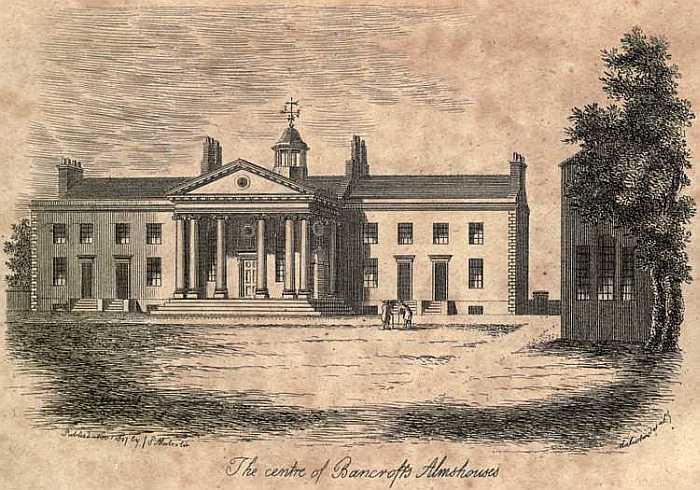
Whether Bancroft was influenced by having viewed the state of the poor in the same light, or whether he acted from an innate impulse of charity, is of little importance at present; but it is certain that his alms-houses were most opportunely erected in 1735, to supply part of the wants of the community, on the ground at Mile-end, where a fair was previously held. This gentleman left 28,000l. to accomplish his intentions; which were, that 24 houses should be built for 24 aged men, a school-room for 100 poor boys, two houses for as many masters, and a chapel, under the direction of the company of Drapers[47:A].
A person who concealed his name gave, in May, 1736, the sum of 1000l. to each of the following charities: the Society for propagating the Gospel in foreign parts; for the Augmentation of poor livings; and the Corporation of the Sons of the Clergy; with 500l. for the promotion of Christian knowledge.
The Prince of Wales sent the Lord Mayor 500l. in January 1737, to be applied in discharging poor freemen from prison, by the payment of their debts and fees.
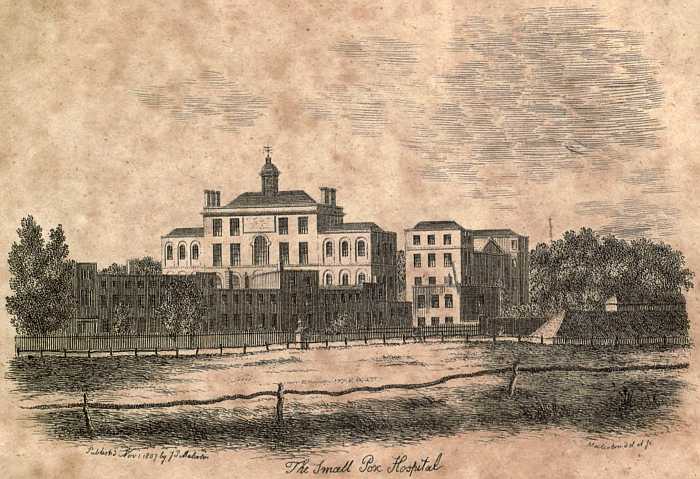
The governors and the publick at large had enabled the conductors of the Small-pox hospital (who at that time had two separate buildings for the purpose, the one at Islington, the other in Cold Bath Fields) to receive 500 patients in six months, so long since as 1757. Those who have seen the present elegant building at Battle-bridge, will be aware of the excellent accommodations it contains; and those who have not are referred to the view of it annexed.
In the year 1758, another pleasing act of benevolence distinguished the natives of London, under the title of "an Asylum, or house of refuge for orphans, and other deserted girls of the poor within the bills of mortality, situated near Westminster-bridge on the Surrey side." The following notice appeared in the newspapers of the above period:
"The guardians of this charity (the intention of which is to preserve poor friendless girls from ruin, and to render them useful members of the community) have engaged three matrons: the first to superintend the affairs of the house in general; the second a school-mistress to teach reading, knitting, sewing, making linen, &c.; the third to preside in the kitchen, and instruct the children in plain cookery, curing provisions, pickling, and other branches of housewifery.
"The house will soon be prepared and furnished for the reception of poor deserted girls, from the age of eight to twelve years.
"As in the beginning of these institutions considerable expences are necessarily incurred, the guardians hope the benevolence of the publick will be excited, to enable them effectually to carry this laudable design into present execution; and to extend their plan hereafter as they shall see occasion."
This forcible appeal was by no means made in vain; subscriptions followed immediately, and the Asylum now flourishes in full vigour.
The efforts of the humane at present, in attempting to cure the ruptured poor, deserve every commendation; but it should at the same time be remembered, that the community of 1759 were equally desirous of alleviating the sufferings of the miserable. Mr. Lee, of Arundel-street, surgeon, superintended the hospital at that period; and according to his statement to the committee of subscribers, 60 men, women, and children, and upwards of fifty soldiers, had been perfectly cured, without the loss of a single life, from the day of its institution.
Mr. Paterson, secretary to a charitable fund, gave the following account of it in a letter to the editor of the London Chronicle, April 21, 1759.
"Sir,
"The distressed circumstances in which many of our inferior Clergy necessarily leave their numerous families, induced the piety of our ancestors to establish a Corporation for their relief; in aid of which, the stewards of the feast of the Sons of the Clergy have promoted an annual collection for putting some of their helpless orphans apprentices to reputable trades. But there being still wanting a fund for the maintenance and education of these poor children in their more helpless infant state; some gentlemen in the year 1749, formed themselves into a Society for raising such a fund by a small annual subscription, and for seeing it faithfully applied to this very humane and necessary purpose.
"The Society's income, small as it has hitherto proved, yet not being burthened with salaries of any kind, has enabled them in the course of nine years, to take care of 28 boys, selected out of the most numerous and distressed families that applied.
"Of these, 13 have been placed out apprentices, and to the remaining number the Society have agreed to add two, besides filling up the vacancies that will happen, by the placing out of others who are now properly qualified.
"The Society's general account at their last audit in February, stood as follows:
"Total receipts 971l. 15s. 6d. Disbursements, for schooling and maintenance, 713l. 11s. 6d. Children's travelling charges 32l. 15s. 10d. Printing 62l. 12s. 6d. Balance in the Treasurer's hands 162l. 16s. 8d.
"The Society's circumstances have hitherto prevented them from extending their care to the poor girls, whose situation, no doubt, is full as deserving of compassion; but this they hope the benevolence of other well-wishers to the Church of England will soon enable them to do; and in the plan and management of this branch of the Charity, they shall be glad of the advice and assistance of the ladies.
"Several Bishops and other persons of rank of both sexes have been pleased to approve of the design and conduct of the Society, and to honour the subscription with their names.
John Paterson, Sec.
"Mr. Hayter (treasurer) desires I will, in his name, acknowledge the receipt of a bank-note for 20l. sent in a penny-post letter signed P. Q. R. and also of one guinea sent in the name of E. B. for the benefit of the above charity."
A fire attended with many distressing circumstances occurred in King-street, Covent-garden, at the close of 1759, in consequence of which the managers of the Theatre there granted the sufferers a benefit, when every person employed on the occasion gave their salaries for the night cheerfully. The produce of another at Drury-lane was 230l.
A subscription in imitation of that which took place in 1745 for rewarding the soldiers with money and clothing who assisted in suppressing the Rebellion, distinguished the winter of 1760; and a very considerable sum was obtained for those then in the field.
Another subscription, far more disinterested, amounting to 1782l. 17s. 3d. in January 1760, was intended for the relief of French prisoners. As the prologue spoken at the Drury-lane benefit alludes to each of the above traits of national benevolence, I think, the reader will pardon its insertion.
"Cowards to cruelty are still inclin'd, But generous pity fills each Briton's mind. Bounteous as brave; and though their hearts are steel'd With native intrepidity, they yield To Charity's soft impulse: this their praise, The proud to humble, and th' oppress'd to raise: Nor partial limits can their bounty know;— It aids the helpless alien, though a foe. Hear this, ye French, who urge the insidious strife That arms the Indian with the murdering knife; Who, to your foes less cruel, leave your own Starving in sad captivity to groan. Think of th' inhuman policy—and then Confess, ye fight not, nor ye feel, like men. Britons, this night your kind compassion flows For near-felt mis'ries and domestic woes; The dire distress with horror we recall;— 'Twas death, 'twas dreadful devastation all. The sleepers were alarm'd with wild dismay, As lull'd in calm security they lay; While each perhaps in dreams forgot his pains, And fondly counted o'er his honest gains. But oh! the poor mechanic, scarce with life Himself escap'd, his children and his wife, Cold, naked, hungry, whither can they roam, No friend to succour, and without a home? Their little all with sorrow they survive, And hardly deem it mercy, that they live. Your tender care their present wants supplies, And gives to industry new means to rise; Nor needed yet this bounteous act to prove Your wide humanity, and social love; All, all who want it, your protection find; For Britons are the friends of all mankind."
The continued rains of May 1761 had almost ruined the haymakers assembled near the Metropolis, and compelled them to enter it as suitors for charity, which they received to the amount of 16l. 12s. from the Merchants on Change spontaneously. 129 persons shared the above sum.
In a work of this description the thoughts of respectable writers cannot but be acceptable; one of those observed, in July 1761, "that parish charges (were) every where justly complained of; but how insupportable would they be, were it not for the hospitals erected in the Metropolis, and of late in several county towns, which, so far as they extend, for they go no farther than to relieve such sick or lame poor as there is a probability of curing, are of infinite use, not only to London and the county towns, but to the country for many miles around them.
"In St. Bartholomew's hospital, in the year 1760, there were 3,539 in-patients cured. The number of in-patients in that hospital at that time is 405, and in Guy's and St. Thomas's about 400 in each. Supposing the numbers of in-patients cured in the two last to be the same, therefore, with that in St. Bartholomew's hospital, the total in the three will be 10,617: add to these, the number cured in the hospitals at Hyde-park corner and Westminster, the London Infirmary, the Middlesex, Small-pox, Bethlehem, and other hospitals in London, and they will amount to 15,000 at least. Add to this number the patients cured in the hospitals at Winchester, Bath, Bristol, Newcastle, Shrewsbury, Northampton, Liverpool, and the two hospitals at Exeter; I think there are fourteen of them out of London in different counties; and I believe I shall not exceed when I put the whole number, including those at London, at 20,000. All these are entirely maintained, and do nothing towards a subsistence; except that in some houses, those who are tolerably well assist in cleaning the house, making the beds, &c.
"And it is very observable, that these hospitals for the sustenance and relief of the sick and lame poor have all of them been founded (St. Bartholomew's, St. Thomas's, &c. excepted) within these forty years: Hyde-park hospital was founded in 1733.
"The London hospitals are so many and large, and under such prudent management, that scarce any persons are so destitute of friends, but they can procure admittance into one or other of them. In this, as in all other instances, Providence seems to have proportioned the quantity of pity and compassion to the real wants and distresses of the indigent."
There are numbers of well-disposed persons who would contribute to the support of charitable institutions, were they introduced to their notice in a manner congenial to the bent of their inclination. A man of a grave and sedentary turn of mind may be prevailed upon by a tale of distress to open his purse, but similar methods will not succeed with the bon vivant; full of life and spirit, he drives care from him by every artifice in his power; and yet the governors of our hospitals and benevolent foundations have contrived a trap for him, and he cheerfully catches at the bait.—Ecce signum!
Magdalen-house charity, Prescot-street, Goodman's fields, Feb. 10, 1762.
"The anniversary feast of the Governors of this Charity will be held on Thursday, the 18th of March next, at Drapers-hall, in Throgmorton-street; after a Sermon to be preached at the parish church of St George's, Hanover-square, before the Right honourable the earl of Hertford, president, the vice-presidents, treasurer, and governors of this Charity, by the Rev. William Dodd, A. M. chaplain to the bishop of St. David's. Prayers will begin at 11 o'clock precisely.
"And dinner will be on the table at three o'clock.
"N. B. A Te Deum composed by Mr. Handel, for the late duke of Chandos's chapel, with Jubilate and other Anthems, will be performed by Mr. Beard, and a proper band of the best performers, both vocal and instrumental.
"Tickets for the feast may be had at the following places at five shillings each," &c. &c.
The readers of the newspapers of our day will thus perceive that Solomon was right in saying, 'there is nothing new under the Sun;' from the above hour, nay long before, conviviality and charity have coalesced. Dinners, and collections after dinners, when the mind generously dilates, have relieved thousands from the deepest misery; and I hope this mode of filling the chasms of more disinterested benevolence will prevail till such methods are unnecessary.
An occurrence happened in 1762, which places the humanity of his present Majesty in a very amiable point of view. A female infant had been left in one of the courts of the palace of St. James's; some of the officers in waiting sent it to the overseers of St. Martin's parish, who, with those of St. Margaret's afterwards applied to, refused to receive the child under the plea that the palace was an independent jurisdiction. When the King heard of the circumstance, he immediately ordered that a nurse should be provided, and the fortunate orphan was subsequently honoured with the name of Georgiana Charlotta Sophia.
The City of London Lying-in hospital, established many years past, has served as a pattern for several others in various parts of the Metropolis. From the date of its commencement to 1762, 3655 married women had been received, 45 of whom were delivered of twins, and one of three children; including which, 1896 male and 1806 female infants were indebted for life to this humane establishment[57:A].
Collections have been frequently made during severe weather, or on some particularly distressing occasion, from door to door in the various parishes within the bills of mortality, and considerable sums obtained. In the winter of 1763, the inhabitants of St. Anne's, Westminster, gave 169l. 15s. 3d. the Princess dowager of Wales 100l. and the duke of York 50l. to the poor not relieved by the regular assessments. Nor was this a solitary instance of generosity, as the duke of Newcastle gave above 400l. to different places at the same period; and the rich parish of St. James's relieved 1200 persons with gifts of money and coals.
Though so much had been done to prevent the calamities of poverty, wretchedness prevailed in places where benevolence could not imagine it existed. Garrets in retired alleys and lanes always afford inmates in the last stages of disease and starvation; and the instances that might be adduced would prove very distressing in the recital; but that supposed empty houses should contain wretches expiring with want, was beyond the imagination of the most exalted charity; and yet the following melancholy fact actually occurred in November 1763, the narrative of which may serve as a hint to overseers, whose duty it is, I should conceive, to prevent actual death through want in their respective districts.
A Mr. Stephens, of Fleet-market, was commissioned to shew some empty houses in Stonecutter-street intended for sale, and one day accompanied a gentleman to them, who had thoughts of purchasing the estate on which they were situated. On entering a room on the first floor, an object of horror attracted their attention, a naked female corpse! Stephens, alarmed beyond expression, fled from the scene; but the other more courageous ascended to the next floor, where he was soon after joined by his terrified attendant, and they discovered a second and a third woman dead, and nearly destitute of clothing; pursuing this dreadful research, they found in the upper story two women, and a girl about eighteen years of age, one of whom, and the latter, appeared emaciated beyond description, but their companion in misery was in better condition. Prudence and humanity dictated that an examination should take place as to the cause of so singular and dreadful an occurrence; in consequence, the survivors were taken into custody, and the ensuing particulars were related by them before the Coroner and his Jury.
"It appeared on the inquisition, from the evidence of Elizabeth Stanton, one of these women, that on the Wednesday preceding the inquiry she came from Westminster, and being in want of lodging, strolled to this house, and laid herself down on the ground-floor, where she saw nobody; that about eleven that evening the woman in good condition (Elizabeth Pattent) a stranger to her, came into the room where she (Stanton) had laid herself down, and by treading on her awakened her, at the same time crying out 'Who is there?' To which Stanton replied, 'No person that will hurt you, for that she was going away in the morning.' Pattent therefore advised her to go up to the garret with her, which she did, and stayed there all that night, and the following day and night, and until she was taken into custody in the garret upon the above discovery.
"Pattent, being out of place, attended the Fleet-market as a basket-woman; where she became acquainted with the deceased women, who were basket-women, and both known by no other names than Bet. Pattent, being destitute of lodging, was recommended to this ruinous house by the deceased women, who had lived, or rather starved, there for some time. Pattent, in the day-time, used to go to her late mistress's, who kept a Cook's-shop in King-street, Westminster, and worked for her victuals, and lodged in this house at night, where she continued till she was taken into custody. About the middle of the week preceding the inquisition, the deceased women were taken ill; and on Saturday the 12th instant, Pattent pawned her apron for sixpence, and bought some beef and plumb-pudding at a Cook's-shop in Shoe-lane, and both the deceased women on Saturday and Sunday ate heartily thereof, and on Sunday night she heard the deceased women groan. One had the itch, and the other a fever; and, being fearful of catching the one or the other, she did not go to them any more; nor did she know of their deaths till taken into custody.
"Elizabeth Surman, the girl, was the daughter of a deceased Jeweller, in Bell-alley, Coleman-street; her parents died when she was about six years of age, and she was taken care of by Mrs. Jones, a next door neighbour, with whom she lived about four years; Mrs. Jones then dying, Surman was left destitute; and on being informed she could get employment in Spital-fields, she went there, and assisted a woman in winding quills, but she retiring into the country, Surman was again left destitute; however, she found employment in Spital-fields market, with Mrs. Bennet, in winding silk, but, not pleasing her, was discharged in a week. She then went to Mrs. Roach's in that market, who took in washing and nursed children, where Surman continued six years, and until she was taken ill, on which account she was discharged her service. She then went to the churchwarden of the parish where her father had been housekeeper many years, to desire relief; but he refused, without so much as expostulating with her about her legal settlement, or informing her that she had gained a settlement by servitude. She being very ill and weak, lay all night at the churchwarden's door, but it had no effect on him; and this girl was obliged to lie about in the streets, until she was informed of this empty house, where she lay every night for near two months; the deceased women being there when she came, and both then lying on straw in the two pair of stairs room. For the first week of Surman's being there, she lay in the room with them on straw, all which week she was ill with an ague, and had no sustenance whatever; that then Elizabeth Pattent relieved her; and as Surman grew better, she went abroad and received alms, returning at night, and delivering her money to Pattent, who bought her victuals. Surman was afterwards received into St. Andrew's workhouse, where she continued a week; and, about a fortnight ago, she returned to this empty house, and lodged in the garret; and being very ill, was assisted by Pattent, and for the last fortnight was not out of the garret till last Friday, when she, with the two other women, were found in the garret, and taken into custody, and never saw or heard, all that time, any thing of the deceased women till she was apprehended.
"On Pattent's being interrogated with respect to the woman's being stripped naked and selling her cloaths, she strictly denied knowing any thing of it; alledging, that as they all entered the house at the cellar, and she being mostly out in the day-time, and attending the poor girl at night, other persons might strip the deceased unknown to her.
"There were no marks of violence about the deceased women, but they appeared as if starved.
"The Jury were well satisfied with the account they had received from their most deplorable evidence. The Coroner gave them some money; and the Jury ordered them a supper, and that care might be taken of them in the Casualty-house."
These pitiable objects, worthy of a far better fate, who starved rather than they would steal, and met death surrounded with tenfold terrors, supported by pure consciences, deserve statues to their memory; nay, Pattent would have done honour to Roman virtue, who worked the day through for a miserable subsistence, and passed the night in watching and relieving the sick—and yet I should be afraid to know the sequel of her eventful story. Is it not shocking to think on this catastrophe, when we reflect how many would have contributed to the relief of this family of misery, had they known their wants, when advertisements for relief daily appeared from the distressed and were successful. Even at the moment they were dying a thousand lingering deaths through every possible privation, Catharine Shaw, a widow, with seven children and a mother, acknowledged the bounty of the publick in the receipt of 191l. 13s. 9d. and presentations to Christ's hospital for two of her boys.
The Marine Society, mentioned in "Londinium Redivivum," relieved 295 youths a second time in 1763. These lads, rescued originally from ruin, and sent by the Society into the King's service, were discharged on the conclusion of peace; when they apprenticed 15 to fishermen, 71 to trades, 17 to manufacturers, 6 to public-houses, 29 to the merchant's service, 80 to naval officers for three years, one to agriculture, and nine to water and lightermen; assisted 17 to procure masters, sent 29 to their friends, and 21 provided for themselves.
The unfavourable weather which occurred in July 1764, did infinite damage to the grain near London; and a hail-storm that fell on the 23d injured the inferior farmers' property to the amount of 4864l. in Middlesex only: the benevolent inhabitants of the Metropolis, touched with their misfortunes, opened a subscription, and restored their losses[64:A].
A second scene of wretchedness and distress attracted commiseration in the above year, for certain Germans; who, deceived by splendid offers of prosperity provided they emigrated to America, were left by their inhuman deceivers to perish in the neighbourhood of London, because they found some deficiencies in their own calculations of profit. Such was the miserable situation of those poor Palatines, that they actually lay in the fields near Bow, where, it is asserted, they had not eaten for two days previous to the following generous act recorded of a baker, who should have been a Prince. This worthy man (whose name has unfortunately not been mentioned) passing along the road near the Germans with his basket on his shoulder, containing 28 two-penny loaves, perceiving their forlorn situation, threw it down, and observed, that his customers must fast a little longer that day, and immediately distributed the bread, for no other return than signs of gratitude and tears of joy.
This affecting circumstance is the first intimation the publick received of their situation; but Mr. Wachsel, Minister of the German Lutheran church, in Little Ayliffe-street, Goodman's-fields, thus addressed the publick immediately afterwards, through the medium of the newspapers:
"I hope you will permit me, by means of your paper, to inform those who have the power to redress it, of the very deplorable situation of the poor unhappy Palatines, lately arrived here from Germany. They are in number, men, women, and children, about six hundred, consisting of Wurtzburghers and Palatines, all Protestants; and were brought hither from their native country by a German officer, with a promise of being sent to settle, at his own expence, in the Island of St. John and Le Croix, in America; but by inability he has been obliged to decline the undertaking; so that, instead of their being shipped off for those places, some of them have lain during the late heavy rains, and are now lying, in the open fields adjacent to this Metropolis, without covering, without money, and, in short, without the common necessaries of life; others lie languishing under the complicated evils of sickness and extreme want, at the Statute-hall in Goodman's-fields; and more than 200 remain on board the ship which brought them over, on account of their passage not being paid for, where they are perishing for food, and rotting in filth and nastiness. Collections have been made at the German churches and chapels here, several times, to afford them some relief; but as the number of these poor creatures is so considerable, it is impossible, by such means, to furnish them with a regular and continued supply, adequate to their wants; so that, unless some provision is very speedily made for them, they must inevitably perish. These unfortunate people would think themselves inexpressibly happy, if the English Government would be graciously pleased to take them under its protection; to allow them, for the present, some ground to lie on; tents to cover them; and any manner of subsistence, till it shall be thought proper to ship them off, and settle them in any of the English colonies in America; where, I doubt not, they will give their protectors and benefactors constant proofs of their affection and gratitude for such kindness, by behaving as becometh honest, industrious, and dutiful subjects to the British government. I take the liberty of thus expressing the hopes and wishes of these wretched beings, as they have no friend to intercede for them who has interest sufficient for such an undertaking, or even a knowledge of the proper method of application.
"That their distresses are unutterably great, I myself have been too often a mournful witness of, in my attendance on them to administer the duties of my function; with one instance of which I shall conclude this melancholy detail. One of the poor women was seized with the pangs of labour in the open fields, and was delivered by the ignorant people about her in the best manner they were able; but, from the injury the tender infant received in the operation, it died soon after I had baptized it; and the wretched mother, after receiving the Sacrament at my hands, expired from the want of proper care and necessaries suitable to her afflicting and truly lamentable condition.
"That the Almighty may, of his infinite mercy, incline the hearts of the great and good of this Kingdom, distinguished for its charity and hospitality, to take under their protection these their unhappy fellow Christians, who did not intrude themselves into this country, but were invited hither, and send them whithersoever they in their wisdom and goodness shall think proper, is the most ardent prayer of
G. A. Wachsel."
A subscription was opened at Batson's Coffee-house, where eight hundred pounds was instantly subscribed; and Government, fully impressed with the urgency of the case, immediately sent 100 tents and other necessaries from the Tower. On the following Sunday 120l. was collected at Whitechapel-church, and several other parishes followed this most urgent example; but one unknown good Samaritan sent Mr. Wachsel an 100l. bank note, who soon after addressed the Editors of the Newspapers with the following welcome information:
"As I have twice solicited the attention of the publick through your paper in regard to the German Emigrants, give me leave now to inform those beloved servants of the Lord, of every rank, who so cheerfully fulfilled the will of their Divine Master, in kindly receiving, feeding, clothing, and visiting these poor strangers, that the remainder of them on the 6th instant (November 1764), left this Christian hospitable shore, to settle in America, on the spot assigned them by the bounty of the gracious Ruler of this happy realm. For all which extraordinary and unparalleled instances of beneficence, and likewise for the attention paid to them by the most worthy gentlemen of the Committee, who not only generously contributed to their relief, but have also been indefatigably employed in conducting this charity with the utmost wisdom and integrity, my warmest and most respectful thanks, as well as those of my poor brethren, are too mean a tribute. But, though they earnestly entreated me to convey their humble and sincere acknowledgments to their very humane and generous benefactors, it is out of the power of language justly to describe their grateful feelings on this occasion: I am, however, confident, that the remembrance of the benefits so seasonably and liberally bestowed on them will remain on their minds to the latest period of their existence; and that they will seize every opportunity of testifying their gratitude to this nation.
"I have been applied to by anonymous letters, complaining of the delay of the promised account of receipts and disbursements; to which I take this opportunity of replying, that when the gentlemen subscribers, after the publication of my first letter, had formed themselves into a Committee for the management of this Charity, I gave into their hands an account of what I had received and expended before their establishment; and to them I have paid all the monies since received by me, &c. &c.
G. A. Wachsel."
The King sent 300l. to the Committee alluded to by the indefatigable Wachsel, who exerted themselves with the utmost perseverance, in providing food and other necessaries, while the Minister read prayers and preached daily before the Palatines, in addition to his other unwearied exertions in their favour. After the more immediate attentions had been paid to their wants, the Committee determined to petition the King, that he would be pleased to grant the Germans lands in some of the American provinces; which they had no sooner done, than they were informed land in South Carolina should be appropriated for that purpose, and that they would be allowed 150 stand of arms to be used by them on their settlements for defence from the Indians and for hunting. Upon this favourable result, the Committee agreed with certain ship-owners to convey the objects of their care to the place of their destination, on the following liberal terms:
"Two ships of not less than 200 tons each, and to carry no more than 200 persons in each ship, to be ready to sail in ten days: the necessaries to be provided were, one pound of bread of sixteen ounces for each person, men, women, and children, every day; one man, one woman, and three children to a mess: Sunday, for each mess, a piece of beef of four pounds, flour three pounds, fruit or suet half a pound, and a quart of pease. Monday, stock-fish three pounds, butter one pound, cheese one pound, potatoes three pounds. Tuesday, two pieces of pork six pounds, rice two pounds. Wednesday, grits five pounds, butter two pounds, cheese two pounds. Thursday, the same as Sunday, only potatoes instead of pease. Friday, grey pease two quarts, butter two pounds, cheese two pounds. Saturday, flour three pounds, fruit half a pound, potatoes two pounds, butter two pounds, and cheese two pounds. Sufficient of vinegar, pepper, and salt every day; a ton of water for every three persons; six quarts of good ship beer each mess, for the first three weeks; and for the remainder of the voyage, a pint of British spirits each day; medicines, and a doctor to each ship, provided by the Committee.
"Half the freight to be paid before sailing from Gravesend, the other moiety at their delivery at South Carolina, deducting one half of the second payment for every person that dies on their passage: all that exceed fourteen years on the first of September, to be deemed whole passengers; all under two to be deemed as one passenger. Security is required for the exact performance of the above contract."
On Saturday, October 6, the Germans left their tents, to embark on board of lighters which were to convey them to Blackwall, attended by the Treasurer and several gentlemen of the Committee.
The parting between those poor people and their guardian Wachsel was exceedingly affecting; nor were their expressions of gratitude to the inhabitants of London less fervent, who accompanied them in crowds in boats, admiring the devotion with which they sung various hymns on their way.
One detestable act disgraced this dignified scene of disinterested Charity, which seems almost beyond credibility, and yet it is certainly a fact; the Committee had filled four tents with clothing, which were guarded by children during the time their parents were attending Divine Service; at that critical moment, several wretches decoyed the guards away by a distribution of half-pence to buy cakes, and immediately stole every article worth conveyance.
The above splendid æra in the annals of Charity was equally distinguished by the exertions of other individuals, who obtained large sums by contributions from the publick, with which they relieved 4931 persons who had been compelled to pawn their clothes, and other necessary articles, to supply the deficiencies in their earnings, through the decline of the Silk manufactory in Spitalfields. I am, however, sorry to add that the conduct of those artizans did not in the least resemble that of the Germans; clamorous assemblies of men, women, and children, under turbulent leaders, with a black flag carried before them, approached the Royal residence of St. James's; where, disappointed of meeting the King, many of the most violent presumed to follow his Majesty to Richmond with a petition, which certainly ought to have been presented to the House of Commons through the medium of a Member; others met in Old Palace-yard, where they obstructed the passage of the Peers, and were only prevented from committing acts of violence by a party of guards. Thus disappointed of their aim, they spread in various directions, and almost filled Bloomsbury-square in defiance of parties of horse and foot soldiers sent to keep the peace. After suffering several severe injuries, self-committed by pressure, they returned towards home; but in their way broke all Messrs. Carr and Co.'s windows on Ludgate-hill, and would have done other damage, had not a patrole of grenadier guards interfered and dispersed them; but, as this article should be wholly devoted to the peaceful operations of benevolence, I must refer the reader to "Popular Tumults," for the remainder of the event.
The King gave 1000l. to the sufferers by a fire in Bishopsgate-street, London, in November 1765; and the Society of Quakers 500l.
During the severity of the winter of 1767-8, a great deal was done for the relief of the poor, particularly in the following instances: Earl Percy gave 400l.; 200l. was collected at Almack's; Daniel Giles, esq. distributed 20 chaldrons of coals; the Archbishop of Canterbury gave 5s. 3d. each, to upwards of 200 watermen of Lambeth; the Lord Mayor had 50 pounds of beef boiled every day, and distributed it and the broth from it; an unknown person released 26 prisoners from the Poultry, and others from Wood-street, confined for debts between forty shillings and six pounds, and each received thirty shillings, the surplus of the cash sent; besides these generous acts, large sums were collected in various parishes, and the Queen gave 500l. under a feigned name, through the hands of Dr. Hill[74:A].