Volume 3 — Chapter XXXII
Reading edition
{285} CHAP. XXXII
Low part of the Carolines and Georgia.—Agriculture.—Population.—Arrival at Charleston.
The low country of the two Carolinas extends from the borders of the sea for a hundred and twenty or a hundred and fifty miles, widening as it gets towards the south. The space that this extent embraces presents an even and regular soil, formed by a blackish sand, rather deep in parts, in which there are neither stones nor flints; in consequence of which they seldom shoe their horses in that part of the United States. Seven-tenths of the country are {286} covered with pines of one species, or pinus palustris, which, as the soil is drier and lighter, grow loftier and not so branchy. These trees, frequently twenty feet distant from each other, are not damaged by the fire that they make here annually in the woods, at the commencement of spring, to burn the grass and other plants that the frost has killed. These pines, encumbered with very few branches, and which split even, are preferred to other trees to form fences for plantations. Notwithstanding the sterility of the land where they grow, they are sometimes interspersed with three kinds of oaks; viz. the quercus nigra, the quercus catasbœi, and the quercus obtusiloba. The wood of the two first is only fit to burn, whilst that of the other is of an excellent use, as I have before remarked.
The Pine Barrens are crossed by little swamps, in the midst of which generally flows a rivulet. These swamps, from ten to forty fathoms broad, are sometimes more than a mile in length, and border on others, more spacious and marshy, near the rivers. {287} Each have different degrees of fertility, clearly indicated by the trees that grow there exclusively, and which are not to be found in the upper country. Thus the chesnut oak, or quercus prinus palustris, the magnolia grandiflora, the magnolia tripetala, the nyssa biflora, &c. flourish only in swamps where the soil is of a good quality, and continually cool, moist, and shady. In some parts of these same swamps, that are half the year submerged, where the earth is black, muddy, and reposes upon a clayey bottom, the acacia-leaved cypress, the gleditsia monosperme, the lyric oak, and the bunchy nut-tree, the nuts of which are small, and break easily between the fingers. The aquatic oak, the red maple, the magnolia glauca, the liquidambar stiracyflua, the nyssa villosa, the Gordonia lasyanthus, and the laurus Caroliniensis, cover, on the contrary, exclusively the narrow swamps of the Pine Barrens.
The Spanish beard, tillandsia asneoides, a kind of moss of a greyish colour, which is several feet in length, and which grows in abundance upon the {288} oaks and other trees, is again a plant peculiar to the low country.
In those districts where there are no pines, the soil is not so dry, deeper, and more productive. We found there white oaks, or quercus alba, aquatic oaks, or quercus aquatica, chesnut oaks, or quercus prinus palustris, and several species of nut-trees. The whole of these trees are here an index of the greatest fertility, which does not take place in the western country, as I have before observed.
The best rice plantations are established in the great swamps, that favour the watering of them when convenient. The harvests are abundant there, and the rice that proceeds from them, stripped of its husk, is larger, more transparent, and is sold dearer than that which is in a drier soil, where they have not the means or facility of irrigation. The culture of rice in the southern and maritime part of the United States has greatly diminished within these few years; it has been in a great measure replaced by that of cotton, which affords greater profit to the planters, {289} since they compute a good cotton harvest equivalent to two of rice. The result is, that many rice fields have been transformed into those of cotton, avoiding as much as possible the water penetrating.
The soil most adapted for the culture of cotton is in the isles situate upon the coast. Those which belong to the state of Georgia produce the best of cotton, which is known in the French trade by the name of Georgia cotton, fine wool, and in England by that of Sea Island cotton. The seed of this kind of cotton is of a deep black, and the wool fine and very long. In February 1803 it was sold at Charleston at 1s. 8d. per pound, whilst that which grows in the upper country is not worth above seventeen or eighteen pence. The first is exported to England, and the other goes to France; but what is very remarkable is, that whenever by any circumstance they import these two qualities into our ports, they only admit of a difference of from twelve to fifteen per cent. The cotton planters have particularly to dread the frosts that set in very early, and that frequently {290} do great damage to the crops by freezing one half of the stalks, so that the cotton has not an opportunity to ripen.
In all the plantations they cultivate Indian corn. The best land brings from fifteen to twenty bushels. They plant it, as well as the cotton, about two feet and a half distance, in parallel furrows from fifteen to eighteen inches high. The seed of this kind of Indian corn is round, and very white. When boiled it is preferable to that cultivated in the middle and western states, and in Upper Carolina. The chief part of what they grow is destined to support the negroes nine months in the year; their allowance is about two pounds per day, which they boil in water after having pounded it a little; the other three months they are fed upon yams. They never give them meat. In the other parts of the United States they are better treated, and live nearly upon the same as their masters, without having any set allowance. Indian corn is sold at Charleston for ten shillings per bushel, about fifty-five pounds weight.
{291} Thus rice, long cotton, yams, and Indian wheat, are the only cultures in the maritime part of the southern states; the temperature of the climate, and the nature of the soil, which is too light or too moist, being in no wise favourable for that of wheat or any kind of grain.
Through the whole of the low country the agricultural labours are performed by negro slaves, and the major part of the planters employ them to drag the plough; they conceive the land is better cultivated, and calculate besides that in the course of a year a horse, for food and looking after, costs ten times more than a negro, the annual expense of which does not exceed fifteen dollars.
I shall abstain from any reflexion concerning this, as the opinion of many people is fixed.
The climate of Lower Carolina and Georgia is too warm in summer to be favourable to European fruit-trees, and too cold in winter to suit those of the Carribbees. The fig is the only tree that succeeds tolerably well; again, the figs turn sour a few days after {292} they have acquired the last degree of maturity, which must doubtless be attributed to the constant dampness of the atmosphere.
In the environs of Charleston, and in the isles that border the coast, the orange-trees stand the winter in the open fields, and are seldom damaged by the frosts; but at ten miles distance, in the interior, they freeze every year even with the ground, although those parts of the country are situate under a more southerly latitude than Malta and Tunis. The oranges that they gather in Carolina are not good to eat. Those consumed there come from the island of St. Anastasia, situate opposite St. Augustin, the capital of East Florida; they are sweet, very large, fine skinned, and more esteemed than those brought from the Carribbees. About fifty years ago the seeds were brought from India, and given to an inhabitant of this island, who has so increased them that he has got an orchard of forty acres. I had an opportunity of seeing this beautiful plantation when I was at Florida in 1788.
{293} In the general verification of the United States, published in 1800, the population of North Carolina, comprising negro slaves, amounted to four hundred and seventy-eight thousand inhabitants, that of Georgia to one hundred and sixty-three thousand, and that of South Carolina to three hundred and forty-six thousand. Not having been able to see the private extracts of the two former states, I am unacquainted with the proportion that there is between the whites and blacks, and the difference that exists between the population of the low and high countries; however an idea may be formed by the verification of South Carolina, where they reckon in the low country, comprising the town of Charleston, thirty-six thousand whites and a hundred thousand negroes, and in the high country one hundred and sixty-three thousand whites and forty-six thousand negroes.
I arrived at Charleston on the 18th of October 1802, three months and a half after my departure from Philadelphia, having travelled over a space of {294} nearly eighteen hundred miles. I staid at Carolina till the 1st of March 1803, the epoch when I embarked for France on board the same ship that had taken me to America eighteen months before, and arrived at Bourdeaux on the 26th of March 1803.
THE END
FOOTNOTES:
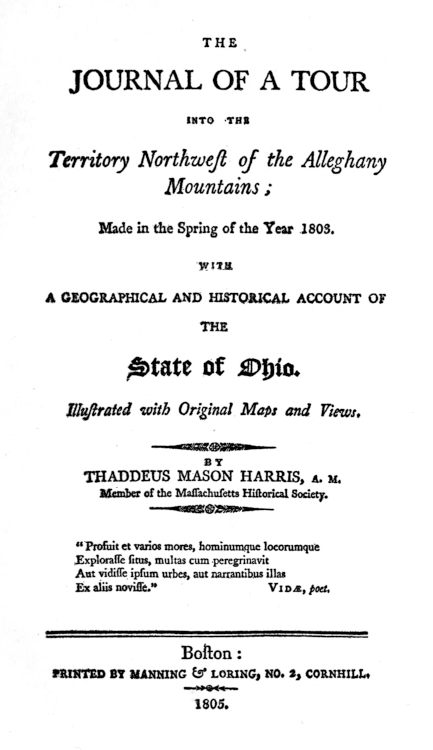
Journal of a Tour ... Northwest of the Alleghany Mountains, by Thaddeus Mason Harris, A. M.
Reprint from Boston edition, 1805; the Journal proper, omitting the Appendix thereto
THE