PAGAN AND CHRISTIAN SYMBOLISM.
Reading edition
PLATE II.
This is taken from a photograph of a small bronze image in the Mayer collection of the Free Museum, in Liverpool. The figure stands about nine inches high, and represents Isis, Horus, and the fish. It is an apt illustration of an ancient custom, still prevalent amongst certain Christians, of reverencing a woman, said to be a virgin, giving suck to her child, and of the association of Isis, Venus, and Mary with the fish. Friday, for example, is, with the Romanists, both "fish day," and "dies Veneris." Fish are known to be extraordinarily prolific. There was a belief that animals, noted for any peculiarity, imparted their virtues to those who ate them; consequently, tigers' flesh was supposed to give courage, and snails to give sexual power. The use of fish in connubial feasts is still common. Those who consider it pious or proper to eat fish on Venus' day, or Friday, proclaim themselves, unconsciously, adherents to those heathen ideas which deified parts about which no one now likes to talk. The fish has in one respect affinity with the mandrake.
Since the first publication of this work, a friend has suggested to me another reason, besides its fertility, for the fish being emblematic of woman. From his extensive experience as a surgeon, and especially among the lower order of courtesans, he has repeatedly noticed during the hot months of the year that the parts which he had to examine have a very strong odour of fish. My own observations in the same department lead me to endorse his assertion. Consequently, I think that in warm climates, where the utmost cleanliness can scarcely keep a female free from odour, scent, as well as other attributes, has had to do with the selection of the fish as an emblem of woman.
Still further, I have been informed by another friend that in Yorkshire, and I understand in other counties of England, the double entente connected with the fish is so marked that it is somewhat difficult to render it into decent phraseology. It will suffice to say that in the county mentioned, Lais or Phryne would be spoken of as "a choice bit of fish," and that a man who bore on his features the stamp which is imprinted by excessive indulgence, would be said to have indulged too much in "a fish diet." I do not suppose that in the Yorkshire Ridings the folks are unusually well acquainted with mythology, yet it is curious to find amongst their inhabitants a connection between Venus and the Fish, precisely similar to that which has obtained in the most remote ages and in far distant climes.
It is clear from all these facts that the fish is a symbol not only of woman, but of the yoni.
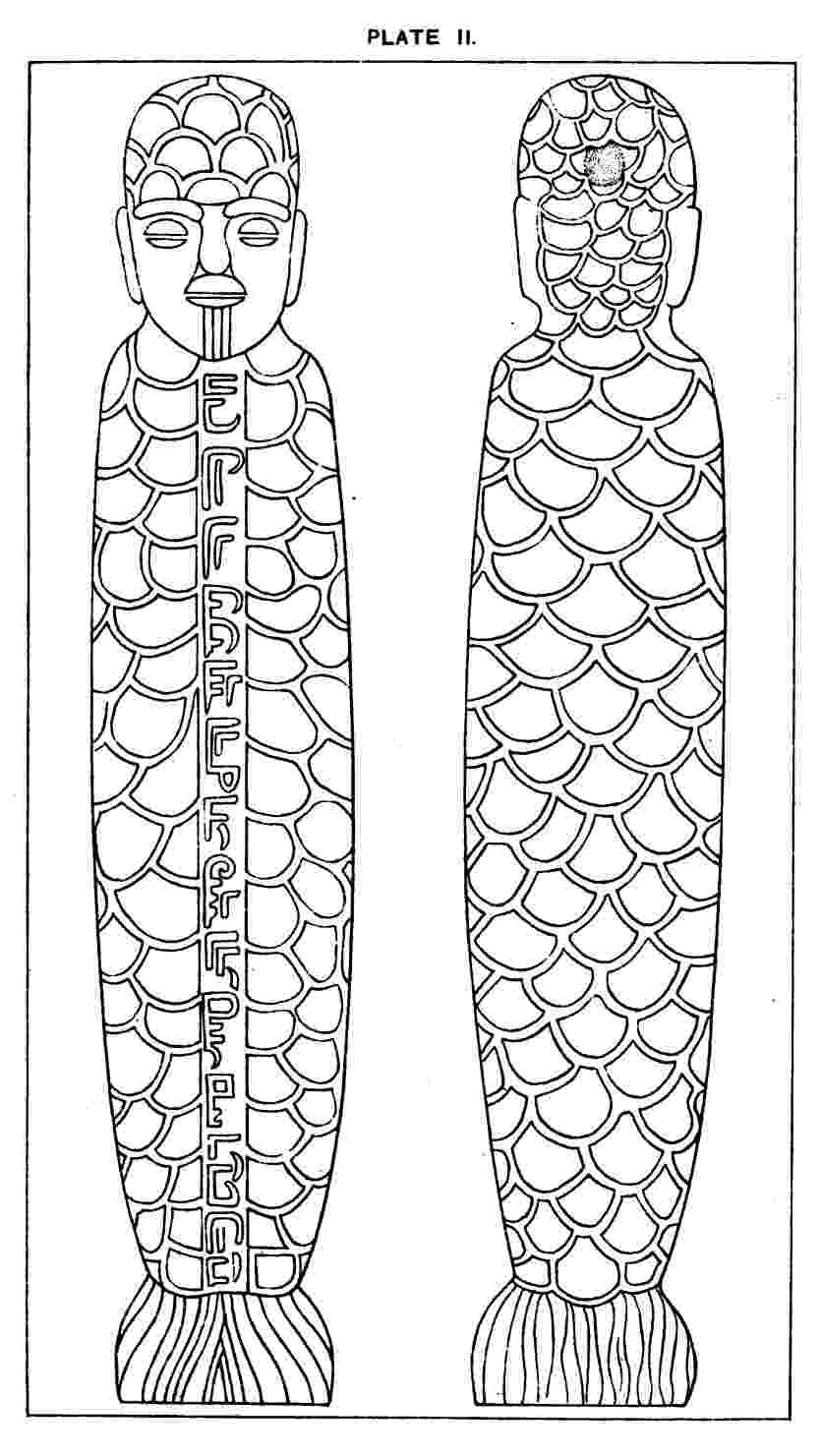
PLATE II.
Is supposed to represent Oannes, Dagon, or some other fish god. It is copied from Lajard, Sur le Culte de Venus, pl. xxii., 1, la, and is thus described, "Statuette inédite, de grès houiller ou micacé, d'un brun verdâtre. Elle porte par devant, sur une bande perpendiculaire, un légende en caractères Syriaques très anciens (Cabinet de M. Lambert, à Lyon)." I can find no clue to the signification of the inscription. It would seem paradoxical to say that there is something in common between the bull-headed deity and Oannes. It is so, nevertheless. One indicates, par excellence, physical, and the other sexual, power. That Oannes may, for the Assyrians, represent a man who played a part with them similar to that of Penn among the Indians of Pennsylvania, I do not deny; but, when we find a similar fish-god in Philistia and Hindostan, and know that Crishna once appeared as a fish, the explanation does not suffice. It is curious that Jesus of Nazareth should be called "a fish"; but this only proves that the religion of Christ has been adulterated by Paganism.
Figs. 1 and 4 are illustrations of the antelope as a religious emblem amongst the Assyrians. The first is from Layard's Nineveh, and in it we see carried in one hand a triply branched lotus; the second, showing the regard for the spotted antelope, and for "the branch," is from Bonomi's Nineveh and its Palaces.
Fig. 2 illustrates Bacchus, with a mystic branch in one hand, and a cup in the other; his robe is covered with spots arranged in threes. The branch is emblematic of the arbor vitæ, or tree of life, and its powers of sprouting. Such a symbol is, by outsiders, figured on the houses of newly married couples amongst the Jews of Morocco, and seems to indicate the desire of friends that the man will show that he is vigorous, and able to have many sprouts from the tree of life. It will be noticed that on the fillet round the god's head are arranged many crosses. From Hislop's Two Babylons, and Smith's Dictionary, p. 208.
Figs. 8 and 5 are intended to show the prevalence of the use of spots on priestly dresses; they are copied from Hislop's Two Babylons, and Wilkinson, vol. vi., pi. 88, and vol. iv., pp. 841, 858. For an explanation of the signification of spots, see Plate iv., Fig. 6, infra.
Fig. 1 represents an Assyrian priest worshipping by presentation of the thumb, which had a peculiar signification. Sometimes the forefinger is pointed instead, and in both cases the male is symbolised. It is taken from a plate illustrating a paper by E. C. Ravenshaw, Esq., in Journal of Royal Asiatic Society, vol. xvi., p. 114. Amongst the Hebrews, and probably all the Shemitic tribes, bohen, the thumb, and ezba, the finger, were euphemisms. They are so in some parts of Europe to the present day.* The hand thus presented to the grove resembles a part of the Buddhist cross, and the shank of a key, whose signification is described in a subsequent page.
PLATE III.
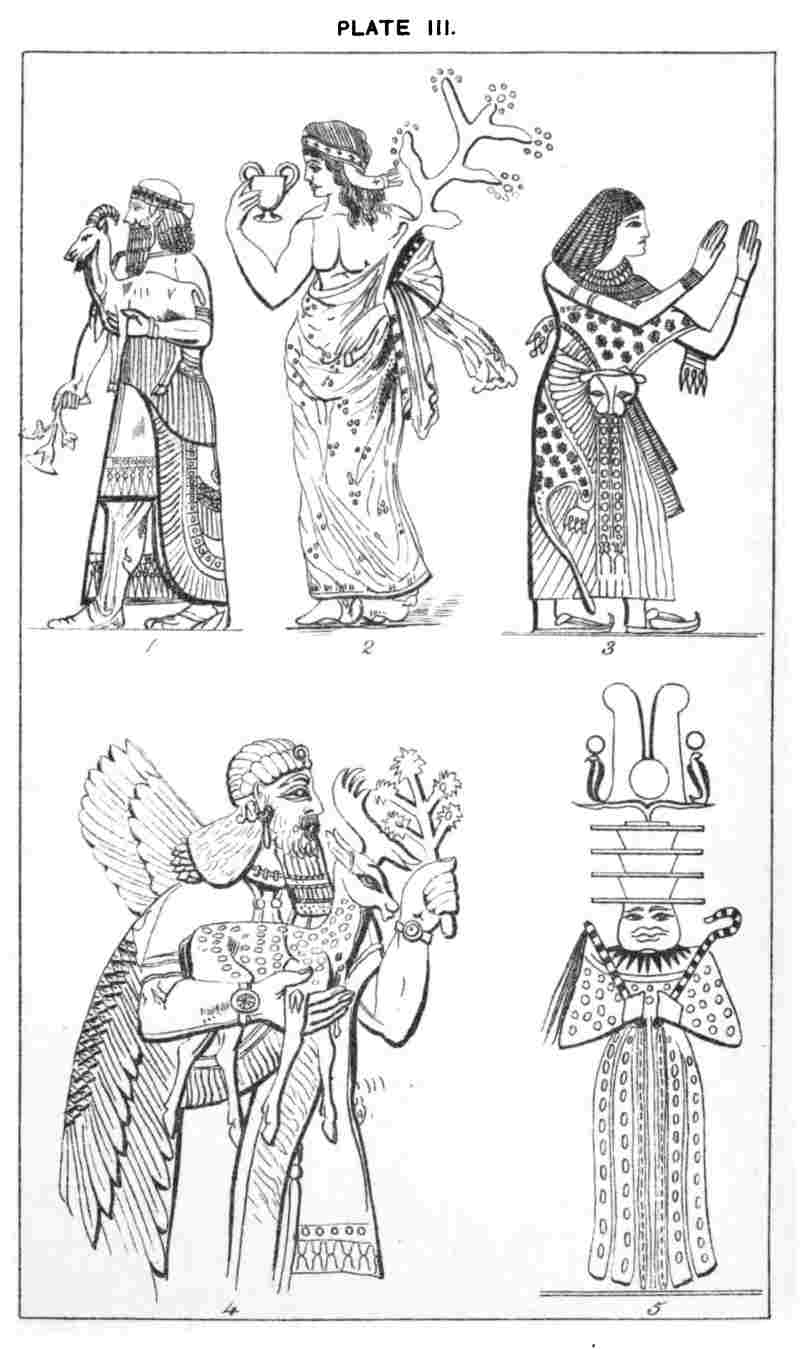
PLATE IV.
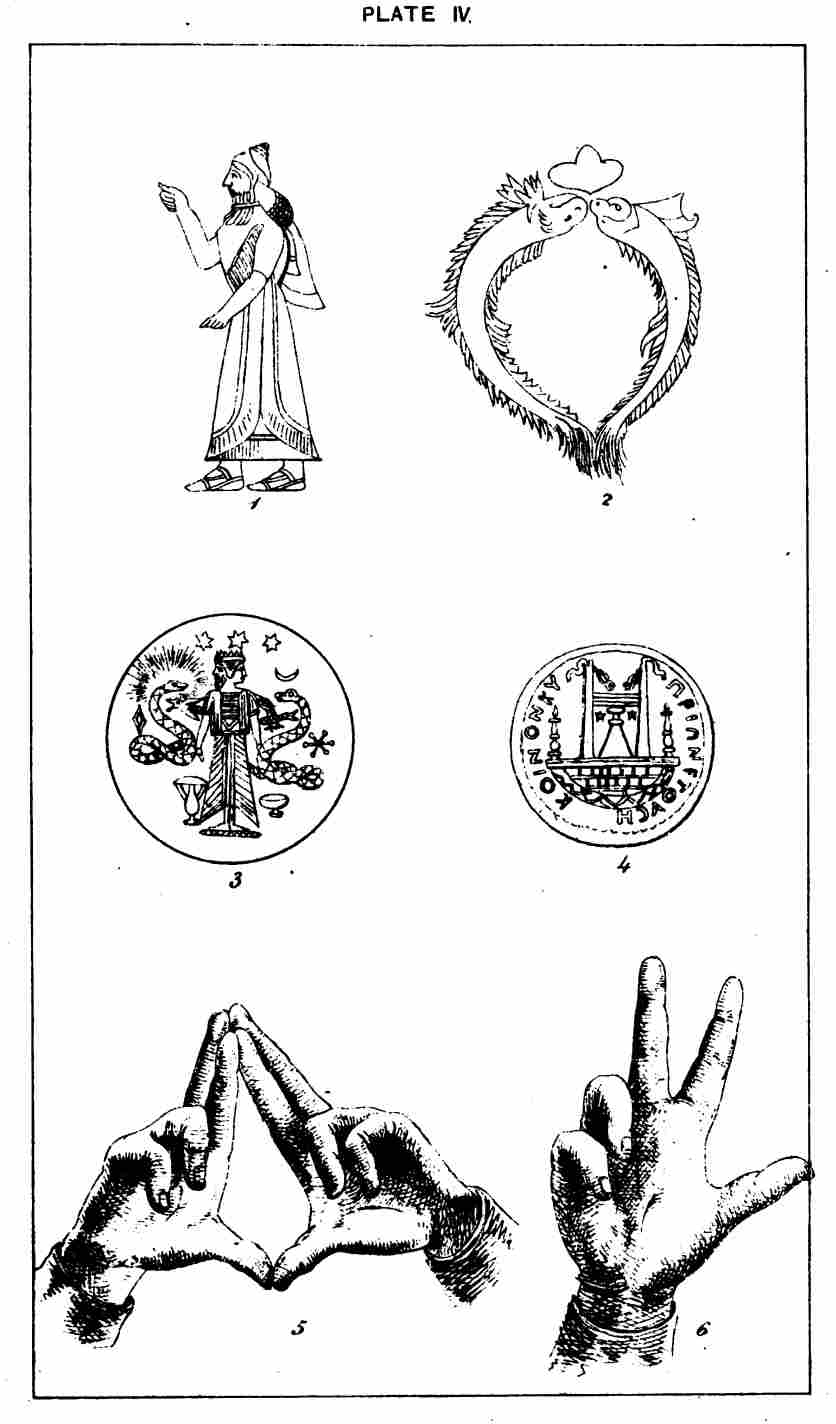
Fig. 2 is a Buddhist emblem; the two fishes forming the circle represent the mystic yoni, the sacti of Mahadeva, while the triad above them represents the mystic trinity, the triune father, Siva, Bel, or Asher, united with Anu and Hea. From Journal of Royal Asiatic Society, vol. xviii., p. 892, plate ii.
Fig. 3 is a very remarkable production. It originally belonged to Mons. Lajard, and is described by him in his second Memoire, entitled Recherches sur le Culte, les Symboles, les Attributs, et les Monumens Figurés de Vénus (Paris, 1837), in pages 32, et seq., and figured in plate I., fig. 1. The real age of the gem and its origin are not known, but the subject leads that author to believe it to be of late Babylonian workmanship. The stone is a white agate, shaped like a cone, and the cutting is on its lower face. The shape of this gem indicates its dedication to Venus. The central figures represent the androgyne deity, Baalim, Astaroth, Elohim, Jupiter genetrix, or the bearded Venus Mylitta. On the left side of the cutting we notice an erect serpent, whose rayed head makes us recognise the solar emblem, and its mundane representative, mentula arrecta; on a spot opposite to the centre of the male's body we find a lozenge, symbolic of the yoni, whilst opposite to his feet is the amphora, whose mystic signification may readily be recognised; it is meant for Ouranos, or the Sun fructifying Terra, or the earth, by pouring from himself into her.
* A friend has informed me, for example, that he happened, whilst at Pesth, to look at a gorgeously dressed and handsome young woman. To his astonishment she pointed her thumb precisely in the manner adopted by the Assyrian priests; this surprised the young man still farther, and being, as it were, fascinated, he continued to gaze. The damsel then grasped the thumb by the other hand; thus indicating her profession. My friend, who was wholly inexperienced in the ways of the world, only understood what was meant when he saw my explanation of Fig. 1.
The three stars over the head of the figure, and the inverted triangle on its head, are representations of the mythological four, equivalent to the Egyptian symbol of life (figs. 31, 82). Opposite to the female are the moon, and another serpent, which may be recognised by physiologists as symbolic of tensio clitoridis. In a part corresponding to the diamond, on the left side, is a six-rayed wheel, emblematic, apparently, of the sun. At the female's feet is placed a cup, which is intended to represent the passive element in creation. As such it is analogous to the crescent moon, and is associated in the Roman church with the round wafer, the symbol of the sun; the wafer and cup thus being synonymous with the sun and moon in conjunction. It will be observed that each serpent in the plate is apparently attacked by what we suppose is a dragon. There is some difficulty in understanding the exact idea intended to be conveyed by these; my own opinion is that they symbolise Satan, the old serpent that tempted Eve, viz., fierce lust, Eros, Cupid, or desire, which, both in the male and female, brings about the arrectation which the serpents figure. It is not to be passed by without notice, that the snake which represents the male has the tail so curved as to suggest the idea of the second and third elements of the trinity. Monsieur Lajard takes the dragons to indicate the bad principle in nature, i. e., darkness, night, Ahriman, etc. On the pyramidal portion of the gem the four sides are ornamented by figures—three represent animals remarkable for their salacity, and the fourth represents Bel and Ishtar in conjunction, in a fashion which can be more easily imagined than described in the mother tongue. The learned will find the position assumed in Lucretius, Dê Rerum Naturâ, book iv., lines 1256, seq.
Fig. 4 is also copied from Lajard, plate i., fig. 10. It is the reverse of a bronze coin of Vespasian, struck in the island of Cyprus, and represents the conical stone, under whose form Venus was worshipped at Paphos, of which Tacitus remarks, Hist, ii., c. 8, "the statue bears no resemblance to the human form, but is round, broad at one end and gradually tapering at the other, like a goal. The reason of this is not ascertained." It is remarkable that a male emblem should be said to represent Venus, but the stone was an aerolite, like that which fell at Ephesus, and was said to represent Diana. It is clear that when a meteoric stone falls, the chief priests of the district can say that it is to be taken as a representative of their divinity.
My very ingenious friend, Mr. Newton, suggests that the Venus in question was androgyne; that the cone is a male emblem, within a door, gateway, or delta, thus resembling the Assyrian grove. It is certain that the serpents, the two stars, and the two candelabra, or altars with flame, favour his idea.
Fig. 5 represents the position of the hands assumed by Jewish priests when they give the benediction to their flock. It will be recognised that each hand separately indicates the trinity, whilst the junction of the two indicates the unit. The whole is symbolic of the mystic Arba—the four, i, e., the trinity and unity. One of my informants told me that, being a "cohen" or priest, he had often administered the blessing, and, whilst showing to me this method of benediction, placed his joined hands so that his nose entered the central aperture. On his doing so, I remarked "bene nasatus," and the expression did more to convince him of the probability of my views than anything else.
Fig. 6, modified in one form or another, is the position assumed by the hand and fingers, when Homan and Anglican bishops or other hierarchs give benediction to their people. A similar disposition is to be met with in Indian mythology, when the Creator doubles himself into male and female, so as to be in a position to originate new beings. Whilst the right hand in Plate VII. symbolises the male, the left hand represents the mystic feminine circle. In another plate, which is to be found in Moor's Hindu Pantheon, there is a similar figure, but draped fully, and in that the dress worn by the celestial spouse is covered with groups of spots arranged in triads and groups of four. With regard to the signification of spots, we may notice that they indicated, either by their shape or by their name, the emblem of womankind. A story of Indra, the Hindoo god of the sky, confirms this. He is usually represented as bearing a robe covered with eyes; but the legend runs that, like David, he became enamoured of the wife of another man, who was very beautiful and seen by chance, but her spouse was one whose austere piety made him almost equal to Brahma. The evil design of Indra was both frustrated and punished. The woman escaped, but the god became covered with marks that recalled his offence to mind, for they were pictures of the yoni. These, by the strong intercession of Brahma with the Rishi, were changed by the latter into eyes. This story enables us to recognise clearly the hidden symbolism of the Hindoo and Egyptian eye, the oval representing the female, and the circle the male lodged therein—i.e., the androgyne creator.
PLATE V.
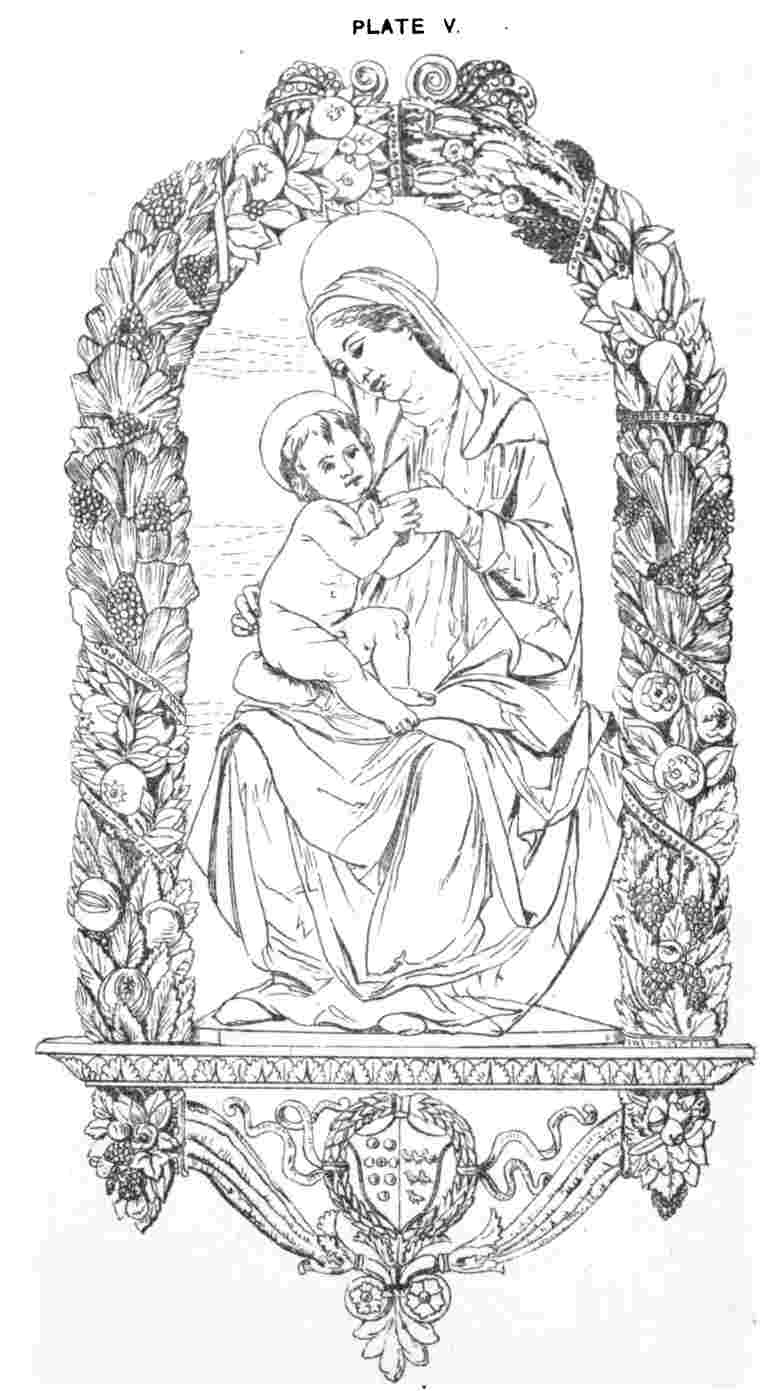
Is a copy of a mediæval Virgin and Child, as painted in Della Robbia ware in the South Kensington Museum, a copy of which, was given to me by my friend, Mr. Newton, to whose kindness I am indebted for many illustrations of ancient Christian art. It represents the Virgin and Child precisely as she used to be represented in Egypt, in India, in Assyria, Babylonia, Phoenicia, and Etruria; the accident of dress being of no mythological consequence. In the framework around the group, we recognise the triformed leaf, emblematic of Asher; the grapes, typical of Dionysus; the wheat ears, symbolic of Ceres, l'abricot fendu, the mark of womankind, and the pomegranate rimmon, which characterises the teeming mother. The living group, moreover, are placed in an archway, delta, or door, which is symbolic of the female, like the vesica piscis, the oval or the circle. This door is, moreover, surmounted by what appear to be snails, whose supposed virtue we have spoken of under Plate i. This identification of Mary with the Sacti is strong; by-and-by we shall see that it is as complete as it is possible to be made.
PLATE VI.
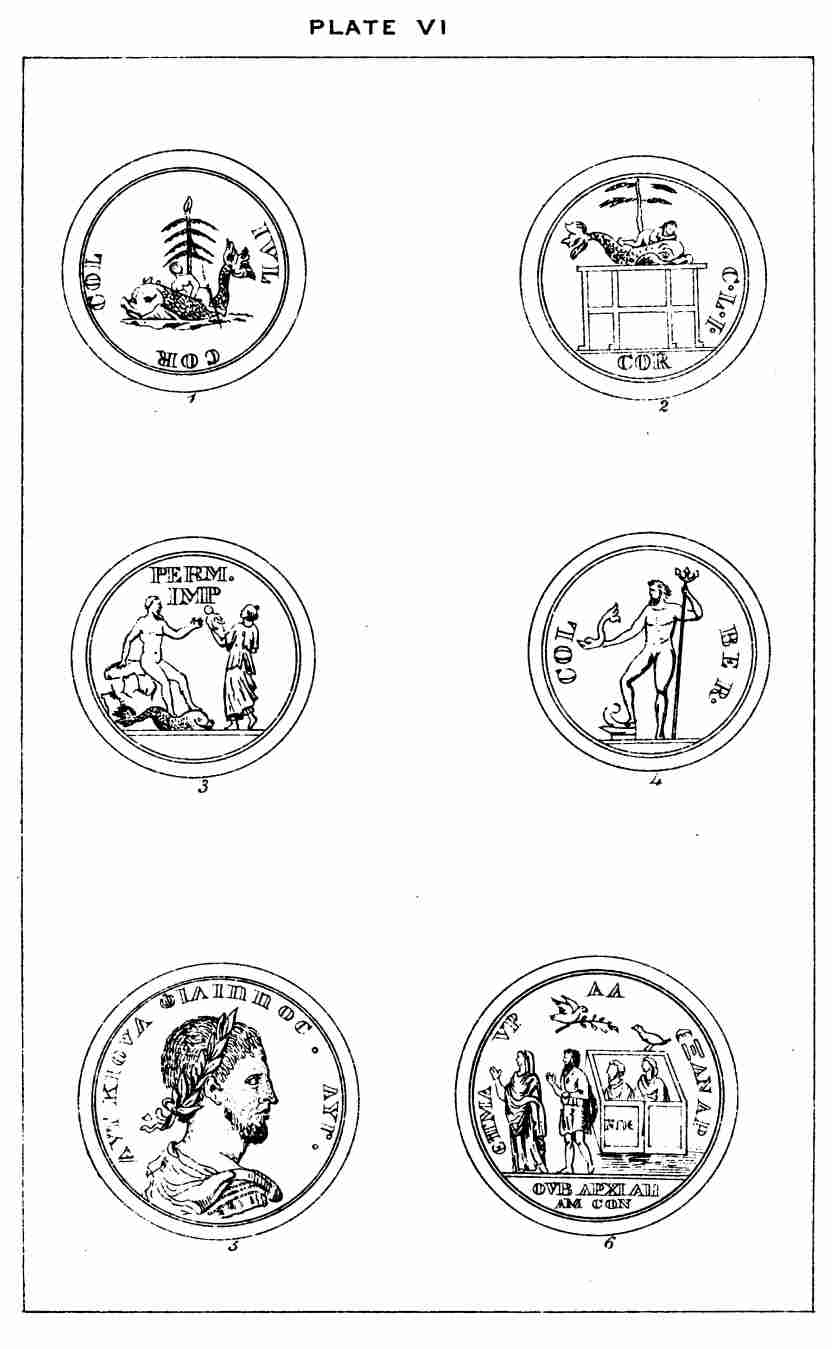
Is a copy of figures given in Bryant's Ancient Mythology, plates xiii., xxviii., third edition, 1807. The first two illustrate the story of Palemon and Getus, introducing the dolphin. That fish is symbolic of the female, in consequence of the assonance in Greek between its name and that of the womb, delphis and delphus. The tree symbolises the arbor vitæ, the life-giving sprout; and the ark is a symbol of the womb. The third figure, where a man rests upon a rock and dolphin, and toys with a mother and child, is equally suggestive. The male is repeatedly characterised as a rock, hermes, menhir, tolmen, or upright stone, the female by the dolphin, or fish. The result of the junction of these elements appears in the child, whom both parents welcome. The fourth figure represents two emblems of the male creator, a man and trident, and two of the female, a dolphin and ship. The two last figures represent a coin of Apamea, representing Noah and the ark, called Cibotus. Bryant labours to prove that the group commemorates the story told in the Bible respecting the flood, but there is strong doubt whether the story was not of Babylonian origin. The city referred to was in Phrygia, and the coin appears to have been struck by Philip of Macedon. The inscription round the head is [—Greek inscription—]See Ancient Faiths, second edition, Vol. ii.., pp. 128, and 885-892.
The Supreme Spirit in the act of creation became two-fold; the RIGHT SIDE WAS MALE, THE LEFT WAS PRAKRITI, SHE IS OF ONE FORM WITH BRAMAH.
She is Maya, eternal and imperishable, such as the Spirit, such is the inherent energy. (The Sacti) as the Faculty burning is inherent in pure.
(Bramah Vaivartta Puranu, Professor Wilson.)
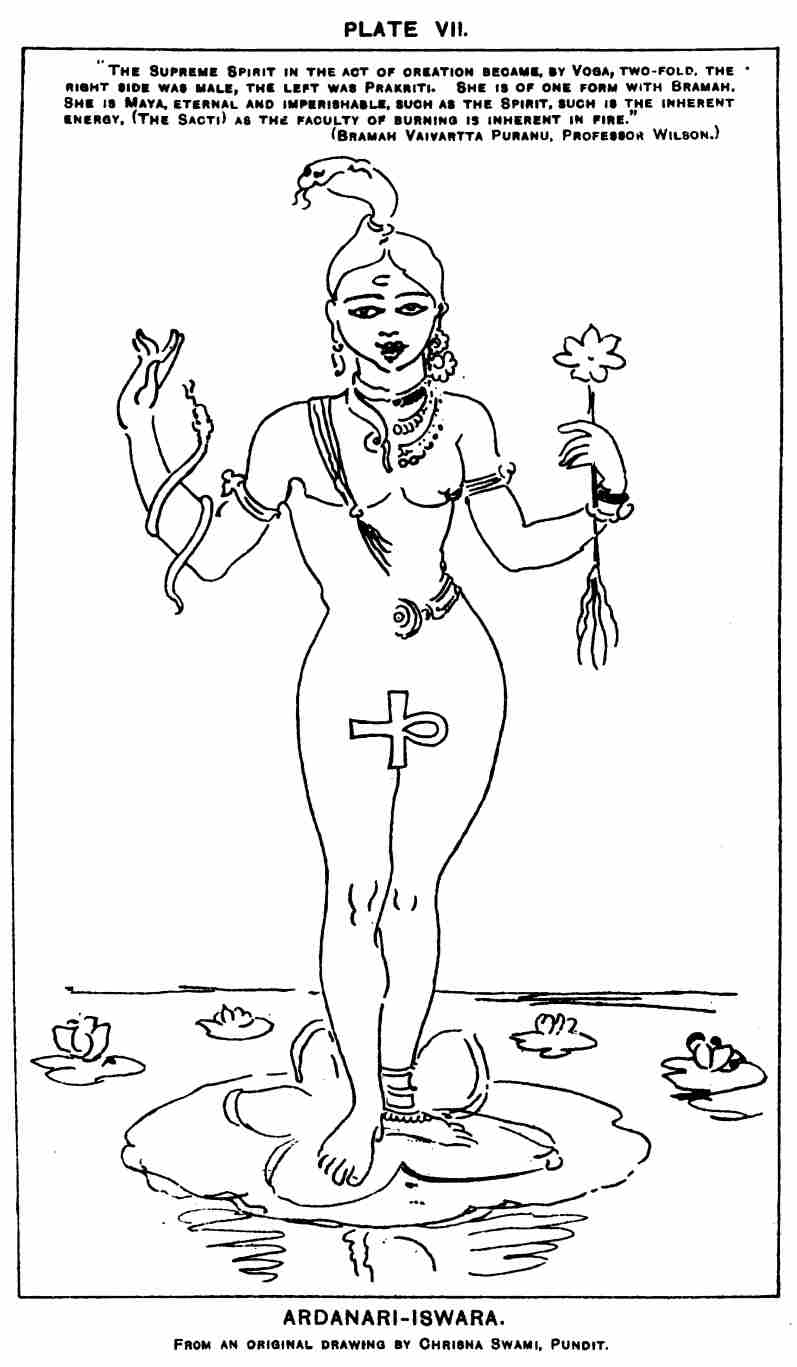
ARDANARI-ISWARA.
From an original drawing by Chrisna Swami, Punoit.
PLATE VII.
Is a copy of an original drawing made by a learned Hindoo pundit for Wm. Simpson, Esq., of London, whilst he was in India studying its mythology. It represents Brahma supreme, who in the act of creation made himself double, i.e. male and female. In the original the central part of the figure is occupied by the triad and the unit, but far too grossly shown for reproduction here. They are replaced by the crux ansata. The reader will notice the triad and the serpent in the male hand, whilst in the female is to be seen a germinating seed, indicative of the relative duties of father and mother. The whole stands upon a lotus, the symbol of androgyneity. The technical word for this incarnation is "Arddha Nari."
PLATE VIII.
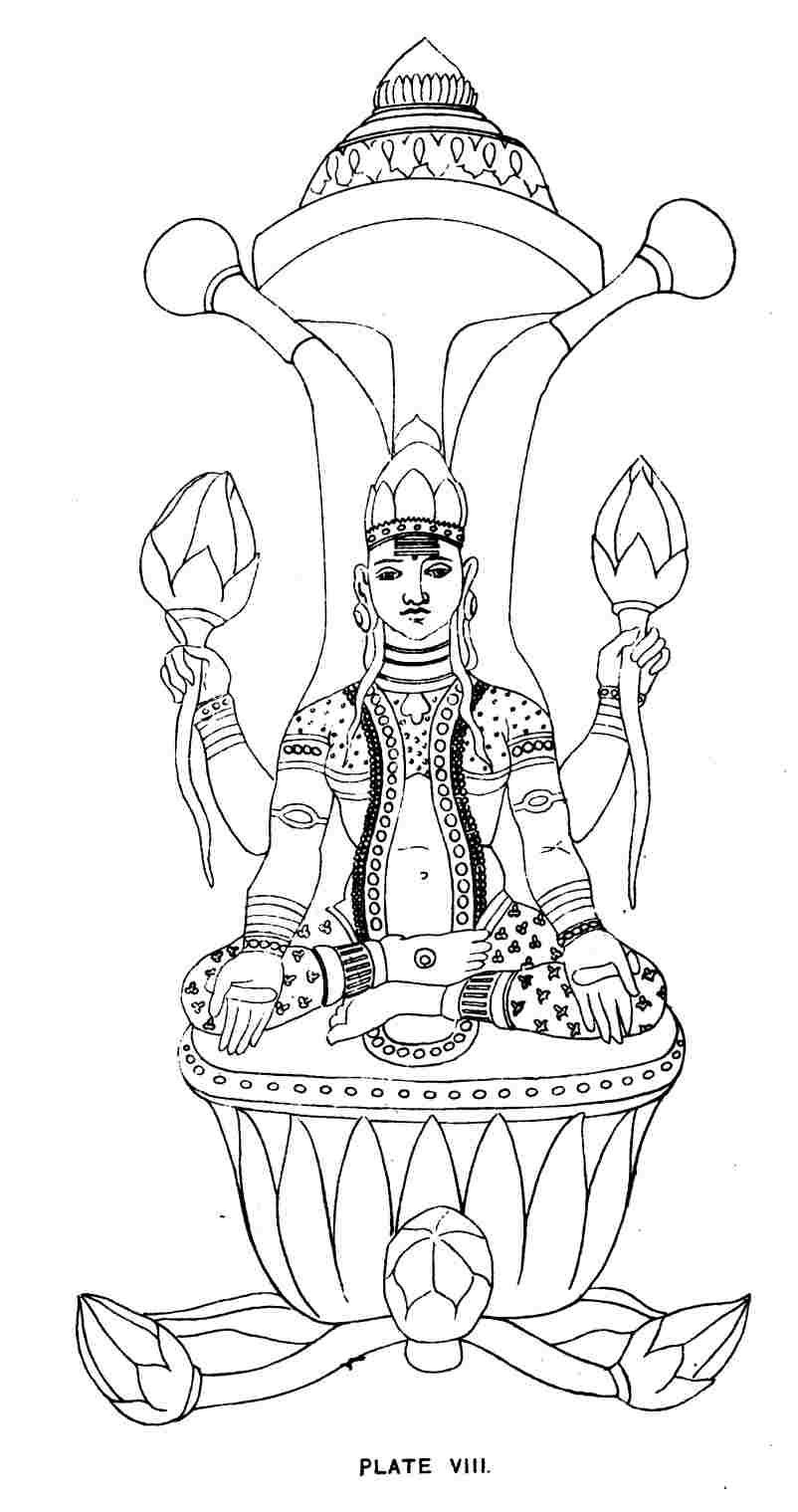
Is Devi, the same as Parvati, or Bhavani. It is copied from Moor's Pantheon, plate xxx. The goddess represents the feminine element in the universe. Her forehead is marked by one of the symbols of the four creators, the triad, and the unit. Her dress is covered with symbolic spots, and one foot peculiarly placed is marked by a circle having a dot in the interior. The two bear the same signification as the Egyptian eye. I am not able to define the symbolic import of the articles held in the lower hands. Moor considers that they represent scrolls of paper, but this I doubt. The raised hands bear the unopened lotus flower, and the goddess sits upon another.
PLATE IX.
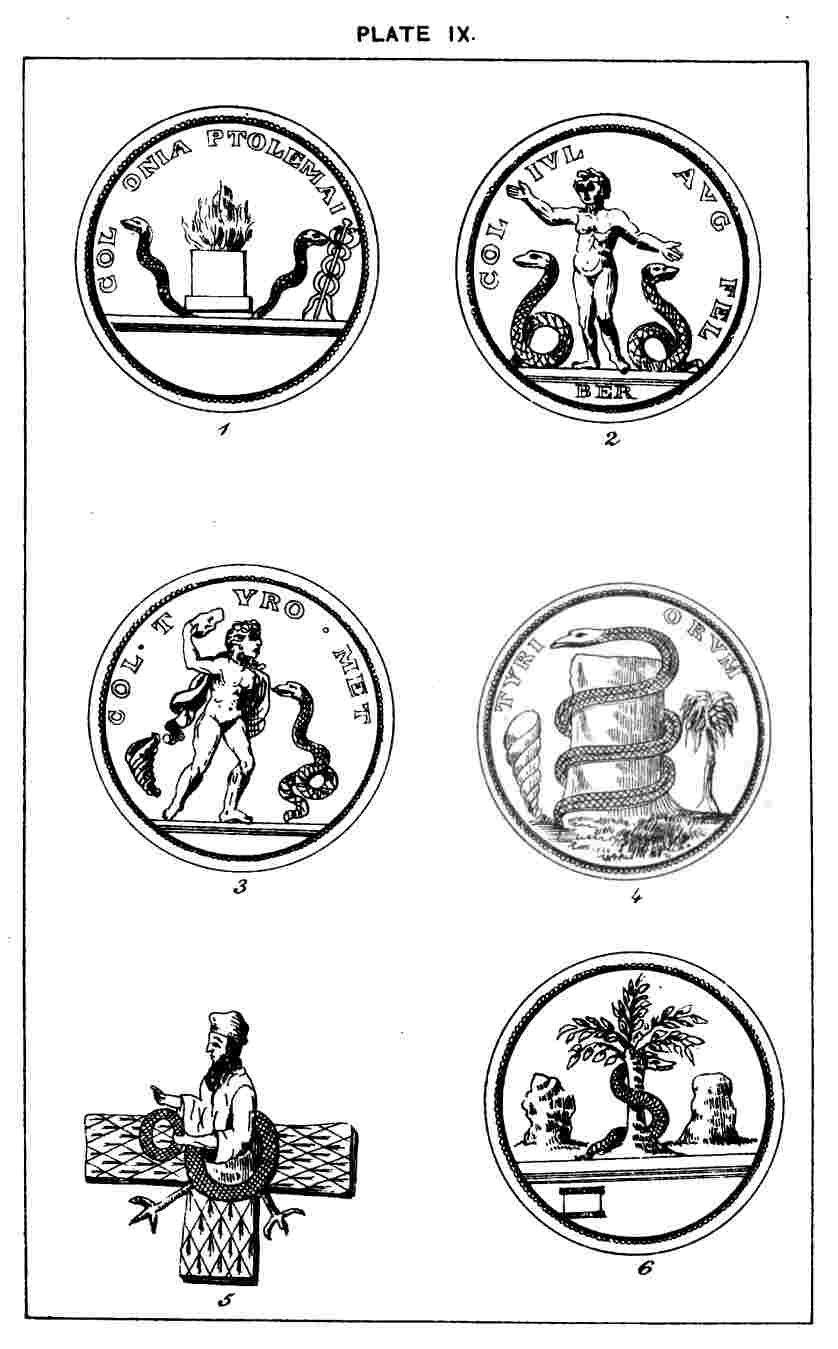
Consists of six figures, copied from Maurice's Indian Antiquities, vol. vi., p. 278, and two from Bryant's Mythology, vol. ii., third edition, pp. 203 and 409. All are symbolic of the idea of the male triad: a central figure, erect, and rising above the other two. In one an altar and fire indicate, mystically, the linga; in another, the same is pourtrayed as a man, as Madaheva always is; in another, there is a tree stump and serpent, to indicate the same idea. The two appendages of the linga are variously described; in two instances as serpents, in other two as tree and concha, and snake and shell. The two last seem to embody the idea that the right "egg" of the male germinates boys, whilst the left produces girls; a theory common amongst ancient physiologists. The figure of the tree encircled by the serpent, and supported by two stones resembling "tolmen," is very significant. The whole of these figures seem to point unmistakably to the origin of the very common belief that the male Creator is triune. In Assyrian theology the central figure is Bel, Baal, or Asher; the one on the right Ann, that on the left Hea. See Ancient Faiths, second edition, Vol. i., pp. 88-85. *
There are some authors who have treated of tree and serpent worship, and of its prevalence in ancient times, without having, so far as I can see, any idea of that which the two things typify. The tree of knowledge, the tree of life, the serpent that tempted Eve, and still tempts man by his subtlety, are so many figures of speech which the wise understand, but which to the vulgar are simply trees and snakes. In a fine old bas-relief over the door of the Cathedral at Berne, we see an ancient representation of the last judgment. An angel is dividing the sheep from the goats, and devils are drawing men and women to perdition, by fixing hooks or pincers on the portions of the body whence their sins sprang. One fat priest, nude as our risen bodies must be, is being savagely pulled to hell by the part symbolised by tree and serpent, whilst she whom he has adored and vainly sought to disgrace, is rising to take her place amongst the blest. It is not those of the sex of Eve alone that are inveigled to destruction by the serpent.
* For those who have not an opportunity of consulting the work referred to, I may observe that the Assyrian godhead consisted of four persons, three being male and one female. The principal god was Asher, the upright one, the equivalent of the Hindoo Mahadeva, the great holy one, and of the more modern Priapus. He was associated with Anu, lord of solids and of the lower world, equivalent to the "testis," or egg on the right side. Hea was lord of waters, and represented the left "stone." The three formed the trinity or triad. The female was named Ishtar or Astarte, and was equivalent to the female organ, the yoni or vulva—the [Greek] of the Greeks. The male god in Egypt was Osiris, the female Isis, and these names are frequently used as being euphemistic, and preferable to the names which are in vulgar use to describe the male and female parts.
PLATE X.
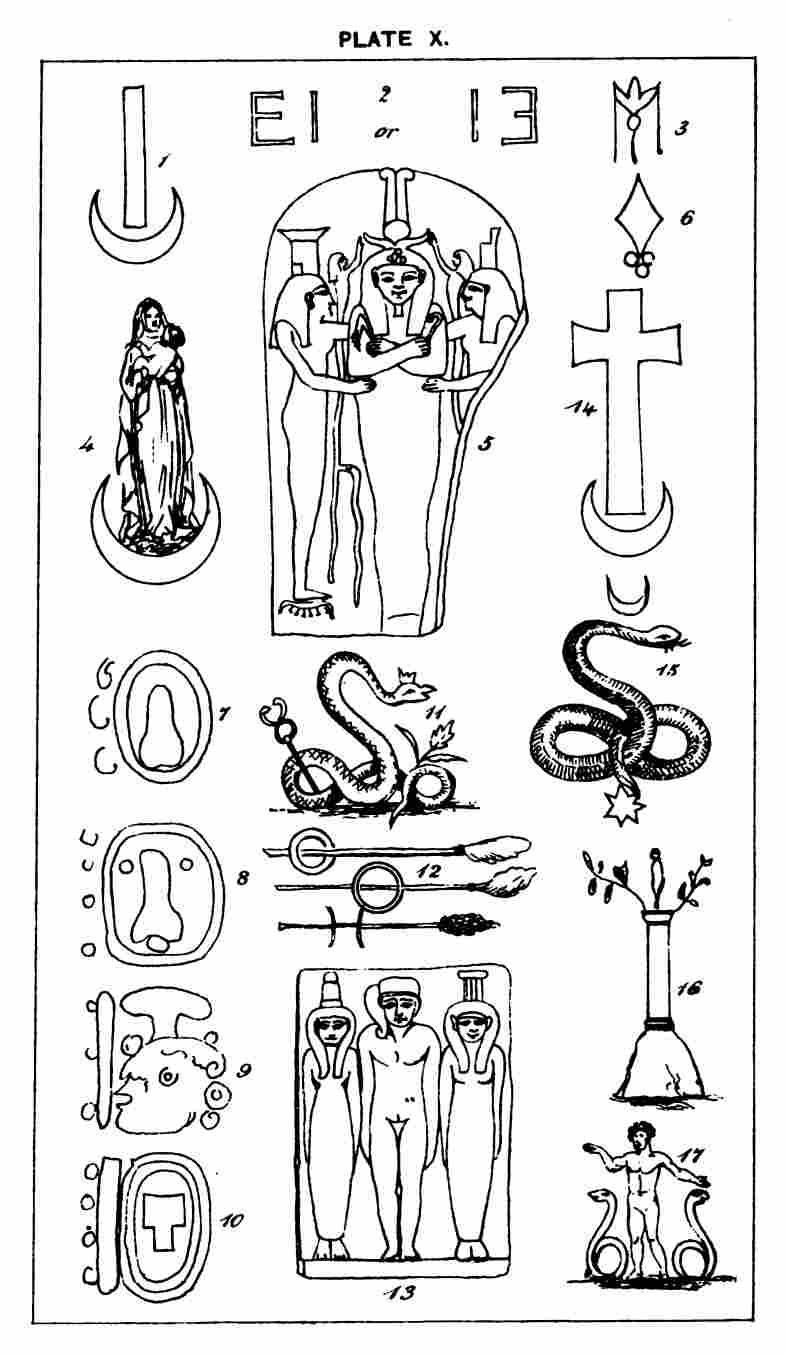
Contains pagan symbols of the trinity or linga, with or without the unity or yoni.
Fig. 1 represents a symbol frequently met with in ancient architecture, etc. It represents the male and female elements, the pillar and the half moon.
Fig. 2 represents the mystic letters said to have been placed on the portal of the oracle of Delphi. By some it is proposed to read the two letters as signifying "he or she is;" by others the letters are taken to be symbolic of the triad and the unit. If they be, the pillar is a very unusual form for the yoni. An ingenious friend of mine regards the upright portion as a "slit," but I cannot wholly agree with him, for in Fig. 1 the pillar cannot be looked upon as an aperture.
Fig. 3 is a Hindoo sectarial mark, copied from Moor's Hindu Pantheon, and is one out of many indicating the union of the male and female.
Fig. 4 is emblematic of the virgin and child. It identifies the two with the crescent. It is singular that some designers should unite the moon with the solar symbol, and others with the virgin. We believe that the first indicate ideas like that associated with Baalim, and Ashtaroth in the plural, the second that of Astarte or Venus in the singular. Or, as we may otherwise express it, the married and the immaculate virgin.
Fig. 5 is copied from Sharpe's Egyptian Mythology, p. 15. It represents one of the Egyptian trinities, and is highly symbolic, not only indicating the triad, here Osiris, Isis, and Nepthys, but its union with the female element. The central god Osiris is himself triune, as he bears the horns symbolic of the goddess Athor and the feathers of the god Ra.
Fig. 6 is a Hindoo sectarial mark, from Moor's Hindu Pantheon. The lozenge indicates the yoni. For this assertion we not only have evidence in Babylonian gems, copied by Lajard, but in Indian and Etruscan designs. We find, for example, in vol. v., plate xlv., of Antiquités Etrusques, etc., par. F. A. David (Paris, 1785), a draped female, wearing on her breast a half moon and mural crown, holding her hands over the middle spot of the body, so as to form a "lozenge" with the forefingers and thumbs. The triad in this figure is very distinct; and we may add that a trinity expressed by three balls or three circles is to be met with in the remotest times and in most distant countries.
Figs. 7, 8, 9 and 10 are copied from Cabrera's account of an ancient city discovered near Palenque, in Guatemala, Spanish America (London, 1822). Although they appear to have a sexual design, yet I doubt whether the similarity is not accidental. After a close examination of the plates given by Cabrera, I am inclined to think that nothing of the ling-yoni element prevailed in the mind of the ancient American sculptors. All the males are carefully draped in appropriate girdles, although in some a grotesque or other ornament, such as a human or bestial head, a flower, etc., is attached to the apron or "fall" of the girdle, resembling the sporran of the Highlander and the codpiece of mediæval knights and others. I may, however, mention some very remarkable sculptures copied; one is a tree, whose trunk is surrounded by a serpent, and whose fruit is shaped like the vesica piscis; in another is seen a youth wholly unclothed, save by a cap and gaiters, who kneels before a similar tree, being threatened before and behind by some fierce animal. This figure is peculiar, differing from all the rest in having an European rather than an American head and face. Indeed, the features, etc., remind me of the late Mr. Cobden, and the cap is such as yachting sailors usually wear. There is also another remarkable group, consisting apparently of a man and woman standing before a cross, proportioned like the conventional one in use amongst Christians. Everything indicates American ideas, and there are ornaments or designs wholly unlike any that I have seen elsewhere. The man appears to offer to the cross a grotesque human figure, with a head not much unlike Punch, with a turned-up nose, and a short pipe shaped like a fig in his mouth. The body is well formed, but the arms and thighs are rounded off like "flippers" or "fins." Besting at the top of the cross is a bird, like a game cock, ornamented by a necklace. The male in this and the other sculptures is beardless, and that women are depicted, can only be guessed at by the inferior size of some of the figures. It would be unprofitable to carry the description farther.
Figs. 11, 12 are from vol. i., plates xix. and xxiii. of a remarkably interesting work, Recherches sur l' origine, l' esprit, et les progrès des Arts de la Grèce, said to be written by D'Harcanville, published at London, 1785. The first represents a serpent, coiled so as to symbolise the male triad, and the crescent, the emblem of the yoni.
Fig. 12 accompanies the bull on certain coins, and symbolises the sexual elements, le baton et l'anneau. They were used, as the horse-shoe is now, as a charm against bad luck, or vicious demons or fairies.
Fig. 13 is, like figure 5, from Sharpe's Egyptian Mythology, p. 14, and is said to represent Isis, Nepthys, and Osiris; it is one of the many Mizraite triads. The Christian trinity is of Egyptian origin, and is as surely a pagan doctrine as the belief in heaven and hell, the existence of a devil, of archangels, angels, spirits and saints, martyrs and virgins, intercessors in heaven, gods and demigods, and other forms of faith which deface the greater part of modern religions.
Figure 14 is a symbol frequently seen in Greek churches, but appears to be of pre-Christian origin.* The cross we have elsewhere described as being a compound male emblem, whilst the crescent symbolises the female element in creation.
Figure 15 is from D'Harcanville, Op. Cit., vol. i., plate xxiii. It resembles Figure 11, supra, and enables us by the introduction of the sun and moon to verify the deduction drawn from the arrangement of the serpent's coils. If the snake's body, instead of being curved above the 8 like tail, were straight, it would simply indicate the linga and the sun; the bend in its neck, however, indicates the yoni and the moon.
Figure 16 is copied from plate xvi., fig. 2, of Recueil de Pierres Antiques Gravés, folio, by J. M. Raponi (Rome, 1786). The gem represents a sacrifice to Priapus, indicated by the rock, pillar, figure, and branches given in our plate. A nude male sacrifices a goat; a draped female holds a kid ready for immolation; a second man, nude, plays the double pipe, and a second woman, draped, bears a vessel on her head, probably containing wine for a libation.
Figure 17 is from vol. i. Récherches, etc., plate xxii. In this medal the triad is formed by a man and two coiled serpents on the one side of the medal, whilst on the reverse are seen a tree, surrounded by a snake, situated between two rounded stones, with a dog and a conch shell below. See supra, Plate ix., Fig. 6.
PLATE XI.
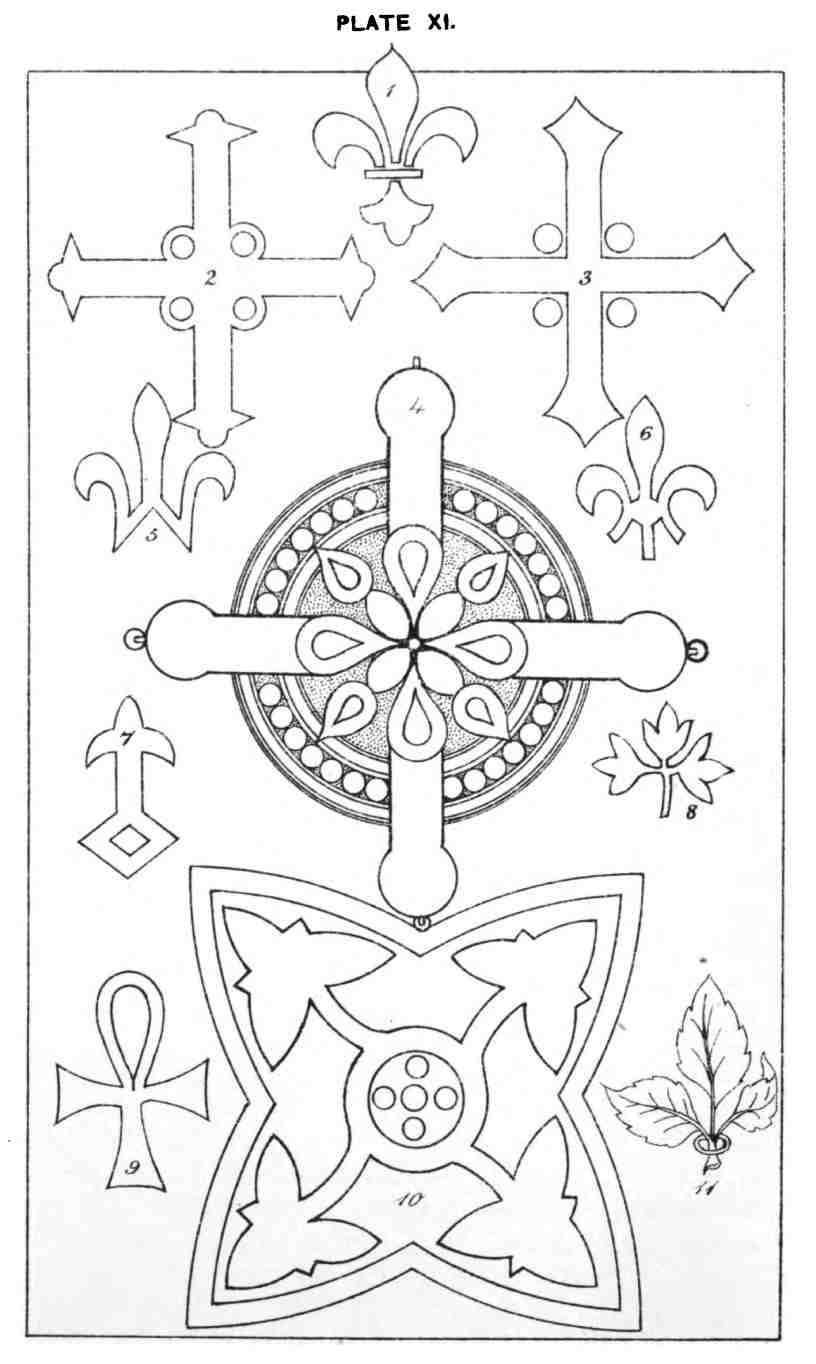
With two exceptions, Figs. 4 and 9,—exhibits Christian emblems of the trinity or linga, and the unity or yoni, alone or combined; the whole being copied from Pugin's Glossary of Ecclesiastical Ornament (London, 1869).
Fig. 1 is copied from Pugin, plate xvii., and indicates a double union of the trinity with the unity, here represented as a ring, Vanneau.
* There is an able essay on this subject in No. 267 of the Edinburgh Review—which almost exhausts the subject—but is too long for quotation here.
Figs. 2, 8, are from Pagin, plate xiv. In figare 2, the two covered balls at the base of each limb of the cross are extremely significant, and if the artist had not mystified the free end, the most obtuse worshipper must have recognised the symbol. We may add here that in the two forms of the Maltese cross, the position of the lingam is reversed, and the egg-shaped bodies, with their cover, are at the free end of each limb, whilst the natural end of the organ is left unchanged. See figs. 85 and 86. This form of cross is Etruscan. Fig. 8 is essentially the same as the preceding, and both may be compared with Fig. 4. The balls in this cross are uncovered, and the free end of each limb of the cross is but slightly modified.
Fig. 4 is copied in a conventional form from plate xxxv., fig. 4, of Two Essays on the Worship of Priapus (London, 1865). It is thus described (page 147): "The object was found at St. Agati di Goti, near Naples.......It is a crux ansata formed by four phalli, with a circle of female organs round the centre; and appears by the look to have been intended for suspension. As this cross is of gold, it had no doubt been made for some personage of rank, possibly an ecclesiastic." We see here very distinctly the design of the egg- and sistrum- shaped bodies. When we have such an unmistakable bi-sexual cross before our eyes, it is impossible to ignore the signification of Figs. 2 and 8, and Plate xii., Figs. 4 and 7.
Figs. 5, 6 are from Pugin, plates xiv. and xv., and represent the trinity with the unity, the triune god and the virgin united in one.
Fig. 7 represents the central lozenge and one limb of a cross, figured plate xiv. of Pugin. In this instance the Maltese cross is united with the symbol of the virgin, being essentially the same as Fig. 9, infra. It is a modified form of the crux ansata.
Fig. 8 is a compound trinity, being the finial of each limb of an ornamental cross. Pugin, plate xv.
Fig. 9 is a well-known Egyptian symbol, borne in the hand of almost every divinity. It is a cross, with one limb made to represent the female element in creation. The name that it technically bears is crux ansata, or "the cross with a handle." A reference to Fig. 4 serves to verify the idea which it involves.
Fig. 10 is from Pugin, plate xxxv. In this figure the cross is made by the intersection of two ovals, each a vesica piscis, an emblem of the yoni. Within each limb a symbol of the trinity is seen, each of which is associated with the central ring.
Fig. 11 is from Pugin, plate xix., and represents the arbor vitæ, the branch, or tree of life, as a triad, with which the ring is united.
It has been said by some critics that the figures above referred to are mere architectural fancies, which never had pretensions to embody a mystery; and that any designer would pitch upon such a style of ornamentation although profoundly ignorant of the doctrine of the trinity and unity. But this assumption is not borne out by fact; the ornaments on Buddhist topes have nothing in common with those of Christian churches; whilst in the ruined temple of the sun at Marttand, India, the trefoil emblem of the trinity is common. Grecian temples were profusely ornamented therewith, and so are innumerable Etruscan sculptures, but they do not represent the trinity and unity. It has been reserved for Christian art to crowd our churches with the emblems of Bel and Astarte, Baalim and Ashtoreth, linga and yoni, and to elevate the phallus to the position of the supreme deity, and assign to him a virgin as a companion, who can cajole him by her blandishment, weary him by wailing, or induce him to change his mind by her intercessions. Christianity certainly requires to be purged of its heathenisms.
PLATE XII.
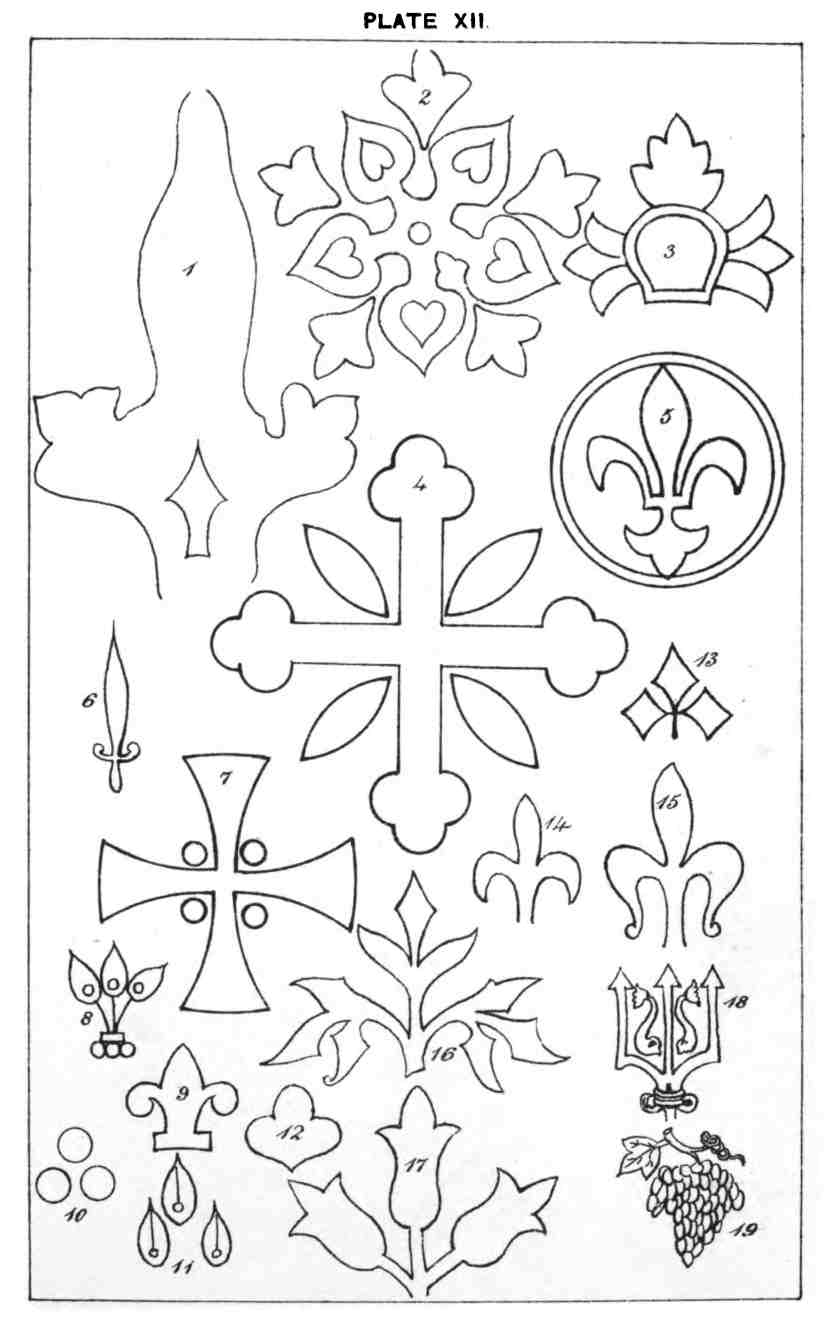
Contains both pagan and Christian emblems.
Fig. 1 is from Pugin, plate xviii., and is a very common finial representing the trinity. Its shape is too significant to require an explanation; yet with such emblems our Christian churches abound, that the Trinity may never be absent from the minds of man or woman!
Fig. 2 is from Pugin, plate xxi. It is a combination of ideas concealing the union patent in Fig. 4, Plate xi., supra.
Fig. 3 is from Moor's Hindu Pantheon. It is an ornament borne by Devi, and symbolises the union of the triad with the unit.
Fig. 4 is from Pugin, plate xxxii. It is a double cross made up of the male and female emblems. It is a conventionalised form of Fig. 4, Plate xi., supra. Such eight-rayed figures, made like stars, seem to have been very ancient, and to have been designed to indicate the junction of male and female.
Fig. 5 is from Pugin, plate xvii., and represents the trinity and the unity.
Fig. 6 is a Buddhist emblem from Birmah, Journal of Royal Asiatic Society, vol. xviii., p. 392, plate i., fig. 62. It represents the short sword, le bracquemard, a male symbol.
Fig. 7. is from Pagin, plate xvii. See Plate xi., Fig. 3, supra.
Figs. 8, 9, 10, 11, 12 are Buddhist (see Fig. 6, supra), and symbolise the triad.
Figs. 13, 14, 15, 16, 17 are from Pugin, and simply represent the trinity.
Figs. 18 and 19 are common Grecian emblems. The first is associated with Neptune and water, the second with Bacchus. With the one we see dolphins, emblems of the womb, the name of the two being assonant in Greek; with the other, the saying, sine Baccho et Cerere friget Venus, must be coupled.
PLATE XIII.
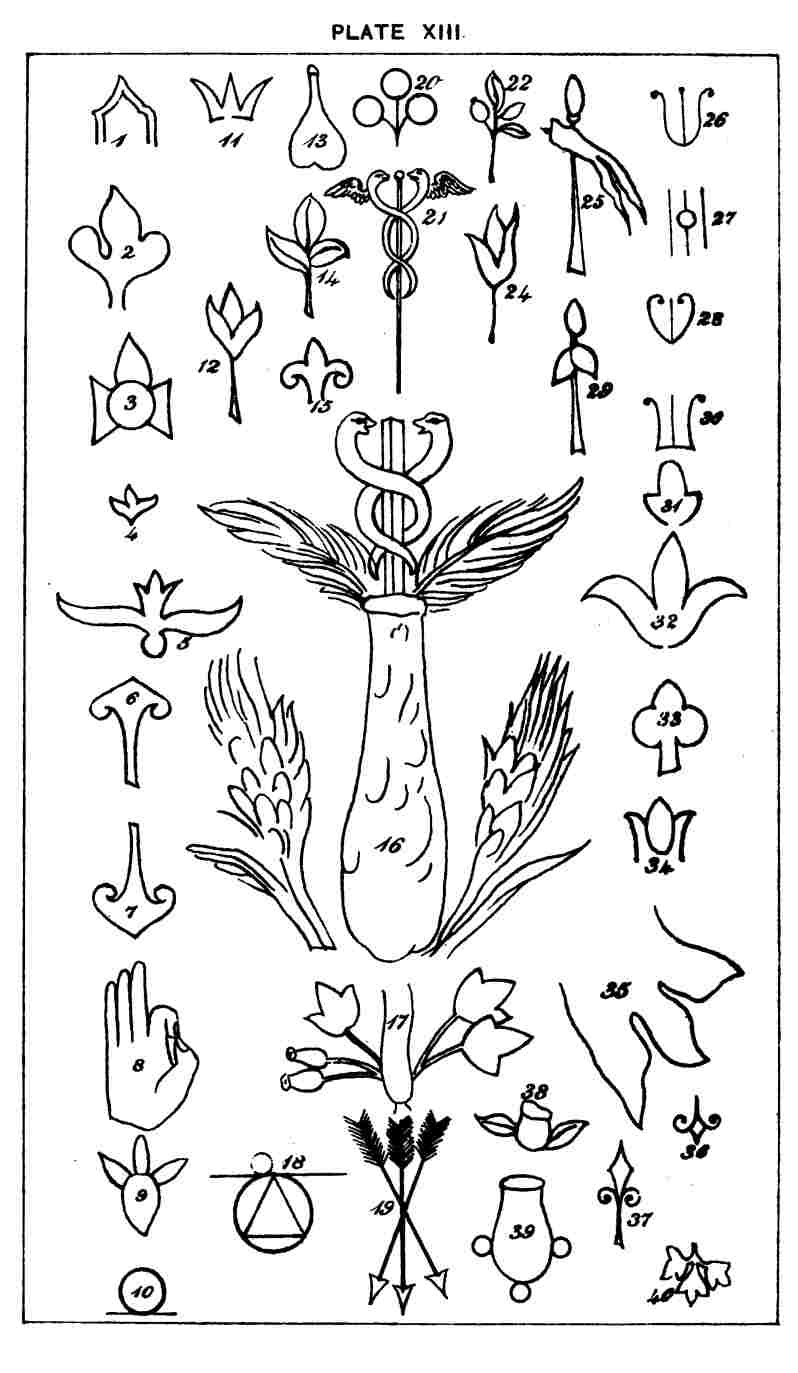
Consists of varions emblems of the triad and the unit, drawn almost exclusively from Grecian, Etruscan, Roman, and Indian gems, figures, coins, or sculptures, Maffei's Gemme Antiche Figurate, Raponi's Recueil, and Moor's Hindu Pantheon, being the chief authorities.
PLATE XIV.
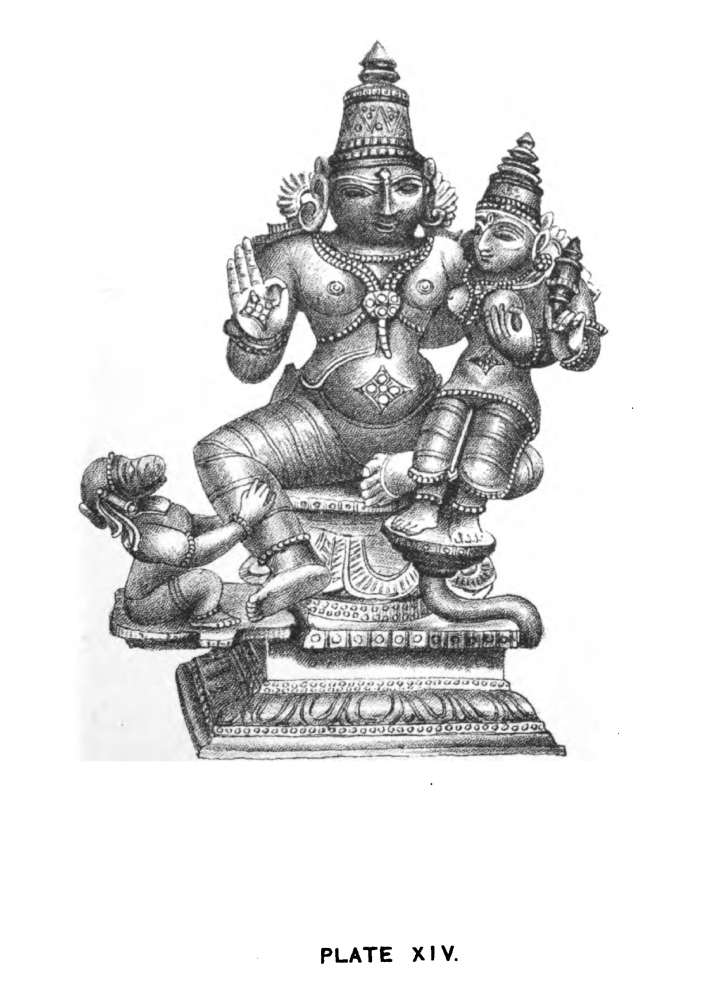
Is a copy of a small Hindoo statuette in the Mayer Collection in the Free Museum, Liverpool. It probably represents Parvati, the Hindoo virgin, and her child. The right hand of the figure makes the symbol of the yoni with the forefinger and thumb, the rest of the fingers typifying the triad. In the palm and on the navel is a lozenge, emblematic of woman. The child, perhaps Crishna, equivalent to the Egyptian Horus and the Christian Jesus, bears in its hand one of the many emblems of the linga, and stands upon a lotus. The monkey introduced into the group plays the same part as the cat, cow, lioness, and ape in the Egyptian mythology, being emblematic of that desire which eventuates in the production of offspring.
Fig. 1, the cupola, is well known in modern Europe; it is equally so in Hindostan, where it is sometimes accompanied by pillars of a peculiar shape. In one such compound the design is that of a cupola, supported by closely placed pillars, each of which has a "capital," resembling "the glans" of physiologists; in the centre there is a door, wherein a nude female stands, resembling in all respects Figure 61, except in dress and the presence of the child. This was copied by the late Mr. Sellon, from a Buddhist Dagopa in the Jumnar Cave, Bombay Presidency, a tracing of his sketch having been given to me by William Simpson, Esq., London.
The same emblem may be found amongst the ancient Italians. Whilst I was staying in Malta during the carnival time in 1872, I saw in all directions men and women selling cakes shaped like the yoni shown in Fig. 1. These sweetmeats had no special name, but they came in and went out with the carnival.
Fig. 2 represents Venus standing on a tortoise, whose symbolic import will be seen by referring to Fig. 74, infra. It is copied from Lajard, Sur le Culte de Venus, plate iiia., fig. 5, and is stated by him to be a drawing of an Etruscan candelabrum, existing in the Royal Museum at Berlin. In his account of Greece, Pausanias mentions that he saw one figure of Venus standing on a tortoise, and another upon a ram, but he declines to give the reason of the conjunction.
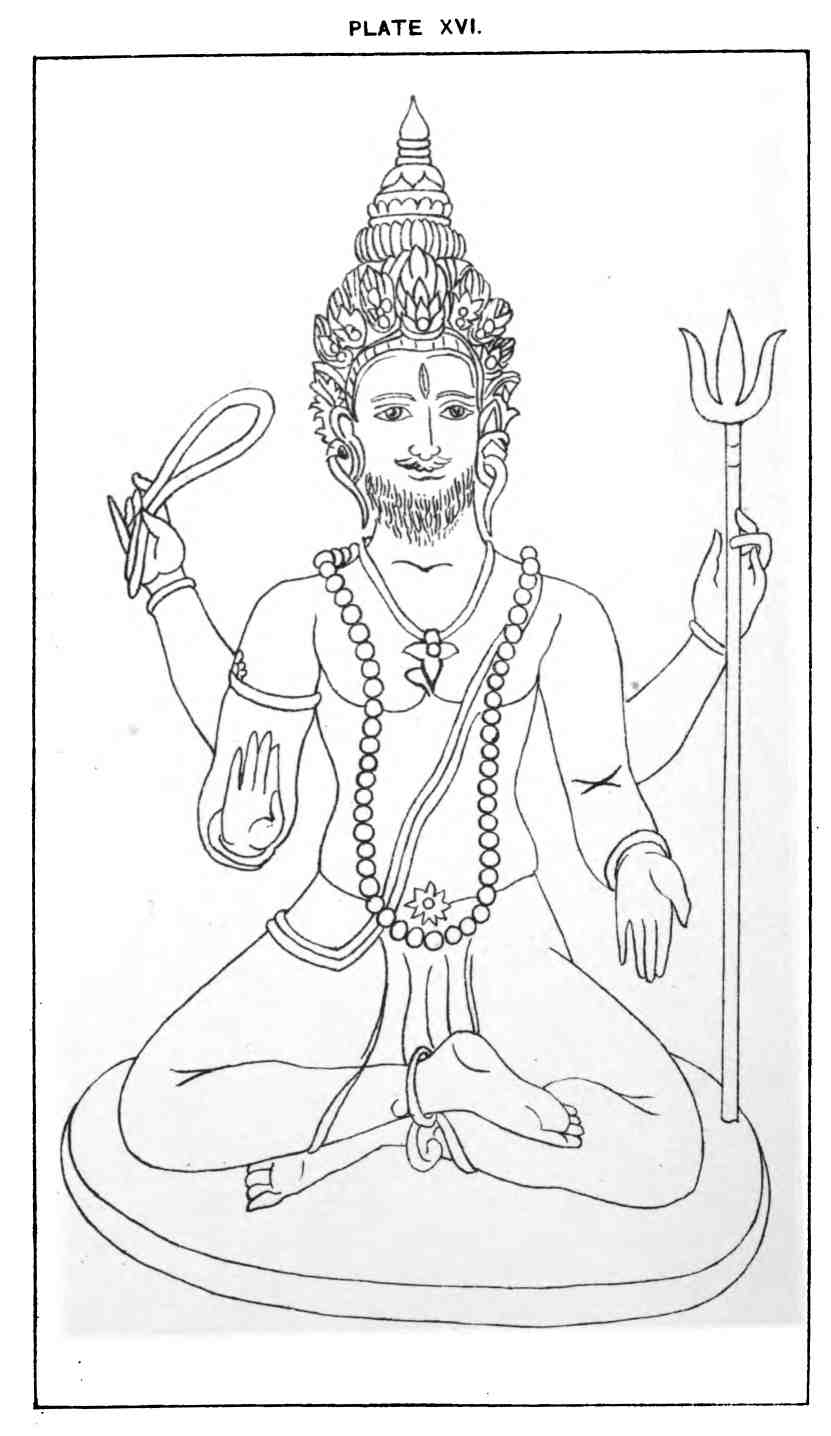
Is a representation of Siva, taken from Moor's Hindu Pantheon, plate xiii. Siva is supposed to be the oldest of the Indian deities, and to have been worshipped by the aborigines of Hindostan, before the Aryans invaded that country. It is thought that the Vedic religion opposed this degrading conception at the first, but was powerless to eradicate it. Though he is yet the most popular of all the gods, Siva is venerated, I understand, chiefly by the vulgar. Though he personifies the male principle, there is not anything indecent in pictorial representations of him. In one of his hands is seen the trident, one of the emblems of the masculine triad; whilst in another is to be seen an oval sistram-shaped loop, a symbol of the feminine unit. On his forehead he bears an eye, symbolic of the Omniscient, the sun, and the union of the sexes.
As it has been doubted by some readers, whether I am justified in regarding the sistrum as a female emblem, I append here a quotation from Socrates' Ecclesiastical History, Bohn's translation, p. 281, seq. In Rome, in the early time of Theodosius, "when a woman was detected in adultery.... they shut her up in a narrow brothel, and obliged her to prostitute herself in a most disgusting manner; causing little bells to be rang at the time.... As soon as the emperor was apprised of this indecent usage, he would by no means tolerate it; but having ordered the Sistra (for so these places of penal prostitution were denominated) to be pulled down," &c. One can as easily see why a female emblem should mark a brothel in Rome as a male symbol did at Pompeii.
PLATE XVI.
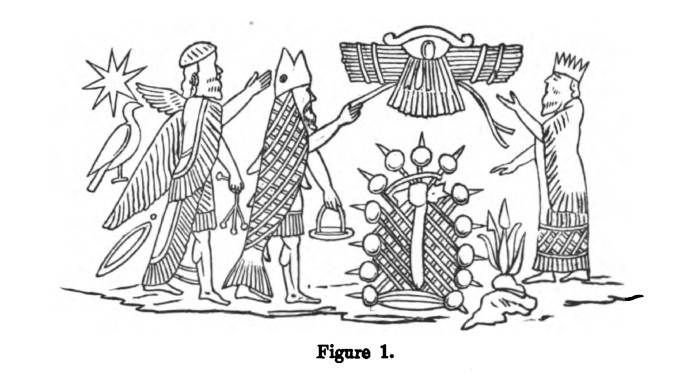
This Figure represents Assyrian priests offering in the presence of what is supposed to be Baal—or the representative of the sun god and of the grove. The first is typified by the eye, with wings and a tail, which make it symbolic of the male triad and the female unit. The eye, with the central pupil, is in itself emblematic of the same. The grove represents mystically le verger de Cypris. On the right stands the king; on the left are two priests, the foremost clothed with a fish's skin, the head forming the mitre, thus showing the origin of modern Christian bishops' peculiar head-dress. Arranged about the figures are, the sun; a bird, perhaps the sacred dove, whose note, coa or coo, has, in the Shemitic, some resemblance to an invitation to amorous gratification; in Latin coi, coite; the oval, symbol of the yoni; the basket, or bag, emblematic of the scrotum, and apparently the lotus. The trinity and unity are carried by the second priest.
Figure 2 is copied from an ancient copper vase, covered with Egyptian hieroglyphic characters, found at Cairo, and figured in a book entitled Explication des divers monument singuliers, qui ont rapport à la religion des plus anciens peuples, par le R. P. Dom.......á Paris, 1739.
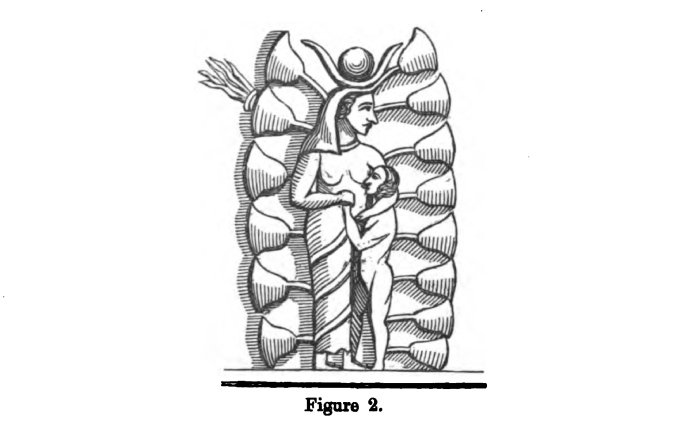
The group of figures represents Isis and Horus in an unusual attitude. They are enclosed in a framework of the flowers of the Egyptian bean, or of the lotus. This framework may be compared to the Assyrian "grove," and another in which the Virgin Mary stands. The bell was of old a symbol of virginity, for Eastern maidens wore them until marriage (see Isa. iii. 16). The origin of this custom was the desire that every maiden should have at her marriage, or sale, that which is spoken of in the Pentateuch as "the token of virginity." It was supposed that this membrane, technically called "the hymen" might be broken by too long a stride in walking or running, or by clambering over a stile or wall. To prevent such a catastrophe, a light chain or cord was worn, under or over the dress, at the level of the knees or just above. Its length only permitted a short step and a mincing gait. Slight bells were used as a sort of ornament, and when the bearer was walking their tinkling was a sort of proclamation that the lady who bore them was in the market as a virgin. After "the flower" had been plucked, the bells were no longer of use. They were analogous to the virgin snood worn on the head of Scotch maidens. Isis bears the horns of a cow, because that animal is equally noted for its propensity to seek the male and its care to preserve the offspring. As the bull with a human head, so a human being with cow's horns, was made to represent a deity. The solar orb between the horns, and the serpent round the body, indicate the union with the male; an incongruous conjunction with the emblem of the sacred Virgin, nevertheless a very common one. In some of the coins pictured by E. P. Knight, in Worship of Priapus, etc., a cow caressing her sucking calf replaces Isis and Horus, just as a bull on other coins replaces Dionysus. The group is described in full in Ancient Faiths, second edition, Vol. i., pp. 53, 54.
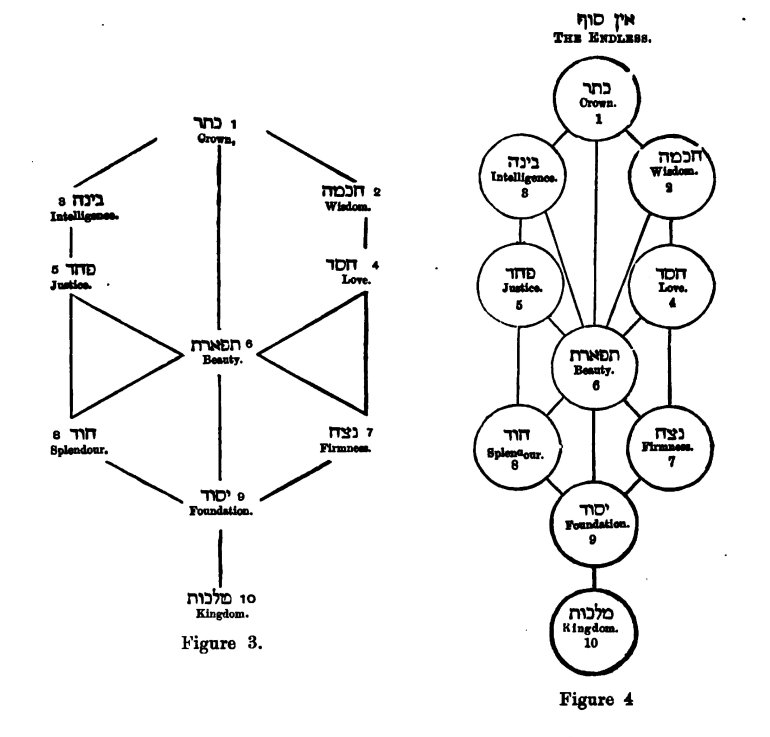
Figures 3, 4, are taken from Ginsburg's Kabbalah, and illustrate that in the arrangement of "potencies" two unite, like parents, to form a third. Sometimes we see also how three such male attributes as splendour, firmness, and solidity join with beauty to form the mystic arba, the trinity and unity.
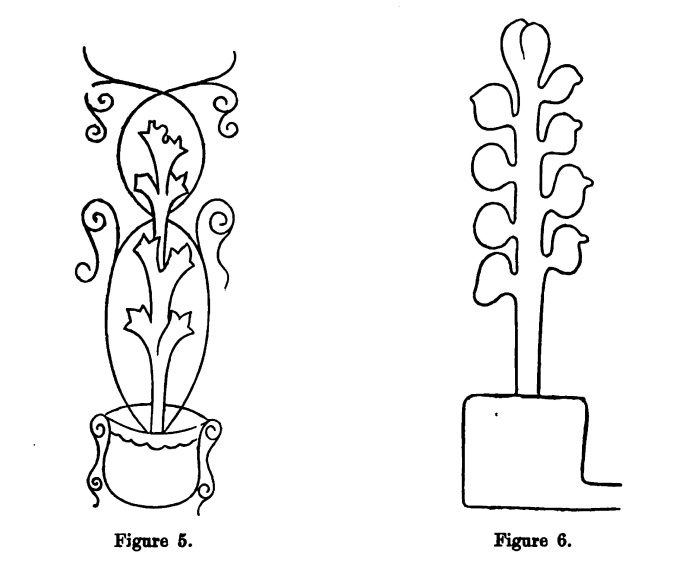
Figures 5, 6, are copies from figures found in Carthage and in Scotland, from Forbes Leslie's Early Races of Scotland, vol. i., plate vi., p. 46 (London, 1866). This book is one to which the reader's attention should be directed. The amount of valuable information which it contains is very large, and it is classified in a philosophical, and, we may add, attractive manner. The figures represent the arbor vitæ.
Figure 7 is from Bonomi, page 292, Nineveh and its Palaces (London, 1865). It apparently represents the mystic yoni, door, or delta; and it may be regarded as an earlier form of the framework in Plate iv. It will be remarked, by those learned in symbols, that the outline of the hands of the priests who are nearest to the figure is a suggestive one, being analogous to the figure of a key and its shank, whilst those who stand behind these officers present the pine cone and bag, symbolic of Ann, Hea, and their residence.
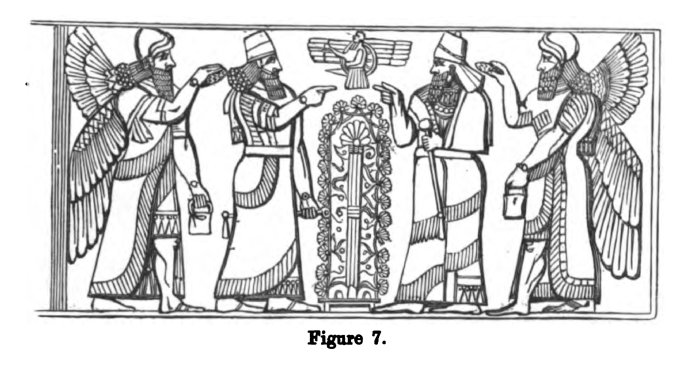
It is to be noticed, and once for all let us assert our belief, that every detail in a sculpture relating to religion has a signification; that the first right hand figure carries a peculiarly shaped staff; and that the winged symbol above the yoni consists of a male archer in a winged circle, analagous to the symbolic bow, arrow, and target. The bow was an emblem amongst the Romans, and arcum tendere was equivalent to arrigere. In the Golden Ass of Apuleius we find the metaphor used in his account of his dealings with amorous frolicsome Fotis, "Ubi primam sagittam sævi cupidinis in ima procordia mea delapsam excepi, arcum, meum et ipse vigore tetendi."
Again, we find in Petronius—
Astra igitur mea mens arcum dum tendit in ilia. Ex imo ad summum viva sagitta volat.
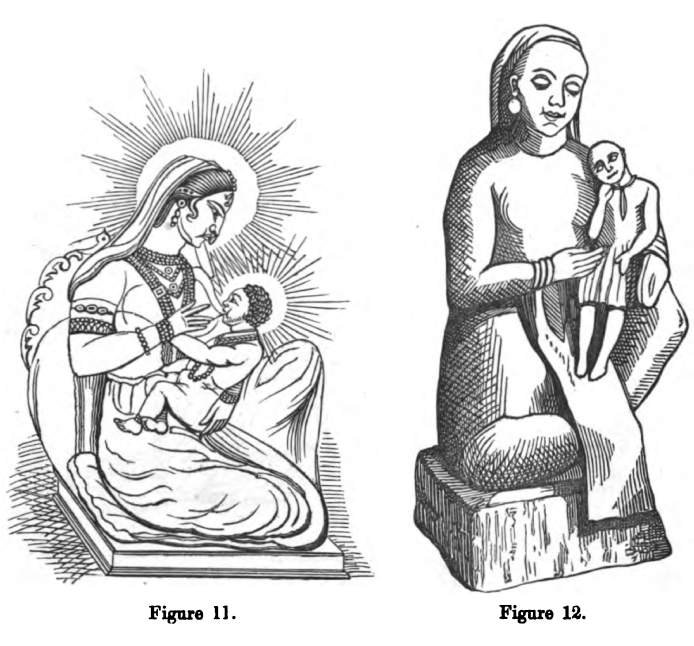
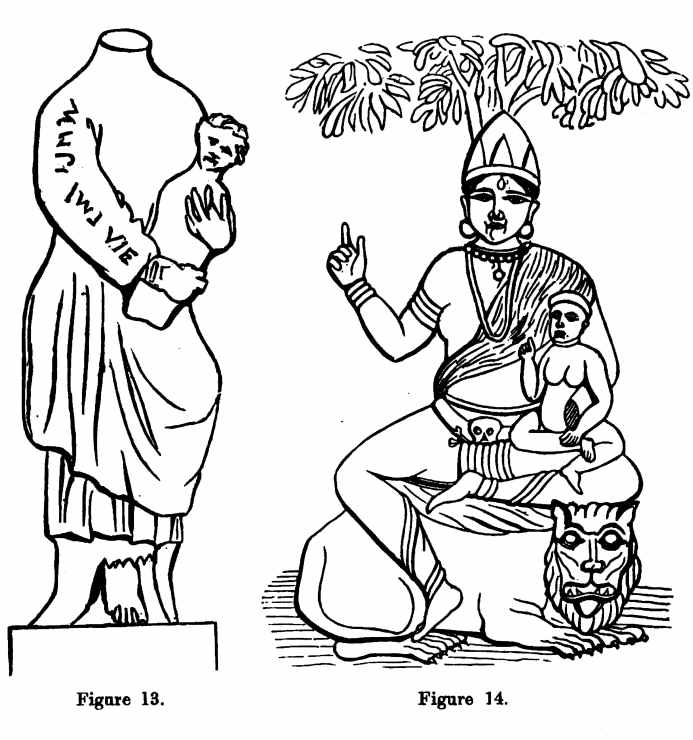
Figures 8 to 14 are representations of the goddess mother, the virgin and child, Ishtar or Astarte, Mylitta, Ceres, Rhea, Venus, Sacti, Mary, Yoni, Juno, Mama Ocello.
Fig. 8 is a copy of the deified woman or celestial mother, from Idalium, in Cyprus. Fig. 9 is from Egypt, and is remarkable for the cow's horns (for whose signification see Vol. i., p. 54, Ancient Faiths, second edition), which here replace the lunar crescent, in conjunction with the sun, the two being symbolic of hermaphroditism, whilst above is a seat or throne, emblematic of royalty.
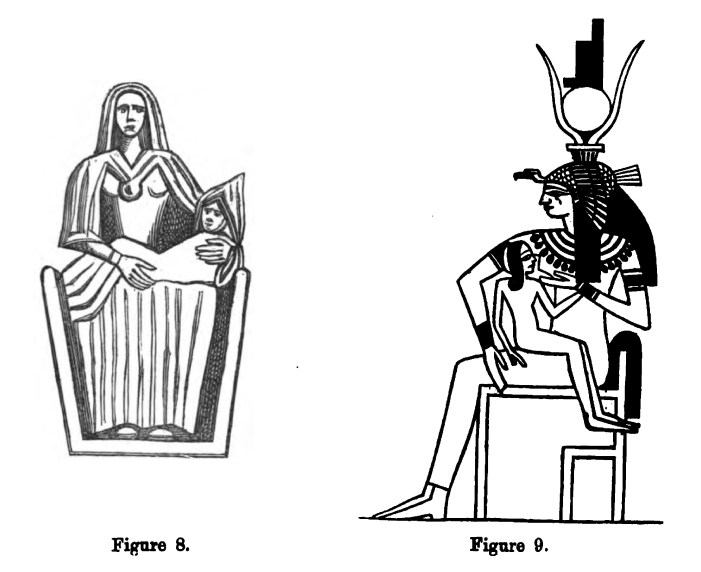
The two figures are copied from Rawlinson's Herodotus, vol. ii., p. 447, in an essay by Sir Gardiner Wilkinson, wherein other illustrations of the celestial virgin are given. Fig. 10 is a copy of plate 59, Moor's Hindu Pantheon, wherein it is entitled, "Crishna nursed by Devaki, from a highly finished picture." In the account of Crishna's birth and early history, as given by Moor (Op. Cit., pp. 197, et seq.), there is as strong a resemblance to the story of Christ as the picture here described has to papal paintings of Mary and Jesus. Fig. 11 is an enlarged representation of Devaki. Fig. 12 is copied from Rawlinson's Ancient Monarchies, vol. iii., p. 899. Fig. 13 is a figure of the mother and child found in ancient Etruria at Volaterra; it is depicted in Fabretti's Italian Glossary, plate xxvi., figure 349.
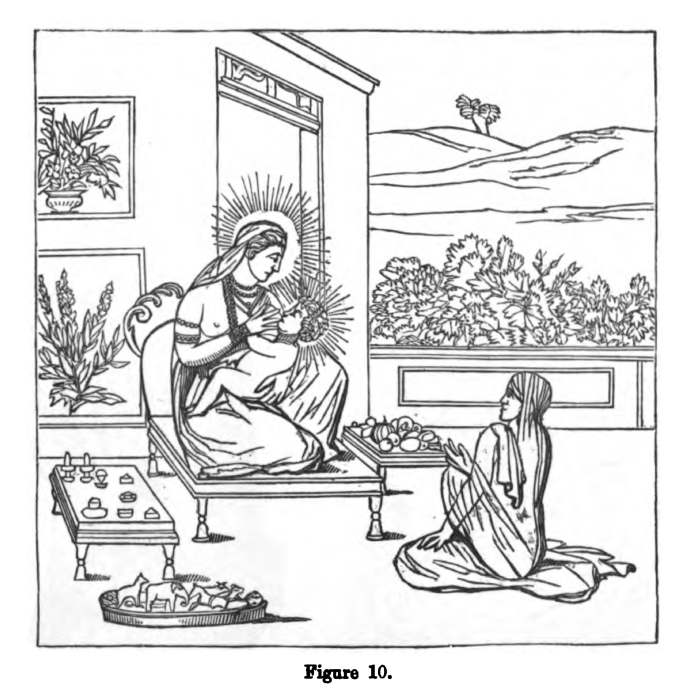
It is described as a marble statue, now in the Guarnacci Museum. The letters, which are Etruscan, and read from right to left, may be thus rendered into the ordinary Latin characters from left to right, MI: GANA: LARTHIAS ZANL: VELKINEI: ME - SE.; the translation I take to be, "the votive offering of Larthias (a female) of Zanal, ( = Zancle = Messana in Sicily), (wife) of Velcinius, in the sixth month." It is uncertain whether we are to regard the statue as an effigy of the celestial mother and child, or as the representation of some devout lady who has been spared during her pregnancy, her parturition, or from some disease affecting herself and child. Analogy would lead us to infer that the Queen of Heaven is intended. Figure 14 is copied from Hislop's Two Babylons; it represents Indranee, the wife of Indra or Indur, and is to be found in Indur Subba, the south front of the Caves of Ellora, Asiatic Researches, vol. vi., p. 893.
Indra is equivalent to Jupiter Tonans, and is represented as seated on an elephant; "the waterspout is the trunk of this elephant, and the iris is his bow, which it is not auspicious to point out," Moor's Pantheon, p. 260. He is represented very much as if he were a satyr, Moor's Pantheon, p. 264; but his wife is always spoken of as personified chastity and propriety. Indranee is seated on a lioness, which replaces the cow of Isis, the former resembling the latter in her feminine and maternal instincts.
Figures 15, 16, are copies of Diana of the Ephesians; the first is from Hislop, who quotes Kitto's Illustrated Commentary, vol. v., p. 250; the second from Higgins' Anacalypsis, who quotes Montfauçon, plate 47. I remember to have seen a figure similar to these in the Royal Museum at Naples.
The tower upon the head represents virginity (see Ancient Faiths, second edition, Vol. i., p. 144); the position of the hand forms a cross with the body: the numerous breasts indicate abundance; the black colour of Figure 16 indicates the ordinary tint of the feminine lanugo, the almost universal colour of the hair of the Orientals being black about the yoni as well as on the head; or, as some mythologists imagine, "Night," who is said to be one of the mothers of creation. (See Ancient Faiths, second edition, Vol. n., p. 882.) The emblems upon the body indicate the attributes or symbols of the male and female creators.
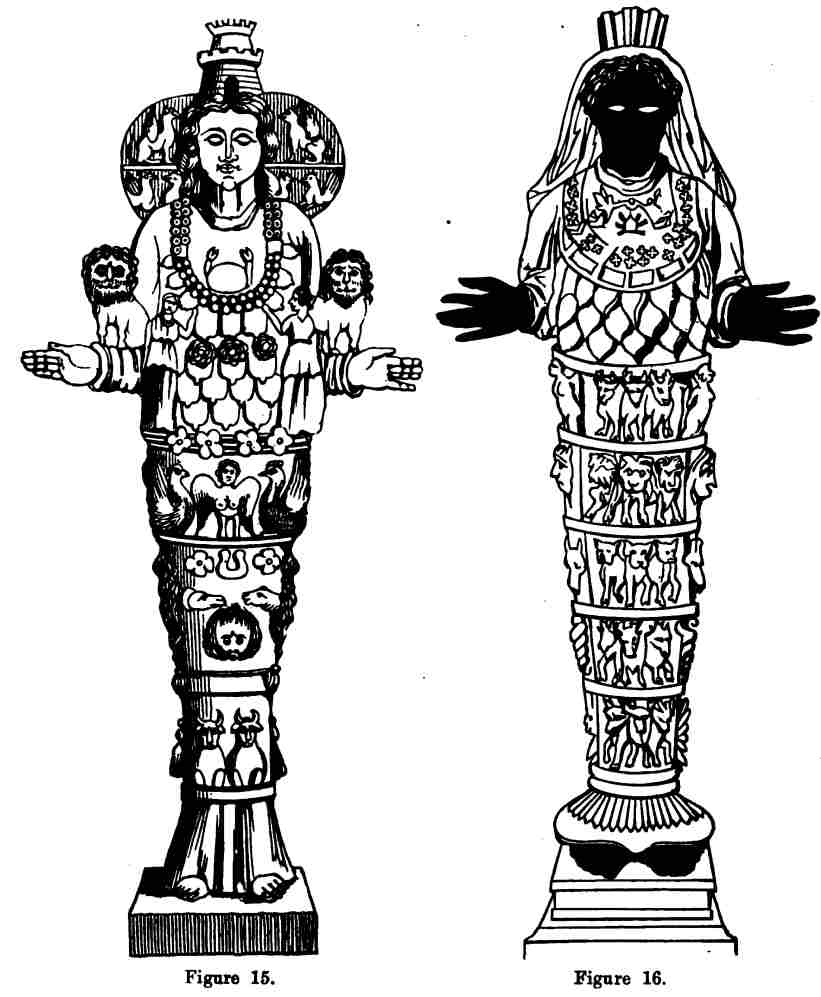
Figure 17 is a complicated sign of the yoni, delta, or door of life. It is copied from Bonomi's Palaces of Nineveh, p. 809.
Figure 18 signifies the same thing; the priests adoring it present the pine cone and basket, symbolic of Ann, Hea, and their residence. Compare the object of the Assyrian priest's adoration with that adored by a Christian divine, in a subsequent figure. (See Ancient Faiths, second edition, Vol. I., p. 88, et seq., and Vol. n., p. 648.)
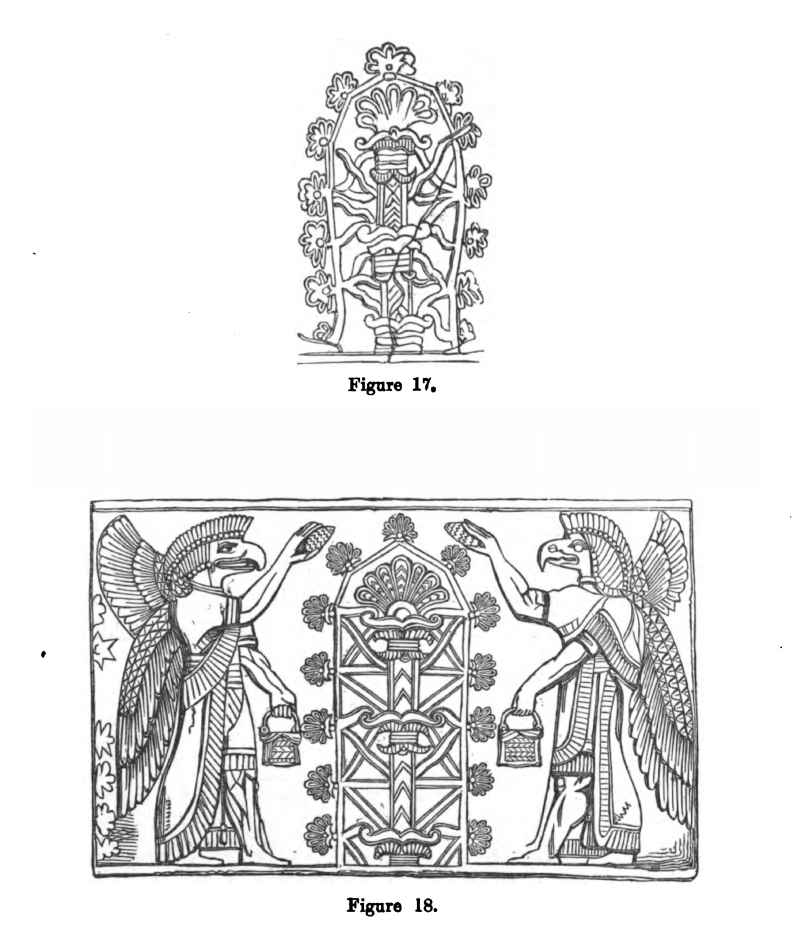
Figure 19 is copied from Lajard (Op. Cit.), plate xxii., fig. 5. It is the impression of an ancient gem, and represents a man clothed with a fish, the head being the mitre; priests thus clothed, often bearing in their hand the mystic bag, are common in Mesopotamian sculptures; two such are figured on Figs. 63, 64, infra. In almost every instance it will be recognised that the fish's head is represented as of the same form as the modern bishop's mitre.
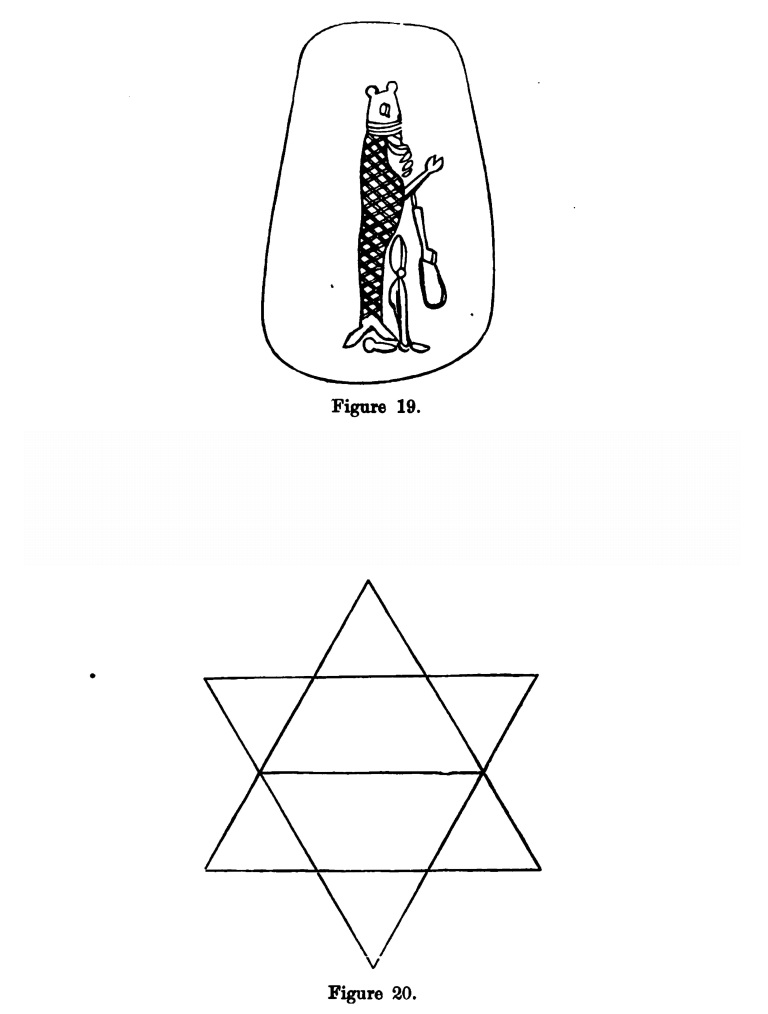
Figure 20 represents two equilateral triangles, infolded so as to make a six-rayed star, the idea embodied being the androgyne nature of the deity, the pyramid with its apex upwards signifying the male, that with the apex downwards the female. The line at the central junction is not always seen, but the shape of the three parallel bars reappears in Hindoo frontlet signs in conjunction with a delta or door, shaped like the "grove" in Fig. 17; thus showing that the lines serve also to indicate the masculine triad. The two triangles are also understood as representing fire, which mounts upwards, and water, which flows downwards. Fire again is an emblem of the sun, and water of the passive or yielding element in nature. Fire also typifies Eros or Cupid. Hymen is always represented carrying a torch. It is also symbolic of love; e.g., Southey writes.
"But love is indestructible, Its holy flame for ever burneth; From heaven it came, To heaven returneth."
And again, Scott writes—
"It is not phantasy's hot fire Whose wishes, soon as granted, fly," &c.
Figures 21, 22, are other indications of the same fundamental idea. The first represents Nebo, the Nahbi, or the navel, characterised by a ring with a central mound.
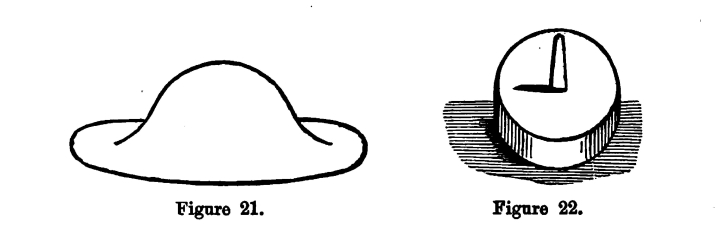
The second represents the circular and upright stone so common in Oriental villages. The two indicate the male and female; and a medical friend resident in India has told me, that he has seen women mount upon the lower stone and seat themselves reverently upon the upright one, having first adjusted their dress so as to prevent it interfering with their perfect contact with the miniature obelisc. During the sitting, a short prayer seemed flitting over the worshippers' lips, but the whole affair was soon over.
Whilst upon this subject, it is right to call attention to the fact that animate as well as inorganic representatives of the Creator have been used by women with the same definite purpose. The dominant idea is that contact with the emblem, a mundane representative of the deity, of itself gives a blessing. Just as many Hindoo females seek a benefaction by placing their own yoni upon the consecrated linga, so a few regard intercourse with certain high priests of the Maharajah sect as incarnations of Vishnu, and pay for the privilege of being spouses of the god. In Egypt, where the goat was a sacred animal, there were some religious women who sought good luck by uniting themselves therewith. We have heard of British professors of religion endeavouring to persuade their penitents to procure purity by what others would call defilement and disgrace. And the "cord of St. Francis" replaces the stone "linga." Sometimes with this "cord" the rod is associated; and those who have read the trial of Father Gerard, for his seduction of Miss Cadiére under a saintly guise, will know that Christianity does not always go hand in hand with propriety.
With the Hindoo custom compare that which was done by Liber on the grave of Prosumnus (Arnobius adverma Gentes, translated by Bryce and Campbell, T. and T. Clark, Edinburgh, pp. 252, 258), which is far too gross to be described here; and as regards the sanctity of a stone whose top had been anointed with oil, see first sentence of paragraph 89, ibid, page 81. The whole book will well repay perusal.
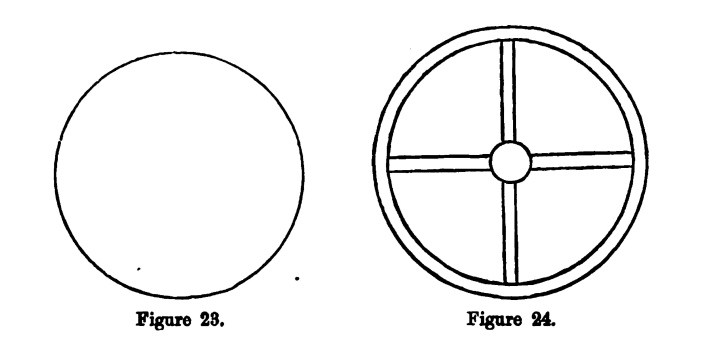
Figures 28, 24, are discs, circles, aureoles, and wheels, to represent the sun. Sometimes the emblem of this luminary is associated with rays, as in Plate iii., Fig. 8, and in another Figure elsewhere. Occasionally, as in some of the ancient temples in Egypt discovered in 1854, the sun's rays are represented by lines terminating in hands. Sometimes one or more of these contain objects as if they were gifts sent by the god; amongst other objects, the crux ansata is shown conspicuously. In a remarkable plate in the Transactions of the Royal Society of Literature (second series, vol. i., p. 140), the sun is identified with the serpent; its rays terminate in hands, some holding the handled cross or tau, and before it a queen, apparently, worships. She is offering what seems to be a lighted tobacco pipe, the bowl being of the same shape as that commonly used in Turkey; from this a wavy pyramid of flame rises. Behind her, two female slaves elevate the sistrum; whilst before her, and apparently between herself and her husband, are two altars occupied by round cakes and one crescent-shaped emblem.
The aureole was used in ancient days by Babylonian artists or sculptors, when they wished to represent a being, apparently human, as a god. The same plan has been adopted by the moderns, who have varied the symbol by representing it now as a golden disc, now as a terrestrial orb, again as a rayed sphere. A writer, when describing a god as a man, can say that the object he sketches is divine; but a painter thinks too much of his art to put on any of his designs, "this woman is a goddess," or "this creature is a god"; he therefore adds an aureole round the head of his subject, and thus converts a very ordinary man, woman, or child into a deity to be reverenced; modern artists thus proving themselves to be far more skilful in depicting the Almighty than the carpenters and goldsmiths of the time of Isaiah (xl. 18, 19, xli. 6, 7, xliv. 9-19), who used no such contrivance.
Figure 24 is another representation of the solar disc, in which it is marked with a cross. This probably originated in the wheel of a chariot having four spokes, and the sun being likened to a charioteer. The chariots of the sun are referred to in 2 Kings xxiii. 11 as idolatrous emblems. Of these the wheel was symbolic. The identification of this emblem with the sun is very easy, for it has repeatedly been found in Mesopotamian gems in conjunction with the moon. In a very remarkable one figured in Rawlinson's Ancient Monarchies, vol. ii., p. 249, the cross is contrived as five circles. It is remarkable that in many papal pictures the wafer and the cup are depicted precisely as the sun and moon in conjunction. See Pugin's Architectural Glossary, plate iv., fig. 5.
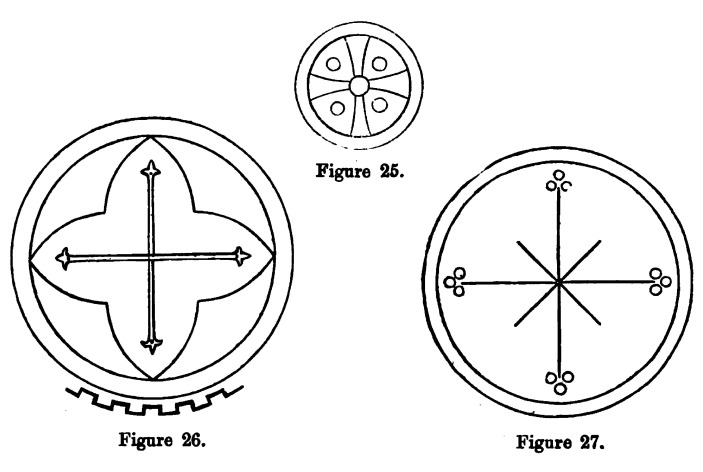
Figures 25, 26, 27, are simply varieties of the solar wheel, intended to represent the idea of the sun and moon, the mystic triad and unit, the "arba," or four. In Figure 26, the mural ornament is introduced, that being symbolic of feminine virginity. For explanation of Figure 27, see Figures 85, 86.
Figure 28 is copied from Lajard, Op. Cit., plate xiv. F. That author states that he has taken it from a drawing of an Egyptian stèle, made by M. E. Prisse (Monum. Egypt., plate xxxvii.), and that the original is in the British Museum. There is an imperfect copy of it in Rawlinson's Herodotus, vol. ii.
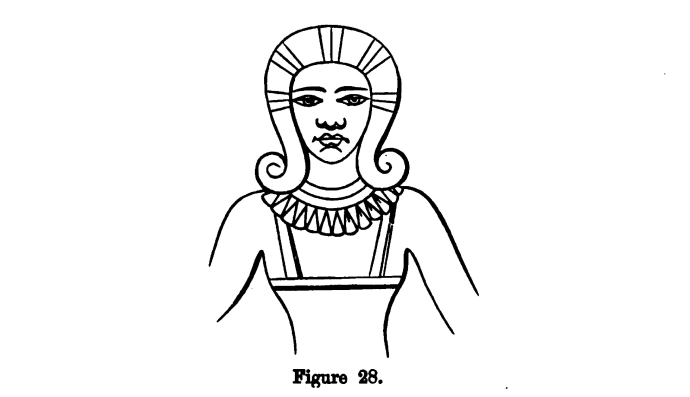
The original is too indelicate to be represented fully. Isis, the central figure, is wholly nude, with the exception of her head-dress, and neck and breast ornaments. In one hand she holds two blades of corn apparently, whilst in the other she has three lotus flowers, two being egg-shaped, but the central one fully expanded; with these, which evidently symbolise the mystic triad, is associated a circle emblematic of the yoni, thus indicating the fourfold creator. Isis stands upon a lioness; on one side of her stands a clothed male figure, holding in one hand the crux ansata, and in the other an upright spear. On the opposite side is a male figure wholly nude, like the goddess, save his head-dress and collar, the ends of which are arranged so as to form a cross. His hand points to a flagellum; behind him is a covert reference to the triad, whilst in front Osiris offers undisguised homage to Isis. The head-dress of the goddess appears to be a modified form of the crescent moon inverted. It is not exclusively Egyptian, as it has been found in conjunction with other emblems on an Assyrian obelisc of Phallic form.
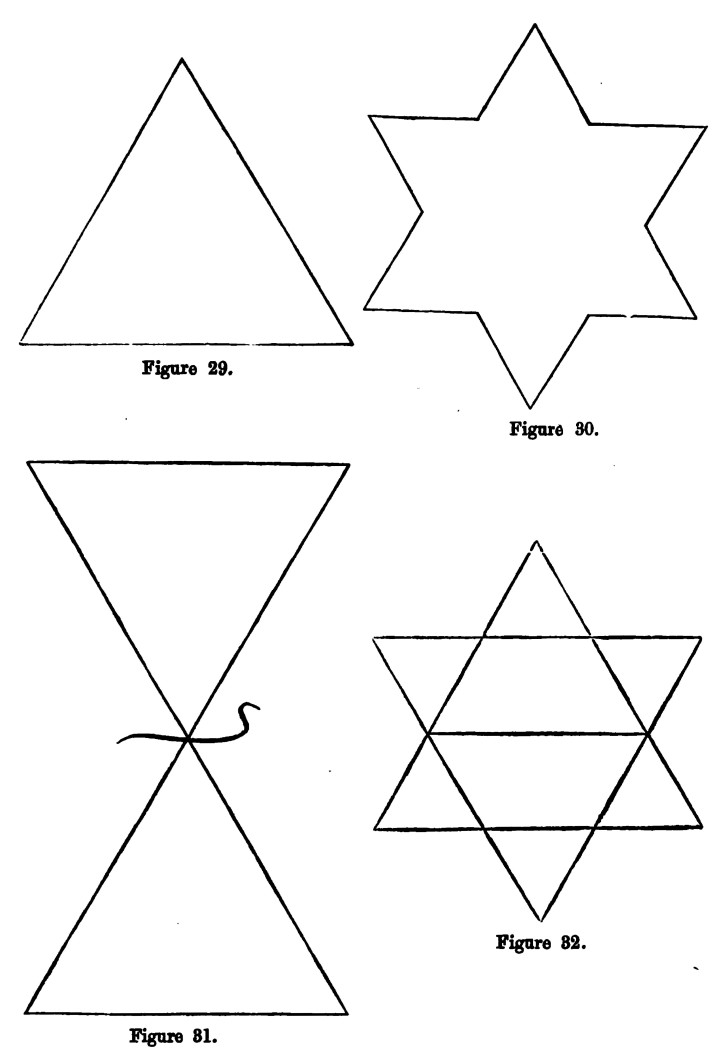
Figures 29, 30, 31, 32, represent the various triangles and their union, which have been adopted in worship. Figure 29 is said to represent fire, which amongst the ancient Persians was depicted as a cone, whilst the figure inverted represents water.
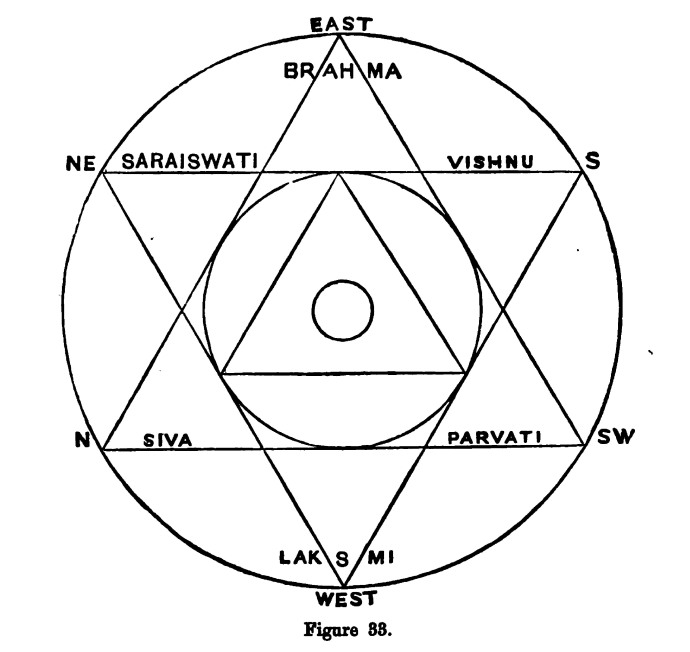
Figure 33 is an ancient Hindoo emblem, called Sri Iantra. The circle represents the world, in which the living exist; the triangle pointing upwards shows the male creator; and the triangle with the apex downwards the female; distinct, yet united. These have a world within themselves, in which the male is uppermost. In the central circle the image to be worshipped is placed. When used, the figure is placed on the ground, with Brahma to the east, and Laksmi to the west. Then a relic of any saint, or image of Buddha, like a modern papal crucifix, is added, and the shrine for worship is complete. It has now been adopted in Christian churches and Freemasons' lodges.
It will be noticed that the male emblem points to the rising sun, and the female triangle points to the setting sun, when the earth seems to receive the god into her couch.
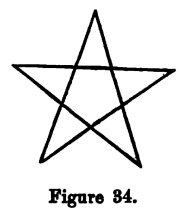
Figure 34 is a very ancient Hindoo emblem, whose real signification I am unable to divine. It is used in calculation; it forms the basis of some game, and it is a sign of vast import in sacti worship.
A coin, bearing this figure upon it, and having a central cavity with the Etruscan letters SUPEN placed one between each two of the angles, was found in a fictile urn, at Volaterræ, and is depicted in Fabretti's Italian Glossary, plate xxvi., fig. 858, bis a. As the coin is round, the reader will see that these letters may be read as Supen, Upens, Pensu, Ensup, or Nsupe. A search through Fabretti's Lexicon affords no clue to any meaning except for the third. There seems, indeed, strong reason to believe that pensu was the Etruscan form of the Pali panca, the Sanscrit pânch, the Bengalli pânch, and the Greek penta, i. e., five. Five, certainly, would be an appropriate word for the pentangle. It is almost impossible to avoid speculating upon the value of this fragment of archæological evidence in support of the idea that the Greeks, Aryans, and Etruscans had something in common; but into the question it would be unprofitable to enter here.
But, although declining to enter upon this wide field of inquiry, I would notice that whilst searching Fabretti's Glossary my eye fell upon the figure of an equilateral triangle with the apex upwards, depicted plate xliii., fig. 2440 ter. The triangle is of brass, and was found in the territory of the Falisci. It bears a rude representation of the outlines of the soles of two human feet, in this respect resembling a Buddhist emblem; and there is on its edge an inscription which may be rendered thus in Roman letters, KAYI: TERTINEI. POSTIKNU, which probably signifies "Gavia, the wife of Tertius, offered it." The occurrence of two Hindoo symbols in ancient Italy is very remarkable. It must, however, be noticed that similar symbols have been found on ancient sculptured stones in Ireland and Scotland. There may be no emblematic ideas whatever conveyed by the design; but when the marks appear on Gnostic gems, they are supposed to indicate death, i. e., the impressions left by the feet of the individual as he springs from earth to heaven.
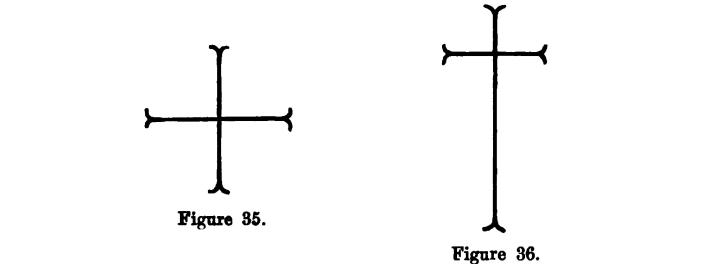
Figures 35, 36, are Maltese crosses. In a large book of Etrurian antiquities, which came casually under my notice about twenty years ago, when I was endeavouring to master the language, theology, etc., of the Etruscans, but whose name, and other particulars of which, I cannot now remember; I found depicted two crosses, made up of four masculine triads, each asher being erect, and united to its fellows by the gland, forming a central diamond, emblem of the yoni. In one instance, the limbs of the cross were of equal length; in the other, one asher was three times as long as the others. A somewhat similar cross, but one united with the circle, was found some time ago near Naples. It is made of gold, and has apparently been used as an amulet and suspended to the neck. It is figured in plate 35 of An Essay on the Worship of the Generative Powers during the Middle Ages (London, privately printed, 1865). It may be thus described: the centre of the circle is occupied by four oblate spheres arranged like a square; from the salient curves of each of these springs a yoni (shaped as in Figure 59), with the point outwards, thus forming a cross, each ray of which is an egg and fig. At each junction of the ovoids a yoni is inserted with the apex inwards, whilst from the broad end arise four ashers, which project beyond the shield, each terminating in a few golden bead-like drops. The whole is a graphic natural representation of the intimate union of the male and female, sun and moon, cross and circle, Ouranos and Ge. The same idea is embodied in Figure 27, p. 86, but in that the mystery is deeply veiled, in that the long arms of the cross represent the sun, or male, indicated by the triad; the short ones, the moon, or the female (see Plate xi. Fig. 4).
The Maltese cross, a Phoenician emblem, was discovered cut on a rock in the island from which it takes its name. Though cruciform, it had nothing Christian about it; for, like the Etruscan ones referred to above, it consisted of four lingas united together by the heads, the "eggs" being at the outside. It was an easy thing for an unscrupulous priesthood to represent this "invention" of the cross as a miracle, and to make it presentable to the eyes of the faithful by leaving the outlines of Anu and Hea incomplete. Sometimes this cross is figured as four triangles meeting at the points, which has the same meaning, Generally, however, the Church (as may be seen by a reference to Pugin's Glossary of Ecclesiastical Ornament) adopts the use of crosses where the inferior members of the trinity are more or less central, as in our Plate xi., Figs. 2, 8, and as in the Figures 40, 41, 42, infra. When once a person knows the true origin of the doctrine of the Trinity—one which is far too improper to have been adopted by the writers of the New Testament—it is impossible not to recognise in the signs which are symbolic of it the thing which is signified.
It may readily be supposed that those who have knowledge of the heathenish origin of many of the cherished doctrines of the so-called Christian church, cannot remain enthusiastic members of her communion; and it is equally easy for the enlightened philosopher to understand why such persons are detested and abused by the ignorant, and charged with being freethinkers, sceptics, or atheists. Sciolism is ever intolerant, and theological hatred is generally to be measured by the mental incapacity of those who indulge in the luxury. But no amount of abuse can reduce the intrinsic value of facts. Nor will the most fiery persecution demonstrate that the religion of Christ, as it appears in our churches and cathedrals, especially if they are papal, is not tainted by a mass of paganism of disgusting origin.
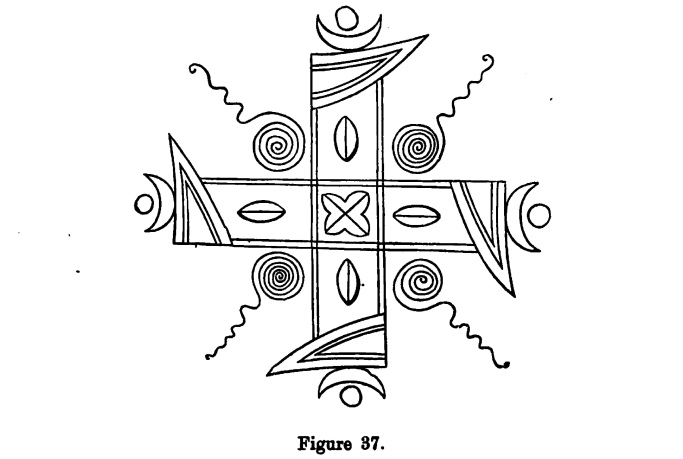
Figure 37 is copied from the Journal of the Royal Asiatic Society, vol. xviii., p 898, plate 4. It is a Buddhist emblem, and represents the same idea under different aspects. Each limb of the cross represents the fascinum at right angles with the body, and presented towards a barleycorn, one of the symbols of the yoni. Each limb is marked by the same female emblem, and terminates with the triad triangle; beyond this again is seen the conjunction of the sun and moon. The whole therefore represents the mystic curba, the creative four, by some called Thor's hammer. Copies of a cross similar to this have been recently found by Dr. Schliemann in a very ancient city, buried under the remains of two others, which he identifies as the Troy of Homer's Iliad.
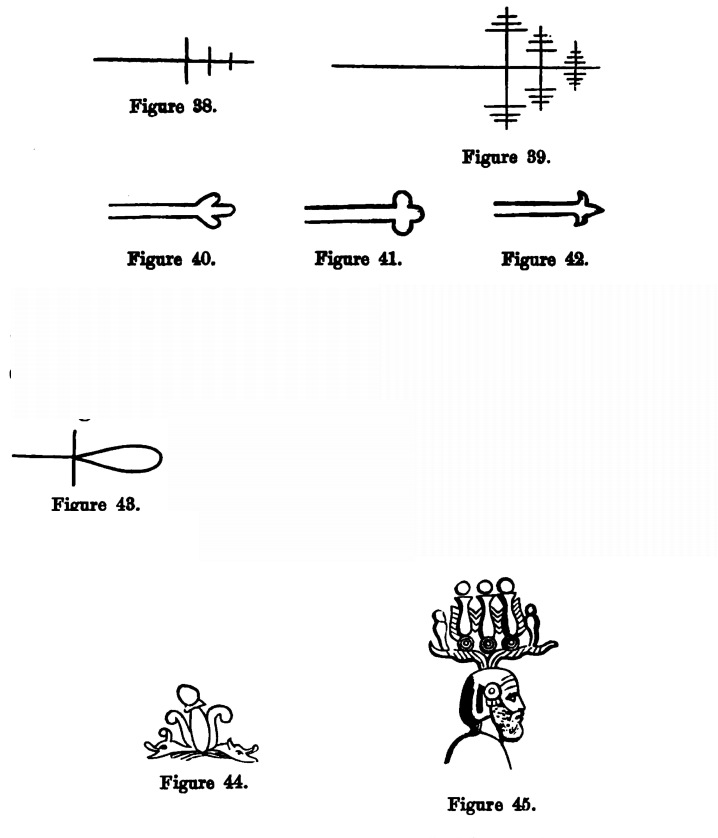
Figures 38 to 42 are developments of the triad triangle, or trinity. If the horizontal limb on the free end of the arm were to be prolonged to twice its length, the most obtuse would recognise Asher, and the inferior or lower members of the "triune."
Figure 43 is by Egyptologists called the 'symbol of life.'
It is also called the 'handled cross,' or crux ansata. It represents the male triad and the female unit, under a decent form. There are few symbols more commonly met with in Egyptian art than this. In some remarkable sculptures, where the sun's rays are represented as terminating in hands, the offerings which these bring are many a crux ansata, emblematic of the truth that a fruitful union is a gift from the deity.
Figures 44, 45, are ancient designs, in which the male and female elements are more disguised than is usual. In Fig. 44 the woman is indicated by the dolphin.
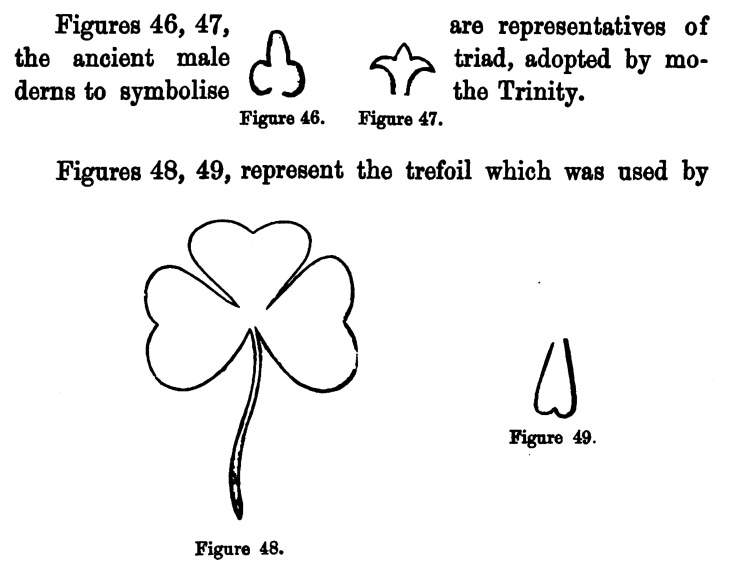
Figures 48, 49, represent the trefoil which was used by the ancient Hindoos as emblematic of the celestial triad, and adopted by modern Christians. It will be seen that from one stem arise three curiously-shaped segments, each of which is supposed to resemble the male scrotum, "purse," "bag," or "basket.".
Figure 50 is copied from Lajard, Culte de Venus, plate i., fig. 2. He states that it is from a gem cylinder in the British Museum. It represents a male and female figure dancing before the mystic palm-tree, into whose signification we need not enter beyond saying that it is a symbol of Asher. Opposite to a particular part of the figures is to be seen a diamond, or oval, and a fleur de lys, or symbolic triad. This gem is peculiarly valuable, as it illustrates in a graphic manner the meaning of the emblems in question and how the "lillies of France" had a pagan origin.
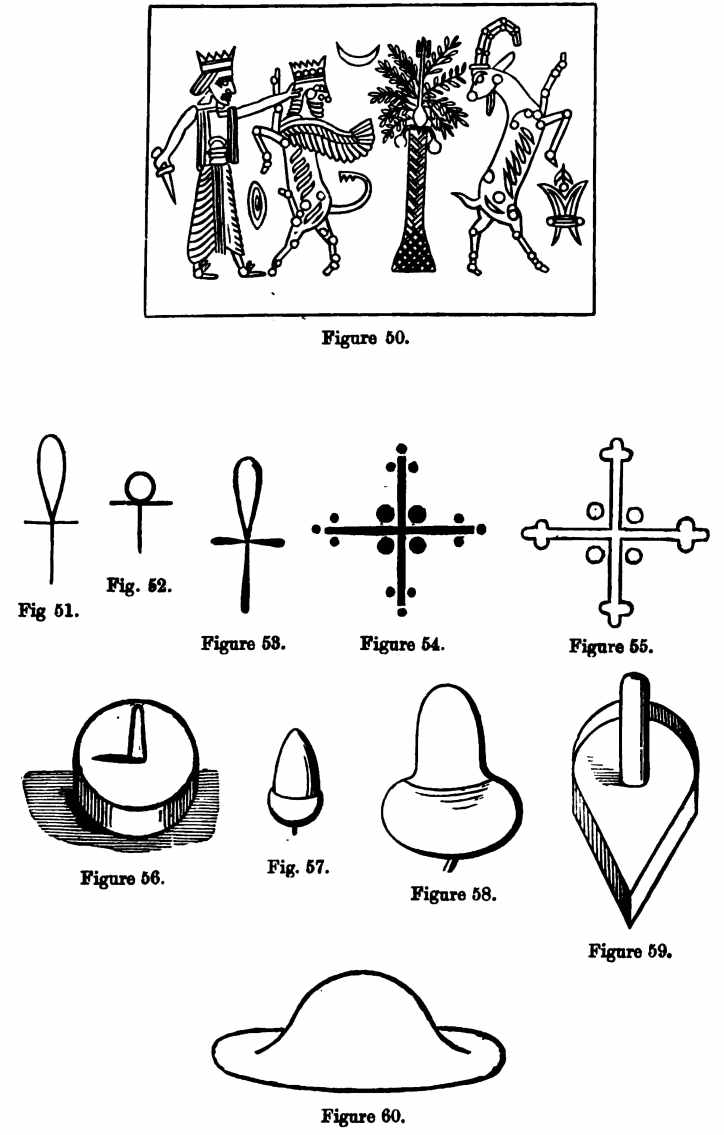
Figures 51 to 60 are varions representations of the union of the four, the arba, the androgyne, or the linga-yoni.
Figure 61. In modern Christian art this symbol is called vesica piscis, and is sometimes surrounded with rays. It commonly serves as a sort of framework in which female saints are placed, who are generally the representatives of the older Juno, Ceres, Diana, Venus, or other impersonations of the feminine element in creation. We should not feel obliged to demonstrate the truth of this assertion if decency permitted us to reproduce here designs which naughty youths so frequently chalk upon walls to the disgust of the proper part of the community. We must, therefore, have resort to a religious book, and in a subsequent figure demonstrate the meaning of the symbol unequivocally.
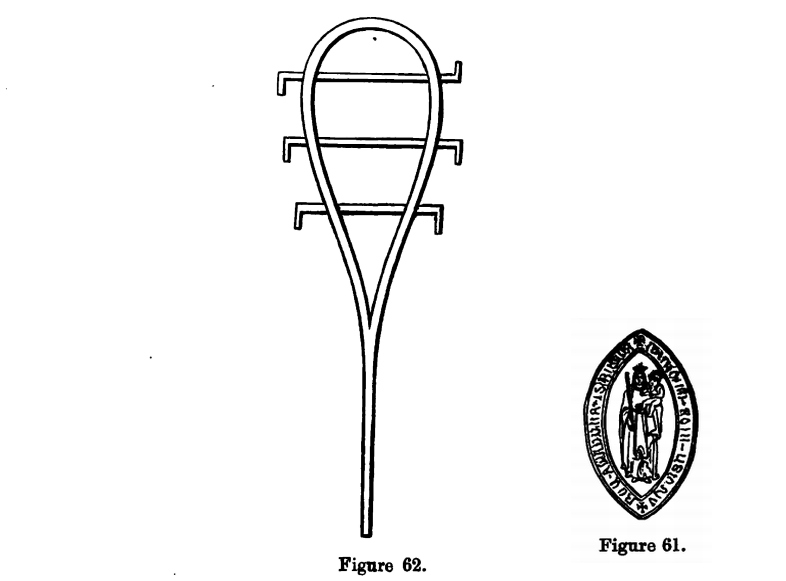
Figure 62 represents one of the forms assumed by the sistrum of Isis. Sometimes the instrument is oval, and occasionally it terminates below in a horizontal line, instead of in an acute angle. The inquirer can very readily recognise in the emblem the symbol of the female creator. If there should be any doubt in his mind, he will be satisfied after a reference to Maffei's Gemme Antiche Figurate (Rome, 1707), vol. ii., plate 61, wherein Diana of the Ephesians is depicted as having a body of the exact shape of the sistrum figured in Payne Knight's work on the remains of the worship of Priapus, etc. The bars across the sistrum show that it denotes a pure virgin (see Ancient Faiths, second edition, Vol. n., pp. 743-746). On its handle is seen the figure of a cat—a sacred animal amongst the Egyptians, for the same reason that Isis was figured sometimes as a cow—viz., for its salacity and its love for its offspring.
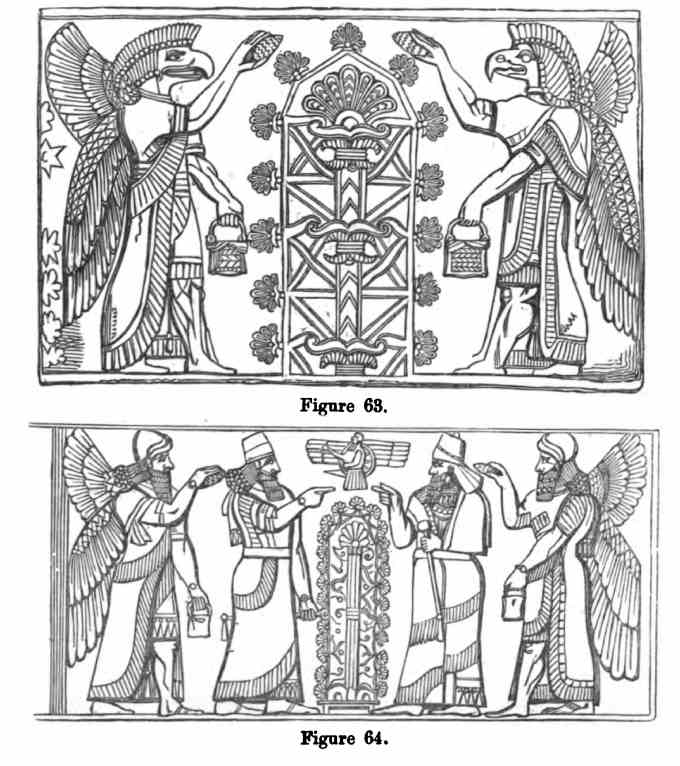
Figures 63 to 66 are all drawn from Assyrian sources.
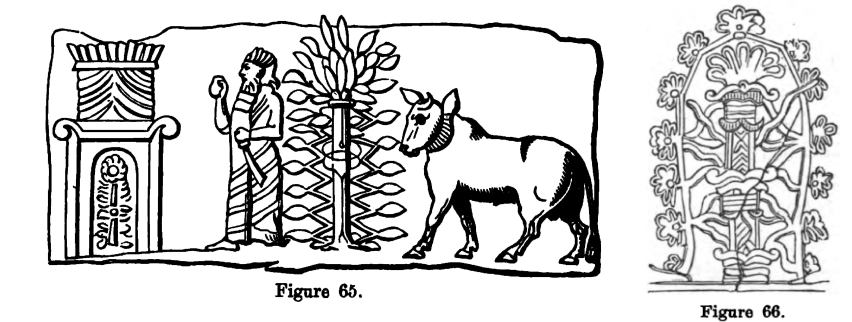
The central figure, which is probably the biblical "grove," represents the delta, or female "door." To it the attendant genii offer the pine cone and basket. The signification of these is explained subsequently. I was unable at first to quote any authority to demonstrate that the pine cone was a distinct masculine symbol, but now the reader may be referred to Maffei, Gemme Antiche Figurate (Rome, 1708), where, in vol. iii., he will see a Venus Tirsigera.
The goddess in plate 8, is nude, and carries in her hand the tripliform arrow, emblem of the male triad, whilst in the other she bears a thyrsus, terminating in a pine or fir cone. Now this cone and stem are carried in the Bacchic festivities, and can be readily recognised as virga cum ovo. Sometimes the thyrsus is replaced by ivy leaves, which, like the fig, are symbolic of the triple creator. Occasionally the thyrsus was a lance or pike, round which vine leaves and berries were clustered; Bacchus cum vino being the companion of Venus cum cerere. But a stronger confirmation of my views may be found in a remarkable group (see Fig. 124 infra). This is entitled Sacrifizio di Priapo, and represents a female offering to Priapus. The figure of the god stands upon a pillar of three stones, and it bears a thyrsus from which depend two ribbons. The devotee is accompanied by a boy, who carries a pine- or fir- cone in his hand, and a basket on his head, in which may be recognised a male effigy. In Figure 64 the position of the advanced hand of each of the priests nearest to the grove is very suggestive to the physiologist. It resembles one limb of the Buddhist cross, Fig. 37, supra. The finger or thumb when thus pointed are figurative of Asher, in a horizontal position, with Anu or Hea hanging from one end. Figure 65 is explained similarly. It is to be noticed that a door is adopted amongst modern Hindoos as an emblem of the sacti (see Figs. 152, 153, infra).
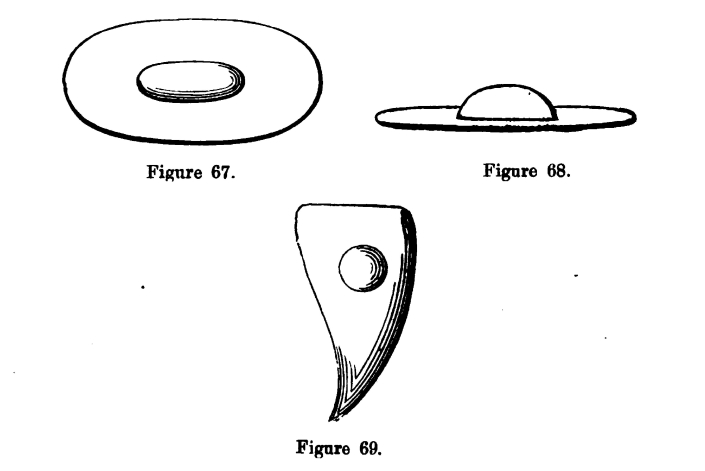
My friend Mr. Newton, who has taken great interest in the subject of symbolism, regards these "groves" as not being simply emblems of the yoni, but of the union of that part with the lingam, or mystic palm tree. As his ideas are extremely ingenious, and his theory perfect, I have requested him to introduce them at the end of this work.
Figures 67, 68, 69, are fancy sketches intended to represent the "sacred shields" spoken of in Jewish and other history. The last is drawn from memory, and represents a Templar's shield. According to the method in which the shield is viewed, it appears like the os tincæ or the navel. Figures 70, 71, represent the shape of the sistrum of Isis, the fruit of the fig, and the yoni. When a garment of this shape is made and worn, it becomes the "pallium" donned alike by the male and female individuals consecrated to Roman worship.
King, in his Ancient Gnostics, remarks: "The circle of the sun is the navel, which marks the natural position of the womb—the navel being considered in the microcosm as corresponding to the sun in the universe, an idea more fully exemplified in the famous hallucination of the Greek anchorites touching the mystical 'Light of Tabor,' which was revealed to the dèvotee after a fast of many days, all the time staring fixedly upon the region of the navel, whence at length this light streamed as from a focus." Pages 158, 154.

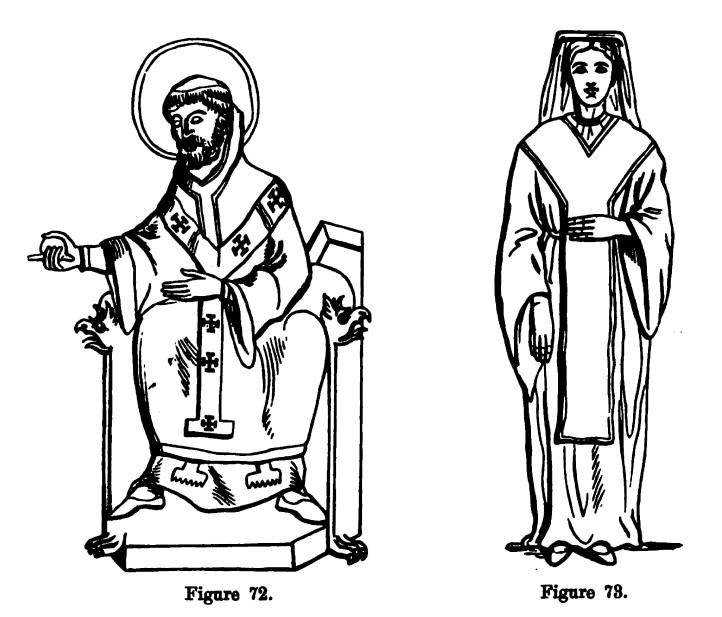
Figures 72, 73, represent an ancient Christian bishop, and a modern nun wearing the emblem of the female sex. In the former, said (in Old England Pictorially Illustrated, by Knight) to be a drawing of St. Augustine, the amount of symbolism is great. The "nimbus" and the tonsure are solar emblems; the pallium, the feminine sign, is studded with phallic crosses; its lower end is the ancient T the mark of the masculine triad; the right hand has the forefinger extended, like the Assyrian priests whilst doing homage to the grove, and within it is the fruit, tappuach, which is said to have tempted Eve. When a male dons the pallium in worship, he becomes the representative of the trinity in the unity, the arba, or mystic four. See Ancient Faiths, second edition, Vol. n., pp. 915-918.
I take this opportunity to quote here a pregnant page of King's Gnostics and their Remains, (Bell & Daldy, London, 1864). To this period belongs a beautiful sard in my collection representing Serapis,... whilst before him stands Isis, holding in one hand the sistrum, in the other a wheatsheaf, with the legend... 'Immaculate is our lady Isis,' the very terms applied afterwards to that personage who succeeded to her form (the 'Black Virgins,' so highly reverenced in certain French Cathedrals during the middle ages, proved, when examined critically, basalt figures of Isis), her symbols, rites, and ceremonies.... Her devotees carried into the new priesthood the former badges of their profession, the obligation to celibacy, the tonsure, and the surplice, omitting, unfortunately, the frequent ablutions prescribed by the ancient creed. The sacred image still moves in procession as when Juvenal laughed at it, vi. 530.
Escorted by the tonsured surpliced train. Her proper title, Domina, the exact translation of Sanscrit Isi, survives with slight change in the modern Madonna, Mater Domina.
By a singular permutation the flower borne by each, the lotus—ancient emblem of the sun and fecundity—now re-named the lily, is interpreted as significant of the opposing quality. The tinkling sistrum... is replaced by... the bell, taken from Buddhist usages.... The erect oval symbol of the Female Principle of Nature became the Vesica Piscis, and the Crux Ansata, testifying the union of the male and female in the most obvious manner, is transformed into the orb surmounted by the cross, as an ensign of royalty. Pp. 71, 72.
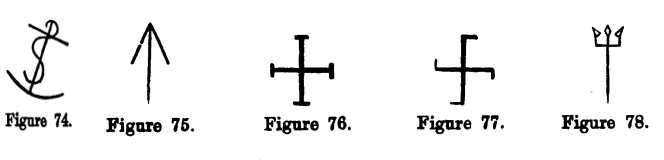
Figure 74 is a well known Christian emblem, called "a foul anchor." The anchor, as a symbol, is of great antiquity. It may be seen on an old Etruscan coin in the British Museum, depicted in Veterum Popvlorum et Regum Nummi, etc. (London, 1814), plate ii., fig. 1. On the reverse there is a chariot wheel. The foul anchor represents the crescent moon, the yoni, ark, navis, or boat; in this is placed the mast, round which the serpent, the emblem of life in the "verge," entwines itself. The cross beam completes the mystic four, symbolic alike of the sun and of androgeneity. The whole is a covert emblem of that union which results in fecundity. It is said by Christians to be the anchor of the soul, sure and steadfast. This it certainly cannot be, for a foul anchor will not hold the ground.
Figures 75 to 79 are Asiatic and Egyptian emblems in use amongst ourselves, and receive their explanation similarly to preceding ones.
Figure 80 is copied from Godfrey Higgins' Anacalypsis, vol. ii., fig. 27. It is drawn from Montfauçon, vol. ii., pi. cxxxii., fig. 6. In his text, Higgins refers to two similar groups, one which exists in the Egyptian temple of Ipsambal in Nubia, and is described by Wilson, On Buddhists and Jeynes, p. 127, another, found in a cave temple in the south of India, described by Col. Tod, in his History of Raj-pootanah. The group is not explained by Montfauçon. It is apparently Greek, and combines the story of Hercules with the seductiveness of Circe. The tree and serpent are common emblems, and have even been found in Indian temples in central America, grouped as in the woodcut.
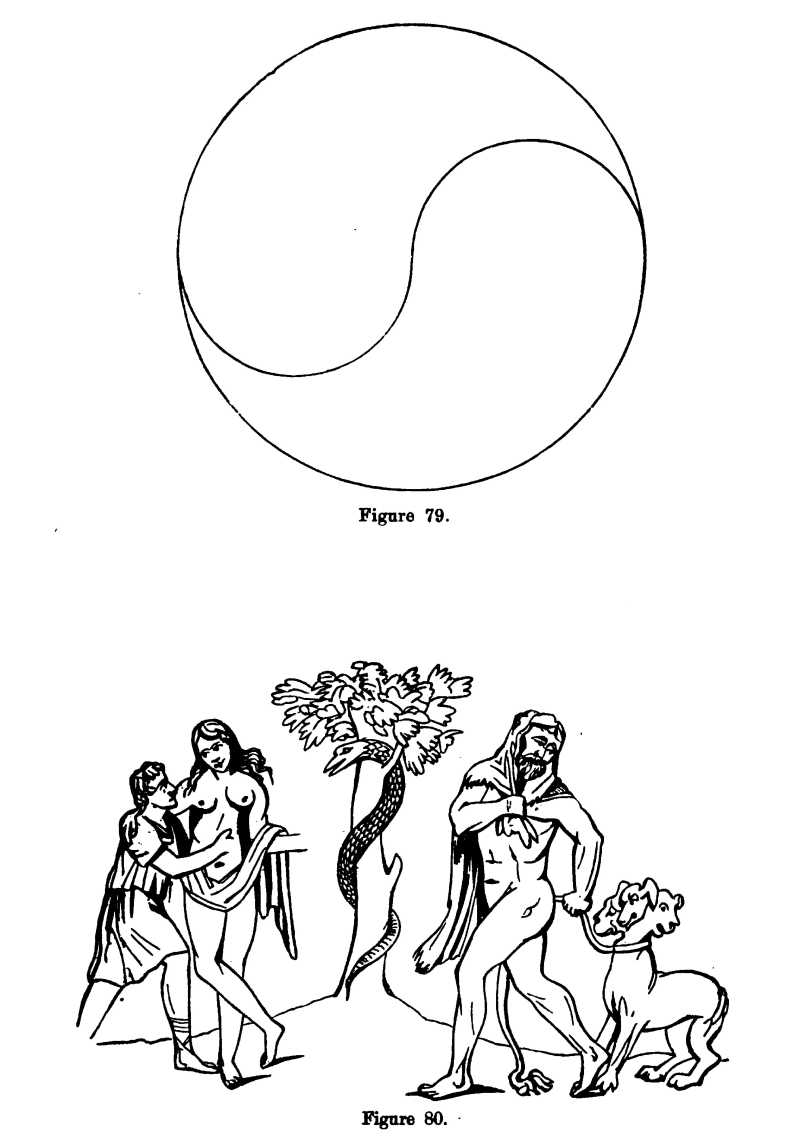
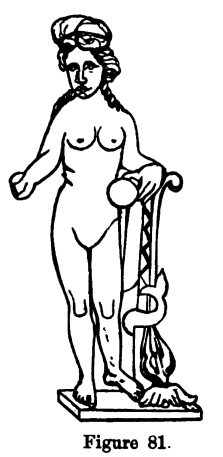
Figure 81 is copied from Lajard, Culte de Venus, plate xix., fig. 11, The origin of this, which is a silver statuette in that author's possession, is unknown. The female represents Venus bearing in one hand an apple; her arm rests upon what seems to be a representative of the mystic triad (the two additions to the upright stem not being seen in a front view) round which a dolphin for 'womb' is entwined, from whose mouth comes the stream of life. The apple plays a strange part in Greek and Hebrew mythology. The story of "the apple of discord," awarded by Paris to Venus, seems to indicate that where beauty contends against majesty and wisdom for the love of youth, it is sure to win the day. We learn from Arnobius that a certain Nana conceived a son by an apple (Op, Cit., p. 286), although in another place the prolific fruit is said to have been a pomegranate. Mythologically, that writer sees no difficulty in the story, for those who affirm that rocks and hard stones have brought forth. In the Song of Solomon, apples and the tree that bears them are often referred to; and we have in Ch. ii. 5 the curious expression, "Comfort me with apples, for I am sick of love." We are familiar with the account of Eve being tempted by the same fruit. Critics imagine that as the apple in Palestine is not good eating, the quince is meant; if so, we know that a leaf of that tree is to be seen in every amorous picture found in Pompeii, the plant having been supposed to increase virile power. Others imagine that the citron is intended, whose shape makes it an emblem of the testis. However this may be decided, it is tolerably clear, from all the tales and pictures in which a fruit like the apple figures, that the emblem symbolised a desire for an intimate union between the sexes. The reader will doubtless remember how, in Genesis xxx, Leah is represented as purchasing her husband's company for a night by means of mandrakes, the result being the birth of Issachar; and in the well-known story of the Creation we find that the apple gives birth to desire, as shown in the recognition for the first time of the respective nudity of the couple, which was followed immediately, or as soon as it was possible afterwards, by sexual intercourse and the conception of Cain.
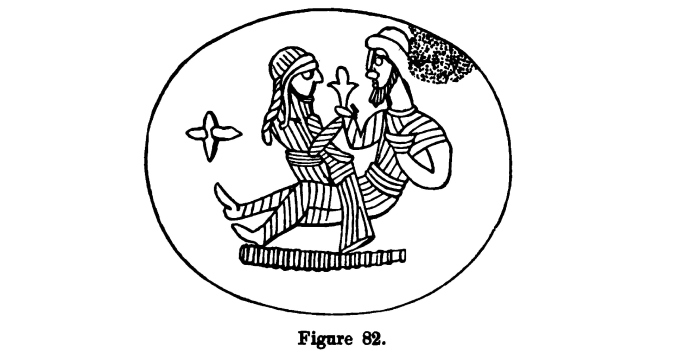
Figure 82 is from Lajard (Op. Cit.), plate xivb, fig. 3.
The gem is of unknown origin, but is apparently Babylonish; it represents the male and female in conjunction: each appears to be holding the symbol of the triad in much respect, whilst the curious cross suggests a new reading to an ancient symbol.
I have of late heard it asserted, by a man of considerable learning, though of a very narrow mind in everything which bears upon religious subjects, that there is no proof that the sun was commonly regarded as a male, or the moon as a female; and he based his strange assertion solely upon the ground that in German and some other languages the sun was represented by a feminine, and the moon by a masculine noun. The argument is of no value, for [—Greek—] and other Greek and Latin names of the yoni, are masculine nouns, and Virga and Mentula, the Roman words for the Linga, are feminine. In Hindostan, the sun is always represented as a God; the moon is occasionally a male, and sometimes a female deity. In ancient Gaulish and Scandinavian figures, the sun was always a male, and the moon a female. Their identification will be seen in Figure 118—as their conjunction is in the one before us—in the position of the individuals, and in the fleur-de-lys and oval symbol.
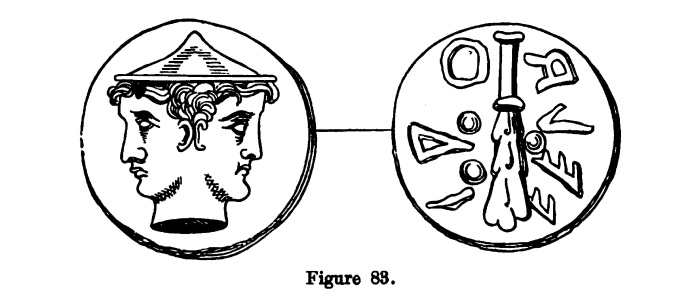
Figure 88 may be found in Fabretti's Corpus Inscriptionum Italicarum (Turin, 1867), plate xxv., fig. 808 f. The coins which bear the figures are of brass, and were found at Volaterræ. In one the double head is associated with a dolphin and crescent moon on the reverse, and the letters Velathri, in Etruscan. A similar inscription exists on the one containing the club. The club, formed as in Figure 88, occurs frequently on Etruscan coins. For example, two clubs are joined with four balls on a Tudertine coin, having on the reverse a hand apparently gauntleted for fighting, and four balls arranged in a square. On other coins are to be seen a bee, a trident, a spear head, and other tripliform figures, associated with three balls in a triangle; sometimes two, and sometimes one. The double head with two balls is seen on a Telamonian coin, having on the reverse what appears to be a leg with the foot turned upwards. In a coin of Populonia the club is associated with a spear and two balls, whilst on the reverse is a single head. I must notice, too, that on other coins a hammer and pincers, or tongs, appear, as if the idea was to show that a maker, fabricator, or heavy hitter was intended to be symbolised. What that was is further indicated by other coins, on which a head appears thrusting out the tongue. At Cortona two statuettes of silver have been found, representing a double-faced individual. A lion's head for a cap, a collar, and buskins are the sole articles of dress worn. One face appears to be feminine, and the other masculine, but neither is bearded. The pectorals and the general form indicate the male, but the usual marks of sex are absent. On these have been found Etruscan inscriptions (1) v. cvinti arntias CULPIANSI ALP AN TURCE; (2) V. CVINTE ARNTIAS SELANSE TEZ alpan TUBCE. Which may be rendered (1) "V. Quintus of Aruntia, to Culpian pleasing, a gift"; (2) "V. Quintus of Aruntia to Vulcan pleasing gave a gift," evidently showing that they were ex voto offerings.
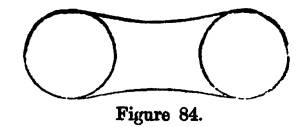
Col. Forbes Leslie's Early Races of Scotland. In plate 49 it is associated with a serpent, apparently the cobra. The design is spoken of as "the spectacle ornament," and it is very commonly associated with another figure closely resembling the letter Z. It is very natural for the inquirer to associate the twin circles with the sun and earth, or the sun common amongst the sculptured stones in Scotland. Four varieties may be seen in plate 48 of sun and moon. On one Scottish monument the circles represent wheels, and they probably indicate the solar chariot. As yet I have only been able to meet with the Z and "spectacle ornament" once out of Scotland; it is figured on apparently a Gnostic gem (The Gnostics and their Remains, by C. W. King, London, 1864, plate ii., fig. 5). In that we see in a serpent cartouche two Z figures, each having the down stroke crossed by a horizontal line, both ends terminating in a circle; besides them is a six-rayed star, each ray terminating in a circle, precisely resembling the star in Plate in., Fig. 8, supra. I can offer no satisfactory explanation of the emblem.
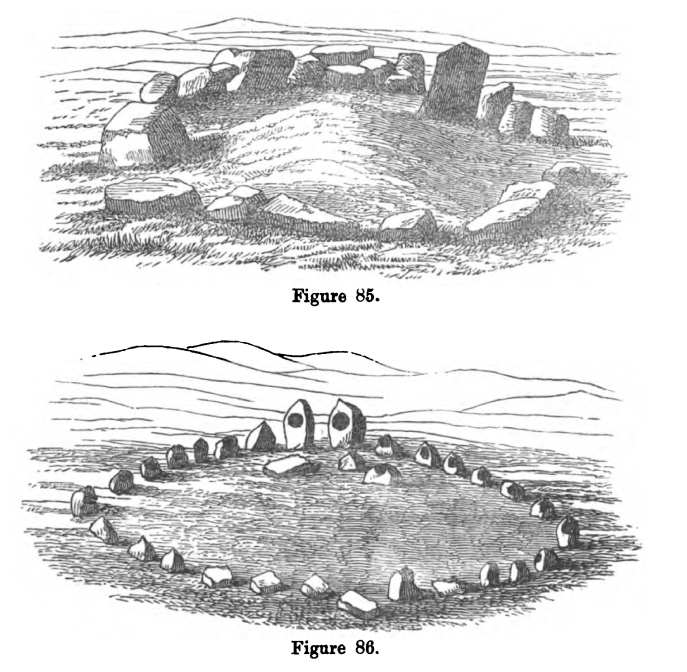
Figures 85, 86, represent a Yorkshire and an Indian stone circle. The first is copied from Descriptions of Cairns, Cromlechs, Kistvaens, and other Celtic, Druidical, or Scythian Monuments in the Dekkan, by Col. Meadows Taylor, Transactions of the Royal Irish Academy, vol. xxiv. The mound exists at Twizell, Yorkshire, and the centre of the circle indicates an ancient tomb, very similar to those found by Taylor in the Dekkan; this contained only one single urn, but many of the Indian ones contained, besides the skeleton of the great man buried therein, skeletons of other individuals who had been slaughtered over his tomb, and buried above the kistvaen containing his bones; in one instance two bodies and three heads were found in the principal grave, and twenty other skeletons above and beside it. A perusal of this very interesting paper will well repay the study bestowed upon it. Figure 86 is copied from Forbes Leslie's book mentioned above, plate 59. It represents a modern stone circle in the Dekkan, of very recent construction. The dots upon the stones represent dabs of red paint, which again represent blood. The circles are similar to some which have been found in Palestine, and give evidence of the presence of the same religious ideas existing in ancient England and Hindostan, as well as in modern India. The name of the god worshipped in these recent shrines is Vetal, or Betal. It is worth mentioning, in passing, that there is a celebrated monolith in Scotland called the Newton Stone, on which are inscribed, evidently with a graving tool, an inscription in the Ogham, and another in some ancient Aryan character (see Moore's Ancient Pillar Stones of Scotland).
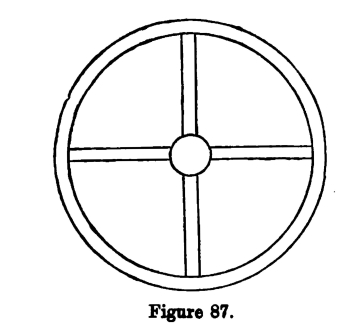
Figure 87 indicates the solar wheel, emblem of the chariot of Apollo. This sign is a very common one upon ancient coins; sometimes the rays or spokes are four, at others they are more numerous. Occasionally the tire of the wheel is absent, and amongst the Etruscans the nave is omitted. The solar cross is very common in Ireland, and amongst the Romanists generally as a head dress for male saints.
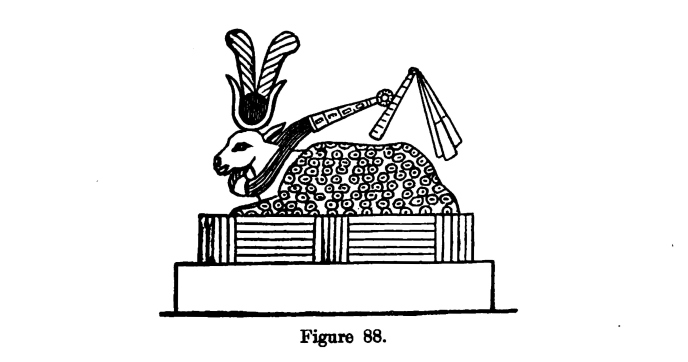
Figure 88 is copied from Hyslop, who gives it on the authority of Col. Hamilton Smith, who copied it from the original collection made by the artists of the French Institute of Cairo. It is said to represent Osiris, but this is doubtful. There is much that is intensely mystical about the figure. The whip, or flagellum, placed over the tail, and the head passing through the yoni, the circular spots with their central dot, the horns with solar disc, and two curiously shaped feathers (?), the calf reclining upon a plinth, wherein a division into three is conspicuous, all have a meaning in reference to the mystic four.
I have long had a doubt respecting the symbolic meaning of the scourge. Some inquirers have asserted that it is simply an emblem of power or superiority, inasmuch as he who can castigate must be in a higher position than the one who is punished. But of this view I can find no proof. On the other hand, any one who is familiar with the effect upon the male produced by flagellation, and who notices that the representations of Osiris and the scourge show evidence that the deity is in the same condition as one who has been subjected to the rod, will be disposed to believe that the flagellum is an indication or symbol of the god who gives to man the power to reproduce his like, or who can restore the faculty after it has faded. It is not for a moment to be supposed that a deity who was to be worshipped would be depicted as a task-master, whose hands are more familiar with punishment than blessing.
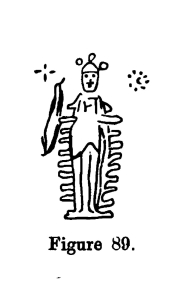
Figure 89 is taken from Lajard's Culte de Venus, plate i., fig. 14, and is an enlarged impression of a gem. A similar figure is to be found in Payne Knight's work On the Worship of Priapus. In both instances the female is fringed with male emblems. In the one before us a fish, apparently a dolphin, is borne in one hand. In the other the woman is bearded. These are representations of Ashtaroth—the androgyne deity in which the female predominates.
Fig. 90 represents an ancient Italian form of the Indian Ling Yoni. It is copied from a part of the Frontispiece of Faber's Dissertation on the Cabiri, where it is stated that the plate is a copy of a picture of a nymphoeum found when excavating a foundation for the Barbarini Palace at Rome. It deserves notice, because the round mound of masonry surmounted by the short pillars is precisely similar to similar erections found in Hindostan on the East and America on the West, as well as in varions parts of Europe. The oval in the pediment and the solitary pillar have the same meaning as the Caaba and hole—the upright stone and pit revered at Mecca long before Mahomet's time—the tree serves to identify the pillar, and vice versa. Apertures were common in ancient sepulchral monuments, alike in Hindostan and England; one perforated stone is preserved as a relic in the precincts of an old church in modern Rome. The aperture is blackish with the grease of many hands, which have been put therein whilst their owners took a sacred oath. We have already remarked how ancient Abraham and a modern Arab have sworn by the Linga; it is therefore by no means remarkable that some of a different form of faith should swear by the Yoni.
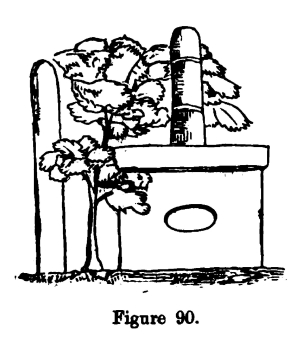
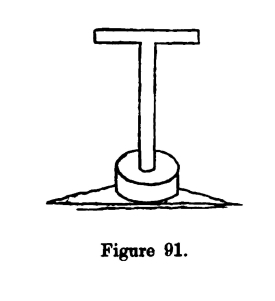
Figure 91 is stated by Higgins, Anacalypm, p. 217, to be a mark on the breast of an Egyptian mummy in the Museum of University College, London. It is essentially the same symbol as the crux ansata, and is emblematic of the male triad and the female unit.
Figure 92 is simply introduced to show that the papal tiara has not about it anything particularly Christian, a similar head-dress having been worn by gods or angels in ancient Assyria, where it appeared crowned by an emblem of "the trinity." We may mention, in passing, that as the Romanists adopted the mitre and the tiara from "the cursed brood of Ham," so they adopted the episcopalian crook from the augurs of Etruria, and the artistic form with which they clothe their angels from the painters and um-makers of Magna Gracia and Central Italy.
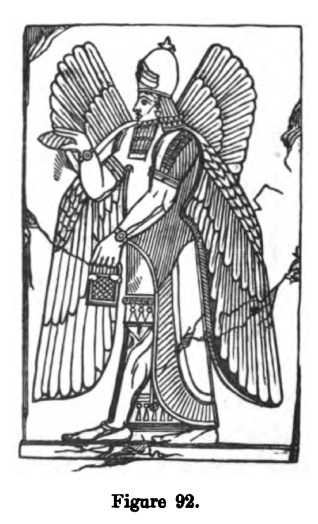
Figure 98 is the Mithraic lion. It may be seen in Hyde's Religion of the Ancient Persians, second edition, plate i. It may also be seen in vol. ii., plates 10 and 11, of Maffei's Gemme Antiche Figurate (Rome, 1707). In plate 10 the Mithraic lion has seven stars above it, around which are placed respectively, words written in Greek, Etruscan and Phoenician characters, ZEDCH. TELKAN. TELKON. TELKON. QIDEKH. UNEULK. LNKELLP., apparently showing that the emblem was adopted by the Gnostics. It would be unprofitable to dwell upon the meaning of these letters. After puzzling over them, I fancy that "Bad spirits, pity us," "Just one, I call on thee," may be made out by considering the words to be very bad Greek, and the letters to be much transposed.
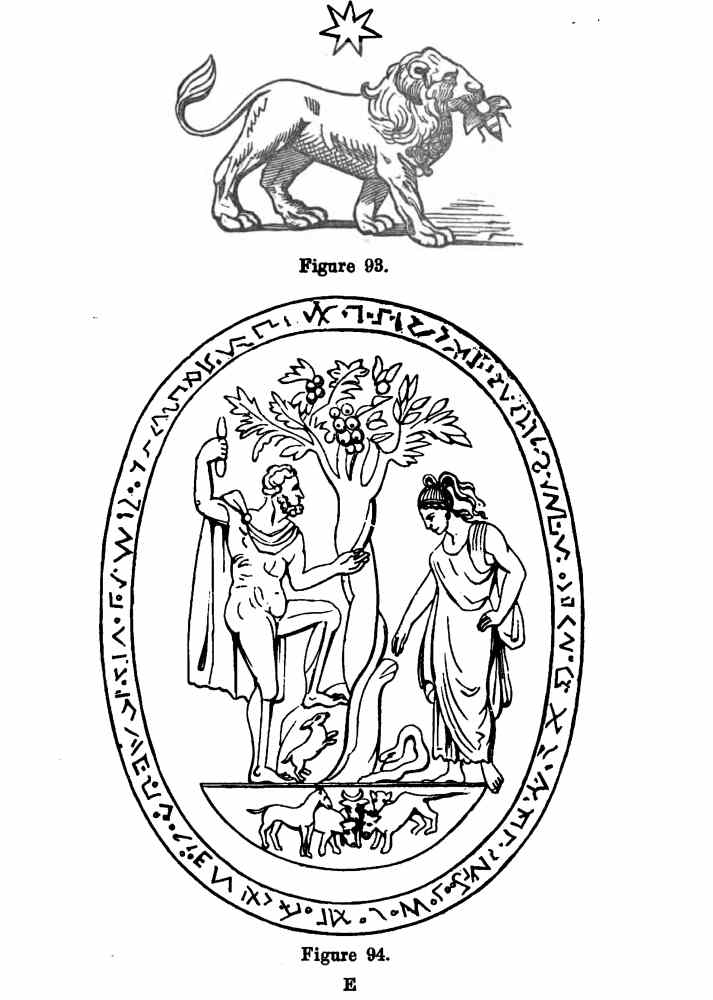
Figure 94 is copied by Higgins, Anacalypsis, on the authority of Dubois, who states, vol. iii., p. 88, that it was found on a stone in a church in France, where it had been kept religiously for six hundred years. Dubois regards it as wholly astrological, and as having no reference to the story told in Genesis. It is unprofitable to speculate on the draped figures as representatives of Adam and Eve. We have introduced it to show how such tales are intermingled with Sabeanism.
Figure 95 is a copy of a gem figured by Layard (Nineveh and Babylon, p. 156), and represents Harpocrates seated on a lotus, adoring the mundane representative of the mother of creation. I have not yet met with any ancient gem or sculpture which seems to identify the yoni so completely with various goddesses.
Compare this with Figure 138, infra, wherein the Figure 95. emblem is even more strikingly identified with woman, and with the virgin Mary. Those who are familiar with the rude designs too often chalked on hoardings, will see that learned ancients and boorish moderns represent certain ideas in precisely similar fashion, and will understand the mystic meaning of O —— I have elsewhere called attention to the idea that a sight of the yoni is a source of health, and a charm against evil spirits; however grotesque the idea may be, it has existed in all ages, and in civilised and savage nations alike. A rude image of a woman who shamelessly exhibits herself has been found over the doors of churches in Ireland, and at Servatos, in Spain, where she is standing on one side of the doorway, and an equally conspicuous man on the other. The same has been found in Mexico, Peru, and in North America. Nor must we forget how Baubo cured the intense grief of Ceres by exposing herself in a strange fashion to the distressed goddess. Arnobius, Op. Cit., pp. 249, 250.
As I have already noticed modern notions on the influence produced by the exhibition of the yoni on those who are suffering, the legend referred to may be shortly described. The goddess, in the story, was miserable in consequence of her daughter, Proserpine, having been stolen away by Pluto. In her agony, snatching two Etna-lighted torches, she wanders round the earth in search of the lost one, and in due course visits Eleusis. Baubo receives her hospitably; but nothing that the hostess does induces the guest to depose her grief for a moment. In despair the mortal bethinks her of a scheme, shaves off what is called in Isaiah "the hair of the feet" and then exposes herself to the goddess. Ceres fixes her eyes upon the denuded spot, is pleased with the strange form of consolation, consents to take food and is restored to comfort.
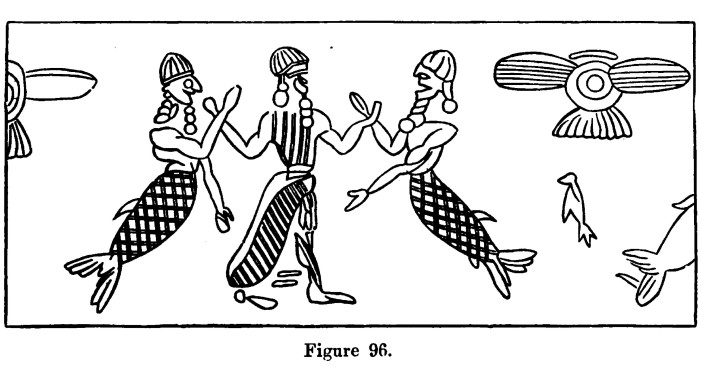
Figure 96 is copied from plate 22, fig. 8, of Lajard's Culte de Venus. He states that it is an impression of a cornelian cylinder, in the collection of the late Sir William Ouseley, and is supposed to represent Oannes, or Bel and two fish gods, the authors of fecundity. It is thought that Dagon of the Philistines resembled the two figures supporting the central one.
Figure 97 is a side view of plate 1. The idol represents a female. Dagon, the fish god, male above, piscine below, was one of the many symbols of an androgyne creator. In the first of the Avatars of Vishnu, he is represented as emerging from the mouth of a fish, and being a fish himself; the legend being that he was to be the saviour of the world in a deluge which was to follow. See Moor's Hindu Pantheon, and Coleman's Mythology of the Hindus.