ANCIENT ART OF THE PROVINCE OF CHIRIQUI. (continued 2)
Reading edition
Single handles of like character occur in a number of cases upon minute cups, an example of which is given in Fig. 86. It would seem that possibly in such cases the rim had been expanded and prolonged for the purpose of giving support to the animal figures with which the shoulders were embellished. The expansion is probably the outgrowth of the use of animal figures in connection with simple handles.
Fig. 86. Fig. 87.
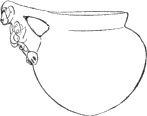
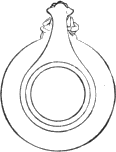
Small cup with single handle ornamented with grotesque figure—½.
We have a number of vessels of this group the bodies of which imitate animal forms, but they are in nearly all cases furnished with
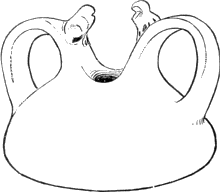
Fig. 88. Vase of eccentric form—½.
The illustration of this group of vessels would not be complete without a series of tripod vases. In shape of body these vases differ but little from the legless forms already given, excepting where the use of life forms has led to eccentric modifications. Very great interest attaches to the modeling of the tripod supports, upon which the potters have expended much time and ingenuity.
Fig. 89. Fig. 90. Fig. 91.
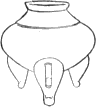

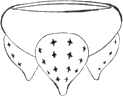
Vessels illustrating forms of legs—½. Vessel with large legs ornamented with stellar punctures—½.
The illustrations given herewith are chosen from a great number of examples and are intended to convey an idea of the range of forms, both of the vessels and of their supports. Figs. 89 and 90 show plain forms of legs, all of which are hollow and contain small pellets of clay. The openings are generally wide vertical slits, and are placed in front, as seen in Fig. 89, or in the side, as in Fig. 90; but in exceptional cases they take other shapes and are scattered over the surface, as seen in Fig. 91. The legs are often remarkable in form, being swollen to an enormous size above and terminating in small rounded points
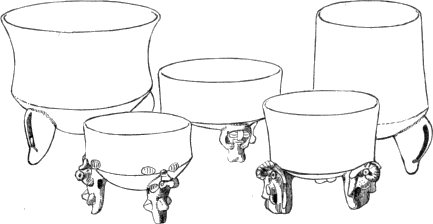
Fig. 92. Vases of varied form with plain and with animal shaped legs—⅓.
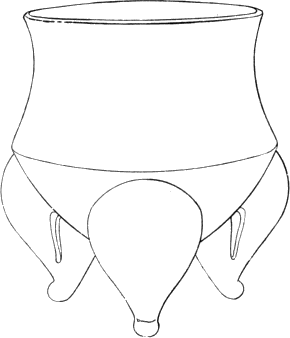
Fig. 93. Large vase of striking shape—½.
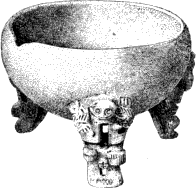
Fig. 94. Cup with legs imitating animal forms—½.
It will be seen that in a number of cases the legs are modeled to represent animal forms. This feature is brought out more clearly in succeeding figures. The creatures represented are often grotesque, as seen in Figs. 94 and 95. The human form is rarely shown in a way to make it clearly distinguishable from the figures of monkeys and other animals. The armadillo is a favorite subject. An example of
Fig. 95. Fig. 96. Fig. 97.
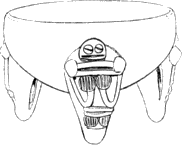

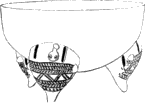
Cup with legs imitating a grotesque animal form—½. Cups with legs imitating the armadillo—½.
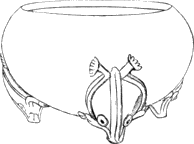
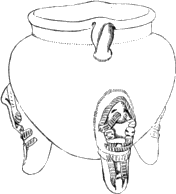
Fig. 98. Cup with frog shaped legs—½. Fig. 99. Cup with legs imitating an animal and its young—½.
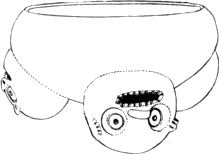
Fig. 100. Cup supported by grotesque heads—½.
The remarkable specimen illustrated in Fig. 101 is furnished with unique supports. Two rudely modeled, semihuman, grotesque figures are affixed to the under surface of the bowl, supporting it with their backs.
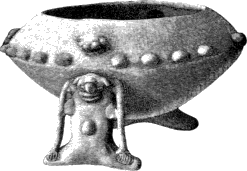
Fig. 101. Large cup supported by two grotesque figures—⅓.
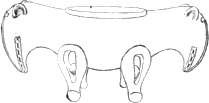
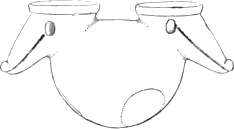
Fig. 102. Cup with two animal heads attached to the sides—¼. Fig. 103. Cup with two animal heads attached to the sides—¼.
The legs of these figures are spread out horizontally, so that a firm support is obtained. The periphery of the body of this vessel is encircled by a number of nodes and noded projections, which represent the heads, tails, and spines of two crab-like animals. The heads, with arms attached, appear at the right and left, and the tails occur at the front and back just over the heads of the supporting figures. The use of the crab in this way is quite common. Fish, birds, and a variety of quadrupeds are similarly treated. Some very interesting examples of double headed animal vases are found. Two of these are outlined in Figs. 102 and 103, the first having a single orifice and the
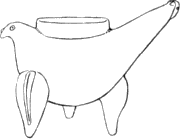
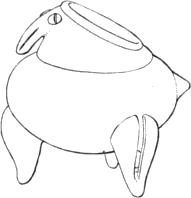
Fig. 104. Vase imitating an animal form—⅓. Fig. 105. Vase imitating an animal form—⅓.
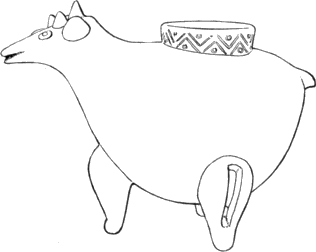
Fig. 106. Vase shaped to imitate an animal form—⅓.
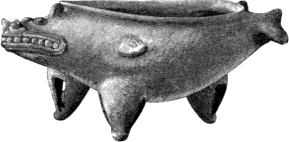
Fig. 107. Fish shaped vessel—⅓.
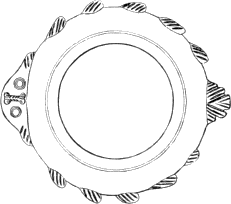
Fig. 108. Top view of a fish shaped vessel—⅓.
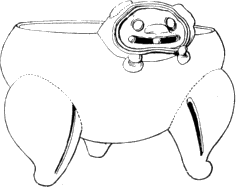
Fig. 109. Cup with grotesque head attached to the rim—½.
Black incised group.—
This pottery, although closely related to the other varieties in its leading features, presents differences of a pronounced character. The number of specimens recovered is rather small. The largest piece has a capacity of perhaps a quart. Some of the forms are identical with those of other groups, but a few are peculiar to this ware. The color is black, brown, or dark gray, and in most cases the entire mass is quite dark. The decoration is executed in two somewhat distinct styles: in one the lines were scratched or engraved subsequently to the hardening of the clay; in the other
Fig. 110. Fig. 111.
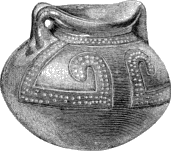
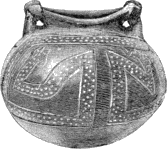
Black cups with incised reptilian figures—½.
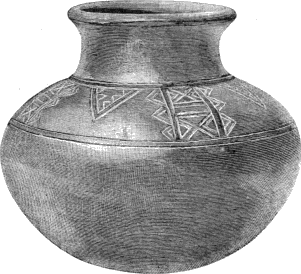
Fig. 112. Black vase with conventional incised pattern—½.
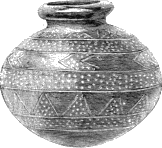
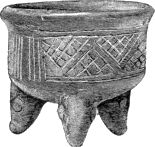
Fig. 113. Small cup with conventional incised patterns—½. Fig. 114. Small tripod cup with upright walls and legs imitating animal heads—½.
There are a number of tripods in this group, some of which have the deeply incised ornaments and others the shallow ones. The shapes vary greatly, a few examples being decidedly Costa Rican in type. Pieces with round bodies have conical legs, like much of the Chiriquian ware, but those with shallow basins and angular, incurved, upright, or flaring rims have the Costa Rican tripod. Figs. 114 and 115 may serve to illustrate this variety. The first is a cup, with upright sides and thick rim, having an incised geometric pattern. The second is much more striking in appearance. The surface color is brownish gray in hue and the simple geometric design was scratched through into the lighter color beneath after the clay hardened. The legs represent the heads of animals conventionally treated and are hollow, containing movable pellets. This specimen is from latitude 8° 42´ north, longitude 82° 52´ west. Others of this class come from different parts of the province.
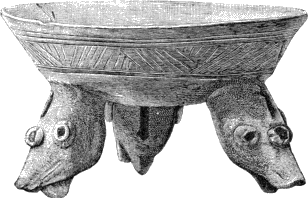
Fig. 115. Vase with flaring rim and legs, imitating animal heads—½.
To this class belongs also a small dark vase of peculiar shape and interesting decoration, which is illustrated in Fig. 116. The neck is large and the lip widely flaring, and the body is modeled in imitation
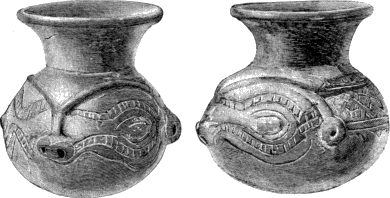
Fig. 116. Vase modeled to resemble the head of an animal—½.
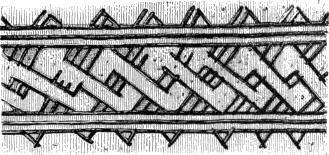
Fig. 117. Pattern upon the back of the vase presented in Fig. 116.
The unpainted wares here so briefly described are typically Chiriquian, and are closely associated in the graves with most of the leading groups of art products of the province. It must be allowed that
PAINTED WARE.
The painted vases of Chiriqui embrace at least ten easily distinguished varieties of ware. The characters upon which the classification is based are somewhat heterogeneous and include material, color, shape, finish, ornamentation, method of manufacture, and evidences of use. No single character and no one group of characters can be relied upon to distinguish the different groups. We must depend, therefore, upon an assemblage of characters or upon one character in one place and another in another place. Observing a number of striking differences in two groups of ware, we arrive at the conclusion that these groups must have been the work of distinct communities; yet we find very marked differences in wares that (through the possession in common of some particular feature) we know to be the work of the same hands. We can, therefore, determine little in regard to the peoples concerned.
I do not consider the presence in a single grave of two or more varieties sufficient proof of their common origin, for a number of distinct wares may come into the possession of one community through trade, conquest, or the spoliation of tombs; but a constant recurrence together of the same forms affords strong evidence that the objects were the work of the people with whom they were buried. Unfortunately our observations in the field are not sufficiently accurate to enable us to utilize associations or methods of occurrence in the graves as a means of classification.
The following classification is, under the circumstances, the best that I can devise, and is of use mainly as a means of facilitating description. The name chosen generally indicates a leading or striking characteristic of the group.
The scarified group, separated widely from all other varieties.
The handled group and
The tripod group, apparently the work of one community and devoted to the same or similar uses.
The maroon group;
The red line group;
The white line group;
The lost color group;
The alligator group; and
The polychrome group, no two of which are sufficiently alike to make it certain, without extraneous evidence, that they were manufactured by the same community, yet all clearly belonging to one great family.
These groups are presented in the order given.
Before proceeding with the descriptions, however, there are some matters of a general nature that should be referred to. Technical questions have already received considerable attention, and I shall need only to refer here to the painted ornamentation, and at sufficient length to insure a clear understanding of its treatment and the scope of its subject matter.
Painted vessels are embellished to some extent also by incising and modeling, and these methods are employed very much as in the unpainted pottery already described.
Painted decoration is executed with much freedom and in many cases with considerable skill. It is greatly varied in method of treatment and embraces a wide range of motives. Geometric patterns occur in great variety, but are found to be of types peculiar to Isthmian America. The conventional meanders, frets, and scrolls so extensively employed in other regions are here almost unknown. Decorative motives derived from natural forms are abundant and afford an excellent opportunity to study the processes of conventional modification. These designs are often applied in a way to indicate that the decorator possessed a keen sense of the requirements of the vessel, although the treatment perhaps is not as universally satisfactory as is the treatment of plastic embellishment.
The potter, in preparing the vessel for the decorator, ordinarily finished it with a slip or wash of fine clay, which varied in hue from a gray white to a pale orange. A slip of bright red tint was also extensively used. The more delicate hues formed an excellent ground upon which to work. The slip covered surface was generally polished, often to a high degree, with the usual polishing implements, the marks of which can be seen upon the less carefully finished surfaces. By observers unacquainted with aboriginal methods this polish is liable to be taken for a glaze, and it has been pronounced a vitreous glaze by a few writers. It is more noticeable upon specimens that have been handled a great deal, as is the case with whistles, needlecases, and the like.
The colors utilized in decoration, so far as they have been preserved, are the ground tints, described above, and the delineating colors, the latter consisting of black, white, red in various hues, and a dull purple. An additional color (or perhaps a solution without particular color) extensively employed in the designs has totally disappeared. The nature of the various colors has not been determined, but it is probable that some were of mineral and others of vegetal origin.
Red was often employed as a ground color, as stated above, and sometimes covered the whole surface, but more frequently occupied zones or panels. In such use it was applied and polished down with the slip. Red was also extensively used in the delineation of decorative figures in several of the groups of ware, and is in all cases a permanent color. The hues vary decidedly with the groups of products,
The light purple tint is but sparingly used and only in the polychrome group. It is very effective in combination with the reds and blacks upon the orange ground of this ware. It is probably of a mineral nature.
What I have denominated the lost color was a pigment, or “taking out” solution, extensively and exclusively employed in the decoration of one of the principal groups of ware. Its former existence is made known by its action upon the ground colors and upon the paste or slip within the areas covered by it. Where superimposed upon black, that color has in all cases been removed, exposing the underlying tints of the slip in which the designs are now manifested, the interspaces being still black. In some cases the lost color has not only removed the black ground, but has affected the slip beneath, removing it also, and to such a degree that the polished surface is destroyed and shallow intaglio lines occur, leaving the interspaces in relief. This circumstance enforces the idea that possibly the “lost color” was really not a color at all, but an acid which acted upon the ground colors at once, destroying the black entirely and leaving the effect now seen. This point must remain for the present undetermined.
The figures in all cases appear to have been delineated with ordinary brushes and by purely free hand methods. The degree of skill varies greatly. The execution in the great body of the work is rather inferior and indicates a lack of skill and care, but in a limited number of pieces the manipulation is masterly.
The designs are confined to the show spaces, being exterior in narrow necked vessels and generally interior in shallow forms.
In arrangement upon the surfaces this decoration presents some novel features. The slight degree of uniformity in arrangement indicates the absence of any mechanical aid, such as the wheel, which device would tend to reduce all decoration to a series of horizontal zones. We observe indeed the occurrence of horizontal arrangements, but not to a degree greater than would naturally arise as a result of the conformation of the vessel. Upright, oblique, and arched arrangements are frequently met with, and all are safely attributable to the domination of spaces to be covered or to the influence of antecedent
The scarified group.—
This group is represented by about forty specimens and is worthy of especial attention. It comes from the graves of two localities, one near C. E. Taylor’s hacienda, north of David, on the slopes of Mount Chiriqui, and the other at Alanje, southwest of David. As a variety of ware it stands so entirely alone that had it arrived unlabeled no one would have recognized its affinities with Chiriquian art. It is rather inferior in material, grace of form, and surface finish, and the decoration appears to belong to a lower grade of culture than that of the other groups. It is possibly the work of an inferior race in comparatively recent times.
Nearly all the vessels are tripods, but a few have rounded or flat bottoms and a few are supplied with annular stands. The walls are thick and the shapes are uncouth or clumsy. The paste is coarse, poorly baked, and friable; near the surface it is a warm reddish or yellowish gray; within the mass it is a dark gray.
The makers of this pottery, like their brother artificers, took especial pleasure in the modeling of life forms. The work exhibited in these specimens is, however, exceptionally rude. In some cases grotesque heads are attached to the rims of bowls; in others the head, tail, and
These vessels are embellished by painting, incising, or scarifying and by modeling in relief. Color was not employed in the production of designs, but a dark Indian red pigment was daubed over that part of the surface not occupied by incised ornament. Little or no slip was used and the rude geometric patterns were executed with pointed tools in a very haphazard manner.
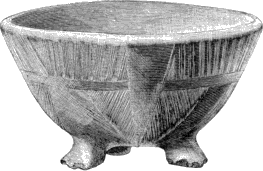
Fig. 118. Tripod bowl of red scarified ware—⅓.
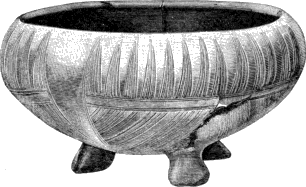
Fig. 119. Tripod bowl of red scarified ware—⅓.
The bowls are more numerous than in any other group of the Chiriquian ware, but, as in the other groups, they are supplied with supports, either tripods, shaped like the feet of quadrupeds, or rude annular bases. In most cases the rim expands gradually from below, as seen in Fig. 118, or is recurved, as shown in Fig. 119. In a few cases the basin is oblong or boat shaped and the ends are pointed, as indicated in Fig. 120.
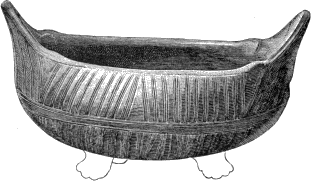
Fig. 120. Oblong basin with scarified design—⅓.
An interesting specimen is illustrated in Fig. 121. At the opposite ends of the bowl portions of the rim are carried upward and inward, forming handle-like appendages, modeled to represent, rudely, the heads of animals. Details of form and ornament are well brought out in the cut.
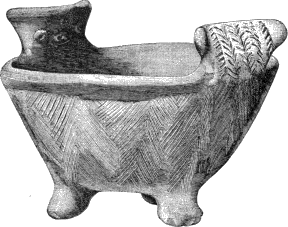
Fig. 121. Large bowl with handles imitating animal heads—⅓.
In Fig. 122 we have a high cylindrical shape with a flat bottom, the surface being scarified in vertical bands. A small pot, having an annular base and decoration similar to the preceding, is given in Fig. 123. In Fig. 124, instead of the vertical lines, we have a series of heavy ribs. Two strong vertically placed loops are fixed upon opposite sides of the shoulder and the base is supplied with the usual feet.
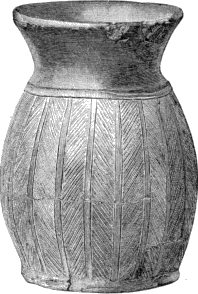
Fig. 122. Jar with flat bottom and vertical bands of incised ornament—⅓.
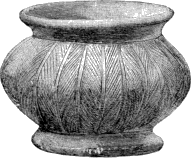
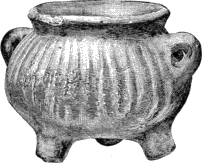
Fig. 123. Vase with stand and vertical incised bands—⅓. Fig. 124. Vase with handles, legs, and vertical ribs—⅓.
The tripods shown in Figs. 125 and 126 are somewhat mutilated, but they present features of interest in the novel shapes and the unique
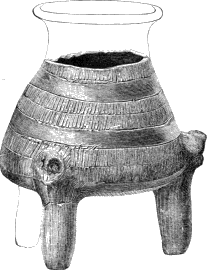
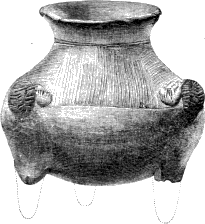
Fig. 125. Tripod with owl-like heads at insertion of legs—⅓. Fig. 126. Tripod with legs rudely suggesting animal forms—⅓.
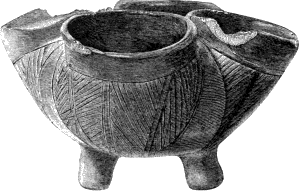
Fig. 127. Heavy red vase with four mouths—⅓.
The handled group.—
The series of vessels to which this name is given comprises a large number of pieces of unusually even characters.
The body is usually much compressed vertically and is flattish above and more or less conical below, giving a very graceful contour. The surface is rather rudely polished and the painting is done with notable carelessness, as if the intended use were not favorable to the preservation of the ornament. By means of a heavy brush, red figures, consisting of splotches, stripes, arches, and encircling bands, were applied to the yellowish gray surface and sometimes, as indicated by a smeared appearance, were polished down with an implement. It does not seem that a slip of ordinary white clay was very generally used. In a few cases a grayish blue tint appears upon some of the wider spaces.
The handles are perhaps the most notable feature of this ware, and usually occur two to a vessel; rarely there is but one handle and in a few cases there are four. This group may be separated into at least four sections by the styles of handles. Vessels of the two more important sections have two handles each, which are placed vertically in one variety and horizontally in the other, reference being had to the position of the points of attachment. These differences of position have given rise to a marked difference in the shape of the orifice and of the lip. The handle is a simple loop, which in the one variety is placed as seen in Fig. 128 and in the other as in Fig. 132. In the latter case one end of the loop is fixed to the shoulder and the other end Fig. 133.
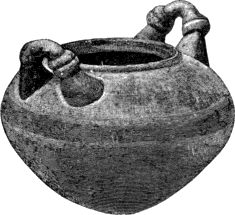
Fig. 128. Vase with horizontally placed handles and rude designs in red—½.
A third variety of handle is a single arch, which spans the orifice and is attached to opposite sides of the expanded lip. In a fourth variety the looped handles are replaced by the heads of animals, which are set upon the shoulder of the vase, as are similar features in other groups of ware.
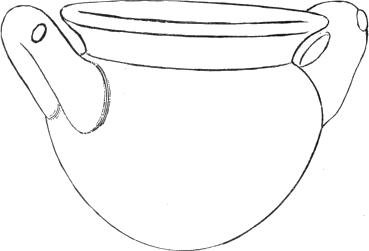
Fig. 129. Unpolished vase with heavy handles and coated with soot—½.
A type specimen with the horizontal loop is shown in Fig. 128. The lip and a wide belt about the body are painted red and the shoulder is occupied by rudely executed arched strokes of the same color. A much less usual shape is given in Fig. 129, which exhibits some characters of contour that remind us of well known Grecian forms. Another novel variation from the type is seen in Fig. 130, in which the arch of each loop is divided by an upright piece. A neat incised ornament occupies the shoulder of this vessel and the remainder of the body is finished in pale red.
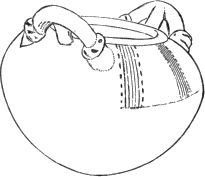
Fig. 130. Round bodied red vase with unique handles and incised ornament—½.
It will be observed that the handles are rarely wholly plain. Each loop is supplied with one or more rings or ring-like fillets, or with small nodes, generally near the most prominent part of the curve or arch. By the study of a large number of specimens I am able to trace these puzzling features to their origin. They are the representatives of life forms which were originally modeled in full detail and which are still so modeled in many cases. The nodes and like features are atrophied heads, hands, or feet, and in some cases are marked with indentations that refer to the eyes or to the fingers or toes, and the round fillets stand for the arms and legs of animals, or, if notched in peculiar ways, may be referred to other originals, such as the mouths of fishes or the spines of crabs. Examples could be given showing all stages of the progress of simplification.
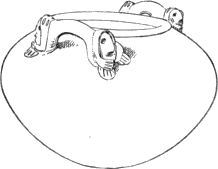
Fig. 131. Vase with grotesque figures attached to the handles—½.
In Fig. 131 I present a fine example of the horizontal loop, in which the opposite ends are supported by grotesque animal figures, applied, however, in a way not detrimental to the grace and simplicity of the vessel.
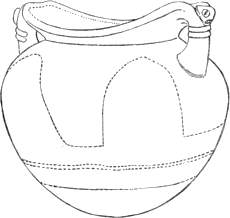
Fig. 132. Vase with upright handles and winged lip—½.
An example shown in Fig. 132 is of especial interest in this connection. The ornament upon the handle serves as a link between
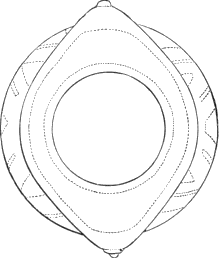
Fig. 133. Top view of vase with winged lip—½.
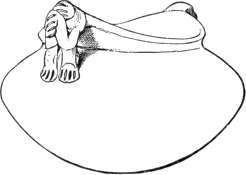
Fig. 134. Vase with grotesque animal shaped handles—½.
Examples are outlined in Figs. 134 and 135 in which the life form is clearly defined. In the first we have a human-like figure, the face of which is entirely hidden by the hands. In the second we observe a curious little animal figure, with a long curved proboscis and a body covered with annular indentations. In general shape and in ornamentation these vases do not differ from the preceding. A remarkable
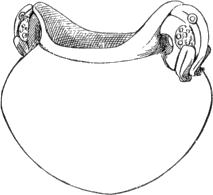
Fig. 135. Vase with handles representing strange animals—½.
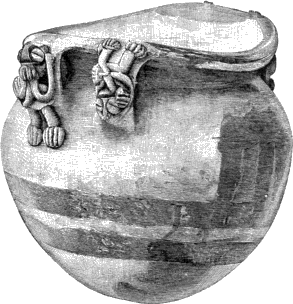
Fig. 136. Vase with two pairs of handles ornamented with grotesque figures—½.
In a third variety the loop is omitted entirely, the animal figure taking its place upon the shoulder of the vase. This feature appears
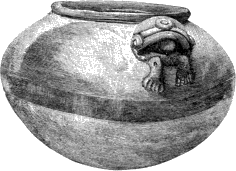
Fig. 137. Vase with handles representing animal heads, which are hollow and contain pellets of clay—½.
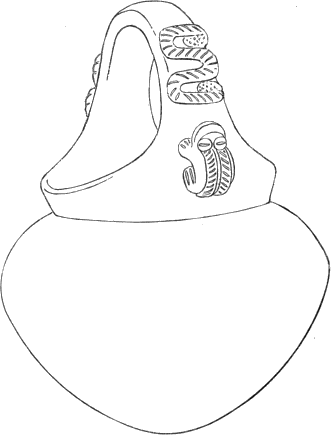
Fig. 138. Vase with arched handles embellished with life forms in high relief—½.
A fourth variety is shown in Figs. 138 and 139, in which the handle spans the orifice as in an ordinary basket. The lip is flaring and is
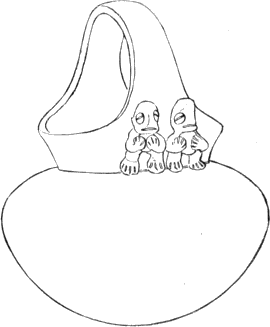
Fig. 139. Vase with arched handles embellished with life forms in high relief—½.
Typical vessels of this class are in many cases mounted upon tripods, but, for convenience of description, these are classed with the succeeding group, which consists mainly, if not entirely, of the same variety of ware.
To recapitulate, the striking characteristics of this group are the uniformity of size, shape, and handles, the rude finish and ruder ornamentation, and the very marked evidence of use over fire.
The tripod group.—
Closely related in most respects to the group of ware just described is the striking series of vessels here presented. At first glance the resemblances are not apparent, but a careful study renders it clear that the vessels proper correspond closely in both groups. The basins are for the most part made in the same heavy, rudely finished style, the decoration is almost equally rude, and the size and the evidence of use over fire are the same. The strong contrast in appearance is due mainly to the presence of tripod supports in this group. The legs, which constitute such a striking feature, are merely appendages to the bodies of vases already perfect, and are evidently an acquired feature suggested by some change in function or in the habits of the people. In this way we are able to account for the
The legs are very generally modeled to represent animal forms. In a majority of cases the fish was chosen because, perhaps, its shape was suitable or because the fish bore some relation to the use to which the vessel was to be devoted. Lizards and mammals are also seen and the human form occasionally appears. In some cases the animal figure is attached to the upper part of the leg or is perched upon the hip, where that feature is pronounced. The body, or shaft, is hollow and contains pellets of clay, sometimes one only and again a dozen or more, and in order that these may be seen and heard variously shaped slits are cut in the sides or front of the legs. If the animal represented is a fish or lizard the entire body is modeled: the head is placed at the top, the under jaw or neck uniting with the body of the vessel; the tail rests upon the ground, and the fins or legs appear along the sides of the shaft. It should be observed that, while in Chiriqui the whole body of the creature is usually employed in forming the support, in Central America and Mexico the head alone is very generally used, the nose resting upon the ground. In less elaborate forms the legs are plain or have the merest hint of animal form in a node, a notched ridge, or a slightly modified extremity.
Handles are present in a majority of cases and as in the preceding group take the form of loops or represent the forms of animals. The loops are generally attached in a vertical position, connecting the shoulder with the lip of the vessel, and are plain round ropes of clay or consist of two or three cords twisted or plaited together. A few eccentric forms occur and are illustrated early in this section.
The animal shapes are often quite elaborate and appear to bear no relation to the creatures embodied in the legs of the vessel; neither does the position of the handles bear any uniform relation to the positions of the legs—another indication that the latter features are recent acquisitions, since features developed together are uniformly well adjusted.
The rim or lip is generally heavy and flaring, and the neck, which is short and pretty sharply constricted, is decorated with incised patterns and with various applied ornaments in relief. The body is graceful in outline and more or less conical below. As a rule the surface is uneven and but slightly polished and the figures in red are rudely executed, but in the more pretentious pieces much care has been exercised in finishing and painting. Most of the vessels have been used over the fire and still retain the sooty incrustations. This ware comes from a wide range of territory to the north and west of David.
The following illustrations represent some of the more important
Fig. 140. Fig. 141.
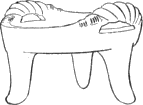
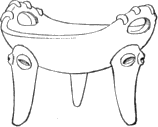
Fig. 142.
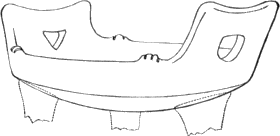
Tripod vases with shallow basins and eccentric handles—⅓.
I present, first, three vases of rather eccentric shapes, the basins of which are shallow and in two cases are flat bottomed. The handles are of unusual shapes, consisting of modifications of the lip, as seen in the illustrations (Figs. 140-142). Life elements are present in all cases in connection with the handles and legs where these are preserved, but they are very meager and so abbreviated as to be identified with difficulty. Incised markings at the ends of the handles represent hands or feet and eyes are affixed to the upper part of the legs. The ware is identical with that of the preceding group.
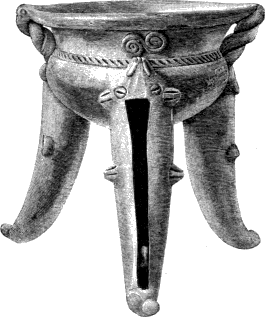
Fig. 143. Tripod vase of graceful shape and neat finish—⅓.
A representative specimen of the fish legged vessels is presented in Fig. 143. It is one of the most graceful forms in the series and is neatly finished and embellished, but is thoroughly blackened with soot. The handles are formed of twisted fillets or ropes of clay and a narrow, incised, rope-like band encircles the lower part of the neck. Set upon the neck and alternating with the handles are two scrolls neatly formed of small round ropes of clay. The fishes forming the legs are very simply treated. The mouth at the apex is formed by laying on an oblong loop of clay and the eyes are represented by two round pellets set into the soft clay of the head and indented with a slit that gives to them the exact effect of screwheads. A pair of fins—small incised or channeled cones—is placed at the sides of the head and another at the sides of the body. The cavity contains a single ball of clay and the slit is long and wide.
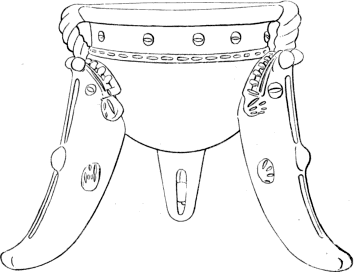
Fig. 144. Heavy tripod vase with widely spreading feet—⅓.
In other examples the fish form is much more elaborately modeled.
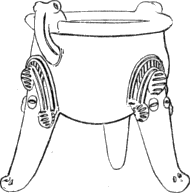
Fig. 145. Neatly modeled vase embellished with life forms and devices in red—⅓.
The process of modeling these heads was about as follows: The upper end of the leg—the head of the fish—was first rounded off, giving the general shape; then parallel incisions were made to represent the teeth, and around these a fillet of clay was laid, forming the lips, which were then channeled with a sharp tool. Nodes or flattened pellets of clay, representing the gills, snout, and eyes, were then laid on and finished with incision-like indentations. The handles consist of bird-like heads, with protruding eyes and long bills that curve downward and connect with the shoulder of the vase. The body is rudely spotted with red.
A large, uncouth specimen is shown in Fig. 146. The legs are ponderous and are not neatly adjusted to the vessel. A meander pattern of incised lines encircles the neck and the body is rudely decorated with broad red stripes.
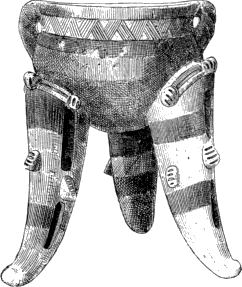
Fig. 146. High tripod vase with incised designs and rude figures in red—⅓.
There is a general consistency in the use of life forms which is worthy of notice. The fish and other creatures used, although variously conceived and treated, are never confused. When the fish is employed no features suggesting other animals appear and when the heads of other creatures occupy the upper extremity of the leg all the details refer to these creatures with uniform consistency. In Fig. 147 we have an unusually graceful shape, decorated about the neck with scrolls and indented fillets. The legs represent some reptilian form resembling a lizard. The head projects from the hip and is conventionally treated. A round fillet fixed at its middle point to the muzzle of the creature is turned back at the sides of the head and coiled to form the eyes. The forelegs are attached at the sides near the top and the recurved terminal point is encircled by rings that stand for the coiled tail.
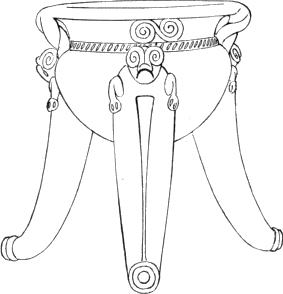
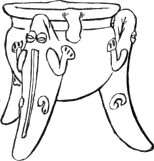
Fig. 147. Handsome tripod vase with scroll ornament—⅓. Fig. 148. Vase with lizard shaped legs—⅓.
There is little room for doubt as to the kind of creature represented in the legs of the vase given in Fig. 148. The head, legs, and general
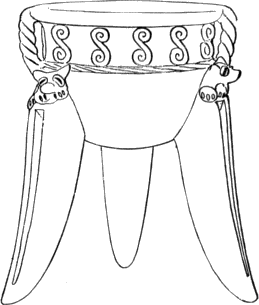
Fig. 149. Vase with scroll ornament—⅓.
A vase of unusually striking appearance is presented in Fig. 150. It is one of the largest tripods in the collection and is characterized by a high widely expanded lip and a long conical body and by legs of unusual size and conformation. Small animal figures are perched upon the projecting hips. The surface of the vessel is rudely finished and is much blackened by smoke about the upper part of the legs and the body.
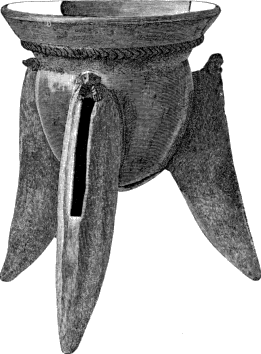
Fig. 150. Large vase with flaring rim and wide spreading legs—⅓.
A unique use of the animal form is illustrated in Fig. 151, which shows a large fragment of one of these tripods. The figure of an alligator, modeled with a great deal of spirit, is attached to the side of the vessel, resting partly upon the leg and extending upward obliquely to the lip. A similar figure upon the opposite side of the same vase is represented as grasping the form of a man or boy in its formidable looking jaws.
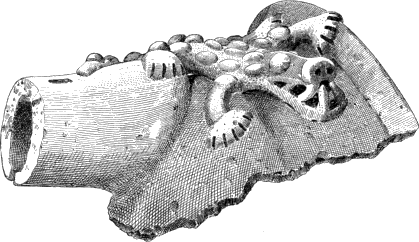
Fig. 151. Fragment of a tripod vase embellished with the figure of an alligator.
The alligator, rarely employed in this group of ware, is freely used in other groups and was probably a creature of importance in the mythology of Chiriqui.
In one case only, so far as I have seen, is the human form employed in the supports of these vessels, and in that case, as will be seen in Fig. 152, the result is extremely grotesque. The shape of the basin is good and the thick, rounded lip and most of the surface are carefully polished. A disconnected meander of incised lines encircles the rather high neck, and parts of the body and its attached features
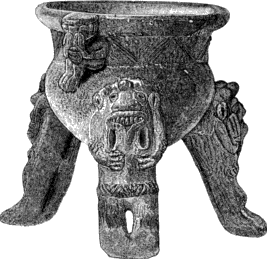
Fig. 152. Vase supported by grotesque human figures—⅓.
I add, in Fig. 153, one more example, a large, full bodied vase, which, more decidedly perhaps than any of the foregoing, proclaims its relationship to the preceding group. If the three rather clumsy legs were knocked off there would remain a large beautifully shaped and finished vase, with a constricted but flaring rim not in any way distinguishable from those of the preceding group. The legs in this case are less perfectly adapted to the vessel than in the other examples, as if the potter, skillful in modeling the vessel, had only recently undertaken to add the tripod. The slit in the outer face of the leg is unusually wide and the inclosed ball is three-fourths of an inch in diameter. The most remarkable feature of this vessel is the pair of unique figures affixed to the upper surface of the body near the lip, and which would seem to be intended to represent semihuman monsters. The arms and legs are contorted and serpent-like in appearance and terminate in most cases in heads of serpents instead of
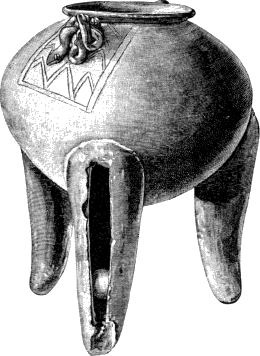
Fig. 153. Round bodied vase embellished with figures of monsters—⅓.
It may be noted, in recapitulation, that these vases, although elaborately modeled and often well finished, are rudely decorated and very generally show use over fire; that the legs, though often graceful and well proportioned, are in many cases clumsily adjusted to the body, giving a decidedly unsatisfactory result as a whole. This ware was devoted to domestic uses, or, if otherwise, in all probability to the burning of incense. Animal forms are freely employed, but in a rather rude way. The fish form is more generally used than any other, and is in all cases embodied in the legs of the vessel, the head joining the body of the vessel and the tail resting upon the ground. These representations exhibit all grades of elaboration from the fairly well modeled to the merest suggestion of animal character—any one feature, as the mouth, the eye, the fins, or the tail, being alone a sufficient suggestion of the creature to satisfy the potter and keep alive the idea of the fish. Other animal forms are employed in modeling the legs, and exhibit equally varying degrees of elaboration, and it is
The pottery of the two groups already presented exhibits characters so uniform throughout that there need be no hesitation in placing them together as the work of one community and of one period of practice of the art; but between these groups and those that follow there is a wide gap. The differences are so marked that, if they had come from widely separated localities, very intimate relationships would not have been suggested.
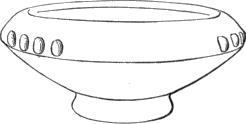
Fig. 154. Cup with incurved rim and life form ornamentation—½.
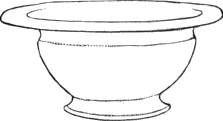
Fig. 155. Cup with widely expanded rim and constricted neck—½.
The maroon group.—
For the want of a better name I have called the group first to be presented the maroon group, on account of its color. Our collection comprises not more than a dozen pieces of this ware. The locality from which they come is called Los Tenajos by Mr. McNiel, but he has not distinguished them in any way from the other varieties, and I am therefore unable to say whether or not they occur together with others or under identical conditions. In symmetry of outline, diversity of shape, and cleverness of modeling this ware takes a high rank, but there is no painted ornament. The surfaces are usually well polished, and all exposed parts have received a coat of purplish maroon colored paint. The paste contains a great deal of fine sand, and is yellowish upon the surface and generally quite dark within the mass. Considering the small number of pieces, the scale of form is remarkably varied. There are plain bowls with incurved rims and with flaring rims, vases with
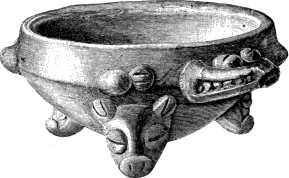
Fig. 156. Small tripod cup with animal features in high relief—½.
A most interesting tripod is shown in Fig. 157. The bowl is beautifully modeled, is symmetrical, and has a flaring rim, rounded and polished on the upper surface and drooping slightly at the outer margin. The body is hemispherical and is supported by three grotesque anthropomorphic figures that strongly remind us of the “mud head” masks used in one of the dances of the Zuñi Indians. The head is a rounded ball, upon which pellets of clay are stuck to represent the features. The arms are set against the sides of the body, as in other isthmian specimens, the hips are excessively large, the legs straight, and the feet small and united to form the foot of the vessel. Nearly the entire surface is finished in a dark purplish red paint, which appears to have been polished down as a slip. A companion piece is considerably smaller and the supporting figures are very grotesque and somewhat crouched, as if bearing a very heavy weight.
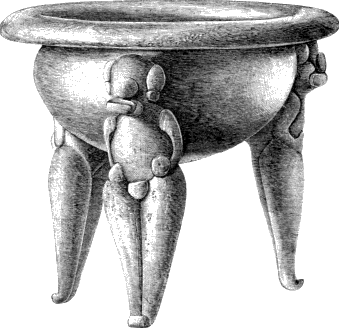
Fig. 157. Handsome vase supported by three grotesque figures—½.
A number of large basins or caldrons, collected in Chiriqui, and fragments of vessels of extraordinary size resemble this ware in material, color, and finish. The rims of the larger pieces are upwards of an inch thick and the walls are in cases three-fourths of an inch thick. A number of large vessels of similar ware now in the National Museum were collected in Costa Rica and Nicaragua.
The red line group.—
The group of vessels to which I have given this name is represented by about a dozen specimens, which indicate a wide range of form and exhibit a number of unique characters.
The localities from which they are derived extend from 8° 20´ to 8° 40´ north latitude and from 82° 40´ to 82° 50´ west longitude.
The paste is of about the usual composition, but takes a variety of tints on burning, a light gray orange prevailing. The finish of the surface is about the same as in other groups. The decoration consists of life forms and their conventional representatives in relief and of carelessly executed geometric designs, the pigment used being a bright, sienna-like red.
As will be seen by reference to the illustrations, the forms are varied and pleasing, but for the most part repeat outlines common to other groups. The handles, single or in twos, are upright loops, and the tripods are in nearly all cases looped or annular, an unusual feature in other groups.
I present three illustrations, two of which were given in outline in the introductory pages. The first (Fig. 158) has a well proportioned, somewhat globular body, supported by three legs formed of looped bands of clay. On the shoulder are two small animal forms, probably meant for frogs. The spaces between these are occupied by panel-like arrangements of red lines. The surface is yellowish gray in color, excepting where blackened in the baking. The paste has
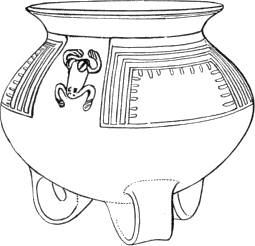
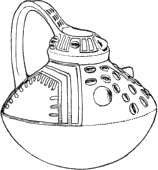
Fig. 158. Vase decorated with figures of frogs and devices in red—½. Fig. 159. Vase of unique shape and life form ornamentation—½.
A unique piece is represented in Fig. 159. The single handle is a high projecting loop and connects with the margin of the orifice, which rises to meet it, and with the lower part of the shoulder. An animal form, apparently anthropomorphic, is embodied in this vessel. The upper part of the vessel, separated by a slight constriction from the body proper, represents the head of the creature, the nose, mouth,
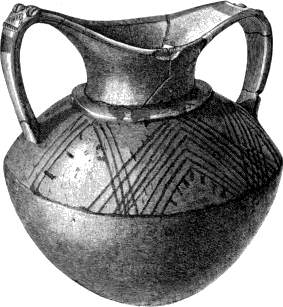
Fig. 160. Two handled vase with life form and linear decoration—½.
A graceful shape is illustrated in Fig. 160. The paste is a grayish orange on the surface and is rather dark within the thicker portions of the walls. The under surface is much blackened by use over fire. An interesting feature is seen upon the handles at the highest point of the loop. Instead of the single indented transverse fillet observed in similar forms in other groups, we have two such features, set about an inch apart, and between them are two indented nodes which stand for eyes, and a number of indentations within the space refer to other features of the animal suggested. Upon the shoulder and collar of the vessel are carelessly drawn geometric patterns in red lines.
The white line group.—
One group of vases, of which we have but four pieces, is characterized by the use of a whitish pigment in decoration. Not one of the collections that I have seen is well supplied with this class of ware, and hence little can be said of its varieties of form and ornament. All are tripods, but the shapes of the vessels vary considerably. Two small pieces are from latitude 8° 40´ north and longitude 82° 32´ west. One of these is shown in Fig. 161. They are small, rather carelessly finished tripods, with narrow necks and flattened bodies. The inner surface of the orifice and the under side of the body are painted a dull red. The remainder of the surface is a warm reddish gray, the color of the slip and the paste. The legs in the piece figured represent some small creature with a rabbit-like face and a body which tapers gradually to the base. Two feet are placed near the middle of the body, which is striped transversely with white lines. A white collar crosses the neck and the eyes are white dots. The upper surface of the vase is embellished with two animal figures, executed in a white earthy pigment. They may refer to the alligator,
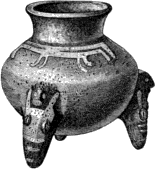
Fig. 161. Small tripod vase with animal figures in white—½.
The large tripod vase presented in Fig. 162 is distinct in many ways from anything in the collection and is remarkable for symmetry of form and neatness of finish. The body is a long, symmetrical cone and the legs are long, straight cylinders, neatly rounded off to a point below. A thick rim projects at a sharp angle and is rounded up toward the margin. The legs are hollow, and through two pairs of lateral slits a number of small pellets can be seen, which rattle when the vase is moved. Rudely modeled little animals, with erect ears, large feet, and conical tails, are fixed to the upper end of the legs. The ground color, the slip, and the paste are of a reddish
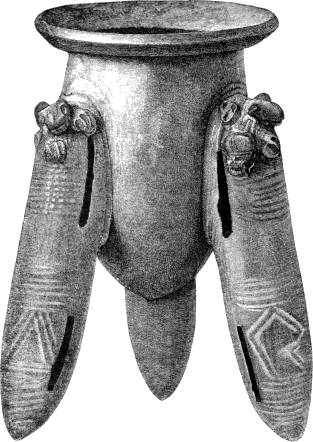
Fig. 162. Shapely vase with designs in white paint—½.
The lost color group.—
In number of specimens this group is second to none, excepting perhaps that given under the head of terra cotta ware. Nine-tenths of the pieces may be classed as bottles, which have rather short, wide necks and globular bodies, slightly conical below and in cases flattened above. They range in size from one inch to nearly a foot in height, but the average capacity is not above a pint. Aside from the bottles there is a wide range of shapes. There are shallow bowls and various complex and compound forms. Animal forms are associated with all classes of vessels. Tripod supports are limited to rather modest proportions, and handles, although often present and greatly varied in style, do not constitute an important feature. These vessels are remarkably well preserved and exhibit few traces of abrasion by use or of blackening over fire. The paste is fine grained and usually of a light yellow gray tint throughout.
The surface was finished either in a light colored slip or in a strong red pigment. In some cases the light tint was used exclusively and again the red covered the entire surface, but more frequently the two were used together, occupying distinct areas of the same vessel and forming the groundwork for decorative patterns in other colors. They were usually polished down with very great care, giving a glistening surface, upon which the markings of the tool can still be seen.
I have already described the methods of decoration, but may review them briefly here. The bright red color, which forms such a prominent and pleasing feature, is, as stated above, only a ground tint and is not used in any case in the delineation of design. The actual patterns, so varied and interesting, were worked out in a pigment or fluid now totally lost, but which has left traces of its former existence through its effect upon the ground colors. In beginning the decoration, a thin black color, probably of vegetal character, was carried over the area to be treated, and upon this the figures were traced in the lost color. When this color (if it was indeed a pigment, and not merely an acid or “taking out” medium) disappeared, it carried with it the black tint beneath, exposing the light gray and red tints of the ground and leaving the interstices in black. The interstitial figures thus formed are often of such a character as to be taken for the true
The nature of the materials employed cannot be determined. Applied to the polished surface, they were easily removed. The black ground tint is now easily rubbed off and in most cases is much injured by handling or by contact with the soil. The lost color may have been similar to the white, argillaceous pigment used by the Aztecs, which has in many cases partially or wholly disappeared, leaving its marks upon the ground either by deadening the polish or by removing portions of the slip and the paste upon which it was laid, presenting the ornament in intaglio.
The designs are infinitely varied in appearance and arrangement, yet are far from having a mixed or heterogeneous character. It is probably our lack of knowledge of the origin and history of the elements and their derivations that causes confusion. Both geometric and imitative elements abound and are blended in perfectly graded series. The treatment of geometric figures is peculiar to Chiriqui and in many respects is peculiar to this group of ware. Classic forms, such as the meander, the scroll, and the fret, rarely occur and are barely recognizable. It appears from a close study of all the work that motives derived from nature have greatly leavened the whole body of decoration. This matter will receive attention as the examples are presented and will be treated with greater care in a succeeding section.
Plastic decoration, aside from the life forms so commonly associated with the body of the vase and with the handles and legs, is not of importance. The high degree of polish required in this ware tended to simplify all relieved features.
The presence of life forms in relief has produced important modifications in the appearance and the arrangement of the painted devices, and in many cases there is a manifest correlation between the plastic and the painted forms: as, for example, when the body of the vase was thought of as the body of the animal, the extremities of which were placed upon its sides, the colored figures carried out the idea of the creature by imitating in a more or less conventional way the markings of the body. This will be understood through reference to the examples presented in the following pages.
I will present, first, a series of bottles, selecting at the beginning those decorated in the more purely geometric style and gradually approaching those upon which animal forms are treated in a literal manner. The few pieces selected for illustration are totally inadequate to the proper representation of the group and must be regarded only as average specimens, more or less typical in character.
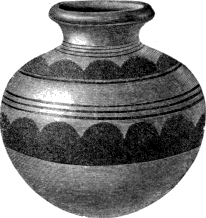
Fig. 163. Small red bottle with horizontal bands of ornament consisting of plain and scalloped lines—½.
I give first a number of examples in which the decorative devices are arranged in horizontal zones. In Fig. 163 broad bands of ornament,
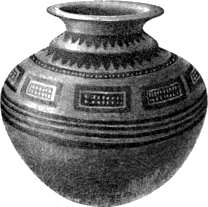
Fig. 164. Small red bottle with encircling geometric devices—½.
In a numerous series of vessels the decorated bands are divided into compartments or panels, often four in number, which spaces are occupied by lines and figures of greatly diversified characters. In the example shown in Fig. 165 the ground color of the principal zone is in the light yellow gray tint of the slip, the remainder being red. This lends brilliancy to the effect.
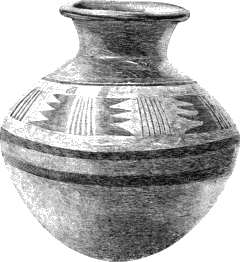
Fig. 165. Bottle with zone occupied by geometric devices—½.
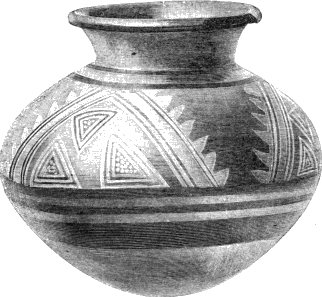
Fig. 166. Bottle with broad zone containing geometric figures—½.
In the vase shown in Fig. 166 the treatment is in a general way the same, but the compartments are triangular and are separated by lines that form a disconnected meander. An additional example is given in Fig. 167. Here the principal zone is expanded to cover the whole upper surface of the vase, which was finished in the light colored slip to receive it. The principal lines are arranged to give the effect of rays when viewed from above, but as seen in the cut they give the effect of a carelessly connected meander. The groups of lines are
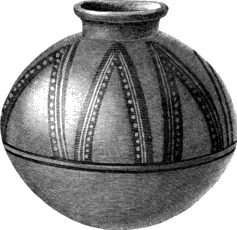
Fig. 167. Bottle with decoration of meandered lines—½.
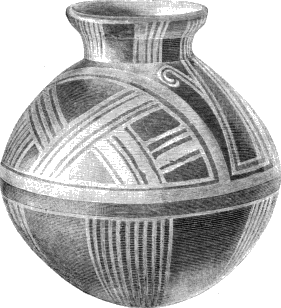
Fig. 168. Bottle with arched panels and geometric devices—½.
Somewhat similar also in general effect to the last example is the work upon another important series of vases. Instead of the simple meandered or zigzag arrangement of parts, two of the dividing lines of the zone run tangent to the neck of the vase on opposite sides, forming arched panels and leaving upright panels between.
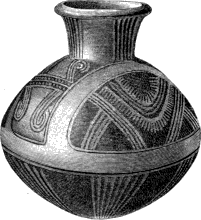
Fig. 169. Bottle with arched panels and elaborate devices—½.
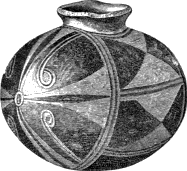
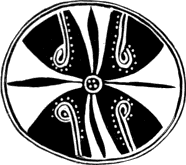
Fig. 170. Vase with rosette-like panels—½. Fig. 170a. Ornament from vase shown in Fig. 170.
In a small group of vases we have a radiate ornament within the arches and in a few cases the arched lines are continued down around the base of the vessel, forming vertical circles in which rosette-like designs are formed by repeating the radiate figures in an inverted a), which are the interspaces or remnants of the ground, groups of lines have been drawn, in most cases curved at the inner ends like an opening frond and accompanied in all cases by series of dots. An examination of a number of vessels shows various degrees of convention. It is clear, however, that these devices, showing curves, hooks, and dots, are not of technical or mechanical origin, but that they refer to delineative originals of which they are survivals; but we must remain in the dark as to what the originals were or what was the precise nature of the idea associated with them in the mind of the decorator. Another question refers to the arrangement of the parts of the design in the five preceding figures. The distribution of the designs is a matter of great interest, and much may be learned from a close study of these specimens.
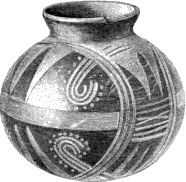
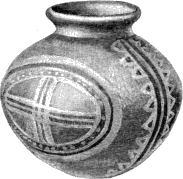
Fig. 171. Vase with rosette-like panels—½. Fig. 172. Vase with rosette-like panels—½.
Horizontal zones appear in the ceramic decoration of all countries, and result, no doubt, from technical causes; but the division of zones into compartments of peculiar shape is due to other influences. I believe the peculiar arched arrangement here seen results from the employment of plastic features, such as handles or life forms. The ancient races were accustomed to conceive of the vessel as the body of an animal, an idea originating in the association of mythologic conceptions with art. The head and the tail of the particular creature thought of were attached to opposite sides of the vase and consequently interfered with the original zonal arrangement of the design where it existed, or where it did not exist the sides were filled with devices representing the markings of the creature’s body. The decoration now consisted of four parts, two in the round or in relief and two in color, the former occupying small areas and the latter wide areas, as
Fig. 173. Fig. 174. Fig. 175.
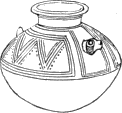
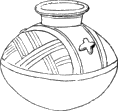
Theoretical origin of the arched panels.
In multiplying these vessels the original forms and associations of decorative features are necessarily to some extent lost sight of; the panels change in shape, number, and relationships; and devices originally appropriate to particular spaces are employed indiscriminately, so that the uninitiated see nothing but confusion. All devices are delineations of or have more or less definite reference to the creature or spirit associated with the vessel.
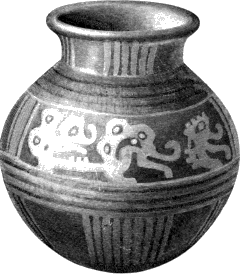
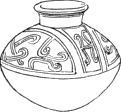
Fig. 176. Vase decorated with conventional figures of alligators—½.
I will now pass over the many hundreds of pieces with designs too conventional to furnish a clew to the original animal forms, yet still suggesting their existence, to those in which the life forms can be traced with ease or in which they are delineated with a much nearer approach to nature. The manner of introducing life forms into the panels of the encircling zones is illustrated in the following figures. In the vase shown in Fig. 176 there are four panels, two short and two long, separated by vertical bands. The short panels are black, but the long ones are occupied by rudely drawn figures of alligators, some of which are very curiously abbreviated. At the right hand in the cut we have simply the head with its strong recurved jaws and notched crest. The principal figure at the left is a two headed alligator, the body being straight and supplied with two feet. The ground finish of the decorated band is in the light gray tint and the alligator figures and vertical septa now appear in that color. The ground of the remainder of the surface is red. It will be seen that in this case the panel outlines are rather elaborate and that the neck and base are striped in a way to enhance considerably the beauty of the vessel. Additional examples of animal devices are given in Figs. 177 and 178. The significance of the curious figure
Fig. 177. Fig. 178.
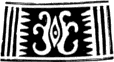
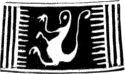
Portions of decorated zones illustrating treatment of life forms.
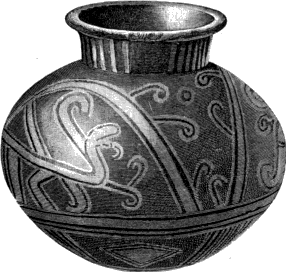
Fig. 179. Vase decorated with highly conventional life forms—½.
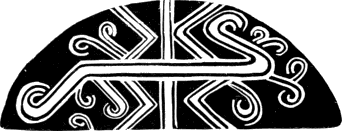
Fig. 179a. Design from vase shown in Fig. 179.
In Figs. 179 and 180 I present very interesting examples in which the arched panels are used. In the first the compartments are occupied by a favorite Chiriquian motive, which consists of groups of lines curled up at one end like unfolding fronds. The whole group represents a very highly conventionalized animal figure (Fig. 179a). The devices occupying the upright panels take the place of the animal heads shown in several preceding figures. In the arched panels shown in Fig. 180 we have the frond-like motive treated in a manner
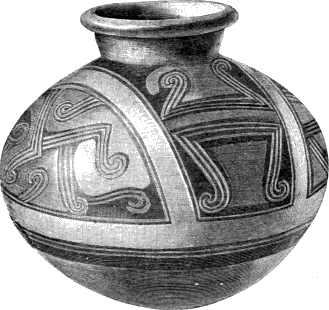
Fig. 180. Vase decorated with highly conventional life forms—½.
Many of these globular vases are unusually handsome. The polished ground is red or is varied with stripes or panels of the whitish slip. Over this ground the whole surface was painted black and then the lost color was employed to work out the design. The coiled figures were produced by drawing the lines in the lost color. The interspaces were then roughly gone over with the same pigment in such a way as to leave the figures inclosed within rather uneven black borders. The presentation of these ornaments brings me naturally to the consideration of a number of very puzzling forms which, if taken alone, must inevitably be referred to vegetal originals. In Fig. 181 we have a handsomely shaped vessel, finished in a polished red ground and decorated in the usual manner. In the main zone—here rather high up on the vase—there is a series of upright figures resembling stalks or stems with scroll-like branches springing from the sides. The stalks are probably the septa of the panels and the leaves are the usual reptilian symbols. About the widest part of the body of the vase is a band of ornament probably representing an animal.
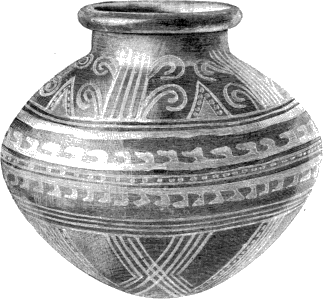
Fig. 181. Vase decorated with highly conventional life forms—½.
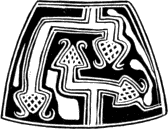
Fig. 182. Decorated panel with devices resembling vegetal growths, but probably of animal origin—½.
A still more remarkable ornament is shown in Fig. 182. The decorated zone of the vessel from which this is taken is divided into three panels, each of which contains stem-like figures terminating in flower shaped heads and uniting in a most remarkable way animal derivatives and vegetal forms. I am inclined to the view that here, as in
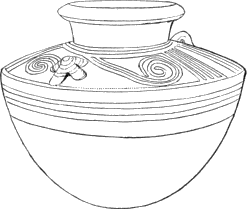
Fig. 183. Example of vase of unusual shape—½.
Fig. 184. Fig. 185.
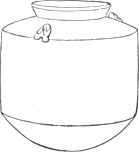
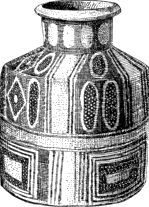
Examples of vases of unusual shapes—½.
In striking contrast with the globular forms just given are the angular outlines presented in the following illustrations. The first is flattened above, the body being much expanded horizontally and having a sharp peripheral angle. Upon the shoulder, occupying the places of and probably standing for animal heads, are two cruciform
Complex and compound forms are comparatively rare. A double vessel is shown in Fig. 186, and a second, varying somewhat from the first in shape and ornamentation, is presented in the succeeding figure. Vessels of this form are always small, but are neatly constructed and finished with much care. The strong handles are more or less arched and connect the inner margins of the two lips. The bodies of the twin cups are closely joined, but the two compartments are not connected.
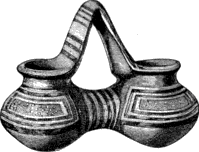
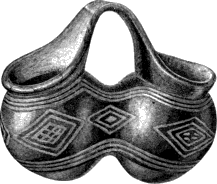
Fig. 186. Double vessel with high arched handle—½. Fig. 187. Double vessel with arched handle—½.
It seems impossible to present a satisfactory series of the plastic features characteristic of this group of products without extending this paper inordinately. Handles, legs, and life forms are varied and interesting; they are not so boldly treated, however, as in some of the
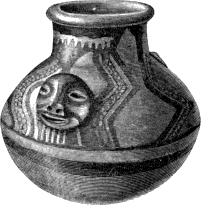
Fig. 188. Vase embellished with life forms, heads in relief and other parts in color—½.
With reference to life forms it has already been pointed out that the painted figures generally imitate or typify animal forms, and it is important to note that these figures are in very many cases used as auxiliaries to plastic features in the development of particular conceptions. This is shown to advantage in Fig. 188, which illustrates a small, well formed bottle, having two large human-like heads attached to opposite sides of the body. There are no other plastic features, but the heads are supplied with arms and legs, rudely expressed in black lines, which are really the interspaces of the lines drawn in the lost color. These painted parts occupy the zone usually devoted to decoration and, as will be seen by reference to the cut, resemble closely the radiate or meandered figures seen in vases of the class shown in Fig. 167. The arms are joined to the lower part of the head and extend upward to the neck of the vessel, where they terminate in rudely suggested fingers. Rising to the right and left of the arms are legs terminating as do the arms. A double row of dots is carried along each member, and thus we have a suggestion of the relation of the dots and dotted lines, seen in more highly conventional forms, to the markings of the creature represented or symbolized. The grotesque faces are covered with lines which follow the forms as if imitating markings upon the skin. Another example, equally suggestive, also employing an animal form, is shown in Fig. 189. It is a cup, mounted upon three feet, which has attached to one side the head of a peccary, modeled with more than usual skill. The ears of the animal appear at the sides of the vessel and the tail is opposite the head. The lines and dots seen upon the head are carried along the sides of the vessel as far as the ears and
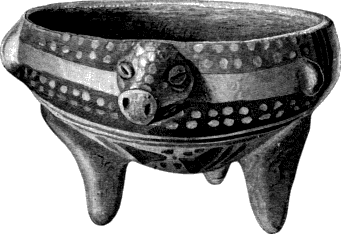
Fig. 189. Vase modeled to represent a peccary—½.
Fig. 190. Under surface of vase shown in Fig. 189.
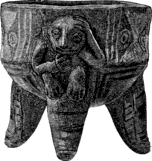
Fig. 191. Small vessel with human figures in high relief and geometric color decoration—½.
I present next (Fig. 191) a piece in which there is no recognizable relationship between the painted and the plastic features. It is a small tripod cup with upright walls, upon which two characteristic Chiriquian human figures, male and female, are fixed. The painted figures upon the sides of the vessel are geometric, but refer possibly to some character or attribute of the modeled figures or are the survivals of figures belonging to vessels of this shape or style before the life forms were associated with them. The legs, however, so far as can be determined, are not related to the human motive, as they are modeled and painted to imitate the heads of alligators.
I shall now present a few shallow bowls or pans mounted upon tripods. They vary in dimensions from a few inches in diameter to a foot or more and are strongly made, symmetrically formed, and neatly finished. The polished surfaces are mainly red. The designs were executed in the usual way in the lost color, upon a black ground, and are confined chiefly to the exterior surface. The alligator is the favorite motive, and in a number of cases is quite graphically, although still conventionally, rendered. As in the preceding examples, the animal heads represented in the legs do not always correspond to the creatures embodied in the painted decoration.
In Fig. 192 we have a representative example of moderate size and ordinary finish. The decorated band is divided into panels, three of which are long and contain figures of the alligator. The other three are short and are filled with conventional devices, related perhaps to that animal. The legs are apparently intended to resemble the heads of alligators. A large piece, nearly twelve inches in diameter, is very similar in shape and decoration, but the legs resemble puma heads.
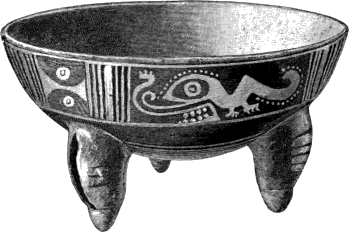
Fig. 192. Tripod cup, with figures of the alligator—½.
The specimen shown in Fig. 193 is extremely well made and differs decidedly from the preceding. The sides are upright and the lip is recurved and thick. The legs represent some animal form with thick body, eyes at the top, and a tail-like appendage below that turns up and connects with the side of the body. The form of the bowl is symmetrical and the surface carefully finished and polished. The exterior design is divided into panels, as in the preceding case; the figures are simple and geometric. The inside of the upright portion of the wall is decorated with vertical lines and bands and the bottom is covered with an octopus-like figure, now partially obliterated.
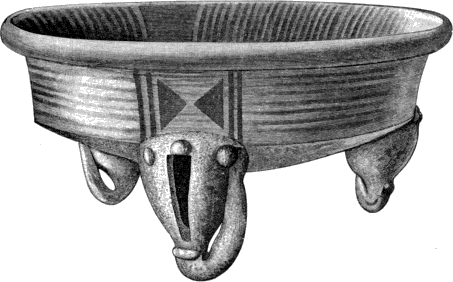
Fig. 193. Large shallow tripod vase, with geometric decoration—½.
The remarkable example shown in Fig. 194 illustrates a number of the points suggested in the preceding pages. It is a large bottle of the usual contour and color, mounted upon three high legs, which are slit on the inner surface and contain movable balls of clay. Two handles, placed at opposite sides of the neck, represent human or anthropomorphic figures. These figures and the neck and base of the vessel were finished in the red slip. The broad zone extending from the neck to some distance below the periphery was finished in the gray slip, with the exception of the frames of two panels beneath the handles and the foundation lines of two large figures of alligators, which are in red. The surface, when thus treated, was well polished and then a coat of black was laid upon it, and upon this details of the designs were drawn in the lost color. The figures of the alligators exhibit some striking peculiarities. The hooked snout, the hanging jaw, the row of dotted notches extending along the back, and especially the general curve of the body are worthy of attention.
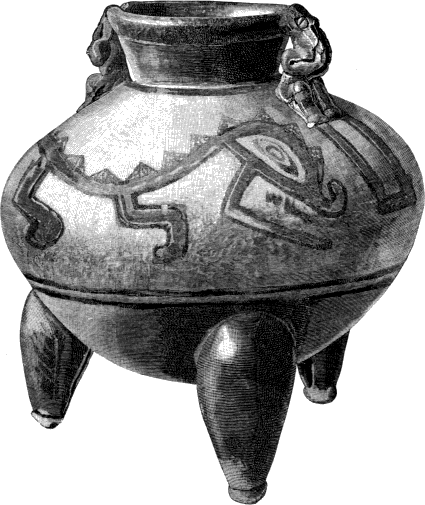
Fig. 194. Large bottle shaped vase, with high tripod and alligator designs—½.
Belonging to this group are many whistles, needlecases, and rattles, all of which are described under separate headings upon subsequent pages.
The alligator group.—
The group of ware to which I give the above name is perhaps the most interesting in the collection, although numerically inferior to some of those already presented. Its decoration is of a very striking character and may serve to throw much light upon the origin and evolution of certain linear devices, as it illustrates with more than usual clearness the processes of modification.
I will first present a representative series of the vessels, in order that they may in a measure tell their own story; yet it is not possible without
This group, like that last described, is composed chiefly of bottle shaped vases with globular bodies and short, wide necks; but there is no danger of confusion. By placing a series from each group side by side a number of marked differences may be noted. In the lost color group the neck is decided in form, the body is usually somewhat flattened above and is distinctly conical below, and the prevailing color is a rich dark red. In the alligator group the body is more nearly globular and the curves of the whole outline are more gentle; the prevailing color is a light yellowish gray. The reds and the blacks, which are used chiefly in the figures, are confined to rather limited areas.
Besides the bottle shaped vases, there is a limited series of the usual forms, and a few pieces exhibit unique features. The management of life forms is especially instructive. Handles are rare and legs are usually not of especial interest, as they are plain cones or at most but rude imitations of the legs of animals. Shallow vessels are invariably mounted upon tripods and a few of the deeper forms are so equipped. Usually the sizes are rather small; but we occasionally observe a bottle having the capacity of a gallon or more. The materials do not differ greatly from those employed in other groups of ware. The paste is fine grained and light in color, sometimes reddish near the surface, and where quite thick is darker within the mass. A slip of light yellowish hue was in most cases applied to the entire surface. A red ochery pigment was in some instances used in finishing the lip and the base of the body, and occasionally the red pigment was applied as a base, a kind of sketch foundation for the decoration proper. For example, when the alligator was to appear upon the side of the vessel, the principal forms were traced in broad lines of the red color, and these were polished down with the slips. When the polishing process was complete, the details of the figure, were drawn in black and in cases partially in red. Black was the chief delineating color, the red having been confined to broad areas, to outlines, and to the enframing of panels. In execution, therefore, there is a decided contrast with the preceding group, and it may be added that there is an equally strong contrast in both treatment and subject matter of the ornament. The motives are derived almost wholly from life forms and retain for the most part features that suggest their origin. The subjects are chiefly reptilian, the alligator appearing in a majority of cases, and hence the name of the group.
I present first a few examples of plain bottles which have no extraneous plastic features. The decorations are arranged in two ways, in zones about the upper part of the body or in circular areas, generally four in number, equidistantly placed about the shoulder of the vessel.
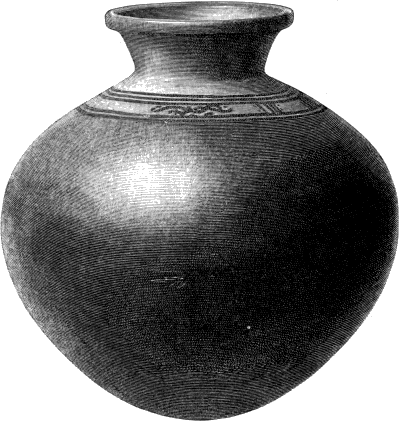
Fig. 195. Large bottle, with narrow zone containing figures of the alligator—⅓.
An example of the first style is given in Fig. 195, which represents the largest piece in this group of ware. The form is symmetrical and very pleasing to the eye. The surface is not very highly polished and shows the marks of the polishing implement distinctly over the entire surface. Two black lines encircle the flat upper surface of the rim and the outer margin is red. The neck and a narrow zone at the upper part of the body are finished in a cream colored slip and the body below this is red. The narrow band of ornament occupies the lower margin of the light colored zone and consists of five encircling lines in black, three of which are above and two below a band one-half an inch wide, in which five much simplified figures of alligators are drawn. Besides these figures there are two vertical septum-like bands. Each of these consists of three lines bordered by dots, which probably have some relationship with the alligator. The decorated zone of these vessels is divided in various ways into panels, some of which are triangular, while others are rectangular or arched. The latter form is seen in Fig. 196. Five arches, having no border line above, are occupied by abbreviated alligator devices. The number of compartments
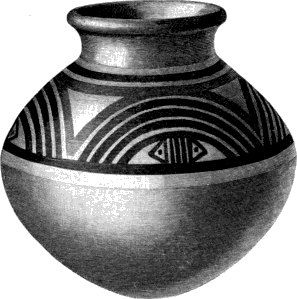
Fig. 196. Vase with decorated zone containing four arched panels—½.
A very peculiar form of decoration consists of circular or rosette-like ornaments, such as are shown in Fig. 197. Four slightly relieved nodes an inch or more in diameter are placed upon the shoulder of the vessel. These are encircled by red lines which inclose two black lines
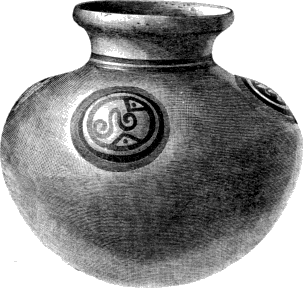
Fig. 197. Vase with four round nodes upon which animal devices are painted—½.
In the series of outlines presented in Fig. 198, we have some of the varieties of form and decoration of both the ordinary bottles and the plainer tripod cups. Each example presents certain features of particular interest. The handsome little bottle (d) with the plastic ornament about the neck and the zone of geometric ornament in black and red lines is unique. The double necked bottle is an unusual form and its decoration consists of a strangely conceived representation of the alligator. The tripod vases are worthy of close attention: the piece illustrated in b has a zone of ornament separated into three parts by vertical spaces, each part being enframed in black. The sections are divided by red lines into three panels, each of which contains a conventional figure of an alligator in black. The piece shown in a is unique in its decoration. Four angular fret links in black are inclosed in as many panels, bordered by red and separated by blank spaces. These fret links, as I shall show further on, probably refer to or symbolize the alligator. The legs of the cups are all conical and are marked with short transverse lines in black, which have a direct reference to the markings of the animal to which the vase was consecrated. A careful study of the preceding illustrations leads to
a b
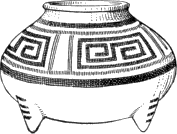
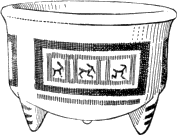
c d e

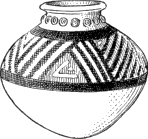
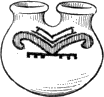
Fig. 198. Vases of varied form and decoration.
In Fig. 199 the whole conformation of the vessel is considerably modified through the attempt to perfect the likeness of the alligator, whose head, tail, and legs are graphically rendered. The body, head, and tail are covered with nodes, each of which is encircled by a black ring and has a black dot upon the apex. Dotted rings and short strokes of black occupy the interspaces. These devices represent the spines and scales of the creature’s skin. The legs are marked with horizontal stripes and oval spaces at the top inclose three dots each. The general Fig. 250.
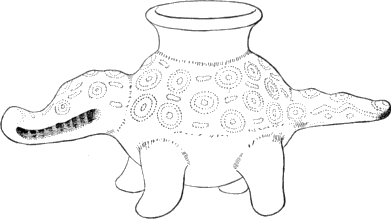
Fig. 199. Alligator vase, with conventional markings—½.
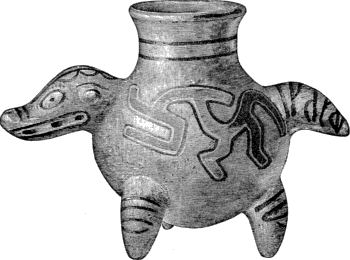
Fig. 200. Alligator vase, with conventional figures of the alligator painted on the sides—½.
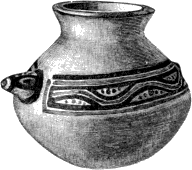
Fig. 201. Vase having the head and tail of a serpent projecting from opposite sides of the body and connected by a meandered design which stands for the markings of the body—½.
A somewhat different treatment is shown in Fig. 200. Here the animal form has undergone considerable modification. There are but three legs—a concession to the conventional tripod—and the body exhibits, instead of the nodes and the markings of the creature’s skin, two conventional drawings of the whole animal. Now, by higher and higher degrees of convention, we come to a long series of modified results which must be omitted for want of room. We find that the plastic features are gradually reduced until mere nodes appear where the head and the tail should be, and finally in the lower forms there remains but a blank panel or a painted device, as already shown in a preceding section. The painted devices are also reduced by degrees until all resemblance to nature is lost and geometric devices alone remain. I observe in this association of plastic and painted features a lack of the perfect consistency I had learned to expect in the work of primitive peoples. It is easy to see how, from painting the markings of the creature’s skin upon the body of the vessel, the painter should come gradually to delineate parts of the creature or even the whole creature, but we should not expect him to paint a creature distinct in kind from that modeled, thus confusing or entirely separating the conceptions; this has been done, apparently, in the vase illustrated in Fig. 202, where the plastic form represents a puma and the painting upon the sides seems intended for an alligator. It will be seen from the figures given that the devices of the panels or sides do not necessarily represent the markings of the animal’s body, as in Fig. 201, but that they may refer to the entire creature (Fig. 200) or even to what appears to be a totally distinct creature (Fig. 202).
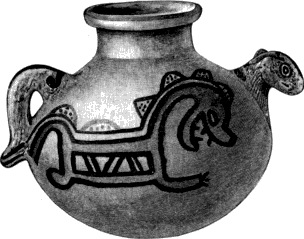
Fig. 202. Vase representing a puma, with figures of the alligator painted upon the sides—½.
If realistic or semirealistic delineations are confused in this way it is to be expected that highly conventional derivative figures, so numerous and varied, should be much less clearly distinguished; that indeed there should be no certainty whatever in the reference to originals. It is difficult to say of any particular conventional device
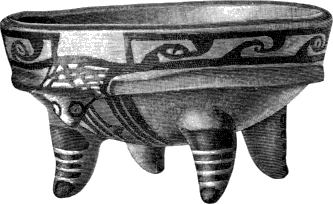
Fig. 203. Shallow vase with reptilian features in the round and designs in red and black representing the markings of the creature’s body—½.
A very instructive example bearing upon this subject is shown in Fig. 203. Attached to one side of the basin is a pendent head resembling that of a serpent or a turtle. A kind of hood overhangs the head and extends in a ridge around the sides of the vessel, connecting with the tail of the creature, which is also pendent and hooded. Four legs support the vessel and are marked with transverse stripes of red and black paint. The upper surface of the head is covered with reticulated lines in black, and bands of conventional ornament in the same color extend around the sides of the vessel, uniting the head with the tail of the animal. A single band of ornament passes beneath the body, also connecting those members. It is plain that these painted bands serve to complete the representation of the reptile.
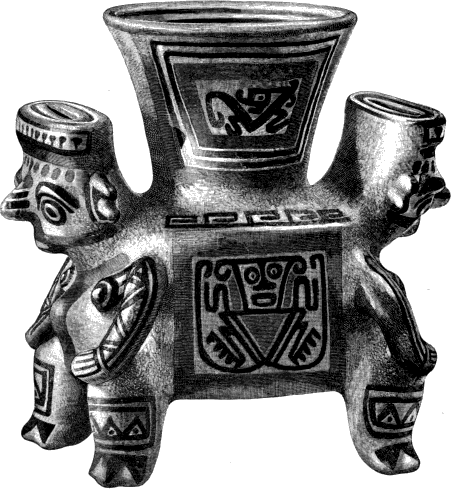
Fig. 204. Vase with funnel shaped mouth and square body, supported by two grotesque figures and decorated with figures of alligators and monkeys—½.
I have but one more example of the alligator vases to present, but it is perhaps the most remarkable piece in the collection (Fig. 204). It illustrates to good advantage both the skill and the strange fancy of these archaic potters. A large vase, having a high flaring rim and a subcubical body, is supported by two grotesque human appearing figures, whose backs are set against opposite ends of the vessel. The legs are placed wide apart, thus affording a firm support. The heads of the two figures project forward from the shoulder of the vase and are flattened in such a way as to give long oval outlines to the crowns
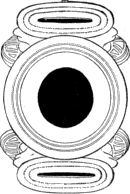
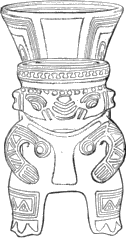
Fig. 205. Top view of vase in Fig. 204, showing the main orifice and the oblong openings. Fig. 206. End view of vase in Fig. 204, showing front view of grotesque figure. The red portions of the painted figures are outlined with dots.
A front view of one of the supporting figures is shown in Fig. 206. Although certainly not intended to represent a human figure with accuracy, it is furnished with a crown, as are the figures in gold and stone, and is covered with devices that seem to refer to costume. The features are extremely grotesque, the nose resembling the beak of a bird and the mouth being a mere ridge, without indications of the lips. The face and the chest are painted with curious devices in red. The funnel and body of the vase are decorated with subjects that seem to have no connection with the plastic features and no relation to one another in subject matter. The upper panel, surrounded by a framework of black and red lines, contains the figure of an alligator much simplified and taking a peculiar position on account of the shape of the space into which it is crowded. The figure occupying the body panel is that of a very strangely conventionalized two tailed monkey and is enframed by a wide red line. On the shoulder of the vessel is an ornament consisting of a number of angular hooks attached to a straight line. The effect is like that of fretwork, but the figure is probably derived from a modified animal form. The paste of this
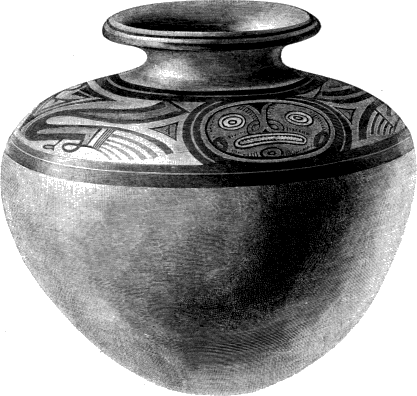
Fig. 207. Large vase with decorations in red and black—¼.
The polychrome group.—
The National Museum collection contains but three examples of this most artistic of the wares of Chiriqui. Its claim to superiority rests upon a certain boldness and refinement of execution, combined with nobleness of outline and a type of design much in advance of other isthmian decoration. It is probably most nearly allied to the ware of the alligator group, and it possesses some of the characteristics of the best Central American work. Unlike the other wares of Chiriqui, this pottery has a bright salmon red paste and the slip proper is a delicate shade of the same color. In nearly all cases undecorated portions of the surface are finished in
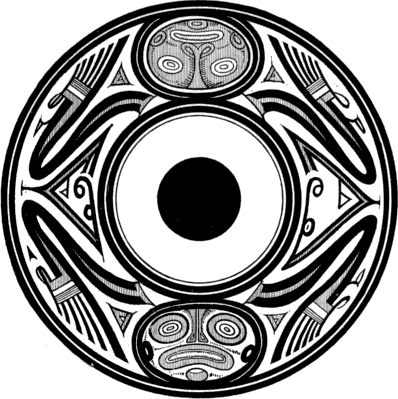
Fig. 208. Devices of the decorated zone of vase shown in Fig. 207.
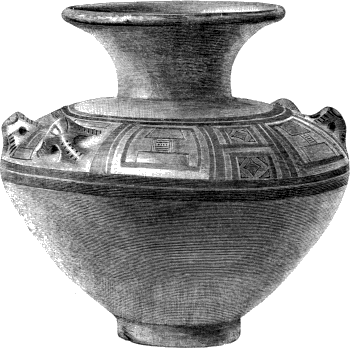
Fig. 209. Handsome vase with four handles and decorations in black, red, and purple—⅔.
A second example, illustrated in Fig. 209, is a fine piece of somewhat unusual shape. The orifice is trumpet shaped and rather too wide for good proportion. The body is flattened above and conical below and is supported by a rather meager annular foot. The paste is of a light brick red color, and the slip, as seen in the ground of the decorated belt, is a pale gray orange. Undecorated portions of the surface are painted red. The ornamented zone is interrupted by two pairs of handle-like appendages set upon the outer part of the shoulder. These projections may possibly have served as handles, as they are perforated both horizontally and vertically, but they are at the same time undoubtedly conventionalized animal forms, the creature being represented by the four flattened, transversely marked arms or rays and an eye-like device painted upon the top of each figure. The painted devices are seen in plan in Fig. 210, where the relations of the relieved features to the zone of painted decoration are clearly shown. This zone is divided into panels of unequal dimensions, and within these a number of extraordinary devices are drawn in three colors, red, black, and purple. These are distinguished in the plan by peculiar tint lines. The designs are of such a character as to leave little doubt that they are ideographic, although at present it is impossible to guess the nature of the associated ideas. The annular foot observed in this specimen illustrates the first step in the development of a feature the final stage of which is shown in Fig. 211. The latter
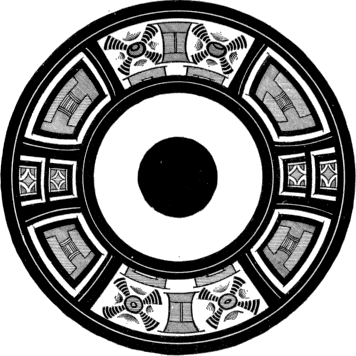
Fig. 210. The painted designs of vase in Fig. 209 viewed from above.
The painted decoration is of unusual interest. The colors are so rich, the execution is so superior, and the conception so strange that we dwell upon it with surprise and wonder. The central portion of the bowl is occupied by what would seem to represent a fish painted in strong, firm, marvelously turned lines, and in a style of convention wholly unique. The outlines are in black and the spaces are filled in with red and purple or are left in the orange hue of the ground. An idea of the superior style of execution can be gained from Fig. 212. It will be impossible to characterize the details of the drawing in words. The strange position and shape of the head, the oddly placed eyes and mouth, and the totally incomprehensible treatment of the body can be appreciated, however, by referring to the illustration. A careful study leads inevitably to the conclusion that this
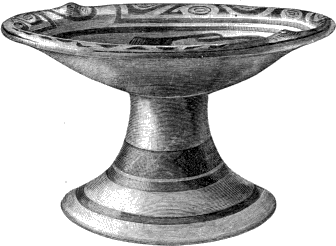
Fig. 211. Vase of unusual shape, with decoration in black, red, and purple—⅓.
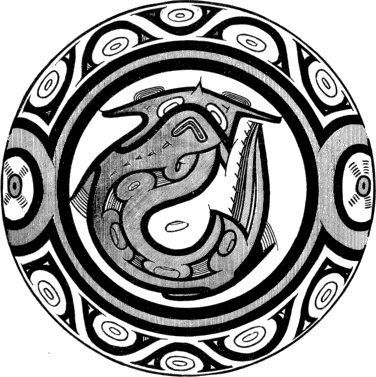
Fig. 212. Ornament occupying the interior surface of the basin of vase shown in Fig. 211.
The figures occupying the border zone of the bowl are worthy of careful inspection. It will be seen that the potter, even in this
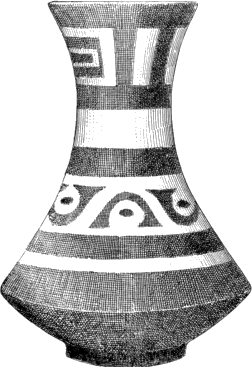
Fig. 213. Large vase of fine shape and simple decorations. From De Zeltner—about ¼.
I must not close this section without referring to some fine vases that belong apparently to this group and which were collected
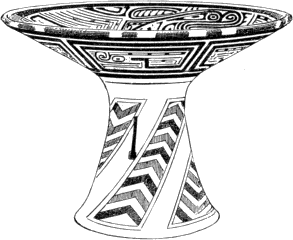
Fig. 214. Vase with extraordinary decorative designs. From De Zeltner—about ¼.
A second piece (Fig. 214), of which two views are given by the same author, corresponds closely in many respects with the vase illustrated in Fig. 211 and is described in the following language:
My collection includes a cup (or chalice) of baked clay 25 centimeters in diameter, mounted on a hollow stand which gives it a height of 18 centimeters, and the designs of which are very rich and in perfect taste. The base is hollow and colored red, white, black, and purple; it has four narrow openings or slits, and the design represents plaits spirally arranged. The under side of the cup is divided into four compartments, each of which incloses a dragon painted in black and red on a white ground; the borders are sometimes red, sometimes purple. The body of the dragon might have been painted in China, so neat and intricate is the drawing.
The design upon the inside of the cup seems to resemble Egyptian art. The body of a man is seen, painted in red, the arms and legs separated, and the shoulders bearing the head of the dragon with teeth and crest. The color is similar to the rest of the piece—purple, white, and black. The intermediate spaces are filled with very intricate designs.
This extraordinary design is shown in Fig. 215, and it will be seen that it agrees in many respects with figures presented in the lost color and alligator groups. It is compound in character, however, the head referring to the alligator, the body and extremities perhaps to a man or to a monkey. The suggestion of the oriental dragon in this, as in other examples, is at once apparent, and the resemblance to certain conventional forms that come down to us from the earliest
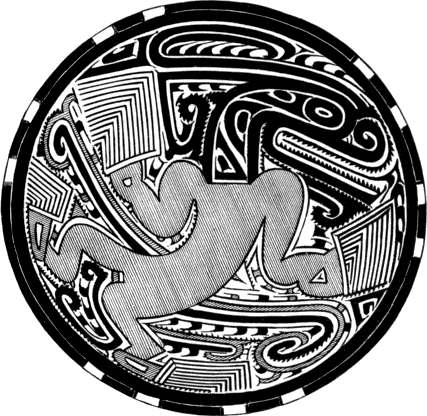
Fig. 215. Painted design of vase in Fig. 214, viewed from above, thought to represent a dragon by De Zeltner; probably a composite of the alligator and the monkey or man.
Unclassified.—
A small number of vases do not admit of classification under any of the preceding heads. In most cases, however, they are not of especial interest and may be passed over. They represent a number of varieties of ware and are possibly not all Chiriquian, their affinities being rather with the pottery of Costa Rica and Nicaragua. One remarkable piece, of which a sketch is given in Fig. 50, c, is of large size and is shaped somewhat like an hour glass, and on account of its peculiar form and markings may be said to resemble a corset. The upper end is somewhat the smaller, and the septum, which forms the bottom of the vessel, is placed about an inch above the base of the foot. The interior surface is smoothly polished and painted a dark dull red. The exterior is uncolored and neatly fluted. The series of vertical ribs of the upper end is separated
Perhaps the most interesting of these unclassified vases is a somewhat fragmentary piece, of which an outline is given in Fig. 216. The ware closely resembles that of the alligator group in color of the paste and slip, but the base has been supplied with an annular stand, a feature not observed in that group, and the colors of the design, with the exception of the black, are unlike those used in Chiriquian vases.
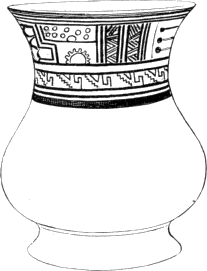
Fig. 216. Vase of unique form and decoration—⅓.
It will be seen by reference to Fig. 217 that the painted figures are partially pictorial, the conventional scenes including the sun, the moon, and stars. The more conventional parts of the design are very curious and without doubt are symbolic. The border of fret work is Mexican in style. The sun, which is only partially exposed above the horizon, is outlined in red and is surrounded by red rays. The
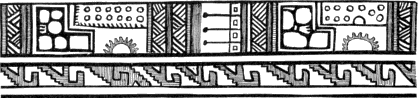
Fig. 217. Painted design of vase in Fig. 216 in black, red, and gray.
MISCELLANEOUS OBJECTS OF CLAY.
As primitive peoples advance in culture and the various branches of art are differentiated, each of the materials employed is made to fill a wider and wider sphere of usefulness. Clay, applied at first to vessel making and used perhaps as an auxiliary in a number of arts in which it took no definite or individual shapes, gradually extended its dominion until almost every art was in a measure dependent upon it or in some way utilized it. The extent of this expansion of availability is in a general way a measure of the advancement of the races concerned. The Chiriquians employed clay in the construction of textile machinery, as shown by the occurrence of spindle whorls, and a number of small receptacles, probably needlecases, are constructed of that material. It was employed in the manufacture of stools, statuettes, drums, rattles, and whistles. With less cultured races, such as the Pueblo and mound builders of the north, such articles were rarely manufactured, while with the more cultured nations of Mexico and Peru a wider field was covered and the work was considerably superior.
SPINDLE WHORLS.
The art of weaving was carried to a high degree of perfection by many of the American races, but the processes employed were of the simplest kind. The threads were spun upon wooden spindles weighted
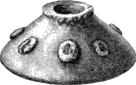
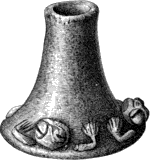
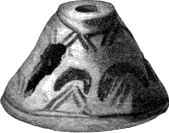
Fig. 218. Spindle whorl in gray clay decorated with annular nodes—1/1. Fig. 219. Spindle whorl of gray clay with animal figures—1/1. Fig. 220. Spindle whorl of dark clay with perforations and incised ornament—1/1.
NEEDLECASES (?).
I have given this name to a rather large class of small oblong or oval receptacles that could have served to contain needles or any other small articles of domestic use or of the toilet. They consist of two parts, a vessel or body and a lid. The former takes a variety of cylindrical, subcylindrical, and doubly conical shapes, and the latter is conical and is in many cases furnished with a knob at the top for grasping with the fingers. The lid is attached or held in place by means of strings passed through small holes made for the purpose in corresponding margins of the two parts. These objects were in pretty general use in the province, as they are found to belong to a number of the groups of ware, being finished and decorated as are the ordinary vessels of these classes. A few type specimens are given in the following cuts. A fine example belonging to the unpainted ware is shown in outline in Fig. 221. It is five inches in height and three in diameter and is pleasing in shape. The specimen outlined in Fig.
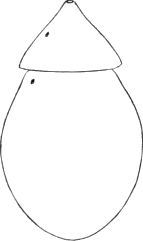
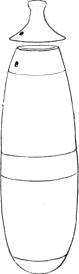
Fig. 221. Needlecase of unpainted clay with conical lid—½. Fig. 222. Needlecase, lost color group of ware—½.
A fine example, with high polish and elaborate decoration, is presented in Fig. 223. The lid is raised to show the position of the perforations. Two interesting examples belonging to the dark incised ware are shown in Figs. 224 and 225. The deeply incised design of the first is purely geometric, but is probably of graphic parentage, while that of the second, rather rudely scratched through the dark surface into the gray paste, is apparently a less highly conventionalized treatment of the same motive.
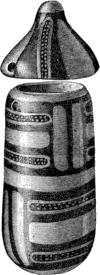
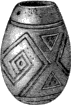
Fig. 224. Needlecase of gray clay with angular incised geometric ornament—½.
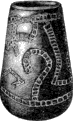
Fig. 223. Needlecase with painted geometric ornament, belonging to the lost color group of ware—½. Fig. 225. Needlecase of gray clay with black polished surface and incised ornament—½.
FIGURINES.
I have already called attention to the fact that there is no such thing in Chiriquian ceramic art as a well modeled human figure and apparently no indication of an attempt to render the human physiognomy with accuracy. It is highly probable that the personages embodied in the mythology of the people took the forms of animals or were anthropomorphic and gave rise to the peculiar conceptions embodied in their arts. The strange objects herewith presented are rendered in a measure intelligible by the adoption of this hypothesis. These figurines are confined to the alligator group of ware and are quite numerous. They are small, carefully finished, and painted with care in red and black lines and figures. They are semihuman and appear to be arrayed in costume. The head of each is triangular in shape, having a sharp, projecting profile, with the mouth set back beneath the chin, reminding one of the face of a squirrel or some such rodent.
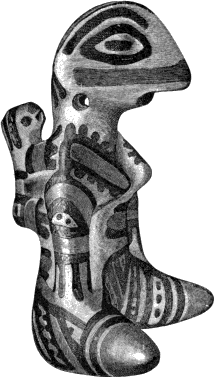
Fig. 226. Statuette, alligator group—1/1.
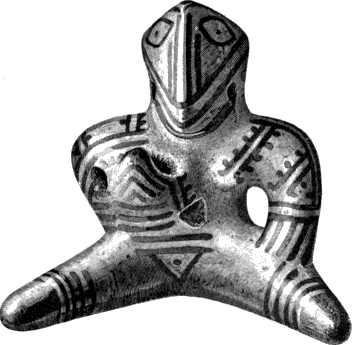
Fig. 227. Statuette, alligator group—1/1.
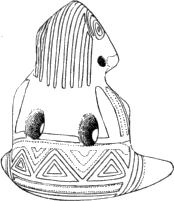
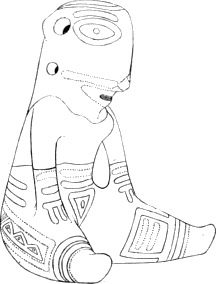
Fig. 228. Statuette of small size—1/1. Fig. 229. Statuette of largest size—½.
STOOLS.
I have given this name to a class of stone carvings presented in a previous section, and, for want of a better name, give it also to a series of similar objects modeled in clay. These are among the most elaborate products of Chiriquian art. In all cases they are of the yellowish unpainted pottery and indicate much freedom and skill in the handling of clay. They do not show any well defined evidences of use, and as they are too slight and fragile to be used as ordinary seats we are left to surmise that they may have served some purpose in the religious rites of the ancient races. They are uniform in construction and general conformation and consist of a circular tablet supported by upright circular walls or by figures which rest upon a strong, ring shaped base. The tablet or plate is somewhat concave above, is less than an inch in thickness, and has a diameter of ten and one-fourth inches in the largest piece, descending to seven and one-half in the smallest. The margin is rounded and usually embellished with a beaded ornament consisting of grotesque heads, generally reptilian. The variations exhibited in details of modeling are well shown by the illustrations. In the example given in Fig. 230 the upright portion is a hollow cylinder, having four vertical slits, alternating with which are oblique bands of ornament in incised lines and punctures. The projecting margin of the tablet is encircled by a row of grotesque, monkey-like heads, facing downward.
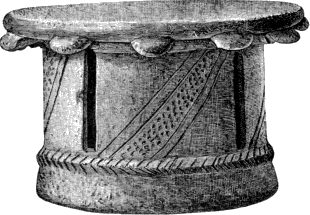
Fig. 230. Stool of plain terra cotta, decorated with grotesque heads and incised figures—⅓.
Fig. 231 illustrates a specimen in which three grotesque figures, with forbidding faces, alternate with as many flat columns embellished with rude figures of alligators. Eighteen grotesque, monkey-like heads occupy the lower margin of the seat plate in the spaces between the heads of the supporting figures. This specimen illustrates the favorite Chiriquian method of construction. The various parts were modeled separately in a rough way and then set into place
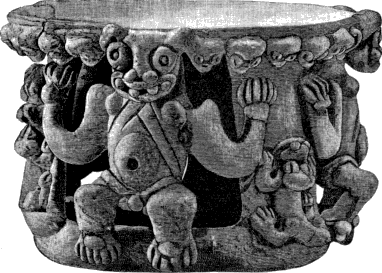
Fig. 231. Stool of plain clay, with grotesque figures—½.
The discoidal plate of another specimen is supported by four absurdly grotesque monkeys, giving a general effect much like that of the last.
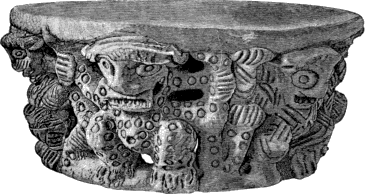
Fig. 232. Stool of plain terra cotta, with strange figures—⅓.
A very remarkable piece is shown in Fig. 232. The tablet is supported by six grotesque figures, somewhat human in appearance, whose limbs are intertwined with serpents, suggesting the famous group of the Laocoön. The work is roughly done and the details
There are additional specimens in the National Museum. In one case, the largest specimen of the series, the tablet is supported by five upright female human figures and the margin is encircled by a cornice of forty-six neatly modeled reptilian heads. A small example differs considerably in general shape from those illustrated, the base being much smaller than the circular tablet. The supporting figures are two rudely modeled ocelots and two monkey-like figures, all of which are placed in an inverted position. Similar objects are obtained from the neighboring states of Central and South America.
MUSICAL INSTRUMENTS.
Something is already known of the musical instruments of the ancient Chiriquians through fugitive specimens that have found their way into collections in all parts of Europe and America. The testimony of the earthen relics—for no others are preserved to us—goes to show that the art of music was, in its rude way, very assiduously practiced, and that it probably constituted with these, as with most primitive communities, a serious and important feature in the various ceremonial exercises. Clay is naturally limited to the production of a small percentage of the musical instruments of any people, the various forms of woody growths being better adapted to their manufacture. We have examples of both instruments of percussion and wind instruments, the former class embracing drums and rattles and the latter whistles and clarionette-like pipes.