PART II The First World War
Reading edition
VII EVE OF THE WAR: 1914
Early in the spring of 1914 we went to Livadia. Full days of school work were continued here. M. Pierre Gilliard and our Russian tutor, M. Peter Vasilievich Petrov, accompanied us as usual. Sometimes our tutors were invited to lunch with us and afterwards joined us in our hikes when the sun was bright and warm, or in some other recreational pastime. Our hikes took us through the park or along the shore to Yalta or to the Church of Alexander Nevsky on the opposite hill. Dinner was the focal point of the day with friends and relatives as guests. We children, especially, enjoyed Prince Igor Constantinovich and the Grand Duke Dimitri Pavlovich. Aunt Ella, Mother’s older sister, the widow of the Grand Duke Serge, brother of Alexander III, was another cherished guest. She and Mother had similar religious views, having inherited this mysticism from their mother, Princess Alice, Grand Duchess of Hesse, daughter of Queen Victoria of England.
Grandmother Alice, I was told, was a student of religious history and movements, having been inspired by her tutor, a theologian who was a close friend of the Hesse family. He also had a direct influence on Mother. This theologian imbedded into her thoughts the terrible fear of sin. For years we children watched her struggle, trying to leave this deeply-buried mysticism and return to reality. However, due to the thoughtless criticism by my other grandmother, Father’s mother, Marie Feodorovna, and also the unsympathetic attitude of the Russian court, she sought comfort in this mysticism and her whole soul once more overflowed with it. Then with the misfortune of her son’s illness, she reverted to it all the more. At the same time she pretended not to notice the criticism and tried to hide her pride; but her sensitive heart suffered and the words which she should have spoken hardened in her soul. Courtiers took her for a heartless, cold and eccentric woman. She, having been raised by her austere grandmother, tried to carry on in an efficient English manner. Even though her humble faith grew stronger, her English upbringing never left her and she never became a true Russian in manners, but in her heart and soul she was a better Russian than most native-born Russians.
We boarded our yacht, the “Standard”, which had been brought to the Crimean waters from the Baltic Sea via the North Sea. We went on several short cruises on the Black Sea. Once we crossed to Constantsa on the Rumanian coast to return a visit of King Carol and Queen Elizabeth (Carmen Sylva) of Rumania. They had come to see us with their grandnephew, the future King Carol II. It was an overnight trip to Constantsa. Carmen Sylva at her late age was still beautiful, as also was Princess Marie (Missy), wife of Prince Ferdinand; later they became sovereigns of Rumania. During this visit Princess Marie and my sister Olga developed a close friendship. The strained relationship between Mother and Missy’s sister Victoria, who was divorced from Mother’s brother Ernest, was improved; all was forgotten now. We had luncheon in a pavilion which seemed to rise right out of the sea. From this vantage point we could see many yachts and smaller boats cruising back and forth for a closer look at the “Standard”.
In the afternoon, tea was served on board the “Standard” for the members of the two families. After tea a great many dignitaries joined us on board ship.
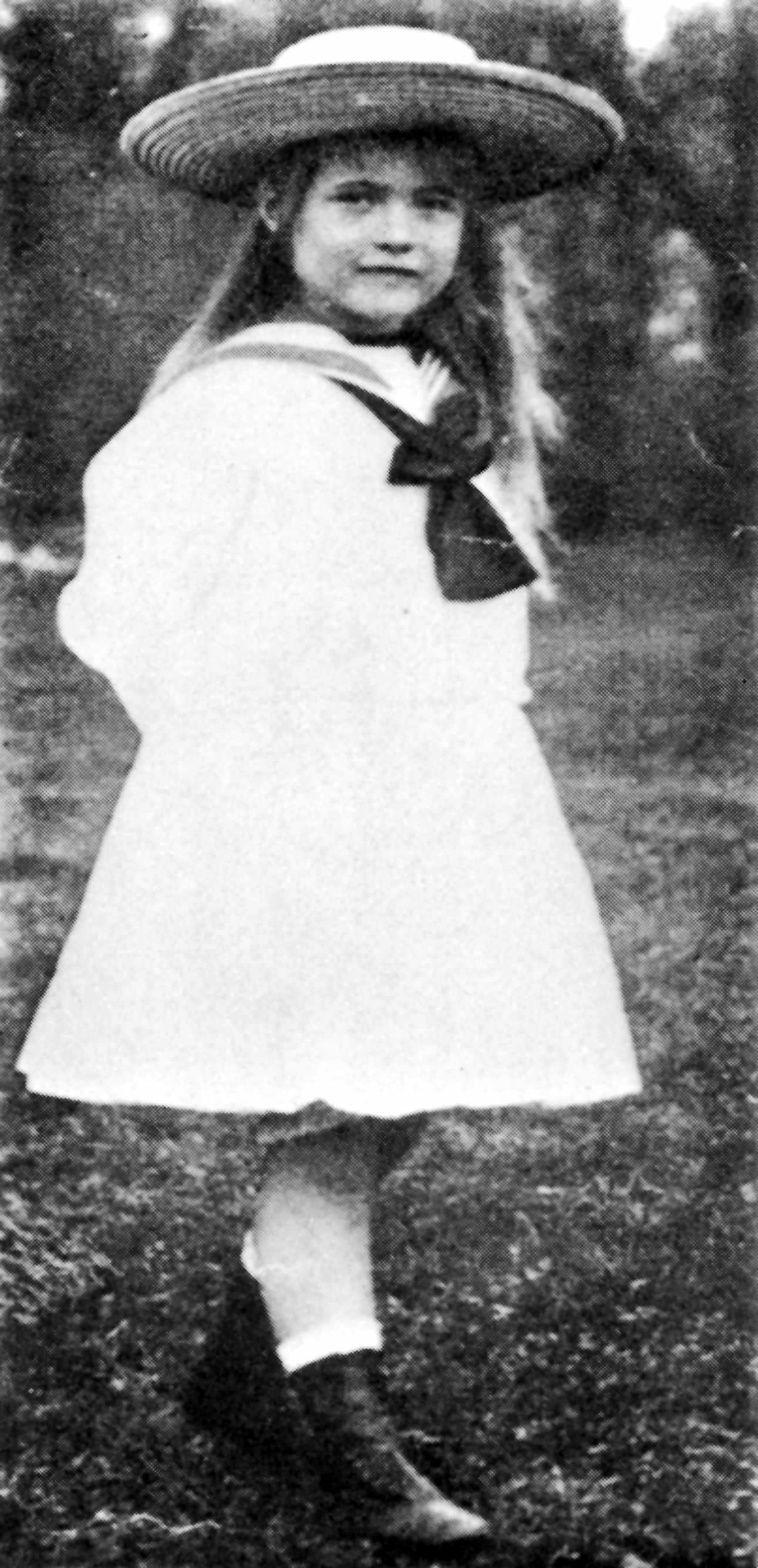
1906
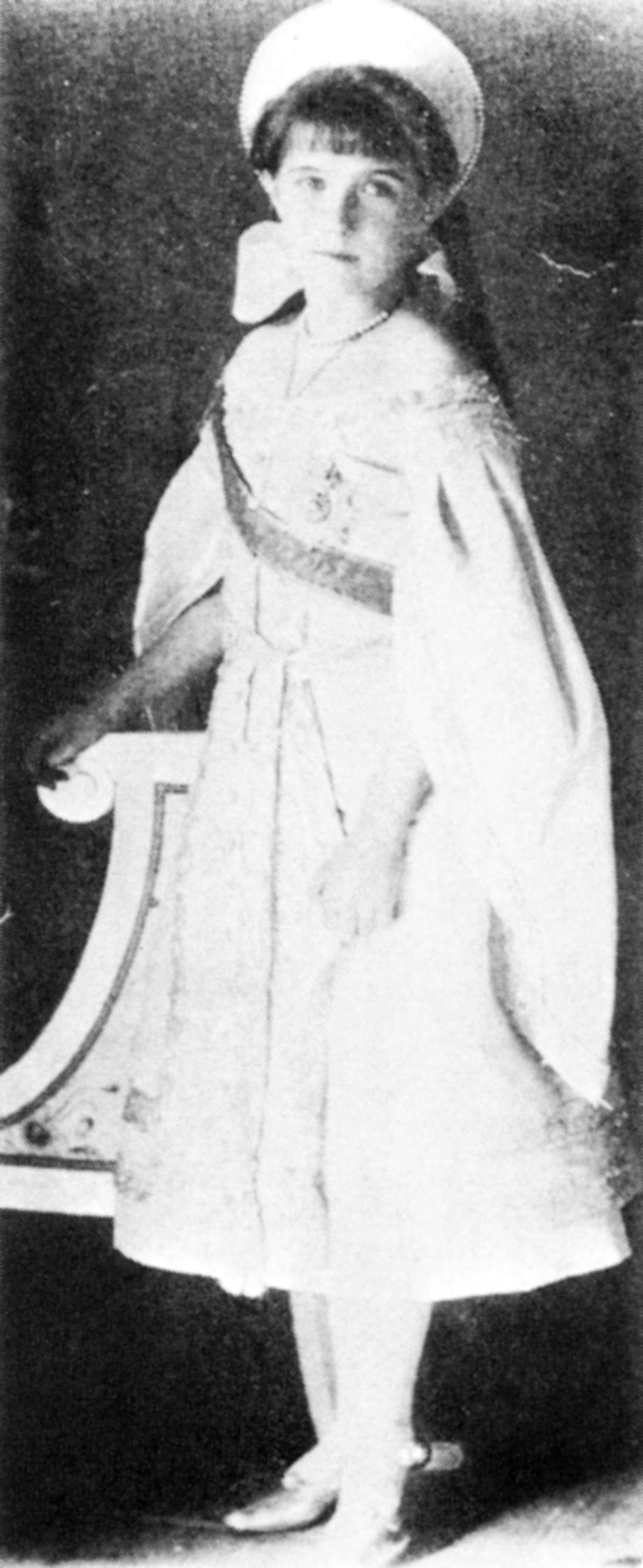
1913—JUBILEE YEAR
THE GRAND DUCHESS ANASTASIA
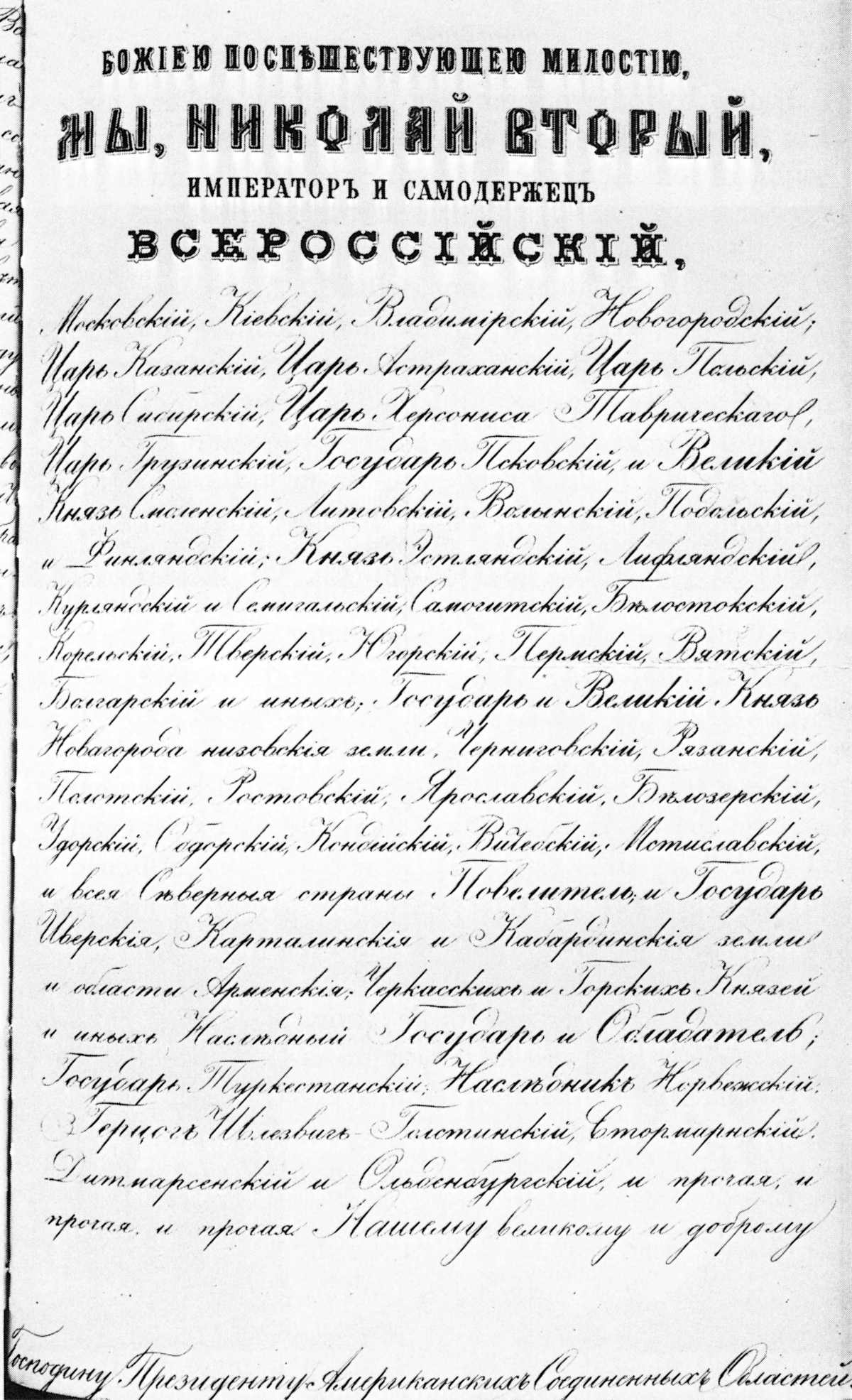
COMMUNICATION. DATED JUNE 14TH, 1901 (OLD STYLE), FROM THE EMPEROR NICHOLAS II TO THE PRESIDENT OF THE UNITED STATES ANNOUNCING THE BIRTH ON JUNE 5TH (OLD STYLE) OF THE GRAND DUCHESS ANASTASIA
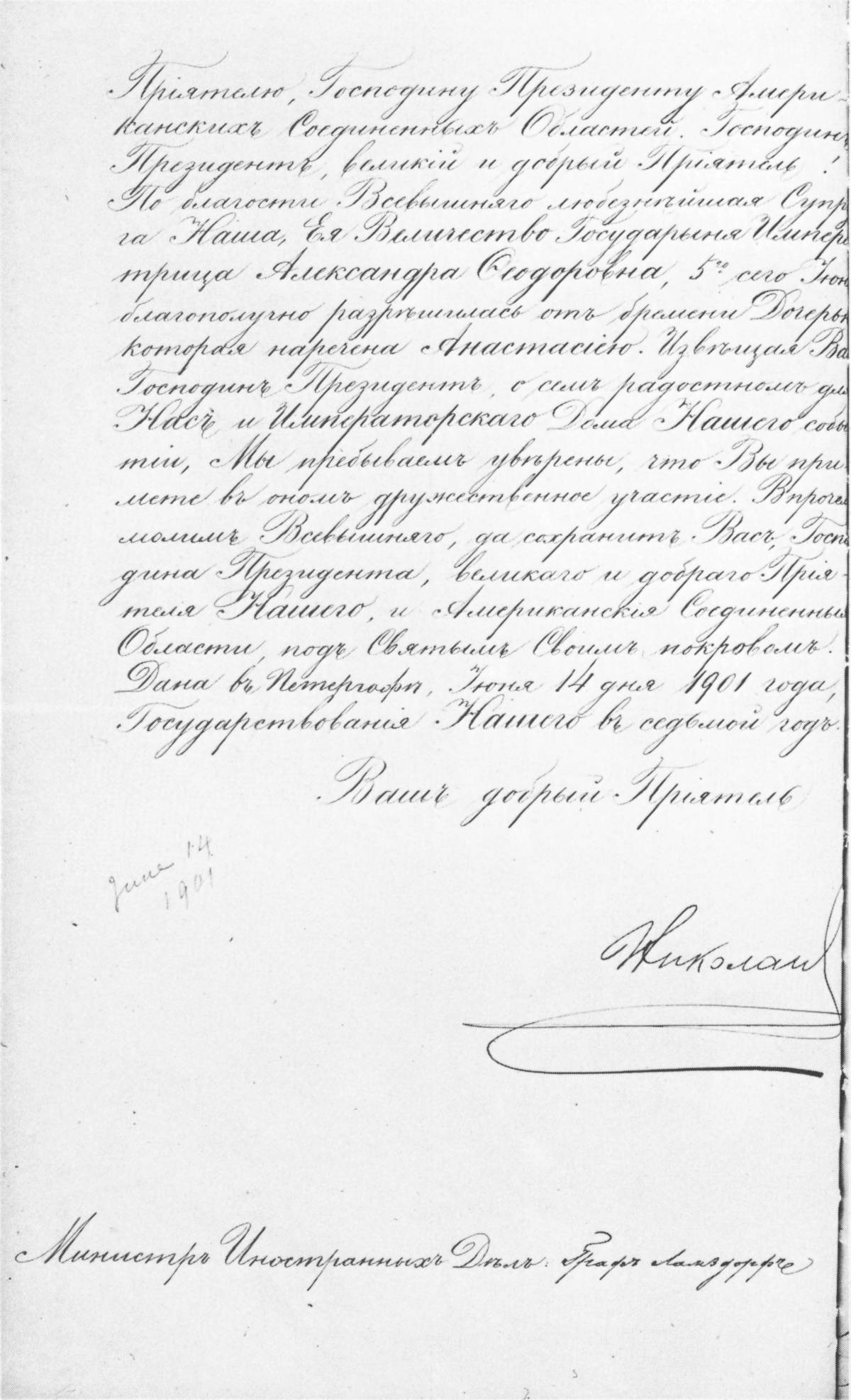
CONTINUATION OF COMMUNICATION ANNOUNCING THE BIRTH OF ANASTASIA, SIGNED BY NICHOLAS II AND COUNTERSIGNED BY COUNT LAMSDORF, MINISTER OF FOREIGN AFFAIRS
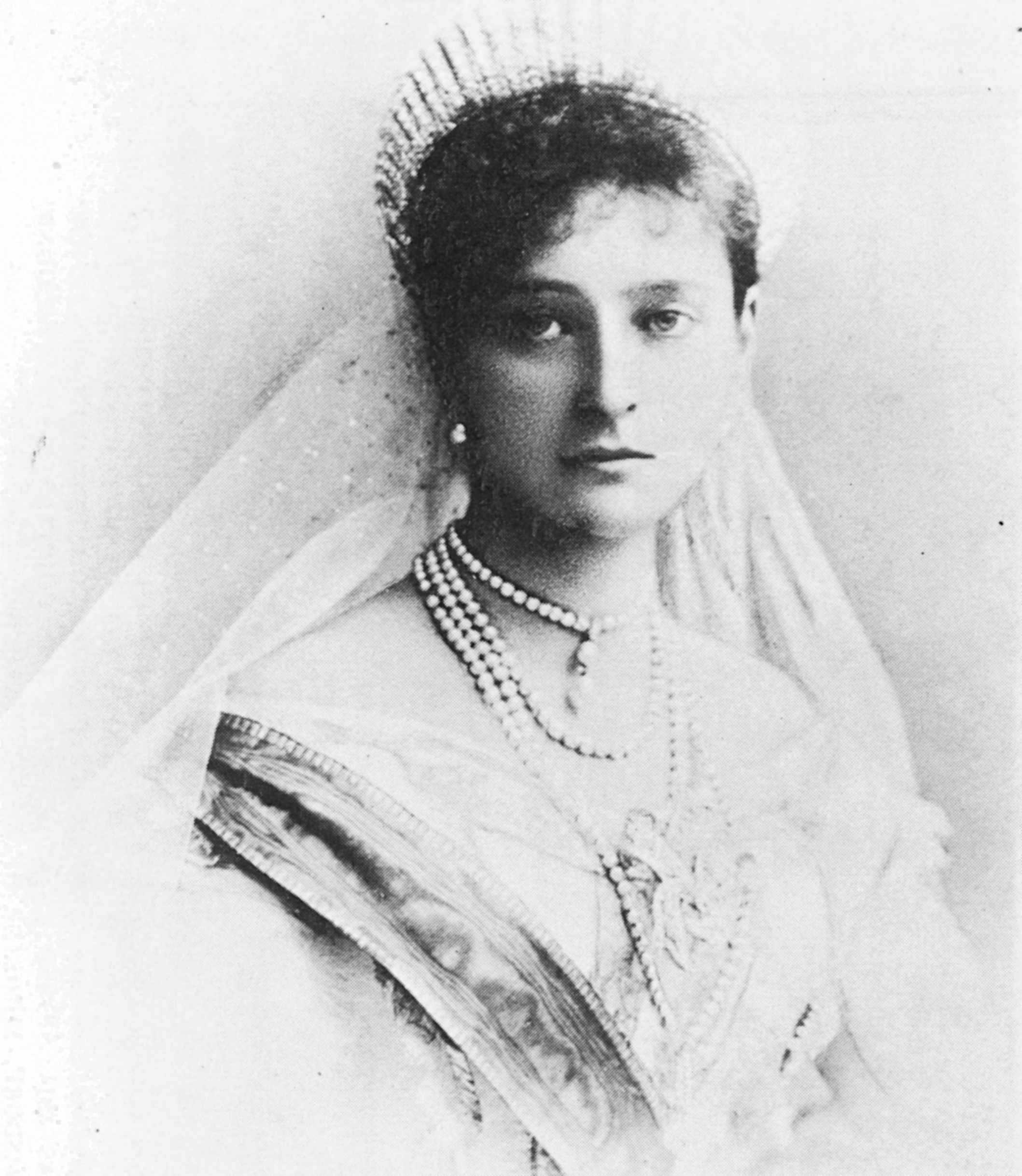
Courtesy The P.B. Corporation
ca. 1896
THE EMPRESS ALEXANDRA FEODOROVNA
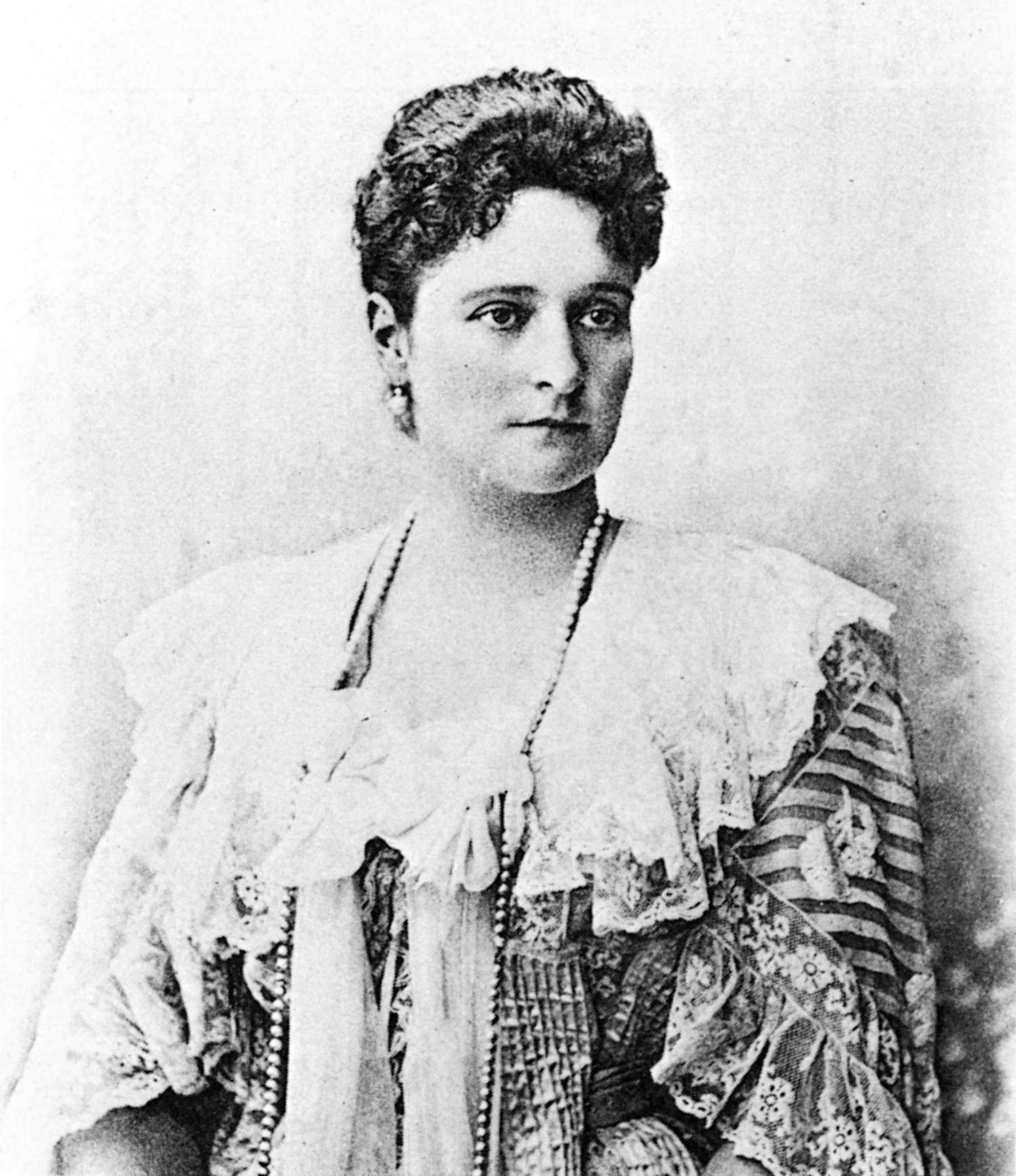
Courtesy The P.B. Corporation
PETERHOF—1901
THE EMPRESS ALEXANDRA FEODOROVNA
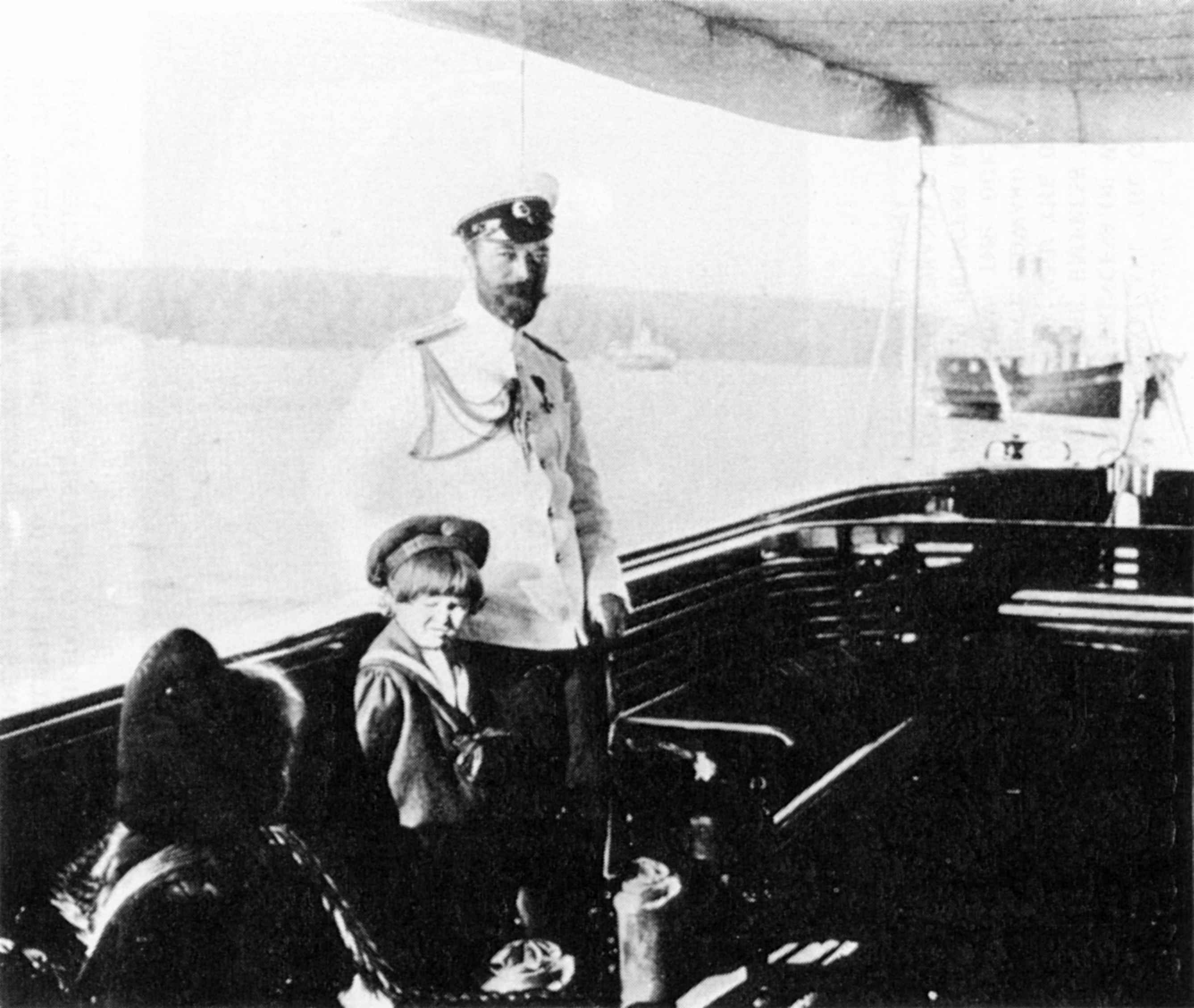
THE GRAND DUCHESS ANASTASIA, THE TSESAREVICH ALEXEI NICHOLAEVICH, AND THE EMPEROR NICHOLAS II ON A TENDER APPROACHING THE “STANDARD”—ca. 1908
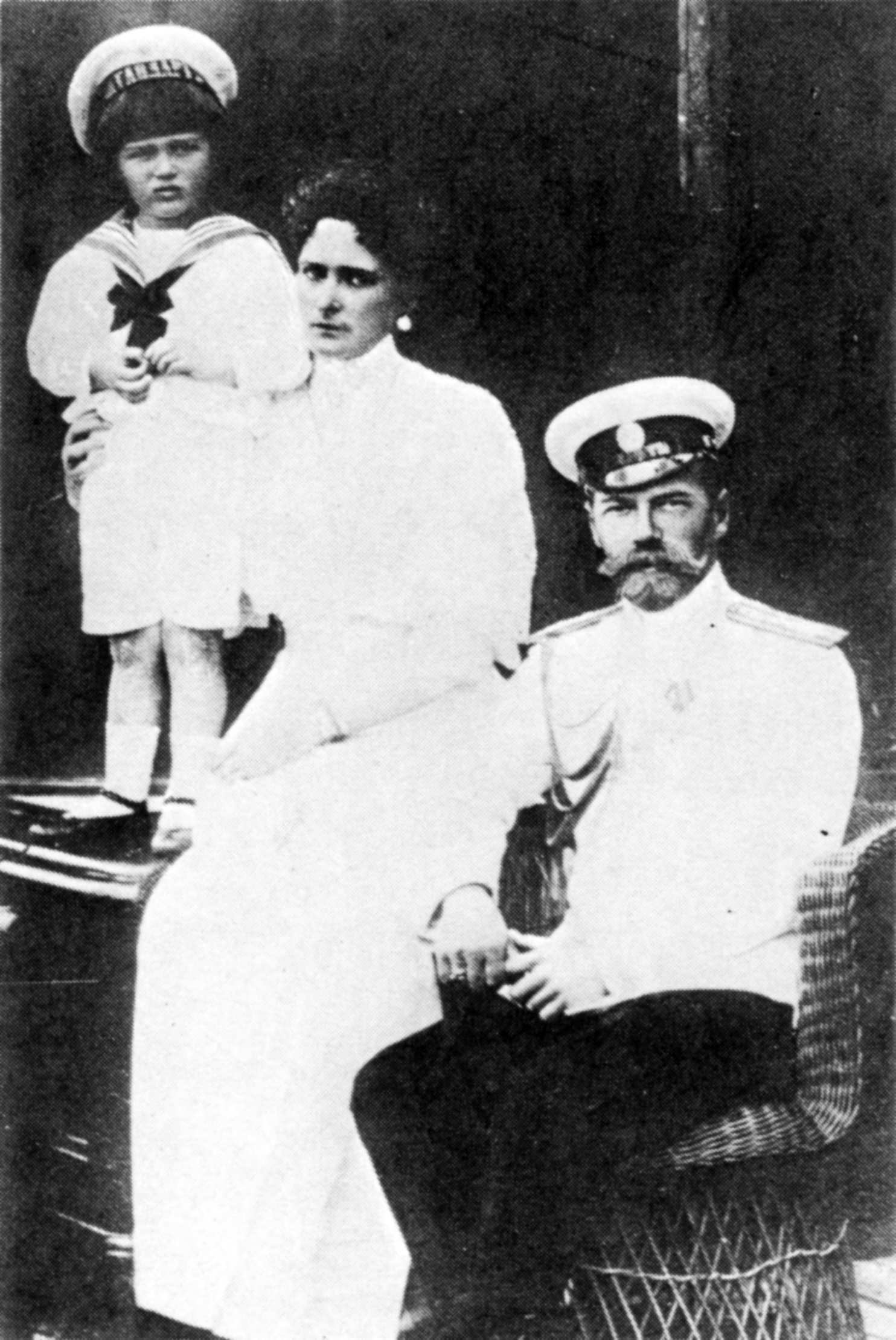
Courtesy The P. B. Corporation
THE TSESAREVICH ALEXEI, THE EMPRESS ALEXANDRA, AND THE EMPEROR NICHOLAS II—ca. 1908
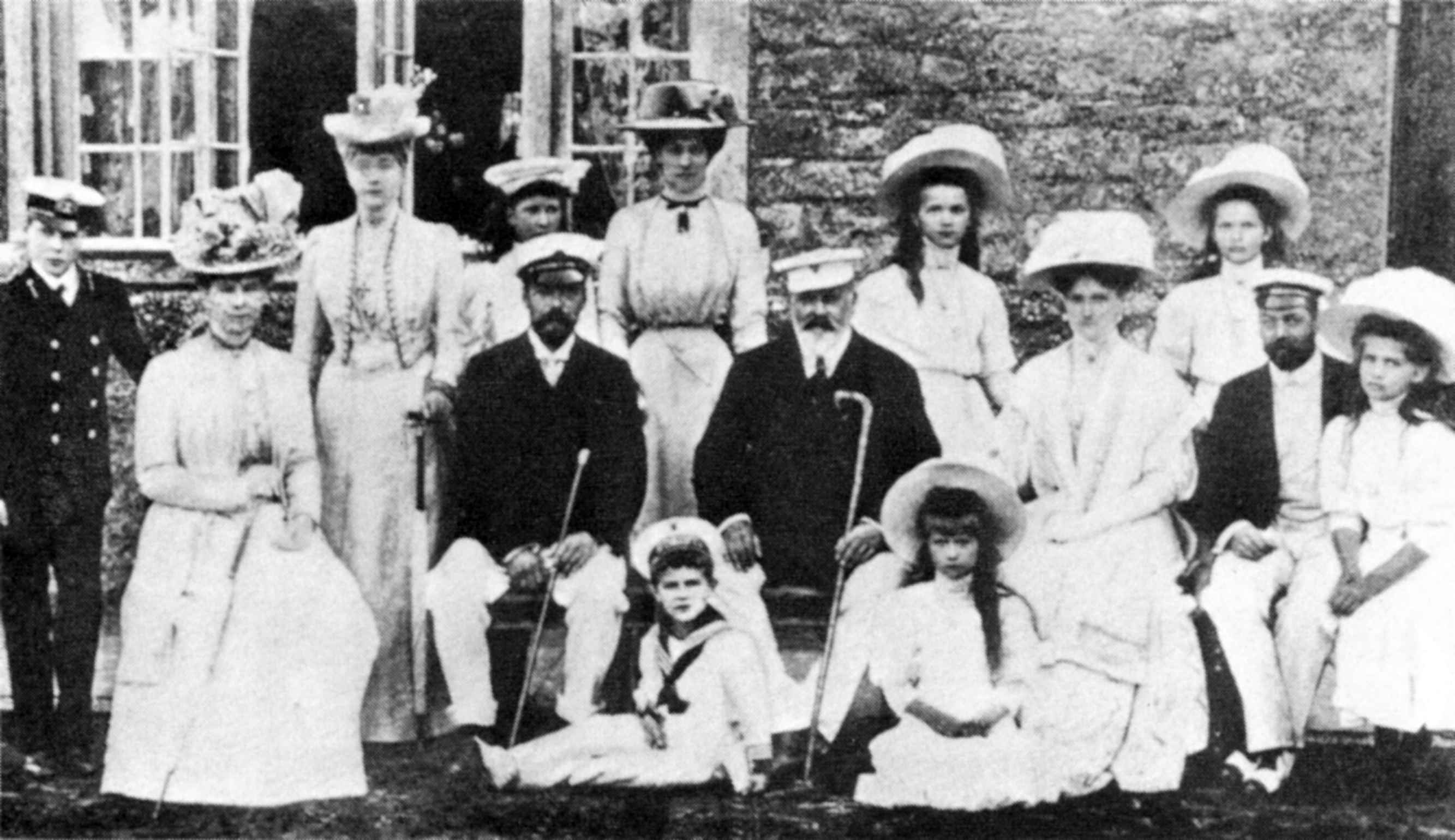
THE RUSSIAN IMPERIAL FAMILY ON VISIT TO BRITISH ROYAL FAMILY—ENGLAND—1909
SEATED ON THE GROUND (l. to r.): THE TSESAREVICH ALEXEI AND THE GRAND DUCHESS ANASTASIA. SEATED ON CHAIRS (l. to r.): MARY, PRINCESS OF WALES (LATER QUEEN MARY); NICHOLAS II; KING EDWARD VII; THE EMPRESS ALEXANDRA; GEORGE, PRINCE OF WALES (LATER KING GEORGE V); AND THE GRAND DUCHESS MARIE NICHOLAEVNA. STANDING (l. to r.): PRINCE EDWARD DAVID (LATER PRINCE OF WALES AND KING EDWARD VIII, NOW THE DUKE OF WINDSOR); QUEEN ALEXANDRA; PRINCESS MARY, NOW THE PRINCESS ROYAL, DOWAGER COUNTESS OF HAREWOOD; PRINCESS VICTORIA; THE GRAND DUCHESS OLGA NICHOLAEVNA; AND THE GRAND DUCHESS TATIANA NICHOLAEVNA.
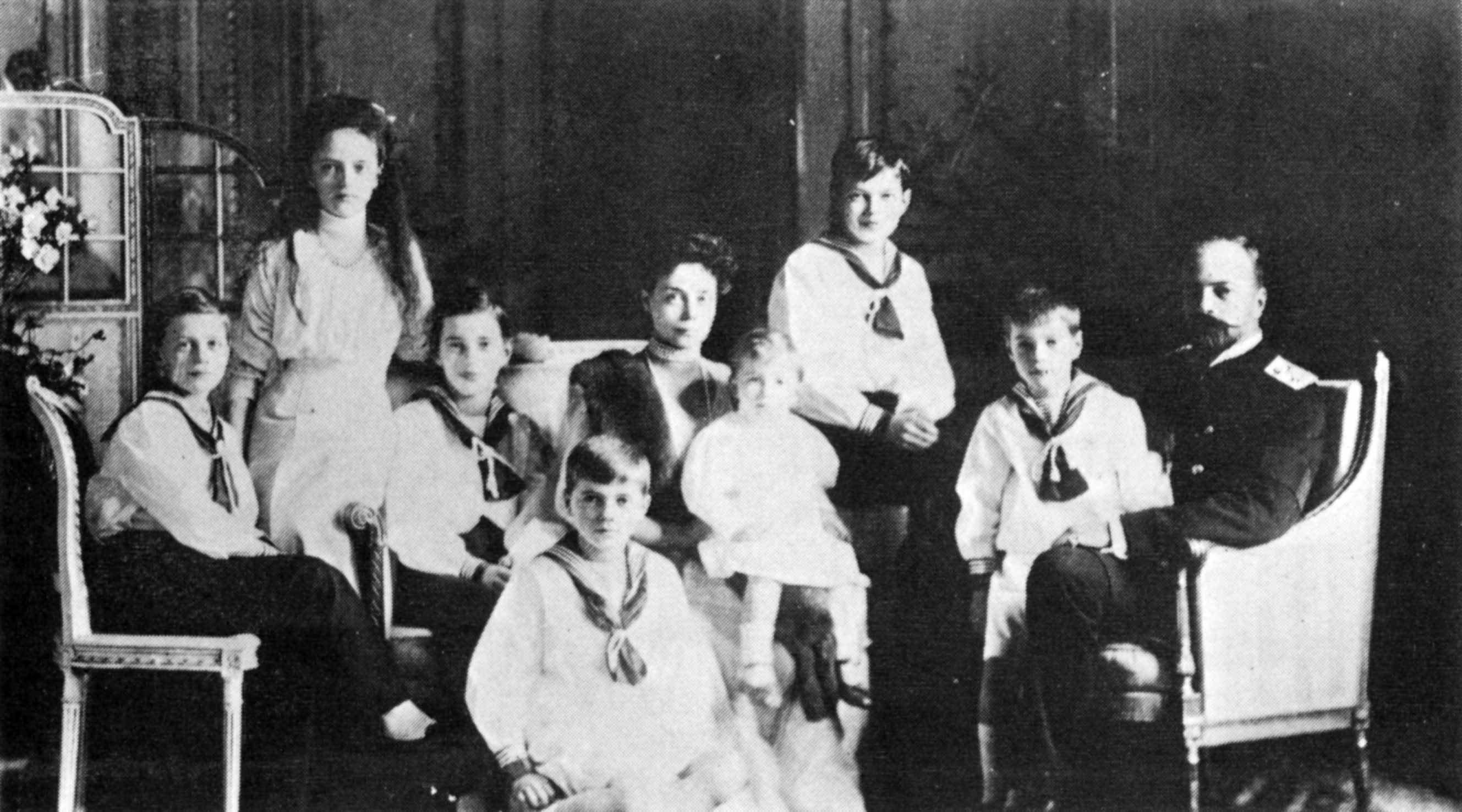
THE GRAND DUKE ALEXANDER MIKHAILOVICH AND THE GRAND DUCHESS XENIA ALEXANDROVNA AND THEIR CHILDREN (l. to r.): THE PRINCE NIKITA, THE PRINCESS IRINA, AND THE PRINCES ANDREI, DIMITRI, VASILI, FEODOR, AND ROSTISLAV—ca. 1909
Courtesy E. L. Packer
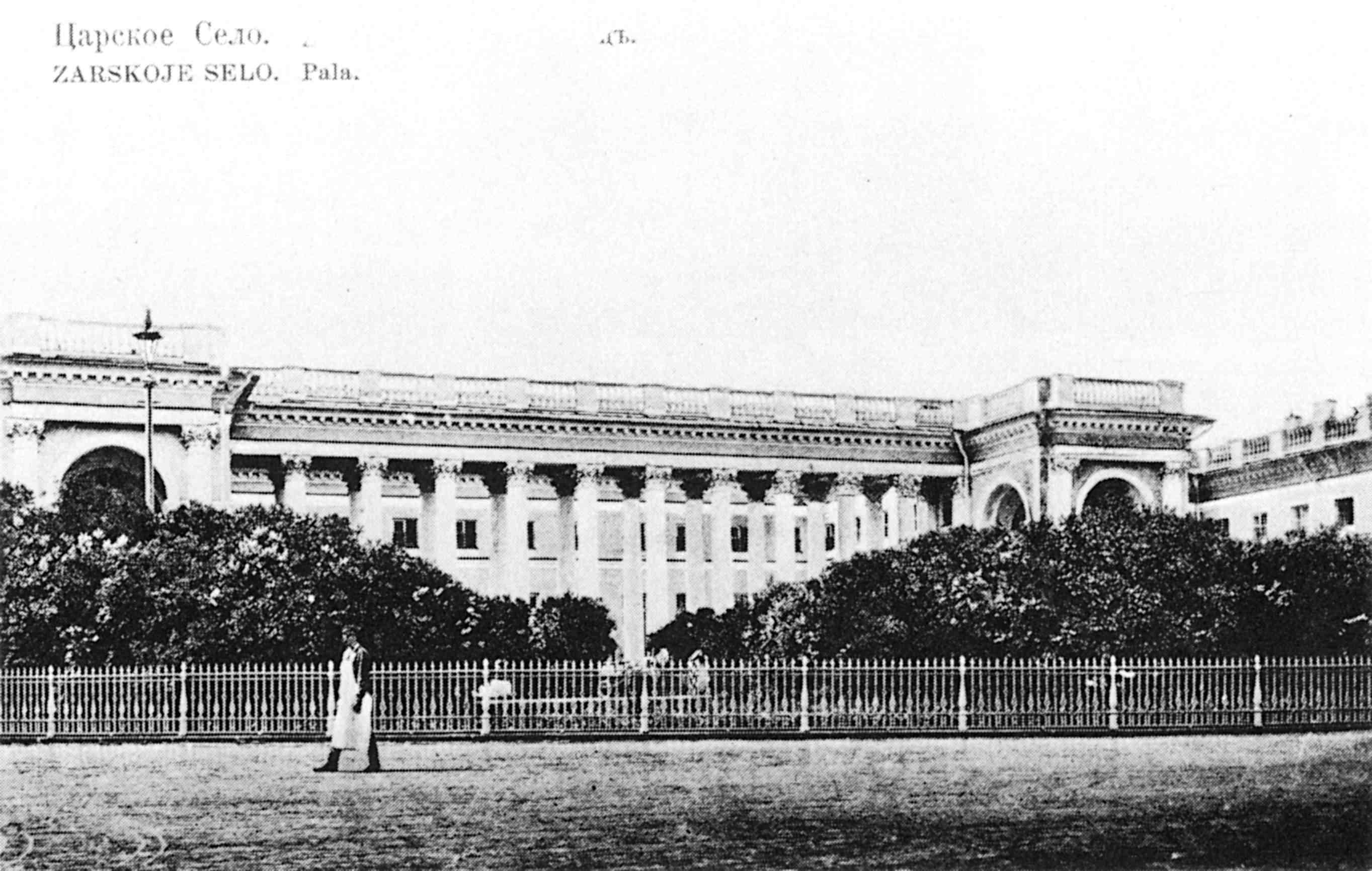
ALEXANDER PALACE, TSARSKOE SELO—ca. 1912
Courtesy E. L. Packer
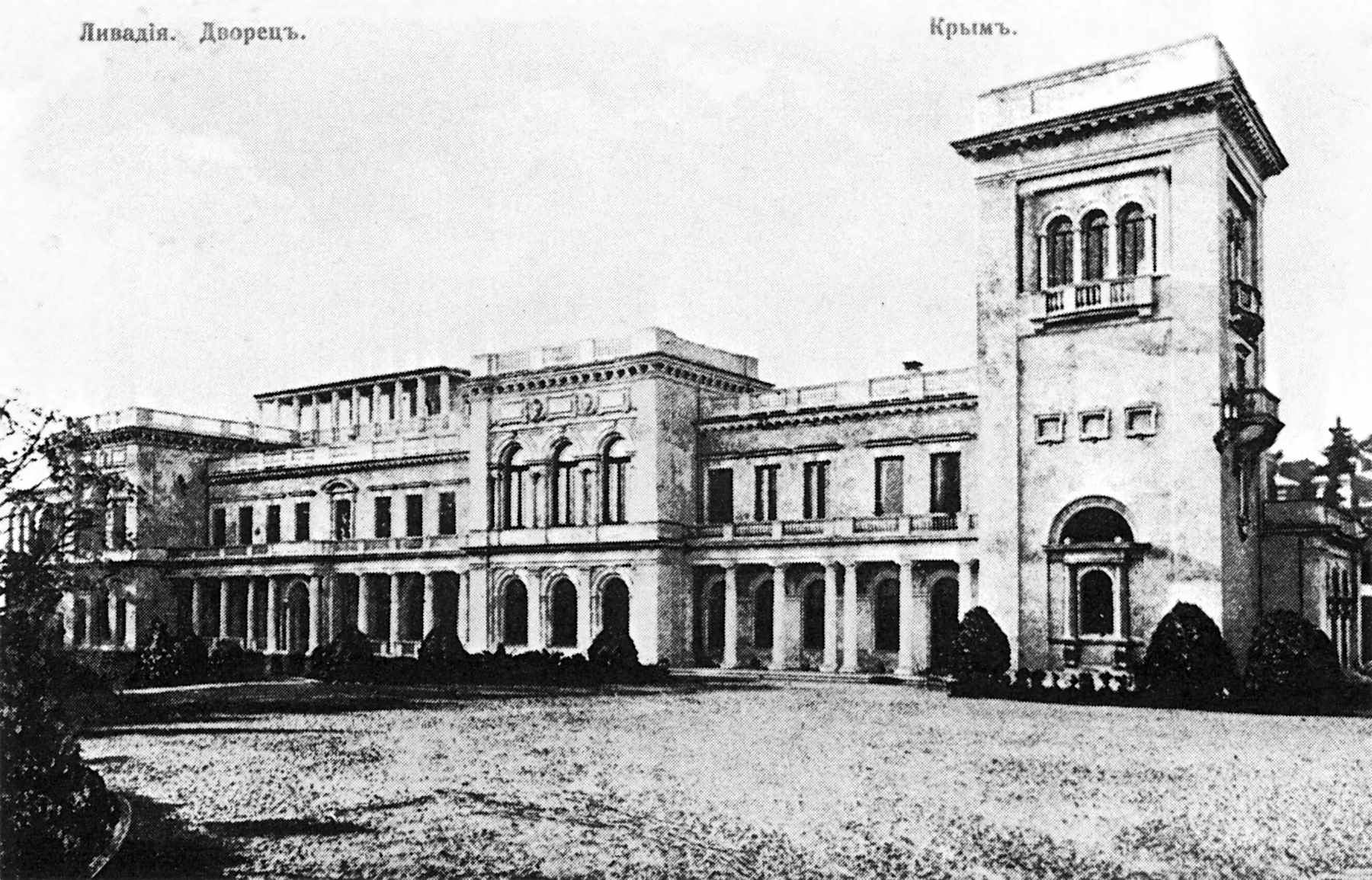
THE NEW PALACE, LIVADIA—ca. 1912
Courtesy E. L. Packer
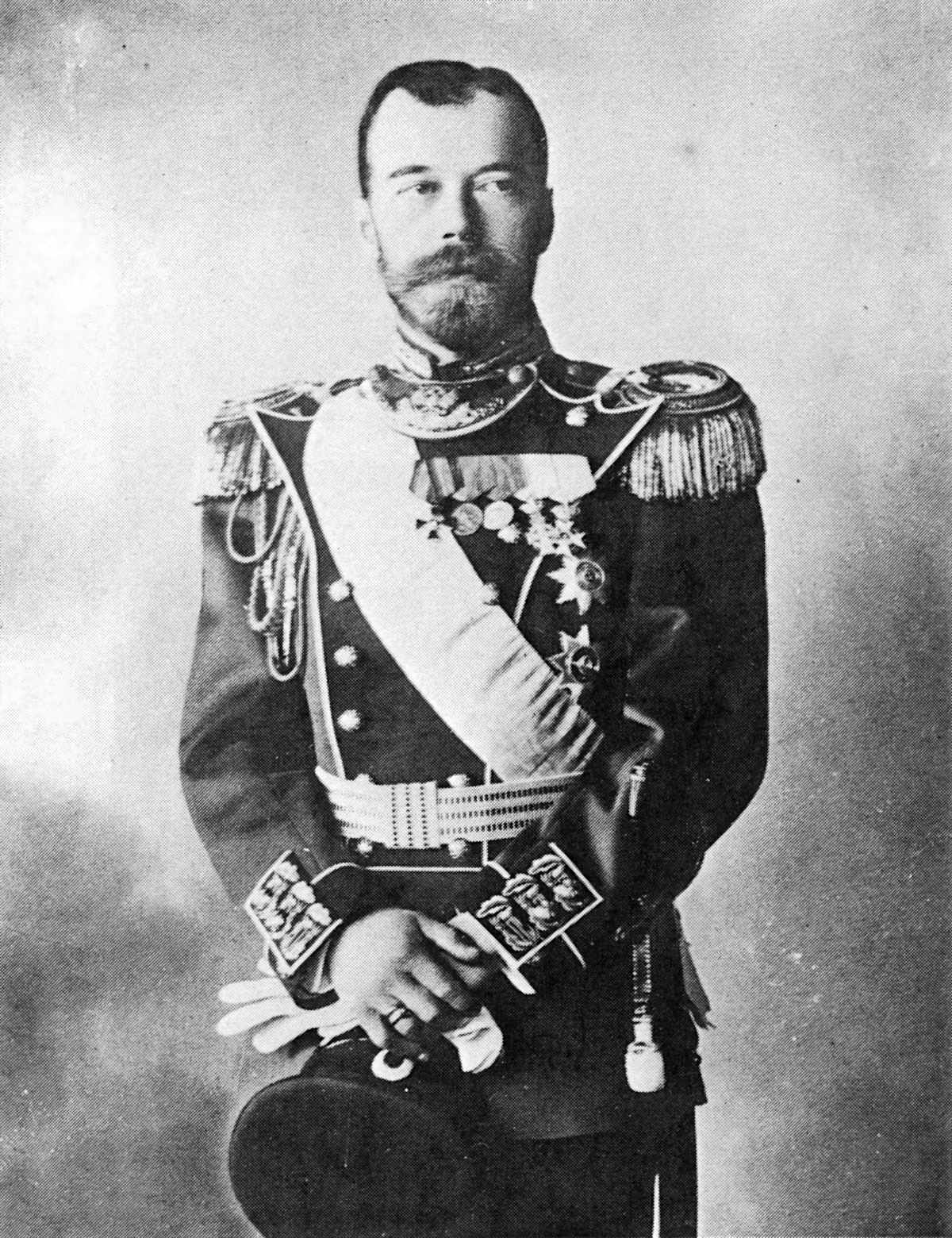
NICHOLAS II—ca. 1914
Courtesy E. L. Packer
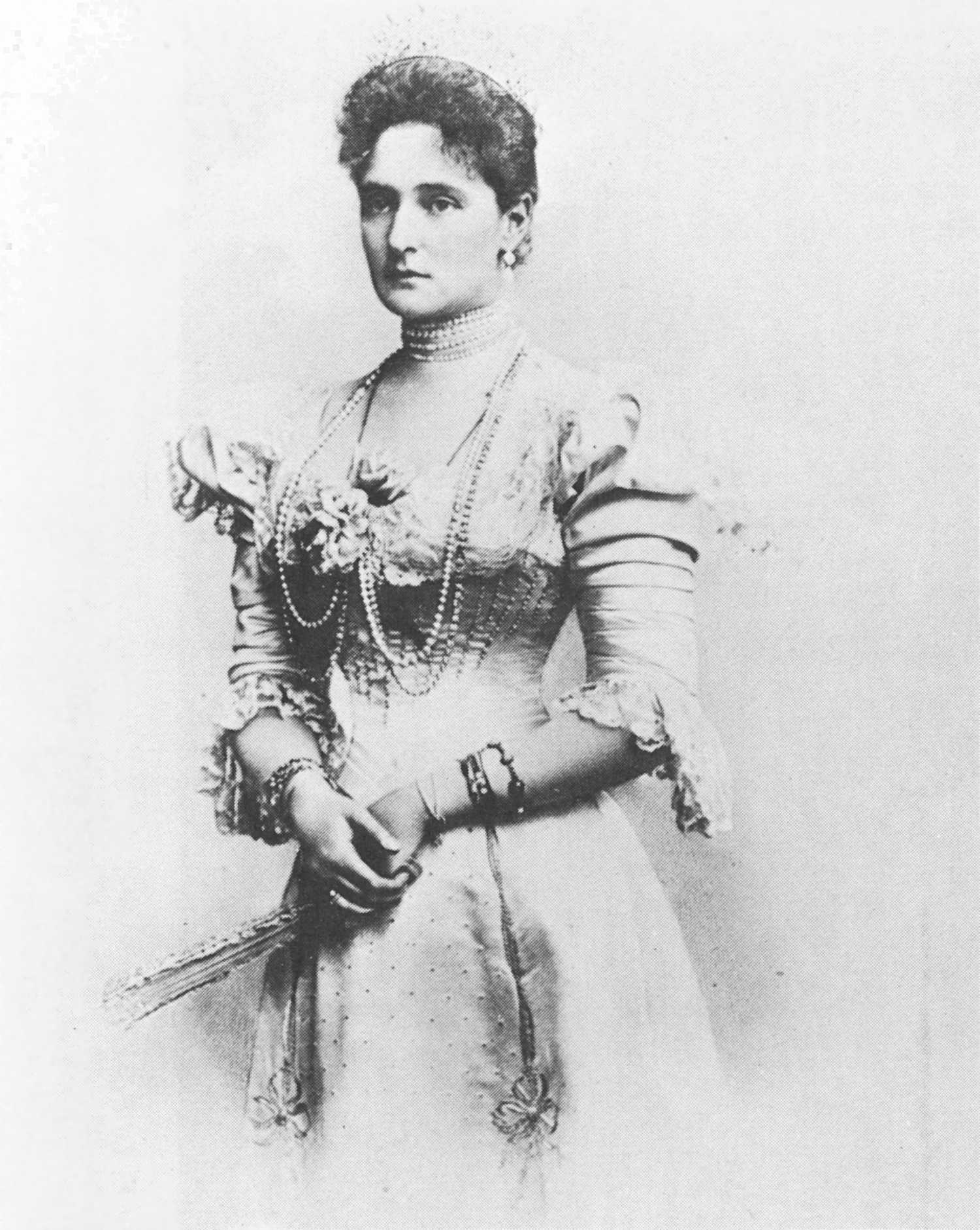
THE EMPRESS ALEXANDRA—ca. 1910
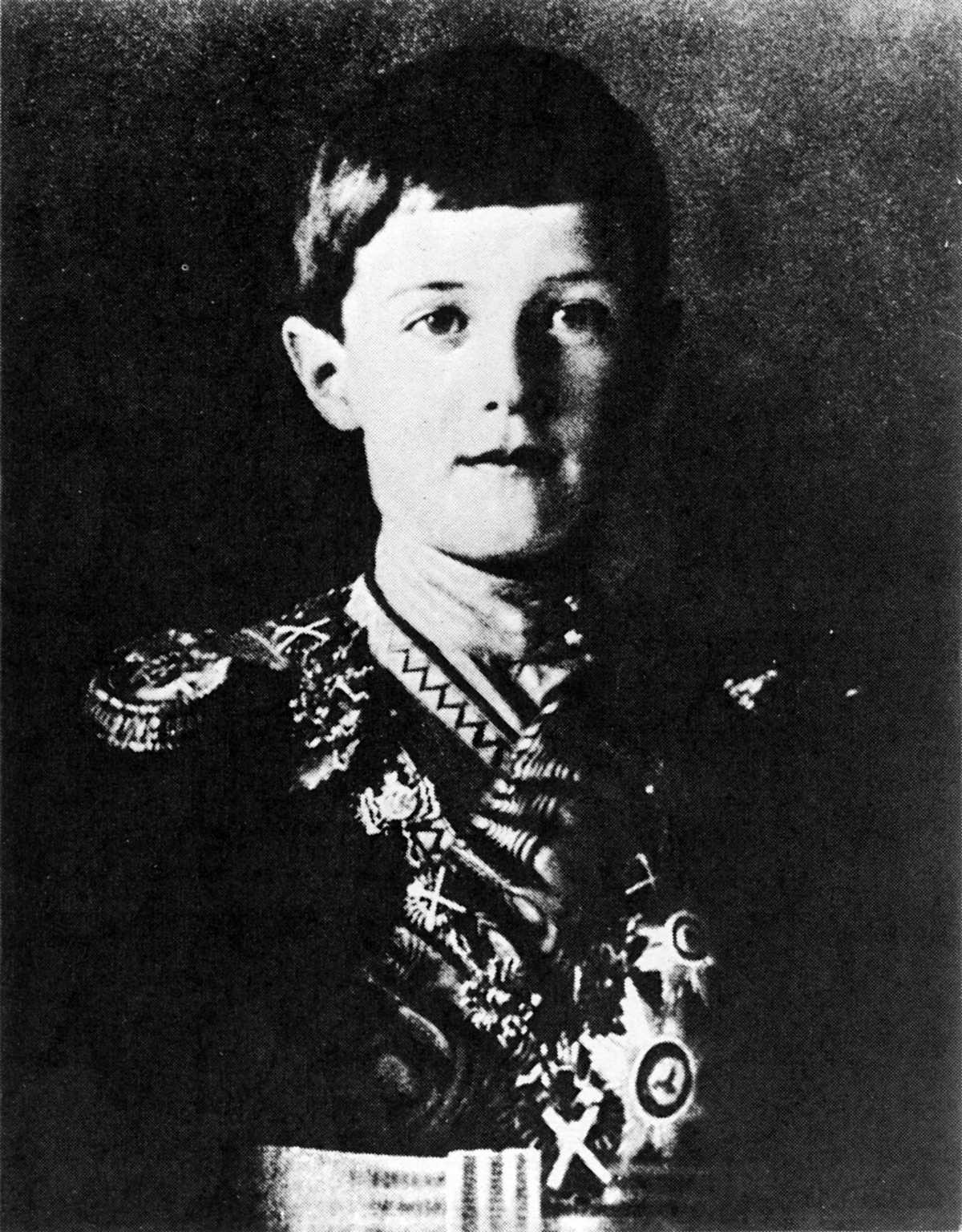
THE TSESAREVICH ALEXEI—ca. 1913
Courtesy The P. B. Corporation
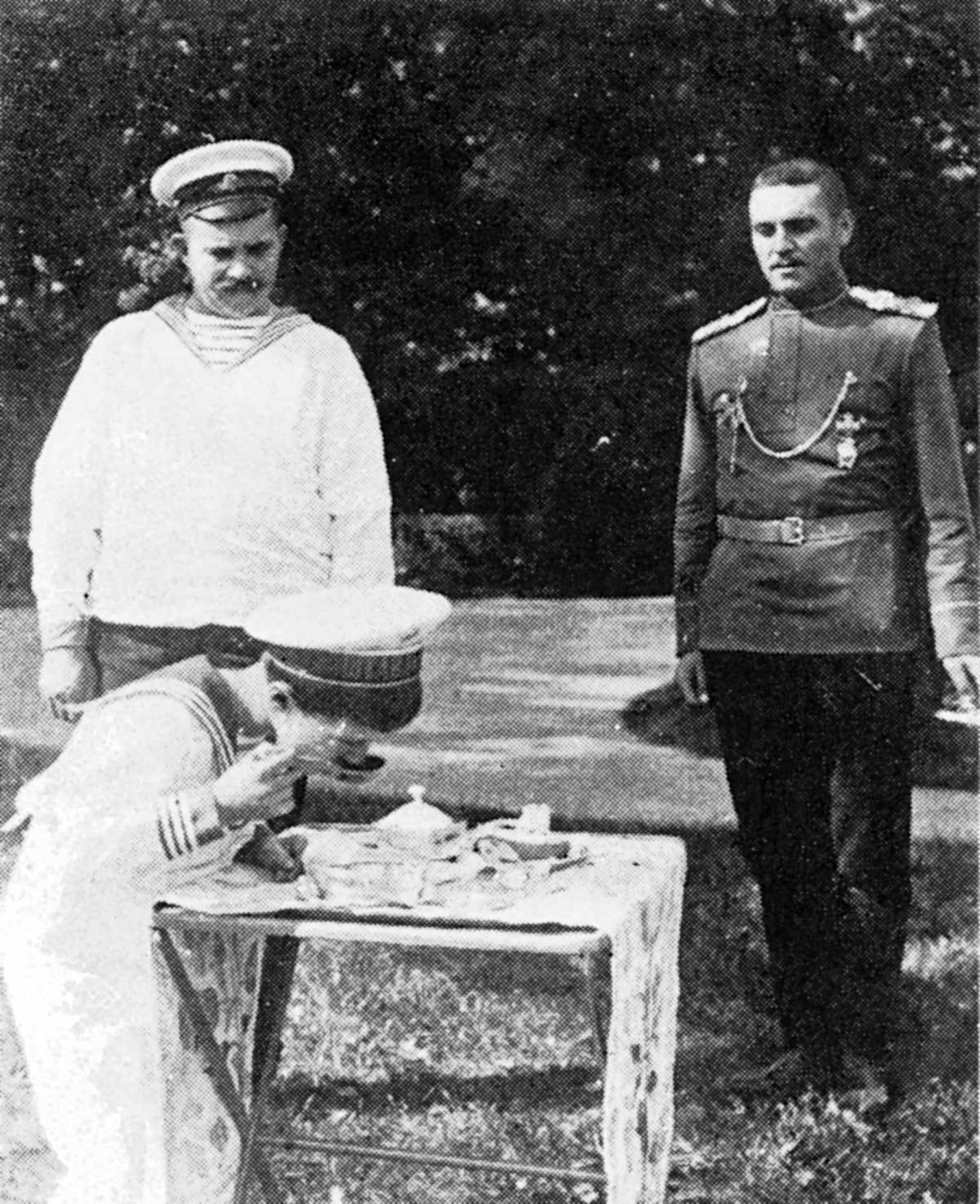
THE TSESAREVICH ALEXEI TESTING FOOD OF RUSSIAN TROOPS—1911
Courtesy E. L. Packer
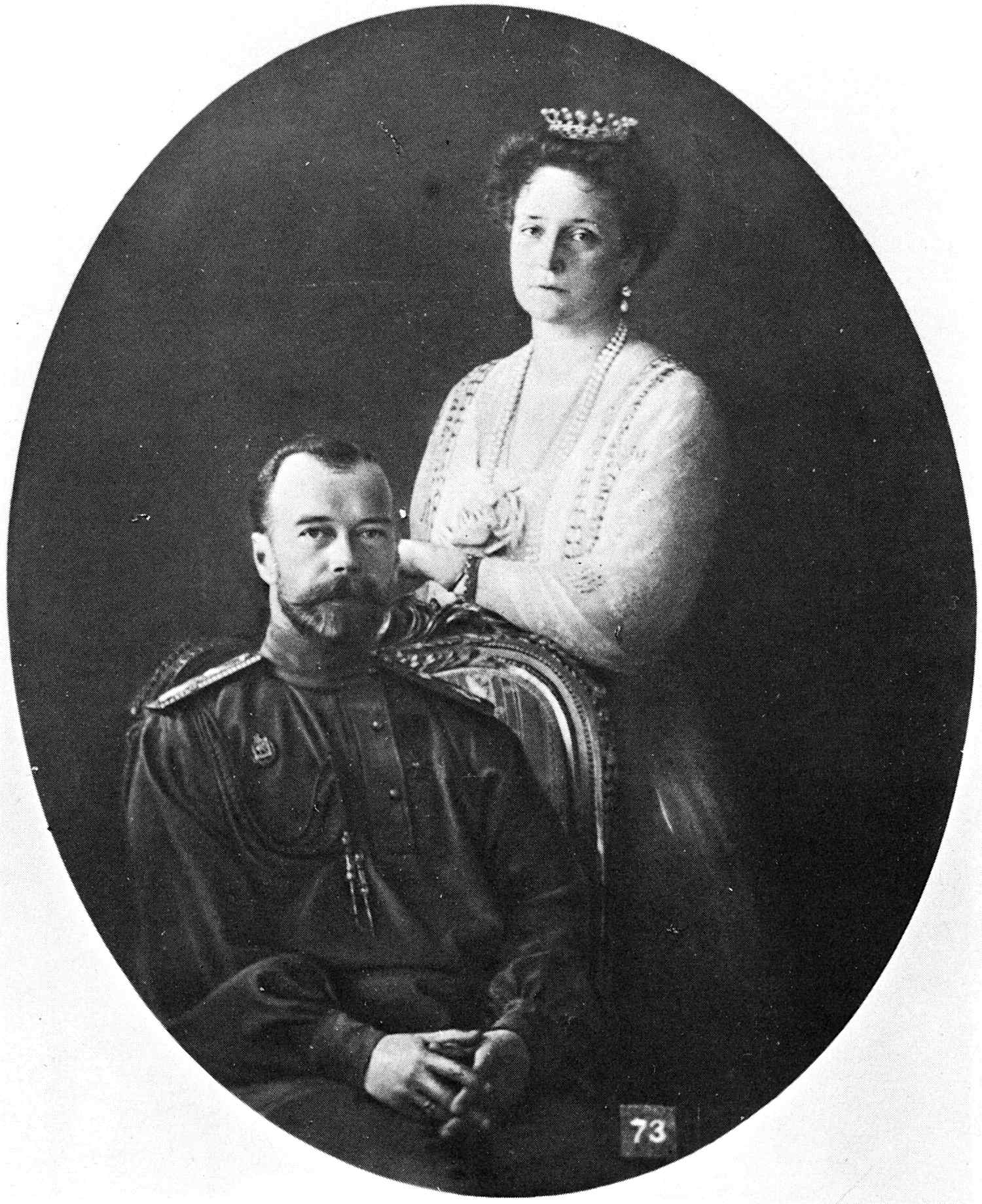
NICHOLAS II AND THE EMPRESS ALEXANDRA—ca. 1914
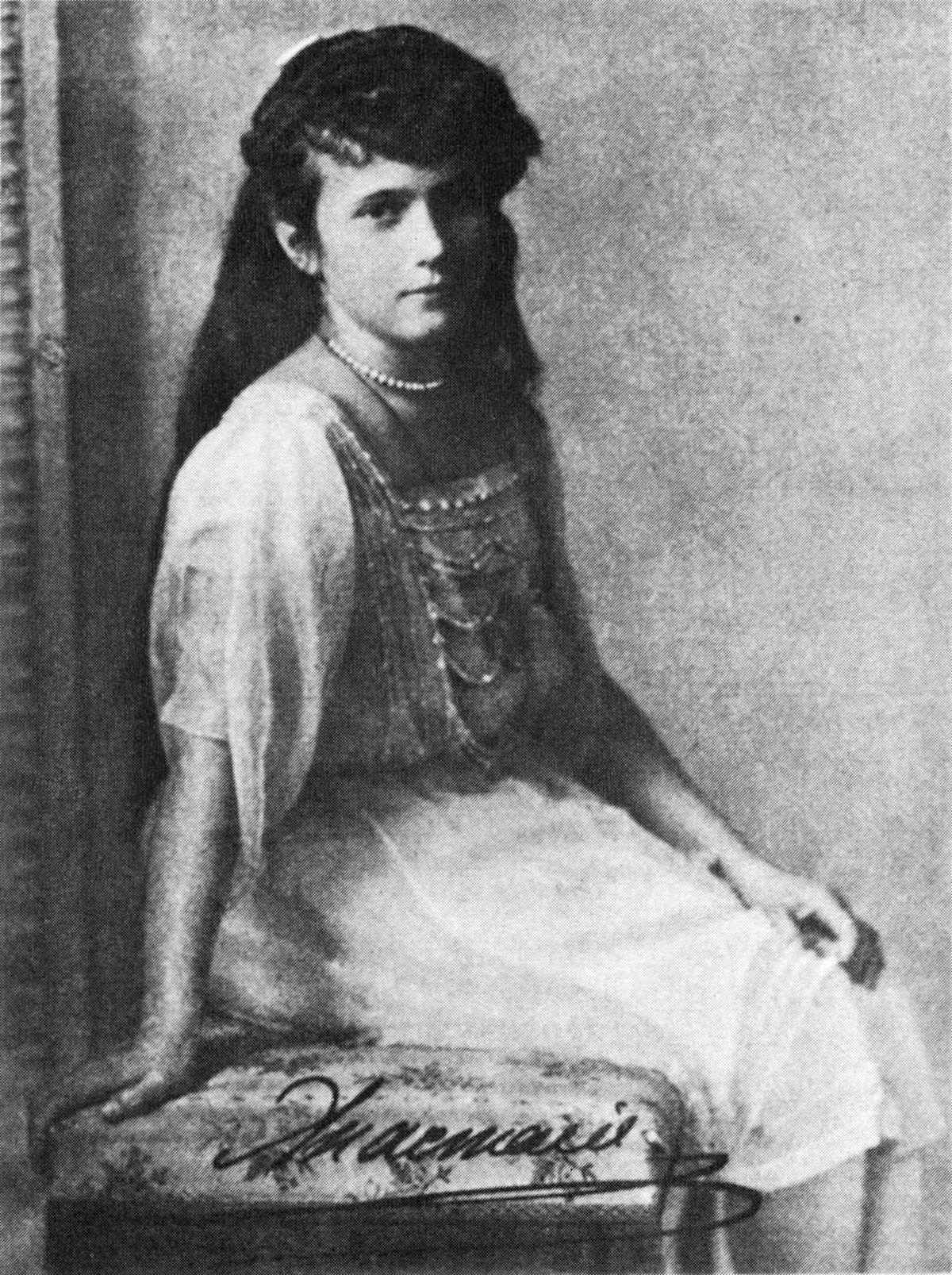
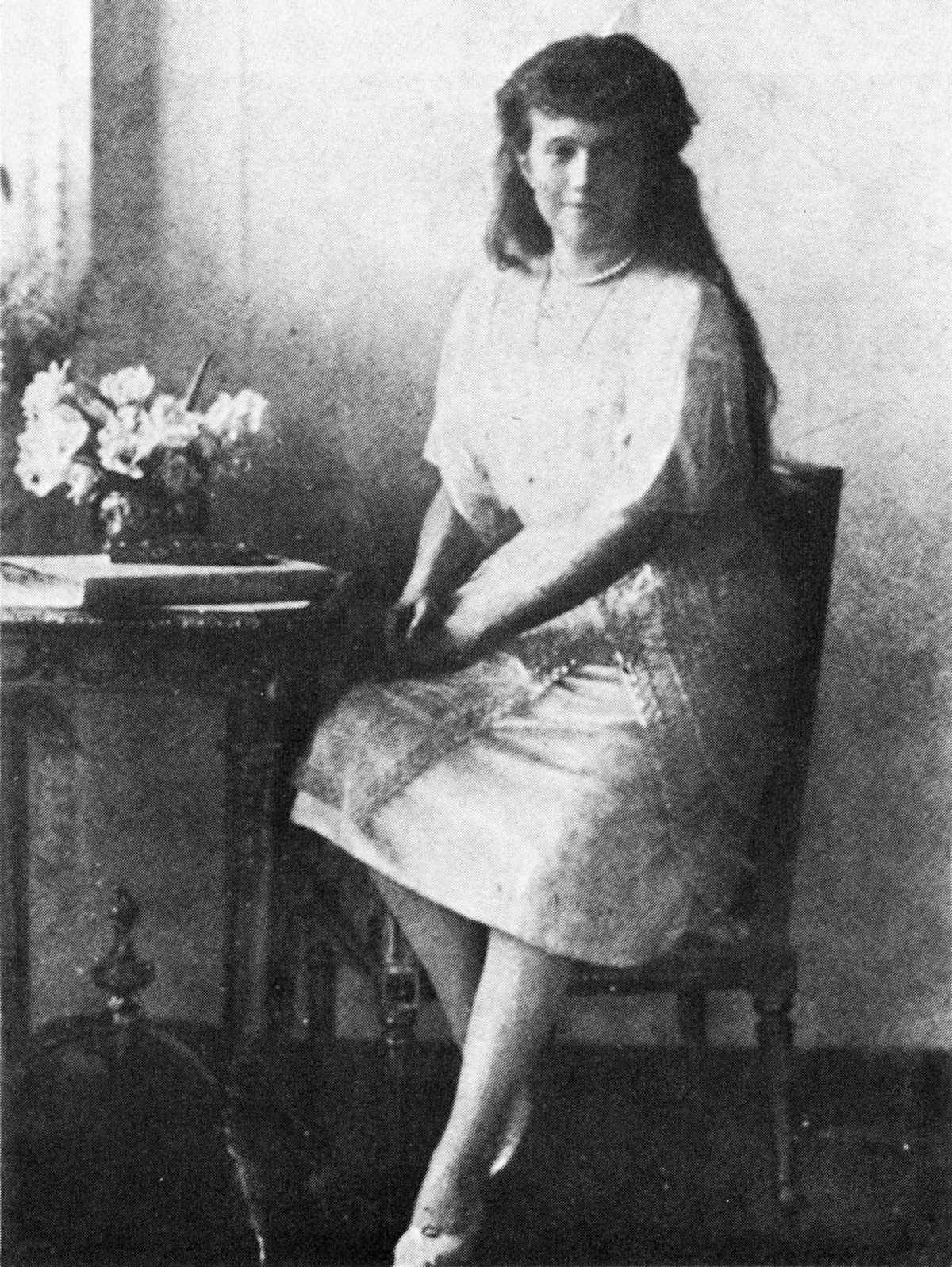
THE GRAND DUCHESS ANASTASIA—TSARSKOE SELO—1914
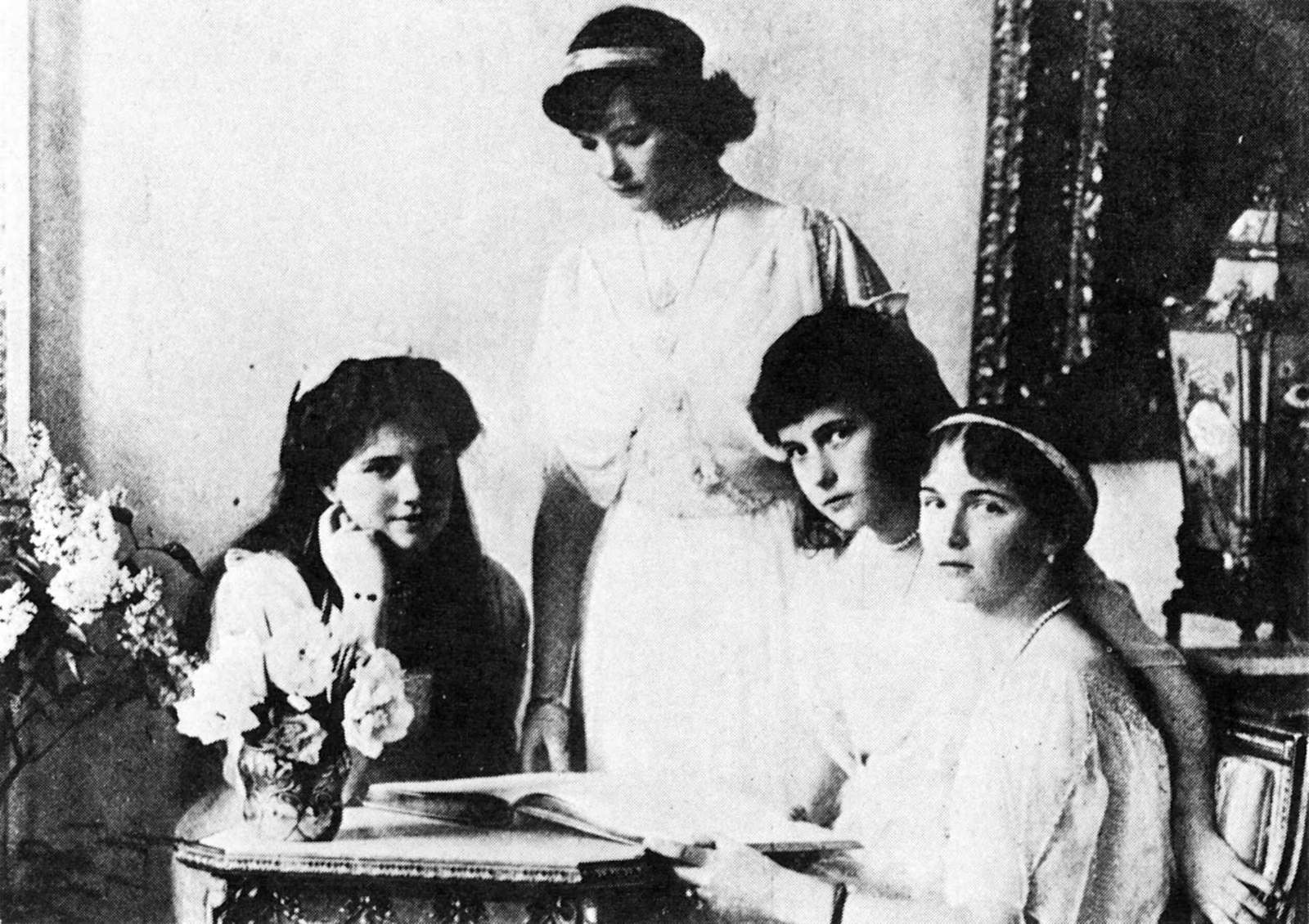
THE GRAND DUCHESSES MARIE, TATIANA, ANASTASIA AND OLGA—ca. 1913
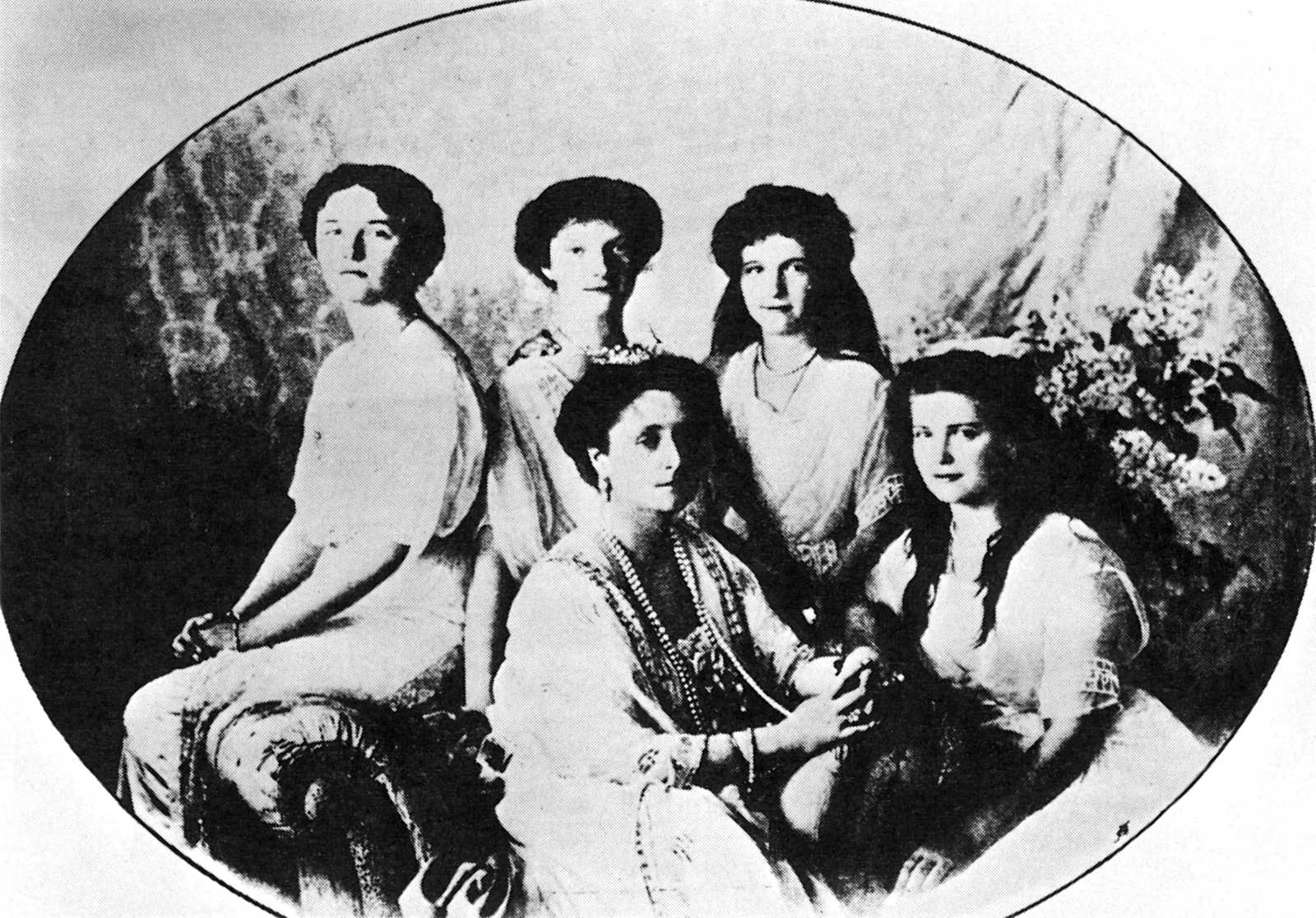
THE EMPRESS ALEXANDRA WITH HER DAUGHTERS, THE GRAND DUCHESSES OLGA, TATIANA, ANASTASIA AND MARIE—ca. 1913
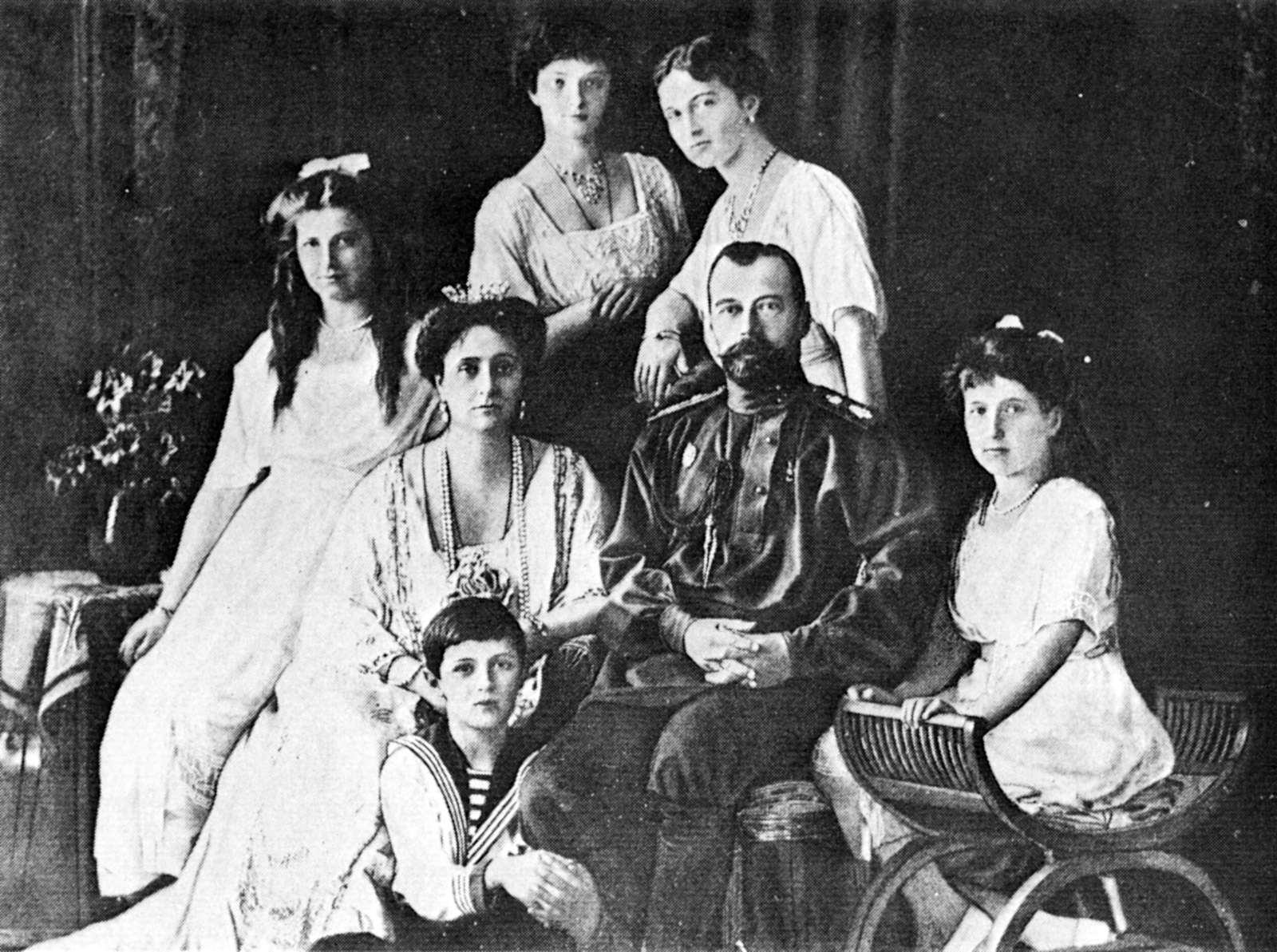
NICHOLAS II AND THE EMPRESS ALEXANDRA AND THEIR CHILDREN, THE GRAND DUCHESSES MARIE, TATIANA, OLGA AND ANASTASIA AND THE TSESAREVICH ALEXEI—ca. 1913
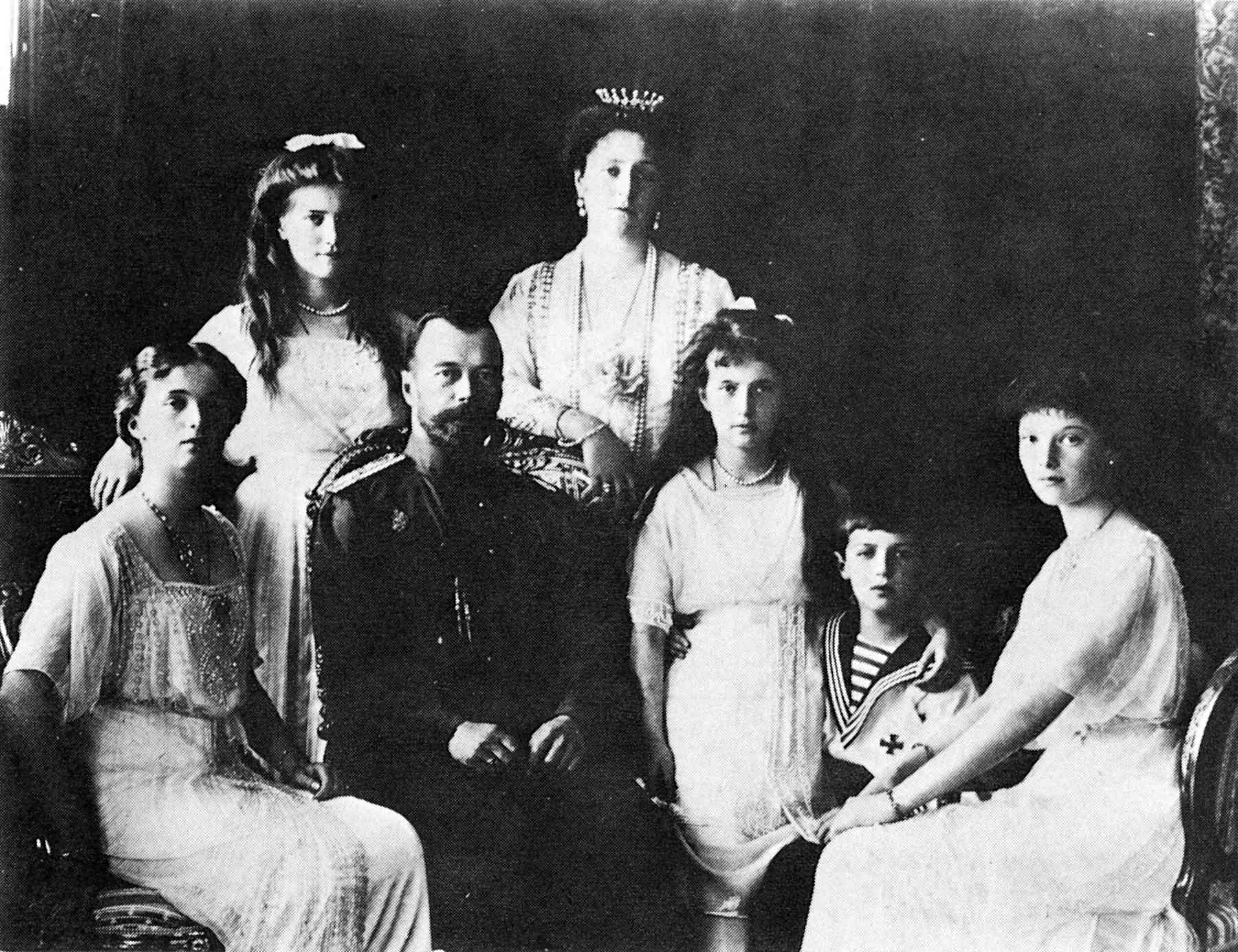
NICHOLAS II AND THE EMPRESS ALEXANDRA AND THEIR CHILDREN (l. to r.) THE GRAND DUCHESSES OLGA, MARIE AND ANASTASIA, THE TSESAREVICH ALEXEI AND THE GRAND DUCHESS TATIANA—ca. 1913
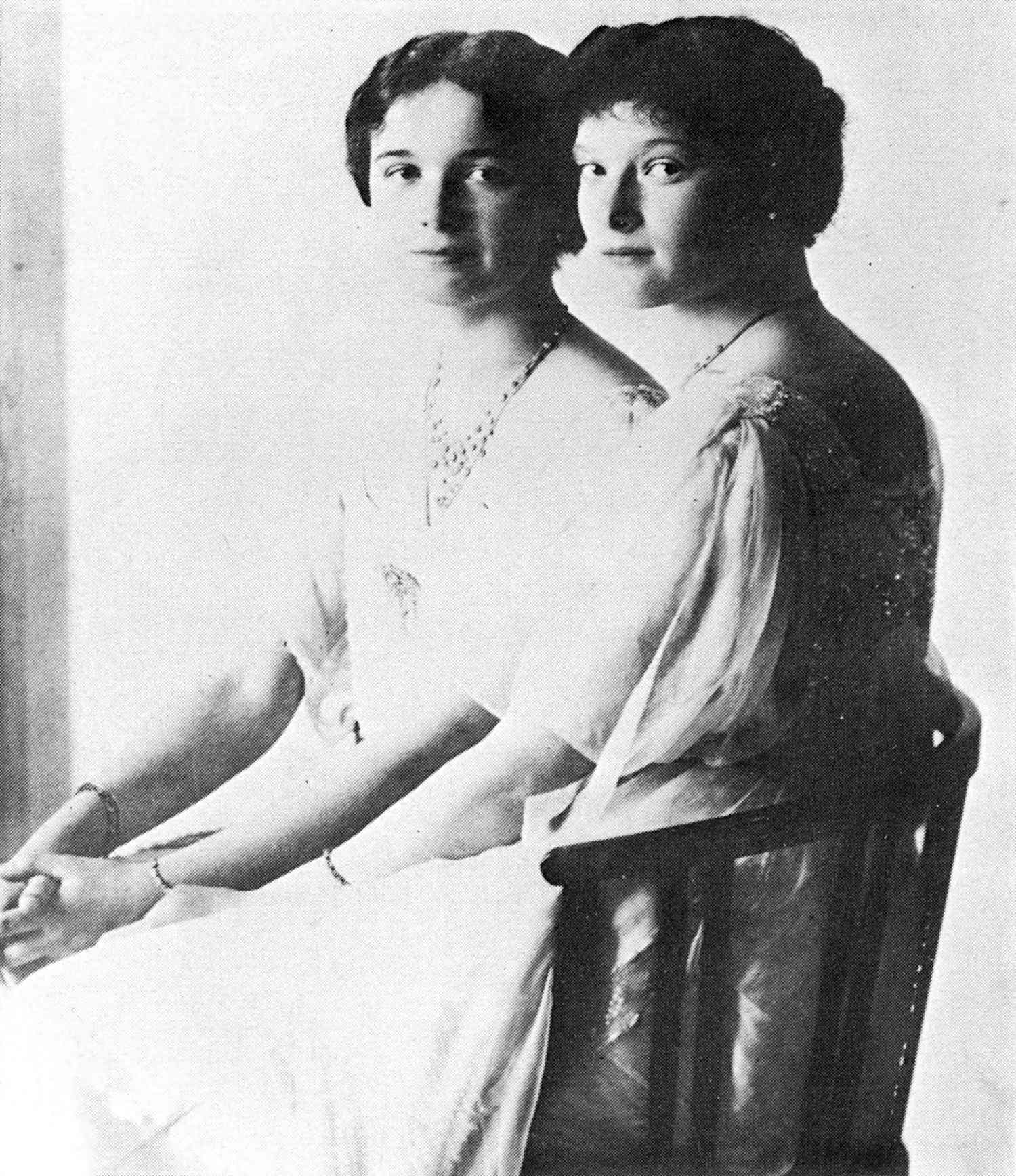
Courtesy The P.B. Corporation
THE GRAND DUCHESSES OLGA AND TATIANA—ca. 1914
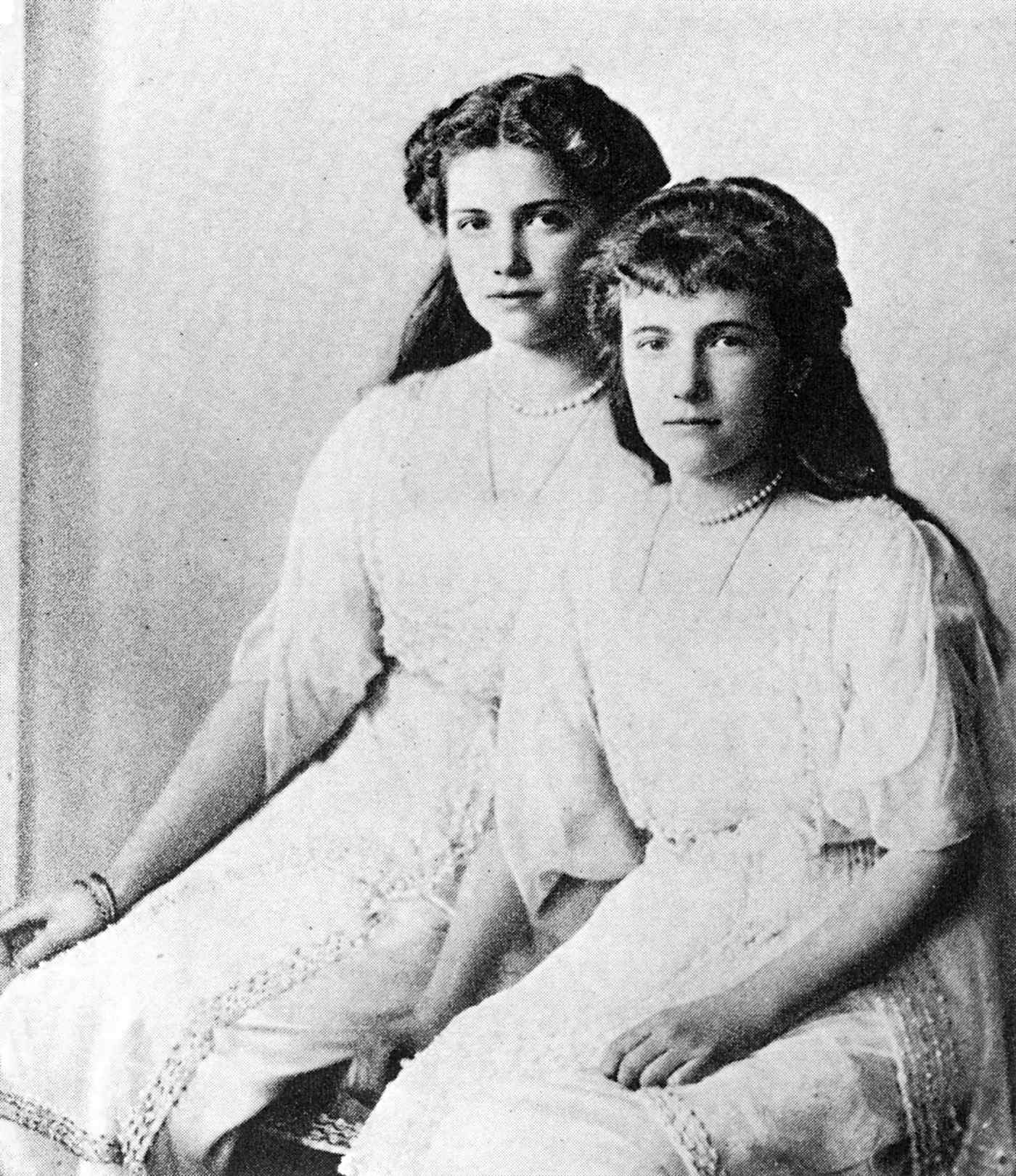
Courtesy The P.B. Corporation
THE GRAND DUCHESSES MARIE AND ANASTASIA—ca. 1914
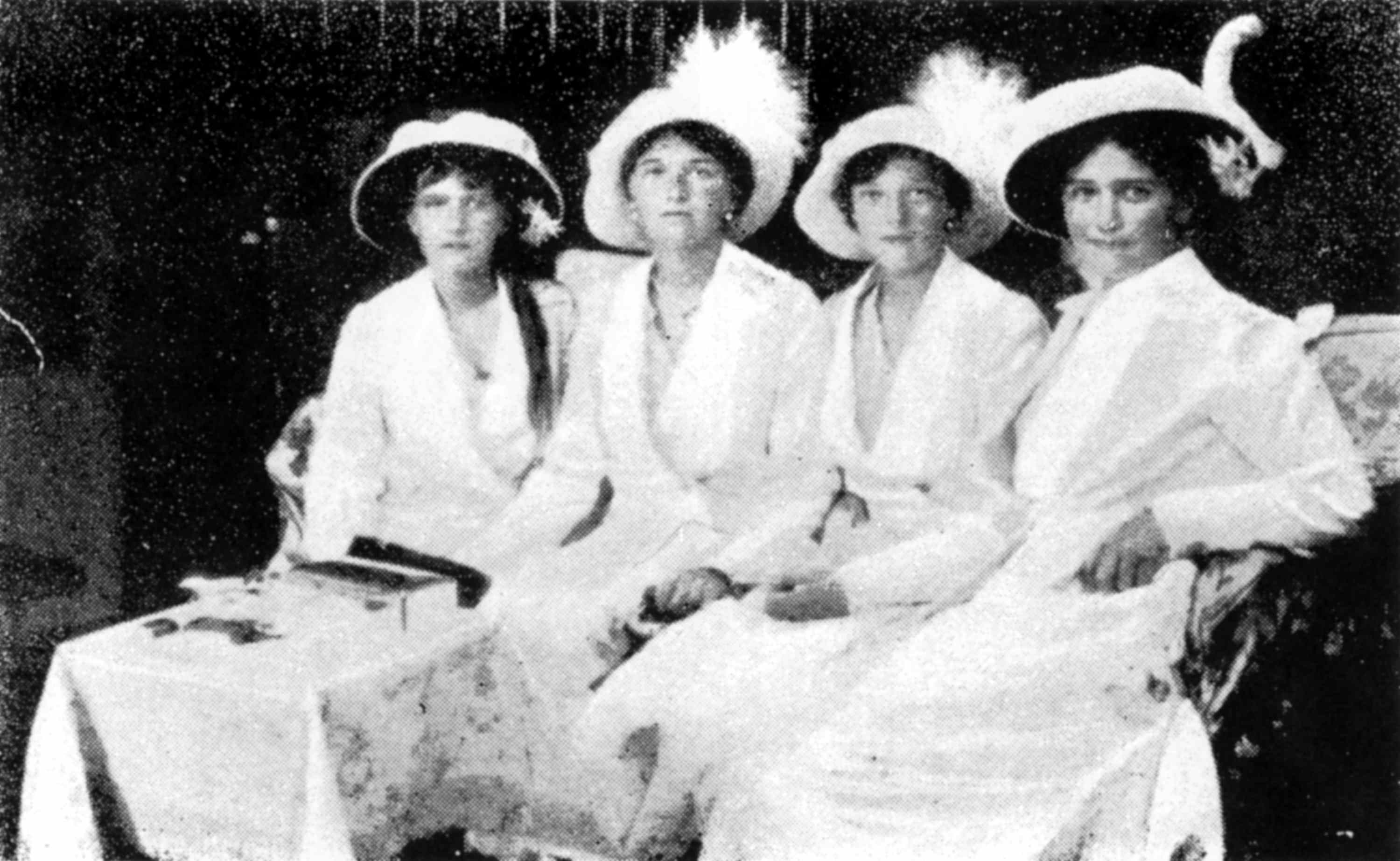
THE GRAND DUCHESSES ANASTASIA, OLGA, TATIANA AND MARIE ON BOARD THE “STANDARD”—1914
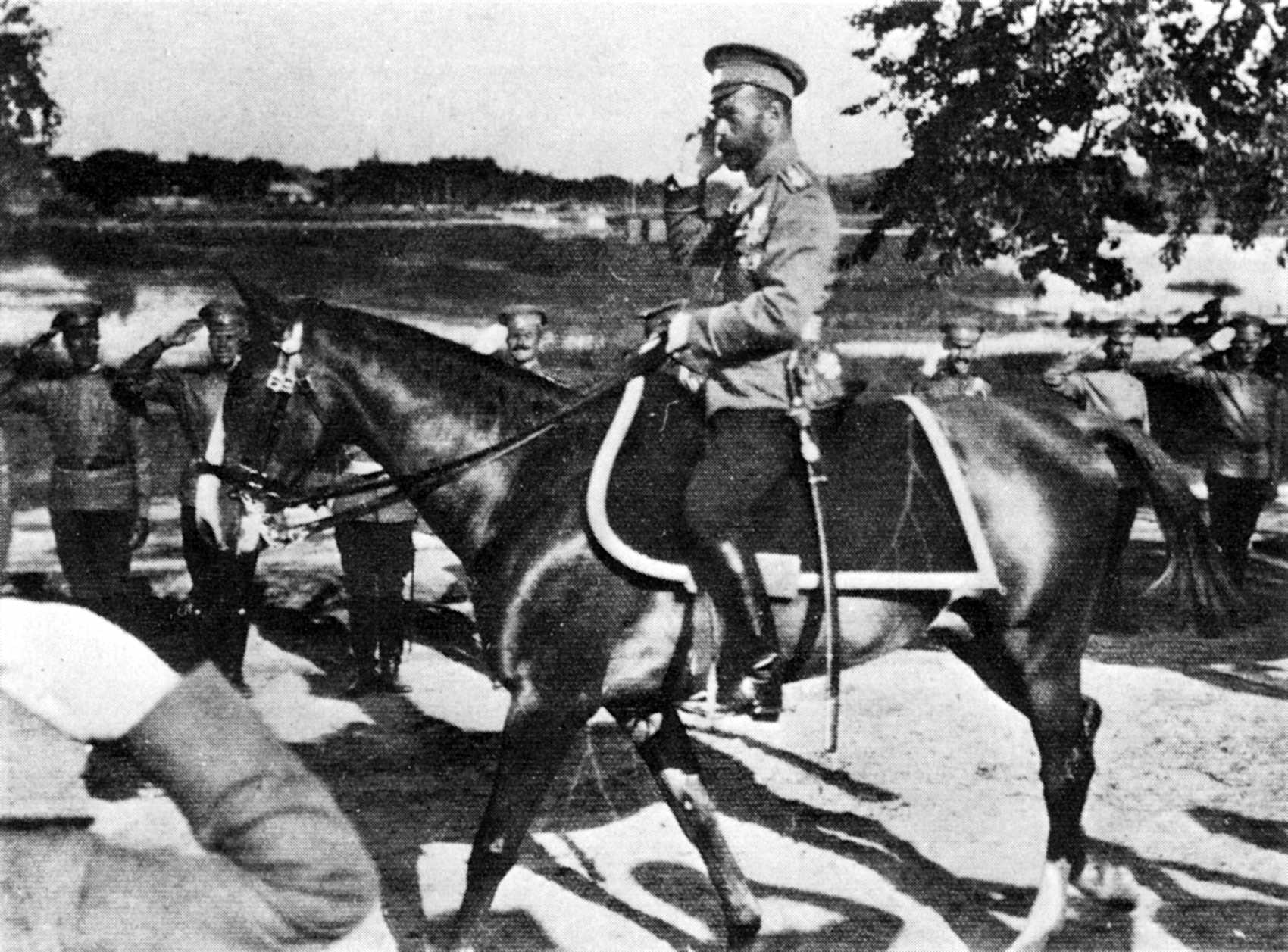
Photograph by the late Colonel N. Koishevski
NICHOLAS II
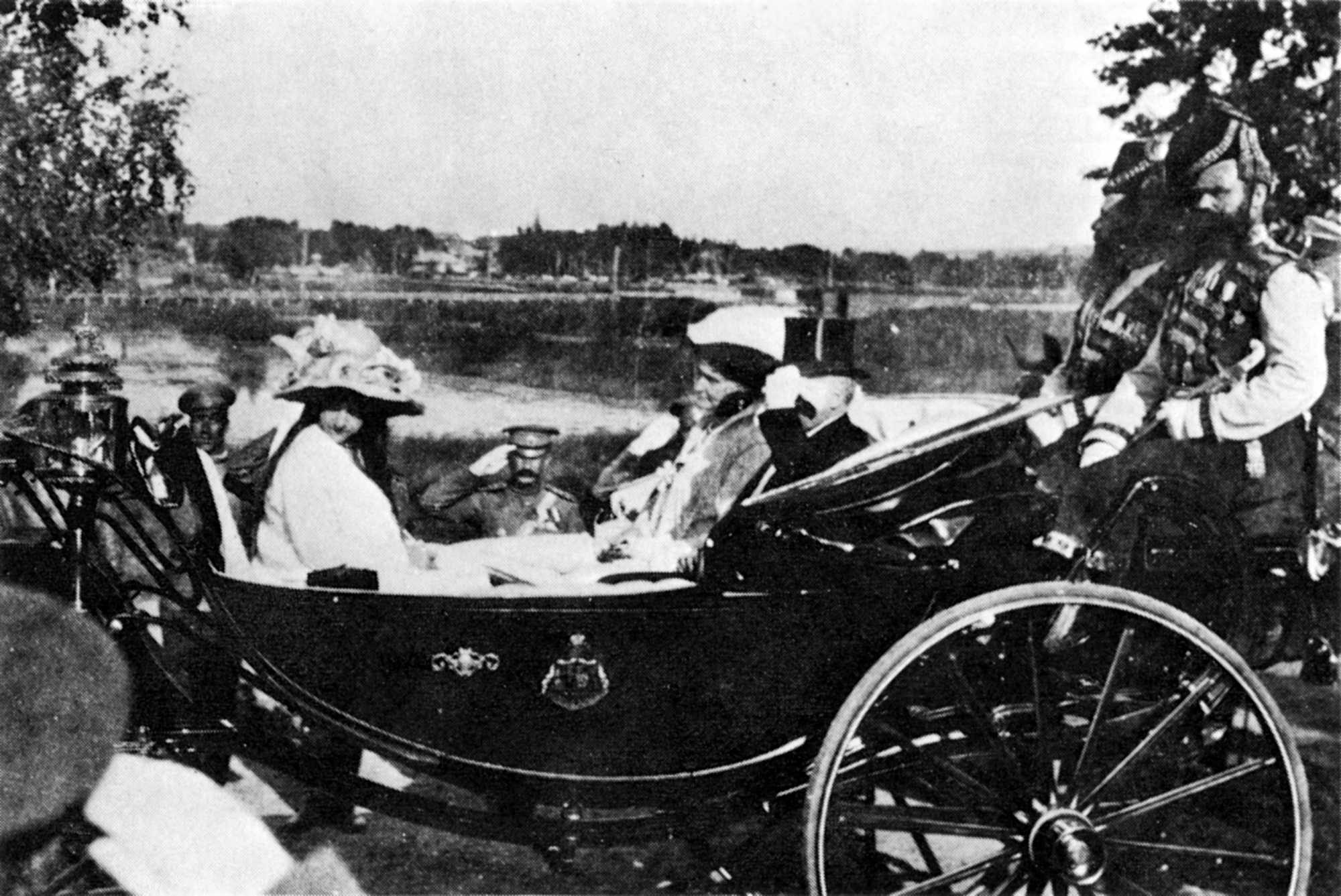
Photograph by the late Colonel N. Koishevski
(l. to r.) THE GRAND DUCHESS ANASTASIA, THE EMPRESS ALEXANDRA AND PRESIDENT POINCARÉ
STATE VISIT OF FRENCH PRESIDENT RAYMOND POINCARÉ TO RUSSIA—1914
That night a grand banquet was held in the beautifully decorated pavilion overlooking the sea. The lights reflected on the water as various craft sailed by, and the sound of music spread over the sea like a cloud. It was a gala occasion with many garlands and flags flying. I could not help watching Olga intently for I had overheard someone say that this trip was planned with a view to her possible marriage into the Rumanian royal family. At the dinner table Olga and Prince Carol sat side by side, apparently having a good time. The table was decorated with tricolors: red, white and blue, and small gifts were exchanged. Olga received a Rumanian national costume which was beautifully embroidered; the skirt was in a dark color woven in a pattern of gold and silver thread, and the blouse daintily embroidered in white. Princess Marie did not hesitate to admit that she herself was a beauty, especially her blue eyes. She was the eldest daughter of Prince Alfred, Duke of Edinburgh, and the Grand Duchess Marie Alexandrovna of Russia. She was named Marie Alexandra Victoria, after both her grandmothers, the Russian Empress Marie Alexandrovna and Queen Victoria of England. As already mentioned, her younger sister Victoria Melita (Ducky) was the divorced wife of Mother’s brother Ernest of Hesse; she was now married to the Grand Duke Cyril Vladimirovich. Another sister, Alexandra (Sandra), married Prince Ernest of Hohenlohe-Langenburg. A third sister was Beatrice (Baby B.), wife of the Infante Alfonso of Spain, first cousin of Alfonso XIII.
I was filled with a compelling interest I had never before experienced. But when we sailed away that night, I learned it had been decided Olga was too young to marry. Later she told us that she would rather stay single than marry outside of Russia. We sisters were so happy we could not help teasing her about losing a husband. It was a good thing that Alexei did not know about Olga; he would have been sick with worry that she might leave Russia. Later I wished Olga had married at that time, she might be alive today.
During the war Prince Carol came to Russia several times and stayed with us for a few days. Once he was accompanied by Prime Minister Bratianu. However, even this time, Olga was not given an opportunity of being left with him alone for one single minute, entirely apart from others. There were always ladies in waiting and we the younger ones excitedly were in and out of the room. She had no chance to hold his hand and less of being kissed.
Nor was any one else given an opportunity to be with Olga unchaperoned. It was in Tobolsk that Mother first realized her mistake in not giving more independence to her older daughters.
Olga was named after my Aunt Olga. She was tall, slender, blonde with a lovely fresh complexion. Her eyes were a lustrous blue, her nose was slightly turned up. She often jokingly referred to it as “the little stub”. When she smiled she displayed beautiful white teeth. As I look back, I am more and more appreciative of her fine character. She was an omnivorous reader and wrote some stories which she sent to Aunt Missy, Queen Marie of Rumania, who in turn sent Olga stories she had written. Olga’s poetry was destroyed by herself at the time of the revolution. She had a deep religious faith and often sat beside a patient at the hospital praying that God might spare the life of the young soldiers. Her touch on the piano was excellent and was able to master the most difficult compositions of Tchaikovsky, Wagner, Mozart, and Beethoven. Mother and Olga often played duets on the piano. Her talent for composing and writing was inherited from her Danish and Romanov sides which boasted a long line of artists, poets, sculptors and musicians. She was a mezzo soprano; she memorized musical compositions very easily. Mr. Konrad was her musical instructor, as well as ours. Father’s favorite was Tchaikovsky’s “Chanson Sans Paroles”. When she played it for him, his face lighted up with pleasure. She loved Father tenderly. Often, when Father was troubled, he talked over his problems with Olga and permitted no other member of the family to be present. She loved children and sponsored several who were confined to the hospital. She even provided for their education by setting aside money from her allowance.
Going back to our Rumanian cruise, we arrived in Odessa at night, where the Imperial train was ready to take us to Kishinev for the unveiling of the monument to Alexander I. I remember the trip especially because Alexei misbehaved. No doubt this was due to fatigue brought on by the heat on the train. In Kishinev we were the guests of the Governor, an old friend, who wore the longest beard I have ever seen, reaching almost to his waist.
At the tea which followed, champagne was served. At an opportune moment, Alexei took a glass of champagne and drank it down before anyone could stop him. Soon this champagne took effect and he became very gay so that all the ladies, old and young surrounded him. I never realized he possessed such a sense of humor. Youngster that he was, he did not realize what the champagne had done to him. Of course the family was terrified at this display. In the evening back on the train when the effect had worn off, Father gave him a scolding and he was put to bed.
We children now realized that Alexei’s illness and the Jubilee had brought our studies to a virtual halt. Alexei and I used to have our French lessons together, but now he was far ahead of me. French was much easier for him than for me. I was really bored with all my studies. When I entered the classroom, my face grew long, but when school hours were over, I shot out of the detested place like a bullet. As a result my tutors were not fond of me and I felt their disapproval.
We had been home a short while when the world was shocked at the news of the assassination of the Archduke Francis Ferdinand of Austria and his wife on the streets of Sarajevo, on June 28th, 1914. After that date Father spent very little time with us. He was constantly busy with his ministers, diplomats and the Grand Dukes. The President of France, M. Poincaré, spent four or five days with us at Alexandria Cottage in Peterhof. He was as complaisant as President Fallières whom he had recently replaced. Father felt drawn to him from the start, admiring his diplomacy and friendly manner. Several dinners were given in his honor with the Imperial family attending. Everyone looked grave and alarmed, and I gathered matters must be serious. Why should the assassination of an Austrian be so threatening to Russia? I was told that Russia had an agreement which might implicate us all unless the affair could be settled amicably. The hour the President departed, the Austrian ultimatum was served at once on Russia and on Serbia.
Out of this puzzling dilemma which hung over Russia, two things were clear to me: the quiet paleness of Father and Mother’s tearful entreaties imploring that Russia be kept out of war. Mother kept repeating, “The country is not recovered from one war before it is in another.” She was thinking of the Japanese war, whose horrors were still fresh in her mind. Mother’s agonized face vividly foreshadowed the tragedy ahead.
Every summer there was a review of regimental maneuvers at Krasnoe Selo (near Tsarskoe Selo). This time they were held in honor of King Frederick Augustus III of Saxony. We sisters enjoyed horses and each had a favorite horse of her own. Tatiana especially knew a great deal about them, since she had been taught riding by a competent riding master, but so did we all. The two older sisters were unusually graceful on horseback, more so than Marie and I.
Cossack horses were especially fascinating to me, since they seemed to understand one’s very thoughts. Tatiana described to me how the Cossack and his horse grow up together. Training begins when the young Cossack is given a horse, a progeny of a Cossack horse, trained to the requirements of the Cossack regiment. From then on boy and horse are one, inseparable, each learning to understand the other: the boy is the head and the horse is the body. When the responses are mutual, they are ready to enter actively the Cossack regiment. I often wished I were a boy so that I might be a Cossack with a noble horse and wear a stunning uniform.
We drove speedily past the cheering crowds. To see these maneuvers was most interesting and exciting as we watched from the Imperial pavilion. In one performance a large unit trotted in perfect formation, then suddenly all the riders jumped off their horses in unison, then jumped back on their saddles without a single horse breaking its gait or changing its speed. In another exercise each horseman threw his black cape around his own shoulders and over his horse, so skilfully that the cape covered both horse and rider. There were many stunts and jumps over wide trenches filled with water; no one fell into them. During the luncheon, which was served under tents following the exercise, a message came stating that Austria-Hungary had declared war on Serbia (August 1st, 1914). At once we left for home.
I remember previous years when I was taken to see the review of the troops annually in May. All the society of St. Petersburg felt it was a privilege to pay hundreds of rubles for a box seat at these maneuvers. The proceeds from the sale of tickets went to charities. I still carry in my mind that upon our approach a signal was given and cheers spread along the quays.
Our carriages were drawn each by two pairs of pure white horses. Father always rode to the left side of Mother’s and Grandmother’s equipage, accompanied by the staff. We sisters followed swiftly in our carriage between the lines of troops until we reached the Imperial box under a green tent. Father reviewed his troops. First to march were the men of his own Preobrazhensky regiment, then the Hussars, the Pavlovsky regiment, the Lancers, the cuirassiers and the others.
Father did not think that the Emperor Francis Joseph would wage war on Serbia on account of the killing of the Archduke and his wife. Father thought so because of the remark the old Emperor had made, in the presence of Father and persons about him, that the Archduke was good for nothing, that not a bone in his body was worth saving, and that he was not fit to carry the Crown.
During the latter part of the war several captured, high-ranking Austrian officers told the Court Chamberlain, General Tatishchev, that the old Emperor was directly responsible for the Sarajevo incident and that the Archduke was purposely sent there, where he was hated and murdered by oppressed Bosnians of the Dual Monarchy. The officers thought it was a deliberate excuse to provoke war and the aim was to destroy the little Kingdom of Serbia and take it under control as had happened earlier with Bosnia and Herzegovina. They knew that this little country would not be able to resist the two powers, Austria-Hungary and Germany. But those millions of suppressed plucky Serbs had already endured deprivation of freedom and arrests and confiscation of their property under the Dual Monarchy. They were determined to defend what was left of their country from being dismembered again, and all were willing to die for the right to live in their own land.
Father sent a telegram to Kaiser Wilhelm asking that the Austro-Hungarian-Serbian dispute be tried by the International Arbitration Court at The Hague. He also sent word to King Carol of Rumania to wire the Kaiser that Russia did not want war. But all was in vain. They took the killing of this good-for-nothing Archduke as a deliberate excuse, even though the murder was committed by their own citizens who resented the Dual Monarchy. It was common knowledge that Russian mobilization which was under way was directed against Austria, not Germany.
VIII NO CHOICE BUT WAR
Events moved rapidly. Austria and Germany declared war on Serbia. More than ever Father was shut away from us, doing all in his power to keep Russia out of the conflict. But Russia was an ally of Serbia. There was no choice. German and Austrian troops were already mobilized and were conducting maneuvers near our border, and soon we, too, were in war. Mother wept copiously. “Why,” she asked, “should millions of Russians lose their lives because one man is killed? Wilhelm has brought this on. I never trusted him. I never forgave him the humiliation and indignities toward our Granny (Queen Victoria).” My thoughts flew back to the visit in Germany when the Kaiser was my friend. Only two years ago we had exchanged jokes. Now he was Russia’s enemy, Mother’s enemy, and mine. Wilhelm, Mother’s own cousin.
Before we knew it the Austrian troops were threatening the old Russian fortification of Bendery. I was filled with forebodings. Being a believer in dreams, I tried to interpret a dream I had had the night before this news arrived. I dreamed that the forest on the Russian western border was ablaze. I could hear the crackling of the timber and could see fierce fire raging high into the sky.
A few years later, during my escape, I crossed these same forests and remembered my dream. Then the trees were not on fire but lay with their huge roots pulled out of the ground—witnesses of the terrific suffering and tragedy that had occurred there.
At Tsarskoe Selo that evening, after the news of the German advance, we prayed to the Almighty, hoping that disaster could still be averted and peace could be maintained. We realized how much Father was suffering when he appeared late for dinner. His face was pale, his bearing indicated anguish. He said, “Russia has no choice but war, when the armies of Germany and Austria are already on Russian soil.” Mother burst into tears, and so did we all. Supper was not finished that night. We left the table. That same evening, Foreign Minister Sazonov and the British Ambassador, Sir George Buchanan, spent half of the night conferring with Father. The next day Father was at his desk at five in the morning, working until breakfast. Alexei, who was ill, did not know about the war until the next morning.
In the afternoon we all went to St. Petersburg, except Alexei. As we were entering the Winter Palace, people gathered in the square and surrounded us as they cheered. After an old Russian tradition they kissed Father’s shoulders and Mother’s skirt. This display of loyalty brought tears to Mother’s eyes. Father went directly to a meeting at the huge Nicholas Concert Hall with the ministers and generals. Then the Te Deum was sung. When Father appeared on the balcony of the Winter Palace to read the Manifesto declaring war, all of us children and other relatives stood behind him. At once the voices died down and all was quiet as though the whole world had suddenly fallen asleep. The thousands of people who had assembled in the square knelt down, their garments making a rustling sound, and in unison sang “God Save the Tsar.” At this time Father took an oath that he would never make peace so long as one enemy remained on Russian soil. Then he promised his people that he would defend all the Slavs, even if he would have to shed his own blood. It was a painful moment to announce to the people that war was an actuality.
We returned to Alexandria and several days later we all left for Moscow. We were greeted with the same enthusiasm there. The church bells rang continually as we passed from the station to the Kremlin. People were everywhere, on roof tops, balconies and trees. The Russian national anthem was heard repeatedly along the way. Alexei was ill, and had to be carried to the Cathedral of the Assumption to hear the Te Deum. The patriotic demonstrations lasted three days. “Ura” (hurrah) resounded everywhere. From Moscow we went near by to Sergievo to pray at the celebrated Troitsko-Sergievskaya Lavra. Practically every living person in the area lined the streets to the monastery, the richest and most important monastery in Russia. It covered a large territory and was surrounded by a lofty, thick wall with many towers. It contained some dozen of churches and many historical treasures, some dating from ancient days. Many pages of Russian history had been devoted to this monastery, about the heroic defense by the monks in 1608 against the Poles. Here were the tombs of Tsar Boris Godunov and his family. Here Father received an icon to carry with him through the battles. This icon was sent to the field chapel at General Headquarters and remained there to the last.
With war an actuality, all Russia seemed to unite in a determination to win a quick victory. Whenever Father travelled, the people greeted him enthusiastically; sometimes the whole family went with him and heard him deliver his war messages. During these trips the air was full of unity and the family never felt closer to the people. Many letters were received from students who begged to be allowed to go to war. “A beautiful patriotism,” Father said. “But how little they understand what war is.”
During the first days of the war, all factions drew together in a great patriotic surge. We saw some of our own relatives return to Russia to take part in the war. We sisters hardly knew some of these relations. All helped in the war effort; even our frail Grandmother did her bit in hospital work. Later she spent a great deal of time in Kiev, with her younger daughter Olga, our aunt, who worked in her own hospital there as a Sister of Mercy. Being so near the front, she received the most critical cases.
Life in the palace quickened. For days on end Mother could not think of anything but the hospitals. Were they adequate for the most certain strain ahead? She was not ignorant of the heavy task. In her younger days, before her marriage, she had taken up medicine for a while, knowing that the dreaded haemophilia might be in her genes. She wanted to be prepared to take personal care of any children she might have in the event they should inherit it. Later on, through the long illness of Alexei and during the war, her previous knowledge of this affliction helped enormously in her work. Mother also had a medical library on the second floor in Tsarskoe Selo, where in addition to texts, all kinds of anatomical diagrams and other materials could be found. Even before the war she was an excellent organizer of hospitals and charitable institutions, being particularly interested in orphanages. In addition to her medical training, Mother had studied philosophy in one of the German universities. In fact I recall the very drawer in the desk in a room on the balcony where she kept her documents and other papers of this nature. Most of all, I was always sure, Mother was determined to meet with courage any problems she had to face. So now, a nurses’ course was arranged for Mother, Olga and Tatiana, so that they might serve the wounded more effectively.
Alexei no longer played at soldiering. He was now in serious military training. In Father’s study there was always a chair for Alexei, where he sat on certain days listening to various reports brought by the Ministers. He was not allowed to make any comments at these conferences, although, after the Ministers left, he could ask questions about anything that puzzled him.
“If Alexei could take part in things, why not I?” Mother said, “During a war there are first duties. Yours is to continue your education in order to be useful later on.” How disappointing. Yet the war-electrified patriotism compelled me to dig in at my school work and to pursue my formal education. Stirring sounds of bands and marching feet often disturbed my good intentions. I learned the meaning of discipline and self-sacrifice from the men under arms.
My newly awakened conscientiousness would not let me waste a minute. Besides working on my lessons, I joined a group of young women in hemming children’s dresses for various charities. Later under Marie’s supervision we worked in the palace workroom on garments and often we called officers of Father’s own regiment on duty in the palace to turn the wheels of the sewing machines and sort the garments.
We had learned sewing at an early age because Mother had always stressed its importance in any woman’s life. She, herself, was expert at sewing and during the early years of her marriage made some of the layettes for us infants. Many of her embroideries sold at benefits and some handmade blouses in silk or linen, beautifully tucked and embroidered, went as gifts to our relatives in England and in Germany.
Grandmother, too, was clever at hand work. She could repair her own exquisite handkerchiefs so perfectly one would never know they had been mended. Grandmother could knit well, too; during the war she made fine woolen gloves for the soldiers and sent some to Father. Marie and I concentrated on socks, gloves, and caps, and received our war news while we were knitting in the evening. War and our mutual problems became the greatest teachers of responsibility. When I became the honorary chief of a regiment, the 148th Caspian Infantry, the monthly reports I received of my regiment brought to me news of the losses in dead and wounded. These reports were frightening and I ran to Olga to find what could be done to ease the situation. She said; “Hundreds of wounded are coming every day and it is horrible the way they suffer.” I heard that the German losses were even greater.
Once again I wanted to be a doctor when I grew up. Soon after this, Mother allowed Marie and me to visit our own hospital more often. As we entered the building they were carrying a wounded man with bloody bandages. He was taken directly to the operating room; a moment later they carried him right out again. The doctors had found he was already dead when he was brought to the operating room. I had a dizzy spell. I was ill. No, I never could be a doctor. The sight of that poor boy could never be erased from my mind. For weeks I could smell blood. Red became a haunting color with its reminder of the horror of that picture. Even red medicine made me ill all over again.
Day after day Olga and Tatiana worked beside Mother at the hospital. They got up at seven, attended lectures, and then again resumed their hospital work. In the evening, they read while knitting. I could not understand how they endured it all. It was comforting, however, to learn that Olga, like me, could not bear to see suffering. Tatiana was like Mother in her ability to see beyond the suffering to the relief she was able to give. Doctors were scarce, and Mother assisted in many operations. Each day before going to the hospital she stopped at the Znamensky Sobor, the little church she had restored, to pray that her hands might be blessed with the power to do things right. She felt so obligated to each wounded soldier, she wanted to nurse him with her own hands to relieve his suffering. At the sight of each new patient she prayed anew for the war to end. She spent all day at the hospital and came home exhausted and would lie on her sofa for a short rest.
With tragedy on all sides Father ordered strict economy. Every possible kopeck must be saved to benefit the soldiers. Mother reduced our staff of servants. Our meals became simpler. Father insisted that the Court, without exception, must observe all the restrictions. These economies were not too difficult for us children, since we had not been brought up to expect extravagant luxuries. Mother had always preached to us against wastefulness, and against idleness. These ideals were now more necessary. We accepted whatever we received with appreciation. We had very few dresses. I wore the ones handed down from my sisters. Being much smaller than they, the fit was not perfect and required alterations. A few tucks here and there made me happy in them. When we did get a new dress we were so careful with it that we could hardly bear to sit down. Each of us had definite duties to perform.
Olga and Tatiana continued their studies and carried on with their hospital work and also made out schedules for us younger sisters for the next day. In addition they checked supplies for the hospitals, attended meetings for charitable organizations, and supervised the raising of money through concerts and plays. Many of the leading artists donated their services and large sums were raised for the expanding hospitals and other charities. Our friend Madame Plevitskaya proved most helpful by generously donating her time and her talent to the war effort. Mother eagerly awaited reports showing the financial account of these benefits.
Marie and I selected gramophone records to be sent to the convalescent wards, also books which the soldiers might like to read. We ordered fruit, candies, cakes, games, stationery, soap and pencils. Box after box was taken to the hospitals. Sometimes we played dominoes with the men, or watched those who could play croquet, or wrote letters to their families.
Our playrooms were now deserted. Alexei’s electric automobile had been stored under the slide. His special duties kept him occupied, as did his class work. When he did go for a ride, with a friend or with one of his cousins, he made it appear as if they were engaged in an important war project.
With the beginning of war most gaiety ceased. Benefits became the social functions; anyone not helping was out of fashion. Everyone worked together to make each benefit a successful affair. To raise money, photographs of the Imperial family were sold. There were name days set aside when one member of the family was played up throughout Russia; the newspapers helped in the competition. It was exciting to see whose photographs sold best. Tatiana proved a great favorite with the people.
Many relatives and friends turned their homes into hospitals, often paying the expenses themselves. In addition, they devoted all their time to the wounded. Some had as many as seventy patients in their residences. Olga designed an attractive calendar, each page gave the historical event of that day. It became a favorite and was ordered by the thousand. Aunt Olga, Father’s sister, made drawings and paintings which brought large sums to charities. Moreover there were outright gifts in large amounts. A banker named Yaroshinsky donated over a quarter of a million rubles. Yaroshinsky was assistant manager of Mother’s own hospital train. He reappears later in my memories of Tobolsk and Ekaterinburg.
In 1915, before Father took over the Supreme Command of the Russian Armies in the Field, there were occasional officers’ balls. Father and Mother attended these affairs but stayed only long enough to show their interest in them, always having in mind that it might be their last gaiety. Marie and I were too young to attend any of these functions at this time, but Olga and Tatiana went. When they were dressed to leave they came to show themselves to Marie and me that we might have a little touch of festivity. Their joy in being gowned in evening clothes instead of the customary nurse’s uniform made them radiantly happy.
Their eyes sparkled and their cheeks were flushed, making them look more beautiful, so that I was sure each might meet her Prince. Mother always wanted her daughters to be poised and act natural in the company of men. It was all so romantic, I could hardly wait until I, too, could go to such affairs. My sisters looked every bit the princesses they were, soft and graceful in manner, stately and tall, and we younger sisters had to be told about these parties over and over again in every detail.
Aunt Olga, Father’s sister, from the kindness of her heart realized, while the young men were at the front, the young ladies at home were more than ever appreciative of a little gaiety. She, too, planned several parties at her home in Petrograd (the new name for St. Petersburg). These usually came on Sunday when we met a great many young people. At other times, we were asked to see stage plays at Countess Sheremetieva’s. The Countess was a close friend of our Aunt Olga. We had a wonderful time at these parties.
Aunt Olga was very close to us girls, more like a sister than an aunt, only thirteen years older than my sister Olga. She understood the art of living; she was full of life and gaiety; her visits brought joy to our lives. When she left, it seemed all the fun went with her. She loved sports; besides tennis she liked skating and skiing; she played a good game of billiards, often with her mother; also croquet and many other games. She was an excellent painter. Her religious art was appreciated by many churches. She was a woman of deep faith and loved her religion. Mother and Aunt Olga often talked about religion. The latter had a good voice and played several instruments. An excellent linguist she spoke at that time Russian, English, French and had some command of both Danish and German.
Her love for peasants was great. She disliked formality, and was happy to by-pass the rules of etiquette, which were forced upon the royal families. She considered them old-fashioned. She loved to dress like a peasant. Because of her liberal views she became a target of cheap gossip. Her husband, Prince Peter of Oldenburg, was chronically ill. Uncle Peter was tremendously rich, but all his wealth could not give her the child she so longed for. For this marriage my Grandmother was responsible. Finally and after fifteen years of marriage the Grand Duchess obtained an annulment, against my Father’s wishes, and married Colonel Nicholai Koulikovsky, a tall handsome officer, who was her former husband’s aide-de-camp and the head of her hospital in Kiev. For this she was criticized by gossiping women, but Aunt Olga felt it was her own affair and not that of the women who did nothing good in their lifetime but interfered with the lives of others. Prince Peter indeed was nice but companionship alone was not enough to make their marriage completely successful. This condition caused a strained family relationship, and she was eventually to be exiled. But while we were in Tobolsk even Father wrote to her.
While Grandmother was in Petrograd, even for a short visit, she utilized her time folding bandages with her companions. Olga and Tatiana after their meetings in the Winter Palace often drove to the Anichkov Palace to take tea with Granny. They brought us news of her. When she was not well, Mother sent us children to see her. We took along some delicacies as a present. For some reason I felt uncomfortable and self-conscious in Grandmother’s presence. I could not help but admire her; she carried herself in such a stately manner in her pretty clothes, mostly black.
During the early part of the war, Mother took us to Moscow to see our Aunt Ella (Elizabeth), whose husband, the Grand Duke Serge, was murdered by a bomb. I did not remember Aunt Ella in any other way than in a nun’s costume with its finely draped habit covering her hair entirely. Her features were beautiful and symmetrical. Many highly titled men would have given anything if she would but consider a second marriage; some even made suggestions to Mother who, knowing her sister, realized it was useless.
I learned a great deal of history from her. She told us that when she first came to Russia as the bride of Serge Alexandrovich, she studied the Greek Orthodox religion with the court priest for several years before she felt sufficiently versed in it to join the Church. The night before Uncle Serge’s name day, she said to him, “I have a gift for your name day.” “A piece of jewelry?” “No, my dear, something more precious to you.” At breakfast next morning she said, “My gift to you today is my embracing the Greek Orthodox religion.” Uncle Serge replied: “This is the happiest day of my life since our marriage.”
In 1914 when Aunt Ella was with us in the Crimea, she told us sisters that during the Japanese war Uncle Serge offered to take command of the army, confident that he would win and prevent a civil war. But Count Witte, the Prime Minister, opposed it. A controversy ensued and the two men became enemies. After the signing of the peace treaty, which was encouraged by the President of the United States, Theodore Roosevelt, Uncle Serge and Count Witte fought over it.
Soon after this someone threw a bomb at Uncle Serge as he was leaving the Kremlin in a sleigh. Aunt Ella heard the explosion and she knew it was intended for her husband. This occurred just outside the gate. She and her lady in waiting ran out to find only the remnants of his body which the two gathered with their bare hands for burial. They also gathered the pieces of his torn uniform which Aunt Ella enclosed in a holder in the shape of a cross and later kept in her convent cell. It was after his death that Aunt Ella went into the convent of Martha and Mary. From then on she wore a habit of her order in soft pale gray, which was artistically draped around her head. She thought Count Witte was behind the man who killed her husband. Yet she forgave them. She even sent food, cigarettes, and clothing to the prisoners who had murdered her husband and frequently went to visit them in prison in spite of Father’s objections.
Many sufferings and much unrest took place while Count Witte was Prime Minister (1905-6). Madame Narishkina often spoke to us children about the opening of the Duma in 1906. She said that at the time Mother, Grandmother and many others cried when during a reception people marched to the Tauride Palace singing the revolutionary song. She said, “Witte gave all the power to the Duma, and because of the character of this power the Duma was dissolved in 1906.” But it left the most damaging results, and these effects germinated and were ripe at the opening of the Fourth Duma in 1912. Witte was still living at that time. Even during the war the Duma so jeopardized the life of the nation that finally it collapsed.
The news from the front was for a time encouraging; there was talk of a short war. People seemed to work harder than ever. At this time Father was often summoned to the telephone which he did not want to have on his desk in his study. Even while Father was on his daily short walks, frequently an officer on a velocipede was dispatched to fetch him on an urgent matter.
IX FAMILY HEARTACHES
The news from the front was bad. There were serious reverses. Father was staggered. The people and the army were dissatisfied with Grand Duke Nicholai Nicholaevich, who was in command of the Russian armies at the front. A change had become imperative.
My father now decided to take over the Supreme Command of the Russian Armies in the Field. He realized that a tragic hour was at hand. The Army already had begun to show disunity, under the Grand Duke Nicholai Nicholaevich who continually complained about Father, not only to Grandmother and our Aunts but also to the officers of the high command. Father thought that this older giant who was at least 6′ 4′′, would be better off in the warmer climate of the Persian front as he suffered from rheumatism. But the Grand Duke claimed that Father was jealous of his position.
Father’s decision meant going to General Headquarters and entrusting the government to others in his absence, hoping for the wholehearted support of the Duma. It also meant separation from the family. Mother believed completely that this was the correct decision, but never from that moment on was she free from constant worry.
Before his departure Mother drove with Father to the Cathedral of Sts. Peter and Paul, then to Our Lady of Kazan to pray for guidance in his undertaking and to dedicate all, even life itself, to the task. Then they crossed the Troitsky bridge over the Neva, which was built as a memorial to the silver wedding anniversary of Alexander III and Marie Feodorovna.
At this time Mother believed she saw the sign of a cross in the sky. This saddened her, for she became worried that Father by taking command would encounter personal danger. She dreaded lest he become the victim of some fanatic assassin, as was his grandfather, Alexander II.
We realized this risk when we went to the Alexander Station to see Father entrain for Mogilev. The waiting room was filled with guards and secret police. No one was admitted except by special permit. Even ministers and relatives could not enter except by invitation. When the big, blue, Imperial train, with its double eagle crest, pulled out of the station, we saw Father standing at the wide window of his sitting room.
It was a comfort to know that each hundred feet of track was guarded by a soldier against accidents or bombs. No one knew in which car Father rode. All the church bells rang until the train was no longer in sight. The Nicholas railway on which they travelled provided a direct line to General Headquarters. Several days before the trip, roads were searched and guards were posted. As a further precaution, railroad tracks crossing the Nicholas line were removed until Father’s train passed. Once he said, “I have known from my early years that I will fall a victim for my country.” Nevertheless, Father disliked all the fuss.
With Father speeding away from us, we knew he would carry on efficiently and with determination. Of course he would miss his family, but we were going to send him letters daily and an occasional package containing needed articles. We often sent him fruit and books and occasionally flowers received from Livadia. I can still hear Mother say, as she examined the flowers while placing them in the box, “When one sees these heavenly blossoms, how can one be reconciled to this terrible war?” Whatever went into each package was lovingly and tenderly packed; and Father knew it. Mother often packed everything with her own hands and made a list of what she included. A jaeger (messenger), an aide-de-camp, or a relative waited until it was ready. Mother sometimes handed the package to him personally and he departed to the undisclosed destination where Father was. There was always a letter in the package, describing our activities, sometimes only a note from Mother, containing a language just the two of them could understand, words that made her love sing in Father’s heart.
In going to General Headquarters, Father discarded all conventionality. He went behind the lines to fight with his men in arms. He took it as a matter of faith that it was his duty to sacrifice everything in order to save Russia. He promised to do so the day he took the Crown. He said, “I shall not allow my people to be insulted and to be trampled upon by the enemy.”
His cheerful disposition gave great inspiration and happiness to the Army whom he loved more than his family; here he found happiness among his men in arms.
We heard of victories. Surely the war would soon end especially since reports from the front showed that prisoners were captured by tens of thousands at a time. “A supreme success,” Father wrote home. No wonder a few months later the Kaiser wanted to sign a peace.
Spring, 1916. Father sent word it would be impossible for him to be with us at Easter. This was his first absence from home at this important holiday, which in the Greek Orthodox religion is celebrated more fervently than Christmas. Instead he sent Mother a gift from G.H.Q., a most beautiful Easter egg, which he himself had designed. It was indeed a rare gift, made by Fabergé himself because his many workers were at the front and some of them had been killed. M. Fabergé delivered it in person, and, in our presence, Mother opened the beautifully wrapped package and exclaimed, “It is exquisite. How can human hands make such a beautiful work of art?” Then, when she opened the egg itself, five dainty miniatures of us children unfolded in a row. Father had remembered Mother’s expressed wish to own a miniature of us children. M. Fabergé beamed with pleasure, as did Mother and we children. That Easter the service was held by Father Vassiliev at the Feodorovsky Sobor and we all took Communion.
Easter afternoon was the customary time to distribute gifts to the hospital patients. These consisted of china eggs and real eggs and some sweets. We “tied” hundreds of the special china eggs. They had been decorated with the gold-crested double eagle with Mother’s initials on one side and the Red Cross emblem on the other. Usually they had the hole lengthwise from one end to the other so that a ribbon could be pulled through to be suspended below an icon under which there was a burning lamp (lampadka). Also, special Easter eggs were made by Fabergé, and Father distributed them to the Allied Mission as well as to deserving men. Mother, too, sent some of these to Petrograd to the English Hospital for Lady Sybil Grey so that she might give them to her patients. Mother also sent a beautifully hand-painted one to Lady Sybil herself in appreciation for her excellent work at the hospital, also to Lady Buchanan. Our household maids received gold enamel bijou trinkets; many girls wore a necklace of them for six weeks preceding Ascension Day.
This particular Easter afternoon, a little family argument ensued between Mother and Olga, who wanted to wear a pretty dress for this occasion. Mother insisted that Olga and Tatiana wear their nurse’s uniforms as usual. There were pleadings, opinions, and disagreements, but Mother stood her ground. We all went to the hospital to which we were assigned and we sisters agreed among ourselves that Mother was wrong and unfair to deny a change for the two young girls, who would have found pleasure in appearing before the patients in a different dress. In the evening, Alexei came running into our bedroom. He was excited and upset. He informed us that “Olga was crying.” He ran to his tutor’s room and returned. We rushed into her bedroom and tried to comfort her, assuring her that we felt Mother had been unjust. Olga soon forgot the whole thing and Mother never knew of our indignation.
Mother worried about Father’s loneliness, in the midst of responsibilities and without the comforts of home and family. However, Mother was quite surprised when Father wrote that he had no time to be lonely, and that, on his next trip home, he would take Alexei with him to G.H.Q. M. Gilliard, his Swiss tutor, and others would accompany Alexei, so that his studies need not be neglected. Dina Derevenko and Nagorny would watch over him. Dr. Fedorov was already at G.H.Q. as Father’s physician and also as lecturer to the Headquarters hospital staff.
The more Mother thought on this subject the more reasonable it seemed to her. Alexei would learn military science first hand. He would get acquainted with officers and men, and learn about war in general and foreign representatives in particular. Above all, he would be the best possible company for his Father. So Alexei left home—in tears. It was the first time he had been separated from Mother. While Alexei was away, Mother would slip into his room every day and pray on her knees beside his empty bed. His absence was a heartrending experience for her. We tried hard to comfort and console her by showing how much we, too, missed the little fellow.
So Alexei joined his Papa, but now Mother’s worries began to increase. She telephoned almost every day, asking about Father’s and Alexei’s health. She wondered whether Alexei was getting the proper food, having enough sleep. Was he careful, or was Father too busy to pay attention to Alexei? In spite of these worries she was proud to hear that they were together, sharing the same room.
While Mother worried, Alexei was proud of his association with Father. We discovered it when we arrived in Mogilev. With great pride Alexei showed us his bed beside Father’s, then added, “We say our prayers together, too. But sometimes, when I am tired and forget, Papa says them for both of us.” He could not wait to show us photographs of himself standing beside Father reviewing troops and partaking of the soldiers’ rations. Father was proud to show Russia what a real Tsarevich she had in Alexei and the tender relationship between Father and son and the country. This made Mother proud enough to endure the heartache of the little boy’s absence from home. Alexei remained at General Headquarters.
Mother talked constantly about her “boys” at the hospitals. They were all her boys. On her trips to nursing centers to visit the wounded, Olga and Tatiana accompanied her when she made her rounds. When the sickrooms were on the second floor, she had to be carried upstairs in a wheel chair. She was their symbol of courage, representing home and loved ones, and they died in peace. When the day was done she was exhausted, but it seemed to mean so much to the men that the Empress herself cared so deeply for their welfare. She could never face death philosophically. She considered each death as that of her own son, each death a fresh cause to despair at the futility of war and the greed of Wilhelm.
She was a very good Christian and followed the religious teaching, but towards the Kaiser she disregarded all the teachings of Christianity and her hatred for him was beyond description.
Mother, seeing all the young on the verge of death, suffered vicariously with them, and spent many sleepless nights pacing the floor. Often in the darkness of the night, she ordered her chauffeur to drive her to the cemetery. From grave to grave this tall shadow went and said a prayer in this quiet place for the young men. She knew them all and grieved over the loss of the lives they gave to their country. She often sent us sisters to plant flowers on the graves of these men; they were all her children.
I cannot describe more deeply nor find words that could give a better understanding and do justice to this much misunderstood woman. She insisted upon being present at the most gruesome operations. Carefully she handed the instruments to the surgeon, while one of my sisters stood by with the freshly threaded needles ready for use. Mother, looking upon these heartrending scenes, tried to give her very inner self to these sons and husbands and brothers of Russia. So did the nurses who worked heroically in our hospitals or public institutions, practically all of them volunteers. Mother never postponed taking care of important matters. She checked the reports on supplies for the hospitals to see if they were sufficient.
Mother had at first considered the question of the duration of Alexei’s stay at G.H.Q. Now she planned a hospital inspection tour in the area, so that she would be able to bring him home. But Father and General Hanbury-Williams asked Mother to let the little boy stay at G.H.Q. We left for home without Alexei.
When Father was absent for any reason, General Alexeiev was in complete command. All military matters were discussed between them; they worked together congenially. A number of times Father took Alexei with him to inspect the troops of Generals Ivanov and Brussilov and to decorate all those involved in heroic action with crosses. The soldiers were quite impressed with Alexei. In the uniform of a private, he stood proudly beside Father during military reviews. By the erectness of his posture and the tenseness of his expression, it was obvious he felt deeply responsible. They returned to G.H.Q. from the front, which was within the range of German guns. Fortunately the Kaiser did not know this. Father insisted that his food come from the field kitchen—the same that the soldiers had.
My sisters continued working; when they were tired they rested on little stools at a bedside reading, praying for the sick, or writing letters if the patients were unable to do so. Olga was deliberate in her decisions and very exact in all her work. She was responsible and successful in raising a great deal of money by her carefully planned programs of entertainment, which were always carried out successfully. Tatiana who was physically stronger was prone to take the lead in their hospital work. We heard from doctors that she was unusually gifted in this type of work, took everything calmly and systematically and with a clear head. Mother always counted on her to carry out the most pressing work with accuracy, and she never failed.
Mother also used to sit with the sick men for hours and when the officers were returning to the front, Mother was introduced to each as he passed her and gave him a prayer book. Standing next to Mother, Madame Narishkina gave each one a package containing a set of underwear, made out of silk in the “Marie-Anastasia Workshop.” It was to protect them from body lice, mainly at the front.
Alexei, when home, visited the wounded often at our hospital. He enjoyed listening to the men of war speak of their experiences at the front, never tired of hearing stories. Often he told them jokes to make them laugh. He felt indignant when the time came to leave, when the merriment might only have begun.
As to our trips no one knew the date of our departure or return. Count Fredericks, Minister of the Court, made all the arrangements. In the fall we left for an inspection of different military hospitals, stopping on our way in Mogilev. We made our headquarters on the train which stood on the track in a deep forest, some distance from the station. A few days later, Father and Alexei returned home with us. The many dangerous trips to the front, the sight of the wounded in the hospitals, and the feeling of responsibility made a deep impression on Alexei, causing him to be nervous.
While at home, Father had a long talk with Olga, and asked her to see that Mother kept all those hated people out of our house. But Mother, thinking they were helping her, continued to have them. Olga disliked Rasputin, never wanting his name brought up in her presence. When our company mentioned his name she changed the conversation. Once I heard her say to Mother, “Why do you listen to some of these women? Their minds and upbringing are so different from yours. Why do they come to you with all kinds of gossip? In their position, they should not be permitted to interfere with things that do not concern them.”
Mother answered, “But, my dear, every ruler must have contact with the people outside. That is the only way to get at the truth. Granny (Queen Victoria) had confidential informers, and consequently knew everything that was going on.”
Olga replied, “That is all right, Mother, but these people were not constantly in Granny’s company. Especially we like to have a visit with Father when he is home for a short period. You must keep your public and private lives separate.”
These unworthy, capricious people irritated Olga when they became involved in matters about which they knew nothing. Their careless words later ignited a devastating flame. Marie often was reprimanded because of friction with one of them who was a constant friend of Mother’s.
Soon Father and Alexei left for an inspection at the front; they went as far as Chernovitsy, Bukovina, where I spent some time after my escape. Could Father ever have dreamed that a child of his would ask shelter near this battered city? He was also in Warsaw, and described the battle in that area to us. He brought back many pictures, showing, as I recall, on one side of a road thousands of crosses on the graves of Russian soldiers and on the other side the enemy’s graves. We prayed God that our men would be able to defend our country.
My parents visited the Red Cross units and ambulance trains for the evacuation of the wounded village people and went to the field hospitals to say a few encouraging words to the wounded. Mother and we sisters carried envelopes containing writing paper, handkerchiefs, sweets, fruit and other articles for distribution. Father depended on us sisters for these supplies. Ambulance trains were named after us children and the train was met by that person whose name it bore. Often these trains arrived simply packed with the wounded who in some cases were even lying on the floors which were covered with straw and blankets. Frequently infections set in, when flesh was torn and bones were shattered. German bullets usually made a jagged hole, tearing the flesh. Russian bullets made a clean cut. Infections were especially prevalent during springtime when the snow had melted and the trenches were filled with polluted water which made it impossible for the men to lie down. It was difficult to move the wounded along roads cut up by the heavy artillery. Instead muddy fields had to be used for their transportation to the nearest hospital or the train; often the mobile hospital got stuck in the field and the rescue work had to be done in the dark. It was heartbreaking.
Every possible space was used. Even the Catherine Palace in Tsarskoe Selo had to be utilized. Mother also had built many new hospitals with Father’s and her own money; she appointed Madame Zizi Narishkina as the head of the hospitals. Mother also established refugee homes for the unfortunates whose farms were plundered and laid waste by artillery. For the evacuated village people, shelters and orphanages, hospitals and convalescent homes were constructed. She had built about ninety military hospitals from Petrograd down into the Ukraine.
Many men released from the hospital were unable to return to the front. Some of them were sent to farms and trades. Others learned to paint and their pictures were bought and sold at different bazaars; some were taught to weave rugs; others did wood carving; still others took up sculpture, photography, printing or bookkeeping. All this was made possible through the organized efforts of my family.
Grandmother and other members of the Imperial family did the same. She even built camps in Germany to house Russian prisoners of war there. But a Red Cross doctor and a nurse returned from Germany with a report of the terrible conditions, the mistreatment of prisoners, and the lack of heat and sanitation. They said that many wounded were infected with sores and no nurses were permitted to help them. Officers were insulted and beaten, because they refused to give the Germans information as to the situation at the front. One of the Kaiser’s sons was present and saw all these conditions and indignities. Over the Russian prisoners the Germans put Russian Jews, who had run away to avoid serving in the army. The mistreatment of the prisoners was unbelievable.
Through the Red Cross, Mother sent supplies to these camps in Germany including Bibles, books, bandages and other necessities. She also helped to organize camps near the railroad stations in Siberia for German and Austrian prisoners of war; many such prisoners were sent to work on farms. These camps were well regulated as she was eager to demonstrate that Russia could lead in the humane treatment of prisoners. For this she was deeply criticized on the ground that she was saving the lives of our enemy. Maybe later the same men were the killers of her own family.
Often my sisters came with a story of some unusual occurrences. One young patient coming out of anesthesia sang and moved his arms as if conducting an orchestra. When he was told later what he had done and that Mother was present, he apologized, fearing he might have used some vulgar words. Another said that he had received a letter from his girl friend. He kept on repeating all the sweet words only a bride-to-be can write to her fiancé.
We looked forward to the evening when we could snuggle around Mother in her room. Usually there was a letter from Father. These arrived by special messenger and were delivered to Mother by Mother’s ladies in waiting or maids. Mother read parts to us and afterwards seemed more contented. She preferred to open her own personal mail. Mother eyed her other letters with suspicion, turning them over. When she read a line or two, her face grew dark, her eyes flashed anger; she tore them to bits and threw them in the wastebasket. With all the misery in the world, many found time to criticize her and were too cowardly to sign their name. God forgive them for the unpleasant hours they caused Mother, not to mention the injury to our war effort. She said the Germans used the same method of propaganda as did the Japanese in 1905.
Father never allowed us girls to discuss these unpleasant matters. Once when Father was absent, I mimicked one of the suspected trouble-makers. I was promptly reprimanded, then everyone burst out in laughter. My technique worked. The next morning Mother’s eyes were red and swollen. She said she had read late and her eyes hurt. It was obvious to us that she had cried herself to sleep. We four sisters got off a letter to Father begging him to come home for a day or two. Father and Alexei arrived. Now Mother was a new person. She gave all her heart and soul to Father, and Alexei’s entertaining chatter lifted her spirits. Her eyes were no longer red and swollen; instead they glistened. Evenings found the whole family gathered together in Mother’s boudoir. If one had looked in, he would have been impressed by the harmony in that room.
Mother expressed her wish to have a little house, away from everybody, where she could have peace and quiet. We wished so, too. Mother’s and Father’s love for each other would have made a home out of any humble dwelling.
All too soon Father had to leave. Alexei was so diverting, we wished we could keep him home, but the little fellow was too proud of his association with Father even to listen to such a suggestion. Good-byes were hard on Mother, and we often wondered whether we had been wise in asking Father to come from G.H.Q. After he left, Mother prayed daily for his safe return; she was proud of his service to the country.
Almost on the very day of Father’s departure, the anonymous letters began to come in greater numbers. Mother almost dreaded reading the numerous letters because of their venomous content. One of the letters was signed by Princess Vasilchikova. She accused Mother of many things and claimed to be speaking for the women of Petrograd. She suggested that Mother leave Russia and go back to Germany where she had come from. How little she knew that Mother came from the little province of Hesse and had no connection with Prussia. I wondered what this woman thought the Empress’ children would do? Obviously this and other letters were inspired by those who wanted to overthrow the Imperial family and its government in order to gain control of the country, as they eventually did.
Mother even was accused of sitting behind a curtain at the top of the stairway of her maple sitting room which let into Father’s study, listening to all the reports given Father on the progress on the war. These reports she was supposed to transmit to Kaiser Wilhelm. This ridiculous gossip was not only believed by many in Russia but was even circulated in foreign countries. The story was so impossible it hardly needs refuting. To reach the spot, Mother would have had to climb some dozen steps to the top of the balcony room, which she could not have done because of her heart condition. Besides, Mother never was left alone. She always had a personal attendant with her on duty, day and night. In a room next to Mother’s bedchamber, a bell was connected with the maid’s room in which there was a narrow bed and a comfortable armchair; also a small table on which were magazines and books for the maid’s relaxation. The other personnel were dismissed at 11:00 P.M. Most of her help had been with Mother since her marriage; we parted with some, when we left for Tobolsk. Her loyalty to her adopted country was unquestionable and her personal dislike for the Kaiser and his government was almost an obsession with her.
Another rumor, freely circulated, was to the effect that Mother had been visited secretly by the German General Ludendorff. This and many other similar rumors were part of the propaganda to destroy Russia by attacking the heart of the Russian government. Mother was depressed and exhausted as these accusations multiplied. Some of the writers demanded the discharge of all officials with foreign names. This would have meant dismissing people like faithful Trina Schneider whose loyalty was beyond suspicion. In the end she, too, was killed outside of Perm. She had taught both Mother and Aunt Ella the Russian language. Now she served as a reader and a governess to Marie and myself. Some of the people had German names but were Scandinavian; others were descendants of people brought to Russia during the reign of Catherine the Great.
With Father at G.H.Q., there was much he could not follow first hand. Mother felt she must report to him everything that came to her notice. All the praise, criticism, advice, countless suggestions of many individuals were brought to her that she might pass them on to Father. Sometimes these were important messages, sometimes they were petty and trivial in comparison with the momentous questions that confronted the nation. Mother was eager for advice but unfortunately most of the suggestions came from those she had the least reason to trust, persons who were suspected of being the real instigators of the propaganda against her. More and more she felt that most of those who volunteered to advise her were serving their own self-interest.
Reports often brought depressing information: that Father’s orders, his telegrams, were purposely sabotaged, and often were replaced by others. Inefficiency and betrayals were noticeable. Father was frequently imposed upon as a result of his kindness and generosity. Mother said, “He must make his will felt, inspire wholesome fear through firmness and discipline. To inspire love is not enough.” With her own background Mother often wished that Russia had some of the efficiency of the Germans. She thought Russia needed more ingenuity and greater economic independence. She felt the need of more railroads for the transportation of troops and supplies, though one Siberian line had just been completed during the war (in 1915).
Petrograd was full of crosscurrents. One said this, another said that. Mother did not know whom she should believe. In spite of slanders that were heaped on her, she still wanted to find out the truth to pass on to Father. The people were tired, tired of everything, especially of war. Whatever the reason, they were in a careless mood in their attitude toward their country. No one had brought proof to back up their accusations of Anna and Rasputin. These two, in Mother’s opinion, were continually persecuted. Had not Anna given every kopeck of her compensation for injury in a terrible train wreck to establish a hospital for convalescent soldiers so that they might receive training in some trade? The hospital was so successful that before the Revolution hundreds of invalids had been trained and she had purchased the land on which to build an additional building. What greater proof of her loyalty was needed? Could anyone know better than Mother the power of Rasputin’s prayers? Had she not witnessed his miracle on Alexei? Now all she wanted for Father was divine guidance to see things straight and to bring Russia safely through this ordeal. Had not Rasputin used his foreknowledge which made him see what others could not? He had foretold several events which later came true. Once he predicted that our death would follow his death and that in the event of a member of the family surviving, he or she would meet with disaster in 1960.
Another accusation was that Mother was hiding Uncle Ernest in the palace. Uncle Ernie had been in Russia with his family in 1912. It was at the new palace in the Crimea. That was the last time he visited Russia. During the war, the Kaiser made it so disagreeable for Uncle Ernest that, in 1918, he abdicated. He and his father had worked so hard to make their country economically sound. We had a few letters from Aunt Victoria, Mother’s sister in England. Prince Louis of Battenberg, her husband, was the First Sea Lord of the British Admiralty. Pressure was brought against him also during the war hysteria so that he was forced to resign his commission, in spite of his loyalty to his adopted country, Great Britain.
When the war broke out, the Grand Duke Constantine Constantinovich and his wife were in Germany. They were subjected to considerable mistreatment so that, a year after, he died. Father was furious when he received the report of the abuses from the Grand Duke himself. Grandmother also was passing through Germany at the outbreak of the war, and she, too, was subjected to the same indignities. The death of the Grand Duke Constantine was a great loss, not only to the family, but to all Russia. The Grand Duke was a most brilliant scholar, poet and patron of music and drama. He wrote plays, essays, poems, using a pseudonym. He translated Hamlet into Russian. He wrote a play entitled King of Judea. It was a magnificent production, in which he took part. Even when his health was failing, he continued to promote the arts. The last production in which I saw him on the stage was Hamlet. He played the leading role of the Danish Prince himself. Some of his children had parts in it. During the last performance my family was present. Alexei sat with Mother in the front row and excitedly called out, “Mother, Mother, do you know that is Uncle Constantine! And that there is an officer of the Guards?” Uncle Constantine sponsored a number of young people in music and drama. He had a theatre of his own and designed his own stage settings.
He was deeply religious and brought up his family in the best Christian tradition. Despite his good life he suffered great misfortune. Shortly before he died, his son-in-law was killed in the war. Earlier, one of his sons, Prince Oleg, had been a battle casualty. While the Germans were retreating Oleg followed them on his horse when a wounded German officer played dead and shot him; he soon died in the hospital. The names of his children were all taken from early history. During the revolution, three more sons were brutally murdered, together with Aunt Ella, near Alapaevsk.
I remember Aunt Mavra, Constantine’s wife, and one of her daughters having tea with us for the last time, shortly before the revolution. Always deeply religious, they crossed themselves for safe driving before they entered their car. Whoever could have known that we would never see one another again? Still Aunt Mavra lived through all the tragedy that befell her innocent family.
Mother seldom came to the dinner table these days. She was served in one of her rooms and we joined her after the meal. At that time Father’s letters were read and reread. Usually there was a clever one from Alexei, too. His note was always so cheering to Mother that we hoped she could retain the mood till bedtime. To break the monotony, I planned on entertaining them, even though it made me feel sad rather than lighthearted, but, once I started, everybody began to laugh and we were soon all in the midst of great merriment.
Watching Mother carefully, when she looked troubled, I sprang a new joke or some lighthearted remark to cheer her up again. In this self-appointed task I had a helper. I found a book of funny stories, which I kept in one of the drawers in the round table in the music room, and in privacy I delved through it. It contained many jokes which I did not understand, but, believing they must be funny, I put my own interpretation upon these and tried them out on the family in the evening.
On Father’s last trip to the capital, his appearance before the Duma was a great success. In his speech he urged unity and warned that only unity would bring victory—the victory he reminded them was so near. Hearing his inspiring message, everyone was optimistic. There was country-wide rejoicing, especially when shortly afterward the news came that Erzerum, which had been stubbornly held by the Turks for so long, had fallen.
Father said that he was willing to grant liberal concessions but he feared that this was not the time for great, radical changes. They would have too damaging an effect during wartime.
Sir John Hanbury-Williams was in Petrograd for several days and saw Olga and Tatiana at this presentation of Father’s at the Tauride Palace (Duma). He afterwards said to Olga: “Knowing your Imperial Father the way I do, I am most sorry for His Majesty; so is all the High Command, for there is not one single word of truth in all the propaganda circulating. He assuredly does not deserve such malicious criticism.” Hanbury-Williams thought that Father’s address was most enthusiastically accepted and would bring good results. However, it created apprehension among the enemy who seemed to be losing hope of winning the war. Nevertheless, it provoked more damaging propaganda. Father repeated that he would not yield to Germany. More than ever, Wilhelm made Father his target. He aimed at him with traitors who spread their lies insidiously underground like the roots of a tree. There were attacks on Father from all directions—a whispering campaign spread to injure his reputation before his people. Of course Mother already had come in for her share of this terrible barrage of falsehood; in her case the slander centered around Anna and Rasputin. But that only made Mother stubborn, and she closed her ears and no longer would believe anyone around her. She had felt for a long time that she was doomed to death from the day she set her foot on Russian soil.
X MOGILEV
The year 1916, the date May 6th. It was Father’s forty-eighth birthday. The day before, we went to G.H.Q. at Mogilev to be with him. As usual we stayed on our train. On this occasion the Russian and all the Allied High Command, as well as some of our relatives, came to extend to Father their congratulations.
Mother, shy and reserved by nature, came with us even though she dreaded meeting the members of the Allied Military Missions, some of whom she had not yet met. We knew many of the officers quite well. I particularly remember our friend General Keller, Generals Ivanov, Lechitsky, Dieterichs, Yanin, Resin, Kornilov, Brussilov, Father’s Chief of Staff, General Alexeiev, General Dubensky, the military historian attached to G.H.Q., and Captain Nilov. I recall, too, the traitor, General Ruzsky, who left such a bad impression in the Baltic.
In the morning we went to the garrison church services nearby, under the thick pine trees. There were many high ranking men and titled guests in attendance.
Mother had ordered flowers from the Crimea to be used as decorations for the occasion. We sisters made two flower arrangements for Father’s study and his bedroom. One of these was placed on the table in his bedroom in front of an icon of Saint Nicholas. On the piano in the big hall were large branches of white orchids artistically arranged.
Dinner was served to about fifty guests. All the members of foreign missions and the Russian generals and their wives who happened to be there attended, as well as a number of the Grand Dukes who came to Mogilev especially for this occasion.
We assembled in the large hall and stood in line with Father to receive the congratulations of the guests. We girls wore white dresses and white hats trimmed with ostrich feathers. Uncle Serge Mikhailovich, who was in command of the Russian artillery, was present. Others were the Grand Duke Cyril and his brother the Grand Duke Boris Vladimirovich; they could not disguise their bitter hatred for the family, especially for Mother, when their turn came to take our hands.
At the dinner Mother sat next to Father and at her side was our handsome, lively brother Alexei. Opposite them was Olga, Hanbury-Williams and the others. In the evening we took in a movie. Prince Igor Constantinovich was there and accompanied us next morning on a walk in the forest, where spring flowers were abundant.
From Mogilev we went to Sevastopol, Crimea, making several stops on the way to inspect military hospitals. At the Tsarskaya Pristan (dock) in Sevastopol we were greeted with cheers by sailors from Navy vessels. Everywhere we went, we were met with a great deal of friendliness by the people who came forth with flowers, fruits, and gifts of money for the hospitals. We also made a surprise visit to the Romanov Institute of Physical Therapy. In Evpatoria we met Admiral Kolchak, who later played an important role in fighting the Communists in 1918 in order to capture Ekaterinburg and rescue us. Unfortunately he was betrayed by the Czech troops. We had tea with Anna, who had been sent there by Mother on a special mission some weeks earlier. Father and Alexei went back to Mogilev and we left for Tsarskoe Selo. Anna accompanied us for several stations, and then returned to the Crimea.
About this time the people began to show unrest as a result of a rumor, which an investigation showed had been spread by German agents, to the effect that Mother and Aunt Ella were hiding Uncle Ernest. It upset my Mother so much that she had a heart attack.
When demonstrations began to take place in Moscow, because of this false propaganda, Mother was told that Kerensky, who up to now was biding his time, urged Guchkov to start a revolution, while the situation was still hot. Mother said he should be hanged for it. While Kerensky was plotting against my family, Father was at the front making every effort to bring Kaiser Wilhelm to his knees, despite the offers for the separate treaty which were made by the Kaiser who stressed that an alliance with Germany would be more beneficial to Russia than one with England. But all the proposals were ignored. Father knew the German position in the war was the lack of physical strength, particularly after Father’s Chamberlain, General Tatishchev had interviewed German officer prisoners and was told by them that the Kaiser had lost all his power which now rested in the hands of the High Command.
Mother went to Mogilev again and this time she took Anna with her. It caused a great deal of trouble and more hatred sprang from it. Even our own cousin, the Grand Duke Dimitri Pavlovich, spread the most unjust lies: that some drink was given to Father by Anna and that he was under hypnosis. How shameful that this young man in return for love gave disloyalty to the man who had given him kindness and affection as if he were his own father. Another ridiculous rumor was that gold had been shipped over the border to Germany in the coffins in which supposedly were bodies of German soldiers killed in the war.
Mother became resentful toward these rumors and stubborn in her reaction to them. Now she and Father would defend any innocent friend who was brought under false suspicion or accusation. How could anyone believe such falsehoods, especially against my Father, which were found in the end not to be true. Madame Narishkina once said to us that Mother’s friends brought her nothing but misfortune. It is true, but for this misfortune many others also were responsible. Anybody could have believed anything under the prevailing chaotic conditions of rumor and deceit For example, some years before the war, while the family was in the Crimea, every day a bouquet of fresh flowers was sent to Father for his desk in his study, and the card in them bore the signature “Ania.” This naturally aroused great consternation. Upon investigation, it was found that Ania Vyrubova at that very time had been with her family in the small village of Terijoki on the Gulf of Finland and so could not possibly have sent the flowers. Later Princess Sonia Orbeliani, once Mother’s lady in waiting, a bitter enemy of Anna’s, in a fit of anger revenged herself on Anna by saying that Anna had hired a gardener to send the flowers.
Another rumor related that Rasputin came to the palace by way of the back porch and visited the children’s quarters. In the first place, there was no back porch. On one occasion, he did come upstairs to see Alexei in his sickbed, using the private spiral stairway from Mother’s apartments, but subsequently, whenever Rasputin came, Alexei was carried downstairs. Moreover, Rasputin was accompanied by Father Vassiliev and almost always the Emperor was present. Father had traced this rumor to its source, and everyone connected with the story admitted that they had not seen Rasputin enter the palace, but that they were told to say so by a certain person. In fact, I never saw the peasant in any of our private quarters. These were always guarded at the foot of each stairway. We were so surrounded with people that he could not have avoided being detected by many.
This false rumor grew stronger and more outrageous stories were added to it. Those spreading these cruel gossips which injured Mother’s reputation were those who never had an opportunity even to see any member of the Imperial family, people whose feet never had trodden the grounds of Tsarskoe Selo. For every person living in this village was known to the police and any stranger coming into the area was always picked up and investigated. Anyone entering there had to carry his credentials. Those who spread such propaganda lived to regret it, but their remorse came much too late. Tragic as it was, these paid agents schemed to take Father away from the front because they knew his presence was all-important.
Alexander Park was enclosed by an iron fence, which was topped with three rows of barbed wire. Inside and outside were sentries at regular intervals. Every day these grounds were searched to be sure that no one was hiding there. Not a single person could enter the palace without a great deal of red tape. There were four entrances to the palace. The peasant was not allowed to use the main gate. In retrospect, this was probably a mistake as it gave an air of mystery to his rare visits. Accompanied by Father Vassiliev, he entered through the side or garden gate (across from the Znamensky Cathedral) which was accessible to only a few. The procedure here was simpler but any such entry was recorded, as was the case at the main gate. These authentic official entries were available since the time of Peter the Great, but many were destroyed by the invading Communists.
The visitor had to present proper credentials as to whom he was to see and for what purpose. His name was written several times; also the time of his arrival to the very minute. Halfway up the driveway to the palace the door of the car or the carriage was opened and the vehicle checked; also again a note was made of the identity of the visitor. In the meantime, the sentry at the gate had already telephoned the palace guard, announcing the arrival of the person. At the palace entrance, the guard on duty opened a square, barred window, and the visitor was ushered into a room where he presented his card to the officer on duty. The latter checked and compared the name and description of the visitor with names and photographs in a book, copies of which were found on tables in various parts of the palace. Then the visitor was directed to the reception room, where Mother received him. This was the procedure for all.
At each end of the corridor, and at the foot of every stairway, there was always an officer on duty who kept a record to the minute of everyone going up and down the stairs, no matter how many times a day.
Upon departure of a visitor, the same accuracy as to time was maintained, and a record of his stay was handed to the palace police. There were also a number of runners and about thirty-five guards on duty in the corridors and stairways alone; not all were armed. That same strict rule applied to all the palace staff, including the well-known Mistress of the Robes, Madame Narishkina, and the ladies in waiting. In fact when any one of us, even Father, arrived, the carriage was always inspected. We were never left unattended and we did not know what privacy was, being always surrounded by our teachers, ladies in waiting, governesses, nurses and chambermaids who frequently entered our rooms.
Secret police continually checked every activity of everyone. It would have been impossible to enter or leave in secrecy. No doubt there was a file on Rasputin with a complete record of his visits to the minute, showing how long he had been there and whom he had seen; and the names of the officers on duty had to appear in the record, especially after it was rumored that Rasputin was a spy. The secret police were watching him; according to some it was only for his own protection. But, at the same time, his activities were being carefully scrutinized. One slip on his part would have sent him to his death. The palace chief of police kept a copy of such records; another copy was delivered to the chief of police in Petrograd. In fact, during our arrest, these records were checked on Rasputin and on every member of our family to the very morning of our departure from the palace. The Ministers were responsible for many troubles, because they gathered around Rasputin and that gave him more confidence.
As for Mother’s supposed pro-German leanings, how often I wished Kaiser Wilhelm could have been in our household to hear the uncomplimentary remarks attached to his name. Alexei and I used to stuff pillows and take shots with toy guns at Uncle Wilhelm. The name Wilhelm aroused such invectives we were ordered not to use the word.
Olga Constantinovna, wife of King George I of Greece, sister of the Grand Duke Constantine Constantinovich, spoke to Mother about the peasant. She had become very upset about the gossip and because of it and the hot summer of 1916, she had suffered a heart attack. Later Father’s friend, Prince Volkonsky, came to see Father to warn him about the peasant. At that time, Aunt Ella became so upset by these rumors that she sent Count Sheremetiev, a friend and distant relative of ours, to deliver the message that Rasputin had been using our family name for his personal advantage while under the influence of liquor in Moscow. Mother and Father even now refused to believe the tale. It left Father very distressed. He could not understand how this highly educated man could have allowed anyone to recount such tales to him. This good family raised a great deal of money for hospitals; in their huge villa in Petrograd they sponsored a hospital for officers and paid for the upkeep from their own pockets. Besides, two of their sons were at the front.
Shortly afterwards, Aunt Ella herself appeared at Tsarskoe Selo. First, she talked to Mother alone about the peasant, but Mother said, “Sister, you do not believe all that do you?” Ella said, “I do not, but the people do.” Mother asked, “And who are those people? Please do not speak, as the others do. There is not one word of truth in what your friends are telling you.”
Mother was especially furious and could never forgive her sister when she said that God might punish Mother by taking her son away from her. That was a most painful remark for my Mother. The following morning, Aunt Ella pleaded on her knees before my parents. Even then they refused to believe the story. Instead Father turned to his aide-de-camp saying, “Have a train ready for the Grand Duchess’ departure.” Father at once left for G.H.Q. very upset. When Aunt Ella entered the room where we had bid good-bye to Father, her eyes were wet with tears and she was wiping them with her handkerchief. This was a sorrowful parting for both sisters as well as for the whole family. We kissed her for the last time, never to see her again. When she was leaving the rooms she lifted a hand, saying, “Remember the fate of the other Empresses.” Mother and both older sisters accompanied Aunt Ella to the station. We were told that Aunt Ella knew then that Rasputin would be killed.
Mother often asked why people had not opened their eyes to see something else besides an inclination for harm, which springs from stupidity and ignorance. Why were they not able to judge us, and see the good we had done? Even now she did not see that one could be capable of falsehood. Mother had such a love for Russia that often she said, “I would rather die than see Germany win the war!” She was English in every way. She had spent most of her time with Granny (Queen Victoria), and from her earliest childhood had taken a dislike for her cousin Wilhelm, largely because of his lack of consideration toward their Granny.
During this time, Mother’s mail was more voluminous than ever. One of the letters she received called her attention to the illustrated magazine Niva, in which was an article with a photograph of a dog undergoing vivisection. Among the magazines usually to be found on the table in the room next to Mother’s room, I could not find this issue. Because we were not allowed to remove books or magazine from the shelves, Mother immediately requested Mr. Shcheglov, our librarian, to bring this magazine to her. She asked me to find the page showing this needless cruelty. I opened the periodical; it fell open at that page. Strapped to a table, the unfortunate animal was being operated on without anaesthesia. This horrifying picture made an enormous impression on us. Mother without wasting time took steps to prevent such laboratory work being done without the animals being anaesthetized.
At once she became unpopular with many technicians and medical men. We all were always sympathetic towards animals, especially Alexei who frequently took home many homeless animals; he fed them and never feared being harmed by them. This good child repeatedly said, “Some time I shall have a large place for all the animals who have no home. I will feed them and care for them myself.” Many unfortunate animals were made homeless by war. He brought dozens of cats and dogs and sent them to our farms. Proudly he once said, “I am positive there is not a mouse left here.” The farmer agreed with him there was none.
There were always appeals to Mother for help. If a son was missing, she was asked to help trace him. Any injustice which came to her attention she tried to resolve by appealing to the proper authorities. When the burdens became too heavy, Mother rushed to the Church. To her, religion was more than worship, it was life. She loved the rituals, candles, chanting and prayers. Through the unburdening of her heart, through supplication for guidance, she was strengthened and helped to think more clearly, to understand more deeply and accept God’s will with greater humility. But dishonesty, insincerity, friction and perfidious gossip were continually clouding her sense of God’s will. At such a time disunity was high treason to Church and State. She wanted a new regime so that Alexei would not have to struggle with the old autocracy handed down by his Grandfather.