Chapter VII · WAKEFIELD AND THE WAIRAU (continued 2)
Reading edition
During this visit to Porirua, the attention of the official party had been directed to the presence of the New Zealand Company's boat, which had been brought by the natives from the Wairau, after the massacre, and hauled up on the shore of Taupo Bay amongst some twelve or fifteen canoes; and this fact was made a subject of discussion next day when the frigate reached Kapiti.
Landing at Waikanae, where the interview was to take place, Sir Everard Home says—
"We were received by the Rev. Mr. Hadfield, a missionary, a gentleman of high character and great intelligence, who, living in the pa amongst the natives, knows every movement, for none could take place without his knowledge. He at once declared all the reports (of an intended attack upon Wellington) to be without foundation. Having walked to his house, which is within the pa, we proceeded to his school-yard, and the chiefs, Te Rauparaha, and Rere, chief of the tribe inhabiting the pa of Waikanae, came, accompanied by about fifty men. I then stated to the chief all that was reported of him, and asked him what he had to say to contradict it. He replied that, far from wishing to continue the quarrel with the Europeans, which had been commenced by them, and not by him, his whole time was occupied in travelling up and down the coast, endeavouring to allay the irritation of the natives and to prevent any ill consequences arising from the provoking language and threats with which they were continually annoyed by the Europeans travelling backwards and forwards. That, for himself, he believed them to be lies invented by the white men, having been assured by the Police Magistrate that no steps would be taken until the arrival of the new Governor, or the pleasure of the Queen was known. He also declared that they all stood in fear of the white men, and asked why I had come if it was not to fight with and destroy them, for they had been told that was my intention.
"I told them that the Queen's ships went to all parts of the world, and that my object was to preserve peace rather than to make war, and he was advised to believe no reports which he might hear, but to inquire into the truth of them of Major Richmond, through Mr. Clarke or Mr. Hadfield."
The conference then dispersed, but at a later hour Te Rauparaha was sent for to Mr. Hadfield's house, and asked if he would send a letter to the principal chief at Porirua, requesting him to deliver up the Company's boat to Sir Everard Home. His reply was that he had but little influence amongst the Porirua people, but that, as he had always been against the retention of the boat, he would assert what authority he had to secure its return. He then became curious to know if the surrender of the boat would end the quarrel; but Major Richmond discreetly declined to commit himself on the point, and appealed to Te Rauparaha's position as a chief to see that justice was done. Te Rauparaha then penned the following letter, which he addressed to the Porirua chiefs:—
"Go thou, my book, to Puaha, Hohepa, and Watarauehe. Give that boat to the chief of the ship; give it to the chief for nothing. These are the words of Te Rauparaha. Your avarice in keeping back the boat from us, from me, Mr. Hadfield, and Mr. Ironside, was great. This is not an angry visit, it is to ask peaceably for the boat. There are only Mr. Clarke, Mr. Richmond, and the chief of the ship: they three who are going peaceably back to you that you may give up the boat.
"This is my book, "Te Rauparaha."
Armed with this authority Sir Everard Home returned to Porirua, where, after lying at anchor all day on Sunday, he landed on the following day, and made a formal demand for the return of the boat. At first, Te Rangihaeata was inclined to resist the request, but, on receipt of a private message from Te Rauparaha that a refusal might mean trouble, he yielded the point, and the boat was ultimately handed over with "the greatest good-humour."
During the interview at Waikanae, Te Rauparaha had given the most profuse assurances that he, relying upon the promise that there would be no reprisals until the facts surrounding the massacre had been investigated, was employing his best endeavours to pacify his people. But his efforts, he said, were often nullified by the disturbing rumours which reached them of armings and drillings[170] by the settlers at Wellington, which seemed to portend war rather than peace. But the seeds of irritation and mistrust had already been sown much further afield than Waikanae and Otaki; for the natives, on leaving the Wairau, had taken with them, as well as the boat, the handcuffs and leg-irons which had been foolishly brought down by Mr. Maling to ensure Rauparaha's capture. These were sent from one pa to another, and wherever they were exhibited, the enemies of the pakeha were not slow to insinuate that, when the English became numerous in the land, they would provide leg-irons for the whole of the natives. The sight of these manacles, and the dark hints with which they were everywhere accompanied, created bitterness and resentment against settlers, with whom the Maoris had always lived in perfect harmony; so that before many weeks had passed away it only required a single spark of indiscretion to set the whole colony in a blaze of war. At no period of her history has New Zealand stood so much in need of firm, discreet and conciliatory guidance as in this critical juncture;[171] and fortunately the hand of authority was strong enough to prevent the spark being kindled. Acting-Governor Shortland, taking a bold but unpopular initiative, on July 12, 1843, issued the following proclamation:—
"Whereas it is essential to the well-being of this Colony that confidence and good feeling should continue to exist between the two races of its inhabitants, and that the native owners of the soil should have no reason to doubt the good faith of Her Majesty's solemn assurance that their territorial rights should be recognised and respected. Now, therefore, I, the officer administering the Government, do hereby publicly warn all persons claiming land in this Colony, in all cases where the claim is denied or disputed by the original native owners, from exercising rights of ownership thereon, or otherwise prejudicing the question of title to the same, until the question of ownership shall have been heard and determined by one of Her Majesty's Commissioners appointed to investigate claims to land in New Zealand."
The wisdom of thus holding the hands of the settlers until the title to their lands had been settled by a constitutional course was not at first apparent to the pioneers, who treated the proclamation with scant respect, and roundly abused it and its author in the public press.
"If," said one writer, "it had been the desire of its framer to hound a troop of excited savages upon a peaceable and scattered population, to destroy the remains of friendly feeling existing between the two races, to imbrue in blood the hands of both, and lead to the extermination of one or the other, such a proclamation might have served its purpose."
This style of exaggerated invective will serve to show the unreasoning pitch to which even the better class of colonists had allowed themselves to be worked by the news of the catastrophe. Nor were they content with merely upbraiding the authorities in the press and at public meetings; deputations waited upon the Acting-Governor at Auckland, urging him to take immediate steps to avenge the death of Captain Wakefield. The Nelson deputation consisted of Dr. Monro and Mr. A. Domett, and the essence of their petition was contained in the following paragraph:—
"We have no hesitation in stating that it is the general opinion of the settlers at Nelson that our countrymen who were killed at Wairau Plain lost their lives in endeavouring to discharge their duties as magistrates and British subjects, obedient to British law, and that the persons by whom they were killed are murderers in the eyes of common sense and justice."
They therefore hoped that impartial justice would be done, and that the penalties of the law would certainly overtake those whom its verdicts pronounced to be guilty. But to this and all other petitions of a similar tone Mr. Shortland staunchly refused to accede. In his reply to Dr. Monro and Mr. Domett he clearly set forth the error under which the settlers were labouring, when they ascribed the disaster to the performance of duty on the part of the magistrates, and pointed out that it might be more fairly attributed to an excess of duty on the part of those officials, in attempting to annex land which had never been legally purchased. After dwelling upon the criminality of those who were responsible for the final conflict, he proceeded:—
"But whatever may be the crime, and whoever may be the criminals, it is but too clear that the event we must all deplore has arisen from several parties of surveyors, without the concurrence of the local Government, proceeding to take possession of and to survey a tract of land in opposition to the original native owners, who had uniformly denied its sale. His Excellency therefore deems it proper to inform you that the New Zealand Company has not selected any block of land in the valley of the Wairau, nor has the local Government yet received any intimation that it is the intention of the Company to select a block in that district."
To say that the Englishmen were trespassers is the mildest way in which the case against them can be stated, especially in view of the forceful opinion expressed by Mr. Swainson, the Attorney-General, who described their conduct as "illegal in its inception and in every step of its execution, unjustifiable in the magistrate and four constables, and criminal in the last degree on the part of the attacking party." Writing from Port Nicholson ten days after the massacre, Mr. Spain confirmed Mr. Swainson's condemnation of their conduct, which he declared to be "an attempt to set British law at defiance and to obtain, by force, possession of a tract of land, the title of which was disputed, and then under the consideration of a commissioner specially appointed to investigate and report upon it." From the information he had been able to collect, Mr. Spain arrived at the conclusion that at the commencement of the affair the natives exhibited the greatest forbearance, and the utmost repugnance to fight with the Europeans. His views were cordially endorsed by Mr. Clarke, the Protector of the aborigines, who reported to the Acting-Governor that he was "satisfied that such an unhappy affair as that of the Wairau could never have occurred had not the natives been urged to it by extreme provocation." These emphatic opinions from men who were not only capable of arriving at a judicial conclusion, but were impartial in the sense that they were not concerned in the catastrophe, together with the decision of the Attorney-General that no act of felony had been committed by the natives in burning the huts, fortified His Excellency in ignoring the violent clamour of the settlers for revenge. They induced him even to go further, and prohibit the military displays which they were beginning to organise amongst themselves under the plea that they were in imminent danger of being attacked by the natives. This prohibition was to their excited minds the crowning injustice of all; and in October, when H.M.S. North Star arrived at Port Nicholson, the Wellington and Nelson settlements were practically in a state of open rebellion. When Sir Everard Home was applied to by the colonists to execute a warrant against Rauparaha and Rangihaeata for murder, he was compelled to "decline the honour," and admit candidly that he did not consider a force so necessary to put a check upon the natives as to keep in subjection the irate settlers themselves. The settlers further memorialised Sir Eardley Wilmot, Governor of Tasmania, for assistance, and he immediately sent a battleship to their aid. But he took the precaution to warn Captain Nicholson not to land his troops unless the natives and Europeans were in actual conflict; and this not being the case when the ship arrived, she soon after took her departure. In their extremity the settlers then turned to a French frigate which was lying in New Zealand waters; but Major Richmond, on hearing of the proposal to call upon her captain for aid, indignantly vetoed it as being "a stain upon British arms."
The social and political atmosphere was still in this condition of ferment when, towards the close of the year, Captain Fitzroy, the newly appointed Governor, arrived. It was not, however, until February that he was able to give his undivided attention to the adjudication of matters connected with the massacre; but he then spared no pains to make himself master of all the facts upon which a decision was to be based. He first studied the merits of the European case, and then journeyed to Waikanae, where he landed on February 12, 1844, with his suite, consisting of Sir Everard Home, Mr. Spain, the officers of the North Star, Major Richmond and Mr. Symonds, the Wellington magistrates, and Mr. George Clarke, the Sub-Protector of the aborigines. There he met Rauparaha and Rangihaeata with upwards of four hundred of their tribe, congregated for the korero in an enclosure in the centre of the pa, the Governor being provided with a chair, Rauparaha sitting by his side. His Excellency, addressing the assembled natives through Mr. Clarke, said:—
"I have heard from the English all that happened at the Wairau, and it has grieved my heart exceedingly. I now ask you to tell me your story so that I may compare the two and judge fairly. When I have heard your account of that dark day, I will reflect and then tell you what I shall do. The bad news I have just heard about killing the English after they had ceased fighting, and had trusted to your honour, has made my heart very dark, has filled my mind with gloom. Tell me your story that I may compare it with the English, and know the whole truth. When I first heard of the death of my friends at the Wairau, I was very angry and thought of hastening here with many ships of war, with many soldiers, and several fire-moved ships (steamers). Had I done so your warriors would have been killed, your canoes would have been all taken and burnt, your houses and your pas would have all been destroyed, for I would have brought with me from Sydney an irresistible force. But these were hasty, unchristian thoughts: they soon passed away. I considered the whole case. I considered the English were very much to blame even by their own account, and I saw how much you had been provoked. Then I determined to put away my anger and come to you peaceably. Let me hear your story."
Rauparaha then arose, and after being exhorted by several of his tribe to speak out that all might hear, he began in slow and measured tones to narrate their land troubles with the Company in the Wellington settlement, and then he passed on to the Wairau. This land, he declared, was taken away by Thompson and Captain Wakefield, and he described the visit of Rangihaeata and himself to Nelson to protest against its occupancy; nor did he omit to mention the threats then used towards them by Captain Wakefield. Then he told how they had gone over and stopped the survey, and brought Messrs. Cotterell and Barnicoat down to the bar, and how they had afterwards met Mr. Tuckett, and likewise refused him permission to remain.
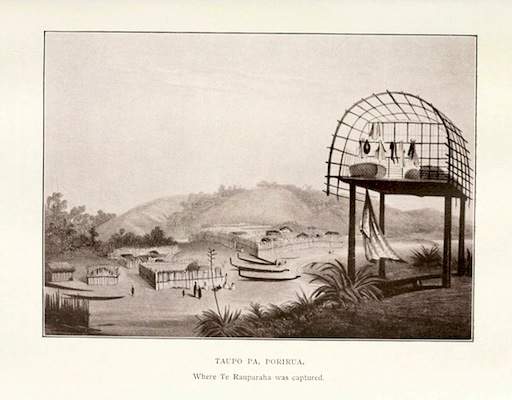
TAUPO PA, PORIRUA. Where Te Rauparaha was captured.
"After Mr. Tuckett had gone to Nelson," said Rauparaha, "we continued our planting, till one morning we saw the Victoria (the Government brig). Then were our hearts relieved, for we thought Mr. Spain and Mr. Clarke had come to settle the question of our lands. Being scattered about on the different places on the river, we took no further notice, expecting a messenger to arrive from Mr. Spain; but a messenger came up to say that it was an army of English, and that they were busily engaged in cleaning their arms and fixing the flints of their guns. They met Puaha, and detained him prisoner. They said, 'Where are Rauparaha and Rangihaeata?' Puaha said, 'Up the river.' After Puaha and Rangihaeata arrived, we consulted as to what we should do. I proposed going into the bush, but they said 'No, let us remain where we are: what have we done that we should be thus beset?' The Europeans slept some distance from us, and, after they had breakfasted, came on towards us in two boats. We remained on the same spot without food. We were much alarmed. Early in the morning we were on the look-out, and one of the scouts, who caught sight of them coming round a point, called out, 'Here they come! here they come!' Our women had kindled a fire and cooked a few potatoes that we had remaining, and we were hastily eating them when they came in sight. Cotterell called out, 'Where is Puaha?' Puaha answered, 'Here I am, come here to me.' They said again, 'Where is Puaha?' Puaha again saluted them. Cotterell then said, 'Where is a canoe for us to cross?' Thompson, Wakefield, and some other gentlemen crossed over with a constable to take me, but the greater number stopped on the other side of the creek. Thompson said, 'Where is Rauparaha?' I answered, 'Here.' He said, 'Come, you must come with me.' I replied, 'What for?' He answered, 'To talk about the houses you have burnt down.' I said, 'What house have I burned down? Was it a tent belonging to you that you make so much ado about? You know it was not; it was nothing but a hut of rushes. The materials were cut from my own ground; therefore I will not go on board, neither will I be bound. If you are angry about the land, let us talk it quietly over. I care not if we talk till night and all day to-morrow; and when we have finished, I will settle the question about the land!' Mr. Thompson said, 'Will you not go?' I said 'No,' and Rangihaeata, who had been called for, and who had been speaking, said so too. Mr. Thompson then called for the handcuffs and held up the warrant, saying, 'See, this is the Queen's book, this is the Queen to make a tie, Rauparaha.' I said, 'I will not listen either to you or your book.' He was in a great passion; his eyes rolled about and he stamped his feet. I said I would rather be killed than submit to be bound. He then called for the constable, who began opening the handcuffs and advancing towards me. Mr. Thompson laid hold of my hand. I pushed him away, saying, 'What are you doing that for?' Mr. Thompson then called out 'Fire!' The Europeans began to cross over the creek, and as they were crossing they fired one gun. The women and children were sitting round the fire. We called out, 'We shall be shot,' After this one gun, they fired a volley, and one of us was killed, then another, and three were wounded. We were then closing fast; the pakehas' guns were levelled at us. I and Puaha cried out, 'Friends, stand up and shoot some of them in payment.' We were frightened because some of them were very close to us. We then fired; three of the Europeans fell. They fired again and killed Rongo, the wife of Rangihaeata. We then bent all our energy to the fight, and the Europeans began to fly. They all ran away, firing as they retreated; the gentlemen ran too. We pursued them and killed them as we overtook them. Captain Wakefield and Mr. Thompson were brought to me by the slaves, who caught them. Rangihaeata came running to me, crying out, 'What are you doing, I say?' Upon which some heathen slaves killed them at the instigation of Rangihaeata; neither Puaha nor the Christian natives being then present. There was no time elapsed between the fight and the slaughter of the prisoners. When the prisoners were killed, the rest of the people were still engaged in the pursuit, and before they returned they were all dead. I forgot to say that during the pursuit, when we arrived at the top of the hill, Mr. Cotterell held up a flag and said, 'That is enough, stop fighting!' Mr. Thompson said to me, 'Rauparaha, spare my life.' I answered, 'A little while ago, I wished to talk to you in a friendly manner, and you would not; now you say, 'Save me,' I will not save you. It is not our custom to save the chiefs of our enemies. We do not consider our victory complete unless we kill the chiefs of our opponents. Our passions were much roused, and we could not help killing the chiefs."
At the conclusion of Rauparaha's address, Captain Fitzroy desired time to reflect upon what he had just heard, and, at the expiration of half-an-hour, he announced his decision as follows:—
"Now I have heard both sides, I have reflected on both accounts, and I am prepared to give my judgment. In the first place, the English were wrong; they had no right to build houses upon lands to which they had not established their claim—upon land the sale of which you disputed; on which Mr. Spain had not decided. They were wrong in trying to apprehend you, who had committed no crime. They were wrong in marking and measuring your land in opposition to your repeated refusal to allow them to do so until the Commissioner had decided on their claim. Had you been Englishmen, you would have known that it was wrong to resist a magistrate under any circumstances, but not understanding English law, the case is different. Had this been all, had a struggle caused loss of life in the fight—wrong and bad as it would have been to fight in the sight of God—I could not have blamed you so much as the English. The very bad part of the Wairau affair—that part where you were very wrong—was the killing of the men who had surrendered, who trusted to your honour as chiefs. Englishmen never kill prisoners; Englishmen never kill men who have surrendered. It is the shocking death of these unfortunate men that has filled my mind with gloom, that has made my heart so dark, that has filled me with sorrow; but I know how difficult it is to restrain angry men when their passions are aroused. I know you repent of your conduct, and are now sorry that those men were killed. As the English were very greatly to blame, as they brought on and began the fight, and as you were hurried into crime by their misconduct, I will not avenge their death."[172]
In arriving at this determination, Captain Fitzroy may have been actuated to some extent by considerations of expediency; for, had he decided in any other way, the reprisals of the English would undoubtedly have created a war with the natives, which the Government was not in a position at that juncture to carry to a successful issue. Therefore, to have provoked hostilities with Rauparaha would have meant the obliteration of all the settlements before the necessary reinforcements could have arrived. At the same time, there was a large measure of justice in the course he chose to adopt, which, in the calmer judgment of to-day, must receive the endorsement of all impartial men, as it did that of Lord Stanley, the Secretary of State for the Colonies, immediately the Governor's decision was known to the Home authorities. In his despatches on the subject, Lord Stanley made it clear that, in his opinion, Mr. Thompson and Captain Wakefield had needlessly violated the rules of English law, the maxims of prudence, and the principles of justice; and having thus provoked an indefensible quarrel with a barbarous tribe, they could not reasonably complain at the barbarities practised in the subsequent conflict. He was therefore satisfied that, in declining to make the Wairau massacre a subject for criminal proceedings, the Governor had taken a wise, though undoubtedly bold, decision. As might have been expected, the action of Captain Fitzroy in refusing to arrest the two chiefs created a tempest of ill-will against him amongst the settlers, but, on the other hand, the Maoris were overjoyed at the prospect of once more possessing the friendship of the pakeha, and instantly resumed a sociable demeanour towards the colonists. This feeling, upon the advent of Captain Grey as Governor, was gradually reciprocated by the Europeans, who in time came to recognise the folly of their fears, and the absurdity of their hostile attitude. In this way, the startling nature of the catastrophe, which had paralysed the efforts of the New Zealand Company and thrown a pall over the settlement of the whole Colony, began to lose its deadly effect, and the splendid scheme of setting a new gem in the British Crown was rescued from the disaster which threatened it.