Volume 2 — LETTER XXVII. (continued 2)
Reading edition
M. P. Huber, in his valuable paper in the sixth volume of the Linnean Transactions[819], states that he has seen large humble-bees, when unable from the size of their head and thorax to reach to the bottom of the long tubes of the flowers of beans, go directly to the calyx, pierce it as well as the tube with the exterior horny parts of their proboscis, and then insert their proboscis itself into the orifice and abstract the honey. They thus flew from flower to flower, piercing the tubes from without, and sucking the nectar, while smaller humble-bees or those with a longer proboscis entered in at the top of the corolla. Now from this statement it seems evident, that the larger bees did not pierce the bottoms of the flowers until they had ascertained by trial that they could not reach the nectar from the top; but that having once ascertained by experience that the flowers of beans are too strait to admit them, they then, without further attempts in the ordinary way, pierced the bottoms of all the flowers which they wished to rifle of their sweets.—M. Aubert du Petit-Thouars observed that humble-bees and the carpenter-bee (Xylocopa[820] violacea) gained access in a similar manner to the nectar of Antirrhinum Linaria and majus, and Mirabilis Jalappa; as do the common bees of the Isle of France to that of Canna indica[821]; and I have myself more than once noticed holes at the base of the long nectaries of Aquilegia vulgaris, which I attribute to the same agency.
My second fact is supplied by the same ants, whose sagacious choice of the vicinity of Reaumur's glass hives for their colony has been just related to you. He tells us that of these ants, of which there were such swarms on the outside of the hive, not a single one was ever perceived within; and infers that, as they are such lovers of honey, and there was no difficulty in finding crevices to enter in at, they were kept without, solely from fear of the consequences[822]. Whence arose this fear? We have no ground for supposing ants endowed with any instinctive dread of bees; and Reaumur tells us, that when he happened to leave in his garden, hives of which the bees had died, the ants then never failed to enter them and regale themselves with the honey. It seems reasonable, therefore, to attribute it to experience. Some of the ants no doubt had tried to enter the peopled as they did the empty hive, but had been punished for their presumption, and the dear-bought lesson was not lost on the rest of the community.
Insects, in the third place, are able mutually to communicate and receive information, which, in whatever way effected, would be impracticable if they were devoid of reason. Under this head it is only necessary to refer you to the endless facts in proof, furnished by almost every page of my letters on the history of ants and of the hive-bee. I shall therefore but detain you for a moment with an additional anecdote or two, especially with one respecting the former tribe, which is valuable from the celebrity of the relater.
Dr. Franklin was of opinion that ants could communicate their ideas to each other; in proof of which he related to Kalm, the Swedish traveller, the following fact. Having placed a pot containing treacle in a closet infested with ants, these insects found their way into it, and were feasting very heartily when he discovered them. He then shook them out and suspended the pot by a string from the ceiling. By chance one ant remained, which, after eating its fill, with some difficulty found its way up the string, and thence reaching the ceiling, escaped by the wall to its nest. In less than half an hour a great company of ants sallied out of their hole, climbed the ceiling, crept along the string into the pot, and began to eat again. This they continued until the treacle was all consumed, one swarm running up the string while another passed down[823]. It seems indisputable that the one ant had in this instance conveyed news of the booty to his comrades, who would not otherwise have at once directed their steps in a body to the only accessible route.
A German artist, a man of strict veracity, states that in his journey through Italy he was an eye-witness to the following occurrence. He observed a species of Scarabæus (Ateuchis pilularius?) busily engaged in making, for the reception of its egg, a pellet of dung, which when finished it rolled to the summit of a small hillock, and repeatedly suffered to tumble down its side, apparently for the sake of consolidating it by the earth which each time adhered to it. During this process the pellet unluckily fell into an adjoining hole, out of which all the efforts of the beetle to extricate it were in vain. After several ineffectual trials, the insect repaired to an adjoining heap of dung, and soon returned with three of his companions. All four now applied their united strength to the pellet, and at length succeeded in pushing it out; which being done, the three assistant beetles left the spot and returned to their own quarters[824].
Lastly, insects are endowed with memory, which (at least in connexion with the purposes to which it is subservient) implies some degree of reason also; and their historian may exclaim with the poet who has so well sung the pleasures of this faculty,
Hail, Memory, hail! thy universal reign Guards the least link of Being's glorious chain.
In the elegant lines in which this couplet occurs[825], which were pointed out to me by my friend Dr. Alderson of Hull, Mr. Rogers supposes the bee to be conducted to its hive by retracing the scents of the various flowers which it has visited: but this idea is more poetical than accurate, bees, as before observed[826], flying straight to their hives from great distances. Here, as I have more than once had occasion to remark in similar instances, we have to regret the want of more correct entomological information in the poet, who might have employed with as much effect, the real fact of bees distinguishing their own hives out of numbers near them, when conducted to the spot by instinct. This recognition of home seems clearly the result of memory; and it is remarkable that bees appear to recollect their own hive rather from its situation, than from any observations on the hive itself[827]: just as a man is guided to his house from his memory of its position relative to other buildings or objects, without its being necessary for him even to cast a look at it. If, after quitting my house in a morning, it were to be lifted out of its site in the street by enchantment, and replaced by another with a similar entrance, I should probably, even in the day time, enter it, without being struck by the change; and bees, if during their absence their old hive be taken away, and a similar one set in its place, enter this last, and if it be provided with brood comb contentedly take up their abode in it, never troubling themselves to inquire what has become of the identical habitation which they left in the morning, and with the inhabitants of which, if it be removed to fifty paces distance, they never resume their connexion[828].
If, pursuing my illustration, you should object that no man would thus contentedly sit down in a new house without searching after the old one, you must bear in mind that I am not aiming to show that bees have as precise a memory as ours, but only that they are endowed with some portion of this faculty, which I think the above fact proves. Should you view it in a different light, you will not deny the force of others that have already been stated in the course of our correspondence: such as the mutual greetings of ants of the same society when brought together after a separation of four months[829]; and the return of a party of bees in spring to a window where in the preceding autumn they had regaled on honey, though none of this substance had been again placed there[830].
But the most striking fact evincing the memory of these last-mentioned insects has been communicated to me by my intelligent friend Mr. William Stickney, of Ridgemont, Holderness. About twenty years ago, a swarm from one of this gentleman's hives took possession of an opening beneath the tiles of his house, whence, after remaining a few hours, they were dislodged and hived. For many subsequent years, when the hives descended from this stock were about to swarm, a considerable party of scouts were observed for a few days before to be reconnoitring about the old hole under the tiles; and Mr. Stickney is persuaded, that if suffered they would have established themselves there. He is certain that for eight years successively the descendants of the very stock that first took possession of the hole frequented it as above stated, and not those of any other swarms; having constantly noticed them, and ascertained that they were bees from the original hive by powdering them while about the tiles with yellow ochre, and watching their return. And even at the present time there are still seen every swarming season about the tiles, bees, which Mr. Stickney has no doubt are descendants from the original stock.
Had Dr. Darwin been acquainted with this fact, he would have adduced it as proving that insects can convey traditionary information from one generation to another; and at the first glance the circumstance of the descendants of the same stock retaining a knowledge of the same fact for twenty years, during which period there must have been as many generations of bees, would seem to warrant the inference. But as it is more probable that the party of surveying scouts of the first generation was the next year accompanied by others of a second, who in like manner conducted their brethren of the third, and these last again others of the fourth generation, and so on,—I draw no other conclusion from it than that bees are endowed with memory, which I think it proves most satisfactorily.
I am, &c.
END OF THE SECOND VOLUME.
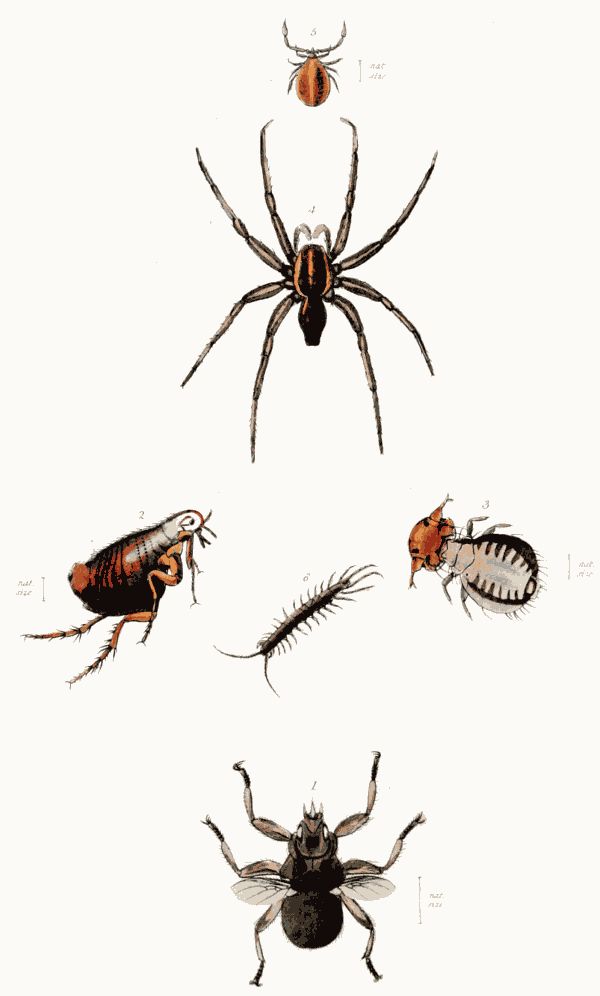
Plate V