William Le Queux (continued 4)
Reading edition
Then, when she shook my hand to go forth, she said—
“I thank you so much for all your kind words, Mr Urwin. I have at least to-day found a real friend.”
“I hope so,” I laughed. “Good-bye.”
“Good-bye; I hope you’ll soon be about again.”
Then the door closed and I was again alone.
I was heartily sorry for her, poor girl. The sudden flight of the old herbalist was, to say the least suspicious. That he had money and could pay the debt was certain. Without doubt he had disappeared on account of a too close attention from the police. Morris Lowry was, I knew, not very remarkable for paternal affection, therefore I feared that he had, as Lily suspected, left her at the mercy of the world.
A week later I was able to go down to my office again, and about six o’clock on the second day I had resumed my duties I accidentally met Boyd at the bottom of Fleet Street.
As merry as usual, we drank together at the Bodega beneath the railway arch in Ludgate Hill, but in reply to my eager questions he told me that absolutely nothing fresh had transpired regarding the curious affair at Kensington. I explained that I was still a frequent visitor at Riverdene, but up to the present had discovered nothing. I, of course, did not tell him all my suspicions, preferring to keep my own counsel and allow him to prosecute his inquiries after his own method. From his conversation, however, I saw that he had many other matters in hand, and from his attitude it seemed as though he had given up hope of obtaining a clue to the mystery.
On finishing our wine we rose from the barrel on which we had been sitting, and he having announced his intention to walk along to the bookstall in Ludgate Hill Station to buy a magazine for his wife—for he was just off home by motor-bus to Hammersmith—we strolled together through that short arcade leading to the station, at that hour crowded by hungry City men eager to get back to their suburban homes.
Into every door they surged, springing up the two staircases to the platform above as though they had not a further moment to live, while every few seconds the deep voices of the ticket-collectors cried the names of the stations from the City to Blackheath or Victoria, or from Herne Hill down to Dover. Amid this black-coated, silk-hatted, perspiring crowd a man suddenly brushed past me, rushing up the stairs two steps at a time, slipping through the barrier just as the door was slammed, and disappearing on to the platform.
“Hulloa!” cried Boyd, pressing my arm quickly. “See! Look at that man—the one with the bag, running up the steps. Do you see him?”
“Yes,” I answered, myself confounded.
“Well, that’s the fellow I saw in St. James’s Park, and who got away so neatly from Ebury Street—you remember?”
“That man!” I gasped, utterly amazed.
“Yes. We mustn’t lose sight of him this time. He can tell us something if he likes,” and without further word he dashed away after the man who had hurried to catch his train, leaving me standing alone in amazement.
That man who had brushed past I had instantly recognised as none other than Henry Blain, who for so many weeks was supposed to have been in Paris.
This fresh development was certainly both startling and mysterious.
Chapter Seventeen.
A Visit from Boyd.
Without a second’s hesitation I rushed up the steps after Boyd, but on gaining the platform found that a train had just gone out, and was at that moment disappearing across the bridge over the Thames. The detective, known to the ticket-collector as a police-officer, had been allowed to pass the barrier, and had evidently caught the same train as Blain.
There was certainly an element of deepest mystery in the fact that the unknown man who had kept the appointment in St. James’s Park, and had afterwards taken such elaborate precautions against being followed, should be revealed to be none other than the once purse-proud proprietor of Shenley. Quite apparent it was, too, that the object of Eva’s visit to the park was to meet him clandestinely, for what reason was a profound enigma. The more I revolved the strange events within my mind, the more absolutely bewildering they become.
True, I had made certain discoveries—discoveries which, rather than tending to throw light on the real author of the crime or its motive, only, however, increased the enigma and enveloped the woman whom I had grown to love so fondly in an impenetrable veil of suspicion.
Thoughts such as these filled my mind as, turning from the station in despair, I went back into the dust and turmoil of Fleet Street, crowded at that hour by tired thousands hurrying homeward. I loved Eva. Even though every proof I had obtained pointed to her complicity in the dastardly affair, she was still my idol. I thought daily, hourly, only of her, refusing always to suspect her, and endeavouring to convince myself that the truths I had elicited had no foundation in fact.
Love is blind. When a man loves a woman as I loved Eva Glaslyn at that moment, nothing can turn aside his passion. I verily believe that if at that hour I had stood by and seen her in the dock at the Old Bailey, condemned as a murderess, my affection for her would have been none the less. I lived for her alone. She was all that was dearest in the world to me. Mary Blain had, no doubt, noticed my infatuation, yet she had said nothing, she herself being, I believed, in love with Dick. At least I could congratulate myself that we had mutually agreed to allow the past to fade from our remembrance.
Nevertheless, when I thought of Eva, and told myself how passionate was my affection and how ardent my feelings towards her, the ogre of suspicion would sometimes arise and cause me to pause in my ecstatic dreamings. Had she not stiffened strangely, and refused to reciprocate my love? Had she not point-blank told me that we could never be more than friends? Had she not, indeed, herself hinted at her own guilt in that strange sentence which had fallen from her lips?
As I passed up Fleet Street that evening, jostling with the crowd, I thought of these things, and was plunged into gloom and uncertainty. The statement of old Lowry was one of which I felt in duty bound to obtain proof. Yet how? He had declared that a woman exactly resembling her had purchased a certain drug which could be required for one purpose alone, while a secret attempt had been made to take my life—by whom I knew not. Sometimes, in moments of despair, I entertained deep suspicions of her, but always I found my love in the ascendancy, and ended by refusing to believe the evidence which I had so diligently and patiently collected.
For months Scotland Yard had had the matter in hand, but discovering nothing, had allowed it to drop. Of course, in face of the statement made by the landlord of the house in Phillimore Place, Boyd was ever anxious to question Mrs Blain, but had wisely left this to me. And how had I succeeded? Only in making discoveries which, although startling in themselves, increased the mystery rather than solved it.
Even at that moment the identity of the victims remained still unknown. They were lying in nameless graves in Abney Park Cemetery, having been buried by the parish. The Blains alone could give us information as to who they were and who was the unnamed scientist whose discovery was now creating such a stir throughout Europe. Curious it was that he did not come forward and claim the discovery as his own, for he must have read accounts of it in the papers. My own theory in this matter was that he was unable to communicate with the Royal Institution for one simple reason, namely, that he was dead—that he was the man whom we found lying lifeless with that strange mascot, the penny wrapped in paper, in his pocket.
I walked along to Wellington Street, where I called in to see my friend Crutchley, one of the sub-editors of the Morning Post, who had just come on duty and was preparing for his night’s work. In the offices of the morning papers activity begins when tired London takes her ease, for their night is as day, until at dawn the staff, weary after hours of work by electric light in stifling rooms, go forth chilled and jaded to their homes to sleep while the world works. For half an hour I sat in his den, where the table was already piled with telegrams and flimsy, while he, with coat off, shirt-cuffs turned up, and a cigarette in his mouth, sighed, sharpened his big blue pencil, and, as he chatted, commenced to “slaughter” wordy descriptions by too eloquent reporters. The world wants news, not “gas,” is the motto of every working sub-editor. The public prefer facts without “padding,” and to cut out the latter is the duty of the man who, from the sub-editorial chair, decides upon what shall appear and what shall be omitted, a duty which requires the greatest care and judgment. When I left him I recollected that Dick had gone to some place down in Essex for the Comet, and would not return to eat the diurnal steak in company. Therefore I wandered aimlessly along the Strand, and turned into a restaurant, afterwards spending the evening at the theatre.
Nearly three weeks went by and I heard nothing of Boyd, although I had written to him. At nearly ten o’clock one night, however, when I had returned to Gray’s Inn alone, I found the detective standing in the half-light against the mantelpiece.
“Bad luck the other night,” he said, after we had exchanged greetings.
“What, didn’t you follow him?” I cried, surprised.
“No, that’s the devil of it,” he exclaimed in a tone of bitter disappointment, sinking into a chair. “You’ll remember that that platform at Ludgate Hill is an island one, and just as I got through the barrier a train on the other side was moving off to Snow Hill and Moorgate Street, while one to Blackheath was just on the point of starting in the opposite direction. I, of course, jumped into the latter, feeling sure he’d be going out of town.”
“And you found out your mistake too late?”
“I examined all the carriages at Loughborough Junction, but there was no sign of him. He evidently took the other train.”
“Unfortunate,” I answered, then sat for a few moments in calm reflection.
“Unfortunate!” he echoed. “It’s more than that. We seem foredoomed to failure in this affair. I’ve had three men on the job ever since, but with no result. Even the ‘narks’ know nothing. But,” he added, “when I pointed him out you seemed to know him. Am I right?”
I hesitated, wondering whether to tell him all the facts as I knew them and obtain his assistance in my further inquiries. It struck me that he, a professional investigator of crime, shrewd, clear-headed and acquainted with all the methods and subterfuges of evil-doers, might suggest some other means which had not occurred to me. I had hitherto been deterred from making any explanation of my discoveries and suspicions on account of my strong love for Eva, but now the idea took possession of me that if I explained the whole to Boyd and told him of my deep affection for her, we might work together, and perhaps at length obtain some solution of this most intricate of problems. I was sick with the giddiness of one who falls from some great height. I had lost my hold upon the dreams and hopes of life.
“You’re quite right, Boyd,” I said, handing him the cigarettes. “I know that man.”
“Who is he? He looks rather gentlemanly. That shabby get-up of his was a fake, I’m sure.”
“Yes,” I responded. “He’s a man pretty well-to-do. His name is Blain, and he is the husband of Mrs Blain, whom, you recollect, is supposed to have taken the house in Phillimore Place.”
The detective gave vent to an unwritable exclamation.
“Blain!” he echoed, his face betraying a look of amazement, and pausing with a lighted vesta in his hand. “Well, that’s indeed a facer!” Then he added: “He must, in that case, know something of the matter as well as his wife.”
At that moment there was a tap at the door of the sitting-room, and old Mrs Joad entered with a letter which, she said, had come by the last post and she had forgotten to give it to me.
By the writing I saw it was from Eva, and eagerly read it. It was a brief note to say that her mother had been called away to her brother in Inverness, who was seriously ill, that The Hollies was closed, and that she had accepted an invitation to remain the guest of the Blains until Lady Glaslyn’s return.
I handed the note to the detective without comment.
“Well,” he exclaimed, looking up at me when he had read it, “there’s nothing very fishy about that, is there?”
Then I recollected that he was in ignorance of my suspicions. Yet I loved Eva with all my soul and held back from placing any facts in the hands of this man who, with ruthless disregard for my affection or my feelings, would perhaps arrest her for complicity in the crime. And yet as I sat before him, watching his face through the blue haze of cigarette smoke, I felt impelled to seek his aid, for this tangled chain of recent events had utterly bewildered and unnerved me. I was not yet strong again after the strange seizure which had so puzzled the doctor, and a sense of gloom and despair had since overwhelmed me, arising perhaps from the constant suspicion that a secret attempt had been made upon my life.
To remain longer in that state of uncertainty was impossible. I felt I should go mad if I did not make some further determined effort to ascertain the truth. Some one, whom I knew not, had attempted to kill me. And why? There could be but one reason. Because I had succeeded in placing myself upon the actual track of the assassin. An attempt, cowardly and dastardly, had been made upon me, therefore I had every right to seek the aid of the police to discover its author.
This argument decided me, and casting my cigarette into the grate, I asked Boyd to give me his attention while I related to him all that I had discovered.
In an instant his free-and-easy manner changed, and as I spoke he sat leaning towards me, attentively listening to every word, but hazarding no remark. Without attempting to conceal anything, I explained to him first of all my great love for the woman who was under such terrible suspicion, and then as I narrated our conversation when alone on the river, and repeated her curious response to my declaration of love, he knit his dark brows seriously and gave vent to a grunt indicative of doubt. He was no blunderer, this detective. Unlike the majority he was well-educated, speaking French and Italian fluently, an adept in the art of disguise, a man who formed very careful theories, and whose appearance was never that of an agent of police. One would rather have taken him for a well-to-do Jew, or perhaps some prosperous City man of foreign extraction, for his dark complexion and aquiline features gave him an un-English appearance, and his invariable spruceness in dress accounted for his success in following criminals, who never dreamed that the smart, well-dressed gentleman of perfect manner was actually an emissary from Scotland Yard. His knowledge of foreign languages had caused him to be entrusted with numbers of very important inquiries political and criminal, and in tracking the guilty he had paid flying visits to nearly all the Continental capitals.
In his sharp eyes there was a strange glitter, I thought, as without interruption I told him what I knew. I advanced no theories whatever, but merely laid before him the plain unvarnished truth. Then, when I had finished, I said—
“Now, first of all, recollect that whatever may be the result of our inquiries I will do no harm whatever to the woman I love. Understand that entirely.”
“I quite understand,” he said gravely, speaking for the first time. “That’s only natural. But the difficulties in our way appear almost insurmountable.”
“Well?” I asked anxiously, “what is your opinion, now that I have told you everything?”
He shook his head, puffed thoughtfully at the fresh cigarette he had just lit, and then contemplated it thoughtfully.
“I have no opinion at present,” he responded. “One might form half a dozen theories upon these facts, all equally wide of the mark.”
“Then how are we to act?” I asked in dismay.
He raised his dark eyebrow’s in gesture of bewilderment. Then he gazed gravely in my face.
“Look here, Boyd,” I continued, “I love Eva Glaslyn, and to you I make no secret of it whatsoever. But at all hazards I mean to ascertain the truth.”
“Even at the risk of convicting her?” he inquired, looking across at me quickly.
“Convicting her!” I echoed. “Then you really entertain the same suspicion as myself?”
“We may have suspicions without forming any theories,” he responded calmly. Then he added, in a tone of regret, “It’s certainly a thousand pities that you love her.”
“Why?”
“Upon your own showing she appears to have very little regard for you.”
“How?”
“Well,” he answered slowly, “there’s no doubt that the other day an attempt was made upon your life.”
“And you suspect her?”
“We can suspect no one else,” he answered.
“According to that old herbalist’s statement she had purchased a certain drug of him. What could an innocent young lady require with this unnamed drug if not to administer it to some one she wanted to get rid of?”
“But she has no object in ridding herself of me,” I urged.
“Of that I’m not quite so sure, my dear fellow,” he observed, after a brief pause. “Recollect that on the morning when she went to St. James’s Park in order to meet, for some mysterious purpose, the man whom we now know was old Mr Blain, she met you face to face. We have no idea what her actions were previously, but she may have believed that you had been spying upon her; therefore, on recognising you when you were formally introduced at Riverdene, she conceived a plan for getting you out of the way. It was with that object very possibly that she made the secret purchase at the herbalist’s.”
“No, Boyd, I can’t believe it of her,” I said quickly. “I won’t believe it!”
“Very well,” he said in the same calm tone as before. “But there’s still another fact extremely puzzling, and that is why this man Lowry should have left in such a hurry. I must inquire at the Carter Street Police-Station, the district wherein he lived, and see whether there was anything against him. By the way,” he added, “does your friend Cleugh know the whole of these facts you’ve explained to me?”
“No, not the whole—only some.”
“Does he know that you’ve declared your love to Lady Glaslyn’s daughter and been refused?”
“No.”
“Then don’t tell him,” said the detective.
“I believe that the reason of his sudden weariness of Lily Lowry’s society is due to the fact that he loves Mary Blain.”
“All the more reason, then, why he should in future remain in entire ignorance of whatever facts we may elicit.”
Then he paused, furiously consuming his cigarette and taking a long draught of the whisky-and-soda I had mixed and placed at his elbow.
“This is really a most remarkable mystery, Urwin,” he exclaimed at length, twisting the plain gold ring upon his finger, a habit of his when pondering deeply. “There seem a thousand complications. It’s absolutely the most astounding case that I’ve ever had in hand. Even Shaw, our superintendent at the Yard, a man whose deep-rooted conviction is that we never need fail if we really take an interest in an inquiry, acknowledged to me the other day that he could see no way to a clue. Of course, we might question Mrs Blain, or even arrest Blain himself on suspicion if we could find him again. But whoever is guilty has taken such careful precautions to obliterate every trace of a clue that both the superintendent and myself are agreed that the interrogation of either of the Blains would only result in defeating our ends.” That was exactly my own opinion. I had many times wondered why the police had not made inquiries of Mrs Blain on account of the statement by the landlord at Kensington, but it was now plain that the Director of Criminal Investigations, the greyheaded, loud-voiced, old gentleman whom I knew quite well at Scotland Yard, had decided otherwise.
“But why are you so anxious that my friend Cleugh should remain in ignorance of our movements?” I inquired.
“You say that he loves Mary Blain,” answered Boyd. “He might in that case drop some unintentional hint to her of the direction of our inquiries. This matter, to be successful, must be entirely a secret between ourselves—you understand? To-day we’ve made a discovery—the identity of the man who threw some object into the lake—and it puts a rather fresh complexion upon the affair, even though it further complicates it considerably. You said that his wife has all along told you that her husband was in Paris—I think?”
“Yes,” I responded. “She said he was there in connexion with some company which he was trying to promote.”
“And all along he has been in London—in hiding.”
“He may have just returned from Paris,” I suggested. “Recollect that I’ve not been to Riverdene for some little time.”
“No, my dear fellow,” Boyd said. “His ingenuity in eluding us in Ebury Street showed that he had already prepared a snug hiding-place for himself before that tragedy at Phillimore Place. Besides, the other evening his clothes showed an attempt at disguise—didn’t they?”
“Certainly. He’s very smartly dressed always; indeed, rather a fop in his way.”
“Depend upon it that he’s never dared to set foot outside London all this time. He knows well enough that the Metropolis is the safest place in the whole world in which a criminal may conceal himself. Only a bungler attempts to get away abroad.”
Silence again fell between us. The quiet was unbroken save for the slow ticking of the clock upon the mantelshelf. Of a sudden, with a rather curious glance, he bent forward to me, eagerly saying—
“Now in this affair we must be perfectly candid with each other. You must conceal nothing from me.”
“I have concealed nothing,” I protested, surprised at his curious attitude, as though he held me in some suspicion.
“I don’t allege that you have,” he answered. “But I want you to answer truthfully a question which is of highest importance. I want you to tell me whether, on the afternoon of the day you were called by Patterson to Kensington, your friend Cleugh was here, at home.”
“No, he certainly wasn’t. I arrived home first, and he came in perhaps ten minutes or a quarter of an hour later than usual,” I answered, wondering what connexion this could have with the inquiry.
“And after you made the discovery you did not telegraph or communicate with him in any way? I take it that you were surprised to meet him in that house.”
“Certainly I was,” I responded. “But he had an appointment with Lily Lowry, and finding that she could not keep it, he came along to Kensington to ascertain the nature of the event about which Patterson had wired to me.”
The detective’s features relaxed into a strange smile.
“Would you be surprised then to know that your friend never called at the Police-Station on that evening, but went straight to Phillimore Place and there joined me while you were absent inquiring of the neighbours? That very evening I inquired of the constable on duty at the door of the station, and of others, all of whom told me that no one had called to inquire for Patterson except yourself.”
“That’s certainly extraordinary,” I said in wonderment.
“Yes,” he observed mechanically. “It’s a very curious fact; one which appears to prove that he knew something more of the mysterious occurrence than he has admitted—in fact, that he was aware of it long before we were.”
“What!” I gasped, gazing at my companion in alarm. “Surely you don’t mean that you suspect Dick of having had any hand in the affair?”
Then, at that instant, I recollected how, when I had received the telegram on that memorable evening, his face had suddenly changed, and his hand had trembled.
Chapter Eighteen.
“You will never Know—Never!”
Dick returned about eleven, and shortly afterwards Boyd swallowed another whisky-and-soda and left.
I thought my friend started slightly at finding the detective with me, but he betrayed not the slightest annoyance. Indeed, he himself started the discussion regarding the mystery, appearing in no way loth to discuss it in all its phases.
The detective’s suspicion was certainly a startling one, and of course accounted for his anxiety that Dick should in future remain in utter ignorance of our actions. When Boyd had gone he at once commenced to question me upon what theories he had expressed, and in what direction he was prosecuting inquiries. Although I would not allow myself to suspect my best friend, I nevertheless preserved the silence which Boyd had imposed upon me, evading giving him direct answers, preserving the secret of the identity of the man seen in St. James’s Park, and managing to put aside his questions by a declaration that personally I was sick of the whole matter, for I felt that it would now ever remain a mystery.
That night, however, I remained awake many hours thinking fondly of Eva, and calmly revolving in my mind all that had fallen from the lips of Boyd. He, one of the most skilful officers in London, had formed no theory. He only entertained certain suspicions, vague perhaps, yet by no means groundless. I had not seen Eva since that day when the strange, incomprehensible attempt had been made to take my life, and a strong desire again possessed me to stroll at her side, to hear her voice, to hold her hand. Was it, I wondered time after time, that hand, so soft, slim and delicate, that had actually attempted to secretly take my life?
The detective had calmly reviewed all the facts I had explained, and, as a professional investigator of crime, had openly expressed a suspicion in the affirmative.
Often had I wondered what kind of woman was Eva’s mother, whom I had never met. That she was somewhat eccentric was evident from her daughter’s words on the last occasion I had visited Riverdene. I lay there thinking of Eva, scouting every suspicion which the detective’s words had aroused within me, until with the first streak of dawn I fell asleep and dreamed of her.
Next afternoon, without mentioning anything to Dick save the sending of a telegram to say I should not dine at home, I left my office half an hour earlier, and full of conflicting thoughts travelled down to Riverdene.
Having been informed by the servant that Mrs Blain and Miss Mary were absent in London shopping, but that Miss Glaslyn was at home, I was shown into the long, pleasant drawing-room which opened upon the wide lawn sloping to the river’s brink. The great bowls of cut flowers diffused a pleasant odour, and the books and papers lying in the cosy-corner, with its soft cushions of pale-blue silk, betrayed signs of recent occupation.
It was a low-ceilinged, comfortable apartment, cool and restful after the dust and glare of the white road outside.
In a few moments the door opened and Eva entered, fresh and charming in a cool dress of cream flannel, her sweet face illumined by a smile of glad welcome.
“This is quite an unexpected pleasure, Mr Urwin!” she exclaimed, rushing towards me gladly with outstretched hand. “I had no idea that you’d come down to-day. The Blains are up in town, you know. I should have gone, only I had a rather bad headache. We went up to Windsor yesterday with the Thurleys on their launch, and I suppose the sun upset me. It was unbearably hot.”
“Why do you persist in calling me Mr Urwin?” I asked in a rather reproachful tone, still retaining possession of her hand. “Cannot you call me Frank?”
She blushed slightly, and drew her hand forcibly away. Then motioning me to a seat she cast herself into a low armchair near me, stretching forth her tiny foot, neat in its silk stocking and patent leather shoe. She made no response to my suggestion, so I repeated it.
“Why should I call you by your Christian name?” she asked.
“Because I call you by yours, Eva,” I answered earnestly. “I really can’t bear this persistent formality.”
She smiled, a rather curious smile it was, I thought.
“So you’re staying as guest here?” I went on, after a moment’s pause.
“Yes,” she explained. “My Uncle Henry, in Inverness, is very ill and not expected to live; therefore they summoned mother by telegraph, with other members of the family. As the servants have had no holiday this year, she sent them away for a fortnight and closed the house, Mrs Blain having invited me here.”
“Have you heard from your mother?”
“Yes, I had a wire yesterday to say that she had arrived, safely,” she answered, not, however, without a second’s hesitation, as though she were debating whether or no to tell me the truth.
“And Mr Blain has not returned from Paris yet?” I asked.
“No,” she responded. “The Blains are talking of joining him next week, or perhaps the week after, and have invited me to accompany them. I should be delighted, for I love Paris.”
“You find the shops interesting?” I laughed.
“Yes,” she answered. “All women do, I suppose. At least I’ve met very few who, having been in Paris, haven’t hunted for bargains at the Louvre, the Printemps, or the Bon Marché. Paris is worth visiting if only for one’s hats, for you can often buy a hat for twenty francs exactly the same style and of better material than that for which you pay three or four guineas in Regent Street.”
“I’m not much of an expert in such things,” I laughed, nevertheless recollecting how curious it was that Blain remained still in London. Might not his wife and daughter have gone up that day to visit him in his hiding-place?
“But you’ve been awfully queer, I hear,” she said concernedly. “You really don’t look quite yourself even now. What has been the matter? We were all so concerned when we heard about it.”
Our eyes met. In hers there was a deep, earnest look as though she were really solicitous of my welfare, yet I fancied somehow that those clear blue eyes wavered beneath my steady, searching glance. She watched me, reading me as easily as she would have read black letters on a white page.
“I was taken suddenly ill—the heat perhaps,” I answered with affected carelessness. “I had run down, the doctor said. It was nothing very serious.” She gave vent to a perceptible sigh of relief, then smiling sweetly as she ever did, said: “Well, it is indeed a pleasure to welcome you here again to-day.” She still wore that brooch, the quaint little playing-card which had betrayed her visit to Morris Lowry. Its sight sent a strange thrill through me, for I remembered the object of her visit to that dark, dirty, obscure herbalist’s.
“The pleasure is mutual, believe me, Eva,” I answered, putting away from me instantly the gruesome thought oppressing me. “Through this whole month I have thought only of you.”
She sighed, in an instant serious. Then glancing back to assure herself that there were no eavesdroppers, she said, “It would be far better, Mr Urwin—Frank—if you could leave me and forget.”
“But I can’t,” I said, rising quickly and again taking her soft white hand. “You know, Eva, how deeply, how sincerely, how devotedly I love you; how I am entirely yours for ever.”
I spoke simply and directly what I felt; I was calmer than I had been when I rowed her beneath the willows’ shade.
“Ah, no!” she cried in a pained voice, rising to her feet with sudden resolution. “You really must not say this. I will not let you sacrifice yourself. I will not allow you to thus—”
“It is no sacrifice,” I protested, quickly interrupting. “I love you, Eva, with all my soul. One woman alone in all the world holds me beneath the spell of her grace, her charm and her sweetness. It is yourself. Every hour I think only of you; ever before me your face rises in my day-dreams, and in those moments when I see your sweet smiles I tell myself that no other woman can ever have a place in my heart. Ah! you cannot know how fondly I love you,” I said, raising the hand tenderly to my lips and imprinting a kiss upon it. “If you could only know you would never treat me with this cold, calm indifference.”
Her bosom rose and fell slowly, and she was silent. I fancied that she shuddered slightly.
At that moment my position struck me as an extremely strange one, declaring love to one whom an expert detective suspected of having made a cowardly attempt upon my life. Was it just? I asked myself. Yes, in this I was justified, for I loved her, even though I had more than once been inclined to agree with Boyd in his misgivings.
“I was not aware of any indifference,” she faltered at last, raising her great eyes, so clear and earnest, for an instant to mine. “I had merely urged you to reflect.”
“Reflection is unnecessary,” I answered quickly. “I know that I love you truly. That surely is sufficient.”
“It might be if I were free,” she responded in a low, hoarse voice. “But I tell you to-day, Frank, as I told you before, this love dream of ours is impossible of realisation.”
“Then you do reciprocate my love?” I cried, in joyous eagerness. “Come, tell me. Do not keep me longer in suspense.”
“I have already told you,” she answered in a low, intense voice. “Of what use is it to continue this painful discussion?”
“Of every use,” I cried in desperation. “Give me one word of hope, Eva. Tell me that some day you will try and love me better than you do now; that some day in the future you will become my wife. Tell me—”
“No! no!” she cried, snatching her hand away and receding from me. “No, Frank, I cannot—I will not lie to you.”
“Then can you never love me—never?” I cried despairingly.
“Never,” she answered hoarsely, and her answer struck deep into my heart. “I have sinned—sinned before God and before man—and love no longer knows a place in my heart,” and her fine head was bowed before me.
“Sinned!” I gasped. “What do you mean?”
“I am as a social leper,” she panted, raising her head and looking at me with wild, unnatural gaze. “If you knew the dark and awful truth you would shun me rather than kiss my hand. Yet you say you love me—you! who would have so great a cause to hate me if you knew the ghastly truth!”
“But,” I cried, wondering at these strange words, and with my suspicions again aroused, “I do love you, nevertheless, Eva. I shall always love you, I swear it, for my very life is yours.”
“Your life!” she echoed in a weird, harsh voice, as she stood, pale-faced, swaying before me, her hands clasped to her breast, her lips cold and white. “Yes,” she said, in a strange, half-hysterical tone. “Yes, it is true, too true, alas! that your future is in my hands. Only by a miracle have you come back to life, a grim shadow of a crime to taunt, to defy, to denounce. Ah! Frank, you do not know the terrible truth; you will never know—never!”
I was bewildered. Horror possessed me. The darkness of an irreversible fact spread over her and made her terrible to me. All must be given up. Conscience pronounced this dread decree and multiplied the pain a thousand times.
Destiny had once more taken me by the elbow.
Chapter Nineteen.
Eva Makes a Confession.
“Why may I not know the truth?” I asked the blanched and agitated woman before me. Her involuntary declaration that I had only returned to life by little short of a miracle was in itself clear proof that she was aware of the attempt made to assassinate me. I therefore determined to question her further and ascertain whether Boyd’s grave suspicion had any absolute foundation. “You know, Eva,” I went on, standing before her with my hand upon her shoulder in deep earnestness, “you know how strong is my affection; you know that you are all the world to me.”
Often during my many visits to that riverside house, so cool and peaceful after the busy turmoil in which fate compelled me to earn my bread, I had spoken of my love for her, and now in my desperation I told her that I could not leave the woman whom I had so long worshipped in the ideal, whom I had instantly recognised as being the embodiment of that ideal, of whose presence I could not endure to be deprived even in thought.
She stood silent, with her back to the table, looking into my eyes while I told her these things. A ray of sunlight tipped her auburn hair with gold. Sometimes she would seem to yield to a kind of bliss as she listened to my avowal; to forget all else than ourselves and my words. At others a look of anguish would suddenly cloud her features, and once she shuddered, pressing her hands to her eyes, saying—
“Frank, you must not! Spare me this. I cannot bear it! Indeed I can’t.”
Sometimes, in the days that had passed, when I had spoken of my love, joy and pain would succeed each other on her face; indeed, often they would be present at the same moment. From the look of complete abandonment to happiness that sometimes, though never for long, shone on her features when we had idled up that shady, picturesque backwater, where the kingfishers nested, I felt that she loved me, and that eventually that love would gain the victory. Thus, continually, I tried to elicit an expression of her feelings in words. Sweet to me as was the confession of her looks, I sought also a confession of speech.
Alas! however, she seemed determined to give me no single word of encouragement.
“But why,” I asked, as she stood there with bent head, her hand toying nervously with her rings, “why is it that when I speak of what most occupies my heart you become silent or sorrowful?”
She smiled, a strange, artificial smile, and for an instant her clear blue eyes—those eyes which spoke of an absolute purity of soul—met mine, as she replied—
“Can a woman explain her caprice any more than a man can understand it?”
Without heeding this evasion I went on—
“Is it that you are already pledged to marry some other man?”
“No,” she answered, quickly and earnestly.
“Then it is because you do not wish me to love you,” I observed reproachfully.
Her look startled me, for it contained besides a world of grief and pity, something of self-reproach. She regarded me strangely, first as if my words were a welcome truth, then, while her brow darkened, a mental anguish forced itself into her expression.
“You were mad to come here to me,” she said, with a quick, apprehensive look. “If you knew the truth you would never again cross the threshold of this house.”
“Why?” I demanded, in an instant alert.
“For a reason that is secret,” she responded with a shade of sadness.
That ring of earnestness in her voice it seemed impossible to counterfeit. Puzzled, I gazed at her, striving to read her countenance. Her head was bent, her colour changing; do what she would she could not keep the blood quite steady in her cheek.
“But may I not know, Eva?” I implored. “Surely you will not refuse to warn or guide one who is so entirely devoted to you as I am?”
“I cannot warn you, except to say that treachery may be sweetly concealed, and danger lurk where you may least suspect its presence.”
“You wish to place a gulf between us,” I cried impatiently. “But that’s impossible. I cannot rest without you; I am drawn to you as though by some power of magic. I am yours in life, in death.”
“Ah, no!” she cried suddenly, putting up her hands to her face. “Speak not of death. You are making vows that must ere long be broken,” and she sighed deeply.
Was not her attitude, standing there pale and trembling, the attitude of a guilty woman who feared the revelation of her crime? I looked again at her, and becoming convinced that it was, I regarded her with inexpressible scorn and love, horror and adoration. She seemed to have changed of late. She pondered over my words, weighing them without any idle misleadings of fancy. Did she never dream as she had done when we first met?
“Why must my vows be broken when my love for you is so fervent, Eva?” I demanded, in a voice a trifle hard, I think.
She shuddered and gave a gesture of despair as if there were, indeed, no defence for her. A great darkness was over my mind like the plague of an unending night.
“I have warned you,” she responded, in a strange low tone. “If you really love me as you say you do, remain away from this house.”
“Why are you so anxious that I should not visit you?” I demanded, puzzled. Then I added: “Of course in order to gain your love I am prepared to accept any conditions you may propose. If I do not again come here, will you meet me in London?”
“I can say nothing of the future,” she answered slowly. “For your own sake—indeed, for mine also—do not come here again. Promise me, I beg of you.”
This request was the more curious in the light of recent events. Was it that she could not bear me to kiss the hand that had attempted to slay me?
“All this is very strange, Eva,” I said with a sudden seriousness. “I cannot understand your attitude in the least. Why not be more explicit?”
The heart of man is an open page to women. Love, though greatest of all selfish ecstasies, must yet have self-forgetfulness. She had none. She glanced at me and seemed to divine my thoughts. She cast a furtive look across the room to the lawn beyond, and I read on her face the birth of some new design.
“I have been quite explicit,” she laughed, with a strenuous attempt to preserve her self-control. “I merely give you advice to keep away from this house.”
“Yes, but you give me no reason. You do not speak plainly and openly,” I protested.
“One cannot speak ill of those of whose hospitality one is partaking,” she answered with a calm smile. “Is it not sufficient for the present that you are warned?”
“But why?” I demanded. “I am always a welcome guest here.”
Again she smiled, with a strange curl of the lip, I thought.
“I do not deny that,” she answered. “Have I not, however, already pointed out that treachery may be marvellously well concealed?”
Did she really warn me of the danger of associating with these intimate friends of hers merely because in her heart she really loved me? or had she some ulterior motive in getting me out of the way? She was hand-in-glove with this suspected family, therefore the latter seemed the theory most feasible.
Yes, she was undoubtedly playing me false.
A new thought suddenly arose within me, and with my eyes fixed upon her I said, in a voice hard and determined—
“Eva, just now you gave utterance to a remark which is to me full of meaning. You said that I had escaped death by little short of a miracle. True, I have.” Then I paused. “Yet, if the truth were told, have you not also escaped a swift and sudden end by means almost as miraculous?”
Her face blanched instantly, her mouth, half-opened, seemed fixed. She was unable to articulate, and I saw what an effect this speech of mine had upon her. She tottered to the table and laid her hand upon it in order to steady herself. Her eyes glared upon me for an instant, like those of some animal brought to bay.
Yet, with a marvellous self-control, her white face a moment later relaxed into a smile, and she replied—“I really don’t know to what you refer. In the course of our lives we have many hairbreadth escapes from death, for dangers are around us on every side.” By this I saw what a consummate actress she was, and was filled with regret that I had thus referred to the tragedy at Kensington, fearing lest this revelation of my knowledge should hamper Boyd in his inquiries. Through all she kept a calm and steady judgment that was remarkable.
“Reflect at leisure,” I responded, “and perhaps you will not find my words quite so puzzling as your own veiled references.”
“A few minutes ago,” she exclaimed reproachfully, “you declared that you loved me. Now, however, you appear to entertain a desire to taunt me.”
“With what?”
She hesitated, for she saw how nearly she had been entrapped. Every woman is a born diplomatist, so she answered—
“With having endeavoured to mislead you.”
“I only know that I love you, Eva,” I said in softer tones, again tenderly taking her hand. “I only know that I think of no other woman in all the world besides yourself. I only know that I cannot live without your love.”
Her bosom heaved and fell painfully, and from her large blue eyes tears sprang—quick, salt, bitter drops that burned her as they fell.
“Ah, no?” she cried protestingly. “Do not let us talk of that. Do not let us dream of the impossible.”
“Then you really love me?” I cried in quick earnestness, bending over her, my arm about her slim waist.
But she shuddered within my grasp. Her frame was shaken by a convulsive sob, and gazing upon me with serious eyes she, in a low whisper, gave her answer.
“Alas! I cannot—I—I dare not!”
I drew back crushed and hopeless. Once again the strange thought possessed me that Mary Blain held her within her power; that although she actually loved me she feared the relentless vengeance of that woman who posed as her most intimate friend, who smiled upon us both, although in her heart was a fierce and jealous hatred.
Eva’s was a strange character. She seemed a brilliant antithesis—a compound of contradictions—of all that I most detested, of all that I most admired. Her whole character seemed a triumph of the external over the innate; even though she presented at first view a splendid and perplexing anomaly, there was yet deep meaning and wondrous skill in the enigma when I came to analyse and decipher it. What was most astonishing in Eva’s character was its antithetical construction, its consistent inconsistency, which rendered it quite impossible to reduce it to any elementary principles. The impression she gave was that of perpetual and irreconcilable contrast.
In those months I had known her she had enchanted me. Her mental accomplishments, her unequalled grace, her woman’s wit and woman’s wiles, her irresistible allurements, her starts of hauteur, her vivacity of imagination, her petulant caprice, her fickleness and her falsehood, her tenderness and her truth, all had dazzled my faculties and bewitched my fancy. She held absolute dominion over me.
My reference to that fatal night when I had discovered her apparently dead in that weird house in Kensington had utterly unnerved her. I had apparently, by those words, given her proof of the strong suspicion which she had entertained, and now she held aloof from me as from an enemy. Again and again Boyd’s forcible words recurred to me. Try how I would I could not place from me the increasing belief that she had actually given me that fatal draught on the last occasion when we met.
Yet, after all, she had my welfare at heart to some extent, or she would not utter this strange inexplicable warning; she would not have so pointedly told me that the family whose guests she was were my actual enemies. The latest passion of my love had long ago kindled into a quenchless flame, and again, after this declaration of fear which she had uttered, I repeated my inquiry as to its cause.
But she shook her head, and remained silent to all my entreaty, even though her panting breast plainly showed her agitation. Had she, I wondered, really perpetrated a deed of horror? Was she, although so pure-looking and so beautiful, one of those women with inexorable determination of purpose, an actual impersonation of the evil powers?
At her invitation we strolled together across the lawn to a shady spot at the river’s brink, where we sat in long wicker chairs, tea being brought to us by the smart man-servant. Again and again I sought to discover some truth from her, but she was ever wary not to betray either herself or those under whose roof she was now living. As I lounged there by her, gazing upon her neat-girdled figure, so graceful and striking in every form, I could not help reflecting that, in a mind not utterly depraved and hardened by the habit of crime, conscience must awake at some time or other, and bring with it a remorse closed by despair, and despair by death.
Had her conscience been awakened that afternoon? To me it seemed very much as though it had.
“How strangely you talk, Eva,” I said, when we had been conversing together a long time beneath the trees, and the sun was already sinking. “You seem somehow to entertain an extraordinary antipathy towards me.”
“Antipathy!” she echoed. “Oh, no, you are really mistaken. You ask me to love you, and I express myself unfortunately unable.”
“But why unable?”
She sighed, but was silent. Her eyes were fixed far away down the tranquil river which ran with liquid gold in the sunset.
From my lips there poured swift, eager, breathless, unconsidered words in all their unreason, all their wisdom, their nobility, their ignorance, their folly, their sublimity. Yet I meant to their very uttermost every syllable I uttered.
“Tell me now,” I urged. “You wish me to leave you without a single word of hope. You give me a negative reply without reason or explanation.”
“I have a reason,” she answered in a low, mechanical tone, a voice quite unusual to her.
“What is it?”
“I am a stern fatalist in principle and in action,” she responded.
“And is it that which prevents you from reciprocating my affection?”
“No,” she answered, shaking her head sadly, and glancing at her rings. “I know that happiness can never more come to me. To love would only be to increase my burden of remorse.”
“Remorse?” I cried, in a moment recollecting all the mysterious past.
“Yes,” she answered in a hard tone of melancholy and despair. “A remorse that arises from the pang of a wounded conscience, the recoil of the violated feelings of my nature, a horror of the ghastly past, a torture of self-condemnation strong as my soul, deep as my guilt, fatal as my resolve, and terrible as my crime.”
“Your crime!” I gasped.
She had at last confessed. I sat gazing at her absolutely dumbfounded. My brain seemed dead in me.
“Yes, my crime,” she responded, her face white and hard set, her clenched hands perceptibly trembling. “Now at least you are aware of the reason that I will not accept your love. I, the woman whom you love, am unworthy, degraded and perverted, a woman who would have suffered a thousand deaths of torture rather than have betrayed myself, but who is now without pity or fear, unconscious, helpless, despair-stricken, although still linked with my sex and with humanity. Death alone would be welcome to me as bridegroom.” Then panting, she added, rising to leave me: “No, Frank, this must all end to-day. I can never love you. It is utterly impossible. You cannot know—you will never know—how I suffer.”
She had gone from me. She was to me a thing terrible, and almost loathsome. Yet she was dear to me. I was ready to give my life to ransom hers.
She stretched out her hand and musingly touched mine. I shrank as if the contact burned me. She saw my involuntary gesture of aversion. It set her heart harder on the thing she meant to do.
Chapter Twenty.
A Night Adventure.
In the silent evening hour, as the dusk darkened and twilight slowly faded into night, I was conscious of a kind of fascination against which my moral sense rebelled, but from which there was no escape. We talked on, I striving ever to learn the truth, she careful to conceal it from me. I saw how unexpected but natural were her transitions of temper and feeling, noted the contest of various passions, the wild hurricane of resentment melting into tears, faintness and languishment, and endeavoured time after time, but always in vain, to obtain a further confession from her lips.
That she existed in deadly fear of some dread secret being revealed was vividly apparent, just as it was also clear that my ill-timed observation regarding her mysterious presence in that house of mystery at Kensington had placed her upon her guard, and proved to her a fact of which before she had no confirmation. Her airy caprice and provoking petulance, which had so attracted me when we had been first introduced, had been now succeeded by a mixture of tenderness with artifice, and fear with submissive blandishment. She quailed before me when I rebuked her tenderly for her lack of confidence in me, partly because of her female subtlety, partly owing to natural feeling.
Nevertheless, when I reviewed the situation, and calmly and deliberately reflected upon her attitude, I saw plainly that she regarded me as something more than a mere acquaintance, even though her character was so complicated that no one sentiment could exist pure and unvarying in such a mind.
Therefore, sadly, with a heavy feeling of non-achievement, I took a long and lingering leave of her, and was driven back to Shepperton Station by Simpson, my mind overflowing with puzzling thoughts. Great as was my hesitation to believe that her conscience was a guilty one, nevertheless her own words were now sufficient proof that my suspicions were not unfounded. Yet I loved her. I still adored her with all my soul, even though I had kissed the slim white hand that had sought to send me to the grave.
These and a thousand similar thoughts whirled through my bewildered brain as I sat back alone in the ill-lit railway carriage. Puzzled and baffled, I sat plunged in deepest melancholy and despair, when, on the train drawing up at the quiet, lethargic station of Hampton, the door of the compartment was suddenly flung open, and a well-known cheery voice cried—
“Hullo, Urwin! Get out here. I want to speak to you.”
I roused myself instantly, recognising Boyd standing on the platform in the semi-darkness. With an expression of surprise at such a meeting I jumped out and joined him, he explaining that he had come down from Waterloo with the object of finding me, and had waited at Shepperton Station for my arrival there. He, however, had not spoken to me, lest the man Simpson should chance to mention the fact at Riverdene.
“But why are you down here?” I inquired surprised.
“Well,” he answered in a low voice, “we’ve got a piece of most secret investigation before us to-night. I’ve waited for your assistance. We are going to search The Hollies.”
“Search the Hollies?” I echoed.
“Yes,” he answered. “You’ll remember Miss Glaslyn’s letter to you, stating that the house was closed and the servants are away on holiday. Therefore, now’s our time. We must, however, act so that Lady Glaslyn and her daughter have no suspicion that the place has been overhauled. I obtained a search-warrant from Sir John Gibbons, the chief of the local bench, this morning, and now we’ll just satisfy our curiosity.”
“But the place is locked up, isn’t it?” I suggested, amazed at this sudden resolve.
“Of course. We must get in how we can, only being careful not to attract the attention of any neighbours, and to leave no trace behind that intruders have entered.”
“Then we are to go to work like burglars?” I observed, smiling.
“Exactly,” he answered.
We had now left the station, and were walking along an ill-lit path which skirted the railway until we gained the high road leading into Old Hampton. He explained the precautions he had taken, namely, to tell the constable on the beat of our intentions, and imposing upon him secrecy, and also to arrange for the local plain-clothes officer to be on duty in the vicinity. His proposal seemed to possess all the elements of adventure, therefore, notwithstanding my hesitation to commit any act which might further implicate the woman I loved, I expressed myself eager and ready to accompany him.
Nine o’clock chimed from the square old tower of Hampton Church, that landmark so well-known to those who frequent the river, and Boyd declared that it was too early to commence operations. People were about, and we might be observed. Therefore we entered that old-fashioned inn where the ancient sign is still suspended from a beam across the road, a hostelry much patronised by boating-parties, who there replenish their hampers, and entering the billiard-room we whiled away the time, playing and gossiping with a couple of tradesmen, who, judging from their pronouncements, were local notabilities, perhaps District Councillors.
We remained until the landlord called “Time, gentlemen, please!” then lighting our cigars went forth, strolling through the quaint old-world village, and skirting the long, high wall of Bushey Park towards Lady Glaslyn’s. The night was dark and overcast, a gusty wind had sprung up precursory of rain, and in our ears sounded the hum of the telegraph wires. The weather favoured us. For such an excursion Boyd did not care for a perfectly still night.
At length, when we had been walking perhaps a quarter of an hour along the dark, deserted road, a man, bearded and rather shabby-looking, suddenly emerged from the shadow of the wall and greeted Boyd with the policeman’s password—
“All right, sir.”
“Are the things there?” Boyd inquired.
“Yes, sir. I’ve put the lamp, the jemmy and the keys under a laurel bush on the left of the back door.”
“Well,” said my friend, “I think you’d better come with us. We may have some difficulty in getting in.”
“Very well, sir,” the man answered, and continued to walk by our side. He was smoking a pipe, and as we neared the house he knocked out the ashes and placed it in his pocket.
“No dogs there, I hope?” Boyd said, addressing him.
“No, sir. None.”
I confess to feeling a thrill of excitement, for the business of “breaking and entering a dwelling-house” was entirely new to me. The Hampton Road is ill-lit, and after ten at night utterly deserted, therefore in our walk we met no one except the solitary policeman, who stood beneath a lamp and greeted Boyd with a low “All right, sir,” as we passed on towards The Hollies.
All was in darkness. Not a soul was about save ourselves and the policeman standing watchful and motionless beneath the street-lamp fifty yards away. The well-kept garden with its laurels, its monkey-trees and its old yews was shut off from the road by a high wall, in which was a pair of heavy iron gates giving entrance to the gravelled drive. These gates were locked and secured by a chain and formidable padlock, a fact which showed that to enter we must climb them. The houses on either side were of rather meaner order than The Hollies, and in one of them a light still showed in an upper window.
In order not to attract the occupiers of these houses we conversed in low whispers, and in obedience to the local detective’s suggestion climbed the gates one after another and carefully descended within the garden. On either side of the house extended walls some ten feet in height, with doors in them giving access to the rear of the premises, and again, guided by the plain-clothes man, we scaled this wall, a somewhat perilous process, it being spiked on the top. As it was, indeed, I made a serious rent in an almost new pair of trousers, much to Boyd’s amusement.
At last, when we were in the rear garden, our guide began foraging beneath a laurel bush and brought forth a dark lantern, a short, serviceable-looking jemmy, and a big bunch of skeleton keys.
“I examined the place this afternoon,” he explained. “This door is the only one locked from the outside, therefore if we can pick the lock we shall be able to enter and get away without leaving a trace.”
“Very well,” Boyd said impatiently. “Let’s get to work,” and taking the keys he went to the garden entrance and commenced work upon the lock, while his assistant lit and held the lantern.
Every effort, however, to open the lock proved a failure.
“It’s a Chubb, a Bramah, or one of those lever locks,” said Boyd, in a low tone, giving it up after he had tried all the keys in vain. “It won’t do to force the door, for that’ll betray us.”
“Why not try a window?” I suggested.
“No, sir,” said the plain-clothes man. “They’re all barred, I’m afraid.”
“But those on the first floor,” I suggested, looking up at one, evidently a landing window, over the door.
“We might try if we could only reach it,” Boyd said, laying down the keys upon the doorstep. “If we forced the catch we could screw it down again before we left.”
In order to discover something by which we might gain access to the window we all three crept carefully across the lawn and down the long old-fashioned garden to an outhouse, where, after some search, we found an old and rotten ladder, half the rungs of which seemed missing. This we carried back, and a few moments later Boyd, mounting, with a strong clasp-knife which he had taken from his pocket, began slowly working back the catch, until at last he was able to throw up the window and crawl in. Without a sound I followed, the local detective clambering in after me.
We found ourselves on the first floor landing, therefore, descending the stairs to the main hall, we lit the candles provided by the plain-clothes man, and after taking the precaution to let down the blinds of the front windows, commenced an active search of the drawing-room, that spacious old-fashioned apartment into which I had been shown when I had called. Our search, directed by Boyd, was careful and methodical; neither nook nor corner escaped him, although we replaced everything just as we found it. So large were the rooms that we found the lights we carried were not sufficient to give us proper illumination, therefore we sought the gas-meter, and after turning on the gas, lit jets in the various rooms. Fortunately all the windows were furnished with Venetian blinds, therefore we let them down and closed them, so that no light should be noticed outside.
An air of desolation hung about the place, and every sound we made echoed weirdly, for at dead of night all noise becomes exaggerated. The drawing-room yielded practically nothing, therefore we passed into a well-furnished morning-room, and thence to the dining-room, which we likewise thoroughly overhauled. None of these rooms bore any trace of the struggle with poverty which the innkeeper’s wife had alleged. Indeed, in the drawing-room was a fine grand piano of one of the best-known makers, together with several rare works of art. All the rooms bore signs of being the abode of a rich and cultured family, the old oak in the dining-room being, I noted, genuine, evidently antique, Italian, while the upholstery and carpets were of the first quality. On the walls of those ground-floor rooms were many examples of old as well as modern masters, one portrait hanging in the dining-room representing Eva herself, a half-length picture, undoubtedly from recent sittings, signed by an artist extremely well-known in London. In this room also were antique high-backed oak chairs, lined with old tapestry, the back and arms bearing armorial bearings embroidered in coloured silks, evidently the arms of the Glaslyns, for a similar device was upon the plate.
On ascending to the first floor we found the house to be of far larger proportions than we had imagined, for off a long, well-carpeted corridor opened quite a number of bed and other rooms, each of which we proceeded to inspect.
“We haven’t found a single thing below,” Boyd observed to me, as we entered the first of these rooms, evidently one of the spare bedrooms, for the place was very dirty and neglected in comparison with the other apartments. “Let’s hope we may come across something here.”
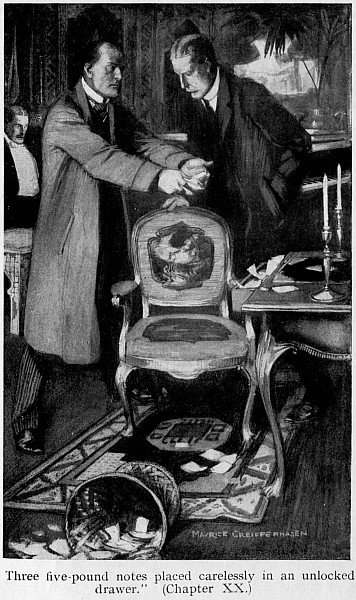
Nothing was locked, and five minutes sufficed to show us that no attempt had been made to conceal anything in any of the two chests of drawers, or in the wardrobe. So thoroughly did Boyd search that in each room he went around the wainscoting, tapping it with the jemmy and examining any part which appeared to be loose or movable. The next room, apparently Lady Glaslyn’s room, with a small dressing-room adjoining, we searched with redoubled energy, but beyond establishing the fact that her ladyship was not in want of money by the finding of three five-pound notes placed carelessly in an unlocked drawer, there was nothing to arouse our curiosity.
Adjoining the dressing-room, with its window overlooking the road, was a small but elegant apartment upholstered in pale-blue, quite a luxurious little room with a piano; evidently a boudoir. The carpet was so thick and rich that our feet fell noiselessly, while near the window was a handsome Louis XV escritoire inlaid with various woods and heavy mountings of chased ormolu. A pretty cosy-corner occupied the angle beside the tiled hearth, while the little bamboo table with its small shelves spoke mutely of cosy five-o’clock tea often served there.
“I wonder what’s in this?” Boyd said, advancing to the escritoire while his assistant lit the gas.
Finding it locked, my friend bent, examined the keyhole carefully, and then commenced to ply the various skeleton keys. For some time he was unsuccessful, but at length the lock yielded and he opened it. Then, while the local officer took the dark lantern and went along the corridor to explore what further rooms there were, and their character, Boyd and I proceeded to carefully examine every paper, letter or document the escritoire contained. Some letters were addressed to Lady Glaslyn, others to Eva, but most of them were ordinary correspondence between relatives and friends, while the folded documents were receipted bills, together with a file of papers relating to some action at law regarding property near Aberdeen.
Behind the receptacle in which we found these letters was a panel which Boyd at once declared concealed some secret drawers, and being well versed in all the contrivances of cabinet-making, he very soon discovered the means by which the panel could be released. As he had predicted, its removal disclosed three small drawers.
To the first I gave my attention, while he took out the contents of the second. The letters, of which there were seven or eight, secured by an elastic band, I took out and read, being puzzled greatly thereby. They were all type-written and bore the post-mark “London, S.E.” The first had been received about three months before, the last as recently as a fortnight ago. They were very friendly, commencing “Dear Eva,” and although the writer was apparently extremely intimate, there was, however, not a word of love, a fact which gave me some satisfaction. They all, without exception, contained a most mysterious reference to “the Silence,” in terms extremely guarded and curious, one urging the utmost caution and declaring that a grave peril had unexpectedly arisen which must, at all hazards, be removed. The writer did not appear to be a very educated person, for in many places there were mistakes in spelling, while all were devoid of both address or signature, bearing only the single initial “Z.”
I passed them over to Boyd, asking his opinion, and as he sat at the writing flap reading them we were both suddenly startled by hearing a plaintive cry near us. It was a poor lean cat, who had accidentally been shut up there and was undoubtedly starving.
“These letters are very strange,” Boyd observed, looking up at me. “I wonder to what the silence refers?”
“I don’t know,” I said. “There’s evidently some very good reason that they’ve been concealed here.”
As I was speaking I took from beneath some letters, still remaining in the secret drawer Boyd had opened, a wooden pill-box, from which I removed the lid, there being disclosed a small quantity of a peculiar greyish-blue powder.
“Hulloa!” Boyd exclaimed, with a quick glance at it. “What’s that, I wonder? No label on the box. It looks suspicious!”
“Yes,” I agreed. “I wonder what it is, that it should be so carefully concealed?”
“Leave it aside for a moment,” he said.
Then taking up a large envelope which, while I had been reading the letters, he had been carefully examining, he drew from it two photographs.
“Do you recognise the originals of these?” he inquired with a grave smile.
“Great Heavens!” I gasped. “Why, they are the man and the woman whom we found at Phillimore Place!”
“Exactly,” he said, in a voice of satisfaction, just as his assistant re-entered.
Then, before I could recover from my bewilderment, he took up the little wooden box, exclaiming—
“This powder here is a very suspicious circumstance, but we’ll test it at once.”
Turning to the local officer he said—
“I saw you eating something when you met us and you put part of it in your pocket. What was it?”
“A sandwich. My wife always makes me one when I go out on night-duty,” the man explained.
“Have you any of it left?”
For answer he drew from his pocket a portion of an uneaten sandwich and placed it upon the table. Boyd, with his pocket-knife, cut off a piece of the meat, upon it sprinkled a grain or so of the mysterious powder, and threw it down to the hungry cat, which was mewing loudly, and purring round our legs.
The thin creature, ravenously hungry, devoured it, but ere ten seconds had passed, and while we all three were watching attentively, it staggered, with a faint cry, and almost without a struggle rolled over, dead.
“As I suspected,” Boyd observed, turning to me. “This is the powder from the herbalist’s.”
Chapter Twenty One.
Under the Leaden Seal.
“So far,” continued Boyd, thoughtfully, pushing his hat to the back of his head, “we’ve proved one thing—that this stuff is poison.”
“Yes,” I said. “But these photographs? Is it not extraordinary that we find them here among Eva’s possessions?”
“It’s all extraordinary,” he answered. “The letters more strange than anything,” and he unlocked the third drawer expectantly, only, however, to find it contained something small wrapped in a piece of dirty wash-leather. He placed it before him, carefully opening it and disclosing something which caused us both to give vent to exclamations of surprise.
Inside was a most commonplace object, yet to us it had a meaning peculiarly tragic—a single penny.
Both of us recollected vividly the finding of a similar coin carefully wrapped in paper upon the body of the man at Phillimore Place, and there must, we decided, be some mysterious connexion between our two discoveries.
“These letters,” observed Boyd, putting aside the coin and its wrapping and taking up the correspondence he had been examining when I had found the box of mysterious powder, “they are all addressed to Miss Glaslyn, and in one only, as far as I can see, is her mother mentioned. They evidently refer to some deep secret.”
“Do you think the silence can refer to the affair at Kensington?” I suggested, holding one of the letters in my hand.
“It’s impossible to tell,” he answered. “We have now the clearest proof that these letters were preserved in secret by Eva Glaslyn, together with some unknown but fatal drug, and the photographs of the victim. Therefore, if circumstantial evidence may be trusted, I should be inclined to believe that these letters refer to the matter which we are investigating. Perhaps, indeed, the peril mentioned in one of the letters refers to your own endeavours to fathom the mystery.”
“The whole thing is utterly bewildering,” I said, re-reading the letter in my hand, a communication which certainly was of a most veiled character, evidently being type-written to disguise the writer’s identity.
“There is no object whatever to be gained by adopting your suggestion,” it ran. “The only absolutely safe course is to continue as in the past. The silence is effectual, and for the present is enough. All your fears are quite groundless. Show a bold front and be cautious always. If you wish to write, send your letter to the old address.”
Each of the others were similarly unintelligible, except perhaps the later one, in which the writer said: “You are right. I, too, have discovered cause for apprehension. A peril threatens, but if the secret is preserved it cannot harm us.”
With the mass of papers and correspondence spread before us we all three examined these suspicious letters very carefully. In the drawer which Boyd had opened was, among other things, a few girlish trinkets and souvenirs of the past, and a note signed “Mary Blain,” and dated from Riverdene a couple of months before.
In the face of recent events it was a somewhat noteworthy missive, for beginning “Dearest Eva,” it gave her an invitation for tennis on the following day, Tuesday. “I have also your admirer,” she went on, “and he will no doubt come. Perhaps I shall be compelled to go to town to-morrow afternoon on business, the urgent nature of which you may guess. If I do I will convey your message to the quarter for which it is intended. Be careful how you act, and what you say to F,” (meaning, I suppose, myself), “for I have no great faith in him. His friend is, of course, entirely well-disposed towards us.”
I passed it to Boyd, and when he had read it, asked—
“What’s your opinion of that? Is the person mentioned myself? and is the friend actually Dick?”
“It really seems so,” he responded, with knit brows. “In that case they must have long ago suspected you of being aware of their secret. This would, of course, account for the cowardly attempt to take your life.”
“By means of this unknown drug here—eh?” I suggested bitterly, pointing to the small box which I had a moment before closed.
“Certainly,” said the detective. “There can now be no further doubt of Miss Glaslyn’s complicity in the affair.”
“I wonder who is the author of these type-written letters?” I said. “If we knew that, it would let a flood of light into the whole matter.”
“We shall, I hope, discover that in due course,” he answered. “Let’s finish these investigations before discussing our next move,” and he continued, carefully placing back the letters in the secret drawers, now and then pausing to re-read one which chanced to attract his attention.
“Look at this,” he said, passing one over to me after he had glanced at it.
It was written on pale green paper in a fine fashionable woman’s hand, a few brief lines, which ran:—
“My dear Eva,—I could not come to-day, but shall be there this evening. Everything is complete. When the truth becomes known the discovery will, I anticipate, startle the world. It must, for reasons you know, remain a strict secret. Do not breathe a word to a soul.—Yours ever.
“Anna.”
“That may refer to the invention we found in the laboratory; a scientific discovery which no one has come forward to claim. But who, I wonder, is Anna?”
“She might be the dead woman,” Boyd suggested.
“True,” I agreed. “So she might.”
During fully half an hour we still remained in that small cosy boudoir, which seemed to be Eva’s own room, examining everything carefully and taking the utmost precaution to replace everything exactly as we found it. In this Boyd displayed real genius. Whatever was moved he rearranged it with an exactness little short of astounding. His astuteness was remarkable. Nothing escaped him, now that he was on the trail.
Yet, as I wandered about, examining things here and there, I could not repress a feeling of reproach, for had I not, after all, assisted in this secret search which had resulted so disastrously for the strange, mysterious woman I so dearly loved? She was now under the suspicion of the police. They would keep her under surveillance, for the evidence we had already obtained was sufficient to induce any magistrate to grant a warrant for her arrest. A sudden sense of a vast, immeasurable loss fell upon me.
The small box containing the greyish-blue powder had been replaced in the concealed drawer, and everything had been rearranged in the room, when the local officer said—
“At the end of the corridor there’s another sitting-room.”
“Very well,” Boyd answered. “Let’s see what it’s like,” and we all three, lights in hand, followed our guide until we entered a smaller sitting-room.
An easel stood in it and it was apparently used by Eva as a studio, for she, I knew, took lessons in painting. Upon the easel stood a canvas half finished, while near the window was a small writing-table, the one long drawer of which was locked. The lock was a common one and quickly yielded to Boyd’s skeleton keys, but within we only found another collection of old letters, a quantity of pencil sketches, colours and other odds and ends connected with her art studies. Boyd was turning them over methodically, when suddenly an involuntary exclamation escaped him.
“Ah! What’s this?” he ejaculated, at the same time drawing forth a card about the size of a lady’s visiting card, and held it out to me.
Upon it was drawn in ink a circle. It was executed in exactly the same manner as that we had found concealed beneath the plates in the dining-room at Phillimore Place.
Again he turned the things over and drew out three or four other cards of similar size and style, each bearing a device, one having upon its face the straight line exactly like that we had found in Kensington.
“You recognise these devices?” he inquired.
“Of course,” I responded in an awed voice, utterly bewildered. “What, I wonder, can they denote?”
He shrugged his shoulders, examined each card carefully beneath the rays of his lamp, felt it, and after carefully examining all the heterogeneous collection of things in the drawer, placed them back again, closed it, and relocked it.
“Those cards bear some very important part in the tragedy, I feel assured,” he said when he had finished, and turned to me with a puzzled expression. “They look innocent enough, and the devices are in no way forbidding; nevertheless, it is strange that we find here, in her possession, exact duplicates not only of the cards, but also of that coin carried by the dead man.”
“It’s all utterly astounding,” I declared. Then, with a touch of poignant regret and despair, I added: “All these discoveries would cause me the highest gratification if I did not love her as fondly as I do.”
“You surely could not make a murderess your wife, Urwin?” my friend said. “In this matter remember that we are striving to fathom a mystery which is one of the most profound and remarkable that has ever been reported at the Yard.”
“I know,” I answered, glancing around that small room wherein my well-beloved had spent her days in the study of art. “But what I cannot understand is how, being an actual victim of the tragedy, she is nevertheless at the same time implicated in the affair.”
“That will be made plain later,” he said with an air of confidence.
“One thing is quite clear, that she purchased certain poisons which are only known to those well versed in toxicology. We have that on old Lowry’s own authority. If, then, she bought this drug it could only be for one purpose, namely, to commit murder. Well, she made an attempt upon you; therefore, why should you endeavour to shield her?”
“Because I love her,” I answered, still unconvinced by his argument.
“Bah! Love is entirely out of the question in this matter, my dear fellow,” he said, with a gesture of impatience. “She may have fascinated you because of her unusual beauty, but beyond that—well, in six months’ time you’ll thank Providence that you’ve not married her—mark my words.”
That was exactly what she herself had said, I reflected. She had prophesied that one day, ere long, I would hate the very mention of her name.
From room to room we passed, examining everything, allowing nothing to escape us. There was assuredly no sign of poverty in that house, but really the reverse, a lavish display of costly objects, which showed that its owner was capricious, with money at her command. No expense seemed to have been spared to render that abode the acme of comfort and modern convenience.
In one of the bedrooms in that same corridor, a room which we decided was Eva’s from various dresses and other things it contained, we found standing upon the table a large panel photograph of a kind-faced, middle-aged woman, which the local officer at once recognised as that of Lady Glaslyn.
Boyd, taking it up, examined it long and earnestly beneath the light of the bull’s-eye.
“Devilish good-looking for a woman of her age,” he remarked thoughtfully, as he slowly replaced it upon the table. “Do you know?” he added, turning to me, “I fancy I’ve met her somewhere—but where I can’t for the life of me recollect. What do you know about the family?”
“Very little beyond what’s in Burke, which only devotes three lines to them. The baronetcy was conferred in 1839, and Lady Glaslyn’s husband, Sir Thomas, died six years ago. No mention is made of their country seat, so I presume they haven’t one.”
Boyd stroked his beard and gave vent to a low grunt of doubt.
“Well,” he said, “I’m almost positive that I’ve met her before somewhere. I wonder where it was.”
Quickly we rearranged the articles in the room which we had disturbed and passed on to the next, the door of which faced us, forming the end of the long corridor.
“Hulloa!” Boyd cried. “What does this mean?”
We both looked, and by the light of the lantern saw that the door was a double one and that right across it was a long bar of steel or iron painted and grained the colour of the wood so as not to be noticeable, and securing it strongly.
“This is decidedly funny,” the detective continued, bending down to examine something. “Look! it’s sealed!”
I bent eagerly beside him, and there saw that the great sliding bolt ran in three large hasps, and that one of the knobs of the bolt was secured by wire to the hasp, the two ends of the wire being secured together by a round seal of molten lead about the size of a shilling. By this the bolt was rendered immovable.
“Extraordinary!” I gasped, as we all stood wondering what might be therein concealed. “If we cut the wire then our presence here will be betrayed,” I said.
But Boyd, who was still examining the seal with great care, exclaimed at last, pointing to it—
“Do you see two letters on the seal, ‘R.’ and ‘M.’?”
“Yes,” I answered. “What do you think they denote?”
“They tell us how this seal was impressed,” the detective responded. “These initials stand for Rete Mediterranea, and the machine with which the seal has been impressed is one of those used at every Italian railway station to seal merchandise and passengers’ baggage. It has certainly been placed upon the wire by one who knew how to handle the instrument with dexterity.”
“There must be something in that room which her ladyship desires to keep secret,” I remarked, both amazed and excited at this latest discovery.
“Yes,” remarked Boyd. “At all hazards we must explore it.”
“But how,” I queried, “without tampering with the seal?”
His brow clouded for a few moments, then again he examined the seal and wire with the utmost care. He stood motionless, looking at it for fully a minute, then turning to the local officer, said—
“I’m going downstairs a moment. Don’t touch it till I return.”
We both sat upon an ottoman in the corridor for nearly a quarter of an hour, during which time we heard noises downstairs; until Boyd at last rejoined us with a look of satisfaction in his face, and bearing in his hands something which looked like a huge pair of rusty shears with wooden handles.
“I thought I’d find it,” he observed, wiping the perspiration from his brow. His hands and face were blackened as though he had been groping in a cellar. “This is the seal,” and opening his other hand he displayed an old discoloured pewter teaspoon, adding, “And here’s a bit of lead—or what’s as good.”
I took the sealing machine from him and examined it carefully. It was red with dust, and had apparently been thrown aside and neglected for a long time.
“Now,” said Boyd to his assistant, “I’ve lit a fire downstairs in the kitchen, and by the time we’ve done it’ll be sufficiently fierce to melt the lead.”
“Then you intend to break open the door?” I exclaimed.
He smiled, and for answer took from his pocket a champagne-knife, cutting the wire with a sharp click, untwisting it from the knob, and placing it with its seal in his pocket.
In breathless eagerness we watched him push back the bolt, and stood expectant; but when he tried the door he found it to be still locked. Again he went swiftly to work with his bunch of queer-looking keys, and at last he saw one of them gently turn, and he pushed wide open the door of the chamber of secrets.
Next second the bright light of Boyd’s bull’s-eye flashed into the interior, and all three of us fell back with exclamations of surprise and horror. Our discovery was truly astounding.
The horrible sight was most weird and terrifying. Upon the threshold I stood speechless, utterly unable to move, for the ghastly spectacle made my hair rise as my eyes became riveted upon the noisome interior of that long-closed chamber.
Our nostrils were filled with a foetid, nauseating smell of decay which burst upon us as the door was opened, and at the shock of witnessing the repulsive sight within, the candle I had held dropped from my trembling fingers and was extinguished. Slowly, however, I recovered it, taking a light from the one held by my friend’s assistant, and then entered the place.
It was not a large room, but the shutters of the window had, we afterwards discovered, been secured by screws and strongly barred. In the centre was a square table, covered with dust, and several common wooden chairs stood around. In the empty rusted grate stood a kettle and a couple of cooking-pots, while upon a side table were a few plates and a couple of cups and saucers. Along one side stood an old camp bedstead, and lying upon it, half-covered with a dirty blanket, was a figure that had once been human but which was now a sight so gruesome and so horrible that even Boyd, used as he was to such things, drew away and held his handkerchief to his nose.
The features were beyond recognition, but by the shortness of the hair the body was evidently that of a man. One arm hung helpless, shrivelled and discoloured, while on the floor close by were the broken portions of a cup which had evidently fallen from the dead man’s claw-like fingers.
“This is another facer!” Boyd exclaimed in a tone of absolute bewilderment. “I wonder who he was? It seems by the pots and plates that he was held a prisoner here—an invalid or imbecile, perhaps, unable to help himself. Evidently the servants knew nothing of him, for he cooked his food himself. Phew!” he added. “Let’s get outside in the passage to breathe. This air is enough to poison one.”
Half-choked, we went outside, all three of us, and discussed the startling situation while breathing the purer air. I offered both my companions cigarettes, which they lit eagerly with myself.
Then, after a few minutes, we returned and resumed our investigations. About the room were several books in French and German treating of political economy and other subjects, a couple of old newspapers, two or three novels, and a number of scientific books which showed their reader to be an educated man. The room had originally been a bathroom, we concluded, for there was a water-tap and a large pipe for waste, and this unfortunate man, whoever he was, had evidently not existed wholly in darkness, for on examining the shutters we found that one of the panels was movable, and at that spot the pane of glass was broken, thus admitting both light and air. Again, there was a small gas-stove ring, used so universally in London to boil kettles, and this was still connected by a flexible pipe to a gas bracket on the wall. Hence it was quite apparent that the room had been specially fitted for the occupation of the unknown man now dead.
Upon the dusty table were several pieces of writing-paper covered with some writing in German, a language which I unfortunately could not read, while beside them I picked up an object which held me amazed and astounded—a plain card similar to those we had found at Phillimore Place and among Eva’s secret possessions.
Beyond those writings in German we found nothing else to give us a clue to whom the dead man might be, and even these writings were no proof as to his identity. We found no writing materials there, hence our doubt that the writing had been traced by his hand.
Into every hole and crevice we peered, disturbing the rats who had scampered here and there on our unexpected intrusion, but discovering nothing else of especial interest, we, after about half an hour, went forth, glad to escape from the poisonous atmosphere. I closed and locked the door, when Boyd, cutting out a piece of bell-wire from one of the bedrooms, re-secured the bolt, and after melting the pewter spoon below in the kitchen fire, replaced the seal in such a manner that none could tell it had ever been disturbed.
Truly our midnight search had been a fruitful one. What might next transpire I dreaded to think. All was so mysterious, so utterly astounding, that I had become entirely bewildered.
Chapter Twenty Two.
In Defiance of the Law.
The discovery of the horror concealed within that closed room opened out an entirely fresh development of the mystery. On discussing it with Boyd after we had stealthily left the house we were in complete agreement that the dead man must have either been in hiding there, or else, being an imbecile, had been kept under restraint. The fact of the door being barred on the outside strengthened Boyd’s belief in the latter theory, while I made the suggestion that he might have been imprisoned and died of starvation.
“No,” Boyd answered, “I don’t agree with you there, for it is quite plain that Lady Glaslyn must have been aware of his presence, and perhaps, indeed, arranged the room. There is every evidence that he was supplied with food at intervals, and cooked it himself, which shows that, even if an invalid, he was sufficiently active. My idea is that he may have been some relation whose demented condition her ladyship wished to keep from her friends and other members of the family, and that having died suddenly she was compelled to lock and seal the door, dreading the publicity of a coroner’s inquiry, when the truth must have been made public.”
“True,” I said. “That’s, of course, a very feasible theory. But if she were in the secret, Eva, too, must have known.”
“Of course,” he said. “She can tell us everything if she chooses. It’s a pity that the dead man’s face is unrecognisable.”
“Again, is it not strange that we should have found in there one of those same cards?”
“Yes, rather,” responded my friend. “But at present it is useless to advance all kinds of wild theories. We must stick closely to facts if we would succeed. We have to-night made certain discoveries, startling enough in all conscience, and among them have elucidated the secret which Lady Glaslyn has hidden from every one. Now we must seek to discover the motive which caused her to apply that seal to the door, as well as ascertaining the reason her daughter has that mysterious drug among her possessions, together with the photographs of the two unknown victims.”
“I wonder how long it is since the man died in that room,” I said. “What a horrible existence he must have led shut up there, gaining all his light and air through a broken pane of glass. He was studious, at any rate, judging from the character of the books with which he had been supplied.”